In the worthwhile debates over the Israel-Palestinian Arab conflict, there are is much inanity, ignorance and disinformation. It is good and proper to discuss the best ways of dealing with the conflict but such discussion should be based on basic truths.
As it relates to Jews, a key item to remember is that Judaism was designed – and remains – a particular local tribal religion, as opposed to Christianity and Islam.
Christianity and Islam are global universalistic religions. They spread their gospel by word and sword, converting people everywhere. Each sought to save people’s souls, so thought nothing of killing disbelievers and apostates. The world we know today is an outgrowth of Christian and Muslim crusades, invasions and colonization efforts.
Judaism has no such aims. The Jewish faith is tied to The Promised Land, the land of Israel. In the era before planes, trains and automobiles, Jews were commanded in the Bible to visit Jerusalem three times every year, requiring every Jew to live in the land (in sharp contrast to Muslims who are supposed to visit Mecca once in a lifetime because they are supposed to live everywhere).
Jews have a diaspora, which is everywhere outside of the land of Israel. Christians and Muslims have no such concept.
Jews believe that peaceful non-Jews can ascend to Heaven, and therefore do not engage in forceful conversions. It is unique in this way, not pre-judging people of other faiths about the state of their souls.
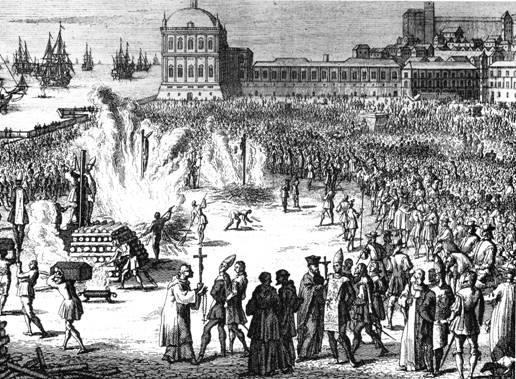
Christians burning “heretics” at the stake in the main square of Lisbon, Portugal during the Inquisition
It is a major reason that there are so few Jews in the world despite Judaism being around much longer (3,500 years) than Islam (1,400 years) or Christianity (2,000 years). The particular nature of the faith has kept the numbers small, in addition to being victims of massacres perpetrated by universalistic religions.
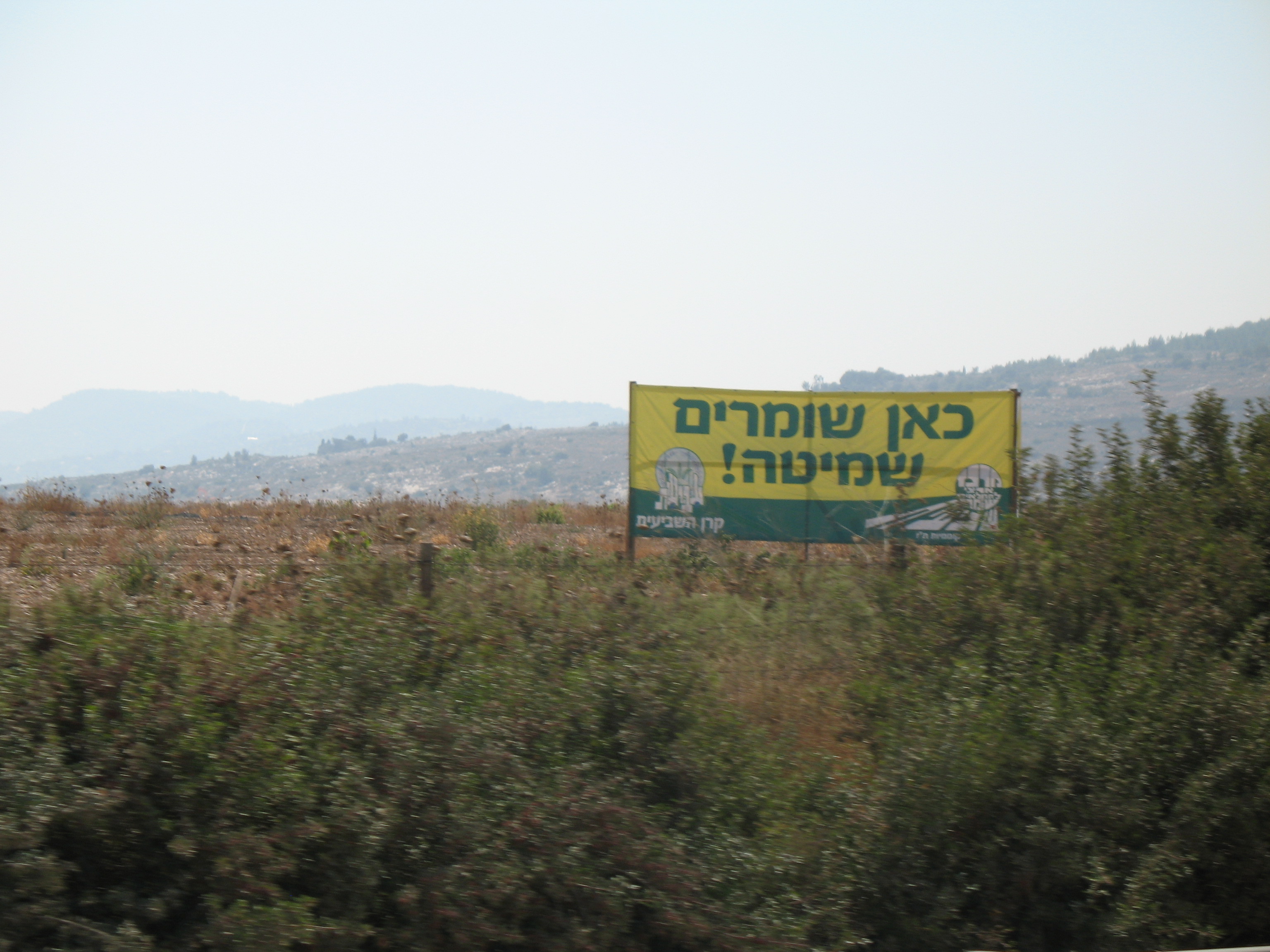
There are biblical commandments that can only be done in the land of Israel to this day. Jewish farming has particular laws to keep within the borders of Israel which do not apply to farming in the diaspora, such as shmita, letting the land lie fallow every seventh year.
Sign on an agricultural plot of land in central Israel where the farmers observed shmita in 2015 (photo: First One Through)
The tribal nature of Jews has made them a source of suspicion for centuries. NOT wanting to convert people was viewed as elitist (even though Judaism believes people of other faiths aren’t damned). Whether religious or secular, living in Israel or the diaspora, people saw the remnant of Jews who survived the pogroms, genocides, expulsions and crusades as a stubborn lot.
Jews don’t simply move to the land of Israel because of history and heritage; that’s why Palestinian Arabs who had grandparents who once lived in the land want to move there.
Jews are intrinsically connected to the small strip of land in a way that has no parallels in other faiths.
It has led to interesting population statistics in the land:
More Jews moved to Palestine/ land of Israel under the Ottomans between 1800 and 1914 than Muslims. And more Muslims moved to the land under the British from 1922 to 1948 than Jews.
Jews have been the largest faith group in Jerusalem since 1867
Further, Israel’s national anthem is the oldest in the Middle East, and is the only national anthem in the world focused on its capital city of Jerusalem.
The Jewish homeland is the land of Israel and its diaspora is the world outside of that land. No other faith has such concept of homeland and diaspora.
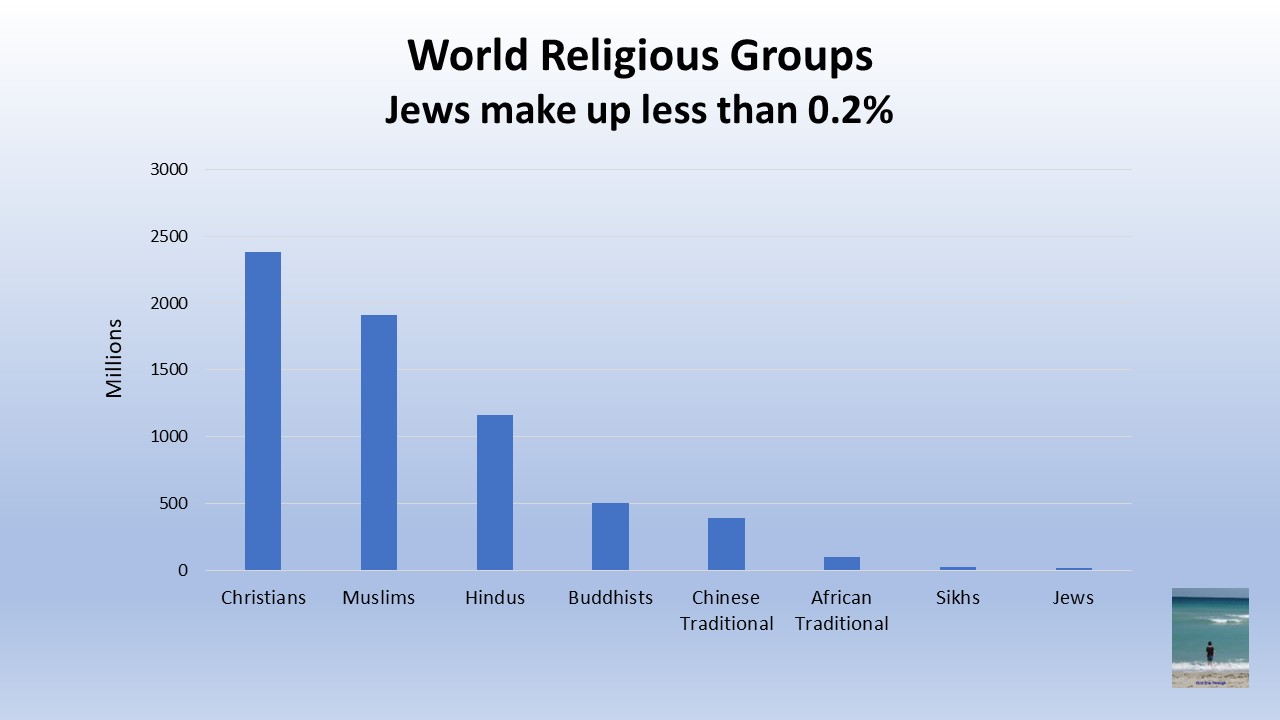
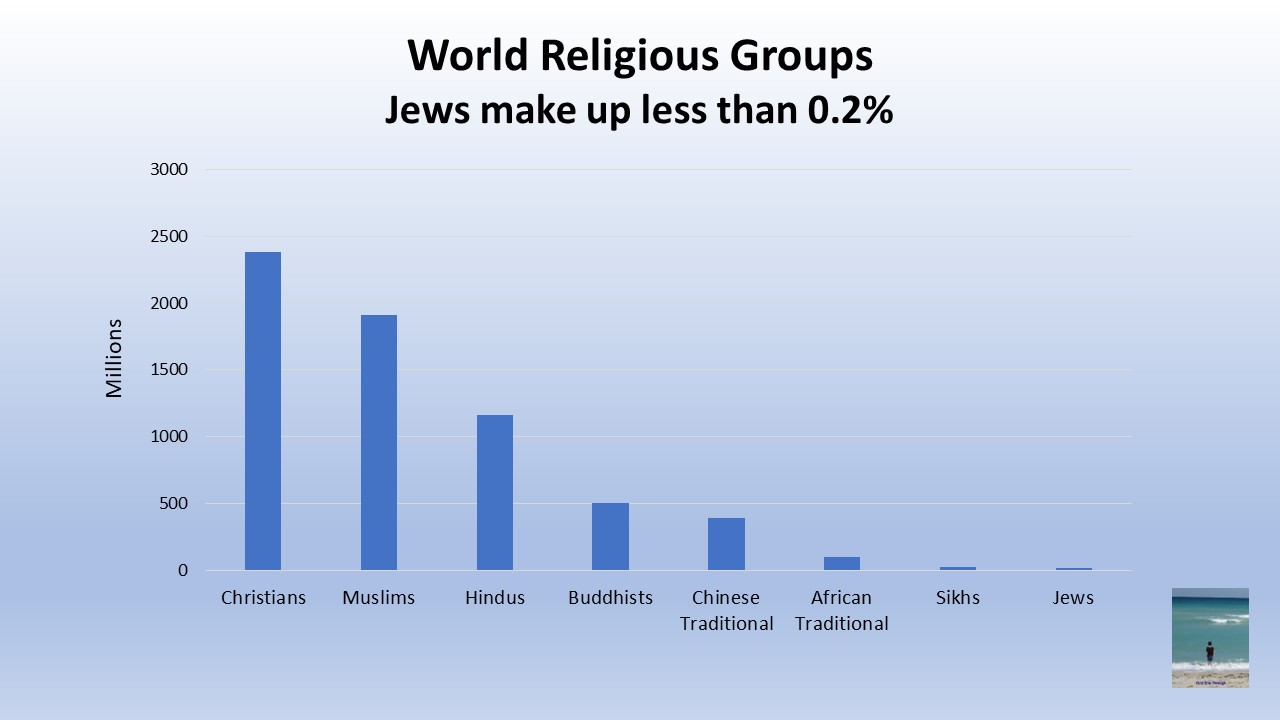
Jews make up a very small population in the world yet suffer disproportionately from persecution.
Globally, Jews account for less than 0.2% of the population, or about 1 person for every 525 people. Most people have never met a Jewish person.
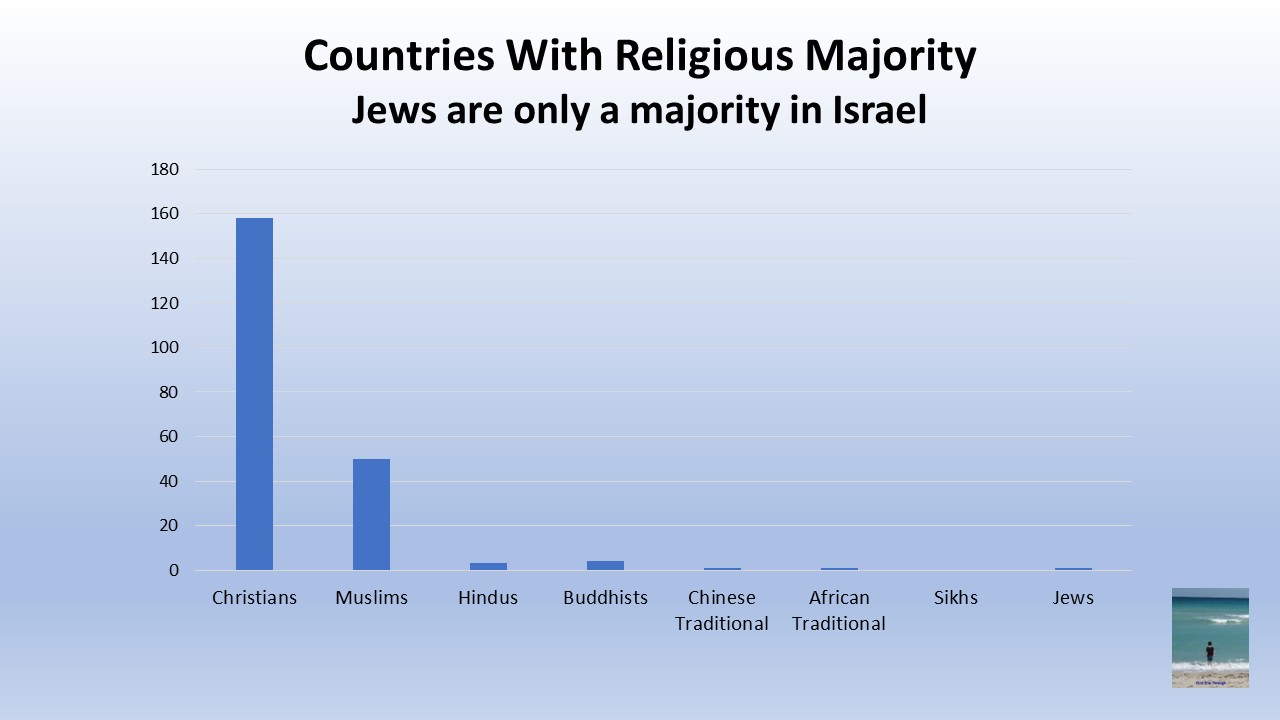
As most of the world is Christian and Muslim, it is not surprising that Christian-majority countries make up the majority of the United Nations, followed by Muslim-majority countries. There is only a single Jewish-majority country, Israel, which is disproportionately vilified at the United Nations.
Outside of the Israel, the only country with a sizable Jewish population is the United States, which has 40% of the global Jewish population. Outside of Israel and the USA, there is roughly 15% of the rest of world Jewry, principally located in France, Canada, United Kingdom, Argentina and Russia.
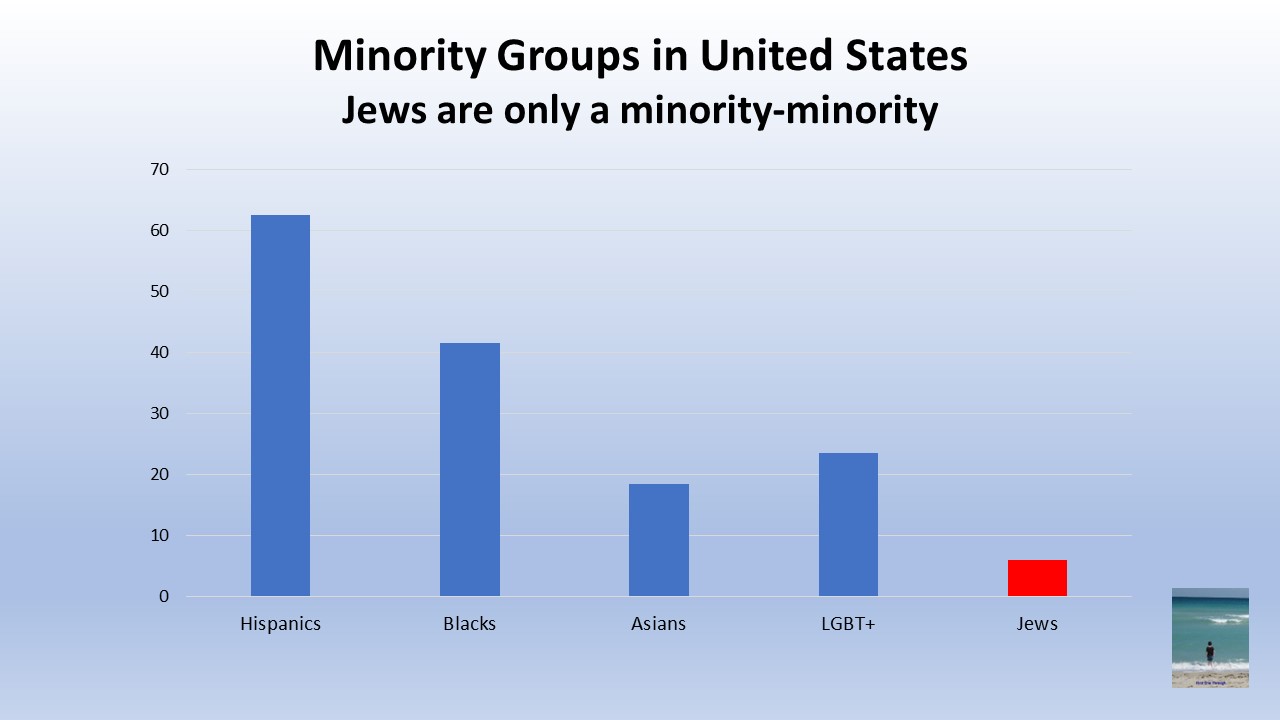
In the United States, Jews are a small part of the minority groups. While DEI (diversity, equity and inclusion) efforts focus on Hispanics, Blacks, Asians and the LGBT+ community, it ignores Jews who are labeled “White” and “privileged”.
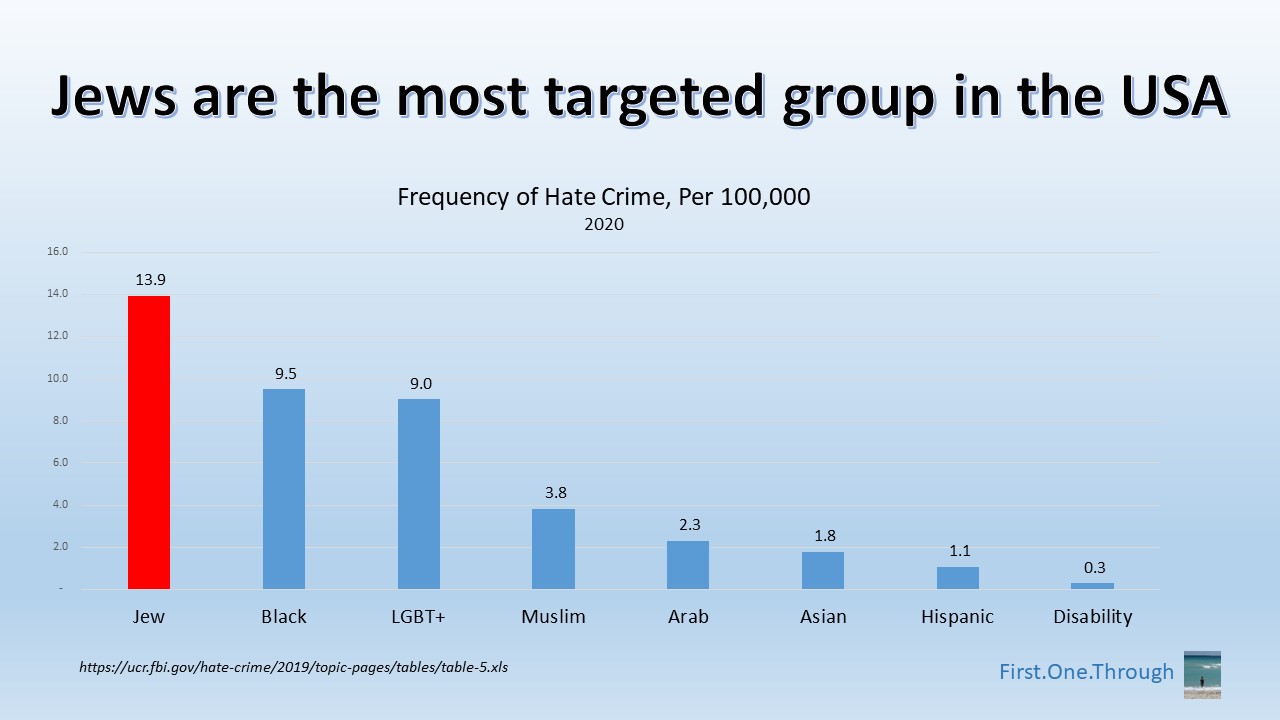
Without protection afforded to other minorities, Jews stand out as the most targeted group in the United States for hate crimes, based on population.
College campuses have become particularly noxious breeding grounds of antisemitism. In addition to excluding Jews from DEI and federal Title VI protections, universities miseducate Zionism to be a form of “European colonialism” and Zionists to be racists. Compounding the matter, because Jews are labeled “White and privileged”, they are not allowed to defend themselves, and must simply sit and be berated.
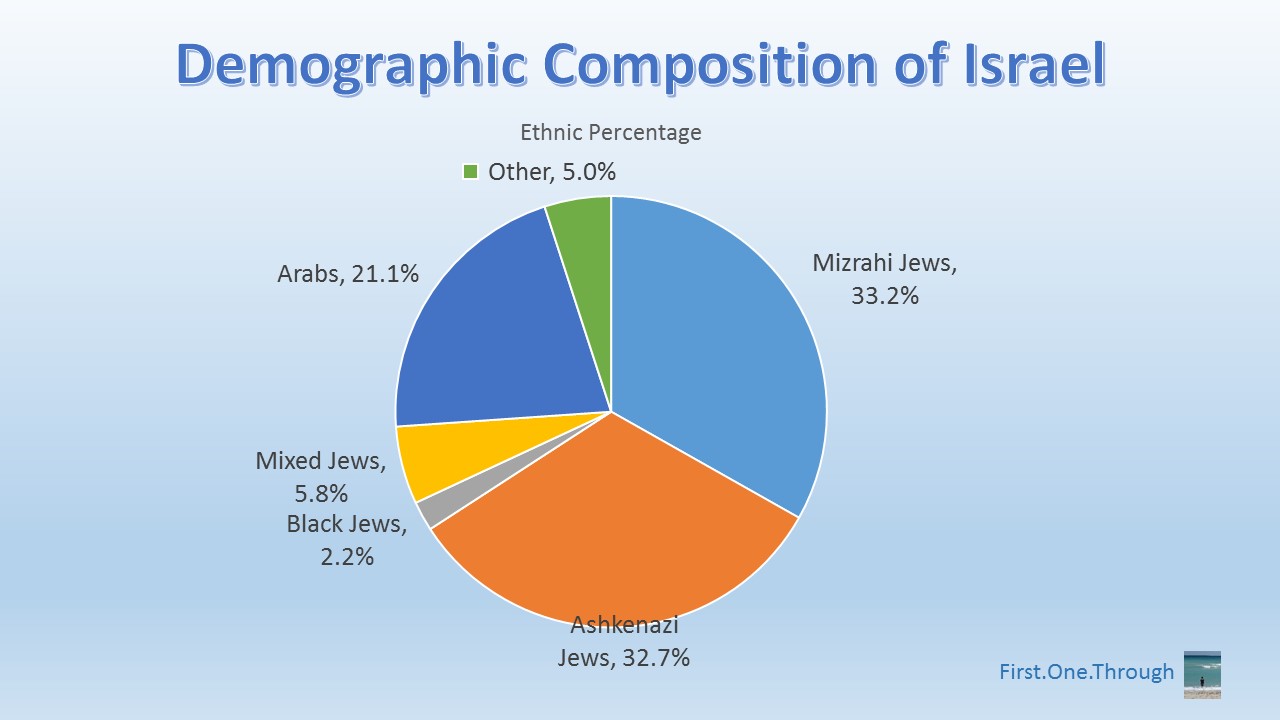
The tragic farse doesn’t even end there. In addition to persecuted American Jews being vilified by laws and people meant to defend minorities, those groups label Israel as an example of White Supremacy, even though Mizrahi Jews make up a majority of the Jewish State. Jews of color make up 41.2% of the Israeli population.
Despite Jews being indigenous to the land of Israel and Israel being the most liberal country in the entire Middle East, liberal universities have turned the Jewish State into a polluter of pure Arab land.
Jews are a minority-minority in the United States and around the world, persecuted and unprotected by laws and people who are both proud of their antisemitism and those who think they are fighting for minority rights. At least majority-minority rights, like 1.8 billion Muslims.
There has been an uptick in the number of homicides happening in Israel recently, and it deserves a detailed review which the mainstream media is too lazy to examine and too biased to report clearly.
In 2021, the last year for which homicide information is available by the World Bank, Israel’s homicide rate was 1.94 per 100,000, which increased from 1.42 in 2020, a 36% jump. The 1.42 in 2020 figure placed it amongst its neighbors’ average of 1.39 in Turkey, Lebanon, Cyprus and Jordan (no data was available for Lebanon in 2021).
Israel’s jump in 2021 to 1.94 homicides per 100,000 was similar to the murder rate in Montenegro (2.39), Albania (2.31), Armenia (2.18), Canada (2.06), Estonia (1.96), Morocco (1.93), Azerbaijan (1.91), Ghana (1.83) and Algeria (1.57). The United States homicide rate in 2021 was 6.80 per 100,000, or 3.5 times as much as Israel.
The rise in the murder rate shows particular trends.
Breakdown By Sex
The murder rate of males jumped to 3.3 per 100,000 in 2021 from 2.3 the prior year, while the murder rate for women jumped to 0.6 from 0.5 per 100,000, according to the World Bank.
The Israel Observatory on Femicide noted the erratic nature of the data: 21 women murdered in 2020, 16 in 2021 and then 24 in 2022, a 50% jump. The average age of the female victim jumped to 45.6 years old in 2021 due to a spike in matricide cases, where people killed their mothers.
Breakdown By Ethnicity
For 2021, the murdered women were 44% Jewish, 31% Israeli Arab and 19% Druze. In almost every case, the murderer had the same ethnic background as the victim. As in 2021, half of the women murdered in 2022 were Arab and killed by Arabs, mostly family members or former partners.
Overall, there were 126 Arabs murdered in 2021 (110 males and 16 females), almost all killed by fellow Arabs. While various organizations track violence in the Israeli Arab sector Abraham Initiatives, the data isn’t as available for Israeli Jews. Using the 1.94 homicides per 100,000 in an Israeli population of 9.364 million in 2021 would imply a total homicide figure of 182, of which 56 were Jewish. This assumes that the 17 Israelis killed by Arab terrorism in 2021 are not included in the homicide statistics.
While data from different sources are somewhat inconsistent, there is a sharp pattern.
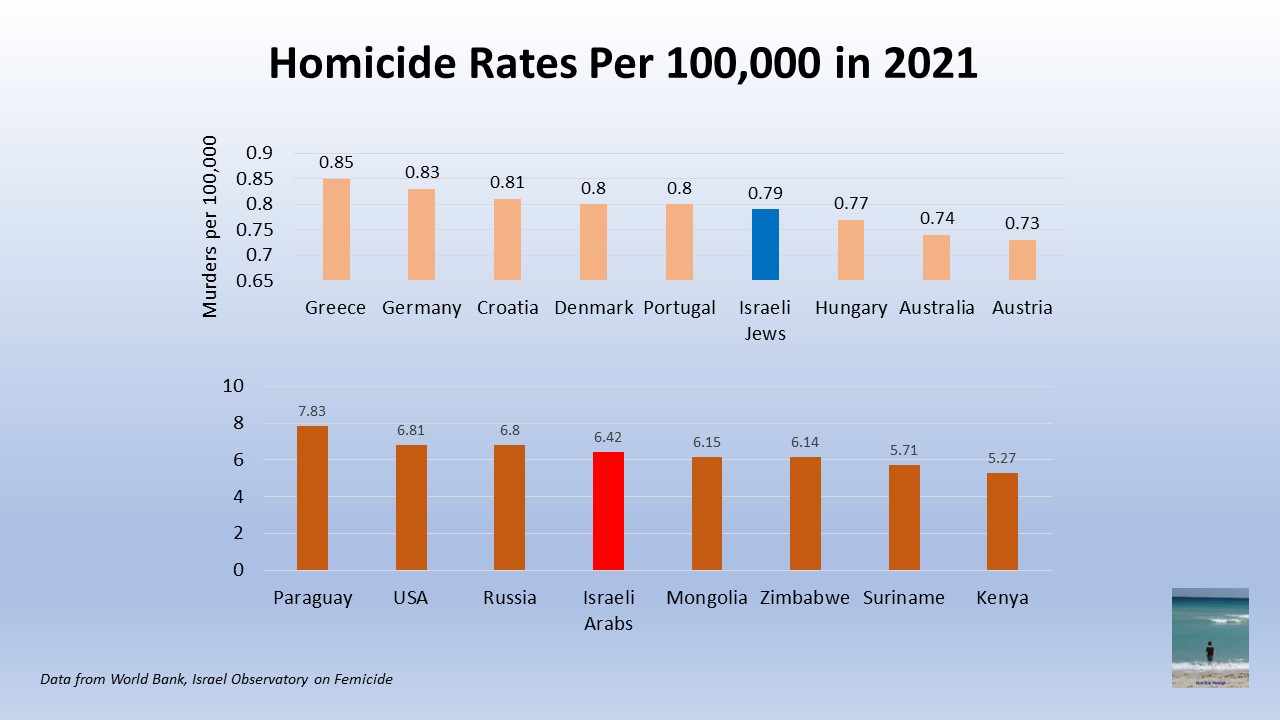
The difference in the rate of murderers between Jews and Arabs is astounding if one considers that Jews make up 76% of the population and Arabs account for 21%. It means that an average Israeli Arab is 8.1x more likely to commit a murder than an Israeli Jew.
The 0.79 homicides per 100,000 amongst Israeli Jews is similar to the homicide rate in Greece (0.85), Germany (0.83), Croatia (0.81), Denmark (0.80), Portugal (0.80), Hungary (0.77), Australia (0.74) and Austria (0.73).
The homicide rate in Israel has taken a worrying trend upwards since 2021, now approaching the rate of Turkey when it used to be closer to Cyprus in 2015. The jump has principally come from Israeli Arabs killing other Arabs in gang violence amongst male victims, and “honor killings” and matricide among female victims. At the same time, the homicide rate of Israeli Jews remains much closer to those in Western Europe.
These pages have reviewed that Christians love visiting Israel (a majority 56% of tourists in 2018!) and that Muslims barely come despite the supposed significance of the al Aqsa Mosque in Jerusalem. Here we will dive a bit deeper into the countries that make up tourists to Israel.
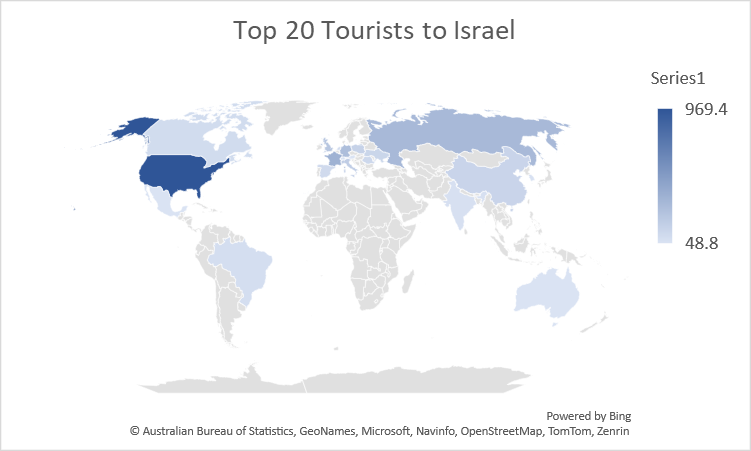
In 2019, before the pandemic impacted travel, 4.55 million tourists visited Israel. The United States numbered almost 1 million, and every continent was represented in the top 20 originating places, with the exception of Africa. Despite the proximity and Israel being lumped into the MENA (Middle East and North Africa) region by many, the Jewish State has few personal ties with Africa.
It is perhaps not surprising that France was the second highest source of tourists destined for Israel, as it is home to the second largest Jewish population (estimated around 450,000) after the USA. Many people from France have moved to Israel, with an estimated total of 3,500 in 2021, behind the USA at 4,400, and the Former Soviet Union at 10,500.
Italy, which does not have a large Jewish population (under 30,000) had 190,000 tourists visiting Israel, as they came to visit the Christian holy sites.
When normalizing for the population size of each country, the large countries like India and China fall out of the top ranking. In fact, only European countries made the list of top 20 countries when reviewed on a normalized basis.
Interestingly, the top six countries with a high percentage of people visiting Israel do NOT have many Jews. Among the top 20, only seven countries (listed in yellow above) have more than 25,000 Jews.
It is perhaps not a surprise to see non-Islamic Cyprus as the dominant tourist country, as it is very close to Israel and Israelis visit the country all of the time – including to get married. Lithuania, Switzerland, Latvia, Romania and Austria round out the tourists who come to Israel frequently, countries which USED to have a significant number of Jews before World War II.
Lithuania’s Jewish population was estimated at 263,000 people in 1939. Today’s estimates is 2,250. Latvia had about 95,000 Jews at the eve of World War II. Today’s population is about 8,000. Romania’s Jewish population is down to about 3,000 people. Austria had about 190,000 Jews in 1938 with Vienna alone having 22 synagogues. Today there are about 10,000 Jews.
The popularity of people visiting Israel has not translated into those governments’ supporting Israel at the United Nations. As seen below, Hungary was the only country to support Israel more than EIGHT PERCENT of the time from 2015 to present according to UN Watch.
Voting records of countries on Israeli resolutions at United Nations (2015-present), source: UN Watch
Many Muslim majority countries do not recognize Israel and several are technically in a state of war with the Jewish State. Only eight Muslim countries list their tourists to Israel. Of them, only Jordan, which abuts Israel and claimed half of its land as its own until 1988, had over 100 visitors per 100,000 people – 172.2, on par with Hong Kong – and half the rate of Germany.
Muslim Country
Total visitors
Visitors per 100,000
Indonesia
38,700
14.1
Turkey
32,000
37.7
Jordan
19,200
172.2
Malaysia
14,700
43.8
Egypt
8,000
7.3
Morocco
3,500
9.4
Uzbekistan
3,400
9.7
Azerbaijan
3,200
31.6
Muslim countries visiting Israel, 2019
Every Muslim country voted against Israel at the UN 100% of the time.
The populations which come to visit the Jewish State today include its only non-Muslim neighbor and those who live among Jewish ghosts who had lived throughout eastern Europe in the ghettoes of the Pale of Settlement. Today’s ghetto has its own flag with a Jewish Star, and it remains to be seen if it can withstand the pandemic of antisemitism which still permeates the world.
A new U.S. government report noted that the birth rate continues to fall, now with a fertility rate of just 1.6 children per woman. That rate is considered “below replacement rate” meaning that the next generation will be smaller than the current one and that the overall population will grow older on average.
According to the World Bank, the overall percentage of the global population under 14 years old in 2019 was just 25.6%. It was just 18.5% for the United States, down significantly from 30.8% in 1961 in the post-World War II boom years.
There is a meaningful divide between the western world and the rest in terms of the number of children and how it relates to household wealth which will be reviewed here.
Children and Household Wealth around the World
There are three parts of the world which have a very young population, with over 35% of the population being 14 years old or younger: sub-Saharan Africa, several Muslim countries, and the islands of the Pacific.
Roughly 42% of sub-Saharan Africa is under 14 years old. Most of the countries are very poor, with a GDP per capital under $2,000. Outliers like Seychelles (with a relatively low 24% of the population under 14 y.o.) and Mauritius (17%) have much higher GDP per capita (GDP/C) of $17,448 and $11,099, respectively.
The other regions have a more scattered correlation between GDP per capita and high percentage of children as seen in the chart below.
Countries with over 35% of the population under 14 years old fall into three buckets: sub-Saharan Africa (not shown), Muslim countries (yellow) and Pacific islands(blue)
The blue dots represent Pacific island countries and the yellow dots correspond to Muslim countries. Pakistan, Tajikistan, Yemen and Afghanistan have GDP/C of around $1,000 or less. The two subsidized Muslim economies of Iraq ($5,955) and the Palestinian Authority ($3,562) are outliers in their relatively higher income levels and young population. Only Tonga and Samoa have similar around $4,000 GDP/C outside of Africa.
The United States
The GDP per Capita in the United States crossed $65,000 in 2019 while the fertility rate plummeted. The country has a diverse population so a deeper review of the drivers of the fertility drop as well as the dynamics of household wealth are worth exploring to appreciate the underlying causes.
As seen in the US Fertility Rate table above, the fertility rate for women of all races declined significantly between 2008 and 2016. The drop was greatest for Hispanic women (-26%) and Native Americans (-24%), followed by Whites and Blacks (-12% each).
The census data on average household income by race and status adds further color.
Characteristic
All races
White alone, not Hispanic
Black alone
Asian alone
Hispanic (any race)
No Children
89,315
96,081
60,794
113,354
70,604
With children <18
119,506
138,970
79,151
165,793
80,592
Married no kids
127,016
132,340
99,595
141,350
96,487
Married with kids
146,238
161,392
123,121
178,510
94,336
Unmarried, no kids
103,795
107,342
78,588
156,377
91,062
Unmarried with kids
87,865
95,925
71,381
(B)
78,031
Male, no kids
92,133
99,118
74,695
123,492
82,112
Male with kids
83,983
94,733
63,693
88,764
73,777
Female, no kids
74,953
79,148
69,543
92,755
64,067
Female with kids
57,274
65,248
46,900
90,476
52,923
Household income for various US groups in 2019 according to the U.S. census. Too small a data set for unmarried Asian households with children at home.
There’s a lot of data here, so some observations:
Households headed by married couples with children at home make more money. Households (HH) with children under 18 at home make more money than those without, but that is purely driven by married HH. Asian married HH that have kids at home make an average of 26% more than married Asian HH without children. For Blacks the difference was 24%. Meanwhile, Hispanic married HH – and only Hispanics – without children make slightly more money than those with kids.
“Non-traditional” HH with no kids make more money. Unmarried HH and those headed by either a single father or mother have greater wealth if there are no children. The difference is the greatest for Black HH headed by a woman, where average HH income is 48% higher if there are no kids at home, and for HH headed by Asian men, who make 39% more money on average if no kids are at home. Only HH headed by Asian women have virtually no difference whether there are kids at home or not.
Asian and Blacks have dramatically different household wealth. Not only do Asians make significantly more money than Black HH (86% more in HH with no kids at home and 109% more in HH with kids at home), the biggest drivers were in unmarried HH without kids and woman-headed HH with kids.
The change in household income adds additional color, with the table below showing the change from 2012 to 2019.
Characteristic
All races
White alone, not Hispanic
Black alone
Asian alone
Hispanic (any race)
Married no kids
38%
38%
40%
39%
35%
Married with kids
44%
42%
51%
49%
50%
Unmarried, no kids
35%
34%
37%
62%
20%
Unmarried with kids
48%
45%
41%
NA
55%
Male, no kids
38%
41%
42%
37%
32%
Male with kids
41%
41%
35%
34%
44%
Female, no kids
32%
31%
33%
24%
38%
Female with kids
40%
33%
47%
60%
50%
Change in household income between 2012 and 2019 for various groups in the United States according to US Census
Households with kids have income growing faster. Income grew faster for households with children relative to those without kids between 2012 and 2019 for every type of household. Income grew fastest for those households headed by unmarried couples. Minorities faired better than Whites for female-headed homes with kids and married homes.
Hispanic households seeing the biggest gaps to an increase in income between having kids and not having kids. While Whites, Blacks and Asians mostly followed the averages or had mixed results, the Hispanic community saw big advances among those families which had children at home relative to the more modest gains among those with no children at homes.
In summary, the Hispanic community which accounts for 16.7% of the US population is having a steep decline in the number of children which is driving the overall low US fertility rates. While this is happening, the wealth for Hispanic households without kids is growing at a much slower pace than those HH with children. This is creating a gap in the Hispanic community between the wealthier HHs with children and the poorer ones which are having no kids.
Possible Reasons for Fertility Rates and Changes
There is clearly a correlation around the world that poorer countries have more children than richer countries.
The Guttmacher Institute estimates that 93 out of 1,000 pregnancies are unintended in poor countries compared to 66 in middle income and 34 in wealthy countries. Abortions are also more prevalent in wealthier countries with 40%, 66% and 43% of such unwanted pregnancies ending with an abortion in poor, middle and wealth countries, respectively. The net result is a higher fertility rate in poorer countries.
Religion should also be considered as a factor as many devout Muslim countries do not promote contraception and abhor abortions.
The low fertility rates in the United States goes beyond income and abortions.
Minority groups have the highest rates of abortion in the US. In 2016, 28% of abortions were by Black women even though they account for just 13% of the population. Hispanics accounted for 25% of abortions while they make up 17% of the population. This is in contrast to the global trend where poorer segments had fewer abortions.
In the US, Hispanics and Blacks still have higher fertility rates (2.1 and 1.9, respectively) than Whites (1.7) but the trends are much steeper for Hispanics as they are quickly adopting the more prevalent fertility rates found throughout America.
The lower fertility rates may seem strange relative to Pew Research which shows that women in America are having MORE children, albeit later in life as they prefer to pursue advanced degrees and build their careers. Pew notes that their work looks at the lifetime fertility rates of women whereas the standard definition of fertility is based solely on that one year’s accounting of births.
The Pew report also noted that one of the biggest changes in fertility is among women who were never married having children, where 55% of women aged 40-44 have had a child in 2014, up from just 31% in 1994. Incorporating the data above, this suggests that unmarried women are having children despite the fact that they are likely to be poorer for doing so, but the income level for this segment (unmarried moms) is growing the fastest.
Outlier
One country seems to be defying the trends in fertility, with a higher fertility rate and a high level of wealth: Israel.
From 2000 to 2019, Israel’s fertility rate stayed relatively constant, growing from 2.95 to 3.01. With a GDP/C of $43,600, this is a remarkable achievement.
The country’s ultra-Orthodox and Bedouin communities continue to have large numbers of children and the number of abortions in the country continues to hit new lows every year.
A quick read of the low and declining fertility rates in the US is certainly reason for concern, but a deeper dive into the numbers reveals some important facts. 1) Women are extending the period of time in which they have children to later in life so the total number of children they have is actually rising. 2) The drop off in fertility in the US is mostly due to the Hispanic community moving quickly towards the societal average. 3) The average income for the growing “non-traditional” households (unmarried, single parent) with children is growing faster than the rest of society.
It has been often reviewed how the United Nations has manufactured Palestinian Arab “refugees.” The fabrication done at the United Nations Relief and Works Agency for Palestinian Refugees in the Near East (UNRWA) has been via:
calling someone a “refugee” when they left a home or town, rather than a country which is the actual definition of a refugee;
allowing the descendants of those Palestinian Arab “refugees” to claim such status, even though no such status is conferred to other refugees;
Telling those refugees that they will return to homes that grandparents left decades ago, even when such homes no longer exist and not a goal of relief agencies;
Still calling such people “refugees,” even when they live in the same country that they claim to be refugees of, in the case of Palestinian Arabs living in Gaza and the West Bank
However, the NUMBER of Palestinian Arabs has not been reviewed, and particularly, how UNRWA has increased the number of Palestinian Arabs through its actions.
Fertility Rates in Undeveloped Areas
The UN has completed studies that show how more developed countries witness a much lower rate of birth and older population compared to less developed countries.
Development Stage: Advanced Less Least
Annual rate of
population change 0.3% 1.4% 2.4%
Population age 0-14 16% 28% 40%
Maternal Mortality 0.01% 0.24% 0.44%
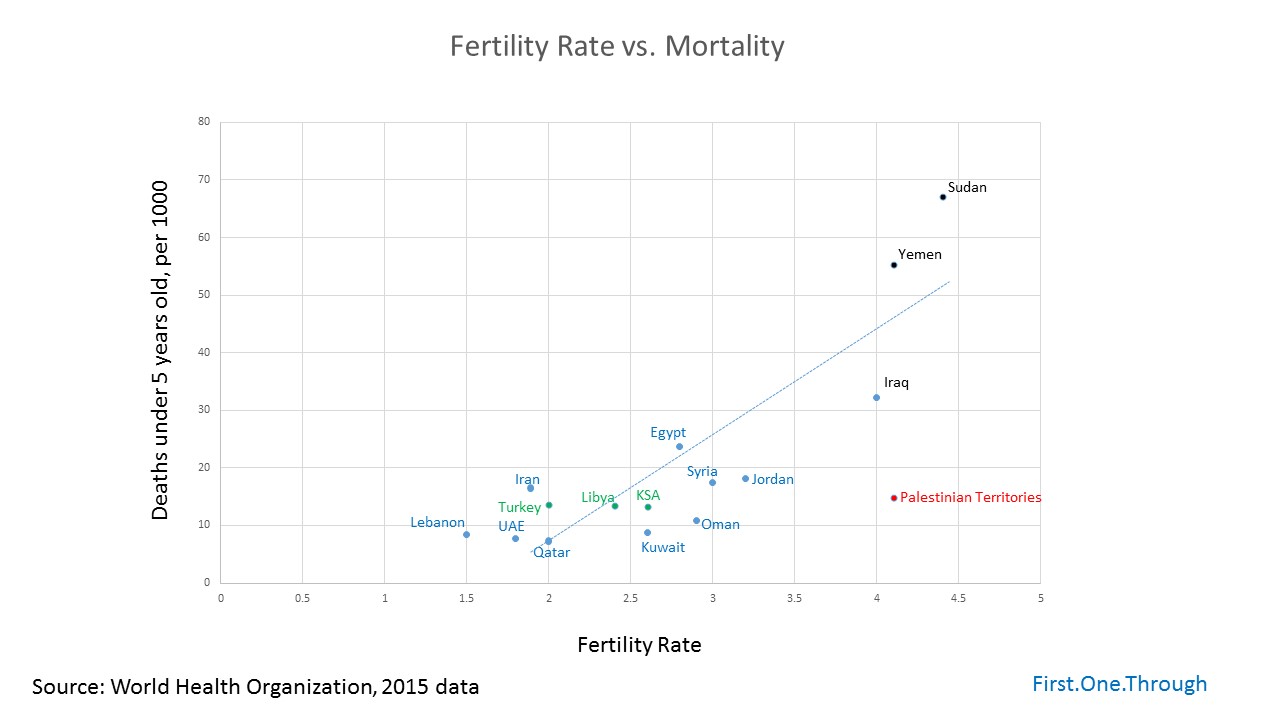
Undeveloped countries like Yemen and Sudan have very high birth rates, averaging over 4 children per mother. They similarly have a high maternal and infant mortality rates, as the level of healthcare in those countries is quite poor.
Not so for the healthcare of Palestinian Arabs, thanks to UNRWA.
UNRWA deploys billions of dollars every year to give the Palestinian Arabs the best healthcare in almost the entire world. As a result, despite the high birth rates in the Gaza Strip and West Bank, the mortality rates are a fraction witnessed throughout the region.
Most of the mothers in the Middle East average between 1.5 and 3.0 children. Societies in Turkey, United Arab Emirates, Iran and Qatar average just below two children per mother according to the World Health Organization. The incidents of children under five years old dying was low in those countries, at roughly 1.0 to 1.5%. On the other end of the spectrum were countries under severe distress, including Sudan and Yemen. These countries with over four children on average per mother saw an expected rate of death for children under five years old of 6.0%, five times the rate of the more stable and advanced regions.
But the Palestinian Arabs are an anomaly. While Palestinian mothers average 4.1 children, according to the WHO, the probability of the children dying was the same as experienced in advanced Turkey or Saudi Arabia, at under 1.5%. Applying 2014 data of 121,330 Palestinian Arab births in Gaza and the West Bank, would suggest that 1,808 of these children will die before age 5, but the theoretical number without UNRWA intervention would be closer to that 6.0% percentage of Sudan and Yemen, or 7,280 deaths. That means that because of UNRWA, there will be 5,472 more Palestinian Arab children alive from the class of 2014.
Further adding the 0.2% improved rate of maternal mortality represents approximately 240 mothers each year that do not pass away due to UNRWA’s efforts. In total, considering that UNRWA has been operating for close to 70 years through multiple generations, the number of incremental Palestinian Arabs living in Gaza and the West Bank because of UNRWA is close to 1 million.
Future Action: Jobs versus Contraception
The United Nations created a document together with the Palestinian Authority called “Palestine 2030 – Demographic Change” which told an interesting narrative and plan for the Palestinian demographic boom.
The opening lines of the report bemoaned the slow rate of the population growth: “Palestine’s demographic transition particularly its fertility component, continues to lag behind that of many Asia countries, including Arab countries… Fertility, which was extremely high in the 1970s has been cut in half.” A shocking statement compared to the statistics listed above.
The report continued to discuss the connection between fertility rates and education and income. “Very universal marriage, early marriage, and a low contraceptive rate,especially for modern methods of contraception (used by 44%), are the main proximate determinants of the present level of fertility. Household wealth also plays a role. But it is mainly education, particularly female education that determines the fertility rate.”
The report estimates that the Palestinian Arab population in Gaza and the West Bank will grow from 4.7 million in 2015, to 6.9 million in 2030 and 9.5 million in 2050. The doubling of the Palestinian population between 2015 and 2050 compares to a global growth rate of just 36%. The high Palestinian rate of growth is only anticipated in the large poor African countries like Chad, Uganda and Tanzania. Consider further that the number of “refugees” in the GS/WB areas is forecast to grow from roughly 2 million today to 3 million in 2030 and 4.5 million in 2050 (+125% for refugees and +85% for non-refugees). UNRWA clearly impacts the population growth, with estimates of “creating” an additional 800,000 Palestinian Arabs by 2050.
Those are staggering figures for a small territory.
And yet the report claims that the solution to the population boom is not population control, but more jobs and education for women.
If the United Nations is on the front lines of health services in the Palestinian territories, why is the use of contraception only at 44%, when it stands at 64% in the rest of the world where women have to obtain, purchase and manage their health on their own? Why isn’t UNRWA doing more education about family planning and making more contraceptives available? It is estimated that 7.0% and 5.0% of Palestinians use the pill and condoms, respectively. Shouldn’t the rate be double or triple, more in line with Lebanon (15.1% pill) and Turkey (15.9% condoms)? Overall contraceptive use should be targeted at 75%, in line with the Islamic Republic of Iran at 76.6%.
The UN General Assembly made a global goal of comprehensive family planning in its 2030 Agenda for Sustainable Development in which it set out “universal access to sexual and reproductive health-care services, including for family planning, information and education, and the integration of reproductive health into national strategies and programmes.” With thousands of feet on the ground in Gaza and the West Bank, the UN is in prime position to take an aggressive stance.
Palestinian Arabs have extremely high fertility rates similar to third world countries but receive first-class healthcare from the United Nations. In doing so, UNRWA has helped the Palestinian Arab population balloon by an incremental one million people, or 25%. Will the UN advance its own global family planning goals for Palestinian Arabs, or does it prefer to create a demographic army to confront Israel?
The term “ethnic cleansing” has been used often in the Arab-Israeli conflict. The reactions to the comment are in inverse relation to the truth.
Palestinians Claim of Israeli “Ethnic Cleansing”
In 2012, the acting-President of the Palestinian Authority, Mahmoud Abbas, stood at the United Nations and claimed that Israel was engaged in “ethnic cleansing” of Palestinian Arabs. At first, he spoke about “ethnic cleansing” when Israel declared independence:
“The Palestinian people, who miraculously recovered from the ashes of Al-Nakba of 1948, which was intended to extinguish their being and to expel them in order to uproot and erase their presence, which was rooted in the depths of their land and depths of history. In those dark days, when hundreds of thousands of Palestinians were torn from their homes and displaced within and outside of their homeland, thrown from their beautiful, embracing, prosperous country to refugee camps in one of the most dreadful campaigns of ethnic cleansing and dispossession in modern history.”
Abbas neglected to say that the Palestinian Arabs left their homes while their fellow Arabs launched an attack on the nascent Jewish State to destroy it completely. The Arabs failed in their genocidal quest. Yet for its part, Israel granted all of the Arabs living in its territory full citizenship. A complete inversion of his claim that Israel “intended to extinguish their [Arab] being and to expel them in order to uproot and erase their presence.”
Abbas continued to claim that Israel was engaged in “ethnic cleansing” to this day:
“We have not heard one word from any Israeli official expressing any sincere concern to save the peace process. On the contrary, our people have witnessed, and continue to witness, an unprecedented intensification of military assaults, the blockade, settlement activities and ethnic cleansing, particularly in Occupied East Jerusalem, and mass arrests, attacks by settlers and other practices by which this Israeli occupation is becoming synonymous with an apartheid system of colonial occupation, which institutionalizes the plague of racism and entrenches hatred and incitement.”
Abbas conveniently neglected to mention the hundreds of rockets fired from Gaza into Israel throughout 2012. He also neglected to mention that Israel left Gaza in 2005, allowing the Palestinian Arabs to rule themselves for the first time in hundreds of years.
No matter. The people at the United Nations gave Abbas a standing ovation.
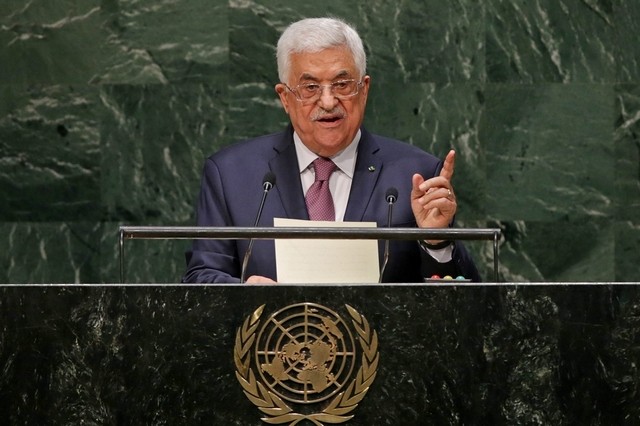
Acting-President of the Palestinian Authority Mahmoud Abbas addressing the United Nations in 2012
United Nations Claim of Israeli “Ethnic Cleansing”
In 2014, the “Special Rapporteur on the occupied Palestinian territories” (yes, that’s an actual title) whose job it is to report on Israelis, declared that Israel was committing “ethnic cleansing” in East Jerusalem.
“The continued pattern of settlement expansion in East Jerusalem combined with forcible eviction of long residing Palestinians are creating an intolerable situation that can only be described, in its cumulative impact, as a form of ethnic cleansing.”
The facts are the exact opposite: the Arabs in Jerusalem are growing faster than the non-Arab population.
As detailed in “Arabs in Jerusalem,” the Arab population in Jerusalem now stands at 36% of the city, up from 26% when the city was reunited in 1967. From 1967 to 2011, the Arab population in the city grew by 5.7 times, while the Jewish population in the Israeli capital only grew by 3.4 times over the same period.
No matter the facts. “The Special Rappoteur “called on the Council to undertake efforts to have the UN’s top court, the International Court of Justice (ICJ), assess allegations that the prolonged occupation of the West Bank and East Jerusalem possess elements of “colonialism,” “apartheid” and ‘ethnic cleansing.'”
No comments from United States or anyone else about the absurd and caustic statements, nor on the lunatic who made them (who incidentally, is a big 9/11 conspiracy theorist).
Israeli Prime Minister Claims of Palestinian “Ethnic Cleansing”
In September 2016, Israeli Prime Minister Benjamin Netanyahu accused the Palestinians of “ethnically cleansing” Jews from their historic homeland of Judea and Samaria / the West Bank. Netanyahu made his statement because Abbas has stated he cannot accept a single Israeli living in a new state of Palestine.
Netanyahu did not even bring up a variety of other Palestinian Authority laws, as detailed in “Abbas Knows Racism,” such as:
Palestinian Authority law that condemns any Arab that sells land to a Jew to death.
The origins of Arab ethnic cleansing of Jews dates back decades, to when the Jordanians illegally annexed eastern Jerusalem and the West Bank in 1950 and expelled all of the Jews from the area. Jordan then passed a citizenship law in 1954 that specifically EXCLUDED Jews from being granted citizenship in their own homeland.
“Any person who, not being Jewish, possessed Palestinian nationality before 15 May 1948 and was a regular resident in the Hashemite Kingdom of Jordan between 20 December 1949 and 16 February 1954″ (Article 3)
So what was the world reaction when Netanyahu finally stated some clear and obvious facts? Condemnation.
The spokesperson for the US State Department responded to the Netanyahu video: “We believe that using that type of terminology is inappropriate and unhelpful.”
When Abbas heard that Netanyahu used the “ethnic cleansing” charge, Abbas doubled-down by saying again that Israel uses “ethnic cleansing” against the Palestinians.
No comment from the State Department about Abbas’s use of the term.
The current United States administration and United Nations have no time or interest for Israelis stating simple truths. It would appear, that if you want the world to agree and applaud, you would best be served by denying facts like the Palestinian Arabs.
The questions of word choice and chosen narrative dominates much of the discourse around the Israeli-Arab conflict. However, simple statistics do not suffer and sit in the same simmering pot as poisoned positions.
Below is a music video with music by Seal with a basic question: “Why do people get complacent with the things they’re told?”
Under the Ottomans, the Muslim population in Palestine barely grew from 1800 to 1922. The rate of growth was effectively births minus deaths (meaning no Muslims moved to Palestine).
Jewish population growth in Palestine BEFORE THE BRITISH MANDATE took effect was twice the Muslim population growth (meaning Jews were the only people who moved to Palestine, well before the mandate).
The expanding Jewish aliyahs to Israel after the mandate came from countries OTHER THAN ENGLAND (meaning that the “creation of a Jewish homeland” as dictated under the San Remo agreement, was NOT a colonization effort, as the Jews did NOT come from England).
Jews did not come to Israel as a reaction to the Holocaust- they already constituted 31% of the country in 1945.
By the time World War II was over, the growth of Jews in Israel was equally from NATURAL population growth, as from aliyah (further undermining the claim that the Holocaust had anything to do with the creation of Israel).
The population growth of Muslims in the region, ONLY started under Israeli rule in 1967 (the claims of ethnic cleansing are not only insulting but completely opposite the actual population statistics).
Jerusalem has had a majority of Jews since 1866 (the claim that Israel is “Judaizing” the city is not simply insulting about their holiest city, it has no merit on the basis of simple numbers).
The only time the Christian population in Jerusalem declined over the past century, was during the period of Jordanian/Palestinian rule 1949-1967.
The Muslim population in Jerusalem exploded since Israel reunified the city in 1967. Their growth far surpasses the growth of Jews or Christians (not only has there been no “ethnic cleansing” in Israel, there has been none in Jerusalem).
Compared to all of the surrounding countries which house Palestinians, the Palestinian population is not only growing faster in Israel/WB/Gaza than in any other region, it is the only place where they are growing faster than the host country.













 First One Through