The Abraham Accords struck between Israel and several Arab Muslim countries including the United Arab Emirates (U.A.E.), Bahrain, Sudan and Morocco in 2020, have continued to advance the cause of peaceful coexistence.
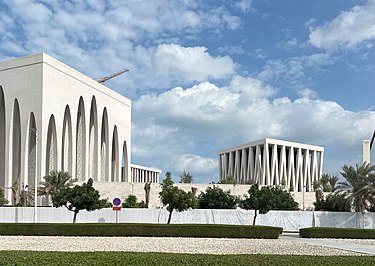
On February 20, 2023, the U.A.E. invited many Jewish guests to be part of the opening ceremony of the first new synagogue in a Muslim country in generations. The Moses Ben Maimon Synagogue is part of the multi-faith Abrahamic Family House complex in Abu Dhabi which also includes a mosque and a church. The three places of worship sit beside one another in an effort to show harmony between the different faiths.
Beyond the proximity of each house of worship, the architects took care in designing each building: the mosque faces the Islamic holy city of Mecca, the church faces east towards the rising sun, and the synagogue faces Jerusalem, Judaism’s holist city.
Abrahamic Family Complex in Abu Dhabi, UAE
On that same February day, the United Nations took the polar opposite approach towards religious coexistence as the U.N. Security Council issued a statement condemning Jews and Judaism.
The official statement was a litany of complaints on the presence of Jews in their holy land. It expressed “strong opposition” to Jews building homes east of the 1949 Armistice Lines (E49AL). It condemned Israel’s killing Islamic terrorists planning attacks on Jewish civilians. It demanded that Jews continue to be forbidden from praying at the holiest site on the Jewish Temple Mount. And it urged that Jews and Christians take a backseat to Muslims when the holidays of Ramadan, Easter and Passover overlap this year, prioritizing Muslim access to Jerusalem over believers of the other faiths.
Remarkably, the “most right-wing government in Israeli history” as portrayed in the media, acquiesced to the anti-Semitic proposals. The Israeli government said that it would keep the “status quo” of banning Jewish prayer on the Temple Mount and would ban Jews from the site during the last ten days of Ramdan. Israeli Prime Minister Benjamin Netanyahu also reportedly told the United States that it won’t authorize new Jewish towns in E49AL for the next few months and will limit incursions into Palestinian Authority towns to arrest terrorists.
While the United Arab Emirates works for religious coexistence, the United Nations works to foment religious animosity and segregation. If there’s a future for peace and coexistence in the region, it will run through the U.A.E. and not the U.N..
The United Nations has summarized its thoughts about Jews in Jerusalem, and it’s appalling.
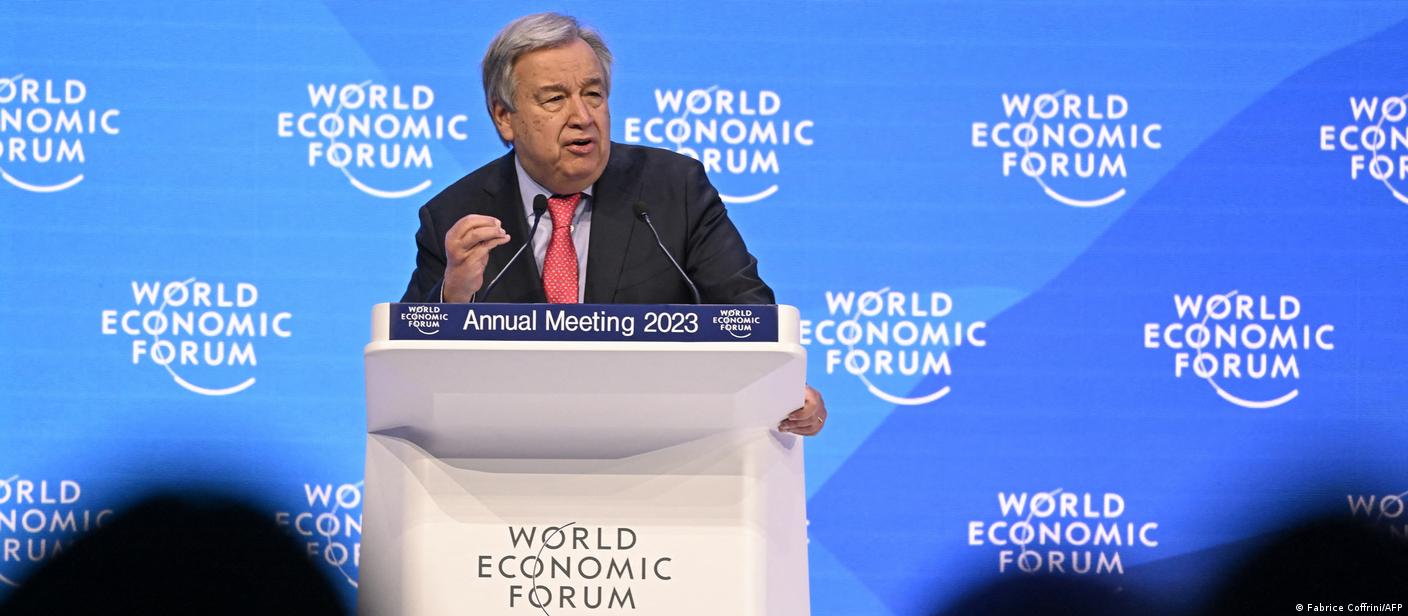
On February 12, 2023, UN Secretary General Antonio Guterres sent a message to a conference held in Cairo, Egypt called “Supporting the City of Jerusalem and its Population.” By the term “its Population,” the leader of the UN made clear he only supports the Arab Muslim population, not the Jewish one. He admitted as much in his opening statement about the “challenges faced by the Palestinian population in Jerusalem.” Presumably, the term Palestinian population refers to those Arabs who have not opted to take Israeli citizenship which has been offered to all law-abiding Arabs in the city.
It clearly didn’t mean Jews.
Guterres continued:
“Jerusalem — Al-Quds is not only a treasured home for so many — it also holds a unique place in the hearts of millions of Muslims, Jews and Christians the world over.“
Jerusalem is ONLY the holiest city for Jews. Minimizing the Jewish connection to the city after an opening comment showing unique concern for the challenges of non-Jews, reveals the jaundiced mindset of the global leader.
“As we have seen time and again, what happens in Jerusalem reverberates globally — and tensions, incitement and violence often spill into wider instability.“
Jews have been a majority in Jerusalem since the 1860s. However, the Jordanian Army ethnically cleansed the Jews out of the eastern portion of Jerusalem including the entirety of the the Old City, and forbade Jews from even visiting their holy sites from 1949 to 1967. The world remained completely silent about the abuse to Jewish human rights, even in the shadow of the European genocide of Jews.
Now, Jews once again control the eastern portion of Jerusalem after Israel defended itself from the attacking Jordanian army in 1967. The current Jewish presence sickens the anti-Semitic Arab Muslims who shout that “al Aqsa is in danger.” Outrageously, the United Nations echoes their sentiments, further inflaming the region.
“It is therefore imperative that all parties exercise restraint and refrain from provocations, inflammatory actions and rhetoric. I am very concerned by the unilateral initiatives that we have seen in recent weeks.“
Refraining “from provocations, inflammatory actions and rhetoric” makes perfect sense. Unfortunately, the head of the U.N. has a perverse idea of what that constitutes, as can be seen in his next comment.
“The position of the United Nations is clear: The status of Jerusalem cannot be altered by unilateral actions, including settlement activities in occupied East Jerusalem; it can only be resolved through negotiations between the parties.“
Perhaps the U.N. does not accept Israel’s annexation of the eastern portion of Jerusalem, as the global body had sought that Greater Jerusalem and Greater Bethlehem be held under an international regime in the 1947 Partition Plan. But the Jordanians drastically altered the character of the city when it expelled every Jew, destroyed every synagogue, banned Jews from entering the city, illegally annexed it and granted any non-Jew citizenship. Reversing the anti-Semitic Jordanian actions is not altering the city with “unilateral actions, including settlement activities”, but reestablishing the Jewish presence in the Jewish holy city that had been unilaterally destroyed by the anti-Semitic Jordanian regime.
While Israel tries to establish a final resolution to the Arab-Israel conflict, it is absurd to demand that the city be frozen in time – only as it relates to Jews and to that period when Jews were ethnically cleansed. It is the capital city of Israel with an enormous demand for housing. How can the U.N. advocate for Arab housing in the city but not for Jewish homes?
“Jerusalem’s demographic and historical character must be preserved — and the status quo at the Holy Sites must be upheld, in line with the special role of the Hashemite Kingdom of Jordan.“
If Jerusalem has been 75% Jewish in 2020, 2000, 1980, 1960 or 1940, is that the fixed percentage of the demographic character of the city that must be preserved? No city in the world has a fixed demographic character. To suggest that the demographic and historical character should relate to the eighteen years that Jordan banned the presence of Jews would be an endorsement of ethnic cleansing.
Which is what Guterres seems to have done, in calling for the anti-Semitic Jordanians to have a special role “at the Holy Sites.” The Jordanian Waqf ONLY has a special role in regards to Muslim holy sites such as the al Aqsa Mosque. It has no special role on the overall Temple Mount which is a Jewish holy site. In falsely giving the Waqf a greater role than was agreed upon in the 1994 Peace Agreement between Israel and Jordan, the U.N. chief is inflaming the situation and going directly against his own words: ignoring an agreement reached between the parties.
“The United Nations remains committed to help Israelis and Palestinians chart a credible path forward: Towards an end of the occupation; towards two States living side by side with Jerusalem as the capital of both; towards lasting security, peace and dignity for all. Thank you. Shukran.“
All of Guterres’ comments show a disregard for Jewish Israelis, so the call out of helping Israelis is a polite lie thinly spread on a mountain of scorn.
There is no “occupation” in Jerusalem. It was never Palestinian nor was it ever intended to be part of an Arab state, but part of an international “corpus separatum.”
If the parties are to negotiate a solution between themselves, then declaring the outcome of Jerusalem being a shared capital undermines the very principle of negotiation. The parties themselves will determine what they find acceptable.
Note that Israel has already advanced the sharing of Corpus Separatum, when it handed Bethlehem to the Palestinian Authority in 1996. The sharing of the holy basin has already been accomplished.
If the U.N. cared about Jewish dignity, it would INSIST upon Jewish prayer rights on the Jewish Temple Mount, not calling for banning Jews.
The head of the United Nations called for banning Jews from the Old City of Jerusalem and denying them basic human rights and dignity to pray at their holiest location. He has sadly become an ugly tool of radical jihadists, and an enemy of Jews.
The U.N.’s desire to impose sharia law in Jerusalem offers no justice nor dignity for Jews. The agency has broken its social contract with the Jewish State, and its heartless shell is but a conduit for overt anti-Semitism.
Each society makes rules to govern its citizenry. It considers the tastes and preferences of its inhabitants and tries to balance enabling human rights and the maintaining of public order. Some countries opt to ban certain activities if they might lead to violence, while others believe that human expression cannot be stifled because of the reactions that might ensue.
The world has seen this play out in the recent past, with an interesting wave of defenses and condemnations.
Charlie Hebdo Drawings of Mohammed
France is a deeply secular society that prizes its freedoms, including freedom of the press. It was perfectly legal for a French satirical magazine, Charlie Hebdo, to draw pictures of the Islamic prophet even though it was highly provocative and upsetting to devout Muslims. Indeed, several Islamic radicals shot up the magazine’s headquarters, killing many of its writers. As part of the jihadists’ derangement, they followed up on that violent vengeance with a visit to a local kosher store to slaughter Jews who had nothing to do with the cartoons.
The western world rallied to the defense of France, with global leaders marching arm-in-arm in defense of freedom of expression and against reactive violence. The provocative nature of the drawings was dismissed as irrelevant.
World leaders march in support of France and freedom of expression in January 2015 (Photograph: AFP)
Gay Pride Parade and Israeli Pride Marches in Jerusalem
The city of Jerusalem is both holy and contentious. It is the holiest city for Jews, the third holiest city for Muslims, and holy for Christians who don’t rank cities as commonly as Jews and Muslims.
It is also a politically sensitive city. Recommended to be an international city (along with Bethlehem) by the United Nations General Assembly in 1947, it became divided between Israel and Jordan in the 1948-9 Arab-Israeli War. After Jordan attacked Israel again in 1967, the reunited city became completely Israeli, even while much of the world still considers it to be international or under negotiations for a final settlement.
The holiness of the city makes the annual gay pride parade offensive to many religious Jews, Muslims and Christians. While legal, the provocative nature of holding the event in Jerusalem has sparked violence, such as occurred in July 2015 when a Jewish man just released from a mental hospital, stabbed six people, killing one. The public condemned the violence and defended the right to parade.
For their part, proud Jewish nationalists flew Israeli flags through Jerusalem, including in predominantly Arab sections of eastern Jerusalem, to mark the reunification of the city. When Palestinian groups claimed the parade was “provocative” and threatened violence, the United States asked Israel to reroute the march away from Arab areas, an action it did not take for the gay parade.
Both legal marches went on as planned, with left-wing groups labeling the nationalist march as provocative, and right-wing groups stating the same about the gay parade.
Israeli Jews on the Temple Mount
In sharp contrast to the legal actions above which are defended, the fundamental human right to pray at a holy site is deemed illegal and condemned. At least, only for Jews in Jerusalem.
The central point of prayer and holiest place on earth for Jews is the Jewish Temple Mount in the Old City of Jerusalem. Jews around the world pray facing it, and many around the world make a pilgrimage to Jerusalem three times a year, as commanded in the Jewish Bible.
It has historic significance as the place where two Jewish Temples stood, and deep relevance today, especially to Orthodox Jews.
Jews have a basic human right to pray at their holiest location, as detailed in the Universal Declaration of Human Rights. Even more, they have an accepted right to visit the Jewish Temple Mount according to rules laid out by the Islamic Waqf which has administrative rights on the compound.
But Arab extremists want to have none of it.
Wafa, the official Palestinian news site said “Israeli Jewish supremacist Minister of National Security, Itamar Ben-Gvir, Tuesday stormed the compounds of al-Aqsa mosque in the occupied city of Jerusalem under heavy protection from the Israeli forces.“
The political-terrorist group Hamas’s news site said “Ben Gvir’s incursion into the Al-Aqsa Mosque courtyards on Tuesday morning constitutes a grave violation against the Palestinian people and their holy sites.” It condemned and mocked other Jews praying outside of the Temple Mount as “settlers [who] organized provocative dances and performed Talmudic rituals in the Old City and near Al-Aqsa Mosque.“
Jordanian Foreign Ministry spokesman Sinan Al Majali said “The storming of the blessed Al Aqsa Mosque by one of the Israeli ministers and violating its sanctity is a provocative, condemned move.“
National Security Minister Itamar Ben Gvir quietly visited the Temple Mount on the Jewish fast day of the 10th of Tevet, January 3, 2023. (Courtesy Minhelet Har Habayit)
While not directly condemning Ben-Gvir’s visit or mocking Jews who pray in Jerusalem, the US Embassy in Jerusalem said that Ambassador Thomas Nides “has been very clear in conversations with the Israeli government on the issue of preserving the status quo in Jerusalem’s holy sites. Actions that prevent that are unacceptable.”
It is deeply disturbing that Israeli Jews visiting their sacred site is greeted by condemnation by not only radical Islamists, but by the western media and governments. Did those same people argue for the “status quo” of banning gay marriage? Segregation? Why do liberal values melt before jihadi zealots when it comes to the Jews?
Jews visiting and praying on the Temple Mount do so because the site is dear to them, not to antagonize Muslims. The people who condemn Jewish visitation and call it and act of “provocation” are not simply echoing radical Islamist propaganda, but denying Jewish history and Judaism itself, while simultaneously trampling on a basic human right.
On December 19, 2022, The New York Times published an article about a menorah that was lit in the window of a Jewish home across from a Nazi flag in Germany, in defiance of the edicts to ban Jews from participating in society. The descendants of that German family brought the menorah back to Germany to rekindle it once again.
It’s an interesting story on many levels. To consider the defiance and fear that the Jewish family must have felt in 1931 as Nazis gathered power in Germany, to openly declare their Judaism in the face of growing anti-Semitism. And then, eighty years later, to return to Germany after the genocide of European Jewry with that same menorah.
Chanukah candles lit in the ashes of millions of slaughtered Jews.
Yehuda Mansbach, the grandson of the Jewish couple who lit that menorah in the iconic 1931 photograph, wept openly after lighting the two candles to mark the holiday of Chanukah in Germany in 2022.
It was the only story that the New York paper would write about the Jewish holiday of Chanukah, other than some recipes for latke cocktails and how to make a DIY menorah. The actual holiday story of Jews expelling the Hellenist pagan rituals from the Jewish Temple in Jerusalem and throughout the Jewish holy land 2,200 years ago must have been considered too political for the anti-Zionist paper.
During the holiday, the paper preferred to write stories about Arabs who had “ancestors” in “modern day Israel” whose towns were destroyed at Israel’s creation. These “Palestinian citizens of Israel” (commonly called Israeli Arabs) have been trying to get back to the homes where their grandparents lived but have been blocked from doing so by the Israeli military and courts because the town sits in a buffer zone along Lebanon which is in a state of war with the Jewish State.
These are stories that neatly contour to the Times’ jaundiced narrative: Jews are native to Europe but were pushed out by Nazis, and Arabs are native to Palestine but were pushed out by Jews.
The actual Chanukah story disrupts the anti-Zionist propaganda, that Jews have thousands of years of history in Israel and not just throughout the land, but on the Jewish Temple Mount itself. That is where the original menorah of the Jews was lit, not in defiance of any edict but as a basic part of Jewish religious ritual.
Today, while Arabs may be blocked from returning to living in villages alongside the border of a hostile country by Israel’s military, Jews are considered to be in violation of United Nations edicts for going to Jerusalem and the Temple Mount. While Israeli Arabs freely drive around Israel as recognized citizens of the Jewish State, countries around the world demand that Jews be forbidden from living and praying in their holiest city.
Jews have been lighting menorahs for 2,200 years, even in the face of blatant anti-Semitism from neighbors, governments and media propaganda. And Jews will continue to light their menorahs in their windows as proud Jews, and visit the reestablished Jewish State, as they use the anti-Jewish and anti-Israel propaganda as the rags that they are.
A single menorah of defiance lit before a Nazi flag in Germany, dozens of menorahs held aloft in Montana in 1993 amidst a wave of anti-Semitic attacks, and thousands of menorahs lit in Jewish homes in Jerusalem and around the world today in the face of blatantly anti-Semitic articles and resolutions. Jews are indigenous to Israel and will always insist on the basic human right to practice their faith everywhere, especially in their holiest city.
The United Nations Security Council met on December 19, 2022 during the Jewish holiday of Chanukah which marks Jews rededicating their temple in Jerusalem 2,200 years ago. The council heard from Tor Wennesland, Special Coordinator for the Middle East Process (aka Coordinator For Palestinian Demands) about the situation in the region during the period September 21 to December 7.
The comments and replies from various countries hit upon Jews in Jerusalem several times.
Wennesland called the Old City of Jerusalem and its surroundings as “occupied East Jerusalem,” and bemoaned the fact that the “number [of new housing units for Jews] more than tripled from some 900 units in 2021 to some 3,100 units in 2021 with tenders doubling from 200 to 400.”
Other countries chimed in.
The spokesperson from France said “The priority today is to halt the Israeli settlement building policy in the occupied Palestinian territories, including East Jerusalem.”
The agent from Russia offered that “the expropriation of Palestinian property, the demolition of houses and the systematic violation of the status quo of Jerusalem’s holy sites continue.”
UAE, Israel’s new theoretical ally in the region, said “Any unilateral measures affecting the legal status of Jerusalem and the holy sites are a violation of international law which threatens to exacerbate tensions,” and added “the need to respect Jordan’s custodianship of Jerusalem’s holy sites,” making it sound like Jordan had authority over all Jewish, Christian and Muslim holy sites, when in fact it only has a “special role” regarding Islamic sites.
The representative of Ghana urged “Israel’s Government to not continue with plans to expand or create settlements, particularly in and around East Jerusalem.”
The basic idea that Jews should be banned from living somewhere, let alone in their holiest city of Jerusalem, is anti-Semitic at its core. That many countries would publicly call for such action at the United Nations during the Jewish holiday celebrating Jewish rights in Jerusalem adds a noxious element of antagonism towards global Jewry.
Jewish Chanukiah at the Kotel in Jerusalem (photo: First One Through)
Jews will never abandon Jerusalem. The perpetual calls at the United Nations for them to do so is pure inflammatory rhetoric, and makes any resolution from the organization about the conflict fall on hostile ears.
Chanukah is a celebration of Jews purging the pagan practices of their holy Second Temple in Jerusalem, and expunging the Hellenists from the holy land. It is a worthwhile time to consider how Jews today think about the Jewish Temple Mount and the future of Jewish prayers on the site.
Reform Judaism
Reform Jews are the largest denomination of American Jews, accounting for roughly 33% of American Jews (right ahead of 29% of Jews of no religion) according to a 2021 Pew poll. Their authoritative rabbinic body, the Central Conference of American Rabbis (CCAR) issued a resolution in 2015 about the Reform movement’s view of the Temple Mount. While it said that Jews considered it “holy”, it noted that it only was so because of historic significance. It added some important points:
There is “not to any hope for rebuilding the Temple, reestablishing sacrificial rites, or restoring any future Jewish worship where the Al-Aqsa Mosque and Dome of the Rock now stand”
“Supports the status quo on the Temple Mount which restricts prayer to Islamic, not Jewish, prayer.”
“Stands in opposition to those Jews who attempt to alter the status quo by praying on the Temple Mount, which is contrary both to traditional Jewish law and practice as well as peaceful co-existence.”
“Affirms the freedom of religion and the right of persons to pray where they choose, while at the same time, asserts that the interests of peace and safety are, in this unique and extraordinary circumstance, best served when some rights are suspended and legitimate religious passions restrained in deference to the rights and sensibilities of others.”
“Encourages efforts of the [Reform Movement’s] Israel Religious Action Center, in cooperation with the Religious Action Center, to maintain the status quo on the Temple Mount while combating terror and incitement to violence.”
The Reform Movement repeatedly makes clear that it opposes Jewish prayer on the Temple Mount now and forever. It believes that Temple Mount is simply a relic of the past, and any Jew who seeks to pray at Judaism’s holy site is essentially inciting violence.
The Reform movement’s leaders echo this theme. Rabbi Rick Jacobs lied to his base during Chanukah 2016 that the Maccabees of 2,200-years ago fought for religious tolerance when they did did the opposite. The Maccabees fought for a Jewish Temple, period. Further, it is perplexing (revolting) that the movement advocates for religious tolerance seemingly for all religions except for Jews at their holiest location.
Conservative Movement
The Conservative Movement is the fastest shrinking denomination of American Jewry. For every Jew who joins, three leave according to Pew, with the vast majority migrating to Reform or Jews with no denomination.
The movement has said remarkably little about the Temple Mount.
Way back in 2001, the Rabbinical Assembly issued a resolution which said almost nothing about its position about the sacred site, other than confirming its holiness to Jews, and respectfully asking Islamists to stop proclaiming otherwise. It has issued no other official comments about the holy compound.
Its silence can be found in other places as well.
In 2016, the Conservative movement published a new prayer book, a siddur, meant to be more egalitarian which included a wide variety of contemporary commentators. The siddur sits somewhere between Reform and Orthodox denominations’ liturgy, but much closer to Reform as it relates to the Temple Mount.
While Orthodox Jews recite a short prayer after the central Amidah service three times a day (four times on Sabbath and holidays), as well as earlier in the morning service, asking for the Temple to be rebuilt, the Conservative Movement omitted it:
May it be Your will, Adonoy, our God, and the God of our Fathers that the Holy Temple be rebuilt speedily in our days, and grant us our share in Your Torah. And there we will serve You reverently as in the days of old, and in earlier years. And let Adonoy be pleased with the offerings of Judah and Jerusalem as in the days of old and in earlier years.
Perhaps the Conservative movement agrees with Reform Jews that there is no need for a Third Jewish Temple and that Jews should be banned from the site. Or maybe it is just staying out of the fray.
View of the Jewish Temple Mount from the top of the rebuilt Hurva Synagogue in the Old City’s Jewish Quarter (Photo: First One Through)
Orthodox Jews
While most non-Orthodox American Jews do not focus on the Temple Mount even as they might pray facing it, the small Orthodox community actively prays about rebuilding the Third Temple, as seen above. Many have gone to the site in recent years, during the few hours in which visitation for non-Muslims is currently permissible.
In December 2013, the Chief Rabbis of Israel reimposed a ban on Jews ascending the Temple Mount, as Orthodox Jews began to do so with greater frequency. The rationale had nothing to do with angering Islamists, as it did with potentially walking on the most holy of spots, which is not permitted for Jews other than a High Priest, according to Jewish law.
Despite the ban, the number of Jews visiting the Temple Mount has jumped in recent years as Orthodox Jews have rationalized that the location of the holy of holies is understood. In 2012, the total number of Jewish visitors was about 7,700. In October 2022 during the Jewish month of Tishrei, the figure was almost 8,000 according to Beyadeynu, an activist group encouraging Jewish visitation. The group estimates that the total this year doubled to about 50,000 from last year and it hopes to double again – to 100,000 Jews – in the coming year.
That figure remains a small fraction of the millions of Muslims who frequent the site at all hours.
In Israel, the Ultra-Orthodox Haredi community makes up 13% of the population and it is growing twice as fast as the rest of the country. There is roughly another 10% of Jews who are dati, or Modern Orthodox religious. Taken together, the 20%-plus Orthodox Israeli Jews is quite a bit larger than the 8% of Orthodox American Jews. Israel – and Jerusalem in particular – is much more Orthodox than world Jewry, as the devout Jews are drawn to the holy city much more than other Jews.
The increasingly secular nature of the majority of America’s Jews has fed a narrative that the Temple Mount is not central to Jewish prayer or aspirations. As Israel’s new government includes several Orthodox parties in the ruling coalition, the likely promotion of a greater Jewish presence at Judaism’s holiest spot will be cast as foreign and extreme around the world, when it is, and has always been, a basic component of Orthodox Judaism.
On December 1, 2001, two frustrated Palestinian Arabs from Abu Dis, just east of Jerusalem, could not stand seeing so many Jews walking around on a Saturday night in a popular Jerusalem pedestrian mall. Osama Bahar, age 25, and Nabil Abu Habaliya, age 24, took explosives which were supplied by the terrorist group Hamas and blew themselves up amongst the young Israelis strolling on Ben Yehuda Street. A short time later, another terrorist blew up a car nearby.
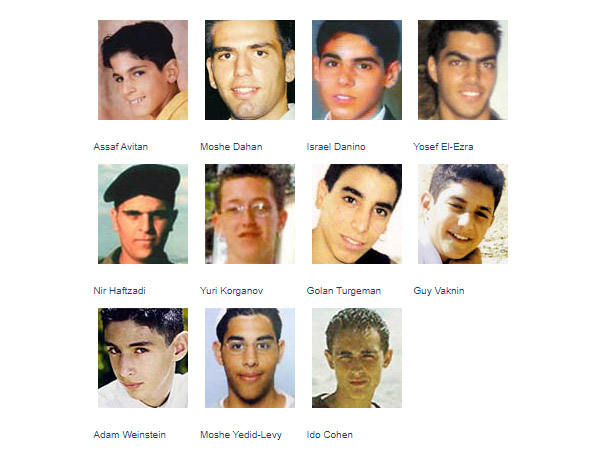
The eleven dead included: Assaf Avitan, 15, of Jerusalem; Michael Moshe Dahan, 21, of Jerusalem; Israel Ya’akov Danino, 17, of Jerusalem; Yosef El-Ezra, 18, of Jerusalem; Sgt. Nir Haftzadi, 19, of Jerusalem; Yuri (Yoni) Korganov, 20, of Ma’alei Adumim; Golan Turgeman, 15, of Jerusalem; Guy Vaknin, 19, of Jerusalem; Adam Weinstein, 14, of Givon Hahadasha; Moshe Yedid-Levy, 19, of Jerusalem; and Ido Cohen, 17, of Jerusalem. Roughly 180 others were injured, 17 seriously.
Israeli victims of Palestinian terrorism at a popular pedestrian mall on Saturday night December 1, 2001
The Martyr Izz ad-Deen al-Qassam Brigades – Information office described how angry the Arabs were with the Jews, stating:
“As part of our retaliation to [Israeli Prime Minister Ariel] Sharon’s madness and with the success granted by Allah and His protection, the two fighting martyr brothers, Osama Bahar and Nabil Abu Habaliya, have carried out on Saturday evening, 12/1/2001, the night of Ramadan 17, their bold and painful attack in one of the enemy’s dens in occupied west Jerusalem as a revenge for the blood of our martyrs and a punishment to all the reckless leaders in the enemy’s army and ministry.
“We do not only do this in self-protection or in retaliation of a future killing, but we also do this as part of our absolute right to react towards the continual aggression and usurpation of our country for more than 50 years. We also wish to emphasize our right of resistance and our right to die as martyrs [istishhad], which is the pinnacle of resistance – that is to say, to sacrifice one’s self, spirit and blood is an absolute right, despite the aggressive attack by the enemy and some liars, meant to rob us of this right.“
Saudi Arabia funded the families of these terrorists in cooperation with the Arab Bank as part of the Saudi Committee for the Support of the Intifada al Quds. As the support for terrorism was too blatant (or to keep the funds flowing after the end of the intifada), the committee changed its name in 2004 to the Saudi Committee for the Relief of the Palestinian People. The Saudis also cannot stand Jews enjoying a Saturday night in Jerusalem.
Two frustrated Palestinian Arabs had to contend with Jews walking the streets of Jerusalem for their whole lives. The Saudis well understood their frustration and supported their “right of resistance to die as martyrs.” All had internalized that the Muslim world can have no dignity as long as Jews walk the streets of Jerusalem with impunity.
September 20, 2022 started off much better than usual for the Middle East. A region, normally aflame with hatred seeking the end of the Jewish State, began with calmer voices.
The Palestinian Arabs published their quarterly poll of sentiment on the street. It showed a more moderate, albeit still troubling, tone regarding making peace with Israel.
Palestinian Arabs favored the political terrorist group Hamas over the more moderate Fatah in theoretical presidential elections, by 15 points, down from 22 points three months earlier. Support for a two-state solution rose to 37% from 28% in the prior quarter (60% still oppose a two-state solution). Currently, 48% support armed attacks against Israel, down from 55% in favor of returning to intifada-terrorism, just three months prior.
The pollsters believe that the rise in moderating positions stems from “greater appreciation of the [Israeli confidence building] measure in which a larger number of work permits are issued by Israel for laborers from the Gaza Strip.” It added that there was also “negative public assessment of the last armed confrontation between Islamic Jihad and Israel [in which most Arabs believe Palestinians lost and noted Hamas stayed out of the fight], the findings indicate a significant decline in support for armed attacks or a return to an armed intifada and a significant rise in support for Palestinian-Israeli negotiations.“
So far, so good.
At the United Nations in New York City, the General Assembly got underway in an annual ritual in which leaders of the world explain why their country was noble and everyone else was terrible.
Qatar, a state sponsor of the Palestinian terrorist group Hamas, did not slam Israel, but only called for a two-state solution. Turkey, which also has supported Hamas, took a softer tone about Israel. It obnoxiously called for a two-state solution that only could have the contours of the 1967 “borders” (they were never borders) with eastern Jerusalem as its capital, but still, a far better statement than in years past.
Unfortunately, the positive direction fell apart with the address from the Hashemite Kingdom of Jordan. While his English was wonderful and his voice soothing, King Abdullah II disappoints every year.
Jordan’s King Abdullah II addresses the 77th session of the United Nations General Assembly, Tuesday, Sept. 20, 2022 at U.N. headquarters. (AP Photo/Mary Altaffer)
As he’s done frequently, Abdullah incorrectly said several things such as UNRWA helping Palestinian “refugees” rather than compelling them to remain wards of the world. But the king went so much deeper than a bad opinion, as he waged an attack on the Jewish State regarding Jerusalem. At 9:09 of his speech, he ramped up the temperature:
“Today, the future of Jerusalem is of urgent concern. The city is holy to millions of Muslims, Christians and Jews around the world. Undermining Jerusalem’s legal and historical status quo triggers global tensions and deepens religious divides. The holy city must not be a place for hatred and division.
“As custodians of Jerusalem’s Muslim and Christian holy sites, we are committed to protecting the historical and legal status quo and to their safety and future. And as a Muslim leader, let me say clearly, that we are committed to defending the rights, the precious heritage, and the historic identity of the Christian people of our region. Nowhere is that more important than in Jerusalem.
“Today, Christianity in the holy city is under fire. The rights of churches in Jerusalem are threatened. This cannot continue. Christianity is vital to the past and present of our region and the holy land. It must remain an integral part of our future.”
This is outrageous and pathological.
At the most basic, churches in Jerusalem and all around Israel are not threatened. Israel actually helped build the Mormon church in Jerusalem. Christian pilgrims are found everywhere, as Christian tourists to Israel outnumber Jewish ones. There is not a single Muslim-majority country in the world where Christian tourists outnumber Muslim visitors.
“in accordance with the Washington Declaration, Israel respects the present special role of the Hashemite Kingdom of Jordan in Muslim Holy shrines in Jerusalem. When negotiations on the permanent status will take place, Israel will give high priority to the Jordanian historic role in these shrines.“
Jordan has no “custodianship” and no role to “protect” any shrine, let alone non-Muslim sites which are never mentioned. To assert a special role as savior of Christians from fabricated non-existent threats is delusion of the highest order.
The king not only suffers from a messiah complex, he is abrogating the peace treaty signed with Israel. The following sentence, Article 9.3, clearly states that the countries will work together to promote religious cooexistence:
“The Parties will act together to promote interfaith relations among the three monotheistic religions, with the aim of working towards religious understanding, moral commitment, freedom of religious worship, and tolerance and peace.“
The Jordanian monarch is promoting the opposite, seeking a religious confrontation of Muslims and Christians against the Jews.
The Jordanian king is inciting a religious war against the Jewish state, seeking to alarm the Christian world that ‘Jerusalem is in danger’ the same way radical jihadists scream ‘al Aqsa is in danger’ to Muslims, in the hopes of killing Jews and the Jewish State. It is an alarming development and one which must be addressed swiftly, such as demanding a public recanting and apology from the king, or risk the 1994 peace treaty which he defecated upon.
The New York Times used four journalists to cover the August 14 Arab terrorist attack on Israeli Jews in Jerusalem. The journalists reporting from Jerusalem, Seoul and Hong Kong (I have no idea why correspondents from thousands of miles away were needed) could not muster a clear and balanced report.
The article started with the usual anti-Israel bias with the headline “Eight Injured in Shooting in Jerusalem” which did not clearly label the attacker as an Arab Muslim nor the victims as Israeli and American Jews. While the article would eventually reveal that the attacker was a “Palestinian man”, it would never clearly state that the victims were all Jewish. Instead, the attack was crafted as between warring countries, continuing a trend of Palestinians and Israelis killed over the past few months.
Israeli security forces at the scene of a shooting attack outside Jerusalem Old City, August 14,2022. (photo: YONATAN SINDEL/FLASH90)
The Times then mentioned Silwan, the neighborhood from where the Arab terrorist came, as having tension “between its Palestinian residents and a small but growing number of Israeli settlers.” While the Palestinian Arabs and Israelis are both “residents”, the Times opted to use the biased Palestinian narrative to describe the Israelis.
At that point, the paper shifted squarely to religion:
“Sacred to both Jews and Muslims, the nearby Temple Mount houses the third-holiest mosque in Islam and was the location in antiquity of two ancient Jewish temples that remain important to Jewish identity.“
According to the Times, while the Temple Mount is “sacred to both Jews and Muslims”, the site is really more important to Islam, as it “houses the third-holiest mosque in Islam”. For Jews, the site is merely a talisman and “important to Jewish identity.”
That’s a deliberate insult to millions of Jews around the world. The Temple Mount is THE holiest location for Judaism.
Continuing the trend, the article mentioned that “Hamas, the Islamist militant group that runs the Gaza Strip” celebrated the attack, but did not quote Fatah, the party of Palestinian President Mahmoud Abbas cheering the shooting as well, posting on Facebook “Praise to the one whose rifle only speaks against his enemy. Long live our people’s unity and long live the free hero. Praise to the rifle muzzles, our people will fight the occupation with all kinds of resistance. Save your bullets and use them against the occupation, only the occupation!!”
Why did the paper opt to only refer to the “Islamist” political-terrorist group but not the secular political one which controls the presidency and Areas A and B? Does the Times believe that the conflict is a religious one or a political one? It pivoted back-and-forth in the article inelegantly.
The four journalists contributing to the story made a final pivot at the end of the article, writing “Israeli efforts to build archaeological and tourism attractions in Silwan, mostly celebrating the area’s ancient Jewish heritage, are perceived by Palestinians as a means of eroding Palestinian claims to the city.” This pivoted the conflict as neither political nor religious but a historical one. In this case, the Times seemed more comfortable pointing out that Jews have a much longer history in the region than the Arabs who first came more recently. Perhaps it does so, questioning whether history truly fuels the conflict, or is a talking point between the parties.
The Times is dancing around the political and religious nature of the Israeli-Arab conflict. While the anti-Zionist paper is comfortable making political arguments which make Israel look like the larger and more powerful political actor, it is loathe to point out that Israel has a much deeper religious claim to the land and Jerusalem. Perhaps the liberal media fears that too much information will educate readers about the profound logic of Israel retaining full control of the Old City of Jerusalem, in direct opposition of Palestinian political goals of seizing the site from the Jewish State.
Social justice is a concept that has been advanced by left-wing Americans into mainstream conversation. The idea covers a number of principles:
Access
Human rights
Participation
Equity
Diversity
The Jews in Jerusalem are slowly advancing in their movement on each of these principles, however, systemic anti-Semitism at the United Nations and for many Arab Muslim nations, has slowed progress.
Access
Despite the facts that only Jews consider Jerusalem as its holiest location and uniquely made the city its capital, Arab Muslim nations ethnically-cleansed the Old City of Jerusalem of its Jews in the 1948-9 Arab-Israeli war. Transjordan illegally annexed the eastern part of the city including the Old City and the west bank of the Jordan River, and subsequently denied any Jew the ability to visit their holiest sites.
Jordan attacked Israel again in 1967 but lost the ‘West Bank’ and eastern Jerusalem to Israel. While Israel once again allowed Jews to live and visit their holiest city, the Jordanian Waqf was given permission by Israel to administer the Jewish Temple Mount, and limits the time and number of Jews who can visit.
Human Rights
Not long after Jordan annexed lands west of the Jordan River in a move not recognized by almost every country in the world, it passed a citizenship law specifically excluding Jews in article 3. Now under Israeli rule, the Jews of Jerusalem – as well as Arabs – are afforded citizenship in a reversal to Jordan’s anti-Semitic law.
Jordan still enforces its ban on Jewish prayer on the Temple Mount, a flagrant violation of the basic human rights of Jews. Remarkably, the world stays mum on the subject, fearing radical Islamic violence.
Participation
The Jews in Jerusalem are marginalized by the United Nations and much of the world. The UN Security Council passed Resolution 2334 which stated that “Israelis” could not move to eastern Jerusalem. The anti-Zionists call Jews who live and visit ‘settlers’, even if they are not Israeli, and do not use the label for Israeli Arabs who do the same, clearly demonstrating the anti-Jewish nature of the smear.
The UN has set up distinct agencies, committees and inquiries uniquely for the Jewish State and does not afford Israel an opportunity to participate on the same basis as others in a forum stacked against it.
As noted above, the administration of the Temple Mount which holds the al Aqsa mosque is administered solely by Arab Muslims of the Jordanian waqf. Such formulation does not allow Jews to participate in the administration of their holiest site, and has led to their being completely marginalized.
Equity / Restorative Justice
There has been some measure of restorative justice for Jews, in facilitating the migration of Jews back to their ancestral homeland over the past hundred years. Germany has paid the state compensation for its actions in the Holocaust. The United States has invested in the fledgling state and facilitated its ascendency out of a third world emerging state to a thriving liberal democracy. The most persecuted people who faced a genocide have established a safe haven.
But evil still lurks. The Islamic Republic of Iran has stated its desire to destroy Israel. It has several terrorist proxies abutting the Jewish State including Hamas and Hezbollah which have thousands of missiles directed at it. The world is debating how to handle the leading state sponsor of terrorism’s quest for nuclear weapons, even though the answer is obvious to any toddler.
In relation to Jerusalem, the world has done the opposite of restorative justice. It did – and still does not – facilitate and recognize Jews in the Old City of Jerusalem. Israel had to reunite the city on its own in a defensive battle. It rebuilds the synagogues (like the Hurva) that Jordan destroyed in the face of global condemnation.
The Hurva Synagogue in the Jewish Quarter of the Old City of Jerusalem, shortly after its re-opening in March 2010 (photo: First One Through)
Diversity
Israel’s neighbors like Lebanon, Syria, Jordan, Saudi Arabia, Kuwait, Oman, UAE, Iraq and others, are each over 90% Muslim. In contrast, Israel is only 73.9% Jewish and has over 26% of the population from a variety of religions including Muslims, Christians, Druze, Baha’i, Samaritans and others.
Israel’s diversity is seen in its schools and hospitals. The signs in the country are written in Hebrew, Arabic and English. Its parliament and Supreme Court have people of different religions, ethnic backgrounds, genders and orientation. All of those dynamics are lacking in the other countries of the Middle East.
Many of those same countries that lack diversity attack Israel economically, politically and militarily. They deny the history of the Jews, their rights and any acceptance of the Jewish State. They have stood against ‘normalizing’ the Jewish State in any manner in an aggressive campaign of ‘three denials.‘ These efforts are most pronounced regarding Israel’s capital of Jerusalem, which they seek to revert back to the Arab-only, Jew-free situation they enforced in the eastern half from 1949 to 1967.
Regarding the principles of access, human rights, participation, equity and diversity, Israel stands as a beacon in the Middle East. However, the country still faces many obstacles, mostly from the biased United Nations and at the Jewish Temple Mount. Hopefully those committed to social justice will engage in the hard work to end the systemic anti-Semitism, xenophobia, Islamic privilege, religious persecution and isolation of the indigenous Jewish people in their ancient homeland and in their holy capital city of Jerusalem.