The Undemocratic Nature of Fire and Water in the Middle East

Israeli President Shimon Peres

Former President of Israel and Nobel Peace Prize winner Shimon Peres is well liked by the left-wing and even admired by the right-wing in Israel and around the world. His long history of working on behalf of Israel was highlighted by many wonderful quotable phrases. His farewell address in the United States was no different.
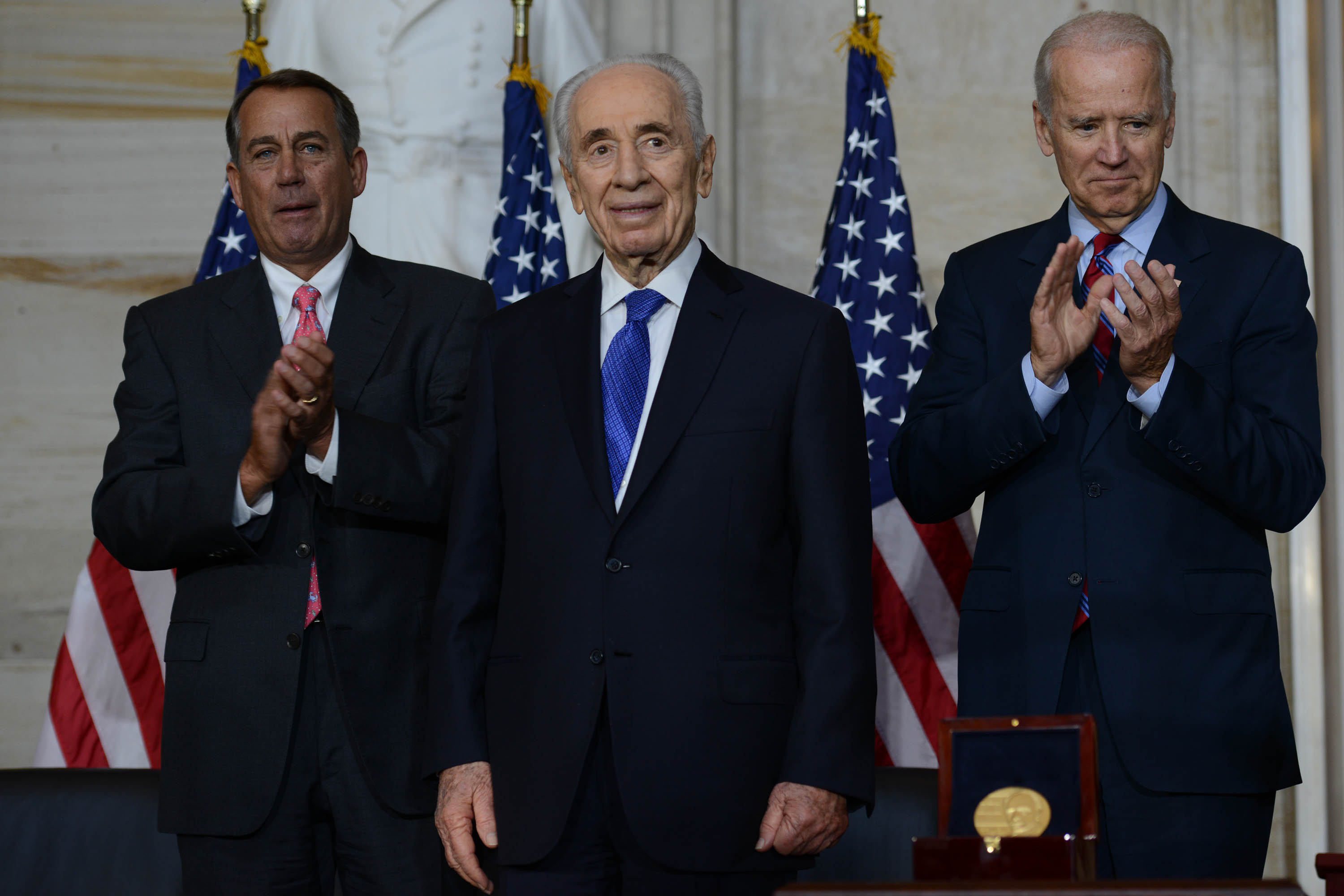
???? ?????? ????? ??? ???? ?? ?????? ???? ?? ??????? ????????? Photo by Kobi Gideon / GPO

Israeli President Shimon Peres, June 2014
(Photo by Kobi Gideon / GPO)

On June 26, 2014, Shimon Peres addressed the US Congress for the final time, receiving the Congressional Medal of Honor. His remarks addressed the strong bonds between the United States and Israel, as well as the threats of terrorism. While cautious, Peres remained an optimist about the chance for peace:

“President Abbas is clearly a partner for peace.  He spoke bravely in Saudi Arabia, in Arabic, against the kidnappings, against terror, and for peace. But you cannot put fire and water in the same glass. Hamas is clearly not a partner for peace.  Hamas fires rockets at our civilians. They oppose peace and support terror. Finding a way forward is hard. But we must not lose hope. There is no better solution than two states for two peoples.”

Peres’s comments about acting-President of the Palestinian Authority Mahmoud Abbas had mixed reactions in Israeli society: the left believes that Abbas is a partner for peace; while the right-wing believes he is simply a more polite face of terrorism. However, both the right and the left agree that the rabidly anti-Semitic, jihadist, militant, terrorist group Hamas is an enemy of peace. Peres spoke clearly that any Palestinian government that included Hamas was not one that sought peace with Israel.

Peres used an analogy from nature: that fire and water cannot co-exist in the same small space. Similarly in politics, the Palestinian Arabs cannot advance a plan of destroying Israel, while claiming it seeks peace with the Jewish State.

The Secretary-General of the United Nations had a very different view of nature in the Middle East.

Secretary-General of the United Nations Ban Ki-Moon

Promoting Reconciliation of Hamas and Fatah: Ban Ki-Moon has pushed aggressively for Hamas to be included in the Palestinian government and in peace talks. Some examples from after the Peres speech to the US Congress:

  • October 21, 2014: “Palestinians are taking critical steps to forge a united path to the future. This includes an intra-Palestinian reconciliation agreement followed by a historic meeting in Gaza of the Cabinet of the Government of National Consensus.
  • April 21, 2015: “I welcome ongoing efforts to promote Palestinian reconciliation. The Government of National Consensus must assume its leadership of Gaza, including control of border crossings.
  • January 26, 2016: “Reconciliation is critical in order to reunite the West Bank and Gaza under a single legitimate Palestinian authority.

This view is diametrically opposed to Peres’s and almost all Israelis.

Hamas has never recanted its founding charter which calls for killing Jews and destroying Israel. It explicitly states that peace talks are not to be pursued. That the only pathway to freeing Palestine is through militant jihad.

Terrorism is Natural: Even while Ban Ki-Moon condemned terrorism, he made excuses for it. During the same January 2016 comments calling for a Hamas-Fatah reconciliation government, he stated:

as oppressed peoples have demonstrated throughout the ages, it is human nature to react to occupation, which often serves as a potent incubator of hate and extremism.”

The Secretary General of the UN stated that the victims of terrorism are to be blamed for their own injured status. According to him, it is “human nature” to walk into a family’s home at night and stab and murder all of the inhabitants, including a three month old baby (as Palestinian Arabs did to the Fogel family), because of “occupation”.


Israel’s left-wing champion, Shimon Peres, stated that nature itself dictates that peace and terrorism cannot coexist.  As such, Hamas can never be accepted into a legitimate Palestinian government if there will be peace between the Israelis and Palestinian Arabs.

Ban Ki-Moon argued that human nature demands freedom from a ruling authority it does not want. Therefore, his proposal is to remove Israeli controls and restrictions from the “West Bank” and Gaza.

But Ban went beyond that.

He demanded that no Jews be allowed to live in either of those lands, even if they legally purchase houses. He demanded that no Jew be allowed to run a business in those areas, even when they hire many Arabs and help the local economy.

Ban does not just argue about the “occupation” of an Israeli military, but against the simple presence of Jews.  He stated that any Jew prevents the “the viability of a Palestinian state and the ability of Palestinian people to live in dignity.


Israelis see no room for an anti-Semitic death group to be part of a future of peaceful coexistence.

The United Nations sees no room for Jews to coexist with anti-Semites.


Peres has urged Israelis to make peace with those that seek peace.

Ban has demanded that Jews abandon their homes to accommodate Jew-haters.


For Israelis, the natural world can be one of peace, where there is respect for Jewish history, culture and people.

For the United Nations, the natural world is rife with anti-Semitism.


A Democratic and Undemocratic Nature

Jews are happy to co-exist with non-Jews. The Israeli government granted all non-Jews citizenship in May 1948. Non-Jews account for 25% of Israeli citizens today.

In a democratic natural world, Jews and non-Jews are not “fire and water.”  The only opposites are peace and war.  Israel’s mission is to have peace extinguish the fire of hatred, terrorism and war.

The United Nations represents the undemocratic world.  As the agency says of itself “When the founders of the United Nations drafted the Charter 70 years ago, they did not include the word democracy. This was hardly surprising. In 1945, still more than today, many of the UN’s Member States did not espouse democracy as a system. Others laid claim to it but did not practise it.

The undemocratic natural world is one of anti-Semitism, where Jews are the fire to be extinguished.  So stated the UN’s Secretary General.


Related First.One.Through articles:

The United Nation’s Ban Ki Moon is Unqualified to Discuss the Question of Palestine

The Palestinians aren’t “Resorting to Violence”; They are Murdering and Waging War

The UN Can’t Support Israel’s Fight on Terrorism since it Considers Israel the Terrorists

The Hollowness of the United Nations’ “All”

The United Nations’ Remorse for “Creating” Israel

A “Viable” Palestinian State

The Israeli Peace Process versus the Palestinian Divorce Proceedings

Subscribe YouTube channel: https://www.youtube.com/user/FirstOneThrough

Join Facebook group: Israel Analysis


The United Nation’s Ban Ki Moon is Unqualified to Discuss the Question of Palestine

On January 30, 2016, United Nations Secretary-General Ban Ki Moon made a statement about the Hamas leadership’s intention to continue to attack Israel.  His comments clearly spell out why he is unqualified to lead the UN and comment on the “Question of Palestine.”

Ban Ki Moon
Secretary General of the United Nations, Ban Ki Moon

From The United Nations: Statement attributable to the Spokesperson for the Secretary-General on statements by Hamas leadership:

The Secretary-General is alarmed by recent statements from the Hamas leadership in Gaza about the group’s intention to continue building tunnels and firing rockets at Israel.”

  • Alarmed? Maybe he should read their charter, watch PalWatch or MEMRI where they describe their intention to kill Israelis and destroy the country time and again. To be alarmed is to be willfully ignorant about the situation and therefore undeserving to comment or be the head of the United Nations.


“Such statements and actions put at risk reconstruction, humanitarian and development efforts by the international community and Palestinian and Israeli authorities. They also do a serious disservice to the long-suffering people of Gaza.”

  • The building of tunnels and firing rockets into Israel puts ISRAELIS AT RISK of attack and death. It continues the disservice that the world community is complicit in ignoring the SUFFERING OF ISRAELI CIVILIANS. To ignore the threat to Israel in a statement about Hamas is to be complicit in the crimes of Hamas.

“After three devastating conflicts in seven years, people in Gaza and the people of southern Israel deserve a chance for peace and development. Every effort must be made to improve the living conditions of the people of Gaza.”

  • In a statement about the continued military aspirations of the elected leadership of the people of Gaza to attack and kill Israelis, why isn’t the Secretary-General clearly highlighting the need to improve the living conditions of the people of ISRAEL? Why are those that harbor evil intent, granted good will? Why are the innocent ignored?

“The Secretary-General reiterates his condemnation of terrorism in all its manifestations.”

  • A condemnation of Hamas barbarity should have clear condemnation of Hamas and its actions, not a general statement about terrorism generally.

The Secretary-General of the United Nations has shown himself unfit to judge the Arab-Israel conflict squarely and fairly.


Related First.One.Through articles:

The Palestinians aren’t “Resorting to Violence”; They are Murdering and Waging War

The United Nations “Provocation”

The UN Can’t Support Israel’s Fight on Terrorism since it Considers Israel the Terrorists

The Hollowness of the United Nations’ “All”

UN Concern is only for Violence in “Occupied Palestinian Territory,” not Israel

UN Comments on the Murder of Innocents: Henkins

The United Nations’ Remorse for “Creating” Israel

UN Press Corps Expunges Israel

The United Nations Audit of Israel

The United Nations and Holy Sites in the Holy Land

An Inconvenient Truth: Palestinian Polls

Extreme and Mainstream. Germany 1933; West Bank & Gaza Today

Subscribe YouTube channel: https://www.youtube.com/user/FirstOneThrough

Join Facebook group: Israel Analysis

Oxfam and Gaza

Oxfam seems like such a nice charity.  It’s slogan is “The power of people against poverty.” What can be controversial about that?

Much of the organization’s work is focused on providing aid and services to poor communities around the world.  Work includes bringing clean water, food and basic services to people in need.

However, the organization also goes beyond a core mission of charity to other rights-based work including human rights and women’s rights.  The charity claims that “when people have the power to claim their basic human rights, they can escape poverty – permanently” and “the right to gender justice underpins all of our work.” Such activity leads Oxfam to get involved in politics and to advocate for particular actions by governments.

Oxfam produces reports and details its assessments of certain regions and their treatment of people.  Consider the report which warns about a potential slide in the treatment of women in Afghanistan.  Oxfam clearly “called on world leaders to ensure that any peace deal includes benchmarks to guarantee women’s rights” and highlighted the terrible crimes of “honor killings” in which wives and daughters are killed by family members if they engaged in something considered impure, like dressing inappropriately or turning down a male suitor.

Oxfam also puts feet on the ground to encourage peace in places such as South Sudan where “Oxfam has been working closely with communities and their leaders in Rumbek to establish peace committees that are now avenues for different clans to meet on a regular basis to discuss issues, mediate conflicts and encourage peaceful co-existence.” Such activity is obviously well beyond delivering humanitarian aid.

Consider Oxfam’s approach to Gaza.

Gaza

Oxfam has repeatedly called for “world leaders to press the Israeli government to lift the blockade on Gaza which Israel put in place in June 2007 to prevent arms smuggling after the terrorist group Hamas took over Gaza.  Hamas has used its weapons to fire over 10,000 rockets into Israel since then.

Legality: Oxfam called the blockade “illegal,” even though the United Nations Palmer Report of 2011 clearly stated “that Israel’s naval blockade was legal… Israel faces a real threat to its security from militant groups in Gaza.  The naval blockade was imposed as a legitimate security measure in order to prevent weapons from entering Gaza by sea and its implementation complied with the requirements of international law.

Ignoring the ruling authority of the terrorist group, Hamas: Oxfam stated that “The government of Israel holds the primary responsibility to lift the blockade, although agencies signing on to the campaign also recognize that reconstruction is hindered by the failure of Palestinian political parties to reconcile and prioritize reconstruction, and by Egypt’s closure of its border with Gaza.”

An amazing gloss over the facts.  Not only does Israel have “primary responsibility” for the situation, but the failure to alleviate the plight of ordinary people in Gaza according to Oxfam is also “the failure of Palestinian political parties to reconcile.” Hamas is a terrorist organization sworn to destroy Israel that repeatedly attacks Israelis. Until it relinquishes control of Gaza, the blockade will stay in place. It is not a matter that there is an internal division between Palestinian leaderships, as Oxfam states.

Collective Punishment:  Oxfam continued: “The government of Israel justifies the restrictions on security grounds. However, the United Nations and the International Committee of the Red Cross have repeatedly asserted that the blockade is a violation of international law. Indeed, there can never be justification for collective punishment of an entire population and leaving tens of thousands of families homeless and hundreds of thousands of children without a school or health centers.

Not only did the UN report specifically state that the blockade is legal as noted above, it also disputed the nature of “collective punishment” when it concluded that “although a blockade by definition imposes a restriction on all maritime traffic, given the relatively small size of the blockade zone and the practical difficulties associated with other methods of monitoring vessels (such as by search and visit), the Panel is not persuaded that the naval blockade was a disproportionate measure for Israel to have taken in response to the threat it faced.

Blame: Further, the phrasing of the Oxfam article put the blame for homeless families and “children without a school or health centers” on Israel, instead of the terrorist group Hamas that continues its war to destroy Israel.

Women’s Rights and Co-Existence:  Interestingly, for an organization that claims that “gender justice underpins all of our work,” it never once mentions in any of its numerous articles about Gaza, that Gaza now leads the world in the number of “honor killings” of women per capita.  It also doesn’t seem as keen to promote co-existence between Israelis and Palestinian Arabs as it does in South Sudan.


Oxfam is not simply a charitable organization, but a political one as well. It goes beyond important work of helping the poor, to a mission-based action group influencing governments.

When it comes to Gaza, it has turned a blind eye to an anti-Semitic terrorist government and focuses instead on demonizing a democracy that is protecting its citizens. It has produced articles with misinformation and circulated petitions to open Israel to attacks.

Consider that when you see an Oxfam volunteer walk up to you on the street.

oxfam


Related First.One.Through articles:

UN’s Confusion on the Legality of Israel’s Blockade of Gaza

Cause and Effect: Making Gaza

Honor Killings in Gaza

Gaza Blockade versus Cuban Blockade

Save the Children

Subscribe YouTube channel: FirstOneThrough

Join Facebook group: FirstOne Through  Israel Analysis

The New York Times Refuses to Label Hamas a Terrorist Group

Readers rightfully assume that newspapers go through the effort of educating its readers. As such, the papers should include descriptions and backgrounds of the main actors in any news story.

“Good” actors and “bad” actors are often labelled as such.  For example, readers would imagine that the media would specifically call out a terrorist organization, and almost all of the time, they do. The exception is the terrorist group Hamas.

Consider this comparison:

P.K.K.

A group that is often-mentioned in the New York Times lately that is labelled a terrorist group is the P.K.K. The Kurdish group has been fighting for years against Turkey to gain independence and has used violence to achieve its goal. Some people consider the Kurdish aspirations for independence similar to the Palestinians, but there are many differences, such as the fact that the Kurds are actually a distinct people compared to Arabs and Muslims in Syria, Iraq and Turkey where they live, as opposed to Palestinians who are an indistinguishable part of the broader Arab world. The P.K.K. fights alone for the Kurdish people, while the whole Arab world fights for the Palestinian Arabs. Put those facts aside and look at recent reports from the New York Times.

The NY Times is consistent in labelling the P.K.K. a terrorist group.  It may state that the label is attributed to Turkey and other groups such as NATO, the United States or just “widely considered.”  But it usually avoids just stating that Turkey alone considers the group to be a terrorist organization:

  • October 12, 2015: “Turkey and its NATO allies consider the P.K.K a terrorist organization.”
  • September 9, 2015: “The Kurdish group, which is considered a terrorist organization by Turkey, the United States and the European Union, has been attacking Turkish security officials almost daily since the breakdown of the fragile peace process.”
  • August 12, 2015: “a Kurdish separatist group known as the P.K.K., which is widely listed as a terrorist group
  • August 6, 2015: “Mr. Erdogan has said he is acting in Turkey’s national security interests in targeting terrorists of all stripes, both the Islamic State and the P.K.K”
  • July 29, 2015: “Under alliance rules, they are bound to protect Turkey from threats, and they have long listed the Kurdish militant group that fought a long insurgency in Turkey, the P.K.K., as a terrorist organization
  • July 26, 2015 (an exception to prove the rule): “targeting camps of the militant Kurdistan Workers’ Party for the first time in four years… ended an unstable two-year cease-fire between the Turkish government and the Kurdish militants, also known by the initials of their Kurdish name, P.K.K.”

Readers of the New York Times are educated by the paper over-and-again that many countries outside of Turkey consider the P.K.K. a terrorist group.  Understanding that designation gives readers specific context with which to consider the story.  A government fighting a terrorist group is logical and appropriate; a defensive action of “the good guys” against the “bad guys”.

Now consider the labeling of Hamas in the New York Times.

Hamas

Hamas has been labeled a “Foreign Terrorist Organization” by the United States government since 1997. This is not subject to interpretation but is established fact.  It was awarded this designation on the same day as other notable terrorist groups including: Abu Nidal; Hizbullah; Palestine Liberation Front; Palestinian Islamic Jihad; Popular Front for the Liberation of Palestine; PFLP-General Command; and the P.K.K.  It is also consider a terrorist group by the European Union, Canada and other countries.

However, the New York Times does not call Hamas a terrorist group.  Instead it prefers to call it a “militant group.”  The Times does not call attacks by Hamas “deliberate attacks” but uses terms like “resorting to violence.”  The Times does not say that Hamas is the favorite established political party of the Palestinians, winning 58% of the Parliament, but uses terms like “dominates Gaza” to make it appear as an outside force against its own people.

All of these observations are plain facts for any reader of the Times to see (some examples are listed below, but do your own search of Hamas and the Times and see it for yourself).  These descriptions by the Times are used to transform readers’ mindsets:

  • from thinking of Hamas as a terrorist organization, to a freedom fighting group.
  • from a group that seeks to destroy all of Israel, to one that simply wants freedom of movement.
  • from a group that actively seeks to kill innocents, to one that is left with no choice.
  • from a popular Palestinian political party, to a small outside force.

From a terrorist group that violently seeks to overthrow a democratic government which must therefore be combatted aggressively with force, to a group that justly uses an armed struggle to achieve modest ends which should be placated.

  • July 17, 2015: “Saudi support for reconciliation between Hamas and Fatah, the two dominant but feuding Palestinian factions
  • June 30, 2015: “the ruling Islamist group, Hamas
  • June 8, 2015 “Hamas, the militant group that dominates Gaza”
  • June 3, 2015: “Hamas, the Islamic militant group that controls Gaza, has worked to enforce the cease-fire with Israel,” makes Hamas part of the peaceful solution (enforcing a cease-fire), not the core of the problem.
  • May 26, 2015: “The militant group Hamas used last summer’s war” separates Hamas from launching the war to a group that just used the war.
  • September 4, 2014: “…orchestrated by Hamas, which Israel regards as a terrorist group committed to its destruction” makes the characterization specific ONLY TO ISRAEL and not the US and many other countries.

IMG_3608
New York Times October 30, 2015 referred to Hebron as the
“‘Fortress of Hamas,’ because of its role as the Islamist group’s
unofficial West Bank headquarters.”

In short, the liberal paper goes through efforts to transform the broadly popular terrorist group that seeks the destruction of Israel and murder of Jews, to a fringe militant religious group that controls a part of the Palestinian population and occasionally resorts to violence against Israel. In such a narrative, who does the Times label as the “good guy” and who is the “bad guy”?  In such a scenario, is the current wave of violence just an “intifada” or “uprising” or part of a broader war to destroy the Jewish State?


Related First.One.Through articles

CNN’s Embrace of Hamas

Differentiating Hamas

The New York Times wants the military to defeat terrorists (but not Hamas)

Cause and Effect: Making Gaza

Why the Media Ignores Jihadists in Israel

The Palestinians aren’t “Resorting to Violence”; They are Murdering and Waging War

What do you Recognize in the Palestinians?

Subscribe YouTube channel: FirstOneThrough

Join Facebook group: FirstOne Through  Israel Analysis

UN’s Confusion on the Legality of Israel’s Blockade of Gaza

In June 2015, the United Nations issued a report highly critical of Israel’s handling of its war against Palestinian attacks. Throughout the report, the committee suggested that the Israeli blockade of Gaza was a major cause for suffering of Palestinians, rather than a result of Palestinian actions, and helped precipitate the war.

Member of the Commission of Inquiry on the 2014 Gaza conflict Doudou Diene (L) gestures next to Chairperson of the Commission Mary McGowan Davis during a press conference to present their report on June 22, 2015 at the United Nations Office in Geneva. Both Israel and Palestinian militants may have committed war crimes during last year's Gaza war, a widely anticipated United Nations report said on June 22, decrying "unprecedented" devastation and human suffering.   AFP PHOTO / FABRICE COFFRINI

Member of the Commission of Inquiry on the 2014 Gaza conflict Doudou Diene (L) gestures next to Chairperson of the Commission Mary McGowan Davis during a press conference to present their report on June 22, 2015 at the United Nations Office in Geneva.  AFP PHOTO / FABRICE COFFRINI

2015 UN Assertion that
Blockade was Cause for Conflict

In the section of the report that reviewed the background to the 2014 conflict, the report stated that “In the preceding months, there were few, if any, political prospects for reaching a solution to the conflict that would achieve peace and security for Palestinians and Israelis and realize the right to self-determination of the Palestinian people. The blockade of Gaza by Israel, fully implemented since 2007 and described by the Secretary-General as “a continuing collective penalty against the population in Gaza” (A/HRC/28/45, para. 70), was strangling the economy in Gaza and imposed severe restrictions on the rights of the Palestinians.” By way of correction and education to the reader, the naval blockade of Gaza only began in January 2009 (not 2007). The land blockade of Gaza began in 2007 after Hamas routed Fatah from Gaza and took complete control of the region.

It is important and significant to point out that this 2015 report suggested that there were “few POLITICAL PROSPECTS for reaching a solution” and that the “blockade of Gaza.. was strangling the economy” and “imposed severe restrictions” on Palestinians. This directly implied that the Palestinians were seeking a political solution and rightfully frustrated with a blockade that was imposed on them (presumably for no reason).  Therefore, since a political solution was not available, they were forced to pursue a military response.

That is outrageous on many levels.

  1. Hamas has stated clearly in its charter and in addresses by its leaders that it seeks the complete destruction of Israel and that it will never enter peace negotiations. (A fact that was never mentioned in the UN report)
  2. Hamas clearly stated that it would not pursue any “peaceful solutions and international conferences” as seen in its charter, below.
  3. Hamas’s takeover of Gaza in 2007 is never mentioned in the UN report.

Hamas Charter Article 13: “Initiatives, and so-called peaceful solutions and international conferences, are in contradiction to the principles of the Islamic Resistance Movement…. These conferences are only ways of setting the infidels in the land of the Moslems as arbitraters… There is no solution for the Palestinian question except through Jihad. Initiatives, proposals and international conferences are all a waste of time and vain endeavors.

The UN report inverted reality and ignored that the blockade of Gaza was in response to Hamas’s taking over of Gaza and firing thousands of missiles at Israeli civilians.

 2015 UN Report
Call to Remove the Blockade

The UN report concluded with several suggestions which clearly placed the blame for the conflict on Israel’s actions: “The commission calls upon the Government of Israel… to address structural issues that fuel the conflict and have a negative impact on a wide range of human rights, including the right to self-determination; in particular, to lift, immediately and unconditionally, the blockade on Gaza.

This conclusion and suggestion are in stark contrast to the September 2011 UN “Palmer Commission Report” which clearly spoke of the legal nature of Israel’s blockade of Gaza and spoke to the harm and evil intent of Hamas which necessitated the blockade.


2011 UN Report
on LEGAL NATURE of Blockade of Gaza

To start, the Palmer Report correctly identified the different blockades of Gaza and the reason for them: “the tightening of border controls between Gaza and Israel came about after the take-over of Hamas in Gaza in June 2007.  On the other hand, the naval blockade was imposed more than a year later, in January 2009.”

The report continued that “the naval blockade as a distinct legal measure was imposed primarily to enable a legally sound basis for Israel to exert control over ships attempting to reach Gaza with weapons and related goods.  This was in reaction to certain incidents when vessels had reached Gaza via sea.”

The report then continued in greater detail on the “structural issues that fuel the conflict” with specific history (as opposed to simply echoing the Palestinian narrative as it did in the 2015 report): “Israel has faced and continues to face a real threat to its security from militant groups in Gaza.  Rockets, missiles and mortar bombs have been launched from Gaza towards Israel since 2001.  More than 5,000 were fired between 2005 and January 2009, when the naval blockade was imposed.  Hundreds of thousands of Israeli civilians live in the range of these attacks.  As their effectiveness has increased some rockets are now capable of reaching Tel Aviv. Since 2001 such attacks have caused more than 25 deaths and hundreds of injuries.  The enormity of the psychological toll on the affected population cannot be underestimated.  In addition, there have been substantial material losses.  The purpose of these acts of violence, which have been repeatedly condemned by the international community, has been to do damage to the population of Israel.  It seems obvious enough that stopping these violent acts was a necessary step for Israel to take in order to protect its people and to defend itself.

In regard for using a naval blockade to prevent the assault from Gaza on Israel, the report stated “The Israeli report to the Panel makes it clear that the naval blockade as a measure of the use of force was adopted for the purpose of defending its territory and population, and the Panel accepts that was the case.  It was designed as one way to prevent weapons reaching Gaza by sea and to prevent such attacks to be launched from the sea.  Indeed there have been various incidents in which ships carrying weapons were intercepted by the Israeli authorities on their way to Gaza.”

In sharp contrast to the 2015 report which cited the UN Secretary General’s comment that the blockade was a “collective penalty against the population in Gaza“, the 2011 Palmer Report concluded that “Although a blockade by definition imposes a restriction on all maritime traffic, given the relatively small size of the blockade zone and the practical difficulties associated with other methods of monitoring vessels (such as by search and visit), the Panel is not persuaded that the naval blockade was a disproportionate measure for Israel to have taken in response to the threat it faced.

The report concluded with clarity: “Israel was entitled to take reasonable steps to prevent the influx of weapons into Gaza.  With that objective, Israel established a series of restrictions on vessels entering the waters of Gaza.  These measures culminated in the declaration of the naval blockade on 3 January 2009… There is nothing before the Panel that would suggest that Israel did not maintain an effective and impartial blockade….  it is evident that Israel had a military objective.  The stated primary objective of the naval blockade was for security.  It was to prevent weapons, ammunition, military supplies and people from entering Gaza and to stop Hamas operatives sailing away from Gaza with vessels filled with explosives… It is also noteworthy that the earliest maritime interception operations to prevent weapons smuggling to Gaza predated the 2007 take-over of Hamas in Gaza.  The actual naval blockade was imposed more than one year after that event. These factors alone indicate it was not imposed to punish its citizens for the election of Hamas….  As this report has already indicated, we are satisfied that the naval blockade was based on the need to preserve Israel’s security.  Stopping the importation of rockets and other weapons to Gaza by sea helps alleviate Israel’s situation as it finds itself the target of countless attacks, which at the time of writing have once again become more extensive and intensive…  We have reached the view that the naval blockade was proportionate in the circumstances… The Panel therefore concludes that Israel’s naval blockade was legal… Israel faces a real threat to its security from militant groups in Gaza.  The naval blockade was imposed as a legitimate security measure in order to prevent weapons from entering Gaza by sea and its implementation complied with the requirements of international law.

Quite a different narrative and conclusion than the UN wrote up in 2015.


Related FirstOneThrough article:

Cause and Effect: Making Gaza

Gaza Blockade versus Cuban Blockade

The Disproportionate Defenses of Israel and the Palestinian Authority

The United Nations Human Rights Council (UNHRC) produced a report in the spring of 2015 about the war between Israel and the Palestinians in the summer of 2014. The UNHRC continued with a debate in June 2015 in which several “delegations strongly condemned Israel’s excessive and disproportionate military aggression against the Palestinians” including from: Egypt; Tunisia; Maldives; Iraq; South Africa; Indonesia; Ireland and Cuba.

This analysis does not directly review “disproportionate force” but disproportionate defense employed by the two sides.

Obligation to Defend

The foremost responsibility of any governmental leadership is to protect its population. Such defense can be implemented in a variety of ways: a police force or army to maintain order; infrastructure to ensure safety; and intelligence which can guide the appropriate use of manpower and equipment. The United Nations has been developing a framework for “The Responsibility to Protect” over the past several years.

In the conflict between Israel and the Palestinian Authority, only one side proactively protects its citizens, while the other side uses reactive defenses. One side assumes responsibility via using its own resources and capabilities, while the other side relies completely on outside agents.

ISRAEL – ACTIVE DEFENSE

Protecting Against Incoming Missiles and Armaments

Bunkers and Bomb Shelters: Israel is unique in the Middle East in establishing a policy of bomb shelters throughout the country. In response to being surrounded to hostile neighbors that have attacked and shelled its people and lands since its inception, houses, schools, hotels, hospitals and even playgrounds are built with bomb shelters.

The Palestinians have not built shelters. Instead, they used their cement to build tunnels with which to attack Israel.

Israel_-_shelter_by_kate_simmons

Playground shelter in Israel
(photo: Kate Simmons)
Iron Dome. Israel developed a new missile defense system called the Iron Dome, and continues to build new air defense systems to protect the country from incoming missiles.

The Palestinians have neither developed nor imported defensive systems. They have only imported offensive weaponry.

irondome

Israeli developed “Iron Dome” Defense System
Blockade of Gaza. Israel imposed a naval blockade around Gaza after the terrorist group Hamas, which is sworn to the destruction of Israel, seized the land. The blockade has successfully kept out many missiles and other arms from reaching Hamas and ultimately causing death and destruction in Israel.

Protection Against Killers

Security Barrier. In September 2000, the Palestinians began multi-year riots which killed over a thousand Israelis through hundreds of attacks. In response, the Israeli government began to construct a security barrier in 2002 to keep out terrorists who mostly emanated from cities in Judea and Samaria/ east of the Green Line (EGL).

The Palestinians have not built any security barriers from the Israelis. There have been no suicide bombers going from Israel into Gaza or EGL blowing up civilians.

IMG_1805

Stretch of Security Barrier along highway
(photo: FirstOneThrough)

Airport Security. Well before the world became attuned to airport security after the attacks on the United States on 9/11/01, Israel established an extensive airport security system. The screening of passengers, x-rays of baggage and other methods were in response to a series of airplane hijackings in the 1970s (a method of terrorism created by the Palestinian Arabs).

The Palestinians do not have an airport and therefore no such security concerns.

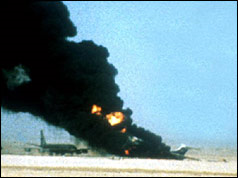
plane blowup 1970

Palestinians blow up plane, 1970

Protection Against Lethal Plans

Intelligence. Israelis utilize a wide variety of information sources to uncover plans to attack its country. Whether through a network of Israeli spies, Palestinian informants, money tracking, wiretapping and other means, the Israelis gather information and make assessments on potential Palestinian Arab attacks. It is then able to take preventative action before such attacks occur.

PALESTINIAN AUTHORITY AND HAMAS – REACTIVE DEFENSE

Relying on Israeli Sensitivities and Sensibilities

Civilians. As detailed above, the Palestinian Authority and Hamas have not instituted proactive tangible means of defending its people. One of the ways it attempts to defend the population is by making it nearly impossible to distinguish between fighters and civilians.

  • The fighters do not typically wear uniforms and can therefore not be distinguished from civilians
  • Men, women and children are all enlisted in the war against Israel
  • Militants fire at Israel from mosques, schools and civilian neighborhoods

Palestinian Arabs hope that Israel will not indiscriminately fire upon everyone. By forcing Israel to take time and extra precautions to target the right attackers, it slows down Israeli defenses during battles.

humanshieldsgaza

Destroying its Own Infrastructure. Hamas built an extensive offensive network of tunnels into Israel which originated in many private homes. By relying on Israelis sensitivities to minimize destruction in civilian neighborhoods, Hamas was able to protect many tunnel openings.

Further, Hamas and other Palestinian Arab groups often booby-trapped homes from which they attacked Israel. While the Palestinian Arabs destroyed their own infrastructure, they slowed down and killed many Israelis who looked to root out the attackers.

Relying on Global Bodies like the United Nations

United Nations. One of the principal methods that the Palestinian Authority uses to defend its population is through global bodies AFTER a war. The United Nations includes 57 Islamic countries (in the OIC) and 22 Arab countries (in the Arab League) which align themselves with the Palestinian Arab cause. Many of those countries do not even recognize the State of Israel. They were instrumental in passing the “Zionism is Racism” resolution in 1975 and creating several committees devoted only to Palestinian causes.

The Palestinians turn to the UN to highlight the damage that Israel inflicts on its intentionally defenseless population. It uses deliberate attacks on Israel to provoke premeditated casualties to show the world.

This same UN has not condemned the Palestinian Authority for not properly defending its population. Instead, it recommended the incredulous idea that Israel must give the Arabs the defensive systems like Iron Dome that it developed.

The latest forum that the Palestinian Authority has pursued is the International Criminal Court, the ICC. While it is evident that the Palestinians Arabs definitely committed war crimes in the 2014 War against Israel, it would still sue Israel in the hopes that such action will hurt Israel, further its cause and protect the Palestinian Arabs.


As detailed above the two sides in the Israel-Palestinian Authority conflict have disproportionate defenses.

  • The Israelis use several proactive approaches; the Palestinians use reactive methods
  • The Israelis rely upon ingenuity and preparedness; the Palestinians rely on Israeli sensitivities and global sympathy
  • The Israelis principally depend on themselves; the Palestinians depend on the world

A discussion of “disproportionate force” cannot be made in a vacuum without discussing “disproportionate defenses”. The global community cannot continue to reward the acts of a leadership that deliberately deals in its own premeditated casualties.


Related FirstOneThrough articles:

Israel: Security in a Small Country

The United Nations and Holy Sites in the Holy Land

The International Criminal Court for Palestinians and Israelis

The United Nations Audit of Israel

Flip-Flopping on the Felling of Terrorist Groups’ Founders

The New York Times reported on July 3, 2015 that “Tunisia’s most wanted jihadist” was killed in an American airstrike. The New York Times coverage stood in sharp contrast to the coverage that the paper used in covering Israel’s killing of a top jihadist in 2004.

DSC_0015
New York Times July 3, 2015 page A6

Headline: The headline from the story in 2015 was “Jihadist From Tunisia Died in Strike in Libya, U.S. Official Says” which clearly labeled the target as a “jihadist”. The way he died was framed in the passive “died” and was attributed to a “U.S. Official” speaking about the incident. This was in sharp contrast to the NYT article “Leader of Hamas killed in Airstrike by Israeli Missile” which did not suggest that the target was a militant but a “leader.” The man was “killed” in an active way, rather than simply stating that he “died”, and the method of the assassination was clearly attributed to Israeli action, rather than news reported by “US Officials.”

Opening paragraphs: A comparison of the opening paragraphs of each article shows the pattern of the Times coaxing its readers to celebrate the assassination of bad jihadists, but questioning the tactics of Israelis.

TUNIS — Tunisia’s most wanted jihadist, who masterminded a campaign of assassinations and terrorist attacks, including one against the United States Embassy in Tunis, was killed in an American airstrike in Libya in mid-June that had targeted another Al Qaeda leader, a senior United States official said on Thursday.

The jihadist, Seifallah Ben Hassine, also known as Abu Ayadh, was one of Osama bin Laden’s top lieutenants and the leader of the outlawed group Ansar al-Shariah in Tunisia. He had been based in Libya since 2013, according to reports, and ran training camps and a network of militant cells across the region.”

The article clearly spelled out that Ben Hassine was a very bad man from the very start of the article. He was the “most wanted jihadists” who led “assassination and terrorist attacks” including against American interests. If the US took out a man who launched many attacks including against Americans, it would make sense that such person got what he deserved. Heck, the article threw in two references to “Al Qaeda” and “Osama bin Laden” to convince the reader that this was a really, really bad guy.

Let’s compare the article about the targeted killing of the founder of Hamas by Israel in 2004:

JERUSALEM, Monday, March 22 Sheik Ahmed Yassin, the spiritual leader and founder of the militant Palestinian group Hamas, was killed early Monday by an Israeli missile that struck him as he left a mosque in Gaza City, his family and Hamas officials said. They said at least two bodyguards had been killed with him.

Sheik Yassin, a symbol to Palestinians of resistance to Israel and to Israelis of Palestinian terrorism, was by far the most significant Palestinian militant killed by Israel in more than three years of conflict.

The article led with the Sheik’s name. He was referred to as the “spiritual leader” who was killed while he “left a mosque.” His demise was reported by “his family.” Overall, he was regarded as much more of a religious human being than the “most wanted terrorist” in the article the attacker against the U.S.

The Times continued that the Sheik was “a symbol to Palestinians of resistance.” This phrase did many things: 1) using the term “symbol” made him appear as an uninvolved player; 2) “resistance” gave credence to a Palestinian narrative. No such equivalence was given to Tunisia’s most wanted terrorist.

While the Times stated that Yassin was the “founder of the militant Palestinian group Hamas”, it did not go on to state that the organization was considered a terrorist group by the US, EU, Israel and many other countries. Yet it did state that the Tunisian terrorist was “the leader of the outlawed group Ansar al-Shariah.”

Don’t worry. The contrasts get worse.

The NY Times then went on to praise the murder of the Tunisian terrorist:

“His death, if confirmed, would be an important victory for Tunisia in its struggle to contain a persistent insurgency in its western border region and a growing threat to its urban centers. Just last Friday, 38 people, most of them British, were massacred at a beach resort in the town of Sousse. In March, 21 people were killed when militants attacked the national museum.

The government has attributed many of the attacks to sleeper cells established by Mr. Ben Hassine when he founded Ansar al-Shariah after Tunisia’s revolution in 2011.”

The Times gave its readers the conclusion of the operation: it was “an important victory”. The people of Tunisia were struggling against a “persistent… and growing threat.” What about Israel?

“Black smoke curled over Gaza City as Palestinians began burning tires in the streets and demonstrators chanted for revenge. Mosque loudspeakers blared a message across Gaza of mourning for Sheik Yassin in the name of Hamas and another militant group, Al Aksa Martyrs Brigades.”

The Times reported that the assassination was not a step forward but a step backward. The killing of the founder of a terrorist movement in Tunisia was a step towards stability while the killing of founder of the Palestinian terrorist group was just a move to escalate a cycle of violence.

The Times emphasized the point by reporting on the recent attacks in Tunisia on tourists at a beach resort and a national museum (anyone in the world could have been one of those tourists, which elicits global sympathy). The Times failed to report on the multi-year Second Intifada which started in September 2000 in which Palestinians killed thousands of Israeli civilians. Just before the Israeli strike, Hamas took credit for two bombings at the Port of Ashdod which killed 10 people. No mention of the incident until much later in the article.


I leave the rest of the two articles for you to read. You will note that one article describes a military attack against a man with a long history of terrorist activities. The other article describes a Palestinian community in grief over the death of a “quadriplegic” without any mention of the hundreds of attacks and thousands of civilians murdered by Hamas.

It is not a coincidence that the article about Tunisia on July 3rd was next to another with a headline “Egypt fights back in Northern Sinai after Deadly Assault by Militants.”  The Times has taken to reporting that much of the world responds to militants while Israel attacks civilians and “spiritual leaders”.  The world’s responses will lead to victory and peace, while Israeli actions escalate violence.

Pretty amazing conclusions

  • from a country that has been waging wars for fourteen years, killing hundreds of thousands of people,
  • about a country that sits in the middle of region that is embroiled in civil wars and terrorist attacks that have also killed hundreds of thousands of people,
  • that is fighting against a group that has declared loudly and proudly its intentions of destroying its state

Related FirstOneThrough articles:

Double Standards: Assassinations

CNN’s Embrace of Hamas

The New York Times wants the military to defeat terrorists (but not Hamas)

Strange difference of opinion on Boko Haram and Hamas in New York Times

Differentiating Hamas

Why the Media Ignores Jihadists in Israel

Educating the New York Times: Hamas is the Muslim Brotherhood

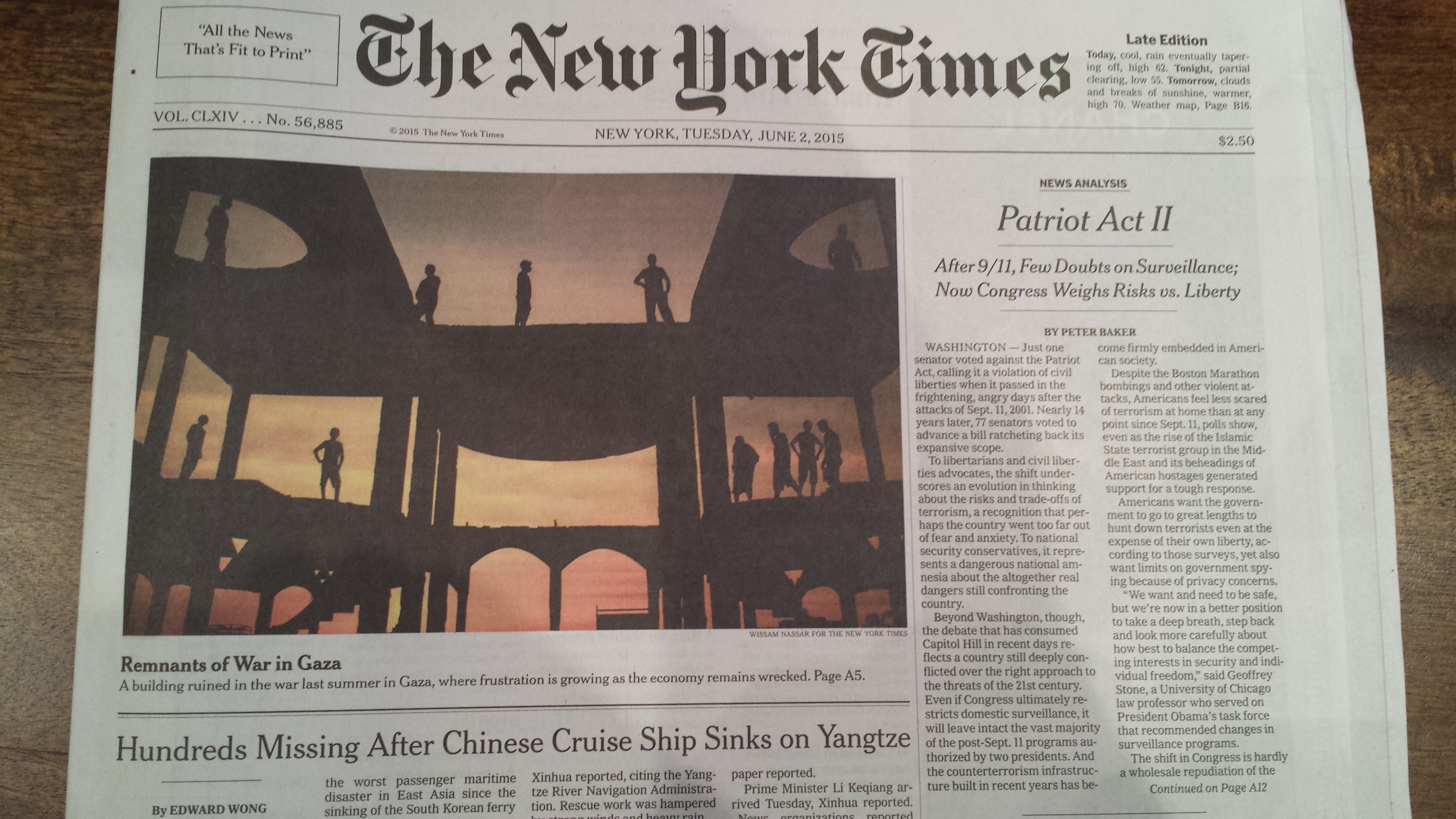
On June 2, 2015 the New York Times once again decided to tell the world that the people of Gaza are suffering.

20150602_201544
New York Times cover picture of Gaza,
June 2, 2015

With a large color picture on the front page, the Times included another picture and article inside regarding how the Gazan community has still suffered from a lack of money, jobs and rebuilding of the infrastructure one year after the war “between Hamas and Israel.”  If a reader ever wanted to learn about the scores of people killed in Nigeria, they would have to hunt inside the paper for an article on page A4 (with no picture).  If they wanted to hear about the dozens of Yemeni civilians killed by Saudi Arabia, they would have had to turn to page A12 the day before.  This has been a continuing pattern for the NYT, as outlined in “Every Picture Tells a Story – Whitewashing the World” where the killing of civilians around the world went under-reported, while the suffering of Gazans remained over-reported.

Another trend of the liberal press has been to not label Hamas a terrorist organization, as reviewed in “CNN’s Embrace of Hamas.”  The group simply is a political group dedicated to “resistance.”

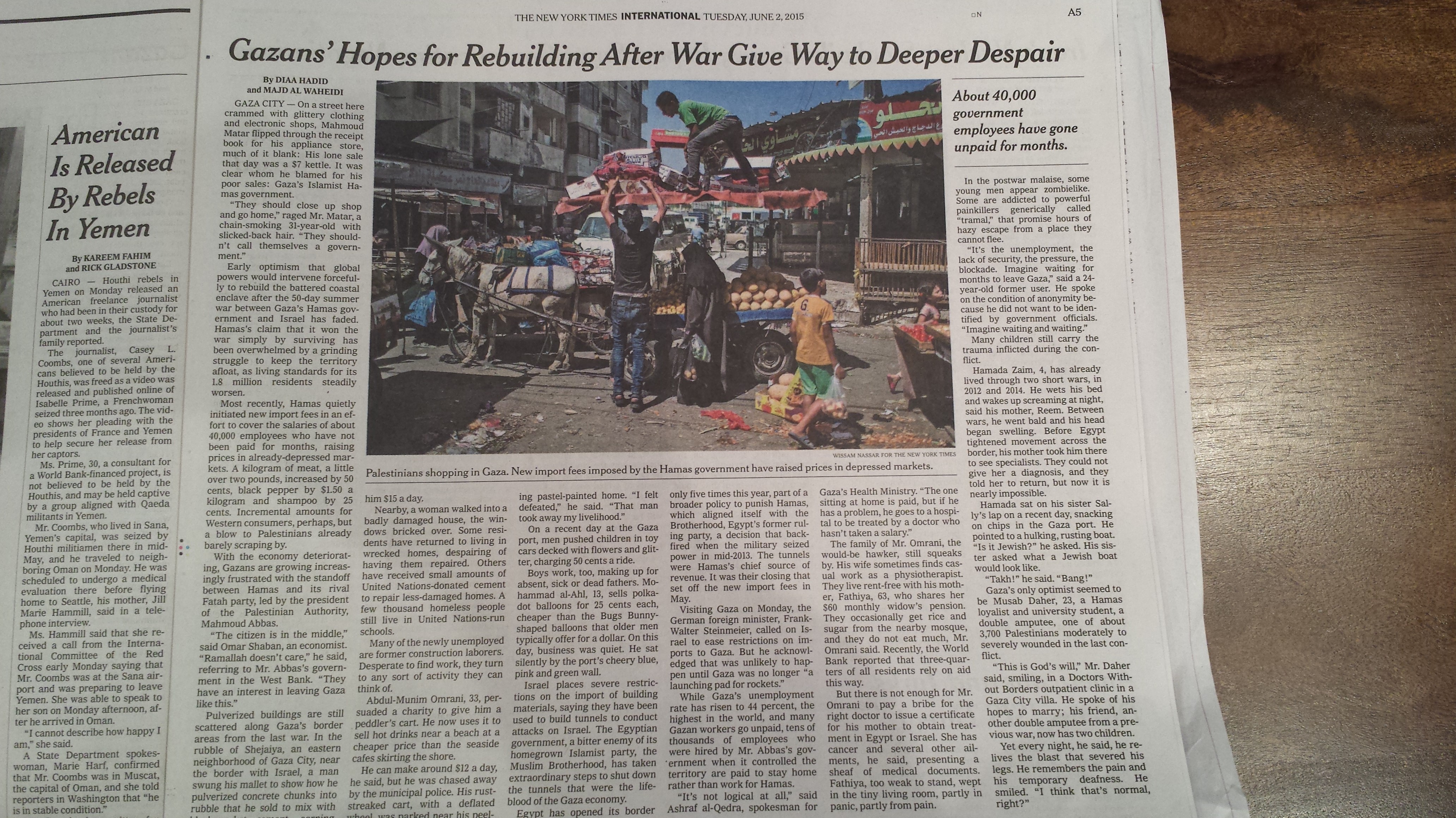
The June 2 NYT article “Gazans’ Hopes for Rebuilding After War Give Way to Deeper Despair” has continued to add to the trend of distancing Palestinian Arabs from Hamas, and Hamas from terrorism, as if everything that happened to Gazans was poor luck and happenstance.

20150602_201625

The article referred to the Palestinian Arabs’ “hope” and “Early optimism that global powers would intervene forcefully to rebuild the battered coastal enclave after the 50-day summer war between Gaza’s Hamas government and Israel “.  The article never discussed their hope that Hamas would destroy Israel.

The article detailed the blight in Gaza, stating “Pulverized buildings are still scattered along Gaza’s border areas from the last war. In the rubble of Shejaiya, an eastern neighborhood of Gaza City, near the border with Israel,” but did not discuss that the Shejaya neighborhood was the locus of dozens of tunnels from people’s homes into Israel to commit acts of terror.

It would appear that the NYT further wanted its readers to believe that the people of Gaza made a momentary strategic blunder in aligning itself with the Muslim Brotherhood in a “decision that backfired“:

The Egyptian government, a bitter enemy of its homegrown Islamist party,
the Muslim Brotherhood, has taken extraordinary steps to shut down the tunnels [connecting Egypt and Gaza]  that were the lifeblood of the Gaza economy.

Egypt has opened its border only five times this year, part of a broader policy to punish Hamas, which aligned itself with the Brotherhood, Egypt’s former ruling party,
a decision that backfired when the military seized power in mid-2013.

This is ridiculous.  Hamas IS an integral part of the Muslim Brotherhood. It didn’t simply “align itself” in “a decision that backfired.”  Here are quotes from the Hamas Charter (1988):

“Article 2: The Islamic Resistance Movement is one of the wings of Moslem Brotherhood in Palestine. Moslem Brotherhood Movement is a universal organization which constitutes the largest Islamic movement in modern times….

Article 7: The Islamic Resistance Movement is one of the links in the chain of the struggle against the Zionist invaders. It goes back to 1939, to the emergence of the martyr Izz al-Din al Kissam and his brethren the fighters, members of Moslem Brotherhood. It goes on to reach out and become one with another chain that includes the struggle of the Palestinians and Moslem Brotherhood in the 1948 war and the Jihad operations of the Moslem Brotherhood in 1968 and after.”

This is not subject to interpretation. Hamas is an integral part of the global Muslim Brotherhood movement, a group which has been actively banned and persecuted in Muslim countries such as Egypt and Syria for promoting terrorism.

However, such facts muddy a narrative of Palestinian Arabs as innocent victims.  Therefore, the media seems to have concluded that the best way to advance the victimhood tale requires a multi-part effort:

  1. Distance the people from the ruling government and negative reports. Minimize the fact that Palestinian Arabs voted for Hamas, which has led Fatah in every poll since 2006. Explain that the Arabs are frustrated by the Fatah corruption so had no practical choice other than voting for Hamas. Explain Palestinian Arabs being the most anti-Semitic people in the world by using terms like “not surprising” without delving into cause-and-effect.
  2. Stop calling Hamas a terrorist organization. Use terms like “militant” sparingly, and ideally, just “Islamist”.
  3. Refer to Hamas as a political entity. Which it is, like the Nazi party was a political entity elected by the Germans in the 1930s. Quote “political leaders” of Hamas often.
  4. Never refer to the Hamas Charter, which calls for the complete destruction of Israel; murder of Jews and never accepting any negotiated settlement. Skip the long, evil Jewish and Zionist conspiracy theories- those statements are just noise that cloud the picture of Palestinian Arab suffering.
  5. Localize Hamas to an Israeli resistant movement.  In a world that fears the dangerous rise of the Islamic State / ISIS, do not let Hamas get painted as part of a broader Muslim terrorist group (as described above).

If you follow these steps, the Palestinian Arabs can appear as passive victims and not as active participants in a radical anti-Semitic, anti-Western regional movement to install a Muslim caliphate.

Read the press today. Which rules are they using?


Related First.One.Through articles:

Cause and Effect: Making Gaza

The Death of Civilians; the Three Shades of Sorrow

Honor Killings in Gaza

The Palestinians aren’t “Resorting to Violence”; They are Murdering and Waging War

What do you Recognize in the Palestinians?

Extreme and Mainstream. Germany 1933; West Bank & Gaza 2014

CNN’s Embrace of Hamas

Many people in the pro-Israel community continue to be frustrated by the refusal of many media outlets and some political organizations to designate Hamas a terrorist organization. While the phrase “one person’s terrorist is another person’s freedom fighter” is often bandied about, organizations have no difficulty clearly labeling some organizations as terrorist groups.

Consider CNN which highlighted five jihadist groups in February 2015 as terrorist organizations: Al-Shabaab; Al Qaeda; Boko Haram; ISIS; and the Taliban. The groups are consistently labeled as jihadist terror organizations that seek to destroy reigning governments.

AL-SHABAAB

CNN has clearly labeled Al-Shabaab as a terrorist group:

Al-Shabaab was specifically designated as a  terrorist organization by CNN, which did not couch the language as a suggestion that it could be considered a terrorist group by some third party.

AL QAEDA

As of early 2015, CNN considered Al Qaeda’s central command structure under threat while it spread around the world. It was clear in all circumstances that they were terrorists:

BOKO HARAM

CNN often localized Boko Haram to Nigeria and neighboring countries (compared to the growing global threat of Al Qaeda), but consistently referred to the group as terrorists.

ISIS

ISIS/ ISIL/ Islamic State has been extremely active in 2015 and gathering many news reports on CNN and all media outlets, particularly as the United States has been engaging them in Iraq and Syria:

TALIBAN

The Taliban has not been as prominent in the news lately.  However, when it was, CNN was clear that the group’s actions and the group itself was involved in terrorism.

These five organizations are identified by CNN as terrorist groups. They are Islamic jihadists. They terrorize and attack. They seek to overthrow existing governments through murder and mayhem.

Now compare them to CNN’s description of Hamas.

HAMAS

On February 28, 2015 CNN had an article entitled Egyptian court designates Hamas as a terror organization, state media says.  Note that CNN clearly did not make the designation, but repeated an assertion from Egypt.  The article read: “Hamas, the Islamist group which dominates the Gaza strip, has been at odds with the Egyptian government…” made it seem that there was simply a political disagreement between Hamas and Egypt, between two ruling parties. CNN referred to Hamas only as “Islamist” and not “jihadist”, “militant” or “terrorist”.

CNN continued: “Hamas quickly denounced the decision at a news conference…. “It is a shocking and dangerous decision that targets the Palestinian people,” Fawzi Barhoum, a Hamas spokesman, said at a news conference”.  The article highlighted that Hamas was designated a terrorist organization by one country (as opposed to actually being a terrorist group) and CNN made the effort of showing that the group challenged such opinion.  The quote chosen by CNN further tried to show that such designation was itself an attack on “the Palestinian people” making the group the victim.

How is that for a turn?

On January 6, 2015 CNN wrote another piece that seemed all about politics. “Senior Hamas official Izzat Risheq denied reports Monday that the group’s political leader Khaled Meshaal has been expelled from Qatar” making the group appear as purely s political party. There was no mention that the group is in favor of jihad, destruction of Israel or is terrorist group.

On November 27, 2014 a CNN article entitled “Israel says it broke up Hamas terror plot” specifically gave attribution of the plot to Israel, and not as a clear fact. The article stated that “Authorities arrested at least 30 members of Palestinian militant group Hamas” which at least referred to the group as “militantwhich is much more than it typically writes to describe Hamas.

These were the recent articles while Hamas licked its wounds from its 2014 war against Israel.  How did CNN describe Hamas during the 2014 campaign itself?

CNN’s Assertion of No Hamas War Against Israel 

In its August 22, 2014 article “Hamas leader admits militants abducted slain Israeli teens,” CNN quickly distanced the group leadership from the abduction and murder of three Israeli boys.  The three leading paragraph’s took pains to absolve the group’s leadership:

“Three Israeli teens kidnapped in the West Bank in June and later found dead were abducted by Hamas militants who did not inform the group leadership about
the kidnapping, a Hamas official said Friday.
“At that time, the Hamas leadership had no knowledge about this group or the operation it had just carried,” Saleh Aruri, a Hamas Political Bureau member, said in a statement from Doha, Qatar. “It turned out later, however,
that they were members of Hamas.”
Aruri said the operation to abduct the teens was not approved by the Hamas leadership or its military wing, the Qassam Brigades.”

The article (in its entirety) quoted no Israelis. CNN repeatedly referred to Hamas as a political entity (does CNN ever quote Boko Haram’s main political spokesman?), as the article sought to distance Hamas from the murders.

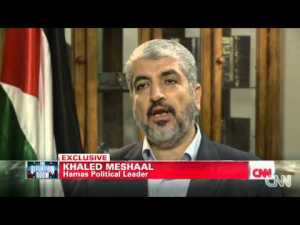
These actions were done repeatedly by CNN, most egregiously on August 4, 2014 when it aired an interview “CNN exclusive: Inside the mind of Hamas’ political leader

Meshaal CNN Meshaal “Political Leader” on CNN

The introduction to the interview with Khaled Meshaal made it appear that CNN was going to have a serious exchange: “CNN’s Nic Robertson had tough questions for Hamas’s political leader.”   Well, maybe not- CNN was again directing the public that Hamas is simply a political organization. Did the article ever mention:

  • that the Hamas Charter calls for the complete destruction of Israel?
  • the Hamas Charter calls for jihad and murder of Jews by every man, woman and Palestinian child?
  • the Hamas Charter which declares that there is no possibility of peace with Israel through any negotiation, and that all of Israel must be destroyed through military means?
  • the Hamas Charter’s repeated use of anti-Semitic slurs, stereotypes and conspiracy theories?
  • the repeated calls by Hamas and Palestinian leadership to attack Israel?

During the interview, did Robertson get answers to questions:

  • if Hamas is fighting for the Palestinians, why was Meshaal sitting comfortably in Qatar?
  • if Hamas was intentionally firing rockets from civilian neighborhoods in Gaza?
  • if Hamas targeted Israeli civilians with such attacks?
  • if Hamas built tunnels to abduct and kill Israelis?
  • if Hamas would abolish its charter?
  • if Hamas would recognize Israel?
  • what lands Hamas considers as “occupied” since Israel left Gaza in 2005

It is noteworthy that Robertson asked Meshaal how he was helping his “resistance” to Israel (Robertson used Hamas’ terminology instead of terrorism). Meshaal responded that Palestinians understood that military resistance was needed to get rid of Israeli occupation, the same way that the Americans got rid of the British and the French got rid of the Nazis.  Robertson let the statement stand and did not follow up about the absurdity of the comparisons. The French repelled the Nazi invading force that took over France. The US sought separation from a colony to an independent country. But here, the Palestinians were attacking an independent country, once again seeking its complete destruction and murder of its people.

Neither in the interview nor accompanying article did CNN’s Robertson ever call out Hamas as a jihadist terrorist group.  It did however, allow Meshaal to air his propaganda and assume a victim status both at the hands of Israel and the global community:

“”We the Palestinian people have, since 1948, have listened to the international community and U.N. and international regulations, in the hope they end the aggression against us. But the international community failed in ending the Israeli occupation and failed in helping our people to have self-determination and have its own state.”

Imagine CNN airing such an interview and article about any other terrorist group.


Related FirstOneThrough articles:

Differentiating Hamas into Political and Military Movements

The New York Times wants to defeat Terrorists (just not Hamas)

Cause and Effect: Making Gaza  

Recognizing the Palestinians

Palestinians are “Desperate” for…

The Palestinians aren’t “Resorting to Violence”; They are Murdering and Waging War

Why the Media Ignores Jihadists in Israel


The “Unclean” Jew in the Crosshairs

Summary: Antisemites calling Jews “unclean” is their first step towards calling for purifying them from the world. How should the world respond?

There have been a number of political leaders who have called Jews “unclean”:

  • Adolf Hitler’s Mein Kampf (1925): “The moral and physical cleanliness of this race [Jews] was a point in itself. It was externally apparent that these were not water-loving people, and unfortunately one could frequently tell that even with eyes closed. Later the smell of these caftan wearers often made me ill. Added to this were their dirty clothes and their none too heroic appearance. 
  • Hamas Charter (1988):The basic structure of the Islamic Resistance Movement consists of Moslems who have given their allegiance to Allah whom they truly worship, – “I have created the jinn and humans only for the purpose of worshipping” – who know their duty towards themselves, their families and country. In all that, they fear Allah and raise the banner of Jihad in the face of the oppressors, so that they would rid the land and the people [Jews] of their uncleanliness, vileness and evils.”
  • Iran’s Supreme Leader Ayatollah Ali Khamenei (2013):Israeli regime, this sinister, unclean rabid dog of the region
  • Acting Palestinian Authority President Mahmoud Abbas (2014): “Keep the settlers and the extremists away from Al-Aqsa and our holy places. We will not allow our holy places to be contaminated.

iran-khamenei-adl-israel-rabid-dog

It did not take long for these leaders and parties to move from their initial anti-Semitic positions, to calls to eradicate the Jews:

  • Hitler’s Nazi party gradually stripped Jews of their citizenship in the early and mid-1930’s once the gained power, pushed them into ghettoes and work camps by late 1930’s and began their annihilation by the early 1940’s.
  • Hamas called for the murder of Jews and destruction of Israel in the very same 1988 charter: “rid the land and the people [Jews]“, “there is a Jew behind me, come and kill him” and “Israel, Judaism and Jews challenge Islam and the Moslem people.”  The Palestinian people voted for Hamas into 58% of the Parliament in 2006.
  • Iran’s leader was quite clear in 2014: “This barbaric, wolflike & infanticidal regime of which spares no crime has no cure but to be annihilated
  • The Fatah party of the Palestinians was led by Yasser Arafat who said: “We will not bend or fail until the blood of every last Jew from the youngest child to the oldest elder is spilt to redeem our land!”” His successor, Mahmoud Abbas declared In a final resolution, we would not see the presence of a single Israeli – civilian or soldier – on our lands.

One can call Abbas a “moderate” in comparison to those around him in that he has not openly called for killing Israelis (he prefers the indirect method of honoring and celebrating those that do kill Israelis).

President Obama commented about ISIS (2014) that “the world must never cease in seeking to defeat their evil ideology.” Such evil ideology is the open platform in the Iranian and Palestinian leadership.

As Obama is actively engaged in dialogue and negotiations with both of those parties, does he think

  • that the Iranian and Palestinian platforms are not “evil ideologies
  • that they are exceptions that do not need to be defeated, or
  • his process of negotiation and placating them is a method of “defeating” them?

Related FirstOneThrough articles:

The Palestinians War Against the Jews

Palestinian anti-Semitism surpasses Nazi Germany

Before recognizing a Palestinian State, Recognize what the Palestinians are saying