The Journeys of Abraham and Ownership of the Holy Land

One of the most famous cartographers in the world was Abraham Ortelius (1527-1598). Appointed as cartographer to King Phillip II of Spain, the religious Christian Flemish cartographer is credited with creating the first world atlas called “Theatrum Orbis Terrarum” or “Theatre of the World.” The atlas was originally printed in 1570 and became one of the most popular books of its time and resulted in a few printings. In total, there were 178 plates amounting to approximately 730,000 printed copies of the various maps.

In addition to the maps printed in the atlas, Ortelius also produced “Parergon” maps of interesting places. These “classical” maps were produced by Ortelius himself, as opposed to some maps in “Theatrum” which were adopted from other cartographers. The 56 such plates produced roughly 143,000 printed maps.

One of the maps of the Parergon was called “Abrahami Patriarchae” which chronicled the life of the biblical patriarch Abraham. The first map was printed between 1590 and 1595 (975 copies made) with a second plate produced 1592-1624 (2925 copies made). The map shows the journey and life of Abraham with an inset map of his journey from Ur to Canaan, as well as 22 medallions of significant life events. The map highlights Ortelius’s gift as cartographer, artist and historian.

Ortelius
Abrahami Patriarchae Peregrinatio et vitae, 1592

Some notable medallions in the map are detailed below which underscore the belief that God gave Jews the holy land:

  • Medallion 6. Genesis 13: 14-15 “The Lord said to Abram after Lot had parted from him, “Look around from where you are, to the north and south, to the east and west. 15 All the land that you see I will give to you and your offspring forever.”
  • Medallion 10. Genesis 15: 17-21 “17 When the sun had set and darkness had fallen, a smoking firepot with a blazing torch appeared and passed between the pieces. 18 On that day the Lord made a covenant with Abram and said, “To your descendants I give this land, from the Wadi of Egypt to the great river, the Euphrates— 19 the land of the Kenites, Kenizzites, Kadmonites, 20 Hittites, Perizzites, Rephaites, 21 Amorites, Canaanites, Girgashites and Jebusites.”“
  • Medallion 12. Genesis 17:3-8 “3 Abram fell facedown, and God said to him, 4 “As for me, this is my covenant with you: You will be the father of many nations. 5 No longer will you be called Abram; your name will be Abraham, for I have made you a father of many nations. 6 I will make you very fruitful; I will make nations of you, and kings will come from you. 7 I will establish my covenant as an everlasting covenant between me and you and your descendants after you for the generations to come, to be your God and the God of your descendants after you. 8 The whole land of Canaan, where you now reside as a foreigner, I will give as an everlasting possession to you and your descendants after you; and I will be their God.”
  • Medallion 18. Genesis 21: 27-31 (ownership of Beersheba) “27 So Abraham brought sheep and cattle and gave them to Abimelek, and the two men made a treaty. 28 Abraham set apart seven ewe lambs from the flock, 29 and Abimelek asked Abraham, “What is the meaning of these seven ewe lambs you have set apart by themselves?” 30 He replied, “Accept these seven lambs from my hand as a witness that I dug this well.” 31 So that place was called Beersheba, because the two men swore an oath there.“
  • Medallion 20. Genesis 23: 19-20 (ownership of Hebron) “19 Afterward Abraham buried his wife Sarah in the cave in the field of Machpelah near Mamre (which is at Hebron) in the land of Canaan. 20 So the field and the cave in it were deeded to Abraham by the Hittites as a burial site.”

This map was made by a religious Christian, not a Jew. Many evangelical Christians and others that believe in the Old Testament firmly hold that while the holy land may be holy to all of the monotheistic faiths, the land itself is God’s gift to Jews. Indeed, God is the original Zionist.

The Relationship of Man and Beast

“18 The Lord God said, “It is not good for the man to be alone.
I will make a helper suitable for him.”

19 Now the Lord God had formed out of the ground all the wild animals and all the birds in the sky. He brought them to the man to see what he would name them; and whatever the man called each living creature, that was its name. 20 So the man gave names to all the livestock, the birds in the sky and all the wild animals.

But for Adam no suitable helper was found.”  (Genesis 2:18-20)


Biblical Review:
Man’s Superiority over Animals

Humans believe they are the smartest animals on Earth. While our three pound brain is not the largest in the animal kingdom (sperm whales have 17 pound brains), we humans tend to commend ourselves for our ability to walk upright, develop sophisticated machines, consider things beyond our senses and create the selfie stick.

Religion has cemented this bias. The Old Testament unveiled the story of the creation of the world with plants and animals arriving first and then man – Adam – being the final ultimate act of creation.  Man’s creation was preceded with a statement:

“26 Then God said, “Let us make mankind in our image, in our likeness, so that they may rule over the fish in the sea and the birds in the sky, over the livestock and all the wild animals, and over all the creatures that move along the ground.” (Genesis 1:26)

Man was the only creature “made in God’s image” and the only creation which was specifically tasked with “ruling” over other species. The superiority of Man over animals could not be more clearly laid out.

The Quran similarly detailed man’s dominion over beasts: “And the cattle, He has created them for you.  You have in them warm clothing and (other) advantages, and of them you eat.  And therein is beauty for you, when you drive them back (home) and when you send them out (to pasture).  And they carry your heavy loads to regions which you could not reach but with great distress to yourselves.  Surely your Lord is Compassionate, Merciful.  And (He made) horses and mules and asses that you might ride upon them and as an ornament.  And He creates what you know not.” (Quran 16:5-8)

OLYMPUS DIGITAL CAMERA

Adam and Eve in the Garden of Eden, by Wenzel Peter

Man’s Relationship with Animals

Interestingly, the story in the Old Testament quickly moved past man’s supremacy over beasts. We soon read about a lonely man needing companionship so God brings the animals to man to ease the pain of solitude.  While the Quran relayed some benefits of ruling over animals (food, clothing, beasts of burden), the Old Testament relayed that animals could be a source of company and intimacy.

The bible pivots from man’s dominant position quickly.  When a snake tricked man into eating the forbidden fruit in the Garden of Eden (maybe it was mad at being passed over by Adam?), man lost his place in paradise. Suddenly, man understood that he was not only naked, but had reason to fear animals as well.

Despite this more complicated relationship between man and beast, during the story of Noah and the flood, man was given the responsibility for saving all of the animals.  God could have instructed Noah to build a small boat to save only himself and his family, but instead tasked man with helping animals as well. Superiority and fear yielded to responsibility and care.

Later generations in the bible would principally treat animals as inferior life forms for man to enjoy, whether by eating them, dressing with their skin, using them to work the fields, and offering them for sacrifices.  The bible principally describes helping animals only to keep the animals alive for future service; there was no discussion of them as companions.

Overall, the Pentateuch discussed plant life in a much more gentle fashion than animals.  Consider Deuteronomy 20 which discussed going to war:  All living things – including animals – were to be killed when fighting people with detestable belief systems.  The animals belonging to those people were considered corrupted by the actions of the people and therefore worthy of annihilation.  However, the fruit trees that belonged to those same people were spared.

All items from the ground are kosher and permissible to eat, but animals are more complicated: they are innately kosher or non-kosher. But even kosher animals can become corrupted.

Pets Today:
Companions Again

Americans have grown very close to their pets and have begun to “humanize” them. People are now more inclined to give their pets human names (Bo) versus “pet names” like “Rover” a generation ago. Approximately 76% of pet owners consider their pets to be full members of the family and they treat their pets accordingly.

Pet ownership in the United States rises every year. There are an estimated 78 million dogs and 86 million cats in the US in 2015 (APPA). That figure compares to 74 million children under the age of 18 in the country. Yes, there are more cats and dogs than kids. Consider further that the US pet industry is about $60 billion. That is more than the entire planet spends on babies.

Entirely new industries have sprung up around pets over the past several years: pet insurance; pet day care, pet-friendly hotels and restaurants. There is even a special TV channel, DogTV, just for dogs to watch.

We have taken animals from the fields into our homes and call them members of the family.


The biblical story of superiority over animals evolved over time. The power of creation imbued man with power over animals. Stories of destruction were coupled with man’s responsibilities.  But the biblical discussion of animal companionship was very fleeting. Man rejected animals right at the beginning of history, so God created woman to be his partner.  Thereafter, the role of animals became utilitarian.

Today, animals give us comfort.  We have added pets to our families in even greater numbers than children. We read stories of the flood to our children and skim the vileness of man and their annihilation, and celebrate the many animals in the world’s first zoo.

Darwin’s Theory of Evolution is that all living things had a common ancestor. Beyond considering man’s physical evolution, it is worth noting mankind’s emotional evolution in its relationship with his fellow creations.

Related First One Through article:

Israel, Mother Nature’s Son

Subscribe YouTube channel: FirstOneThrough

Join Facebook group: FirstOne Through  Israel Analysis

Gimme that Old-Time Religion

Two of the three main monotheistic faiths had amazing historical revelations in July 2015. If you read the New York Times, you only learned about one of them.

Quran

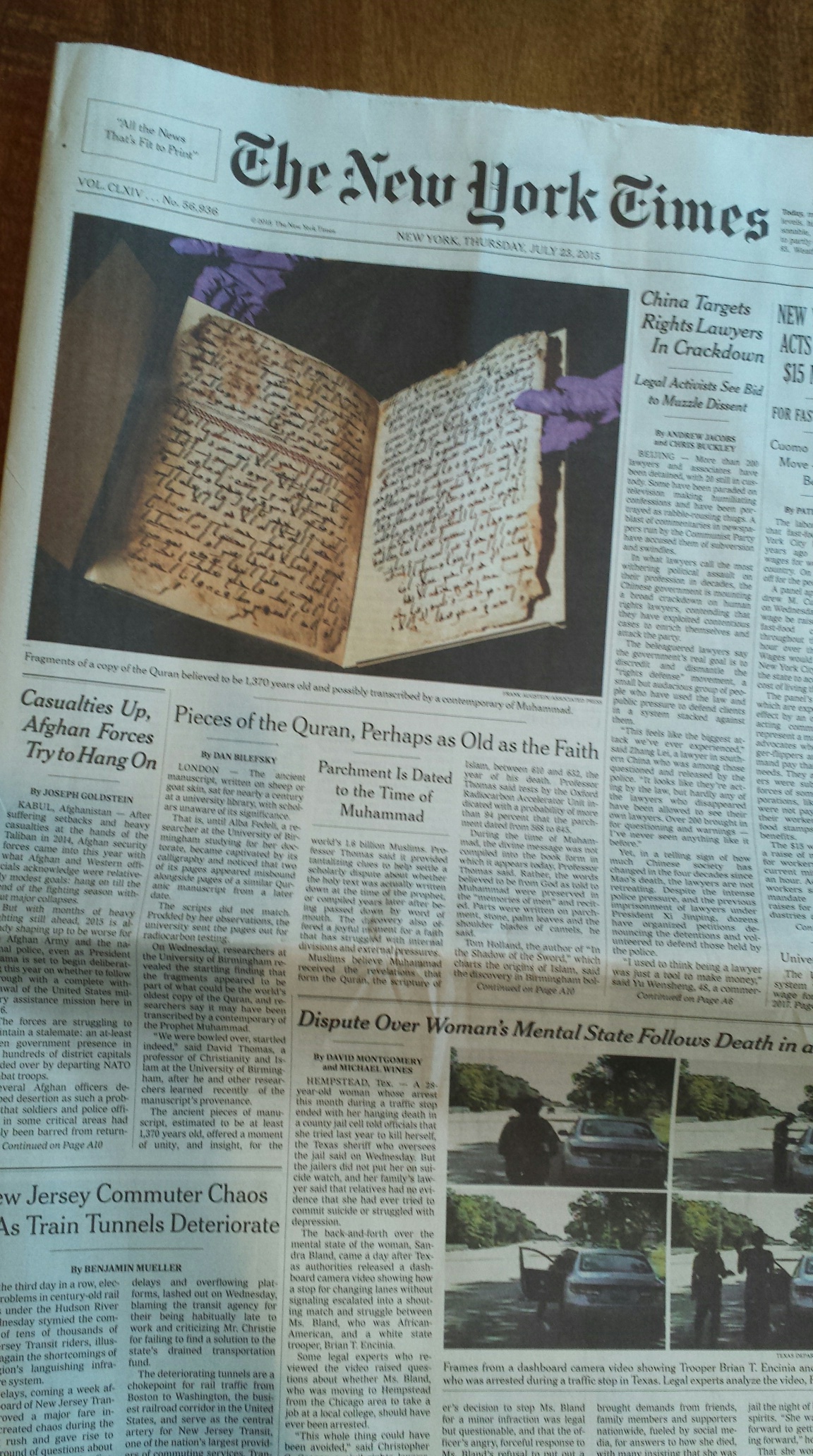
On a front page story with a large accompanying color picture, the New York Times relayed an incredible discovery: an old Quran that had been sitting on the shelves of the University of Birmingham, England for a century, was dated to around the year 600CE plus or minus 50 years.  That would make this version of the Quran the oldest manuscript in Islam.

20150724_072357
New York Times Front Page Story on Quran,
July 23, 2015

According to Islamic tradition, their prophet Mohammed received divine revelations and compiled the Quran sometime between 610 to 632CE. Religious scholars had debated whether the Quran was passed down in oral form for many generations after Mohammed’s death before ultimately being written down. If the text indeed was written down on the parchment when it was prepared (sometimes parchments were washed and reused, and carbon-dating only relates to the parchment but not the actual ink and text), it would answer that outstanding question.

The Hebrew Bible

Three days before the world heard about the dating of the oldest Quran, researchers uncovered one of the oldest texts of the Hebrew Bible, dating from around 500CE.

EinGediscroll1
Charred scroll from synagogue in Ein Gedi
(photo: Shay Halevi/Israel Antiquities Authority)

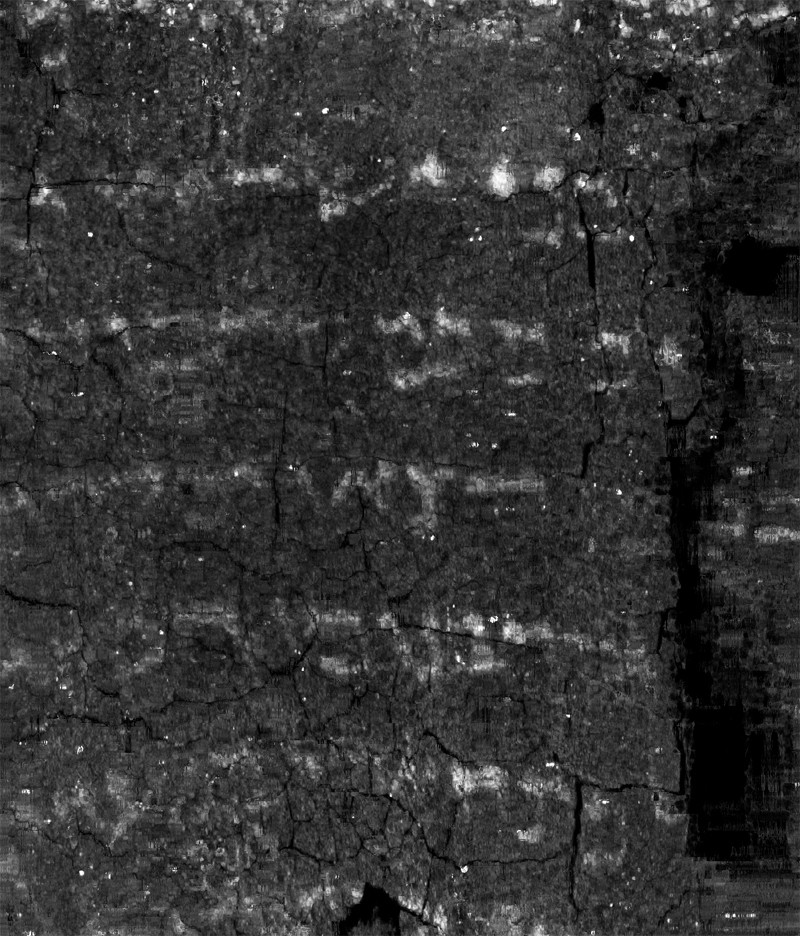
In the 1970s, the piece of a charred scroll was discovered in Ein Gedi in the Judean Desert. Only in July 2015 were researchers able to use the latest technology to decipher the damaged text to reveal sentences from the book of Leviticus. While older documents (by 500+ years) of the Hebrew Bible had been discovered not far from Ein Gedi, those documents were found hidden in jars within caves.  This scroll was found in the ancient synagogue of Ein Gedi, revealing the earliest discovery of a Torah scroll housed in a synagogue.

scroll-800x936
Text from the Ein Gedi scrolls
(photo: University of Kentucky)

Both of these stories are amazing in terms of history, religion and science.  It brings to mind an old gospel song: “Give Me that Old Time Religion!”

Yet the part “that’s NOT good enough for me” (to paraphrase the song) is the nagging question why the New York Times never misses an opportunity to slight Israel.  The discovery of one old religious treasure received front page attention (for Islam) but a text from 100 years earlier didn’t even get a passing mention (for Judaism).  Was it because the scrolls were found in the Judean Desert which further underscores the long history of Jews in the contentious Jordan Valley?

Why do you think the NYT mentioned only one of these stories?


Related FirstOneThrough articles:

When were Jews barred from living in Judea & Samaria?

Names and Narrative: The West Bank / Judea and Samaria

The Subtle Discoloration of History: Shuafat

Subscribe YouTube channel: FirstOneThrough

Join Facebook group: FirstOne Through  Israel Analysis

From Promised Land to Promised Home

Summary: God is the original Zionist.

Judaism is a unique religion in many respects:

  • Every other religion is based primarily on faith. Judaism is based primarily on lineage.
  • Every other religion is based on belief. Judaism is based on action.
  • Every other religion is not geographically-bound. Judaism is tied to the land of Israel.

The Old Testament has 613 commandments for Jews to observe. Many of those can only be kept inside the land of Israel. Those commandments relate to the sanctity of the land, as God promised the land to Abraham and the generations after him.

shmita
Observing “Shmita” only in Israel
(photo: FirstOneThrough)

Promised Land

The Bible has three sets of promises of the land of Israel for the Jewish people. The first set is God’s original promise to Abraham:

  • “The Lord appeared to Abram and said ‘To your descendants I will give this land’” (Genesis 12:7)

The book of Genesis repeats the promise to Abraham, Isaac and Jacob several times where the land is presented as “an everlasting possession” for the generations to come. (Genesis 17:8).

DSC_0258
The Western Galilee
(photo: FirstOneThrough)

Promised Return to the Land

The second set of promises related to the return to Israel from slavery in Egypt. That promise is slightly different than the original promise to the Jewish forefathers:

  • The land is described as being a good land “flowing with milk and honey”
  • The land is occupied by others, by the “Canaanite and the Hittite and the Amorite and the Perizzite and the Hivite and the Jebusite.” (Genesis 3:8)

Hundreds of years earlier, God just told Abraham to go “to the land that I will show you” (Genesis 12:1) without any description of the location or nature of the land.  At the point of the exodus from Egypt, God promised not only freedom from slavery, but to a land of great quality.  Presumably, the land was so good, that others had now moved there while the Jews were trapped in Egypt.  However, God promised to “drive them [the others] out” (Exodus 23:30) and that the Jews will ultimately possess it.

cows
Cows in the Golan
 
(photo: FirstOneThrough)

 Promised Home

The Old Testament ends with yet a third promise: a return from the diaspora to the land of Israel, to their home.

  • The promise includes an ingathering of exiles from “the four quarters of the Earth” (Isaiah 11:12)
  • Israel is no longer only described as simply being a good land, an inhabited land or the land of the Jewish forebears. The land is described as belonging to the people of Israel. The prophets repeatedly describe that God will “bring you home again to your own land” (Jeremiah 29:14)

Home. A place that is established and well-known. That doesn’t require a list of directions of how to get there, nor many adjectives.

It is a place where a people grows up and lives. It is a place of life events, both happy and sad. Where families celebrate, quarrel and mourn. A place with family history and history to be made.

Home is where “house rules” apply; where the house decides what is allowed and denied. It decides what is in the best interest of its inhabitants. It is the safe space where a family comes to find sanctuary from the world at large.

Home is always home, even when people have been away. But especially when they come back.

 DSC_1067
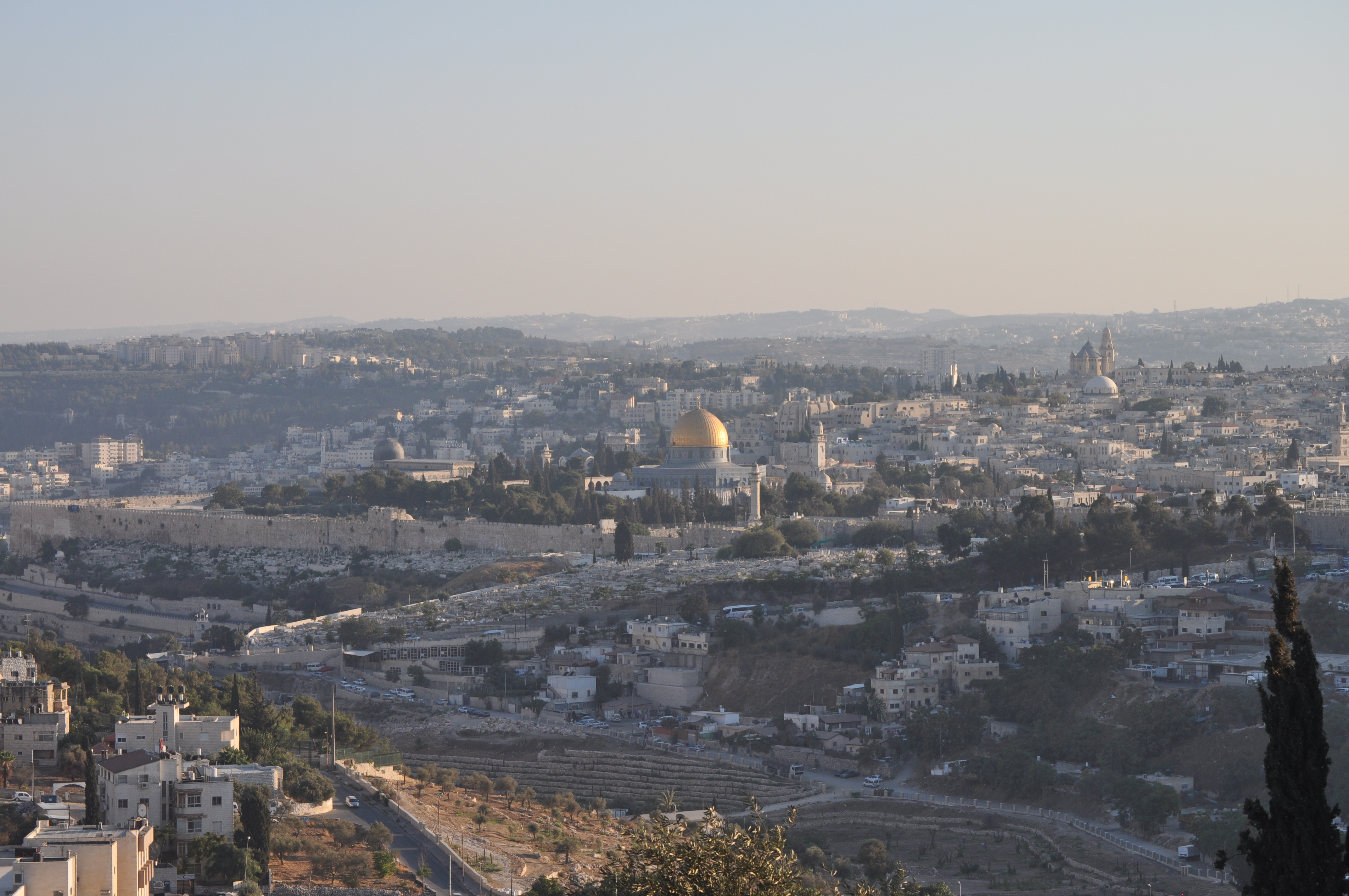
Jerusalem’s Old City
(photo: FirstOneThrough)

A music video about God’s promises of the land of Israel to the descendants of Abraham, Isaac and Jacob to become a home for the Jewish people.