
Understanding Judaism as the ancestral religion of a people changes the entire debate over Zionism, indigeneity and colonialism.
Everyone wants to define antisemitism and Zionism. Jewish organizations, politicians and academics spend enormous energy debating these terms, convinced that better definitions will produce greater understanding.
Yet they overlook a more fundamental question: What is Judaism?
The conventional answer, that Judaism is one of the world’s three great monotheistic religions, is technically correct but profoundly misleading.
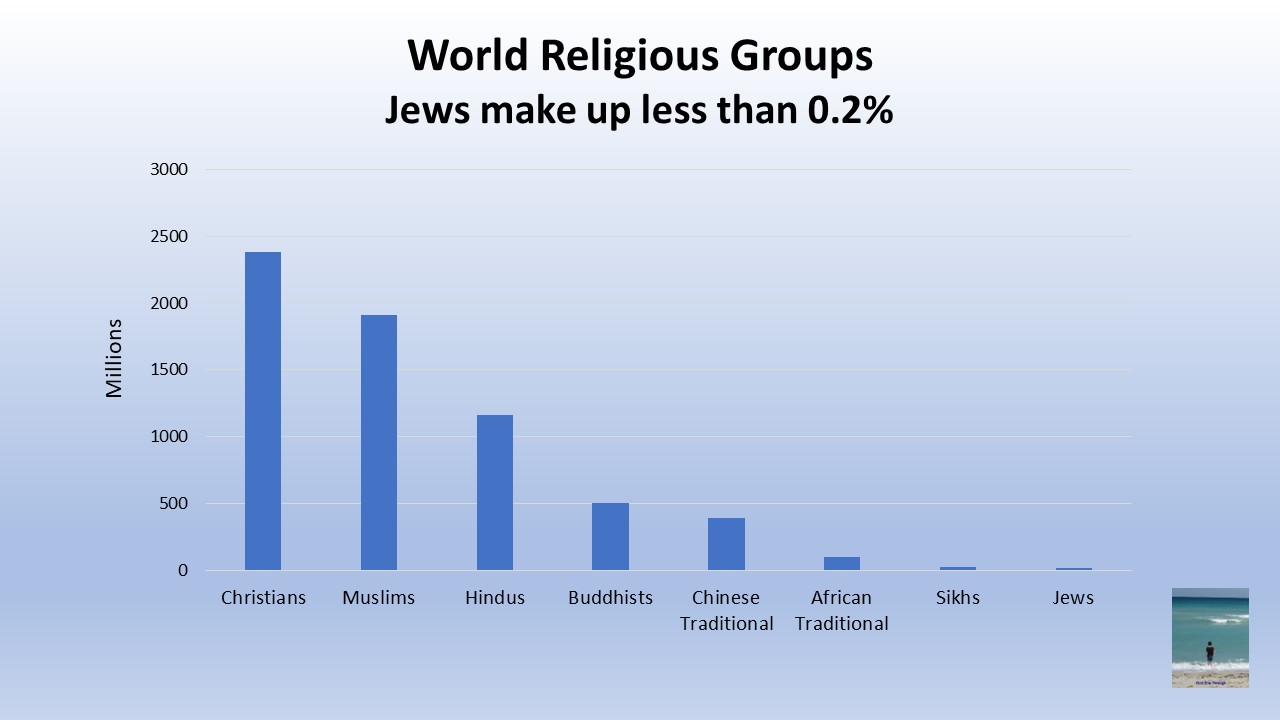
Christianity and Islam are universal religions, with messages directed toward humanity and traditions of bringing the world into their faiths. Their religious communities transcend ancestry and geography, helping explain why each has spread across continents and attracted more than two billion adherents.
Judaism, meanwhile, has approximately 15 million people after more than three thousand years. It has survived empires, expulsions, massacres, forced conversions and genocide, yet remains extraordinarily small.
The three religions are grouped together because of their historical and theological connections. Jesus was Jewish, forever connecting Christianity to the Jewish people. Islam incorporates Abraham, Moses and other biblical figures into its tradition. Both transformed elements of Judaism’s religious inheritance into universal faiths. The historical irony is that the world subsequently began interpreting Judaism through the framework of its successors, making the original religion appear to be the peculiar exception.
Jewish religious leaders often explain the difference by describing Judaism as a particularist rather than universalist form of monotheism. Jews have a special covenant with God, while humanity can live righteously without becoming Jewish. Judaism generally does not seek converts.
But particularism merely modifies the conventional classification. There is a more fundamental distinction: Judaism is an ancient tribal folk religion, or more precisely, an indigenous ethnoreligious tradition.
Consider the Yazidis, a small ethnoreligious community whose ancestral homeland lies in northern Mesopotamia and whose sacred sanctuary at Lalish remains central to their identity despite centuries of persecution. Or the roughly one million Māori of New Zealand, whose understanding of ancestry, tribal identity and sacred geography binds people to the land of their forebears. The world readily recognizes that these peoples’ relationships with their ancestral lands are embedded in their identities.
Judaism belongs in this same family of land-rooted traditions.
The Torah itself reveals the difference. It begins with the creation of humanity but quickly narrows to the story of one family, its descendants, its covenant, its laws and its promised land. Genesis traces a family. Exodus describes the formation of a nation. Numbers organizes that nation into tribes. Deuteronomy prepares it to reenter its ancestral homeland.
The Torah is sacred scripture, but it is also the founding history and constitution of a people. Jews call themselves Am Yisrael, the People of Israel, carrying the name given to Jacob, ancestor of the twelve tribes, thousands of years before the establishment of the modern state.
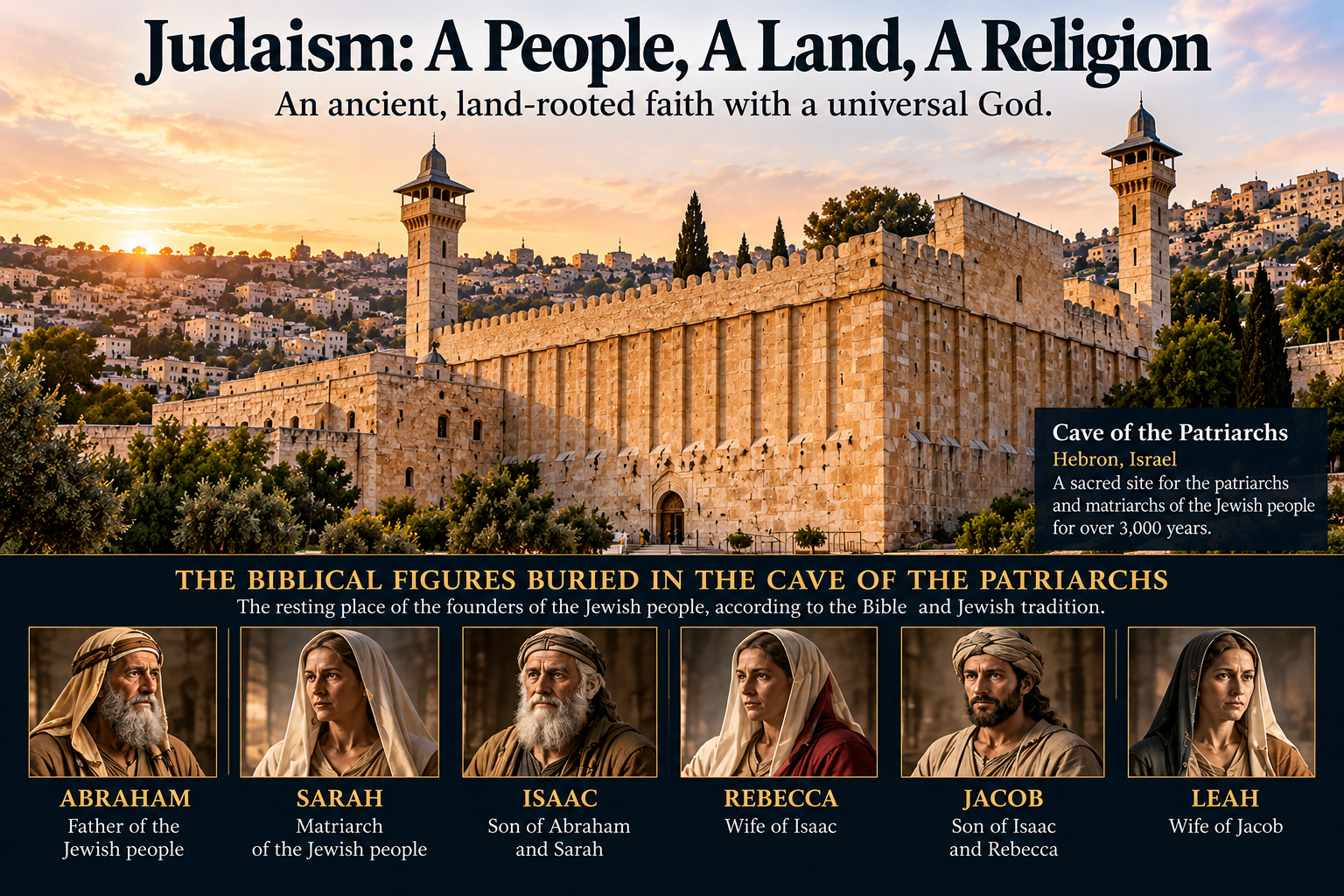
Even conversion reflects this understanding. A person converting to Judaism joins the Jewish people, assuming the obligations and identity of the community. Ruth’s famous declaration captures the union: “Your people shall be my people, and your God my God.” The people come first in the sentence.
Most revealing is how thoroughly Judaism is rooted in the physical land of Israel.
Jewish law governs the cultivation, harvesting and distribution of produce grown there. The sabbatical year requires the land itself to rest, shmita. The Temple in Jerusalem was the center of national worship. And the Torah commands Jewish males to appear before God at the designated sanctuary three times annually, for Passover, Shavuot and Sukkot.

Consider the extraordinary geographic assumption: Three times every year, Jewish men were commanded to journey to the national sanctuary, eventually established in Jerusalem. These commandments were written for a world of footpaths, centuries before mechanized transportation. The Torah envisioned a people living within reach of a common sacred center, cultivating the same land and celebrating its agricultural seasons.
Judaism was conceived as the religion of a people living in the land of Israel. Its commandments were embedded in the soil, seasons, cities and sacred places of that homeland. Its God was universal, but its religious civilization was profoundly local.
The destruction of Jewish sovereignty and the dispersal of much of the population forced that land-based religion to adapt. Jewish communities developed religious institutions and practices that could survive thousands of miles from Jerusalem, and without a Temple. Yet the homeland remained central to their prayers, calendar, holidays and collective memory.
Jews continued living in Israel under successive foreign rulers, while communities in Poland, Yemen, Ethiopia and Iraq preserved the same ancestral orientation. A Jew could speak another language, adopt different customs or even reject belief in God and remain part of Am Yisrael.
For Christianity and Islam, the faithful carry their religion wherever they go. For Jews, wherever they went, their religion carried them back to Israel.

The consequences of misunderstanding this relationship are visible today on the Temple Mount.
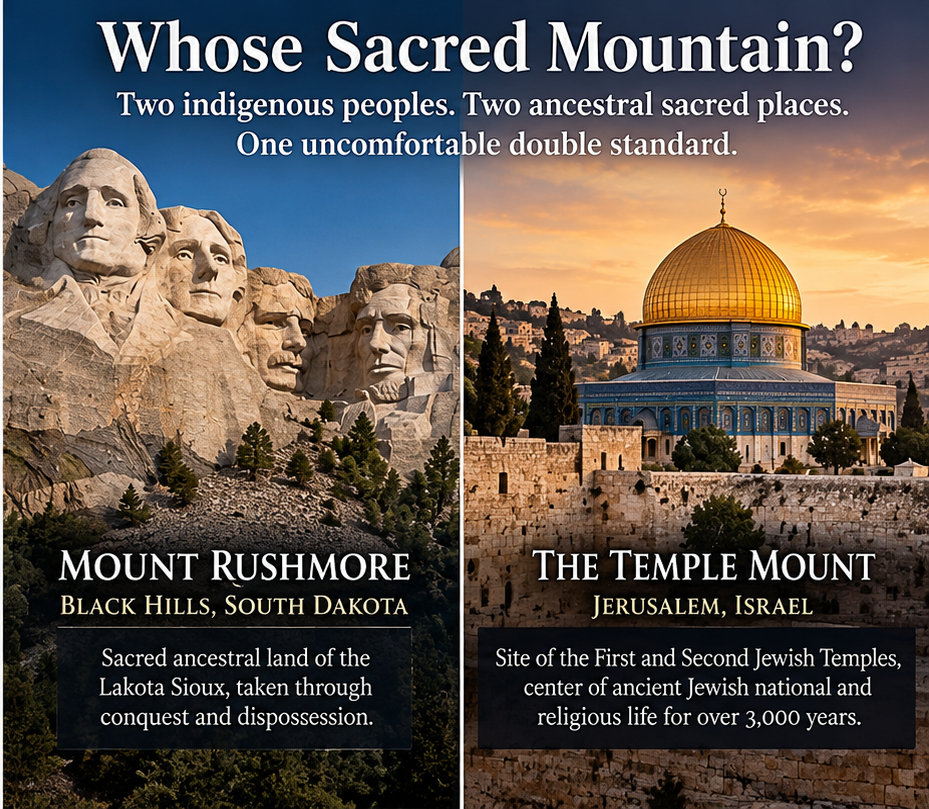
Imagine the United Nations defending a prohibition on Lakota Sioux praying in the Black Hills because American ultranationalists threatened violence if they approached Mount Rushmore. The world would be outraged. The Black Hills are sacred ancestral territory, and Mount Rushmore was carved into that landscape following the conquest and dispossession of indigenous peoples.
Yet UN bodies have defended the Temple Mount “status quo,” under which Jewish prayer is forbidden, and have labeled Jewish religious activity there as “provocative.” The First and Second Temples stood on that mountain, the center of ancient Jewish national and religious life. Jews have prayed toward Jerusalem for two thousand years. It is the holiest location to only one religion: Judaism.
But the threat of jihadi violence has become a justification for limiting the religious rights of an indigenous people rather than confronting those threatening them. Political sovereignty and religious structures have changed repeatedly, but the Jewish ancestral attachment endures.
This same failure to understand Jewish indigeneity distorts the contemporary debate over Zionism and colonialism.
Modern political Zionism emerged in the nineteenth century, but the Jewish relationship to Zion began thousands of years earlier. Zionism gave modern political expression to the aspiration of an ancient people to restore national life in its ancestral homeland.

Colonialism generally describes the expansion of power by outsiders who establish control over another territory and its inhabitants. European colonial enterprises extended the authority of distant imperial capitals into foreign lands.
But how can a people be considered foreign colonizers in the very land at the center of their religion? How can their return be understood through the framework of European imperial expansion when their prayers, festivals, laws and sacred geography have been tied to that land for thousands of years? If the Māori were expelled from New Zealand for hundreds of years, would their return be labeled imperialism or colonialism?
To call Jews foreign colonizers in the center of their own ancient folk religion is to misunderstand the very nature Judaism.


