De-Islamification, The Twin of Decolonization

“Decolonization” has become one of the most fashionable buzzwords of the modern age. It is taught in schools, shouted in protests, and deployed at the United Nations as a moral bludgeon against the West. European imperialists, we are told, robbed indigenous peoples of their land, stripped them of their culture, and erected foreign regimes on stolen soil. The work of decolonization — dismantling those legacies and restoring dignity — has been cast as the great ethical project of our time.

But what of the other colonial power that swept across continents, subjugating peoples and erasing their sacred spaces? What of Islamic imperialism, which invaded the Jewish promised land centuries ago, laying claim to sites that predated Muhammad’s birth by millennia?

Consider Hebron, the resting place of Abraham, Isaac, Jacob, Sarah, Rebecca, and Leah. For Jews, it is the Ma’arat HaMachpelah, the Cave of the Jewish Matriarchs and Patriarchs — a holy site woven into the very text of Genesis. When Muslim conquerors took over, they renamed it the “Ibrahimi Mosque,” transformed it into a shrine for their own creed, and barred Jews from entering. For seven hundred years, Jews were not even allowed to set foot past the seventh step of the building.

This was not preservation; it was expropriation. A classic colonial tactic: erase the indigenous name, overwrite the meaning, and forbid the natives from practicing their own faith.

But unlike the narratives drilled into young students about European settlers in Africa or Asia, the Jewish story is not told.

In 1967, Israel liberated Hebron, and Jews once again could pray at the burial site of their patriarchs and matriarchs. Slowly, painstakingly, the work of de-Islamification has begun — not by erasing the Muslim presence, but by restoring Jewish rights. Jews may now pray, Jews may now enter, Jews may now sanctify their ancestral home.

And in June 2025, a historic step was taken: the Israeli government transferred administration of the second holiest site in Judaism to Jewish leaders in Kiryat Arba, removing it from the sole control of the Islamic waqf. This was neither vengeance nor displacement. It was simple justice — the recognition that all of those buried at the site are the founders of Judaism (while only one is revered by Muslims), and Jews are the indigenous people in the land as proven by that fact.


Decolonization movements have received global endorsement. Universities run entire programs on “postcolonial studies.” Yet when Jews engage in the parallel project of reclaiming their holy spaces from centuries of Islamic imperial rule, the world looks away — or worse, condemns.

Why should “decolonization” be celebrated while “de-Islamification” is scorned? Both are projects of justice. Both undo centuries of cultural theft. Both restore indigenous peoples to their rightful heritage.

If the United Nations were consistent, it would champion de-Islamification alongside decolonization. It would recognize Jewish efforts as authentic acts of restoration, not “provocations.” Schools should teach children that just as Africans reclaimed their lands from European empires, Jews are reclaiming their sacred spaces from Islamic erasure.

Instead, the UN gives its platform to radical jihadists who claim that Israel is trying to “Judaize” the Jewish holy sites in Jerusalem and Hebron. It’s an offensive smear deliberately made to try to erase the reality of their Islamic imperialism, colonization, ethic cleansing and cultural appropriation.

Palestinian Authority President Mahmoud Abbas talking about the “Judaization” of Jerusalem to conceal that Islamic cultural appropriation.

The jihadists fear that after Hebron, the Jews will come for the site they know is really Jewish – Jerusalem. They are calling the transfer of the Cave of the Jewish Matriarchs and Patriarchs from the Hebron Waqf to Jewish authorities a “rehearsal for al Aqsa” in Jerusalem. They know the Jewish Temple Mount is the holiest site for Jews and Muslims invaded and took the site. They are proud of the feat and fear a reversal would legitimize a people they consider “sons of apes and pigs.

There is no “Judaization” of Jerusalem and Hebron. There is de-Islamification.

Decolonization may be decades old, but de-Islamification is still in its early chapters. It deserves not only legitimacy, but applause.

Beyond The Battle Plan

For the last several parshas, Moses has been addressing the children of Israel with a constant refrain: follow the commandments in the land, and you will be blessed; stray from them, and you will lose your inheritance. To us today, these verses are about mitzvot — the commandments that define Jewish life. But to the Israelites standing on the banks of the Jordan, the charge must have sounded different.

They had just watched an entire generation die in the desert. The memory of the spies still lingered — those men who declared that the land was too difficult to conquer, that the people within were too mighty to destroy. Could such whispers have been forgotten? Surely the children had heard rumors of what their parents had repeated around campfires for forty years. And now, standing on the edge of the land, they might have expected Moses to lay out the strategy, the order of battle, the plan of conquest.

Instead, Moses did something else entirely. He skipped the war. He jumped straight to what life would look like after. The rules of worship, the rhythms of daily life, the blessings and curses of obedience. It was as if the battles ahead — Jericho’s walls, Ai’s ambush, the wars against mighty kings — would be non-events.

Imagine a coach gathering his team before kickoff and skipping the playbook. Instead, he passes out dinner menus for the victory banquet to follow. No Xs and Os. No defensive schemes. Only a vision of celebration after the game.

Why? Perhaps it was Joshua’s role to direct the war, the next chapter of the Tanach already waiting to be written. Perhaps Moses, who knew he would not enter the land, wanted to leave the people with principles for the future. Or perhaps Moses was teaching something deeper: that the wars were only one part of securing a peaceful future. That the real challenge was not in winning the land, but in living faithfully within it.

The truth is, the dream of the land was already realized — even if the Israelites didn’t know it. Hundreds of years of diaspora were ending. The promise was being fulfilled before their eyes, not through a war plan but through divine decree. The land would be theirs. The victory was guaranteed. What remained in doubt was whether they would keep it.

Moses understood: the conquest would be won by God’s hand, but the inheritance would be maintained only through God’s law. The spies had feared giants and fortified cities, but the true danger was disobedience and forgetfulness once the land was secured. That is why Moses spoke not of how to conquer, but of how to live.

The people knew that Joshua would lead them to battle, just as he had over Amalek. And they had seen that Moses was their intermediary with God, who prayed for their success (Exodus 17:10-13). Now Moses was telling the people: you no longer need me as your agent; you are they keys to victory. Prayers during battle to secure victory; obedience thereafter to keep the peace.

Aaron and Hur hold up the hands of Moses in prayer as he grew tired, asking God’s help for Joshua to lead the people to victory in battle

And so it is today. The battles of our time are real, but they are only part of the threat. We must not be complacent. We must not assume that everything is on the battlefield. Beyond the battle plans lies our own responsibilities in living a meaningful life and knowing the source of our strength.

ACTION PLAN

Go to the United Nations and sing outside the line from Al Tira, “Utzu Etza”: “Take counsel together, and it shall come to nought; speak the word, and it shall not stand: for God is with us.”

The Wisdom of Waiting

The ability to delay gratification has long been seen as a mark of intelligence. The famous “marshmallow test” placed children in front of a single treat and offered a simple bargain: eat it now, or wait and get two. Those who resisted often went on to succeed academically, socially, even financially. Patience was not just a virtue; it was predictive.

Yet it turns out this trait is not uniquely human. In a Cambridge experiment, cuttlefish were given a similar choice — a mediocre meal immediately or a shrimp, their favorite, if they waited. They waited. In fact, they sometimes endured two full minutes of temptation, holding out for the better prize. Even more remarkable: those same cuttlefish who delayed showed sharper learning in other tests. Intelligence, it seems, wears many disguises.

This was the first time this kind of patience was found in an invertebrate. Chimpanzees, crows and parrots have long been known to delay satisfaction in order to save food for later.

What makes this discovery all the more striking is that cuttlefish are solitary creatures. They do not form schools, build social bonds, or raise their young. Their patience evolved for the hunt — the advantage of waiting for the better prey, of holding still in camouflage until the perfect strike. Their foresight is purely individual, a strategy of survival.

Humans, by contrast, require patience not just for survival but for flourishing. Patience is what allows us to build together — to trust one another, to undertake projects that span generations, to cultivate communities and civilizations. Our ancestors planted trees whose shade they would never sit under and built cathedrals that took centuries to complete, as an extension of delayed satisfaction – a commitment towards a future society they would never enjoy.

But in our age of instant messages, instant news, and instant outrage, society no longer prizes waiting. Why suffer a moment of discomfort when a thousand distractions beckon from a glowing screen? Why wrestle with the silence of patience when clicks deliver dopamine now? Where our forebears saw wisdom in restraint, we see boredom. Where they saw the dignity of discipline, we see inconvenience.

Patience as a virtue is not just about self-control; it is the very condition that allows for deep thought and deep bonds. To abandon patience is to abdicate our gifts of reflection, to trade away the ability to imagine futures greater than the present moment. In our hurry, we become more animalistic, lunging at whatever stimulus flashes before us. And unlike the cuttlefish, whose patience serves survival, we squander patience’s higher purpose — the power to build not only buildings that endure, but bonds that sustain.

Are we in the process of losing our basic survival skills – in both the present and future? Are we burying our ability to ponder to be led like dolts to an unsuspecting danger?

The irony is sharp: solitary cuttlefish wait with foresight, while humans — the only creature who truly needs patience to hold communities together — are in danger of forgetting how. Delayed gratification once built civilizations. Instant gratification now tears at their foundations.

The cuttlefish reminds us that intelligence is not about speed but foresight. A creature with no interest in faith, family, or future still knows the wisdom of waiting. The question that remains is whether we do.

Pilgrims or Provocateurs?

A Muslim who visits Mecca is called a Hajji. It is one of the highest honors in Islam, the completion of the Hajj pilgrimage, celebrated by family and community as a sacred accomplishment.

A Catholic who travels to the Vatican is a pilgrim. For centuries, the faithful have journeyed to Rome, walking into St. Peter’s Square with reverence, greeted with blessing and legitimacy.

And a Jew who goes to the Temple Mount in Jerusalem — the very place where the First and Second Temples once stood, the holiest site in Judaism? That Jew is branded a provocateur. Not a pilgrim, not a worshiper, not a faithful soul ascending to pray — but an instigator, an agitator, an accused trespasser, a “settler” on their own sacred ground.

The disparity could not be starker. What is celebrated as devotion for others is condemned as incitement for Jews. For Muslims, the Hajj is a right; for Catholics, Vatican pilgrimage is honored; but for Jews, even quiet prayer on the Temple Mount is labeled an offense — by the United Nations, NGOs, and international bodies.

It is not only hypocrisy; it is erasure. To deny Jews the name of pilgrim is to deny Jewish history, Jewish identity, and Jewish legitimacy. It casts the holiest place in Judaism as alien to Jews themselves, a desecration of memory turned into policy.

And why? Because the world has normalized the jihad. It has allowed Islamic Supremacy to dictate permissible behavior, even in the Jewish holy land.

The truth is simple: a Jew ascending the Temple Mount is not incitement. It is the most ancient pilgrimage of them all — the echo of three millennia of devotion, commanded in Torah, rooted in covenant, and carried in every prayer whispered toward Jerusalem, before Islam was even created.

The real provocation is not the Jew who prays on the Temple Mount but a world that dares to tell Jews they don’t belong at the center of their faith.

ACTION ITEM

Come to the United Nations in New York City and demand Jewish rights and freedom of religious assembly in Jerusalem.

Rockefeller Center and The Modern Tower of Babel

In biblical times, after the Great Flood destroyed the known world, mankind responded not with humility but with defiance. They sought to raise themselves above God’s wrath, building the Tower of Babel as a monument to their own power, reaching for the heavens.

Centuries later, as the Great Depression ransacked America, another tower began to climb skyward. John D. Rockefeller, the oil titan turned philanthropist, commissioned an audacious complex in the heart of Manhattan. Out of the rubble of despair rose Rockefeller Center, a collection of soaring structures anchored by “30 Rock,” a 70-story monument of steel and stone.

Construction workers having lunch as they build the RCA Building in 1932

At its entrance, the vision was chiseled into eternity: “Wisdom and Knowledge shall be the stability of thy times” — the words of Isaiah engraved above the door. Flanked by sculptures representing Light and Sound, the building proclaimed its purpose: to be the voice of news and entertainment for the world, a modern temple to information and culture.

Sculptures atop the main entrances of 30 Rockefeller Plaza (photo: First One Through)

Yet curiosity lingers when one gazes up at that famous inscription. The line from Isaiah 33:6 was never meant to stand alone. The full verse concludes: “…and the fear of the Lord is his treasure.” But that final clause was deliberately omitted. The builders sanctified wisdom and knowledge, but excised God. The omission transformed Rockefeller Center into secular scripture, elevating man’s wisdom over divine truth. For nearly a century, the complex stood representing a modern Tower of Babel: a singular voice beaming news, culture, and entertainment to a world tuned to one frequency.

Sculpture above doorway of 30 Rockefeller Plaza (photo: First One Through)

But the world has shifted. The authority of a single edifice has collapsed. The pandemic pulled workers from office towers into spare bedrooms and kitchen tables. The internet, social media, and ubiquitous cell phones scattered the once-unified audience into billions of isolated “my-truthers.” The great tower that once declared itself master of wisdom and knowledge no longer reigns over truth — or even news. Instead, we have a digital cacophony, a post-Babel of infinite voices, each one clamoring for relevancy.

In the ancient tale, God looked down upon Babel, saw mankind united in defiance, and scattered the people with a confusion of tongues. It was divine intervention that broke apart the human project. The modern incarnation lacks lightning bolts from the heavens with thunderous judgment. The fracture came from within. By sanctifying ourselves over the divine, the builders enshrined wisdom and knowledge as supreme — and in so doing, they planted the seeds of our undoing.

Even in scattering, the ancient world retained stability. Though tongues differed, mankind still clung to faith. Out of the dispersion of dialects came hundreds of religions, with Abraham’s radical monotheism, affirming that there was one God who bound the human family together, at its heart. In contrast, modern society’s disdain for God has left us truly unstable. We do not scatter into tribes of belief but dissolve into atomized individuals, each enthroning himself as arbiter of truth, each rejecting the notion of any higher authority.

There is no “stability of thy times.”

As Lord Jonathan Sacks once observed, “If you want to take this diverse, fractured culture and turn it into a united nation, you have to get them to build something together.” Culture is not born of proximity but of purpose. Yet even that is not enough. For building without faith leads only to another Babel — a project that may rise high but will ultimately fracture under the weight of its own pride.

Our ancestors knew this instinctively. They struggled, they questioned, they even quarreled with God — but they never erased Him from the story. Faith provided the mortar that held their collective together. In contrast, our age has celebrated knowledge while amputating belief, enthroning technology while dismissing transcendence. We build networks instead of communities, platforms instead of sanctuaries. And without faith, what we construct collapses into confusion, as surely as Babel once did.

A Way Forward

The modern Tower has already cracked. Today’s Titans do not build skyscrapers broadcasting monoliths of truth but platforms and algorithms addicting both tweeter and tweeterdom. We live in a splintered archipelago of isolated truths. To endure, we must restore the missing half of Isaiah’s wisdom. It is time to harken to Isaiah’s full words and engage with humble faith together with wisdom and knowledge, so that we may yet build a more perfect union.

Perhaps an answer for us today is not chiseling new words above our heads into the stone of Rockefeller Center to amend the verse. The real task is closer to home. Each of us can sanctify our own entrances with God’s presence. A mezuzah affixed to the doorpost — of a house, an apartment, and our workplaces — serves as the quiet reminder that wisdom and knowledge alone are not enough. It is God’s presence within that provides the stability of our times. Where the tower excised Him, the mezuzah restores Him. And if enough doorways bear that mark, perhaps our fractured society can yet rediscover a shared foundation.

30 Rockefeller Plaza at night, September 2025 (photo: First One Through)

The Biographies of Two Shofars

The sound of the shofar is meant to pierce the heavens. Sometimes the shofar’s story pierces the heart.

I remember coming home one day to find my son in tears. His beloved shofar — a gift from his grandfather — had been chewed by his dear dog. The horn was mangled beyond salvation. I carried it to the rabbi in desperation, asking if it could be saved. Perhaps the mouthpiece could be trimmed…. Alas, it could not, and I never saw it again.

My father had given it to him not long before, teaching his grandson how to coax sound from its ancient curves in preparation for his bar mitzvah. That shofar, which transitioned from a smooth polished mouthpiece to a rough and natural opening, was more than bone and horn — it was a link between generations.

My father bought my son a new shofar and continued to teach him how to blow. He was there on the bimah as my son blew it proudly in Jerusalem on the first day of Elul for his bar mitzvah. I took in the special moment, and also considered my son’s previous shofar that was not there. Even more, the profound emotion of a young boy torn at losing his grandparent’s bar mitzvah gift – to a dog whom he also loved, who was just being a dog. The gathered family and milestone in Jerusalem were the key celebrations of the day, but recalling my son’s well of tears months earlier over this moment which may not have happened, enriched it.

My father’s own shofar has a different story. He blew it for decades in his shul, year after year, his steady blasts calling our community to repentance. Eventually the horn began to crack, to dry, to lose its voice. He gifted the treasure to me some years ago, and I have placed it on my living room mantle, its curves still beautiful though its sound has fallen silent.

This year, my father — approaching 90 — will not blow the shofar. While he’s strong enough to walk to synagogue, some health issues will keep him from the bimah as he has done for as long as I can remember. The body ages. The shofar ages.

There are shofars that pass through the generations, blown by grandparents and great-grandparents a hundred years ago and still blown today. They carry not just sound but touch — the hands that held them, the lips that pressed them, the prayers that filled them. In many ways, these shofars still live.

We think of the shofar as the instrument through which we hear God’s call on Rosh Hashanah. It is the vehicle – and the subject. The shofar itself has its own biography. Some are placed on mantles, mute witnesses to decades of service. Some are destroyed, leaving only the memory of their sound. Some are retired to museums as quiet curiosities.

As we enter a new year, I think of two particular shofars in my life — one that I can no longer see, one that I can no longer hear — and of the special people who breathed life through them whom I am blessed to still hold and cherish. These horns, like us, are finite. But their stories resound forever, calling us to remember, to connect, and to pray for many more years of holding them and each other as a family and community.

The Touch of the Sound of the Shofar (September 2015)

From Hostage Posters to Charlie Kirk

“What starts with the Jews doesn’t end with the Jews.”
We are watching that adage unfold in real time.

Seven hundred days ago, way too many people in western cities took to the streets and shredded the faces of Israeli hostages taped to lampposts.
Those faces were voices, each one a witness, a story, a plea — and that is precisely why some felt they had to be destroyed.
It wasn’t enough to ignore them; they had to be erased, obliterated, so that the public would never be confronted by their humanity.

So it was with the assassination of Charlie Kirk.
They didn’t just want his opinions silenced — they wanted his existence blotted out.
His death was a warning to anyone who shared his worldview: you will not be allowed to speak, and if you persist, you will suffer.

This is not merely a campaign against perceived bad ideas — it is a maximal campaign against the people who hold them.
They want Israel destroyed, and they want those who support Israel to feel pain.
They want conservatives destroyed, and those who think like them to live in fear.

This is not free speech but a purge.
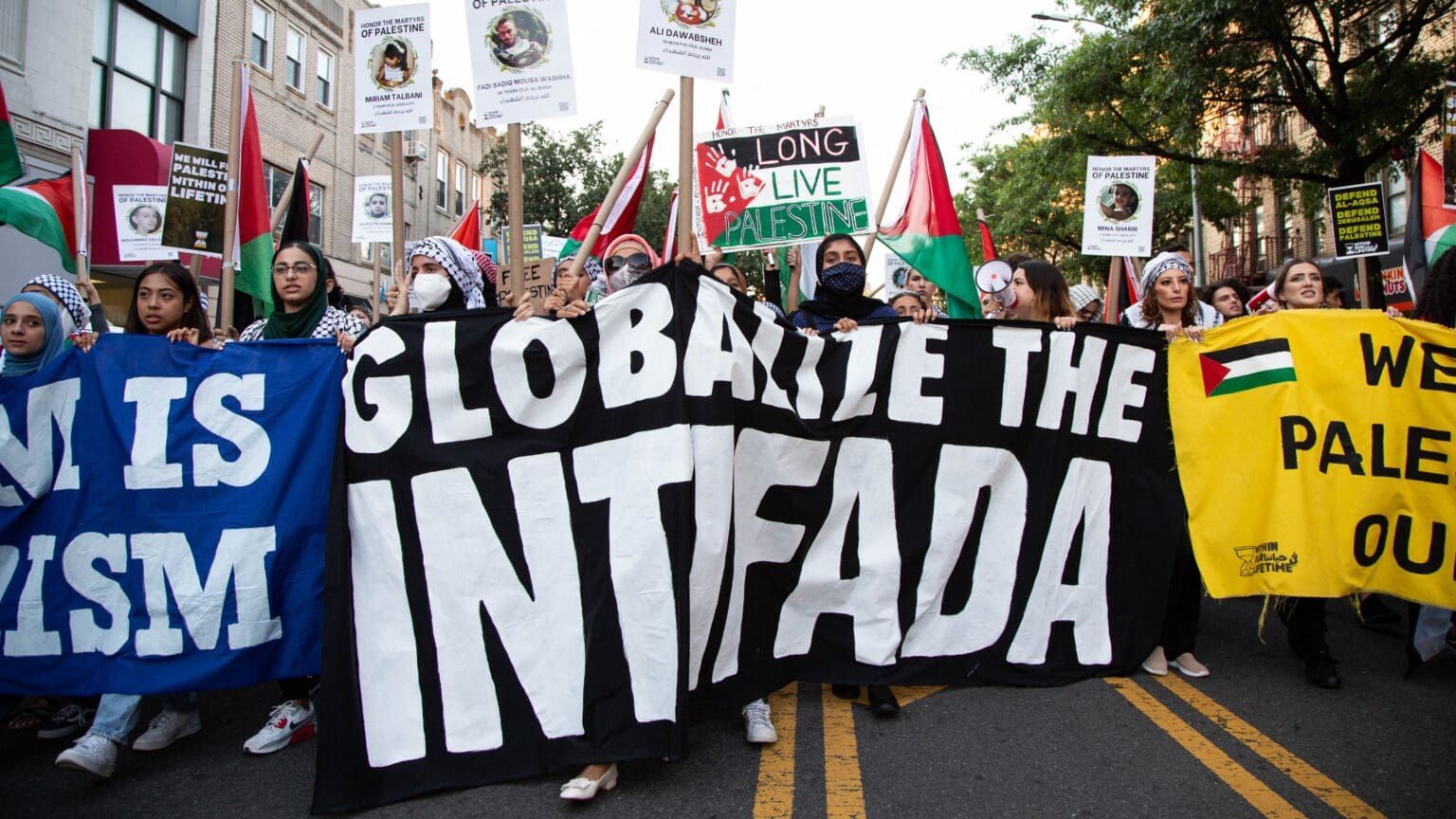
It is a revolution that calls itself “good trouble” but wields the club, the knife, and the guns to bring the “intifada” to the west.

The secular left has adopted an “Islamonormative” framework.
It treats the faces of Jewish hostages like drawings of Mohammed, punishable by erasure, and treats conservative talking points as blasphemy, punishable by death.
This is not debate — it is jihad.

I’m Offended, You’re Dead.

America is not just losing empathy for hostages nor tolerance for opposing ideas — it is learning to enjoy their destruction.
The mob laughs as the faces are ripped down, cheers as the dissenter is silenced.
America’s youth are being groomed to take pleasure in erasing the unwanted.
Once that appetite is formed, it will not stay confined.

The spectacle of the auto de fe is slowly coming to America as society moves from speech to speakers. To infidels.

Jews have long been the most persecuted and hunted people in the world. Now, religious conservatives are becoming new Jews as the secular crusade vilifies their beliefs.

Ten years ago they came for blasphemers at Charlie Hebdo in France, and expanded their jihad to nearby Jews (read “random folks” by US President Obama). World leaders marched arm in arm that they would not be silenced. Now they offer to lie Charlie Kirk’s body at the U.S. Capitol building, in a sign of respect and a nation that remained unbowed. Gestures.

But the voice of the Jew, the face of the Jew, and the Jew himself are one and the same. People believe The Jew is targeted in isolation; that his situation is unique. A dynamic that will not pierce the majority. Until they realize that it has.

The drip of antisemitism infiltrates society and corrodes it from within, an insidious jihad. Stealthily, it kills morality and sanity. Alas, it is too subtle to recognize as a macro threat until it is a stage four tumor that has ransacked the body politic, then unable to proffer basic protection for the masses.

Ki Tavo: From Wandering to Rooted

When the Torah commands the farmer to bring his first fruits, it does not let him talk about his soil or his labor. Instead, the ritual begins: “My father was a wandering Aramean…” (Deuteronomy 26:5) The commentators note that gratitude is not complete without memory. To thank God for the harvest, one must first recall that the Jewish story began in exile and slavery. Only against that backdrop does the basket of figs become miraculous.

Later in the same parsha (Deuteronomy 28:4), the Torah turns to blessings and curses. If Israel listens to God, “Blessed shall be the fruit of your womb, the fruit of your soil, and the fruit of your livestock.” If not, those very fruits will wither. Here too, fruit is not agricultural output — it is covenantal currency.

Put together, the two passages form a cycle. The first fruits ceremony roots gratitude in memory: remember that you were once landless and fruitless. The blessings and curses tie the future of fertility to obedience: remember that your continued abundance is not guaranteed.

And notice where this all happens: Jerusalem. The farmer did not simply thank God in his vineyard or whisper gratitude in his kitchen. He carried his produce up to the city, presented it at the Temple, and declared his history publicly. Jerusalem was not just a capital; it was the beating heart of Jewish memory and faith. The fruits gained meaning when they were placed before God in the city chosen for His name.

The Old City of Jerusalem including the Jewish Temple Mount

This is why the prophets, the rabbis, and Jewish history itself encircle Jerusalem. The city is not peripheral to Judaism — it is central. It is where private labor becomes national testimony, where agriculture becomes covenant, where the wandering Jew becomes rooted in a people’s eternal home.

To this very day, Jews sing at their wedding the verses of Psalms 137:5-6: “If I forget you, O Jerusalem, let my right hand wither; let my tongue stick to my palate if I cease to think of you, if I do not keep Jerusalem in memory even at my happiest hour.” Jerusalem is bound in memory, that same memory that reminds us of our history, our promise, our obligations.

Today, too, the Jewish people encircle Jerusalem. Jews bring their “first fruits” to the city not only in the form of produce, but through aliyah, prayer, innovation, and sovereignty. Just as in ancient days, the city transforms personal blessings into collective covenant.

And yet, the world still questions that rootedness. Governments refuse to recognize Jerusalem as Israel’s capital. Diplomats condemn the building of homes in areas like E1 — the very corridor that links Jerusalem to the rest of the land, enabling Jews from north, south, east, and west to come to their eternal city.

Ki Tavo reminds us that Jerusalem cannot be negotiable. To encircle it, to build in it and around it, is not a matter of politics but of foundational principle. Without Jerusalem at the center, our fruits risk becoming mere produce, and the people risk becoming wanderers once more.

America’s Intifada

The mob is impatient.

The activists have long been screaming and yelling. They’ve been heckling in person and posting online. Yet nothing changes. The mob is impatient.

They’ve held conferences in Detroit, banged drums in the street, organized sit-ins and campus walkouts. Yet few of the policies they demand have been enacted. The mob is impatient.

The crowds find succor online. They read the manifestos of both killers and their favorite radical group. The hashtags keep trending, the slogans keep coming — yet the news cycle feels the same. The mob is impatient.

They interact with their heroes on social media. It feels like they have a direct connection in their hands and ears. They know the message. They know the orders. Doesn’t everyone? Where is the revolution? The mob is impatient.

It is easier to complain than to enact. It is quicker to destroy than to build. It is more satisfying to heckle than to speak clearly. To tweet and reteweet than to contemplate and deliberate. The mob is impatient.

The last ten years have proven that anyone can gain fame — or infamy. The louder and more outrageous, the greater the clicks. The calls to fellow travelers echo louder and the ranks grow. Not over years, but instantly. The mob is impatient.

Democratic Socialists for America stating that there are no innocent civilians

Political violence is not new. Presidents and senators have been assassinated before. But today, an army of lone soldiers is running toward their neighbors — convinced by the pandemic that everyone is a threat and trained by the Twitterstorm that outrage works.

The mob is impatient.

And, as it grows larger and closer, more people are turning to guns for self-defense. They see a government that appears weak, unable or unwilling to confront the rage.

The next step has arrived. The broken healthcare system was not addressed via advocacy but a bullet into the back of the CEO. To cheers. A splinter group from Jewish Voice for Peace has birthed a new violent Antizionist Jewish Student Front. When debate failed, when they could not best Charlie Kirk on the stage, they decided to silence him permanently. The People’s Conference for Palestine and the DSA have given them the language, the chants, the charge: Escalation.

THE MOB IS IMPATIENT.

And the mob now has blood. And it is chum for the devotees.

The Reckoning

A polite society is a beautiful thing when at peace. But politeness collapses when mobs take power. When debate is replaced by doxxing, when protest becomes arson, when manifestos become murder plans — the social contract frays. If the state cannot protect citizens from ideological violence, people will arm themselves and take matters into their own hands.

The question is no longer whether our institutions can withstand the mob — but whether they will act before the mob makes the next move, or allow a societal “resistance” movement to rise to replace dormant laws to revive trampled norms.

Introducing America’s Intifada.

The Holocaust Will Not Be Colorized. The Holocaust Will Be Live.(May 2019)

What They Said About The Assassination of Rashida Tlaib

Conservative commentator Charlie Kirk was assassinated today while he spoke with college students in Utah. The killing was yet another sad marker on the collapse of American society. The comments about his murder were much the same.

The left-wing media at MSNBC essentially said that he deserved it with Matthew Dodd saying “He has been one of the most divisive figures … who is constantly sort of pushing this sort of hate speech aimed at certain groups. And I always go back to hateful thoughts lead to hateful words which then lead to hateful actions, and I think that’s the environment we’re in. You can’t stop with these sort of awful thoughts you have and then just saying these awful words and not expect awful actions to take place.” His colleague Katy Tur also called Kirk “a divisive figure. Polarizing. Lightning rod. Whatever term you want to use.”

Left-wing politicians including AOC and Ilhan Omar condemned the killing and denounced… gun violence.

What if antisemitic Congressperson Rashida Tlaib were assassinated. Would AOC and Omar issue a statement about gun violence or denounce the killers and the vitriol that surrounded such shooting? Would MSNBC say she deserved to be taken out because of her rants about Jews? Would the right issue statements like the left-wing is doing today?

Tlaib is an active voice in conferences which call to destabilize the United States and to destroy Israel. She whips up the violent jihadi and Democratic Socialists of America mob to tear down western society and the Jewish State.

But that only means she’s evil. It means she should be arrested if found to incite violence. But it doesn’t mean she should be killed or her murder celebrated or excused.

Charlie Kirk had lots of opinions but he took the time to calmly debate and have a discussion with anyone. He did not call for the destruction of America or American allies. So why the obnoxious comments from the far left?

The issue before us is not only the violence itself but the selective outrage that follows. Political violence is corrosive to democracy. To our humanity. If Americans respond to it with partisanship — excusing it when the victim is an opponent, or diminishing it when the rhetoric seems uncomfortable — then the nation is already fractured beyond recognition.

The true test of a society’s moral health is whether it can condemn violence against its enemies with the same clarity as against its friends. Those people who cannot, are likely the ones whose goal is the destruction of our society.