Time for Obama to Address Palestinian Arabs Directly

The Palestinian Arabs conduct polls of themselves every few months. The Palestinian Center for Policy and Survey Research  publish the polls for all to see.

It would appear that the United Nations and the Obama Administration refuse to read and internalize the clear print.

Consider the poll completed in September 2016.  The findings concluded:

“current level of support for an armed intifada remains high and a majority opposes the Russian invitation for a meeting between Abbas and Netanyahu in Moscow. Moreover, the public remains highly pessimistic about the French Initiative’s chances of success. Finally, Hamas’ candidate for the presidency, Ismail Haniyeh remains more popular than Abbas.”

The Palestinian Arabs continue to “support an armed intifada,” meaning killing Israelis rather than speaking and negotiating with them.  The Arabs further support the terrorist group Hamas rather than the “more moderate” Fatah head Mahmoud Abbas.

But the US and the United Nations don’t acknowledge these persistent inconvenient facts.

On November 29, 2016, the US State Department had its daily press briefing were Spokesperson John Kirby stated:

” in order to get there [two state solution], you have to see tangible leadership on both sides to ratchet down the rhetoric and to reduce the violence and to show a willingness to sit down and have discussions about a two-state solution. That hasn’t been the case….
we need to see the leadership on both sides take the kinds of actions to realize a two-state solution; to commit to a willingness to sit down and have those kinds of discussions and to effect those kinds of negotiations. And his point was exactly and succinctly right: You can lead the horse to water, but you can’t make them drink. You have to – ultimately – and we’ve said this time and time again – you have to see leadership exuded and demonstrated there in the region. They have to be willing to get to this two-state solution or it’s not going to be sustainable. And I think if you go back and look at the transcript of his remarks, you’ll see that he expounded on that thought in exactly – almost exactly those words.

The US State Department seemed to recognize the failure of Palestinian leadership – but not the Palestinian people. It chose to equivocate in condemning Israeli settlements by also blaming the impasse of advancing peace talks on Palestinian leadership.  However, the State Department never is critical of the Palestinian Arabs who continue to favor violence and terrorism instead of coexistence and peace.

On that same November day, the UN Secretary General Ban Ki Moon also blamed the leadership of the two parties. “Israeli and Palestinian leaders still voice their support for the two-State solution. However, without urgent steps to revive a political perspective, they risk entrenching a one-state reality.” According to the UN, the failures of leadership have in turn caused anger from the populations:

“All this has led to growing anger and frustration among Palestinians and profound disillusionment among Israelis. It has strengthened radicals and weakened moderates on both sides.”

The inversion of cause-and-effect never enters the mindset of Ban Ki-Moon, that Acting-President of the Palestinian Authority Mahmoud Abbas cannot take steps towards peace, because his own people demand more forceful actions.  The UN will state that Palestinian Arab civilians are simply “resorting to violence” and are “desperate” for a state, even though the entire fabric of the PA, Fatah and Hamas is about the destruction of the Jewish State.

A New Path

US President Obama declined to address the Israeli parliament when he visited Israel in March 2013, and instead addressed Israeli citizens.   In his opening remarks he said “what I’ve most looked forward to is the ability to speak directly to you, the Israeli people — especially so many young people who are here today — (applause) — to talk about the history that brought us here today, and the future that you will make in the years to come.”

Perhaps the final gesture to advancing peace between Israelis and Palestinian Arabs, is for Obama to address the Palestinian Arabs directly to accept their Jewish neighbors and build a future together, rather than reward the intransigence of the Palestinian Authority as former US President Jimmy Carter suggested on that same November 29 day of willful blindness.


Related First.One.Through articles:

Cause and Effect: Making Gaza

It’s the Democracy, Stupid

Opinion: Remove the Causefire before a Ceasefire

Subscribe YouTube channel: FirstOneThrough

Join Facebook group: FirstOne Through  Israel Analysis

The Many Lies of Jimmy Carter

It is not particularly surprising that Jimmy Carter, former US president and author of “Palestine: Peace not Apartheid,” chose to commemorate the UN’s official Day of Solidarity with the Palestinian People (November 29), to launch another attack on Israel. Carter did this through lies and half-truths in a New York Times Op-Ed (printed below).

Here are some lying lowlights:

Lie: Israel cannot take control of any of the “West Bank” which it seized during a war. Carter wrote that Israel and Egypt concluded a peace deal because it was based on UN resolution 242 which included the clause “the inadmissibility of the acquisition of territory by war.” The peace agreement with Egypt has nothing to do with the Palestinian Arabs.

  • The “West Bank” was taken during a DEFENSIVE war. While it is a matter of debate whether Israel’s 1967 preemptive attack on Egypt which was ready to attack Israel was offensive or defensive, there is no debate that the Jordanians (and Palestinian Arabs who had taken Jordanian citizenship) attacked Israel first. The laws about the inadmissibility of taking land have to do with a “belligerent party,” not the defensive party.
  • The international community recognizes Israel’s taking land in a defensive war. After the Arab armies attacked Israel in 1948-9, Israel seized much more land than was granted to it under UN Resolution 181, known as the 1947 Partition Plan. The dynamic of taking more of the “West Bank” in yet another defensive war follows the same principle.
  • The Sinai peninsula was never part of the Palestine Mandate.  Israel returned land to Egypt that it took in the 1967 war, land that was never part of the Palestine Mandate which sought to reestablish a Jewish homeland. However, the “West Bank” is part-and-parcel of the Palestine Mandate, just as the land west of the 1949 Green Line was part of the Jewish homeland.

Lie: The Palestinians seek “a just and lasting peace in the Middle East in which every state in the area can live in security.” Carter continued to recite language from UN resolution 242, but failed to connect Palestinians to the clause.

  • The Palestinian Arabs have voted for war, not peace. The Palestinian Arabs voted Hamas, a recognized terrorist group that seeks the destruction of Israel, to 58% of the parliament in 2006. Palestinian polls show Palestinian Arabs favoring the group in every poll. This is a group that has the most anti-Semitic charter in the world, which specifically calls for killing Jews and destroying all of Israel. The Hamas leadership continues to incite violence against Israelis.

Lie: Carter implied that “withdrawal of Israel armed forces from territories occupied in the recent conflict,” meant withdrawal from the West Bank. It does not.

  • A withdrawal from “territories” but not “all of the territories.”  The language in the UN resolution was approved with specific amendments in the final text. It specifically did not call for Israel to remove troops from all of the new lands, as the 1949 Armistice Agreements with Egypt and with Jordan specifically stated that the Armistice Lines / the Green Line was NOT to be considered a new border.

Lie: Carter stated that Jewish homes in the West Bank were “constructed illegally by Israel on Palestinian territory.” Carter has adopted the anti-Israel United Nations language in describing “settlements” as illegal. He might as well also state that “Zionism is racism,” as stated in UN Resolution 3379 which was passed in 1975 under his watch.

  • Jews living throughout the West Bank is LEGAL. International law in 1920 (San Remo Agreement) and 1922 (Mandate of Palestine) specifically stated that Jewish immigration was to be encouraged throughout Palestine and that “No person shall be excluded from Palestine on the sole ground of his religious belief” (Mandate Article 15). You cannot bar Jews from living in the West Bank as a matter of moral and legal principle.

Lie: Carter wrote that Obama declared that the border between Israel and Palestine “should be based on the 1967 lines.”   This is a half-truth that is a complete lie.

  • Obama stated that borders should be negotiated between the two parties and include land swaps to account for current realities. Carter deliberately misled his liberal fans and Israel-bashers by only using half of Obama’s suggested course to peace. Obama stated that the borders would NOT look like the 1967 borders, but Carter piecemealed Obama’s quote into a distortion, a lie.  It should be further noted that Obama’s language was much softer than the assurances that President George W. Bush gave Israeli Prime Minister Ariel Sharon in 2004 that “it is unrealistic to expect that the outcome of final status negotiations between Israel and the Palestinians will be a full and complete return to the armistice lines of 1949.”

Lie: Carter implied that the Israelis’ “commitment to peace is in danger of abrogation,” and said nothing about Palestinian Arabs lack of desire for peace.

  • Israeli Prime Minister Benjamin Netanyahu has stated repeatedly he seeks to commence negotiations immediately to resolve the conflict. It is Palestinian Authority Mahmoud Abbas that refuses to engage with Israel. It is Mahmoud Abbas that incites terror against Israelis and seeks to deny Jewish rights and history in Jerusalem. Only Israeli leadership has declared the goal of two states for two peoples, while Abbas has called for an Arab state of Palestine devoid of Jews, and Israel, which should be a bi-national state.

Lie: Carter calls all of the West Bank “Palestinian Land,” which are “occupied.”

  • The West Bank includes “Palestinian Authority territory” which is administered by the PA, and Israeli territory, administered by Israel – according to the Oslo Accords, agreed to by both parties. The Oslo I and Oslo II Accords signed in 1993 and 1995 by the Israeli government and the Palestinian Authority handed over certain lands to the PA. Those areas, known as Area A, are where the vast majority of Arabs in the West Bank live. They are not under Israeli military control. Area C, which is under Israeli military control, is where the vast majority of Israelis live in the West Bank, and include a minimal number of Arabs.

Lie: Carter claims that the world condemns Israel since Arabs east of the Green Line cannot vote, while Israeli Jews living in EGL can. That is wild distortion of reality.

  • Arabs in Jerusalem can become citizens and vote in Israeli elections. Israel reunited the city of Jerusalem in 1967, and expanded the borders of the city in 1980. Israel gave ALL people living in the city the option to become Israeli citizens, just as the other million-plus non-Jews in Israel enjoy Israeli citizenship. Thousands of Arabs from Jerusalem have become citizens of Israel.
  • People in territories around the world don’t vote. Puerto Ricans, Guam and other US territories, are not eligible to vote in US elections. Does the world condemn the US for this structure? No. Citizens are entitled to vote – regardless of where they live. An American living in Germany for 20 years still gets to vote in US elections, while a Puerto Rican will not. Similar for Israeli citizens that opt to live in EGL/ the West Bank.

Lie: Carter calls the Palestinian Authority a “moderate Palestinian leadership.”

After laying out a package of outright lies and half-truths, Carter calls on President Obama to act quickly and: 1) recognize a Palestinian State; and 2) passing a UN Security Council Resolution that all Israeli “settlements” are illegal.  He added “Recognition of Palestine and a new Security Council resolution are not radical new measures, but a natural outgrowth of America’s support for a two-state solution.

It is beyond “radical.” It is wrong and dangerous.

To this day, Carter remains the only US president to call Israelis living in EGL/West Bank “illegal.” Obama, Bush and others used terms like “illegitimate” (Obama) or “unhelpful” (Bush) or even an “obstacle to peace,” but no other president claimed that settlements in disputed territory are “illegal.” Such a declaration is radical, and the left-wing extremist was the only president to use such terminology.

Further, recognizing a Palestinian State completely ends the Oslo Accords and a negotiated solution. It doesn’t “restart” talks, but puts both parties on the course for unilateral actions, such as annexation of additional lands. It will most likely lead to war.

Carter (like the anti-Israel UN Secretary General Ban Ki Moon) has urged Hamas and Fatah to reconcile. They seek to insert a genocidal Nazi party into the Palestinian government as a pathway to peace. These are the same people that recommend these two radical actions.

While Carter and Ban are correct in recognizing that it is unsustainable to have a Palestinian state with distinct governments controlling different parts of the country, that just underscores why there cannot be recognition of a Palestinian state today. It doesn’t mean rewarding a dysfunctional and anti-Semitic government with recognition.

 20161130_070230
Jimmy Carter New York Times Op-Ed November 29, 2016

Seeing Jimmy Carter write again is a reminder of the far left fringe’s inability to see or grasp the truth of the Middle East.  Carter’s adoration of Hamas, underlines his insanity. He imagines and hopes for a world that doesn’t exist, and makes suggestions that are dangerous for civil society.


Here is Carter’s Op-Ed of lies in full. The boldface is meant as reference for the notes above.

ATLANTA — We do not yet know the policy of the next administration toward Israel and Palestine, but we do know the policy of this administration. It has been President Obama’s aim to support a negotiated end to the conflict based on two states, living side by side in peace.

That prospect is now in grave doubt. I am convinced that the United States can still shape the future of the Israeli-Palestinian conflict before a change in presidents, but time is very short. The simple but vital step this administration must take before its term expires on Jan. 20 is to grant American diplomatic recognition to the state of Palestine, as 137 countries have already done, and help it achieve full United Nations membership.

Back in 1978, during my administration, Israel’s prime minister, Menachem Begin, and Egypt’s president, Anwar Sadat, signed the Camp David Accords. That agreement was based on the United Nations Security Council Resolution 242, which was passed in the aftermath of the 1967 war. The key words of that resolution were “the inadmissibility of the acquisition of territory by war and the need to work for a just and lasting peace in the Middle East in which every state in the area can live in security,” and the “withdrawal of Israel armed forces from territories occupied in the recent conflict.”

The agreement was ratified overwhelmingly by the Parliaments of Egypt and Israel. And those two foundational concepts have been the basis for the policy of the United States government and the international community ever since.

This was why, in 2009, at the beginning of his first administration, Mr. Obama reaffirmed the crucial elements of the Camp David agreement and Resolution 242 by calling for a complete freeze on the building of settlements, constructed illegally by Israel on Palestinian territory. Later, in 2011, the president made clear that “the borders of Israel and Palestine should be based on the 1967 lines,” and added, “negotiations should result in two states, with permanent Palestinian borders with Israel, Jordan and Egypt, and permanent Israeli borders with Palestine.”

Today, however, 38 years after Camp David, the commitment to peace is in danger of abrogation. Israel is building more and more settlements, displacing Palestinians and entrenching its occupation of Palestinian lands. Over 4.5 million Palestinians live in these occupied territories, but are not citizens of Israel. Most live largely under Israeli military rule, and do not vote in Israel’s national elections.

Meanwhile, about 600,000 Israeli settlers in Palestine enjoy the benefits of Israeli citizenship and laws. This process is hastening a one-state reality that could destroy Israeli democracy and will result in intensifying international condemnation of Israel.

The Carter Center has continued to support a two-state solution by hosting discussions this month with Israeli and Palestinian representatives, searching for an avenue toward peace. Based on the positive feedback from those talks, I am certain that United States recognition of a Palestinian state would make it easier for other countries that have not recognized Palestine to do so, and would clear the way for a Security Council resolution on the future of the Israeli-Palestinian conflict.

The Security Council should pass a resolution laying out the parameters for resolving the conflict. It should reaffirm the illegality of all Israeli settlements beyond the 1967 borders, while leaving open the possibility that the parties could negotiate modifications. Security guarantees for both Israel and Palestine are imperative, and the resolution must acknowledge the right of both the states of Israel and Palestine to live in peace and security. Further measures should include the demilitarization of the Palestinian state, and a possible peacekeeping force under the auspices of the United Nations.

A strong Security Council resolution would underscore that the Geneva Conventions and other human rights protections apply to all parties at all times. It would also support any agreement reached by the parties regarding Palestinian refugees.

The combined weight of United States recognition, United Nations membership and a Security Council resolution solidly grounded in international law would lay the foundation for future diplomacy. These steps would bolster moderate Palestinian leadership, while sending a clear assurance to the Israeli public of the worldwide recognition of Israel and its security.

This is the best — now, perhaps, the only — means of countering the one-state reality that Israel is imposing on itself and the Palestinian people. Recognition of Palestine and a new Security Council resolution are not radical new measures, but a natural outgrowth of America’s support for a two-state solution.

The primary foreign policy goal of my life has been to help bring peace to Israel and its neighbors. That September in 1978, I was proud to say to a joint session of Congress, “Blessed are the peacemakers, for they shall be called the children of God.” As Mr. Begin and Mr. Sadat sat in the balcony above us, the members of Congress stood and applauded the two heroic peacemakers.

I fear for the spirit of Camp David. We must not squander this chance.


Related First.One.Through articles:

Palestinians are “Desperate” for…

Real and Imagined Laws of Living in Silwan

Liberals’ Biggest Enemies of 2015

Social Media’s “Fake News” and Mainstream Media’s Half-Truths

The Impossible Liberal Standard

The New York Times Refuses to Label Hamas a Terrorist Group

Educating the New York Times: Hamas is the Muslim Brotherhood

CNN’s Embrace of Hamas

Squeezing Zionism

Subscribe YouTube channel: FirstOneThrough

Join Facebook group: FirstOne Through  Israel Analysis

The United Nations Once Again “Encourages” Hamas

“I stand with the people in Gaza who have suffered through conflicts, closures and continue to face unimaginable suffering….

I encourage Hamas to pursue reconciliation with Fatah in line with the PLO principles and to consider redefining its political stance.”

Nickolay Mladenov, Special Coordinator for the Middle East Peace Process
19 October 2016

699773middleeast
Nickolay Mladenov addressing the UN via satellite

Nickolay Mladenov is one of the more balanced people working at the United Nations commenting about Israel. The Special Coordinator for the Middle East Peace Process typically goes through the efforts of pointing out the good and bad of both Israelis and Palestinian Arabs as he tries to advance Middle East Peace, an atypical practice among UN personnel.

Consider his remarkable statement on October 19, 2016 of the plain fact that “Fueling Israeli fears [of Palestinian Arab terrorism] is that Gaza is controlled by a de facto authority whose overtly anti- Semitic Charter equates resistance with violence, rejects peaceful solutions and aspires to the obliteration of Israel.” No one at the United Nations ever bothers to discuss the Hamas Charter which lays out it’s thoughts about Jews around the world in language seemingly lifted from Nazi propaganda.

Unfortunately, Mladenov’s understanding of the genocidal aspirations of Hamas only took his thought process so far.

Mladenov spoke of “Hamas’ takeover of Gaza in 2007,” but failed to note that Palestinian Arabs VOTED Hamas to 58% of the Parliament the year before, in 2006. In doing so, Mladenov made Hamas appear as simply a military force with de facto control of Hamas, rather than a political party with tremendous support of the Palestinian Arabs who endorsed the terrorist group’s anti-Semitic charter.

Failing to point out the Palestinian Arabs’s deep hatred of Jews (93% were found to be antisemiitc by an ADL poll), made it comfortable for Mladenov to repeat UN Secretary General Ban Ki Moon’s call of “stand[ing] with the people in Gaza.” Would the UN proclaim that it stands with the people of Nazi Germany during World War II?

Further, how could Mladenov – knowing that Hamas seeks the complete destruction of Israel, is opposed to any peace process, and is virulently anti-Semitic – then go on to “encourage Hamas to pursue reconciliation with Fatah in line with the PLO principles and to consider redefining its political stance.”  This is a group that should be banned completely, and not invited into any government.

Historically, the United Nations chose to ignore uncomfortable facts like the deeply anti-Semitic and nihilistic views of Hamas, as the UN promoted Palestinian Arab interests.  So while at first it seemed encouraging that the Mladenov acknowledged those facts, it is arguably more depressing that the UN would nevertheless still use words of encouragement for such entity.

Mladenov may state that “if Palestinians genuinely hope to reach the long-overdue goal of statehood and an end to the occupation, this will not be achieved through violence, but must be reached through negotiations,” but his efforts at promoting Hamas fly in the face of such efforts.


Related First.One.Through articles:

UN Breakthrough? “Hamas continues to directly threaten the security of Israel”

The UN Fails on its Own Measures to address the Conditions Conducive to the Spread of Terrorism

Goodbye Moon

The Cancer in the Arab-Israeli Conflict

Ban Ki Moon Has No Solidarity with Israel

An Inconvenient Truth: Palestinian Polls

Stopping the Purveyors of Hateful Propaganda

Extreme and Mainstream. Germany 1933; West Bank & Gaza Today

Subscribe YouTube channel: FirstOneThrough

Join Facebook group: FirstOne Through  Israel Analysis

The Cancer in the Arab-Israeli Conflict

Chemotherapy is a terrible thing at first glance.

The treatments make the patient feel terrible and make them look even worse. After repeated treatments, the person becomes a shell of their former selves, losing hair, weight and energy.  They often appear as living dead.

Amazingly, people suffering from cancer before commencing chemotherapy often do not look ill to the outside world.  While the disease may be destroying the individual internally, the cure looks to be the actual instrument of death.

But appearances can be deceiving.  The chemotherapy gives hope to an otherwise terminal situation.

The Confusion between Cancer and Chemotherapy
in the Middle East

Israel’s military administration east of the Green Line (EGL)/ the West Bank is neither pleasant for Israelis or Palestinian Arabs. The patrols, checkpoints, security barriers, raids and arrests make the region appear as a battleground rather than a holy land.

But for those that look past the skirmishes and understand the nature of the protagonists in the land, the Israeli military is not the sickness, but forces that may enable peace in the region.

The Israeli Perspective

For Israelis, the cancer in the region is the adamant refusal of Palestinian Arabs to accept the rights of Jews to live in the region and to be self-governing.

The Arabs’ violent opposition started in the 1920s with several riots and pogroms against Jews throughout Palestine, and became multi-year riots in the 1930s when the Arabs convinced the British administrators to limit admission of Jews to the region on the eve of the Holocaust. The opposition grew into all out wars, from Israel’s founding in 1948, successive wars in the 1950s, 1960s and 1970s, to other violent intifadas and wars from the 1980s until today.

The refusal to accept the Jewish state was made clear by the terrorist Palestinian party Hamas, which seeks the complete destruction of Israel as declared in its charter and by its current leadership.  The refusal is seen in the “relatively moderate” Fatah party which controls the West Bank, which seeks to “eradicate the Zionist entity.”

The acting-President of the Palestinian Authority Mahmoud Abbas reiterates these positions continuously, including a refusal to accept the basic history and religious rights of Jews in Israel:

  • In July 2016, Palestinian Arabs pushed UNESCO to sever any Jewish connection with the Western Wall in Jerusalem.
  • In March 2016, Abbas accused Israel of “Judaizing” the Temple Mount, as if there weren’t two Jewish Temples that stood on the platform for hundreds of years.
  • In October 2015, Abbas addressed the UN Human Rights Council where he referred to Israel as a “colonial” power, as if Jews had not lived in the land for thousands of years.
  • In September 2015, Abbas called on Arabs to martyr themselves for Jerusalem.
  • In 2014, Abbas stated that he will never recognize the Jewishness of the State of Israel.
  • In 2013, Abbas said that he does not want a single Jew – soldier or civilian – living in Palestine.

The “moderate” leader of the Palestinian Arabs praised people who killed Israeli civilians and named schools after the terrorists. His government has a Palestinian law that considers it a capital offense to sell land to Jews, and Palestinian universities do not allow Jews to step foot onto the campuses.

For Israelis, the cancer in the region is the Arab and Muslim hatred for any Jews living in the holy land and a desire to expel them. The Iranian leader summed up the feelings of many Muslims in the region in 2012 when he said that Israel was a “cancerous tumor that should be cut and will be cut.

rabbi-in-blood
Rabbis killed by Palestinian terrorist while they prayed in synagogue
November 2014

Whether the Arabs use lethal force, threats of boycotts, or UN resolutions, the tactics are just components of a war against the very presence of Jews and the existence of the Jewish State. The Palestinian hatred was highlighted in an ADL poll which showed almost every Palestinian Arab as being an anti-Semite.

The Palestinian Arab Perspective

The Palestinian Arabs do not see their hatred for Jews as the core problem. The Arab argument is that the Jews have no right to be on their land and to create a state for themselves.

Simply put, if the Jews would not be living in their land, the Arabs would not hate them.  If the Jews lived in another part of the world the Palestinian Arab anti-Semitism may resemble the hatred of Jews found in other parts of the world, not more nor less.

For the Palestinians, the “cancer” is the Jewish theft of their land, whether in the West Bank or Israel proper.  That is why in September 2016, Abbas asked Great Britain to apologize for the 1917 Balfour Declaration, which served as a starting point to reestablish the Jewish homeland in Palestine as then laid out in international law in the 1920 San Remo Agreement and the 1922 Mandate of Palestine. The Arabs feel that the imperialist world powers had no right to dictate what should happen in the Arab lands.

The United Nations Perspective

The United Nations sees the core of the conflict as stemming from the Palestinian Arabs not having full independence and autonomy.  The UN sought an independent Arab state alongside a Jewish state when it put forward the 1947 Partition Plan.  While the Jews accepted the plan, the Arabs rejected it, and since 1948, the Jews have had autonomy in their own state while the local Palestinian Arabs have not.

In 1977, the UN used the 30th anniversary of the 1947 Partition Plan, to establish an annual International Day of Solidarity with the Palestinian People. The UN has continued to advance a two-state solution, albeit only since 1993, with some Arab support.

Overall, the UN believes that it is the “frustration” of the Palestinians that makes them “desperate” and “resort” to violence against the Jews.


Three different opinions as to the core of the Arab-Israeli conflict:

  1. For Israel, it is the perceived Arab hatred and their refusal to accept Jews in the land
  2. For Arabs, it is the perceived Jewish theft of Arab land
  3. For the United Nations, it is the perceived frustrations of Arabs not having a state

Each view of the conflict has its own path towards resolving it.


Long Term Treatment

The United Nations Perspective

From the UN’s perspective, the solution seems pretty straight-forward: if the core of the conflict is the lack of a Palestinian State, then create a Palestinian State.

The issue is that the 1947 Partition Plan is no longer viable.

After five Arab armies invaded Israel in 1948, the Israelis pushed the line of their territory further, to the 1949 Armistice Lines.  While the warring parties all agreed that those lines were NOT to be viewed as permanent borders, the international community recognized those lines as being the limits of Israeli law, and do so to this day.

When Israel conquered more lands in another defensive war in 1967, and then annexed the eastern part of Jerusalem, the issue started to become even more complicated. While Israel offered to return land immediately for peace after the war, the Arabs refused to engage.  It would take another 21 years, until the 1988 Madrid Conference, for the Israelis and some Palestinian Arabs to begin to formulate a plan for co-existence.

Land for Peace: As the Israelis and Egyptians were able to successfully forge a peace agreement based on returning the Sinai Peninsula to Egypt, the UN pushed more aggressively for the Israelis to hand land – specifically Gaza and the West Bank – to Palestinian Arabs for a new state. For the UN, land = statehood = peace, and the end of the conflict.

However, in 2005, after the Israelis left Gaza unilaterally, the area was taken over by the elected terrorist group Hamas which subsequently fought wars against Israel in 2008, 2012 and 2014. Land for Palestinian Arabs did not equal peace for Israel.

Still, the UN believes that land-for-peace and the creation of a Palestinian State will ultimately stop the fighting.  As such, the UN views Israel’s presence (civilian settlements) and administration (military control) of the West Bank as key parts of the problem. Therefore, as part of getting to peace, the UN is pushing for all Israelis to abandon the West Bank to create a “viable” Palestinian State.

The Palestinian Arab Perspective

Many Palestinians – including Hamas and its supporters – feel that the only way to solve the problem of land theft is to return the land to its rightful owners – the Arabs. To meet that end, they seek the full destruction of the Jewish State.

The more moderate Palestinian Arabs do not seek to destroy Israel; they just want to return to homes and villages that existed 70 years ago, even if they no longer exist. They want to live in a state that has no Jewish preferences, and resembles the Arab and Muslim countries in the region.

The more pragmatic Palestinian Arabs are willing to follow the recommendation of the United Nations: a new State of Palestine without Jews in the West Bank and Gaza, and many Arabs (fewer than the millions they desire) sent to Israel to reclaim their land.

The Israeli Perspective

For Israelis, the cancer of violent hatred and a refusal to accept a Jewish presence and a Jewish State is not easy to cure. The hatred is systemic on many levels in the Arab culture, particularly among Palestinian Arabs today.

Israelis employ a number of approaches:

  • Champion Arabs in Israel. Israelis point out the liberal nature of the country and the integration of Arabs throughout Israel.
  • Respect for Holy Sites. Even after taking over the Old City of Jerusalem and the Cave of the Patriarchs in Hebron in 1967, Israel gave full rights to Muslim worshippers, even though the Jordanians forbade any Jewish access to their holy sites when they ruled the sites.
  • Protection.  The Palestinian Arabs have killed thousands of Israeli civilians over the decades, whether they were children in school, mothers in pizza stores, or families in their beds.  Israel actively seeks to protect all Israelis from violence, wherever they live. While not addressing the hatred, it addresses the murders.

A possible long-term solution that incorporates the three parties’ perspectives could be achieved through a negotiated process between the Israel and the Palestinian Authority that would include:

  • Payment to descendants of refugees for homes lost 70 years ago, and invitations to actual Palestinian Arab refugees to return into Israel (address perceived “theft”)
  • Removal of any “settlement” built on privately-owned land (address theft)
  • Ban Hamas from being part of any Palestinian government (address Arab hatred)
  • Recognize Israel as a Jewish State and permit Jews to live in a Palestinian state(address perception that Arabs reject Jewish rights to live in the land)
  • Demilitarized Palestinian State and annexation of key blocs of Area C into Israel (address security)
  • Mutual and mirrored control of holy sites, such that Israel has special authority over the Cave of the Patriarchs in Palestinian Hebron, and Arabs have special authority of the Temple Mount in Jerusalem, Israel (address rights and access to holy sites)

In all likelihood, should the parties ever get to a two-state solution, it will likely look something like the bullet points above.

But how can the parties get to a new starting point to advance peace?


Current Treatment

For the Palestinians and United Nations, the Israeli military control in the West Bank and the blockade of Gaza are part-and-parcel of their perception that the root cause of the conflict is Israeli presence in Arab lands.  But for the Israelis, the military presence is a basic security requirement to defend themselves.

How does one undo the Catch-22 of the situation to resolve the conflict?

  • If the Israeli presence was removed from the West Bank, would the Arabs recognize the rights of Jews in the region? Not based on the history of three wars from Gaza; or according to Abbas who will never recognize Israel as a Jewish State; let alone the basic suggestions of removing every Jew means that there is no recognition of Jewish rights. FAIL.
  • If the UN tries to dictate a two-state solution without the parties involvement, then each party will fight the implementation as they have no ownership for the compromises required to make peace happen. FAIL.
  • If the Palestinians stop incitement, beginning with banning Hamas and all terrorist groups from the government, Israel could – and should – begin to soften the Gaza blockade and other security restrictions. The process begins. SUCCESS.

According to the Oslo II Accords, the last agreement signed between the Israelis and Palestinian Authority, Israel is in complete control of Area C in the West Bank, where all of the Jewish towns exist. In Area B, the Israelis and PA security teams coordinate security together.  It is a matter of modern record that the current Israeli military presence in the West Bank has been approved by the Palestinians themselves.

In general, it has worked.

  • Israel’s security measures have kept the Syrian civil war and ISIS from overwhelming the country. Millions of Syrian refugees currently reside in Jordan, a short swim from Israel and the West Bank.
  • Israel’s security measures have minimized the flow of heavy weaponry into Gaza and the country’s Iron Dome blocked many missiles emanating from Gaza. These efforts reduced the counter-measures and duration of the wars with Gaza, saving many lives.
  • Israel’s security measures in the West Bank, including the security barrier, reduced the number of attacks and deaths from Palestinian terrorists during the Second Intifada. Patrols prevent potential attacks from happening. Consider that during the three wars from Gaza, there was little violence in the West Bank.

dsc_0036
Sticker in Jerusalem
(photo: FirstOneThrough)

Israel’s “military occupation” of the West Bank may appear ugly, but it has saved both Israeli and Palestinian Arab lives.

Ultimately, no hatred and killings, no military response.

If there’s no cancer, there’s no chemotherapy.


Related First.One.Through articles:

The Israeli Peace Process versus the Palestinian Divorce Proceedings

Stabbing the Palestinian “Right of Return”

Abbas Knows Racism

Nicholas Kristof’s “Arab Land”

Obama’s “Palestinian Land”

Subscribe YouTube channel: FirstOneThrough

Join Facebook group: FirstOne Through  Israel Analysis

Stopping the Purveyors of Hateful Propaganda

Propaganda has been an important tool in war efforts for centuries. Today, there is a growing consensus to forcefully confront the people and machinery used to promote terror, as much as the effort to eradicate the terrorists themselves.

Nazi Germany

Nazi Germany exterminated millions of civilians that it considered undesirable before and during World War II. Historians have long considered the reasons that so many Germans and other Europeans turned on their fellow citizens, and attributed some of the rationale to an effective Nazi propaganda machine.

While Adolf Hitler was the leader of the Nazi Party that led the effort to kill Jews, Gypsies and others, it was his propaganda specialist, Joseph Goebbels, who spearheaded the effort to coopt all Germans and other Europeans to despise and turn in those targeted by the Nazis.  Goebbels’ efforts to rally Germans against Jews included actions to make Germans appear as victims after WWI, and to portray Jews as sub-humans that undermined the purity of Aryans. His depictions of Jews in advertisements and film helped deceive the public and sway opinion against the Jews.

goebbels

Goebbels never stood trial for his actions, as he committed suicide at the end of the war.

ISIS

Today, the Islamic State / ISIS is considered the most lethal terrorist organization that kills thousands in the Middle East.  It has made and released many videos showing its barbarity which it uses to recruit soldiers from around the world.

US presidential candidate Hillary Clinton voiced her concern about the terrorist threat from ISIS in several debates, including its online propaganda:

“We also have to do a better job combating ISIS online, where they recruit, where they radicalize. And I don’t think we’re doing as much as we can. We need to work with Silicon Valley. We need to work with our experts in our government. We have got to disrupt, we have got to take them on in the arena of ideas that, unfortunately, pollute and capture the minds of vulnerable people. So we need to wage this war against ISIS from the air, on the ground, and online, in cyberspace.”
September 7, 2016

Those Clinton comments seemed like an online fight: a battle fought on the internet against an online threat.

However, in her comments during the September 26, 2016 debate, Clinton seemed to increase her threat against those involved in making the evil propaganda:

“And I would also do everything possible to take out their leadership. I was involved in a number of efforts to take out Al Qaida leadership when I was secretary of state, including, of course, taking out bin Laden. And I think we need to go after Baghdadi, as well, make that one of our organizing principles. Because we’ve got to defeat ISIS, and we’ve got to do everything we can to disrupt their propaganda efforts online.”

Those comments seemed to convey Clinton’s desire to physically attack those members of ISIS that produce the propaganda. She coupled the assassination of terrorists with the online battle. That was a major ratcheting up of the fight against terrorist propaganda by a politician.

For their part, civilians have taken to the courts to block the spread of terrorist propaganda online.  January 2016 saw a suit against Twitter, and in June 2016, Facebook and Google were also sued for airing ISIS videos.  These online forums had nothing to do with producing or posting the videos, but were attacked for not taking down the propaganda, thereby allowing the evil messages to spread globally.

isis-online

The incitement to violence and terrorism is also found in many places beyond social media and Iraq.

Palestinian Arabs

In between the first two presidential debates, Israeli Prime Minister Benjamin Netanyahu addressed the United Nations General Assembly. In his remarks, he noted the disgraceful incitement to terrorism and anti-semitism prevalent in Palestinian Arab society:

“Now here’s the tragedy, because, see, the Palestinians are not only trapped in the past, their leaders are poisoning the future.

I want you to imagine a day in the life of a 13-year-old Palestinian boy, I’ll call him Ali. Ali wakes up before school, he goes to practice with a soccer team named after Dalal Mughrabi, a Palestinian terrorist responsible for the murder of a busload of 37 Israelis. At school, Ali attends an event sponsored by the Palestinian Ministry of Education honoring Baha Alyan, who last year murdered three Israeli civilians. On his walk home, Ali looks up at a towering statue erected just a few weeks ago by the Palestinian Authority to honor Abu Sukar, who detonated a bomb in the center of Jerusalem, killing 15 Israelis.

When Ali gets home, he turns on the TV and sees an interview with a senior Palestinian official, Jibril Rajoub, who says that if he had a nuclear bomb, he’d detonate it over Israel that very day. Ali then turns on the radio and he hears President Abbas’s adviser, Sultan Abu al-Einein, urging Palestinians, here’s a quote, “to slit the throats of Israelis wherever you find them.” Ali checks his Facebook and he sees a recent post by President Abbas’s Fatah Party calling the massacre of 11 Israeli athletes at the Munich Olympics a “heroic act”. On YouTube, Ali watches a clip of President Abbas himself saying, “We welcome every drop of blood spilled in Jerusalem.” Direct quote.

Over dinner, Ali asks his mother what would happen if he killed a Jew and went to an Israeli prison? Here’s what she tells him. She tells him he’d be paid thousands of dollars each month by the Palestinian Authority. In fact, she tells him, the more Jews he would kill, the more money he’d get. Oh, and when he gets out of prison, Ali would be guaranteed a job with the Palestinian Authority.

Ladies and Gentlemen,

All this is real. It happens every day, all the time. Sadly, Ali represents hundreds of thousands of Palestinian children who are indoctrinated with hate every moment, every hour.

This is child abuse.

Imagine your child undergoing this brainwashing. Imagine what it takes for a young boy or girl to break free out of this culture of hate. Some do but far too many don’t. How can any of us expect young Palestinians to support peace when their leaders poison their minds against peace?”

slit

The Palestinian Authority and much of the society is rife with terrorist propaganda.

Did the world listen to Netanyahu’s speech, fact-check his statements and call out the Palestinian Arab vile anti-Semitism and propaganda?

No. It parroted the Palestinian Arab argument about settlements, “The Quartet emphasized its strong opposition to ongoing settlement activity, which is an obstacle to peace, and expressed its grave concern that the acceleration of settlement construction and expansion … (is) steadily eroding the viability of the two-state solution.” Nothing about Arab propaganda being an obstacle to peace.


Hateful propaganda leads directly to violence and terrorism.  Depending where that propaganda is posted, that message can spread like wildfire globally.

In parts of the world, there are leaders that are willing to step up and fight against the poisonous contagion.  Regretfully, not at the United Nations, where its leader, Ban Ki Moon, actively promotes that the terrorist group Hamas should become part of the governing Palestinian Authority.

Perhaps it is time for people to sue the United Nations – just as people are suing  Facebook and Twitter – in giving a platform and pass to Palestinian Arab anti-Semitic propaganda.


Related First.One.Through articles:

What’s “Outrageous” for the United Nations

The UN Fails on its Own Measures to address the Conditions Conducive to the Spread of Terrorism

Palestinians of Today and the Holocaust

The United Nations’ Ban Ki Moon Exposes Israeli Civilians

The UN Can’t Support Israel’s Fight on Terrorism since it Considers Israel the Terrorists

Subscribe YouTube channel: FirstOneThrough

Join Facebook group: FirstOne Through  Israel Analysis
“Ethnic Cleansing” in Israel and the Israeli Territories

The term “ethnic cleansing” has been used often in the Arab-Israeli conflict.  The reactions to the comment are in inverse relation to the truth.

Palestinians Claim
of Israeli “Ethnic Cleansing”

In 2012, the acting-President of the Palestinian Authority, Mahmoud Abbas, stood at the United Nations and claimed that Israel was engaged in “ethnic cleansing” of Palestinian Arabs.  At first, he spoke about “ethnic cleansing” when Israel declared independence:

“The Palestinian people, who miraculously recovered from the ashes of Al-Nakba of 1948, which was intended to extinguish their being and to expel them in order to uproot and erase their presence, which was rooted in the depths of their land and depths of history. In those dark days, when hundreds of thousands of Palestinians were torn from their homes and displaced within and outside of their homeland, thrown from their beautiful, embracing, prosperous country to refugee camps in one of the most dreadful campaigns of ethnic cleansing and dispossession in modern history.”

Abbas neglected to say that the Palestinian Arabs left their homes while their fellow Arabs launched an attack on the nascent Jewish State to destroy it completely.  The Arabs failed in their genocidal quest.  Yet for its part, Israel granted all of the Arabs living in its territory full citizenship.  A complete inversion of his claim that Israel “intended to extinguish their [Arab] being and to expel them in order to uproot and erase their presence.”

Abbas continued to claim that Israel was engaged in “ethnic cleansing” to this day:

“We have not heard one word from any Israeli official expressing any sincere concern to save the peace process. On the contrary, our people have witnessed, and continue to witness, an unprecedented intensification of military assaults, the blockade, settlement activities and ethnic cleansing, particularly in Occupied East Jerusalem, and mass arrests, attacks by settlers and other practices by which this Israeli occupation is becoming synonymous with an apartheid system of colonial occupation, which institutionalizes the plague of racism and entrenches hatred and incitement.”

Abbas conveniently neglected to mention the hundreds of rockets fired from Gaza into Israel throughout 2012. He also neglected to mention that Israel left Gaza in 2005, allowing the Palestinian Arabs to rule themselves for the first time in hundreds of years.

No matter.  The people at the United Nations gave Abbas a standing ovation.

abbas-at-un
Acting-President of the Palestinian Authority Mahmoud Abbas
addressing the United Nations in 2012

United Nations Claim
of Israeli “Ethnic Cleansing”

In 2014, the “Special Rapporteur on the occupied Palestinian territories” (yes, that’s an actual title) whose job it is to report on Israelis, declared that Israel was committing “ethnic cleansing” in East Jerusalem.

“The continued pattern of settlement expansion in East Jerusalem combined with forcible eviction of long residing Palestinians are creating an intolerable situation that can only be described, in its cumulative impact, as a form of ethnic cleansing.

The facts are the exact opposite: the Arabs in Jerusalem are growing faster than the non-Arab population.

As detailed in “Arabs in Jerusalem,” the Arab population in Jerusalem now stands at 36% of the city, up from 26% when the city was reunited in 1967.  From 1967 to 2011, the Arab population in the city grew by 5.7 times, while the Jewish population in the Israeli capital only grew by 3.4 times over the same period.

No matter the facts. “The Special Rappoteur “called on the Council to undertake efforts to have the UN’s top court, the International Court of Justice (ICJ), assess allegations that the prolonged occupation of the West Bank and East Jerusalem possess elements of “colonialism,” “apartheid” and ‘ethnic cleansing.'”

No comments from United States or anyone else about the absurd and caustic statements, nor on the lunatic who made them (who incidentally, is a big 9/11 conspiracy theorist).

Israeli Prime Minister Claims
of Palestinian “Ethnic Cleansing”

In September 2016, Israeli Prime Minister Benjamin Netanyahu accused the Palestinians of “ethnically cleansing” Jews from their historic homeland of Judea and Samaria / the West Bank.  Netanyahu made his statement because Abbas has stated he cannot accept a single Israeli living in a new state of Palestine.

Netanyahu did not even bring up a variety of other Palestinian Authority laws, as detailed in “Abbas Knows Racism,” such as:

  • Palestinian Authority law that condemns any Arab that sells land to a Jew to death.
  • Palestinian universities bar entry to Jews

The origins of Arab ethnic cleansing of Jews dates back decades, to when the Jordanians illegally annexed eastern Jerusalem and the West Bank in 1950 and expelled all of the Jews from the area.  Jordan then passed a citizenship law in 1954 that specifically EXCLUDED Jews from being granted citizenship in their own homeland.

“Any person who, not being Jewish, possessed Palestinian nationality before 15 May 1948 and was a regular resident in the Hashemite Kingdom of Jordan between 20 December 1949 and 16 February 1954″ (Article 3)

So what was the world reaction when Netanyahu finally stated some clear and obvious facts?  Condemnation.

The spokesperson for the US State Department responded to the Netanyahu video: “We believe that using that type of terminology is inappropriate and unhelpful.”

When Abbas heard that Netanyahu used the “ethnic cleansing” charge, Abbas doubled-down by saying again that Israel uses “ethnic cleansing” against the Palestinians.

No comment from the State Department about Abbas’s use of the term.

The current United States administration and United Nations have no time or interest for Israelis stating simple truths. It would appear, that if you want the world to agree and applaud, you would best be served by denying facts like the Palestinian Arabs.


Related First.One.Through articles:

Palestinians of Today and the Holocaust

The Long History of Dictating Where Jews Can Live Continues

The UN Fails on its Own Measures to address the Conditions Conducive to the Spread of Terrorism

Names and Narrative: Genocide / Intifada

The Left-Wing’s Two State Solution: 1.5 States for Arabs, 0.5 for Jews

The US State Department Does Not Want Israel to Fight Terrorism

Subscribe YouTube channel: FirstOneThrough

Join Facebook group: FirstOne Through  Israel Analysis
Names and Narrative: “Palestinians” versus Palestinian Arabs / Israeli Arabs

History and politics can sometimes be analyzed on the usage of language as much as policy. The Names and Narrative series reviews how language oftentimes changes the nature of the narrative in the Israel-Arab conflict.

Nouns and the Range of Adjectives

An important component in considering language is the distinction between nouns and adjectives.  A noun is the key element of English sentences.  The noun is the focus of language; the item that commits actions.  In comparison, an adjective is the modifier of the noun, that helps describe the noun more explicitly.

But not all adjectives are the same. In some cases, adjectives can become nouns themselves.

Consider a simple noun like “table.” Describing a “wooden table” would give more context to the table, differentiating it from other tables like a glass table.  As such, “wooden” would be an adjective.  However, it is an adjective that is factual and embedded in the noun “wooden table.”  The two words cannot be separated – the table is, and always will be, made of wood.  I call this an “embedded adjective.”

Compare this to other adjectives for the table.  The table may be a “painted wooden table,” or “a rectangular wooden table.”  In these examples, “painted” and “rectangular” are also adjectives that describe the wooden table.  But these adjectives are not forever tied to the table.  The table could be stripped, and become unpainted.  It could be cut and become a square.  These adjectives are therefore not embedded in the noun, but a semi-permanent description of the noun.

There are also adjectives that are based on a relative position. Consider a “long table” or a “high table.”  A table could be viewed as long or high only relative to something else.  Describing a table in such fashion brings a person’s vantage point into the description.  These are “relative adjectives.”

Lastly there are adjectives that relay a person’s preferences. A “pretty table” conveys the author’s own sense of beauty.  The table itself is not inherently pretty- it is simply an opinion of a single person.  This “subjective adjective” is the polar opposite of an embedded adjective.

Consider the use of adjectives – embedded, relative and subjective – as they relate to the Israeli-Arab conflict in a single expression: Palestinian Arabs.

From Many Palestinians to Exclusively Palestinian (Arabs)

The Holy Land was renamed “Palestine” roughly 2000 years ago by the Romans who defeated the Jewish kingdom. The name stuck even when the Romans departed hundreds of years later.  Arabs from the Arabian Peninsula took over the region when they came as part of the Muslim invasion in the 7th century.  The Ottomans (Muslims, but not Arabs) also kept the name Palestine when they controlled the region as part of their empire for 400 years which ended at World War I.

There were many people that lived in the region during this time. They referred to themselves as Palestinian Arabs or Palestinian Jews or Palestinian Christians.  There was no consideration that “Palestinian” meant only one particular type of person, and “Palestinian” was a subjective adjective (people used it for themselves) and relative adjective (they lived in Palestine and not somewhere else).

That changed during the 20th century.

As world powers that defeated the Ottoman Empire considered breaking the empire into distinct countries (which were to become countries known today as Iraq, Syria and others), they looked to facilitate the reestablishment of the Jewish homeland in Palestine. They developed international laws in 1920 and 1922 known as the San Remo Agreement and the Mandate of Palestine, respectively, which sought to facilitate additional Jewish emigration to Palestine, an area which today covers Israel, Gaza, the “West Bank” and Jordan.

That did not make the local Arabs happy.

The British quickly divided Palestine into two parts, giving the area east of the Jordan River to the Hashemite family in what became the state of Transjordan. Arabs in remaining part of Palestine rioted against the Jews throughout the 1920s and 1930s.  By the end of the 1930s, the Arabs had effectively convinced the British who administered the Mandate of Palestine to stem the tide of Jewish emigration, and make entire sections of Palestine Jew-free (in edicts known as the White Papers).

When the British ended their administration of the Palestine Mandate in 1948, Jews declared an independent state of Israel. Five Arab countries invaded the nascent state, with a war that ended in 1949.  By war’s end, the area known as Palestine was split yet again, with the western half becoming Israel and the eastern half becoming the illegally annexed “West Bank” of TransJordan.  Gaza was taken over by Egypt.  Palestine was no more.

The Jordanians expelled all the Jews from their newly conquered territory.  They granted Jordanian citizenship to all Arabs living east of the 1949 Armistice Lines.  Their citizenship laws clearly and explicitly EXCLUDED Jews from obtaining Jordanian citizenship.

Some of the Arabs in the West Bank who were granted Jordanian citizenship were not happy with the Jordanian arrangement. They preferred their own autonomy and country and not to be part of Jordan.  As such, in 1964, the Palestinian Liberation Organization (PLO) was created.  Its goal was a new Arab country in all land west of the Jordan River – in Gaza, the West Bank and Israel.  They sought to destroy Israel and replace it with a new state of Palestine.  As they did so, they created new definitions for Palestine and a Palestinian in the PLO Charter:

At first, the charter continued to use the historic formula of noun and adjective of “Palestinian Arab.” Each of the charters preambles began with “We, the Palestinian Arab people.”  However, the charter then went on to describe the land as inherently “Arab” with ties to the rest of the Arab world:

Palestine is an Arab homeland bound by strong national ties to the rest of the Arab Countries and which together form the large Arab homeland.” (Article 1)

That statement stripped the land from non-Arabs that lived and ruled in the territory for thousands of years. It turned the physical ground into “Arab land,” a subjective adjective. The Arabs think of the land as Arab.  However, that terminology became incorporated into the left-wing media’s dictionary as an embedded adjective, as if the land were really inherently Arab (further described in “Nicholas Kristof’s ‘Arab Land’.)

The PLO Charter continued to extend the argument that only Palestinian Arabs have rights to “Arab land”:

“The Palestinian Arab people has the legitimate right to its homeland and is an inseparable part of the Arab Nation. It shares the sufferings and aspirations of the Arab Nation and its struggle for freedom, sovereignty, progress and unity.” (Article 3)

After declaring that the land was inherently Arab and the Palestinian Arabs were the logical possessors of the Arab land, the charter took the next step of defining a “Palestinian” in a new manner:

The Palestinians are those Arab citizens who were living normally in Palestine up to 1947, whether they remained or were expelled. Every child who was born to a Palestinian parent after this date whether in Palestine or outside is a Palestinian.” (Article 6)

From this date, a new term of “Palestinian” was created to refer exclusively to Arabs.

The PLO did make a provision that some Jews could be “considered” Palestinian (as opposed to actually being Palestinian) in a further affront as stated in their modified 1968 PLO Charter:

“The Jews who had normally resided in Palestine until the beginning of the Zionist invasion will be considered Palestinians.” (Article 6)

Did the Palestinian Arabs claim that the “Zionist invasion” (of “Arab Land”!) began in the 1880s with the first aliyah? In 1917 with the Balfour Declaration? In 1948 with the declaration of Israeli independence? The Palestinian Arabs certainly didn’t think it was 3700 years ago when Jews moved into the region and formed several kingdoms. Of course they wouldn’t allow their descendants (the Jewish people) to be considered Palestinian too.

When the Jordanians (as well as Palestinian Arabs who were granted Jordanian citizenship) attacked Israel again in 1967 and lost the “West Bank” which they had illegally annexed, the Palestinian Arabs witnessed yet more of their “Arab land” fall under non-Arab control, and the war of land and language intensified.

Names and Narrative:
Palestinians versus Palestinian Arabs and Israeli Arabs

In the politics of language, the debate of using “Palestinians,” “Palestinian Arabs,” and “Israeli Arabs” has become a debate over narratives.

Adalah, an organization established in 1996 that seeks to dismantle the Jewish State, feels strongly about using the PLO’s definition of “Palestinian” and objects to calling them “Palestinian Arabs” or “Israeli Arabs” if they are citizens of Israel.

Consider Adalah’s opening in ther “Inequality Report” of what it considers the racist state of Israel:

Palestinian citizens of the state [of Israel] comprise 20% of the total population, numbering almost 1.2 million people. They remained in their homeland following the establishment of the State of Israel in 1948, becoming an involuntary minority.”

This formula of “Palestinian citizens of Israel,” rejects the notion of “Israeli Arab.” As such, Adalah seeks to deny the standard adjective-noun term, as much as they reject the historic usage of “Palestinian Arab” and “Palestinian Jew.”

This anti-Jewish State organization does this as a matter of principle.

Subjective adjectives can be parsed and separated. A “Palestinian Arab” both means that there are non-Arab Palestinians, and Arabs that are not Palestinians.

Land = People: As noted above, the PLO sought to declare that all Palestinians are Arabs.  “Palestinian” and “Arab” are inseparable terms, now morphed into the exclusively Arab “Palestinians.”  Stating that the land’s people are only Arab, denies both the history and rights of Jews in the land.

People = Land: Just as important to many anti-Zionists, if the two terms of “Palestinian” and “Arab” are used, they can be separated.  That suggests that the people can be separated from the land.  Does a Jordanian Arab that moves to Egypt stay a Jordanian Arab for generations, or do those descendants eventually become Egyptian?  The Palestinian Arabs produced a bizarre definition that demands that “Palestinians” – regardless of where they have lived for generations – be permanently referred to as Palestinians.

(This absurdity is compounded by the fact that more Arabs than Jews moved to the holy land under the British administration of 1922 to 1948. How do Iraqi Arabs that moved to Haifa in 1930 – and all of their descendants, regardless of their citizenship – become “Palestinians” forever, while a Jew who came from Russia at the same time becomes only a semi-permanent Israeli Jew, only while he lives there.)

Further, as there is no country called Palestine at this time, what does a “Palestinian citizen of Israel” mean? That Israel is simply in a de facto state of existence and the Arabs have citizenship of that entity, but that Israel is occupying the underlying true state of Palestine?  Or that only Palestinians are truly part of the fabric of the land itself?

dsc_0881
Israeli Arab farmers in the Galilee
(photo: First.One.Through)

Pro-Zionists should never use the term “Palestinians”

As detailed above, the pro-Israel community should always use the terms “Palestinian Arab” (or stateless Arabs until if/when a new state of Palestine is created), or “Israeli Arabs” and reject using “Palestinians” as it furthers a flawed and anti-Zionist narrative.

Using “Palestine” and “Palestinians”:

  • Rejects the 3700-year history of Jews in the holy land
  • Declares that the land is inherently “Arab”
  • Argues that the Jewish State is simply in a de facto existence, while the underlying Arab nature of the land is permanent
  • It facilitates removing the Jewish , Zionist “invaders” from EGL (east of the Green Line)/ West Bank in the near-term, and from Israel in the longer-term.

“Israeli Arab” and “Israeli Jew” are relative and subjective terms, similar to “Palestinian Arab.” Do not get caught in the trap of pretending that a “Palestinian” is an embedded term, in which the holy land is Arab, nor those Arabs are permanently Palestinian.


Related First.One.Through articles:

Names and Narrative: Palestinian Territories/ Israeli Territories

Names and Narrative: The West Bank / Judea and Samaria

Names and Narrative: Genocide / Intifada

Names and Narrative: CNN’s Temple Mount/ Al Aqsa Complex Inversion

New York Times Lies about the Gentleness of Zionism

Elie Wiesel on Words

Subscribe YouTube channel: FirstOneThrough

Join Facebook group: FirstOne Through  Israel Analysis


The UN Fails on its Own Measures to address the Conditions Conducive to the Spread of Terrorism

In an effort to stop global terrorism, the United Nations assembled a team that composed an official Counterterrorism Strategy.  The eight point plan was meant to serve as a set of guiding principles for governments to follow in the hopes of curbing terrorism.

Unfortunately, the UN ignores those exact principles when it comes to dealing with Palestinian Arab terrorists.

un counter terrorism

Here is a review of the UN’s Counterterrorism Strategy, and its approach to the Arab-Israeli conflict.

  1. “[C]ontinue to strengthen and make best possible use of the capacities of the United Nations in areas such as conflict prevention, negotiation, mediation.”  Does the UN use the capacities of its institution in negotiations and mediation?  No.  It endorses a French plan that excludes both Israelis and Palestinian Arabs from the discussions.  It does nothing to encourage the Palestinian Arabs to commence negotiations.
  2. [M]utual respect for and prevent the defamation of religions, religious values, beliefs and cultures.” The UN fails in this initiative as well.  The United Nations’ UNESCO arm drafted resolutions that deny that the Jewish Temples stood on the Temple Mount in Jerusalem and its centrality to Judaism and the Jewish people.  It argues that Jews should be banned from praying at their holiest place.  It’s entire treatment of Jewish holy places in the holy land is terrible.  Further, as detailed in “The Only Religious Extremists for the United Nations are “Jewish Extremists,” the UN uniquely calls Jews extremists, while it never refers to Islamic terrorism.
  3. To promote a culture of peace, justice and human development, ethnic, national and religious tolerance, and respect for all religions, religious values, beliefs or cultures by establishing and encouraging, as appropriate, education and public awareness programmes involving all sectors of society. In this regard, we encourage the United Nations Educational, Scientific and Cultural Organization to play a key role, including through inter-faith and intra-faith dialogue and dialogue among civilizations.” UNESCO denies Jewish history in Jerusalem and the Temple Mount.  It undermines the education of the world of the 3700 year history of Jews in the holy land, including throughout the West Bank/ Judea and Samaria, as it worries that it offends Arabs. Another UN agency, UNRWA, does not teach the Holocaust to Palestinian Arab children for the same reason.
  4. “[P]rohibit by law incitement to commit a terrorist act or acts and prevent such conduct.” The UN calls for the terrorist group Hamas to be integrated into a Palestinian Authority unity government.  The UN doesn’t seek to prohibit terrorism as much as reward it. The UN Secretary General loudly declares that he “stands with Gaza.,” which is run by Hamas that launched three wars against Israel. Does Ki-Moon ever say that he stands with Israel? Never.
  5. [C]ommitment to eradicate poverty and promote sustained economic growth, sustainable development and global prosperity for all.” The UN worked to remove the Israeli company Sodastream from the West Bank/ Judea and Samaria, costing hundreds of Arabs their jobs.  In March 2016, the United Nations Human Rights Watch created a “blacklist” of Israeli companies operating east of the Green Line.  Does the UN want a sustainable economic model for Israelis and Palestinian Arabs, or would it prefer to keep the Palestinians on perpetual life-support from the UN?  In any event, the entire notion that there is a link between poverty and terrorism has repeatedly been proven false.
  6. To pursue and reinforce development and social inclusion agendas at every level as goals in themselves, recognizing that success in this area, especially on youth unemployment, could reduce marginalization and the subsequent sense of victimization that propels extremism and the recruitment of terrorists.”  There is nothing that creates the sense of “victimization” of youth more than UNRWA, the United Nations Relief and Works Agency for Palestine Refugees in the Near East. As detailed in “UNRWA’s Ongoing War against Israel and Jews,” the organization is perpetuating a war from 1948 which the Arabs initiated and lost.  UNRWA is making children, grandchildren and great grandchildren of original refugees grow up in camps without citizenship to specifically foster the sense of victimhood. The UN never address or rebukes the multi-decade laws of Lebanon and Syria that prevent the stateless Arabs from receiving citizenship.
  7. To encourage the United Nations system as a whole to scale up the cooperation and assistance it is already conducting in the fields of rule of law, human rights and good governance, to support sustained economic and social development.” Is the UN happy with Palestinian laws which call for death sentence for people who sell land to Jews? How about giving a pass to honor killings? Rampant theft by government officials?  How has the UN helped the Palestinians these many years?
  8. To consider putting in place, on a voluntary basis, national systems of assistance that would promote the needs of victims of terrorism and their families and facilitate the normalization of their lives.” Maybe the UN can acknowledge the Israeli victims of terror for a change.  Maybe it can stop excusing Palestinian Arab terrorists with statements that they “resort” to violence.

The United Nations stands by while Acting President of the Palestinian Authority Mahmoud Abbas incites terror.  The UN ignores payments that the PA makes to terrorist families.  It seems to bless the naming of schools, squares and tournaments after terrorists.  The UN Secretary General never seems to have read the Hamas Charter or the Fatah Constitution, and then acts shocked when Hamas commits murder.

Instead, Ban Ki Moon asked Israel to put its trust in the Palestinian Authority as he statedIsraelis should be comforted by the emergence of a reliable partner and neighbour committed to Israel’s right to live in peace and security, opposed to violence and terrorism, and able to deliver on the ground.”  Within days, an Israeli family was killed while they slept by two Palestinian Arab terrorists.

The United Nations under Secretary General Ban Ki Moon ha stood watch while terrorism spread from the Middle East to around the globe.  The UN has acted as guardians of Palestinian Arab wards these many decades, and did not institute any of these reforms for itself or into the nascent Palestinian Authority.

How can the world put any faith in the UN in developing a plan to combat terrorism, when it has fostered and perpetuated terrorism in the Middle East?

As the UN doesn’t follow any of its own enumerated Counterterrorism strategies in dealing with Palestinian Arabs, maybe the plan might actually work.


Related First.One.Through articles:

Ban Ki Moon Has No Solidarity with Israel

What do you Recognize in the Palestinians?

The UN is Watering the Seeds of Anti-Jewish Hate Speech for Future Massacres

The UN’s Disinterest in Jewish Rights at Jewish Holy Places

The United Nations and Holy Sites in the Holy Land

Subscribe YouTube channel: https://www.youtube.com/user/FirstOneThrough

Join Facebook group: Israel Analysis


The Only Precondition for MidEast Peace Talks

Acting President of the Palestinian Authority Mahmoud Abbas has long argued that he needed many preconditions satisfied before he would sit down with Israeli Prime Minister Benjamin Netanyahu for peace talks. Those requirements included settlement freezes and releasing Palestinian Arab prisoners from Israeli jails. Netanyahu begrudgingly did both of those things, and Abbas slowly showed up to talks, but didn’t actively engage to negotiate a solution.

Instead, during the last talks in 2014, Abbas shuttered the talks by forming a unity government with the terrorist group Hamas. Within a week, Hamas loyalists kidnapped and murdered three Israeli teenagers, leading to the 2014 Gaza War.

More recently, Abbas argued for a new set of preconditions, including that peace talks must continue for at least one year, and that Israeli withdrawal from the West Bank would be concluded by 2017. His preconditions seemingly now include demanding that his end goals (a new Palestinian State without Jews) be met before he even sits at the table.

Abbas sounds like a very serious man seeking peace.

For his part, Netanyahu continues to state that he is willing to sit down with Abbas without any preconditions and that he is open to discuss any matter. In doing so, he hoped to start bilateral talks and resolve the Israeli-Palestinian Arab conflict.

Netanyahu is wrong too.

benjamin-netanyahu-valls-france-israel
Israeli Prime Minister Benjamin Netanyahu (R) holds a joint press conference with Prime Minister of France Manuel Valls, May 23, 2016. (Photo: Kobi Gideon / GPO)

GOALS and PRECONDITIONS

There is nothing wrong with the parties stating the goals they hope to achieve in the talks, whether they be the establishment of an independent Palestinian State with every Jew evicted from the land (PA position), or that such Palestinian state needs to officially recognize Israel as a Jewish State (Israeli position). The desires may be non-starters for the counter-parties, and whether those goals are ultimately achieved will be a matter of negotiations and compromise. However, they are not, nor should they be treated as, preconditions.

Preconditions had historically been viewed as items which the parties required to initiate and sustain the peace talks. In the past, Abbas argued that he needed those tangible results to gain popular support for the talks, and Netanyahu gave in (due to pressure from the USA) with a settlement freeze and releasing prisoners. More recently, Netanyahu banned any member of the Israeli parliament from going to the Temple Mount, to calm the killing spree launched by Palestinian Arabs against Jews in the Holy Land.

Asking for and satisfying these preconditions is flawed and counter-productive.

If peace talks will ultimately put both parties on a path to a better course, why beg the parties to show up?  The Palestinians demand preconditions and use the complaint “show me that you’re serious” to obtain slices of their ultimate goal, while never publicly making a single concession.  They continue to extract items from the Israelis while conceding nothing, as they wait to see what the French proposal will produce for them, before taking any steps towards the Israelis.

The French, while likely well-meaning, have destroyed the basic parameters for peace talks: they have pushed aside bilateral negotiations.  In doing so, there is no chance of bringing the Palestinians to the table.

For the Israelis, satisfying slices of Palestinian goals without any mutual action by the Palestinians before talks commence has two negative consequences: it continues to demonstrate to the Palestinians that they can forever delay publicly stating any compromise position, undermining the Israeli public’s confidence in the talks; and it obfuscates the vital parameter of the peace process, which is not whether the parties can sustain the talks, but whether they have the ability to deliver on the outcome.

THE ONLY PRECONDITION

If the parties negotiating the peace talks have no legitimacy, and no ability to deliver on whatever is negotiated, the talks are a complete waste of time and effort.

Which leads to the only real practical precondition to peace talks: the Palestinians must hold elections.

The Palestinians last voted for president in 2005, and for parliament in 2006. They have held no elections for either president or parliament since that time.

Acting President of the PA Abbas’s term expired in January 2009. He has continued in that post for many years, but has neither mandate nor support of the Palestinian people. The March 2016 Palestinian poll concluded “If new presidential elections are held today in the West Bank and the Gaza Strip, Hamas’ candidate Ismail Haniyeh would win against Mahmud Abbas with a margin of 11 percentage points.”  Further, “a majority in both the West Bank and the Gaza Strip continues to demand his [Abbas’s] resignation.”

Abbas plo council
Acting President of the Palestinian Authority Mahmoud Abbas at the
Central Council of the PLO in Ramallah

(photo: Reuters)

Hamas won 58% of the seats of parliament in the 2006 elections and subsequently routed the rival Fatah party out of Gaza. Abbas and his Fatah party have almost zero influence in the coastal strip.  That coastal strip has launched three wars against Israel since Abbas took power, in 2008, 2012 and 2014.

So Abbas has no legitimate authority, no popular support, and no ability to deliver peace.

Yet the world wants the Israelis to negotiate with a straw man.  Why should they?  For photo ops?

The only precondition for peace talks are for the Palestinian to hold new elections and for that winner to control both Palestinian Authority territories in Gaza and Area A in Judea and Samaria.

PALESTINIAN ELECTIONS AND RAMIFICATIONS

One of the fears in the global community about holding Palestinian elections is that Hamas would win the presidential contest. Almost every poll of Palestinian Arabs over the past ten years shows Hamas winning, particularly against Abbas. As such, world leaders have been reluctant to force an election as a Hamas victory would destroy any peace process, as Hamas states clearly in its charter (Article 13), “so-called peaceful solutions and international conferences, are in contradiction to the principles of the Islamic Resistance Movement…There is no solution for the Palestinian question except through Jihad. Initiatives, proposals and international conferences are all a waste of time and vain endeavors.

As such, the world must be clear about the elections: Hamas, in its current configuration, with its current charter cannot participate in the elections. Should the Palestinians allow Hamas to run, the world will view such action as a rejection of any peace with the Jewish State.  The ramifications would be severe:

  • Nations would begin to cut off all Palestinian aid
  • From the United Nations perspective, the UNRWA relief agency which was initially designed as a short-term agency almost 70 years ago, will cut its staff and funding in half (and move those resources to help actual refugees at the UNHCR)
  • The global community would not put forward any international peace process, nor consider permitting a Palestinian admission into any UN agency for a decade

However, should the Palestinians have elections which exclude the Hamas terrorist group, the Palestinians would be represented by a leadership with a mandate, authority and capability of delivering on peace.  Such a leadership would be an actual counterparty that could deliver on the necessary compromises with Israel.


It is well past time to stop calling international conferences that exclude the Palestinians and Israelis, and forcing Israelis to negotiate with a straw man.  Begin the process of holding genuine Palestinian elections now.


Related First.One.Through articles:

The Disappointing 4+6 Abbas Anniversary

The United Nations Applauds Abbas’ Narrative

The Undemocratic Nature of Fire and Water in the Middle East

The Israeli Peace Process versus the Palestinian Divorce Proceedings

Subscribe YouTube channel: FirstOneThrough

Join Facebook group: FirstOne Through  Israel Analysis
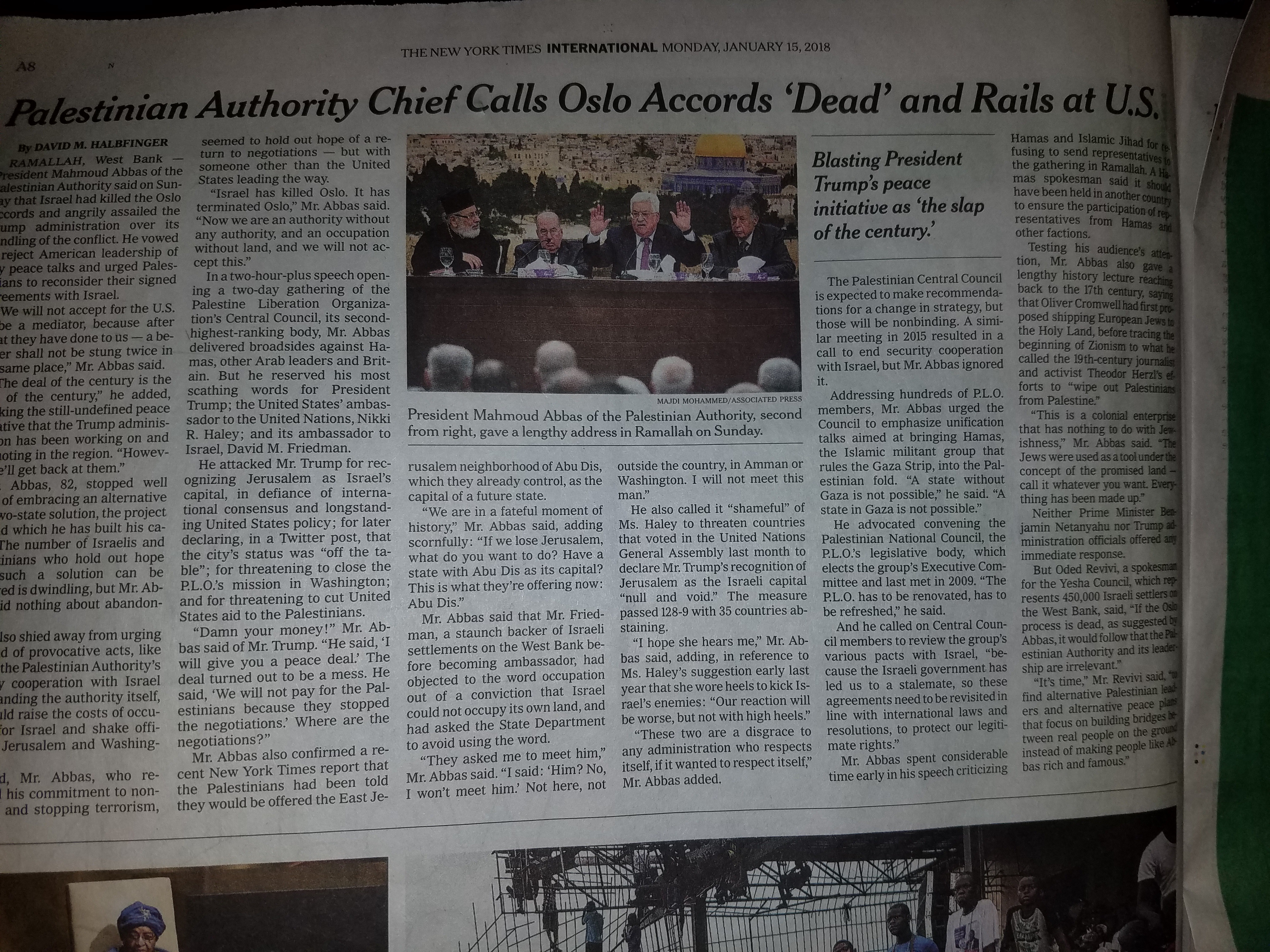
Palestinian Authority Perfects Hypocrisy

On May 19, 2016, Israeli Prime Minister Benjamin Netanyahu announced that he was considering adding a right-wing party, Yisrael Beytenu, to his coalition. The Palestinian Authority’s reaction to this rumor was quick.

The Israeli government sent a message to the world that Israel prefers extremism, dedication to the occupation and settlements over peace.”

In a region which has perfected finger-pointing, the Palestinian Arabs have once again shown their mastery of hypocrisy.

liberman netanyahu
Yisrael Beytenu’s Avigdor Liberman with Israeli Prime Minister Benjamin Netanyahu
(photo: Reuters)

On June 2, 2014, the Palestinian Authority (PA) welcomed the terrorist group Hamas into a unity government. That move abruptly ended the many months of peace negotiations going on between Israelis and the PA which was shepherded by US Secretary of State John Kerry.  Within two weeks of forming the unity government, Hamas loyalists kidnapped and murdered three teenage Israelis and launched a war against Israel that killed thousands.

That’s a message of preferring “extremism” to peace.

Care to do a simple comparison of Yisrael Beytenu and Hamas?

Position Yisrael Beytenu Hamas
Land Extending full governmental control east of the Green Line (EGL), above current military control Complete destruction of all of Israel
Death penalty For terrorists convicted of killing Israelis For all Jews
Compromise Yes. “in the debate over unity of the land or the unity of the people, the unity of the people must take precedence, because over the unity of the people there can be no compromise and a deep fracture will not be overcome None. “Initiatives, and so-called peaceful solutions and international conferences, are in contradiction to the principles of the Islamic Resistance Movement
Minority Rights in country All minorities welcome, as long as loyal to the government Only “under the wing of Islam” can non-Moslems live in the land.
Legal System Full separation of powers, such as in the United States Shariah, Islamic Law
Racism No negative stereotypes Jews referred to as Nazis (Art. 20) and schemers and plotters (Art. 22)

Sources: Yisrael Beytenu positions; Hamas Charter

Hamas is considered a terrorist group by many countries,

  • but the Palestinian Arabs decided to vote them into a majority of Parliament anyway;
  • but the acting Prime Minister of the PA, Mahmoud Abbas, decided to create a coalition government with them anyway;
  • and the Palestinians actively killed the peace process that US Secretary Kerry had worked on for months anyway;
  • and they launched a war that killed thousands anyway.

So should anyone be surprised by the audacity and hypocrisy of the PA condemning Netanyahu for bringing Yisrael Beytenu into his coalition?  Which party has aligned itself with racists and murderers, and shown a complete unwillingness to compromise and make peace time-and-again, Netanyahu or Abbas?

Palestinian-Unity-Government-AP1-620x330
Palestinian Unity Government June 2, 2014
(photo: AP/Majdi Mohammed)


Related First.One.Through articles:

“Mainstream” and Abbas’ Jihad

Abbas Knows Racism

The Undemocratic Nature of Fire and Water in the Middle East

“Peace” According to Palestinian “Moderates”

Subscribe YouTube channel: FirstOneThrough

Join Facebook group: FirstOne Through  Israel Analysis