Names and Narrative: “Palestinians” versus Palestinian Arabs / Israeli Arabs

History and politics can sometimes be analyzed on the usage of language as much as policy. The Names and Narrative series reviews how language oftentimes changes the nature of the narrative in the Israel-Arab conflict.

Nouns and the Range of Adjectives

An important component in considering language is the distinction between nouns and adjectives.  A noun is the key element of English sentences.  The noun is the focus of language; the item that commits actions.  In comparison, an adjective is the modifier of the noun, that helps describe the noun more explicitly.

But not all adjectives are the same. In some cases, adjectives can become nouns themselves.

Consider a simple noun like “table.” Describing a “wooden table” would give more context to the table, differentiating it from other tables like a glass table.  As such, “wooden” would be an adjective.  However, it is an adjective that is factual and embedded in the noun “wooden table.”  The two words cannot be separated – the table is, and always will be, made of wood.  I call this an “embedded adjective.”

Compare this to other adjectives for the table.  The table may be a “painted wooden table,” or “a rectangular wooden table.”  In these examples, “painted” and “rectangular” are also adjectives that describe the wooden table.  But these adjectives are not forever tied to the table.  The table could be stripped, and become unpainted.  It could be cut and become a square.  These adjectives are therefore not embedded in the noun, but a semi-permanent description of the noun.

There are also adjectives that are based on a relative position. Consider a “long table” or a “high table.”  A table could be viewed as long or high only relative to something else.  Describing a table in such fashion brings a person’s vantage point into the description.  These are “relative adjectives.”

Lastly there are adjectives that relay a person’s preferences. A “pretty table” conveys the author’s own sense of beauty.  The table itself is not inherently pretty- it is simply an opinion of a single person.  This “subjective adjective” is the polar opposite of an embedded adjective.

Consider the use of adjectives – embedded, relative and subjective – as they relate to the Israeli-Arab conflict in a single expression: Palestinian Arabs.

From Many Palestinians to Exclusively Palestinian (Arabs)

The Holy Land was renamed “Palestine” roughly 2000 years ago by the Romans who defeated the Jewish kingdom. The name stuck even when the Romans departed hundreds of years later.  Arabs from the Arabian Peninsula took over the region when they came as part of the Muslim invasion in the 7th century.  The Ottomans (Muslims, but not Arabs) also kept the name Palestine when they controlled the region as part of their empire for 400 years which ended at World War I.

There were many people that lived in the region during this time. They referred to themselves as Palestinian Arabs or Palestinian Jews or Palestinian Christians.  There was no consideration that “Palestinian” meant only one particular type of person, and “Palestinian” was a subjective adjective (people used it for themselves) and relative adjective (they lived in Palestine and not somewhere else).

That changed during the 20th century.

As world powers that defeated the Ottoman Empire considered breaking the empire into distinct countries (which were to become countries known today as Iraq, Syria and others), they looked to facilitate the reestablishment of the Jewish homeland in Palestine. They developed international laws in 1920 and 1922 known as the San Remo Agreement and the Mandate of Palestine, respectively, which sought to facilitate additional Jewish emigration to Palestine, an area which today covers Israel, Gaza, the “West Bank” and Jordan.

That did not make the local Arabs happy.

The British quickly divided Palestine into two parts, giving the area east of the Jordan River to the Hashemite family in what became the state of Transjordan. Arabs in remaining part of Palestine rioted against the Jews throughout the 1920s and 1930s.  By the end of the 1930s, the Arabs had effectively convinced the British who administered the Mandate of Palestine to stem the tide of Jewish emigration, and make entire sections of Palestine Jew-free (in edicts known as the White Papers).

When the British ended their administration of the Palestine Mandate in 1948, Jews declared an independent state of Israel. Five Arab countries invaded the nascent state, with a war that ended in 1949.  By war’s end, the area known as Palestine was split yet again, with the western half becoming Israel and the eastern half becoming the illegally annexed “West Bank” of TransJordan.  Gaza was taken over by Egypt.  Palestine was no more.

The Jordanians expelled all the Jews from their newly conquered territory.  They granted Jordanian citizenship to all Arabs living east of the 1949 Armistice Lines.  Their citizenship laws clearly and explicitly EXCLUDED Jews from obtaining Jordanian citizenship.

Some of the Arabs in the West Bank who were granted Jordanian citizenship were not happy with the Jordanian arrangement. They preferred their own autonomy and country and not to be part of Jordan.  As such, in 1964, the Palestinian Liberation Organization (PLO) was created.  Its goal was a new Arab country in all land west of the Jordan River – in Gaza, the West Bank and Israel.  They sought to destroy Israel and replace it with a new state of Palestine.  As they did so, they created new definitions for Palestine and a Palestinian in the PLO Charter:

At first, the charter continued to use the historic formula of noun and adjective of “Palestinian Arab.” Each of the charters preambles began with “We, the Palestinian Arab people.”  However, the charter then went on to describe the land as inherently “Arab” with ties to the rest of the Arab world:

Palestine is an Arab homeland bound by strong national ties to the rest of the Arab Countries and which together form the large Arab homeland.” (Article 1)

That statement stripped the land from non-Arabs that lived and ruled in the territory for thousands of years. It turned the physical ground into “Arab land,” a subjective adjective. The Arabs think of the land as Arab.  However, that terminology became incorporated into the left-wing media’s dictionary as an embedded adjective, as if the land were really inherently Arab (further described in “Nicholas Kristof’s ‘Arab Land’.)

The PLO Charter continued to extend the argument that only Palestinian Arabs have rights to “Arab land”:

“The Palestinian Arab people has the legitimate right to its homeland and is an inseparable part of the Arab Nation. It shares the sufferings and aspirations of the Arab Nation and its struggle for freedom, sovereignty, progress and unity.” (Article 3)

After declaring that the land was inherently Arab and the Palestinian Arabs were the logical possessors of the Arab land, the charter took the next step of defining a “Palestinian” in a new manner:

The Palestinians are those Arab citizens who were living normally in Palestine up to 1947, whether they remained or were expelled. Every child who was born to a Palestinian parent after this date whether in Palestine or outside is a Palestinian.” (Article 6)

From this date, a new term of “Palestinian” was created to refer exclusively to Arabs.

The PLO did make a provision that some Jews could be “considered” Palestinian (as opposed to actually being Palestinian) in a further affront as stated in their modified 1968 PLO Charter:

“The Jews who had normally resided in Palestine until the beginning of the Zionist invasion will be considered Palestinians.” (Article 6)

Did the Palestinian Arabs claim that the “Zionist invasion” (of “Arab Land”!) began in the 1880s with the first aliyah? In 1917 with the Balfour Declaration? In 1948 with the declaration of Israeli independence? The Palestinian Arabs certainly didn’t think it was 3700 years ago when Jews moved into the region and formed several kingdoms. Of course they wouldn’t allow their descendants (the Jewish people) to be considered Palestinian too.

When the Jordanians (as well as Palestinian Arabs who were granted Jordanian citizenship) attacked Israel again in 1967 and lost the “West Bank” which they had illegally annexed, the Palestinian Arabs witnessed yet more of their “Arab land” fall under non-Arab control, and the war of land and language intensified.

Names and Narrative:
Palestinians versus Palestinian Arabs and Israeli Arabs

In the politics of language, the debate of using “Palestinians,” “Palestinian Arabs,” and “Israeli Arabs” has become a debate over narratives.

Adalah, an organization established in 1996 that seeks to dismantle the Jewish State, feels strongly about using the PLO’s definition of “Palestinian” and objects to calling them “Palestinian Arabs” or “Israeli Arabs” if they are citizens of Israel.

Consider Adalah’s opening in ther “Inequality Report” of what it considers the racist state of Israel:

Palestinian citizens of the state [of Israel] comprise 20% of the total population, numbering almost 1.2 million people. They remained in their homeland following the establishment of the State of Israel in 1948, becoming an involuntary minority.”

This formula of “Palestinian citizens of Israel,” rejects the notion of “Israeli Arab.” As such, Adalah seeks to deny the standard adjective-noun term, as much as they reject the historic usage of “Palestinian Arab” and “Palestinian Jew.”

This anti-Jewish State organization does this as a matter of principle.

Subjective adjectives can be parsed and separated. A “Palestinian Arab” both means that there are non-Arab Palestinians, and Arabs that are not Palestinians.

Land = People: As noted above, the PLO sought to declare that all Palestinians are Arabs.  “Palestinian” and “Arab” are inseparable terms, now morphed into the exclusively Arab “Palestinians.”  Stating that the land’s people are only Arab, denies both the history and rights of Jews in the land.

People = Land: Just as important to many anti-Zionists, if the two terms of “Palestinian” and “Arab” are used, they can be separated.  That suggests that the people can be separated from the land.  Does a Jordanian Arab that moves to Egypt stay a Jordanian Arab for generations, or do those descendants eventually become Egyptian?  The Palestinian Arabs produced a bizarre definition that demands that “Palestinians” – regardless of where they have lived for generations – be permanently referred to as Palestinians.

(This absurdity is compounded by the fact that more Arabs than Jews moved to the holy land under the British administration of 1922 to 1948. How do Iraqi Arabs that moved to Haifa in 1930 – and all of their descendants, regardless of their citizenship – become “Palestinians” forever, while a Jew who came from Russia at the same time becomes only a semi-permanent Israeli Jew, only while he lives there.)

Further, as there is no country called Palestine at this time, what does a “Palestinian citizen of Israel” mean? That Israel is simply in a de facto state of existence and the Arabs have citizenship of that entity, but that Israel is occupying the underlying true state of Palestine?  Or that only Palestinians are truly part of the fabric of the land itself?
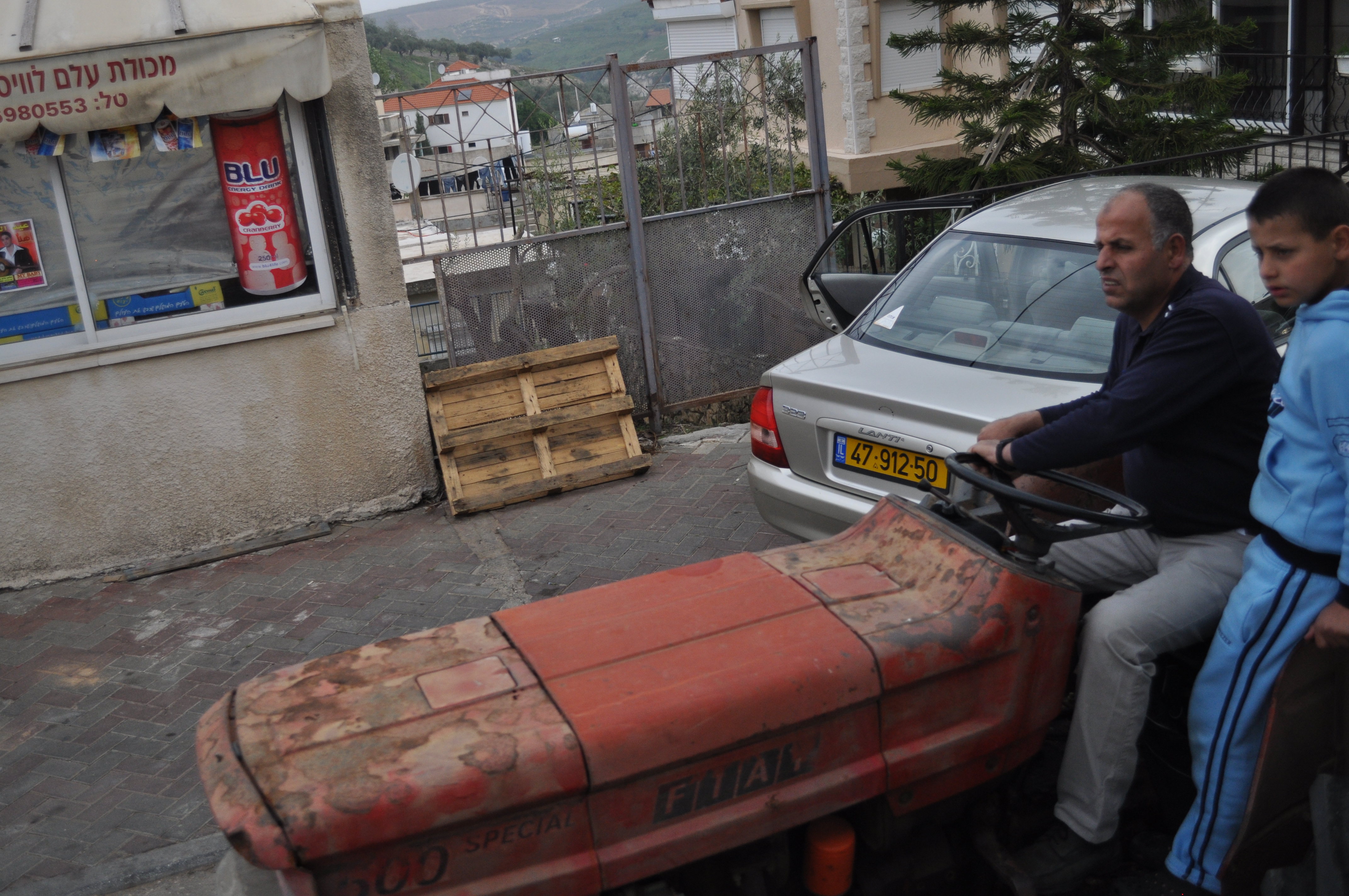
dsc_0881
Israeli Arab farmers in the Galilee
(photo: First.One.Through)

Pro-Zionists should never use the term “Palestinians”

As detailed above, the pro-Israel community should always use the terms “Palestinian Arab” (or stateless Arabs until if/when a new state of Palestine is created), or “Israeli Arabs” and reject using “Palestinians” as it furthers a flawed and anti-Zionist narrative.

Using “Palestine” and “Palestinians”:

  • Rejects the 3700-year history of Jews in the holy land
  • Declares that the land is inherently “Arab”
  • Argues that the Jewish State is simply in a de facto existence, while the underlying Arab nature of the land is permanent
  • It facilitates removing the Jewish , Zionist “invaders” from EGL (east of the Green Line)/ West Bank in the near-term, and from Israel in the longer-term.

“Israeli Arab” and “Israeli Jew” are relative and subjective terms, similar to “Palestinian Arab.” Do not get caught in the trap of pretending that a “Palestinian” is an embedded term, in which the holy land is Arab, nor those Arabs are permanently Palestinian.


Related First.One.Through articles:

Names and Narrative: Palestinian Territories/ Israeli Territories

Names and Narrative: The West Bank / Judea and Samaria

Names and Narrative: Genocide / Intifada

Names and Narrative: CNN’s Temple Mount/ Al Aqsa Complex Inversion

New York Times Lies about the Gentleness of Zionism

Elie Wiesel on Words

Subscribe YouTube channel: FirstOneThrough

Join Facebook group: FirstOne Through  Israel Analysis


The UN Fails on its Own Measures to address the Conditions Conducive to the Spread of Terrorism

In an effort to stop global terrorism, the United Nations assembled a team that composed an official Counterterrorism Strategy.  The eight point plan was meant to serve as a set of guiding principles for governments to follow in the hopes of curbing terrorism.

Unfortunately, the UN ignores those exact principles when it comes to dealing with Palestinian Arab terrorists.

un counter terrorism

Here is a review of the UN’s Counterterrorism Strategy, and its approach to the Arab-Israeli conflict.

  1. “[C]ontinue to strengthen and make best possible use of the capacities of the United Nations in areas such as conflict prevention, negotiation, mediation.”  Does the UN use the capacities of its institution in negotiations and mediation?  No.  It endorses a French plan that excludes both Israelis and Palestinian Arabs from the discussions.  It does nothing to encourage the Palestinian Arabs to commence negotiations.
  2. [M]utual respect for and prevent the defamation of religions, religious values, beliefs and cultures.” The UN fails in this initiative as well.  The United Nations’ UNESCO arm drafted resolutions that deny that the Jewish Temples stood on the Temple Mount in Jerusalem and its centrality to Judaism and the Jewish people.  It argues that Jews should be banned from praying at their holiest place.  It’s entire treatment of Jewish holy places in the holy land is terrible.  Further, as detailed in “The Only Religious Extremists for the United Nations are “Jewish Extremists,” the UN uniquely calls Jews extremists, while it never refers to Islamic terrorism.
  3. To promote a culture of peace, justice and human development, ethnic, national and religious tolerance, and respect for all religions, religious values, beliefs or cultures by establishing and encouraging, as appropriate, education and public awareness programmes involving all sectors of society. In this regard, we encourage the United Nations Educational, Scientific and Cultural Organization to play a key role, including through inter-faith and intra-faith dialogue and dialogue among civilizations.” UNESCO denies Jewish history in Jerusalem and the Temple Mount.  It undermines the education of the world of the 3700 year history of Jews in the holy land, including throughout the West Bank/ Judea and Samaria, as it worries that it offends Arabs. Another UN agency, UNRWA, does not teach the Holocaust to Palestinian Arab children for the same reason.
  4. “[P]rohibit by law incitement to commit a terrorist act or acts and prevent such conduct.” The UN calls for the terrorist group Hamas to be integrated into a Palestinian Authority unity government.  The UN doesn’t seek to prohibit terrorism as much as reward it. The UN Secretary General loudly declares that he “stands with Gaza.,” which is run by Hamas that launched three wars against Israel. Does Ki-Moon ever say that he stands with Israel? Never.
  5. [C]ommitment to eradicate poverty and promote sustained economic growth, sustainable development and global prosperity for all.” The UN worked to remove the Israeli company Sodastream from the West Bank/ Judea and Samaria, costing hundreds of Arabs their jobs.  In March 2016, the United Nations Human Rights Watch created a “blacklist” of Israeli companies operating east of the Green Line.  Does the UN want a sustainable economic model for Israelis and Palestinian Arabs, or would it prefer to keep the Palestinians on perpetual life-support from the UN?  In any event, the entire notion that there is a link between poverty and terrorism has repeatedly been proven false.
  6. To pursue and reinforce development and social inclusion agendas at every level as goals in themselves, recognizing that success in this area, especially on youth unemployment, could reduce marginalization and the subsequent sense of victimization that propels extremism and the recruitment of terrorists.”  There is nothing that creates the sense of “victimization” of youth more than UNRWA, the United Nations Relief and Works Agency for Palestine Refugees in the Near East. As detailed in “UNRWA’s Ongoing War against Israel and Jews,” the organization is perpetuating a war from 1948 which the Arabs initiated and lost.  UNRWA is making children, grandchildren and great grandchildren of original refugees grow up in camps without citizenship to specifically foster the sense of victimhood. The UN never address or rebukes the multi-decade laws of Lebanon and Syria that prevent the stateless Arabs from receiving citizenship.
  7. To encourage the United Nations system as a whole to scale up the cooperation and assistance it is already conducting in the fields of rule of law, human rights and good governance, to support sustained economic and social development.” Is the UN happy with Palestinian laws which call for death sentence for people who sell land to Jews? How about giving a pass to honor killings? Rampant theft by government officials?  How has the UN helped the Palestinians these many years?
  8. To consider putting in place, on a voluntary basis, national systems of assistance that would promote the needs of victims of terrorism and their families and facilitate the normalization of their lives.” Maybe the UN can acknowledge the Israeli victims of terror for a change.  Maybe it can stop excusing Palestinian Arab terrorists with statements that they “resort” to violence.

The United Nations stands by while Acting President of the Palestinian Authority Mahmoud Abbas incites terror.  The UN ignores payments that the PA makes to terrorist families.  It seems to bless the naming of schools, squares and tournaments after terrorists.  The UN Secretary General never seems to have read the Hamas Charter or the Fatah Constitution, and then acts shocked when Hamas commits murder.

Instead, Ban Ki Moon asked Israel to put its trust in the Palestinian Authority as he statedIsraelis should be comforted by the emergence of a reliable partner and neighbour committed to Israel’s right to live in peace and security, opposed to violence and terrorism, and able to deliver on the ground.”  Within days, an Israeli family was killed while they slept by two Palestinian Arab terrorists.

The United Nations under Secretary General Ban Ki Moon ha stood watch while terrorism spread from the Middle East to around the globe.  The UN has acted as guardians of Palestinian Arab wards these many decades, and did not institute any of these reforms for itself or into the nascent Palestinian Authority.

How can the world put any faith in the UN in developing a plan to combat terrorism, when it has fostered and perpetuated terrorism in the Middle East?

As the UN doesn’t follow any of its own enumerated Counterterrorism strategies in dealing with Palestinian Arabs, maybe the plan might actually work.


Related First.One.Through articles:

Ban Ki Moon Has No Solidarity with Israel

What do you Recognize in the Palestinians?

The UN is Watering the Seeds of Anti-Jewish Hate Speech for Future Massacres

The UN’s Disinterest in Jewish Rights at Jewish Holy Places

The United Nations and Holy Sites in the Holy Land

Subscribe YouTube channel: https://www.youtube.com/user/FirstOneThrough

Join Facebook group: Israel Analysis


The Only Precondition for MidEast Peace Talks

Acting President of the Palestinian Authority Mahmoud Abbas has long argued that he needed many preconditions satisfied before he would sit down with Israeli Prime Minister Benjamin Netanyahu for peace talks. Those requirements included settlement freezes and releasing Palestinian Arab prisoners from Israeli jails. Netanyahu begrudgingly did both of those things, and Abbas slowly showed up to talks, but didn’t actively engage to negotiate a solution.

Instead, during the last talks in 2014, Abbas shuttered the talks by forming a unity government with the terrorist group Hamas. Within a week, Hamas loyalists kidnapped and murdered three Israeli teenagers, leading to the 2014 Gaza War.

More recently, Abbas argued for a new set of preconditions, including that peace talks must continue for at least one year, and that Israeli withdrawal from the West Bank would be concluded by 2017. His preconditions seemingly now include demanding that his end goals (a new Palestinian State without Jews) be met before he even sits at the table.

Abbas sounds like a very serious man seeking peace.

For his part, Netanyahu continues to state that he is willing to sit down with Abbas without any preconditions and that he is open to discuss any matter. In doing so, he hoped to start bilateral talks and resolve the Israeli-Palestinian Arab conflict.

Netanyahu is wrong too.

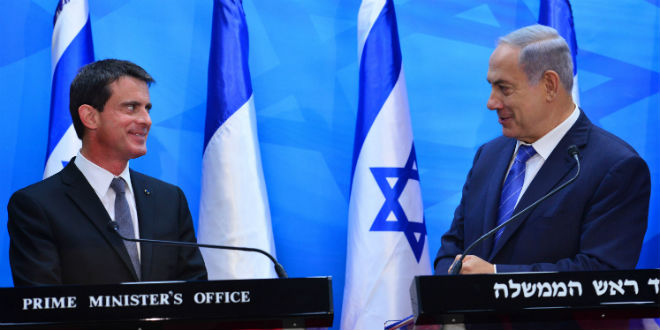
benjamin-netanyahu-valls-france-israel
Israeli Prime Minister Benjamin Netanyahu (R) holds a joint press conference with Prime Minister of France Manuel Valls, May 23, 2016. (Photo: Kobi Gideon / GPO)

GOALS and PRECONDITIONS

There is nothing wrong with the parties stating the goals they hope to achieve in the talks, whether they be the establishment of an independent Palestinian State with every Jew evicted from the land (PA position), or that such Palestinian state needs to officially recognize Israel as a Jewish State (Israeli position). The desires may be non-starters for the counter-parties, and whether those goals are ultimately achieved will be a matter of negotiations and compromise. However, they are not, nor should they be treated as, preconditions.

Preconditions had historically been viewed as items which the parties required to initiate and sustain the peace talks. In the past, Abbas argued that he needed those tangible results to gain popular support for the talks, and Netanyahu gave in (due to pressure from the USA) with a settlement freeze and releasing prisoners. More recently, Netanyahu banned any member of the Israeli parliament from going to the Temple Mount, to calm the killing spree launched by Palestinian Arabs against Jews in the Holy Land.

Asking for and satisfying these preconditions is flawed and counter-productive.

If peace talks will ultimately put both parties on a path to a better course, why beg the parties to show up?  The Palestinians demand preconditions and use the complaint “show me that you’re serious” to obtain slices of their ultimate goal, while never publicly making a single concession.  They continue to extract items from the Israelis while conceding nothing, as they wait to see what the French proposal will produce for them, before taking any steps towards the Israelis.

The French, while likely well-meaning, have destroyed the basic parameters for peace talks: they have pushed aside bilateral negotiations.  In doing so, there is no chance of bringing the Palestinians to the table.

For the Israelis, satisfying slices of Palestinian goals without any mutual action by the Palestinians before talks commence has two negative consequences: it continues to demonstrate to the Palestinians that they can forever delay publicly stating any compromise position, undermining the Israeli public’s confidence in the talks; and it obfuscates the vital parameter of the peace process, which is not whether the parties can sustain the talks, but whether they have the ability to deliver on the outcome.

THE ONLY PRECONDITION

If the parties negotiating the peace talks have no legitimacy, and no ability to deliver on whatever is negotiated, the talks are a complete waste of time and effort.

Which leads to the only real practical precondition to peace talks: the Palestinians must hold elections.

The Palestinians last voted for president in 2005, and for parliament in 2006. They have held no elections for either president or parliament since that time.

Acting President of the PA Abbas’s term expired in January 2009. He has continued in that post for many years, but has neither mandate nor support of the Palestinian people. The March 2016 Palestinian poll concluded “If new presidential elections are held today in the West Bank and the Gaza Strip, Hamas’ candidate Ismail Haniyeh would win against Mahmud Abbas with a margin of 11 percentage points.”  Further, “a majority in both the West Bank and the Gaza Strip continues to demand his [Abbas’s] resignation.”

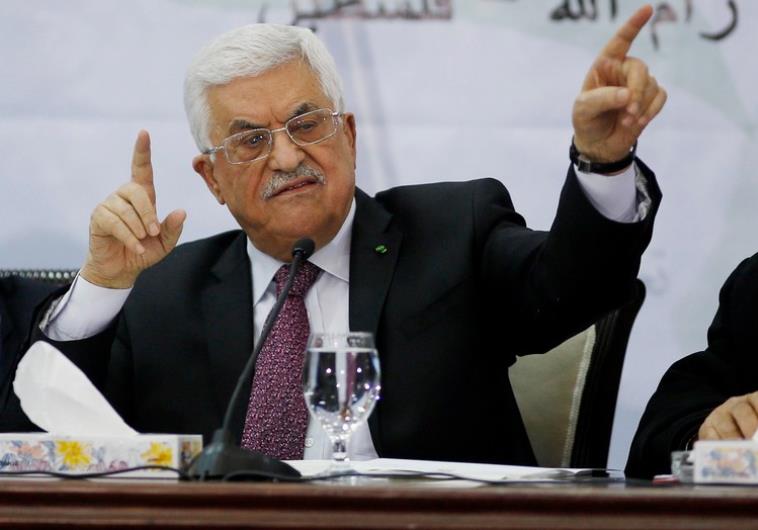
Abbas plo council
Acting President of the Palestinian Authority Mahmoud Abbas at the
Central Council of the PLO in Ramallah

(photo: Reuters)

Hamas won 58% of the seats of parliament in the 2006 elections and subsequently routed the rival Fatah party out of Gaza. Abbas and his Fatah party have almost zero influence in the coastal strip.  That coastal strip has launched three wars against Israel since Abbas took power, in 2008, 2012 and 2014.

So Abbas has no legitimate authority, no popular support, and no ability to deliver peace.

Yet the world wants the Israelis to negotiate with a straw man.  Why should they?  For photo ops?

The only precondition for peace talks are for the Palestinian to hold new elections and for that winner to control both Palestinian Authority territories in Gaza and Area A in Judea and Samaria.

PALESTINIAN ELECTIONS AND RAMIFICATIONS

One of the fears in the global community about holding Palestinian elections is that Hamas would win the presidential contest. Almost every poll of Palestinian Arabs over the past ten years shows Hamas winning, particularly against Abbas. As such, world leaders have been reluctant to force an election as a Hamas victory would destroy any peace process, as Hamas states clearly in its charter (Article 13), “so-called peaceful solutions and international conferences, are in contradiction to the principles of the Islamic Resistance Movement…There is no solution for the Palestinian question except through Jihad. Initiatives, proposals and international conferences are all a waste of time and vain endeavors.

As such, the world must be clear about the elections: Hamas, in its current configuration, with its current charter cannot participate in the elections. Should the Palestinians allow Hamas to run, the world will view such action as a rejection of any peace with the Jewish State.  The ramifications would be severe:

  • Nations would begin to cut off all Palestinian aid
  • From the United Nations perspective, the UNRWA relief agency which was initially designed as a short-term agency almost 70 years ago, will cut its staff and funding in half (and move those resources to help actual refugees at the UNHCR)
  • The global community would not put forward any international peace process, nor consider permitting a Palestinian admission into any UN agency for a decade

However, should the Palestinians have elections which exclude the Hamas terrorist group, the Palestinians would be represented by a leadership with a mandate, authority and capability of delivering on peace.  Such a leadership would be an actual counterparty that could deliver on the necessary compromises with Israel.


It is well past time to stop calling international conferences that exclude the Palestinians and Israelis, and forcing Israelis to negotiate with a straw man.  Begin the process of holding genuine Palestinian elections now.


Related First.One.Through articles:

The Disappointing 4+6 Abbas Anniversary

The United Nations Applauds Abbas’ Narrative

The Undemocratic Nature of Fire and Water in the Middle East

The Israeli Peace Process versus the Palestinian Divorce Proceedings

Subscribe YouTube channel: FirstOneThrough

Join Facebook group: FirstOne Through  Israel Analysis

Palestinian Authority Perfects Hypocrisy

On May 19, 2016, Israeli Prime Minister Benjamin Netanyahu announced that he was considering adding a right-wing party, Yisrael Beytenu, to his coalition. The Palestinian Authority’s reaction to this rumor was quick.

The Israeli government sent a message to the world that Israel prefers extremism, dedication to the occupation and settlements over peace.”

In a region which has perfected finger-pointing, the Palestinian Arabs have once again shown their mastery of hypocrisy.

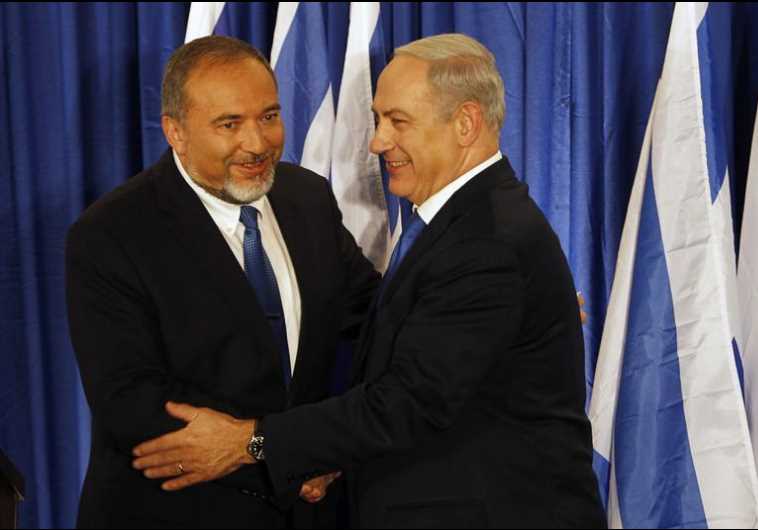
liberman netanyahu
Yisrael Beytenu’s Avigdor Liberman with Israeli Prime Minister Benjamin Netanyahu
(photo: Reuters)

On June 2, 2014, the Palestinian Authority (PA) welcomed the terrorist group Hamas into a unity government. That move abruptly ended the many months of peace negotiations going on between Israelis and the PA which was shepherded by US Secretary of State John Kerry.  Within two weeks of forming the unity government, Hamas loyalists kidnapped and murdered three teenage Israelis and launched a war against Israel that killed thousands.

That’s a message of preferring “extremism” to peace.

Care to do a simple comparison of Yisrael Beytenu and Hamas?

Position Yisrael Beytenu Hamas
Land Extending full governmental control east of the Green Line (EGL), above current military control Complete destruction of all of Israel
Death penalty For terrorists convicted of killing Israelis For all Jews
Compromise Yes. “in the debate over unity of the land or the unity of the people, the unity of the people must take precedence, because over the unity of the people there can be no compromise and a deep fracture will not be overcome None. “Initiatives, and so-called peaceful solutions and international conferences, are in contradiction to the principles of the Islamic Resistance Movement
Minority Rights in country All minorities welcome, as long as loyal to the government Only “under the wing of Islam” can non-Moslems live in the land.
Legal System Full separation of powers, such as in the United States Shariah, Islamic Law
Racism No negative stereotypes Jews referred to as Nazis (Art. 20) and schemers and plotters (Art. 22)

Sources: Yisrael Beytenu positions; Hamas Charter

Hamas is considered a terrorist group by many countries,

  • but the Palestinian Arabs decided to vote them into a majority of Parliament anyway;
  • but the acting Prime Minister of the PA, Mahmoud Abbas, decided to create a coalition government with them anyway;
  • and the Palestinians actively killed the peace process that US Secretary Kerry had worked on for months anyway;
  • and they launched a war that killed thousands anyway.

So should anyone be surprised by the audacity and hypocrisy of the PA condemning Netanyahu for bringing Yisrael Beytenu into his coalition?  Which party has aligned itself with racists and murderers, and shown a complete unwillingness to compromise and make peace time-and-again, Netanyahu or Abbas?

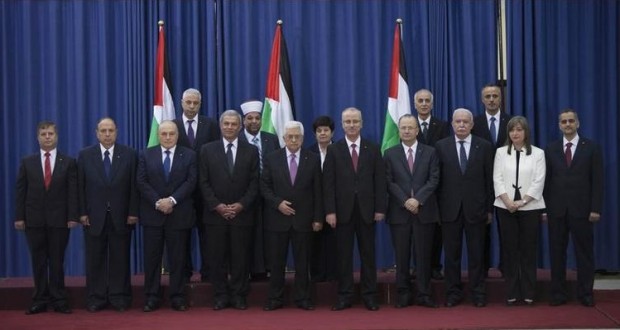
Palestinian-Unity-Government-AP1-620x330
Palestinian Unity Government June 2, 2014
(photo: AP/Majdi Mohammed)


Related First.One.Through articles:

“Mainstream” and Abbas’ Jihad

Abbas Knows Racism

The Undemocratic Nature of Fire and Water in the Middle East

“Peace” According to Palestinian “Moderates”

Subscribe YouTube channel: FirstOneThrough

Join Facebook group: FirstOne Through  Israel Analysis


The UN is Watering the Seeds of Anti-Jewish Hate Speech for Future Massacres

One of the key warning signs of genocide is the spread of hate speech in public discourse and the media…. And every day, the seeds of future massacres and genocides are being planted.

The only way to prevent genocide and other egregious violations of human rights is to acknowledge shared responsibility and commit to shared action to protect those at risk.

It is essential that Governments, the judiciary and civil society stand firm against hate speech and those who incite division and violence.”

UN Secretary General (UNSC) Ban Ki Moon April 11, 2016

Ban Ki Moon
UNSC Ban Ki Moon

The powerful words of the current UN Secretary General clearly denounced hate speech and recognized their role in sowing massacres and genocides.

However, the UNSG never reflects on his own theory when he considers the Palestinian Arabs and their attacks on Jews and Israel. Consider:

  • The Hamas party is the most anti-Semitic ruling governmental entity in the world that specifically calls for killing Jews and destroying Israel, yet the UNSC called for Hamas to be integrated into the Fatah party in a reconciliation government.
  • The acting Prime Minister of the Palestinian Authority and head of the Fatah party Mahmoud Abbas continually denies Jewish history in the Holy Land and calls for a Jew-free state, but the UN endorses these efforts, including a UNESCO resolution denying any Jewish history on the Temple Mount and the UNSC backing Abbas’s Jew-free state.
  • The Palestinian Authority routinely celebrates murderers of Jews by naming schools, squares, streets and tournaments after them. The UNSC absolves their words and actions by stating that Palestinians are simply “resorting to violence“, because a peaceful solution has not yielded the results they seek.
  • Mahmoud Abbas, who wrote his doctoral thesis on a theory that Israel actively supported the Holocaust, routinely uses Nazi Germany imagery about Israel, but the UN remains silent.

The world must unite against Hamas and state clearly that the United Nations is wrong about including Hamas in a unity government.

The world must categorically reject the notion that Jews should be barred from living in any country, and recall the words of Article 15 of the 1922 British Mandate Article which specifically stated that “no person shall be excluded from Palestine on the sole ground of his religious belief.

Countries should consider their own laws which ban Holocaust denial as a form of hate speech, while they stand and applaud Abbas at the United Nations.

Countries should withhold financial aid to the Palestinian Authority, every time they promote another murderer onto the walls of their institutions.


Israel’s Mission to the United Nations will host 1500 students and organizations on May 31, 2016 to combat the toxic narrative around Israel which is part of the BDS (Boycott, Divestment and Sanctions) of Israel initiative, as part of Israel’s “Ambassadors Against BDS“.  It is an effort that is unfortunately needed because of the United Nations endorsement of Palestinian Arab hate speech.

If only Ban Ki Moon would listen to his own words that “It is essential that Governments, the judiciary and civil society stand firm against hate speech and those who incite division and violence.”


Related First.One.Through articles:

The Palestinians aren’t “Resorting to Violence”; They are Murdering and Waging War

Names and Narrative: Genocide / Intifada

What do you Recognize in the Palestinians?

The United Nations’ Adoption of Palestinians, Enables It to Only Find Fault With Israel

UN Breakthrough? “Hamas continues to directly threaten the security of Israel”

UNRWA’s Ongoing War against Israel and Jews

Subscribe YouTube channel: FirstOneThrough

Join Facebook group: FirstOne Through  Israel Analysis

The Arab Middle East Makes Refugees, They Don’t Help Them

The Middle East is producing refugees in great numbers, as the civil wars in Syria and Sudan drag on, ISIS takes over large swathes of Iraq, and Libya and Yemen deteriorate into failed states.

The refugees are being welcomed into various western countries including Germany, Sweden and Canada. Just recently, Canada changed its laws under its new Prime Minister Justin Trudeau, to facilitate refugees becoming citizens.

In the Arab Middle East, only Jordan has opened its doors to fellow Muslim Arabs. The Islamic country of Turkey is not Arab, and prefers to act as a way station to refugees in transit to Europe.  The vast Kingdom of Saudi Arabia has not opened its doors. The rich states of Oman, Qatar and Kuwait have done nothing.

syrain refugees jordan
Syrian refugees in Jordan

There is a long history of the Muslim Arab Middle East creating refugees, but not welcoming them.

  • In 1991, after the Palestinians supported Iraq’s Saddam Hussein in his takeover of Kuwait, the Kuwaitis expelled over 300,000 Palestinians. Goodbye.
  • In 1967, after the Egyptians and Syrians threatened to destroy Israel, but ended up losing the war, the countries did not welcome any Arabs from the region into their countries as new citizens.
  • In 1948-9, when the Arab countries surrounding Israel launched an attack to destroy the Jewish State, but failed to do so and consequently helped create 711,000 Arab refugees, they let the people suffer.  While the Syrian government allowed the United Nations to establish refugee camps for the Palestinian Arab refugees inside Syria, it never allowed those refugees or their descendants to obtain work permits to get professional jobs.

And so it continues to this day. While the Islamic State dreams of building a unified caliphate to unite the Muslims of the Middle East, the established monarchies continue to do their utmost to cement divisions.

The Muslim Middle East today is divided between the genocidal jihadists of ISIS who seek Muslim unity by killing anyone not like themselves, and the corrupt, racist monarchies that do nothing to promote unity.

Will the Muslims that flee the insanity of the region adopt western values of tolerance, or will they bring one of these brands of barbarism to the western world?


Related First.One.Through articles:

Help Refugees: Shut the UNRWA, Fund the UNHCR

Palestinian “Refugees” or “SAPs”?

Considering a Failed Palestinian State

The United States Joins the Silent Chorus

A Flower in Terra Barbarus

Subscribe YouTube channel: https://www.youtube.com/user/FirstOneThrough

Join Facebook group: Israel Analysis

Names and Narrative: Genocide / Intifada

William Shakespeare once wrote What’s in a name? that which we call a rose, by any other name would smell as sweet.”  The suggestion of Juliet’s comment to Romeo was that the name given to a person or a thing is less significant than the essence of what that person or item is.  The famous phrase is often repeated; it is a widely-held belief in the western world: essence trumps labels.

It is therefore surprising that so many concentrate efforts to precisely label things.  Consider the term “genocide,”  which the United States government just used for only the fourth time.

ISIS Committing Genocide

On March 17, 2016, US Secretary of State John Kerry defined the actions of the Islamic State/ ISIS as “genocide.” He stated that “in my judgment, (ISIS) is responsible for genocide against groups in areas under its control including Yazidis, Christians and Shiite Muslims.” Kerry made such declaration after the US House of Representatives unanimously passed a resolution stating that ISIS was committing a genocide against Christians in Syria and Iraq, just days before. Their action followed the European Union  designating the killings as a genocide in February.

Does labelling the actions of ISIS a “genocide” change anything? Will the United States be forced to take action to stop the brutal slaughter of Christians and other minorities by these jihadists? No.

Will ISIS be so upset by the declaration that it will stop killing people? No.

Senator Marco Rubio noted as such when he said “That it took so long for the administration to arrive at this conclusion, in the face of unspeakable human suffering, defies explanation. At long last the United States is no longer silent in the face of this evil, but it would be travesty if we were to mistakenly take solace in this designation, if the designation did not then yield some sort of action.”

Possible actions could include: pushing for the restoration of property and lands taken; offering aid and asylum to those being persecuted. It may also mean that the US must take action according to the Genocide Convention which was adopted after World War II. Article I of that Resolution specifically states that genocide is a crime “to prevent and to punish.

ISIS-executing-prisoners
Islamic State executing prisoners

The Definition and Roadmap to Genocide

The Genocide Convention enumerates what constitutes a genocide in Article II.
[G]enocide means any of the following acts committed with intent to destroy, in whole or in part, a national, ethnical, racial or religious group, as such:

  • Killing members of the group;
  • Causing serious bodily or mental harm to members of the group;
  • Deliberately inflicting on the group conditions of life calculated to bring about its physical destruction in whole or in part;
  • Imposing measures intended to prevent births with the group;
  • Forcibly transferring children of the group to another group.”

These actions are clearly being taken by the Islamic State against the Yazidis.

A group called “Genocide Watch” described a multistep pathway in which many genocides unfold. The pathway includes:

  1. Classification
  2. Symbolization
  3. Dehumanization
  4. Organization
  5. Polarization
  6. Preparation
  7. Extermination
  8. Denial

In addition to labelling the pathway to genocide, the authors of this list enumerated actions that society could implement to prevent a genocide from happening during each phase. For example, in the case of “Organization,” they suggest that “membership in these militias should be outlawed. Their leaders should be denied visas for foreign travel. The U.N. should impose arms embargoes on governments and citizens of countries involved in genocidal massacres.

While people may agree or disagree with the pathway to genocide enumerated by Genocide Watch, it is a useful tool to examine evil intent as it unfolds in some societies, and some potential remedies.

Palestinian Intifada or Genocide

The Palestinian Arabs have launched numerous wars, riots and “intifadas” since the world approved the reestablishment of a Jewish homeland in the holy land in 1920. The Arab activities over these almost 100 years can be benchmarked against the definition and roadmap of genocide described above.

  1. Classification, is the deliberate use of ethnic and racial divisions in a society to promote intolerance. Muslim-majority countries often rule with unique systems of laws, where ethnic and religious minorities are given a “dhmmitude” status.  These dhimmis have secondary status in society. When Islam invaded the holy land in the seventh century, they gave the indigenous people the option of converting to Islam, dying, or living in dhimmitude.
    The Arabs of EGL (east of the Green Line) extended the pariah classification of Jews when they evicted all of them from the region including the Old City of Jerusalem in 1949. The Jordanians granted all people in the area citizenship, but explicitly excluded any Jews. To this day, Palestinian Arab leadership has called for a country to be devoid of any Jews, and has official laws that call for the death sentence for any Arab caught selling land to a Jew.
  2. Symbolization, is the use of special symbols like the yellow star that Nazis forced Jews to wear. The Palestinian Arabs have no authority over any Jews so such comparison is not apropos, at this time.
  3. Dehumanization of Jews is a something that Palestinian Arab media and leadership does repeatedly. Actions include calling Jews the “sons of apes and pigs“.
  4. Organization is the assembly of special groups and militias to carry out the killings. This is a Palestinian Arab specialty, as they have more terrorist entities than any other group in the world. They include: Abu Nidal; Hamas; Palestine Liberation Front; Palestinian Islamic Jihad; Popular Front for the Liberation of Palestine; PFLP- General Command; and Al-Aqsa Martyrs Brigade, to name a few.
  5. Polarization includes broadcasting hate propaganda and the targeting of moderates. MEMRI and Palestinian Media Watch have hundreds of examples of Palestinian hate propaganda. The Hamas Charter calls against any negotiation with Israel. Palestinian leadership assassinates anyone considered collaborating with Israel.
  6. Preparation includes limiting where people can live and identifying them for death. As noted above, the “moderate” Palestinians call for removing all Jews from EGL/Judea and Samaria, while the more popular and extreme Palestinians openly call for targeting Jews for death and wiping out Israel in its entirety.
  7. Extermination has been an ongoing Arab effort since the riots of the 1920s and 1930s, to the war to destroy Israel in the 1940s, and the wars and “intifadas” of the past two decades.
  8. Denial only exists after the genocide is complete, which fortunately has not happened to the Jewish State. An example of genocide denial can be best captured by the “moderate” acting-Prime Minster of the Palestinian Authority, Mahmoud Abbas, who wrote his doctoral thesis on Holocaust denial, and the champion of Hamas, the Turkish leader Recep Erdogan who continues to deny the genocide of Armenians to this day.

Gaza cattle ranchers

The Palestinian war against Israel fits the UN’s definition of genocide as well. Can the Palestinians claim they are simply “resisting” Israel and “resorting” to violence?

  • Killing Jews has been going on since 1920. Today the actions are with knives and cars. In 2014 it was with missiles. In 2002 it was with bombings. The focus on killing a subset of Israelis – the Jews – is made clear in Palestinian founding documents which include such statements as:
    1. Our struggle against the Jews is very great and very serious….”
    2. The Day of Judgement will not come about until Moslems fight the Jews
    3. In face of the Jews’ usurpation of Palestine, it is compulsory that the banner of Jihad be raised…”
    4. Israel, Judaism and Jews challenge Islam and the Moslem people…”
    5. Israel, by virtue of its being Jewish and of having a Jewish population, defies Islam and the Muslims.
  • Causing serious bodily and mental harm is also part-and-parcel of the attacks. The dehumanization (mentioned above), denying Jewish history in the holy land and the rights to live in their holy land are also forms of inflicting mental harm.
  •  As noted above, Palestinians have repeatedly tried to destroy Israel.  The wars of 1948 and 1967 were intended to destroy Israel completely.  Terrorism has targeted Jewish schools, synagogues and everywhere that people live.
  • The Palestinian Arabs have not been able to enforce items 4 and 5 under the UN definition of Genocide as they have not have sufficient control over Jews.

Whether by the United Nations own definition, or the pathway described by Genocide Watch, it is clear that the Palestinians are actively trying to engage in a genocide of the Jews in the Middle East.  According to an ADL poll, Palestinian Arabs are almost 100% anti-Semitic.

Har Nof
Murder in Synagogue in Har Nof neighborhood of Jerusalem
November 2014 (photo: Israel Government Press Office)

Actions to be Taken

Genocide Watch recommends embargoes and denying visas to genocidal groups like Hamas.  The United Nations is mandated by the Genocide Convention to “to prevent [massacres] and to punish [those committing and inciting such actions].”  And what has the United Nations done with the Palestinian Arabs?  The opposite.

  • UN Secretary-General Ban Ki Moon has pushed for a Palestinian reconciliation government that includes the terrorist group Hamas
  • The UN promises Palestinian Arabs that they will all get to move into Israel
  • The UN emphasizes Palestinian victims while it ignores Israeli victims
  • The UN pushes for this anti-Semitic group to get their own country and become a member of the UN
  • The UN Secretary General pushes to end the blockade of Hamas-ruled Gaza
  • The UN gave the podium and recognition to Mahmoud Abbas, who blamed Jews for the Holocaust in his doctoral thesis, and then added to the insult, claiming from that UN platform that Jews were committing a genocide against Palestinians

The UN is supposed to fight to prevent genocide.  However, when it comes to Palestinian Arabs, the organization either chooses to not recognize the vileness of Palestinian actions, or it simply forgives their activities, in the belief that Arab self-determination will pacify their blood lust beyond their new borders.

If one chose to be more “generous” about the UN’s actions and statements regarding Palestinian Arabs, it is that the world wants to prevent an inevitable genocide by Palestinian Arabs against the Jews, so it supports enforcing anti-Semitic edicts and evicting Jews from their homes and businesses in Judea and Samaria.  Give the Palestinian Arabs their Jew-free state, and prevent a large scale genocide.

What’s in a Name?

ISIS has been slaughtering minorities for a long time, and only in March 2016 did the United States opt to call the brutality a “genocide.”  Will the new designation of “genocide” make people and governments take a stand against the racist jihadist slaughter?

The world has used Palestinian terminology of their war against the existence of a Jewish State, calling it an “intifada,” or an uprising.  In a similar vein, the UN refers to Arabs “resisting” Israel and the New York Times says that Hamas “resorts” to violence.  Arab violence and incitement get a pass.

The labels and terms do not conceal the murders or bold statements that Hamas declares in its charter and its leaders call out today.  They seek a genocide of the Jews and Jewish State.  Yet their genocidal movement is labeled in soft reactionary language.

Do names and labels matter?

If people called the ISIS campaign in Iraq and Syria an “intifada,” would they consider that their goal of a Sunni state is legitimate?  Would the world embrace the eviction of Christians from their homes in Iraq, so the Islamic State can be self-governing in a new caliphate?

If the world acknowledged the evil of the anti-Semitism of the Palestinian Arab mission to ban Jews from living in their homes, and their mission to drive Jews from the holy land, and called their attacks a “genocide,” would they demand an end to Hamas instead of including it in a reconciliation government?

Will a label produce an action?  Or is a designation simply a conclusion?  A statement of opinion of right versus wrong; good versus evil.

Perhaps the United States will take new actions against the Islamic State, and actively protect the persecuted, now that they have taken to calling the actions of ISIS a “genocide.”

Maybe the pro-Israel community can stop calling the Palestinian Arab attacks an “intifada,” and clearly call out the “genocide” and put an end to the war on the Jewish State.


Related First.One.Through articles:

The United Nations’ Adoption of Palestinians, Enables It to Only Find Fault With Israel

UN Press Corps Expunges Israel

The UN Can’t Support Israel’s Fight on Terrorism since it Considers Israel the Terrorists

UNRWA’s Ongoing War against Israel and Jews

The United Nations’ Remorse for “Creating” Israel

Names and Narrative: Palestinian Territories/ Israeli Territories

Names and Narrative: The West Bank / Judea and Samaria

Names and Narrative: CNN’s Temple Mount/ Al Aqsa Complex Inversion

Subscribe YouTube channel: FirstOneThrough

Join Facebook group: FirstOne Through  Israel Analysis


The United Nations’ Adoption of Palestinians, Enables It to Only Find Fault With Israel

In the course of a war, there are often incidences where civilians are harmed. It is interesting to consider the United Nations responses to such attacks during recent battles.

  • Saudi Arabia killed 41 civilians on March 16, 2016. The UN condemned the airstrike, but not Saudi Arabia that carried out the attack.
  • Russia carried out attacks in Syria that killed 41 people, including 27 civilians on November 6, 2015. UN Secretary-General Ban Ki Moon issued no statement.
  • The USA bombed a medical facility run by Doctors Without Borders, killing 22 people on October 3, 2015. The UN condemned the attack, but not the United States.
  • Israel attacked an UNRWA school, killing 10 people on August 3, 2014. The UN called out Israel for the “moral outrage and a criminal act.” Ban Ki Moon repeatedly stated that the Israelis responsibility was to protect Palestinian civilians, and made no mention of their actual responsibility to protect Israeli civilians.

Why can the UN Secretary General only recognize and call out an attacker in the case of Israel? Why are Palestinian civilians worthy of more protection and recognition than other civilians? Why is an attack on Palestinians uniquely a “moral outrage and criminal act?”

The Protector of One

The United Nations views itself as the guardians of the Palestinians uniquely; every other conflict in the world is between two independent warring parties.

The Palestinians have a unique definition of “refugee” and a unique relief agency (UNRWA) compared to every other actual refugee (UNHCR).  This enables the United Nations to funnel money and assume a parental role of 5 million people instead of the actual 30,000 current Palestinian refugees from the 1948-9 war they initiated.

Therefore, when Palestinians are attacked, the UN views itself as attacked.

The United Nations adopted the Palestinians.  They are the guardians of these Arab wards.

The UN’s outrage against Israel is unique in words, actions and intent.  The Palestinians are part of UN’s family.  As such, the UN is inherently an unqualified arbitrator in any dialogue between the Israelis and Palestinian Arabs.

Ban Ki Moon
UN Secretary General Ban Ki Moon


UN Statement on Saudi Arabia killing of 41 civilians in Yemen. KSA is not mentioned:

“The Secretary-General condemns the airstrikes that hit al-Khamees market in Mastaba district in the Hajjah province of Yemen yesterday. This incident is one of the deadliest – reportedly killing and wounding scores of civilians, including women and children – since the start of the conflict. This is the second major incident of this kind in just over two weeks.

The Secretary-General underscores to all parties the utmost necessity to fully respect their obligations under international humanitarian and human rights laws, including the fundamental rules of distinction, proportionality and precaution. Attacks directed against civilians and civilian objects, including populated markets, are strictly prohibited. The Secretary-General stresses that any intentional attack against civilians or civilian objects is a serious violation of international humanitarian law. It is critical to carry out prompt, effective, independent and impartial investigations into all allegations of serious violations.

The Secretary-General continues to urge all parties to the conflict to cease all military activities and to start to resolve all differences and outstanding issues in a new round of peaceful negotiations facilitated by his Special Envoy for Yemen.

The Secretary-General expresses his sincere condolences and sympathies to the families of the victims and wishes a speedy recovery to those injured.”

 UN Statement on US killing 22 people in hospital. USA is not mentioned:

“The Secretary-General strongly condemns the airstrikes in Kunduz, Afghanistan, that resulted in the death and injury of medical workers and patients at a Médecins Sans Frontières hospital on 3 October.

The Secretary-General recalls that hospitals and medical personnel are explicitly protected under international humanitarian law. He calls for a thorough and impartial investigation into the attack in order to ensure accountability.          Médecins Sans Frontières have been operating the only hospital in Kunduz under extremely trying conditions. The Secretary-General commends the courageous and dedicated staff of the organization and extends his deepest sympathies to the families of those killed and injured in this attack.”

UN statement on Israel’s killing of 10 people near an UNRWA school. Calls out Israel and highlights Palestinian civilians.

“The Secretary-General strongly condemns the killing today of at least 10 Palestinian civilians in shelling outside of an UNRWA school in Rafah providing shelter to thousands of civilians.  The attack is yet another gross violation of international humanitarian law, which clearly requires protection by both parties of Palestinian civilians, UN staff and UN premises, among other civilian facilities.

United Nations shelters must be safe zones not combat zones. The Israel Defence Forces have been repeatedly informed of the location of these sites.  This attack, along with other breaches of international law, must be swiftly investigated and those responsible held accountable. It is a moral outrage and a criminal act.

The Secretary-General is profoundly dismayed over the appalling escalation of violence and loss of hundreds of Palestinian civilian lives since the breach of the humanitarian ceasefire on 1 August. The resurgence in fighting has only exacerbated the man-made humanitarian and health crisis wreaking havoc in Gaza.  Restoring calm can be achieved through resumption of the ceasefire and negotiations by the parties in Cairo to address the underlying issues.

The Secretary-General repeats his demand to the parties to immediately end the fighting and return to the path of peace.  This madness must stop.”


Related First.One.Through articles:

The UN Can’t Support Israel’s Fight on Terrorism since it Considers Israel the Terrorists

The United Nations’ Remorse for “Creating” Israel

The United Nation’s Ban Ki Moon is Unqualified to Discuss the Question of Palestine

The United Nations’ Ban Ki Moon Exposes Israeli Civilians

The United Nations “Provocation”

The Hollowness of the United Nations’ “All”

Help Refugees: Shut the UNRWA, Fund the UNHCR

Subscribe YouTube channel: FirstOneThrough

Join Facebook group: FirstOne Through  Israel Analysis


Every Picture Tells a Story: The Invisible Killed Terrorists

France Against ISIS

Every media outlet reported repeatedly about the devastation in Paris in November 2015. The terrorist attacks throughout the city killed 130 people going about their daily lives, and pictures filled newspaper pages of the bloody scene of the Batclan night club where most of the people were murdered. There were many other pictures and articles of the various innocent victims over the following days.

IMG_3612
Front page of the New York Times, November 15, 2015

In the following days the headlines of newspapers broadcast that France was attacking ISIS in retaliation for the attacks. Liberal papers like the New York Times editorial section even stated that “France rightfully attacked ISIS.” The papers reported 20 sorties.

Yet, where were the pictures of the dead ISIS fighters?  Where was the headcount of how many fighters were killed?

For all of the coverage about the terrorist attack and follow-up airstrikes, there was virtually no discussion of the deaths inflicted on the ISIS fighters in Syria or Iraq.

The pictures in the paper show the innocent victims of France. Nowhere does it show the images of what the French did in response.

The US Against Al Shabab

On March 8, 2016, the New York Times reported that the US struck and killed 150 fighters in Somalia, belonging to the terrorist group Al Shabab. The United States has been fighting against Al Shabab, an affiliate of Al Qaeda, for a decade.  While this group has not conducted any attacks on US soil against American civilians, a Pentagon spokesperson claimed that the group was planning a “large-scale attack” against US troops.

The US attack was the deadliest attack against Islamic militants in Africa.

There were no pictures in the newspapers to accompany the article.

There were no follow up stories.

Israel Against Hamas

Hamas has defined itself as opposed to the very existence of Israel.  They refuse to acknowledge any right or legitimacy of the Jewish State.  They repeatedly state in their charter and on their news programs that there can be no peace agreement with Israel, only jihad.

Hamas has launched over 10,000 rockets into Israel, since Israel left Gaza in 2005.  The group has instigated three wars and killed over a thousand Israelis.  Those Hamas wars have claimed thousands of Palestinian Arab lives as well.

However, unlike the invisible terrorists of ISIS and Al Shabab, the papers post the pictures of dead Palestinian terrorists.  Whether covering the front pages of the paper in the summer of 2014, or running long articles with several pictures of Gazans dying using the tunnel network, the paper relays the Palestinians in a sympathetic light.  The people of Gaza, who voted for and are governed by the terrorist group Hamas, are shown as victims time and again.


The United Nations often condemns Israel for “disproportionate” force in stopping Palestinian attackers actively involved in attacking people.  It did not condemn France  nor the United States for its actions against terrorists.

Maybe every day people can begin to condemn the media for disproportionate coverage of Israel’s handling its War on Terror.


Related First.One.Through articles:

Review of Media Headlines on Palestinian Arab Terror Spree

Every Picture Tells a Story: Arab Injuries over Jewish Deaths

Every Picture Tells A Story: Only Palestinians are Victims

Every Picture Tells a Story- Whitewashing the World (except Israel)

The Big, Bad Lone Wolves of Terrorism

The New York Times Refuses to Label Hamas a Terrorist Group

Flip-Flopping on the Felling of Terrorist Groups’ Founders

My Terrorism

Subscribe YouTube channel: FirstOneThrough

Join Facebook group: FirstOne Through  Israel Analysis

The United Nations’ Ban Ki Moon Exposes Israeli Civilians

Five years ago, in March 2011, the world was a very violent place. The Secretary-General of the United Nations often spoke at length about the responsibility to protect civilians from violence. In some places.

When it came to Israel, after two Palestinian Arab men slaughtered five people in their beds while they slept, Ban Ki Moon uttered few words, and rather than demand better protection for civilians, he argued that the government should “act with restraint.”

Just four days before the massacre in Itamar, Secretary General Ban Ki Moon said the following: “The Palestinian Authority continues to make progress in institution-building and the delivery of public services, which leaves it well-positioned for the establishment of a State at any point in the near future. Israelis should be comforted by the emergence of a reliable partner and neighbour committed to Israel’s right to live in peace and security, opposed to violence and terrorism, and able to deliver on the ground.”

More ignorant words may never have been spoken.

If the UN Secretary General was so impressed with the PA as a partner, why does he never call out the Palestinian Authority to stop inciting violence and protect people?  As seen below, he is comfortable calling on other ruling authorities to protect civilians.  Except Israel.

Quotes from Ban Ki Moon in March 2011

On Israel, March 12, 2011 (38 words): “The Secretary-General condemns last night’s shocking murder of an Israeli family of five, including three children, in a West Bank settlement. He calls for the perpetrators to be brought to justice, and for all to act with restraint.”

  • There was no call for ensuring the protection of innocent civilians.
  • There was no calling out of the Palestinian Authority for incitement.
  • There was no call to contain Palestinian extremists to prevent the further loss of life.

That would only happen for other countries, where he would wax on about the obligation to protect civilians:

On Sudan, March 14, 2011 (161 words): ” He calls upon the leadership of the National Congress Party (NCP) and Sudan People’s Liberation Movement (SPLM) to restrain the local communities in Abyei and to implement the short-term containment measures…”

On Libya, March 17, 2011 (208 words): “Resolution 1973 affirms, clearly and unequivocally, the international community’s determination to fulfil its responsibility to protect civilians from violence perpetrated upon them by their own government. The Resolution authorizes the use of all necessary measures, including a no-fly zone to prevent further casualties and loss of innocent lives

On Syria, March 18, 2011 (104 words): “The use of lethal force against peaceful demonstrators and their arbitrary arrests are unacceptable

On Yemen, March 18, 2011 (111 words): ”  He reiterates his call for utmost restraint and reminds the Government of Yemen that it has an obligation to protect civilians. He calls on all to desist from any provocative acts that might lead to further violence..”

On Libya, March 23, 2011 (64 words): “…he reiterates his call for an immediate end to violence by all parties, in accordance with Security Council resolutions 1970 and 1973, and for the responsibility to protect civilians.

On Syria, March 23, 2011 (101 words): “He reminds the Syrian Government of its obligation to protect civilians

On Ivory Coast, March 31, 2011 (175 words): “He urges all parties to abide by their responsibility to avoid harm to the civilian population. It is essential that all parties cooperate with the United Nations Mission in Côte d’Ivoire in carrying out its mandate to protect civilians. The Secretary-General reiterates that those responsible for inciting, orchestrating or committing human rights violations will be held accountable under international law.

Ban Ki Moon
UN Secretary General Ban Ki Moon

The UN Secretary General believes governments in the region should protect civilians, but Israel should rely on the Palestinian Authority for its security.  In March 2011, a family was butchered in their beds.

Five years later, Ban Ki Moon continues the same pattern of not calling out the Palestinian Authority – which he still claims is a “reliable partner and neighbor” for Israel’s security – for inciting murder.  He excuses them with words that the Palestinians are “frustrated.”  He absolves their sins with silence.

Five years on, innocent civilians continue to be killed in the streets of Israel, and Ban Ki Moon continues to deny that Israel has the right and responsibility to protect its citizens.


Related First.One.Through articles:

The United Nation’s Ban Ki Moon is Unqualified to Discuss the Question of Palestine

The United Nations’ Remorse for “Creating” Israel

The Hollowness of the United Nations’ “All”

The UN Can’t Support Israel’s Fight on Terrorism since it Considers Israel the Terrorists

UN Comments on the Murder of Innocents: Itamar and Duma

UN Media Centre Ignores Murdered Israelis

UN Comments on the Murder of Innocents: Henkins

FirstOneThrough video of Itamar massacre: The 2011 Massacre of the Fogels in Itamar (Gorecki)

Subscribe YouTube channel: FirstOneThrough

Join Facebook group: FirstOne Through  Israel Analysis