The Revolutionary Theology Has Gone Operational

The arrests came just before New Year’s Eve.

Federal authorities charged members of a group calling itself the Turtle Island Liberation Front with planning coordinated bomb attacks in Southern California. Investigators described discussions of explosives, targets, and timing. The plan was operational, deliberate, and aimed at creating fear and mass harm.

The group’s own words revealed how its members understood their actions. Posters and social media tied to the suspects declared “death to America,” hostility toward federal institutions, and solidarity with “Palestine” framed as “liberation.” The suspects did not describe their plans as criminal. They viewed them as morally required.

That distinction is critical. It explains why violence felt justified rather than transgressive. And why young people can cheer the assassinations of healthcare executives and the massacres by Hamas terrorists, rather than ponder the moral swamp that has taken over their minds.

A World Reduced to Moral Absolutes

At the core of this twisted ideology is a belief that America, Israel, and capitalism are systems of permanent oppression. They are described as forces that keep a foot on the throat of the common man—extracting labor, denying dignity, enforcing hierarchy through violence.

DSA member Rep. Rashida Tlaib (MI) reciting her version of Hitler’s Mein Kampf to the DSA conference in 2021

Within this framework, reform loses meaning. Coexistence is treated as betrayal. Opposition becomes a duty. Violence becomes resistance.

Once that moral threshold is crossed, escalation is no longer radical. It is faithful.

How Far-Left Activism Removed the Guardrails

This worldview is not confined to clandestine cells. Its language has circulated for years inside far-left activist spaces, including factions associated with the Democratic Socialists of America.

DSA-linked rallies, resolutions, and affiliated campus groups have repeatedly adopted language that frames politics as existential struggle rather than democratic contest. Israel is described as a settler-colonial project that must be dismantled. Zionism is labeled racism. Capitalism is defined as violence. America is cast as an imperial force whose institutions lack legitimacy.

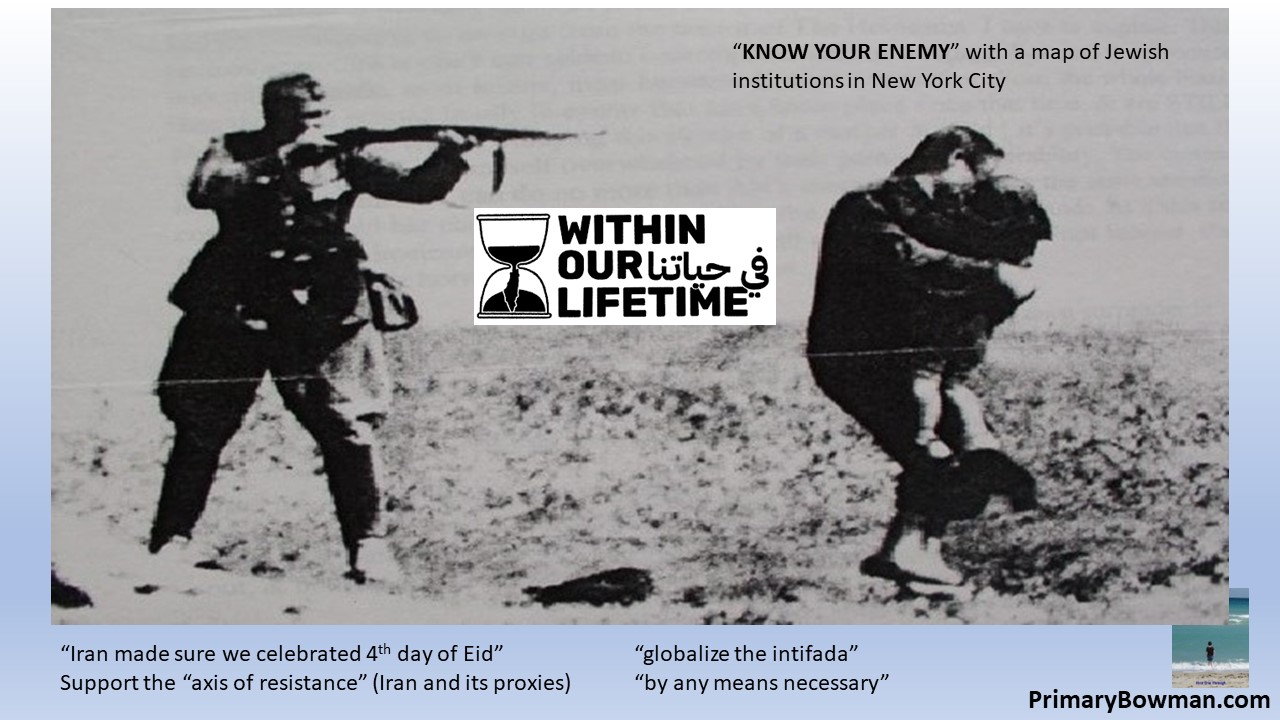
The phrasing matters. Calls for “by any means necessary,” “intifada revolution,” and declarations that there can be “no peace on stolen land” are not metaphors. They are moral instructions. They announce that outcomes justify methods and that limits no longer apply.

The rhetoric has infiltrated American schools, both K-12 and universities. Young people are being taught that they have a moral duty to dismantle systems of oppression and that the oppressors are capitalism, the American government, and powerful Jews. Stealing from stores is no longer a crime but means of reparations. Shooting up a kosher store is a form of “restorative justice.”

And the DSA rhetoric and candidates have infiltrated the Democratic Party. It began in 2017 and has accelerated. Rashida Tlaib is the most noxious example, but incoming mayor of New York City, Zohran Mamdani may become the most visible, leading the largest American city, the center of American capitalism, and the city with the largest number of Jews outside of Israel.

Where will this lead? Will Jews and capitalists become daily targets?

Movements are shaped by the permissions they grant. When activists normalize the idea that destruction is justice, someone eventually decides to carry it out literally.

Why Israel and Jews Become the Inevitable Focus

Israel occupies a singular place in this ideological ecosystem. It represents sovereignty, national identity, military power, economic success, and Jewish self-determination. For movements defined by opposition to perceived power, Israel becomes the ultimate symbol.

Criticism shifts from policy to existence. Zionism is no longer debated; it is pathologized. Jewish presence becomes suspect. Exclusion is reframed as moral clarity.

And this is not just aired on TikTok but taught at leading American schools, often funded by Islamic regimes.

This pattern is familiar. When a people are defined as embodying the system itself, harm against them begins to feel righteous. Antisemitism thrives wherever absolutist ideologies divide humanity into victims and irredeemable oppressors.

Iran’s Revolutionary Language, Recycled

The structure of this worldview is not new.

Iran’s Islamic Revolution articulated it decades ago. America was cast as the Great Satan. Israel as the Little Satan. Zionism as a cancer that must be removed. These were not rhetorical excesses. They were moral justifications for perpetual violence.

Over time, the religious vocabulary faded, but the framework endured. Imperialism replaced heresy. Capitalism replaced idolatry. “Liberation” replaced salvation. The certainty remained intact in a secularized lexicon. It was internalized as faith for the common man.

What once animated clerical revolution now circulates through Western classrooms and social media feeds, stripped of theology but retaining its absolutism.

A Warning, Not a Theory

The Turtle Island arrests are not an anomaly. They, the election of DSA candidate Zohran Mamdani, and the Luigi Magione fandom are an American signal flare that has been brewing for years for the Jewish community. They mark the moment when revolutionary language stops being symbolic and becomes operational against Americans on a mass scale.

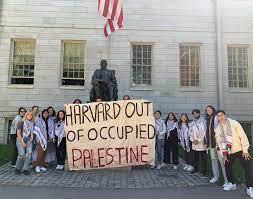
Harvard students rally to Hamas in the aftermath of the brutal slaughter of 1,200 people in Israel

Societies do not collapse because extremists speak. They collapse when eliminationist ideas are normalized, when calls for destruction are treated as moral expression, and when institutions charged with defending pluralism hesitate to draw lines.

Once a culture accepts the premise that entire nations, peoples, or systems deserve to be erased, violence is no longer a question of if. It is a question of when.

Liberal Democracy, on Edge

A liberal democracy begins with a belief in pluralism—that a society can remain open even when its people profoundly disagree.

It assumes citizens will hold incompatible views about religion, morality, identity, and history, and that the state’s role is not to arbitrate truth but to preserve space. Speech is therefore protected broadly, even when it is crude, offensive, or deeply wrong. A liberal democracy does not require enlightenment. It requires freedom.

That freedom extends even to haters. But it is not unlimited.

Pluralism does not mean surrender. A society can protect speech while still drawing firm lines against coercion. The distinction is simple and essential: ideas are free; intimidation is not.

This is why liberal democracy depends on strong law enforcement. Courts, police, and prosecutors are the infrastructure of freedom. Without enforcement, rights exist only for those willing to defend themselves physically.

The law must intervene before intimidation hardens into violence. Waiting for broken windows or spilled blood is not neutrality—it is negligence. Fear does its work quietly. People leave long before they are injured.

This is not theoretical.

Across the West today, Jews are being harassed in public spaces, on campuses, and in neighborhoods—not for what they say or do, but for who they are. They are told their presence is a provocation. That they should leave “for their own safety.” That public space belongs to others now.

Jewish man in Montreal Canada out shopping with his family told to leave area because his physical presence was a provocation to anti-Israel protestors in November 2024

This is a flashing warning sign.

When Jews are asked to disappear so that others may feel comfortable, liberal democracy is already failing. When the burden shifts from the intimidator to the target—when minorities are told to lower their profile, avoid certain areas, or conceal their identity—the law has retreated.

President Biden’s Jewish liaison, Aaron Keyak, tells Jewish Americans to hide their religion in May 2021

The logic is dangerous: if you weren’t here, there wouldn’t be trouble.

That logic ends pluralism.

A liberal democracy does not require Jews—or any minority—to justify their presence. It does not ask them to trade visibility for safety. It does not treat their normal lives as inflammatory acts.

When intimidation succeeds, speech becomes theoretical and freedom selective. The public square shrinks until only the loudest remain, and those vicious groups with whom the government aligns. Elections may continue, courts may still issue rulings, but the civic bargain is broken.

The test of a liberal democracy is therefore how it responds when minorities are told to leave, either directly by government officials or with their tacit approval. If the state allows harassment to drive people out—quietly, gradually, without intervention—it has abandoned its most basic duty.

Zohran Mamdani, the incoming mayor of New York City who is comfortable with the phrase “globalize the Intifada,” will be in charge of law enforcement in the city with the greatest number of Jews.

  • How will he respond when Baruch College at the City University of New York suggests Jews cancel holiday events because antisemites have the run of the school and the institution cannot (will not) assure their safety?
  • What will he do when Jewish students at New York University cannot enjoy the school’s facilities because of gross failures to protect students?
  • Who will send in the police when Columbia University Jewish students are forced to walk a tight direct line between classrooms with an escort, because the university cannot secure the campus for everyone?
  • Where will the courts and law enforcement be when Jewish students and faculty at CUNY Hunter College are forced to cancel or not attend classes because of widespread harassment and intimidation?

Students at Cooper Union in downtown NYC lock themselves in a library while anti-Israel protestors threaten them outside

A successful liberal democracy welcomes immigrants and may elect a Ugandan born mayor. Yet it fails to be a liberal democracy when Jews are forced to flee the streets because governmental officials give a free pass to harassment, intimidation and discrimination.

The West is on the cusp of learning whether it remains a liberal democracy. And whether it cares.

Bondi Attack: Can Jews Be Victims in the Media?

There are moments when a headline tells you everything by what it refuses to say.

A mass shooting took place at a Hanukkah party in Sydney, Australia. A Jewish holiday. A Jewish gathering.

Yet when major global outlets reported the story, something curious happened.

The New York Times headline did not mention Jews. Only the sub-header caught the significance of the attack, but did not say Jews were targeted.

More disturbing, follow-up articles did not focus on the horrific spike in antisemitism in Australia these past two years. Instead, the Times posted an article about… Bondi Beach, and how beautiful and popular it is.

The BBC followed a similar path. So did The Guardian. So did others like CNN. The event was flattened into abstraction: a “shooting,” a “disturbance,” a “tragedy,” untethered from identity.

By contrast, The Telegraph named Jews. The Jerusalem Post did as well. The New York Post and CNBC, too. Al Jazeera did not. Actually, Qatari-owned Al Jazeera attempted to whitewash the entire incident that there was “no information.”

This divide is not accidental. It reflects something deeper and more uncomfortable.

Because at the same moment that major Western media hesitated to name Jewish victimhood, the global Jewish community had no such confusion. WhatsApp groups lit up within minutes. Videos circulated—not to sensationalize, but to bear witness. The injured were named, not as statistics but as people. Hebrew names were shared so strangers across continents could pray for them.

No one asked whether Jews had been targeted. They knew.

The only uncertainty discussed privately was not if the attack was antisemitic, but which strain of antisemitism it represented. Neo-Nazis? Radical Islamists? A lone actor steeped in online hate? Jews have learned, painfully, to recognize the pattern even before the authorities finish their press conference.

So why the hesitation in public framing?

Why is Jewish identity often erased precisely when Jews are attacked?

Part of the answer lies in a narrative trap the modern media has built for itself. Jews, especially Israeli Jews, are increasingly cast in a single role: power holders, enforcers, aggressors. In that framework, Jews are permitted to be actors—but not victims. Agents—but not targets. Perpetrators—but not innocents.

Victimhood, in today’s moral economy, is rationed. And Jews often find themselves disqualified from it in favor of victims of preference.

Naming Jews as victims complicates the preferred storyline. It disrupts the binary of oppressor and oppressed. It forces an uncomfortable reckoning: that a people portrayed relentlessly as powerful are still being hunted in synagogues, homes, and holiday celebrations—from Pittsburgh to Poway, from Paris to Copenhagen, from Jerusalem to Sydney.

And so the language softens. The identity disappears. The motive is delayed, blurred, or left unexplored. The story becomes about the setting, not the target. About the neighborhood, not the people. About ambience, not intent.

The question is not whether Jews are under attack. That is beyond dispute.

The question is whether the world’s most influential media institutions are willing to say so plainly—or whether Jews may only appear in headlines when they are accused, never when they are wounded.

Part of the answer to the disgraceful shrug to the barbaric October 7 massacre in Israel is the systemic brainwashing that has been going on, that Jews cannot be viewed as innocent victims. Even when they plainly are, half a world away.


The Jewish Golden Years, 1991-2016

People tend to both forget and exaggerate. Today, many Americans speak as if antisemitism vanished for decades and only resurfaced after the October 7, 2023 massacre of Israelis by the Arabs of Gaza. The narrative goes: everything was fine, and then suddenly the world turned against Jews.

That is simply false.

Jews have always been the most targeted group for hate crimes in the United States on a per-capita basis. Jews were assaulted, synagogues were attacked, and Jewish centers were bombed long before social media existed to broadcast the hate. The 1970s alone saw a litany of terror: Jewish places targeted, flights to Israel hijacked, hostages separated by religion, and Jewish children born into a world where the UN itself declared Zionism—a core component of Jewish identity—to be racism. That infamous 1975 UN General Assembly Resolution 3379 did not merely insult Jews; it institutionalized antisemitism on a global stage.

But something remarkable happened in 1991. U.S. Ambassador Daniel Patrick Moynihan’s crusade finally came to fruition, and the UN revoked its poisonous declaration. For the first time in modern history, the Jewish story—people, land, and identity—was not officially stigmatized by the world’s central diplomatic body. Israel was no longer framed as a racist project; Zionism was permitted to exist as a normal national movement. With that reversal, Jews in the diaspora experienced something astonishing: a geopolitical tailwind.

Begin Center hosts event in Jerusalem about 50th anniversary of UNGA Resolution 3379, in December 2025a condemnation of the United Nations

The Jewish Golden Years had begun.

From 1991 through 2016, Jewish life flourished across the West. Israel integrated into global markets, made peace with former enemies, and became a hub of innovation admired even by countries without diplomatic ties. Antisemitic incidents did not disappear, but they lost their ideological legitimacy. The world’s leading institutions were no longer branding Jewish self-determination as a crime. Jews could breathe—never fully secure, but broadly accepted.

That period ended with a vote.

In December 2016, the Obama administration allowed UN Security Council Resolution 2334 to pass—a measure far more extreme than the 1975 resolution it resembled. The 1975 General Assembly resolution slandered Zionism; UNSC 2334 criminalized Jewish presence. It declared that Jews living anywhere east of the 1949 Armistice Lines—including the Jewish Quarter of Jerusalem’s Old City, the holiest ground in Judaism—are in violation of international law. Jewish prayer at the Western Wall was, according to the world’s most powerful diplomatic forum, an offense.

Hasidic Jews at the Kotel in Jerusalem’s Old City, learning, praying, and inserting wishes into cracks in the wall (photo: First One Through)

It was not merely a political resolution. It was the legalization of antisemitism.

Once the UN stamped Jewish presence in Judaism’s holiest places as illicit, the global tide shifted quickly. The Jewish Golden Years began to collapse.

By 2018, Jews were being murdered in Pittsburgh and Poway. On college campuses, BDS campaigns metastasized into doctrinal dogma. In public schools, students were taught that Jews are not indigenous to the Land of Israel but “white Europeans” with no ancestral claim—a complete inversion of historical fact. Jews were physically beaten in the streets of New York and Los Angeles during the May 2021 Gaza conflict, years before the post–October 7 mobs marched with chants to “globalize the intifada.”

By the time American cities filled with crowds celebrating Hamas’s massacre, the unraveling was already underway.

The Golden Years—the 25 years of relative acceptance—were gone.

For generations, Jews believed that Israel’s existence itself guaranteed Jewish safety. The 1970s proved that was untrue. The present moment proves it again. A Jewish state cannot protect its people if the world delegitimizes it, demonizes it, or criminalizes Jewish presence in Judaism’s holiest places.

The real guarantor of Jewish safety is not Israel’s strength, but the world’s willingness to accept the basic history and human rights of Jews. That legitimacy existed only in a narrow window: from the UN’s repudiation of its Zionism-is-racism libel in 1991 to Obama’s decision to let UNSC Resolution 2334 pass in final days of 2016.

Those twenty-five years were an intermission in a much longer historical pattern. A rare pause in which Jews were not told by the world that their existence—national, historical, spiritual—was a crime.

Since 2016, the message has returned with force: Jews may live, but not there. Jews may pray, but not here. Jews may exist, but only on someone else’s terms.

The Golden Years did not end because Israel faltered, but because the world revoked its permission. Without it, the old hatreds rushed back as if they had never left.

Jews are not witnessing a sudden outbreak of antisemitism. They are living through the collapse of the only era in modern history when the world briefly pretended to accept the Jewish story.

The Little Drummer Boys of Terror

President Obama once derided those who warned of Iran’s nuclear ambitions as promoting a “drumbeat of war.” It was a curious charge, especially as his negotiated JCPOA deal paved Iran’s legal pathway to nuclear weapons within a decade—despite Tehran’s unabashed calls to utterly destroy an American ally, and referred to the United States as “Satan.”

The phrase “drumbeat of war” is worth pausing over, because its imagery is meant to point a damning finger at generals and war profiteers, when in fact it refers to a beating passion that comes from a variety of sources.

Music itself teaches us the power of the drumbeat. Maurice Ravel’s “Bolero” begins as a whisper—a single snare tapping a faint rhythm—but its relentless pattern swells, layer by layer, into a rapturous explosion. Nothing changes except the intensity. It is a master class in how a simple beat, repeated without interruption, can inflame emotion, tighten resolve, and propel an entire orchestra toward an inevitable climax. Passion grows not from complexity but from persistence.

Cinema took that lesson to the battlefield. Ennio Morricone’s “L’Arena,” born from spaghetti-western duels and later carried into modern war films, shows how percussion can elevate tension into confrontation. Its pounding drums accompanied by trumpets push characters toward conflict; the beat does not merely accompany battle—it summons it. Morricone understood that rhythm can be a weapon, a psychological drumroll that makes violence feel fated long before the first shot is fired.

In American history, drummers were not symbolic ornaments—they were battlefield communicators. The famous “Spirit of ’76” painting captures a young boy and an old man beating time through the fog of revolution. In both the Revolutionary War and the Civil War, the drummer corps relayed commands, kept formation, and lifted morale. Soldiers needed to be adults to enlist, but drummer boys could be barely in their teens. They were not the policymakers of war; they were the ones whose youthful energy pushed men forward into battle.

“The Spirit of ’76” (1875) by Archibald Willard (1836-1918)

It is an uncomfortable truth: the drumbeat of war is often carried not by governments or generals but by the young.

We like to imagine youth as the innocent bystanders of conflict—swept up, exploited, or victimized by forces beyond their control. That is often tragically correct. But not always. In the Middle East, teenage Palestinian Arabs have repeatedly been at the center of anti-Jewish violence. During the knife intifada of 2015–2016, most of the attackers were adolescents. Arabic media even gave them a romanticized nickname: Ashbāl al-Quds—the lion cubs of Jerusalem.

On October 12, 2015, two Palestinian boys, 15-year-old Hassan Khalid Manasra and his cousin 13-year-old Ahmad Manasra, stabbed two Israeli civilians in Jerusalem

They were not pawns in someone else’s narrative. They were active participants in it.

While they were stabbing Israelis in the streets, new legions of drummer boys was forming. The Lions’ Den was inaugurated in the West Bank to unleash dozens of attacks. The United Arab Emirates named a school for children for these young murderers. In the United States, a group calling itself the Palestinian Youth Movement openly glorifies the murderers of October 7 and calls for an intifada on American soil. They harass Jews at universities, shut down bridges, disrupt traffic, and chant for “uprisings”—all under the pretext of activism, and often shielded by tax-exempt organizations like WESPAC.

In the immediate aftermath of the October 7, 2023 massacre by Gazans of Israelis, Cornel West marches with PYM calling for an “Intifada revolution”. West has taught at Princeton, Harvard and Yale, indoctrinating the next generation of American leaders on intifada.

The drumbeat is steady. It is disciplined. And it is aimed squarely at Jews.

Where does this beat begin? It is not in the Israeli cabinet rooms the media delights in blaming. It begins at UNRWA schools, where generations of children are taught that Jews are colonial invaders with no history in their homeland. It echoes through activist teacher unions in the United States, where “decolonization” rhetoric is repackaged into lesson plans that erase Jewish indigeneity. It thunders at the United Nations, where Muslim-majority blocs and their allies advance resolutions asserting that Jews must be removed from Judea, Samaria, and even parts of Jerusalem “by any means necessary.” The young Palestinian Arab terrorist are then shielded from blame and prosecution by the poorly named “UN Coordinator for Middle East Peace.” Laughable if not such a tragedy.

The young listen. And they march.

At Christmastime, the world hears “The Little Drummer Boy”—a melody of humility. A child with nothing to give but a simple rhythm of devotion for a newborn Jewish baby in Bethlehem. A beat based on innocence and purity.

But the modern Middle East and its Western echo chambers have perverted that image.

Today’s little drummer boys are not offering gentle hymns. They are being raised, trained, and celebrated for a beat of hatred—an indoctrinated cadence that valorizes “martyrs,” delegitimizes Jews, romanticizes violence, and promises glory for those who shed blood.

The world should hear the drumbeat. And it should finally ask: Who handed these children the drums? Who taught them that murder is heroism, that Jews are prey, that violence is virtue?

These teenagers did not invent the rhythm—they are marching to a score composed by UN agencies, radicalized teachers, political opportunists, and ideological arsonists who hide behind the language of “justice” while grooming minors for war.

UN Watch’s Hillel Neuer presents new report, “Schools in the Grip of Terror: How UNRWA Allowed Hamas Chiefs to Control its Education System,” to the Italian Senate in September 2025

At Christmas, we think of a young drummer offering a humble gift to a Jewish child in Bethlehem. Alas, today too many young drummers are taught to offer not devotion, but destruction—and the world nods along as if the rhythm were unavoidable. It isn’t.

The beat continues only because we refuse to silence the conductors who train the next generation of drummers to hate.

Vatican II – and the New Jew

On December 8, 1965, a crowd of 100,000 spectators assembled in St. Peter’s Square to mark the closing ceremony of Vatican II. The three years of work was orchestrated to bring about Christian unity, hoping to bring non-Catholics and Catholics together in a joint mission. The sixteen documents that the council enacted were designed on the theme of aggiornamento (Italian for bringing up to date) the Catholic church, which had started to be viewed by many as fading in relevance.

Pope Paul VI greets the faithful during the closure of the Second Vatican Council in St. Peter’s Square at the Vatican Dec. 8, 1965. (CNS/Catholic Press Photo)

The Second Vatican Council did not emerge in a Christian vacuum. It unfolded in the long shadow of Auschwitz, under the moral weight of a truth that could no longer be hidden: Christian Europe had stood by, silent or complicit, as the Jewish people were hunted, deported, and incinerated. The murderers were not pagan invaders; many were baptized Christians. The trains did not run through lands hostile to Christianity; they passed churches, crossed Catholic villages, glided along tracks laid in the heart of Christendom.

In 1961, the world could no longer avert its eyes. The Eichmann trial in Jerusalem forced every nation, every church, every conscience to watch. Survivors spoke in court with the clarity of witnesses resurrected from the grave: the collaborators, the bystanders, the bureaucrats, the bishops who said nothing, the priests who closed doors, the institutions that rationalized their silence. The trial tore away the last veil protecting Christian moral innocence. It was a moment when the Church had to confront not only the sins of individual Christians but the theological soil in which hatred had grown.

Trial of Adolph Eichmann in Jerusalem, Israel in 1961 (Photo: Bettmann / Getty)

Against this storm of reckoning, another seismic event had already taken place: the re-establishment of the Jewish state in 1948. For nearly two thousand years, Christianity had preserved an image of the Jew as the wandering witness, condemned by God to homelessness so Christians could inherit the promise. But suddenly, the wandering stopped. The Jewish people returned to their ancient homeland. Hebrew was resurrected from liturgy into daily speech. Jewish sovereignty reappeared as if history itself had refused to obey the theological script.

Israel’s rebirth shattered the Christian narrative of Jewish exile more forcefully than any sermon ever could. It reopened questions buried since the early Church Fathers: What does it mean if God’s covenant with the Jews never ended? What does it mean if the Jewish people still live, still dream, still return? What does it mean when prophecy looks suspiciously like news?

Israel declares itself a new country on May 14, 1948, to take place officially the following day May 15, which was Shabbat, coinciding with Britain ending its mandate.

By the time the Vatican convened, the Church was wrestling with two cataclysms: the moral collapse of Christian Europe during the Holocaust and the miraculous revival of the Jewish nation that Christian theology had relegated to the margins of history. These two realities — failure and fulfillment — created an impossible tension.

One of the sixteen Vatican II documents, Nostra Aetate (October 26, 1965) was not merely a doctrinal correction. It was a confession, an apology, a theological revolution. It declared the Jews not rejected but beloved, not guilty but enduring, not a fossil but a living partner in covenant. It rejected antisemitism “at any time and by anyone.” For Christians, it was liberation from a poisoned inheritance. For Jews, it was an unexpected invitation to be seen — perhaps for the first time — not as shadows in another people’s story, but as a people with a story of their own.

And something else began in the wake of Vatican II, something few would have predicted: the rise of Christian Zionism in its modern form. Many Christians, freed from the contempt of supersessionism, looked upon the Jewish state not as an accident of geopolitics but as a fulfillment of ancient promise. Some of Israel’s strongest supporters today come from Christian communities shaped by the theological revolution Vatican II inaugurated. They see Jewish sovereignty as evidence not of colonialism but of covenant, not of power but of destiny. They stand with Israel not out of political calculation but out of spiritual gratitude — an act of repentance and solidarity woven together.

Christian leaders assemble at the Western Wall in Jerusalem, observing Jewish prayer in November 2025 (photo: First One Through)

For Jews, this support has been both a blessing and a riddle. After centuries of persecution in Christian lands, how does one accept the embrace of former adversaries? How does a people long defined by suspicion learn to trust a hand that once struck but now extends in friendship? The Jewish story, once shaped by surviving Christian hostility, must now grapple with receiving Christian loyalty. The sting of history meets the strange balm of reconciliation.

These questions unfold in a nation — the United States — whose own identity has been shaped by Judeo-Christian roots from its earliest days. As the country approaches its 250th birthday, Americans are rediscovering that its foundational ideas — human dignity, moral law, liberty of conscience — flowed from a biblical inheritance shared by Jews and Christians alike. The Founders read the Hebrew Bible not as relic but as roadmap. The Exodus shaped the imagination of revolutionaries and abolitionists. The prophets shaped the conscience of Lincoln and King. The Jewish story is woven into the American one, even when America failed to honor it.

Rabbi Meir Soloviechik leads a tour of Christians and Jews at the Metropolitan Museum of Art in New York City, discussing the Judeo-Christian roots of America through art, in September 2025 (photo: First One Through)

Now, as antisemitism again rises and institutions fray, the old alliance becomes newly urgent. Jews and Christians are bound not by accident but by destiny: two peoples who share scripture, share moral vocabulary, and share responsibility for sustaining a civilization built on covenant rather than empire. Vatican II made it possible for this bond to be spoken aloud again, freed from the hostility that had once obscured it.

December 8, 1965 created a new Christian. But it also created a new Jew: a Jew who could stand in relationship not only to Jewish history but to Christian history, not only in resistance but in dialogue, not only as survivor but as partner. A Jew whose identity could be affirmed by the very institutions that once erased it.

And perhaps, as America steps toward its 250th year, this renewed bond is not merely theological or historical. It is a reminder that the future of Western freedom may depend on the same truth Vatican II finally proclaimed: that the Jewish people are not a footnote in someone else’s story, but the root from which so much of our shared moral world has grown.

The Veil on Antisemitism is Gone

For years, defense lawyers tried to blur the lines in terrorism cases. When police uncovered jihadist plots, attorneys floated the well-worn argument of entrapment — that officers merely nudged vulnerable young men into thinking about violence. If not entrapped, then “mentally ill.” “Impressionable.” “Confused.” A haze of excuses meant to rehabilitate the indefensible.

But look at the landscape now.

The people calling for violence against Jews aren’t hiding behind whispers in back rooms or being lured by undercover officers. They’re shouting it from megaphones under the banner of “free speech.” They’re organizing through groups like CAIR, Within Our Lifetime, and the Palestine Youth Movement. They openly describe Jews as “enemies” who must be “confronted by any means necessary.” They praise “resistance” in every form, stripping the word of euphemism and revealing precisely what they endorse.

Unlike past defendants, they haven’t yet been charged with providing weapons, scheming attacks, or casing synagogues. Not yet. But they are building the moral scaffolding for others to do so — a permission structure wrapped in slogans about “justice,” “liberation,” and “decolonization.” It is ideological, deliberate, and public.

This is not entrapment.
This is not mental instability.
This is not marginal, confused fury.

This is ideology. Hardened, intentional, and proud of itself.

For decades, antisemitism coming from “majority minorities” — segments of the Black community and the Muslim community — was treated differently. Explained away. Softened. Excused as an understandable reaction to oppression, poverty, policing, or trauma. Jews were asked to tolerate it, contextualize it, empathize with it. The burden of understanding was always placed on the victim. So much so, that when Jews were killed by Black people in Jersey City, Jews asked the Black community for forgiveness.

But the past few years have blown apart the pretense.

Anti-Israel activists outside a Jewish day school in Westchester calling for “liberation by any means necessary” in 2024

The hatred is no longer whispered. It is validated in academic departments, amplified on social media, and wrapped in moral language to disguise its ugliness. The same voices that once insisted they were merely “pro-human rights” now chant openly for the erasure of the Jewish people and state. They’ve dropped the mask because they believe the cultural winds are at their backs.

The veil is gone.

What remains is the raw reality: A movement that celebrates violence, justifies terror, and cloaks explicit antisemitism in the robes of social justice — and an America increasingly unwilling, or unable, to call it what it is.

Because the scaffolding of antisemitism for the alt-left is that Jews are a threat. They are powerful. They steal what is not theirs. And Jews then have the temerity to complain of “antisemitism” as if they aren’t privileged, their veil of protection to rip the victim card from the truly marginalized communities of color. For the alt-right, the rightful owners of this land are White Christians, and Jews are undermining them too.

This is FOLO, Fear Of Losing Out. The trepidation that what should rightly be yours is being snatched away by nefarious forces. The Jews. Perhaps alone, perhaps with other allies, whether they be minority groups, PACs or a foreign country.

It’s old antisemitism, magnified by social media and chat groups to instigate and mobilize the masses against the most persecuted people of the past centuries. The media veil can no longer conceal the barbarians at the gates of synagogues.

Roughly 200 protestors outside of New York City’s Park East Synagogue shouting “There is only one solution! Intifada revolution!” on November 19, 2025

Palestine 2.0

The world keeps pretending we’re about to build something new when we talk about a “future Palestinian state.” As if Palestine 1.0 never happened. As if the first real test of Palestinian self-rule didn’t already give us a precise answer.

Because when Palestinians were first allowed to govern themselves, they told us exactly who they were politically:

  • They elected a Holocaust denier, Mahmoud Abbas, to be president.
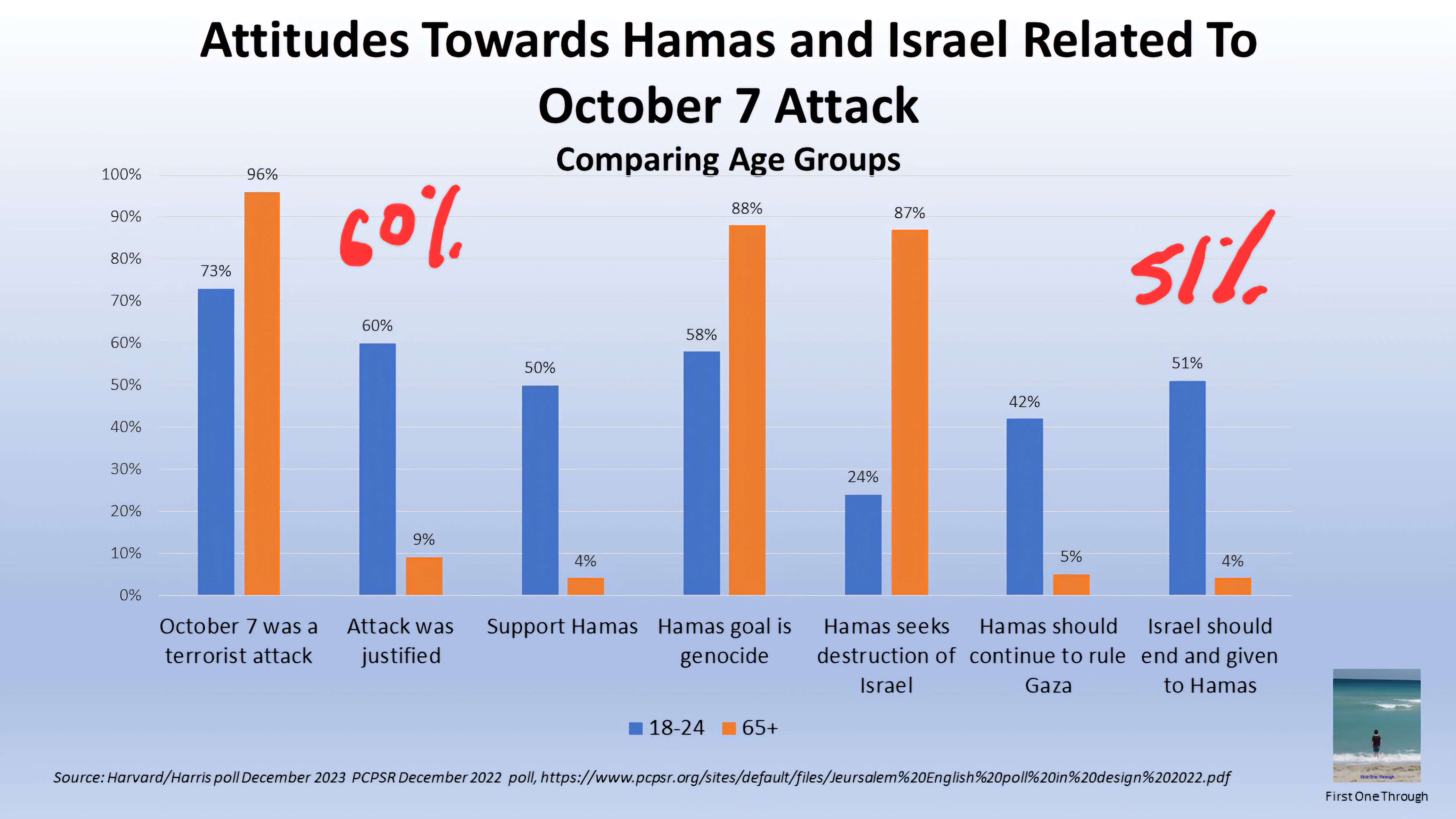
  • They handed 58% of their parliament to Hamas — a terror group that doesn’t hide behind euphemisms. Hamas says openly that its mission is killing Jews and destroying the Jewish state, and Palestinians rewarded that platform with victory.
  • Then Hamas seized Gaza, and the public celebrated.
  • Then they launched war after war — 2008, 2012, 2014, 2021 — and Palestinians cheered again.
  • They spent their time and energy building a terrorist infrastructure under homes, mosques, schools and hospitals.
  • And then came the last two years, the worst carnage of all, and PCPSR polls showed overwhelming support in both Gaza and the West Bank.
Gazans celebrate the parade of dead Israeli Jews through the streets

This was Palestine 1.0. It wasn’t Israel running the show. It wasn’t occupation controlling the ballot box. This was Palestinian society expressing its political will.

And the result was catastrophic: a corrupt leadership, a terror government, zero investment in coexistence, zero preparation for statehood, and a culture built not on governance but on grievance.

Palestine 1.0 didn’t collapse because of logistics. It collapsed because of values.

Yet the world now wants to release Palestine 2.0 — a supposedly “upgraded” version where terrorists are kept out, Hamas is disarmed, and nicer leaders are installed. As if changing the packaging changes the product.

So the question becomes unavoidable: Was Palestine 1.0 a failure of government or a failure of the people?

If it was the government’s failure, then why did Europe rush to recognize it as a state? How do you crown a political project as a nation when its first attempt at self-rule ended in a terror dictatorship?

And if the failure was the people — if majorities truly wanted leaders who promised Israel’s destruction — then what confidence should anyone have that Palestine 2.0 will be any different?

You can replace leaders.
You can write new constitutions.
You can disarm militias.
But you cannot create a peaceful state when the foundational political culture rejects the existence of the neighbor it must live beside, one that even Palestinian advocates acknowledge is a profound “deformity.

The majority of Gazans have always supported killing Jewish civilians inside of Israel

Palestine 2.0 is being sold like a software update: “Bug fixes. Improved performance. No terrorism this time.” But the core virus — the ideology that Jewish sovereignty is unacceptable — has never been removed.

And until it is, every version will crash.

The world can fantasize about Palestine 2.0, but if the Stateless Arabs from Palestine (SAPs) still believe the destruction of Israel is their national purpose, then all we’re doing is reinstalling the same system and acting surprised when the outcome doesn’t change.

You don’t upgrade a failure by renaming it. You upgrade a failure by changing the values that made it fail.

And until that happens, no one should pretend Palestine 2.0 is a new future.
It’s the same code with the same flaws — and the same predictable ending.

How Jews Should Manage The Bad Apples

Every political movement faces the same question: what do you do with the bad people in your camp?

Ezra Klein, writing in The New York Times, argues that Democrats should welcome everyone under their banner — no matter how extreme — because inclusion wins elections. He calls it the big tent: forget purity, just make sure they call themselves Democrats. It’s politics over principle, and power over conscience.

Republicans, by contrast, still try to draw a line. When groups like the Heritage Foundation flirt with extremists such as Tucker Carlson or Nick Fuentes — men who traffic in grievance and racism — many conservatives recoil. To them, the party label still carries moral weight. You can lose elections, but you shouldn’t lose your soul.

And then there’s Hamas — the third model. When Hamas decides someone in its own ranks isn’t loyal enough, it doesn’t debate inclusion or expulsion. It breaks their legs in the street. It executes them in public. For Hamas, politics is not persuasion or debate; it is terror enforced by fear. That’s how it keeps power — absolute, unchallenged, and bloodstained.

The Temptation of the Big Tent

Ezra Klein’s “big tent” philosophy played out in real time with Zohran Mamdani’s win in New York City. The Democratic Party opened its doors to a wholly different ideology and welcomed it inside to secure a victory. But at what cost?

The party platform now stretches so far that it’s unrecognizable — and to many, repulsive. In its desperation to confront unified Republican power in Washington, the Democrats chose to absorb the fringe rather than confront it. The price of inclusion was coherence.

For illustration, imagine a Jewish newspaper facing a business dilemma:

A group like Jews for Jesus wants to buy an ad. The editor must decide:
Do we take the money? Do we run it in the name of inclusion and open debate? Or do we reject it as off-brand, offensive, and disloyal to our readership?

Most would choose the last. They’d rather forgo the check than cheapen their identity.

But the Democrats have made a different calculation. The party tasted the fringe, saw no backlash, and convinced itself there’s no downside. It’s as though that Jewish paper ran the Jews for Jesus ad — and the subscribers applauded.
So what’s next?
An ad from the KKK?
Pork recipes for Passover?
How far can inclusion stretch before it becomes desecration?

Power, Principle, and the Price of Brand

Republicans have power so can afford to maintain their brand by shedding radicals. Hamas maintains power by shedding blood. Democrats, desperate to gain power, are willing to shed consistency.

Three models emerge to rule:

  • The Democrat: inclusion for victory
  • The Republican: exclusion for integrity
  • The Islamist: execution for control

Each reveals a truth about how institutions face the corrupting pull of power.

Politics, like publishing, isn’t just about what you include — it’s defined by what you refuse to print. A brand without boundaries isn’t brave. It’s broken.

Of course the masses would like consistency and inclusion and integrity and peace on the streets. But they have come to realize that politics is power, and they want power. When Congress was a bell curve with little difference between Democrat and Republican, there was general ambivalence about elections and the impact on people’s daily lives regarding who was in power. Not so in today’s barbell society with extremists dominating politics.

The Jewish Community

What does the Jewish community do with groups like Neturei Karta that join the worst of the anti-Israel protests and fly to Iran for Holocaust denial conferences? With Jews who voted for a mayor who supports “globalize the Intifada”?

Neturei Karta protesting a march against antisemitism in New York City, January 2020 (photo: First One Through)

Neturei Karta is a small fringe group that mostly keeps themselves isolated, so in practice, there needn’t be an active response. But there were an estimated one-third of Jews in New York City that voted for Zohran Mamdani, including public officials and celebrities. There was a big turnout in younger Jews voting for Mamdani, estimated at two-thirds of those under 44 years old.

How does the Jewish community react when a majority of young Jews are viewed as putting the broader community at risk? Which model does it follow, or is the question more complicated as one’s Jewishness cannot be shed like political affiliation, and being a Jew is not about attaining power.

And is the conclusion in the observation? Politics is about power and people take actions depending on the environment to obtain or maintain power. However, Judaism shuns power, and seeks to live a religious life of one’s choosing without external influence.

Jews have never been a monolithic group, and include capitalists and socialists, conservatives and progressives. Some have power and influence, many are poor, and others seek to shed any power and influence and hand it to majority-minority groups.

Mandy Patinkin endorsing Zohran Mamdani for mayor, president and emperor

Jews, while always small in number, have always had a very large and wide tent because they don’t get to decide who to include and exclude for their numbers. They only decide who should be included in their associations – in their shuls, schools, umbrella groups.

In May 2021, young anti-Israel Jews were calling Israeli engagement with Palestinian Arabs “apartheid” and “genocide’ (well before Hamas’s 2023 War on Israel), and some were thereby fired from teaching positions at Jewish schools. At Upper East Side Yeshivat Ramaz, alumni pressured the Principal Emeritus Haskel Lookstein to not speak at Donald Trump’s 2017 inauguration. Jews shut down other Jews for their comments and associations.

I do not believe that there is a single answer for what Jews should do with kinsmen who are regarded as beyond the pale. Historically, in a bell curve political dynamic with moderate antisemitism, the radical could be ignored as noise. However, in today’s barbell political reality, with heightened antisemitism, active measures need to be considered regarding the bad apples.

What will those actions be? Who has the power to enforce them? That is the critical question before the diaspora community today. The first step is to comprehend that the paradigm has shifted, and we can no longer ignore nor absolve the problematic actions of fellow Jews.

Look Right

There are signs on the streets of London that read “LOOK RIGHT.” They are painted boldly on the pavement to protect visitors—especially Americans—who are used to glancing left before stepping into the street. In the U.K., traffic comes from the opposite direction, and those who rely on old instincts can find themselves in sudden danger.

So it is now with American Jews.

For generations, they have turned instinctively to the Democratic Party—to the left—out of habit, heritage, and a deep belief that liberal ideals best protected minorities. But the political landscape has shifted beneath their feet. The party that once championed freedom, tolerance, and support for Israel has been co-opted by radicals: anti-Israel voices, socialists, and anarchists who now wield growing influence in its ranks.

These are not the Democrats of old. They are activists who view capitalism as oppression, who denounce Israel as colonial, and who see Jews not as a vulnerable minority but as part of a power structure to be dismantled. They are coming for capitalism—and for the Jews who helped build and sustain it.

This election, American Jews must recognize that the public square is not what it used to be. The political traffic now comes from the right direction—but the danger comes from the left.

Times have changed. Look right.