Every Picture Tells a Story: Arab Injuries over Jewish Deaths

On November 19, 2015, a Palestinian Arab murderer shot up cars in the Gush Etzion district of Judea and Samaria. Among the three Jews that were killed in that incident, was an American citizen who was studying in Israel for the year.

Ezra Schwartz was an 18 year old from Sharon, MA. He went with some friends to bring food and candies to Israeli soldiers who were guarding an intersection where three Israeli boys were abducted and killed in July 2014. On his way back to school, he was shot and killed along with others while sitting in traffic.

The New York Times did not think much of this Jewish American teenager.

The story of the murder was placed at the very bottom of page A6. There was no accompanying picture. No caption. No one saw this American victim of Palestinian Arab barbarity.  As a matter of fact, if you wanted to know the name of this American victim, you would have to wait until the tenth paragraph of the article.

IMG_3620
NY Times November 20, 2015, page A6

This was in sharp contrast to how the New York Times covered the story of an American Arab who was beaten up while engaged in a riot in Israel.

On July 7, 2014, the New York Times placed a large color picture on the front page of an Arab youth surrounded by policemen.  The caption read “Tariq Abu Kheidar, 15, arrested in the unrest, is a cousin of the victim and was shown on a video being beaten by Israeli officers.” Tariq led the world news, on a day when over 100 people were slaughtered in various attacks.

20140707_082918
Front page of the New York Times July 7, 2014

The beating of an Arab American who participated in a riot got front page attention, while the murder of a Jewish American who was simply riding in a car got nothing.

The New York Times has a long history of ignoring Israeli deaths and highlighting Palestinian injuries as detailed in the articles below. The New York Times has extended its bias against American Jews as well.


Related First.One.Through articles:

Every Picture Tells a Story: The Invisible Murdered Israelis

Every Picture Tells A Story: Only Palestinians are Victims

Every Picture Tells a Story: Versions of Reality

The New York Times’ Buried Pictures

Every Picture Tells a Story, the Bibi Monster

Every Picture Tells a Story, Don’t It?

The New York Times Picture of the Year, 2014

Subscribe YouTube channel: FirstOneThrough

Join Facebook group: FirstOne Through  Israel Analysis

The New York Times Refuses to Label Hamas a Terrorist Group

Readers rightfully assume that newspapers go through the effort of educating its readers. As such, the papers should include descriptions and backgrounds of the main actors in any news story.

“Good” actors and “bad” actors are often labelled as such.  For example, readers would imagine that the media would specifically call out a terrorist organization, and almost all of the time, they do. The exception is the terrorist group Hamas.

Consider this comparison:

P.K.K.

A group that is often-mentioned in the New York Times lately that is labelled a terrorist group is the P.K.K. The Kurdish group has been fighting for years against Turkey to gain independence and has used violence to achieve its goal. Some people consider the Kurdish aspirations for independence similar to the Palestinians, but there are many differences, such as the fact that the Kurds are actually a distinct people compared to Arabs and Muslims in Syria, Iraq and Turkey where they live, as opposed to Palestinians who are an indistinguishable part of the broader Arab world. The P.K.K. fights alone for the Kurdish people, while the whole Arab world fights for the Palestinian Arabs. Put those facts aside and look at recent reports from the New York Times.

The NY Times is consistent in labelling the P.K.K. a terrorist group.  It may state that the label is attributed to Turkey and other groups such as NATO, the United States or just “widely considered.”  But it usually avoids just stating that Turkey alone considers the group to be a terrorist organization:

  • October 12, 2015: “Turkey and its NATO allies consider the P.K.K a terrorist organization.”
  • September 9, 2015: “The Kurdish group, which is considered a terrorist organization by Turkey, the United States and the European Union, has been attacking Turkish security officials almost daily since the breakdown of the fragile peace process.”
  • August 12, 2015: “a Kurdish separatist group known as the P.K.K., which is widely listed as a terrorist group
  • August 6, 2015: “Mr. Erdogan has said he is acting in Turkey’s national security interests in targeting terrorists of all stripes, both the Islamic State and the P.K.K”
  • July 29, 2015: “Under alliance rules, they are bound to protect Turkey from threats, and they have long listed the Kurdish militant group that fought a long insurgency in Turkey, the P.K.K., as a terrorist organization
  • July 26, 2015 (an exception to prove the rule): “targeting camps of the militant Kurdistan Workers’ Party for the first time in four years… ended an unstable two-year cease-fire between the Turkish government and the Kurdish militants, also known by the initials of their Kurdish name, P.K.K.”

Readers of the New York Times are educated by the paper over-and-again that many countries outside of Turkey consider the P.K.K. a terrorist group.  Understanding that designation gives readers specific context with which to consider the story.  A government fighting a terrorist group is logical and appropriate; a defensive action of “the good guys” against the “bad guys”.

Now consider the labeling of Hamas in the New York Times.

Hamas

Hamas has been labeled a “Foreign Terrorist Organization” by the United States government since 1997. This is not subject to interpretation but is established fact.  It was awarded this designation on the same day as other notable terrorist groups including: Abu Nidal; Hizbullah; Palestine Liberation Front; Palestinian Islamic Jihad; Popular Front for the Liberation of Palestine; PFLP-General Command; and the P.K.K.  It is also consider a terrorist group by the European Union, Canada and other countries.

However, the New York Times does not call Hamas a terrorist group.  Instead it prefers to call it a “militant group.”  The Times does not call attacks by Hamas “deliberate attacks” but uses terms like “resorting to violence.”  The Times does not say that Hamas is the favorite established political party of the Palestinians, winning 58% of the Parliament, but uses terms like “dominates Gaza” to make it appear as an outside force against its own people.

All of these observations are plain facts for any reader of the Times to see (some examples are listed below, but do your own search of Hamas and the Times and see it for yourself).  These descriptions by the Times are used to transform readers’ mindsets:

  • from thinking of Hamas as a terrorist organization, to a freedom fighting group.
  • from a group that seeks to destroy all of Israel, to one that simply wants freedom of movement.
  • from a group that actively seeks to kill innocents, to one that is left with no choice.
  • from a popular Palestinian political party, to a small outside force.

From a terrorist group that violently seeks to overthrow a democratic government which must therefore be combatted aggressively with force, to a group that justly uses an armed struggle to achieve modest ends which should be placated.

  • July 17, 2015: “Saudi support for reconciliation between Hamas and Fatah, the two dominant but feuding Palestinian factions
  • June 30, 2015: “the ruling Islamist group, Hamas
  • June 8, 2015 “Hamas, the militant group that dominates Gaza”
  • June 3, 2015: “Hamas, the Islamic militant group that controls Gaza, has worked to enforce the cease-fire with Israel,” makes Hamas part of the peaceful solution (enforcing a cease-fire), not the core of the problem.
  • May 26, 2015: “The militant group Hamas used last summer’s war” separates Hamas from launching the war to a group that just used the war.
  • September 4, 2014: “…orchestrated by Hamas, which Israel regards as a terrorist group committed to its destruction” makes the characterization specific ONLY TO ISRAEL and not the US and many other countries.

IMG_3608
New York Times October 30, 2015 referred to Hebron as the
“‘Fortress of Hamas,’ because of its role as the Islamist group’s
unofficial West Bank headquarters.”

In short, the liberal paper goes through efforts to transform the broadly popular terrorist group that seeks the destruction of Israel and murder of Jews, to a fringe militant religious group that controls a part of the Palestinian population and occasionally resorts to violence against Israel. In such a narrative, who does the Times label as the “good guy” and who is the “bad guy”?  In such a scenario, is the current wave of violence just an “intifada” or “uprising” or part of a broader war to destroy the Jewish State?


Related First.One.Through articles

CNN’s Embrace of Hamas

Differentiating Hamas

The New York Times wants the military to defeat terrorists (but not Hamas)

Cause and Effect: Making Gaza

Why the Media Ignores Jihadists in Israel

The Palestinians aren’t “Resorting to Violence”; They are Murdering and Waging War

What do you Recognize in the Palestinians?

Subscribe YouTube channel: FirstOneThrough

Join Facebook group: FirstOne Through  Israel Analysis

Palestinians of Today and the Holocaust

The New York Times berated Israeli Prime Minister Benjamin Netanyahu for tying Palestinians to the Holocaust in its editorial pages on October 23, 2015 “Mr. Netanyahu’s Holocaust Blunder.”  It is interesting for the Times to be so angry about this remark while failing to note certain current truths about the Palestinians and the Holocaust:

  • Acting-President of the Palestinian Authority Mahmoud Abbas wrote his doctoral paper on Holocaust denial
  • Abbas’s April 2014 disturbing comments trivializing the Holocaust when he said that Palestinians understand genocide because they suffer “ethnic discrimination and racism” from Israelis was celebrated by the NY Times
  • Regular NY Times contributor Roger Cohen suggested a pathway to peace between Israelis and Palestinians was that “Jews should study the Nakba. Arabs should study the Holocaust” trivializing the torture and killing of millions of innocent people with a conflict about land.
  • Abbas repeatedly said that Israel is engaged in “a war of genocide” against Palestinians, in a deeply insulting distortion of both the conflict and the Holocaust.
  • Palestinian leaders forbid Holocaust education in UNRWA schools in Gaza, counter to the United Nations wishes and curricula.
  • The list goes on

The Palestinians are the most anti-Semitic people in the world, with almost every person (93%) holding negative feelings about Jews according to a May 2014 poll.  By almost every measure, the Palestinians today are more extreme than Germans were in 1933, whether in passing laws that forbid Jews entry onto Palestinian college campuses; laws that prevent land sales to Jews; or the stated desire to have a country free of any Jews.  Shouldn’t that be the main focus of the Times?  Why does it perpetually give a pass to the vile anti-Semitism and trivialization of the Holocaust by the Palestinians, but immediately attack of Netanyahu?

The Times stated that Netanyahu attempted “to distort history in order to draw a straight line between Mr. Husseini’s Nazi views and the current Palestinian leadership.”  Netanyahu didn’t need to do that. Palestinians do that themselves.

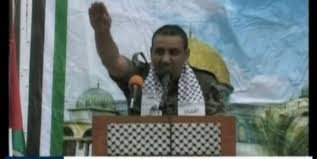
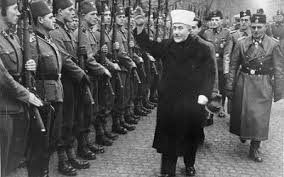
Pal nazi2Pal naziFatah nazimufi Jlem Nazi
Palestinians with Nazis yesterday. Palestinians acting like Nazis today.


Related First One Through articles:

Abbas Knows Racism

What do you Recognize in the Palestinians?

Extreme and Mainstream. Germany 1933; West Bank & Gaza Today

Subscribe YouTube channel: FirstOneThrough

Join Facebook group: FirstOne Through  Israel Analysis

Framing the Israeli-Palestinian Arab Conflict: WSJ and NY Times

The portrayals of the Israeli-Palestinian Arab conflict in the two main New York newspapers could not be more different.  Snapshots of the two papers on October 17, 2015 and the editorials from the prior days frame the conflicting attitudes.

In Pictures

On October 17, 2015, each paper posted a picture of an attack that occurred in Hebron. The Wall Street Journal captured the Palestinian who posed as a journalist stabbing an Israeli soldier.  The New York Times showed a picture of two Israeli soldiers standing over the dead Palestinian.

IMG_3554
Wall Street Journal front page picture of Israeli soldier attacked by Palestinian
October 17, 2015

IMG_3549
New York Times front page picture of armed Israeli soldiers standing over dead Palestinian October 17, 2015

The Wall Street Journal covered this story – and many of the stories over October 2015 when Palestinians attacked Israelis – as Palestinians as the aggressors and Israelis as defending themselves.  However, The New York Times almost uniformly showed all Palestinians as victims and Israelis as the armed aggressors.

In Editorials

New York Times: On October 15, the Times ran an editorial entitled “The Cycle of Violence in Israel.” The title and the opinion piece described a country that is in a never-ending cycle of “attacks and reprisals“, blaming neither party as being aggressor or instigating the violence.  The attacks were referred to as Palestinian “uprisings,” and the Times pointed the finger at a few parties:

  • “Yasir Arafat, could speak for all Palestinians” back in 1993 so there was a better prospect for peace according to the Times behind a unifying leader.  It neglected to state that the same Arafat walked away from a serious peace offer and then launched the Second Intifada in 2000, killing thousands.
  • The Times correctly stated that “Mahmoud Abbas is bitter and unpopular” which makes it difficult for him to lead and deliver peace negotiations. The paper failed to point out that Abbas has constantly incited violence against Israelis and never put forth any public comments on his willingness to compromise on his demands to create peace.
  • “Netanyahu has demonstrated little interest in a two-state solution” according to the Times, even though he is the only person that specifically has demonstrated a desire for peace: handing over half of the “Holy Basin”, Bethlehem, in 1996; a ten month settlement freeze in 2010; releasing dozens of terrorists; and repeatedly stating his willingness to engage in direct peace talks anytime, anywhere.

The New York Times described the only solution to ending the cycle of violence as “creating an independent Palestinian state alongside an Israel whose right to exist is fully acknowledged by all Palestinians.”  Note that the Times language specifically does not mention any Israeli demands of “security” and recognition as a “Jewish State.”  According to the Times, the only thing creating violence is the lack of a Palestinian state.

Wall Street Journal: On October 16, 2015, the WSJ had an editorial calledThe Knives of Jerusalem.The Journal’s attitude about the violence and approach could not be more different than the New York Times:

  • The WSJ called the Palestinian Arab attacks “terrorism” five times, a term never used by the Times (nor by the Obama Administration for that matter)
  • “[A] deep-seated culture of hate” among Palestinian Arab society was at the core of the attacks
  • Blame is specifically placed on Palestinian leaders including Abbas spreading “rumors” and “lies” about Israel to incite the Arabs.

The WSJ noted that Israel will need “to ride out another storm of terror.”  Peace will ultimately come when Palestinians realize that the Jews are not going to leave: “The sooner they [Israelis] impress on Palestinians that they will never bow to knives or bend to terror, the sooner the stabbings will end.”


The Times placed the principal blame for the attacks on Israeli “occupation” and therefore the solution is a peace agreement / a separation accord. Their pictures and articles repeatedly use images of Palestinians as victims and Israelis as militant occupiers.

The WSJ placed the blame on Palestinian Arabs who have denied the right of Jews to live in the holy land as self-governing people since the League of Nations gave Jews that legal right in 1922.  Peace will only come when Palestinian Arabs give up the fight and accept that the Jews are never going to leave. Their articles are more likely to show Israel as at the frontlines in the battle against Islamic radicals, similar to much of the western world.

The pictures and articles of the two papers have been consistent in their coverage of the conflict, and the weekend of October 17, 2015 brought the contrast into clear focus.


Related First One Through articles

Every Picture Tells A Story: Only Palestinians are Victims

Why the Media Ignores Jihadists in Israel

The Israeli Peace Process versus the Palestinian Divorce Proceedings

Every Picture Tells a Story: Versions of Reality

Subscribe YouTube channel: FirstOneThrough

Join Facebook group: FirstOne Through  Israel Analysis

Every Picture Tells a Story: Versions of Reality

The New York Times published an article on October 16, 2015 entitled “Conflicting Accounts of Jerusalem Strife Surround Wounded Boy“.  The article described a 13-year old Palestinian boy who stabbed a 13-year old Israeli boy who was riding a bicycle.  The acting-President of the Palestinian Authority Mahmoud Abbas claimed that the innocent Palestinian was executed by Israelis, while in fact he was recuperating at an Israeli hospital.

Normal logic would suggest that the pictures that accompany the article have something to do with the story.  Indeed, the Times did post a small black-and-white photograph of the 13-year old Palestinian recuperating in a hospital bed.  However, the Times decided to post a much larger photograph on top of that picture – of Israelis with machine guns standing over Palestinian Arab women.

IMG_3546
Times leading with a picture of armed Israelis standing over Arab women in a story about a 13-year old Palestinian terrorist being described as “executed” by Mahmoud Abbas

Why didn’t the Times also post a picture of the wounded Israeli boy? Why didn’t it have a picture of Abbas declaring the boy “executed”?  Or Israeli Prime Minister Benjamin Netanyahu pointing out the lies and incitement of Abbas? Because for this “progressive” newspaper, the real story about Arabs attacking innocent Israelis is about Israelis fighting Palestinians, not the other way around.

The Times wrote a piece about “conflicting versions of reality” between Israelis and Palestinians. The reality of the Times constant portrayal of Israelis “occupying” Palestinian victims is another disturbing story in the “conflicting” (read “false”) narratives that fan the flames in the region.


Related First One Through articles:

Every Picture Tells A Story: Only Palestinians are Victims

Every Picture Tells a Story: The Invisible Murdered Israelis

Subscribe YouTube channel: FirstOneThrough

Join Facebook group: FirstOne Through  Israel Analysis

Every Picture Tells A Story: Only Palestinians are Victims

The “Every Pictures tells a Story” series reviews newspapers through a lens focused only on their pictures and captions. The brutal attacks that occurred in Israel during the week October 7-14 provide a good snapshot for how the New York Times viewed the conflict – the only victims in the Middle East are Palestinians.

To set the background for the two weeks of violence: on October 1, 2015, Palestinians shot an Israeli couple who were driving on a road with four of their children. After shooting up the car, the Palestinians approached it once it came to a stop and executed the parents. The Times did not post any pictures of the Henkins, the murdered Israelis along the story. If one were to only focus on the pictures and captions, their murders would never have occurred.

In the following days, the number of Palestinian Arab attacks against Jews continued to grow in frequency. Yet remarkably, the Times pictures showed one story: Palestinians as victims.

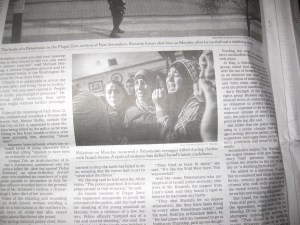
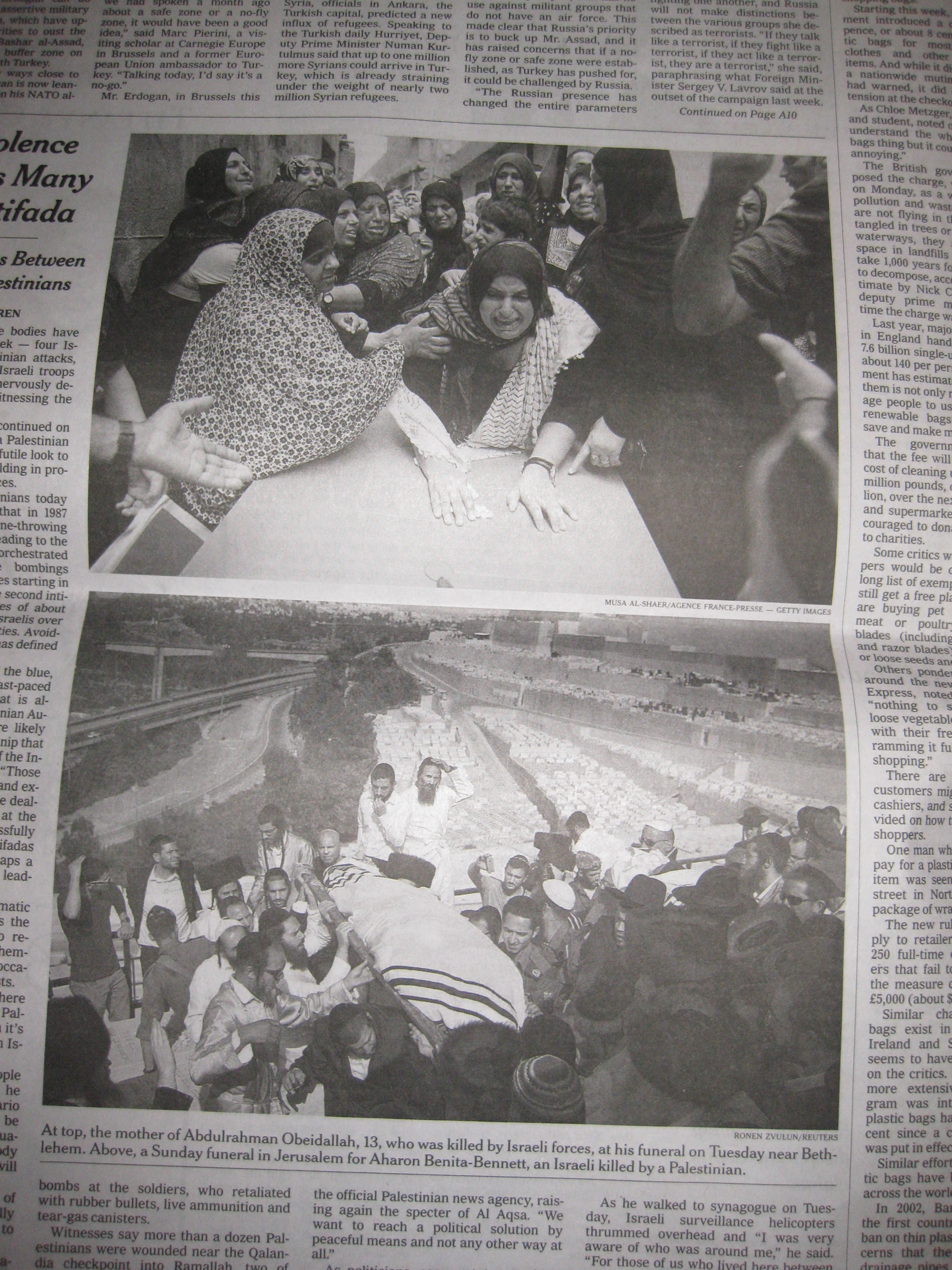
October 7 Page A4. “At top, the mother of Abdulrahaman Obeidallah, 13, who was killed by Israeli forces, at his funeral on Tuesday near Bethlehem. Above, a Sunday funeral in Jerusalem for Aharon Benita-Bennett, an Israeli killed by a Palestinian.” This was the Times only attempt at providing a “balanced” picture of deaths on both sides. However, there was no attempt to convey that the Palestinian was not shot intentionally, while the Palestinians deliberately were murdering Israelis.
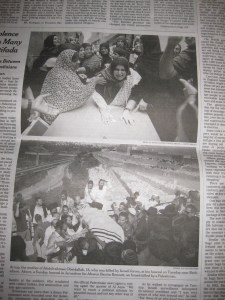
IMG_3538
Only NY Times photo showing Israelis attacked during week October 7-14, 2015
included picture above of Palestinian killed

October 8 Page A6. “A Palestinian man in a flooded tunnel that was used to smuggle goods between Egypt and the Gaza Strip. Egypt has been flooding the tunnels to deter smuggling.” The large color picture and caption leads one to feel sorry for the Palestinian. Of course, what was not mentioned was that the “goods” that were being smuggled into the tunnels included weapons to target Israelis and Egyptians.  The article continued on page A14 with two black and white pictures.  The large picture’s caption “Juma Abu Shaer and his wife Masouma Abu Shaer, at home in Rafah. They fear they may have to leave because of flooding.” Names are given of people living in fear. You will not see that for Israelis over the week of terror attacks. The last small photo has a caption “The border between Rafah, in the Gaza Strip, and Egypt on the right. Egypt has flooded part of the nine-mile border area twice.” Such picture and caption confirms that the Times knows that many readers only glance over the articles and rely on the pictures and captions only.

The article about “Unrest Spreads in Israel Despite Tighter Security” which reviewed more Palestinian’s attacking Israelis had no pictures.  No Israelis were injured in unprovoked attacks for the news-in-pictures.

IMG_3536IMG_3537
Three sad Palestinian Arabs

October 9 Page A14. “An Israeli man looked over the body of a Palestinian assailant who was shot dead after carrying out a stabbing attack on an Israeli soldier and three civilians in Tel Aviv on Thursday.” Another article with larger picture “Palestinian protestors took cover during clashes with Israeli security forces on Thursday in Beit El, West Bank. Disputes over Jerusalem have added to tensions.” The pictures again show dead Palestinians and those under fire. There were no pictures of Israeli civilians who the Palestinian stabbed in unprovoked attacks. The “protestors” are not shown throwing Molotov cocktails and rocks.
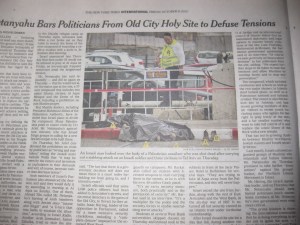
IMG_3534IMG_3535
Dead Palestinian and one under attack

October 10 Page A4. Small color picture of soldiers over small boys “With security increased, Israeli border police told Palestinians on Friday they could not enter the Noble Sanctuary in Jerusalem’s Old City.” The caption fed a Palestinian narrative that the unrest is from Israeli soldiers keeping innocent Palestinians from praying at their holy site. The image of soldiers with weapons directing small boys add to the drama of the story. There were no pictures of Arabs harassing Jewish visitors on the Temple Mount nor firing firecrackers at the soldiers.

IMG_3527
Sad Palestinians Turned away by Israeli soldiers

Page A8: 2 color pictures. Very large crowd of Palestinians carrying wounded “Palestinians carried a wounded man on Friday in Gaza. It was the first time in the latest outbreak that significant unrest spread to the territory” smaller picture of man throwing stones “A Palestinian protestor hurled some stones at Israeli soldiers on Friday amid clashes on the Israeli border.” Again, Palestinians are shown injured, not Israelis.

Page A8 another article with medium color picture of Israelis taking wounded away “Israeli emergency personnel loaded a Palestinian into an ambulance on Friday after violent confrontations in the West Bank.” In the third article of the day, the Times once again chose to only show injured Palestinians in attacks that they provoked. None of the injured Israelis is pictured.

IMG_3524
Dead Palestinian

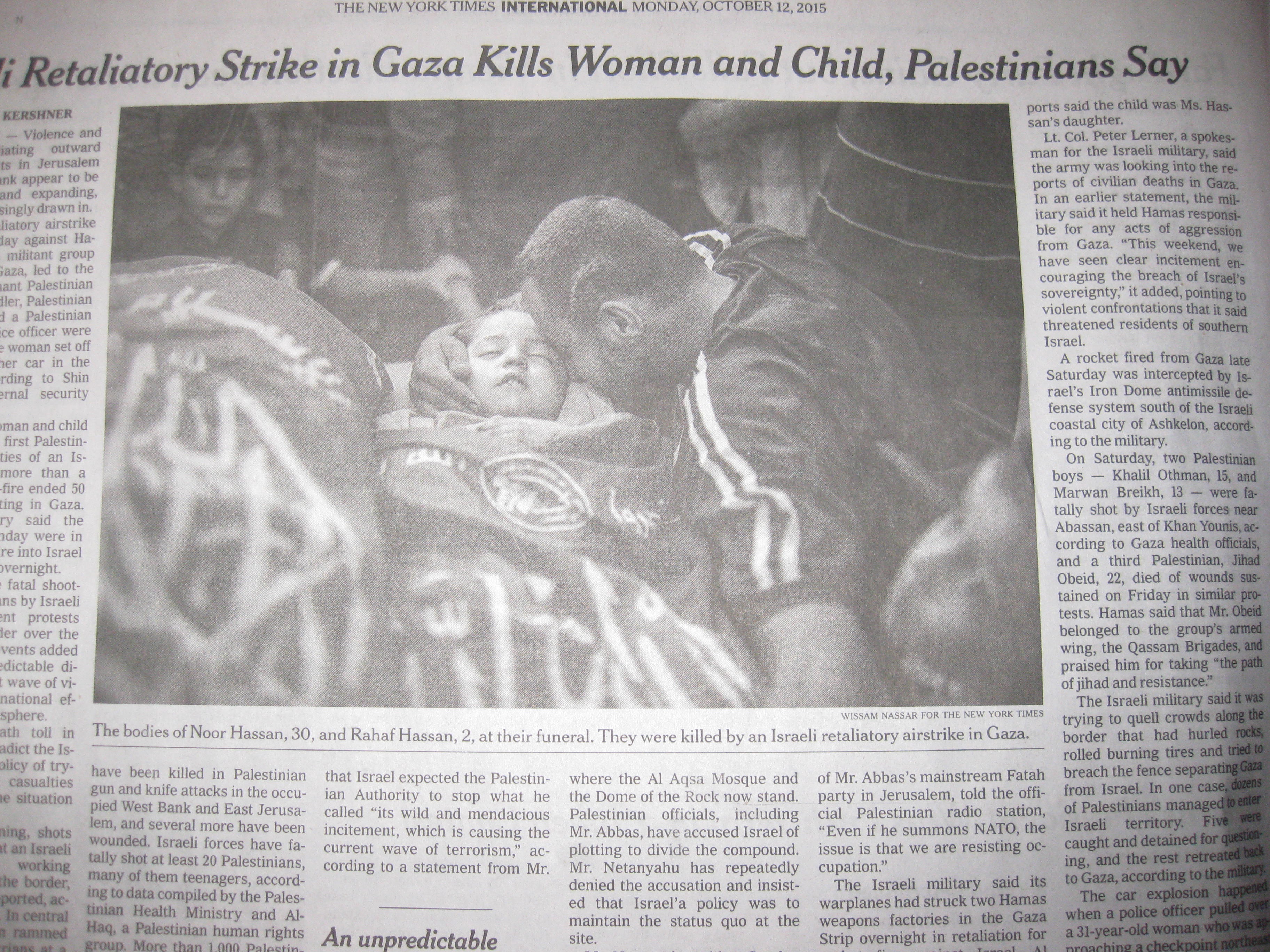
October 12 Page A6. Black and white of father over dead child “The bodies of Noor Hassan, 30m and Rahaf Hassan, 2, at their funeral. They were killed by an Israeli retaliatory strike in Gaza.” While the caption at least mentioned that the Israeli did a “retaliatory strike” conveying that Palestinians initiated the fight (compared to earlier language of a generic “confrontation”) the pictures are again only of Palestinians hurt in the conflict.

IMG_3520
Two dead Palestinian Arabs

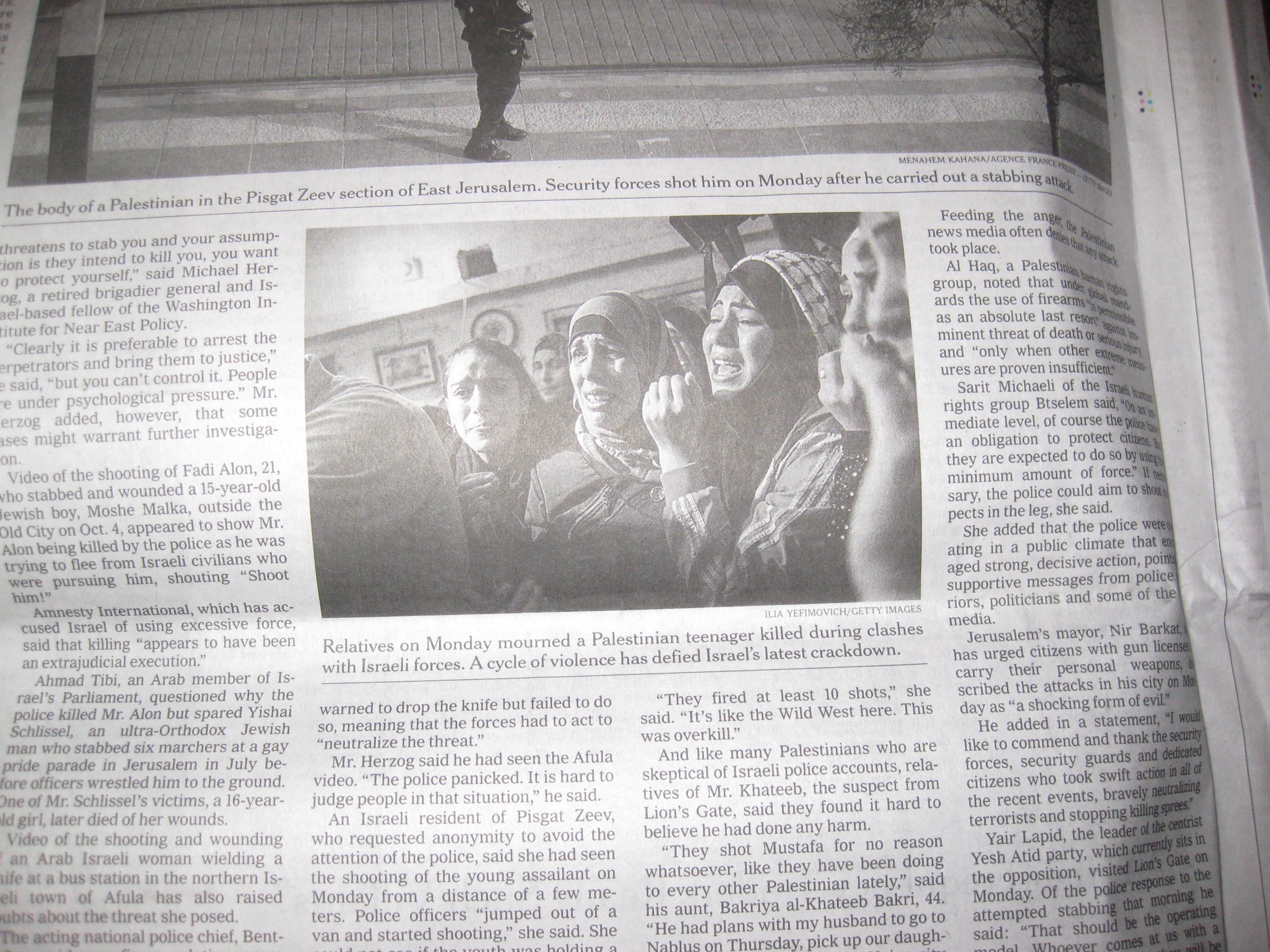
October 13 page A4. Two black and white photographs. The large photo caption reads “The body of a Palestinian in the Pisgat Zeev section of Eat Jerusalem. Security forces shot him on Monday after he carried out a stabbing attack.” The body of a partially dressed man lay on the ground surrounded by police.  The smaller photo showed women crying with a caption “Relatives on Monday mourned a Palestinian teenager killed during clashes with Israeli forces. A cycle of violence has defied Israel’s latest crackdown.

IMG_3529IMG_3530
Dead Palestinian and Grieving Palestinians

October 14 COVER PAGE: On a particularly violent day with Palestinian Arabs hacking people with meat cleavers and killing three, the Times covered an alternative news in its pictures. The front page large color photo of Palestinians running from Israeli tear gas with a caption “Palestinian demonstrators scattered Tuesday after Israeli forces fired tear gas during clashes in the West Bank city of Bethlehem.

IMG_3540
Cover page picture of Palestinians fleeing from Israeli forces

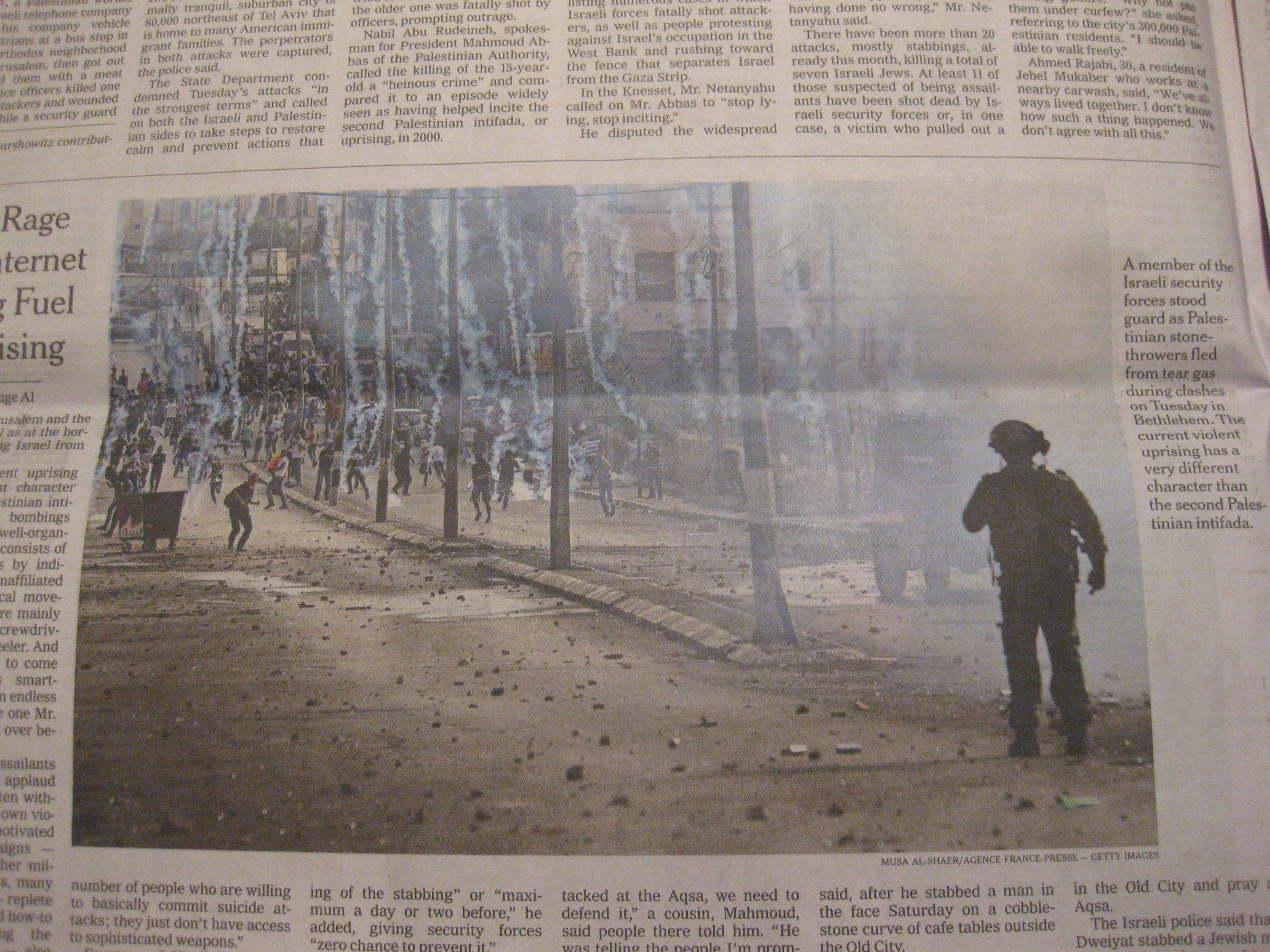
Page A8: The cover page story continued on page A8 with another large color picture of Israeli forces before Palestinians running from tear gas. The caption: “A member of the Israeli security forces stood guard as Palestinian stone throwers fled from tear gas during clashes on Tuesday in Bethlehem. The current violent uprising has a very different character than the second Palestinian intifada.”

IMG_3543
Palestinians fleeing tear gas

Page A8: Another story about the attacks medics pulling someone out of a bus. The caption: “Israeli emergency responders removing the body of a Palestinian from  bus where an attack took place in Jerusalem in Tuesday.” No Israeli victims covered from an unprovoked attack by a crazy Arab- note that no blame assigned for the “attack” in the caption.

IMG_3541
Dead Palestinian removed from a generic “attack”

In a week that saw dozens of unprovoked attacks on Israelis, it cannot be an oversight that the New York Times repeatedly chose to show only injured Palestinians. The Times deliberately decided to feed the narrative of Palestinian victimhood. The Israelis were seemingly untouched.

There are some researchers that argue that the media and social media are fanning the flames of the unrest in the Middle East by fanning “misinformation.” If so, the Times’ irresponsible journalism might be viewed as a war crime.


Related First One Through articles:

Every Picture Tells a Story: The Invisible Murdered Israelis

Every Picture Tells a Story- Whitewashing the World (except Israel)

Every Picture Tells a Story, the Bibi Monster

Every Picture Tells a Story, Don’t It?

The New York Times’ Buried Pictures

Subscribe YouTube channel: FirstOneThrough

Join Facebook group: FirstOne Through  Israel Analysis
New York Times: “Throw the Jew Down the Well”

Sacha Baron Cohen, a comedian from the United Kingdom, developed some fascinating characters as part of his comedic routine. One of them was Borat, a tall, awkward man who hailed from Kazakhstan.

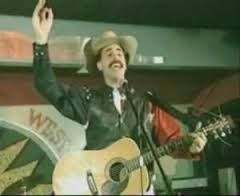
borat
Sacha Baron Cohen as Borat

Cohen used Borat as a tool on unsuspecting Americans to elicit responses which may be funny or frightful in his movie, “Borat: Cultural Learnings of America for Make Benefit Glorious Nation of Kazakhstan.” Cohen counter-balanced Borat’s large 6’3″ frame with a friendly, simple and naïve demeanor, such that ordinary people responded to him in a more open manner than they would have for another large adult male stranger. Once within their sphere of hospitality, he engaged people in various outrageous actions.  Cohen captured those bizarre interactions for the public to witness.

Borat was introduced as a foreigner, unfamiliar with the social norms of the USA. As people interacted with him, they quickly saw evidence of his primitive, racist, homophobic, misogynistic and anti-Semitic side. For example, when he attended a dinner party in the South, his lack of etiquette was so extreme he did not know how to use the bathroom.  As the American hosts viewed themselves as extremely enlightened, they excused his outrageous behavior.  The comedy of Baron Cohen/Borat was specifically about revealing people in such awkward and “dark” moments.

Throw the Jew down the Well

Another scene from the movie placed Borat in a cowboy bar in Tucson, Arizona. Borat was invited to sing a song from his home country to the crowd. The audience of men and women were at first unsure of this foreigner in a cowboy hat, as he started his song “In my Country there is a Problem.” It was clear from the first verse that Borat could not really sing, play the guitar or rhyme. But the crowd wanted to be hospitable and welcomed this stranger who was trying to fit in.

By the second verse, the song became rabidly anti-Semitic. Jews were blamed for taking everyone’s money and causing problems in his country. Imagery of Jews being wild animals with claws, gnashing teeth and horns were sung aloud, and the crowd joined in louder with each verse. The women – much more than the men – loudly clapped and sung along to the anti-Semitic verses with free abandon. One would imagine a scene from the Hofbrahaus in Munich 1920 more than Tucson 2006.

Sacha Baron Cohen is himself a Jew who is likely not an anti-Semite nor a racist nor a homophobe.  He used the Borat character to force people to confront their own biases in unconventional ways. His use of a big fish-out-of-water persona made people want to embrace this gentle giant. The American-way of hospitality placed people in a situation where they were closely engaged with little room to maneuver. They were left with a choice of either being astonished and sickened (as were the southerners at the dinner party) or engaged, as were the anti-Semites in the Tucson cowboy bar.  However, the Southerners took the effort to correct Borat, while the cowboys embraced his foul behavior and language.

The New York Times embrace of the Primitive

The New York Times has long looked on the Arab world with sympathetic eyes. Whether in advocacy for Arabs in urging the Obama administration to welcome thousands of Arab refugees, and pushing for building of a mosque at ground zero, or in ignoring Arab crimes through the use of double standards for people from a “primitive” culture, the NYT embraced the Arab world.

Like Borat, Arabs are from a different culture and unfamiliar with America’s progressive ways.  As enlightened people, the writers for the Times have sought to engage and embrace these people. For example, Saudi Arabia is rarely called out as one of the most repressive regime in the world which decapitates minors in the streets; it is just an American ally.

No where is the treatment more apparent than in the warmth shown to the acting President of the Palestinian Authority, Mahmoud Abbas.  The soft-faced nearly 80 year old man is repeatedly described as a “moderate,” who seeks “non-violent” means to achieve “independence” for Palestinian Arabs. In the Times desire to see Abbas succeed, they turned deaf to his various statements and actions:

  • Abbas’s inability to govern the Palestinian Authority territories is never blamed on his ineffectual leadership.
  • The Times rarely mentions that Abbas is so unpopular among Palestinians that he would have lost any election since 2007 according to every poll (if he ever had the ability to have an election).
  • Abbas’s phd paper on Holocaust denial is almost never discussed.  When it is, the Times makes an effort to say that he now respects the history of the Holocaust, even though he explicitly said the opposite
  • When polls show that the Palestinians are the most anti-Semitic people on the planet, the Times just brushed over the fact as “not particularly surprising
  • The Hamas Charter call for the destruction of Israel and death of Jews is rarely mentioned, and Hamas is almost never labeled a terrorist group
  • Palestinians engaged in the most honor killings per capita is ignored and blame assigned to Israel
  • Abbas’s calls to “defend al Aqsa by all means possible” is never described as an incitement to violence

The Times opted to not take a constructive approach like the Southern lady who taught Borat how to use the bathroom. It never sought to educate its readers about the misstatements and outright lies of the Palestinian Arabs. Instead, the Times just ignored that Abbas or the Palestinians were incompetent or said and did anything wrong.

However, on October 8, 2015, the Times decided to move past being deaf and joined the Palestinians’ anti-Semitic chants.

Throw the Jew from the Temple Mount

In an article entitled “Historical Certainty Proves Elusive at Jerusalem’s Holiest Place” Rick Gladstone wrote that there is little evidence that Jewish Temples existed on the Temple Mount.

20151009_065901New York Times article Refuting the Existence of the Jewish Temples
October 8, 2015

As if echoing the Palestinian Arab and Jordanian Arab narrative that Jews have no history in Israel or Jerusalem, that they are trying to “Judaize” the city and “falsify history,” the Times wrote a piece that completely misrepresented archaeological findings.  Indeed, the only religion that has archaeological proof of being on the Temple Mount is Judaism (there are no structures to show where Jesus walked or Mohammed’s night journey).

The Times’ echoed the calls of anti-Semites who seek to deny Jews of their history and basic rights.  The Times effectively moved from the back of the Tucson cowboy bar to the front row singing and clapping along with Abbas:

Throw the Jew from the Temple Mount
so my country can be free!
You must grab him by his horns
and we will have a big party!”

Now that the Times has more openly embraced its anti-Semitic Borat persona, perhaps we will soon see articles that Jews are really from Khazar and have no connection to the bible at all.


Related First.One.Through articles:

Visitor Rights on the Temple Mount

Educating the New York Times: Hamas is the Muslim Brotherhood

New York Times Finds Racism When it Wants

The New York Times wants the military to defeat terrorists (but not Hamas)

Every Picture Tells a Story- Whitewashing the World (except Israel)

Subscribe YouTube channel: FirstOneThrough

Join Facebook group: FirstOne Through  Israel Analysis

Gimme that Old-Time Religion

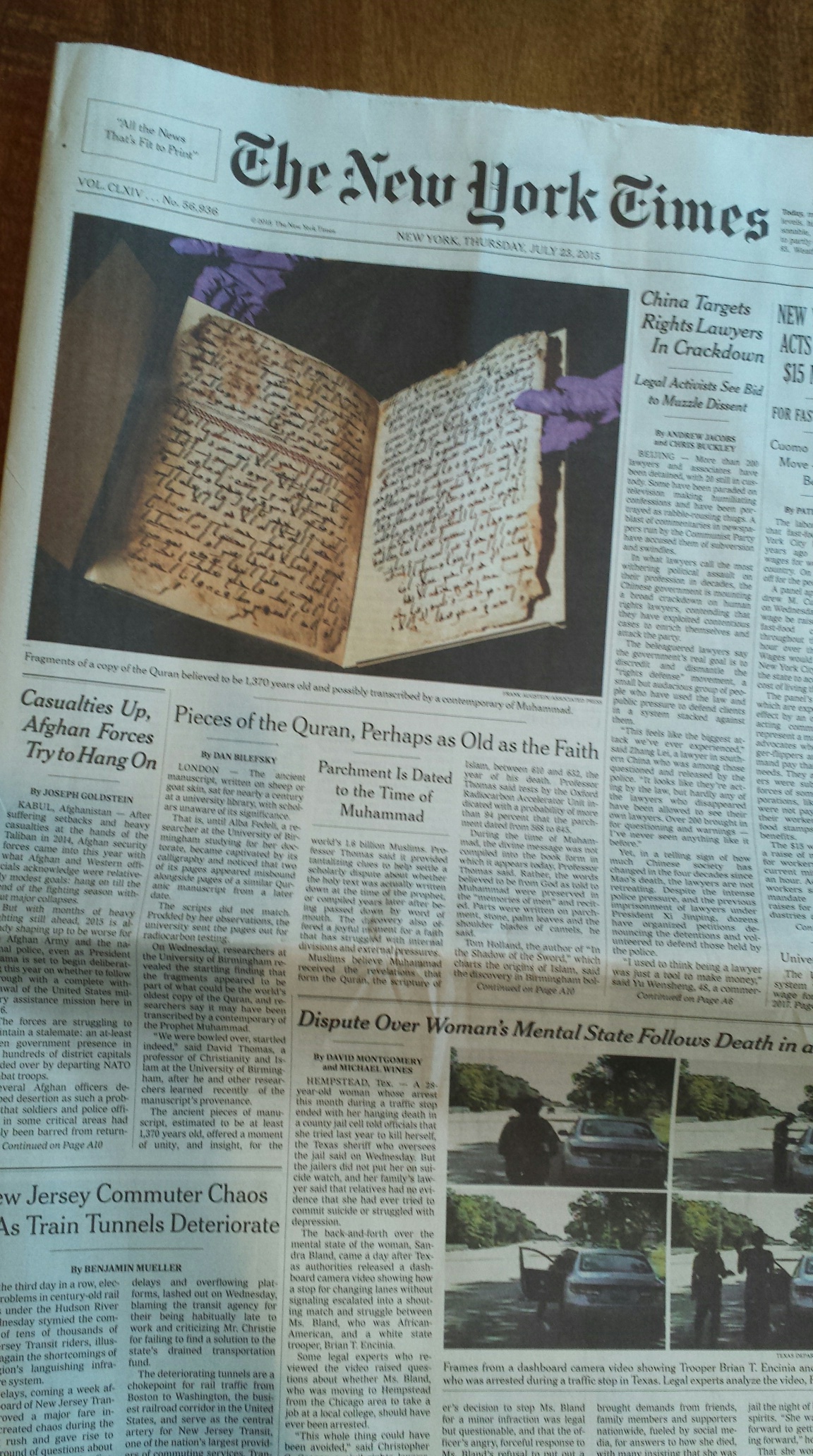
Two of the three main monotheistic faiths had amazing historical revelations in July 2015. If you read the New York Times, you only learned about one of them.

Quran

On a front page story with a large accompanying color picture, the New York Times relayed an incredible discovery: an old Quran that had been sitting on the shelves of the University of Birmingham, England for a century, was dated to around the year 600CE plus or minus 50 years.  That would make this version of the Quran the oldest manuscript in Islam.

20150724_072357
New York Times Front Page Story on Quran,
July 23, 2015

According to Islamic tradition, their prophet Mohammed received divine revelations and compiled the Quran sometime between 610 to 632CE. Religious scholars had debated whether the Quran was passed down in oral form for many generations after Mohammed’s death before ultimately being written down. If the text indeed was written down on the parchment when it was prepared (sometimes parchments were washed and reused, and carbon-dating only relates to the parchment but not the actual ink and text), it would answer that outstanding question.

The Hebrew Bible

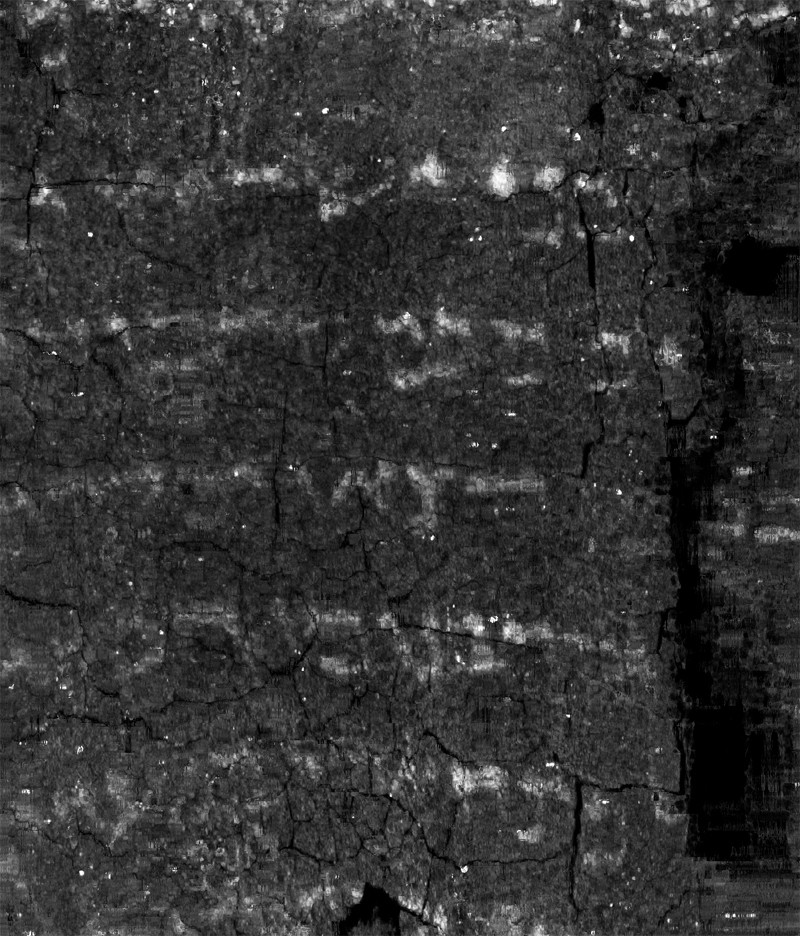
Three days before the world heard about the dating of the oldest Quran, researchers uncovered one of the oldest texts of the Hebrew Bible, dating from around 500CE.

EinGediscroll1
Charred scroll from synagogue in Ein Gedi
(photo: Shay Halevi/Israel Antiquities Authority)

In the 1970s, the piece of a charred scroll was discovered in Ein Gedi in the Judean Desert. Only in July 2015 were researchers able to use the latest technology to decipher the damaged text to reveal sentences from the book of Leviticus. While older documents (by 500+ years) of the Hebrew Bible had been discovered not far from Ein Gedi, those documents were found hidden in jars within caves.  This scroll was found in the ancient synagogue of Ein Gedi, revealing the earliest discovery of a Torah scroll housed in a synagogue.

scroll-800x936
Text from the Ein Gedi scrolls
(photo: University of Kentucky)

Both of these stories are amazing in terms of history, religion and science.  It brings to mind an old gospel song: “Give Me that Old Time Religion!”

Yet the part “that’s NOT good enough for me” (to paraphrase the song) is the nagging question why the New York Times never misses an opportunity to slight Israel.  The discovery of one old religious treasure received front page attention (for Islam) but a text from 100 years earlier didn’t even get a passing mention (for Judaism).  Was it because the scrolls were found in the Judean Desert which further underscores the long history of Jews in the contentious Jordan Valley?

Why do you think the NYT mentioned only one of these stories?


Related FirstOneThrough articles:

When were Jews barred from living in Judea & Samaria?

Names and Narrative: The West Bank / Judea and Samaria

The Subtle Discoloration of History: Shuafat

Subscribe YouTube channel: FirstOneThrough

Join Facebook group: FirstOne Through  Israel Analysis

Parallel and Perpendicular Views of Iranian Nuclear Deal

In a world of 7 billion people, there can be no surprise that people have different views. Even in smaller segments of society, whether in a small town or school, different people could look at a situation and arrive at very different conclusions. One story, two views.

Conclusions may in turn generate additional comparisons. Once an opinion becomes anchored, another similar thought may come to mind. Over time, the two distinct ideas become linked together, in closely related parallel views. Two stories, one view.

THE IRANIAN NUCLEAR DEAL

Perpendicular Conclusions

Much of the world followed the negotiations between six global powers and Iran over the latter’s nuclear ambitions. Not only did many people seek different outcomes, even people that sought the SAME outcomes, viewed the deal in completely different ways.

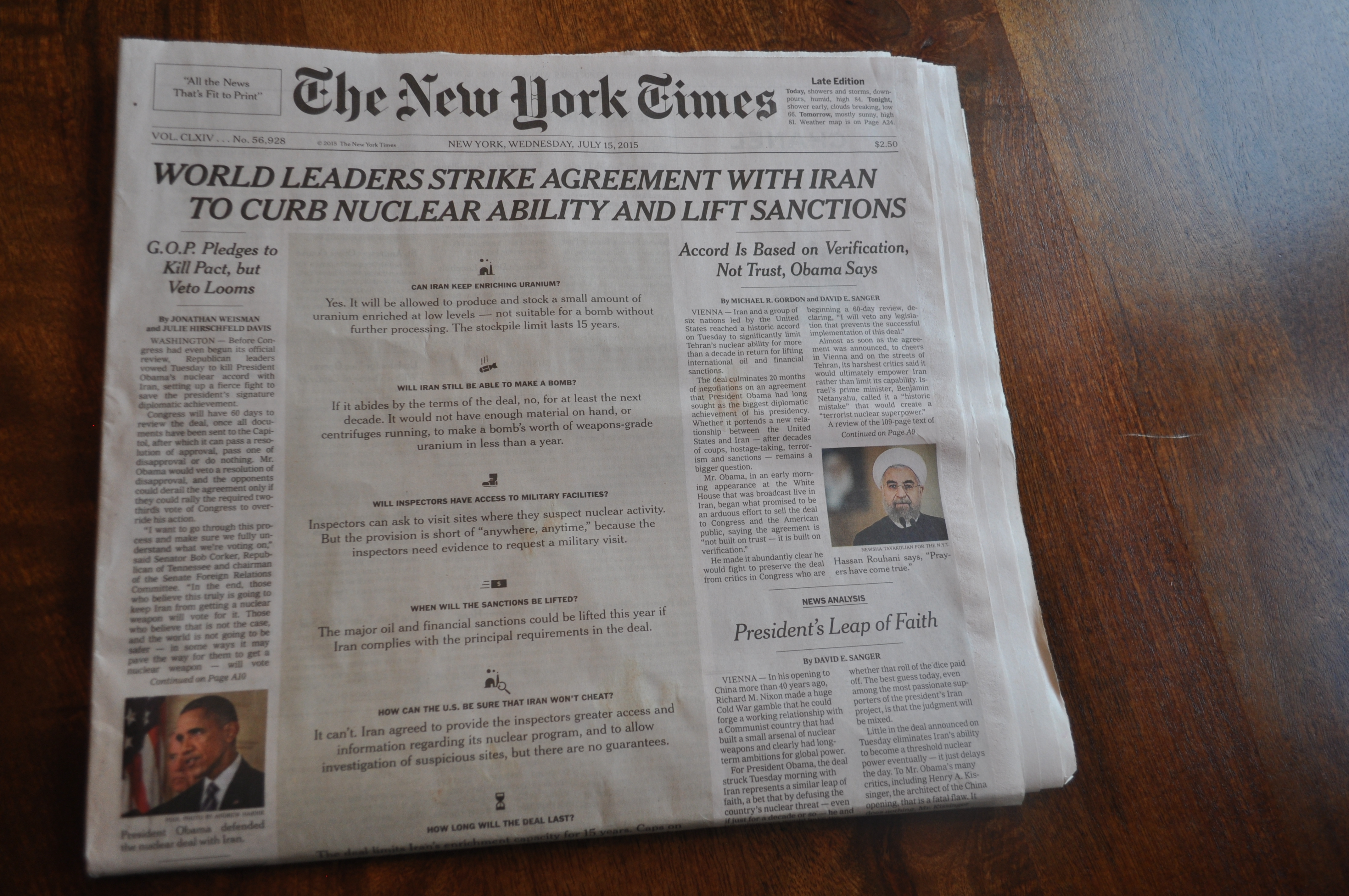
Consider the Wall Street Journal and The New York Times. Presumably each American newspaper sought a deal which left Iran without nuclear weapons capability.  On July 15, each paper ran factual headlines about the outcome of the negotiations.  Yet the emphasis for each was extremely different.

DSC_0119
Front page of New York Times,
July 15, 2015

The headline for the NYT read: “World Leaders Strike Agreement with Iran to Curb Nuclear Ability and Lift Sanctions.”  Sub-headers read “Accord is Based on Verification, Not Trust, Obama Says” and “G.O.P. Pledges to Kill Pact, But Veto Looms.”  An article further down the page was entitled “President’s Leap of Faith“.

In the middle of the front page the Times sought to summarize the deal terms in a Q&A format.  For anyone reading the answers, it was clear that the deal offered few assurances that Iran was not going to have nuclear weapons within the decade, and certainty that they would have it after a decade.

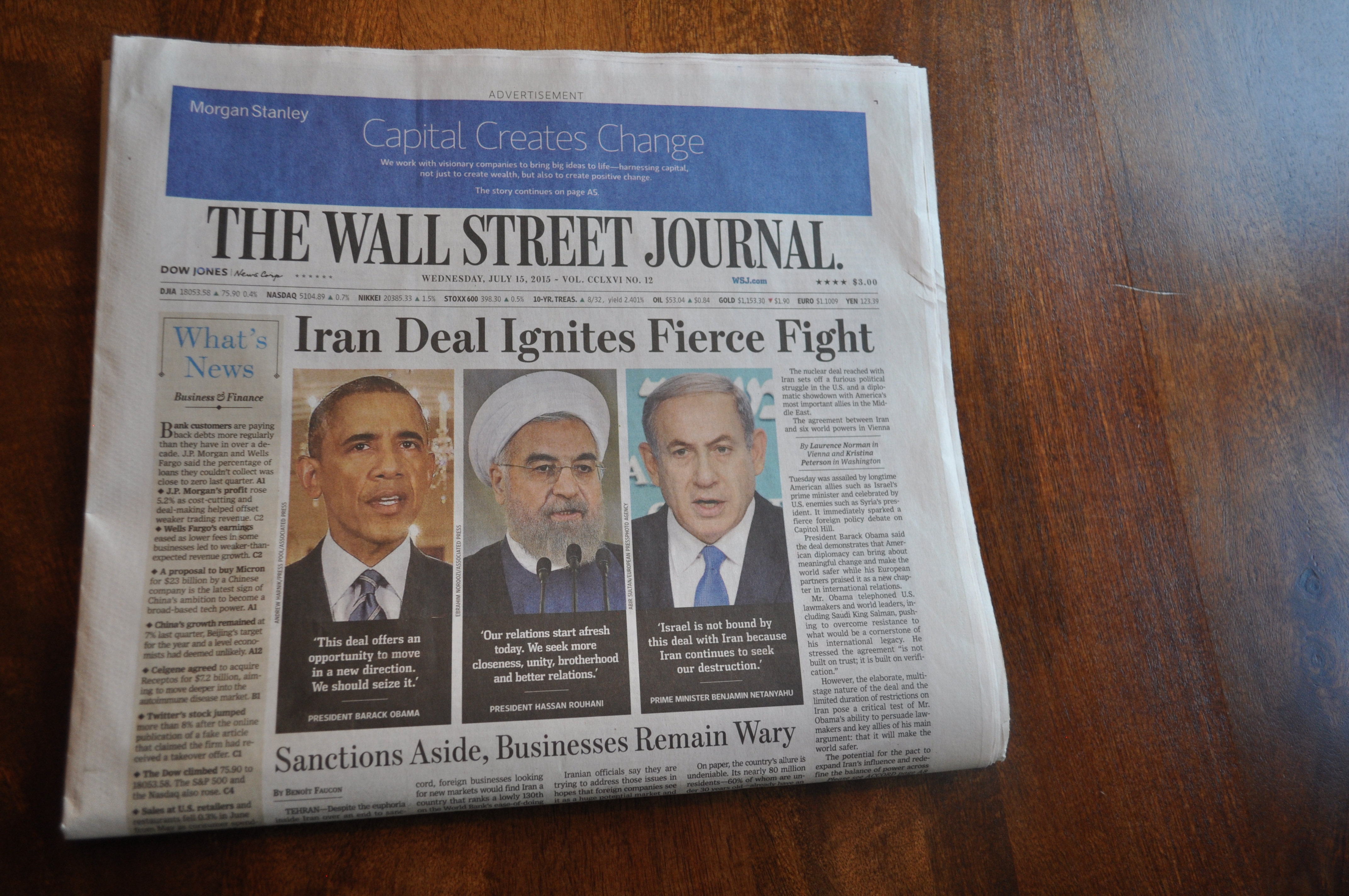
The portrayal was in sharp contrast to the front page of the WSJ.

DSC_0118
Front page of Wall Street Journal,
July 15, 2015

The WSJ also led with a factual headline about the reactions to the Iranian deal. “Iran Deal Ignites Fierce Fight” The paper included three large pictures with quotes from the leaders of the United States, Iran and Israel with their views on the deal terms.

Both papers considered that Obama and Iranian leader Rouhani were happy with the deal.  That was where the similarities ended.

The Times called out the Republicans as being unhappy, while the Journal highlighted Israel’s unhappiness with the deal. One paper took a more domestic review of the international matter, while the other focused on the international fallout. The NYT used small font to review the dissent of the deal in language that could have been used to describe a capital gains tax hike, while the WSJ used large color photographs in the center of the paper to draw attention to the significant global ramifications of the agreement.

The NYT seemed to tell its readership that if they had faith in Obama, they should have faith in this deal. The WSJ told its readership that a huge fight was brewing overseas, and the US aligned itself with an enemy state and against an ally.

Two papers presumably started at the same spot seeking the same result, but moved in opposite directions when the negotiations concluded.

False Parallels

The head of the Shalom Hartman Institute of North America, Yehuda Kurtzer, also decided to weigh in on the Iranian deal from the ancient Jewish city of Hebron. In a blog called “On Iran, from Hebron” he described his trip with a group of rabbis who came to hear a wide range of narratives from all sorts of people in the city.  Kurtzer’s conclusion was that there exists an obvious parallel between the Iranian threat against Israel, and Jews living east of the Green Line. He said: “I am sad and nervous – both about what Israel is doing to itself in places like Hebron with its commitment to structures which risk its unmaking, and about the threats to Israel’s existence from state actors” and continued the parallel in more clear language about “a settlement [Hebron] that constitutes a self-imposed existential threat to Israel, while listening on Twitter to debates about external existential threats.

Here was a leader of an organization that described itself as a “pluralistic center of research and education deepening and elevating the quality of Jewish life in Israel and around the world,” equating a Jew living with his family in Hebron, with an Iranian regime shouting “Death to Israel” while it obtained the green light from the world to have nuclear weapons in ten years.

A champion of pluralism drew an equivalence between starkly different stories: Jews living freely in places they lived for thousands of years; and a country that has threatened -and will soon be armed for- a genocide.


I understand different people having different opinions. I respect the concept that two parties can start at the same spot and move in opposite directions. Yet I struggle when a single person can conflate two completely different matters into a single narrative.

The NYT loves Obama and feels that their trust and faith in him has prevailed over his presidency, so why not trust him again now? (Of course, that has nothing to do with trusting Iran, but the Times at least starts consistently). The WSJ has always pointed out the flaws of Obama’s foreign policies and used this bad Iranian deal to point it out again.

But what of the leader of a “pluralistic” organization? Does being pluralistic mean that everything and everyone carry the same weight? Does the notion that “pluralism can mean that no full knowledge of truth is possible” mean that it can be so amazingly wrong to suggest that the “external existential threat” of an Iranian nuclear bomb is the same as a “self-imposed existential threat” of Jews living in Hebron?

There is a logic to a liberal paper supporting a liberal president. One can agree to disagree. But how does one react to someone who distorts reality as if the world was a hall of mirrors perched atop a black hole? On Earth, we know opinions can diverge.  In the ethereal world of “pluralism”, it would appear that accepting information from everywhere can lead to a singularity of stupidity.

Every Picture Tells a Story: The Invisible Murdered Israelis

In an Instagram and Twitter world, people expect their news in small tidbits. The major media sources have understood this and not only have taken to social media, but have their news stories include more pictures than they had previously. A review of their selection of pictures and captions provides an interesting snapshot of their views of the news.


Over a two week period in June/July 2015, seven major unprovoked attacks on Israeli Jews were committed by Palestinian Arabs. The Washington Post captured the anguish of the attacks with a picture of a grieving family which included a caption “Relatives of Malachi Moshe Rosenfeld, an Israeli settler who died in a car shooting attack on Tuesday near a Jewish settlement in the Israeli-occupied West Bank, cry during his funeral.”

The New York Times had no such pictures or description of Israelis suffering. Even while reporting on the region from many different journalists on June 24, 25, 26, 27, 28, 29, 30 and July 1 and 4

On June 27, the NYTimes made a small post without a picture in the World Briefing section in a blurb called “Man is Shot in West Bank After Opening Fire on Soldiers”. (journalist: Diaa Hadid)

On July 1, the NYTimes posted in the World Briefing section a blurb called “Man Died After West Bank Attack”. (Isabel Kershner)

These two attacks on Israeli Jews were completely invisible to a casual reader.

Another World Briefing report on June 24 without picture had a headline “Gazans Denied Access to Mosque.” (Diaa Hadid)

On June 30 Diaa Hadid had another World Briefing “Ship Halted in Blockade Protest

DSC_0101DSC_0105

On June 30, the NYTimes ran a larger article, also without a picture entitled “Worried that a Fasting Palestinian Prisoner Could Die, Israel Releases Him.” While there was no picture, the bold headline might have caught someone’s attention. The details in the article that the Palestinian prisoner was the spokesman for the terrorist group Islamic Jihad certainly would not have been recorded. (by Diaa Hadid)

Here are stories that the Times emphasized with pictures with their own terse storyline captions.

On June 29 the paper had an article which included a small map. The heading was “Israel plans Fence for part of Jordan Border.” (Diaa Hadid and Rick Gladstone)

On June 26, the Times included a small color photograph under an article called “Palestinians Deliver Accusations of Israeli War Crimes to International Criminal Court.” The picture of a group of people had a caption “Riad al-Malki, the Palestinian foreign minister, center, and delegation members on Thursday after submitting what they called evidence of Israeli war crimes to the court in The Hague.” (by Marlise Simmons)

On June 25, the Times posted two large black and white photographs as part of an article “Years after Massacre, a West Bank ‘Ghost Town’ Stirs.” The large picture was of Israeli soldiers walking past a store, while the smaller picture was of a man opening his store before four children. The single caption read “Israeli soldiers patrolling al-Sahla Street passed a reopened granary. Below, children watched as Mohammed Abu Halaweh briefly unlocked his butcher shop.” (by Jodi Roduren)

DSC_0099

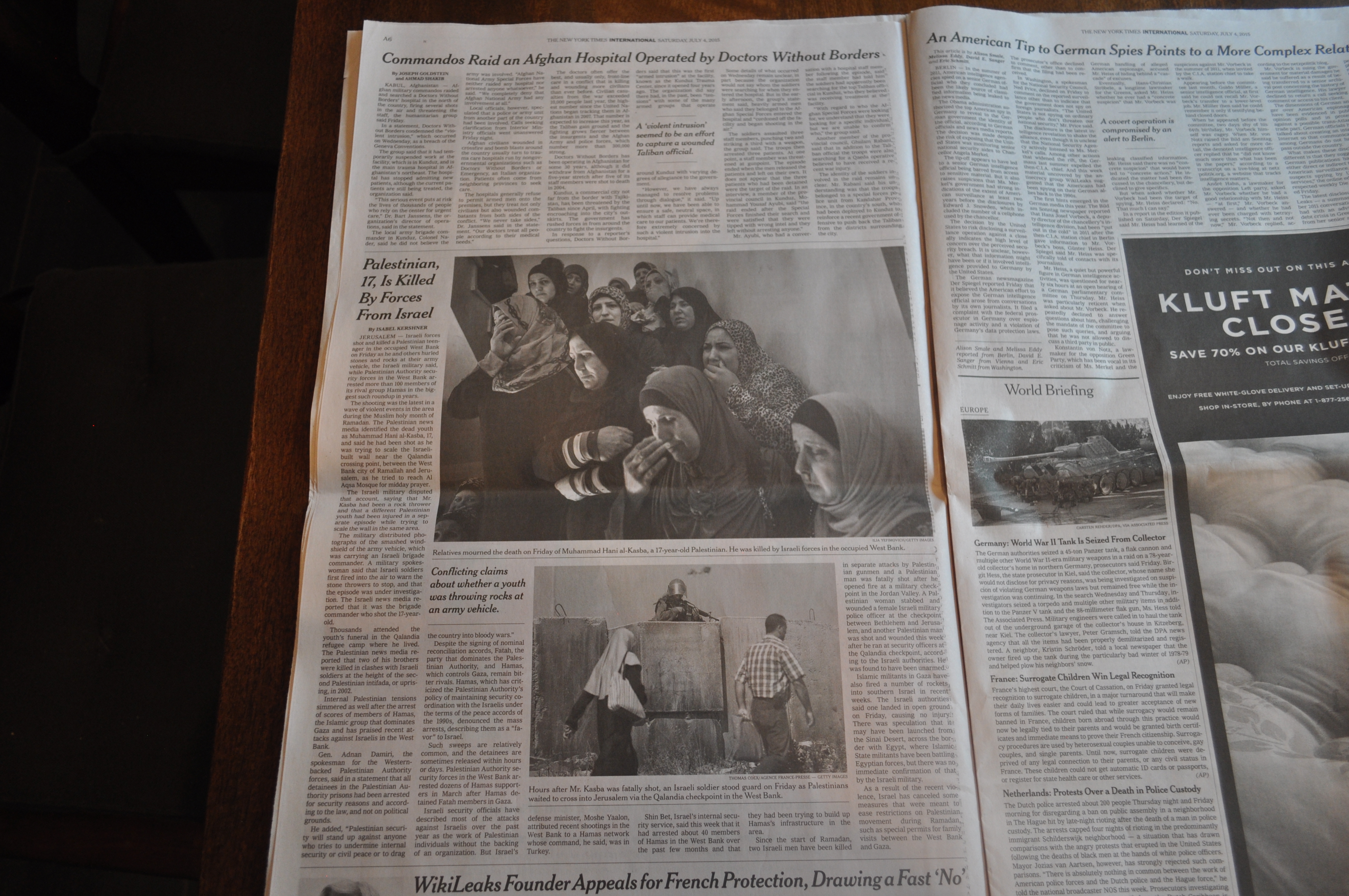
On July 4, The Times again posted two large black and white pictures alongside an article called “Palestinian, 17, is Killed by Forces from Israel.” The large photograph was of Palestinian women mourning with a caption “Relatives mourned the death on Friday of Muhammad Hani al-Kasba, a 17-year-old Palestinian. He was killed by Israeli forces in the occupied West Bank.” The smaller picture was of an Israeli soldier behind a barricade with two people walking before him. The caption read “Hours after Mr. Kasba was fatally shot, an Israeli soldier stood guard on Friday as Palestinians waited to cross to Jerusalem via the Qalandia checkpoint in the West Bank.” (Isabel Kershner)

DSC_0110

There was one news story which had two color pictures, albeit smaller than the two stories above. On June 28, the paper ran an article “Youth Chorus Unites Israelis and Palestinians, at Least for a Few Hours.” The two pictures were of a group of young men and women clapping and laughing. The caption read “Members of the Jerusalem Youth Chorus, above, took a break from rehearsing this month for their first United States tour. Micah Hendler, right, a Maryland native, founded the group.” (by Isabel Kershner)

DSC_0102

Contrast in Israeli Jews and Palestinian Arabs

The balance in the stories overall and in individual news reports was completely lacking in the New York Times.

First, consider the pictures and the stories they told: the Palestinians were dignitaries and everyday people going about life or mourning a death. They had names and professions. However, every Israeli that was pictured was a soldier and nameless. Even more, they were accused of war crimes.

Second, think of the seven attacks on Israelis Jews. They were treated as non-events and received no pictures or mention in the captions. The casual reader would not even know that such attacks occurred.

Third, review a specific story: The July 4 headline, pictures and caption would lead a reader to think that Israeli soldiers simply opened fire on a youth and that soldiers continue to patrol the intimidate the Arab population. The complete news report was that the Arab that was killed initiated an attack by hurling stones at Israeli vehicles, smashed the windows. It was in response to the Arab attack that soldiers got out of their vehicles and shot him. There were many pictures of the smashed car available that the Times could have posted as the second picture to show the complete story of the incident. Instead, it opted to convey a one-sided narrative of Palestinian Arabs as passive victims and Israelis as military oppressors.


The pictures and captions in the New York Times tell a specific narrative time after time after time: the Palestinian Arabs are passive victims under the oppression of the Israeli military. It is only these poor Arabs that suffer – unprovoked. Ordinary Israelis are not stoned, stabbed and murdered and are not subject to attacks by Palestinian Arabs. More, if there is any chance for peace in the region, it will come from Americans who will bring peace to the region.


Related First.One.Through articles

Every Picture Tells a Story, Don’t It?

Every Picture Tells a Story, the Bibi Monster

Every Picture Tells a Story- Whitewashing the World (except Israel)

The New York Times’ Buried Pictures