The Last Sounds of “Son of Saul”

The Holocaust movie “Son of Saul” is unlike every other movie ever made in the genre. While much has and will be written about the narrow focus on the principal actor’s face throughout the movie, words cannot properly convey the impact of the sounds infused in each scene.

Sounds of a Concentration Camp

The movie opens with the camera focused on a faraway subject, completely out-of-focus. The viewer struggles to make out the distant activity, and in a short time realizes that this is intentional, when the main protagonist of the film, Saul Ausländer, slowly walks into the middle of the image in sharp focus. He remains centered there for the remainder of the movie.

The close-up of Saul leaves the movie viewer with a sliver of background imagery. The war is mostly inferred by the rapidly passing images on the screen’s edges. The viewer’s mind is left to expand upon the brutality of the concentration camp where Saul works processing the dead for the Nazis.

The picture is further clouded by Saul. His face, which fills 70% of the frame, is expressionless. He is a walking dead, somewhere between the prisoners that arrive by train at the camp, and those “pieces” that he carts to the crematoria for burning. Saul shares no emotion and offers little in the way of dialogue with the other Sonderkommandos, those Jews tasked with helping the Nazis annihilate the Jews of Europe. The little dialogue that occurs, is choppy as the Sonerkommandos come from a variety of countries – Hungary, Poland, Germany, Ukraine – and do not speak the same language.

Devoid of strong visuals and dialogue, the movie provides rich sounds. There is no background music to direct our emotions.  The sounds are of the camp itself that fill the viewers’ ears. Sounds of babies crying. Mother’s screaming. Gun shots. Metal doors crashing closed. Rocks crunching under the feet of the Sonderkommandos. Papers scraping the floor, gathered for burning.

This is the dialogue of “Son of Saul.” These sounds transport the viewer from a modern movie theater to 1944 Nazi Europe. It is not surround sound; it is transportive sound.

The Last Sounds

Saul’s journey to an awakening begins when he sees a boy survive the gas chambers. While terminal, the child won a minor victory over the Nazis’ efficient killing machine. He beat the system.

This boy gives Saul some depth of vision. He gives Saul hope – not of his own survival – but that the humanity of the natural world can break through into the unnatural brutality where he exists. Saul’s mission is set, that with the help of a rabbi, the boy will not be incinerated like everyone else in the Nazi’s ovens, but will have a proper Jewish burial.

Saul risks his own life and those around him to fulfill this mission. He understands that he and the other Sonderkommandos are the unnatural walking dead who will soon die and be incinerated. However, the boy is nature’s dead, who must have a natural burial.

As Saul manages to get the boy, his “son”, out of the concentration camp ground, he loses the body in a river. The body is taken by nature and cleansed in water. Then, without the boy’s body, Saul’s mission and hope disappear and he almost drowns before being saved by another prisoner.

Saul sits with fellow Sonderkommando in a broken shed, all catching their breaths. The dialogue between them remains almost non-existent. As they sit, a new sound slowly is introduced that seems out of place.  The noise grows louder, but unclear. The viewer considers whether this is rain falling on the leaves of the trees in the forest. But the picture tells us that it is not raining. We see the men are damp, but it is from the swim across the river, not from raindrops.

Slowly the viewer becomes aware that the sound is not raindrops, but the crackle of the fire from the crematoria ovens.

The movie viewers witness Saul showing some expression at last, as the movie’s hero understands both his completed mission and fate: he helped his son escape to nature; his fate will be to burn with the other Sonderkommandos in the Nazi’s fire.

In the unnatural world where he exists, fire extinguishes water.  However, he achieved a moment of humanity, where the water was able to extinguish the Nazi fire.

Son of Saul
Géza Röhrig who played Saul Ausländer, talking to the audience at
screening of “Son of Saul” sponsored by the Claims Conference, December 2015
(photo: First.One.Through)

In December 2015, the Claims Conference put on a special showing of “Son of Saul” in New York City. The Claims Conference obtains money from Germany and other countries that participated in the slaughter of Jews during the Holocaust, and distributes that money to the Holocaust Survivors as well as educational projects like this movie.

The Executive Chairman of the Claims Conference, Greg Schneider, interviewed the film’s star Géza Röhrig who played Saul Ausländer at the end of the screening. Via Skype, Géza relayed that the sound editing of the movie took over five months, involving hundreds of man-hours to create the environment the writers and directors sought to convey.

It was a remarkable effort that helped create one of the great movies of our time.


Related First.One.Through articles:

Eyal Gilad Naftali Klinghoffer. The new Blood Libel.

Memory and Responsibility in Germany

Wearing Our Beliefs

Subscribe YouTube channel: FirstOneThrough

Join Facebook group: FirstOne Through  Israel Analysis

Wearing Our Beliefs

There are a number of English expressions in which people describe their inner feelings by describing their external appearances.

For example, “Being comfortable in one’s skin” means exuding confidence and being content with one’s appearance.  The expression “wearing one’s heart on one’s sleeve” dates back hundreds of years. It is meant to convey the openness of one’s emotions for the world to see. The inner feelings are plain and visible for review, scrutiny, appreciation and/ or scorn.

What an individual decides to show to the outside world oftentimes says a lot about their personal beliefs and emotions.

The way a society dresses people, also says much about such society’s beliefs.

Nazi Germany Enforced Dress Code

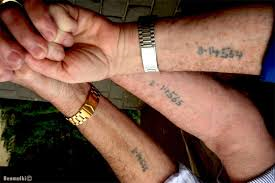
During the Holocaust, the Germans made certain undesirable people wear badges on their outer-garments so the people could be easily identified. Jews were forced to wear yellow stars. Gays wore pink triangles. Jehovah’s Witnesses had purple ones. These symbols were not chosen by the individual as an outward expression of their faith, but by an evil society that chose to mark people for abuse, imprisonment, torture and death.

In the Auschwitz concentration camp complex, prisoners were tattooed by the Nazis beginning in autumn 1941. The numbering system etched into the arms of men, women and children, was used almost exclusively on Jews. The system allowed the Nazis to track and process hundreds of thousands of people who were not killed immediately. The ink relayed the cold reality that these prisoners were not in charge of their bodies anymore. Society no longer recognized their names nor humanity.

The evil of Nazi Germany was not simply that they viewed the “Aryan race” as superior – they viewed others as less than human.  The Nazis marked the clothing and bodies of those Untermensch to relay the Aryan perception of these sub-humans.

auschwitz tattoo

Jews Wearing Tefillin

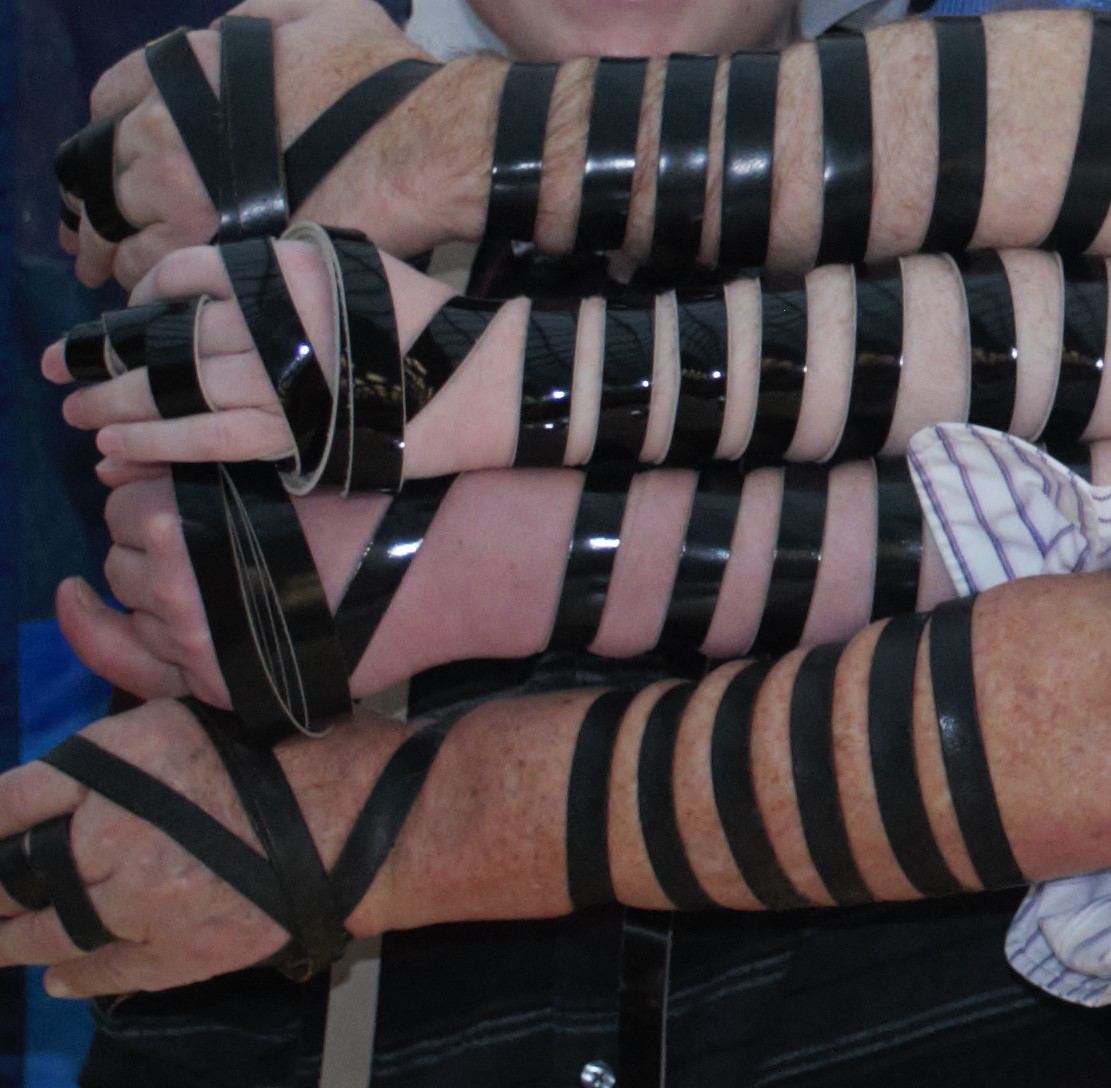
Jewish tradition is an important component of the Jewish religion. While there are specific laws in Judaism, such as wearing phylacteries/ tefillin, the manner in which some Judaic laws are carried out changes according to custom.  Some people wrap the tefillin around the arm in an outward motion, while others wrap them going towards the body.  Some traditions have the entire name of God appearing on the hand while others only write a portion of the three letter name of God.

When a person wraps the tefillin straps around the fingers, he recites a quote from Hosea 2:19-20: “V’erastich li l’olam; v’erastich li b’tzedek u-v’mishpat u-v’chesed u-v’rachamim; v’erastich li b’emunah; v’yadat et adonai.
And I will betroth you to myself forever; and I will betroth you to myself in righteousness and in justice, in kindness and in mercy; and I will betroth you to myself in faithfulness, and you will know God.”

teffilin
Grandfather, father and two sons wearing tefillin
(photo: First.One.Through)

Just one generation ago, the dominant force in Europe labeled Jews and stole their humanity.  Today, when Jews put on tefillin, they assert themselves and declare their connection to both God and family tradition.


Related First.One.Through

The Touch of the Sound of the Shofar

The Termination Shock of Survivors

The EU’s Choice of Labels: “Made in West Bank” and “Anti-Semite”

Subscribe YouTube channel: FirstOneThrough

Join Facebook group: FirstOne Through  Israel Analysis
New York Times’ Tales of Israeli Messianic War-Mongering

Summary:  One year after acknowledging that Palestinians were to blame for the failed Israeli-Palestinian Authority peace process, left-wing NY Times contributor Roger Cohen cast Israelis as fanatical nationalists and Palestinians as passive, despondent victims. The Times’ cure for Jews’ violent adherence to their religious texts is punishing settlers with BDS, while the paper distanced Muslims from their religion and called for greater compassion towards these innocents.


Just in time for Christmas, Roger Cohen decided to write about the Israeli-Palestinian Arab conflict. Again.

In an article called “The Assassination in Israel that Worked,” Cohen portrayed an Israeli society overrun with religious fanatical murderers. He described the killer of Israeli Prime Minister Yitzhak Rabin, Yigal Amir, as “a religious-nationalist follower of Baruch Goldstein, the American-born killer of 29 Palestinian worshipers in Hebron in 1994.” He wrote about Jews living east of the Green Line (EGL) as obsessed with “Messianic Zionism,” at odds with the concept of democracy. Because Palestinians are desperate for their own state, Jews living in EGL make “violence inevitable” according to Cohen. He argued that the UN’s creation of Israel “was territorial compromise, as envisaged in Resolution 181 of 1947, calling for two states, one Jewish and one Arab, in the Holy Land. This was humankind’s decision, not God’s.” In short, according to Cohen, the vast Messianic cult of violence in Israel seeks all of the Holy Land, but the rights of Jews are limited to just half of the land as dictated by man’s laws.

Lastly, Cohen argued, the only way to push back against the right-wing Israelis and their government was to employ different angles of the BDS movement (Boycott, Divestment and Sanctions) in which Obama should “close American loopholes that benefit Israeli settlers.”

Here is a bit of education for Roger Cohen (maybe the byline was wrong and this was written by Roger Waters of Pink Floyd, the loud advocate of BDS?):

A smaller percentage of Jewish “settlers” are murderers, than are terrorists which are Muslim.  The Cohen opinion piece would lead a person to believe that every Jewish “settler” takes up arms against Arabs, while the reality is that almost every Jew living in the land seeks to live in peace with their Arab neighbors. Baruch Goldstein was an anomaly, not the rule.

Why would the Times print such an inflammatory piece against Jews when it is in the midst of a blitz about the dangers of “Islamophobia”?  The Times wrote over-and-again that most Muslims are peaceful and that Muslim terrorist abuse the interpretation of Islamic holy texts.  Yet the Times was eager to describe Jewish killers as motivated by the plain reading of the Jewish holy texts, and suggested that any Jew living in Judea and Samaria is either a potential killer, or instigates Palestinian violence.

It is untrue, unfair and reeks of hypocrisy to portray Jews in such a manner.  There are almost no Jews in Judea and Samaria that committed murders, but the Times labelled all “settlers” as devout killers.  Meanwhile, the global jihadist movement enlisted thousands and slaughtered thousands, and the Times rallied to the defense of Muslims.

IMG_3677IMG_3674
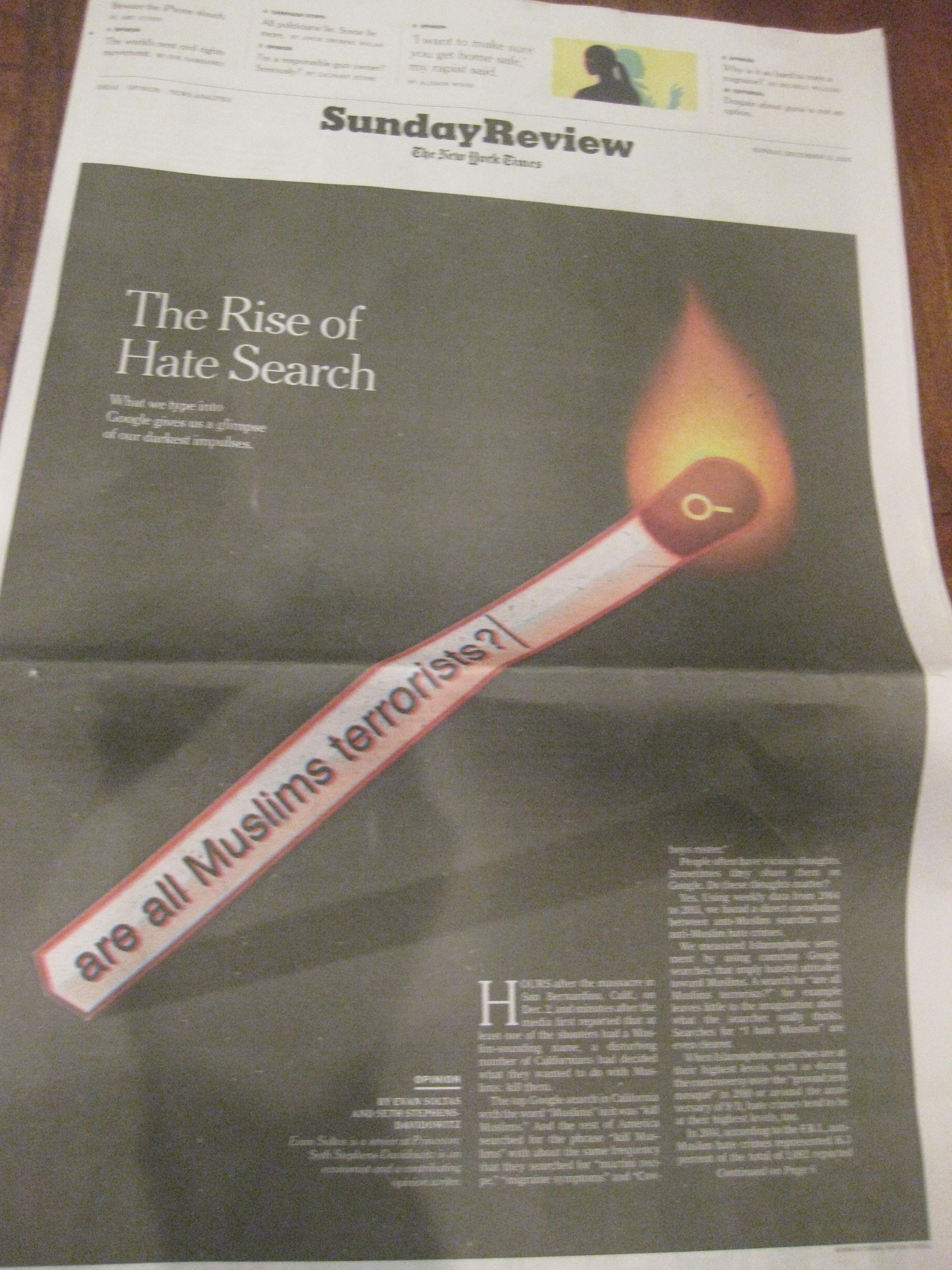
“Islamophobia” Op-Eds from Paul Krugman on December 11, 2015, and
Nicholas Kristof on December 13, 2015

IMG_3670IMG_3671
Front Page of NY Times Sunday Review on “Islamophobia”
on December 13, 2015

IMG_3662IMG_3667
Front Page New York Times story on December 15, 2015 about
Young Muslims suffering from “Islamophobia”

Jews are entitled to live in EGL/ Judea and Samaria according to international law. The 1922 Mandate of Palestine by the League of Nations clearly and specifically encouraged Jews to live throughout the Holy Land, including areas now known as the “West Bank.” The Mandate included language that specified that no one should be prevented from living anywhere because of their religion.

“Messianic Zionism” may be a driving force motivating some Jewish families to move to the region, just as they might move to Haifa or Be’er Sheva. Some people are motivated by Zionism without a Messianic component, while others go for good jobs in the only liberal democracy in the Middle East.  The motivation for living there is irrelevant; the right of Jews to live anywhere in the Holy Land was established in international law.

“Violence is inevitable” because Arab don’t want Jews as neighbors, not because Arabs want a state.  Arabs have been killing Jews in the Holy Land for 100 years.  In several episodes in the 1920s, including the brutal Hebron massacre in 1929, Arabs called for ridding the land of Jews.  On the eve of the Holocaust, they launched multi-year riots (1936-9) slaughtering dozens of Palestinian Jews and convinced the British to limit Jewish immigration, causing the death of hundreds of thousands of European Jews.

Whites in the 1950s also did not want to live with black neighbors. Racism and anti-Semitism are to be condemned, not rationalized.  Shame on the New York Times for defending Arab attacks on Jews.

The establishment of Israel as a Jewish State has been rejected by the Arabs for 100 years, and counting.  Cohen pointed to the United Nations Partition Plan which called for creating a Jewish State in 1947.  He failed to say that the Arabs REJECTED that plan.  They opted to launch a war against Israel instead.

Israel has continued to seek peace with its neighboring Arab countries: Jews approved the partition plan in 1947; the country uprooted Jews living in Sinai in 1982; it handed various cities to the Palestinian Authority in 1995; it uprooted Jews from Gaza in 2005. Israel made various peace offers to the Palestinians, including in 2000 and 2008. The Palestinians reacted to each offer with wars, and continue to reject Israel as the Jewish State to this day.

Conclusion

One year ago, Cohen wrote Why Israeli-Palestinian Peace Failed. “ In the article, he acknowledged various Israeli peace efforts including settlement freezes and prisoner releases.  In exchange for the Israeli gestures, the Palestinian Authority created a reconciliation government with the terrorist group Hamas, and joined international bodies counter to the agreed upon peace framework.  The peace talks collapsed.

Cohen has now concluded that while the Palestinians suffer from ineptitude and corruption, at the end of the day, their cause is just.  The Palestinians are not only despondent, but desperate for an external force to advance their vision of a state.  Cohen believes that Obama should begin to advance various iterations of BDS on Jews living east of the Green Line to assure the Palestinians goal of a Jew-free state (Obama has indicated in the past that he approves of a Judenfrei Palestine). Cohen had no suggestions – or concerns – of how to make Palestinians approve of the Jewish State living in security.

The radical left-wing call for BDS of the Israeli territories is easier to make when one ignores the 99% of peaceful families living in Judea and Samaria.  So Cohen, and other Israel-bashers paint all of these Jews as “Messianic Zionists” who are out of touch with reality.  They are either murderers of Arabs like Baruch Goldstein, or of the peace process with Arabs like Yigal Amir.

Cohen fails two of Natan Sharansky “Three Ds” test for anti-Semitism: demonization and double standards.  To rephrase the great ballad-rocker Meatloaf, Two of the Three IS Bad.

When will the Times and the left-wing fringe look at the Jewish families with an iota of the compassion they shower upon peaceful Muslims?


Related First.One.Through articles:

Palestinians are “Desperate” for…

Nicholas Kristof’s “Arab Land”

Framing the Israeli-Palestinian Arab Conflict: WSJ and NY Times

Names and Narrative: The West Bank / Judea and Samaria

Israel was never a British Colony; Judea and Samaria are not Israeli Colonies

Every Picture Tells A Story: Only Palestinians are Victims

The Narrative that Prevents Peace in the Arab-Israeli Conflict

Israel and Wars

Subscribe YouTube channel: FirstOneThrough

Join Facebook group: FirstOne Through  Israel Analysis
The Long History of Dictating Where Jews Can Live Continues

The world has a long established track record of telling Jews where they can and cannot live. It is a phenomenon that uniquely relates to Jews which continues to this day in the holy land.

Pluralistic World, Narrowly Defined

The “Western World” likes to think of itself as modern and “progressive.” Its leaders believe they have largely overcome rampant bigotry in their societies. For example, western leaders would never suggest that black people be only allowed to live in certain cities, or declare that gays be confined to ghettos. Even during this wave of radical Islamic terrorism, no leader would ever say that all Muslims should be expelled from the country. Modern civilized society would never tolerate such positions.

The “Western” pluralistic approach is not confined to opinions within its own borders. Wherever there is ethnic strife, western officials promote parties getting along.  In northern Cyprus, Christians and Muslims are urged to reconcile.  In Myanmar, the US calls for Muslims and Buddhists to try to live together in peace.

However, the attitudes change when it comes to Jews in the Middle East. Pluralism is passé east of the Green Line.

Jews are Treated Differently

Today, it has become all too common for Europeans to protest in the streets chanting “Free Palestine” in calls for the destruction of the Jewish State of Israel. University professors give legitimacy to Hamas, a terrorist group, which openly calls for killing Jews and destroying Israel. The leaders of the European Union call for Jews to be expelled from Judea and Samaria. And the President of the United States, Barack Obama, condemned Jews living in apartments they legally purchased in eastern Jerusalem.

While pluralism is an embraced ideal, the open tent does not cover Israel.  The western world that prides itself on fraternity, believes that Jews should be banned from living in predominantly Arab neighborhoods.  The modern culture that seeks a global community, wants to deny Jews the right to live in their homes. The progressive left which advocates for human rights, condemns Jews rather than Palestinian Arabs who fight for a Jew-free state.

Ideally, everyone should be able live anywhere.  Except for Jews who should be banned from living east of the invisible Green Line.

It should not surprise people that the Jewish State is treated differently. These same “progressive” countries have a long history of forcing Jews into ghettos and expelling them from their homes.  Dictating where Jews are allowed to live is second nature. It’s the Jewish “Pen Policy.”

Here is a list of the Pen Policy in action, after the Crusades. This list ignores the brutal slaughter of millions of Jews over that time.  There is no comparable treatment of any other ethnic or religious minority.

History of Expelling Jews

Many governments expelled all of their Jewish inhabitants, both on the local city level and on the national level.

Austria: Jews expelled from Vienna in 1670.

Brazil: Jews expelled from Recife in 1654.

Czech Republic: Jews expelled from Prague in 1745.

England: Expelled all of the Jews in 1290. Jews could not live in England for another 360 years.

Egypt: Jews expelled in 1956.
Israel removes Jews from Sinai in peace deal with Egypt in 1982.

France: 100,000 Jews expelled in 1306 and then again in 1322.
Charles VI expelled the Jews in 1394.
In 1420, the Jews were expelled from Lyons.

Germany: Jews expelled from Brandenburg in 1510.
In 1593, Jews expelled from Bavaria.
In 1614, Jews expelled from Frankfurt.

Hungary: Marie Theresa (still an all-time favorite leader among Hungarians) expelled all Jews from Hungary and Bohemia in 1744.

Italy: Jews expelled from Southern Italy in 1288.
In 1491, Jews expelled from Ravenna.
In 1492, Jews expelled from Sicily and Sardinia.
In 1494, Jews expelled from Florence and Tuscany.
In 1510, Jews expelled from southern Rome.
In 1541, last Jews evicted from Naples.
In 1550, Jews expelled from Genoa.
In 1558, Jews expelled from Recanati.
In 1569, all Jews forced out of Papal states by decree of Pope Pius V.
In 1571, Venice decides to evict all remaining Jews, but does not carry it out.
In 1593, Pope Clement VIII evicts Jews from all papal states, except Rome.
In 1597, almost all of the Jews of Milan are expelled.

Lithuania: Jews expelled in 1495.

Martinique: King Louis XIV ordered all Jews expelled from French colonies in the New World in 1683.

Netherlands: Jews banned from Utrecht in 1444.

Palestinian Authority: After massacre of 69 Jews by local Arabs, British forces remove remaining Jewish community of Hebron in 1929.
In 1949, after attacking Israel when it declared independence, Jordanians expel all Jews from Judea and Samaria and the eastern half of Jerusalem which they illegally annex.
In 2005, Israel removes all Jews from Gaza Strip.

Poland: Jews expelled from Warsaw in 1483.

Portugal: Some Jews expelled in 1483.
In 1497, choice of conversion or expulsion of all Jews.

Spain: Jews expelled from Seville in 1483.
All 200,000 Jews expelled from country in 1492.

Switzerland: Jews expelled from Basel in 1349.

Tunisia: Jews expelled or massacred in 1535.

Ghettos

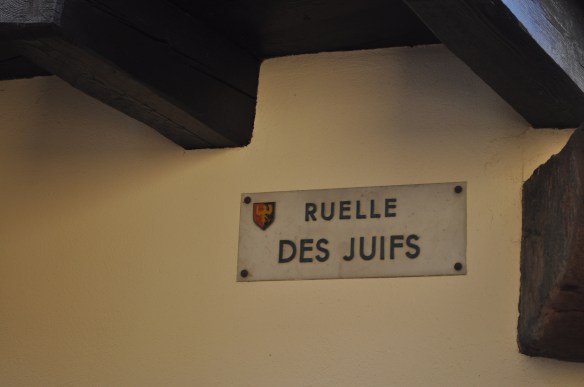
Some governments did not expel their Jews, but forced them to live in concentrated areas. Street signs can still be found in European cities named “Street of the Jews.”

Austria: Vienna’s Leopoldstadt goes back hundreds of years.

Czech Republic: Prague has one of the most famous Jewish Quarters, which was created as a restrictive ghetto.

Italy: Venice instituted the first ghetto by papal decree in Europe in 1516.  Others were developed in Ferrara (1624) and Rome (1555).

Germany: Created over 1000 in Germany and Poland during World War II, including the infamous Warsaw Ghetto.

Russia: Jews were confined to the “Pale of Settlements” in 1791.  Jews were forbidden to live in 75% of Russia.

DSC_0121
“Jew Street” in Obernai, France
(photo: FirstOneThrough)

The world has grown very comfortable dictating where Jews may live. It is well past time for Europeans to condemn the racist Jew-free attitudes of Jordanians (1949-1967) and Palestinian Arabs today, and adopt a pluralistic and welcoming approach towards Jews in Judea and Samaria.

In November 2015, in a speech about attitudes towards Muslims, US President Barack Obama said, “we don’t have religious tests for our compassion… We don’t discriminate against people because of their faith.” If only he and others held such feelings about Jews as well.


Related First.One.Through articles and videos:

Names and Narrative: The West Bank / Judea and Samaria

Names and Narrative: Palestinian Territories/ Israeli Territories

Video: Judea and Samaria (Foo Fighters)

Video: The “1967 Borders” (The Kinks)

Subscribe YouTube channel: FirstOneThrough

Join Facebook group: FirstOne Through  Israel Analysis

The Nation of Israel Prevails

The weekly Torah portion of Vayishlach, describes a famous story in the life of Jacob.  It is a message that Israeli Jews continue to hold dear.

Jacob had left his parent’s home fearing for his life, as his brother Esau had threatened to kill him.  After many years away, Jacob prepared to return with his new large family, only to discover that Esau had a welcoming party for him of 400 men, an army.

Assuming a battle, Jacob prepared to meet his brother Esau by separating his family into two groups, hoping that one group could escape while the other fought Esau’s army.  Jacob did not anticipate that there would be another fight before he even encountered Esau.

Genesis 32:24-30 relays the story of Jacob being left alone after readying his family. Then Jacob was left alone, and a man wrestled with him until daybreak. When he saw that he had not prevailed against him, he touched the socket of his thigh; so the socket of Jacob’s thigh was dislocated while he wrestled with him. he said, “Let me go, for the dawn is breaking.” But he said, “I will not let you go unless you bless me.” So he said to him, “What is your name?” And he said, “Jacob.” He  said, “Your name shall no longer be Jacob, but Israel; for you have striven with God and with men and have prevailed.” Then Jacob asked him and said, “Please tell me your name.” But he said, “Why is it that you ask my name?” And he blessed him there. So Jacob named the place Peniel, for he said, “I have seen God face to face, yet my life has been preserved.”

Jacob-Struggle-With-Angel
Jacob Struggles with an Angel
Gustav Dore (1832-1883)

Sages relayed that the man with whom Jacob wrestled was an angel, both a physical man and divinely creature.  This angel was both a symbol and a messenger: Jacob had fought with men such as Esau and his father-in-law Lavan, but also in his relationship with God.  The angel let Jacob know that as he had prevailed in the past, he would again prevail when he encounters his brother.  As such, the angel renamed Jacob “Yisrael” which is a combination of Hebrew words conveying both the struggle and the success.

Yisrael Today

The Jews of today were originally called “the Sons of Israel” in the bible, not the sons of Jacob.  They carried Jacob’s new name and the knowledge that while they continued to struggle with both man and God, they would ultimately prevail.

Jewish history is full of difficult encounters with men, whether in the holy land or around the world.  Jews lost many more battles than they won which often led them to question their belief in God.  Sages debated whether that cause-and-effect was actually reversed, and considered whether Jews lost so many fights because they failed in their relationship with God.

The Holocaust is an example of the terrible struggle Jews had with man and God. The very government to which Jews remained loyal, turned on them and butchered them.  Holocaust Survivors were left to question both the morality of men as well as the role of God. Was “surviving” really prevailing? On a broader basis, was the establishment of the Jewish State of Israel after the slaughter of one-third of the global Jewish population, really “prevailing?”  Is the definition of “prevailing” staying alive, a tangible victory of a self-governing homeland, or simply maintaining faith?

Today, Jews continue to grapple with those relationships and questions.  In November 2015, an Israeli woman preparing for her wedding was informed that a Palestinian Arab terrorist killed her father and brother.  She delayed the wedding so she could bury her family members and sit shiva, seven days of mourning.  As she ended her mourning, she invited the entire country to join in the wedding celebration.  Her invitation carried a message from the prophet Micah:

אַֽל־תִּשְׂמְחִ֤י אֹיַ֙בְתִּי֙ לִ֔י כִּ֥י נָפַ֖לְתִּי קָ֑מְתִּי כִּֽי־אֵשֵׁ֣ב בַּחֹ֔שֶׁךְ יְהֹוָ֖ה א֥וֹר לִֽי

Do not rejoice over me, O my enemy. Though I fall, I will rise”

The heavenly promise of overcoming battles was matched by human determination.  The bride said precisely from the pain in the month of courage before Hanukkah we will, together with all the nation of Israel, spread a great light of joy, giving and love that the nation of Israel has inundated upon us.

Her voice was echoed by thousands of Jews who came to the wedding in Jerusalem waving Israeli flags singing “The Nation of Israel Lives!”

The children of Israel continue to wrestle with God and man, but prevail. They prevail in being alive, in the Jewish State with complete faith in God.

Am Yisrael Chai.


Related First.One.Through article and video:

From Promised Land to Promised Home

The 2011 Massacre of the Fogels in Itamar (Gorecki)

Subscribe YouTube channel: FirstOneThrough

Join Facebook group: FirstOne Through  Israel Analysis

Every Picture Tells a Story: Arab Injuries over Jewish Deaths

On November 19, 2015, a Palestinian Arab murderer shot up cars in the Gush Etzion district of Judea and Samaria. Among the three Jews that were killed in that incident, was an American citizen who was studying in Israel for the year.

Ezra Schwartz was an 18 year old from Sharon, MA. He went with some friends to bring food and candies to Israeli soldiers who were guarding an intersection where three Israeli boys were abducted and killed in July 2014. On his way back to school, he was shot and killed along with others while sitting in traffic.

The New York Times did not think much of this Jewish American teenager.

The story of the murder was placed at the very bottom of page A6. There was no accompanying picture. No caption. No one saw this American victim of Palestinian Arab barbarity.  As a matter of fact, if you wanted to know the name of this American victim, you would have to wait until the tenth paragraph of the article.

IMG_3620
NY Times November 20, 2015, page A6

This was in sharp contrast to how the New York Times covered the story of an American Arab who was beaten up while engaged in a riot in Israel.

On July 7, 2014, the New York Times placed a large color picture on the front page of an Arab youth surrounded by policemen.  The caption read “Tariq Abu Kheidar, 15, arrested in the unrest, is a cousin of the victim and was shown on a video being beaten by Israeli officers.” Tariq led the world news, on a day when over 100 people were slaughtered in various attacks.

20140707_082918
Front page of the New York Times July 7, 2014

The beating of an Arab American who participated in a riot got front page attention, while the murder of a Jewish American who was simply riding in a car got nothing.

The New York Times has a long history of ignoring Israeli deaths and highlighting Palestinian injuries as detailed in the articles below. The New York Times has extended its bias against American Jews as well.


Related First.One.Through articles:

Every Picture Tells a Story: The Invisible Murdered Israelis

Every Picture Tells A Story: Only Palestinians are Victims

Every Picture Tells a Story: Versions of Reality

The New York Times’ Buried Pictures

Every Picture Tells a Story, the Bibi Monster

Every Picture Tells a Story, Don’t It?

The New York Times Picture of the Year, 2014

Subscribe YouTube channel: FirstOneThrough

Join Facebook group: FirstOne Through  Israel Analysis

Rick Jacobs’ Particular Reform Judaism

The Union for Reform Judaism (URJ) held its biennial in Orlando, FL in November 2015. The head of the URJ, Rabbi Rick Jacobs, gave opening remarks that laid out his personal politics and worldview as the belief system of Reform Judaism.

rickjacobs
Union for Reform Judaism President Rabbi Rick Jacobs
November 2015

Politics

Rabbi Jacobs is not a stranger to politics. In November 2014, Jacobs urged the state of Israel to not go forward with legislation to reaffirm its Jewish character. His position was that Israel needs more pluralism than Judaism; more universalism than particularism. In his opening speech to the Reform Movement one year later, he made clear that Judaism itself needed more of that approach too.

Jacobs spoke about Jewish values that are rooted in the Torah such as loving the stranger in your midst. He said that “thirty-six times the bible reminds us ‘v’ahavtem et ha’ger’ – to love the resident alien and treat the stranger as ourselves.” Indeed, such quotes are throughout the bible such as:

  • “The stranger who resides with you shall be to you as the native among you, and you shall love him as yourself, for you were aliens in the land of Egypt; I am the LORD your God.” (Leviticus 19:34)
  • You shall not wrong a stranger or oppress him, for you were strangers in the land of Egypt” (Exodus 22:21)
  • He executes justice for the orphan and the widow, and shows His love for the alien by giving him food and clothing. So show your love for the alien, for you were aliens in the land of Egypt.” (Deuteronomy 10:18-19)

However, Jacobs opted to then announce his own personal political views as being the official mantra of the Reform Movement: specifically that Jews living east of the Green Line (EGL) in Judea and Samaria is wrong and should be opposed. He stated the “Reform Movement has long opposed Israeli settlement policy in the West Bank. The occupation threatens the very Zionism that we hold dear: the living expression of a Jewish democratic state.

Ignore for a moment that the global community endorsed Jews living throughout Palestine in the British Mandate of 1922.  How does a movement that prides itself on universalism advocate that anyone should be banned from living somewhere? How does a Jewish movement call for Jews being barred from living anywhere? How can a rabbi advocate for an anti-Semitic policy that is also directly against the bible?

Jacobs wants to see peace in holy land; he has no monopoly on that desire.

But why does a policy of welcoming strangers, mean adopting their hateful agenda? While Palestinian Arabs may demand Jews be prevented from buying and living in homes east of the Green Line (EGL), why should Jews endorse the same policy? There are many paths to a two state solution – and actual peace – that would not bar Jews from living in parts of the holy land.

The vast majority of Jews living EGL/ Judea and Samaria, want to live at peace with their Arab neighbors. These are lands that Jews have lived in for thousands of years and without any prohibitions from the League of Nations nor under the Ottomans before them.

While many Reform Jews may agree with Jacobs and his J Street view, does Reform Judaism leave no room for Jews with different views? Is Reform Judaism only open to radical liberals?

A Failure to Educate and Celebrate Israel

Jacobs did passionately defend Israel and spoke clearly of his opposition to the boycott, divestment and sanctions movement (BDS).  He continued that many young people “feel that Israel has become too intolerant, not only of Arab citizens, but also of non-Orthodox Jews, Ethiopian Jews, LGBT Jews, asylum seekers and others.” He tacitly agreed to this viewpoint.

Exactly how does Jacobs believe that he defends Israel?  Just by saying that he is against BDS?

Why doesn’t he educate people and celebrate the accomplishments of Israel? Why isn’t he and the Reform Movement at the forefront of telling fellow liberal friends that Israel is the most liberal country in the entire Middle East and North Africa (MENA) region, and in much of the world?


Jacobs called for a Reform Judaism that welcomes everyone in something he called “audacious hospitality.” He advocated a universalistic approach to the world over one of particularism.

Yet the leader of the Reform movement put forth a narrow political agenda regarding Israel that only spoke to a slice of its members, and by doing so created a wedge within the community about Israel. He failed to educate the community about Israel’s values that it shares, and thereby left a gap between Reform Judaism and the Jewish State.

There is a lot to love about Israel and much to learn about the different approaches to peace in the Middle East.  It would be better – and more consistent – for Rabbi Jacobs to understand that Reform Jews have a range of opinions about Israel that are consistent with Judaism and “loving one’s neighbor as thyself”, not in priority over oneself.

It would also go a long way to healing rifts between the broader Jewish community, and between the diaspora community and Israel.


Related First.One.Through articles:

The Fault in Our Tent: The Limit of Acceptable Speech

A Disservice to Jewish Community

Nicholas Kristof’s “Arab Land”

Subscribe YouTube channel: FirstOneThrough

Join Facebook group: FirstOne Through  Israel Analysis
 

Abraham’s Hospitality: Lessons for Jews and Arabs

The biblical portion of Vayera showcases stories of the patriarch Abraham welcoming strangers. The stories of Abraham’s hospitality became incorporated into the ways that the children of Abraham think of themselves today. However, the nature of the hospitality of Arabs (descendants of Abraham’s son Ishmael) and Jews (descendants of Abraham’s son Isaac) diverge in many ways.

Giovanni_Andrea_de_Ferrari_-_Abraham_and_the_Three_Angels
Abraham and the Three Angels
by Giovanni Andrea de Ferrari (1598-1669)

Man and God

Jewish perspective: Judaism prides itself in being a religion of actions, not faith. God gave the Jewish people 613 commandments to follow, some of which are active (make the Sabbath holy) and others that are passive (don’t kill). A division could also be made of laws between people (like murder) and those between man and God (like the Sabbath).

A casual observer of religions would imagine that laws about God would take precedence to laws about people.  The Jewish organization Limmud, posted an article about Vayera, which argued the opposite.

During the story of Vayera there was an encounter between Abraham and God. In the middle of the conversation, Abraham asked God to wait so he could welcome three strangers that were passing his tent. The author of the Limmud article, Jeremy Rosen argued that Abraham’s action taught Jews a lesson for today, “that however primary God is, there are certain types of human crises or obligations that are so important that one can actually tell God to wait. In the end religion must enhance our relationship with other humans.

Islamic perspective: The website “OnIslam” is dedicated to educating Muslims on a variety of subjects. An article on hospitality and the “joy of honoring others” made a clear effort to differentiate between the kind of hospitality that Muslims extend, and those of non-Muslims. The true concept of hospitality is not something that is widely practiced in most non-Muslim countries. For many non-Muslims, the entertainment of guests is of primary importance in many cases for worldly reasons only, not rooted in real hospitality for the sake of God. In Islam, however, hospitality is a great virtue that holds a significant purpose. Being hospitable to neighbors and guests can increase societal ties as well as unite an entire community. Most importantly, God commands Muslims to be hospitable to neighbors and guests. There is a great reward in doing so. Hospitality in Islam is multi-faceted and covers many different areas in addition to the hospitality that we show guests who visit our homes.”

In Islam, hospitality is performed because it is commanded by God. The act of hospitality may have benefits of creating communal harmony, but it is a derivative of the second degree. The primary obligation is to follow God’s command, and He commands all Muslims to be hospitable. God’s command leads man to action, and such action may, in turn, lead to friendship and social cohesion.

The difference in the approach of the religions is both subtle and significant. Judaism has a value system of helping others. Welcoming a stranger takes precedence to a direct conversation with God. In contrast, Islam focuses on obedience to God’s commands. Hospitality happens to be one of those commands and is therefore performed – within the bounds of religion.

Hospitality Today on a National Level

It is interesting to look at the nature of hospitality on a national level and how the one Jewish State handles hospitality compared to various Muslim countries (note that there are many Muslim countries, like Turkey, Malaysia and Indonesia, that are NOT Arab and descendants of Abraham).

Welcoming Refugees
Israel: Israel has an incredible record when it comes to welcoming Jews from around the world. Whether in bringing Jews that were persecuted in the Arab world in the 1950s, or Russian and Ethiopian Jews in the 1990s, Israel took in so many Jews from around the world, that they dwarf the number of European Jews who came to the country due to persecution in Europe during the 1930s and 1940s.

Those Moroccan, Yemenite, Ethiopian and Russian refugees received Israeli citizenship immediately. They got housing and job training. They had teachers to teach them a new language (Hebrew) and lessons about incorporating into a society that was completely foreign to their old way of living.

Arab/ Muslim Countries: The Middle East has witnessed a large number of wars and corresponding waves of refugees fleeing the battles. Many Arab countries did not welcome their fellow Arabs.

  • When Arabs left the British Mandate of Palestine to Lebanon and Syria in 1948-9, they were forced to live in refugee camps. They were not offered citizenship nor given an opportunity to have white color jobs. Those conditions continue for their children and grandchildren almost 70 years later.
  • When the PLO sided with Iraq when Iraq invaded Kuwait in 1991, Kuwait expelled roughly 360,000 Palestinians that were living there.  Fellow Arabs that were neighbors for 75 years were evicted en masse because of the actions of people hundreds of miles away.
  • Most recently, the millions of Arabs fleeing the civil war in Syria, and ISIS in Iraq have been shut out of the wealthy countries of Saudi Arabia; Qatar; Bahrain; United Arab Emirates and Kuwait.  Westerners may wonder how these oil rich countries are not embarrassed to refuse to welcome fellow Arabs, especially as Europe and America open its doors.  Only Lebanon, Jordan and Turkey (Muslim, but not Arab) have shown these refugees Islamic hospitality.

Welcoming “Others”
Israel: The phrase in the bible “love thy neighbor as thyself” (Leviticus 19:18) has been interpreted by various scholars as both a model for treating fellow Jews and for interactions with all of mankind.

  • When Israel declared independence in 1948, it granted 160,000 non-Jews citizenship.  When Israel reunited Jerusalem after Jordanian and Palestinian Arabs attacked it in 1967, it offered citizenship to all non-Jews.
  • When Menahem Begin became prime minister of Israel in 1977, he brought in and gave citizenship to roughly 300 Vietnamese people fleeing their country.
  • Today the country is grappling with how to deal with Eritrean and Sudanese asylum seekers as many Israeli Jews believe in the principal of hospitality, even while the government considers issues of safety.

Arab/ Muslim Countries: The Arab countries do very poorly in regards to their hospitality with non-Muslims.

  • When Jordan seized Judea and Samaria in 1949, it expelled all of the Jews in the area and forbade them from even visiting their holy sites in Jerusalem.
  • Today, Mahmoud Abbas has laws preventing the sale of any land by Arabs to Jews and has demanded a new country to be established devoid of Jews.
  • After Israel was founded, the Arab countries forced over 850,000 Jews to flee their homes where they had lived for generations.

Helping Others
Israel: Israel has a reputation of rushing to assist countries around the world suffering from natural disasters.  Whether from earthquakes in Turkey or Haiti or tsunamis in the Pacific Ocean, Israel is on the scene with disproportionate numbers with life-saving assistance.

Arab/ Muslim Countries: The Arab world typically does not send much assistance to countries in need.  That fact is surprising since it is a core tenant of Islam.  OnIslam states: “In Islam, hospitality extends well beyond the walls of the home. Being hospitable also means having good manners and treating others with dignity and respect. Hospitality can be applied to the greater community and Muslims must strive to help out whenever there is a time of need. Natural disasters, for example, often result in community turmoil as residents grapple with the aftermath. This provides Muslims with an excellent opportunity to pitch in, whether delivering hot meals to those affected or donating gently used items to someone who has lost everything.”

However, the Charities Aid Foundation did rank some Islamic nations among the most generous in the world, including: Malaysia; Indonesia; and Iran in the top 20.  However, none of those three countries is Arab.  Israel, the Jewish State, ranked number 32.


Abraham taught Jews and Arabs about the importance of hospitality.  Each group interpreted his acts of kindness through their respective prophets and teachers over the centuries, with Jews extracting a primary value of the kinship of men, while Muslims placed hospitality as just one of God’s commands to be observed.  Jews learned a life-lesson from Abraham; Arabs stifled that more human example and took the message of hospitality from the Quran.

The children of Abraham – the Jewish State and the Arab states – should all be mindful of the importance of hospitality in their dealings today.


Related First.One.Through artices:

The End of Together

Joint Prayer: The Cave of the Patriarchs and the Temple Mount

Subscribe YouTube channel: FirstOneThrough

Join Facebook group: FirstOne Through  Israel Analysis

Active and Reactive Provocations: Charlie Hebdo and the Temple Mount

Leaders of the Western World came to the defense of the French satirical magazine Charlie Hebdo in early 2015, after radical Islamists gunned down the staff in their offices. Those leaders stood in solidarity with the French in the name of freedom of speech. Yet those same leaders have not rallied to the side of Israel while Islamic radicals murder and attempt to murder Israelis for an even more basic principle.

empty-street-in-Jerusalem-during-Yom-Kippur
Empty Street in Jerusalem

Active Provocation

An act of active provocation is one in which the action itself is specifically designed to provoke and upset an individual or group. The person taking the action does not have any benefit from the activity, other than the enjoyment of upsetting someone.

For example, when Pamela Geller held a “Draw Mohammed” contest in Texas in May 2015, the event was designed to upset Muslims. The action of portraying the Islamic prophet in physical form is considered highly insulting to many Muslims, and several people came to the event with the goal of killing participants for the sacrilegious act.

While people came out in defense of Geller for exercising her right of free speech, few would argue that Geller had any personal benefit from her actions other than getting satisfaction in hurting the feelings of Muslims.

Reactive Provocation

Reactive provocation is significantly different from active provocation. Such activity has personal benefit and there is no intention of malice. For example, a person may eat a turkey sandwich which they truly enjoy, even though another person may be a vegetarian and find the action upsetting.

Everyone has sensitivities. How far could a society extend itself to ban certain “normal” activities because some people may be offended by the actions?

Would a government ban gay people from holding hands in public if it upsets the values of some religious people? Would it ban all meat because it upsets vegetarians?  It would be impossible to navigate such a world in which anyone could object and block any action.

America was founded on the principle of the “pursuit of happiness” and has defended such right in cases of active provocation such as Pamela Geller in the US and Charlie Hebdo abroad. How could it do less for situations of reactive provocations?

Western Values versus Personal Interest

Various western societies offer a wide spectrum of freedoms including, speech, assembly and religion meant to cover elements of “life, liberty and the pursuit of happiness.” Western culture is designed to offer space for different people to live and interact, even if various belief systems are in conflict. The expectation is for tolerance of different and possibly offending views.

The raison d’etre of Charlie Hebdo is to offend. It’s cartoons are examples of active provocation whereby people deliberately upset others. While the comedic value of some of the pieces could be debated, the principle of freedom of speech is core to western society and fiercely protected. While writing a magazine is not a common activity, free speech is a daily activity of everyone, so the leaders of western countries stood together to defend active provocation and all forms of free speech.

hebdo march
World Leaders come out in solidarity with France
January 2015

In Israel, people also attempt to live with ordinary freedoms.  Like other democracies, they include freedom of speech, press, religion and assembly. But such freedoms sometimes offend radical Muslims.

The Temple Mount has maintained established visiting hours for Jews and non-Jews alike for any decades.  People of all faiths visit the site.  They do so as a natural act of visiting an incredible tourist site or because of religious conviction.  They do not visit as a pretext of causing offense to anyone.  If there are some Islamic extremists who are upset that Jews visit, that is a reaction based on that person’s anti-Semitic biases, an example of reactive provocation.

Muslims have become more worried about Jewish visitation to the Temple Mount which they consider holy as well.  The number of Jews visiting the Temple Mount doubled over the past five years to about 11,000 in 2014.  It is still a paltry sum compared to the estimated 4 million Muslims who come to the site each year. However, fears of the growing Jewish presence has made Muslims begin to attack Jews throughout Israel.

So why is the western world so cavalier about the carnage in Israel from Islamic radicals, while shaken to its core for the Hebdo killings? Is freedom of religion and access a lesser democratic value than speech?  Is France considered more western than Israel? Perhaps some believe that to be true.

It is also a fact that Europe and America do not have shrines holy to Islam, so the situation of the al Aqsa mosque is really a narrow problem for Israel to handle.  Western ambivalence may not be so much a function of values as it is proximity.

How embarrassing that the narrow scope of the champions of democracy shows that they are less interested with values than personal interests.  The world should loudly condemn Islamic terrorism and support freedoms which are enshrined in Israeli law and democratic ideals.


Related First One Through articles:

My Terrorism

I’m Offended, You’re Dead

Selective Speech

Visitor Rights on the Temple Mount

Subscribe YouTube channel: FirstOneThrough

Join Facebook group: FirstOne Through  Israel Analysis

New York Times: “Throw the Jew Down the Well”

Sacha Baron Cohen, a comedian from the United Kingdom, developed some fascinating characters as part of his comedic routine. One of them was Borat, a tall, awkward man who hailed from Kazakhstan.

borat
Sacha Baron Cohen as Borat

Cohen used Borat as a tool on unsuspecting Americans to elicit responses which may be funny or frightful in his movie, “Borat: Cultural Learnings of America for Make Benefit Glorious Nation of Kazakhstan.” Cohen counter-balanced Borat’s large 6’3″ frame with a friendly, simple and naïve demeanor, such that ordinary people responded to him in a more open manner than they would have for another large adult male stranger. Once within their sphere of hospitality, he engaged people in various outrageous actions.  Cohen captured those bizarre interactions for the public to witness.

Borat was introduced as a foreigner, unfamiliar with the social norms of the USA. As people interacted with him, they quickly saw evidence of his primitive, racist, homophobic, misogynistic and anti-Semitic side. For example, when he attended a dinner party in the South, his lack of etiquette was so extreme he did not know how to use the bathroom.  As the American hosts viewed themselves as extremely enlightened, they excused his outrageous behavior.  The comedy of Baron Cohen/Borat was specifically about revealing people in such awkward and “dark” moments.

Throw the Jew down the Well

Another scene from the movie placed Borat in a cowboy bar in Tucson, Arizona. Borat was invited to sing a song from his home country to the crowd. The audience of men and women were at first unsure of this foreigner in a cowboy hat, as he started his song “In my Country there is a Problem.” It was clear from the first verse that Borat could not really sing, play the guitar or rhyme. But the crowd wanted to be hospitable and welcomed this stranger who was trying to fit in.

By the second verse, the song became rabidly anti-Semitic. Jews were blamed for taking everyone’s money and causing problems in his country. Imagery of Jews being wild animals with claws, gnashing teeth and horns were sung aloud, and the crowd joined in louder with each verse. The women – much more than the men – loudly clapped and sung along to the anti-Semitic verses with free abandon. One would imagine a scene from the Hofbrahaus in Munich 1920 more than Tucson 2006.

Sacha Baron Cohen is himself a Jew who is likely not an anti-Semite nor a racist nor a homophobe.  He used the Borat character to force people to confront their own biases in unconventional ways. His use of a big fish-out-of-water persona made people want to embrace this gentle giant. The American-way of hospitality placed people in a situation where they were closely engaged with little room to maneuver. They were left with a choice of either being astonished and sickened (as were the southerners at the dinner party) or engaged, as were the anti-Semites in the Tucson cowboy bar.  However, the Southerners took the effort to correct Borat, while the cowboys embraced his foul behavior and language.

The New York Times embrace of the Primitive

The New York Times has long looked on the Arab world with sympathetic eyes. Whether in advocacy for Arabs in urging the Obama administration to welcome thousands of Arab refugees, and pushing for building of a mosque at ground zero, or in ignoring Arab crimes through the use of double standards for people from a “primitive” culture, the NYT embraced the Arab world.

Like Borat, Arabs are from a different culture and unfamiliar with America’s progressive ways.  As enlightened people, the writers for the Times have sought to engage and embrace these people. For example, Saudi Arabia is rarely called out as one of the most repressive regime in the world which decapitates minors in the streets; it is just an American ally.

No where is the treatment more apparent than in the warmth shown to the acting President of the Palestinian Authority, Mahmoud Abbas.  The soft-faced nearly 80 year old man is repeatedly described as a “moderate,” who seeks “non-violent” means to achieve “independence” for Palestinian Arabs. In the Times desire to see Abbas succeed, they turned deaf to his various statements and actions:

  • Abbas’s inability to govern the Palestinian Authority territories is never blamed on his ineffectual leadership.
  • The Times rarely mentions that Abbas is so unpopular among Palestinians that he would have lost any election since 2007 according to every poll (if he ever had the ability to have an election).
  • Abbas’s phd paper on Holocaust denial is almost never discussed.  When it is, the Times makes an effort to say that he now respects the history of the Holocaust, even though he explicitly said the opposite
  • When polls show that the Palestinians are the most anti-Semitic people on the planet, the Times just brushed over the fact as “not particularly surprising
  • The Hamas Charter call for the destruction of Israel and death of Jews is rarely mentioned, and Hamas is almost never labeled a terrorist group
  • Palestinians engaged in the most honor killings per capita is ignored and blame assigned to Israel
  • Abbas’s calls to “defend al Aqsa by all means possible” is never described as an incitement to violence

The Times opted to not take a constructive approach like the Southern lady who taught Borat how to use the bathroom. It never sought to educate its readers about the misstatements and outright lies of the Palestinian Arabs. Instead, the Times just ignored that Abbas or the Palestinians were incompetent or said and did anything wrong.

However, on October 8, 2015, the Times decided to move past being deaf and joined the Palestinians’ anti-Semitic chants.

Throw the Jew from the Temple Mount

In an article entitled “Historical Certainty Proves Elusive at Jerusalem’s Holiest Place” Rick Gladstone wrote that there is little evidence that Jewish Temples existed on the Temple Mount.

20151009_065901New York Times article Refuting the Existence of the Jewish Temples
October 8, 2015

As if echoing the Palestinian Arab and Jordanian Arab narrative that Jews have no history in Israel or Jerusalem, that they are trying to “Judaize” the city and “falsify history,” the Times wrote a piece that completely misrepresented archaeological findings.  Indeed, the only religion that has archaeological proof of being on the Temple Mount is Judaism (there are no structures to show where Jesus walked or Mohammed’s night journey).

The Times’ echoed the calls of anti-Semites who seek to deny Jews of their history and basic rights.  The Times effectively moved from the back of the Tucson cowboy bar to the front row singing and clapping along with Abbas:

Throw the Jew from the Temple Mount
so my country can be free!
You must grab him by his horns
and we will have a big party!”

Now that the Times has more openly embraced its anti-Semitic Borat persona, perhaps we will soon see articles that Jews are really from Khazar and have no connection to the bible at all.


Related First.One.Through articles:

Visitor Rights on the Temple Mount

Educating the New York Times: Hamas is the Muslim Brotherhood

New York Times Finds Racism When it Wants

The New York Times wants the military to defeat terrorists (but not Hamas)

Every Picture Tells a Story- Whitewashing the World (except Israel)

Subscribe YouTube channel: FirstOneThrough

Join Facebook group: FirstOne Through  Israel Analysis