Time to Boycott the Boycotters of Zionists

I believe in free speech. You don’t have to love me or respect me, and you can say whatever you like. You don’t have to do business with me or hire me. If you deny me an opportunity because of my beliefs rather than my qualifications, that may be discriminatory and unlawful, but you may decide your principles are worth the penalty. That’s your choice.

What I cannot accept is the next step—when you not only refuse to do business with me, but also try to punish those who do. That isn’t free expression. That’s coercion. That’s a form of fascism.

I’m talking about you, Norway.

If you don’t want to invest in Israeli companies, fine—sell your positions. That’s your right. But when you divest from an American company like Caterpillar, which doesn’t even have offices in Israel, simply because it sells equipment to Israel—that’s not just misguided, it’s disgraceful. Will you now go further? Will you ban Israelis from entering your country? Will you ban those who merely visited Israel? Will you blacklist any company that dares do business with Israel? How far will you carry this extremist posture? Carry this on to the next American businesses – Microsoft, Intel, Oracle, Apple, Google, Cisco, HP and IBM – all American companies with significant actual presence in Israel. They don’t have offices east of the 1949 Armistice Lines, but neither does Caterpillar.

You are jumping the BDS bandwagon. Extending your boycott to punish those who refuse to join your boycott—that crosses the line. That reveals an animus so perverse that it undermines your own perception of moral standing. Divest from any company that uses products and services from Apple and Google and there’s no one left. Light your economy on a bonfire of hate, under the guise that you’re morally pure.

If Israel decided to ban Toyota because it’s the vehicle of choice for genocidal terrorists, the world would laugh at it. But you shroud yourself in the cloak of Pontius Pilate, punishing the Jews and bask in the cheers of the jihadi mob.

Perhaps it’s time the world held up a mirror to Norway. Maybe ExxonMobil, ConocoPhillips, Schlumberger, and Baker Hughes should reconsider doing business in your country. Maybe the U.S. should impose a surcharge on any Norwegian investments in other U.S. companies, with a portion of such proceeds used to buy Caterpillar stock. Maybe consumers should not only stop buying Norwegian salmon but also boycott any store that sells it. Maybe the United States should impose tariffs on Norwegian goods for penalizing an American company, and consider an entry fee for Norwegians—or anyone who visited Norway in the past year—who wants to enter the U.S.

Norway funnels money to the Palestinian Authority, where the majority supported the October 7 massacre, all while boycotting companies loosely connected to Israel. That is moral rot, plain and simple.

If Norway insists on boycotting Israel and those who do business with it, then perhaps it is time for the civilized world to boycott Norway in its entirety.

Shoftim Inside the Gates vs. Judges Outside The Hague

Parshat Shoftim begins with a straightforward command:

“Judges and officers you shall appoint in all your gates … and they shall judge the people with righteous judgment.” (Devarim 16:18)

Rashi explains that every town needed both judges to rule fairly and officers to enforce those rulings. Justice could not be a distant idea — it had to be rooted locally, available to every community. That is the Torah’s formula for a moral society: equal justice, applied where people live.

Justice Where You Live

The genius of Shoftim is its insistence that justice must be accessible and equal. Not some imperial tribunal deciding cases in faraway capitals, but local courts where every person could seek fairness and truth.

It is inside the gates where justice takes hold. That’s what builds trust, stability, and morality in a society.

The ICJ’s Distant Spectacle

Contrast this with the International Court of Justice in The Hague. It claims universal authority, yet its judgments fall unevenly. Brutal regimes that slaughter their own citizens often escape its scrutiny. But Israel, a country with one of the most independent and activist judiciaries in the world, is hauled before it repeatedly.

This is an inversion of the Bible’s call for justice: a court far removed from the people, applying rules unevenly, more performance than principle.

Israel hauled before ICJ

Israel’s Local Justice vs. International Bias

Inside Israel, anyone can petition the Supreme Court — Arabs, NGOs, critics of the army. Judges regularly check government policy and military decisions. That is exactly what the Torah envisioned: justice dispensed locally, equally, and consistently.

The ICJ, by contrast, applies law selectively and from a distance. It does not strengthen justice; it hollows it out.

Conclusion

The United Nations had the opportunity for courts in its gates — with its agency UNRWA on the ground in Gaza, running schools, hospital and providing loans. It could have confronted Hamas’ crimes. Instead, it chose silence. It abandoned justice, allowed Hamas to fester, and turned Gaza into a terrorist enclave for Israel to face.

Now the same UN condemns Israel in The Hague. A body that ignored justice locally dares to preach it globally.

But the Torah is clear: a land cannot be moral when evil is allowed to sit at its gates. Hamas must be expelled. And the UN — which empowered terror and continues to undermine justice — has no rightful place in the Holy Land either.

Judging the Judges of Psychopaths

A suicidal antisemite walked into a church school in Minnesota and opened fire. He left behind rants of depression and hate. He idolized the mass murderers who came before him — Hitler, Columbine, Christchurch, Pittsburgh — and fantasized about joining their ranks in death.

It is a sad story. Sad for the victims, whose lives were cut short. Sad for the shooter’s family, who must live with the legacy of his murders. Sad for society, which must add another notch to the ledger of preventable carnage.

But I pause on the judges. Not the judges in robes who preside over courts of law — this menace took his own life and will only face a real judge in the afterlife, if you believe in one. The judges I mean are the self-appointed arbiters of truth on social media, the pundits with millions of followers who rush to craft a narrative before the blood on the church floor has dried.

Narratives Over Facts

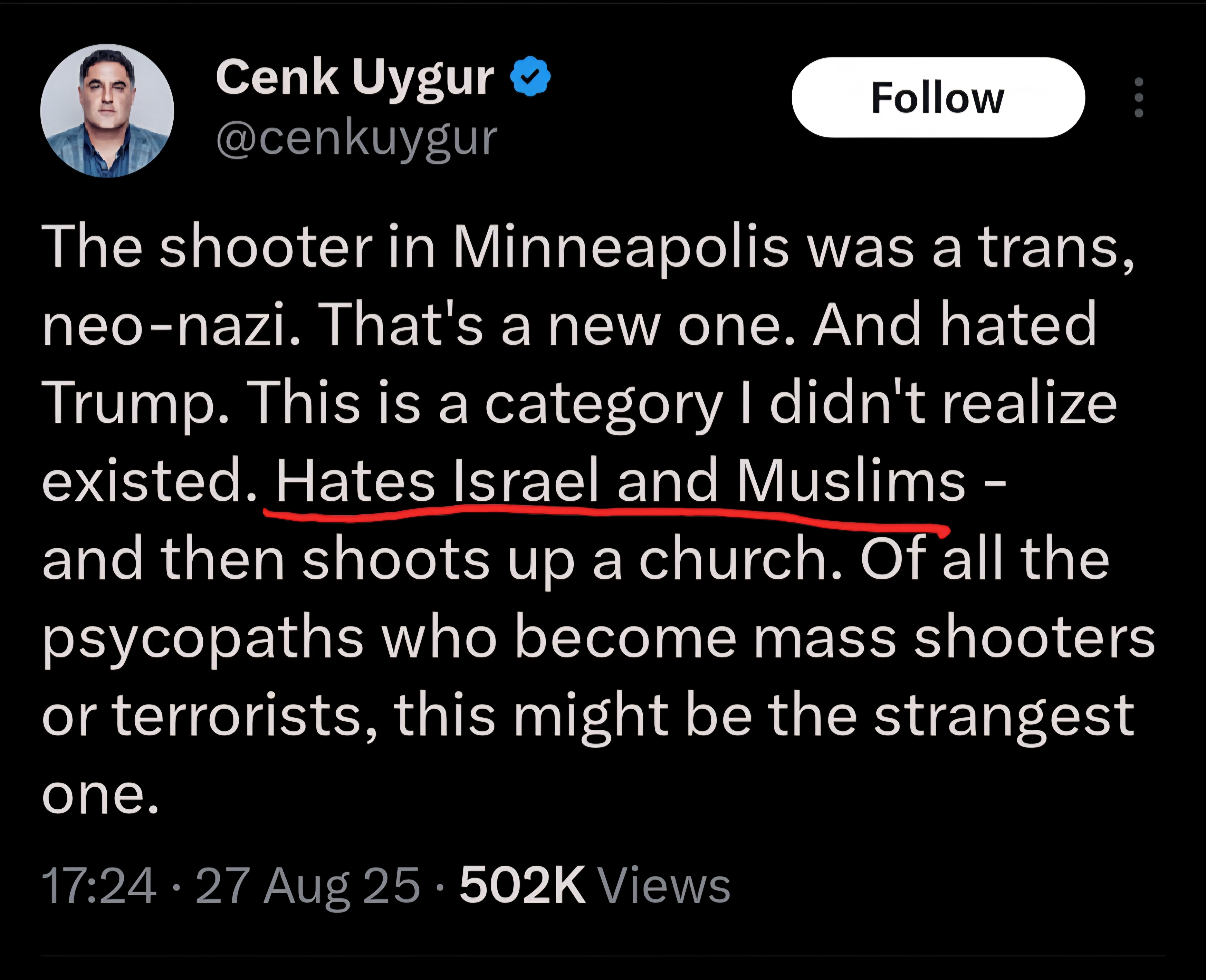
Cenk Uygur, founder of The Young Turks, quickly posted on X that the killer “hates Israel and Muslims.” Two deliberate misdirections.

First misdirection: He didn’t hate Israel in the abstract. He hated Jews — which is precisely why he hated Israel. On his weapon magazine he scrawled, “6 million wasn’t enough.” That wasn’t about Israel. That was about Jews. In his journal he wrote “If I carry out a racially motivated attack, it would be most likely against filthy Zionist jews,” before calling Jewish people “entitled” and “penny-sniffing” and adding “FREE PALESTINE!”

writings on the Minneapolis killer’s weaponry

He even called for destroying HIAS, the Hebrew Immigrant Aid Society that helps resettle refugees in the U.S. His antisemitism and anti-Israel animus were inseparable. He loved Nazis and he loved Palestinian Arabs who killed Jews. Cenk only loves the latter, because it allows him to hang his “anti-Zionist, not antisemitic” credentials where he cannot with the former.

Second misdirection: The shooter never expressed hatred of Muslims. He praised mass murderers — including some who targeted mosques — but not because he despised Islam. His adoration was for the act of mass killing as a pathway to glory. He wanted to die a martyr in the suicide-mass murder cult, to etch his name in the pantheon of psychopaths and inspire the next one, just as he inscribed their names on his gun, as well as “mashallah,” meaning “Gd has willed it” in Arabic.

The Sanitizers

So why did Cenk say what he said? To refit the crime into his own comfortable narrative. To launder the reality that this shooter’s rants — about Jews, Israel, HIAS — were fueled by the same demonization that Cenk himself mainstreams daily.

Cenk published this rant about Israel controlling the US government around the same time as misdirecting people about the Minnesota killer

This is how today’s judges operate. They aren’t rendering justice to take the wicked off the streets. They are sanitizing their own crimes by placing their incitement onto a scapegoat and pushing it off a cliff. They hope you will move on, and not notice their bloody handprints on the crime scene of young children dead on a church floor.

But be clear, Cenk and others like him are inciting the next mass shooter. They just hope the murderers come for Israel supporters.

Conclusion

There are no winners in these tragedies. The dead are buried, the families are broken, the shooter is gone.

But the lies linger. The venom feels less poisonous once imbibed and cleansed by the antisemitic judges.

When influencers and media stars twist a killer’s words into their preferred stories, they are not exposing truth — they are covering their own complicity.

The Minneapolis shooter’s manifesto was clear enough. It will likely be on the DSA (Democratic Socialists of America) book-of-the-month club reading. The world is sad and unjust and we must burn it down. Ideally, start with the Jews. If you can’t, make sure your manifesto reads like a modern day Mein Kampf that would make Rep. Rashida Tlaib (D-MI) proud.

The killer’s sphere of desecration was relatively small. Tragic, but limited. But the shrill antisemitic rants atop social media and infiltrating politics grossly widen the diameter of the damage.

The lingering tragedy is that the loudest voices have become the judges, and that will mark our entire society for collapse.

New Jersey’s Double Standard: Protecting Sunday Rest While Promoting Abortion

New Jersey prides itself on being “progressive,” but its legal framework reveals a hypocrisy that should make any thinking citizen bristle. On one hand, the state enforces Blue Laws in Bergen County — a set of regulations rooted in 17th-century Christian Sabbath observance that still ban most retail sales on Sundays. On the other hand, it boasts some of the most radical abortion laws in the country, permitting the ending of a pregnancy at virtually any stage.

If New Jersey is going to use the force of law to protect Christian values, then be consistent and protect life. If not, stop pretending by maintaining antiquated religious impositions like the Blue Laws.

The Blue Laws: Christian Morality Enforced by Penalty

Bergen County’s Blue Laws are codified in N.J.S.A. 40A:64-1 et seq., prohibiting the sale of clothing, furniture, appliances, and most retail goods on Sundays. Violators face fines up to $1,000 and potential jail time of up to 90 days (N.J.S.A. 40A:64-6). The intent? To preserve Sunday as a day of rest, explicitly tied to the Christian Sabbath.

Supporters of the laws admit their religious roots. Bergen County County Executive James Tedesco “has been a steadfast supporter of the Bergen County blue laws, long recognizing their vital role in enhancing residents’ quality of life and guaranteeing retail employees at least one day off each week,” echoing the original moral intent of honoring Sunday as a sacred day.

Abortion: Unfettered Access, Zero Protection for the Unborn

Contrast this with New Jersey’s abortion statutes. In 2022, Governor Phil Murphy signed the Freedom of Reproductive Choice Act (P.L.2021, c.375), enshrining the right to abortion at any stage of pregnancy with no parental notification for minors, no mandatory waiting periods, and no limits on late-term procedures. Clinics openly advertise this reality: “No gestational limit” (Planned Parenthood of New Jersey, 2023).

For Christians and countless others who believe life begins before birth, this isn’t neutrality — it’s the state actively rejecting Christian morality in the most profound area imaginable: the protection of human life.

Bergen County abortion clinic – closed Sundays

A Call for Coherence

New Jersey cannot have it both ways. Either the state should abandon religiously grounded laws like the Blue Laws — which literally fine people for shopping on Sunday in deference to Christian tradition — and let people lead the lives they choose, or it should acknowledge that Christian moral values still have a legitimate place in public law and extend them consistently, particularly to protect the unborn.

It’s time for New Jersey legislators to stop hiding behind selective morality. If the state truly believes in secular governance, repeal the Blue Laws and let commerce run seven days a week. If it still believes Christian moral heritage has value, then apply it where it matters most — to the defense of life itself.

Van Hollen’s Mainstreaming War on Israel

Senator Chris Van Hollen (D-MD) has become one of Israel’s fiercest critics in the U.S. Senate. Since Hamas’s October 7 massacre, he has pursued a campaign that reframes Israel not as a besieged ally but as a war criminal state, worthy of sanction and censure. His playbook has five coordinated elements: a starvation narrative, a focus on Christian persecution, a drive to restrict U.S. arms, an effort to criminalize Israeli “settlers,” and to demonize the Israeli government while legitimizing the Palestinian Authority.

What began as fringe rhetoric has steadily migrated into the Democratic mainstream. In Washington’s political war over Israel, Van Hollen has positioned himself as the lead general, and he is increasingly turning to enact laws to enforce his worldview.

The Starvation Narrative

The turning point came in February 2024, when Van Hollen escalated from criticism to criminalization.

On February 13, 2024, he declared on the Senate floor:

“Kids in Gaza are now dying from the deliberate withholding of food. That is a war crime. It is a textbook war crime. And that makes those who orchestrate it war criminals.”

Just two weeks later, his office issued a statement reinforcing the charge:

“People are starving in Gaza. And civilians are dying every day. There is no excuse for this situation.”

At the time – just weeks into Gaza’s war on Israel – few international observers had made such claims. By labeling Israel’s blockade as “deliberate starvation,” Van Hollen provided the framework for others to follow. Within months, humanitarian agencies, U.N. officials, and fellow senators adopted the same language.

Christian Persecution: Expanding the Field of Victims

On trips to the region in June 2024 and August 2025, Van Hollen, joined by Senator Jeff Merkley (D-OR) made highly publicized visits with Christian patriarchs in Jerusalem. They highlighted declining Christian communities and implied Israeli responsibility for their plight.

The narrative was selective: minimizing Hamas’s role and Palestinian Authority corruption while amplifying claims that Israel’s policies drove Christians from the Holy Land. Slowly, this angle began echoing in European diplomacy and American church politics. Van Hollen helped mainstream it.

Restricting U.S. Arms

Beyond rhetoric, Van Hollen has worked to curtail U.S. arms transfers to Israel. He joined resolutions to block certain sales, pushed for GAO investigations into Israel’s use of U.S. weapons, and demanded conditioning assistance on humanitarian compliance.

By mid-2025, other Democrats had joined him, showing his success in normalizing the once-fringe notion that America should starve Israel of weapons in the midst of its war for survival.

Criminalizing Settlers: From Rhetoric to Sanctions

Van Hollen has also targeted Israeli settlers, pressing for visa bans, sanctions, and financial restrictions.

In November 2024, nearly 90 Democrats, led by Van Hollen, urged Biden to impose sanctions on Israeli ministers tied to settler violence. In August 2025, he worked with Senator Peter Welch on a sanctions bill, declaring:

“The Netanyahu Government – driven by racist extremists like Smotrich and Ben-Gvir – continues to fuel settler violence and support the expansion of illegal settlements in the West Bank. The United States must not turn a blind eye to these acts.”

The progression from criticisms to sanctions is becoming a hallmark of his activities.

Boycotting Netanyahu, Embracing Abbas

The hypocrisy of Van Hollen’s diplomacy was laid bare in July 2024, when Prime Minister Netanyahu addressed a joint session of Congress. Van Hollen loudly boycotted the speech, denouncing Netanyahu’s government as extremist and refusing to “be a rubber stamp” for what he called a “political prop.”

Yet, just weeks earlier in Ramallah, Van Hollen had gladly sat down with Palestinian Authority President Mahmoud Abbas—a man who: wrote his doctoral thesis on Holocaust denial; maintains laws banning the sale of land to Jews, punishable by imprisonment or death; and funds stipends to terrorists’ families under the “Pay for Slay” program.

This willingness to shun Israel’s elected leader while legitimizing Abbas exposes Van Hollen’s double standard. The boycott was staged as a moral stand, yet his embrace of Abbas—authoritarian, corrupt, and antisemitic—revealed a deeper hostility directed not at extremism but at Israel itself.

Sen. Chris Van Hollen meets Palestinian Authority President Mahmoud Abbas in Ramallah on a August 2025 trip to the region in which he does not meet any Israeli officials (photo from WAFA)

The Legal Framework: Turning Criticism into Punishment

Van Hollen’s strategy is deeper than speeches. He has worked to institutionalize anti-Israel positions into binding U.S. law:

  • Leahy Laws & Foreign Assistance Act: He invoked these statutes in May 2025 to argue that Israel’s restrictions on aid are a “commission of gross violations of human rights” which would trigger U.S. legal violations.
  • GAO Investigations: He formally requested audits to prove U.S. complicity, aiming to tie Israel’s actions to American liability.
  • Codifying Executive Orders: By reintroducing sanctions legislation in 2025, Van Hollen sought to ensure that settler bans would not depend on a future president’s discretion but become permanent U.S. law.

This layering of legal levers shows the depth of his campaign. Van Hollen is not merely criticizing Israel. He is trying to build the legal scaffolding that forces America to punish it.

Summary

Van Hollen as a multi-front war on Israel:

  1. Starvation narrative → turned humanitarian debates into accusations of Israeli war crimes.
  2. Christian persecution → expanded moral indictments beyond Palestinian Arabs.
  3. Arms restrictions → reframed U.S. support as conditional.
  4. Settler criminalization → sought to enshrine punitive measures into U.S. law.
  5. Boycott of Netanyahu, embrace of Abbas → pivot America’s ally from Israel to the Palestinians.

Each step has nudged Democrats further away from the historic bipartisan consensus supporting Israel, tarring the Jewish State as racist and criminal, and unworthy of support.

Mark Mellman of Democratic Majority for Israel – a longtime Van Hollen fan – bemoaned and warned about the “deleterious consequences of his [Van Hollen’s] actions,” as he watched the Democratic party follow Van Hollen’s lead. It has not slowed the senator down.

Chris Van Hollen has become the lead general in mainstreaming anti-Israel narratives and a Democratic political war against Israel—a campaign whose consequences extend from Washington to Jerusalem, and into the very legitimacy of Jewish life in the Holy Land.

Performative Moral Kashrut

When I was a kid, before every supermarket aisle was filled with OU symbols, you had to read the ingredients yourself. That’s how you figured out whether something was kosher. No stamp, no shortcut. You made your own call with the information at hand.

It wasn’t perfect but that training carried over to how I learned to read the news. You didn’t wait for someone in authority to tell you what was moral. You read, you weighed, you judged.

After the October 7 Gazans’ slaughter in Israel, non-Orthodox denominations—the same ones least interested in kosher certification—raced to the presses with appeals for peace on both sides and declarations of shared mourning. The Orthodox world stayed largely quiet.

Then in August 2025, Open Orthodox rabbis decided they, too, needed to weigh in, well after Hamas and its allies had been trounced. Their letter condemned Hamas’s atrocities, but it quickly shifted its focus. Israel, they argued, bore moral responsibility for not providing enough food to Gazans and for Jewish violence in the West Bank.

The reaction was swift. The Coalition for Jewish Values (CJV), representing a more traditional Orthodox camp, branded the letter a distortion. They accused the signatories of ignoring critical facts, downplaying Hamas’s genocidal intent, and amplifying Jewish sins while minimizing Islamist terror. In other words, the Open Orthodox letter was stamped “Not Kosher.”

But step back for a moment and ask the obvious: who exactly are these letters for? Are the rabbis addressing their own congregants and communities, who look to them for guidance in halacha, prayer, and Jewish life? Are they trying to lecture the Israeli cabinet, which is fighting an existential war 6,000 miles away? Are they speaking to the American press and social media audience, where the concern is whether they will be judged as sufficiently “balanced” or critical? Or do they believe they are the modern equivalent of biblical prophets keeping Jewish kings in check?

The truth is that no single voice speaks for the Jews. And if you want serious political analysis, rabbis are not the address. They are trained to decide what happens when your meat knife slices into a piece of cheese—not how to conduct a multi-front war. When the OU stamps a product, it’s because real diligence has been done: site visits, lab tests, ingredient tracing. When rabbis stamp foreign policy with a moral hechsher, it’s about as kosher as Zabar’s selling ham on Chanukah.

Meanwhile, rabbis are getting urgent war-related questions. Not about ceasefires or humanitarian corridors—but about how to bury a soldier whose body isn’t recovered, or what obligations a spouse has when the other is on the front line, or how to mourn when half a community is shattered. Those questions are answered the traditional way: discreetly, privately, and halachically. That is moral clarity.

Open letters, by contrast, are performative. Nobody asked these rabbis to issue a ruling on how the IDF fights its battles. If anyone had, the question and answer would have been private, rooted in Torah and respect. To publish sweeping pronouncements in American media isn’t moral clarity—it’s moral vanity. It attempts to signal superiority over the very people fighting and dying, while feeding the antisemitic bonfire already raging online.

That may be the point. To profess innocence now that certain lines have been crossed, to posture publicly so that no one can accuse you of silence. But make no mistake: this is not Torah. It is branding.

Moral clarity means living the values you preach and answering the hard questions your people actually ask. It does not mean stamping your moral logo on a war you neither fight nor fully understand.

Villains Of Preference

In 2001, a Palestinian Arab jihadist blew up 21 Jewish teens and young adults at Tel Aviv’s Dolphinarium disco. In 2016, a radical Muslim pledging allegiance to ISIS massacred 49 young people at Orlando’s Pulse nightclub. Both killers declared why they killed: Jews and gays had no right to live.

But read today’s news, and the stories have been rewritten. The jihadists are airbrushed out. In their place, new villains are supplied: Israel, Republicans, conservatives. Hamas’s October 7 slaughter becomes “anti-colonial resistance.” The Pulse massacre becomes proof of “alt-right bigotry.” The killers vanish; scapegoats stand in their stead.

The New York Times article on August 24, 2025 essentially blaming Republican anti-gay attitudes surrounding the Orlando nightclub killings. Nowhere does it say that the murderer was a radical Islamist who was interviewed several times by the FBI for involvement with Al Qaeda and Hezbollah.

This is the age of villains of preference.

A Hamas gunman disappears, Netanyahu is written in.

An ISIS bomber is scrubbed out, Trump takes his place.

Jihad becomes invisible, conservatives become the menace.

This isn’t sloppy reporting—it’s deliberate redirection. Our society, already awash in the viral toxicity of social media, is being pushed to focus obsessively on politics and demonizing your neighbors. It’s red vs. blue, right vs. left. The situation courses with the ultimate stakes: life and death. The reframing empowers a radical socialist agenda that uses a domestic enemy to mobilize its base. Jihadists don’t fit the script, but Republicans and Zionists do.

The real clash—radical Islam against democracy and freedom—is inconvenient to acknowledge. So it’s erased. In its place we’re told the true battle is internal: conservatives are dismantling democracy; Israel is committing genocide with American support; capitalism is the ultimate evil that threatens the world. The foreign killers who target Jews, Christians, and gays are excused, while the West turns on itself.

Anti-capitalist, anti-Zionist politicians-in-waiting, Jamaal Bowman and Zohran Mamdani

The creed is simple: protect the victims of preference, attack the villains of preference—Jews, conservatives, capitalists. They are being lined up for your bilestorm. Your retweets. Your ire. Your protest. Your vote.

It is a purposeful rerouting of outrage, weaponized by radicals who despise capitalism and democracy, and cheered on by regimes like Qatar and China that profit from the West’s collapse.

The jihadists told us why they killed. Our media tells us to look away. Because in the new faith, truth is expendable while villains of preference are eternal.

There is a subtle subtitle to mainstream news articles today. It is a chorus that is growing louder and closer, lifted from killers’ manifestos: “There is only one solution: Intifada Revolution.”

Antisemitism For Dummies

A satire.

At last: the definitive handbook for turning age-old Jew-hatred into cutting-edge activism. Whether you’re a beginner looking to chant in the quad or a seasoned professional eager to upgrade from vague conspiracy posts to full-blown manifestos, this guide has you covered.


⭐️ Foreword by Zohran Mamdani

Mamdani reminds readers: the key to effective antisemitism is tone management. “Smile when you chant,” he writes. “Genocide with a grin reassures the brunch crowd that you’re not angry, you’re just passionate about human rights. Remember, a cheery face pairs well with calls for erasure.” He encourages everyone to follow his fellow Democratic Socialists around the United States in their vilification of Jews.


📚 Chapter Highlights

Chapter 1: Chair-Slamming for Justice (by disgraced former Congressman Jamaal Bowman)

Bowman demonstrates the physical theater of antisemitism. Pro tips:

  • Always slam a chair. Tables are optional.
  • If confronted, look wounded and insist you’re the one being silenced.
  • Practice lines like: “Why won’t anyone love me?” while pointing angrily at Jews.

⚠️ Warning Box: Weak antisemitism looks guilty. Turn up the volume.
It’s an interesting first chapter after the Mamdani “smiling antisemitism” approach in the introduction. The message is either speak softly with a smile or go full jihadi.

Bowman and Mamdani as besties, ready to educate the world on both the anti-Israel and anti-Jew lexicon

Chapter 2: Victimhood Chic (by Rep. Rashida Tlaib)

Learn how to wrap 19th-century blood libels in the soft blanket of “solidarity.” From “poor Gazans” to “oppressed Detroitians,” Tlaib shows how to recycle conspiracy theories as community-building.

💡 Pro Tip: Sprinkle “settler-colonial” and “they” into every sentence. Academia eats it up.


Chapter 3: Identifying Enemies (by Zahra Billoo, CAIR)

Billoo’s motto: Know thy Jewish neighbors, then denounce them.

Draw lists of Jewish organizations and label them “agents of oppression.”

Remember: Jewish schools, camps, and synagogues are all part of “the machine.”

Smile as you explain that Jews who acknowledge their heritage and history are “enemies,” even if they appear “polite.” Even if they are elderly or just children.

💡 Field Exercise: Practice in front of a mirror: “We’re not antisemitic, we’re just anti-Zionist.” Repeat until even you almost believe it.


Chapter 4: The Geography of Intimidation

Featuring Within Our Lifetime (WOL) and WESPAC
Why wait for a march in Washington? Bring the fight to Jewish neighborhoods directly.

Step 1: Find out where Jews live.

Step 2: Show up outside their homes and community centers.

Step 3: Chant until even the mezuzahs look nervous.

📌 Dummies Note: Always claim you’re just exercising free speech. (Lawyers love that one.)


Chapter 5: Bring a Jew (by Peter Beinart)

The best deflection against anti-Jew slander is to be accompanied by an AsAJew. You can usually pick one up in a local woke synagogue or library.

💡 Pro Tip: they are likely to be even louder than you are, so no need for an extra megaphone. Also, use them to help map Jewish locations per Chapter 4.


Chapter 6: Reuse Well-known Tropes- Repackaged for Today’s Audience (by Rep. Ilhan Omar)

Blend anti-capitalist buzzwords with old-school Jew-hatred. Example:
“From auto factories to olive groves, Jews profit off Black and Brown bodies.”
Add enough Marxist vocabulary and suddenly it sounds like grad school theory instead of medieval scapegoating. Be hip with “it’s all about the Benjamins,” to keep the younger audience engaged.


Chapter 7: Accuse Jews of Lying (Bowman)

Bowman comes back with the penultimate chapter. Part of antisemitism is to not only deny Jews a defense, but that they cannot be trusted. Even go so far as accuse raped Jewish women of being liars. Don’t be worried if it makes you appear callous and insane in an age of Believe Women: it helps shake out the true antisemites who will still rally to you.


Chapter 8: Theatrics, Not Apologies

Never apologize. If cornered, double down. If really cornered, accuse the accuser of “Islamophobia.” Remember: tears are a weapon—use them.


🎤 Bonus Features

🔲 Tips & Tricks Box:

Always bring a bullhorn or something else to make noise like whistles or pots. It’s impossible to sound genocidal when you whisper. Don’t let anyone have a passing part in the drama: let them be aware and own the fact that they are actively being complacent as Jews are marked for annihilation in their neighborhoods. They have tacitly joined the jihad.

If accused of antisemitism, pivot: “This is about Gaza!” Works every time.

📖 Sample Review Blurbs:

“Finally, a book that says what I scream outside synagogues every weekend!” — Anonymous Activist

“The Magna Carta of modern bigotry.” — UNESCO Heritage Committee

“Reads like Mein Kampf, but with a flair for fashion.” — Vogue Middle East


🏆 Epilogue: Owning It

The authors agree: antisemitism done timidly looks embarrassing. But antisemitism done boldly and passionately can get you re-elected, tenured, or at least viral on TikTok. Own it, project it, and never forget: you are the victim, even while chanting for someone else’s destruction.

Jesus, the Latest Jew Taken Hostage

Cenk Uygur, host of The Young Turks, posted on X that Jesus was a Palestinian. The implication was not only that Jesus was Arab, but also Muslim. Both are historically false. Jesus was a Jew in Judea. He lived, preached, and died as a Jew in his homeland.

If alive today, Jesus would not be celebrated by the Palestinian Authority. He would be condemned. The United Nations would call him an “illegal settler” for living in Bethlehem and Jerusalem. Palestinian leaders would brand him a “colonist” because his Jewish family had the audacity to live in their ancestral land.

This is not a new stunt. A few years ago, activist Linda Sarsour declared that Jesus was a Palestinian from Nazareth. She conveniently ignored the fact that Nazareth is in Israel, and that Jesus was Jewish—observing Jewish holidays, quoting Jewish scripture, and praying in Jewish synagogues. He was as much a “Palestinian” as King David or Moses.

Radical preacher Omar Suleiman – invited to speak before Congress by Nancy Pelosi – said the same. His goal was to peel Christian support away from the Jewish State. Evangelical Zionists needed to hear the gospel from an Islamic extremist.

Why this persistent rewriting of history? Of cultural appropriation? Because anti-Israel agitators have a larger project: erasing Jewish ties to the land of Israel. They cannot admit that Jews have been in their holy land continuously for millennia, so they try to recast Jewish history in Arab clothing. They claim Jews are foreigners and interlopers while appropriating Jewish figures for their own narratives.

The irony is striking. For all their rhetoric about “coexistence” and “justice,” the pro-Palestinian movement reveals its antisemitic moral rot in these fabrications. They would rather deny Jewish history than seek peace with the Jewish people. They would rather invent a fictional Palestinian Jesus than accept the historical Jewish Jesus.

Jesus has now become the latest Jew taken hostage—not in body, but in identity. Uygur, Sarsour, and their fellow travelers parade his name as a prop in their campaign against Jewish sovereignty. But no amount of Twitterstorms, hashtags, or revisionist slogans can undo the reality: Jesus was a Jew, in Judea, in the land of Israel.

Jesus, like every Jew before and after him, is bound up with the land that antisemitic anti-Israel activists desperately want to sever from its true indigenous people.

Parshat Re’eh and E1: Gathering the Nation Around Jerusalem Then and Now

Parshat Re’eh commands the Jewish people:

“Three times a year all your males shall appear before Hashem your God in the place He will choose—on the Festival of Matzot [Pesach], on the Festival of Weeks [Shavuot], and on the Festival of Booths. [Sukkot]” (Deuteronomy 16:16).

At a time when the tribes of Israel were destined to live across a wide and varied land—from the Galilee to the Negev, from the Mediterranean to the Jordan Valley and beyond—this commandment ensured that all Jews, regardless of tribe or geography, would remain bound to a single center: the place “He will choose:” Jerusalem.


Then: One City for One People

The pilgrimage festivals were not simply religious obligations; they were national glue.

  • Unity in Diversity: Each tribe had its own territory, customs, and leadership. But Jerusalem reminded them that they were not twelve separate entities—they were one nation.
  • Physical Connection: The journey itself—families traveling for days from north, south, east, and west, THREE TIMES A YEAR—kept every Jew intimately connected to the city at the nation’s core.
  • Spiritual Focus: No matter how far they lived, Jews oriented their lives toward Jerusalem.

Without this ritual of convergence, the tribes might have drifted apart, their shared purpose diluted by distance and difference.


Now: Re-Centering Around Jerusalem

Fast forward over three millennia. Jerusalem is once again the capital of a sovereign Jewish state. But the modern challenge is becoming increasingly less about tribal dispersion, with Jews in the holy land making up a plurality of Jews – it is geopolitical pressure and strategic vulnerability.

Recent government plans to develop the area known as E1, just east of Jerusalem, have sparked international controversy. Critics claim the project is “obstructive to peace.” It’s an absurd claim. Supporters see it differently: as an essential step to connect Jewish communities around the capital, ensuring that Jerusalem remains safe and accessible and central to Jews from north, south, east, and west.

The parallels to Re’eh are striking:

  • Geographic Cohesion: Just as ancient pilgrimage routes tied the tribes together, modern infrastructure links surrounding communities to Jerusalem.
  • National Identity: Building around Jerusalem reinforces its role not just as a city, but as the beating heart of Jewish life.
  • Defying Fragmentation: Where outside forces seek to carve up and isolate Jerusalem, development ensures continuity and connection.

Jerusalem: The Eternal Center

Parshat Re’eh’s vision was never merely about geography—it was about survival through unity. When Jews journeyed to Jerusalem three times a year, they reaffirmed their covenant and their peoplehood. One God, one people.

Today, as Israel strengthens the areas around Jerusalem, it is engaged in the same mission: to keep the Jewish people close to their capital, secure in their homeland, and united across generations.

Then as now, Jerusalem is not just a place—it is the center of a people.

The Old City of Jerusalem including the Jewish Temple Mount on the holiday of Sukkot