Arabs in Jerusalem

Listening to the United Nations, one might fear that Palestinian Arabs are being “ethnically cleansed” in Jerusalem due to Israeli “occupation.” Here are some facts (statistics as of 2011 as compiled by the Jerusalem Institute for Israel Studies).

Fastest Growing Group in Jerusalem
and Most of the Middle East

The Arab population in Jerusalem has not only grown, it has grown faster than the Jewish population in Jerusalem, faster than Arabs around Israel, and faster than Arabs in the surrounding countries.

  • The annual growth rate in 2011 of Arabs in Jerusalem was 3.2%, higher than Jews who only grew by 2.1%.
  • Arabs now account for 36% of the population of Jerusalem, up from 26% when the city was reunited in 1967.
  • From 1967 to 2011, Arabs grew by 5.7 times, while Jews only grew by 3.4 times.
  • The Arabs of Jerusalem now account for 18% of the Arabs in Israel.
  • The mortality rate of Arabs in Jerusalem (2.7 per 1000) is lower than Jews (5.2 per 1000).
  • Jerusalem leads the country in the number of births, and the Arab births account for the same percentage (36%) as in the city. Jews had 27.8 births per 1000 and Arabs had 27.9 births per 1000. Both of those rates are extremely high, and are rates typically found in Africa, not in developed nations.
  • Arab students make up 38% of the school system in Jerusalem, more than the 36% Arab population.

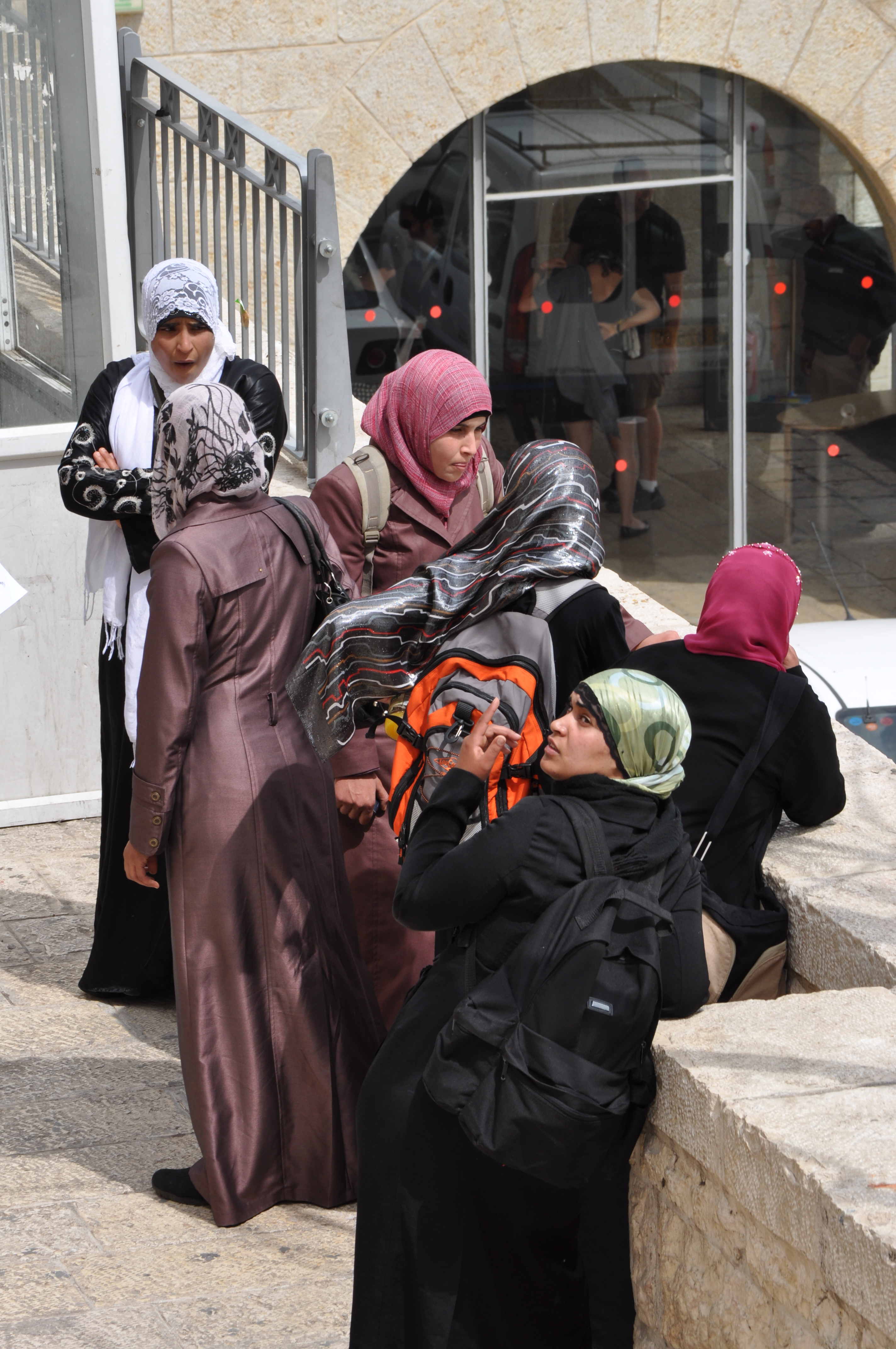
OldCity (14)
Arab Women in Jerusalem entering the Western Wall Plaza
(photo: First.One.Through)

Muslim Arabs are Similar to Charedi Jews

The demographics of the Muslim Arabs in Jerusalem is very similar to that of the Ultra-Orthodox (Charedi) Jews in Jerusalem. Consider the following:

JERUSALEM Children (0-14) Seniors (65+) Media Age
Charedi Jews 42% 6% 18
Muslim Arabs 40% 3% 20
Rest of Jews 26% 14% 31

Christian Arabs

23% 13%

33

The poverty rate among the Muslim Arabs is also similar to Charedi Jews. Each community tends to have much larger families than the rest of the population (Arabs have 5.7 people per household and Jews have 3.4, but skews much higher in the Charedi community). This typically leads to much poorer living conditions for both groups than the rest of the city.

Approximately 23% of the city considers itself Charedi and 36% Arab. These two groups account for the reason that 51% of all of Jerusalem’s residents are considered to live in the lowest socio-economic category. All of the Arab-majority neighborhoods and 24% of the Jewish neighborhoods (basically the Charedi ones) are ranked the lowest in terms of socio-economics.

Charedi Jews had a 20% lower participation rate (44%) in the workforce than other Jews (65%). Religious Arabs had an even worse workforce participation rate (13%) compared to less religious Arabs (59%), which is more comparable to secular Jews.

In Jerusalem overall, the Arab community is more religious than the Jewish community. Approximately 51% of Jews consider themselves either Charedi (30%) or Observant. This compares to 75% of the Arab population that considers themselves very religious. Both of these figures are much higher than found in other cities in Israel.

As the more religiously fervent have more children and are poor, they live in more crowded living conditions. The average Jewish household in Jerusalem has 1.0 people per room, while the average is much higher at 1.9 Arabs per room in Arab households. Due to this poverty and crowded living conditions, many Arabs take advantage of services from UNRWA: in 2011, the Shuafat Refugee Camp had the biggest gain (+690 people), while the Shuafat neighborhood outside of the UNRWA facility declined by 360 people.

Summary

Religious Arabs in Jerusalem are very similar to Jerusalem’s Charedi population, and they constitute a much larger percentage of the Arab community than the strictly observant Jewish community does in theirs. Both of these groups are growing very rapidly. The size and growth of the families, together with poor workforce participation rates have left both groups in poverty.

The unvarnished reality is that both Jews and Arabs in Jerusalem are caught in a similar trap: religious fervor often leads to poverty and crowded living conditions. Curiously, the satisfaction rate of the quality of life and place of work among Jerusalem residents was higher than elsewhere in Israel, while the frustration over income was highest in Jerusalem. It would appear that both the Arab and Jewish residents of Jerusalem are well aware of the trade-offs in life of being extremely religious.


It is unsurprising that the holy city of Jerusalem attracts many religious people – Jews, Muslims and Christians alike. The religiously fervent Jews and Muslims have spurred the city’s population growth (many religious Christians do not marry or have children), and have also increased the city’s poverty levels.

Religious Jews are easy to identify: men by their black hats and black yarmulkes, and women by their dress. Religious Arabs are harder to visually segment, but they are in Jerusalem in much greater proportion than Jews, and account for the rapid growth in the number of Arabs as well as the poorer living standards.

Contrary to the UN reports and Jerusalem “experts” like left-wing radical Danny Seidemann that the New York Times chooses to quote in articles like “Evictions in Walled Old City Stir Up a ‘Hornet’s Nest’“, Arabs in Jerusalem may apply for Israeli citizenship anytime and many do. However, just like the Charedi Jews of Jerusalem, becoming an Israeli citizen is not a ticket out of poverty.

Whether poor or rich, the Arabs in Jerusalem are the fastest growing group of any capital in the Middle East.


Related First.One.Through articles:

An Inconvenient Truth: Population Statistics in Israel/Palestine

The Populations statistics in Israel/Palestine do not support the Arab narrative

Palestinians agree that Israel rules all of Jerusalem, but the World Treats the City as Divided

The Battle for Jerusalem

Are you trying to understand Ethnic Cleansing in Israel?

Subscribe YouTube channel: FirstOneThrough

Join Facebook group: FirstOne Through  Israel Analysis

The Left-Wing’s Two State Solution: 1.5 States for Arabs, 0.5 for Jews

The two state-solution for the “Question of Palestine” has been bandied about for decades. At the 1993 Oslo Accords, the Israelis and Palestinian Arabs seemingly came to a conclusion that there would be a division of the land, one for Arabs and one for Jews. However, when the negotiations reached a critical juncture in September 2000, the head of the Palestinian Authority Yasser Arafat (fungus be upon him), opted to terminate the peace process and launched another war of terrorism against the Jewish State.

Fifteen-plus years and several thousands of dead and injured later, the concept of a two state solution still lingers. While in principle the concept harkens back to the 1947 United Nations Partition plan of two states for two peoples, the radical left has pushed aggressively for a different configuration of two states to the liking of Palestinian Arabs: one and one-half states for Arabs, and one-half of a state for Jews.

The 1.5 Arab States

The 100% Arab State of Palestine. Palestinian Arabs are seeking a new country which will be devoid of any Jews. Acting President of the Palestinian Authority made his demand clear in July 2013. His declaration is consistent with every action taken by Palestinian Arabs over the years:

  • Palestinian laws which make it a crime for any Arab to sell land to a Jew (consistent with Jordanian law);
  • Jordanian law specifically excluded Jews from the “West Bank”/ east of the Green Line (EGL) being granted citizenship;
  • Demand that any and all Jews be removed from EGL (including Jews who live in existing homes that have been around for decades);
  • No Jewish visitor on Palestinian college campuses (Bir Zeit);
  • No Jewish businesses may operate in the disputed territories

These demands are blessed by several radical left-wing Jewish groups. Groups like Jewish Voice for Peace, Independent Jewish Voices (Canada), and European Jews for a Just Peace, advocate for BDS (boycott, divestment and sanctions) for any business that operates east of the Green Line (EGL) and in Israel itself. Individuals like Rabbi Ellen Lippmann on the board of J Street, also see no problems with BDS for Jews living in EGL.

Non-Jewish left-wing radicals take note of the Jewish positions.  US President Obama has not just called new Israeli towns in EGL “illegitimate,” but argued that no Jews should be permitted to live in EGL, even in homes they legally purchase such as in SIlwan, in eastern Jerusalem.  Author Tuvia Tenenbom noted that Europeans and others need not be openly anti-Semitic anymore; they can just fund the rabidly anti-Zionist Jewish groups that bless a Judefrei Palestine.

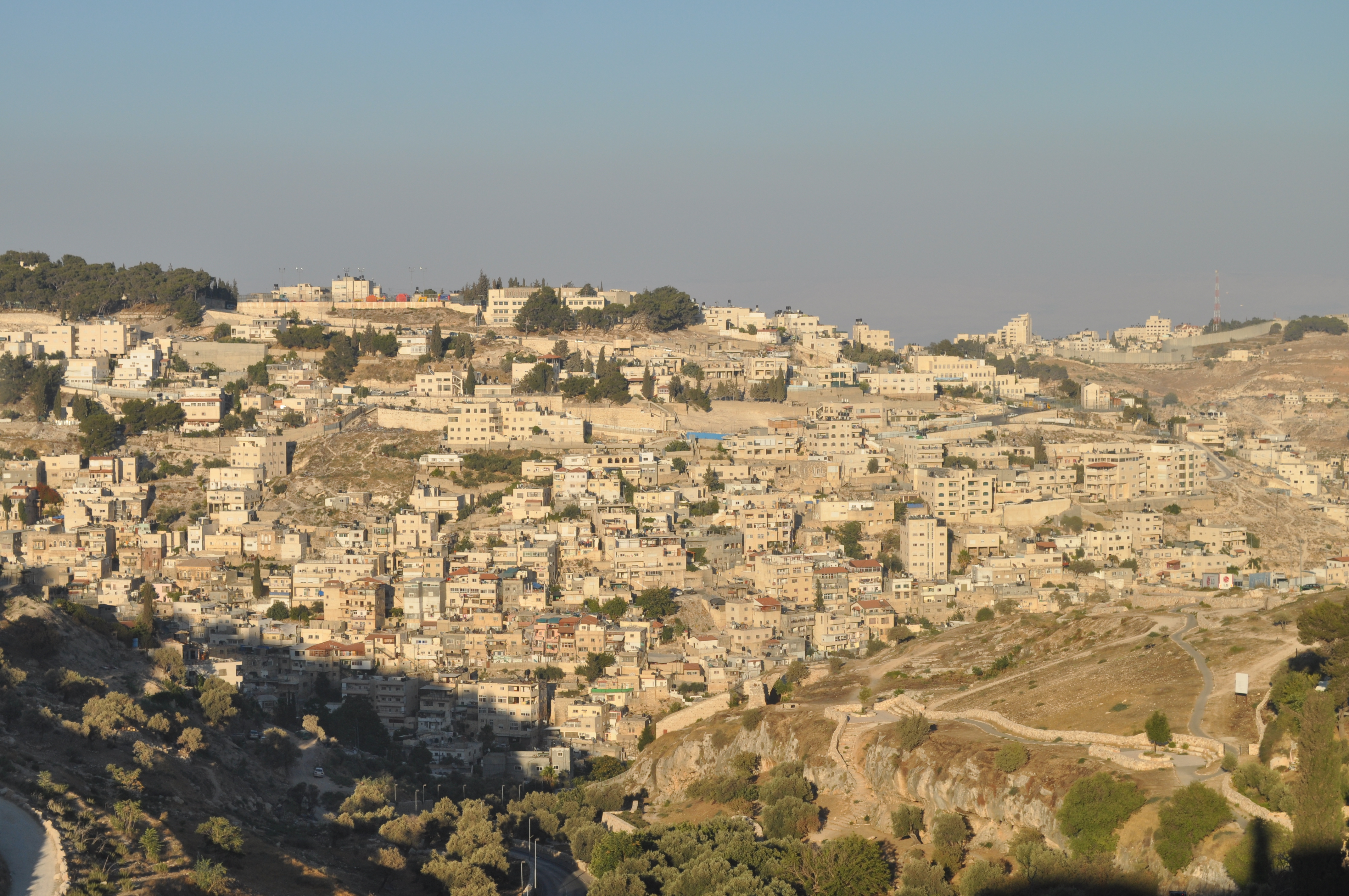
Silwan YemeniteDSC_1020
Top picture: Silwan, in eastern Jerusalem, founded by Yemenite Jews
(photo: late 19th Century)
Bottom picture: mostly Arab Silwan in 2013
(photo: First.One.Through)

The 50% Arab State of Israel. Other left-wing groups like Adalah (supported by the New Israel Fund), seek to dismantle the Jewish State and replace it with a bi-cultural state. They advocate for the removal of anything associated with Judaism such as the Jewish symbols on the flag, in front of the Knesset and in the national anthem.

The left-wing groups are also against any Jewish preferences in Israel, such as the Law of Return which enables Jews from around the world to become citizens of Israel on an expedited basis.  The revised neutral state of Israel would have Jews living as a minority, as the Palestinian Arab Right of Return would bring millions of Arabs into this bi-cultural state.

In the end, the Holy Land would have a completely Arab, Jew-free state called “Palestine,” and a second democratic, bi-cultural state where Arabs would be a majority, but where Jews would be allowed to live.

150% of the “Holy Basin” for Arabs.
The non-holy 50% for Jews

The 1.5 Arab states in the holy land would also have 150% of the “Holy Basin,” and all of the region’s holy sites.

When the United Nations first drafted a partition plan in 1947, it considered the two holy cities – Jerusalem and Bethlehem – to be a “Holy Basin” which would be part of neither state. As the left-wing now pushes for the 150% Arab plan, they are advancing a radical plan for the Holy Basin.

1947plan jerusalem
UN 1947 Partition Plan for the “Holy Basin”
of Greater Jerusalem and Greater Bethlehem

100% of Bethlehem. As part of the Oslo Accords, Israel handed over control of the City of Bethlehem to the Palestinian Authority at the end of 1995. Israel only maintains a small presence at Judaism’s third holiest site, the Tomb of Rachel. After Arafat’s Second Intifada, the Israelis were forced to create a wall around the small tomb to protect Jewish visitors.  In general, the city is now virtually devoid of Jews and Christians since coming under the Palestinian Authority.

The Holy 50% of Jerusalem. The Palestinian Authority demands that the entirety of the Old City of Jerusalem, which contains Judaism’s holiest sites, Islam’s third holiest site, and many Christian holy sites, all be part of the Palestinian capital. It is content to let the newer part of the city to the west, which has no holy sites, to be the capital of Israel.

The radical left endorses the Palestinian Arab plan.

The fact that only Israel has allowed freedoms of access and religion in Jerusalem does not sway people who claim to seek “justice.”  Groups which claim to advance “human rights,” advocate for an anti-Semitic Jew-free agenda in Palestine.  Further, using the maxim that the best defense is a good offense, these groups consider anyone that points out the bias of their plan and impracticality of diving a capital city to be right-wing racists.

The joys of being a radical liberal is that you can feel 150% morally superior while waving banners of “justice” and “human rights”, even while trampling on those very principles.


Related First.One.Through articles:

The Israeli Peace Process versus the Palestinian Divorce Proceedings

The Arguments over Jerusalem

Squeezing Zionism

“Peace” According to Palestinian “Moderates”

Liberals’ Biggest Enemies of 2015

Israel, the Liberal Country of the Middle East

Today’s Inverted Chanukah: The Holiday of Rights in Jerusalem and Judea and Samaria

Subscribe YouTube channel: FirstOneThrough

Join Facebook group: FirstOne Through  Israel Analysis

Adalah, Dismantling Zionism

Adalah is also known as the Legal Center for Arab Minority Rights in Israel. It is funded by a number of left-wing organizations including: the New Israel Fund (NIF); the Ford Foundation; the Open Society Foundation (George Soros); Oxfam; and the European Commission.

Adalah claims to be “an independent human rights organization and legal center which… works to promote and defend the rights of Palestinian Arab citizens of Israel, 1.2 million people, or 20% of the population, as well as Palestinians living in the Occupied Palestinian Territory (OPT).”  It’s agenda is much more aggressive than simply defending Israeli Arabs.

The group seeks to replace Israel as a Jewish State with a bi-national, multi-cultural state.

adalah person
Adalah protested Israel’s ban of Islamic party in Israel, November 2015.  Caption states “Raed Salah, the head of the northern branch of the Islamic Movement in Israel, gestures  in Nazareth on Nov. 17 after an Israeli police raid at the movement’s office.(Atef Safadi / European Pressphoto Agency).”  The four-finger “gesture” is the salute “R4bia” supporting the Muslim Brotherhood.  The United Kingdom also declared the Muslim Brotherhood a terrorist organization in December 2015.

Dismantling the Jewish State

Adalah’s goal is a new Israel, which would no longer have any Jewish preferences, such as special symbols for Jews (in the national anthem and flag), nor special treatment for Jews (such as quick and easy approval for Israeli citizenship).

Adalah’s mission can be clearly seen in its “Democratic Constitution” for Israel, proposed in 2007:

  • Setting Israel’s borders at the 1949 Armistice Lines/ “1967 borders”
  • The “Right of Return” of all Palestinian Arabs that left the region, together with their descendants, back to Israel
  • “[T]he return of land and properties [for all Arab refugees] on the basis of restorative justice
  • Israel would become a “democratic, bilingual and multicultural state,” replacing the Jewish State, because it views Israel as racist due to “the exclusion of the Arab minority based on the definition of the state as Jewish.”

The group rejects the international laws of 1920 (San Remo Conference) and 1922 (Palestine Mandate) that specifically called for “reconstituting their [Jewish] national home” THROUGHOUT Palestine, as Adalah claims that such international actions ultimately turned Arabs from a majority into a minority “against their [Palestinan Arab] will.”

The organization’s mission is to remove any particular “Jewishness” of Israel, and then flood the country with millions of Arabs to make Jews the minority. Homes would be taken away from Israeli Jews and handed to Arab “refugees.”

Refusing Equality for Israeli Jews

While the group fights against what it calls Israeli laws with embedded “racial inequality,” it shows no interest in promoting equality for Jews.

  • Where is the Adalah protest that Jews should not be barred from living in Judea and Samaria?
  • Where are the Adalah lawsuits to enable Jews to pray openly on the Jewish Temple Mount?
  • Why does the group find it offensive for Arabs with Israeli citizenship to be called “Israeli Arabs” and insists on being called “Palestinian Arab citizens of Israel?”  Are they demanding dual citizenship with a future Palestinian State?  Will they advocate that Israeli Jews should similarly get dual citizenship?
  • Adalah highlights that Arabs have lived in the region for generations which entitles them to particular rights in their homeland, yet they deny the history of the Jews and their rights to a homeland in the Holy Land.

Is equality for Adalah only a one-way street where Arabs get access and rights but Jews are denied?

Adalah: Having Your Country and Eating It Too

Adalah’s goals are clear.  It seeks a two state solution for the region: one is called Israel, in which Jews are allowed to live as a minority in a bi-national state with a Palestinian Arab majority; the other country is called Palestine, which will have no Jews nor Jewish rights to their holy places.

As “Palestinian Arab citizens of Israel” are part of the broader Palestinian people, they would have citizenship in both countries, while Jews would be limited to just living in Israel.  Over time, it is easy to visualize a future where those two Palestinian Arab states would merge.  Goodbye Israel.

20151119_161515
Full page NIF ad in The Jewish Week, November 20, 2015
stating it supports “Israelis working for a shared society” and claiming those opposed to NIF have an “ultranationalist agenda”

“Pro Israel” groups like the New Israel Fund state that they “are working for civil rights, social justice and religious tolerance.”  Those are noble goals. However, why does NIF support organizations like Adalah which seek to destroy the Jewish State?  Why does NIF label those people who want to see Zionism flourish in the Holy Land as “ultranationalist?”

Adalah openly opposes the vision of Zionism’s founders, as well as international laws which called for re-establishing the homeland of the Jewish people.  How can NIF give Adalah funds ($1.875 million from 2008-2014) and claim that it is “pro-Israel?”

However the NIF chooses to stretch the definition of “pro-Israel,” it is certainly is not pro-Zionism.


Related First.One.Through articles:

Liberals’ Biggest Enemies of 2015

“Peace” According to Palestinian “Moderates”

Oxfam and Gaza

Subscribe YouTube channel: FirstOneThrough

Join Facebook group: FirstOne Through  Israel Analysis


“Peace” According to Palestinian “Moderates”

Liberals, including the left-wing paper The New York Times, often suggest that there are many leading Palestinian Arab and Israeli Arab moderates who genuinely want peace with Israel. US Secretary of State John Kerry warned Jews and Israelis about failing to fully engage “the moderate Palestinian leadership,” which could lead to “extremism.

Over the past six weeks, one has to wonder what kind of “peace” these “moderates” have in mind.

Mahmoud Abbas

On October 28, 2015, the acting-President of the Palestinian Authority addressed the United Nations Human Rights Council in Geneva, Switzerland. In his prepared remarks he said that Israeli occupation of Palestine has been in place since Israel’s founding in 1948. He viewed all of Israel as illegitimate, and Palestinian land.

Abbas is a proud Holocaust denier as well as denier of Jewish history in the holy land. His anti-Semitic call for a Jew-free country has been endorsed by the Obama administration, and his basic refusal to recognize Israel as the Jewish State make the goal of achieving peace with this straw man a laughable fantasy.

Ayman Odeh

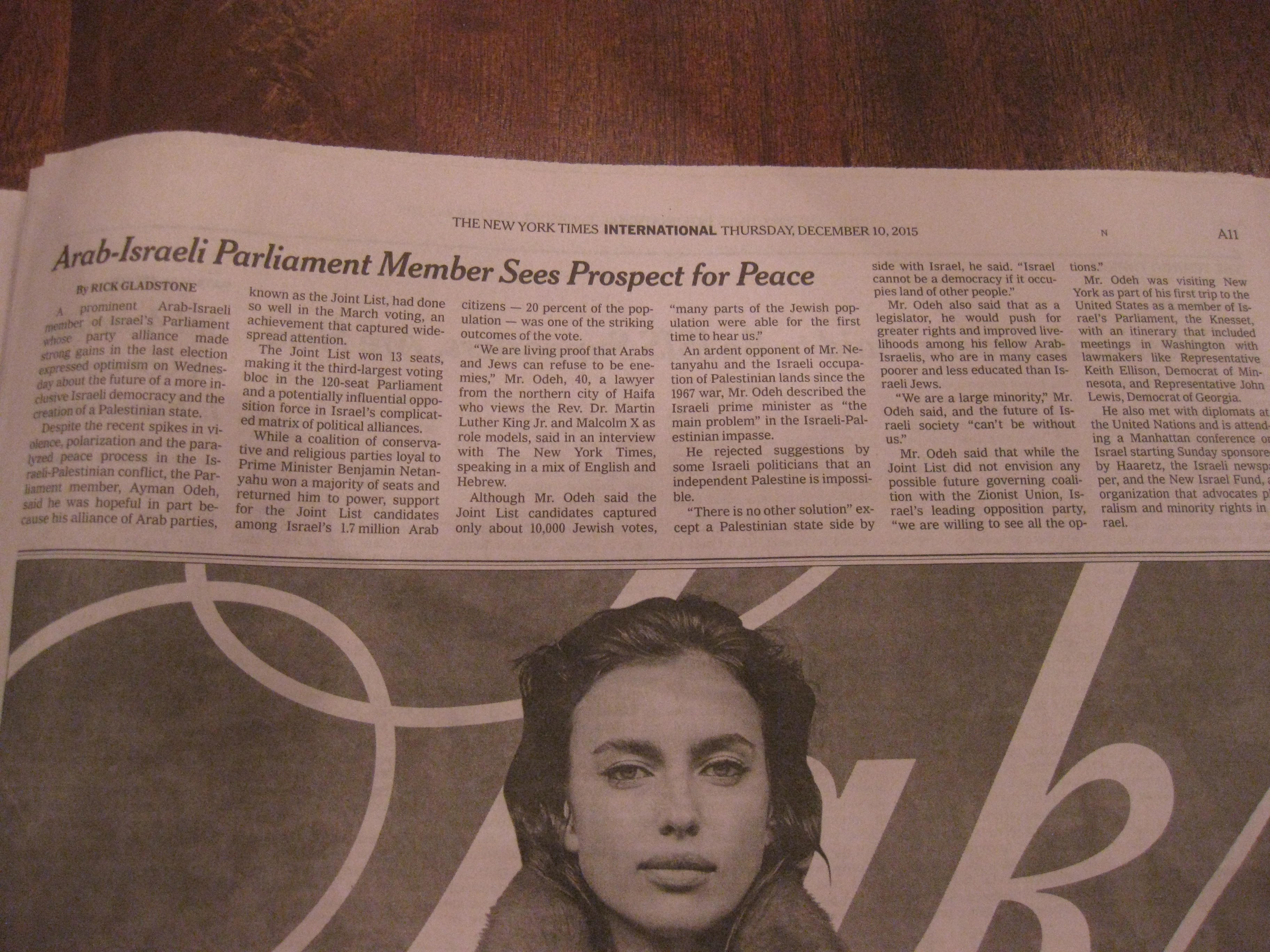
The NY Times was very quick to promote the prospects for Israeli-Arab peace as one of the leaders of the Joint Arab List, Ayman Odeh, was coming to New York to address groups of Jews.  On December 10, the Times ran an article “Arab-Israeli Parliament Member sees Prospect for Peace,” which described a hopeful Ayman Odeh’s thoughts about peace because “many parts of the Jewish population were able for the first time to hear us.”  Somehow, the deafness on the part of Arabs to recognize the Jewish State doesn’t seem to bother him.

IMG_3659
New York Times article on December 10, 2015

On December 10, Ayman’s vision of Israel was brought to the open (except for readers of the NY Times since it opted not to print the follow-up story).

Ayman was due to speak to the Conference of Presidents of Major American Jewish Organizations.  However, when Ayman noticed that the meeting was taking place on the same floor in the building as the Jewish Agency (a group that facilitates Jews moving to Israel) and other Zionist organizations, he refused to go up the elevator.  He insisted that the meeting location be moved so he would not have to be on the same floor as “organizations whose work displaces Arab citizens.  The organization’s leader, Malcolm Hoenlein refused to change the meeting location and the meeting was cancelled.

Saeb Erekat

On December 13, 2015, perennial spokesperson for the Palestinians, Saeb Erekat came to speak at a conference run by the left-wing Israeli newspaper Haaretz and left-wing foundation, the New Israel Fund. Before taking the stage, he demanded that the Israeli flag be removed from the room.  The event organizers quickly complied.

“Moderates” seek a new State of Palestine,
not Peace with Israel

Many progressives have opened up various venues for engagement with Arabs to move a peace process forward.  As part of those efforts, they have chosen to label various Arab leaders as “moderates” and partners for peace.

However, these Arab “moderates” repeatedly make clear – in public, and in front of them – that they view the Jewish State of Israel as illegitimate.  The only rightful rights in the holy land belong to Arabs; if Jews are to remain in the land, it will only be subject to Arab review and approval.

Consider what these “moderates” say in private to their own constituents.

For Palestinian Arabs, there is one goal in the “peace process” and it is not peace with the Jewish State, but the establishment of a new State of Palestine.  The only difference between Arab moderates and extremists, is that extremists want to remove Israel in its entirety immediately, while moderates want to start with a Palestine in half of the holy land, before they assume complete control of the land.

John Kerry, Haaretz, the New York Times and other liberals loudly proclaim that the Palestinian Arab leadership are moderates who seek peace with Israel, but refuse to describe and detail all of the Arab comments and actions which clearly spell out their permanent hostility towards the Jewish State.

The fact that these “moderates” do not represent the general Palestinian public is yet all the more frightening, as 67% of Palestinian support the “stabbing intifada” according to the latest Palestinian poll.

The New York Times may highlight Ayman Odeh’s call that peace is possible since the “Jewish population can hear us.” But the world has news sources and blogs like First.One.Through that are read broadly around the world, that listen to more than just the sound-bites that dreamy liberals promote.

Peace partners are still not present.


Related First.One.Through articles:

The Israeli Peace Process versus the Palestinian Divorce Proceedings

The Narrative that Prevents Peace in the Arab-Israeli Conflict

Israel was never a British Colony; Judea and Samaria are not Israeli Colonies

What do you Recognize in the Palestinians?

Subscribe YouTube channel: FirstOneThrough

Join Facebook group: FirstOne Through  Israel Analysis

The United Nations’ Remorse for “Creating” Israel

Some political analysts have suggested that Europeans tend to be more negative in their attitudes towards Israel than Americans, due to the former’s rejection of their colonialist past. The retreating by the British, French, Dutch, Portuguese and Belgians from the colonies that they had established hundred-plus years prior in India, Algeria, Tunisia, Congo, Morocco and other countries, was part of a repositioning of the world back to local sovereignty. The colonialist era has been cast in a racist light and rejected by today’s more “pluralistic” societies.

Palestinians have taken note of the change in attitudes, and have adopted new vocabulary to instigate the Europeans against Israel whereby the charges of “colonialist” has accompanied the accusation of being racist.

From “Zionism is Racism”
to “Colonial Occupier”

In the 1970s, the head of the Palestinian Liberation Organization, Yasser Arafat, led the world on a venomous attack against “Zionism.” In 1975, Arafat succeeded in getting the United Nations to pass Resolution 3379 condemning “Zionism is Racism.” Somehow, the world became convinced that the national aspirations of Jews to be self-governing was uniquely racist compared to every other nationalistic aspirations.

It took sixteen years for the United Nations to erase the charge, but the venom remained in the UN bloodstream.

At the UN, the “Question of Palestine” ceased to be a territorial dispute, and became an ethical question for the United Nations: should the global body have created and voted for the Jewish State?  Did it do so, solely because of the guilt from the Holocaust?

The current acting-President of the Palestinian Authority, Mahmoud Abbas, stokes that question to the mini-inferno that sits in the United Nations today. He constantly uses the term “colonial” to describe the emergence of Israeli “settlements,” and characterizes Israel as a recent foreign transplant on Arab soil. For some of his listeners, the malicious appearance of Israeli Jews began in the “West Bank” in 1967. For others, the Jewish colony overran the entirety of Palestine when the United Nations voted to partition the land into a Jewish State and Arab State in 1947.

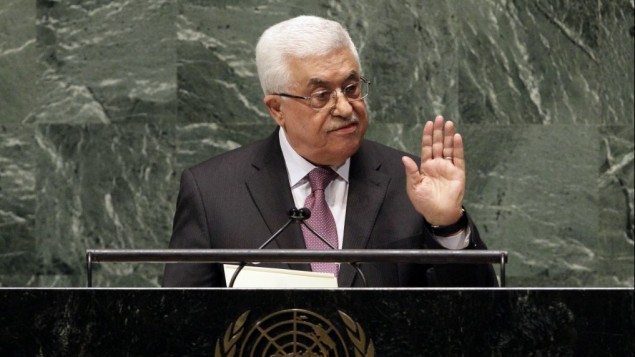
UN-Palestinians-Statu_Horo-1-635x357
Acting President of the Palestinian Authority, Mahmoud Abbas
Addressing the United Nations, November 29, 2012
(photo: Richard Drew/AP)

As Abbas said in his address to the UN on November 29, 2012: “Israeli occupation is becoming synonymous with an apartheid system of colonial occupation, which institutionalizes the plague of racism and entrenches hatred and incitement.”

The Palestinian’s pivot was subtle but significant.  Self-determination (like Zionism) in itself was not a crime.  Indeed, the Palestinian Arabs seek the same right for themselves.  However, the Israelis’ “colonial occupation” was unique and the root cause of the problem.  It was not necessarily the Jews’ goal of self-determination, but the act of colonialization that created “racism” and “incitement.”

Somehow, the Europeans and a growing number of countries, have embraced these narratives, particularly that Israel in its entirety was a UN mistake.

International Remorse for Partitioning Palestine
November 29, not June 4

The clarity of the global adoption of these positions can be found in the annual commemoration of the day of the partition vote on November 29, 1947.

In 1977, while the “Zionism is Racism” edict was still fresh, the United Nations passed another resolution to annually commemorate the UN Partition vote, as the “International Day of Solidarity with the Palestinian People.”

The decision to partition Palestine was approved by Jews and rejected by Arabs in 1947, yet the UN specifically chose that date to stand in “solidarity with the Palestinian People.”  On its face, it would seem like a cruel decision to create a holiday for a people on the very day that those people despised.

However, taken together with the “Zionism is Racism” resolution of 1975, the picture becomes more clear: the UN believed that the decision to partition the land was a mistake.  The global body concluded that the Palestinians were correct in the assertion that the UN created a racist, anti-Arab entity in Palestine.  The Palestinians were correct to reject the partition plan in 1947.  The fault belonged to the United Nations, not the Palestinians, right at creation.

The United Nations did not choose June 4 or June 10 as the date to stand together with Palestinians.  Those dates in 1967 were the beginning and end of the Six Day War when the Jordanians (together with Palestinians who were then citizens of Jordan) launched an attack on Israel and consequently lost the “West Bank” which they had illegally annexed.  If the root cause of the plight of Palestinians was “Israeli settlements” in the West Bank, then those dates would have been more appropriate to anchor the anniversary.

But the United Nations wanted to mark its own poor decision.  While the Palestinians rejected partition in 1947 and launched wars in 1948 and again in 1967, those bad decisions and actions were not deemed relevant.  The UN chose to tell the Palestinians that it was not their fault.  Their situation stemmed from decisions that the UN itself made.

Today, while the UN may no longer outwardly state that “Zionism is Racism,” the global body has adopted Abbas’s narrative that the UN planted a colonialist flag in Palestine.  The Europeans and liberal press now echo Abbas and the Iranian Supreme Leader Ali Khamenei who claim that Israel is a foreign and dangerous entity that was unnaturally inserted into the Middle East, and that the Arabs are the sole indigenous people and the land itself is inherently “Arab.”


It is well passed time for Israel to actively combat this claim of colonialization, the way activists overturned the “Zionism is Racism” UN edict in 1991.  It is time to clearly educate the world that RE-ESTABLISHING the Jewish State and not banning where Jews can and cannot live is neither colonialist nor racist, but the essence of freedom and justice.


Related First.One.Through articles and video:

Israel was never a British Colony; Judea and Samaria are not Israeli Colonies

The United Nations Applauds Abbas’ Narrative

The Holocaust and the Nakba

The Legal Israeli Settlements

UNRWA’s Ongoing War against Israel and Jews

Nicholas Kristof’s “Arab Land”

Video: I hate Israel – Zionism

Subscribe YouTube channel: FirstOneThrough

Join Facebook group: FirstOne Through  Israel Analysis

Every Picture Tells a Story: Arab Injuries over Jewish Deaths

On November 19, 2015, a Palestinian Arab murderer shot up cars in the Gush Etzion district of Judea and Samaria. Among the three Jews that were killed in that incident, was an American citizen who was studying in Israel for the year.

Ezra Schwartz was an 18 year old from Sharon, MA. He went with some friends to bring food and candies to Israeli soldiers who were guarding an intersection where three Israeli boys were abducted and killed in July 2014. On his way back to school, he was shot and killed along with others while sitting in traffic.

The New York Times did not think much of this Jewish American teenager.

The story of the murder was placed at the very bottom of page A6. There was no accompanying picture. No caption. No one saw this American victim of Palestinian Arab barbarity.  As a matter of fact, if you wanted to know the name of this American victim, you would have to wait until the tenth paragraph of the article.

IMG_3620
NY Times November 20, 2015, page A6

This was in sharp contrast to how the New York Times covered the story of an American Arab who was beaten up while engaged in a riot in Israel.

On July 7, 2014, the New York Times placed a large color picture on the front page of an Arab youth surrounded by policemen.  The caption read “Tariq Abu Kheidar, 15, arrested in the unrest, is a cousin of the victim and was shown on a video being beaten by Israeli officers.” Tariq led the world news, on a day when over 100 people were slaughtered in various attacks.

20140707_082918
Front page of the New York Times July 7, 2014

The beating of an Arab American who participated in a riot got front page attention, while the murder of a Jewish American who was simply riding in a car got nothing.

The New York Times has a long history of ignoring Israeli deaths and highlighting Palestinian injuries as detailed in the articles below. The New York Times has extended its bias against American Jews as well.


Related First.One.Through articles:

Every Picture Tells a Story: The Invisible Murdered Israelis

Every Picture Tells A Story: Only Palestinians are Victims

Every Picture Tells a Story: Versions of Reality

The New York Times’ Buried Pictures

Every Picture Tells a Story, the Bibi Monster

Every Picture Tells a Story, Don’t It?

The New York Times Picture of the Year, 2014

Subscribe YouTube channel: FirstOneThrough

Join Facebook group: FirstOne Through  Israel Analysis

The Disproportionate Defenses of Israel and the Palestinian Authority

The United Nations Human Rights Council (UNHRC) produced a report in the spring of 2015 about the war between Israel and the Palestinians in the summer of 2014. The UNHRC continued with a debate in June 2015 in which several “delegations strongly condemned Israel’s excessive and disproportionate military aggression against the Palestinians” including from: Egypt; Tunisia; Maldives; Iraq; South Africa; Indonesia; Ireland and Cuba.

This analysis does not directly review “disproportionate force” but disproportionate defense employed by the two sides.

Obligation to Defend

The foremost responsibility of any governmental leadership is to protect its population. Such defense can be implemented in a variety of ways: a police force or army to maintain order; infrastructure to ensure safety; and intelligence which can guide the appropriate use of manpower and equipment. The United Nations has been developing a framework for “The Responsibility to Protect” over the past several years.

In the conflict between Israel and the Palestinian Authority, only one side proactively protects its citizens, while the other side uses reactive defenses. One side assumes responsibility via using its own resources and capabilities, while the other side relies completely on outside agents.

ISRAEL – ACTIVE DEFENSE

Protecting Against Incoming Missiles and Armaments

Bunkers and Bomb Shelters: Israel is unique in the Middle East in establishing a policy of bomb shelters throughout the country. In response to being surrounded to hostile neighbors that have attacked and shelled its people and lands since its inception, houses, schools, hotels, hospitals and even playgrounds are built with bomb shelters.

The Palestinians have not built shelters. Instead, they used their cement to build tunnels with which to attack Israel.

Israel_-_shelter_by_kate_simmons

Playground shelter in Israel
(photo: Kate Simmons)
Iron Dome. Israel developed a new missile defense system called the Iron Dome, and continues to build new air defense systems to protect the country from incoming missiles.

The Palestinians have neither developed nor imported defensive systems. They have only imported offensive weaponry.

irondome

Israeli developed “Iron Dome” Defense System
Blockade of Gaza. Israel imposed a naval blockade around Gaza after the terrorist group Hamas, which is sworn to the destruction of Israel, seized the land. The blockade has successfully kept out many missiles and other arms from reaching Hamas and ultimately causing death and destruction in Israel.

Protection Against Killers

Security Barrier. In September 2000, the Palestinians began multi-year riots which killed over a thousand Israelis through hundreds of attacks. In response, the Israeli government began to construct a security barrier in 2002 to keep out terrorists who mostly emanated from cities in Judea and Samaria/ east of the Green Line (EGL).

The Palestinians have not built any security barriers from the Israelis. There have been no suicide bombers going from Israel into Gaza or EGL blowing up civilians.

IMG_1805

Stretch of Security Barrier along highway
(photo: FirstOneThrough)

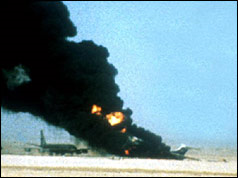
Airport Security. Well before the world became attuned to airport security after the attacks on the United States on 9/11/01, Israel established an extensive airport security system. The screening of passengers, x-rays of baggage and other methods were in response to a series of airplane hijackings in the 1970s (a method of terrorism created by the Palestinian Arabs).

The Palestinians do not have an airport and therefore no such security concerns.

plane blowup 1970

Palestinians blow up plane, 1970

Protection Against Lethal Plans

Intelligence. Israelis utilize a wide variety of information sources to uncover plans to attack its country. Whether through a network of Israeli spies, Palestinian informants, money tracking, wiretapping and other means, the Israelis gather information and make assessments on potential Palestinian Arab attacks. It is then able to take preventative action before such attacks occur.

PALESTINIAN AUTHORITY AND HAMAS – REACTIVE DEFENSE

Relying on Israeli Sensitivities and Sensibilities

Civilians. As detailed above, the Palestinian Authority and Hamas have not instituted proactive tangible means of defending its people. One of the ways it attempts to defend the population is by making it nearly impossible to distinguish between fighters and civilians.

  • The fighters do not typically wear uniforms and can therefore not be distinguished from civilians
  • Men, women and children are all enlisted in the war against Israel
  • Militants fire at Israel from mosques, schools and civilian neighborhoods

Palestinian Arabs hope that Israel will not indiscriminately fire upon everyone. By forcing Israel to take time and extra precautions to target the right attackers, it slows down Israeli defenses during battles.

humanshieldsgaza

Destroying its Own Infrastructure. Hamas built an extensive offensive network of tunnels into Israel which originated in many private homes. By relying on Israelis sensitivities to minimize destruction in civilian neighborhoods, Hamas was able to protect many tunnel openings.

Further, Hamas and other Palestinian Arab groups often booby-trapped homes from which they attacked Israel. While the Palestinian Arabs destroyed their own infrastructure, they slowed down and killed many Israelis who looked to root out the attackers.

Relying on Global Bodies like the United Nations

United Nations. One of the principal methods that the Palestinian Authority uses to defend its population is through global bodies AFTER a war. The United Nations includes 57 Islamic countries (in the OIC) and 22 Arab countries (in the Arab League) which align themselves with the Palestinian Arab cause. Many of those countries do not even recognize the State of Israel. They were instrumental in passing the “Zionism is Racism” resolution in 1975 and creating several committees devoted only to Palestinian causes.

The Palestinians turn to the UN to highlight the damage that Israel inflicts on its intentionally defenseless population. It uses deliberate attacks on Israel to provoke premeditated casualties to show the world.

This same UN has not condemned the Palestinian Authority for not properly defending its population. Instead, it recommended the incredulous idea that Israel must give the Arabs the defensive systems like Iron Dome that it developed.

The latest forum that the Palestinian Authority has pursued is the International Criminal Court, the ICC. While it is evident that the Palestinians Arabs definitely committed war crimes in the 2014 War against Israel, it would still sue Israel in the hopes that such action will hurt Israel, further its cause and protect the Palestinian Arabs.


As detailed above the two sides in the Israel-Palestinian Authority conflict have disproportionate defenses.

  • The Israelis use several proactive approaches; the Palestinians use reactive methods
  • The Israelis rely upon ingenuity and preparedness; the Palestinians rely on Israeli sensitivities and global sympathy
  • The Israelis principally depend on themselves; the Palestinians depend on the world

A discussion of “disproportionate force” cannot be made in a vacuum without discussing “disproportionate defenses”. The global community cannot continue to reward the acts of a leadership that deliberately deals in its own premeditated casualties.


Related FirstOneThrough articles:

Israel: Security in a Small Country

The United Nations and Holy Sites in the Holy Land

The International Criminal Court for Palestinians and Israelis

The United Nations Audit of Israel

The Narrative that Prevents Peace in the Arab-Israeli Conflict

Everyone has a perspective.

Marcus Aurelius, the Roman emperor, was credited with saying “Everything we hear is an opinion, not a fact. Everything we see is a perspective, not the truth.

Our opinions and perspectives are shaped by many things including our backgrounds and biases. When two people look at the same incident at the same time, it is quite possible that they take away very different stories. When two people do not see things first-hand, but hear histories second and third-hand, the narratives of each could appear to describe two different events and worlds.

Yet, those strange worlds can coexist and the parties with alternative truths can get along. The reason is not solely because some events in question are not in direct conflict, but because those events do not define each party.

Many histories remain in the past and do not touch the present. Other narratives reach out from history and impact decisions and views of people in the present. The deepest – and potentially most dangerous – narratives are those that are embedded in a person’s psyche, which can distort history, make people act against their own interests and mar the future.

Arab-Israeli “Neutral” Narratives

There are many narratives that contradict each other in the Middle East. Some are conflicting perspectives and some have alternative facts. Here is just a small sample of events from pivotal moments in 1948, 1967 and 2000 from an Arab perspective, followed by an Israeli view:

  • The creation of Israel in 1948 was a “Nakba” (catastrophe) // the founding of the state was a celebration
  • During the “Nakba”, 711,000 Palestinian Arabs were expelled by Israeli forces from their homes // Palestinian Arabs were encouraged to leave where they lived by their leaders, as the armies of five neighboring Arab states invaded Israel
  • Five Arab armies came into Palestine to defend the Palestinians from Israeli attacks // five Arab armies invaded Israel in an effort to destroy the nascent state
  • In 1967, Israel attacked Egypt, Syria and Jordan // Israel preemptively attacked Egypt and Syria after the parties made clear their intentions to attack and destroy Israel; Jordan then attacked Israel and Israel responded in self-defense
  • The West Bank has always been Palestinian land and cannot be settled by Israelis // Judea and Samaria (the “West Bank”) were always home to Jews and mandated under international law to be a homeland for Jews in 1922; only under the Jordanian expulsion were Jews barred from the land. International laws related to taking land in a defensive war is not the same as taking land in an offensive war
  • In 2000, Israeli Prime Minister Ariel Sharon went to the Al Aqsa Mosque in an attempt to claim control over Islam’s third holiest site, which brought about the Second Intifada // Sharon visited the Temple Mount, Judaism’s holiest site during regular visiting hours; the Palestinian leader Yasser Arafat launched the Second Intifada because he was unhappy with the “near-final” peace agreement with Israel

Consider the opposing narratives. Some can reside comfortably in history books, while others actively influence each party’s actions today.

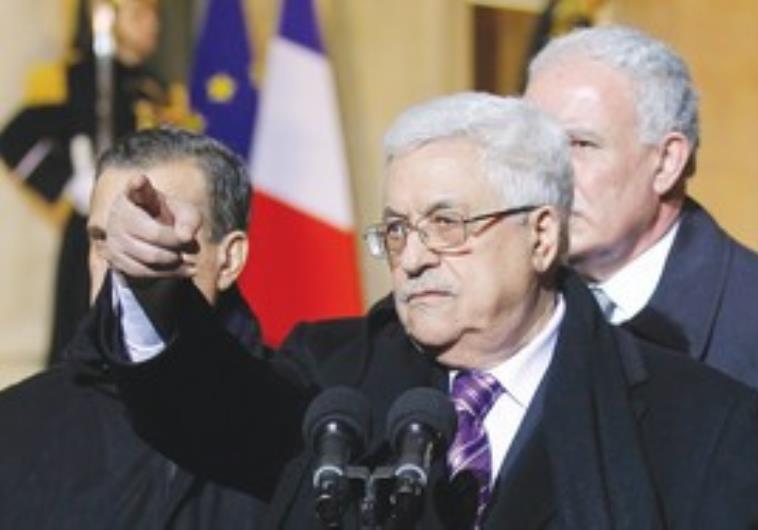
abbas reuters
Acting-President of the Palestinian Authority Mahmoud Abbas
(photo: Reuters)

PAST: Some of these points may be found in either an Arab or Israeli history book. Palestinian textbooks may write about forced expulsions from Palestine during the “Nakba”, while Israeli textbooks may write about Palestinian Arabs being encouraged to leave their homes by their leadership while the armies from five supportive Arab countries attacked Israel in an effort to destroy the country and drive the Jews into the Mediterranean Sea. The arguments are not subtle differences of opinions, and each side holds onto their account of history with examples of stories of a family here, a village there, or quotes from Israeli and Palestinian leadership at that time to underscore their version of history.

Arguably, this is something for historians to debate and a thoughtful person would probably conclude that there are elements of truth to both sides. Whether it is 80/20% or 20/80% for the parties is beyond the point of this discussion. The thrust is that their narratives are stories of the past. While Arabs and Israelis will invariably bring up their point of view in a debate, it need not dictate the debates nor compromise the conversations of the future of the region. A “starting point” of the here-and-now can be established to find a solution for the future.

A second example is the conflict between Egypt and Israel. Each side’s view of who was the belligerent party in 1967 did not impede a path forward to a different future leading to a peace treaty.

PAST AND PRESENT: Some splits in narratives run throughout time. The past can consume the present and the versions of history touch daily dialogue.

Many Arabs argue that a state of Palestine has always existed, but has been occupied by various parties including Israelis, Jordanians, Egyptians and British. They carry placards to “Free Palestine” from current Israeli occupation. For their part, Israelis note that Palestine never existed as an independent country. It was never ruled by a local Palestinian Arab government. The parties are in negotiations to potentially “Create Palestine,” while dismissing the Arab narrative as factually incorrect. The competing narratives are in conflict, but needn’t prevent the parties from moving towards a future that is in alignment.

PRESENT: A last example of a “neutral” clash of each side’s take on history is current history. Israelis and Palestinian Arabs argue forcefully about who started the Gaza war in 2014 and which party is responsible for many civilian deaths. Politicians and people will argue their points forcefully and recommend actions to punish the other side and improve their own position. Ultimately, the war and responses will become part of the past. The parties could opt to move forward with plans for a future OR they could use the war as an excuse to undermine a future peace.
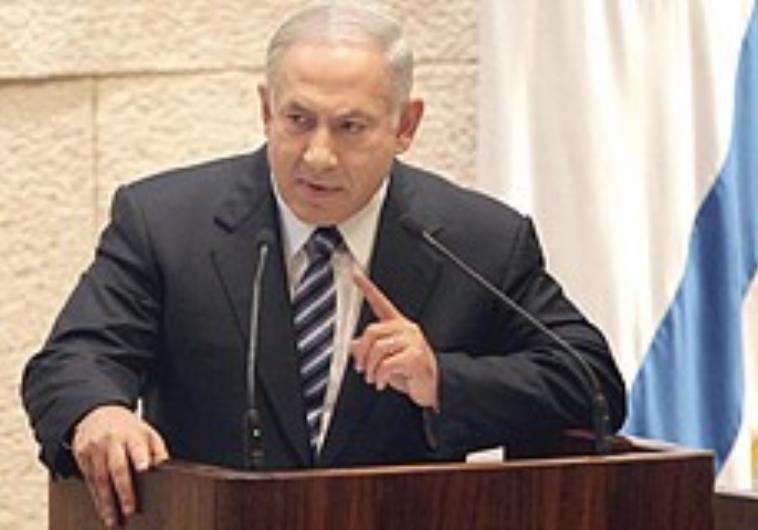
 Bibi -Ariel Jerozolimski)
Israeli Prime Minister Benjamin Netanyahu
(photo credit: Ariel Jerozolimski)

Arab-Israeli “Toxic” Narratives

The term “Toxic Narrative” is meant to describe the inability of the two sides to ever establish a true peace; it is not intended to suggest that a narrative is inherently evil.

PAST, PRESENT and FUTURE: The best example of competing viewpoints of the past that stretch into the future, is the Balfour Declaration (1917) and its incorporation into the San Remo conference (1920) and then the international law established by the League of Nations in the British Mandate of Palestine (1922). The two sides’ competing opinions impact the ability of the parties to establish peace for the future.

International Law: The Palestinian Arabs argue that the League of Nations had no right to declare a homeland for the Jews in Palestine. They contend such international decision was made without the approval of the local Arab population in Palestine, and as such, the law itself should be null and void. They further argue that the imposition of such mandate was an effort to colonialize Palestine. The Palestinian Arabs took many steps to halt the implementation of that mandate for “the establishment in Palestine of a national home for the Jewish people…and facilitate Jewish immigration…and close settlement by Jews on the land.” The most significant actions were the riots of 1936-9 which enabled the Arabs to get the British to issue the 1939 “White Paper” which would limit the Jewish population in Palestine to one-third of the country, leaving an Arab majority population and facilitate Arab rule.

The Israeli perspective is that the League of Nations (precursor to the United Nations) made a law specifically recognizing the Jewish right to a national homeland in Palestine. They do not believe that such international law was illegal in 1922, and when the United Nations voted in 1947 to only grant a small portion of the Mandated land as a Jewish State, the Jews were disappointed but voted in favor of the proposal anyway.  The Arabs rejected the 1947 proposal, just as they rejected the 1922 Mandate.

Historical Connection: As part of the League of Nations Mandate for Palestine, the international community recognized the “historical connection of the Jewish people with Palestine.” The history of the Jews in the land goes back 3700 years and the Jews were the only people to ever be self-governing in the land. They were also the only people to make Jerusalem its capital, which they did for the third time in 1950.

The history of the Jews has also been challenged by the Palestinian Arabs who continually deny Jewish history in the region and insist that Israelis are attempting to “Judaize” the country, and that Jewish presence in the region is a recent phenomenon. (They have even advanced that Jesus was a Palestinian, not a Jew, even though Arabs did not come to the holy land en masse until the Muslim invasions hundreds of years later).

In short, the two conflicting narratives relate to the RIGHTS of Jews to REestablish a Jewish majority in the land and be self-governing again.

The Palestinian contention is that the entire Zionist enterprise was illegal from the start: The call for Israel’s creation in 1922 was illegal; the declaration of the state in 1948 was illegal; and the assumption of additional land in 1967 was illegal. They view the entire region as “Arab land” and Jewish presence and rule is illegitimate and directly undermines the Arab rights in the land.

The Roadblock to Peace

The Future:  Some argue that despite such widely held opinion by Palestinian Arabs, acting-President of the Palestinian Authority Mahmoud Abbas has stated that he would recognize a state of Israel as part of a peace agreement. As such, the debate of narratives and facts is not truly “toxic” as the Arabs are willing to look past their past.

Israeli Prime Minister Benjamin Netanyahu maintains that is not so.

Netanyahu claims that a de facto recognition of Israel as a country that exists today will not prevent a war tomorrow.  A de facto peace treaty that does not recognize Israel’s RIGHT to exist is a flimsy veneer.  Over time the veneer will come off, and the underlying Palestinian Arab contention that Jews have no rights to live and rule on Arab land will lead to further war and bloodshed.  Without a break from the storyline that Jews have no history, no legal authority, nor basic rights to live and pray and be self-governing in Israel, there will never be peace.  No amount of land-for-peace swap could resolve an illegal Jewish claim until the entire state of Israel is under Arab rule.

The Palestinians have not been able to accept such a break with their narrative of the rights of Jews in Palestine.  They could not accept such vision of Jewish rights in 1922 and have been unable to accept it today, as Abbas has repeatedly stated he will never recognize Israel as a “Jewish State”.

As such, the seemingly innocuous request for Palestinians to recognize Israel as the Jewish State has potentially become a roadblock to final settlement talks. A statement that would have no practical impact (compared to tangible matters such as borders or “right of return”), has touched a key nerve in the Palestinian psyche.  They would rather forgo a brighter future than negate their narrative as the sole rightful owners of the land.


People typically speak of the Arab-Israeli conflict and refer to events at important time periods like 1948, 1967 and 2000.  While those events helped shape the present, they need not dictate the future.  Each side can maintain many narratives without destroying the prospects for peace.

The toxic narrative that prevents peace revolves around the rights of Jews to their historic homeland established in international law in 1922.  It is that narrative that must be addressed for the parties to arrive at a long-term peaceful future together.  It has been almost a century, and well past time for Arabs to recognize the legal and legitimate rights of Jews to live in the holy land and to be self-governing.


Related First One Through articles:

Names and Narrative: Palestinian Territories/ Israeli Territories

Names and Narrative: The West Bank / Judea and Samaria

 

Alternatives for Punishing Dead Terrorists

Some media pundits and politicians have questioned the logic of destroying homes of terrorists after those terrorists have been killed. The question as to whether it deters terrorists is impossible to answer as no one knows how many violent actions did not occur because of the home demolition policy that Israel enforced in 2014 against Arab murderers.

As Palestinian Arabs often talk about the importance of “dignity and pride”, perhaps there are some alternative punishments that Israel could administer to the dead murderers. As there is no dignity in intentionally murdering innocent civilians, these evil monsters’ memories should forever be cursed and their names erased. Perhaps attacking their memory broadly and publicly would dissuade others from taking such action.

Here are a few ideas from FirstOneThrough:

  • Place their image on scented pucks that sit at the bottom of urinals, making for excellent target practice (for men at least)
  • Make a small sticker with their name that could be put on the bottom of people’s shoes to trample (the bottoms of shoes are considered very degrading and insulting in Arab society)
  • Name the street where the murderer lives after the victims
  • The families of the murderers would forever forgo any type of compensation for homes lost/ abandoned in 1948
  • If a Palestinian official calls a murderer a “shahid” which means “martyr” in Arabic, all official Israeli publications should anoint such person the title of “Shatty” as in “we denounce the actions of Shatty Abdelrahman Shaludi”. Other variations like “Sharmoota baby” are acceptable (Sharmotta means whore).
  • Any photos used of the suicide killer should have a superimposed camel’s anus for his mouth
  • A bonfire should be made each year at the Dead Sea, the lowest place on earth, where people can write their curses on pieces of paper with the murderers likeness on it, and then toss the picture and curse into the fire

The expense for these items can be taken from a special surtax on the murderer’s families.  The amount of the charge will exactly equal the amount of money that terrorist sympathizers hand the families as “reward” for the disgraceful sick murder of innocents.

I’m sure the Facebook generation can come up with additional ideas.  Please share them. Here are some suggestions thus far:

  • Print the faces of the murderers on toilet paper
  • Do not return the bodies of the murderers to the families. Instead bury them near garbage dumps or at sea OR do not tell them what was done with the bodies at all
  • Every murder should be met with a huge fund-raiser for the Friends of the IDF
  • Every murder is met with a new construction project
  • All new buildings that are put up in Jerusalem or settlements will be named after victims.  Some suggest naming them after the attacker
  • Deport the murderer’s family to Gaza, Jordan or Syria
  • Revoke all working papers for the family
  • Demolish the homes- the family is complicit in the murder. Some suggest demolishing surrounding homes too
  • Celebrations on behalf of the murderer should be treated as incitement to terror and a jail-able offense for all participants
  • Every act of terror should be met with the distribution of guns to all Jews in the neighborhood where the crime took place
  • All Israeli ammunition should be coated in pigs blood to dissuade Arabs from seeking a path to Paradise
  • Take world funds destined to rebuild Gaza to support the victims’ families

camelarab


Sources:

Home demolition: http://www.hurriyetdailynews.com/israel-demolishes-jerusalem-home-of-palestinian-car-killer.aspx?pageID=517&nID=74523&NewsCatID=352

http://www.aljazeera.com/news/middleeast/2014/11/israeli-forces-destroy-home-palestinian-2014111955011479517.html

Arabic curse words: http://www.youswear.com/index.asp?language=Arabic#.VG1VF_8tCUk

Article 17 of the Palestinian Charter: “The liberation of Palestine, from a human point of view, will restore to the Palestinian individual his dignity, pride, and freedom. Accordingly the Palestinian Arab people look forward to the support of all those who believe in the dignity of man and his freedom in the world.” http://avalon.law.yale.edu/20th_century/plocov.asp

Salaries for suicide bombers: http://www.cbsnews.com/news/salaries-for-suicide-bombers/

FirstOneThrough article on Collective Guilt/ Collective Punishment: https://firstonethrough.wordpress.com/2014/10/13/collective-guilt-collective-punishment/