Around 2,800 members of the Hezbollah terrorist group were injured in an exploding pager incident on September 17, 2024. The tally was almost exclusively Hezbollah militants, as it would appear that the pagers had been purchased by the group some time prior and distributed to its team as a measure to avoid eavesdropping.
Scene from video of Hezbollah terrorist shopping in grocery falling to ground after pager explodes
The world has long known that the Islamic Republic of Iran is the major sponsor of Hezbollah, as well as other jihadi terrorist groups like Hamas and the Houthis in Yemen. To see that the involvement of Iran goes beyond sending money and protecting it at the United Nations, but is an integral part of the terrorist militancy is alarming.
But not surprising.
The world saw that many members of the United Nations agency for Palestinian wards, UNRWA, are members of Hamas. It makes one ask how many UNRWA employees would have been injured had similar pagers been distributed by Hamas?
The line between “legitimate” state actors and countries to murderous jihadi groups is blurred. The question is what to do with those “legitimate” agents of death.
The war between Israel and Iran’s proxies is taking place in the media as much as the battlefield. Just review how Israel and Hezbollah published reports of the battle on August 25, 2024.
Israel claims to have thwarted Hezbollah’s attack with preemptive strikes at missile launching sites in Southern Lebanon.
Jerusalem Post headline on August 25, 2024
The Jerusalem Post called Hezbollah’s attack a “failure” and that Israel foiled the attack.
Readers in Lebanon got a very different message from Al-Manar, the Hezbollah media outlet.
Al-Manar online, August 25, 2024
Hezbollah claimed that it’s “military operation has been completed successfully” and that Israel’s claims about a preemptive attack are false [Hezbollah doesn’t recognize Israel and calls it “Zionist”].
It added that Hezbollah’s “offensive drones… crossed the Lebanese-Palestinian border towards intended targets” was successful. [Note again that Hezbollah considers Israel to be occupied Palestine.]
Al-Manar website
The US-designated terrorist group listed various military targets in Israel, which were the focus of the operation.
Al-Manar website lists solely military targets in Israel, in the hope of minimizing Israeli attacks on civilian locations
People in the radical Islamic and anti-Zionist world were told of Hezbollah striking at the Zionist entity in revenge of the assassination of a jihadi leader, complete with a narrative that dismissed any legitimacy of the Jewish State. Zionists were told of the tremendous intelligence of its military, which foiled a potential deadly attack.
Both Hezbollah and Israel had experienced terrible failures of their defensive forces, and each is now fighting a war of propaganda as much as missiles to reclaim the trust of their respective populaces.
One manifestation is that despite the country’s enormous size, it has only two bordering countries. One of them, Canada, is so closely tied to the U.S. in terms of language, culture, trade and military reliance, people often joke that it can be viewed as the 51st state, with 90% of its population living within 100 miles of the U.S. border.
In sharp contrast, small Israel is surrounded by several entities, all of which have gone to war to destroy the country within the last decades. Two of them – Lebanon and Syria – are broken and broke states, with Syria still engaged in its own civil war.
The small sliver of a country has 1,068 kilometers of boundaries with adjacent countries and territories. The breakdown is as follows:
region
boundary (km)
percentage
Lebanon
81
7.6%
Syria
83
7.8%
Jordan
307
28.7%
Egypt
208
19.5%
West Bank
330
30.9%
Gaza
59
5.5%
Length of Israel’s boundaries
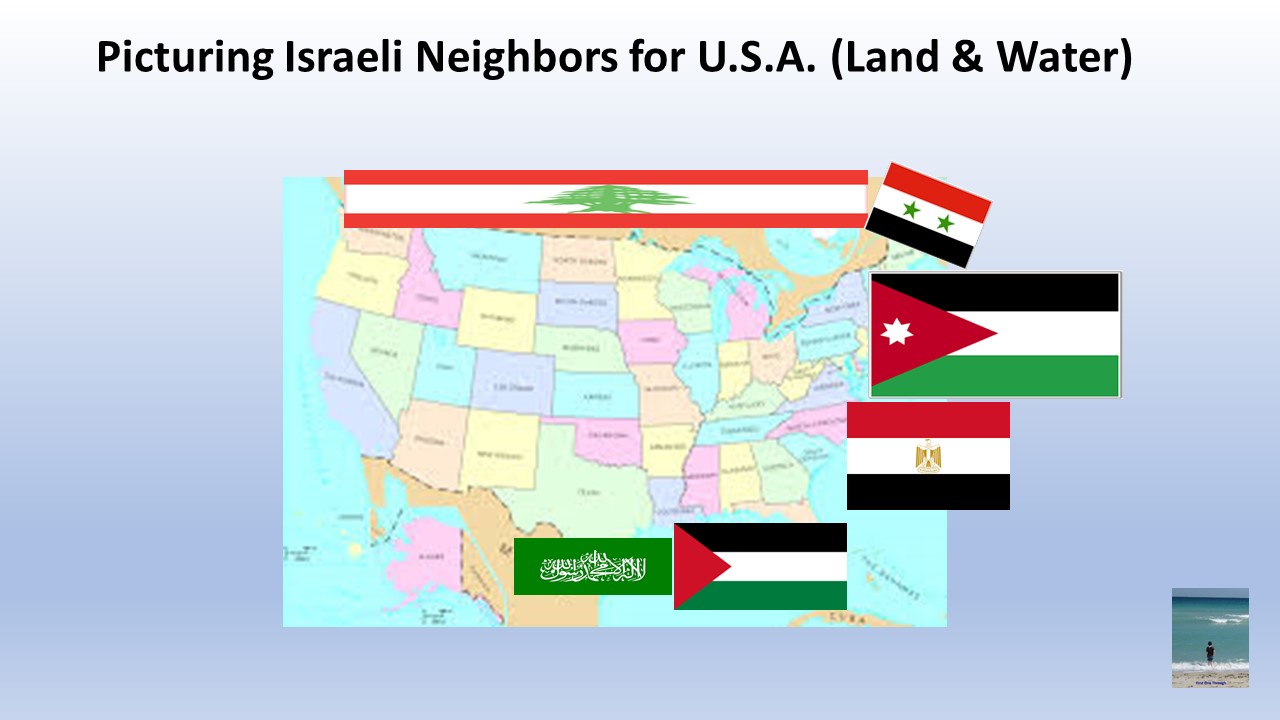
To apply these percentages with the United States’ lower 48 state’s 9,560km land border with Canada and Mexico, would yield the following map:
Imagine such a neighbor for the states of Washington and Idaho!
It doesn’t get better.
Syria has even a longer border with Israel – it would equivalently cover the Montana-Canadian border. Syria’s genocidal leader slaughtered over half a million of his own citizens, in a civil war that has seen millions of people flee the country and millions of others internally displaced. The destructive leader attempted to build a covert nuclear weapons facility with North Korea a few years ago. The country remains in an active state of war with Israel, as it has been since the modern Jewish State came into existence.
At least not that many people in Montana!
Much of the rest of America’s northern border would be with two countries with a cold peace, Jordan and Egypt. While not at war, little economic activity or tourism exists, and the two countries almost always vote against you at the United Nations. A far cry from friendly Canada.
At America’s southern border, there is strain of millions of migrants coming into the country from Central America. They are coming looking for a better life than they had in Mexico, Nicaragua and elsewhere. They are not looking to upend the United States and overthrow it.
Not so with Fatah in the West Bank and Hamas-ruled Gaza. Hamas is actively looking to destroy its neighbor from its vantage point south of California and half of Arizona. The Palestinian Authority pays its people who kill its neighbor’s citizens and claim the country as its own.
This ugly theoretical snapshot of America’s neighbors were based on keeping America’s huge water boundaries. If one were to use Israel’s actual percentage of coastline, the map would look like this:
Lebanon would cover almost all of America’s northern border. Syria would wrap Maine’s land and water boundaries. Jordan would abut the New England states down to Virginia, while Egypt would extend southward to Georgia. The Palestinian Authority would envelope all of Florida and the Gulf states and the terrorist enclave of Gaza would border much of Texas. The balance would be coastline.
Now further imagine that instead of a large, tall and wide country that is the USA, it was flattened into a pancake with those same neighbors.
If you think Texans like guns now, imagine if they had Hamas digging tunnels under their homes and firing rockets at their schools!
This is Israel’s reality every day. Terrorist-led broken countries and territories surrounding a small sliver of land, attempting to destroy the only Jewish state through a variety of means, including militarily, economically, legally and via public opinion.
The United Nations Secretary General, Antonio Guterres, visited Lebanon on December 20, 2021 to show support for the country as it continued fail on multiple fronts. Already floundering due to an economic crisis, Lebanon’s falling fortunes are being exacerbated by the pandemic since March 2020, the explosion in the port that damaged much of the capital in August 2020 and infighting between various factions that make up the country’s political landscape and demographic mix.
Guterres spoke to the Lebanese cabinet in a lengthy speech that painted the people of Lebanon as particularly warm and welcoming in the face of adversity. However, various comments made – and parties unmentioned – reveal a dangerous UN bias for the future of the country and region.
Guterres called out Israel both directly and indirectly, and never favorably.
Palestinian refugees. The UNSG recalled Lebanon’s welcome of Syrian refugees and then appended “not to mention the old Palestinian community of a million.” That’s a complete lie. Lebanon welcomed several thousand Palestinian Arabs in 1948-9, and that total grew to 568,000 in 2021, half of Guterres’s figure. Further, Lebanon places severe restrictions on the professions for the stateless Arabs from Palestine (SAPs), forcing two-thirds of the population into poverty.
Coexistence. Guterres continued that Lebanon was an “extraordinary example of religious tolerance of the capacity to create a diverse society that was harmonious, that was prosperous and that was, I would say, the centre of the region.” Lebanon was engaged in a religious civil war from 1976 to 1990, a point completely omitted and whitewashed in the speech. It has been nearly fifty years since the country had a semblance of religious tolerance. Such tolerance at the “centre of the region” is found in Israel today, not Lebanon.
But Guterres wanted to castigate Israel in his remarks, not elevate it as an example of coexistence.
Israel’s belligerence. While noting for a just a second that Lebanon bore some responsibility for its current state of affairs, Guterres called out outside actors that hurt Lebanon, in particular “the Israeli invasion several years ago.” That invasion in 1982 was in the midst of Lebanon’s Civil War in which the country acted as a terrorist save haven for the Palestinian Liberation Organization (PLO) that repeatedly attacked Israel, forcing a response from Israel.
The unmentioned evil actors. Not only did the PLO go unmentioned in the speech, so did Hezbollah, the terrorist group that controls southern Lebanon, as well as Iran, which backs that terrorist group.
Hezbollah was directly responsible for the Beirut port blast which exacerbated the current situation. It has threatened judges investigating the case, lest the terrorist group be cast in a negative light before elections scheduled for March 2022.
Hezbollah is estimated to have well over 120,000 missiles with a range that covers all of northern Israel. The missile launch sites are nestled among 230 Shiite villages in southern Lebanon. Those rockets were purchased with funds from Iran, including the $400 million in cash sent by President Obama to seal the Iranian nuclear deal. This terrorist army was armed and missiles deployed right under the nose of the United Nations, where UNIFIL (United Nations Interim Force in Lebanon) is charged with maintaining the peace with Israel and keeping Hezbollah from rearming as part of UN Security Council Resolution 1701 (2006).
Hezbollah is likely to become fully active over the next several months as the Lebanese economy collapses, elections happen or are canceled, and the terrorist group’s sponsors in Iran are forced to either accept de-nuclearlization or full economic sanctions. Hezbollah has already begun to test the situation, firing 19 missiles into the Jewish State in August 2021. The UN did nothing, other than voting to continue to fund UNIFIL while it berated Israel and refused to mention Hezbollah.
Which begs the question of what was being accomplished with the head of the United Nations visiting Lebanon at this time. Was it seeking an economic package from world governments? That was mentioned (as was promoting the involvement of women in government), but so was this troubling statement:
“I want to say that our mission is essentially a mission of solidarity. You can be sure that Lebanon is today in the centre of all our strategies and efforts, both at the level of the Secretariat and at the level of the different agencies that are cooperating with the Lebanese authorities, not to mention our two missions, and in particular now, UNIFIL that we want to be more and more actively cooperating with the Lebanese army as a fundamental factor of stability and security in the southern part of Lebanon.“
UNIFIL and the Lebanese army have no sway in southern Lebanon. Guterres’s refusal to call out the main troubling actor in the region that has been firing missiles at its neighbor to the south is outrageous, dangerous and ominous.
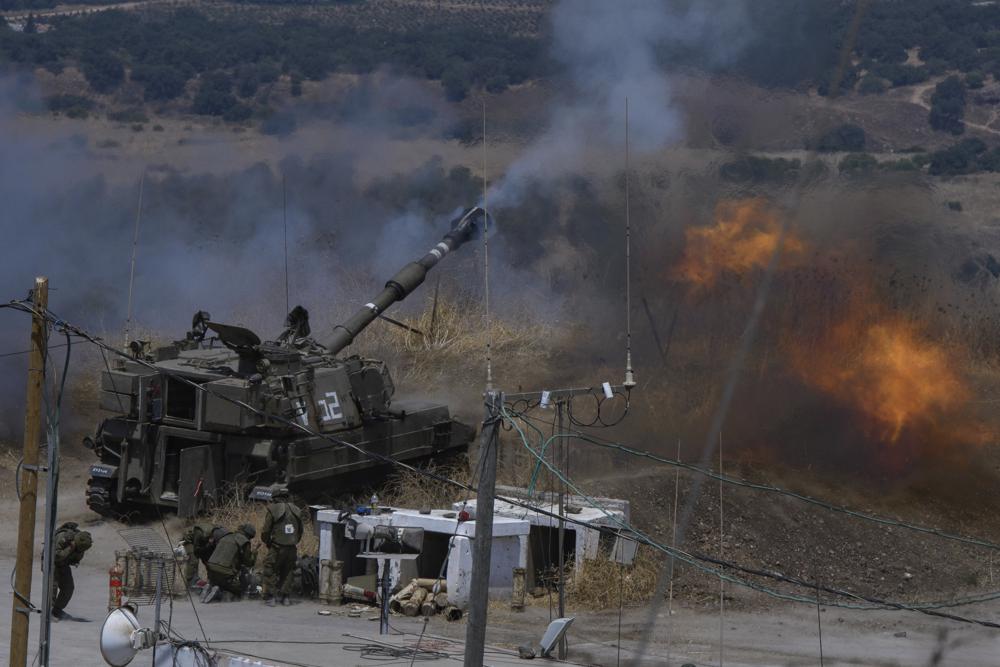
Israeli forces fire artillery from their position on the border with Lebanon after a barrage of rockets were fired from Lebanon, Friday, Aug. 6, 2021. The militant Hezbollah group said it fired rockets near Israeli positions close to the Lebanese border, calling it retaliation for Israeli airstrikes on southern Lebanon a day earlier. (Ayal Margolin/JINIPIX via AP)
The UN Secretary General came to stand in solidarity with Lebanon and ignored the dangerous and dominant role that the terrorist group Hezbollah has in the failing state. In the likely upcoming war with the Israel, it appears that Guterres just placed his chips with the puppet state controlled by Iran.