In Israel, the Winner is… Democracy

Summary: Israeli citizens came out to vote on March 17, 2015. The winner in the midst of the total chaos in the Middle East, was once again, democracy.


The turbulent Middle East got a chance to see a democracy at work.

With a civil war in Syria which has thus far claimed 220,000 lives; with the Islamic State/ISIS destroying Iraq; Yemen and Libya quickly becoming failed states; Jordan becoming a giant refugee camp; Egypt flip-flopping between elections/ military take-overs/ elections in quick succession; and Iran on the verge of building nuclear weapons, a country in the heart of the Middle east with a diverse population and set of opinions took to the polls.

Bibi victory
Likud’s Benjamin Netanyahu declaring victory

Great Voter Turnout. The 2015 Israeli election had an incredible voter turnout. The 71.8% turnout rate dwarfed the 54.9% in US 2012 presidential election and represented a sharp spike from the 67.7% 2013 Israeli turnout.

Majority in the Center. The political center captured the greatest number of votes. The center-right Likud party received 30 seats, center Kulanu had 10 seats, and center-left parties Yesh Atid with 11 and Labor got 24.  With a combined 75 seats in total (of the 120 seats in the Israeli parliament, the Knesset), Israelis predominantly voted for politically moderate parties over the more extreme right-wing and left-wing parties.

Minority representation. The Arab party, the Joint List, placed third in the election with 14 seats. The religious Jewish parties, Shas (7) and United Torah Judaism (6) had a similar total vote count.

Most Women in Parliament. The 20th Knesset will have 28 women, the greatest number ever.

Extreme parties. The far-right nationalist party Yisrael Beiteinu received 6 votes, and the far-left anti-national Arab Joint List received 14 seats. The right wing Israel Home received 8 seats and left-wing Meretz had 4 seats. The totals of 14 for the right-wing parties and 18 for the left-wing parties showed a bias for change in the fringes.

What’s Next for the Israeli Democracy.  If history proves a guide, Likud will be asked to form a coalition.  The Israeli election and transition to a new government should have many of the attributes of functioning democracies:

  • Citizens elected their representatives
    • Majority in the center
    • Minority representation
  • Smooth transition to new parliament
    • No military coup
    • No riots
  • New government will abide by past agreements

These are lessons and models for the chaotic Middle East.  Maybe one day the Palestinians will try it.


Related First One Through articles:

Abbas’s 10 year run at a 4 year presidential term: https://firstonethrough.wordpress.com/2014/09/30/the-disappointing-46-anniversary/

When Palestinians last went to the polls in 2006, they elected Hamas, an anti-Semitic jihadist party which went to war with the second place winner, Fatah. https://firstonethrough.wordpress.com/2014/09/04/its-the-democracy-stupid/

Israel, the Liberal Country in the Middle East

The New York Times Major anti-Netanyahu Propaganda Piece

Summary: The New York Times once again showed its bias against Jews living on the west bank of the Jordan River by painting opinion as international law. It posted a large non news-article during the week of Israeli elections in an attempt to discredit Israeli Prime Minister Netanyahu.

On March 12, 2015, the New York Times ran a cover page story called “As Israeli Settlements take Root, So do Complications” and on its online version it was titled “Netanyahu and the Settlements”. The article repeatedly referred to something called the “Geneva Initiative” as if the initiative carried any backing or legal authority. In actuality, the 2003 initiative is most akin to a present day Facebook Group.

20150313_130018
New York Times large cover story on the “Settlements”

The Times wrote “Two-thirds of new construction over the last two years, the Peace Now report shows, was on the Palestinian side of a line drawn by the Geneva Initiative, an international working group that produced a model agreement in 2003…
Efrat, with nearly 10,000 residents, is to Israelis the capital of the Etzion block. Palestinians, though, do not accept it as part of the block at all,
because it is on the eastern side of Route 60 — their side of the Geneva Initiative map. Annexing it would be far more complicated.”

By reading such statements, one would think that Israel is deliberately building homes on the “Palestinian side” of a road, contrary to existing laws and/or agreements. Palestinians are comfortable with Jews living on one side of Route 60, but not on the other.  That is specifically what the NYT intends the reader to conclude by writing such an article. It is completely untrue.

The Geneva Initiative was launched by a handful of people- both Israelis and Palestinians. The civilians met during 2003 and drafted a guideline of how a two state-solution could emerge. None of the people participating were elected or appointed by any governmental body. Their initiative was not endorsed by any government. Neither Israelis nor Palestinians consider this old private working paper at all.

“the 2003 Geneva Initiative is most akin
to a present day Facebook Group”

Meanwhile ACTUAL laws and agreements were deliberately omitted from the NYT article. They include the 1922 British Mandate of Palestine which was signed by the League of Nations, the precursor to the United Nations. The Mandate stated:

  • Article 6: The Administration of Palestine, while ensuring that the rights and position of other sections of the population are not prejudiced, shall facilitate Jewish immigration under suitable conditions and shall encourage, in co-operation with the Jewish agency referred to in Article 4, close settlement by Jews on the land, including State lands and waste lands not required for public purposes.
  • Article 15: The Mandatory shall see that complete freedom of conscience and the free exercise of all forms of worship, subject only to the maintenance of public order and morals, are ensured to all. No discrimination of any kind shall be made between the inhabitants of Palestine on the ground of race, religion or language. No person shall be excluded from Palestine on the sole ground of his religious belief.

As described above, international law enabled Jews to live everywhere in Palestine. Such freedom of movement and the ability to buy land was also the case under the Ottoman Turks. This is history and law – not the opinion of a handful of private citizens.

The west bank of the Jordan River was an integral part of the 1922 British Mandate of Palestine.  It was annexed by the Jordanians in 1950, after Jordan attacked Israel in the 1948-9 war (such Jordan annexation was with approval of the Palestinians but never considered by the United Nations). The Jordanians illegally evicted all of the Jews from the area, including the eastern part of Jerusalem, counter to the Fourth Geneva Convention.

After Jordan (and the Palestinians who were Jordanian citizens) attacked Israel again in 1967, Israel was obligated to launch a counter-attack per The Hague Regulations which state:

  • Article 40: Any serious violation of the armistice by one of the parties gives the other party the right of denouncing it, and even, in cases of urgency, of recommencing hostilities immediately.

Jordan was therefore legally attacked by Israel.  The Jordanians officially gave up all claim to the land in 1988.

None of these international laws, agreements or actions on the part of governments are mentioned in this large cover story by the New York Times. Instead, the Times chose to paint a picture that Israel is not abiding to laws to make it appear as the belligerent party. It does this with the aid of a private working paper from 12 years ago.

20150313_130046
Double page story by the NYT, continued from March 12 2015 cover 

There was nothing new in the story which begs the questions:

  • Why give the article such prominence by placing it on the cover with a large color picture, and continue with a full two-page spread in the inside pages complete with pictures, maps and drawings?
  • Why use an old private Initiative to make an argument about the location of settlements instead of history and law?
  • Why post the article now?

The New York Times posted the piece as they want to see Israeli Prime Minister Netanyahu defeated in upcoming Israeli elections.  The Israeli elections will take place later in the week, on March 17, 2015.  The New York Times, which has a long history of attacking the Israeli Prime Minister, put this non-news story on the front page the week before Israeli elections to make it appear that Israeli Prime Minister Benjamin Netanyahu was acting outside of the law.

The Times has once again shown it is not a credible source of news and chooses to air its biased opinions throughout the newspaper.  It has also shown that it seeks to influence the outcome of foreign elections with large distortions.  An interesting piece of hypocrisy, as the day before, on March 11, the NYT posted an op-ed from Thomas Freidman arguing about Sheldon Adelson’s attempts to influence elections in the United States with major contributions to Republican candidates, as well as claiming Adelson’s Israel Hayom newspaper is a biased mouthpiece for Netanyahu in Israel.

Is the Times posting the opinion of Barack Obama or George Soros?


First One Through articles:

Legal settlements: https://firstonethrough.wordpress.com/2014/12/11/the-legal-israeli-settlements/

NYT’s Nicholas Kristof’s “Arab Land”  https://firstonethrough.wordpress.com/2015/02/27/nicholas-kristofs-arab-land/

NYT ignores Jihadists in Israel: https://firstonethrough.wordpress.com/2015/01/26/radical-jihadists-in-europe-and-dislocated-and-alienated-palestinians-in-Israel/

NYT minimizing Netanyahu’s election success: https://firstonethrough.wordpress.com/2014/08/11/new-york-times-talking-turkey/

NYT only using “West Bank” instead of “Judea and Samaria” https://firstonethrough.wordpress.com/2014/12/08/names-and-narrative-the-green-line-west-bank-judea-and-samaria/

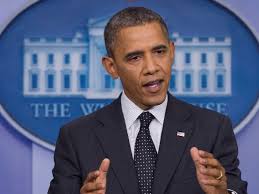
Netanyahu’s View of Obama: Trust and Consequences

Summary: Obama has asked Netanyahu to trust him on an issue (Iranian nuclear power) that is an existential threat to his country, even though Obama hasn’t earned that trust on more basic issues. Obama then compounds Netanyahu’s fear by stating Obama will act completely alone in controlling the outcome. Netanyahu’s nightmare is not just becoming “1938 Czechoslovakia”, but “2014 Ukraine”.
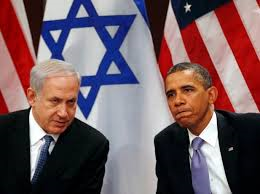
 obama netanyahu2
Netanyahu and Obama

TRUST

Trust is the bedrock of a functional relationship. It enables one party to rely on the other. A trust that includes both intention and capability permits a sharing of responsibility and workload.

The relationship between US President Obama and Israeli Prime Minister Netanyahu started off badly and further deteriorated over the years. Personalities aside, the lack of a shared vision about the path to peace and security in the violent Middle East damaged relations.  However, it was a series of bad decisions which destroyed the trust between the two leaders.

Negotiation with Palestinians. Obama’s actions early in his presidency, hurt his credibility with Netanyahu. Obama insisted on an Israeli settlement freeze as a pre-condition to negotiations with the Palestinians- a pre-condition that was never introduced before, even by the Palestinians. Despite Netanyahu’s serious reservations, he instituted a ten-month freeze on building new homes in the west bank of the Jordan River. In exchange, Obama could not get acting-Palestinian President Abbas to even show up to talk for the first nine months, and when he did, all Abbas offered was extending the freeze even longer.

When US Secretary of State John Kerry tried another round of negotiations with Abbas in the fall of 2013, the US again asked Israel to give up something to start talks while it made no demand of the Palestinians. Israel released dozens of terrorists that were convicted of murder from its prisons. In exchange, Kerry could not even get Abbas to recognize Israel as a Jewish State, let alone any compromises for a Palestinian state. The negotiations failed again.

In both situations the US pressured Israel to give up something just to initiate negotiations and asked nothing of the Palestinians. In the end, the Palestinians continued to give exactly the same: nothing.

Giving it away upfront. The Obama administration has used the tactic of giving away bargaining points upfront in the hope of gaining something in the negotiations down the road. In Cuba, Obama has pulled back sanctions, in the hope that the country reforms. In Iran, the US eased sanctions to get Iran to consider allowing monitors to watch it build nuclear power.

Netanyahu does not believe in such negotiating tactics and it has not worked out well for Israel.

Giving up on Allies. The disagreement on negotiating style is only part of Netanyahu’s issue.  Israel and the Middle East watched the Obama administration turn its back on its allies. Egyptian President Mubarak was once a close ally of the United States. One day, the Obama administration decided it would no longer stand by its ally and called for Mubarak’s ouster. He was rushed off to jail.

The US’s Middle Eastern allies were dumb-founded by Obama’s action. A senior Arab government official stated “[The Saudis] are at odds with the U.S. position, publicly pushing Mubarak out. And frankly so are we—this isn’t how you handle issues in region.”

Failure to Understand Regional Dynamics. Obama’s turn on Egypt’s Mubarak was followed by an embrace of the democratically-elected Muslim Brotherhood. Obama’s infatuation with the “Turkish model” of democratic Islam made him welcome the new Egyptian ruler Mohammed Morsi. Morsi reopened Egypt’s ties with Hamas (the Muslim Brotherhood in Gaza) , much to the chagrin of Israel’s Netanyahu. Those actions also undermined the more moderate (on a relative basis) acting PA President Abbas.

Obama back-tracked from his support of democracy in Egypt by not objecting to the replacement of Morsi via a takeover by Abdul Fattah el-Sisi. El-Sisi clamped down on Hamas and the Muslim Brotherhood which won praise in Israel. From Israel’s perspective, a mistake was rectified to some degree, but the damage done by Obama of not standing by an ally and not appreciating the regional dynamics was etched in memory.

Obama not standing by Treaties or Comments. In addition to not standing by allied leaders, Obama has not stood by his own word or by US treaties with governments. For example, Obama’s declared “red line” on Syria’s use of chemical weapons came and went without ramifications for Syrian President Assad. While Obama claimed credit for negotiating a solution to get rid of Syria’s known chemical weapons, there was no personal penalty for Assad. Assad continues to remain in power and murder his countrymen.

Saudi Arabia was incredulous and stated“We’ve seen several red lines put forward by the president, which went along and became pinkish as time grew, and eventually ended up completely white…When that kind of assurance comes from a leader of a country like the United States, we expect him to stand by it.”
obama syrian red line
Obama asserting a “red line” on Syrian chemical weapons

The Ukrainian situation is even more telling. In 1994, Ukraine signed onto the Budapest Memorandum which was to guarantee its territorial integrity in exchange for giving up its nuclear weapons. While it adhered to its upfront part of the bargain by giving up its weapons, the Obama administration refused to enforce its end of the agreement by coming to the aid of Ukraine when Russia invaded and annexed Crimea in 2014. Russian leader Putin correctly assessed the temperament of Obama that he would fail to honor his obligation, just as he failed to take action in Syria. Putin has continued to move past Crimea to other parts of Ukraine while the US not only fails to come to the defense of Ukraine, but drags its feet in sending weapons to defend itself.

The situation is not lost on Netanyahu (while it is on the knee-jerk liberal New York Times which stated in its lead editorial on March 12, 2015 that “Republicans are perfectly willing to diminish America’s standing as a global power capable of crafting international commitments and adhering to them.”  As detailed above, Obama has made very clear that HE has diminished America’s commitments, not the Republicans).

Obfuscation. The last loose thread in the unraveling fabric of trust is the lack of transparency.

While Obama touted his goal of transparency when he ran for office, his administration has been one of the least transparent. Witness Obamacare, where House Speaker Nancy Pelosi famously said “We have to pass the bill to that you can find out what is in it.” Secretary of State Hillary Clinton ran her own email server outside of the State Department and deleted emails at her own whim. Now, Obama refuses to provide details of the Iranian negotiations with Israel.

The trust between Obama and Netanyahu is broken.

ACTING ALONE

Compounding the Israeli frustration with the lack of trust in the Obama administration’s dealing with Iran, is the unilateral course that Obama has taken. Obama has effectively barred Israel from attacking Iran and is attempting to seal negotiations without legislative approval.

Blocking an Israeli attack. As soon as Obama began to negotiate with Iran, it became impossible for Israel to attack Iran. How could Israel attack the facilities while the US was pursuing a diplomatic initiative? The start of Obama’s talks signaled the end of Israel’s ability to destroy their nuclear program.

Skipping Congress. Obama repeatedly stated that he does not believe that he needs congressional approval to sign a deal with Iran. As such, he has asserted that he has complete authority to negotiate and finalize a deal.  The Republicans, which now have majority control of both the House and Senate, strongly disagree and have taken steps to make their position known to both the Obama administration and Iran itself.

COMPETENCIES and CONSEQUENCES

Israel’s Netanyahu is left in a precarious situation.  As his country is under threat of annihilation by Iran, its close ally has put itself in the lead seat in negotiations.  However, Netanyahu is looking at the current US president as:

  • Lacking an understanding of regional dynamics;
  • Incapable of negotiating;
  • Refusing to be transparent about the negotiations;
  • Unwilling to stand by statements and treaties in support of allies;
  • Determined to act alone without the legislative branch of government

The Trust in Competencies and Fear of Consequences leaves Israel in a vulnerable and lonely spot.  While Israel fears it will be sacrificed at the alter of larger players like Czechoslovakia in 1938, it sees how the lead negotiator will not enforce any security agreements that may be struck, as in the embattled Ukraine today.


Related First.One.Through articles:

Arab states agree with Netanyahu in speech to Congress: https://firstonethrough.wordpress.com/2015/03/08/missing-netanyahus-speech-those-not-listening-and-those-not-speaking/

Conservative focus on safety: https://firstonethrough.wordpress.com/2015/03/01/the-gap-between-fairness-and-ramifications-wmds-in-iraq-and-iran/

Obama’s Iranian red line: https://firstonethrough.wordpress.com/2014/11/24/obamas-iranian-red-line/

The need for a global public reaction to Iran’s nuclear aspiration: https://firstonethrough.wordpress.com/2015/03/03/hidden-reactor-silent-reaction/

Missing Netanyahu’s Speech: Those not Listening and Those Not Speaking

Summary: The media highlighted the Democrats that snubbed the Israeli Prime Minister’s address to Congress. They failed to mention the coalition of countries that Bibi represented. Will the world’s safety rest with those that party-with-their-party or those that bomb-the-bomb?

US President Obama made a deliberate attempt to marginalize Israeli Prime Minister Benjamin Netanyahu and his address to Congress in March 2015. Obama aired a number of complaints about the nature of the invitation and later said that Netanyahu didn’t offer any new ideas in dealing with Iran. His efforts to turn public attention away from the incredibly important topic to a sideshow of partisanship was sad on many levels.

Obama no
Obama and Biden skipped Netanyahu’s Address to Congress,
March 2015

There were many people who were not at Congress on March 3rd: Democrats that didn’t listen, and Arab States that echoed Netanyahu’s message.

Those not Listening: Democrats Partying with their Party

The Obama administration managed to convince 58 members of Congress to skip Netanyahu’s speech. All were his fellow Democrats. They were:

SENATE – 8 members

  • Sen. Al Franken (Minn.)
  • Sen. Martin Heinrich (N.M.)
  • Sen. Tim Kaine (Va.)
  • Sen. Patrick Leahy (Vt.)
  • Sen. Bernie Sanders (I-Vt.)
  • Sen. Brian Schatz (Hawaii)
  • Sen. Elizabeth Warren (Mass.)
  • Sen. Sheldon Whitehouse (R.I.)

HOUSE – 50 members

  • Rep. Karen Bass (Calif.)
  • Rep. Earl Blumenauer (Ore.)
  • Rep. Corrine Brown (Fla.)
  • Rep. G.K. Butterfield (N.C.)
  • Rep. Lois Capps (Calif.)
  • Rep. Andre Carson (Ind.)
  • Rep. Joaquin Castro (Texas)
  • Rep. Katherine Clark (Mass.)
  • Rep. William Lacy Clay (Mo.)
  • Rep. James Clyburn (S.C.)
  • Rep. Emanuel Cleaver (Mo.)
  • Rep. Steve Cohen (Tenn.)
  • Rep. Bonnie Watson Coleman (N.J.)
  • Rep. John Conyers (Mich.)
  • Rep. Elijah Cummings (Md.)
  • Rep. Danny Davis (Ill.)
  • Rep. Peter DeFazio (Ore.)
  • Rep. Diana DeGette (Colo.)
  • Rep. Lloyd Doggett (Texas)
  • Rep. Rosa DeLauro (Conn.)
  • Rep. Donna Edwards (Md.)
  • Rep. Chaka Fattah (Pa.)
  • Rep. Keith Ellison (Minn.)
  • Rep. Marcia Fudge (Ohio)
  • Rep. Raúl Grijalva (Ariz.)
  • Rep. Luis Gutiérrez (Ill.)
  • Del. Eleanor Holmes Norton (D.C.)
  • Rep. Eddie Bernice Johnson (Texas)
  • Rep. Marcy Kaptur (Ohio)
  • Rep. Rick Larsen (Wash.)
  • Rep. Barbara Lee (Calif.)
  • Rep. John Lewis (Ga.)
  • Rep. Dave Loebsack (Iowa)
  • Rep. Zoe Lofgren (Calif.)
  • Rep. Betty McCollum (Minn.)
  • Rep. Jim McDermott (Wash.)
  • Rep. Jim McGovern (Mass.)
  • Rep. Jerry McNerney (Calif.)
  • Rep. Gregory Meeks (N.Y.)
  • Rep. Gwen Moore (Wis.)
  • Rep. Beto O’Rourke (Texas)
  • Rep. Donald Payne (N.J.)
  • Rep. Chellie Pingree (Maine)
  • Rep. David Price (N.C.)
  • Rep. Cedric Richmond (La.)
  • Rep. Jan Schakowsky (Ill.)
  • Rep. Adam Smith (Wash.)
  • Rep. Bennie Thompson (Miss.)
  • Rep. Mike Thompson (Calif.)
  • Rep. John Yarmuth (Ky.)

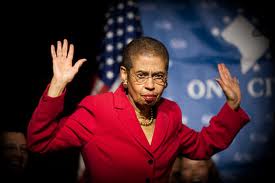
 Holmes
Eleanor Holmes Norton (D, DC)

It is wrong to say that these Democratic Congressmen are anti-Semites for skipping Netanyahu’s speech. They are just small-minded, petty, partisan politicians.

Those who were seen not Speaking: Arab States agree with Netanyahu

While Israel is in the crosshairs of the Iranian regime which has singled out the country for annihilation, several Arab countries are also very against Iran obtaining nuclear weapons.  They supported Netanyahu’s position and address.

el sisi
Egyptian President Fatah El-Sisi calling to reform Islam,
January 2015

The difference between the absent deaf audience (Democrats) and the silent approving chorus (Arab states) is a contrast between politics and policy. The difference between Obama and Netanyahu regarding Iran is between hope and action.

Those Talking and Hoping: Obama and Kerry

Obama has essentially articulated that US intelligence is flawed, so the best solution for managing the Iranian nuclear program would be to rely on the Iranians’ openness. His negotiation tack will conclude with faith that the Iranians:

  • will disclose the entirety of their nuclear program;
  • will provide full access to all of the facilities; and
  • will not covertly move towards nuclear weapons.

It can best be called a policy of “hope”.

Kerry Iran
US Secretary of State John Kerry negotiating with Iran,
March 2015

Those Acting: Israel Bombing the Bomb

If Israel is convinced that the Iranians are good on their word, than they have reason to be concerned as Iran has threatened to destroy Israel.

Israel has long taken the approach that hope is not a policy.  It sits in too volatile a region to believe in the good faith of its neighbors that have declared war on the country. Peace is something that is fought for and defended.

Decisive action has led to extended windows of peace for Israel. In 1981, Israel destroyed the Iraqi nuclear reactor that was due to go live.  In 2007, Israel bombed the Syrian nuclear reactor that was being constructed with the help of North Korea. In 1967, Israel acted preemptively to thwart the attacks of Egypt and Syria which enabled a very quick victory.  When Israel decided to remain passive, such as the Yom Kippur War of 1973, the country was almost overrun.

Netanyahu has pleaded for very tough sanctions against Iran. It has used malware and cyber-attacks against Iran. Israel has reportedly assassinated Iranian nuclear scientists (to the chagrin of the United States). It has advocated for putting all options on the table, including military force as it used against the facilities in Syria and Iraq.


The way forward with Iran has two very different paths:

  • Obama has advocated a policy of hope and has enlisted a quorum of party loyalists who will not listen to alternatives.
  • Israel has deployed policies of actions and has an eclectic group of Arab neighbors that support its position.

Will the future safety of the world belong to those that party-with-their-party or those willing to bomb-the-bomb?


Related First.One.Through articles:

Fairness versus Safety: https://firstonethrough.wordpress.com/2015/03/01/the-gap-between-fairness-and-ramifications-wmds-in-iraq-and-iran/

Obama’s Iranian Red Line: https://firstonethrough.wordpress.com/2014/11/24/obamas-iranian-red-line/

Hidden Reactor, Silent Reaction

Summary: As the world negotiates with Iran about their nuclear program, it is worth remembering lessons from Syria’s nuclear plant in 2007.

In September 2007, something significant happened in the Middle East. While the details were very murky as the news reports were cryptic, it was clear that a major event came-and-went. Over the following months and years, more information emerged about Syria’s nascent nuclear program and Israel’s attack that destroyed it.

syria reactor
Syrian nuclear reactor, 2007

Failure to Detect

Syria began to investigate the feasibility of a nuclear program in the 1990s and by the mid-2000s it was building a nuclear facility with the help of North Korea. The facility was being constructed roughly 100 miles from the Iraqi border. During its construction, hundreds of thousands of American troops were busy a few miles from the construction site during the Iraq War.  Many reconnaissance missions repeatedly flew over the Syrian site, but US intelligence failed to detect that Syria had embarked on plans to build a weapon of mass destruction. For years.

The New York Times stated that “the Americans were somewhat blindsided…. By their own account, they…only identified the plant at Al Kibar, named for the nearest town, after they received photos of the interior of the plant last spring from Israel… But even this victory [of destroying the plant], some experts note, raises questions about the [CIA]’s focus. The reactor was built within 100 miles of the Iraqi border yet never identified even though the administration was searching for any form of such arms programs in Iraq…. Graham Allison, a Harvard professor and author of “Nuclear Terrorism,” who was in Washington on Thursday to testify about Iran’s nuclear program [said] ‘if you can build a reactor in Syria without being detected for eight years, how hard can it be to sell a little plutonium to Osama bin Laden?’”

al kabir map
Location of Syria’s nuclear plant

The Power of Pride

The incident of the secret nuclear facility remained quiet considering the enormity of both its construction and destruction. Not surprisingly, the Syrians wanted to keep the plant hidden as they saw what Israel did to Iraq’s nuclear reactor in 1981. Israel’s silence on its actions against Syria was a calculated move on the part of Israeli Prime Minister Ehud Olmert.

Israel refused to broadcast its strike out of fear that doing so would provoke Syrian President Assad to respond with an attack on Israel. By maintaining silence, Olmert hoped he could allow Assad an escape from reacting to his bruised pride from the crushing setback of Israel’s destroying his plan to become the first Arab nuclear power.

Indeed, the news reports that emerged from Syria about the event were inconsistent. Some reports stated that Israeli planes entered Syrian airspace and were forced to flee due to Syrian fire. Later, the Syrian government said that Israeli planes did enter its airspace, but the warplanes only hit an empty military building.  As such, there was no need for an immediate large-scale confrontation with Israel.  War averted.

Lessons for the Iranian Nuclear Program

DETECTION: The United States administration is actively negotiating with Iran about the extent to which Iran could build nuclear power. Early reports on the negotiations indicate that the terms would necessitate an examination of the Iranian facilities to make sure that they would not migrate an energy program towards nuclear weapons. However, as the Syrian reactor incident makes clear, inspections are flawed. The US’s track record about bad intelligence of Iraq developing a nuclear weapon must also be considered.

Further, consider that the Iranian facilities (that are known) are spread all over the country.  This agreement may enable Iran to operate those current facilities freely.  If the US failed to identify the building of large facilities over many years, can the world really be sure it can make a thorough accounting of the thousands of centrifuges and the fissile materials warehoused inside many buildings spread around the country? The Obama Administration essentially has conceded that it cannot, so it will rely on Iran to show them what they have: “Without an agreement we don’t have any of this insight into Iran’s nuclear program.

In other words, the current working agreement is to let the fox guard the chicken coop.

iran nukes
Iranian nuclear research facility

PRIDE: The second lesson from Operation Orchid, as the Israeli bombing mission was known, was the significance of Arab pride. Israel understood that Syrian pride would have demanded a large response to the Israeli attack. By its keeping its role and the target silent, Israel avoided a large scale war.

The secrecy surrounding Israel’s own nuclear program is for the same purpose.  If Israel’s Arab neighbors would publicly acknowledge the existence of their enemy having nuclear weapons, they would demand WMDs as well. By maintaining an undeclared nuclear program, the arms race in the Middle East never occurred.

That will now change.

Iran’s development of nuclear power, and the world’s tacit approval of it will force other players in the region such as Saudi Arabia to seek nuclear weapons.  The very public nature of these discussions do not permit the Saudi Kingdom to swallow their pride.  People will assume that a quiet side deal was made to allow Iran to get nuclear weapons, or Iran will obtain them against the terms of the agreement.  Regardless, approving a nuclear program for Iran will commence an arms race in the most volatile region in the world.


  • Iraq’s sole nuclear plant was known and Israel’s attack was public.
  • Syria’s nuclear facility was hidden and Israel’s attack was kept silent.
  • Iran’s program is large and public and will demand a large and public response to halt the program from the global community.

Related First.One.Through articles:

The gap between fairness and safety: https://firstonethrough.wordpress.com/2015/03/01/the-gap-between-fairness-and-ramifications-wmds-in-iraq-and-iran/

Obama’s Iranian red line: https://firstonethrough.wordpress.com/2014/11/24/obamas-iranian-red-line/

Murderous governments of the Middle East: https://firstonethrough.wordpress.com/2014/08/01/murderous-governments-of-the-middle-east/

Obama dancing with the Asteroids: https://firstonethrough.wordpress.com/2014/11/14/dancing-with-the-asteroids/

Jews in the Midst

Summary: Jews are vulnerable members of society. They are not on the fringe on the one hand, nor are they just a regular part of the broader community, on the other. As such, they must be actively protected by governments and citizens alike.

copenhagen jews
Jews in Copenhagen laying flowers where a Jewish man was gunned down,
February 2015 

No Canary in the Mine

Well-meaning people have referred to Jews as the “canary in the mine” when it comes to terrorism. They argue that various attacks on Jews in Europe, Israel and Asia by Islamic radicals over the past years should be seen in the context of an oncoming onslaught on the broader civilized world.

Canaries are treated as disposal life forms that coal miners bring into mines to detect poisonous gases. They assume that if the canary is alive, the air is breathable; however, should the canary die, they should evacuate immediately. The sole role of the canary is to detect danger and benefit the people in the mine.

Jews were not brought to Europe or Asia to serve as warning signs for non-Jews. They are not inferior life forms meant to live solely for the benefit of the broader society. They are proud citizens of their home countries.

 hyperkosher
Paris kosher supermarket where four Jews were killed,
January 2015

Not a Fringe Group

Jews are integrated into society in each country where the live. They have homes in the hearts of the country; they have jobs at corporations, in the government and military. They speak the language and have employment rates that are comparable to their fellow countrymen.

Jews are not a fringe group that fails to assimilate, that doesn’t speak the language or has high unemployment. They are not financial drains on society and do not have incarceration rates above the community averages.

Jews are a fabric of society. They are “everymen,” with particular beliefs and customs.

mumbai chabad
Chabad House in Mumbai where six people were murdered,
November 2008 

No “Random” Attack

While Jews are a basic part of the fabric of society, they are uniquely targeted by Islamic radicals. Terrorist attackers who assaulted major cities including Mumbai (2008), Paris (2015) and Copenhagen (2015), took time to specifically attack this small minority.

While US President Obama and his administration initially called the attack on a kosher supermarket in Paris a “random” attack, he back-tracked to corroborate the statement of the French government which clearly stated that the attack stemmed from antisemitism.

Even while embedded in society, Jews are picked out for attack for the simple reason that they are Jewish.

 bruseels museum
Attack on Jewish Museum in Brussels killed four,
May 2014

Jews in the Midst

There was a movie made in 1988 about a woman, Dian Fossey, who fought to protect gorillas in Uganda. These special creatures were a unique part of the Ugandan landscape that were singled out for slaughter. Dian fought both the government and locals to protect those “Gorillas in the Mist”.  It was a brave action on the part of an individual to take on so many to save the group from butchery.

It is the obligation of governments to protect their citizens.  The leaders in Germany and France have correctly stated that they will take action to ensure that their Jewish communities are safe.

It is time for all governments and citizens to speak loudly and act defiantly in protecting their vulnerable neighbors and countrymen, the Jews in their midst.

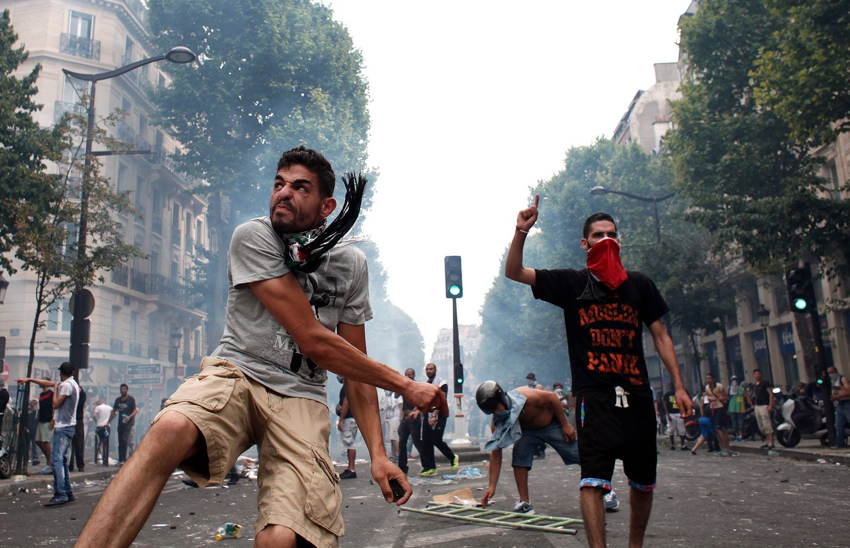
 scariest-riots-anti-semitism-men
Riots against Israel and Jews in France,
July 2014

Israel in Europe

The governments of Europe must do more than just assign police officers to synagogues and Jewish centers. They must also declare that Jews everywhere – including in Israel – cannot be targets of jihad.  As part of that effort, they should confront the biases in their governments that are uniquely against the Jewish State, such as:

  • delisting Hamas as a terrorist organization despite its calls to kill Jews and eradicate Israel
  • European Union blaming Israel for the failure of the peace talks without acknowledging the various actions the Palestinians took to sabotage the talks

The list of European actions against the Jewish State over the past year was long, and to an absurd level when compared to EU actions and comments towards murderous regimes such as Iran and Syria. The people in the streets noted, and held anti-Israel rallies which became anti-Semitic riots.

It was against that backdrop of both murders by homegrown terrorists and the anti-Israel actions of the governments that made Israeli Prime Minister Benjamin Netanyahu invite the Jews of Europe to come to Israel.

The governments of Europe must declare their strong commitment to a safe and secure Israel.  Such actions should include declaring Hamas a terrorist organization and not recognizing a Palestinian state until it prohibits the promotion of antisemitism and Holocaust denial.  The governments should not pass any BDS (boycott, divestment, sanction) actions against Israel any more than they do for other disputed territories such as Kashmir and Cyprus.

The leaders of several European countries acknowledge that there is a problem of anti-Semitism spreading in the continent.  They must be aggressive in confronting it in every manner possible.

Jews in the Midst

Summary: Jews are vulnerable members of society. They are not on the fringe on the one hand, nor are they just a regular part of the broader community, on the other. As such, they must be actively protected by governments and citizens alike.


No Canary in the Mine

Well-meaning people have referred to Jews as the “canary in the mine” when it comes to terrorism. They argue that various attacks on Jews in Europe, Israel and Asia by Islamic radicals over the past years should be seen in the context of an oncoming onslaught on the broader civilized world.

Canaries are treated as disposal life forms that coal miners bring into mines to detect poisonous gases. They assume that if the canary is alive, the air is breathable; however, should the canary die, they should evacuate immediately. The sole role of the canary is to detect danger and benefit the people in the mine.

Jews were not brought to Europe or Asia to serve as warning signs for non-Jews. They are not inferior life forms meant to live solely for the benefit of the broader society. They are proud citizens of their home countries.


Not a Fringe Group

Jews are integrated into society in each country where the live. They have homes in the hearts of the country; they have jobs at corporations, in the government and military. They speak the language and have employment rates that are comparable to their fellow countrymen.

Jews are not a fringe group that fails to assimilate, that doesn’t speak the language or has high unemployment. They are not financial drains on society and do not have incarceration rates above the community averages.

Jews are a fabric of society. They are “everymen,” with particular beliefs and customs.


No “Random” Attack

While Jews are a basic part of the fabric of society, they are uniquely targeted by Islamic radicals. Terrorist attackers who assaulted major cities including Mumbai (2008), Paris (2015) and Copenhagen (2015), took time to specifically attack this small minority.

While US President Obama and his administration initially called the attack on a kosher supermarket in Paris a “random” attack, he back-tracked to corroborate the statement of the French government which clearly stated that the attack stemmed from antisemitism.

Even while embedded in society, Jews are picked out for attack for the simple reason that they are Jewish.


Jews in the Midst

There was a movie made in 1988 about a woman, Dian Fossey, who fought to protect gorillas in Uganda. These special creatures were a unique part of the Ugandan landscape that were singled out for slaughter. Dian fought both the government and locals to protect those “Gorillas in the Mist”.  It was a brave action on the part of an individual to take on so many to save the group from butchery.

It is the obligation of governments to protect their citizens.  The leaders in Germany and France have correctly stated that they will take action to ensure that their Jewish communities are safe.

It is time for all governments and citizens to speak loudly and act defiantly in protecting their vulnerable neighbors and countrymen, the Jews in their midst.


Israel in Europe

The governments of Europe must do more than just assign police officers to synagogues and Jewish centers. They must also declare that Jews everywhere – including in Israel – cannot be targets of jihad.  As part of that effort, they should confront the biases in their governments that are uniquely against the Jewish State, such as:

  • delisting Hamas as a terrorist organization despite its calls to kill Jews and eradicate Israel
  • European Union blaming Israel for the failure of the peace talks without acknowledging the various actions the Palestinians took to sabotage the talks

The list of European actions against the Jewish State over the past year was long, and to an absurd level when compared to EU actions and comments towards murderous regimes such as Iran and Syria. The people in the streets noted, and held anti-Israel rallies which became anti-Semitic riots.

It was against that backdrop of both murders by homegrown terrorists and the anti-Israel actions of the governments that made Israeli Prime Minister Benjamin Netanyahu invite the Jews of Europe to come to Israel.

The governments of Europe must declare their strong commitment to a safe and secure Israel.  Such actions should include declaring Hamas a terrorist organization and not recognizing a Palestinian state until it prohibits the promotion of antisemitism and Holocaust denial.  The governments should not pass any BDS (boycott, divestment, sanction) actions against Israel any more than they do for other disputed territories such as Kashmir and Cyprus.

The leaders of several European countries acknowledge that there is a problem of anti-Semitism spreading in the continent.  They must be aggressive in confronting it in every manner possible.

The Churlish Turkish Leadership

Under the leadership of Recep Tayyip Erdoğan, Turkey has continued to slide further and further into the extreme right towards militant Islam. It has (coincidentally?) also pushed the country closer to US President Obama and further from Israeli Prime Minister Netanyahu.

erdogan hitler

Turkish leader Erdogan on magazine cover

In terms, of the continued suppression of freedom and liberty in Turkey:

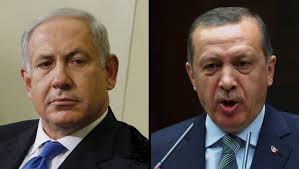
The Turkish leader has also led his country into repeated confrontations with Israel due to his adamant support for the terrorist group Hamas, a group sworn to the destruction of Israel:

erodgan netanyahu

The strong rightward shift has not changed the relationship between Erdogan and Obama.

obama erdogan

  • Obama considered Erdogan in his top five friends among international heads of state (January 2012)
  • Obama used his relationship to coerce an apology from Netanyahu to Erdogan for the assailants killed on the flotilla (March 2013)
  • US continued to contort itself to make Turkey happy as the US tried to help Kurdish fighters against ISIS, while Turkey did almost nothing in the fight, as it despised the Kurds (October 2014)

As described above, the Netanyahu apology to Erdogan did nothing to repair relations between Israel and Turkey and nothing slowed Erdogan’s crackdown on freedom in Turkey.  The Obama administration twisted itself every-which-way to excuse terrible Turkish policies (whether its treatment of the Kurds, failure to support war on ISIS, suppression of freedoms at home…) while it picks on Israel for matters of protocol.

To listen to liberal media and democrats these days, you would think that it was Israel that was acting “churlish” for matters of protocol as opposed to specific attacks on Israel.

Here is the satirical music video by First.One.Through about the sad state of the world, where victims must apologize to the aggressors (music by Joe Cocker):


Related First.One.Through articles:

NY Times support of Erdogan over Netanyahu: https://firstonethrough.wordpress.com/2014/08/11/new-york-times-talking-turkey/


Israel, Mother Nature’s Son

Judaism is celebrating its New Year’s tonight – for trees.

DSC_0878

Almond trees blooming in the Galilee

You will not find Jews sticking candles into tree bark, or trees pounding piñatas held aloft by tall people. But the holiday exists as a milestone, typically with people eating various fruits which were grown in Israel.

Rabbi Adin Even-Israel Steinsaltz wrote an article about how the New Year for Trees – Tu b’Shvat – evolved over the centuries. It began as a note on the calendar and became more significant as Jews were evicted from the holy land. People made a deliberate effort to connect with the land of Israel, so the holiday grew into a minor festival.

Today, we have a have a more environmentally-aware conception of the day. Rabbi Steinsaltz writes that we acknowledge “that all living creatures — plants included — have a connection with the human spirit, a common bond of life. It means that all the forms of life around us are not only meant to furnish us with materials for our subsistence. They actually share a definition of life with us, of growth, or bearing fruit.”

The modern country of Israel has been deeply connected to the land since the early pioneers tilled the land and fought off malaria in the swamps in the north.  Today the country stands as a leader in environmentally-friendly projects:

Here is the celebratory First-One-Through music video with music by the Beatles:

https://www.youtube.com/watch?v=p7-HFK5KTDQ

It is remarkable to consider that this same land went through so many cycles in its history. The bible often referred to the land as “flowing with milk and honey”. The biblical commentator Ramban taught that that expression referred to the nectar in the fruit that was so rich and over-flowing, due to an extremely fertile land.

However, just 150 years ago, the land was in serious neglect under the Ottomans. In 1867, Mark Twain remarked while he visited that the holy land was “A desolate country whose soil is rich enough, but is given over wholly to weeds… a silent mournful expanse…. a desolation…. we never saw a human being on the whole route…. hardly a tree or shrub anywhere. Even the olive tree and the cactus, those fast friends of a worthless soil, had almost deserted the country.

The modern state of Israel can be proud and reflect on its accomplishments during the New Year for Trees.

Enjoy the holiday.

Bibi’s Paris Speech in Context

Israeli Prime Minister Benjamin (Bibi) Netanyahu came to Paris, France in January 2015 to show his support for free speech and to confront anti-Semitism in the wake of terror attacks at the Charlie Hebdo magazine and a kosher supermarket. He addressed a large Jewish audience at the Grand Synagogue where he invited the Jews to make aliyah – to move to Israel.netanyahu paris shul

“Any Jew who chooses to come to Israel will be greeted with open arms and an open heart, it is not a foreign nation, and hopefully they and you will one day come to Israel.”

Many people criticized his statement including, not surprisingly, his Israeli political opponents during an election season.  The French were also unhappy with the call to move to Israel. French Prime Minister Manuel Valls said that “if 100,000 Jews leave, France will no longer be France. The French Republic will be judged a failure.”
French President Francois Hollande made a similar statement a few days later: “French people of the Jewish faith, your place is here, in your home. France is your country.

It is right and proper that the leaders of France seek to assure the country’s Jewish citizens that France is their home and they should not flee the country from fear.  But to berate Netanyahu for his remarks does not take into account the climate in which the invitation to move to the Jewish State was made.

Consider that Netanyahu did not come to France and invite the French Jews after attacks targeting their community in 2012 or 2006. But he felt that the situation for Jews in Europe had deteriorated significantly throughout 2014 which compelled him to invite the largest Jewish population in Europe, with an estimated 500,000 people, to move to Israel:

In summary, the year before the Paris shootings was a cascade of anti-Israel and anti-Jewish activities in Europe.  The year 2014 began with Netanyahu releasing terrorists to push forward a peace initiative (of which he was very skeptical) at the urging of the USA and Europe.  It proved meaningless to the peace process and world opinion; Israel and Jews in Europe were attacked throughout the year, first by Palestinians and then by Europeans.

For Netanyahu, the prior twelve months had:

  1. Israel release prisoners, including Palestinian murderers of Israeli civilians, at the direct urging of allies
  2. Their Palestinian counter-party break peace talks by joining with Hamas and international organizations
  3. A summer in which: three teenagers were abducted and murdered; Israel located an extensive Hamas tunnel network from Gaza into Israel to launch attacks; Israel combated thousands of incoming missiles from Gaza. Yet Israel was still criticized by Europe and the global community for defensive actions
  4. European cities launch multiple riots against Jews
  5. European countries reward the Palestinians with admission to more world bodies and votes of endorsement
  6. The European Union remove Hamas from its terrorist list

For Netanyahu – and many Jews – the year in Europe echoed back 75 years to a period in which the continent nearly annihilated its Jewish citizens.  It was bad enough that Israelis contend with Palestinian Arabs that are more extreme than the Nazis of the 1930s.  But that Europeans embraced this ideaology was truly frightening, particularly as it stood in contrast to values they claimed to support.

In 1939, at the early stages of the Holocaust, Britain drafted the White Paper at the behest of Arabs in the Middle East, which limited Jewish immigration to Palestine at the outset of the Holocaust – a move which likely killed over 100,000 Jews – despite the specific mandate to facilitate the immigration of Jews to their homeland.

In 2015, the Prime Minister of Israel heard the calls to kill Jews, and made clear that a world with an established Jewish State will not allow a repeat of the European Holocaust.


Related First One Through articles:

Europe hurting the peace process: https://firstonethrough.wordpress.com/2015/01/02/failing-negotiation-102-europe/

Europe penalizing Israel even though Palestinians are the reluctant peace partner: https://firstonethrough.wordpress.com/2014/10/15/european-narrative-over-facts/

Jews continue to move out of Europe to Israel and the US music video (Diana Ross): https://firstonethrough.wordpress.com/2014/06/01/the-loss-of-jews-in-europe-continues/

Ignoring Jihad only when it comes to Israel: https://firstonethrough.wordpress.com/2015/01/26/radical-jihadists-in-europe-and-dislocated-and-alienated-palestinians-in-Israel/