To Serve Jews, United Nations Style

In 1962, the television show The Twilight Zone aired a show called “To Serve Man.” The show featured aliens arriving at the United Nations in New York City who presented themselves as saviors who would bring forth a new era of peace and prosperity for mankind, ending starvation and wars on Earth. Their proposal was greeted warmly, and their manifesto, “To Serve Man,” was understood as a friendly call to service mankind. Only as humans alighted the alien spacecraft to embark on a mission of bi-planet relations, was it revealed that their manifesto was actually a cookbook and humans were on the alien menu.

The friendly face of the United Nations itself is such an alien creature, whose stated mission to service is limited to its authoritarian masses, while it places Jews and the Jewish State in its cross-hairs for devouring.

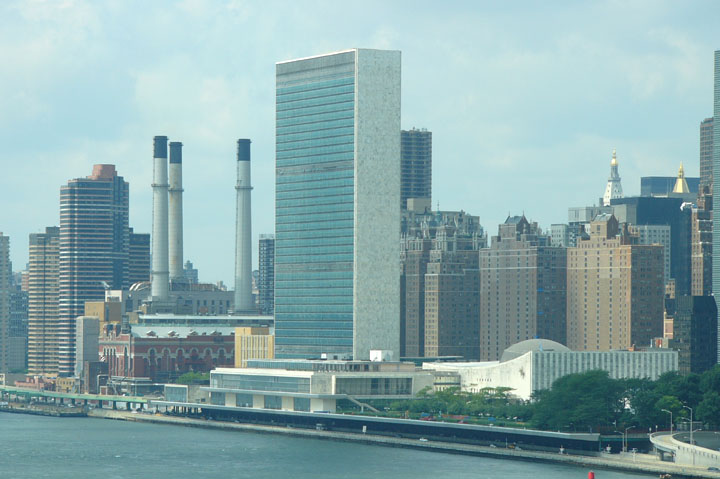
The United Nations in New York City

The UN was formed at the end of World War II as an outgrowth of the League of Nations. Its new mission was more aggressive than its predecessor, and sought to ensure human rights and promote coexistence as a reaction to the terrible global war and genocide of Jews. But the years after 1945 witnessed the emergence of dictatorships, monarchies and authoritarian regimes around the world which joined the UN, changing its mission to a distorted notion of human rights and decency.

The sole Jewish State became the most targeted country by the United Nations. The various UN agencies advanced specific standing items which called out Israel. So it was a regular day at the UN when the General Assembly passed a resolution in 1975 that equated the national aspiration of Jews as uniquely detestable, with the Zionism is Racism resolution. It was more of the same when the UN Security Counsel declared in 2016 that no Israeli Jews should be allowed to live east of the 1949 Armistice Lines.

The hunger for Jews continued in February 2020, as the antisemitic UN added to its menu, featuring not only Jews but also companies that service Jews.

A February 12, 2020 report to the UN Office of Human Rights listed 112 companies which are “involved in certain activities relating to settlements in the Occupied Palestinian Territory.” A total of 94 companies are Israeli and the balance are headquartered in six other countries including the United States. American companies listed include Expedia, Trip Advisor and Airbnb.

So imagine the following scenario: an Israeli Jew and and Israeli Arab who both live in the Israeli city of Jaffa decide to move to the Old City of Jerusalem. The United Nations brands the Israeli Jew as an illegal settler, but not the Israeli Arab. When each of them decides to rent a room in their apartment on Airbnb, the action of the Jew is considered a grave human rights issue, but not when the Arab uses the Airbnb service.

This backward Taliban mentality has become a core of the UN, as anti-Zionism fervor has characterized the reestablishment of the Jewish State as an appalling injustice which must be righted by serving it up whole to its rightful Arab owners.


In 1945, Jews welcomed the creation of the United Nations and the Universal Declaration of Human Rights. In theory and in hope, the new world order was designed to protect everyone including Jews who would be guaranteed the right to own property (Article 17) and pray at Judaism’s holy sites (Article 18). At inception, the UN seemed to be an organization meant to service all of mankind, but like an episode of the Twilight Zone, the UN blueprint became a recipe book to devour Jews, the Jewish State and any person or organization who services Jews.


Related First One Through articles:

Nicholas Kristof’s “Arab Land”

Real and Imagined Laws of Living in Silwan

The Nerve of ‘Judaizing’ Neighborhoods

The New York Times All Out Assault on Jewish Jerusalem

Anti-“Settlements” is Anti-Semitism

The United Nations Bias Between Jews and Palestinians Regarding Property Rights

Google to Stop Displaying Pictures of Israeli Flags in East Jerusalem and West Bank

Subscribe YouTube channel: FirstOneThrough

Join Facebook group: Israel Analysis and FirstOneThrough

A Review of the Fifteen US Slates for the World Zionist Congress

The World Zionist Congress is holding elections through March 11, 2020. There are fifteen slates running from across the political and religious spectrum. They represent roughly 1,800 individual candidates.

In the last election held in 2015, there were eleven slates representing 1,100 candidates. Reform Judaism took the greatest number of votes by a wide margin, surpassing the combined total of the Conservative and Orthodox slates.

2015 World Zionist Election
United States’ Election Results

Slate Votes Seats
ARZA – Reform Judaism 21,766 56
Mercaz USA – Conservative Judaism 9,890 25
Vote Torah: Religious Zionists 9,594 24
American Forum for Israel 3,773 10
HATIKVAH: Progressive Zionists 3,148 8
ZOA 2,738 7
Zionist Spring 2,696 7
World Sephardic Organization 1,650 4
Alliance for New Zionist Vision 735 2
Green Israel 443 1
Herut North America 304 1

In this WZC election, one of the 2015 slates – Green Israel – did not run again. Two slates modified their names and there are five new slates including Eretz HaKodesh (#1); Dorshei Torah V’Tziyon (#7); Kol Yisrael (#14) and Shas (#15, which was part of Ohavei Zion in the US).

The full list of slates is as follows (with the ordering / numbering having been chosen by the AZM at random):

  1. Eretz Hakodesh: Protecting the Kedusha and Mesorah of Eretz Yisrael
  2. Vote Reform: ARZA Representing the Reform Movement and Reconstructing Judaism
  3. Israel Shelanu (Our Israel)
  4. Orthodox Israel Coalition – Mizrachi: Vote Torah
  5. Vision: Empowering the Next Generation
  6. MERCAZ USA: The Voice of Conservative/Masorti Judaism
  7. Dorshei Torah V’Tziyon: Torah and Israel for All
  8. Hatikvah: Progressive Israel Slate
  9. Ohavei Zion: World Sephardic Zionist Organization
  10. Herut Zionists: The Jabotinsky Movement
  11. ZOA Coalition: Zionist Organization of America (ZOA), Torah from Sinai, Make Israel Great (MIG) & National Pro-Israel Partners – Courageously Defending Israel, Sovereignty & the Jewish People
  12. American Forum for Israel
  13. Americans4Israel: Unity, Peace & Security
  14. Kol Yisrael: For the love of Israel – Making Zionism Compelling in the 21st Century
  15. Shas Olami

As in the past election, the main distinction between the slates mostly breaks down according to religious and political philosophy as portrayed on the graphic below.


Religiously Oriented
From Most Right to Most Left

Shas Olami (#15)
Eretz Hakodesh (#1)
Orthodox Israel Coalition – Mizrachi (#4)
Dorshei Torah V’Tziyon (#7)
MERCAZ USA (#6)
ARZA-Vote Reform (#2)

Politically Orientated
From Most Right to Most Left

ZOA Coalition (#11)
Herut Zionists (#10)
Israel Shelanu (#3)
Hatikvah (#8)

Outside of Religion and Politics

Kol Yisrael (#14)
Americans4Israel (#13)
Vision (#7)

Many of the groups have a philosophy combining both politics and religion, and only a few have tried to stay out of politics and religion at all such as Americans4Israel.

The Jerusalem Program
and the Deserved Disqualification of Hatikvah (#8)

There are not many requirements to vote in the WZC elections. Most are basic criteria such as being Jewish, 18 years old, a permanent resident of the United States and not having voted in the latest Knesset elections. The more affirmative declaration asks people to accept the “Jerusalem Program.”

The Jerusalem Program was first established in Basel, Switzerland at the First Zionist Congress in 1897 and has changed very little since that time. Small modifications were made after significant events in the life of Israel, including modifications in 1951, 1968 and 2004. All modifications were made by consensus.

Key points of the Jerusalem Program highlight the particularity of Israel as the home of the Jewish people. For example:

  • Strengthening Israel as a Jewish, Zionist and democratic society…”
  • “Ensuring the future and distinctiveness of the Jewish people by furthering Jewish, Hebrew and Zionist education…”
  • “… representing the national Zionist interests of the Jewish people…”
  • “Settling the country as an expression of practical Zionism.”

The program clearly focuses on Israel as a Jewish State, not a bi-national state. The focus is on Jews, Judaism and Hebrew, not on Arabs, Islam and Arabic.

Yet one of the slates running for the WZC – Hatikvah (slate #8) – opposes those basic principles. Its members include The New Israel Fund, J Street, T’ruah, Americans for Peace Now. The New Israel Fund is actively trying to promote a bi-national state and tear down the distinctiveness of the Jewish State. J Street lobbied the US’s Obama Administration to enable United Nations Security Council Resolution 2334, which labeled the Old City of Jerusalem as illegal Occupied Palestinian Territory, the very opposite of settling Jews and strengthening the Jewishness of the country. Leaders of T’ruah loudly came to defense of Linda Sarsour, a vocal anti-Zionist. According to the philosophy of the far-leftist groups of Hatikvah, 11 million Palestinian Arab refugees from across the world – including Israel – should similarly have their own “World Palestinian Congress” to direct Israeli money towards Arab priorities inside of Israel.

While the groups in the Hatikvah slate stated they support the Jerusalem Program to get on the ballot, it has the equivalent honesty of the Pope saying he’s Jewish. It is a Trojan horse to break the very Jewishness of the Jewish State.

Suggested Slates

Competing slates hurt each other as there is a defined number of seats available. Two similar parties might end up losing a seat by dividing their votes, so it makes the most sense for everyone to rally around a single slate within a cluster which best represents their preferences.

Below are suggested slates to improve the probability of your vote having impact. While there are fifteen slates running, only six of them should be given serious consideration.

Right Religiously/ Right Politically: Vote Slate #4, Orthodox Israel Coalition. OIC has a proven ability to get votes. Don’t dilute and divide the focus among Shas Olami (#15) and Eretz Hakodesh (#1).

Right Religiously / Left Politically: Vote Slate #7, Dorshei Torah V’Tziyon. There is no other option.

Non-Religious / Right Politically: Vote Slate #11, ZOA. A proven vote-getter, avoid the smaller Herut (#10) and the niche Sephardic (#9) and Russian (#12) groups.

Non-Religious / Left-Politically: Vote Slate #3, Israel Shelanu. As noted above, Hatikvah (#8) should not be allowed to participate in the WZC as its actions and deeds are counter to the Jerusalem Program. The best platform is therefore with Israeli-Americans.

Non-Religious / No Politics: Vote Slate #14 Kol Yisrael. This group is about countering antisemitism and promoting Israel without getting into the common fights around the role of religion and politics. It’s appeal and mission are broad and inclusive. While Americans4Israel slate #14 has roughly the same mission, the two will dilute each other so people should rally around one. Vision, slate #7 is much the same.

Left Religiously / Left Politically: Vote Slate #6 Mercaz USA. While the ARZA Reform movement has been a dominant slate in the WZC for many years, its leadership has spent too much time bashing the government of Israel publicly and not using its platform to advocate for the Jewish State. Meanwhile, the Mercaz Conservative Movement has been a more constructive progressive voice while also demonstrating its ability to attract voices and advance its agenda.

Whatever your leanings, take the time to vote at zionistelection.org


Related First One Through articles:

J Street is Only Considered “Pro-Israel” in Progressive Circles

A Basic Lesson of How to be Supportive

Unity – not Unanimity – in the Pro-Israel Tent

There are Standards for Unity

The Anger from the Zionist Center

The Anti-Israel Community in a Jewish House of Worship

Subscribe YouTube channel: FirstOneThrough

Join Facebook group: Israel Analysis and FirstOneThrough

Facts and Stats about the World Zionist Congress Elections

The World Zionist Congress, the organization started by Theodor Herzl in 1897, is having elections again through March 11, 2020.

The organization’s continued existence – let alone the election – is seemingly a curiosity. Why continue an assembly whose mission has already been achieved? The dream of Jewish sovereignty in part of the Jewish homeland was reached in 1948, and throughout Jerusalem in 1967. Is the dream of Zionism still unfulfilled? Does it morph over time?

Or is the WZC simply a manifestation of a collective aspiration, no different than Israel’s national anthem, the Hatikvah, which still speaks of “The Hope” of returning to the land of Zion. Does it remain the country’s national anthem to this day because the hope remains unfulfilled as being free doesn’t end with sovereignty but with true enduring freedom, that the hope is sovereignty that stretches over the entirety of the Jewish homeland, or because one doesn’t stop aspiring to something like love, once already in love?

The Election

The American Zionist Movement is in charge of running the elections in the United States. AZM has been around for 80 years and is an umbrella group of 33 Zionist groups. Its staff includes three full-time people and three consultants.

The election is open to every Jew over 18 years old (as of June 30, 2020). It costs $7.50 to register for the elections, down from the $10 fee in 2015, as AZM is striving to increase voter turnout.

At stake is the direction of roughly $1 billion, which is the collective budgets of the World Zionist Organization, the Jewish Agency, JNF-KKL and Keren Hayesod. Various WZC sub-committees will influence the allocation of resources and policies of those organizations. For example, the international program “Birthright” which brings young Jews for a free trip to Israel might either visit Judea and Samaria or be restricted from visiting it depending on whether right-leaning or left-leaning slates get elected to the WZC.

There are fifteen slates in this 2020 election, representing roughly 1,800 candidates with a wide range of viewpoints. A review of those slates can be found HERE.

The WZC Election by the Numbers

The draw of the WZC appears to have faded over the last few decades, at least in the United States. The 56,450 votes cast in 2015 at the last WZC election, was a paltry sum by historical standards. While WZC elections are supposed to be held every five years, it was not held in 2010. In 2006, a total of 75,686 Americans voted in the elections, a total of 88,753 in 2002, and in 1997 the total was 107,832. If those drops of 18%, 15% and 25% between elections look depressing, consider that the 1987 WZC election had 210,957 Americans voting, meaning that during the eventful decade between 1987 and 1997 – those years which included the First Intifada and the Oslo Accords – American apathy towards Israel doubled, if one could use votes in the WZC as a proxy.

Perhaps it is unfair to state that American Jews were distancing themselves from Israel in the 1987 to 1997 decade. The Oslo Accords were controversial for many, and maybe Americans concluded that the concept of the Israeli government considering the views of American Jews when making policy was either historical or a marketing ploy. Just as the national anthem of Israel, “The Hope,” would appear as a more logical dream for people OUTSIDE of Israel than its inhabitants, the idea of being a “free people in our land, the land of Zion and Jerusalem,” may have held – and holds – different meanings for Israeli and Diaspora Jews: for the former it is a dream of daily peace, while for Diaspora Jews it is an aspiration to bond the Jewish collective of the people, religion and land. Zionism means different things to people around the world, and certainly on a daily practical level for Israelis living in a hostile neighborhood. The Israeli government may care about the opinions of Diaspora Jews, but within limits, and certainly as it relates to daily security.

In regards to the WZC elections, the United States is unique in that it reaches out to its Jews to vote for its representatives. Of the 525 seats in the World Zionist Congress at this election, the United States is allotted 152, or 29% of the seats. Roughly 37% of the seats go to Israel and 34% to the rest of the world based very roughly on the world’s global Jewish population. Israel allocates its seats based on the members of Knesset and the countries of the world allow their major Jewish organizations to directly decide on their representatives.

The WZC voter turnout has been spotty. The United States has eleven states with populations which are over two per cent Jewish. These “Jewish states” did not have great turnouts at the 2015 WZC elections, with fewer than half having one percent of their populations voting. Meanwhile, some smaller states like Oklahoma and Arizona had great turnouts in 2015, with 4.9% and 2.9% of the Jewish populations voting, respectively. As a consequence, the Jews of Oklahoma had a greater impact than the Jews of Oregon, even while the Jewish population was less than one-tenth the size.

2015 World Zionist Election
States with Highest Percentage Jewish Population

State Per Cent Jewish Population Per Cent of Jews Voting in WZC
California 3.2% 0.5%
Connecticut 3.3% 0.8%
Washington, D.C. 4.3% 1.6%
Florida 3.3% 0.4%
Illinois 2.3% 1.4%
Massachusetts 4.1% 0.8%
Maryland 4.0% 1.2%
New Jersey 5.9% 1.4%
Nevada 2.7% 0.1%
New York 8.9% 1.0%
Pennsylvania 2.3% 0.7%

The global community got seats according to their Jewish populations. While Israel and the USA got 190 and 145 seats at the 2015 election, respectively, other countries received significantly fewer seats: France (23), Canada (20), England (19), Australia (13) and Argentina and Russia each with 10. There were 25 countries with fewer than ten seats. Some countries received “penalties” from the Zionist Supreme Court which reduced their seats, resulting in Germany and the Netherlands each having no representation.

The political leanings of the various countries’ ruling authorities were clear. France voted 30% of their members to Likud and England 36%, while Australia only allotted 8% of the seats to Likud. Putting the various parties into groupings of Left, Center and Right shows an interesting divide in the Jewish world’s orientation towards their religious and political leanings as shown in the table below:

2015 World Zionist Election
Global Religious and Political Leanings

Left Center Right
Israel 29% 21% 50%
US 61% 5% 34%
ROW 47% 14% 39%

Note: Left consists of Kadima, Mercaz Olami, Zionist Union, Arzenu and Meretz; Center consists of Yesh Atid, Kulanu, Confederation, Over the Rainbow and undefined; Right consists of Likud, Mizrachi, Beiteinu Olami and Ohavei Tzion

Israel is more right-leaning and the United States is much more left-leaning than the rest of the world. Almost no Jews in the US vote for centrist slates, a unique phenomenon.

If you want to have your opinions reflected in the direction of Zionism over the next five years, register and vote at zionistelection.org


Related First One Trough articles:

I am a Zionist. A Deep Zionist. An Amazed Zionist. A Loud Zionist.

The Anger from the Zionist Center

Subscribe YouTube channel: FirstOneThrough

Join Facebook group: FirstOne Through Israel Analysis and FirstOneThrough

The Best Palestinian Response to the Trump Initiative is Welcoming Jews to Palestine

US President Donald Trump put forward a new Middle East Framework called “Peace to Prosperity” (P2P). It was the first Middle East framework offered since the Arab Peace Initiative in 2002 (API). The API was, not surprisingly, heavily biased towards the Palestinian Arabs’ demands and not Israeli security. It did not advance peace but rather ushered wars from Gaza in 2008, 2012 and 2014, a war from Lebanon in 2006 and a “stabbing intifada” from the West Bank in 2015.

Unlike the API, Trump’s P2P plan was focused on Israel’s security (and Palestinians’ prosperity), and the Palestinian Authority considered it a non-starter before they even saw it. The acting-President of the PA Mahmoud Abbas has refused to even entertain discussing it.

That is a mistake.

The underlying issue of Israel’s security manifests itself in the plan in a few ways, most notably, that all Palestinian border crossings must be managed by Israel and that a future State of Palestine must be demilitarized. If the PA were to refuse to accept those two principles, there is indeed nothing to discuss regarding any of the other key items for Palestinians such as land, refugees and Jerusalem.

However, if Abbas accedes to those two Israeli security points, he will likely be able to gain much on the other issues that matter to him and to the Palestinians.

Consider the land.

The P2P plan has Israel assuming sections of the West Bank including the entirety of the Jordan Valley. It leaves the Palestinian territory as a patchwork of parcels, with the towns in which Jews reside being annexed by Israel dotted, in between.

However, the Palestinians might be able to obtain almost the entirety of the West Bank if it grants Palestinian citizenship to all of the inhabitants of the Jewish towns. This action would be much like the Jewish State’s in 1948 when it granted Israeli citizenship to all of the Arabs. The Jews would make up a much smaller percentage of Palestine than Arabs’ in Israel today.

As the border would be controlled by Israel, only a sliver of land between Palestine and Jordan would be required to be Israeli instead of the whole Jordan Valley, much like the plan assumes Israel having a thin sliver of land buffering Palestinian territory in the Negev and Egypt. The net result would be the Palestinians gaining almost the entirety of the West Bank other than a sliver along the Jordan River.

The willingness to accept Jewish citizens into Palestine might also open a window for Israel to accept many Arab refugees into Israel, rather than just giving them compensation as mapped under the P2P plan. A new Arab spirit of coexistence might stimulate Israel to take as many as 50,000 Arab refugees per year for a number of years, with the balance receiving compensation and settling in a new Palestinian State.

The capital of a Palestinian State could also become more dynamic, with Jewish neighborhoods in Jerusalem becoming parts of a Palestinian capital.

In short, Palestinians can gain a lot on all of their key negotiating points by working off of the Trump peace initiative if they endorse coexistence and welcome Jews into a new state. In contrast, the current path of continued demonization of Israel and the denial of Jewish history and rights will only further cement the stagnation for Palestinians in regards to both peace and prosperity.

Palestinians should call the Israeli bluff, and see if hundreds of thousands of Jews are willing to live as a minority in Palestine. If the Israelis balk, then the BDS movement will likely advance globally. However, if the Israelis endorse the principle, Israel will be blocked from annexing any land (pro-Arab), while United Nations Resolution 2334 will be deemed moot and the global BDS movement will come to an end (pro-Israel).


Related First One Through articles:

The Palestinian’s Three Denials

The Peace Proposal Monologues

Taking it Straight to the People: Obama and Kushner

The Cancer in the Arab-Israeli Conflict

Is Trump Seeing Mid-East Countries to Combat Religious Extremism, or Visiting Religious Sites to Promote Coexistence?

Palestinian Arabs De-Registering from UNRWA

Israel was never a British Colony; Judea and Samaria are not Israeli Colonies

Palestineism is Toxic Racism

The Parameters of Palestinian Dignity

Considering Carter’s 1978 Letter Claiming Settlements Are Illegal

Subscribe YouTube channel: FirstOneThrough

Join Facebook group: FirstOne Through Israel Analysis and FirstOneThrough

American Leaders Always Planned on Israel Absorbing Much of the West Bank

The liberal press is counting on people’s terrible memory and fondness for their cherished presidents Jimmy Carter and Barack Obama to convey a false history of the Middle East. It boldly lies that American politicians have always viewed the contours of Israel to be roughly along the 1949 Armistice Lines, commonly referred to as the Green Line and that Israel would uproot its’ civilian population in the West Bank much as it did in Gaza. Consider The New York Times’ article “What’s in a Peace Plan: Settlements and a Goal of a Palestinian State” on January 30, 2020. The article was full of distortions including: “The United States has long voiced support for the creation of a Palestinian state with only slight adjustments to the Israeli boundaries that existed before the Arab-Israeli war of 1967, when Israel wrested the West Bank from Jordan, and Gaza from Egypt.”
The New York Times January 30, 2020 Page A8
That is total nonsense, meant to make Donald Trump’s plan look like a complete break with the past (a past which must be noted never produced a peace deal). To describe reality, read the letter that President George W Bush wrote to Israeli Prime Minister Ariel Sharon on April 14, 2004, after Sharon announced that he was going to withdraw all Israelis from Gaza: “In light of new realities on the ground, including already existing major Israeli populations centers, it is unrealistic to expect that the outcome of final status negotiations will be a full and complete return to the armistice lines of 1949, and all previous efforts to negotiate a two-state solution have reached the same conclusion. It is realistic to expect that any final status agreement will only be achieved on the basis of mutually agreed changes that reflect these realities.” That is the essence of the Trump plan – reflecting the reality of over half a million Israelis living in communities in the West Bank. This position of Israel incorporating Israeli population centers in the West Bank was reflected in the Democratic party as well, until Obama pivoted away from Israel towards the Muslim world in the hope of creating a “new beginning.” Look at the 2008 Democratic platform’s point on Israel: “All understand that it is unrealistic to expect the outcome of final status negotiations to be a full and complete return to the armistice lines of 1949.” The Democrats-of-old also agreed with the Trump initiative recommendation that Jerusalem remain a unified city and the capital of Israel. The 2008 Democrats stated: “Jerusalem is and will remain the capital of Israel. The parties have agreed that Jerusalem is a matter for final status negotiations. It should remain an undivided city accessible to people of all faiths.” But the current contenders for the president from the Democratic Party (other than Mike Bloomberg) have run from Israel and the notion that Jerusalem should remain the unified capital of Israel. They are the one’s who have turned on long-standing American policy, not Trump. But the liberal media will lie, distort history and tell you #AlternativeFacts like “Israel wrested the West Bank from Jordan” without adding that Jordan attacked Israel in 1967 and Israel took the territory – which Jordan had illegally annexed in 1950 – in a defensive war. The Times article likewise wrote that “[p]revious American proposals spoke of uprooting tens of thousands of Israelis from the settlements to return those areas to Palestinians.” As seen above, that’s a lie. Further, there could be no “return… to Palestinians” as the Israelis would have had to return the land to Jordanians who illegally occupied the land, not Palestinians who never controlled the area. Do not be swayed by the #FakeNews that the Trump peace plan is a radical change of American policy. It just appears that way after eight years of Obama distancing himself from Israel and the current anti-Zionist edge infecting the left-wing media and politicians. Before Obama, Israel truly was a bipartisan cause in which the contours of the Trump peace plan would have been endorsed by all.
Related First One Through articles: When the Democrats Opposed the Palestinian “Right of Return” The Democrats’ Slide on Israel Bernie Sanders is the Worst U.S. Presidential Candidate for Israel Ever Will the 2020 Democratic Platform Trash Israel? The Peace Proposal Monologues New York Times Lies about the Gentleness of Zionism Related First One Through videos: The 1967″Borders” (music by The Kinks) US and Israel Are There For Each Other (music by Michael Jackson) Subscribe YouTube channel: FirstOneThrough Join Facebook group: FirstOne Through Israel Analysis and FirstOneThrough

The Callous-tinian Pause

As is their custom, Palestinian Arabs are calling for a “day of rage” because of what might possibly come out of the Trump Administration this week regarding a proposed peace deal between Israel and the Palestinian Authority. Palestinians had called for a similar day of “mass protests” when the Trump Administration said that Israeli settlements are not inconsistent with the law in November 2019. At that time, various PA officials made statements about their position of a “rejection and condemnation of the Israeli-American settlement enterprise that aims to eliminate the Palestinian cause,” and that they reject “Zionist and American hostile policy… [that are designed to] liquidate the Palestinian cause.

The Palestinians similarly called for a “day of rage” in March 2018 after Trump moved the US embassy in Israel to its capital city of Jerusalem. Palestinian officials said they “will continue to protest against this decision and the plan to move the US embassy to Jerusalem, as well as attempts to liquidate the Palestinian cause.” There were “days of rage” when Israel put metal detectors on Jerusalem’s Jewish Temple Mount after Arabs killed a few people on the holy site.

What is this “Palestinian cause” that is threatened by Jews living alongside Arabs in the West Bank as they do in Israel, and which cannot stand to have the US embassy in Jerusalem? Why do Palestinians hold days of rage when Jews visit the Temple Mount or Israel shows any signs of controlling the site? Why launch this latest “day of rage” before even hearing Trump’s peace plan and stating “[t]he Palestinian leadership, with the support of our people, will fail attempts to liquidate the Palestinian cause?

Do Palestinians believe that they will expel all Jews from the Old City of Jerusalem just as the Jordanians did in 1949? Is the “Palestinian cause” designed to deny Jews their presence, rights and dignity to live, visit and pray at Judaism’s holiest site? Was the Arab happiness about Obama’s endorsement of UN Security Council Resolution 2334 about  expunging the history of Jews in Jerusalem and rolling back the “Judaization” of the city?

It would appear that the “Palestinian Cause” has much less to do with the rights of Palestinians than denying the rights of Jews. Its goal is to reintroduce the 18-year ban on Jews which Arabs introduced and enforced during that window of their control of Jerusalem from 1949 to 1967: the “Callous-tinian Pause.”


Jerusalem’s Old City pre-1949, with the Tiferet Yisrael and Hurva Synagogues,
both destroyed by Arab armies.

This Palestinian cause of a Callous-tinian Pause SHOULD be deliberately and specifically liquidated, their calls for days of rage be damned.


Related First One Through articles:

The Arguments over Jerusalem

The Parameters of Palestinian Dignity

Dignity for Israel: Jewish Prayer on the Temple Mount

Considering Carter’s 1978 Letter Claiming Settlements Are Illegal

Palestineism is Toxic Racism

Jizyah for Jews in Jerusalem

Jerusalem’s Old City Is a Religious War for Muslim Arabs

Related First One Through video:

Israel Provokes the Palestinians (music by The Clash)

Subscribe YouTube channel: FirstOneThrough

Join Facebook group: FirstOne Through Israel Analysis and FirstOneThrough

Jews, Judaism and Israel

There are many debates being waged around the world about whether anti-Zionism is anti-Semitism, how it is possible that some Jews may be against Israel, and why some Jews who do not believe in either God or religion are still considered Jews. This article will not tackle all of those issues but will seek to define, segment and size the nature of Jews, Judaism and Israel to better frame discussions on those topics.

Judaism

Judaism is a religion that takes the source of its teachings from the Five Books of Moses. Biblical scholars over thousands of years have interpreted the various events and commandments found in the Old Testament to frame how a Jewish person should act and live. The approaches changed over the millenia, with some sects like Sadducees, Essens and Karaites fading away while the Pharisees survived with the publication of the Talmud.

Over the last few hundred years, newer religious denominations came about including Conservative, Reform and Reconstructionist Judaism. Each adopted different approaches as to whether the Bible was written by God or was simply divinely-inspired, and how to translate the ancient stories into relevant lessons for today.

Jews

Jews are most often defined by their lineage. Abraham, the father of monotheism, is considered the first Jew in Judaism. His grandchild Jacob became known as Israel and Jacob’s sons were the basis for the twelve tribes and the nation of Israel. Jews consider themselves direct descendants of these biblical characters.

According to the Orthodox and Conservative streams of Judaism, a person’s religion is decided by matrilineal descent (the religion of the mother), while the Reform and Reconstructionist groups have a broader allowance, in that they include patrilineal descent as well. Converts are also welcomed as Jews (although they are not encouraged) and tradition maintains that the new Jews do not only take upon themselves the religion, but the ancestry of Jews as well. A convert’s new Hebrew name will be “______ son of Abraham” or “_____ daughter of Sarah” to show that they are now included as part of the heritage of Jewish peoplehood.

Israel

Judaism is a unique religion in that it has ties to a specific piece of land. The Bible clearly relays to Abraham, Isaac, Jacob and the descendants afterwards that the land of Canaan is their inheritance. The Bible describes specific commandments that can only be kept in Israel, and to this day, every Jew around the world prays facing the Temple Mount in Jerusalem, Israel.

Jews have always lived in the LAND of Israel. Indeed, they were the only religious group to move to the holy land throughout the 19th century and Jews have been a majority in the city of Jerusalem since the 1860’s, BEFORE the push for Jewish sovereignty and advent of Modern Zionism.

Jews, Judaism and Israel

Despite the intersection of Jews, Judaism and Israel, not every Jew follows the religion nor lives in Israel.

Religion and Zionism In Israel

There are roughly 14.2 million Jews alive in the world today. Of that total, roughly 6.7 million live in the Jewish State of Israel. There are another 2.3 million non-Jews that live in Israel, with a population that now exceed 9 million.

  • Religious Jews 3.4 million
  • Secular Jews 3.3 million
  • Non-Jews 2.3 million
    • Total 9.0 million people in Israel

The Pew Forum estimates that Haredi and Orthodox Jews account for 10% and 12% of Israeli Jews, respectively, with Conservatives and Secular Jews accounting for 28% and 49% of the Israeli Jewish population, respectively. Using a Venn diagram, one can plot the 3.3 million Secular Israelis as being Jews connected to the land of Israel (People + Land) but not to the Religion.

Among the religiously-affiliated Israeli Jews, the Haredi Jews are the least Zionistic, while most of the other streams are very passionate about Israel having Jewish sovereignty. The black hat/ Haredi community is less enamored with the Modern Jewish State as it is not based on Orthodox religious law and many believe that such a state should only come into being with the arrival of the Messiah.

Denomination Population% Total Zionist% Total
Haredi 10% 0.7 10%            0.1
Orthodox 12% 0.8 100%            0.8
Conservative 28% 1.9 95%            1.8
Secular 49% 3.3 90%            3.0
Total in millions 6.7 5.7

If one were to assume that only 10% of the Haredi population are Zionists and almost all of the other denominations are Zionists, roughly 1 million Jews in Israel today would not be considered ardent Zionists.

This is not an oxymoron, and goes to the nature of the confusion of different people’s opinions about Zionism. Many Jews living in Israel are against the GOVERNMENT, not the idea of Jews living in the land. Haredi Jews consider themselves anti-Zionist because they think a secular Jewish state has no legitimacy in the Jewish holy land. However, they believe very strongly that the land is the Jewish holy land and they have the right to live Israel. This is in sharp contrast to Muslim anti-Zionism around the world which believes both that the Israeli government should be destroyed and that Jews should be expelled from the land.

Diaspora Jewry on Israel and Judaism

A little more than half of world Jewry lives outside of Israel, roughly 7.5 million people. The vast majority of diaspora Jews live in the United States (over 5 million) with France, Canada and the United Kingdom accounting for over 1 million more.

The United States is a bit of an anomaly compared to Jews around the world, with strong Conservative and Reform movements. In much of the rest of the world, Jews are either Orthodox or secular. In considering the breakdown of Jews in the Venn diagram, assumptions are made for the 5.3 million Jews in the U.S. and then for the rest of the world.

America Population% Total Zionist %  Total 
Orthodox 10% 0.5 50%            0.3
Conservative 18% 1.0 70%            0.7
Reform 35% 1.9 40%            0.7
Unaffiliated 37% 2.0 20%            0.4
Total in millions 5.3 2.1

The Pew Forum estimated the breakdown of Jewish denominations in the United States and the percentages for people who consider themselves Zionists are educated guesses. The Conservative denomination is assumed to be the most pro-Israel, as the Orthodox group includes Anti-Zionist Haredi factions. Using these figures would suggest less than 40% of American Jewry is pro-Israel.

Different percentages are used in making estimates in the rest of the world, below:

ROW Population% Total Zionist %  Total 
Orthodox 25% 0.6 60%            0.3
Conservative 10% 0.2 70%            0.2
Reform 30% 0.7 40%            0.3
Unaffiliated 35% 0.8 40%            0.3
Total in millions 2.2 1.1

The figures for the 2.2 million Jews in the rest of the world are broad estimates. In some countries like France, 60% of the population is Sephardic which almost always considers itself Orthodox, even when not actively practicing Judaism. In general, the unaffiliated/ Reform account for a majority of the population.

Among the diaspora Jews outside of the U.S., Israel holds a more significant role as they suffer more discrimination and are much more likely to emigrate to the Jewish State. Using these figures – which are arguably low – approximately half of the Jews in the rest of the world would be considered active Zionists, 10% more than American Jewry.

Laying out these figures in the Venn diagram above shows that there are about 5.6 million affiliated Jews, of which roughly three-quarters are pro-Israel. This compares to approximately 8.5 million unaffiliated Jews of which only 45% are pro-Israel.

**This breakdown might be viewed by many as unfair. For example, according to Pew, 87% of American Reform Jews consider themselves only Jews through Peoplehood and not religion, while 50% of Unaffiliated Jews felt the same way. This would suggest 4.0 million Affiliated American Jews (both People and Religion) as opposed to the 1.5 million used in the chart above.**

However, the concept remains the same. There are Jews who consider themselves only Jews in the notion of peoplehood, those who consider themselves both Jews by peoplehood and religion, and further, those within each camp who consider themselves tied to Israel (whether they live there or not) and those who do not. The warring factions within the Jewish people of Zionist/anti-Zionist and Jewish anti-Semites often breakdown among these categories.


Jews, Judaism and Israel are all deeply connected yet are distinct at the same time. Before delving into the nuances related to antisemitism and anti-Zionism, it is important to understand the important interrelationship of land-government, people and religion while also acknowledging the varied preferences among Jews in how they define themselves and convey their passions.


Related First.One.Through articles:

For Liberals, It’s Israelis, Palestinians, and Indifference

Heritage, Property and Sovereignty in the Holy Land

The Non-Orthodox Jewish Denominations Fight Israel

Not Remembering, Forgetting and Never Knowing

From Promised Land to Promised Home

In Defense of Foundation Principles

An Orthodox Rabbi at the Capitol

Iran’s New Favorite Jewish Scholars

First.One.Through videos:

God is a Zionist (music by Joan Osborne)

The Green Line (music by The Kinks)

Judea and Samaria (music by Foo Fighters)

The Anthem of Israel is JERUSALEM

Subscribe YouTube channel: FirstOneThrough

Join Facebook group: FirstOne Through Israel Analysis

The Anti-Israel Community in a Jewish House of Worship

On November 26, 2019, a progressive Reform Temple in Westchester County, New York brought together a collection of people from the far-left and anti-Israel community to talk about the situation in “Israel/Palestine.” The discussion was civil and disappointing.

The Israel Action Committee of the Temple Israel of New Rochelle put together the event with “Friends of Mossawa,” an organization based in Tarrytown, NY which claims to fight for equality in Israel, and the United Nations, an organization which claims to be a unifying agency for people all over the world. As the evening demonstrated, what unites these parties is their strong distaste for Israel.

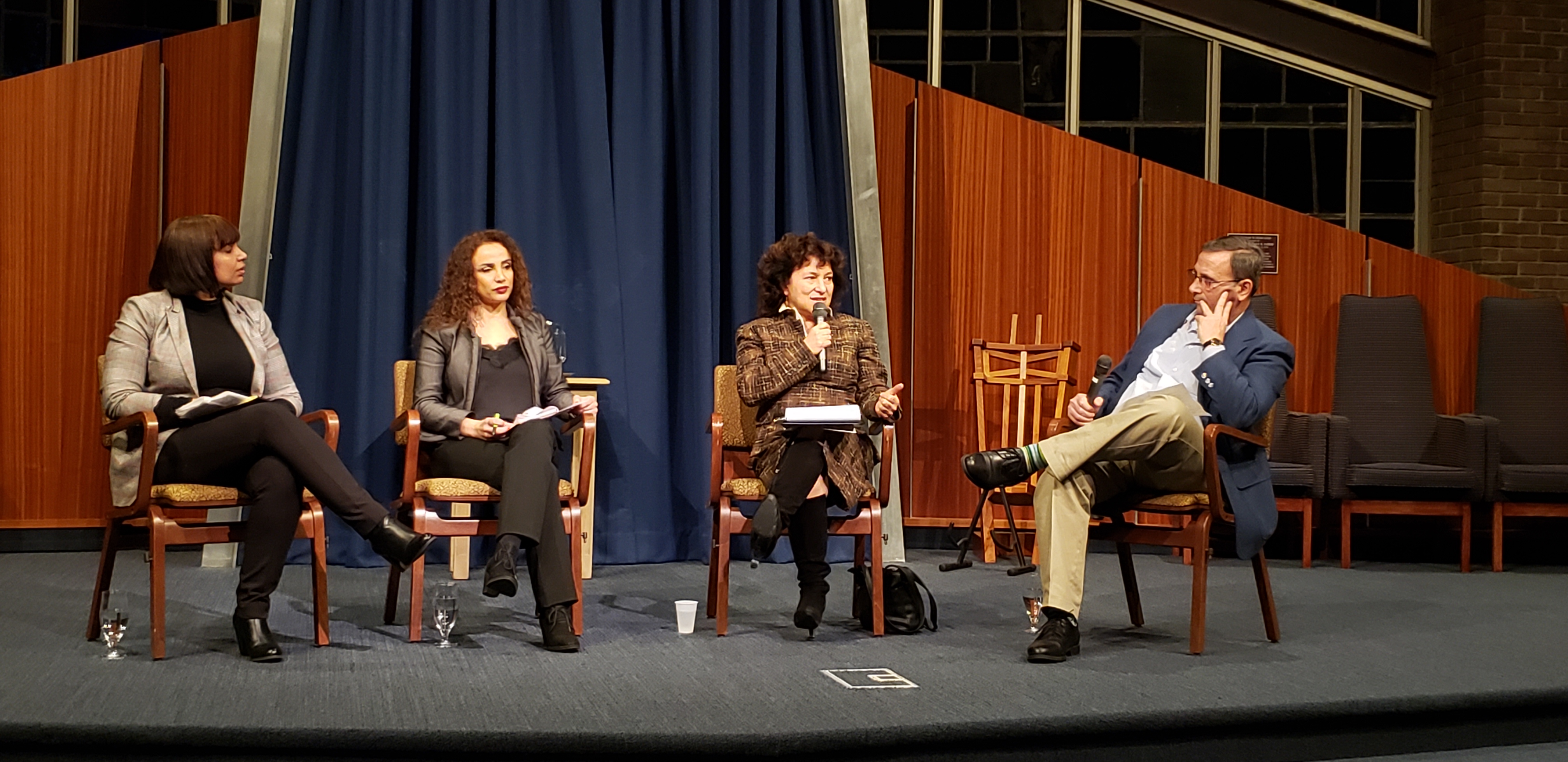
The speakers included Laura Wharton, a left-wing, anti-Israeli Prime Minister Benjamin Netanyahu member of Jerusalem’s City Council; Rana Abu Farha, a host on the Palestinian run Ma’an 24 news show; and Hanan Al Sanah, a representative of an NGO in the Negev which advocates for Bedouin women. It was moderated by Paul Warhit, President of the Westchester Jewish Council.

Hanan Al Sanah, Rana Abu Farha, Laura Wharton and Paul Warhit at TINR
November 26, 2019
From the outset, the tone of the two hour evening discussion was clearly not going to follow the script as laid out in the invitationThe Lived Reality in Israel and the Palestinian Territory: Current Political Developments and the Prospects for a Peaceful Settlement of the Israeli-Palestinian Conflict.” The members of the TINR clergy and Israel Action Committee who welcomed the fifty-person audience repeatedly referred to “Israel/Palestine,” and not the “Palestinian Territory,” upgrading the PA-ruled lands to an actual country. They also noted that one of the evenings invited speakers, Ali Ghaith, an “activist and freelance journalist” was not able to attend as he had recently written a negative piece about Netanyahu and was therefore not able to get a travel visa from Israel. Various people in the audience booed Israel’s actions.

The Left-Wing Israeli Politician

Wharton began the discussion stating that she has “complete solidarity with the Palestinian people” and would state later that she is both pro-Israel and pro-Palestine. Her comments during the evening really only proved the latter.

Even though she serves as a member of the Jerusalem’s City Council, she was woefully ignorant of the city’s composition stating that only about 2,000 Jews live in “East Jerusalem,” even though the actual number is over 200,000 in the eastern part of the city.

Wharton was particularly worried about mixed Arab-Jewish neighborhoods in Jerusalem. She said that it was “worrisome that more Israelis are moving into Palestinian neighborhoods,” especially right-wing Israelis. She said that Jerusalem will ultimately need to be divided as part of a peace agreement and the Jewish presence among the Palestinians made that separation harder. She voiced her belief that the Jewish Quarter and the Western Wall should remain in Israeli hands, but the balance of East Jerusalem should be part of Palestine, with Christian holy places under the jurisdiction of the United Nations.

Wharton believed that the problems in Jerusalem paled relative to the West Bank. She commented that the settlements are illegal by international law and many are also illegal under Israeli law. She believed that all of the settlements complicated matters significantly by placing Jewish towns alongside Arab towns. Neither she nor the moderator chose to mention how Jews and Arabs get along just fine in Haifa, the headquarters of Mossawa.

Wharton ended her remarks by stating that she supported the B.D.S. movement of Israeli goods made in the West Bank but urged people in the audience to not boycott Israel in its entirety, as it silenced the voices of the dovish Israelis like herself and gave ammunition to the right-wing.

The Anti-Israel Palestinian Newscaster

Rana made Laura’s pro-B.D.S. comments look tame.

She decried the “occupation” throughout her remarks, stating that the over 130 Israeli settlements consisting of 1 million Jews pushed 2.5 million Palestinians to live in “ghettos.” (The actual number of Jews in the West Bank is half that number). She said that Netanyahu went to war in Gaza the other week because he feared he was losing the election so thought it would help to kill Arab civilians to excite the Israeli public. She added that the entire notion that Israel is democratic is a joke, and that it just holds election as a marketing ploy to the western world that it shares democratic ideals when it is really just a racist colonial occupier. The moderator chose not to push back aggressively on these libels.

The Palestinian newscaster went on that she thought that every single settler must leave the West Bank and that all 6 million Palestinian refugees (there are actually 5.5 million registered with UNRWA) should be allowed to move to Israel. When asked by Warhit how Israel could possibly allow 6 million Arabs into the country to overwhelm the Jews, she simply stated that “it’s their land so it’s their choice.” The members of the UN and Friends of Mossawa who sat in the audience grunted their approval. Warhit could only summon that he appreciated her position about getting rid of the settlements but could not imagine Israel allowing 6 million Arabs into the country. The TINR organizer of the event admonished Warhit to not share his opinion and just get the panel talking.

The Bedouin Arab

Compared to the other people on stage, Hanan was actually quite good, even while her English was the weakest. She said that she considered herself an Israeli but was frustrated by the country’s lack of investment in the Bedouin community and Israel’s refusal to allow them to live in their traditional lifestyle. At the same time, she acknowledged that she was also frustrated by her own Bedouin traditional lifestyle that kept women illiterate and as second-class citizens. She was advocating for change in the Bedouin culture to empower women, but for more of the traditional status quo from the Israelis to not force them to move into conventional cities.

End Points

The Q&A at the end of the panel discussion was mostly a repeat of prior comments. When asked about the Palestinian and left-wing Israeli poll in the summer of 2018 that showed that almost all Israeli Arabs were in favor of capping the number of refugees coming to Israel and in favor of Israel’s Nation State Law, the denials began to flow.

The questioner was first directed by the panelists to call Israeli Arabs as “Palestinian Citizens of Israel” and told that the poll figures must be wrong. Both Laura and Rana mentioned the huge protests in the streets after the Knesset passed the law which undermined the poll’s statistics. Wharton considered the poll’s point of Israeli Arabs wanting to cap refugees as perhaps stemming from Palestinian Arab viewpoint of Israeli Arabs as collaborators with Israel while they suffered in refugee camps. Rana effectively ignored the question and repeated that all of the Palestinians have a natural right to return to their homes (or more accurately, grandparents’ homes).

At program’s end, when Rana was asked how many Jews she thought could live in a Palestinian State, she repeated that every settlement had to be removed. Pushed further if she would accept a situation in which every Israeli soldier left the land, and every Jewish civilian in the West Bank opted to become a Palestinian citizen, she reiterated her stance that no settlers could remain. When challenged as to why she would take such an antisemitic stance to forbid any Jew from living in a Palestinian State, the organizer of the event from TINR jumped in and said “don’t put words in her mouth” and then tried to escort her out of the room.


Temple Israel of New Rochelle is proud of its progressive bona fides. Its rabbi serves on the board of J Street (a left-wing Israel advocacy group), Planned Parenthood, and Rabbis for Human Rights. It was therefore not surprising to see such a progressive organization give a warm welcome to people advocating for a boycott of Jews in the West Bank, expulsion of all the Jews living there, and changing Israel into a bi-national state. Such is the state of progressive views about Israel today.


Related First.One.Through articles:

A Disservice to Jewish Community

Rick Jacobs’ Particular Reform Judaism

Unity – not Unanimity – in the Pro-Israel Tent

There are Standards for Unity

Arabs in Jerusalem

The Fault in Our Tent: The Limit of Acceptable Speech

The Reform Movement’s Rick Jacobs Has no Understanding of Tolerance

J Street is Only Considered “Pro-Israel” in Progressive Circles

On Heretics and Slanderers

The Non-Orthodox Jewish Denominations Fight Israel

Fake Definitions: Pluralism and Progressive / Liberalism

In Defense of Foundation Principles

J Street is a Partisan Left-Wing Group, NOT an Alternative to AIPAC

J Street: Going Bigger and Bolder than BDS

First.One.Through videos:

The Green Line (music by The Kinks)

Judea and Samaria (music by Foo Fighters)

10 Ignored Facts about Moslem and Jewish Population in Israel (music by Seal)

Israel Provokes the Palestinians (music by The Clash)

The Anthem of Israel is JERUSALEM

Subscribe YouTube channel: FirstOneThrough

Join Facebook group: FirstOne Through Israel Analysis

The Fourth ‘No’ of the Khartoum Resolution: No Return of Palestinian Refugees

In the aftermath of the Arabs humiliating defeat in the June 1967 war with Israel, the leaders of eight Arab countries assembled in Khartoum, Sudan to proclaim their unity with each other and the cause against Israel which had just taken the Sinai from Egypt, the West Bank from Jordan, and the Golan Heights from Syria. They published the Khartoum Resolution which, among other matters, proclaimed the infamous ‘three No’s’ regarding Israel:

“3. The Arab Heads of State have agreed to unite their political efforts at the international and diplomatic level to eliminate the effects of the aggression and to ensure the withdrawal of the aggressive Israeli forces from the Arab lands which have been occupied since the aggression of June 5. This will be done within the framework of the main principles by which the Arab States abide, namely, no peace with Israel, no recognition of Israel, no negotiations with it, and insistence on the rights of the Palestinian people in their own country.”

The comedy of classic clowns might be lost on the listeners of later generations, but the Arab heads of state made the subject of Palestinians having their “own country” a new priority, after 18 years of occupying the West Bank and Gaza between 1949 and 1967, and making no effort whatsoever to create an independent Palestinian state.

What’s more, the no peace/ recognition/ negotiations with Israel not only prevented any pathway to peace for all the Arab actors with Israel, it slammed the door shut on Palestinian refugees having any chance of returning to homes in Israel.

As stated in the 1948 UN General Assembly Resolution 194, item 11, “refugees wishing to return to their homes and live at peace with their neighbours should be permitted to do so at the earliest practicable date, and that compensation should be paid for the property of those choosing not to return and for loss of or damage to property.” The 1967 Khartoum Resolution made clear that there would be no peace with Israel, and consequently, no return for any refugees.

This was not a new or novel issue for the Arab world.

In October 1950, not long after the end of Israel’s War of Independence, the United Nations sought a method of handling the displaced Arabs who had left Israel. The UN Conciliation Commission for Palestine noted the opinion of Israel’s first Prime Minister David Ben Gurion about the status of the Arab refugees:

“Mr. Ben Gurion’s view this passage [Resolution 194] made the possibility of a return of the refugees to their homes contingent, so to speak, on the establishment of peace: so long as the Arab States refused to make peace with the State of Israel, it was evident that Israel could not fully rely upon the declaration that Arab refugees might make concerning their intention to live at peace with their neighbours. Mr. Ben Gurion did not exclude the possibility of acceptance for repatriation of a limited number of Arab refugees, but he made it clear that the Government of Israel considered that a real solution of the major part of the refugee question lay in the resettlement of the refugees in Arab States. On the other hand, Mr. Ben Gurion fully recognized the humanitarian aspect of the problem and on several occasions declared that, when the time came, the Government of Israel would be ready to take part in the efforts necessary for its solution and that it would do this in a sincere spirit of co-operation. Mr. Ben Gurion told the Commission, however, that the Government of Israel considered the refugee question as one of those which should be examined and solved during the general negotiations for the establishment of peace in Palestine.”

Arab states rejected the existence of the Jewish State at its founding in 1948 and dug in deeper after the loss of territory that belonged to THEM (as opposed to local Palestinians) in 1967. While Egypt and Jordan did sign peace agreements with Israel in 1979 and 1994, respectively, the remainder of the Arab world still has not. Thirty Arab and Muslim states still refuse to acknowledge the basic existence of Israel.

So while the number of Palestinian “refugees” stood at roughly 1 million in 1967, that number ballooned to over 5.5 million in 2019. Bringing that many Arabs into Israel would completely alter the demographic composition and character of Israel, a point which the United Nations abhors when it comes to Jews living in the West Bank as it stated in the 2016 UNSC Resolution 2334: “Condemning all measures aimed at altering the demographic composition, character and status of the Palestinian Territory occupied since 1967, including East Jerusalem.” If the desired Arab state cannot handle a 5% Jewish population, how can anyone possibly consider that the Jewish State, which already has a 20% Arab population, take in an additional 5 million Arabs?


Arab women entering the Western Wall Plaza in Jerusalem, Israel
(photo: First.One.Through)

The Arab world declared three No’s to Israel in 1967, and also effectively sealed the fate of Palestinian refugees, that they would never move to houses in Israel.


Related First One Through articles:

Stabbing the Palestinian “Right of Return”

Removing the Next Issue – The Return of 20,000 Palestinian Arabs

The “Great Myth of Return”

When the Democrats Opposed the Palestinian “Right of Return”

Time to Dissolve Key Principles of the “Inalienable Rights of Palestinians”

Losing Rights

What’s Wrong with UNRWA

First.One.Through videos:

The Green Line (music by The Kinks)

Israel Provokes the Palestinians (music by The Clash)

Who are the Palestinians (music by The Who)

Subscribe YouTube channel: FirstOneThrough

Join Facebook group: FirstOne Through Israel Analysis


Considering Carter’s 1978 Letter Claiming Settlements Are Illegal

The November 18, 2019 announcement by US Secretary of State Mike Pompeo that Israeli “settlements” are not illegal reverses the conclusion of a lawyer advising President Jimmy Carter’s State Department in 1978. A First One Through (FOT) deconstruction of that opinion follows.

The letter was compiled by Herbet Hansell, a lawyer from Jones Day who provided occasional legal consulting services to the State Department. His letter of April 21, 1978 set the framework for Carter to label the settlements as “illegal,” an opinion not shared by any other U.S. president before or since.

“Dear Chairmen Fraser and Hamilton:

Secretary Vance has asked me to reply to your request for a statement of legal considerations underlying the United States view that the establishment of the Israeli civilian settlements in the territories occupied by Israel is inconsistent with international law. Accordingly, I am approving the following in response to that request:”

FOT COMMENT: It is important to note that the conclusion was already given to Hansell, that the “United States view that the establishment of the Israeli civilian settlements in the territories occupied by Israel is inconsistent with international law.” Any good lawyer trained at arguing either side of a case can find a rationale to give his employer the backup required. Hansell did his best in the letter.

“The Territories Involved

The Sinai Peninsula, Gaza, the West Bank and the Golan Heights were ruled by the Ottoman Empire before World War I. Following World War I, Sinai was part of Egypt; the Gaza strip and the West Bank (as well as the area east of the Jordan) were part of the British Mandate for Palestine; and the Golan Heights were part of the French Mandate for Syria. Syria and Jordan later became independent. The
West Bank and Gaza continued under British Mandate until May 1948.”

FOT: All of these statements are true to some extent. The issue is that these parcels of land like the “West Bank” were non-entities at the end of World War I. The definition of what they were to become were artifices of war and armistice lines.

Further, there is no discussion of the purpose of the British Mandate of Palestine. There was no mention that the Mandate specifically stated in Article 4 that it “shall facilitate Jewish immigration under suitable conditions and shall encourage… close settlement by Jews on the land,” nor Article 15 that “No person shall be excluded from Palestine on the sole ground of his religious belief.” The Mandate not only considered Jews living in Gaza and what would become the “West Bank” as legal, it ENCOURAGED Jews living throughout the land.

In 1947, the United Nations recommended a plan of partition, never effectuated, that allocated some territory to a Jewish state and other territory (including the West Bank and Gaza) to an Arab state. On 14 May 1948, immediately prior to British termination of the Mandate, a provisional government of Israel proclaimed the establishment of a Jewish state in the areas allocated to it under the Jewish plan. The Arab League rejected partition and commenced hostilities. When the hostilities ceased, Egypt occupied Gaza, and Jordan occupied the West Bank. These territorial lines of demarcation were incorporated, with minor changes, in the armistice agreements concluded in 1949. The armistice agreements expressly denied political significance to the new lines, but they were de facto boundaries until June 1967.”

FOT: The summary of the 1947 partition plan leaves out the principle that Greater Jerusalem and Greater Bethlehem were designed to be a “corpus separatum” and internationally-administered. Its legal position is completely unique and distinct from the “West Bank,” a horrible omission by Hansell.

Another shortcoming is that Hansell’s observation that the UN “recommended a plan of partition, never effectuated,” never enters his calculus for the remainder of his letter. If the UN simply “recommended” the partition, it had no legal validity. Therefore, when Israel declared itself an independent state at the end of the British Mandate, its borders would be set as the FULL territory, including Gaza and what would become the “West Bank” under international law known as Uti possidetis juris.

The reason that partition was never effectuated, was that the Arabs rejected it completely, as they considered the entirety of the land to be Arab with no space for a Jewish state. This makes the issue one about a civil war over a single tract of land, not one between two autonomous countries. Therefore the only international laws which would pertain would be regarding rules of war and protecting civilians, not laws dealing with incursions into foreign territory.

Even if one were to look past these failures and try to see Hansell’s point of view, the historic background still falls flat. Jordan did not simply “occupy” the West Bank; it evicted all of the Jews in 1949, annexed the territory in 1950 and then granted all non-Jews citizenship in 1954. The Arabs ethnically cleansed Judea and Samaria and then renamed the area east of the 1949 Armistice Lines the “west bank of the Jordan River,” which, over time, was shortened to the commonly used term “West Bank.” Such racist and antisemitic behavior – coming just a few years after the Holocaust no less! – should never be embraced.

Additionally, Israel secured additional land in the 1948-9 war beyond what was proposed for the Jewish State in the 1947 Partition Plan. The world accepted this additional territory both because Israel acquired the land in a defensive battle and that the Armistice Lines were expressly viewed as subject to change by both parties (the Arabs assumed Israel would shrink and the Zionists believed Israel sovereignty would expand). The principle of acquiring more land in a defensive battle in 1967 similarly applies.

Lastly, not only did the Palestinians not declare an independent Arab state, there was no more land to even consider as independent, as Egypt assumed control of Gaza and Jordan annexed the West Bank. When Hansell considers the Israeli counter-party in 1978, is he thinking about the Jordanians? Palestinians (who had accepted Jordanian citizenship)?

“During the June 1967 war, Israeli forces occupied Gaza, the Sinai Peninsula, the West Bank and the Golan Heights. Egypt regained some territory in Sinai during the October 1973 war and in subsequent disengagement agreements, but Israeli control of the other occupied territories was not affected, except for minor changes on the Golan Heights through a disengagement agreement with Syria.”

FOT: Completely absent from the narrative is the not-inconsequential point that Israel was the DEFENSIVE PARTY during the June 1967 war. While it is a matter of debate whether Israel’s preemptive attack on Syria and Egypt which had threatened to attack Israel and amassed troops on the border was defensive, there is no question that Jordan attacked Israel first. Just as Israel acquired additional land in a defensive battle in 1949 which was endorsed by the world, so too was Israel’s acquisition of the West Bank.

The Settlements
Some seventy-five Israeli settlements have been established in the above territories (excluding military camps on the West Bank into which small groups of civilians have recently moved). Israel established its first settlements in the occupied territories in 1967 as para-military ‘nahals’. A number of ‘nahals’ have
become civilian settlements as they have become economically viable.

“Israel began establishing civilian settlements in 1968. Civilian settlements are supported by the government, and also by non-governmental settlement movements affiliated in most cases with political parties. Most are reportedly built on public lands outside the boundaries of any municipality, but some are built on private or municipal lands expropriated for the purpose.”

FOT: Stating that settlements are “supported” by the Israeli government is misleading. Israel “supports” all civilians in the West Bank – including Arab towns – with various services ranging from protection to electricity and water. Hansell’s caveat that most settlements are “reportedly” built on public lands seems peculiar, as though he doubted the veracity of the report to add that “some are built on private or municipal lands.”

Legal Considerations
1. As noted above, the Israeli armed forces entered Gaza, the West Bank, Sinai and the Golan Heights in June 1967, in the course of an armed conflict. Those areas had not previously been part of Israel’s sovereign territory nor otherwise under its administration. By reason of such entry of its armed forces, Israel established control and began to exercise authority over these territories; and under international law, Israel became a belligerent occupant of these territories.”

FOT: Hansell now delves into the legal analysis of the settlements, but his omissions in the background now become toxic to the analysis.

  • There is no factual mention that Israel was without question the defensive party regarding Jordan in the West Bank, yet Hansell declares that Israel was the “belligerent” party.
  • Hansell noted that the 1949 Armistice Lines had no “political significance.” Therefore, the area one foot to the right or left of the the armistice lines was only theoretically Israel and Jordan. While the world recognized the sovereignty of Israel to the west of the line, the entirety of the UN (except Pakistan and the UK) did not acknowledge Jordan’s annexation of the West Bank. These Arabs also never declared an independent state as noted above.
  • In short, Israel entered into a disputed territory which was an integral part of the Palestine Mandate from which Jews were expelled in a defensive war 18 years earlier in a defensive maneuver.

Hansell continued:

“Territory coming under the control of a belligerent occupant does not thereby become its sovereign territory. International law confers upon the occupying State authority to undertake interim military administration over the territory and its inhabitants; that authority is not unlimited. The governing rules are designed to permit pursuit of its military needs by the occupying power, to protect the security of the occupying forces, to provide for orderly government, to protect the rights and interests of the inhabitants, and to reserve questions of territorial change and sovereignty to a later stage when the war is ended. See L. Oppenheim, 2 International Law 432-438 (7th ed., H. Lauterpacht ed., 1952); E. Feilchenfield, The International Economic Law of Belligerent Occupation 4-5, 11-12, 15-17, 87 (1942); M. McDougal & F. Feliciano, Law and Minimum World Public Order 734-46, 751-7 (1961); Regulations annexed to the 1907 Hague Convention on the Laws and Customs of War on Land, Articles 42-56, 1 Bevans 643; Department of the Army, The Law of Land Warfare, Chapter 6 (1956) (FM-27-10).

‘In positive terms, and broadly stated, the Occupant’s powers are (1) to continue orderly government, (2) to exercise control over and utilize the resources of the country so far as necessary for that purpose and to meet his own military needs. He may thus, under the latter head, apply its resources to his own military objects, claim services from the inhabitants, use, requisition, seize or destroy their property, within the limits of what is required for the army of occupation and the needs of the local population.”

FOT: Even while Hansell labels Israel as a “belligerent occupant” as if Israel aggressively attacked and entered a sovereign nation’s territory, he comments that such party has the authority to manage the security of the territory and “provide for orderly government” and oversee the inhabitants until “the war is ended.” Has the war ended? It certainly had not by 1978 when this letter was drafted. Jordan only made peace with Israel in 1994, and abandoned all claim to the West Bank in 1988, ten years after this opinion letter was drafted. As such, according to Hansell, Israel’s role in the West Bank is undisputed.

“But beyond the limits of quality, quantum and duration thus implied, the Occupant’s acts will not have legal effect, although they may in fact be unchallengeable until the territory is liberated. He is not entitled to treat the country as his own territory or its inhabitants as his own subjects…, and over a wide range of public property, he can confer rights only as against himself, and within his own limited period of de facto rule. J. Stone, Legal Controls of International Conflict, 697 (1959).”

FOT: Hansell himself comments that the “Occupant” is in charge of orderly government and security until it is “liberated.” Was the West Bank to be “liberated” to the Jordanians who illegally annexed the land? Liberated to the British who ran the Mandate until the Jordanians invaded? Liberated to the Ottoman Empire who ruled the land until the end of World War I? In 1978, the “Palestinians” of the West Bank were all Jordanians, citizens of the invading army which had ethnically cleansed the region of its Jews. It is arguable that the land was liberated from Jordan back to Israel. Yet the fact that Israel did not immediately annex the land in 1967 and put it under its full sovereignty also suggests that Israel viewed the land as disputed.

Hansell stated that the Occupant must not treat the “inhabitants as his own subjects.” A curiosity, as today people complain that Palestinian Arabs have no right to vote in Israeli elections, but that’s the desired result according to Hansell.

“On the basis of the available information, the civilian settlements in the territories occupied by Israel do not appear to be consistent with these limits on Israel’s authority as belligerent occupant in that they do not seem intended to be of limited duration or established to provide orderly government of the territories and, though some may serve incidental security purposes, they do not appear to be required to meet military needs during the occupation.”

FOT: Hansell was very unsure of himself, using couched language throughout his conclusion. He noted that the civilian settlements do not “appear” consistent with the limits as the “belligerent occupant.” Of course, that also doesn’t mean that it is illegal. It just means that his first line of consideration did not touch upon Israeli civilians. However, it did make clear that Israel has security responsibility for the entire land and that the inhabitants should not be considered citizens of the Occupant, therefore only subject to military rule with no rights to vote.

“2. Article 49 of the Fourth Geneva Convention relative to the Protection of Civilian Persons in Time of War, 12 August 1949, 6 UST 3516, provides, in paragraph 6: ‘The Occupying Power shall not deport or transfer parts of its own civilian population into the territory it occupies’.

Paragraph 6 appears to apply by its terms to any transfer by an occupying power of parts of its civilian population, whatever the objective and whether involuntary or voluntary. It seems clearly to reach such involvements of the occupying power as determining the location of the settlements, making land available and financing of settlements, as well as other kinds of assistance and participation in their creation. And the paragraph appears applicable whether or not harm is done by a particular transfer. The language and history of the provision lead to the conclusion that transfers of a belligerent occupant’s civilian population into occupied territory are broadly proscribed as beyond the scope of interim military administration.”

FOT: Hansell uses a very broad interpretation of the word “transfer,” well beyond its definition.

The law states that the government cannot “deport or transfer” its own citizens. The word “deport” means to expel, sort of the way Turkey has invaded Syria and is deporting thousands of its unwanted refugees into Syria (of course, there has been no UN Security Council resolution of Turkey’s slaughter of the Syrian Kurds and dumping unwanteds, but that’s another story). The deported people have no right to return to the original Occupant’s land. This is in contrast to “transfer” in which the civilians remain citizens of the Occupant’s country.

Because the transferred people maintain citizenship rights, Hansell seems to argue that it covers voluntary movement of civilians. However, that interpretation has nothing to do with the definition of “transfer.” Arguing that Israel is enticing its citizens to move to the West Bank because it plans the towns still does not mean the government is moving (“transferring”) anybody. It is simply providing an orderly government in the land which it is obligated to do as discussed above.

Further, Hansell’s concluding point is that the very essence of Article 49 of the Fourth Geneva Convention has to do with situations which are inherently short-term in nature. The Civil War between the Jews and Arabs for the holy land started in the 1920’s and began raging in full force in 1936 and is still going strong as evidenced by three wars, the Second Intifada and Stabbing Intifada, in just the last twenty years. The Article in question is not designed or equipped to deal with a civil war, let alone one which has been going on for decades.

“The view has been advanced that a transfer is prohibited under paragraph 6 only to the extent that it involves the displacement of the local population. Although one respected authority, Lauterpacht, evidently took this view, it is otherwise unsupported in the literature, in the rules of international law or in the language and negotiating history of the Convention, and it seems clearly not correct.
Displacement of protected persons is dealt with separately in the Convention and paragraph 6 would seem redundant if limited to cases of displacement. Another view of paragraph 6 is that it is directed against mass population transfers such as occurred in World War II for political, racial or colonization ends; but there is no apparent support or reason for limiting its application to such cases.

The Israeli civilian settlements thus appear to constitute a ‘transfer of parts of its own civilian population into the territory it occupies’ within the scope of paragraph 6.”

FOT: Having stretched the definition of “transfer” well beyond its intent, Hansell argues against a straw man whether the impact or quantity of people has any impact on his definition of “transfer.” It’s a foolish point and does not buttress his argument for reinterpreting the definition of “transfer.”

“3. Under Art. 6 of the Fourth Geneva Convention, paragraph 6 of Article 49 would cease to be applicable to Israel in the territories occupied by it if and when it discontinues the exercise of governmental functions in those territories. The laws of belligerent occupation generally would continue to apply with respect to particular occupied territory until Israel leaves it or the war ends between Israel and its neighbours concerned with the particular territory. The war can end in many ways, including by express agreement or by de facto acceptance of the status quo by the belligerent.”

FOT: Hansell’s argument is that Israel remains bound to the terms of the Fourth Geneva Convention as long as it remains in the territory or the war ends. While the parties were still fighting in 1978, Israel and Jordan subsequently signed a peace agreement in 1994 therefore implying an end to the applicability of this law. Some might note that Jordan gave up all claims to the West Bank in 1988 and effectively handed such claim to the Palestinians whom Jordan began to strip of Jordanian citizenship. But such arguments fall flat. Jordan had no rights to the West Bank in any form to relinquish them to the Palestinians; the West Bank was land being fought over in a civil war between the Zionists and the local Arabs.

4. It has been suggested that the principles of belligerent occupation, including Article 49, paragraph 6, of the Fourth Geneva Convention, may not apply in the West Bank and Gaza because Jordan and Egypt were not the respective legitimate sovereigns of these territories. However, those principles appear applicable whether or not Jordan and Egypt possessed legitimate sovereign rights in respect of those territories. Protecting the reversionary interest of an ousted sovereign is not their sole or essential purpose; the paramount purposes are protecting the civilian population of an occupied territory and reserving permanent territorial changes, if any, until settlement of the conflict. The Fourth Geneva Convention, to which Israel, Egypt and Jordan are parties, binds signatories with respect to their territories and the territories of other contracting parties, and “in all circumstances” (Article 1), and in ‘all cases’ of armed conflict among them (Article 2) and with respect to all persons who ‘in any manner whatsoever’ find themselves under the control of a party of which they are not nationals (Article 4).”

FOT: Hansell continued to point out that the relevant parties regarding the Geneva Convention are not the Palestinians (which makes sense as those living in the West Bank were all Jordanian in 1978) but Israel, Egypt and Jordan. As Israel and Jordan signed a peace agreement in 1994, the Geneva Convention no longer applies so the Trump Administration can easily state that Israeli civilians living in the West Bank are not illegal.

“Conclusion
While Israel may undertake, in the occupied territories, actions necessary to meet its military needs and to provide for orderly government during the occupation, for reasons indicated above the establishment of the civilian settlements in those territories is inconsistent with international law.”

FOT: Hansell’s arguments were extremely weak and inherently flawed in 1978 and are not relevant today as Israel has peace agreements with both Egypt and Jordan. The Trump administration’s recognition of this fact is welcome and was overdue.

Jews and Arabs are coexisting in Israel and are building a thriving country together in the midst of mayhem all around them. While it is desirable for the stateless Arabs living in Gaza and the West Bank to have citizenship in some country, such goal has no relevance on the legality of Israeli Jews living in the West Bank.
Jewish homes in Psagot, Judea and Samaria/ the West Bank
(photo: First.One.Through)


Related First One Through articles:

The Legal Israeli Settlements

The Long History of Dictating Where Jews Can Live Continues

The Many Lies of Jimmy Carter

Anti-“Settlements” is Anti-Semitism

Israel Has Much Higher Claims to The West Bank Than Golan Heights

Republicans Do Not Believe There is Any “Occupation”

Names and Narrative: The West Bank / Judea and Samaria

The EU’s Choice of Labels: “Made in West Bank” and “Anti-Semite”

When You Understand Israel’s May 1948 Borders, You Understand There is No “Occupation”

“Occupied Palestinian Territory, including East Jerusalem”

First.One.Through videos:

The Green Line (music by The Kinks)

The Anthem of Israel is JERUSALEM

Subscribe YouTube channel: FirstOneThrough

Join Facebook group: FirstOne Through Israel Analysis