Proposed Lame-Duck Actions for Israel

In the waning days of the Obama-Biden administration, President Obama decided to stick a finger in the eyes of Israeli Prime Minister Benjamin Netanyahu and all Israelis, breaking with decades of U.S. policy allowing UNSC Resolution 2334 to pass, declaring that Israeli Jews living east of the 1949 Armistice Lines was illegal. The action set the stage for various BDS (Boycott, Divestment and Sanctions) movements of Israel around the world.

Now, as the Trump administration heads into its final days, it is also considering some parting actions, following up on its pro-Israel initiatives according to U.S. Secretary of State Mike Pompeo.

Below are some recommendations.

At the United Nations

The hostility towards Israel at the United Nations has not abated. While the United States will not be able to get any pro-Israel items through the UN Security Council, it could set markers for future U.S. administrations.

  • Ending Phrase “occupied East Jerusalem” and “Haram al Sharif”. The UN regularly passes resolutions which are incorrect and insulting to the Jewish State. As all of Greater Jerusalem and Greater Bethlehem were separated in the 1947 UN Partition Plan (which did not pass) and the Jordanian annexation of eastern Jerusalem was illegal, there is no basis for calling the eastern part of the city as “occupied Palestinian territory.” Additionally, only calling Judaism’s most holy location, the Temple Mount, by its Islamic name is insulting. The US should declare that it will automatically oppose any resolution with such flawed verbiage, regardless of the contents of the resolution.
  • Dignity for Jews at the Temple Mount. UN resolutions routinely call for dignity of Palestinians but only security for Jews. They also calls for changing the status quo of Jerusalem but not for the holy sites. This outrage and hypocrisy is disgusting. A call for Jews to be allowed to pray on the Temple Mount at specific times just as the Muslims and Jews share the Cave of the Jewish Patriarchs and Matriarchs in Hebron should be clearly articulated.
  • Biased Supporter of Israel. The Palestinians complain the United States is not a neutral mediator in trying to resolve the conflict. It should not be. Not only is Israel a strong American ally but the Palestinians have not abandoned the incitement and reward for terrorism. Further, until the UN stops singling out Israel in its resolutions, the U.S. should make abundantly clear that it will stand with Israel in the global forum and not pressure Israel into any concessions with the Palestinian Authority.

Refugees

The situation of Palestinian “refugees” going on for generations and not having self-determination must end. It is bad for the Palestinians and is bad for the peace process which cannot move forward as it undermines the very basis of two states for two people.

  • Prepare the Compensation Mechanism. UNGA Resolution 194 which passed in 1948, sought to bring refugees who fled the war back to their homes or compensate them for their losses, provided they were willing to live in peace with Israel. Many wars, intifadas, electing a Holocaust denier to the presidency and a terrorist group to the majority of parliament long sealed the fate of how this would play out. It is time to begin tabulating the compensation for ALL Palestinians who fled from the war (not just those under the UNRWA mandate). Similarly, compensation for the Jews who fled from Arab lands should also be calculated.
  • Demand Self-Determination Now. Every person as a human right to self-determination. The Palestinians who live in refugee camps in Lebanon, Syria and Jordan (even though almost all of them were born in those countries) should be granted citizenship and full rights in each respective country immediately. The people who live in Gaza, Areas A and B under the jurisdiction of the Palestinian Authority should be able to vote in Palestinian elections, and all people – Jew and Arab – who live in Area C should be allowed to vote in Israel, if and until other dynamics change that administrative equation.
  • Dissolve UNRWA. The unique agency for Palestinians is bloated in terms of funding and personnel compared to the global UNHCR and foments hatred for the Jewish State. It’s duties should be folded into UNHCR immediately and ultimately the need for the group disappears with the actions taken above.

Jerusalem

Jerusalem has been home for the three monotheistic religions for over a thousand years, and only under the Modern State of Israel have all religions been able to live and pray in their holy city.

  • More Jewish homes. While the city has blossomed, it has done so very unevenly. The Arab population continues to grow dramatically (counter to the false claims that Israel is ‘ethnically cleansing’ the city), with the Arab population growing 38% between 2000 and 2010 and then 29% between 2010 and 2018. Meanwhile the Jewish population in the city only grew by 12% and 13% in those time periods, respectively. All of the growth for Jews was from births as there was actually a net migration out of the city of thousands of people (6,000 in 2018 alone) because of limited housing and costs. The US should support the building of additional homes in and around Jerusalem.
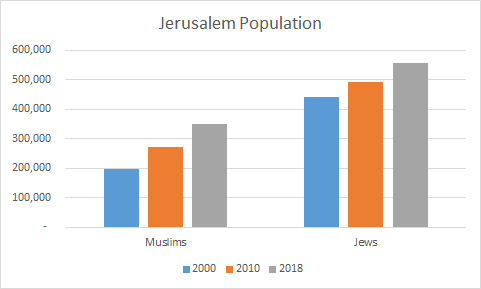
Muslim population of 196,900; 272,000; 349,600 and 439,600; 491,800; 555,800 for Jews

Security

Israel has the terrorists group Hezbullah in Lebanon and Hamas in Gaza at its borders. Iran, the leading state sponsor of terrorism which supports both groups, has threatened to wipe Israel off of the map. The Obama administration gave over $100 billion to Iran and a legal pathway to nuclear weapons threating the survival of Israel.

  • Bunker Busters. The United States is one of the few countries that has the weaponry to blast underground facilities. These armaments should be sold to Israel to enable it to deal with the nuclear facilities in Iran and the missiles in Lebanon.
  • Palestinian Terrorists. The US should make clear that no terrorist group will be allowed in a Palestinian government. Should any group not give up all weapons to the Palestinian Authority and commit to recognize Israel in becoming part of a Palestinian government, the US should cease all aid in all forms to the Palestinians, and label the PA itself a terrorist group.
  • Terrorism in Territories. The State Department under the Obama administration gave scant attention to terrorism that was not committed in Israel proper. Such approach fueled additional terror. It is bad enough when the UN and BBC blame the victims, but the US should make clear that any and all terrorism committed anywhere is appalling and commit to fighting terrorism aggressively, something the Obama administration only did for other countries.

Anti-Semitism

Anti-Semitism is found throughout the world both in official laws and in civilian actions. The United States should encourage other countries to join Israel in routing this global scourge.

  • Jews Should Never Be Banned. The world has a long history of placing Jews in ghettoes and determining where they can and cannot live. It’s a disgrace. Israel is not the world’s Pale of Settlement and Jews should be allowed to live and work anywhere. Anti-settlements is anti-Semitism in its core and should be called out as such. The U.S. should call on all governments to condemn the notion of “Judaizing” a neighborhood, regardless of where it is located.
  • Anti-Kosher/Halal and Anti-Circumcision Bills. Many governments are advancing laws targeting Jews and Muslims, making it impossible to live peacefully as neighbors. The U.S. should be a beacon of openness by calling out anti-circumcision and anti-ritual slaughter laws which are thinly-veiled methods of getting rid of Jews and Muslims.

Overall, the Trump administration should recommit to the 2004 President Bush letter to Ariel Sharon which gave Israel assurances to take risks for peace. The formula led Israel to give up Gaza which rapidly became a hotbed for radical Islam and terrorism. There is no chance Israel will take any future actions to make additional concessions to the PA which not only give it moral support but guarantees for its dignity and security.

The politeness of politics catering to anti-Semites has hindered the promotion of Jewish rights for too long. The Trump administration can still take actions to right these historical wrongs.


Related First One Through articles:

How the US and UN can Restart Relations with Israel

The Parameters of Palestinian Dignity

Squeezing Zionism

Anti-“Settlements” is Anti-Semitism

Subscribe YouTube channel: FirstOneThrough

Join Facebook group: Israel Analysis and FirstOneThrough

The NY Times ‘More Confrontational Approach’

The year of ‘protests’ has many themes and at least as many defenders.

The New York Times wrote about the Black Lives Matter protests in September 2020 that “Some Protests Against Police Brutality Take a More Confrontational Approach.” The Times did not say that they were violent, just that the protest were more assertive, “moving into white neighborhoods where activists demand that people choose a side.” It seems that the paper believes that a protest is simply ‘more confrontational’ when it directly challenges any-and-all to pick a side.

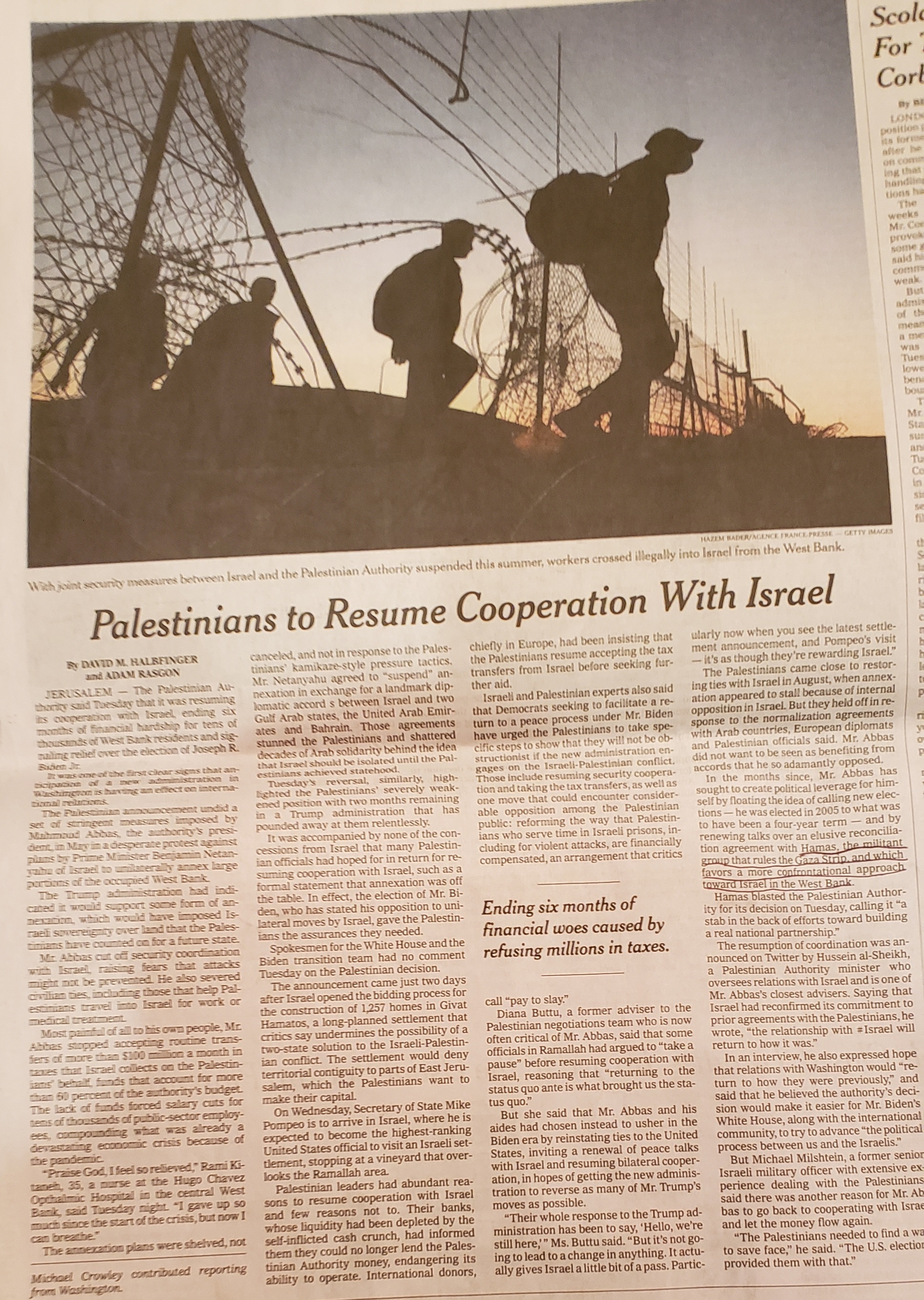
The Times used the same language in a piece on November 18, 2020 about Palestinians dealing with Israel. In describing Hamas, the article wrote that Hamas is a “militant group that rules the Gaza Strip, and which favors a more confrontational approach toward Israel in the West Bank.

Calling Hamas a “militant group” instead of a designated terrorist group is an established priority for this left-wing paper. Using the new choice phrase of a “more confrontational approach” seems to reorient the reader that Hamas is an activist group moving beyond its base in Gaza into the West Bank. It’s a red herring to mislead readers about Hamas’ desire to destroy Israel.

The Times also used its platform to obfuscate U.S. laws such as the Taylor Force Act which was passed to pressure the Palestinian Authority to stop paying people to kill Israelis. The paper wrote about Democrats trying to get Palestinians to make changes including “reforming the way that Palestinians who serve time in Israeli prisons, including for violent acts, are financially compensated, an arrangement that critics call ‘pay-to-slay.’” That’s quite a bit of verbosity to get around stating that U.S. law prohibits rewarding violence, a gross human rights violation. Instead, the Times portrayed the objection as stemming from “critics,” likely those who oppose ‘protests.’

The New York Times itself is actively participating in a “more confrontational approach” to causes it opposes, a list which grows by the day, as enumerated by its alt-left readership.


Related First One Through articles:

The New York Times Refuses to Label Hamas a Terrorist Group

New York Times Recharacterizes Hamas as a Right-Wing Terrorist Group

The Proud Fathers of Palestinian Terrorists

Subscribe YouTube channel: FirstOneThrough

Join Facebook group: Israel Analysis and FirstOneThrough
France’s Hypocrisy Expelling Radical Extremist Non-Citizens

The people of France suffered two terrible attacks in a short period of time. On October 16, 2020, a French schoolteacher was beheaded by an 18-year old Muslim refugee from Russia who was offended by the teacher’s display of a cartoon of the Islamic Prophet Mohammed. Then on October 29th, another Muslim man stabbed three people to death in a church in Nice.

These were not the first attacks on French soil by Islamic radicals. On July 26, 2016 two Muslim men who affiliated with ISIS attacked people in a church in Normandy, slitting the throat of the priest. Two weeks earlier, during Bastille Day celebrations, a truck driven by a Tunisian Muslim man killed 86 people and injured hundreds.

In response to the attacks, French President Emmanuel Macron announced a decision to expel 231 foreigners who are believed to hold extremist religious beliefs. According to Reuters, France defines extremists as “people who, engaged in a process of radicalisation, are likely to want to go abroad to join terrorist groups or take part in terrorist activities.”

While several Muslim countries condemned the stated intentions and related comments by Macron, most of the world remained silent. UAE’s Minister of Foreign Affairs actually said he agreed with him.

The hypocrisy is a bit rich as France had just protested the planned expulsion by Israel of a French-Palestinian who is an active member a terrorist group.

Salah Hamouri is an active member of the Popular Front for the Liberation of Palestine, a designated terrorist group by Israel, the United States and the European Union. The group has killed scores of people through the decades, including 17-year old Rina Shnerb who was on a peaceful hike with her family in August 2019.

Rina Shnerb, 17, killed while hiking with her family by members of the terrorist group, PFLP

Hamouri had already served time in prison for trying to kill the Chief Rabbi of Israel, Ovadyah Yosef some years before. After being released from prison as part of the prisoner exchange for Israeli soldier Gilad Schalit, Hamouri continued his involvement with the PFLP terrorist group. In light of those activities, in early September 2020, Anna Azari, Israel’s Foreign Ministry Deputy Director-General for Europe, told French Ambassador to Israel Eric Danon that Hamuri’s residency was being revoked, adding “Israel is committed to fighting terror[sic] and is acting against the terrorists among us.

The stench of French hypocrisy now evicting 231 foreigners it views as radicals while simultaneously protesting Israel’s expulsion of a single active member of a terrorist group cannot be masked by fancy perfumes. The true intention must be made clear: France isn’t standing in solidarity with Palestinian Arabs; it doesn’t want to take in another radical Muslim, even a French-Palestinian from Jerusalem.


Related First One Through articles:

Israel’s Peers and Neighbors

Grading Evil and Evil Doers

Germans have “Schadenfreude” Jews have “Alemtzev”

Israel and the US Collaborate on Emergency Response

What’s “Left” for The New York Times?

There’s Nothing Worse Than Terrorism in France

The New Salman Abedi High School for Boys in England and the Mohamed Lahouaiej Bouhlel Soccer Tournament in France

Active and Reactive Provocations: Charlie Hebdo and the Temple Mount

Je Suis Redux

I’m Offended, You’re Dead

Subscribe YouTube channel: FirstOneThrough

Join Facebook group: FirstOne Through Israel Analysis

Upside Down for Sudan

In the excitement stemming from the United Arab Emirates and Bahrain forging a path towards peace with Israel, people have speculated which Arab countries would be next. Sudan has been mentioned and the media has speculated that the United States might remove the country from states sponsoring terrorism to help make such normalization happen.

This is all a terrible idea. Sudan needs Israel, not the reverse.

Geography. The UAE and Bahrain both sit opposite the Persian Gulf from Israel’s nemesis, Iran. The proximity to that country may prove vital in dealing with such leading state sponsor of terrorism which has called for Israel’s destruction. Conversely, Sudan is over one thousand miles in the opposite direction.

Military. Both the UAE and Bahrain have over 5,000 U.S. military personnel stationed in the countries. Neighboring Kuwait and Qatar have a combined 25,000 U.S. military personnel. Coordinating forces against Iran with established U.S. military bases is an obvious advantage in stabilizing the region. Sudan has no such U.S. military presence.

Wealth. The UAE and Bahrain are very wealthy countries, with the GDP per capita of $43,000 (slightly ahead of Israel at $42,000) and $24,000, respectively. This compares to a Sudanese GDP per capita of roughly $977. The investment and trade possibilities with the Gulf states are significant while Sudan will be seeking aid from Israel, not trade with Israel.

Culture. The UAE and Bahrain are far from beacons of democracy with liberal policies, however, they are light years ahead of Sudan. Consider that each gulf kingdom still has the death penalty which Bahrain uses for premeditated murder and treason, and the UAE uses for rape, drug trafficking and armed robbery. Meanwhile Sudan kills people for homosexuality, prostitution and apostasy (converting from Islam) – “offenses” which harm no one.

Since its founding, Sudan has been through a series of civil wars, genocides and crimes against humanity. In total, over 2 million people have been killed in Sudan during some of the most heinous actions since World War II. The country remains an unstable haven for terrorists. Today’s U.S. policy vis-a-vis Sudan is “focused on ensuring that Sudan does not provide support to or a safe haven for international terrorists. If that’s the basis for U.S. policy, there is no reason for any party to go out of its way to advance normalization with this failed state.

Should Sudan want to join civilization, it can pay the hundreds of millions owed to the victims of terror, remove the penalty of capital punishment for apostasy and homosexuality, and end its systemic anti-Semitism by recognizing the Jewish State. If not, the U.S., Israel and the world will do quite well without this particular trading partner and vote at the United Nations.

Aftermath of violent clashes in Darfur on 30 December 2019

Related First One Through articles:

Conditional U.S. Support in The Middle East

Naked Trades in the Middle East

Dancing with the Asteroids

Israel and Wars

Subscribe YouTube channel: FirstOneThrough

Join Facebook group: Israel Analysis and FirstOneThrough

Denied No More

There are many parallel and conflicting narratives in the Middle East. The impossibility that items can be both parallel and perpendicular at the same time in geometry is de rigueur  in matters revolving Israel. Anti-Israel lies are crafted by the liberal media while anti-Arab facts cannot be uttered.

The New York Times ran a lead editorial on September 17, 2020 about the Israeli-Arab Abraham Accords titled “A Welcome Middle East Development.” However, the contents of the article would have better deserved the title “You’re Not Worthy, You’re Not Worthy” stating that neither Israeli Prime Minister Benjamin Netanyahu nor U.S. President Donald Trump deserve a Nobel Peace Prize for the remarkable milestone.

The New York Times lead editorial September 17, 2020

A common lie repeated in the Times opinion piece was captured as it attempted to summarize its thoughts belittling the agreements:

“But a true Middle East peace deal will require an accommodation with the 4.75 million Palestinians in the West Bank and Gaza, a people who have been denied a homeland for more than seven decades.”

The lies and inversion in the phrase “a people who have been denied a homeland” are so noxious, I imagine the entire Times editorial board has it as screen savers on their computers and phones.

The Palestinians have homes; they don’t have a country. The notion that Palestinians are refugees running from country to country similar to Syrians fleeing their country set on fire by a genocidal maniac, or like the Rohingya Muslims tossed and unwanted in Southeast Asia is outrageous. The Arabs in Jericho have lived there for decades. Even those Palestinians whose grandparents were from Jaffa who now live in Jericho – considered “refugees” by the United Nations – are in their “homeland” living among their cousins.

The Palestinians haven’t been denied, they have refused. The Arabs in Palestine were welcomed to live as equal citizens by Israel in 1948. The Jordanians annexed the West Bank and offered the local Arabs Jordanian citizenship in 1954. The Arabs in eastern Jerusalem have been offered Israeli citizenship since 1980. But it is the Palestinian Arabs themselves who have refused both citizenship in another country and every peace agreement offered by Israel for the past seven decades.

It is the Jews who have been denied. For centuries, Jews were denied their homeland in Israel, living as unwanted and abused guests who suffered from pogroms, libels, expulsions and a Holocaust. They finally were able to return, only to be denied any rights or welcome by the Arabs who fought to expel them. The Palestinian and surrounding Arabs fought wars and intifadas for seven decades in efforts to rid the land of Jews, while the Arabs simultaneously used the United Nations and global media – like The New York Times – to deny Jews their history and rights in their homeland.

The time for denial is over.

  • The Jews have reclaimed their homeland.
  • The U.A.E., Bahrain and hopefully many more Arab states will no longer deny Jews their history and rights in that homeland nor will they deny the Jewish State’s existence as they normalize relations.
  • And the world will no longer swallow the lies that Palestinians are homeless, living in foreign unknown lands and denied the ability to become citizens. The Palestinians’ refusal to make peace with Israel is of their own making, not as portrayed by The New York Times, as passive victims who are being “denied a homeland.”

The Abraham Accords are a time to celebrate the termination of the hateful and stale thinking that denied peace in the region.


Related First One Through articles:

Time to Dissolve Key Principles of the “Inalienable Rights of Palestinians”

The Arab Spring Blooms in the UAE

UNRWA Artificially Extends Its Mandate

The Fourth ‘No’ of the Khartoum Resolution: No Return of Palestinian Refugees

Time to Define Banning Jews From Living Somewhere as Antisemitic

Related First One Through videos:

Aliyah to Israel (music by The Maccabeats)

Judea and Samaria (music by Foo Fighters)

Ethiopian Jews Come Home (music by Phillip Phillips)

Jewish Migration Since 1900 (music by Diana Ross)

1001 Years of Jewish Expulsions (music from Schindler’s List)

Subscribe YouTube channel: FirstOneThrough

Join Facebook group: FirstOne Through Israel Analysis

Every Picture Tells a Story: Have Israel and the US Advanced Peace?

After 26 years of seeking a normal place in the Middle East, Israel struck two normalization agreements in a single day with the help of the United States. The Wall Street Journal broadcast the news while The New York Times hid it in the shadows.

Cover page of The Wall Street Journal, September 16, 2020

Featured prominently on the WSJ cover page in a large color photo were leaders of three foreign countries surrounding U.S. President Donald Trump standing on the balcony of the White House. With smiles and waves, the four gentlemen conveyed the new warm feelings they had for each other, with the imprint of the presidential seal.

The caption was just as positive: “SEALED: Israel’s Prime Minister Benjamin Netanyahu, President Trump, Bahrain’s Foreign Minister Abdullatif bin Rashid al-Zayani and the United Arab Emirate’s Foreign Minister Abdullah bin Zayed al Nahyan wave from the White House balcony after the signing ceremony Tuesday. The pact is seen as the foundation for a broader alignment against Iran in the region.” The top of the picture had a bold header “Israel, Two Gulf States Sign Peace Deal at White House”

A moment for celebration with each other and the whole world.

The New York Times had a very different view of the two pacts.

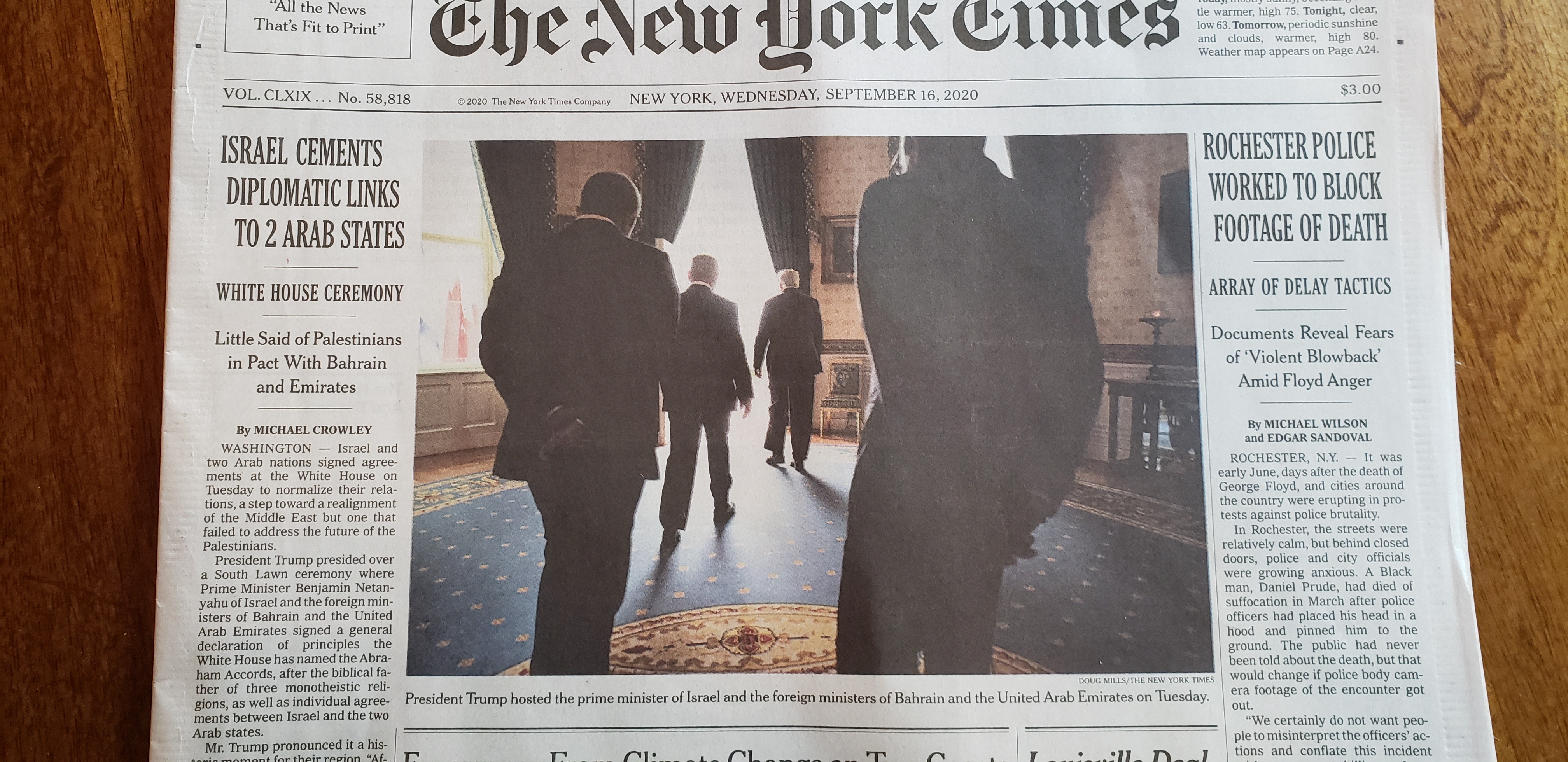
Cover of the New York Times, September 16, 2020

The Times also gave the story a large photo – but it was impossible to make out any of the individuals or even if the photo was in color, as it showed the backs of the four men in a dark room.

In contrast to the WSJ picture of people standing together, the Times showed a disjointed group. The Journal showed global leaders happily standing before the world while the Times made it appear that the four men were reluctantly engaged in a farce.

The caption of the NYT picture was a short single line: “President Trump hosted the Prime Minister of Israel and the foreign ministers of Bahrain and the United Arab Emirates on Tuesday.” None of the foreign leaders had their names mentioned – perhaps not a surprise as their faces were not shown either. The caption did not even mention that Trump hosted these world leaders TO SIGN A NORMALIZATION AGREEMENT, the first Israel signed with an Arab country in 26 years!

The New York Times could not give the historic agreements – nor the leaders it despises in Trump and Netanyahu – the limelight. It belittled the milestone and the men.

But in reality, the pictures laid bare the disgraceful anti-Trump, anti-Israel and anti-peace bias of The New York Times.


Related First One Through articles:

Every Picture Tells a Story: Goodbye Peres

Every Picture Tells a Story: Anti-Semitism

Every Picture Tells a Story: No Need for #MeToo for Palestinians

Every Picture Tells a Story: Fire

Every Picture Tells a Story: The Invisible Killed Terrorists

Every Picture Tells a Story: Arab Injuries over Jewish Deaths

New York Times’ Lost Pictures and Morality for the Year 2015

Every Picture Tells a Story: Versions of Reality

Every Picture Tells A Story: Only Palestinians are Victims

Every Picture Tells a Story: The Invisible Murdered Israelis

Every Picture Tells a Story- Whitewashing the World (except Israel)

The New York Times’ Buried Pictures

Every Picture Tells a Story, the Bibi Monster

Every Picture Tells a Story, Don’t It?

Subscribe YouTube channel: FirstOneThrough

Join Facebook group: FirstOne Through Israel Analysis

Naked Trades in the Middle East

The template for forging peace between Israelis and Arabs for the last many years was based on the notion of trading one item for another. The idea was for Israel to give land to Arabs and would get peace or normalization in return. The formula worked in the 1979 peace treaty between Israel and Egypt and to a lesser extent in the 1994 treaty between Israel and Jordan. During the period of the Oslo Accords, the same idea was advanced between Israel and the Palestinian Authority.

After signing of the Oslo II Accords in September 1995, the Palestinian Authority received several towns and cities from Israel. This was the first time that local Palestinian Arabs got to rule themselves in their history. It was orchestrated as a test to see if the PA could build a functional government and establish controls to enable and enforce a peace agreement with Israel. The five year period ending September 2000 was designed to test the thesis and then hand considerable more territory to the PA.

The Oslo effort proved a complete failure.

The five year period between 1995 and 2000 was marked by intense violence and terrorism. It was capped when Yasser Arafat launched the Second Intifada in September 2000 when the negotiations did not yield 100% of his stated demands. Years of bloodshed began to slow to a trickle when Israel constructed a security barrier separating many of the towns in the “West Bank” from which the Palestinian terrorists emerged.

As the violence ebbed, Israel sought to implement a long-term solution, even without a peace partner. Israeli Prime Minister Ariel Sharon opted to unilaterally withdraw all Israeli troops and civilians from Gaza in 2005, with the assurances from U.S. President George Bush in 2004 that Israel’s borders would not follow the 1949 Armistice Lines and account for current realities. Israel took the action and asked for nothing from the Palestinians.

This first naked trade in the Arab-Israeli conflict was a failure. Within two years of withdrawing from Gaza, the terrorist group Hamas seized control and used the area as a launching pad for terrorism against Israel including three full wars in 2008, 2012 and 2014.

Israel pulled civilians from their homes in Gaza in 2005. It asked for nothing from the Palestinians in return.

It took many years for another one-way trade to take place.

In 2017, U.S. President Donald Trump announced that the United States officially recognized Jerusalem as Israel’s capital and would relocated its embassy to the city. While the U.S. Congress had approved such measure in 1995, every president deferred such recognition and move, hoping to couple such actions with something for the Palestinians. However, in light of the acting-President of the PA’s refusal to engage with the U.S. administration, Trump moved forward with the one-party deal.

The politicians and pundits who worked the region for years derided the move. Former U.S. Secretary of Defense Robert Gates said the move was “ill-advised” and former Secretary of State John Kerry said that Trump wouldn’t survive a year in office. Yousef Munayyer, executive director of the U.S. Campaign for Palestinian Rights said that the move would fuel the “narrative of extremists who want to paint the Western world in terms of a religious war.

Those predictions proved incorrect. There was no outbreak of violence throughout the Muslim world in reaction to the announcement or the relocation of the embassy. The naked trade rectified a historic wrong and did not lead to mayhem. It led to additional positive actions like Guatemala, Serbia and Kosovo recognizing Jerusalem as Israel’s capital.

The success of the 2017 Trump action has enabled the quick adoption of additional one-way trades: the 2020 normalization of relationships of both the United Arab Emirates and Bahrain with the Jewish State, to be signed in Washington, D.C. on September 15.

Palestinians were apoplectic that fellow Arab countries would recognize Israel before a peace agreement with the PA was signed. While the Palestinians were angered by the Israeli peace treaties with Egypt and Jordan, each Arab country at least got tangible benefits from their respective agreements. Such treaties were therefore viewed as not only understandable, but clever. Egypt and Jordan essentially gave away nothing – just a “hudna,” a ceasefire which could be over-turned at any time – while they obtained real immediate benefits. Palestinians were therefore able to convince themselves that they were still a priority for the broader Arab nation.

But these naked trades by the UAE and Bahrain have laid that lie bare. The two gulf emirates are receiving nothing in the near-term but the prospects of gaining access to Israeli and American technology and military capabilities. The trade was for a long-term situational benefit, much like Israel had assumed leaving Gaza in 2005 would yield.

It would appear that we have entered a new stage of diplomacy in the Middle East which is not based on near-term raw cost-benefit analyses but rather on long-term situational positioning. Goodbye land-for-peace. Hello aspirations for the future.

Let’s all hope that this evolution to naked trades will produce an enduring peace for the region.


Related First One Through articles:

Enduring Peace versus Peace Now

The Peace Proposal Monologues

The Arab Spring Blooms in the UAE

Trump Reverses the Carter and Obama Anti-Israel UN Resolutions

Schrodinger’s Cat and Oslo’s Egg

Republicans Do Not Believe There is Any “Occupation”

Netanyahu Props Up Failed Arab Leaders

The Shrapnel of Intent

Nikki Haley Channels Robert Aumann at the UN Security Council

Abbas’ European Audience for His Rantings

Time to Dissolve Key Principles of the “Inalienable Rights of Palestinians”

Subscribe YouTube channel: FirstOneThrough

Join Facebook group: FirstOne Through Israel Analysis

The Cultural Appropriation of the Jewish ‘Promised Land’

Various segments of western society have become critical about “cultural appropriation” in which the majority group adopts customs of another group without explicitly acknowledging its origins, as to do so would be both stealing and effectively wiping out the essence of the minority culture. The issue is even more concerning when the majority group’s acts of appropriation specifically target religious and holy items of minority groups.

There is no greater example of this trend than the broad theft of the Jewish “Promised Land.”

In Genesis 12, God tells Abraham to leave his home “to the land that I will show you.” When he passed through Shechem (Nablus) God said “I will assign this land to your offspring.” It is a speech which God would repeat throughout the Bible to Abraham, Isaac, Jacob (Israel) and the Children of Israel, that this specific land was promised “as an everlasting possession.” (Genesis 17:8) It is a core belief of Judaism.

Over time, non-Jewish musicians and poets would use the phrase “Promised Land” as a generic destination without noting its specific identity to the land of Israel for Jews. Chuck Berry sang about it (later covered by Elvis) in reference to California as a destination for his music to reach the masses. Bruce Springsteen sang about the “promised land” as a place of yearning, a mental and spiritual destination beyond current problems.

When Arab invaders brought Islam into Israel in the seventh and eighth centuries, they seized Jewish holy sites like the Tomb of the Jewish Matriarchs and Patriarchs in Hebron and turned it into a mosque. They built the Dome of the Rock atop the Jewish Temple Mount. The Muslims even adopted the notion of a “waqf” as a religious holy space. As opposed to Jews who viewed the land of Israel as holy because it was promised to them by God, Muslims believe that anywhere Muslims conquered and established the supremacy of Islam became a Muslim holy land. As such, Muslims attempted to erase the physical Jewish Promised Land as a land of their own.

Politicians mostly avoid using the term “Promised Land.” They might note that Israel is a “Holy Land” which is “sacred to Jews and Christians and Muslims” as President Obama noted in a national prayer breakfast in 2014, stripping the uniqueness of the Promised Land for Jews. When Obama did use the term “Promised Land” it was as a metaphor for when Black children will have full equality to live in an America devoid of bigotry and racism.


The worst and most feared element of cultural appropriation happens constantly in regards to the “Promised Land,” in which it is either used generically as a metaphor without any connection to Jews, or when applied to the physical land of Israel, it is noted as holy to the three monotheistic faiths and not uniquely promised to the Children of Israel.

We should aspire to follow the example of Rev. Martin Luther King Jr. whose final speech in 1968 pulled together the story of the Jewish Promised Land in connection with his desire for a more perfect society:

Something is happening in Memphis; something is happening in our world. And you know, if I were standing at the beginning of time, with the possibility of taking a kind of general and panoramic view of the whole of human history up to now, and the Almighty said to me, “Martin Luther King, which age would you like to live in?” I would take my mental flight by Egypt and I would watch God’s children in their magnificent trek from the dark dungeons of Egypt through, or rather across the Red Sea, through the wilderness on toward the promised land. And in spite of its magnificence, I wouldn’t stop there…

Like anybody, I would like to live a long life. Longevity has its place. But I’m not concerned about that now. I just want to do God’s will. And He’s allowed me to go up to the mountain. And I’ve looked over. And I’ve seen the Promised Land. I may not get there with you. But I want you to know tonight, that we, as a people, will get to the promised land!

The “promised land” is commonly used as a metaphor for a perfect society. Let’s strive for that perfection by acknowledging that its foundation is the Jewish State of Israel.


Related First One Through articles:

Martin Luther King and Zionism

The Cave of the Jewish Matriarch and Arab Cultural Appropriation

Linda Sarsour as Pontius Pilate

The Remarkable Tel Jerusalem

The Jewish Holy Land

Jews, Judaism and Israel

The Nation of Israel Prevails

“Flowing with Milk and Honey”

Today’s Inverted Chanukah: The Holiday of Rights in Jerusalem and Judea and Samaria

Subscribe YouTube channel: FirstOneThrough

Join Facebook group: Israel Analysis and FirstOneThrough

Replacing the Jordanian Waqf on The Temple Mount

After Israel defeated the attacking Jordanian army in June 1967, it allowed the Jordanian Islamic Waqf to have administrative control of the Jewish Temple Mount in the Old City of Jerusalem while Israel controlled the security of the area. In 1980, Israel officially applied sovereignty and reunited the city of Jerusalem as its eternal capital but still allowed the Jordanian Waqf to administer Judaism’s holiest site. And in Israel’s 1994 peace treaty with Jordan, the country continued to be sensitive to Jordan, statingIsrael respects the present special role of the Hashemite Kingdom of Jordan in Muslim Holy shrines in Jerusalem. When negotiations on the permanent status will take place, Israel will give high priority to the Jordanian historic role in these shrines.

However, in recent months, Jordan has come out very aggressively against Israel’s contemplated application of sovereignty over more of the west bank of the Jordan River.

In May 2020, Jordanian Prime Minister Omar al-Razzaz saidWe will not accept unilateral Israeli moves to annex Palestinian lands and we would be forced to review all aspects of our relations with Israel.” King Abdullah also said that if Israel “really annexes the West Bank in July, it would lead to a massive conflict with the Hashemite Kingdom of Jordan.

In light of the statements and contemplated reaction by Jordan, it makes sense for Israel to approach both Egypt and the Kingdom of Saudi Arabia to see if they would be interested in taking over the role of the Jordanian Waqf in Jerusalem.

Egypt has maintained a peace treaty with Israel since 1979 and there is a good working relationship with Egyptian President Abdel Fattah al-Sisi. Israel’s relationship with KSA has improved in recent years, especially because of the countries mutual distrust of Iran. As the guardian of Mecca and Medina, KSA would logically welcome the role to extend its guardianship of Islamic holy sites, and the move could be part of an important peace treaty with Saudi Arabia.

The Old City of Jerusalem including the Jewish Temple Mount/ Al Aqsa Compound during the Jewish holiday of Passover

Jordan’s threat to abandon its peace agreement with Israel is an opening for Israel to offer Saudi Arabia a place in Jerusalem and to forge a new peace agreement with the powerful kingdom. In light of the Trump Administration’s deep ties with KSA, it makes sense to advance those initiatives now.


Related First.One.Through articles:

Jordan’s King Abdullah II Fights to Retain His Throne

Oh Abdullah, Jordan is Not So Special

Time for King Abdullah of Jordan to Denounce the Mourabitoun

The Waqf and the Temple Mount

Hamas Charter, Articles 11 and 12

Subscribe YouTube channel: FirstOneThrough

Join Facebook group: Israel Analysis and FirstOneThrough

The Shrinking Modern Jewish Homeland

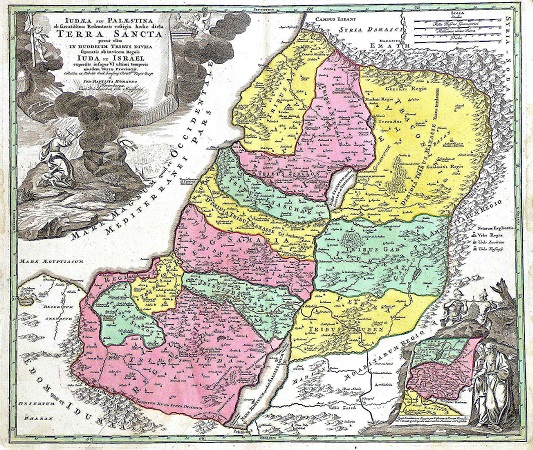
The Jewish homeland as described in the bible is well known to the entire world. Originally the land promised to the first Hebrew, Abraham, was the land west of the Jordan River. When the twelve tribes of Israel returned to the land of their forefathers after being slaves in Egypt, they took land east of the Jordan River as well.

Map of Terra Sancta, Homann, 1730

Later generations would see the Jewish homeland carved up into different footprints under various kings and rulers over 1,400 years but the configuration above remains the orientation of anyone familiar with the Hebrew bible. It also became the basis of the modern initiative to facilitate Jewish immigration back to their homeland.

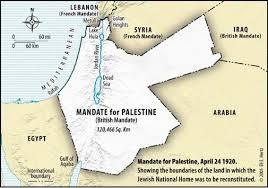
The San Remo Resolution of April 1920 became enshrined in the League of Nation Mandate of Palestine of July 1922. It sought to facilitate the “establishment in Palestine of a national home for the Jewish people” based on the “historical connection of the Jewish people with Palestine.” The mandate of Palestine roughly incorporated the land of Israel as described in the Old Testament plus additional lands.

Modern Jewish homeland per Mandate of Palestine, 1920 and 1922

Article 25 was added into the Mandate in March 1921 which gave the British who were to administer the lands, the option to separate the area east of the Jordan River to a distinct Arab state. The League of Nations approved the British request if such new state would NOT prohibit Jews from living there (“no action shall be taken which is inconsistent with the provisions of Articles 1516 and 18″). In spite of the clear language, the British did exactly that and created Transjordan in August 1922 and barred any Jews from living in the land. Not only was 77 per cent of the Jewish homeland removed by the British but they enforced an antisemitic edit on even allowing Jews to live in the land.

The British would continue to ban Jews from living in parts of their homeland.

In August 1929, Arabs engaged in a series of deadly pogroms in the holy land. The Jewish community of Hebron was massacred and the British response was to evacuate Jews from the city and forbid them from returning. The British commissioned the Shaw Report in 1930 which advocated for limiting the number of Jews in Palestine and their role in government:

  • it is our view that, among a large section of the Arab people of Palestine,
    there is a feeling of opposition to Jewish immigration, that this feeling is well founded in that it has its origin in the known results of excessive immigration in the past and that, given other and more immediate causes for disturbance, that feeling would undoubtedly be a factor which would contribute to an outbreak [of violence]…. It is clear that His Majesty’s Government should at an early date issue a clear and definite declaration of the policy which they intend to be pursued in regard to the regulation and control of Jewish immigration to Palestine.
  • “we would suggest that His Majesty’s Government should re-affirm the statement made in 1922 that the special position assigned to the Zionist Organization by the
    Mandate does not entitle it to share in any degree in the government of Palestine.”

The Jewish homeland was continuing to be chipped away by the British in regards to how many Jews could live in Palestine, where they could live and their role in government.

After more Arab riots in 1936, the British established the Peel Commission which concluded the Mandate was unworkable and suggested dividing the land into a section where the Jews would be allowed to live. As the proposal worked its way through the British system with Arab input, the end result was the 1939 White Papers which capped Jewish immigration to 75,000 people over five years just as the Holocaust began in Europe, condemning tens of thousands of Jews to death.

After Israel declared itself an independent country in 1948, five Arab armies invaded Israel to destroy it. At war’s end, the Arab army of Jordan seized the eastern part of the holy land and expelled all Jews, while the Egyptian army seized the Gaza Strip. In 1950, Jordan illegally annexed the land it took and in 1954, extended its ban on Jewish citizens beyond Transjordan into the “West Bank.”

Israel recaptured parts of the Jewish homeland in 1967 after surrounding Arab countries again sought the annihilation of the Jewish State. Many countries refused to recognize the rights of Jews to live in those lands which had become Judenfrei. Israel uprooted all Jews from the Gaza Strip in 2005 and in 2016, the United Nations Security Council declared that any Jew living east of the 1949 Armistice Lines between Israel and Jordan did so illegally, even in eastern Jerusalem.

First the British worked with the Arabs to shrink the Jewish homeland in regards to land where Jews could live, the number of Jews who could live there, and the role of Jews in government, making the notion of Jewish sovereignty questionable. Later the Arabs asserted for themselves that there was no Jewish history or rights in the land as they fought to completely dismantle the Zionist project in theory and practice. Then the United Nations supported the Arab cause to officially shrink the Jewish homeland.

The attack on the Jewish homeland is ongoing and without Jewish resistance, the Jewish homeland would disappear completely. #100YearsofZionistResistance.


Related First One Through articles:

The Original Nakba: The Division of “TransJordan”

Recognition of Acquiring Disputed Land in a Defensive War

When You Understand Israel’s May 1948 Borders, You Understand There is No “Occupation”

Subscribe YouTube channel: FirstOneThrough

Join Facebook group: Israel Analysis and FirstOneThrough