
Nearly $90 billion. That is the combined announced and reported value of nine major acquisitions of Israeli-founded technology companies by American buyers, completed or announced during 2026.
Among them are some of the largest acquisitions in Israeli history. And they have occurred while Israel has been fighting a multi-front war, its citizens repeatedly called into military service, and activists around the world demanding that businesses boycott the Jewish state.
Google completed its $32 billion acquisition of Wiz in March, the largest Israeli technology exit ever. Palo Alto Networks completed its approximately $25 billion acquisition of CyberArk in February, the second largest. ServiceNow acquired Armis for $7.75 billion in April.
Three transactions totaling nearly $65 billion, all completed in the same year. The agreements were reached in 2025, during the war, and closed in 2026.
To appreciate the scale, consider that Intel’s $15.3 billion acquisition of Mobileye in 2017 had long stood as Israel’s benchmark technology exit. Nvidia’s approximately $7 billion acquisition of Mellanox in 2020 was another landmark. Wiz and CyberArk have now each surpassed Mobileye, while Armis exceeded Mellanox.
And the acquisitions have continued.
| Israeli company | American buyer | Transaction value | 2026 status |
|---|---|---|---|
| Wiz | $32.0 billion | Completed | |
| CyberArk | Palo Alto Networks | $25.0 billion | Completed |
| Armis | ServiceNow | $7.75 billion | Completed |
| Decart | Amazon | $7.5 billion | Announced |
| Varonis | Proofpoint | $6.3 billion | Announced |
| BioCatch | Visa | $2.4 billion | Announced |
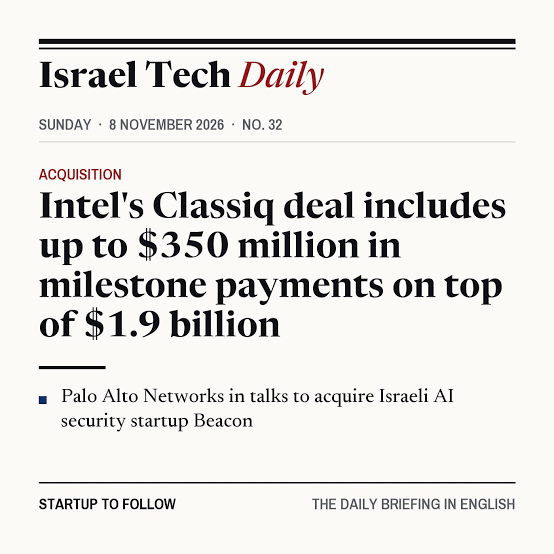
| Classiq | Intel | ~$2.3 billion | Announced |
| Q.ai | Apple | ~$1.6 billion | Completed |
| D-Fend Solutions | Motorola Solutions | $1.5 billion | Announced |
The list extends beyond these nine companies. CTech has tracked roughly 90 Israeli technology acquisitions and exits through early November, demonstrating that the activity reaches well beyond the handful of multibillion-dollar transactions dominating the headlines.
The activity is particularly remarkable given the conditions under which Israeli companies have operated.
Israel has a citizen army. Its engineers, programmers, executives and entrepreneurs are also soldiers and reservists. Since October 7, 2023, many have been called away from their families and businesses, sometimes for months, sometimes repeatedly. Companies have had to manage research and development, customer commitments, international operations and new business while portions of their workforces were serving in uniform.
A software developer can be called away from a product launch. A manager responsible for international customers can suddenly find himself commanding soldiers. A founder raising capital can be required to return to military service.
Yet Israeli businesses have continued to develop technologies, attract customers and secure acquisition offers at historic valuations.
American corporations are not simply purchasing promising ideas. They are acquiring functioning businesses with customers, intellectual property, specialized engineering capabilities and technologies that can be integrated into their global operations.
Google wanted Wiz’s cloud-security capabilities. Palo Alto Networks sought CyberArk’s identity-security platform. Intel is pursuing Classiq’s quantum-computing software. Visa wants BioCatch’s behavioral intelligence technology to strengthen fraud prevention. Motorola Solutions sees value in Israeli counter-drone technology.
Israel’s technology ecosystem has been built over decades through universities, research institutions, private investment, military technological experience and an entrepreneurial culture accustomed to solving difficult problems. The connections between intelligence, cybersecurity, engineering and commercial innovation have helped produce companies that compete in markets far larger than Israel itself.
The result is a country of roughly ten million people creating businesses that some of the world’s largest corporations are willing to pay billions to own.
And the interest is not limited to a few spectacular acquisitions.
According to IVC-LeumiTech, American buyers accounted for $11.2 billion across 70 Israeli technology exits through the third quarter of 2026, representing approximately 70% of the value of transactions below $5 billion. That excludes the enormous Wiz, CyberArk and Armis deals, among others.
Meanwhile, campaigns to boycott Israel have urged corporations, investors and universities to disengage from Israeli institutions and businesses. Some have sought to make commercial relationships with Israel a reputational liability. Yet the executives responsible for some of America’s largest technology companies have reached a different commercial conclusion.
The willingness to make these investments during a prolonged war is particularly revealing. Buyers must evaluate operational risks, employee availability, business continuity, customer retention and future growth. They know the circumstances in which these companies operate. They are proceeding anyway.
“”What I find with Israeli companies is that they’re led by extraordinary engineering talent who also have really great leadership and management talent. That’s one thing that I see out of the founder cohort each year, is that it’s the best of the best.” – Karl Mattson, Squared Circle Ventures
Once acquired, Israeli innovations become components of products and services delivered by Google, Nvidia, Intel, Palo Alto Networks, Visa and other global enterprises. Their technologies reach customers who may never realize that the underlying capabilities originated in Israel.
Israel’s enemies have spent years trying to make the country economically untouchable. Yet American corporations have spent tens of billions of dollars acquiring its technology, even while its citizens fight a multi-front war.
The boycott movement wants a world without Israeli technology. American business is building a future with more of it.


