For decades, Palestinians have believed there were three paths to statehood—and they pursued them simultaneously.
1. Violence. Hamas, Islamic Jihad, Fatah’s militias and several Palestinian Arab terrorist groups waged terror wars, convinced that bloodshed brought gains: the First Intifada led to the Oslo Accords; the Second Intifada drove Israel from Gaza and parts of the West Bank; the 2021 riots were hailed for halting evictions in Sheikh Jarrah. The October 7 massacre, backed by roughly 75% of Palestinians, was the latest in that grim pattern.
2. International Pressure. Even as rockets fell, Palestinian allies abroad pressed boycotts, divestment, sanctions, and United Nations resolutions, seeking to isolate Israel diplomatically and economically until it yielded territory.
3. Negotiations. The Palestinian Authority claimed to prefer talks to gain legitimacy and foreign aid—but insisted on maximalist demands: all the West Bank, all of eastern Jerusalem, a Jew-free Palestine, and a mass “right of return.” Yasser Arafat walked away from a state in 2000 and launched the Second Intifada instead. His successor, Mahmoud Abbas, also spoke of peace while undermining it—keeping the notorious “pay-to-slay” stipends for terrorists’ families and, in a January 2018 speech, blessing those who chose violence even as he professed support for diplomacy.
Polling has consistently shown the order of Palestinian preference: violence first, global pressure second, negotiations last.
The Cost of Failed Strategies
Both violence and sanctions have brought suffering to Palestinians themselves. Suicide bombings and rocket wars prompted Israel to build the security fence, which restricted movement and economic activity. The October 7 attack provoked a massive war in which Gaza was devastated and Hamas decimated. Attempts to use international pressure backfired as well, leading Israel to withhold funds from the PA and tighten restrictions.
Israel fights like a cornered raccoon—fiercely, without backing down when attacked. Every round of violence has left Palestinians weaker and poorer.
In the recent war, Israel scored a double victory: It destroyed Hamas’s military capability, killing an estimated 25,000 fighters, and it refused to bow to global pressure, pressing on despite UN condemnations, ICC threats, and warnings of diplomatic isolation.
This shattered the long-held belief that if terror failed, the world could still coerce Israel into retreat.
A New Reality — and a Call to the Arab World
The old strategies of terror and economic warfare have failed and only deepened Palestinian misery. The third path—real negotiations—remains the only way forward.
Israel and the United States now hope the Arab world will engage Israel constructively, encouraging Palestinian leaders to abandon impossible UN demands and accept the reality of Israel’s permanence. Clinging to maximalist positions will only bring more rounds of bloodshed and despair.
And an Alternative Reality — Coming for Diaspora Jews
While Israel feels that it may have finally fought a war that could lead to long-term peace, there are those who still cling to eradicating the Jewish State. The international “Free Palestine” fighters do not want to see Israel holding onto the Old City of Jerusalem nor limiting the entry of millions of Arabs who claim UN’s mantle of “refugees.” The light at the end of the tunnel for them is not coexistence but a continued “Nakba,” a disaster.
So they are revamping the second front of international pressure, from targeting Israel to the soft targets of diaspora Jews.
They are chanting to “globalize the Intifada” to bring the war to every Jew and pro-Israel person and organization. The incineration of the kibbutzim in Israel on the Jewish holiday of Simchat Torah was echoed in the burning of the Jewish governor of Pennsylvania’s home on the holiday of Passover. Burning Jews alive in Kibbutz Be’eri was mirrored in burning Jews in Boulder, Colorado.
Burned kibbutzGov. Shapiro burned home
While Israel sees that it is in a strongest position in the region since its reestablishment which may finally enable an enduring peace, the anti-Israel horde has opened a new front on the global diaspora.
The international pressure of the BDS camp has not been defeated but inflamed. They are ratcheting up their smears of “apartheid” to “genocide,” and marking local Jews as co-conspirators.
While Israel won the Iranian proxies war, the Free Palestine camp is taking millions of new hostages – diaspora Jewry. Who will fight for them?
There is a disturbing trend to normalize the hatred of Jews and the Jewish State as well as to normalize the calls for and actual massacres of Jews among extremists.
No To Zionism AndCoexistence
The BDS Movement (Boycott, Divest, Sanction) provides a “anti-normalization guideline” outlining the philosophy for haters of Israel: “Normalization with/of Israel is, then, the idea of making occupation, apartheid, and settler colonialism seem normal and establishing normal relations with the Israeli regime instead of supporting the struggle led by the Indigenous Palestinian people to end the abnormal conditions and structures of oppression.” It adds that its mission is not targeting non-Jewish Israelis but “refers to Jewish-Israelis and Jewish-Israeli institutions.”
The anti-normalization camp has a range of views from only opposing the blockade of Gaza, to objecting to the presence of Jews in the West Bank, to rejecting the basic existence of a Jewish State and any Jews in the region.
The far-left’s Democratic Socialist of America is a growing anti-Zionist party in the United States in both numbers and influence. NYC-DSA asked candidates to pledge to never visit Israel, putting the group on the fringe of the extremists. The socialist site Jacobin applauded DSA’s stance which “offers a model for socialist and progressive politicians who want to take on the powerful pro-Israel lobby,” using antisemitic tropes of Jews as powerful puppet-masters.
The DSA’s own “Anti-Zionist Resolution” was greeted with tremendous support by radical jihadi groups like the Palestinian Youth Movement which penned a letter “Do not allow Zionism to be normalized within your organization. We urge the DSA to truly demonstrate its commitments to revolutionary internationalism by upholding anti-Zionism.”
Rep. Jamaal Bowman (D-NY), a member of the extremist “squad” believes in variants of this twisted approach. He voted against supporting the Israel Relations Normalization Act backing the Abraham Accords in which Israel established peaceful agreements with the UAE, Bahrain, Morocco and Sudan. He shockingly argued that Israel’s normalizing relations with Arab countries would actually undermine peace in the region.
Activist Linda Sarsour took the normalization language a step further, and argued that people shouldn’t “humanize the oppressor,” portraying Jews as non-human.
Yes To Massacres and Intifadas
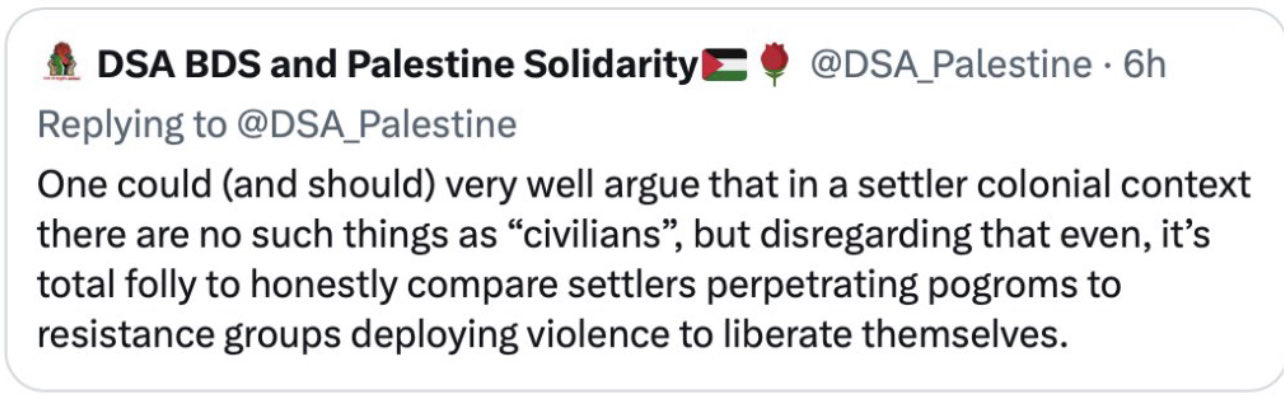
In June 2023, the DSA Tweeted that no Israeli Jews should be viewed as civilians, that all are fair game to be targeted for violence, and simultaneously granted full absolution to Palestinians violently attacking Israeli Jews.
DSA Tweet in June 2023 arguing that all Israelis are fair game to target
Rep. Ritchie Torres (D-NY15) immediately responded “Denying Israelis the status of civilians means declaring them fair game for violence and terror. If a naked justification of terror against Israel is not a sign of a demonic double standard against the Jewish State, I am not sure what would be.”
In the following days, the Institute for the Critical Study of Zionism wrote a letter to university presidents that it was “horrified by the ubiquity of messaging from our university administrations that has expressed empathy for Israeli life,” essentially blessing the raping and mutilation of Jewish women and burning Jewish families alive.
Mohammed El-Kurd, a Palestinian activist who speaks frequently on college campuses including Princeton, addressed a large march in London in January 2024 and declared “Zionism is apartheid. It’s genocide. It’s murder. It’s a racist ideology rooted in settler expansion and racial domination and we must root it out of the world. We must de-Zionize because Zionism is a death cult. Zionism is indefensible…. Our day will come but we must not be complacent. Our day will come but we must normalize massacres as the status quo.”
The calls for and support for violence have metastasized. Shellyne Rodriguez was fired from Hunter College after chasing a reporter with a machete. She was subsequently hired by Cooper Union which effectively normalized her threatening behavior. It was not a surprise that Jewish students at the school had to barricade themselves a library to avoid a mob after October 7.
The New York group Decolonize This Place, has actively called to “globalize the intifada.” It seeks to hunt diaspora Jews to confront them in their homes, offices and on the streets. Backers of the group like Cooper Union’s Rodriguez have advocated for stopping rent payments to Jews in a new form of BDS of Zionists.
Some people switch back-and-forth between advocating for violence and backing away from it. El-Kurd followed his fiery rhetoric calling for massacres to be normalized tweeting that he misspoke. Another extremist, Manolo De Los Santos from the People’s Forum told NPR that he wouldn’t condemn Hamas’s October 7 attack, but said at an event that he would celebrate the destruction of Israel.
X feed of Jason Curtis Anderson showing Manolo De Los Santos telling a cheering crowd that the destruction of Israel will be the beginning of the destruction of capitalism everywhere.
We are watching extremists loudly and proudly declare that their antisemitic and violent attitudes are normal, in a perverted attempt to win supporters. The radical jihadists and alt-left believe that if they can unashamedly strip Jews of their history, heritage, humanity, dignity, rights and property, the closeted antisemites will easily follow suit.
So far, it seems that they are dangerously being proved correct.
On December 23, 2016, the United Nations Security Council passed Resolution 2334. The resolution was disgraceful in several familiar respects in condemning Israel unfairly. To name just a few:
It falsely labeled a place called “East Jerusalem” which had only existed for a mere eighteen years from 1949 to 1967
It called East Jerusalem a “Palestinian territory”, when it never was anything of the sort, before, during or after 1949-1967
It proposed a “two-state solution based on the 1967 lines” when Israel and the Palestinian Authority had already signed agreements to negotiate lines without any preconceived final boundaries
Demanded that Jews be prevented from living in “East Jerusalem” and other “occupied Palestinian territory”, a blatantly anti-Semitic demand
Called for countries to treat Israel and Israeli territory differently, even though countries around the world – including the United States – do not distinguish in labeling their own products
The U.N. General Assembly (GA) had frequently made such horrible comments. What was new and alarming in this instance was that the resolution PASSED THE SECURITY COUNCIL, which may become legally binding.
As noted by the UN, “resolutions adopted by the GA on agenda items are considered to be recommendations and are not legally binding on the Member States. The only resolutions that have the potential to be legally binding are those that are adopted by the Security Council.” Further, “in contrast to the decisions made by the General Assembly, all Member States are obligated under the UN Charter to carry out the Security Council’s decisions…. As Article 25 of the UN Charter states, “The Members of the United Nations agree to accept and carry out the decisions of the Security Council in accordance with the present Charter.””
This alarming anti-Israel action managed to pass because the United States opted to abstain in the Resolution 2334 vote. Until that time, the U.S. had always voted against such anti-Israel measures at the Security Council because of possible ramifications.
This time, President Obama took this action in the final days of his administration because of lobbying from Jewish pro-Palestinian groups like J Street, and as payback for Israeli Prime Minister Benjamin Netanyahu accepting an invitation from the Republican House Speaker to speak to a joint session of Congress about the existential threat of the Iranian nuclear deal in 2015, without coordinating with the president’s office.
At that time, a senior Obama official said that Netanyahu “spat in our face publicly and that’s no way to behave. Netanyahu ought to remember that President Obama has a year and a half left to his presidency, and that there will be a price.“
Israeli Prime Minister Benjamin Netanyahu and U.S. President Barack Obama in 2015
Anti-Jewish attacks in the United States jumped 22.9% shortly thereafter in 2017, the largest spike since the FBI tracked hate crime data.
The ever-increasing number of boycotts and lawsuits against Israel, and the dramatic spike in harassment on college campuses and other locations of global Jewry, is related to Obama’s bruised ego and lobbying of alt-left groups like J Street.
New York’s 16th Congressional district has been reshaped by the latest census, and now includes more of Westchester than it had earlier, and drops sections of the Bronx which are now in NY-15 held by Rep. Ritchie Torres. The current congressman for NY-16 is Rep. Jamaal Bowman, who is facing a number of challengers in the Democratic primaries to be held on August 23rd (early voting begins August 13).
According to the non-partisan website fivethirtyeight, the newly redrawn NY-16 leans heavily towards the Democratic Party, voting for Joe Biden over Donald Trump in the 2020 presidential election by a margin of +40. That means that the Democratic primary is truly the election for this congressional seat.
One of the Democratic contenders, Vedat Gashi, spoke with me about issues of particular concern to the Jewish community.
General Background
Gashi describes himself as a “common sense” Democrat who has nothing in common with the Democratic Socialists of America (DSA) which has backed Bowman. Gashi grew up in Kosovo and came to the United States at age four. He later returned to Kosovo as an adult to work for the United Nations as the country gained its independence in the dissolution of Yugoslavia. His memories of Israel’s involvement with Kosovo – even before it became independent – left a positive mark on him.
Gashi is appreciative of the Jewish community as well. As a secular Muslim, he said he was appalled at President Trump’s so-called “Muslim ban” which would have restricted people like him from coming to the US (writer’s note: Trump did not ban all Muslims, but people from seven Muslim-majority countries, which did not include Kosovo). When Gashi went to JFK Airport to protest the ban, the first people he saw protesting were Jewish groups. These incidents gave Gashi a sense of warmth toward the Jewish community.
A full background of Gashi’s background can be found on his website. Unfortunately, there is little else on the site, such as his positions on important issues.
Vedat Gashi, running for congress in 2022 to represent NY-16
On Israel
Gashi is instinctively pro-Israel but not very well versed on specific topics.
As it relates to Bowman’s vote against supporting the Abraham Accords in April 2021, Gashi said he was “disappointed” in Bowman’s vote because the Accords clearly advanced US’s foreign policy interests. He assumed that Bowman did so because of pressure from the DSA, and Gashi used that point to highlight that he would not abide by any party orthodoxy but consider each issue as it impacted the people in his district. He added that the DSA’s comments which blamed American and NATO policies for causing Russia’s invasion of Ukraine as indicative of the far-left group’s “tenuous grasp of reality.”
Gashi said that the people behind the Boycott, Divest and Sanction (BDS) of Israel are anti-Semitic. He believes that people who call Israel an “apartheid state”, such as Bowman’s senior policy advisor Rajiv Sicora, “don’t want Israel to even exist”. In contrast, Gashi believes that Israel is the only democracy in the Middle East and is a strong American ally.
Bowman is tied to other DSA-backed politicians like Rashida Tlaib (D-MI) and Ilhan Omar (D-MN), as he votes alongside them 98% of the time. Gashi thinks that Tlaib and Omar have made many anti-Semitic comments, such as Tlaib’s screed that Jews and Zionists profit from racism “from Gaza to Detroit,” and Omar’s comments about Jews buying control of Congress and hypnotizing the world. He finds their comments “deeply racist” and offensive.
Rep. Rashida Tlaib (D-MI), Rep. Ilhan Omar (D-MN) and Rep. Jamaal Bowman (D-NY), three members of the ‘Squad’ of Democratic Socialists on November 30, 2021 in Washington, DC. (Photo by Drew Angerer/Getty Images)
Regarding Bowman co-sponsoring the May 2022 Tlaib-led legislation that called the founding of Israel a ‘Nakba’ (catastrophe), Gashi said that sponsors of such legislation do not believe Israel has the right to exist. He said he arrived at such a conclusion from being informed about how Serbs treated Kosovo. Serbs believed Kosovo to be “nothing more than a parking lot,” an empty vessel without meaning or ownership, much the way some anti-Israel people continue to look at the Jewish State today. He noted that the founding of many countries included wars and displacements but that doesn’t mean the new country shouldn’t exist.
Gashi did not have a strong opinion about “settlements.” He noted that he saw some when he visited friends in Israel several years ago, with many being fully established towns which are a far cry from what the name implies, which is a couple of shacks. He offered no opinion about whether they are legal or whether UN Resolution 2334 was appropriate.
As it relates to a number of other regional issues such as the Taylor Force Act and the Palestinian Authority’s desire for a consulate in Jerusalem, Gashi knew little about the topics.
United Nations / Iran
Gashi worked for the United Nations in Kosovo for a number of years and believes that the organization is an “unwieldy animal” with many difficult actors like Russia, however, Gashi believes that there is opportunity for the United Nations to be a positive force. During our interview, Gashi noted he was not familiar with the many resolutions and committees within the United Nations that attack the Jewish State but seemed interested to learn more.
Regarding the Iranian nuclear deal, Gashi said that “Iran achieving nuclear capacity would be a terrible outcome and needs to be opposed every which way we can, if not diplomatically, then by other means”. He added that “it is an existential problem”.
Anti-Semitism / Religion
Gashi was not familiar with the IHRA definition of anti-Semitism but stressed that “words are important.” Drawing on his experience in Kosovo, he shared that politicians were reluctant to use the term “genocide” because it would compel certain actions, even though avoiding its usage “led to more ethnic cleansing” in his home country. He did not know why President Biden agreed to the IHRA definition and then refused to enact it for Title VI to protect Jewish and Zionist students on campuses, until December 2022, which is after mid-term elections.
Gashi was also unfamiliar with Senator Diane Feinstein grilling of Supreme Court nominee Amy Coney Barrett saying “the dogma lives loudly within you and that’s of concern,” as it related to ACB’s Catholic beliefs, suggesting it would possibly disqualify her for office. He said that “all manners of good and bad deeds have been attributed to religiosity. Religiosity in and of itself, is neither good nor bad. Faith, in general, is a good thing.” He did say that Feinstein’s comment was inappropriate.
Schools / Police
Gashi would not engage in a discussion about charter schools or monies for parochial schools. He seemed more concerned about upsetting teacher unions and keeping funding inside of the public school system. Whether he would tackle the issue of prioritizing educating children rather than winning support of powerful unions remains to be seen, as he would not voice an opinion going into a Democratic primary where he is competing against a radical socialist who was formerly a teacher.
Gashi did come after Bowman about his stance to “Defund the Police.” He felt that Bowman’s endorsement of the socialist platform was dangerous for the district and country. He added that Bowman continues to lie about his comments and vote on the manner, much as Bowman clearly lied to his constituents about supporting the infrastructure bill when he voted against it.
Summary
Gashi presents as a left-leaning politician, yet far to the right and much more honest than Bowman. He is not well-versed in various issues of concern to the Jewish people in his district but seems eager to learn and approach the issues thoughtfully.
The toxic environment of America’s educational system was brought into sharp focus in April 2022, as Hamas and Harvard made pronouncements they wanted the entire world to hear.
The leader of the Palestinian Arab political-terrorist group Hamas, Yahya Sinwar declared “Whoever takes the decision to repeat this scene (of a deployment inside the mosque) will be taking the decision to destroy thousands of synagogues across the world.” In the proclamation, Hamas refreshed its mantra that its battle against Israel is a religious one, specifically against Jews around the world, as made clear in its noxious foundational charter statements such as “Our struggle against the Jews is very great and very serious,” and “Israel, Judaism and Jews challenge Islam and the Moslem people.”
Remarkably, not every country in the world has acknowledged that Hamas is a terrorist group. In November 2021, the United Kingdom and Australia finally designated all branches of the group as such and in May 2021, the Organization of American States (OAS), stated unequivocally that Hamas is a terrorist group that targets civilians which “makes the invocation of the principle oflegitimate defense by Israel essential.” Hopefully, more countries will finally join civil society and do likewise, after the latest direct threats against its Jewish citizens.
Regrettably, while the world may finally be waking up to the anti-Semitic genocidal worldview leading Palestinian Arabs, America’s liberal educational institutions are going in the opposite direction.
As anti-Semitic terrorist groups abutting Israel like Hamas and Hezbollah celebrated the murder of Israeli civilians, and liberal papers wrote about the slaughter from the terrorists point of view, Harvard University endorsed a prevailing anti-Zionist progressive stance of absolving Palestinian terrorism and supporting a boycott of Israel.
On April 29, 2022, The Harvard Crimson Editorial board wrote “In Support of Boycott, Divest, Sanction and a Free Palestine,” and opened with words of comfort for Palestinian Arabs, portraying them as non-violent victims of a brutal Israeli regime.
“We first and foremost wish to extend our sincere support to those who have been and continue to be subject to violence in occupied Palestine”
“unlawful killings that victimize Palestinians day in and day out”
“Israeli soldiers have killed nearly 50 Palestinians, including eight children, this year alone”
Not a word about Israelis slaughtered by Arab Muslims over the past few weeks.
Harvard proudly endorses a boycott of Israel, April 29, 2022
The Harvard piece never discussed Israel’s efforts to hand land to Palestinians.
In 1967, Israel decided not to annex the Gaza Strip or the “West Bank” in an effort to make peace but the Arab world responded with the infamous “Three No’s” of “no peace with Israel, no recognition of Israel, no negotiations with it” which has become the Three Denials: to deny the history of the Jews; deny the rights of the Jews; and deny the acceptance of the Jews in their holy land.
Israel would go on to hand the Palestinian Authority several cities between 1995 and 2000 and was scheduled to do much more, but the Palestinians launched the 2000 Two Percent War which killed over 1,000 Israeli civilians because Israel was only meeting 98 percent of the PA’s stated demands.
Israel gave the Palestinians Gaza in 2005, with the express direct support from the United States that “it is unrealistic to expect that the outcome of final status negotiations will be a full and complete return to the armistice lines of 1949” and that “through the establishment of a Palestinian state, and the settling of Palestinian refugees there, rather than in Israel.” Instead of using their new self-determination for peaceful co-existence, the region has become a terrorist enclave run by Hamas, which has repeatedly launched wars against Israel.
These points were completely ignored. Instead, this institution of higher learning stated its “categorical imperative to side with and empower the vulnerable and oppressed” in a situation where the “overwhelming power imbalance” rests with Israel. Israel is accused of “ethnonationalist legislation” and responsible for “human rights and international law violations and of Palestine’s cry for freedom.”
The sole Jewish state with about 7 million Jews, which is surrounded by dozens of Muslim countries and 1.8 BILLION Muslims is somehow cast as the real power player. The mental gymnastics to accuse Israel of “ethnonationalist legislation,” while simultaneously supporting the creation of a Palestinian State which demands to be free of Jews (because the presence of Jews “difficults the prospect of a two-state solution“), is so outrageous that one must be part of the Harvard elite to comprehend.
Has Harvard simply become the latest progressive institution to view every situation in a narrow construct of the party viewed as powerful and the one cast as victim? Do the millions of dollars the institution receives from Muslim countries have any bearing on its twisted perception?
Harvard acknowledged it accepted $30 million from Saudi Arabia between 2013 and 2019, and another $6 million from Qatar, which openly supports Hamas. But the Department of Education noted that the school failed to report millions of additional donations beyond that and launched an investigation.
Hamas and Harvard probably sat next to each other in grade school and passed notes about “The Zionist invasion is a vicious invasion… using all evil and contemptible ways… infiltration and espionage operations on the secret organizations… aim at undermining societies, destroying values, corrupting consciences, deteriorating character and annihilating Islam. It is behind the drug trade and alcoholism in all its kinds so as to facilitate its control and expansion” (Article 28 of the Hamas Charter) and “They obtained the Balfour Declaration, formed the League of Nations through which they could rule the world. They were behind World War II, through which they made huge financial gains by trading in armaments, and paved the way for the establishment of their state. It was they who instigated the replacement of the League of Nations with the United Nations and the Security Council to enable them to rule the world through them. There is no war going on anywhere, without having their finger in it.” (Article 22)
Hamas and Harvard are attempting to educate the world that Jews and the Jewish State are powerful forces, seeking to undermine societies as they seek greater control and expansion of land and resources. If that sounds familiar, you took Holocaust Remembrance Day seriously.
Hamas and Harvard are attempting to educate the world that Jews and the Jewish State are powerful forces, seeking to undermine societies as they seek greater control and expansion of land and resources. If that sounds familiar, you took Holocaust Remembrance Day seriously.
The war against the Jewish State began militarily at Israel’s inception, as the armies of five Arab nations invaded Israel in 1948 in a war to annihilate it. In June 1967, the Arab world attempted the same but failed spectacularly.
Since that time, the armed conflict by Muslim countries has continued with more modest ambitions, as the goal of destroying Israel is considered too remote a possibility, unless and until Iran obtains nuclear weapons. The violent attacks against Israel have mostly been about pestering and killing Jews to obtain concessions. The 1973 Yom Kippur war ushered in a willingness for Israel to hand the Sinai Peninsula back to Egypt, and Palestinian Arabs believe that the Second Intifada War made Israel abandon the Gaza Strip. The various Hamas wars from Gaza since 2008 and the political-terrorist group’s kidnapping of Israelis, secured the release of thousands of fellow terrorists and other modest gains.
The failure to destroy Israel did not make the Muslim countries accept its existence. In fact, it has done its utmost to deny its existence.
Immediately after the 1967 Six Day War, the Arab League passed the Khartoum Resolution declaring a policy of ‘Three No’s’: “no peace with Israel, no recognition of Israel, no negotiations with it.” For the Arabs, the Jewish State had a name but was to be ignored until the Arabs could prevail at destroying the foreign presence.
In the 1970’s, the Arab League enlisted allies to their cause. Leveraging their control of the oil markets, and with a former Nazi sitting as head of the United Nations, the Muslim and Arab countries got the world to pass UNGA Resolution 3379 in November 1975 that declared that “Zionism is a form of racism.” This was an attempt to deny Israel’s legitimacy broadly.
Meanwhile, faced with the impossibility of destroying Israel, the Arabs and Muslims went after Jewish “soft targets,” like plane and boat hijackings (Dawson’s Field in 1970, Rome and Vienna airport shootings in 1985, and Achille Lauro in 1985), as well as blowing up Jewish community centers (Argentina 1994) and synagogues (Turkey 1986). If people inside Israel were too difficult to kill, the Muslim world came for the Jews around the world.
While the ‘Zionism is racism’ resolution was ultimately thrown out in 1991 due to the efforts of the United States, it simmered as the Oslo Accords of 1993 and 1995 anticipated a peace deal in September 2000. Instead of finally accepting peace, the Palestinians launched the Second Intifada War which only subsided with the erection of Israel’s security barrier in 2004-5. That led to two new movements which are unfortunately thriving today: the demonization of the Jewish State and the BDS Movement (Boycott, Divest and Sanction), both economic wars.
Demonization of Jews and Zionists
The 2001 Durban Conference against racism served as the global launch party to amplify and expand upon the prior “Zionism is racism” propaganda.
As the world no longer relied on oil as it had in the 1970’s, the Muslim Arab world hoped to convince the western world to join their war against the Jewish State based on democratic values, a sly and peculiar approach for autocratic regimes. The global conference advanced a new lexicon to vilify Israel with terms like “apartheid,” “settler-colonialism,” “ethnic cleansing,” “genocide,” and “crimes against humanity” to name a few. It similarly painted Palestinians as noble victims, misusing words like “desperate,” “resistance,” and “dignity.”
This approach is more insidious than used during the 1970’s and 1980’s which relied on far-flung violence. The violent attacks against Jews around the world by Arab Muslims made it difficult to portray the Palestinian Arabs as “desperate.” Instead, since 2001, the demonization tactic has penetrated the west through the education systems, the media and the democratic system itself.
The Arab world funneled billions of dollars and tens of thousands of students to universities including New York University, MIT, Columbia and Tufts. The donations funded Middle East Studies departments and Divinity schools with anti-Israel narratives. Due to this activity, college campuses have become hotbeds of anti-Semitism, often denying Jews the right to participate in public spaces as perceived Zionists and racists.
These young voices have been indoctrinated with a new anti-Zionist vocabulary and worldview over the past twenty years. They are now running the western liberal media, working at “human rights” organizations and voting for far-left anti-Zionist politicians endorsed by the Democrat Socialists of America.
The 2001 Durban campaign, now 20-plus years running, has been very successful in not only demonizing Israel, but demonizing Zionists. Under this current version of “Zionism is racism,” Jews in Israel and around the world are no longer only being attacked by Arab Muslims but by their fellow citizens. While the legitimacy of Israel is still being denied, the focus has expanded to Israel’s supporters.
The movement seeks to boycott not only Israeli products but those companies that do business in Israel. It wants universities to bar Israeli professors and athletes to refuse to compete with Israelis.
It has even gone after its own, turning on Arab Muslim states which normalized ties to Israel such as the United Arab Emirates.
After failing to destroy the Jewish State militarily, the Arab Muslim world has gone through three stages to destroy it economically, with the current effort enlisting global support against all Zionists
The current Muslim and Arab war against the Jewish State is being fought everywhere, as Zionists of any religion or ethnicity are falsely branded “racists” who should be canceled. The intent is to pressure people and governments everywhere to sever ties with the Jewish State, making it vulnerable and weak by every measure.
The war against Israel has mutated since the country was founded but the goal remains the same: the end of the Jewish State. What has alarmingly changed now is that YOU are being asked to participate in that anti-Semitic endeavor by your neighbors, schools, media and elected officials.
College campuses have become extremely hostile places for Jews. The spike in anti-Semitic actions and anti-Israel vitriol spewed by both teachers and students are forcing many Jewish students and their parents to seek a course that is both safe and rewarding.
Those concerns and desire to find a blueprint forward brought fifty people to a Westchester synagogue to hear from two notable speakers.
On December 13, 2021, Tikvah’s Jewish Parents Forum presented a panel on “Raising Courageous Jews: A Guide Through the Cultural Minefield” at the Young Israel of Scarsdale. The group dedicated to “Preserving Jewish, Zionist, and American Values for the Rising Generation,” featured Jonathan Silver, Editor of Mosaic, and Liel Leibovitz, a Senior Writer for Tablet.
After Silver’s opening remarks, Leibovitz took the podium and essentially offered the audience his “Get Out” advice which he summarized in four points:
Jewish institutions won’t save you; the forces of culture are too great
Know who your friends are; it is now the moment to choose sides
‘Do’ Jewish. Membership cards are meaningless; one needs deep engagement in Jewish life
Stop going to the expensive universities which despise your values
The approach made many in the audience uneasy. Several were the products of Columbia University (like Leibovitz) and other well-regarded institutions and hoped that they would hear methods for giving their children courage to stand for their Jewish values and the Jewish State. Instead, Leibovitz asked for the parents to have the courage to buck their instincts and send their kids elsewhere – or nowhere.
Silver seemed a bit uncomfortable with the suggestion as well, but for a different reason. Tikvah is dedicated to “bringing Jewish thinking and leaders into conversation with Western political, moral, and economic thought,” not to flee from the conversation.
So let me offer some of my own thoughts here which will be expounded upon in future articles in the FirstOneThrough blog and elsewhere where the articles are openly shared.
I start with a quote from a hero of Roger Hertog, the president of Tikvah, Winston Churchill:
“Success is not final, failure is not fatal: it is the courage to continue that counts.”
Success and failure come-and-go, rise-and-fall like a spinning wheel, but courage is the engine that keeps propelling people forward through the various ups-and-downs. If we want to raise courageous Jews who will not break with Jewish values and the Jewish State, we need to give them life skills that will allow them to flourish in the good times, sustain them in the difficult times and a desire to stay on the path.
Parental Modeling
Asking a child to be a proud Jew and supportive of the Jewish State begins with instilling those values from a young age. Starting the conversation in the senior year of high school or once they’ve entered university is oftentimes too late.
Children are sponges and learn behavior from watching. When they are brought up appreciating Israel and Judaism and see that their family actively engages in the great aspects of the religion and peoplehood and stands up to fight and defend Jews, Judaism and Israel, their instincts are already trained.
Belong to a synagogue and attend classes
Donate to Jewish causes
Write to government officials and the media when anti-Semitic and anti-Israel articles are posted
Talk about Israel and Judaism at the dinner table
Attend seminars both on education and political matters
Vote in elections
Visit Israel
Bring your children to protests
Be involved in Jewish activities at your children’s school
Education and Conviction
It is much easier to have courage when one has conviction about the cause.
Sending children to Jewish schools and camps is a critical way to make them appreciate their history, culture, religion and the remarkable nature of the Jewish State. Being in Israel with peers is a wonderful way to connect with Jewish history, such as made available from Birthright Israel.
Young adults on a Birthright trip to Israel
College campuses tend to be much more liberal than society at large. Liberals’ focus on empathy drives them to support those perceived as weaker and more vulnerable. Pro-Palestinian supporters have leaned into this theme to draw progressives to their cause. Young adults need to understand that Israel is the most liberal country for over 1,000 miles in any direction, as it lays the foundation for deeper engagement.
Our educational system needs a different approach for discussing Zionism, doing so via teaching critical thinking, critical listening and engaging narratives. That is a longer discussion for another article.
Recognize Audience / Be a Critical Listener
Today’s mainstream media is growing ever more hostile about Israel. The media has normalized an anti-Zionist lexicon that is also increasingly anti-Jewish. Understanding language and the forum is critical for knowing how and when to show courage.
There was a time when society at large resembled a bell curve. Most people sat in the middle on particular issues and there were fewer people on the extremes of right and left. Social media and the death of news in favor of editorials have now magnified those margins. In the beginning, it just appeared that the fringe was large as they were loud. Unfortunately, society continues to move towards a barbell shape with people and politicians in the middle lurching to more openly radical positions.
On campuses in particular, students are being asked to take sides on issues which they may or may not have any vested interest or real concern. Leaders, followers and participants now show up at rallies in calls for “allyship,” the comfort of belonging, or simply classic peer pressure. While they may look like a menacing horde, they are still individuals.
Courage requires intelligence. It does not mean taking on every situation in the same way, responding to every action or to every person in the same manner. It is important to help our young adults listen critically to their classmates and distinguish between those groups and individuals that should be engaged in conversation and those that should be confronted aggressively, both directly and indirectly.
Tacticsand Support
The anti-Semites and anti-Zionists have playbooks which are being shared in universities around the world. They include: “die-ins” and “apartheid weeks”; boycott, divestment and sanctions (BDS) resolutions; keeping Jews and Jewish organizations out of school clubs and student government; taking over Middle East Studies departments with anti-Zionist lecturers; anti-Israel and anti-Semitic speakers on campus; etc. These are the manifestations that make campuses feel unwelcoming to Jews which showcase the animus towards the “Chosen People” and God’s “Promised Land.”
It can be very overwhelming to young adults who are simply looking for a quality education and a nice time on campus to deal with such organized hate. Fortunately, there are groups who can help students understand that they are not alone in confronting the mob. It is easier to be courageous with company.
College groups like Students Supporting Israel are springing up on various campuses. StandWithUs gives students materials and information to stand up to misinformation and malicious activities. Fuel for Truth focuses on pro-Israel education for young adults. Club Z is helping train teens to be articulate proactive Zionist leaders. Hillel provides students a Jewish experience on campus. The Louis Brandies Center helps students understand their legal rights when confronting abuse. Students should visit these institutions on a regular basis and not be reactive to negative events on campus.
Each organization uses a variety of approaches in combatting the anti-Jewish and anti-Israel venom. An example may be handing out notices in front of the “apartheid wall” exhibit, about Neta Sorek, an Israeli teacher and feminist who was a strong supporter of making peace with Palestinian Arabs. She was slaughtered while walking in a monastery garden by two Palestinian men who slipped through that “apartheid wall.”
Of course, there’s always the excellent choice of attending Yeshiva University, a proudly Jewish and Zionist university, among the top ranked universities, where the demand to be courageous for Jewish values and the Jewish State is commonplace.
It is a sad state of affairs that one has to talk about the courage required to be Jewish and a proud Zionist on college campuses today. We must prepare our children appropriately, and support those organizations which stand with them in these critical and volatile years.
Due to the pro-Israel backlash about Ben & Jerry’s announced decision to stop selling ice cream in the West Bank/area east of the Green Line (EGL), the two founders penned an opinion piece in the liberal opinion paper, The New York Times on July 29, 2021. Here is a review.
Ben & Jerry comment: “We are the founders of Ben & Jerry’s. We are also proud Jews. It’s part of who we are and how we’ve identified ourselves for our whole lives. As our company began to expand internationally, Israel was one of our first overseas markets. We were then, and remain today, supporters of the State of Israel.“
FirstOneThrough review: Sounds reasonable. The duo is asserting that they are proud to be both Jewish and supporters of Israel so everything that follows must be read in that light. Meaning, this is what they want readers to believe are opinions of pro-Israel Jews.
B&J: “But it’s possible to support Israel and oppose some of its policies, just as we’ve opposed policies of the U.S. government. As such, we unequivocally support the decision of the company to end business in the occupied territories, which a majority of the international community, including the United Nations, has deemed an illegal occupation.“
FOT: B&J say they oppose lots of U.S. policies BUT THEY STILL SELLS ICE CREAM IN THE US. Double-standards, anyone? Further, while it is true that “a majority of the international community” views Israeli Jews living in EGL as “Illegal,” it’s also a fact that most of the world considers homosexuality to be illegal. Are B&J really going to use international standards to decide what is a progressive value?
B&J: “While we no longer have any operational control of the company we founded in 1978, we’re proud of its action and believe it is on the right side of history. In our view, ending the sales of ice cream in the occupied territories is one of the most important decisions the company has made in its 43-year history. It was especially brave of the company. Even though it undoubtedly knew that the response would be swift and powerful, Ben & Jerry’s took the step to align its business and operations with its progressive values.“
FOT: Progressives say that climate change is the most important issue of our lifetimes and B&J proudly supports environmental issues. Yet these two men proclaimed that boycotting the West Bank because Israel has held off annexing it, in the hope of trading some of it for an enduring peace with local Arabs is “one of the most important decisions the company has made.” I guess B&J’s long list of progressive issues really aren’t that important.
B&J: “That we support the company’s decision is not a contradiction nor is it anti-Semitic. In fact, we believe this act can and should be seen as advancing the concepts of justice and human rights, core tenets of Judaism.“
FOT: In what orbit is objecting to Jews living and praying somewhere – let alone in their holy land – advancing human rights, and not anti-Semitic? B&J should re-read the bible to understand that the land of Israel is a core tenet of Judaism.
B&J: “Ben & Jerry’s is a company that advocates peace. It has long called on Congress to reduce the U.S. military budget. Ben & Jerry’s opposed the Persian Gulf war of 1991. But it wasn’t just talk. One of our very first social-mission initiatives, in 1988, was to introduce the Peace Pop. It was part of an effort to promote the idea of redirecting 1 percent of national defense budgets around the world to fund peace-promoting activities. We see the company’s recent action as part of a similar trajectory — not as anti-Israel, but as part of a long history of being pro-peace.“
FOT: The company opposed US wars but still sells ice cream throughout the United States, but uniquely decided to boycott the West Bank. This is not consistent at all. A parallel move would be to sell a new ice cream flavor – maybe with halavah and dates called “Abraham’s Twins” – and to donate part of the proceeds to schools and organizations that promote peace and coexistence.
B&J: “In its statement, the company drew a contrast between the democratic territory of Israel and the territories Israel occupies. The decision to halt sales outside Israel’s democratic borders is not a boycott of Israel. The Ben & Jerry’s statement did not endorse the Boycott, Divestment and Sanctions movement.“
FOT: As the two surely know, the issued statement was not approved by its independent board, which did not include the statement about Israel. The last sentence was inserted by Unilever as the board actually wanted a boycott of all of Israel.
B&J: “The company’s stated decision to more fully align its operations with its values is not a rejection of Israel. It is a rejection of Israeli policy, which perpetuates an illegal occupation that is a barrier to peace and violates the basic human rights of the Palestinian people who live under the occupation. As Jewish supporters of the State of Israel, we fundamentally reject the notion that it is anti-Semitic to question the policies of the State of Israel.“
FOT: It is not “anti-Semitic to question the policies of the State of Israel,” but it is anti-Semitic to boycott the State of Israel in a complete double standard. The company does not boycott the US where it objects to many policies nor does it boycott China, Turkey, Morocco, India, Pakistan, Russia, Ukraine, Azerbaijan or many other countries which have disputed territory. The “perpetuation” of the Arab-Israeli dispute is because the Palestinians have rejected Israeli offers time and again, not because Israel never made any offers to make peace.
B&J: “When we left the helm of the company, we signed a unique governance structure in the acquisition agreement with Unilever back in 2000. That structure is the magic behind both Ben & Jerry’s continued independence and its success. As part of the agreement, the company retained an independent board of directors with a responsibility to protect the company’s essential brand integrity and to pursue its social mission.“
FOT: Anti-Semitism is not a “social mission” and the boycott of Israel is illegal in many jurisdictions so the board acted outside of its authority. Will this board that advocates for “defunding the police” stop selling ice cream in cities that don’t slash police budgets? The board is in favor of expanding voting rights so will it get engaged in vote harvesting which is considered illegal in many states? Being in favor of peace means promoting peace through legal activities. The board is not advancing peace and taking illegal actions.
B&J: “We believe business is among the most powerful entities in society. We believe that companies have a responsibility to use their power and influence to advance the wider common good. Over the years, we’ve also come to believe that there is a spiritual aspect to business, just as there is to the lives of individuals. As you give, you receive. We hope that for Ben & Jerry’s, that is at the heart of the business. To us, that’s what this decision represents, and that is why we are proud that 43 years after starting an ice cream shop in a dilapidated gas station in Burlington, Vt., our names are still on the package.“
FOT: The piece ends as it began with innocuous statements that have nothing to do with the insidious actions taken by the board.
A Ben & Jerry’s ice-cream delivery truck is seen at their factory in Be’er Tuvia, Israel July 20, 2021. (Photo: REUTERS/Ronen Zvulun)
Progressive Jews like Ben & Jerry have endorsed Iran, the leading state sponsor of terrorism which calls for the destruction of Israel, to have a legal pathway to nuclear weapons, and wants that Islamic State to be able to freely ship such weaponry to Hamas in an un-blockaded Gaza and Hezbollah in Lebanon. It should therefore not surprise anyone that the far-left would stop selling ice cream to Israelis in bomb shelters.
Ben & Jerry are boycotting the Old City of Jerusalem, the holiest location for Jews, while they preach that they are both proud Jews and supporters of Israel who are taking action to advance a core tenet of Judaism. The two may not only be guilty of double standards, but lack a basic understanding of Judaism, as they encourage the whole world to engage in the BDS movement to rid the holy city of Jewish presence once more.
When Donald Trump pushed an executive order (EO) to limit the entry into the United States of people from a few countries who were deemed to have poor border controls and many terrorists, the Democratic Party called it a “Muslim ban,” even though the order still allowed people from over forty Muslim-majority countries to enter the US. The Democratic cheerleaders in the mainstream media picked up the phrase and each used it to advance the narrative of Trump as a racist and “Islamophobe.” It wasn’t hard to do, as Trump frequently attacked various minority groups and Islam in other situations.
But the phrase “Muslim ban” made no sense in regards to the actual EO which continued to allow in people from Afghanistan and Saudi Arabia and many other Muslim war-torn countries beset by terrorism.
In sharp contrast, the media refuses to call the global effort for a boycott, sanctions and divestment from Israel (BDS) campaign, a “Jewish ban,” even though it is explicitly that on many levels.
The BDS movement is economic warfare against the only Jewish state and does not target any other country involved in a dispute over land, of which there are many. The effort is to refuse selling products or services to Israel and also to refuse buying such from the country. It attempts to block any speakers, professors, exchange students, sporting teams and athletes, as well as to push investment funds to not invest in any Israeli companies. A variant of the BDS movement only seeks to impose those restrictions against the Israeli territory of Area C in the area east of the Green Line (EGL)/ the West Bank.
The rationale behind this effort is not to protect citizens like Trump’s EO, but to punish Israel for not annexing the West Bank, which Israel has held off doing in the hopes of trading some of the land for an enduring peace with Palestinian Arabs. Israel already gave the Palestinians the entirety of the Gaza Strip and land in the West Bank which is home to 86% of the Palestinian population. The Jewish State has offered more land in various initiatives but each proposal was rejected as insufficient by the Palestinian Authority.
BDS supporters are not interested in a negotiation between the parties but full Israeli capitulation to Palestinian demands.
In the interim, BDS supporters want to enforce a number of additional Jewish bans beyond those listed above. They want to ban Jews from living, working or visiting the West Bank and the eastern part of Jerusalem. They want to bar Jews from praying at their holiest site of the Jewish Temple Mount. They want Jews to abandon their second holiest location in Hebron and the Tomb of the Jewish Patriarchs and Matriarchs to sole Muslim control.
Members of the Israeli security forces stand guard to protect Jews from Palestinian Arabs as they visit the Jewish Temple Mount on Tisha B’Av (Ninth of Av), commemorating the destruction of the Jewish temples some 2000 and 2600 years ago. (Photo by AHMAD GHARABLI / AFP)
As part of the effort, they will deny Jewish history in the holy land and engage in Holocaust denial. They will attempt to alter Arab history by declaring that Jesus was a Palestinian rather than a Jew and instead of acknowledging that Arabs invaded the holy land in the 7th century, claim that Palestinians are descendants of Canaanites and Jebusites in a comic attempt to pre-date Jews. They will further attempt to smear Jews as “colonialists” engaging in “apartheid” and “ethnic cleansing” as a core message of their campaign, in sharp contrast to reality.
The so called-“Muslim ban” was solely placed on people coming from a few countries and did not persecute citizens from those lands nor Muslims generally in the US. Not so for the BDS movement, which attacks the Jewish State and Jews globally.
When the United States placed sanctions on the Islamic Republic of Iran, it did so because the leading state sponsor of terrorism was attempting to build nuclear weapons, a matter of global security concern. When the US put limits on the ability of China to own and operate communications infrastructure, it did so because of national security concerns.
But the BDS movement is not about protecting local or global interests. It is not even about being pro-Arabs-thousands-of-miles-away who have a better situation in Israel and Area C than Arabs in all of the surrounding countries. Those Arabs in Syria, Lebanon, Egypt, Libya, Iraq and elsewhere get no support from the BDS’ers, because BDS’ers aren’t pro-Arab but anti-Jew. They believe that a Jew controlling Arab land or people offends Muslim sensibilities and denies their dignity.
BDS is a movement against the Jewish State, Jews living in the holy land and Jews around the world. It is a “multipronged Jewish ban and jihad,” and should be clearly labeled as such.
There is an emerging fight going on about Ben & Jerry’s sudden decision to stop selling ice cream in what it calls the “occupied Palestinian territories.” One side has called it anti-Semitic while the other defends the company and its parent, Unilever, from the charge stating that not deciding to sell a product in the OPT but continuing to do so in Israel cannot be called anti-Semitic as it differentiates between Israel and the West Bank/ Judea and Samaria.
While this sounds like a niche and irrelevant subject – about selling ice cream! – the discussion and decisions made on this topic are important for the broader review of the boycott, divestment and sanctions (BDS) movement. As dissected and reviewed below, the Ben & Jerry’s board engaged in a boycott of the West Bank (and likely Israel) in concert with its far-left progressive followers but likely outside of its agreement with Unilever. Other companies will be taking note of the fallout.
The Ben & Jerry’s Boardand Mission
B&J was acquired by Unilever in 2000 with a clause in the purchase agreement that allows the ice cream maker to retain its own independent board to preserve “Ben & Jerry’s social mission, brand integrity and product quality, by providing social mission-mindful insight and guidance to ensure we’re making the best ice cream possible in the best way possible.” The term “social mission” is a progressive catch-all that covers a wide range of activities. The three primary categories of values detailed on the company’s website are “human rights and dignity,” “social and economic justice” and “environmental protection.” The company pursues each of these items through a progressive lens which directs the company to use capitalism to the benefit of all, to protect the environment as best it can, and “support nonviolent ways to achieve peace and justice.”
These are clear and worthwhile missions for the company and within its rights to run a company as it sees fit. But any company working with a mission statement as its guide – and Ben & Jerry’s in particular, as this independent board takes actions BASED on the clause in its acquisition agreement that it can pursue its “social mission” – cannot do anything that it wants and just claim it as a “social mission.” Some important criteria to review:
is there really a social mission behind the action
is the action being taken an internal or external concern to the company
is the action itself legal and moral
While B&J was acquired with the proviso that it’s social mission is at the discretion of its independent board, these questions are critical for Unilever to review as to whether the board acted within its rights to boycott the OPT.
The Board Boycott and Intent
Before delving into each of these points, it is important to review what was and wasn’t said by B&J.
On July 19, 2021, B&J issued a statement which read:
“We believe it is inconsistent with our values for Ben & Jerry’s ice cream to be sold in the Occupied Palestinian Territory (OPT). We also hear and recognize the concerns shared with us by our fans and trusted partners.
We have a longstanding partnership with our licensee, who manufactures Ben & Jerry’s ice cream in Israel and distributes it in the region. We have been working to change this, and so we have informed our licensee that we will not renew the license agreement when it expires at the end of next year.
Although Ben & Jerry’s will no longer be sold in the OPT, we will stay in Israel through a different arrangement. We will share an update on this as soon as we’re ready.”
The statement makes clear that its “values” make it difficult to see its product in the “OPT.” It differentiates the OPT from Israel and states in the last line that it will continue to sell ice cream in Israel.
But the B&J board never authorized the last sentencethat it will remain in Israel. The board subsequently released a statement that “The statement released by Ben & Jerry’s regarding its operation in Israel and the Occupied Palestinian Territory (the OPT) does not reflect the position of the independent board, nor was it approved by the independent board.” The sentence was added solely by Unilever without B&J knowledge. The chair of the B&J board, Anuradha Mittal, was incensed by the statement that the ice cream will continue to be sold in Israel and said “I am saddened by the deceit of it. This is not about Israel; it is about the violation of the acquisition agreement that maintained the soul of the company. I can’t stop thinking that this is what happens when you have a board with all women and people of color who have been pushing to do the right thing.“
Mittal specifically wanted no mention of Israel in its statement, just that it is boycotting the “Occupied Palestinian Territory,” presumably meaning the area east of the Green Line (EGL). She seemed poised to rally minorities to her defense describing her situation as pitting “women and people of color” against a conglomerate, deflecting the conversation from her values and actions.
B&J’s website showcases its board members and notes that Mittal’s primary social cause is “Land and Indigenous Rights.” Her resume led with a note that she is “founder and executive director of the Oakland Institute, is an internationally renowned expert on development, human rights, and agriculture issues.“
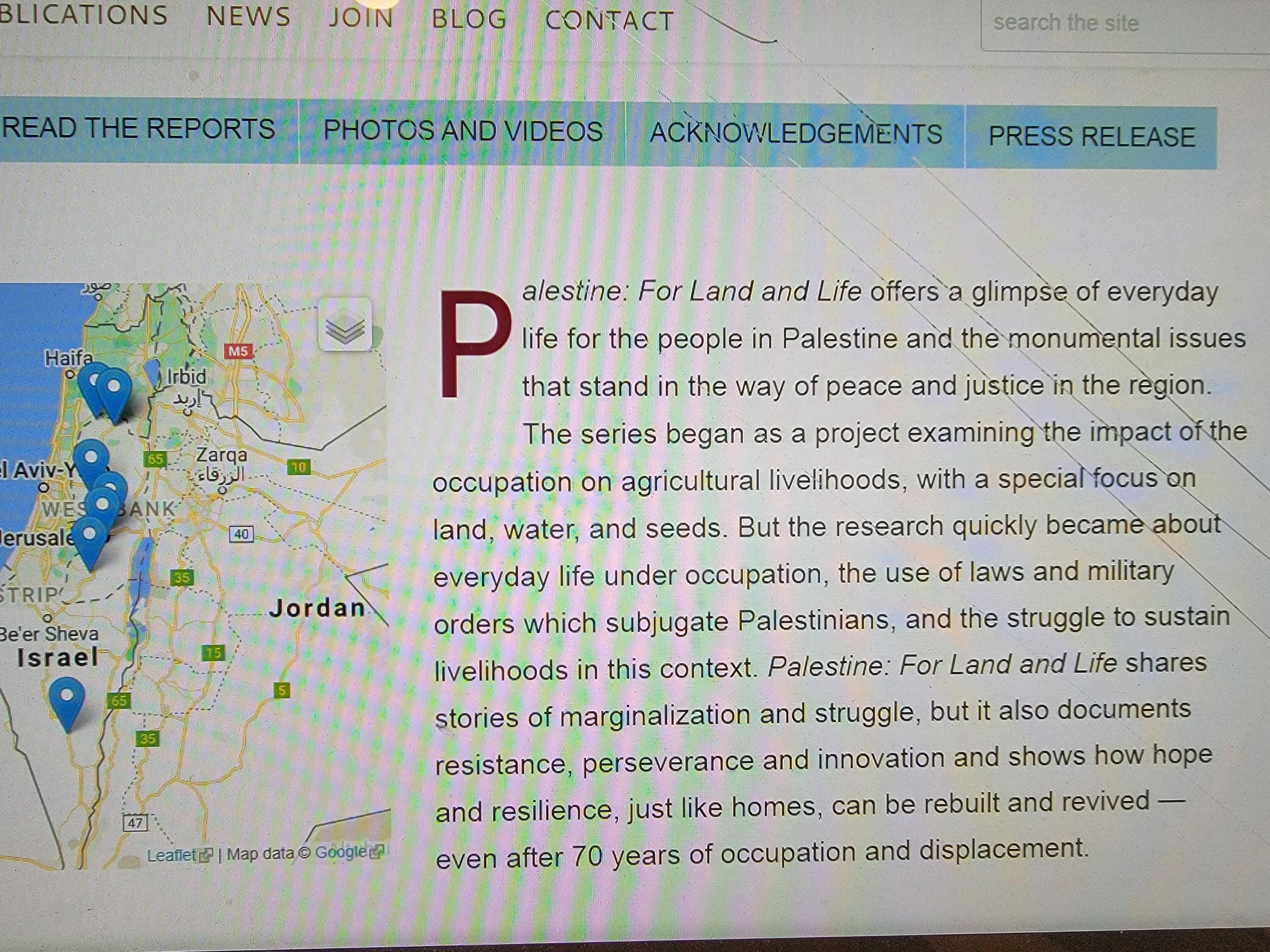
The Oakland Institute website covers a number of topics including “Palestine.” It refers to “research” published by Mittal on “Palestinian resistance & resilience 70 years after the Nakba & 100 years after the Balfour Declaration.” It includes a map regarding places of such “resistance” which includes areas in Israel.
The Oakland Institute website founded by the board chair of Ben and Jerry’s, refers to Palestine and occupation with locations inside of Israel.
Mittal’s references to the “Nakba” in 1948 and Balfour Declaration in 1917 (each well before there was a land called the “West Bank” in 1967) are part-and-parcel of her objection to the inclusion by Unilever of a statement regarding operating in Israel. Her position is seemingly that all of Israel and Israeli territory is “Occupied Palestinian Territory.” That is why she was alarmed by Israel’s “downgrading Arabic as an official language,” (nothing to do with the West Bank) and efforts by Congress “that would criminalize the nonviolent Boycott, Divestment, and Sanctions (BDS) campaign against Israel and Israeli settlements,” (note the inclusion of Israel.)
The B&J board’s statement was vague in verbiage as to whether OPT meant just the West Bank or the entire area known as Palestine in 1917, allowing mainstream progressive groups to jump to the defense of B&J on the premise that this action was just a non-violent “social mission” fighting against Israel’s “military occupation” of the West Bank, and cheered by the radical left and jihadi extremists who consider ALL of Israel to be under occupation.
What Constitutes a Social Mission
Is opposing the existence of a Jewish homeland a valid social mission?
That is the current mindset connecting jihadists, progressives and the alt-right today.
The anti-Zionists were birthed in the Arab and Muslim worlds in 1917 at the Balfour Declaration. The alt-right joined the cause in earnest during the reign of Nazi Germany which collaborated against “the shared… enemy [of world Jewry] and joint fight against it and creating the strong base uniting Germany and freedom-seeking Arabs around the world,” as Heinrich Himmler wrote to the Palestinian Grand Mufti of Jerusalem in 1943. The toxicity spread at the United Nations as more Arab and Muslim countries were admitted and effectively passed the “Zionism is Racism” resolution in 1975. While that resolution was rescinded in 1991 due to the efforts of the United States, it was reintroduced to the world at the Durban Conference in 2001, just before the jihadi attacks on America on 9/11. With the Zionism-is-Racism smear once again in vogue and the progressive wing of intersectionality pushing active anti-Racism initiatives, Anti-Zionism got incorporated under the same banner by necessity.
Is anti-Racism a social mission? Most likely. If one believes that “Zionism is Racism” it follows naturally that anti-Zionism is a social mission too.
Lost in the logic is recognizing the false premise of the “Zionism is Racism” mantra. The notion that Jews should be able to live throughout their holiest land where they have thousands of years of history is a matter of simple human rights. The dream of having independence and sovereignty in the land is no longer a “debatable political philosophy” (to quote Keith Ellison, a progressive politician) but a reality. Arguing against Zionism today is a call to dismantle the sole Jewish State, an anti-Semitic urge.
Anti-Semitism is not a social mission. At least, not for any decent human being or organization.
Internal / External Social Mission
The social mission of a company often helps it build its brand, empower employees and the community in which it operates and serves. The choices are therefore important.
Some experts suggest avoiding politics, niche causes and charisma-fueled social missions, while stressing issues like the environment, local community involvement and charity.
Ben & Jerry’s did not follow this advice and always made its political leanings known. It’s current focus areas include a host of progressive issues including: criminal justice reform; voting rights; racial justice; LGBT rights; climate justice; campaign finance reform; and refugee rights.
The company actively engages in some of these things as a matter of how it runs the company, for example making products in an environmentally-friendly way. In other situations, it tries to inform people about a topic – like criminal justice reform – with articles on its website and directing people how to register to vote.
The company is not shy about getting involved in controversial topics like “Defund the Police,” where it argues that Minneapolis disbanding its police department “is a great start.”
Some topics, like abortion, do not make it onto its website, perhaps to avoid alienating about 40% of America. Still, it signs onto letters in advertisements that criticize abortion restrictions.
So with such history of activism outside the walls of the company’s business, it should not be a surprise that the company would wade into the Arab/Muslim-Israeli conflict.
The question is, what is its position? Does it seek coexistence and peace? Does it advocate for a one state, two state or three state solution? Does it want to see the end of Israel as a Jewish State?
Ben & Jerry’s has operated in Israel since 1987, even before the First Intifada. It has distributed ice cream throughout Israel and EGL/West Bank over this time, even during the waves of Palestinian terrorism and wars over the past 20 years. This suggests that the company has (or at least had) no issue doing business in the Jewish State or its territories.
Anuradha Mittal joined the B&J board in 2008, the same year she founded the Oakland Institute. Her publications there covered many countries including Ethiopia, Sri Lanka, Cambodia and Sierra Leone. Some publications were highly critical of the U.S. Bush Administration for using the War on Terror to cut aid to some poor countries. She wrote that “the U.S. threatened to sever humanitarian aid to the people of Palestine for exercising their right to vote.” Well, maybe not for the act of voting but for voting overwhelmingly for Hamas, a US designated terrorist organization which killed over a thousand people. She skipped that part but added “Alarmed by its [Hamas’s] victory, President Bush announced to his Cabinet that he will not support a Palestinian government made up of Hamas. The U.S. has put pressure on other international donors to follow similar action with the intention of bankrupting the future Hamas-led Palestinian Authority,” and added her concern that “nearly one-half of all Palestinians already live below the poverty line…. and cutting off aid would push the Palestinian territories into chaos.” She tacitly advocated for the US to support a government run by a Palestinian political-terrorist group.
That article which covered the broad War on Terror was an outlier and Mittal did not devote much time to the Arab/Muslim-Israeli conflict at the Oakland Institute until 2017 when she became alarmed at the election of Donald Trump and his pro-Israel positions. It seems that despite B&J operating in Israel for 30 years, the idea of taking action against Israel really came to the front of her mind as U.S. policy began to favor Israel more explicitly.
Is the Action Legal or Moral
As discussed above, the promotion of peace and coexistence is a noble social mission. Actions to advance that mission could include donating to schools and organizations that facilitate dialogue and working together. Ben and Jerry’s donates to numerous causes and there is no shortage of groups (mostly in Israel) which seek to develop a harmonious future which would be happy beneficiaries of the company’s funds but the company specifically excludes donating to international organizations.
In contrast, there are actions that do not advance peace and coexistence such as supporting a ban on Jews living alongside Arabs in the West Bank and in eastern Jerusalem. The denial of Jewish history and connection to the land is not only anti-Semitic but harms the ability for the people to live together as it falsely portrays Jews as foreigners. Promoting a status quo which prevents Jews from praying at their holiest location is a simple denial of basic human rights.
The question comes back to what is the underlying “value” that the board is seeking to promote and is the subsequent course of action, legal and moral.
The board clearly feels that the United States needs to improve a lot in areas like police reform, refugee and LGBT rights, not to mention those of indigenous Americans. Yet B&J continues to manufacture and serve ice cream in these non-perfect lands. It runs its business as a profit-oriented company, selling its products in all 50 states, while articulating methods in which it believes the country can improve. It comments on its values and continues to sell ice cream.
The company has done the opposite in regards to Israel. There is no stated message anywhere on the B&J site about its objection to the state and how it is “inconsistent” with its values. It just published the July 19 statement above that it was going to stop conducting business in the “occupied Palestinian territories.” It did this, with the full knowledge – and perhaps hoping – that various states and countries which have laws banning the boycott of Israel and its territories would take action against the company to elevate the discussion globally.
If the company is against serving its products in disputed territories then it should say so and take similar actions in Cyprus/Turkey, Kashmir/India/Pakistan, Tibet/China, Western Sahara/Morocco and other locations as a new corporate policy and live with the ramifications of doing so. I cannot imagine that Unilever would allow B&J to take such actions of severely hurting the company’s business, which must fall outside the spirit of their agreement.
Israel did not annex the territory it took in a defensive war against Jordan (which itself, had illegally annexed the land in 1950), with the exception of the eastern half of Jerusalem which had been ethnically-cleansed of its Jews under Muslim Arab rule. Israel has withheld annexation in the hopes of arriving at a land-for-peace arrangement which has been consistently rejected by the Palestinians. To penalize Israel and/or the people living in the territory for holding out the hope of reaching an enduring peace goes beyond being illegal in many jurisdictions to being simply asinine.
Ben & Jerry’s board is headed by someone who seemingly thinks all of Israel is occupied Palestinian territory and believes the US should support the popular political-terrorist group Hamas. She is now taking aim at Israel and its territories in full knowledge that such action is considered illegal in many jurisdictions despite the company not taking similar actions in other disputed lands (which also do not incur financial repercussions). Further, while decrying a long list of problems in the United States, B&J continues to operate and sell its products here, but in contrast, it never says anything about the Arab/Muslim-Israeli conflict and then suddenly announces its intention to boycott the region.
The shroud of a social mission does not provide a shield from the accusations of inconsistency, double-standards and poor business judgment, and a global progressive company joining the BDS movement does not miraculously christen anti-Zionism as a “value” for a either a person or a company.
The fallout from the B&J boycott is in the early days and may yet claim the chair of its board.





 First One Through