US Ambassador to Israel Mike Huckabee interviewed by Tucker Carlson
He cannot redraw borders. He has no authority to even set U.S. policy, let alone Israel’s.
Yet the reaction was immediate: he was condemned and vilified through the Muslim world.
At the same time, doctrines that openly reject Israel’s existence are treated as mere rhetoric.
Israel’s record makes the contrast unavoidable. After military victory, it returned the Sinai Peninsula to Egypt. It withdrew from Gaza, dismantling settlements and military presence. Few states concede territory after defeating enemies committed to their destruction.
The popular political-terrorist group Hamas begins from the opposite premise. Its doctrine frames the land as “waqf,” a permanent religious trust, and within the logic of Dar al-Islam, territory that can never be relinquished because it was once ruled by Muslims. This is not metaphor but structure. The conflict is defined as unfinished until sovereignty changes.
And this doctrine is not isolated to a particular politician.
Qatar and Turkey – on a sanctioned national level as a matter of policy – host and politically enable Hamas leadership. They provide access, legitimacy, and endurance for a movement whose framework rejects Israel’s permanence as a foundational principle.
The asymmetry is stark.
A Western figure referencing ancient Jewish kingdoms triggers global outrage. A movement invoking waqf and Dar al-Islam to destroy the Jewish State draws no scrutiny.
This is dangerous narrative selection.
Speculative Jewish expansion is treated as imminent risk, while explicit ideological rejection of Jewish sovereignty is normalized.
In this world view, Jewish history is reframed as provocation and therefore the basic fabric of Jewish peoplehood is positioned as dangerous to be erased. At the same time, maximalist jihadi philosophy is normalized into diplomatic background.
And the press keeps feeding you this antisemitic bile, and no one pauses to call it out.
The core issue in the Middle East is the attempted obliteration of Jewish history and the presence of Jews in the name of Islamic supremacy. We are seeing it daily but failing to identify it plainly.
The Jewish state is offered acceptance on two terms: 1) become less Jewish, and 2) take in those who want to end the Jewish State permanently.
The first demand asks the Jewish state to thin the very idea that created it. The national home is treated as temporary, acceptable only if its defining character softens and disappears.
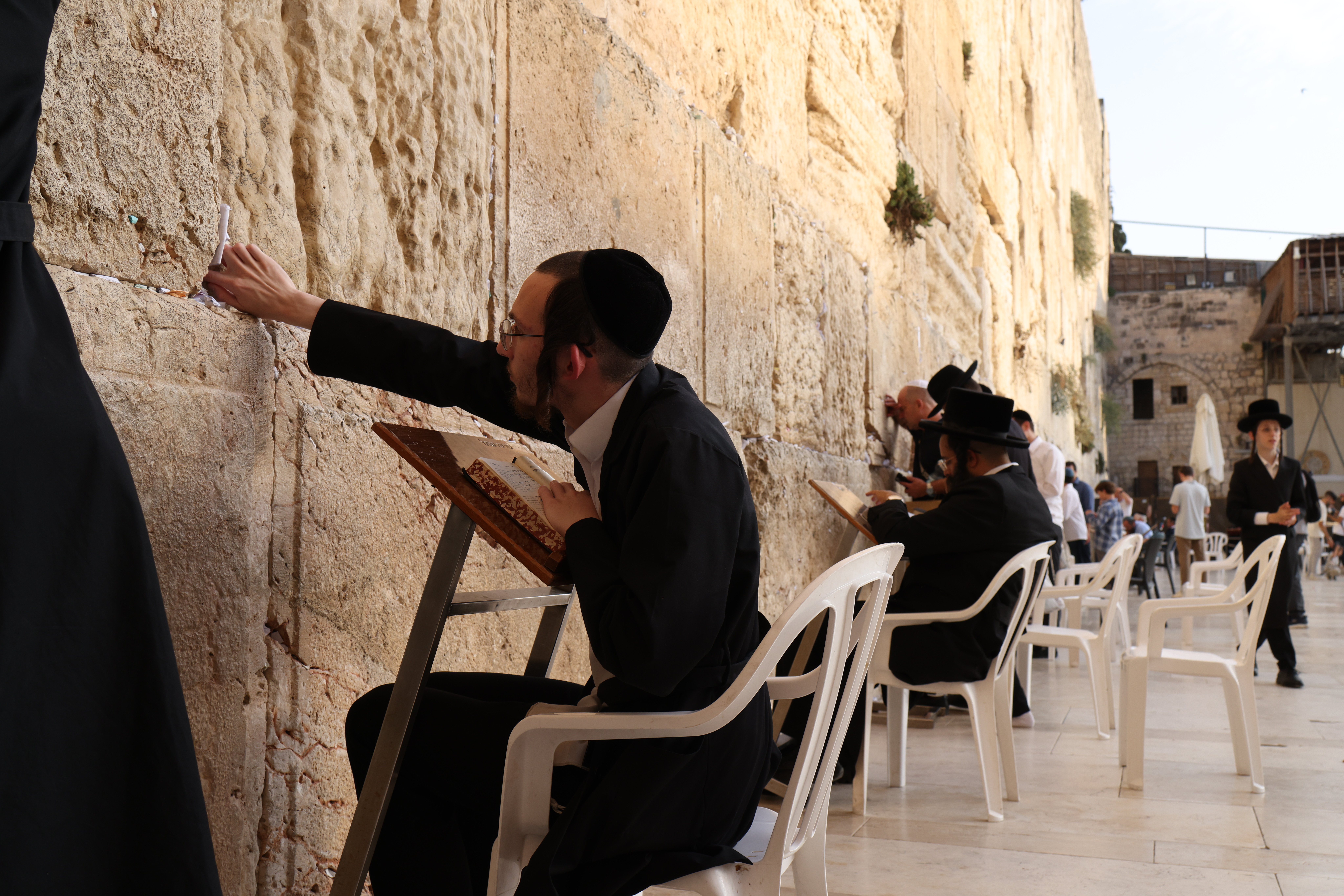
People learning and praying at the Western Wall (Photo: First One Through)
The second demand asks the state to normalize existential risk. The perpetual state of war and support for killing Jewish civilians is ignored is rationalized under the rubric of Arab “frustration.”
Each demand strains reality. Together they form a toxic contradiction.
A country cannot weaken the basis of its existence while expanding exposure to those who challenge that existence, and still promise a degree of safety to its citizens. The condition for global approval erodes the basic condition for survival.
This is the impossible conditional embedded in international language, highlighted in UN resolutions. Acceptance in the Middle East and the community of nations is framed as the reward for steps that make recognition unnecessary because the conflict’s central object -the Jewish state – is expected to disappear into a new secular bi-national entity at best, and from the face of the Earth at worst.
Unsurprisingly, Israel cannot accept such terms. So the UN blesses the violence against it.
Remarkably, the world cannot understand why Israelis will not embrace the offer of acceptance coupled with the demand for self-immolation.
The blood libel begins with how the Book of Exodus is misremembered. Exodus is a story of Jewish liberation, yet antisemites preserve it as a story of punishment. That inversion is not confusion but tradition. Every generation dresses the libel in new language, while the structure never changes.
The plagues were directed at dismantling Egyptian authority with precision. The opening strike hit the Nile—Egypt’s god, economy, and source of life—and exposed a crime already committed there. Egypt had drowned Israelite infants in that river to erase a future it feared. The first plague named that bloodshed and stripped Egypt of moral order.
What followed was escalation with restraint. Egypt lost land, productivity, and cosmic claims. Darkness collapsed Pharaoh’s divine authority. What remained was the empire’s final refuge: the belief that continuity would return, that tomorrow would repair what today exposed.
The final plague took it. The death of the firstborn judged a state that had already made children expendable. It revoked Egypt’s claim on the future. Regimes that destroy children forfeit moral legitimacy. Measure followed measure.
The Israelites did not celebrate death. They marked their doors, stayed inside, and departed at dawn. Their defining act was escape from bloodlust, not indulgence in it. Freedom—not punishment—was the center of the story.
Antisemitism begins by erasing that fact.
Across centuries, Jews were remembered not as a people who fled violence but as a people who embodied it. Divine judgment on a tyrannical state was detached from context and reassigned as a permanent Jewish trait. Victims became perpetrators. Liberation became threat. From this inversion, the blood libel followed naturally, and not surprisingly, during Jewish celebrations of Passover when they left Egypt.
The charge did more than justify violence; it recoded Jews as a permanent danger. If society believes Jews possess bloodlust, then Jews must be watched, monitored, restricted, and scrutinized. They become an unwanted risk. Suspicion overwhelms citizenship. Surveillance replaces equality. In this logic, it is only a matter of time before Jews are assumed to act—and preemptive punishment becomes rationalized as self-defense.
This is how the libel works. It marks Jews forever as dangerous rather than as people who long for freedom. It recasts victims as villains and turns survival itself into evidence of guilt. The blood libel means that Jews are never trusted as equals, and never accepted as free.
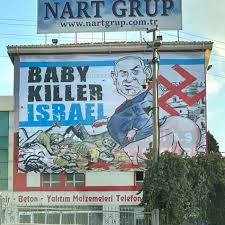
That inheritance governs today’s rhetoric. Calling Jews “baby killers” is not a factual claim; it is the inherited reflex of a culture that never accepted Jewish freedom. The accusation is identity-based, not evidence-based. It exists to keep Jews outside the circle of legitimate humanity and to deny the moral standing of Jewish self-defense before it is even asserted.
Turkey fans the blood libel in Hamas’s latest war to destroy Israel
This mindset survives because it is passed down, laundered through new vocabulary, and presented as moral concern. But it is the same lie. It refuses to see Jews as a people who escaped societies that murdered their children and insists instead on seeing Jews as the source of murder itself.
The story that antisemitism started when Pharoah forgot Joseph and became worried about the growing number and power of Jews was the fear of a monarch. Antisemitism was instilled in the masses when the Exodus story was flipped that Jews had a bloodlust and didn’t deserve equality. Every society that accepted the libel eventually convinced itself that Jewish freedom was intolerable—and acted accordingly.
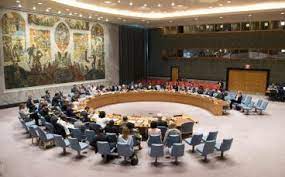
The United Nations rarely changes. But sometimes the composition changes just enough that the temperature drops—even if the structure stays broken.
That is what January 1, 2026 quietly delivered at the United Nations Security Council.
Five countries rotated off. Five rotated on. No grand reform. No moral awakening. Just personnel. And yet, for Israel, the difference matters.
The Council Israel Had to Endure
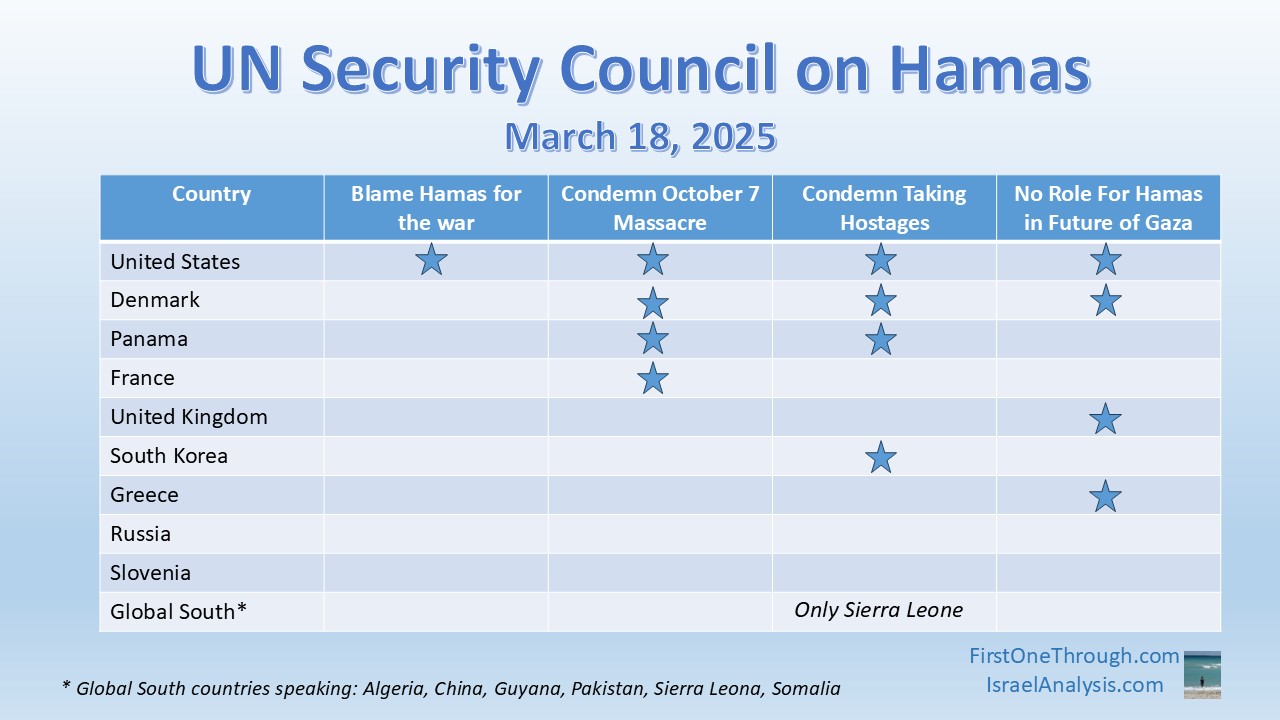
For much of 2024–2025, the Security Council was not merely critical of Israel. It was performative. Ideological. Repetitive. Certain members treated the Council less as a forum for conflict resolution and more as a theater for delegitimization. None more so than Algeria.
Algeria did not argue policy. Israel, it insisted—again and again—was an illegitimate colonial outpost of Europe, no different from French rule in North Africa. History, geography, and Jewish continuity were irrelevant. This framing was injected into draft resolutions, press statements, and emergency sessions with missionary zeal. The goal was not peace. It was erasure.
Then there was Guyana, a country which bonded with the terrorist Palestinian Liberation Organization in the 1970s, which spoke with confidence and without knowledge—accusing Israel, rather than Arab states, of rejecting partition since 1948. One did not need to agree with Israel to recognize the historical absurdity. But the UN often rewards certainty over accuracy.
And Slovenia—a country with no meaningful role in the conflict—seemed to relish its moment on the moral stage. During Israel’s defensive war, it never called out Hamas. Slovenia repeatedly accused Israel of genocide. The charge was not legal analysis; it was rhetoric. And rhetoric, once introduced, metastasizes.
These countries rotated off quietly. No ceremony. No reckoning. Just gone.
The Council Israel Is Getting Instead
Their replacements are not “pro-Israel.” That bar is too high. But they are something rarer: less ideological.
Bahrain now occupies Algeria’s Arab Muslim chair. Bahrain is a signatory to the Abraham Accords and has diplomatic relations with Israel. It understands that shouting “colonialism” does not feed people, build ports, or stabilize regions. Bahrain may not defend Israel loudly—but it will not poison the well reflexively.
Colombia replaces Guyana in South America. Colombia is a serious country with a serious economy. It trades. It fights insurgencies. It understands security dilemmas. Domestic politics fluctuate, but Colombia does not need Israel as a symbolic enemy to feel virtuous on the world stage.
Latvia replaces Slovenia. Latvia knows what occupation actually looks like. It is cautious with language. It aligns more naturally with Western security frameworks and is unlikely to indulge in genocide rhetoric as a form of diplomatic performance art.
Liberia and Democratic Republic of the Congo round out the new entrants. Neither is a champion of Israel. But neither is an ideological crusader. Silence, at the UN, is often an upgrade.
This is not a transformed Security Council. The structural bias remains intact. Russia and China still exploit Israel as a pressure point. France still oscillates. The General Assembly still manufactures moral majorities untethered from reality.
But something important does change: the agenda-setters.
Algeria’s absence means fewer resolutions laced with colonial mythology. Slovenia’s departure means fewer genocide accusations casually flung like slogans. Guyana’s exit means fewer history-free lectures delivered with confidence.
In their place are countries – hopefully – that calculate before they accuse. That lowers the volume. It slows the cycle and gives diplomacy—especially American diplomacy—more room to maneuver.
Conclusion
Israel does not need the UN to love it. It needs the UN to stop lying about it. The 2026 Security Council will not be fair. But it may be less dishonest. Less theatrical. Less obsessed with turning a regional war into a morality play with a prewritten villain.
Sometimes history doesn’t turn with a speech or a vote—but with who quietly leaves the room.
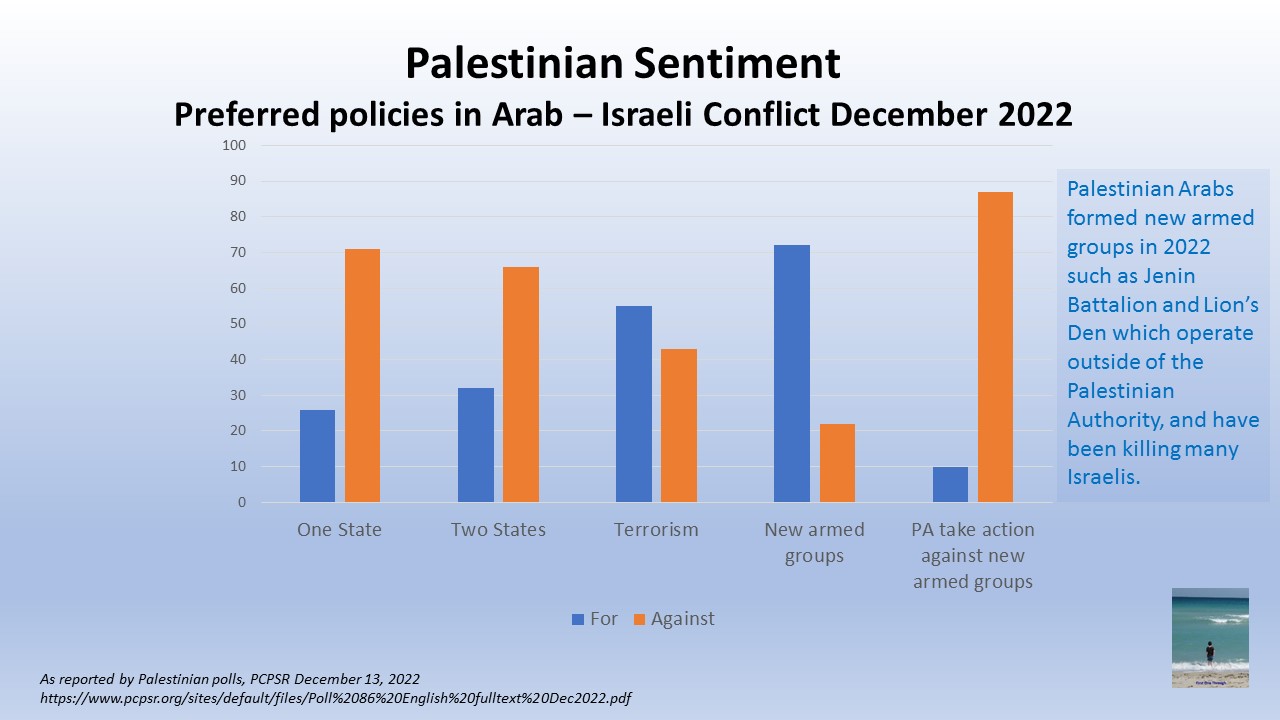
Hamas does not rule Gaza against the will of its people. It rules because large numbers of Gazans want it to. Hamas articulates aims that many in Gaza accept: “armed struggle,” permanent war, and the eradication of Israel. This is not an imposed ideology. It is a shared one.
That reality is the reason the war has not ended.
Hamas refuses to disarm. It promises to fight again. It rejects coexistence as a moral crime. And Palestinian Arabs have not rejected Hamas. There has been no uprising, no mass refusal, no turning inward to say this has destroyed us and must stop. The tunnels remain. The rockets are rebuilt. The hostages were hidden in plain sight and with complicity.
The Arab world understands this. So does the Muslim world and international community, quietly if not publicly. No money will rebuild Gaza while Hamas governs. No state will guarantee security for a territory whose leadership is openly genocidal. Even those who chant Gaza’s cause from afar refuse to absorb the cost of dismantling its rulers. Words are cheap. Responsibility is not.
And so the world fractures.
One side insists Gaza deserves unlimited sympathy—stripped of agency, frozen as a permanent victim, absolved of all consequence. The other side sees a society that has embraced a war of annihilation and asks the world whether moral condemnation is not only justified, but necessary. This divide is not about compassion versus cruelty. It is about whether moral judgment still matters.
What cannot be sustained is the fiction that Gaza is merely trapped between Hamas and Israel. Gaza is trapped— by leaders and parents who have chosen martyrdom over future, ideology over life, and war over their own children’s survival.
That is where sympathy collapses.
Because the only people in Gaza whose moral claim is uncontested are the children—and they are being sacrificed by a society willing to place guns in schools, tunnels under bedrooms, and hostages among families. A society that teaches its children that nothing is nobler than dying for the cause of destroying the Jewish State.
Sympathy cannot be demanded for that choice. It can only be extended—narrowly, painfully—to those who never had one.
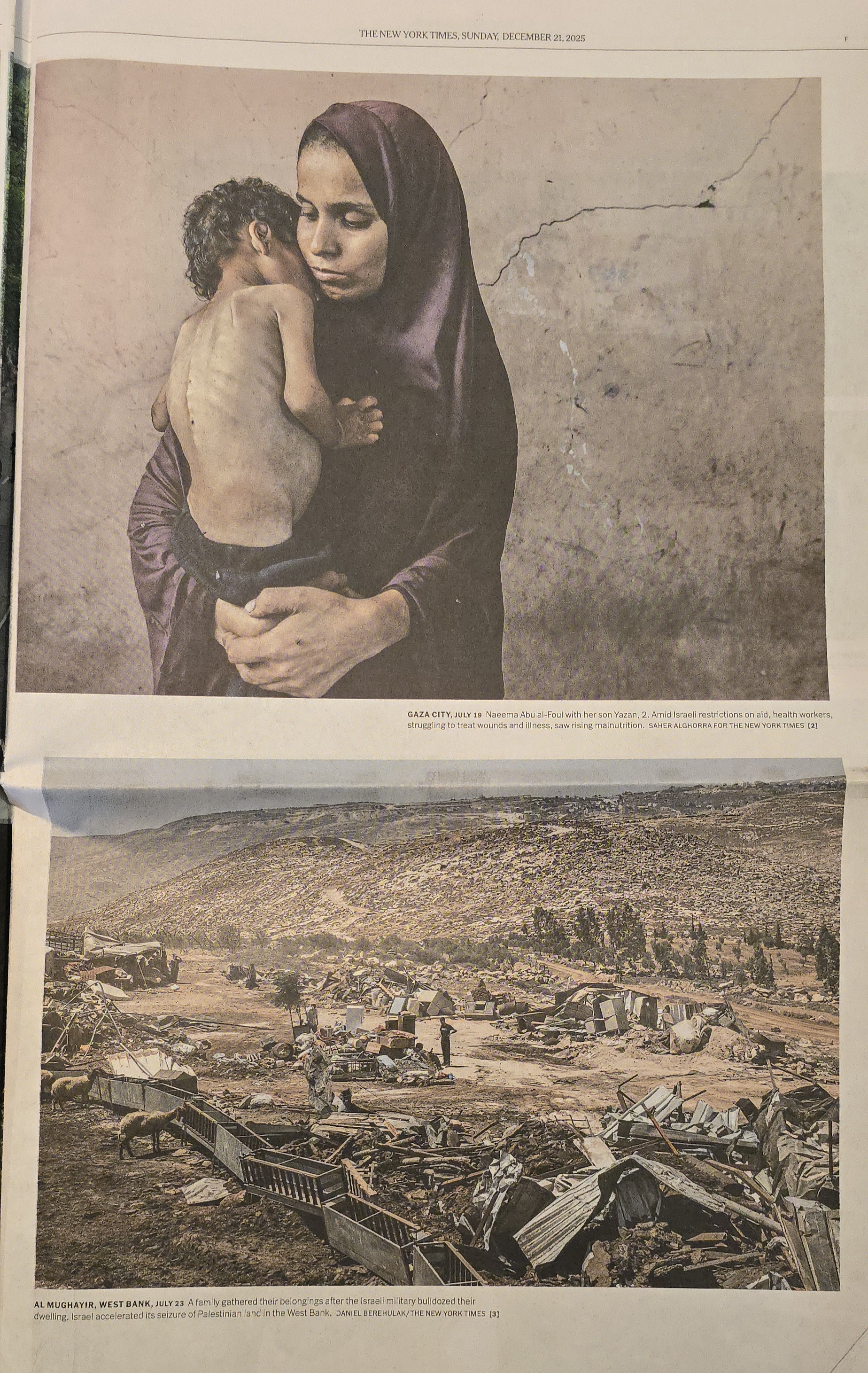
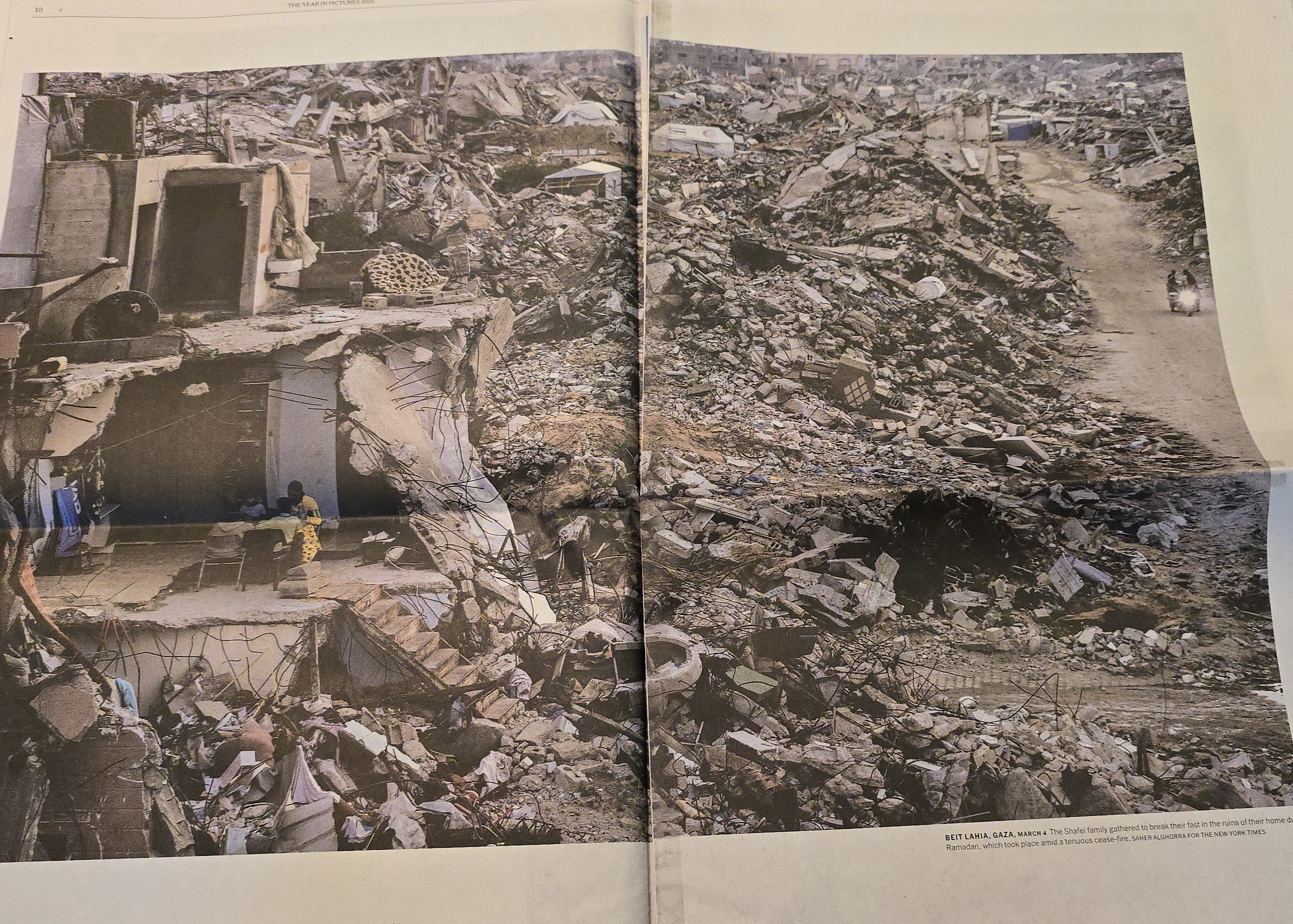
That is why the ritualized outrage of the West’s most powerful institutions now feels so hollow. Each year, The New York Times publishes its Year in Pictures, and the selection itself becomes an argument. In 2025, the year with the largest spike in antisemitism including several incidents of mass murder, there were no pictures of Jewish victims. Instead, page after page of Gaza: rubble, smoke, bloodied streets, dust-covered children. Destruction, repeated until it acquires the authority of inevitability. Israel appears only as force. Gaza appears only as suffering. Context is stripped away. Agency is erased. The camera becomes a verdict.
Two-page spread in New York Times’ 2025 year in pictures showing Gaza rubble. The only other 2-page spread was the election of Zohran Mamdani, an anti-Israel member of the DSA, as mayor of New York City
But the depravity lies not only in what is shown—it lies in what is omitted.
There are no photographs of Jewish life under siege: no police guards posted outside synagogues, no concrete barriers and metal fences erected around schools, no quiet images of fear normalized into daily routine. There are no frames of mourning for Jewish victims abroad, the couple shot in Washington, D.C., the arson at the home of the Jewish governor of Pennsylvania over Passover. No recognition of the global consequences of a war whose ideology has traveled far beyond Gaza. Violence against Jews outside Israel didn’t even make a footnote.
New security fence erected outside synagogue in 2025 (photo: First One Through)
When Israeli hostages appear in the Times, they are reduced to a single visual trope: a large military helicopter, as if their captivity were a logistical problem rather than a crime. Even Jewish victims of Gazan atrocities are set against a large Israeli military. The human cost of hostage-taking is laundered into abstraction.
New York Times only picture of a Jewish victim is a tiny speck in a large Israeli military helicopter
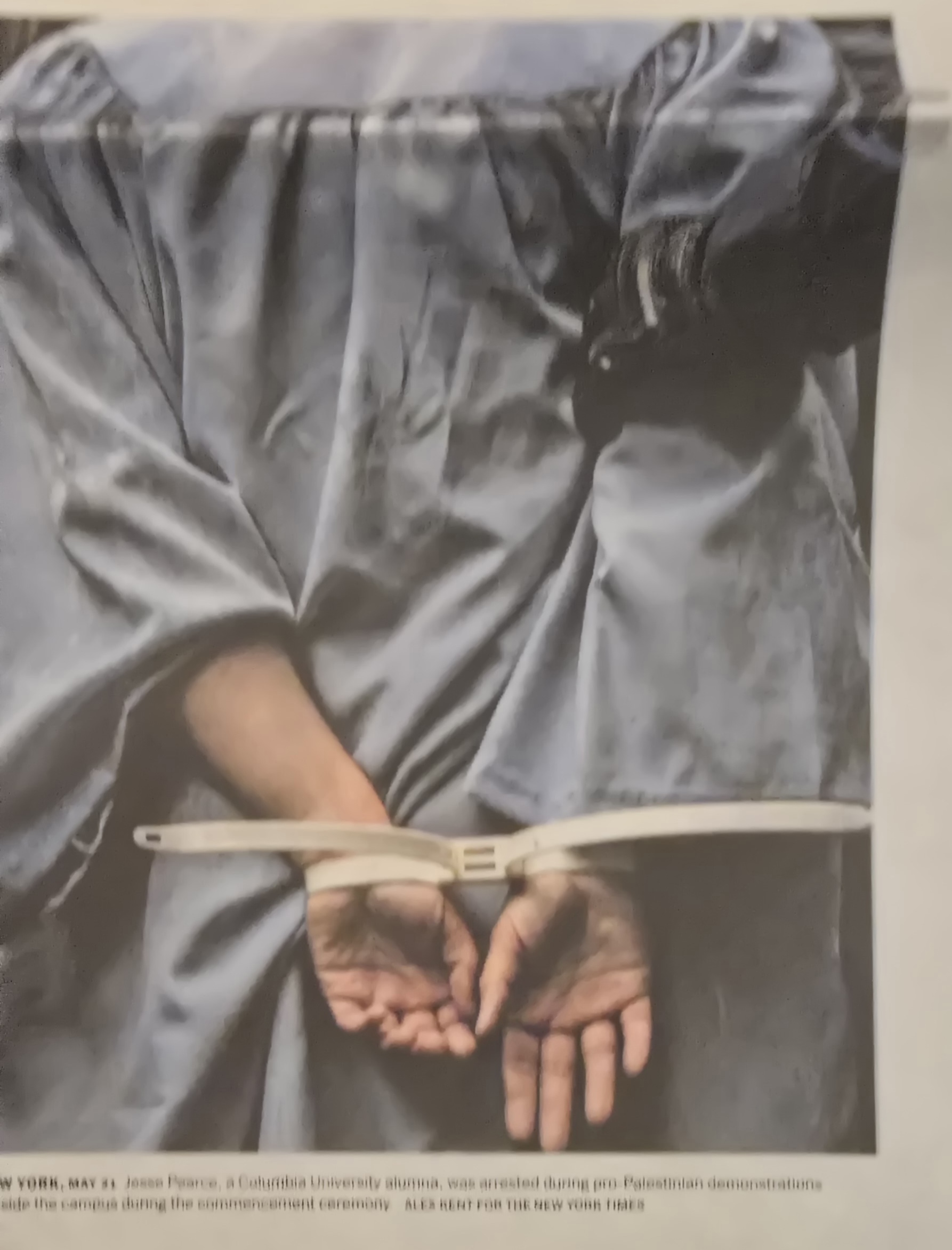
What does receive sympathetic attention are arrests—multiple images of pro-Palestinian demonstrators detained by police, framed as moral courage meeting state power. Advocacy for Israel’s destruction is softened into dissent. The pages preen about resistance while refusing to name what that “resistance” seeks to accomplish.
This is not journalism. It is moral choreography.
The pictures ask only one question—who suffered more?—while carefully avoiding the only one that matters: who chose this war? To launch it? To continue it? They do not show Hamas leaders refusing disarmament. They do not show weapons beneath nurseries. They do not show the ideological choice to sacrifice children for permanence of war.
In this telling, Israel becomes the aggressor by existing, and Gaza becomes sympathetic by persisting in annihilation. The refusal to surrender is recast as resilience. The willingness to sacrifice children is aestheticized as tragedy rather than condemned as crime. Sympathy is manufactured by amputating responsibility. The global anti-Israel advocates are embalmed in the moral light; Jewish victims disappear off the pages.
When the world’s most influential newspaper presents destruction without causation, suffering without choice, and death without ideology, it does not advance peace. It sanctifies perpetual war. It promotes a global blood libel. And it teaches readers that moral clarity is cruelty, while moral confusion is virtue.
The far-left media hopes that history will remember its curated selection of photographs and the modern moment will gather sympathy for the anti-Israel and anti-Jewish horde. Hopefully they are proved very wrong, and this time capsule will forever mark The New York Times for its profound antisemitism and moral depravity.
For years, defense lawyers tried to blur the lines in terrorism cases. When police uncovered jihadist plots, attorneys floated the well-worn argument of entrapment — that officers merely nudged vulnerable young men into thinking about violence. If not entrapped, then “mentally ill.” “Impressionable.” “Confused.” A haze of excuses meant to rehabilitate the indefensible.
But look at the landscape now.
The people calling for violence against Jews aren’t hiding behind whispers in back rooms or being lured by undercover officers. They’re shouting it from megaphones under the banner of “free speech.” They’re organizing through groups like CAIR, Within Our Lifetime, and the Palestine Youth Movement. They openly describe Jews as “enemies” who must be “confronted by any means necessary.” They praise “resistance” in every form, stripping the word of euphemism and revealing precisely what they endorse.
Unlike past defendants, they haven’t yet been charged with providing weapons, scheming attacks, or casing synagogues. Not yet. But they are building the moral scaffolding for others to do so — a permission structure wrapped in slogans about “justice,” “liberation,” and “decolonization.” It is ideological, deliberate, and public.
This is not entrapment. This is not mental instability. This is not marginal, confused fury.
This is ideology. Hardened, intentional, and proud of itself.
For decades, antisemitism coming from “majority minorities” — segments of the Black community and the Muslim community — was treated differently. Explained away. Softened. Excused as an understandable reaction to oppression, poverty, policing, or trauma. Jews were asked to tolerate it, contextualize it, empathize with it. The burden of understanding was always placed on the victim. So much so, that when Jews were killed by Black people in Jersey City, Jews asked the Black community for forgiveness.
But the past few years have blown apart the pretense.
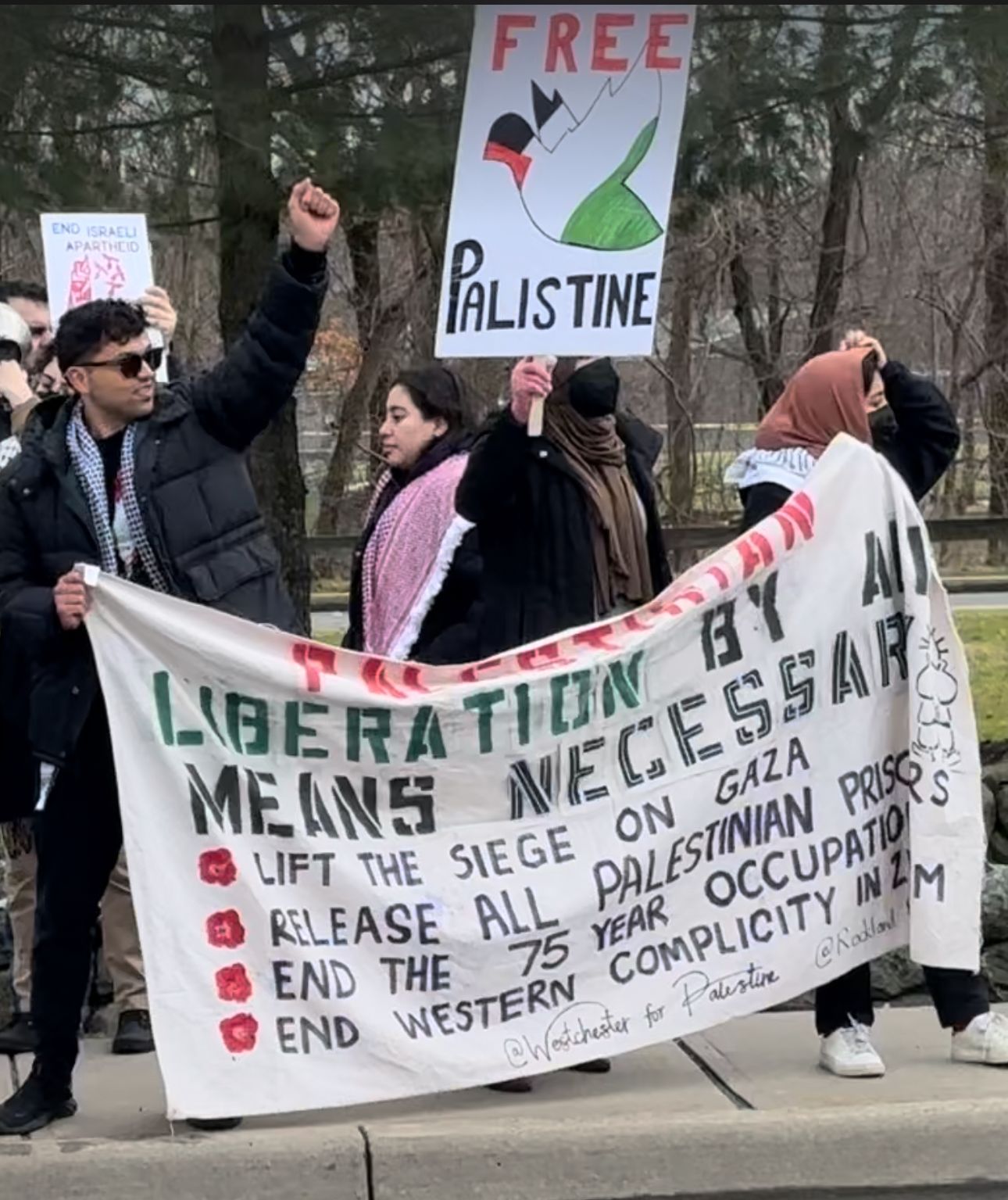
Anti-Israel activists outside a Jewish day school in Westchester calling for “liberation by any means necessary” in 2024
The hatred is no longer whispered. It is validated in academic departments, amplified on social media, and wrapped in moral language to disguise its ugliness. The same voices that once insisted they were merely “pro-human rights” now chant openly for the erasure of the Jewish people and state. They’ve dropped the mask because they believe the cultural winds are at their backs.
Because the scaffolding of antisemitism for the alt-left is that Jews are a threat. They are powerful. They steal what is not theirs. And Jews then have the temerity to complain of “antisemitism” as if they aren’t privileged, their veil of protection to rip the victim card from the truly marginalized communities of color. For the alt-right, the rightful owners of this land are White Christians, and Jews are undermining them too.
This is FOLO, Fear Of Losing Out. The trepidation that what should rightly be yours is being snatched away by nefarious forces. The Jews. Perhaps alone, perhaps with other allies, whether they be minority groups, PACs or a foreign country.
It’s old antisemitism, magnified by social media and chat groups to instigate and mobilize the masses against the most persecuted people of the past centuries. The media veil can no longer conceal the barbarians at the gates of synagogues.
Roughly 200 protestors outside of New York City’s Park East Synagogue shouting “There is only one solution! Intifada revolution!” on November 19, 2025
The cameras panned across the crowd at Zohran Mamdani’s victory celebration — the newly elected mayor of New York City, surrounded by socialist activists, digital influencers, and the self-congratulating left. It was meant to be a night of triumph for the “movement.” But what stood out for those watching was not unity, or even politics. It was who was cheering.
Standing shoulder to shoulder, laughing and hugging, were Jamaal Bowman, Hasan Piker, and Zeteo’s Mehdi Hasan — three men whose names have become synonymous with the moral collapse that followed the Hamas atrocities of October 7.
Zeteo’s Mehdi Hasan at the Mamdani victory party with Hasan Piker and Jamaal Bowman. (start at 52:00)
Bowman, the disgraced former congressman, made his name shouting on New York’s streets that Israeli women were not raped on October 7 — that the accounts of mass sexual violence by Hamas terrorists were fabricated. He wasn’t a lone crank in an internet comment section; he was a member of Congress using his platform to publicly deny the humanity of Jewish victims in the streets of his district.
Hasan Piker, meanwhile, mocked the entire subject on his Twitch stream, telling his millions of followers that he didn’t care if the women on October 7 were raped. That flippant cruelty — that casual dismissal of atrocity — has become a feature, not a bug, of a corrupted culture that cloaks moral degeneracy in “anti-imperialist” rhetoric. His anti-American and anti-Israel rhetoric had become so toxic, that Rep. Ritchie Torres, a Latin-Black gay Congressman, wrote a letter on October 29, 2024 to the CEO of Twitch to have Piker removed.
And then there was Mehdi Hasan, who publicly argued that early reports of “mass rape” on October 7 were overstated and politicized, arguing that the allegations had been “weaponized by supporters of Israel.” At Mamdani’s party, he stood smiling with Bowman and hugging Piker as the pain of Jews was being amplified and normalized.
And celebrated.
The spectacle was a black mirror of a broken city — a city that once prided itself on tolerance and moral clarity now relishing Jewish trauma.
New Yorkers didn’t just elect a socialist. They elected a symbol of moral inversion — a man whose supporters include those who laughed at, ignored, or explained away the rape and murder of innocents.
When the applause dies down and the speeches fade, one question will remain for the city that crowned Mamdani: What kind of people celebrate with rape deniers and those that revel in the pain of the most persecuted minority-minority?
“Well, thank you for asking that. To make sure I answer you fully, let’s first be clear on what a Zionist is. It’s someone who believes in two facts and one principle.
The first fact is that Jews are a people. The second fact is that the Jewish people originate in the Land of Israel.
The principle is that Jews should have self-determination in their homeland, the Land of Israel.
Yes, I believe in both of those facts and that principle. You can plainly see that nothing about Zionism has anything to do with any particular government, leader, or policy.”
That’s it. Calm, factual, and impossible to refute without revealing one’s true bias.
Now, it can very well be that some people simply believe Israel shouldn’t exist — and therefore call themselves anti-Zionists. But as Israel is a living, breathing reality today, to oppose its existence is not a theoretical stance about 1948; it’s a desire to dismantle a sovereign Jewish nation. That’s not political criticism — that’s eliminationism. That’s the desire of many groups including the People’s Forum, Within Our Lifetime and the Democratic Socialists of America.
In today’s world, anti-Zionism isn’t just a philosophical disagreement. It’s an active hostility toward Jewish self-determination, an echo of the same hate that fueled the October 7 massacre. It’s far more lethal and toxic than opposing the idea of creating another Arab state in the Middle East to be called “Palestine,” especially one that has opposed coexistence with the indigenous Jews for over a century.
To deny Jewish peoplehood, heritage, and rights in their homeland is not progressivism — it’s prejudice wrapped in the language of activism.
So, the next time someone smugly demands you “renounce Zionism,” repeat the verses above. Because once you strip away the slogans and hashtags, all that’s left of anti-Zionism is anti-Jewish animus.
A suicidal antisemite walked into a church school in Minnesota and opened fire. He left behind rants of depression and hate. He idolized the mass murderers who came before him — Hitler, Columbine, Christchurch, Pittsburgh — and fantasized about joining their ranks in death.
It is a sad story. Sad for the victims, whose lives were cut short. Sad for the shooter’s family, who must live with the legacy of his murders. Sad for society, which must add another notch to the ledger of preventable carnage.
But I pause on the judges. Not the judges in robes who preside over courts of law — this menace took his own life and will only face a real judge in the afterlife, if you believe in one. The judges I mean are the self-appointed arbiters of truth on social media, the pundits with millions of followers who rush to craft a narrative before the blood on the church floor has dried.
Narratives Over Facts
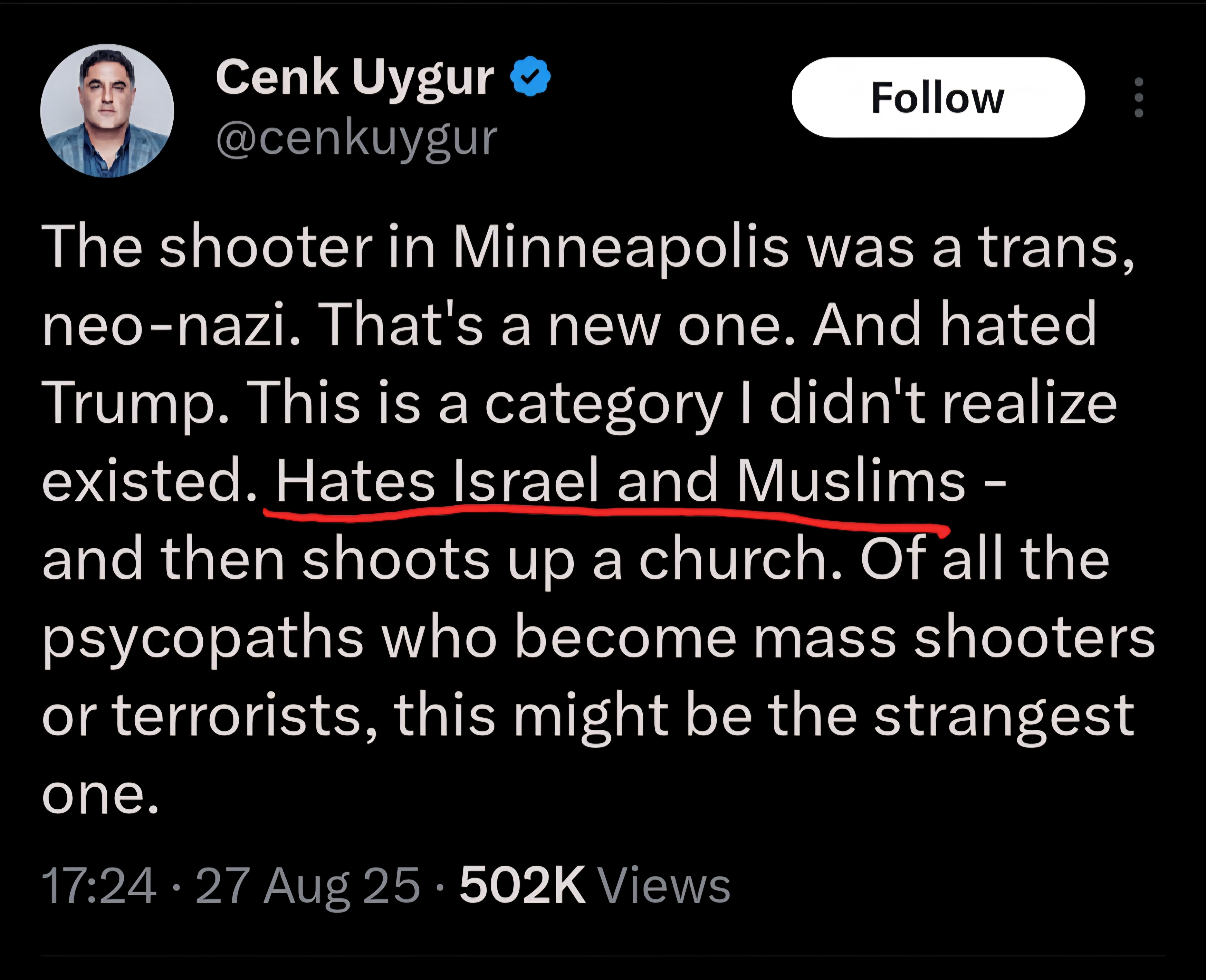
Cenk Uygur, founder of The Young Turks, quickly posted on X that the killer “hates Israel and Muslims.” Two deliberate misdirections.
First misdirection: He didn’t hate Israel in the abstract. He hated Jews — which is precisely why he hated Israel. On his weapon magazine he scrawled, “6 million wasn’t enough.” That wasn’t about Israel. That was about Jews. In his journal he wrote “If I carry out a racially motivated attack, it would be most likely against filthy Zionist jews,” before calling Jewish people “entitled” and “penny-sniffing” and adding “FREE PALESTINE!”
writings on the Minneapolis killer’s weaponry
He even called for destroying HIAS, the Hebrew Immigrant Aid Society that helps resettle refugees in the U.S. His antisemitism and anti-Israel animus were inseparable. He loved Nazis and he loved Palestinian Arabs who killed Jews. Cenk only loves the latter, because it allows him to hang his “anti-Zionist, not antisemitic” credentials where he cannot with the former.
Second misdirection: The shooter never expressed hatred of Muslims. He praised mass murderers — including some who targeted mosques — but not because he despised Islam. His adoration was for the act of mass killing as a pathway to glory. He wanted to die a martyr in the suicide-mass murder cult, to etch his name in the pantheon of psychopaths and inspire the next one, just as he inscribed their names on his gun, as well as “mashallah,” meaning “Gd has willed it” in Arabic.
The Sanitizers
So why did Cenk say what he said? To refit the crime into his own comfortable narrative. To launder the reality that this shooter’s rants — about Jews, Israel, HIAS — were fueled by the same demonization that Cenk himself mainstreams daily.
Cenk published this rant about Israel controlling the US government around the same time as misdirecting people about the Minnesota killer
This is how today’s judges operate. They aren’t rendering justice to take the wicked off the streets. They are sanitizing their own crimes by placing their incitement onto a scapegoat and pushing it off a cliff. They hope you will move on, and not notice their bloody handprints on the crime scene of young children dead on a church floor.
But be clear, Cenk and others like him are inciting the next mass shooter. They just hope the murderers come for Israel supporters.
Conclusion
There are no winners in these tragedies. The dead are buried, the families are broken, the shooter is gone.
But the lies linger. The venom feels less poisonous once imbibed and cleansed by the antisemitic judges.
When influencers and media stars twist a killer’s words into their preferred stories, they are not exposing truth — they are covering their own complicity.
The Minneapolis shooter’s manifesto was clear enough. It will likely be on the DSA (Democratic Socialists of America) book-of-the-month club reading. The world is sad and unjust and we must burn it down. Ideally, start with the Jews. If you can’t, make sure your manifesto reads like a modern day Mein Kampf that would make Rep. Rashida Tlaib (D-MI) proud.
The killer’s sphere of desecration was relatively small. Tragic, but limited. But the shrill antisemitic rants atop social media and infiltrating politics grossly widen the diameter of the damage.
The lingering tragedy is that the loudest voices have become the judges, and that will mark our entire society for collapse.
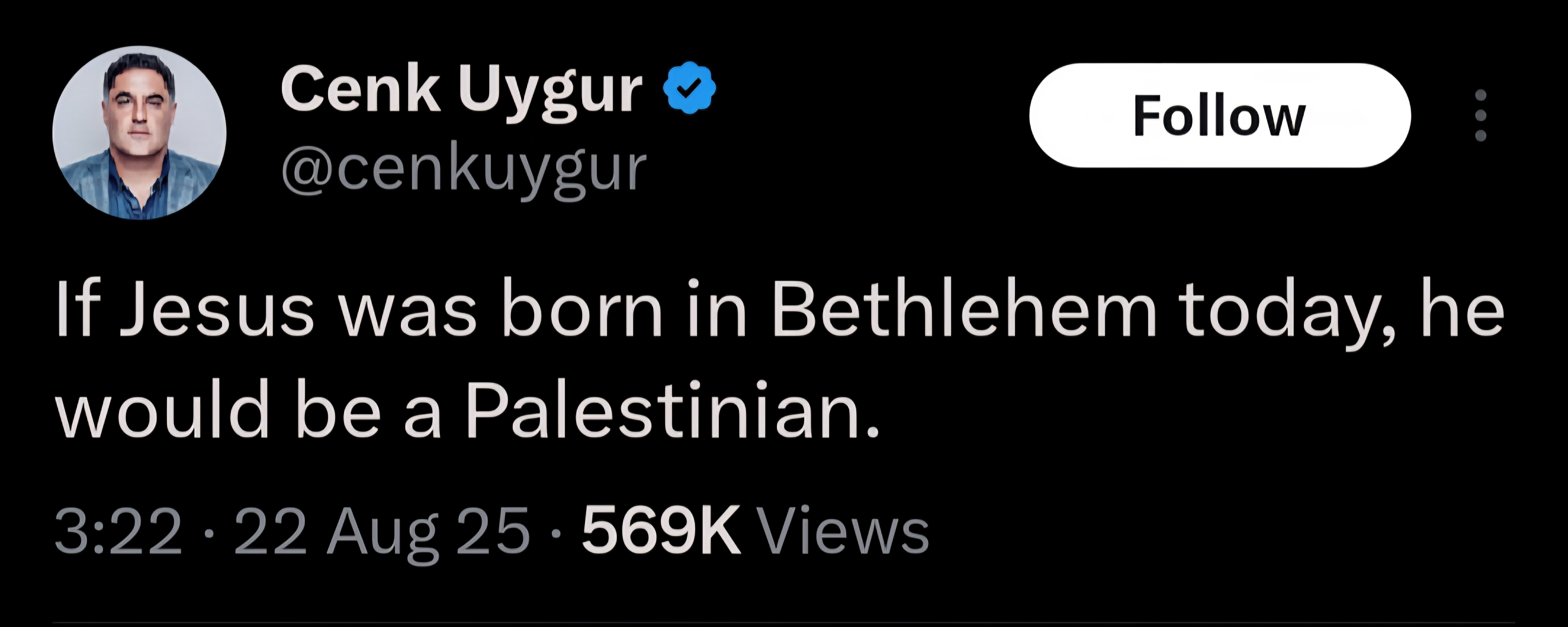
Cenk Uygur, host of The Young Turks, posted on X that Jesus was a Palestinian. The implication was not only that Jesus was Arab, but also Muslim. Both are historically false. Jesus was a Jew in Judea. He lived, preached, and died as a Jew in his homeland.
If alive today, Jesus would not be celebrated by the Palestinian Authority. He would be condemned. The United Nations would call him an “illegal settler” for living in Bethlehem and Jerusalem. Palestinian leaders would brand him a “colonist” because his Jewish family had the audacity to live in their ancestral land.
This is not a new stunt. A few years ago, activist Linda Sarsour declared that Jesus was a Palestinian from Nazareth. She conveniently ignored the fact that Nazareth is in Israel, and that Jesus was Jewish—observing Jewish holidays, quoting Jewish scripture, and praying in Jewish synagogues. He was as much a “Palestinian” as King David or Moses.
Radical preacher Omar Suleiman – invited to speak before Congress by Nancy Pelosi – said the same. His goal was to peel Christian support away from the Jewish State. Evangelical Zionists needed to hear the gospel from an Islamic extremist.
Why this persistent rewriting of history? Of cultural appropriation? Because anti-Israel agitators have a larger project: erasing Jewish ties to the land of Israel. They cannot admit that Jews have been in their holy land continuously for millennia, so they try to recast Jewish history in Arab clothing. They claim Jews are foreigners and interlopers while appropriating Jewish figures for their own narratives.
The irony is striking. For all their rhetoric about “coexistence” and “justice,” the pro-Palestinian movement reveals its antisemitic moral rot in these fabrications. They would rather deny Jewish history than seek peace with the Jewish people. They would rather invent a fictional Palestinian Jesus than accept the historical Jewish Jesus.
Jesus has now become the latest Jew taken hostage—not in body, but in identity. Uygur, Sarsour, and their fellow travelers parade his name as a prop in their campaign against Jewish sovereignty. But no amount of Twitterstorms, hashtags, or revisionist slogans can undo the reality: Jesus was a Jew, in Judea, in the land of Israel.
Jesus, like every Jew before and after him, is bound up with the land that antisemitic anti-Israel activists desperately want to sever from its true indigenous people.


















 First One Through