Apostasy

In response to the mass and gross atrocities committed by Nazi Germany in World War II, the world sought to enshrine a list of basic human rights which were due to every person on the planet. In December 1948,  the United Nations passed those laws as the Universal Declaration of Human Rights, UDHR.

Today, many members of the United Nations continue to routinely trample on those rights.

For example, Article 18 of the UDHR provides for the freedom of religion and worship:

  • “Everyone has the right to freedom of thought, conscience and religion; this right includes freedom to change his religion or belief, and freedom, either alone or in community with others and in public or private, to manifest his religion or belief in teaching, practice, worship and observance.”

The action of changing one’s religion is called “apostasy”. Not only is it considered a crime in many countries, several Islamic countries consider it a capital offense according to their established law:

  • Afghanistan
  • Brunei
  • Mauritania
  • Qatar
  • Saudi Arabia
  • Sudan
  • United Arab Emirates
  • Yemen

Mariam Yahia Ibrahim Ishag
Mariam Yahia Ibrahim Ishag sentenced to death by hanging in Sudan for apostasy,
May 2014

Not all Islamic countries call for killing apostates, but many still criminalize the act of leaving Islam by punishing the apostate with civil penalties including negating the person’s inheritance and nullifying their marriage.

In some countries, specifically: Mauritania; Saudi Arabia; Jordan; and Yemen, individuals can be charged with apostasy for simple matters of writing something negative or controversial about Islam, even a post on social media.

Here is a summary of some countries laws regarding apostasy.

  • Afghanistan: Apostasy is considered a serious offense and persons so charged may “possibly face death by stoning, deprivation of all property and possessions, and/or the invalidation of their marriages.”
  • Brunei: A Muslim who declares himself non-Muslim is punishable with death, or with imprisonment for a term not exceeding thirty years and corporal punishment, depending on the type of evidence.
  • Egypt: There have been cases where people have been placed in jail or marriages nullified due to apostasy.
  • Iran: While Iranian law does not provide for the death penalty for apostasy, the courts can hand down that punishment, and have done so in previous years, based on their interpretation of Sharia’a law and fatwas.
  • Jordan: While there is no express statutory prohibition on apostasy, conversion trials are heard by Islamic courts and may be instituted by any member of the community. According to Islamic law, there are consequences when Muslims adopt religions other than Islam.  For instance, if someone is convicted of apostasy, the Islamic courts adjudicating matters of personal status have the power to void the person’s marriage and deny his/her right to inherit from a spouse and from Muslim relatives.
  • Kuwait: According to Law 51 of 1984 on Personal Status, which is based on Islamic Sharia law, Under Article 18, the marriage of a non-Muslim man to a Muslim woman is considered annulled. Article 145 of the aforementioned law applies such legal and religious principle to Muslim husbands that might adopt other religions than Islam during the marital relationship. Moreover, under article 294 of this law, an apostate is not able to inherent from his Muslim relatives or marital spouse.
  • Mauritania: Apostasy is punished under article 306 of the Mauritanian Criminal Code.  This article provides that “any Muslim guilty of the crime of apostasy” is to be given the opportunity to repent within three days.  If the accused does not repent within that period, he/she is to be sentenced to death, and all of his/her property shall be confiscated by the government.

Mohamed Cheikh Ould Mohamed
Mohamed Cheikh Ould Mohamed sentenced to death for article about Islam,
December 2014

  • Morocco: In April 2013, the Supreme Council of Religious Scholars issued a religious decree (fatwa) that Moroccan Muslims who leave Islam must be sentenced to death.
  • Pakistan: There is no specific statutory law that criminalizes apostasy in Pakistan.  In 2007, a bill to impose the death penalty for apostasy for males and life imprisonment for females was proposed in Parliament but failed to pass.
  • Qatar: While apostasy is one of the offenses subject to the death penalty, Qatar has not imposed any penalty for this offense since its independence in 1971.
  • Saudi Arabia:  Islamic law imposes the death penalty on apostates based on statements attributed to the Prophet Mohammed.
  • Sudan: Article 126 of the Sudanese Penal Code, on apostasy, provides that any Muslim who declares publicly that he/she has adopted any religion other than Islam commits the crime of apostasy and is punishable with the death penalty.
  • Tunisia: Has begun to institute new laws to protect people from Sharia law regarding apostasy. Article 6 of the Tunisian Constitution of 2014 protects its citizens by preventing any attacks against them based on accusations of apostasy.
  • UAE: Article 66 states that among the “original punishments” under the law are the punishments of hudud crimes, including by imposing the death penalty.  However, there have been no known prosecutions or legal punishments for apostasy in court.
  • Yemen: The crime of apostasy may be subject to the death penalty by virtue of Article 12 of the Yemen Penal Code of 1994, as amended by Law 24 of 2006, which identifies crimes, including apostasy, that are punished according to the provisions of Islamic Sharia.  Furthermore, Article 259 provides that individuals committing the act of apostasy may be punished with the death penalty.

KSA apostasy
Man in Saudi Arabia to be beheaded for ripping up Quran,
February 2015

These laws are often not considered radical by the country’s citizens.  Many Muslims in the world specifically support the death penalty for apostasy.  The countries with the highest percentage calling for the murder of converts:

  • Egypt 88%
  • Jordan 82%
  • Afghanistan 79%
  • Palestinians 66%
  • Pakistan 62%
  • Malaysia 62%

Have you ever seen a censure in the United Nations against any of these countries for trampling a basic human right?


Sources:

Country apostasy review: http://www.loc.gov/law/help/apostasy/index.php

Pregnant Sudanese woman gets death sentence for apostasy: http://www.aljazeera.com/news/middleeast/2014/05/sudan-woman-given-death-penalty-apostasy-20145159264775754.html

Vast majority of Muslims support death penalty for apostasy: http://www.washingtonpost.com/blogs/worldviews/wp/2013/05/01/64-percent-of-muslims-in-egypt-and-pakistan-support-the-death-penalty-for-leaving-islam/

Related First One Through article:

Blasphemy: https://firstonethrough.wordpress.com/2015/01/12/blasphemy-or-terrorism/

US Working with Countries with terrible human rights records: https://firstonethrough.wordpress.com/2014/11/14/dancing-with-the-asteroids/

Blasphemy OR Terrorism

On January 7, 2015, three French Muslim men went into the offices of Charlie Hebdo, a satirical magazine in Paris, France, and killed eleven people in response to the magazine’s cartoons depicting the Islamic prophet Mohammed in a negative manner. Politicians have publicly questioned whether this “act of terrorism” was done by “lone wolves” and whether this action had anything to do with Islam. The leaders of the western countries knew full well that this was not a random act of terror, but part of an ongoing rollout of laws that their governments are advancing with 57 Islamic nations to curb free speech around the world to comply with Muslim blasphemy laws.

Origins

Many religions consider blasphemy to be a sin. The range of the sin could be uttering the Lord’s name in vain or it could be drawing a picture of a prophet.  The Old Testament specifically prohibits using the name of God for no purpose or abusing the use of His name:

  • “Thou shalt not take the name of the LORD thy God in vain” (Exodus 20:7)

The New Testament refers to blasphemy many times, such as Matthew 12:31:

  • “Therefore I say unto you, Every sin and blasphemy shall be forgiven unto men;
    but the blasphemy against the Spirit shall not be forgiven.”

The Quran does not specifically call against abusing the name of God, but does consider it a crime to insult Mohammed:

  • “They swear by Allah that they did not say [anything against the Prophet] while they had said the word of disbelief and disbelieved after their [pretense of] Islam and planned that which they were not to attain. And they were not resentful except [for the fact] that Allah and His Messenger had enriched them of His bounty. So if they repent, it is better for them; but if they turn away, Allah will punish them with a painful punishment in this world and the Hereafter. And there will not be for them on earth any protector or helper.” (Quran 9:74)

In Judeo-Christian tradition, the punishment for the sin of blasphemy is considered to come from God and meted out either in this world or the world to come according to divine justice. In Islam, the punishment should be delivered by man in this world according to many Islamic scholars.

Country Laws

Western countries do not have laws against blasphemy. While insulting a religion may be considered rude, it is protected by the laws of free speech. (An editorial by David Brooks covers that nuance in the link below).

Countries that are governed by Islamic law (Sharia) have strict laws against blasphemy. The punishment ranges from fines to prison sentences to death. Here is a review of some of those countries:

  • Algeria: An individual who insults the prophet and the messengers of God, or denigrates the creed or prophets of Islam through writing, drawing, declaration, or any other means, will receive three to five years in prison.
  • Bahrain: Article 309 of the Bahrain Penal Code of 1976 penalizes individuals who insult any religious sects with a term of imprisonment not exceeding one year.
  • Egypt: A person ridiculing or insulting a heavenly religion or a sect following it, or damaging national unity” is punishable with six months to five years’ imprisonment.
  • Indonesia: Blasphemy is addressed in Article 156(a) of the Penal Code.  The Code imposes a penalty of up to five years’ imprisonment.
  • Iraq: Article 372 of Iraq’s Penal Code of 1969 provides that any individual who insults the creed of a religious sect or its practices, or publicly insults a symbol or person that is an object of sanctification, worship, or reverence for a religious sect, may be punished with a term of imprisonment not exceeding three years.
  • Jordan: Jordan explicitly criminalizes blasphemy.  Article 273 of Jordan’s Penal Code of 1960 punishes any individual who insults the Prophet Mohamed with a term of imprisonment of one to three years.
  • Kuwait: Law 19 of 2012 on National Unity was issued to amend article 111 of the Penal Code by imposing harsher penalties and criminalizing any publications and broadcasting content that could be considered offensive to religious “sects” or groups, including through social media.  The new law punishes such crimes with a fine ranging from US$36,000 to US$720,000 and a maximum of seven years in prison.
  • Lebanon: The Lebanese Penal Code punishes individuals who perform acts that are considered blasphemous to the name of God.  It also imposes penalties against individuals who publicly insult the religious proceedings of any religion.
  • Libya: Whoever publicly abuses the Islamic religion—that being the official religion of the State under the Libyan Constitution—with verbal terms not befitting for the Divine Being, the Messenger, or the Prophets, shall be punished with imprisonment for a term not exceeding two years.
  • Oman:  Article 209 of Oman’s Penal Code punishes with a term of imprisonment of between ten days and three years, or a fine between five to five hundred Omani Riyals (approximately US$13 to $1,300) an individual who commits the following acts: (1) publicly blasphemes God or the prophet Mohamed, (2) commits an affront to religions and faiths by spoken or written word, or (3) breaches the peace of a lawful religious gathering.
  • Pakistan:  Converts from Islam and atheists may be vulnerable to Pakistan’s blasphemy law, which prescribes life imprisonment for desecrating or defiling the Quran and the death sentence to anyone for using derogatory remarks towards the Prophet Mohammed.
  • Syria: Article 462 states that individuals who publicly defame religious proceedings are punishable with a term of two years’ imprisonment.

 A Global Mandate

Muslim countries have sought to enforce the ban on blasphemy beyond their borders to cover the entire world. In 2008, the United Nations General Assembly voted 85-50 (with 42 abstentions) to make blasphemy a crime. The measure was originally introduced by Pakistan in 1999 and has continued to be brought up by the 57 Muslim countries that make up the OIC, Organization of Islamic Conference. When the vote was brought up again in 2010, the margin of passage was smaller, 76-64 with 42 abstentions.

In 2011, the OIC attempted to push forward an alternate version of the resolution to overcome the objections of the United States and other western countries that felt the law trampled on basic rights of free speech. The US’s Obama Administration worked hard at developing Resolution 16/18, which sought to criminalize the act of stereotyping or discriminating against people based on religion, rather than the pillorying of the religion itself.

The terms “stereotyping” and “incitement to … hostility or violence” that are used throughout the resolution have been called “vague” and “problematic”.  The mandate of “[a]dopting measures to criminalize incitement to imminent violence based on religion or belief” is confusing as to whether it bans the direct call to incite violence, or for doing anything that could incite violence.  For example, if the cartoons made in Charlie Hebdo did not call for violence against a group, but the negative stereotyping could incite people to violence, would that be considered illegal? Would it be considered illegal if the stereotyping brought violence against the targeted group only, or even if it brought violence against Charlie Hebdo themselves for publishing the piece?  If each instance was considered illegal, it would likely have direct and significant negative impact on the freedom of speech and press for everyone.

 The Individual

According to many Muslim clerics, Islamic law mandates that Muslims take actions against people who slander the prophet Mohammed. As seen above, Sharia law has put such laws into effect in several Islamic countries, and the 57 OIC member countries have been aggressively advancing the case for blasphemy laws everywhere.

While Resolution 16/18 passed without a vote in 2011, most westerners do not know of its existence and consider the freedom of speech, thought, expression and press to be basic fundamental rights that they have in their countries. It is possible that the journalists at Charlie Hebdo did not know about Resolution 16/18.  They knew that their articles and pictures upset many people of different faiths; that was the essence of why they made them, and they considered it their right to do so under the country’s freedoms of speech and press. They experienced the wrath of Muslims when their offices were firebombed in 2011 after posting a caricature of Mohammed.  However, did they consider those cartoons illegal because it lampooned Mohammed which could have incited people to violence?

The French Muslims who came to the offices of Charlie Hebdo to kill the staff may or may not have known about Resolution 16/18.  They did know that their prophet was insulted and no action by the French government was being taken against the perpetrators.  Any Muslim who believes that blasphemers should be punished are obligated to take action. They took matters into their own hands, shouting while they shot the journalists “Hey! We avenged the Prophet Muhammad! We killed Charlie Hebdo.”  They viewed their actions as targeted vigilante justice against evil perpetrators, not terrorism.


If France and the western world are concerned about terrorism that strikes at random individuals, they should put “Paris Est Juif” on the Arc de Triomphe instead of “Charlie” in support of the innocent Jews who were massacred while shopping for their Sabbath meals.

paris est charlie

If France and the western world are concerned about the loss of their treasured freedoms, they should speak to their governments about the essence of Resolution 16/18 that they have advanced at the United Nations, and its implication on their freedom of speech.  At the moment, the governments are ducking from their complicit role, pointing their fingers at “terrorism” instead of “blasphemy”, and denying the role of Islam in any of this.


Sources:

Blasphemy in Quran article with eleven citations: http://www.deoband.net/blogs/blasphemy-in-islam-the-quran-curses-and-hadith-prescribes-punishment

David Brooks editorial on Charlie Hebdo: http://www.nytimes.com/2015/01/09/opinion/david-brooks-i-am-not-charlie-hebdo.html?_r=0

Country laws on blasphemy: http://www.loc.gov/law/help/apostasy/index.php

Recent death sentence in Pakistan for blasphemy: http://cnsnews.com/news/article/patrick-goodenough/pakistani-court-upholds-blasphemy-death-sentence-against-christian

2010 UN vote on basphemy: http://www.huffingtonpost.com/2010/11/25/blasphemy-resolution-pass_n_788305.html

Excellent Freedom House article on blasphemy laws: https://freedomhouse.org/blog/trouble-blasphemy-laws#.VLM1Z8mVnEY

UN Resolution 16/18: http://iheu.org/resolution-adopted-united-nations-human-rights-council-1618/

Article on Res 16/18: http://cnsnews.com/news/article/religious-tolerance-resolution-backed-obama-administration-aligns-islamic-bloc-s

US report on adopting Resolution 16/18: https://geneva.usmission.gov/2012/04/19/implementation1618/

Attack on Charlie Hebdo: http://www.cbsnews.com/news/charlie-hebdo-french-satirical-magazine-paris-office-attack-leaves-casualties/

French President Hollande: “these fanatics have nothing to do with the Muslim religion.”

http://www.news24.com/World/News/LIVE-Police-chase-Paris-suspects-20150109

Related First One Through article:

Press pushes free speech to advance the new blood libel: https://firstonethrough.wordpress.com/2014/06/23/eyal-gilad-naftali-klinghoffer-the-new-blood-libel/

Apostasy: https://firstonethrough.wordpress.com/2015/01/13/apostasy/

New York Times Finds Racism When it Wants

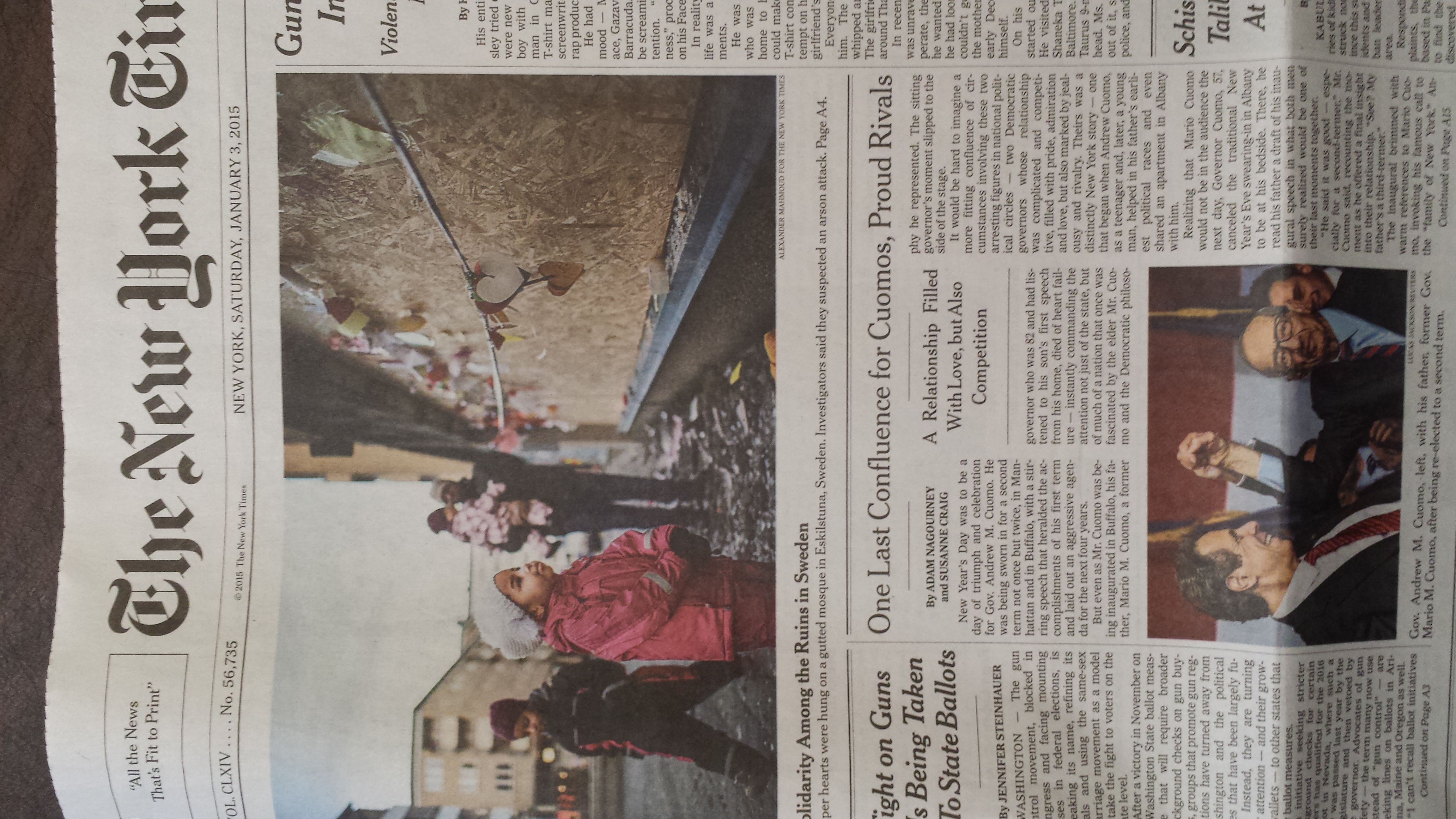
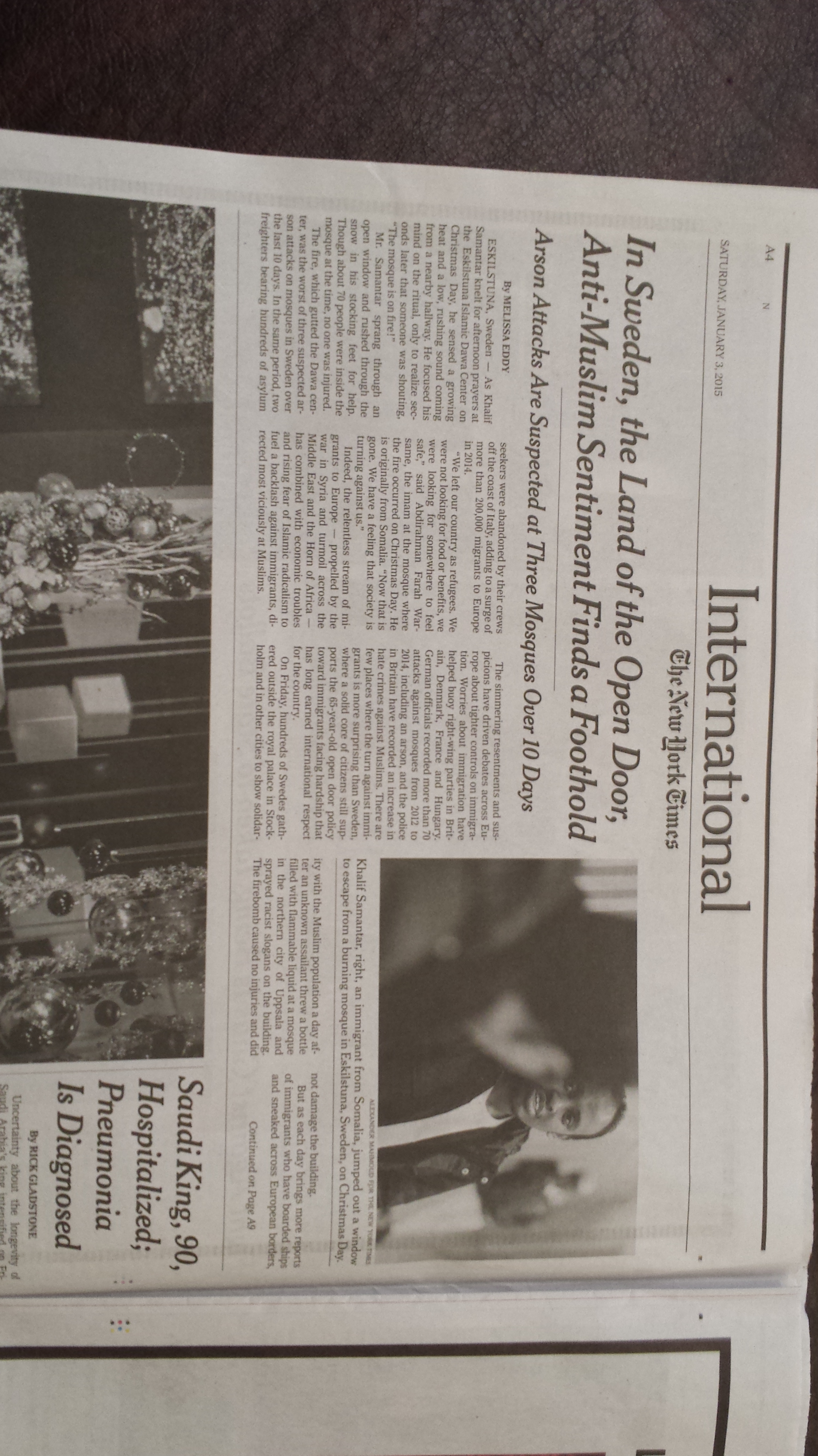
On January 3, 2015, the New York Times posted a large color picture on its front page about people in Sweden standing against a suspected arson attack on a mosque. The article on page A4 that continued onto page A9 described how anti-Muslim sentiment has taken hold in a country that had been known for its liberal immigration policy.

Sweden-articleLarge
New York Times cover about Attack on Mosque in Sweden

Anti-Muslim vs. Anti-Semitism

It is interesting to note how the paper highlighted the “anti-Muslim sentiment” in the title of the article after three suspected arson attacks against mosques in Sweden over the previous ten days. There were no witnesses and no arrests in the attacks but the Times drew its own conclusion that the fires must have been driven by “anti-Muslim” anger.

Compare that conclusion with the one at which the Times arrived in reviewing the actions in Europe during a week in July 2014. There were a dozen incidents involving thousands of people:

  • A synagogue was firebombed in Paris
  • Jewish stores including kosher butchers were looted and 18 people were arrested
  • A mob that gathered outside a synagogue with a hundred Jews trapped inside, shouted “Death to the Jews” and “Hitler was right”
  • In Belgium signs posted in store windows read “no Jews allowed”
  • In Berlin, an imam called for the murder of Jews
  • In Paris, a riot of 4000 people with weapons called for attacks on Jews; 70 were arrested
  • A Facebook page with the names and faces of Jews was posted with a call to attack the individuals who were later beaten
  • The leaders of several countries in Europe condemned the attacks as raw “anti-Semitism”

Despite the clarity of the attacks against Jews, in two separate articles the New York Times said those incidents had an “anti-Semitic tinge”. “TINGE” – meaning that the anti-Jewish sentiment was barely noticeable.

20150104_134833

The Invisible Cause

The Times article on Sweden did not highlight any Muslim actions that may have caused the Swedish “anti-Muslim” sentiment. It mentioned European “rising fear of Islamic radicalism” in a general manner, and mentioned the poor economic situation that recent immigrants find themselves in, and the generous benefits afforded by Sweden’s welfare economy. But the article sought to distance the economic strain on Swedish society by quoting a recent immigrant who stated: “We were not looking for food or benefits. We were looking for somewhere to feel safe.” Some stories neglected by the Times article:

Muslim riots: In 2013, various riots broke out in Sweden with Muslim immigrants burning cars and neighborhoods and throwing stones. Some of those events were covered by the Times. The paper referred to the rioters as “immigrants” throughout the article, and never mentioned their Islamic faith.

Explosion of Rape cases: Over the past decade, the number of reported rapes in Sweden has exploded. The country now ranks as the third highest country in terms of the number of rapes, as the frequency has jumped 250% between 2003 and 2010. While most of the world has seen reported cases of rape dropping or leveling out, the trend in Sweden has been alarming and the focus of much discussion and debate. Many people have attributed the dramatic spike as due to the influx of immigrants from the Middle East, Africa and southeast Asia where rape is much more common than western Europe. This piece of information was also not included in the Times article about Swedes becoming “anti-Muslim”.

Interestingly, in perhaps a related trend, a huge scandal broke in the summer of 2014 about 1400 girls in northern England who had been systematically raped by a gang of Pakistani Muslim men over 13 years. During its reporting of the story, the New York Times refused to publish that any of the attackers was Muslim and just referred to them as men with “Pakistani heritage”. Other media outlets did not exclude the common faith in their reporting.

It would appear that the New York Times deliberately avoids mentioning the religious background of Muslims when reporting crimes, but is quick to blame crimes against their community as “anti-Muslim”.

Conversely, in reporting the European riots protesting Israel, the New York Times seemed perplexed as to why Americans supported Israel while Europeans did not. It put forth an absurd idea that Americans supported Israel “because of the failure of the Arab Spring to spread democracy in the Middle East.” It ignored the actual evil actions and comments of the Palestinians that have been waging war against Israeli civilians for years. Once again, the Times absolved the Muslims of culpability. Regarding the riots in Europe against innocent Jewish citizens of their respective countries who were not Israelis, the Times dismissed the anti-Semitism as not noteworthy.

Racism and anti-religious feelings are indeed real.  The Times has shown that it is adept at finding or ignoring such sentiments as it fits the narrative they are selling.

20150104_134900


Sources:

Immigrant riots in Sweden: http://www.nytimes.com/2013/05/27/world/europe/swedens-riots-put-its-identity-in-question.html?pagewanted=all&_r=0

Rapes in Sweden: http://www.frontpagemag.com/2013/dgreenfield/1-in-4-swedish-women-will-be-raped-as-sexual-assaults-increase-500/

http://www.liveleak.com/view?i=de1_1394099792

Global rape statistics: http://en.wikipedia.org/wiki/Rape_statistics

Pat Condell on Sweden: https://www.youtube.com/watch?v=RZsvdg1dkJ4

Related FirstOneThrough articles:

Anti-Semitic Tinge: https://firstonethrough.wordpress.com/2014/07/25/an-anti-semitic-tinge/

NY Times calling “an anti-Semitic tinge” for a second time: https://firstonethrough.wordpress.com/2014/07/27/tinge-two-idioms-for-idiots/

1400 girls raped in Britain, yet the NY Times refuses to point to the rapists as Muslims: https://firstonethrough.wordpress.com/2014/09/06/the-ties-that-bind-and-those-unmentioned/


Palestinians are “Desperate” for…

On January 1, 2015, the New York Times editorial page led with a piece titled “The Palestinians Desperation Move.” The opinion piece advanced the case that acting Palestinian Authority President Mahmoud Abbas must be frustrated in his mission to create a new Palestinian State.

…Creating a State?

Desperate people take what they can. They view their options as limited and prospects as weak. They seize any opportunities to advance their main goal, whatever that might be.

Witness early Zionists agreeing to any size and configuration of a Jewish state, despite their dream for a larger state based on the British Mandate of Palestine in 1922. They voted “yes” to a United Nations partition in 1947. They voted “yes” to greater Jerusalem and greater Bethlehem being international cities.

The Arabs, on the other hand, consistently voted “no” at every juncture.

These are not activities of a people that is “desperate” for a state. These are not actions of leaders who are willing to make compromises to establish a country and move their people forward.


… Maximizing a Jew-free State and/or Destroying the current Jewish State

Palestinian actions have consistently had three main areas of focus:

  1. Creating a new state free of any Jews
  2. Maximize the size of the new Palestinian state: either the entirety of Israel+West Bank+Gaza or using the 1949 Armistice Lines
  3. If there remains a state of Israel, it should be small and not Jewish


A Jew-free Palestinian state: Palestinians have sought to recreate the conditions of the Arab-controlled regions that expelled and barred the Jews from 1949 to 1967. The Palestinian leadership has continually called for preventing any “settlements”, meaning barring any Jewish people from living anywhere in Gaza, the West Bank and the eastern part of Jerusalem that was controlled by Jordan from 1949-1967. Various Palestinian efforts towards peace talks have demanded a pre-condition of Jewish settlement freezes before any peace talks could begin.  They have lobbied the United Nations to condemn any and all settlements as illegal (even though Jews always lived in the lands before the illegal Jordanian takeover in 1949).

Palestinian law has repeatedly cemented the position of a Jew-free state. In 1973, it passed legislation that made the sale of any land or home to an Israeli to be a capital offense. The Palestinian Authority announced in 1997 that it would seek the death penalty for anyone selling land to a Jew or Israeli.

Abbas has repeatedly voiced his vision of a Jew-free Palestine, stating that he would not allow the presence of a single Israeli- civilian or soldier – in a new Palestine.

Abbas and other members of the Palestinian Authority have also called on the world to engage in a BDS- Boycott, Divestment and Sanction – of any Israeli company that has a presence in the territories they hope will become a Palestinian state. Their aggressive efforts in advancing BDS further underscores their desire to not only prevent any Jews living in a future state, but even establishing businesses there as well.

Even the Universities on the West Bank have laws that prohibit Jews from stepping foot onto campuses.

In short, Palestinian law and leadership calls for banning Jews from visiting, working, buying land or living in the territories it wants for a future state.

Those are the official positions of the “moderate” acting-president of the Palestinian Authority and the existing Palestinian laws. However, the majority of the Palestinian people are in favor of Hamas and would elect someone from Hamas as president according to every poll over the past few years. The Palestinian public elected Hamas to 58% of the Palestinian parliament in their last election in January 2006. Hamas’s charter and its leaders call for the outright killing of Jews and have specifically identified the Jewish nature of Israel as the root cause of the conflict: “In face of the Jews’ usurpation of Palestine, it is compulsory that the banner of Jihad be raised…”


Maximize the size of the Palestinian state. It is not surprising that the Palestinians want to maximize the size of a future state; Israel wants to maximize what it can achieve in negotiations too. However, as detailed here, the working parameters for the Palestinians are to achieve “maximums” and certainly not reflective of a group that is “desperate” and willing to compromise.

Hamas calls for a single Arab Palestine to cover Gaza, the West Bank and all of Israel. They have never backed down or waivered from their 1988 charter in any statement from any leader since that time.

Abbas’ Fatah party has stated that it will “compromise” for a Palestine that follows the “1967 borders.” It states this, despite the fact the 1967 “borders” were not borders but Armistice Lines established in 1949 with Egypt and Jordan. Both of those armistice agreements specifically stated that those lines were not intended to be borders. After repeated invasions and wars by the Palestinians and its Arab allies, Israel has made clear that it will not accept those 1949 Armistice lines as final borders.

“Moderate” Palestinians argue that United Nations Resolution 242 stated that Israel should remove its armed forces from territory acquired during the 1967 war. While the Israelis point out that the language specifically does not state that it must leave “all” of the territory, Abbas is demanding such complete withdrawal; a “maximum” position within the two-state framework.


No recognition of the Jewish State. For much of Israel’s existence, the Arab world refused to recognize Israel in any matter at all and viewed Israel’s entire existence as illegitimate. The Arab world underscored the point with the famous three “no’s” in 1967 including refusing to recognize the basic existence of Israel.

In 1975, Yasser Arafat and the PLO effectively lobbied the United Nations to label the national aspirations of Jews to be a form of racial discrimination. Specifically, Resolution 3379 adopted by the General Assembly referred to the “the racist regime in occupied Palestine” and determined “that zionism is a form of racism and racial discrimination.” Such efforts have nothing to do with establishing a new country and everything to do with delegitimizing the rights and claims of Jews to their own state.

Today, Palestinian leadership continues on the same path of delegitimizing Israel.  Palestinian leadership makes a point of denying Jewish history in the Holy land. Whether addressing the United Nations General Assembly or speaking to reporters, acting Palestinian president Mahmoud Abbas denies any connection between Jews and their history in the land. In 2014, Abbas stated that “they [Israel] imagine that by brute force they can invent a history, establish claims and erase solid religious and historical facts.”

Abbas has made very clear that he will never recognize the Jewishness of the state of Israel:

  • “I’ll never recognize Israel as a Jewish state.” (2014);
  • “We shall never agree to recognize the Jewish state.” (2013);
  • “I will never recognize the Jewishness of the state, or a “Jewish state.” (2011)

Underscoring these points is the insistence of a “Right of return” for descendants of pseudo-refugees to the state of Israel. He believes that the 4.6 million SAPs (Stateless Arabs from Palestine) should be entitled to move into Israel as opposed to a new Palestinian state. The entire point of partitioning the land for two peoples and creating a new Palestinian state is to create a home for these Arabs. What is the point of sending the grandchildren of Arabs who left homes in 1948 to a country they despise (Israel) when they are just creating the country they dreamed of (Palestine)?


For almost a century, the Palestinians have tried various paths to achieve their goals: broad regional wars;  local wars; intifadas; riots; peace talks and lobbying the United Nations.  But what are they hoping to achieve?

If the primary goal of the Palestinian people was a state, would they care if a small number of Jews lived there? Would they so strongly object to recognizing Israel as a Jewish State? Would they insist on an all-or-nothing strategy of getting everything in negotiations?

Are Palestinians truly desperate for a state or are they desperate to deny any rights and legitimacy of Jews to live in the land?

20150102_084725


Sources:

1936 riots: http://www.jewishvirtuallibrary.org/jsource/History/riots36.html

1947 Partition plan: http://www.jewishvirtuallibrary.org/jsource/History/partition_plan.html

1948-9 Israel war of Independence: http://www.jewishvirtuallibrary.org/jsource/History/1948_War.html

1967 Six Day War: http://www.washingtonpost.com/wp-dyn/content/article/2007/05/17/AR2007051701976.html

Khartoum declaration: http://www.sixdaywar.org/content/khartoum.asp

Arafat ends 2000 Clinton-Barack initiative: http://www.theguardian.com/world/2001/jan/03/israel2

Hamas wins 2006 elections: http://www.washingtonpost.com/wp-dyn/content/article/2006/01/26/AR2006012600372.html

No response to Olmert plan: http://www.haaretz.com/news/olmert-abbas-never-responded-to-my-peace-offer-1.263328

Netanyahu 10-month settlement freeze to re-start talks: http://www.nytimes.com/2009/11/26/world/middleeast/26israel.html

No Abbas engagement for nine months: http://www.foxnews.com/opinion/2010/10/13/kenneth-bandler-israel-palestine-peace-mahmoud-abbas-united-states-plo-arab/

Maximum of Olmert is short of Minimum for Abbas: http://www.israelnationalnews.com/News/News.aspx/175910#.VKl5bJs5CUl

Various quotes of Arab intents for Israel: http://www.paulbogdanor.com/israel/quotes.html

Palestinian law banning the sale of land to Jews: http://www.jpost.com/Middle-East/PA-affirms-death-penalty-for-land-sales-to-Israelis

Left-wing article on left-wing journalist barred from Bir Zeit University: http://jfjfp.com/?p=65375

UN resolution 242: http://www.jewishvirtuallibrary.org/jsource/UN/meaning_of_242.html

UN Zionism is Racism: http://unispal.un.org/UNISPAL.NSF/0/761C1063530766A7052566A2005B74D1


Related FirstOneThrough articles:

Laws of Living in Silwan: https://firstonethrough.wordpress.com/2014/10/20/real-and-imagined-laws-of-living-in-silwan/

Abbas knows Racism: https://firstonethrough.wordpress.com/2014/10/27/abbas-knows-racism/

Palestinians are not “resorting” to violence: https://firstonethrough.wordpress.com/2014/11/19/the-palestinians-arent-resorting-to-violence-they-are-murdering-and-waging-war/

The Green Line: https://firstonethrough.wordpress.com/2014/12/09/the-green-line/

Palestinian “refugees” or “SAPs”: https://firstonethrough.wordpress.com/2014/08/08/palestinian-refugees-or-saps/

Palestinian Xenophobia music video (Mr. Rogers): https://firstonethrough.wordpress.com/2014/11/11/wont-you-be-my-neighbor/


The International Criminal Court for Palestinians and Israelis

The International Criminal Court defines itself as “an independent, permanent court that tries persons accused of the most serious crimes of international concern, namely genocide, crimes against humanity and war crimes. The ICC is based on a treaty, joined by 122 countries.”

The ICC uses the following definition for genocide: “According to the Rome Statute, “genocide” means any of the following acts committed with the intent to destroy, in whole or in part, a national, ethnical, racial or religious group:

  • killing members of the group;
  • causing serious bodily or mental harm to members of the group;
  • deliberately inflicting on the group conditions of life calculated to bring about its physical destruction in whole or in part;
  • imposing measures intended to prevent births within the group;
  • forcibly transferring children of the group to another group.”

Regarding “Crimes Against Humanity” the ICC uses the following categories:

  • murder;
  • extermination;
  • enslavement;
  • deportation or forcible transfer of population;
  • imprisonment;
  • torture;
  • rape, sexual slavery, enforced prostitution, forced pregnancy, enforced sterilization, or any other form of sexual violence of comparable gravity;
  • persecution against an identifiable group on political, racial, national, ethnic, cultural, religious or gender grounds;
  • enforced disappearance of persons;
  • the crime of apartheid;
  • other inhumane acts of a similar character intentionally causing great suffering or serious bodily or mental injury.

Lastly, for “war crimes”, the ICC states that it “include grave breaches of the Geneva Conventions and other serious violations of the laws and customs applicable in international armed conflict and in conflicts “not of an international character” listed in the Rome Statute, when they are committed as part of a plan or policy or on a large scale. These prohibited acts include:

  • murder;
  • mutilation, cruel treatment and torture;
  • taking of hostages;
  • intentionally directing attacks against the civilian population;
  • intentionally directing attacks against buildings dedicated to religion, education, art, science or charitable purposes, historical monuments or hospitals;
  • pillaging;
  • rape, sexual slavery, forced pregnancy or any other form of sexual violence;
  • conscripting or enlisting children under the age of 15 years into armed forces or groups or using them to participate actively in hostilities.”

Many of these definitions cover the actions of many countries in modern times. The ICC has taken on a handful of cases thus far including in: Uganda; Congo; Sudan; Central African Republic and Kenya. Crimes committed by Syria, Boko Haram, the Taliban, Iran and Islamic State have not been prosecuted at this time.

Palestinians at the ICC

Genocide: As the Palestinian Authority takes moves to join the ICC, it will place itself in the crosshairs of many of the actions of the court. Within the definition of genocide, the Hamas charter and its leadership call for the killing of Jews and the destruction of Israel clearly put in in violation.

Crimes Against Humanity: Within the definition of crimes against humanity, Hamas murders and kidnaps Israelis. The kidnapped people do not get proper treatment (such as visitation) according to the Geneva Convention. Hamas tortures people suspected of collaborating with Israel and cause mental injury to Palestinians by public executions and torture and dragging bodies through the streets. Acting Palestinian Authority president Abbas actively practices apartheid: he has called for a Jew-free state; Palestinian law bans the sale of any land to Jews (punishable by death); the universities prohibit Jews from stepping foot on campuses. Abbas and Hamas both cause mental injury towards Jews continuously: naming squares and tournaments after murderers of Jewish civilians; airing television programs which call for the murder of all Jews.

War Crimes: Regarding war crimes, Hamas openly attacks civilians and civilian targets. It enlists children to fight Israel and takes hostages.

Israel at the ICC

Genocide: Regarding genocide, the population growth of the Palestinians in Gaza and the West Bank exceed almost every country in the world. The regions have the highest birth rates and lowest death rates. The blockade around Gaza has been deemed legal by the United Nations. No case could be advanced against Israel for such charges.

Crimes Against Humanity: Israel does imprison Arabs in its territories and its practice could come under scrutiny. However, the arrests are likely not viewed as widespread and are often done while investigating crimes. Trying to apply the charge of apartheid would be a stretch as Israel’s practice of using military law for the West Bank which has different criteria for those residents with Israeli citizenship and those that do not. Israel’s treatment of non-Jewish citizens would likely further counter any argument that Israel’s actions in the territories are based on ethnicity.

War Crimes: The Palestinians will likely try to get the most leverage out of the charge of war crimes. It will use the latest Operation Protective Edge over the summer of 2014 to try to blame Israel for intentionally attacking the civilian population and mosques and schools. While Israel may concede that some of their firepower was intentional, it will argue that the targets were legitimate as they were sources of fire. The debate about proportionality of the use of Israel’s firepower and resulting collateral damage versus the firepower aimed at Israeli civilians may be too nuanced for the court to take on.

Palestinian attempts to use the ICC to pursue actions against Israel related to settlement activity in the West Bank would be a stretch. Firstly, it does not fit neatly into the categories which are the focus areas for the ICC. Secondly, international laws like the Geneva Convention and Hague Regulation do not actually consider Jews living in the West Bank to be illegal (see the First One Through article below). Further, “grave violations of the Geneva Conventions” would be a stretch as only one clause (Article 49) deals with treatment of occupied territory, and 95% of that article deals with the treatment of the local population, while only 5% addresses new residents moving into the land.

The international calls that the settlements are illegal are posted by various United Nations and governmental bodies and do not constitute international law from which the ICC would rule. If it were, the ICC could consider the “Zionism is racism” edict by the UN and convict Israel for crimes on that basis. (Note that Turkish Prime Minister Erdogan called Zionism a “crime against humanity” in September 2013.  World opinion on the topic is angry and absurd, but it should not have any bearing on legality).


The Palestinians clearly are much more vulnerable to charges of the ICC. Does Palestinian Authority acting –President Mahmoud Abbas feel that Hamas would bear the brunt of any fallout which would just strengthen his personal position and that of Fatah? Does he think that because his term for president expired six years ago, he can claim no responsibility for Palestinian war crimes?


Sources:

http://www.icc-cpi.int/en_menus/icc/about%20the%20court/frequently%20asked%20questions/Pages/12.aspx

Related FirstOneThrough articles:

The Palestinian call for genocide of the Jews: https://firstonethrough.wordpress.com/2014/11/19/the-palestinians-arent-resorting-to-violence-they-are-murdering-and-waging-war/

Abbas Actively Practices Racism: https://firstonethrough.wordpress.com/2014/10/27/abbas-knows-racism/

The Legal Israeli Settlements: https://firstonethrough.wordpress.com/2014/12/11/the-legal-israeli-settlements/

Quality of life of Arabs in West Bank and Gaza: https://firstonethrough.wordpress.com/2015/01/04/mad-world-of-palestinian-quality-of-life-statistics/

Abbas’s presidential term expired long ago: https://firstonethrough.wordpress.com/2014/09/30/the-disappointing-46-anniversary/


abbas UN

Mad World of Palestinian Quality of Life Statistics

The United Nations had another productive year in 2014, condemning Israel 20 times compared to the rest of the world 4 times in total. This was on the heels of 2013 when it condemned Israel 21 times and the rest of the world only four times in total.

One would imagine that the quality of life of Arabs in Gaza and the West Bank was the worst on the planet by a far margin. Not only does the UN censure Israel multiples of the rest of the world, but it has put into place permanent structures to protect the Palestinians:

  • The only people to get a designated committee in the General Assembly, Committee on the Exercise of the Inalienable Rights of the Palestinian People
  • The only people with a special Ad Hoc committee, Ad Hoc Committee of the General Assembly for the Announcement of Voluntary Contributions to the United Nations Relief and Works Agency for Palestine Refugees in the Near East.
  • The only people with a designated Special Committee, Special Committee to Investigate Israeli Practices Affecting the Human Rights of the Palestinian People and Other Arabs of the Occupied Territories.

These unique committees and agencies further managed to create new definitions to advance the Palestinian cause such as a redefinition of “refugee” only for Arabs pre-1948, to mean people who left a land instead of a country.  They compound the absurdity by enabling these “refugees” and their children, grandchildren and additional generations to obtain benefits courtesy of the world.

With all of the unique concerns of the world for the Arabs from the West Bank and Gaza, it is amazing how well these Arabs are doing compared to the other countries in the world by various measures. Here are some rankings and statistics from the CIA World Fact book comparing 229 countries and territories:

  • Population Growth rate: Gaza (#13) and the West Bank (52) have among the highest population growth rates in the world. Compare them to Jordan (#4), Yemen (20), Turkey (108) and Tunisia (126)
  • Birth rate: Gaza (#35) and West Bank (67) are much higher than many Arab and Muslim countries: Yemen (#39), Jordan (53), Tunisia (112) and Turkey (114)
  • Death rate: Palestinians have the lowest death rates in the world Gaza (#220) and West Bank (#215). Jordan ranks 212, Tunisia 167, Turkey 162 and Yemen 153.
  • Net Migration: Compared to the world and the volatile Middle East, West Bank (#84) and Gaza (#108) are fairly stable, compared to Jordan (5), Yemen (37), Turkey (71) and Tunisia (161).
  • Life expectancy at birth: West Bank (#91) and Gaza (#109) have higher life expectancies than Jordan (#117), Turkey (124) and Yemen (175) and about the same as Tunisia (92).
  • Infant Mortality: Palestinian Arabs have much lower infant mortality rates with Gaza (#105) and West Bank (#117) much lower than Yemen (38), Tunisia (78), Turkey (84) and Jordan (104).
  • Unemployment: the Arabs in West Bank (#169) and Gaza (170) have high unemployment for people aged 15-24, as it has one of the highest percentages of its population under 20 years old, like Yemen. Turkey ranks #101, Jordan 133, Tunisia 151 and Yemen ranks 188.
  • Literacy rate: Gaza (96.4%) and the West Bank (95.6%) compare very favorably to other countries including Jordan (93.4%), Tunisia (88.3%) and Yemen (63.9%), while lower than Turkey (98.8%).

How do the 100+ countries who fair much worse than Gaza and West Bank feel about the unique attention that the Palestinians get? Countries like Tunisia and Yemen probably don’t mind, if the attention comes at the expense of Israel.


The First One Through political music video with music by Tears for Fears:

https://www.youtube.com/watch?v=I943cOvrvm4


Sources:

CIA Fact Book: https://www.cia.gov/library/publications/the-world-factbook/rankorder/2002rank.html

Literacy rates: http://en.wikipedia.org/wiki/List_of_countries_by_literacy_rate

UN condemns Israel 20 times in 2014: http://blog.unwatch.org/index.php/2014/12/17/2014-at-the-un-20-resolutions-against-israel-3-on-rest-of-the-world/

United Nations committees: http://www.un.org/en/ga/about/subsidiary/committees.shtml

Failing Negotiation 102: Europe

“Or What?”

While the United States clearly failed in Negotiation 101 by advancing a peace process that had no chance of success, it is Europe that is failing Negotiation 102.

A basic question in any negotiation is “or what?” If talks break down, where does one stand? Can a party achieve more by having negotiations fail? If so, there would be no motivation to negotiate earnestly.

Those are the questions that acting Palestinian Authority President Mahmoud Abbas is weighing now. Can he get more from the world than he can from negotiating directly with Israel? Based on his assessment of the United Nations and countries willing to prematurely recognize a Palestinian State, he believes that he will achieve greater concessions through a globally mandated solution.

Abbas has been developing this backup (primary?) campaign for several years. The two principal components are recognition (of Palestine) and marginalization (of Israel).   The recognition of Palestine as a state started with UNESCO in 2011. Abbas has continued to work other United Nations agencies and countries around the world to recognize the PA as a sovereign state. In the fall of 2014, Sweden and other European countries began to give Abbas what he desired.

The tool that Abbas hopes will be used to pressure Israel into accepting a globally imposed solution is the BDS (boycott, divest and sanction) movement. If Abbas can convince the world to cease doing business and trade with Israel, he feels that the world can dictate a solution upon Israel which is very reliant on exports for its economy.

As/if European countries move forward with recognizing a state of Palestine and penalizing Israel economically, they effectively will halt any chance for direct peace negotiations. Abbas will not return to the negotiating table while he believes that the world will award him a country with greater borders and controls than he could win in negotiations with Israel.

Even if Abbas doesn’t secure everything he desires from world bodies over the near-term, he would still continue down the unilateral course, as he believes it would position him better in negotiations with Israel at a future point in time, securing whatever advantages he can now. He would further bolsters his credibility with Palestinian Arabs by not giving any concessions while winning Israeli concessions from the world.

And what does Israel gain in a failed peace process? What is its “or what?”

The only “advantage” Israel gains in stalled talks is continuing to permit Jews to move to Judea and Samaria, which may solidify territories under Israeli control in a final settlement. But it loses significantly at the same time from the lack of peace. For eight years it has had Palestinians attacking its citizens from Gaza. It watches Hezbollah in Lebanon gather more weaponry and ready for war. Iran moves forward towards nuclear weapons while calling for Israel’s destruction. As such, the failure of reaching a peace agreement continues to threaten the country. What other country in the world has bomb shelters in every house and every hotel? What other country over the past twenty years has needed to distribute gas masks to its citizens? What other country in the world has countries that refuse to acknowledge its existence? To threaten the country with extermination?


Currently, European and the United Nations’ actions are actively encouraging the Palestinians to avoid direct negotiations with Israel. How far will they continue to move in this direction?


Sources:

UNESCO recognizes Palestine: http://world.time.com/2011/10/31/palestinian-statehood-gets-recognized-unesco-whats-next/

Sweden recognizing Palestine: http://www.theguardian.com/world/2014/oct/03/sweden-recognise-state-palestine

Saeb Erekat calling for BDS: http://www.jpost.com/Diplomacy-and-Politics/Erekat-Israel-preparing-major-settlement-expansion-annexation-355397

Related FirstOneThrough article:

Failing Negotiations 101: the United States https://firstonethrough.wordpress.com/2015/01/01/failing-negotiation-101-the-united-states/


abbas UN


Failing Negotiation 101: The United States

One Party that can deliver

US Secretary of State John Kerry invested heavily in Israel-Palestinian Authority peace talks from July 2013 to March 2014. In the wake of the failure, many people looked to blame one of the two parties for the talks’ failure. A recent New York Times article quoted Israeli left-wing politician Tzipi Livni as blaming the Palestinians for the collapsed negotiations (a surprising statement, as in Israeli election season she only criticizes her political opponent Benjamin Netanyahu.)

In reality, it was the US that was to blame.

The US did not fail for lack of effort. It did not fail in trying to find creative solutions. It failed because the entire basis of having negotiations in the current format was a fool’s errand.

The process was doomed from the outset because Secretary Kerry deliberately ignored Negotiation Rule 101: negotiations between parties that can deliver. A negotiation between parties without authority is meaningless. A person without authority or control could theoretically promise anything – but deliver nothing. That was precisely what Secretary Kerry insisted upon when he pushed Israeli Prime Minister Benjamin Netanyahu to negotiate with a straw man named Mahmoud Abbas.

Abbas has no mandate. Mahmoud Abbas was elected to a four year term as president of the Palestinian Authority in January 2005. After his term expired in January 2009, no new elections were held. He no longer has a mandate.

Abbas has no backing. The reason that no new elections for the PA have been held is that everyone knows that Abbas and his Fatah party would lose. One year after Abbas won the presidency, his Fatah party was trounced in legislative elections. Hamas won 58% of the parliament. Every poll taken since then has shown that Abbas would lose in a presidential election.

Abbas has no control. Gaza, with its population of 1.7 million people, is under complete control of Hamas. Hamas routed all PA forces in 2007 and Abbas has no ability to control any activities from the region. Hamas controls thousands of missiles which it fires at Israeli population centers with or without Abbas approval. Therefore, what “peace” can Abbas deliver?

Despite these enormous glaring flaws, the US pushed forward a peace process that was doomed from the start because of the very essence of one of the negotiating parties. Netanyahu was forced to sit across from a counter-party who could not deliver any compromise that he may have offered. As Netanyahu’s authority was clear, any negotiating point that he made was secure; Abbas could “bank” every concession. However, any compromise that Abbas would theoretically offer, could be negated by the Palestinians. Just as the Palestinians complained that they were never asked about the British Mandate in 1922, they could once again complain that the public was never consulted about the peace process, as a mothballed politician without backing negotiated the agreement.

Further, Abbas’ lack of control meant that he had no means of enforcing the agreement. Israel would be left (at best) with making peace with those parties that accepted the peace agreement, but still be at war with those that rejected the agreement. With Abbas unable to enforce the compromises and the peace, it would continue to fall on Israel to confront those Palestinians that were still at war with the country. Noting how the world reacted to Israel’s defensive operation against Gaza in 2014, could Israel have any sense of security that it could effectively counter-act Palestinian aggression post a mock peace deal?

Secretary Kerry compounded the mistake of the bogus negotiation by building up expectations. His earnest and persistent involvement aggravated the talk’s failure. By investing so heavily in the process, Kerry made the failure that much more pronounced. While there was no direct line linking the talk’s collapse to the July-August battles with Hamas, the environment was poisoned.


Abbas gets no R-E-S-P-E-C-T music video (music by Aretha Franklin): https://www.youtube.com/watch?v=LipAKFsUNq8


Sources:

NY Times on Tzipi Livni impression on talks failure: http://www.nytimes.com/2014/12/24/opinion/roger-cohen-why-israeli-palestinian-peace-failed.html?_r=0

Related First One Through articles:

Abbas 10-year anniversary for a 4 year term: https://firstonethrough.wordpress.com/2014/09/30/the-disappointing-46-anniversary/


2014 Blog Review

The WordPress.com stats helper monkeys prepared a 2014 annual report for this blog.

Here’s an excerpt:

The concert hall at the Sydney Opera House holds 2,700 people. This blog was viewed about 36,000 times in 2014. If it were a concert at Sydney Opera House, it would take about 13 sold-out performances for that many people to see it.

Click here to see the complete report.

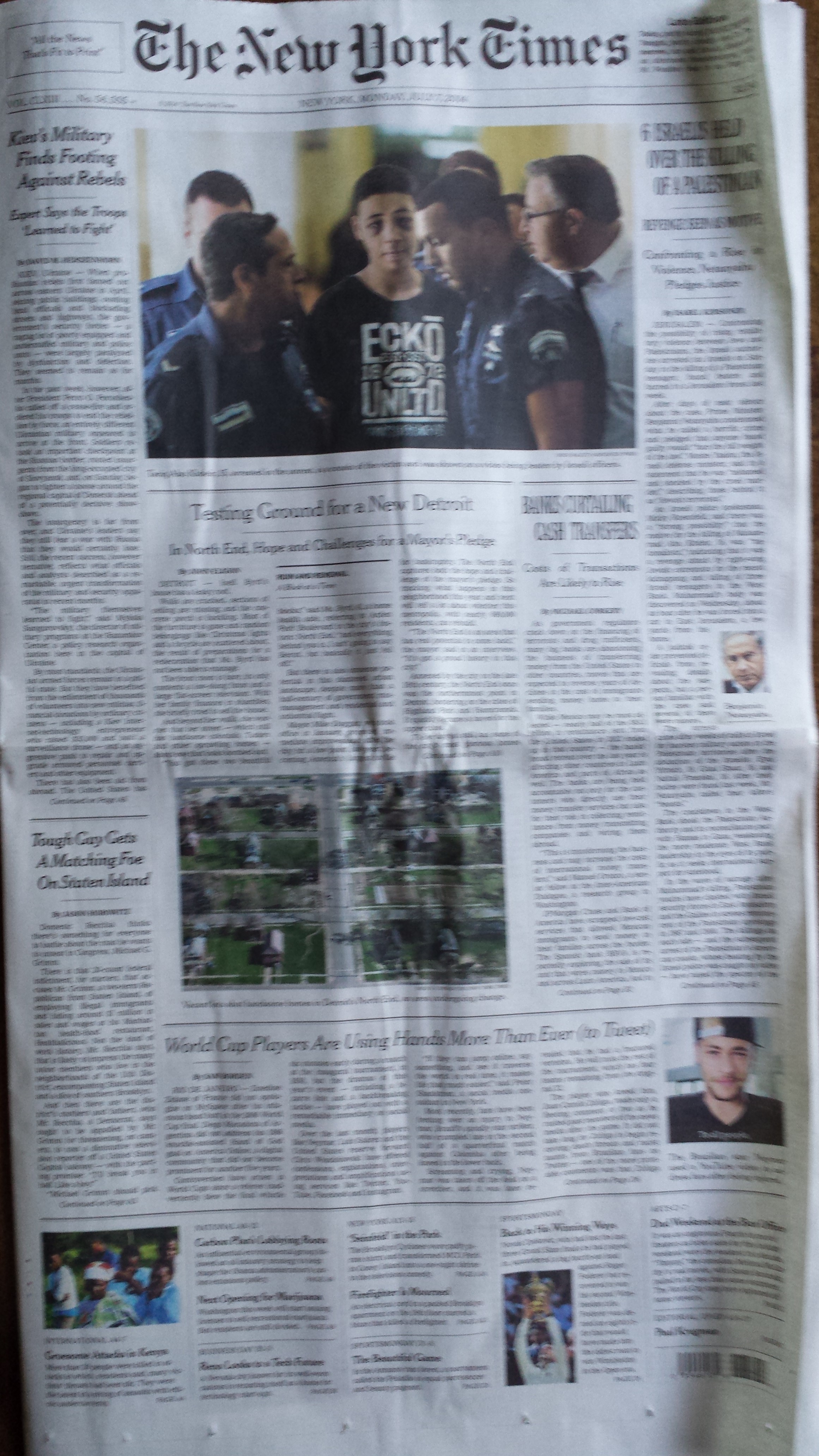
The New York Times Picture of the Year, 2014

15yearold

The year 2014 was notable for the global escalation in terror and death compared to prior years.

  • Islamic State/ ISIS created killing fields in Iraq, executing and beheading hundreds of people which it recorded and aired on the Internet. The group massacred and destroyed entire villages that existed for centuries.
  • Boko Haram in Nigeria killed hundreds of Christians and abducted hundreds of girls.
  • The ongoing war in Syria had a death toll approaching 200,000 people including over 10,000 children.
  • Israel responded to attacks from Gaza for the third time in eight years as Hamas continued rocket fire into Israeli towns. An advanced Hamas terror tunnel network extending into Israel forced a ground invasion into Gaza which claimed over 2000 lives.
  • Russia invaded and annexed Crimea, as Ukraine turned to the world for support but received virtually nothing.
  • Wars in Sudan, Yemen, Afghanistan and other countries continued to claim thousands of lives.

The year also included near break-out race riots in the United States as several unarmed black men were killed by white police officers. In Africa, the deadly disease Ebola killed thousands.

Various news agencies highlighted the most significant news events which ranged from Ebola to Russia’s invasion of Ukraine. They selected new events that impacted thousands of people in 2014 which had potentially long-term consequences.

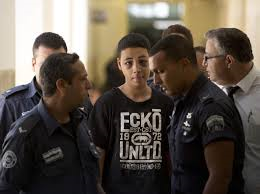
The New York Times year-end review posted dozens of pictures of conflicts around the world to encapsulate 2014.  In my opinion, the NYT picture that  summed up a dominant theme in its reporting for 2014 was the picture above, of a 15-year old Arab surrounded by Israeli policemen. For the New York Times, the stories on its cover pages in 2014 repeatedly told the story: that Israel attacks Arab youths.

The large color picture was displayed on its cover page on July 7, 2014. The bruised 15-year old Arab boy was being escorted out of a police station where he had been detained after throwing stones in a riot. There are several things that make the front-page treatment of the teenager note-worthy:

  • On that same day, over 100 people were killed in attacks in Kenya, Uganda and Yemen. Small stories appeared on the inside pages of the Times to discuss the scores murdered.
  • When Boko Haram killed hundreds, it also did not make the front page.
  • ISIS beheadings of journalists did not make the front page.

The beating of an Arab youth by Israeli forces was given more prominence and therefore deemed more important than those other world events.

This New York Times news story came shortly after three Israeli teenagers were abducted and murdered by Palestinians. The New York Times never placed even a small black-and-white photo of any of the three Jewish teenagers on the front page. Their plight was also not viewed as important by the Times.

Over the course of the next several weeks as Operation Protective Edge unfolded, the New York Times continued to put pictures of Palestinian children on the front page of the paper. Throughout July (July 11, 14, 17, 21, 22, 24 and 29th) the paper had pictures of Palestinians suffering on the front page. It took until July 29 – buried on page A6 – for the Times to write about and post a single picture of the Hamas terror tunnel network that was a main factor in launching the Israeli ground invasion of Gaza.

Further, Palestinian leadership, whether Hamas leaders such as Khaled Mashal or acting Palestinian Authority president Mahmoud Abbas, never were pictured on the pages of the Times during Operation Protective Edge (the only leader to be pictured was Ismail Haniya on September 4 page A10, well after the fighting had stopped). The paper only showed pictures of Arab civilians. However, Israeli Prime Minister Benjamin Netanyahu’s picture was shown often (July 7 twice; July 22; July 27; July 29; August 7), as were Israeli police and soldiers. The overall message of the New York Times was clear: the Israeli government was attacking Palestinian youths and civilians; it was not a war between opposing government authorities.

The Times news stories and editorials built additional narratives onto this theme, regardless of inaccuracies. In attempts to make the Israeli government seem callous to the conditions of Arab youth, an article and editorial on July 7 and July 8 stated that “days of near silence” passed before Israel Prime Minister spoke about the killing of an Arab teenager by Israeli radicals. This was completely untrue and it took days for the NYTimes to print a correction (below).

The NYT editorial board led with a piece on July 19 entitled “Israel’s War in Gaza”.  It was not called “Hamas’ War against Israel”, nor was it called the “War Between Hamas and Israel”.  The Times continued to paint the battle as an aggressive Israeli action against a populace.

In case there was any confusion in the New York Times message to its readership, it included another small picture of Netanyahu near its large picture of the year. (By way of comparison, did you ever see the NYT post a picture of US President Obama near an article about drone strikes or deaths in Afghanistan that he specifically ordered and oversaw?)


The New York Times tried to defend its coverage of the Gaza conflict by printing an editorial on November 23, 2014 entitled “The Conflict and the Coverage”.  Not surprisingly, it attempted to defend its poor media coverage and that it tried too hard to offer “symmetry” in the conflict. It claimed that the paper has “baseline beliefs that Israel has a right to exist and that the Palestinians deserve a state of their own.” The charitable Times board believing that “Israel has a right to exist,” clearly doesn’t extend to: believing that Israel has a right to defend itself; that it was reluctantly pulled into a battle in Gaza; that it sought to minimize Arab casualties; that Hamas is rabidly anti-Semitic; that Hamas leaders are intent on destroying Israel and killing Jews; and that Arab leadership was responsible for the war and deaths of both Israelis and Palestinians.


Sources:

http://www.huffingtonpost.com/2014/07/07/jodi-rudoren-new-york-times-_n_5564067.html

Times moved picture down in online of story: http://www.nytimes.com/2014/07/07/world/middleeast/israel-palestinians-muhammad-abu-khdeir.html

Every Picture Tells a story: https://firstonethrough.wordpress.com/2014/07/04/every-picture-tells-a-story-dont-it/

Bibi as a killing monster: https://firstonethrough.wordpress.com/2014/07/08/every-picture-tells-a-story-part-ii/

The NYT buried pictures: https://firstonethrough.wordpress.com/2014/07/29/the-new-york-times-buried-pictures/


NY Times Correction: July 9, 2014

An article on Monday about the arrest of six Israelis in the killing of a Palestinian teenager referred incorrectly to Prime Minister Benjamin Netanyahu’s response to the killing of Muhammad Abu Khdeir. On the day of the killing, Mr. Netanyahu’s office issued a statement saying he had told his minister for internal security to quickly investigate the crime; it is not the case that “days of near silence” passed before he spoke about it. The error was repeated in an editorial on Tuesday.”