An Inconvenient Truth: Palestinian Polls

There were a growing number of violent attacks by Palestinians against Israelis in October 2015.  Various politicians such as the US Secretary of State John Kerry blamed the root cause as Palestinian frustration about ongoing Jewish “settlements” east of the Green Line.  Acting President of the Palestinian Authority Mahmoud Abbas pointed the finger at defending Al Aqsa Mosque in Jerusalem from Israelis changing the status quo.  United Nations Secretary-General Ban Ki-Moon considered that it was due to Palestinians frustration about the failed peace talks and lack of progress towards creating a Palestinian state.

Why all of the guessing for identifying the root cause when the Palestinians poll themselves every three months?

The Palestinian Center for Policy and Survey Research conducts a poll every quarter on a range of issues.  It breaks the analysis between Palestinian Arabs living in the West Bank/ east of the Green Line and the Gaza Strip.  A review of the poll numbers gives a much better sense of Palestinian Arabs sentiments about their situation than biased and bogus statements from Kerry, Abbas and Ban Ki-Moon.

A Growing Majority of Palestinians Support Attacking Israeli Civilians

The poll figures do show a growing support of attacking innocent Israeli civilians.  In December 2013, the percentage of Arabs supporting unprovoked attacks was 34% and 58% in the West Bank and Gaza, respectively.  Those figures jumped to 48% and 68% for WB and Gaza in September 2014 and then to 50% and 70% in September 2015.  Overall, a clear majority of 57.2% of Palestinians were in favor of terrorism as of September 2015, up from 42.9% in December 2013.

Terrifying numbers about terrorism in both the absolute percentage and in the terrible trendline of support.

No heightened Palestinian fear regarding Annexing the West Bank and Changing the Status Quo on the Temple Mount. Palestinians are ALWAYS afraid.

Despite Kerry’s assertion that Palestinians are increasingly fearful of Israelis living east of the Green Line and Abbas’s statement about Israel changing the status quo on the Temple Mount, the statements are untrue.

kerry harvard
John Kerry at Harvard attacking Israeli settlements
(photo: Brian Snyder/Reuters)

Settlements: Palestinians have always been afraid of Israeli intentions regarding annexing land. In December 2013, 85.3% and 80.5% of Arabs in the West Bank and Gaza, respectively, believed that Israel would annex the entire region.  Those figures dropped after the 2014 Gaza War to 81.2% and 75.3% in September 2014, before rising again to 88.5% and 78% one year later.

In every quarter over the past two years, between 80% and 90% Palestinian Arabs in the West Bank thought Israel was intending to annex both the West Bank and Gaza.  The range was 70% to 82.5% for Palestinians living in Gaza.  Presumably the Arabs in Gaza did not have as great a fear as the Arabs in the West Bank since they clearly saw that Israel left Gaza in 2005.  The question remained why the fear factor numbers remain so consistently high, even in Gaza.  In any event, there was no correlation between the increased Arab desire to kill Jews and their fear of Israelis annexing territory.

Al Aqsa: The poll numbers show similar results for the Temple Mount/ Al Aqsa.  In March 2014, the PCPSR asked whether people were concerned that Israel would change the status quo on the Temple Mount.  Almost everyone – 93% – believed Israel intended to make changes to access and prayer rights.

In December 2014, 66.2% of West Bank Arabs, and 38.8% of Gazans thought that Israel intended to completely destroy the Al Aqsa mosque.  In the most recent September 2015 poll, those figures dropped to 60% and 33.4% for the West Bank and Gaza, respectively.  Again, there was no correlation between the uptick in violence due to Palestinian fears, despite the October 2015 protestations of John Kerry and Mahmoud Abbas.

The UN Fantasy of Palestinian Support for a Two State Solution
and Negotiated Process

Despite the United Nations repeated comments that the key to peace lies in a two state solution, it has never been a particularly popular dream of the Palestinians. In March 2014, a slim majority of 51.2% of Palestinians supported the idea. In the last poll of September 2015, 47.9% of Palestinians were in favor of two states.

Further, throughout 2015 a majority of Palestinians favored an armed struggle with Israel more than negotiations.  In December 2014, Arabs broke down as 41.9%, 25.6% and 28.3% in favor of using either violence, negotiations and non-violent protests, respectively. In September 2015, the polls showed little movement, with a breakdown of 41.6%, 29.2% and 24.2%.

The Palestinian polls show that the two state solution has never been a very popular idea, and those that favor it believe it can best be accomplished through violence. The recent uptick in actual violence actually accompanied a move from a preference for negotiations, counter to expectations.

Safety and Social Media

The poll numbers do show some trends that correlate to the spike in what Wall Street Journal’s Brett Stephens referred to as a Palestinian “blood lust.”

Safety: In December 2013, a majority of Arabs east of the Green Line (54.4%) and in Gaza (61.7%) felt safe.  That changed dramatically after the 2014 Gaza war.  Between June 2014 and December 2014 the sense of safety in the West Bank dropped from 51% to 38.3%, and in Gaza from 63.9% to 46.1%.  The numbers continued to stay low over 2015, with a perceived safety growing from 38.3% to 48.7% in September 2015 in the West Bank, and dropping further in Gaza from 46.1% to 39.5%.  Those are very dramatic declines from two years earlier.

Social Media: Palestinians, particularly those in the West Bank, have been getting their news from social media in much greater numbers.  In the West Bank, Arabs that use Facebook and Twitter jumped from 14.7% (June 2014) to 19% (December 2014) to 26.4% (September 2015). The numbers in Gaza over that time period went from 21.3% to 21.6% to 24.1%.  These are significant changes, particularly in the West Bank.

The survey does not cover what kind of items people are watching and sharing on social media.  According to some news reports, videos of Israeli forces shooting Palestinians and “how to” videos showing ways to stab Jews, have gone viral.

The Palestinian Authority

The Palestinian Authority has always been viewed as corrupt by Palestinians according to polls.  Anywhere from 78% to 84% of West Bank Arabs that live under the PA consider the government corrupt according to every poll.  In Gaza, the percentage is lower, from 72% to 82%, but the overall sentiment is the same.

However, what has not stayed the same is the confidence in Abbas.  While coming in dead last in a theoretical three-person presidential election each quarter, his support has plummeted in the West Bank, while it has grown in Gaza.  In the WB: 32.1% (12/13); 28.5% (6/14); 26.7% (12/14); 21.5% (9/15). In Gaza: 17.2% (12/13); 27.1% (6/14); 20.8% (12/14); and 27.4% (9/15).  By September 2015, 62.9% of West Bank Arabs and 67.4% of Gazans wanted Abbas to resign.

Conclusion

Principal players in the Israeli-Palestinian conflict are using stale and incorrect information to describe the current violence, and as such, are focused on irrelevant solutions.  The settlements and the Temple Mount are not reasons for violent attacks.  A negotiated two state solution was never popular, despite the many efforts of those who strongly advocate for it.  Like the corruption of the Palestinian Authority, these things are constant white noise that don’t suddenly motivate people to murder.

Today’s violence is erupting due to concerns over safety, and fueled by the credibility and incitement of Palestinians on new media.

Abbas announced the beginning of his retreat from the Oslo Accords and managing security in the West Bank. The West Bank Arabs now feel more threatened and communicate directly with each other over social media about attacks and injuries.  The raw videos of families and friends being injured make them feel more unsafe and angry.  They, in turn, make videos for their friends to attack Israelis and reject Palestinian leadership, which fuels the security fears on all sides.

World and regional leaders are rehashing old misconceptions about a pathway towards peace and security in the region.  They should look at what Palestinians are actually saying: they are ambivalent about of a negotiated two state solution. They do not believe or trust their own leadership any more than the intentions of the Israelis.

With such understanding, it is time to rethink always propping up Abbas, ignoring Hamas and condemning the Israelis. It is time to stop obsessing about the settlements and Temple Mount and focus on security and communications.

The inconvenient truth is that Palestinians don’t like and don’t trust any of today’s leaders, and those same leaders refuse to listen to what the Palestinians are telling them.  It is hard to imagine peace and security emerging from such a dynamic.

Subscribe YouTube channel: FirstOneThrough

Join Facebook group: FirstOne Through  Israel Analysis

UN Comments on the Murder of Innocents: Henkins

On October 1, 2015, terrorists shot and killed two Israeli civilians who were driving in their car with their children. As in the past, the United Nations comments about the murders stood in sharp contrast to crimes that may have been committed by Israeli Jews (such as the arson attack which killed three Arabs in Duma):

  • The UN release was all of 181 words (compared to 422 words in Duma)
  • The UN never referred to the event as terrorism (compared to 3 times in Duma)
  • No blame placed on Arabs or Muslims (compared to blaming Jews in Duma)
  • This attack is “condemned” (versus “strongly condemned” in Duma)
  • No blame placed on Palestinian incitement (compared to blaming Jewish settlements in Duma)
  • The UN made a passing reference to Hamas incitement when it stated that “there is nothing heroic about the killing of civilians“, deciding not to specifically and directly call out Palestinians who praised these murders as “heroic”.
  • Similarly, this attack on Israelis is not described as politically motivated (as it was in Duma)
  • No description that the attack came from “hate” (as it was in Duma)
  • The Israeli victims are not described as “innocents” (as they were in Duma)
  • No comment on Abbas’s condemnation of the attack- because Abbas didn’t (compared to no mention of Netanyahu condemning attack in Duma)

#JewishLivesMatter

In Israeli Prime Minister Benjamin Netanyahu’s address to the United Nations General Assembly on the same day, he rebuked almost all of the countries present for their total silence regarding the threats that the Islamic Republic of Iran made to destroy Israel.  This fleeting note of concern by the UN about murdered Israeli civilians remains disappointing.

The UN release about murder of Henkins October 2015:

The United Nations Special Coordinator for the Middle East Peace Process has condemned a shooting attack that took place today on an Israeli civilian vehicle in the West Bank which resulted in the death of two people and injuries to their four children.

“There is nothing heroic about the killing of civilians. The perpetrators of this violent act must be brought to justice,” Nickolay Mladenov said in a statement issued in Jerusalem.

“In order to avoid escalation all must refrain from inflammatory statements and retaliatory action that can only further exacerbate an already tense environment.”

Recent weeks have witnessed increasing tensions both in the West Bank and in East Jerusalem, prompting UN Secretary-General Ban Ki-moon, the Security Council and the High Commissioner for Human Rights to urge Israelis and Palestinians to defuse tensions and prevent any escalation of the current situation on the ground.

Mr. Mladenov noted that today’s tragic incident again highlights “the need for significant steps to help stabilize the situation, reverse the current negative trends and restore hope that a just and lasting negotiated two-State solution is possible.”

UN release of arson attack in Duma July 2015:

31 July 2015 – United Nations Secretary-General Ban Ki-moon and the UN special envoy on the Middle East have strongly condemned today’s arson attack in the West Bank that killed a Palestinian child and left the child’s parents severely injured.

The Secretary-General strongly condemns today’s murder of a Palestinian child in the West Bank and calls for the perpetrators of this terrorist act to be promptly brought to justice,” reads a statement issued by his spokesperson in New York.

Continued failures to effectively address impunity for repeated acts of settler violence have led to another horrific incident involving the death of an innocent life, adds the statement. “This must end.”

The absence of a political process and Israel’s illegal settlement policy, as well as the harsh and unnecessary practice of demolishing Palestinian houses, have given rise to violent extremism on both sides, the statement continues.

“This [situation] presents a further threat to the legitimate aspirations of the Palestinian people for statehood, as well as to the security of the people of Israel. The Secretary-General urges both sides to take bold steps to return to the path of peace.”

Mr. Ban reiterates his call on all parties to ensure that tensions do not escalate further, leading to more loss of life, the statement concludes.

Earlier today, the United Nations special envoy on the Middle East today expressed his outrage over what he called a “heinous murder” and a “terrorist crime.”

“I am outraged by today’s vicious arson attack by suspected Jewish extremists in the Occupied West Bank village of Duma, near Nablus, which killed Palestinian toddler Ali, critically injured his mother and father, and injured his four-year old sibling,” the Special Coordinator for the Middle East Peace Process, Nickolay Mladenov, said.

Joining in the “strong condemnations” issued by Israeli and Palestinian Governments and political leaders, the Special Coordinator also called for a “full and prompt investigation” to bring the perpetrators to justice.

“This heinous murder was carried out for a political objective. We must not permit such acts to allow hate and violence to bring more personal tragedies and to bury any prospect of peace. This reinforces the need for an immediate resolution of the conflict and an end to the occupation.”

Later today, the Security Council issued a statement to the press, condemning “in the strongest terms” the “vicious terrorist attack,” and underlining the need to bring the perpetrators of this “deplorable act” to justice.

Council members encouraged all sides to work to lower tension, reject violence, avoid all provocations, and seek a path toward peace.”


Related First One Through article:

UN Comments on the Murder of Innocents: Itamar and Duma

The New Blood Libel

Subscribe YouTube channel: https://www.youtube.com/user/FirstOneThrough

Join Facebook group: Israel Analysis


The US State Department’s Selective Preference of “Status Quos”

On September 14, 2015, State Department Spokesperson John Kirby gave a daily press briefing in which he said: “The United States is deeply concerned by the recent violence and escalating tensions surrounding the Haram Al-Sharif/Temple Mount. We strongly condemn all acts of violence. It is absolutely critical that all sides exercise restraint, refrain from provocative actions and rhetoric, and preserve unchanged the historic status quo on the Haram Al-Sharif/Temple Mount in word and in practice.”

The comment came after a clash between Arab rock throwers and Israeli police on Rosh Hashanah, the Jewish New Year, as Arabs sought to prevent Jews from visiting the site.

Kirby
State Department Spokesperson John Kirby

State Department Status Quo it Favors

The “status quo” that the State Department presumably sought to maintain was the ban on Jewish prayer on the entire 35 acre Temple Mount platform, the Jews’ holiest place on earth.  That ban was put in place by Muslims in the middle of the 16th century, and Israel has allowed the Islamic Waqf to maintain the ban, even after it captured the Old City from Jordan and reunified the city in 1967.

State Department Status Quo it Seeks to Change

Later in this same briefing, Kirby responded to a question as to whether the Oslo Agreement between the Israelis and Palestinians should be scrapped since no Palestinian state was on the horizon: “Secretary Kerry is committed to pursuing a two-state solution, and I think you’re going to see him continue to do that throughout his tenure here at the department. I don’t think anybody’s – certainly not here – willing to give up on that ultimate goal.”

Kerry is “committed” to changing current reality and creating an Arab-led sovereign state in the holy land for the first time in history.

What makes one status quo worth keeping while the other is not? Does the State Department only endorse a status quo which Muslims desire (banning Jews from the Temple Mount) even though it is clearly anti-Semitic? Is it less a matter of favoring Muslim demands over American integrity and principle, but rather a function of seeking the support of 57 Arab countries versus a single Jewish State?

A more proper – and consistent – response would have been that Israel and the Jordanians and Palestinian Arabs will determine any changes to the status of Jerusalem and the holy sites as part of a final peace agreement. Those changes to the status quo will include matters of sovereignty and rights of access and prayer.


Related First One Through articles:

Joint Prayer: The Cave of the Patriarchs and the Temple Mount

The United Nations and Holy Sites in the Holy Land

The Battle for Jerusalem

A “Viable” Palestinian State

Subscribe YouTube channel: FirstOneThrough

Join Facebook group: FirstOne Through  Israel Analysis


The EU’s Choice of Labels: “Made in West Bank” and “Anti-Semite”

The European Union has taken upon itself to challenge the labelling of products that are made east of the Green Line as “Made in Israel”.   They should consider international norms and the Oslo Accords between Israel and the Palestinians before doing so.

“Made in USA” in US Territories

It is common practice for countries that have territories that are not incorporated into the country, to label products produced in those locations as being made in the country. For example, products produced in American Samoa (say for Sears Department stores) sport the “Made in USA” label even though the products were produced thousands of miles away from US shores on an island that was never part of the country by non-US citizens.

“Made in Israel” in Israeli Territory

Similarly, Israeli law allows products made in Israeli territory to carry the “Made in Israel” label.  The differences between the US and Israeli polices are that the products made in Area C of the West Bank are made by Israeli citizens, and many countries consider the Israeli territory to not be Israeli at all.

The claim that Area C is not Israeli is peculiar, since the land is specifically designated as Israeli territory by the 1993 Oslo II Accords that were agreed to and signed by Israel and the Palestinian Authority. That agreement laid out that Israel continues to have both civil and security control of Area C.  The final determination of control of the area will be decided in a final status agreement, which has not yet occurred. Until that time, the area remains Israeli territory (as opposed to Area A which is Palestinian Authority Territory).

Reasons behind Labelling

The labeling of products is meant to do two main things: inform a consumer about the origins of a product; and distinguish items as they relate to taxes and tariffs.

In the United States, labelling a product from American Samoa as being “Made in USA” may be misleading to consumers about the true origin of the item, but it is consistent as it relates to tariffs. The same holds true for Israeli policy towards items from Area C.

From the EU’s perspective, not only does it seek to inform European consumers about the precise location of origin of foreign products, it wishes to uniquely harm Israel as it disputes the Israeli claim over Area C (despite the Israel-Palestinian Authority agreement noted above). It is therefore requiring a change of labels from “Made in Israel” to “Made in the West Bank” for items produced east of the Green Line.

Date-box-label-1-e1375886179109-350x379
Dates in London, England labelled “West Bank”
(photo: Friends of Al Aqsa London)

Israel has attempted to stop the European Union from embarking on this policy. It fears that the Boycott, Divestment and Sanctions (BDS) movement will hurt its economy by not only not purchasing Israeli products, but by trying to ban the items from store shelves. Some argue that providing a distinct label for products from the settlements would actually help Israel as there are people in Europe who only seek to avoid products from the settlements, but would gladly purchase items from within Israel’s 1949 Armistice Lines. The reality is that many organizations that are promoting the EU policy for distinct labelling of Israel vs. “West Bank” seek to boycott and harm all of Israel. For example, Friends of Al Aqsa (FOA) prints advertisements that call for boycotting all products from anywhere in Israel and its territory.

label Israel
Ad by FOA calling for Boycott of products from “Israel, West Bank (Settlements) & Jordan Valley”

As it relates to taxes and tariffs, the European Union established a framework of trading with Israel in the EU-Israel Association Agreement (1995) which took effect in June 2000. The language in the agreement repeatedly refers to “countries and territories” which can be interpreted broadly to include territories of both European member states as well as Israel.

EU Action Only for Israel

The European Union distinction of strictly labelling products to exclude Israeli territory is unique for Israel.  The EU makes no distinctions for countries where it does not challenge the legal authority (like the US with American Samoa), AND for other countries where it disagrees with the claim on disputed land. Some examples:

  • In 1974, Turkey illegally seized one-third of the Cyprus and declared the Turkish Republic of Northern Cyprus, an entity which is not recognized by any country in the world other than Turkey. Yet the EU avoids heated discussions with Turkey over the labelling of products from TRNC such as its famous halloumi cheese.
  • When it comes to China, the EU trips over itself to facilitate trade. As stated on the EU website on trade: “China is the EU’s biggest source of imports by far, and has also become one of the EU’s fastest growing export markets. The EU has also become China’s biggest source of imports. China and Europe now trade well over €1 billion a day.” Trade includes items made in Tibet, and the EU has not addressed any specific “Made in Tibet” labelling. This is despite China occupying Tibet and transferring 7.5 million Chinese into the territory, counter to the Fourth Geneva Convention.
  • India has a long running dispute with Pakistan over Kashmir. The EU stated that it is “committed to further increase their trade flows in both goods and services as well as bilateral investment and access to public procurement through the Free Trade Agreement negotiations that were launched in 2007.” No specific labelling program has been discussed for items coming from Kashmir.

The European Union has shown a unique fascination with Israeli territories.

  • It makes no labelling distinction for other disputed territories such as Tibet and Kashmir to assist consumers
  • It does not dispute the tariff system that countries use for its territories like the United States with American Samoa
  • The EU ignores the Oslo II agreements between Israel and the Palestinian Authority which specifically segment the Israeli settlements in Area C as Israeli territory
  • It ignores its own trade agreement with Israel

And the EU does all of these things knowing full well of the intention of the BDS movement to leverage their actions to harm the Jewish State.

Double standards and unique critical attention for Israel is considered anti-Semitism, even by US President Barack Obama who said “[if] you acknowledge the active presence of anti-Semitism—that it’s not just something in the past, but it is current—if you acknowledge that there are people and nations that, if convenient, would do the Jewish people harm because of a warped ideology… you should be able to align yourself with Israel when it comes to making sure that it is not held to a double standard in international fora, you should align yourself with Israel when it comes to making sure that it is not isolated.”

It would appear that many Europeans would choose to wear the “Anti-Semitism” label with honor.


Related FirstOneThrough articles:

Names and Narrative: Palestinian Territories/ Israeli Territories

Palestinians agree that Israel rules all of Jerusalem, but the World Treats the City as Divided

Subscribe YouTube channel: FirstOneThrough

Join Facebook group: FirstOne Through  Israel Analysis

The Israeli Peace Process versus the Palestinian Divorce Proceedings

Summary: The gap in resolving the long running Israel-Palestinian Question has to do with the goals of each party: the Israelis believe they have been engaged in a peace process between peoples while the Palestinians are negotiating a divorce settlement between countries.

Politicians and the media – both well-meaning and otherwise – have blamed various parties for the failures to resolve the Israeli-Palestinian conflict. When they are not directly pointing accusing fingers, they still use language which conveys their biases. A person needn’t look past the language used in discussions about Jewish homes beyond the Green Line/ 1949 Armistice Lines – the “settlements”.

“Settlements”

“Viability”: As detailed in “A Viable Palestinian State”, various parties have described the “settlements” as a hindrance to a viable Palestinian state. The statement is meant as a direct attack on Israel, and is absurd. If a Palestinian state cannot exist with a 5% Jewish population, then surely Israel cannot exist with a 20% Muslim population. Are the people that make such a comment looking for Israel to expel a million Israeli Arabs?

Similarly, if a viable Palestine is compromised because such new country would be only 15km across at a single point, surely Israel cannot exist in its current configuration with a 15km narrow corridor for a dozen kilometers. Are these politicians and media pundits suggesting that Israel must annex the entire spine of the land?

“Complication” and “Provocation”: Another sentiment that is expressed is that settlements “complicate the peace process.” As conveyed in June 2015 by the New York Times in an article called “Israel’s work on a West Bank Site Gives Rise to New Suspicion,” even existing homes purchased by private individuals (as opposed to new communities established by the Israeli government) hurt the peace process. The article described a man who purchased an abandoned building and surrounding property: “Leftist Israeli politicians and advocacy groups have reacted with alarm, suspecting a new settlement in the occupied West Bank [a NYT term] that would further complicate the peace process.

This statement is similar to the rebuke of the Obama administration to Jews buying and moving into homes they own in Silwan, in the eastern part of Jerusalem. As detailed in the FirstOneThrough article “Obama supports Anti-Semitic Palestinian Agenda of Jew-Free State,” the Obama administration condemned Jews for legally buying homes and becoming neighbors in an Arab neighborhood east of the Green Line, referring to such basic act of living as a provocation.

And therein lies the basic gap in understanding the actions, intentions and goals of the two sides.

20150610_080707
New York Times article quoting “leftists” that claim that individual Jews owning land east of the Green Line “complicates peace”

Israeli Peace Process

The primary stated goals of the negotiations were to get to a peace based on two states:

  • The peace agreements with Egypt and Jordan are vital. But they’re not enough. We must also find a way to forge a lasting peace with the Palestinians. Two years ago, I publicly committed to a solution of two states for two peoples: A Palestinian state alongside the Jewish state. I am willing to make painful compromises to achieve this historic peace. As the leader of Israel, it is my responsibility to lead my people to peace.” Israeli Prime Minister Benjamin Netanyahu May 2011
  • Our goal is two states, Israel and Palestine, living side by side in peace and security. The process is the one of direct negotiations to end the Israeli-Palestinian conflict and to resolve all the permanent status issues and end the occupation that began in 1967 under which Palestinians have suffered so much.” Prime Minister of the Palestinian National Authority Mahmoud Abbas June 2003

As part of making peace with Palestinian Arabs, Israel has stated it will enable a new state of Palestine to be created.  For their part, the Palestinian Arabs are interested in their new state to be self-governing and to not deal with Israeli Jews. Israel has focused on peace with the people; Palestinians have focused on separation of the people. Two states living side-by-side in peace is not the same as two people living side-by-side in peace.

A peace process is best established with various personal, commercial and governmental relationships and dealings. Such interactions would enable the parties to navigate ongoing thorny issues like water rights and security.  It would enable partnerships to develop tourism and the economy.

Israel understands the importance of establishing relationships with its Arab neighbors.  As soon as the country was founded in 1948, the country granted 160,000 non-Jews citizenship and extended an offer and desire for peace with the neighboring Arab countries.  When Israel annexed Jerusalem, it offered all of the people there citizenship.  As of 2015, non-Jews account for 25% of Israel and have full rights in the most liberal country in the region, and one of the most liberal in the world. In the 2015 Israeli election, the Arab party placed third among the dozen parties seeking seats in the Knesset.

Over the decades, Israel forged peace agreements with neighboring Arab countries Egypt and Jordan.  It has stated that it is ready to so with Palestinian Arabs and the other neighboring countries as well.

Palestinian Divorce Proceedings

When Israel captured the area east of the Green Line in 1967 after it was attacked by the Jordanian and Palestinian Arabs, it rescinded the Jordanian ban on Jews living in the area (from 1949-67).  Israel allowed Jews to live and establish themselves in the region once again where they bought existing houses next to Arabs, built new houses, and created new companies.

All of which, made the Palestinian Arabs angry.

The Palestinians do not want Jewish neighbors in a new state.  Acting President Abbas made very clear his intention when he declared “we will not see the presence of a single Israeli – soldier or civilian – on our lands.”

The Palestinians do not want any Jewish businesses in a new state.  Despite the extraordinary efforts that some companies like Sodastream went through to hire Palestinian Arabs in its plant east of the Green Line (EGL) to work alongside Israeli Arabs and Jews, Palestinians put pressure on the company to abandon the area – which it did. Palestinians promote a BDS (boycott, divestment and sanctions) of all businesses established by Jews in the EGL.

Palestinians think Jews have no rights to buy or live anywhere in the land. They think the entire region – including Israel – is Arab land and that Jews have no history in the region. One can often hear Abbas and other Palestinians refer to the “Judaization” of the land, as if the holy land never had Jews.

The Palestinians reject the legitimacy of Israel itself. While the Palestinians will acknowledge the fact that Israel exists and will negotiate with it, they do not view the existence of the Jewish state as legitimate. They consider Jews colonialists and Israel a foreign colonial enterprise.  As such, they will not recognize Israel as a Jewish State.

The Palestinians are not looking for peace with Israel, nor are they seeking peace with Jews. They view the presence of both in the entire holy land as illegitimate. Their goals are to completely separate themselves from Israel and Jews in their own state, and to reestablish a majority Arab presence inside of Israel. Within their new country, the Palestinians do not want a single Israeli person or business.  Inside of Israel, they want millions of Arabs that are second and third generation removed from Arabs that once lived in the land, to specifically move to Israel because they feel that such land is also Arab land which Jews took illegally.


That is why Jewish “settlements” east of the Green Line are inaccurately called obstacles to a “peace process.” Jewish homes and businesses east of the Green Line do NOT “complicate the peace process”, they complicate the divorce proceedings that the Palestinians desire. A Jewish presence can only be called a “provocation” to a people that want to be rid of Jews.

It is not inaccurate to state that Jewish homes in EGL complicate permanent status negotiations, but it is an inversion of the truth to claim that they hurt the “peace process.”


Related First One Through articles:

Nicholas Kristof’s “Arab Land”

Delivery of the Fictional Palestinian Keys

Names and Narrative: The West Bank / Judea and Samaria


Names and Narrative: Palestinian Territories/ Israeli Territories

Summary: Almost every major media outlet refers to the Gaza Strip and the west bank of the Jordan River as “Palestinian Territories”, when in fact, those areas are actually “Israeli territories” and “Palestinian Authority Territories.”

Most places in the world are part-and-parcel of a country.  However, there are situations when a place is administered by a government which has not incorporated the land and assumed full sovereignty.

The United States of America historically had several large territories as the country expanded, including Alaska and Hawaii.  Today, the USA continues to have several territories including:

  • Puerto Rico
  • US Virgin Islands
  • Guam
  • Northern Mariana Islands
  • American Samoa

These territories have some rights and protections of the US government, but not others such as the right to vote.

Israeli Territories and
Palestinian Authority Territories
1995 to Present

It is easy and obvious to understand that there are no “Palestinian Territories”, because there is no such thing as the State of Palestine (as of this writing, in any event).  Most of the area east of the Green Line (EGL/ west bank of the Jordan River, WBJR), is controlled and administered by Israel.

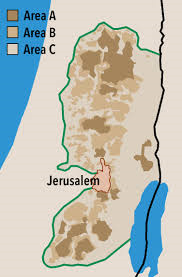
Under the Oslo Accords, EGL was divided into three parts: Areas A, B and C. Area A was handed over to the Palestinian Authority (PA) and it has complete control of that land.  Area C is “Israeli Territory” and is completely controlled by Israel. Area B is a hybrid, which is under the civil administration of the Palestinian Authority, but security control of Israel.

Areas ABC
Breakdown of Areas A, B and C
on the west bank of the Jordan River

Gaza would ostensibly be called “Palestinian Authority Territory”, however, the PA has no control in the area.  The governing party is Hamas, which won elections in 2006 and routed any PA personnel from the region in 2007.  Israel withdrew from Gaza in 2005.

Israeli Territories
1967 to 1995

The Oslo Accords between the State of Israel and the PLO started the process of breaking the Israeli territories into areas with local Palestinian Arab control.  Before the Oslo Accords, all of Gaza and EGL/ west bank of the Jordan River (WBJR) were only Israeli territories.

Israel took control of Gaza from Egypt in June 1967 during the Six Day War.  Egypt had amassed a large army and announced its intention of attacking Israel, so Israel preemptively attacked Egypt and seized Gaza.  In response to Israel’s preemptive attack on Egypt, Jordan attacked Israel from the EGL/WBJR. Jordan lost the region and gave up all claims to the land in 1988.

Jordan and Egyptian Territory
1949 to 1967

In May 1948, the Palestinian Arabs and five Arabs armies attacked Israel as it declared independence from Great Britain. At the end of the war in 1949, Jordan assumed control of much of Judea and Samaria in an area which became known as the “west bank of the Jordan River (WBJR)” in the United Nations, ultimately shortened to the “West Bank”.  Jordan annexed that area in 1950, gave all Arabs living there citizenship and expelled all of the Jews from the area, counter to the Fourth Geneva Convention.

Egypt assumed control of the Gaza Strip, but did not annex the area.

British Territory 1922 to 1948
Ottoman Territory 1517 to 1922

At the end of World War I, the defeated Ottoman Empire was carved up into several areas (including Lebanon, Syria, Iraq, and Jordan) which were administered by the French and British.  The lands currently known as WBJR and Gaza were part-and-parcel of the British Mandate and had no unique laws or characteristics.  Similarly under Ottoman rule for hundreds of years before the British, those areas were neither divided nor distinct.

As detailed above, there are not, nor have there ever been “Palestinian Territories”. Such terminology inherently upgrades the status of the Palestinian Authority and eliminates the legal role and status that Israel has in Areas B and C.


Related First.One.Through articles

Names and Narrative: The West Bank / Judea and Samaria

Nicholas Kristof’s “Arab Land”

The Subtle Discoloration of History: Shuafat

The Legal Israeli Settlements

A “Viable” Palestinian State

Summary: Pundits parrot Palestinian propaganda and state that Jews living in homes on the west bank of the Jordan River (WBJR) threaten the viability of a Palestinian state, Jodi Roduren of the Times being the latest. As Shakespeare wrote “The lady doth protest too much, methinks.”

 20150313_130018
New York Times cover story on “Settlements”

The New York Times’ Jodi Rudoren once again took to the front pages of the paper to decry the building of Jewish homes in lands the Palestinians want for a future state. In the March 12 cover story she wrote: “Steady growth of settlements across the occupied West Bank and East Jerusalem, which most world leaders consider violations of international law, complicates both the creation of a viable Palestine and the challenge of someday uprooting Israelis, who are now raising a second and third generation in contested areas.” The thousand-plus word article detailed the size of various towns and the number of Jews living there, but never once discussed how the presence of Jews “complicates the creation of a viable Palestine.” Thomas Friedman echoed the sentiment on March 18, 2015 op-ed piece where he wrote “some 350,000 settlers are now living in the West Bank, makes it hard to see how a viable two-state solution is possible anymore.“ Let me spell out what they suggested.

PEOPLE

Palestinians are not simply seeking the establishment of a new country where they can be self-governing; they seek a country devoid of Jews. It is as though the presence of Jews triggers some sort of terrible anaphylactic shock to the Palestinian people.

In 2013, acting Palestinian President Mahmoud Abbas declared that “we would not see the presence of a single Israeli – civilian or soldier – on our lands.” For some reason, Abbas abhors the presence of Jews. This would appear to be the rationale for the media thinking that Jews risk the viability of a Palestinian state.

Ignoring for the moment the glaring anti-Semitic nature of the Abbas’s desire, consider the number of Jews that could potentially live in a new state of Palestine.

Small Percentage: Jews account for roughly 40% of the population in the eastern part of Jerusalem; about 13% of the remainder of the west bank of the Jordan River (WBJR), and 0% of Gaza. Ignoring the eastern part of Jerusalem which Israel annexed, Jews account for 8% of the population in the territories. If a portion of the Palestinian population living around the world (estimated at 7 million people) moved to a new state of Palestine – say 2 million of them – the total percentage of Jews would drop to 5%. If land swaps with Israel would move blocks of towns with Jews to Israel, the percentage would drop into the very low single digits.

Is this truly a sticking point for Abbas? Does he need a country to be completely Judenfrei like Nazi Germany? Would a Jewish population of 2-3% make a state non-viable?

Maybe he should look at Israel, which seems to do fine with non-Jewish citizens, which account for 25% of the country’s population. Umm al-Fahm in Israel is a city of nearly 50,000, almost all of whom are Israeli Arabs. Nazareth, with a population of about 66,000 is also completely Arab. Haifa, one of Israel’s largest cities, has a 24% Arab population. The Arab presence doesn’t offend Israelis and doesn’t impact the “viability” of Israel, and they account for 10 times as large a group as Jews would in a new country of Palestine.

“Uprooting Israelis”: Roduren wrote that it will be difficult to move hundreds of thousands of Jewish Israelis from their homes. She is right: such a massive expulsion would dwarf the evictions of Israelis from the Sinai in 1982 and Gaza in 2005. The situation here is also completely different.

When Israel took Sinai from Egypt in the 1967 war, it was new territory. It was never part of the holy land to Jews and was not part of the 1922 Palestine Mandate which established a Jewish homeland in Palestine. The 4500 Israelis that lived in the Sinai who were evicted by the Israeli government as part of a peace treaty were new transplants to the region.

When Israel evacuated the 21 settlements in Gaza in 2005, it was much harder. Gaza was part of Palestine and is featured in the bible. However, it was never home to many Jews at any point in its history.

The WBJR (plus additional area) is known as Judea and Samaria. It has ALWAYS been part of the Jewish history and Jews have always lived throughout the area, except for brief periods of time when they were evicted and banned (such as when Jordanian and Palestinian Arabs controlled the area from 1949-67). The area was an integral part of the 1922 British Mandate of Palestine which established a Jewish homeland. When Israel legally counter-attacked the Jordanians in 1967, it removed the racist ban of Jews in the land that the Jordanians put in place, after they evicted all of the Jews counter to the Fourth Geneva Convention. In 1967, Israel allowed Jews to return to live in lands they had always lived in.

The “complication” of “someday uprooting” hundreds of thousands of Israelis living in WBJR is not about the sheer size of the numbers. These residents belong there and should never be evicted or forced to leave at all.

Counter to Palestinian Law: In 2002, Palestinians drafted a framework of laws called the Basic Law. It, theoretically, guarantees the freedom of religion:

  • Article 18: Freedom of belief and the performance of religious rituals are guaranteed, provided that they do not violate public order or public morals.It is interesting (telling?), that the Palestinians would guarantee the freedom of religion, as long as there are no Jews living in the land.

LAND

Other media sources claim that the threat to a viable Palestinian state is not because of the presence of Jews, but because of the remaining configuration of the land.

For example, the Guardian wrote about the potential development of a parcel of land known as “E1”, standing for “East of Jerusalem”, which Israel plans to develop to bridge the eastern part of the Jerusalem municipality with the large city of Maale Adumim. The Guardian wrote Despite its prosaic name, E1 has the potential to kill off hopes for a viable Palestinian state with East Jerusalem as its capital, according to opponents of Israeli development on the 12 sq km site east of Jerusalem…. It would also almost bisect the West Bank, making a contiguous Palestinian state almost impossible.”

While the annexation of E1 would likely cut off “East Jerusalem” as a capital of a future Palestinian State, it does nothing to harm the viability of a new country. Making such comments is simply echoing the Palestinian government’s alarmist position “we cannot build a viable state with a country that is disintegrating into small pieces.

The “bisection of the West Bank” that the article claims refers to the distance from Maale Adumim to the Jordan River which would be only 15 kilometers. This would be the narrowest spot of WBJR. It would happen at only a single spot in the middle of the Judean Desert before widening by many miles.

Israel’s narrowest spot is that same 15 kilometers across, except it stays narrow for several miles. Further, that narrow stretch runs along Israel’s main population and commercial center near Tel Aviv. This compares to the WBJR which is mostly unpopulated desert land.

15miles wide
Narrowest point map,
from Honest Reporting

Is a single narrow stretch of land so catastrophic that Palestine would not be viable? Should that be true, Abbas must believe that much of the spine of the country which sits in the hills of eastern “West Bank” should be annexed by Israel to make sure it becomes viable, just as Bayit Yehudi’s Naftali Bennett suggests.


In short, if Abbas feels that the issue of a “viable” state is because a handful of Jews cannot live in Palestine, then by definition, the “Right of Return” of millions of Arabs to Israel cannot be permitted or it would destroy Israel. Similarly, if the threat of viability stems from “bisecting” the land, then Israel would need to annex the entire middle of the country.

There are many paths to a viable country which include building an economy and ensuring security. Neither of those are accomplished by banning Jews from living in the land.  It is well past time for Abbas to continue to make such racist claims; it is disgraceful that western media continues to blindly repeat it.


Related First One Through articles:

Abbas’s racism: https://firstonethrough.wordpress.com/2014/10/27/abbas-knows-racism/

The Legal Settlements: https://firstonethrough.wordpress.com/2014/12/11/the-legal-israeli-settlements/

West Bank/ Judea and Samaria: https://firstonethrough.wordpress.com/2014/12/08/names-and-narrative-the-green-line-west-bank-judea-and-samaria/

Palestinian xenophobia:https://www.youtube.com/watch?v=eQS1XVQR-Xc

The New York Times Major anti-Netanyahu Propaganda Piece

Summary: The New York Times once again showed its bias against Jews living on the west bank of the Jordan River by painting opinion as international law. It posted a large non news-article during the week of Israeli elections in an attempt to discredit Israeli Prime Minister Netanyahu.

On March 12, 2015, the New York Times ran a cover page story called “As Israeli Settlements take Root, So do Complications” and on its online version it was titled “Netanyahu and the Settlements”. The article repeatedly referred to something called the “Geneva Initiative” as if the initiative carried any backing or legal authority. In actuality, the 2003 initiative is most akin to a present day Facebook Group.

20150313_130018
New York Times large cover story on the “Settlements”

The Times wrote “Two-thirds of new construction over the last two years, the Peace Now report shows, was on the Palestinian side of a line drawn by the Geneva Initiative, an international working group that produced a model agreement in 2003…
Efrat, with nearly 10,000 residents, is to Israelis the capital of the Etzion block. Palestinians, though, do not accept it as part of the block at all,
because it is on the eastern side of Route 60 — their side of the Geneva Initiative map. Annexing it would be far more complicated.”

By reading such statements, one would think that Israel is deliberately building homes on the “Palestinian side” of a road, contrary to existing laws and/or agreements. Palestinians are comfortable with Jews living on one side of Route 60, but not on the other.  That is specifically what the NYT intends the reader to conclude by writing such an article. It is completely untrue.

The Geneva Initiative was launched by a handful of people- both Israelis and Palestinians. The civilians met during 2003 and drafted a guideline of how a two state-solution could emerge. None of the people participating were elected or appointed by any governmental body. Their initiative was not endorsed by any government. Neither Israelis nor Palestinians consider this old private working paper at all.

“the 2003 Geneva Initiative is most akin
to a present day Facebook Group”

Meanwhile ACTUAL laws and agreements were deliberately omitted from the NYT article. They include the 1922 British Mandate of Palestine which was signed by the League of Nations, the precursor to the United Nations. The Mandate stated:

  • Article 6: The Administration of Palestine, while ensuring that the rights and position of other sections of the population are not prejudiced, shall facilitate Jewish immigration under suitable conditions and shall encourage, in co-operation with the Jewish agency referred to in Article 4, close settlement by Jews on the land, including State lands and waste lands not required for public purposes.
  • Article 15: The Mandatory shall see that complete freedom of conscience and the free exercise of all forms of worship, subject only to the maintenance of public order and morals, are ensured to all. No discrimination of any kind shall be made between the inhabitants of Palestine on the ground of race, religion or language. No person shall be excluded from Palestine on the sole ground of his religious belief.

As described above, international law enabled Jews to live everywhere in Palestine. Such freedom of movement and the ability to buy land was also the case under the Ottoman Turks. This is history and law – not the opinion of a handful of private citizens.

The west bank of the Jordan River was an integral part of the 1922 British Mandate of Palestine.  It was annexed by the Jordanians in 1950, after Jordan attacked Israel in the 1948-9 war (such Jordan annexation was with approval of the Palestinians but never considered by the United Nations). The Jordanians illegally evicted all of the Jews from the area, including the eastern part of Jerusalem, counter to the Fourth Geneva Convention.

After Jordan (and the Palestinians who were Jordanian citizens) attacked Israel again in 1967, Israel was obligated to launch a counter-attack per The Hague Regulations which state:

  • Article 40: Any serious violation of the armistice by one of the parties gives the other party the right of denouncing it, and even, in cases of urgency, of recommencing hostilities immediately.

Jordan was therefore legally attacked by Israel.  The Jordanians officially gave up all claim to the land in 1988.

None of these international laws, agreements or actions on the part of governments are mentioned in this large cover story by the New York Times. Instead, the Times chose to paint a picture that Israel is not abiding to laws to make it appear as the belligerent party. It does this with the aid of a private working paper from 12 years ago.

20150313_130046
Double page story by the NYT, continued from March 12 2015 cover 

There was nothing new in the story which begs the questions:

  • Why give the article such prominence by placing it on the cover with a large color picture, and continue with a full two-page spread in the inside pages complete with pictures, maps and drawings?
  • Why use an old private Initiative to make an argument about the location of settlements instead of history and law?
  • Why post the article now?

The New York Times posted the piece as they want to see Israeli Prime Minister Netanyahu defeated in upcoming Israeli elections.  The Israeli elections will take place later in the week, on March 17, 2015.  The New York Times, which has a long history of attacking the Israeli Prime Minister, put this non-news story on the front page the week before Israeli elections to make it appear that Israeli Prime Minister Benjamin Netanyahu was acting outside of the law.

The Times has once again shown it is not a credible source of news and chooses to air its biased opinions throughout the newspaper.  It has also shown that it seeks to influence the outcome of foreign elections with large distortions.  An interesting piece of hypocrisy, as the day before, on March 11, the NYT posted an op-ed from Thomas Freidman arguing about Sheldon Adelson’s attempts to influence elections in the United States with major contributions to Republican candidates, as well as claiming Adelson’s Israel Hayom newspaper is a biased mouthpiece for Netanyahu in Israel.

Is the Times posting the opinion of Barack Obama or George Soros?


First One Through articles:

Legal settlements: https://firstonethrough.wordpress.com/2014/12/11/the-legal-israeli-settlements/

NYT’s Nicholas Kristof’s “Arab Land”  https://firstonethrough.wordpress.com/2015/02/27/nicholas-kristofs-arab-land/

NYT ignores Jihadists in Israel: https://firstonethrough.wordpress.com/2015/01/26/radical-jihadists-in-europe-and-dislocated-and-alienated-palestinians-in-Israel/

NYT minimizing Netanyahu’s election success: https://firstonethrough.wordpress.com/2014/08/11/new-york-times-talking-turkey/

NYT only using “West Bank” instead of “Judea and Samaria” https://firstonethrough.wordpress.com/2014/12/08/names-and-narrative-the-green-line-west-bank-judea-and-samaria/

Mad World of Palestinian Quality of Life Statistics

The United Nations had another productive year in 2014, condemning Israel 20 times compared to the rest of the world 4 times in total. This was on the heels of 2013 when it condemned Israel 21 times and the rest of the world only four times in total.

One would imagine that the quality of life of Arabs in Gaza and the West Bank was the worst on the planet by a far margin. Not only does the UN censure Israel multiples of the rest of the world, but it has put into place permanent structures to protect the Palestinians:

  • The only people to get a designated committee in the General Assembly, Committee on the Exercise of the Inalienable Rights of the Palestinian People
  • The only people with a special Ad Hoc committee, Ad Hoc Committee of the General Assembly for the Announcement of Voluntary Contributions to the United Nations Relief and Works Agency for Palestine Refugees in the Near East.
  • The only people with a designated Special Committee, Special Committee to Investigate Israeli Practices Affecting the Human Rights of the Palestinian People and Other Arabs of the Occupied Territories.

These unique committees and agencies further managed to create new definitions to advance the Palestinian cause such as a redefinition of “refugee” only for Arabs pre-1948, to mean people who left a land instead of a country.  They compound the absurdity by enabling these “refugees” and their children, grandchildren and additional generations to obtain benefits courtesy of the world.

With all of the unique concerns of the world for the Arabs from the West Bank and Gaza, it is amazing how well these Arabs are doing compared to the other countries in the world by various measures. Here are some rankings and statistics from the CIA World Fact book comparing 229 countries and territories:

  • Population Growth rate: Gaza (#13) and the West Bank (52) have among the highest population growth rates in the world. Compare them to Jordan (#4), Yemen (20), Turkey (108) and Tunisia (126)
  • Birth rate: Gaza (#35) and West Bank (67) are much higher than many Arab and Muslim countries: Yemen (#39), Jordan (53), Tunisia (112) and Turkey (114)
  • Death rate: Palestinians have the lowest death rates in the world Gaza (#220) and West Bank (#215). Jordan ranks 212, Tunisia 167, Turkey 162 and Yemen 153.
  • Net Migration: Compared to the world and the volatile Middle East, West Bank (#84) and Gaza (#108) are fairly stable, compared to Jordan (5), Yemen (37), Turkey (71) and Tunisia (161).
  • Life expectancy at birth: West Bank (#91) and Gaza (#109) have higher life expectancies than Jordan (#117), Turkey (124) and Yemen (175) and about the same as Tunisia (92).
  • Infant Mortality: Palestinian Arabs have much lower infant mortality rates with Gaza (#105) and West Bank (#117) much lower than Yemen (38), Tunisia (78), Turkey (84) and Jordan (104).
  • Unemployment: the Arabs in West Bank (#169) and Gaza (170) have high unemployment for people aged 15-24, as it has one of the highest percentages of its population under 20 years old, like Yemen. Turkey ranks #101, Jordan 133, Tunisia 151 and Yemen ranks 188.
  • Literacy rate: Gaza (96.4%) and the West Bank (95.6%) compare very favorably to other countries including Jordan (93.4%), Tunisia (88.3%) and Yemen (63.9%), while lower than Turkey (98.8%).

How do the 100+ countries who fair much worse than Gaza and West Bank feel about the unique attention that the Palestinians get? Countries like Tunisia and Yemen probably don’t mind, if the attention comes at the expense of Israel.


The First One Through political music video with music by Tears for Fears:

https://www.youtube.com/watch?v=I943cOvrvm4


Sources:

CIA Fact Book: https://www.cia.gov/library/publications/the-world-factbook/rankorder/2002rank.html

Literacy rates: http://en.wikipedia.org/wiki/List_of_countries_by_literacy_rate

UN condemns Israel 20 times in 2014: http://blog.unwatch.org/index.php/2014/12/17/2014-at-the-un-20-resolutions-against-israel-3-on-rest-of-the-world/

United Nations committees: http://www.un.org/en/ga/about/subsidiary/committees.shtml

The Legal Israeli Settlements

Many people have argued that it is illegal for Israelis to live beyond the 1949 Armistice Lines (east of the Green Line, EGL/Judea and Samaria/West Bank).  The question of “legitimacy” (not legality) has been repeated often by the USA’s Obama Administration.  Those comments are more harsh towards Israel than prior American administrations that simply viewed new settlements as “unhelpful” to a peace agreement between Israel and the Arab states.  Jimmy Carter was the only US president that actually called the settlements “illegal”.  Below is a review of the international laws that apply towards the settlements.

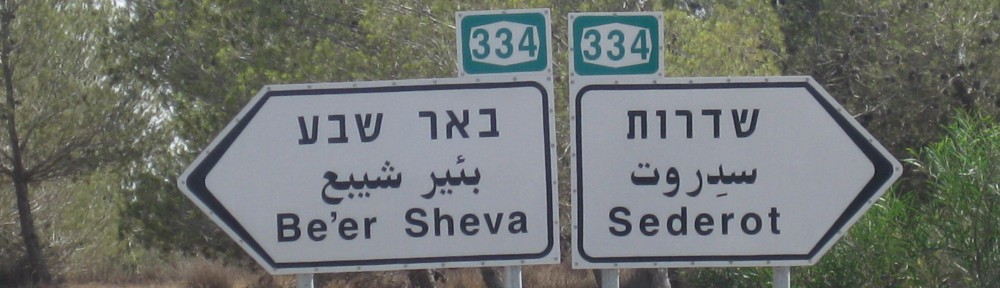
IMG_2002
Street sign in Judea and Samaria

Fourth Geneva Convention

Article 49 of the Fourth Geneva Convention deals with the treatment of “occupied territory“.  It is unclear whether it applies to territory obtained in both offensive and defensive wars, but this review will assume that the law stands in either case.

The majority of Article 49 is about the treatment of the inhabitants of the occupied territory and not about the “Occupying Power” transferring in its own population.  The opening paragraph:

“Individual or mass forcible transfers, as well as deportations of protected persons
from occupied territory to the territory of the Occupying Power or to that of any other country, occupied or not, are prohibited, regardless of their motive.”

This paragraph does not relate to Israelis living in EGL for several reasons:

  • The language is about people from the occupied territory, not to the occupied territory.  It underscores the flagrant illegal eviction of Jews from Judea and Samaria by the Jordanians in 1949.
  • As the Arabs living in EGL were not forcibly transferred to any country, Israel did nothing counter to this law.

The next paragraphs deal with exceptions to the main directive stated above for military reasons:

“Nevertheless, the Occupying Power may undertake total or partial evacuation of a given area if the security of the population or imperative military reasons so demand. Such evacuations may not involve the displacement of protected persons outside the bounds of the occupied territory except when for material reasons it is impossible to avoid such displacement. Persons thus evacuated shall be transferred back to their homes as soon as hostilities in the area in question have ceased.”

  • The law permits operations involving security.  This clause allows the building of the security barrier inside the West Bank that Israel erected in reaction to the Second Intifada, and relocation of people impacted to construct such barrier.

 “The Occupying Power undertaking such transfers or evacuations shall ensure, to the greatest practicable extent, that proper accommodation is provided to receive the protected persons, that the removals are effected in satisfactory conditions of hygiene, health, safety and nutrition, and that members of the same family are not separated. The Protecting Power shall be informed of any transfers and evacuations
as soon as they have taken place. The Occupying Power shall not detain protected persons in an area particularly exposed to the dangers of war unless the security of the population or imperative military reasons so demand.”

  • These paragraphs seek to protect people, even in the case of a necessary evacuation.  The only Arabs that Israel moved out of the West Bank were people who were arrested and therefore not relevant to this clause.

As seen above, almost the entirety of Article 49 of the Geneva Convention has to do with the local population- in this case, a theoretical transfer of Arabs out of EGL/Judea and Samaria/West Bank.  Only the last paragraph addresses the civilians of an “Occupying Power”.

 “The Occupying Power shall not deport or transfer parts of its own
civilian population
into the territory it occupies.”

  • Israelis moving and living in EGL/J&S do so of their own free will.  The government does not “deport or transfer its own civilians” to EGL.
  • The “territory” in question, Judea and Samaria, was settled by Jews long before the Jordanians occupied the area and evicted the Jews. As such, Jews were part of the indigenous population before being illegally evicted in 1949. Returning to the region is in keeping with Article 49’s goal above stating “Persons thus evacuated shall be transferred back to their homes as soon as hostilities in the area in question have ceased.
  • Additionally, this territory was never a distinct country, but part and parcel of the Mandate of Palestine which specifically called for “establishment in Palestine of a national home for the Jewish people.”  As such, Jews moving to Judea and Samaria is part of the ongoing provision established internationally in 1922.

The Hague Regulations

Another law that people contend relates to Israel’s administration of EGL/West Bank is Article 55 of the Hague Regulations:

 “Art. 55. The occupying State shall be regarded only as administrator and usufructuary of public buildings, real estate, forests, and agricultural estates belonging to the hostile State, and situated in the occupied country. It must safeguard the capital of these properties, and administer them in accordance with the rules of usufruct.”

This rule clearly affirms Israel’s role as administrator for public lands.  The Hague regulations – and this provision in particular – deal with situations that are temporary in nature, and are impractical for those that last for decades.  To wit, the Arab population in the West Bank has grown four times since 1967, in one of the largest population increases on the planet. New infrastructure was established to accommodate the growth in the region, and Israel authorized these new homes, roads and other infrastructure, thereby necessitating a change to public lands.

In terms of minimizing the changes to public lands, it is unclear whether the role of Israel is to maintain a status quo according to the laws of Jordan, which illegally seized and annexed the area, or to administer the region according to British laws which had an international mandate before the Jordanians took control.

  • The Jordanians took this area in an offensive war against Israel in 1948-9
  • The Jordanian annexation in 1950 was never recognized by the United Nations
  • The area in question was part of the internationally approved British Mandate of Palestine (from 1922-1948).

Therefore, to comply with Article 55 above, which rules were appropriate for Israel to maintain: the illegal occupying Jordanian laws of 1949-1967 or those accorded in international law in the British Mandate 1922-1948?

If the British laws regarding property were to be maintained, then those laws state that no person should be forbidden to live in any part of the entirety of the Mandate (including Gaza, Israel and the West Bank) on the basis of religion, per Article 15 of that 1922 Mandate:

“The Mandatory shall see that complete freedom of conscience and the free exercise of all forms of worship, subject only to the maintenance of public order and morals, are ensured to all. No discrimination of any kind shall be made between the inhabitants of Palestine on the ground of race, religion or language. No person shall be excluded from Palestine on the sole ground of his religious belief.”

As it relates to the use of public lands (which is the focus of Article 55 of the Hague Regulations), the British Mandate clearly states that public land is to be used for Jewish settlement:

“The Administration of Palestine, while ensuring that the rights and position of other sections of the population are not prejudiced, shall facilitate Jewish immigration under suitable conditions and shall encourage, in co-operation with the Jewish agency referred to in Article 4, close settlement by Jews on the land, including State lands and waste lands not required for public purposes.”

Administration under British law encouraged Jews to live throughout Judea and Samaria, including state lands, and it can therefore not be illegal for any Jew to live there.

The only possibility that Jews moving to and living in the West Bank could be considered illegal, was if Jordanian law was to be maintained in the area.  However, even if one were to assume that despite the Jordanian’s forcible seizure and illegal annexation of the area, that their laws should still be maintained, could any law possibly suggest that it be a requirement to maintain particular laws that were flagrant violations of the Geneva Convention such as the racist Jordanian laws that evicted and barred Jews from living in the land?

Even further, if Israeli actions of Jews moving to EGL/West Bank were somehow considered illegal (which is not the case), Article 3 of the Hague Resolution states that a “belligerent party which violates the provisions of the said Regulations shall, if the case demands, be liable to pay compensation,” so remedy would be a fine, not eviction of the Jews.

(Also note that Hague Regulation Article 40, specifically gave Israel the right to attack Jordan after Jordan broke the 1949 armistice agreement in 1967.)

United Nations Reinterpretation for Israel

Since 1967, the United Nations crafted various resolutions condemning Israel for a wide variety of perceived “sins” such as the infamous “Zionism is Racism” resolution in 1975.  Many resolutions have inverted the meaning of the Geneva Convention such as a UN Security Council Resolution in 1980 which “Deplor[es] the decision of the Government of Israel to officially support Israeli settlement in the Palestinian and other Arab territories occupied since 1967.”  It continued further:

“[A]ll measures taken by Israel to change the physical character, demographic composition, institutional structure or status of the Palestinian and other Arab territories occupied since 1967, including Jerusalem, or any part thereof, have
no legal validity and that Israel’s policy and practices of settling parts of its population and new immigrants in those territories constitute a flagrant violation of the
Fourth Geneva Convention relative to the Protection of Civilian Persons in Time of War and also constitute a serious obstruction to achieving a comprehensive,
just and lasting peace in the Middle East;”

Arguing that “new immigrants” (many of whom were actually returning residents from 1949) are a threat to the security of the existing population is xenophobia at its most extreme.  Arguing that is a “flagrant violation of the Fourth Geneva Convention” is disproved above.

Status of Jerusalem

The inclusion of Jerusalem in the United Nations attacks on Israel is telling.  Greater Jerusalem and Greater Bethlehem were planned to be an international “Holy Basin” according to the UN 1947 Partition Plan – neither Arab nor Israeli.  After Jordan attacked Israel and seized the eastern half of Jerusalem and annexed it, the United Nations remained silent.  The UN issued no declaration against the Jordanian invasion and land grab for the entire period it held the territory through 1967.  However, when Israel took control of Jerusalem and later annexed it in 1980, the United Nations went on tirades about the illegal nature of Israel’s authority. The UN’s motions are absurd and duplicitous in granting tacit approval to the Jordanian Arab illegal annexation of Jerusalem and condemning Israel for its annexation. If Jordan’s offensive war to take a planned international city was viewed as permissible, how can Israel’s defensive war be viewed any less so?

The ongoing dynamic in Jerusalem is also different than the rest of EGL/West Bank since the eastern part of the city was annexed by Israel and all of the residents were offered citizenship (almost all of the Arabs declined and took residency papers instead). As such, clauses in international law about offering citizenship to people are not applicable to the eastern half of Jerusalem (while still relevant in the remainder of EGL/West Bank).

As reviewed above, Israel abides by the global rules of international law relating to Jews living in EGL.  However, the United Nations reinterpretation of law solely as it relates to Israel – whether for national movements like Zionism, or for allowing Jews to move and live freely like other peoples in lands they lived in for thousands of years – is not law, but anti-Semitism.


Source:

Fourth Geneva Convention: https://www.icrc.org/applic/ihl/ihl.nsf/c525816bde96b7fd41256739003e636a/77068f12b8857c4dc12563cd0051bdb0?OpenDocument

Hague Resolution: https://www.icrc.org/applic/ihl/ihl.nsf/WebART/195-200065?OpenDocument

Hague Resolution Article 3: https://www.icrc.org/applic/ihl/ihl.nsf/ART/195-200004?OpenDocument

Hague Resolution Article 40: “Any serious violation of the armistice by one of the parties gives the other party the right of denouncing it, and even, in cases of urgency, of recommencing hostilities immediately.

British Mandate of Palestine: http://avalon.law.yale.edu/20th_century/palmanda.asp

Israel-Jordan Armistice agreement: http://avalon.law.yale.edu/20th_century/arm03.asp

UN Security Council Resolution 465 (1980): http://unispal.un.org/UNISPAL.NSF/0/5AA254A1C8F8B1CB852560E50075D7D5

UN Security Council Resolution 476 (1980) attacking Israel on Jerusalem: http://unispal.un.org/UNISPAL.NSF/0/6DE6DA8A650B4C3B852560DF00663826

UN call that Zionism is racism (1975): http://unispal.un.org/UNISPAL.NSF/0/761C1063530766A7052566A2005B74D1

FirstOneThrough article on the Green Line: https://firstonethrough.wordpress.com/2014/12/09/the-green-line/

FirstOneThrough article on Judea and Samaria/ West Bank terminology: https://firstonethrough.wordpress.com/2014/12/08/names-and-narrative-the-green-line-west-bank-judea-and-samaria/

Summary of US administrations attitudes towards Israeli settlements: http://www.cmep.org/content/us-statements-israeli-settlements_short#Obama