The New York Times’ Buried Pictures

Operation Protective Edge was launched on July 8 after Palestinian terrorists infiltrated Israel through tunnels and launched missiles across Israel.

Israeli Prime Minister Benjamin Netanyahu stated repeatedly that the goal of the operation was to destroy the extensive tunnel network that the terrorists had constructed. “We will not finish the mission, we will not finish the operation without neutralizing the tunnels, which have the sole purpose of destroying our citizens, killing our children,” Netanyahu said.

Remarkably, pictures of the terrorists who use the tunnels have yet to make an appearance to the New York Times. Although numerous pictures and images of terrorists penetrating Israel were made available to journalists, the NYT decided to not print any of them.

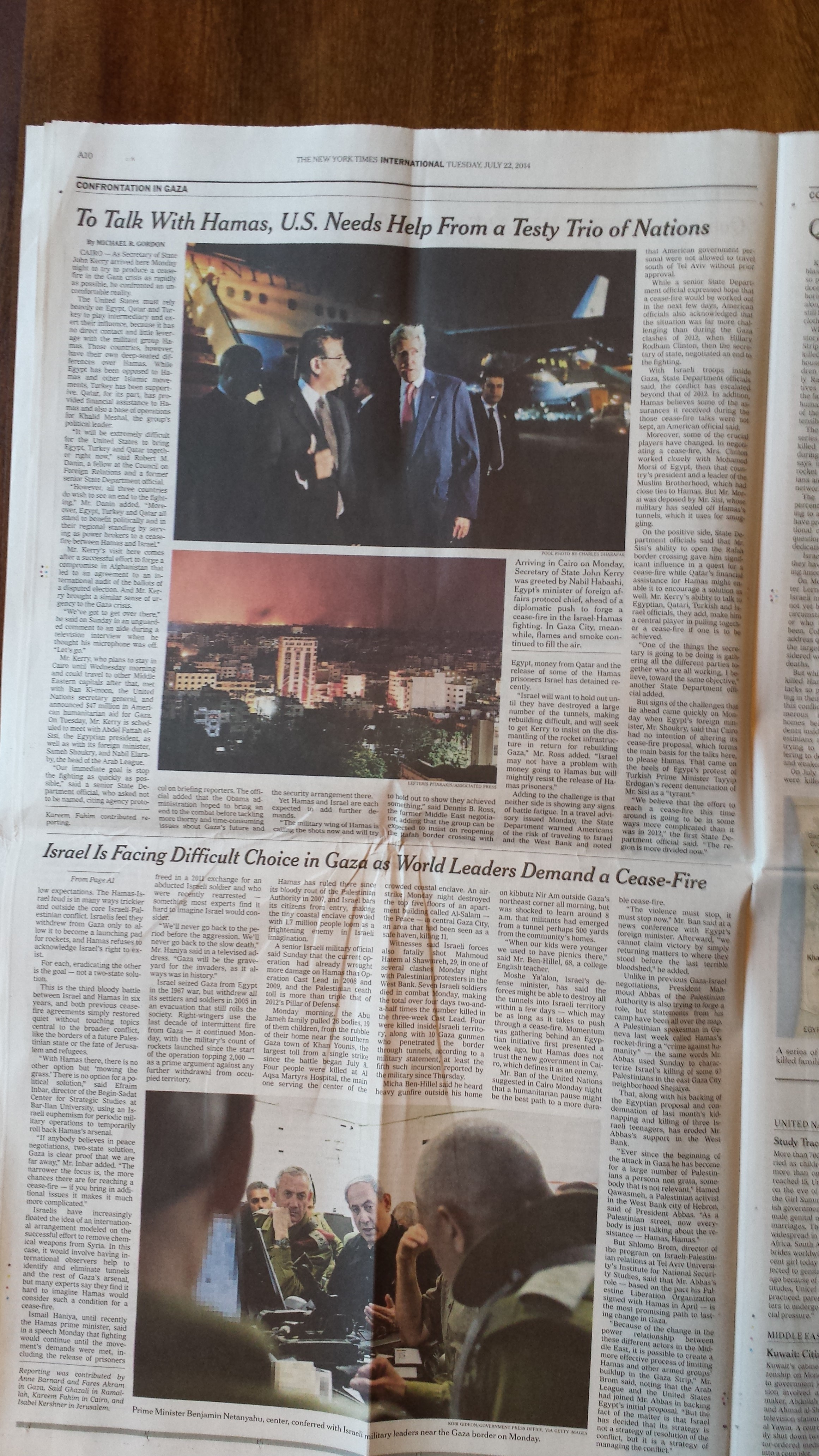
Even though dozens of tunnels were uncovered, it took until July 29 for the Times to publish it’s first picture of one – inside the paper on the bottom of page A6 (under a picture of Palestinians mourning).  Jodi Rudoren referred to the Israeli military “propaganda push” which “invited a few journalists underground for a tour” as “Israelis exchange nightmare scenarios that are the stuff of action movies” – as if the tunnels were a backstage viewing at a Disneyland movieset.

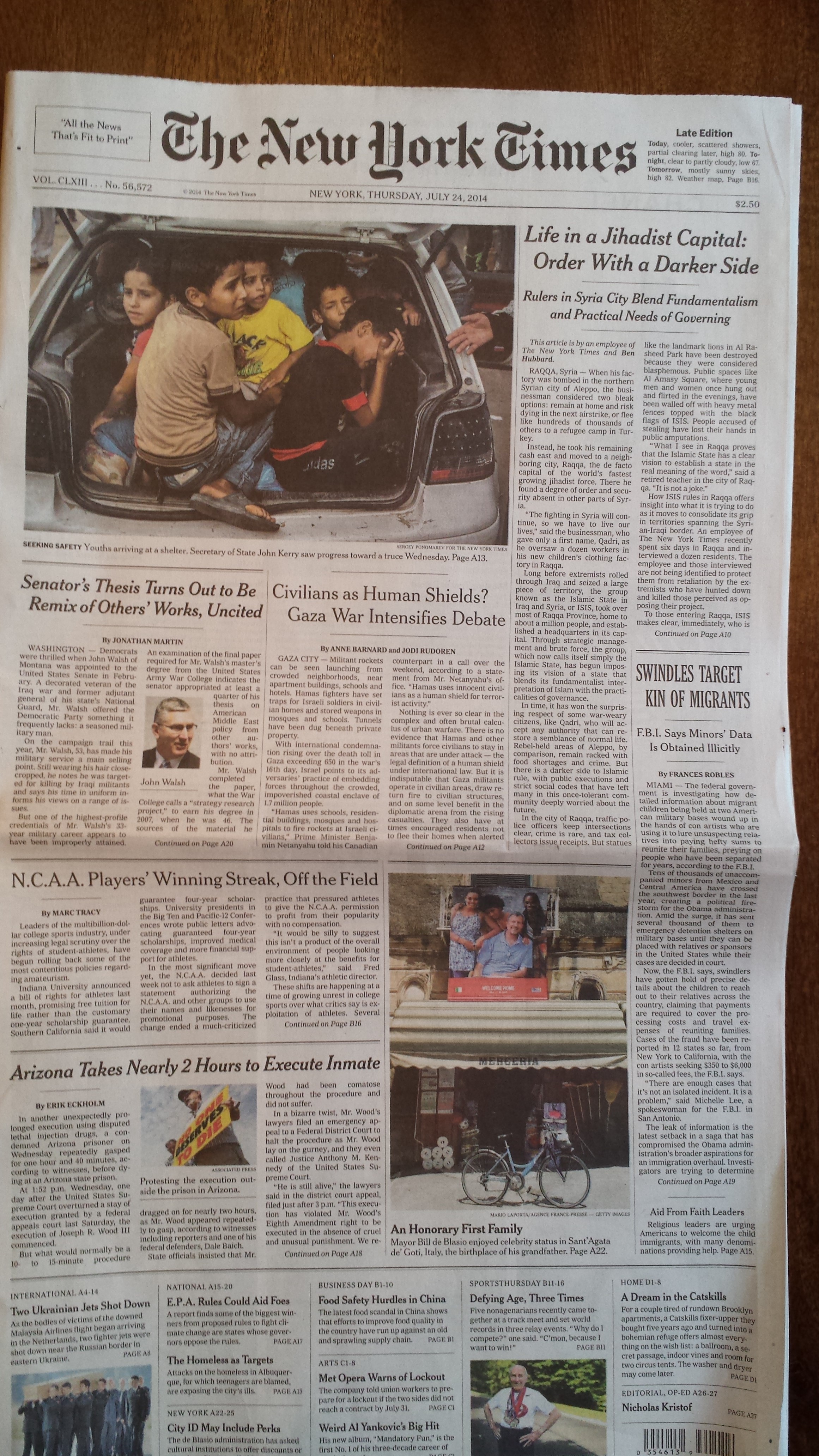
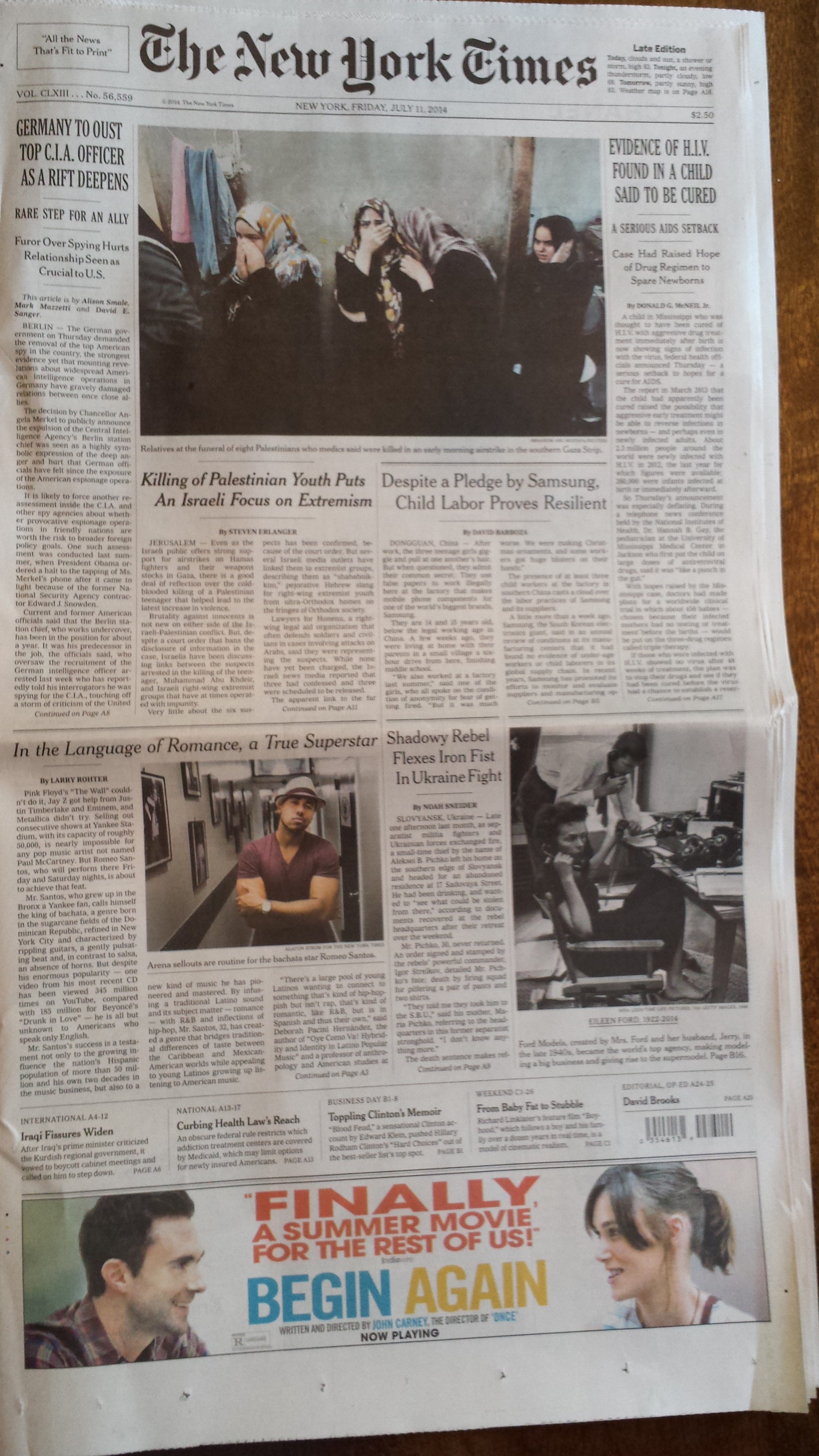
In three weeks of covering the conflict, the Times featured pictures of Palestinians mourning on the front page seven times (July 11, 14, 17, 21, 22, 24 and 29th). But the root cause of the conflict – Hamas terrorists attacking Israel through the tunnel network – never made it to the front page pictures. The Times actually had a story of the tunnels on the front page on July 29- but decided that a large color photograph of a Palestinian morgue was a more appropriate picture for that article.

It would appear that the underground war is being fought by Hamas and by the Times.


Sources:

Articles and pictures of Gaza tunnels in other papers:
http://online.wsj.com/articles/israel-strikes-30-houses-in-gaza-killing-islamic-jihad-official-1406286950

http://af.reuters.com/article/egyptNews/idAFL6N0Q34PG20140728

http://www.businessweek.com/news/2014-07-27/secret-tunnels-under-israel-reveal-intricate-threat-from-gaza

http://america.aljazeera.com/articles/2014/7/23/gaza-undergroundhamastunnels.html

http://www.haaretz.com/news/diplomacy-defense/.premium-1.606903

Videos:

https://www.youtube.com/watch?v=TlvnkECJkYc&list=UUawNWlihdgaycQpO3zi-jYg

https://www.youtube.com/watch?v=_NBEixuQbYQ&list=UUawNWlihdgaycQpO3zi-jYg

https://www.youtube.com/watch?v=5-hH2026OnU&list=UUawNWlihdgaycQpO3zi-jYg

https://www.youtube.com/watch?v=Mv8xR1FPakY&list=UUawNWlihdgaycQpO3zi-jYg

July 29 cover July 29. A6 Jul 21 cover July 17.cover Jul 22 cover July 14. cover July 24 cover (2) July 11. cover

“Tinge” Two. Idioms for Idiots

Do you have friends that use the same expressions over and again?

Some are cultural phenomena, such as “Oh my God!”, “Get real” or “Could you believe it?” Entire groups of friends or communities may be heard using the same sayings. You can be confident that the familiar phrase will be punctuated throughout a conversation.

Sometimes, an expression is an original. A person (or organization) develops a catch-phrase that captures their current thinking. The first time you hear it, you might think nothing of it or just consider the comment a strange choice of words. But when you hear the same bizarre expression used again by different people in the same organization, you can be sure that it reflects a conscious cultural mindset.

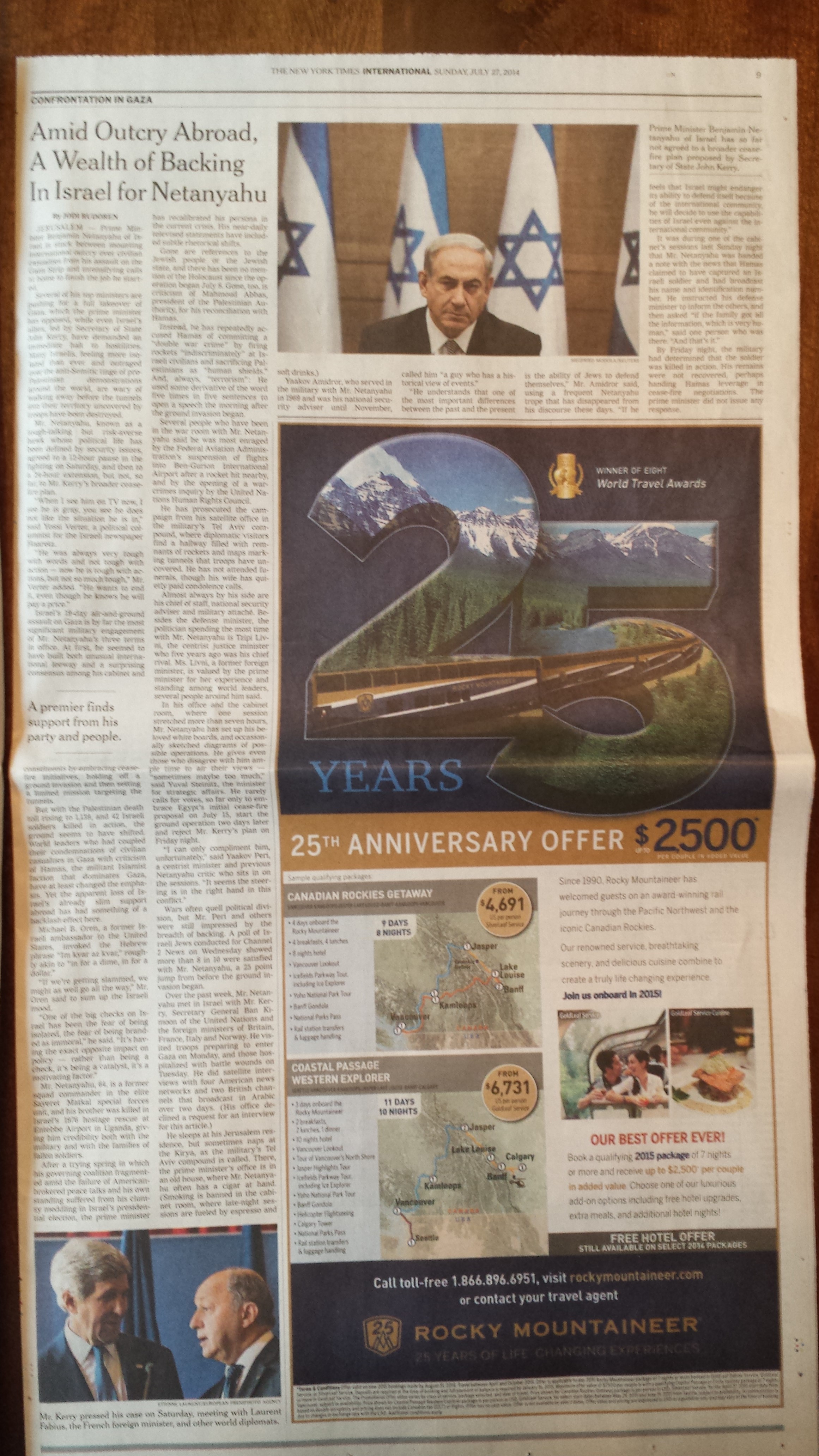
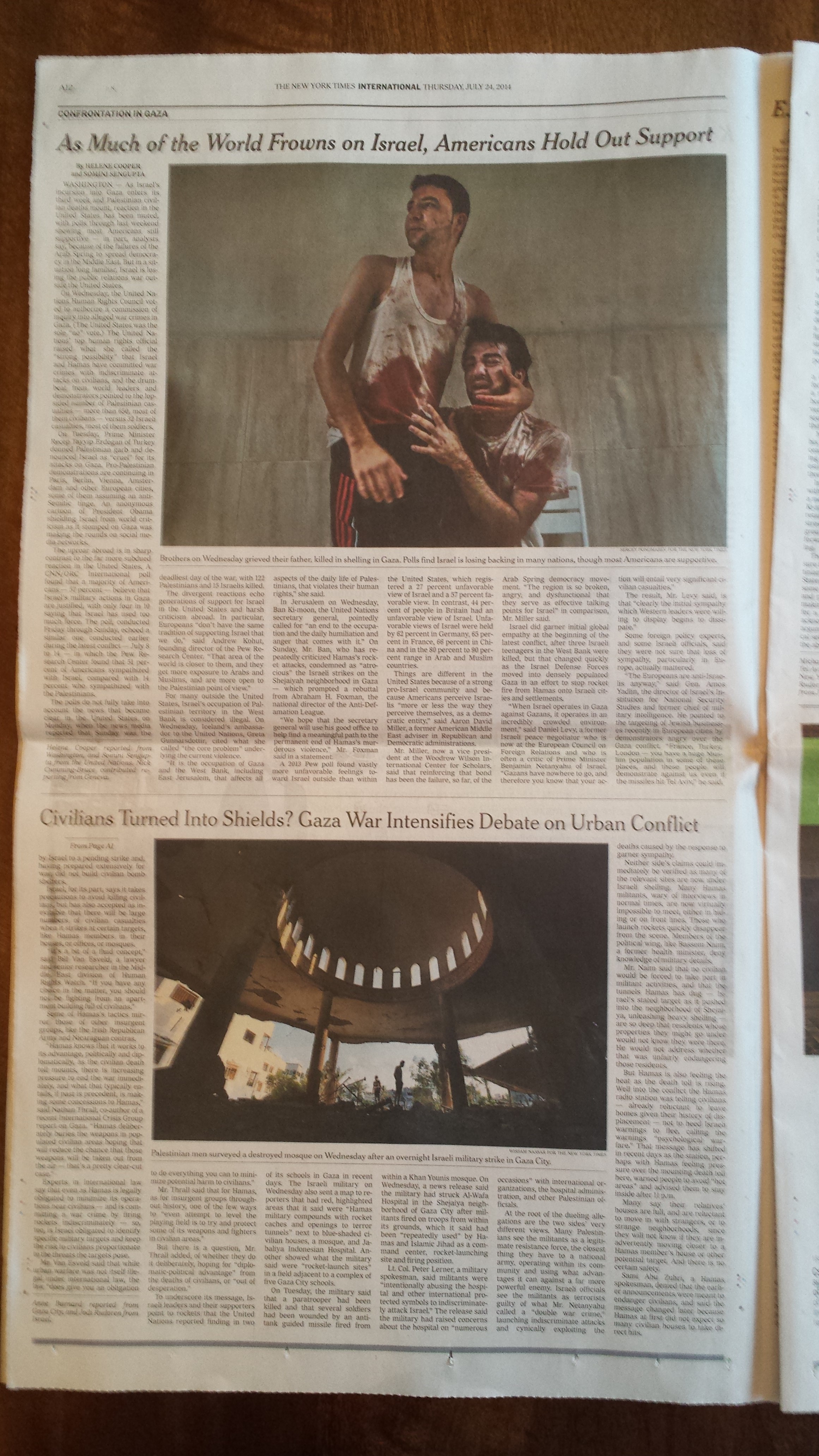
On July 24, Helene Cooper and Somini Sengupta wrote an article in the New York Times about what they considered the unusual support Americans give to Israel relative to the rest of the world. In describing the pro-Palestinian protests in various cities in Europe, they stated that the protests had “an anti-Semitic tinge.” As detailed in FirstOneThrough that day (link below), the phrase ignored the riots specifically against Jews. The choice of the word “tinge” was highly offensive to any civilized person who objects to racism.

Europe being Europe and the Times being the Times, the next few days saw more of the same.

  • Israeli soccer players from Maccabi Haifa were attacked in Austria.
  • In Paris, 4000 people – many with weapons – staged a protest in Place de la Republique; 70 were arrested.
  • A Facebook page was created with the faces of French Jews with an encouragement to attack them; one of the Jews was subsequently attacked by a mob.

But the New York Times continued to be unruffled and unperturbed. So much so, that the incendiary phrase “an anti-Semitic tinge” was used again in a July 27 article by Jodi Rudoren.  Not only did she repeat the phrase verbatim, but she led that only Israelis were offended by these slight expressions of hatred (ignoring the strong condemnations of political leaders throughout the continent).

Perhaps other sections of the Times (which unlike the rest of the paper, still has a few remaining fans) will notice and react: the travel editor might highlight a nice tour of Mississippi that had “a sprinkle of lynchings”; a real estate article might describe a flat in Berlin as “airy, with a nice view of the genocide”; and the food and wine critic might describe a French liquor as “smoky, with a hint of Holocaust.”

One can expect to see other offensive and idiotic idioms in the Times in the weeks ahead.


Sources:

Recent European anti-semitism:
http://www.telegraph.co.uk/news/worldnews/europe/10992886/Anti-Semitism-on-the-march-Europe-braces-for-violence.html

http://www.ynetnews.com/articles/0,7340,L-4549072,00.html

http://www.israelnationalnews.com/News/News.aspx/183377#.U9Tm66NeLi8

http://www.algemeiner.com/2014/07/25/facebook-page-publishing-identities-of-french-jews-to-encourage-attackers-15-men-reportedly-assault-1-jew-in-paris-suburb-after-confirming-photo/

“An anti-Semitic Tinge” by FirstOneThrough:
https://firstonethrough.wordpress.com/2014/07/25/an-anti-semitic-tinge/

20140727_071838

“An anti-Semitic Tinge”

Pulitzer Prize winner William Safire used to write for the New York Times “On Language.” His fascinating articles would describe the etymology of words; their usage and context. He spent years as a speechwriter for US President Nixon, followed by decades writing for the Times. He had a unique appreciation for words.

Safire would not appreciate the New York Times abuse of language today.

Some words are seldom used in daily speech. When heard or seen, we understand that there is a particular purpose and nuance for their application.  Even in comedy.

The old TV sitcom “Seinfeld” had a funny skit about George being set up on a blind date by his friend Jerry. George had a long list of questions to qualify his interest. When asking about her face he said: “Is there a pinkish hue?” The question puzzled his friend Jerry who was setting him up: “A pinkish hue?” he replied. “Yes, a rosy glow.” Jerry: “There’s a hue”. The exchange gets roars of laughter – not only because it is an absurd question to qualify a date, but the word itself is peculiar. I doubt there was ever a time in the history of television that the word “hue” was used so frequently.

We all (think we) know what the word “hue” means – heck, there was even a setting on our TV sets after “brightness” and “contrast” (but being candid, no one ever used it). The word “hue” was replaced by “color” or “tint” on many sets as those words convey a wider spectrum of color. Hue seemed too subtle.

If “hue” is subtle, the word “tinge” is meaningless. While “tinge” may be a slightly more common word, it means a great deal less.  Finding the TV’s hue setting and moving it a single notch, would be the equivalent of “tinge”. Only an expert could readily observe the slight change in color. A reasonable person could never be expected to notice a tinge without close and careful examination.

“An anti-Semitic tinge.”

It was curious (alarming?) to see the word “tinge” show up in an article about “The Confrontation in Gaza”, as the New York Times refers to current war in Gaza (avoiding using Israel’s terminology of “Operation Protective Edge” as that might make it appear that Israel was on the defensive).

On July 24, 2014, the New York Times ran an article called “As Much of the World Frowns on Israel, Americans Hold Out Support” about how angry the world is with Israel. Americans, according to the article, do not support Israel because they believe that Israel has a basic right to self defense in the face of missile attacks, but because “of the failures of the Arab Spring to spread democracy in the Middle East.” That NYT statement is beyond moronic and ignores the entire Pew report and decades of Pew Surveys which have always shown greater support for Israel than Palestinians.

The following paragraphs continued: “Pro-Palestinian demonstrations are continuing in Paris, Berlin, Vienna, Amsterdam and other European cities, some of them assuming an anti-Semitic tinge.” Quite a phrase “anti-Semitic tinge”.

So what happened in the protests the preceding weeks? On July 20 anti-Israel protestors firebombed a synagogue in the Parisian suburb of Sarcelles. Jewish shops were looted and 18 people were arrested. The French Prime Minister said: “What’s happened in Sarcelles is intolerable: attacking a synagogue or a kosher grocery, is quite simply anti-Semitism, racism.”

Just the week beforehand, a demonstration in Bastille Square in the center of Paris moved towards two synagogues which had hundreds of Jews trapped inside. The crowds chanted “death to the Jews” and “Hitler was right”. That demonstration was such a warning shock to the government that it banned further demonstrations, which took place anyway.

In Belgium, a store with a Palestinian flag and a crossed out Israeli flag in the window put up a sign in Turkish: “Dogs are allowed in this establishment but Jews are not under any circumstances.” The French text replaced “Jews” with “Zionists.”

In Berlin, Germany protestors were blocked by police in riot gear from bringing their demonstrations to the Holocaust Memorial. That week, an imam at one of Berlin’s mosques gave a sermon that Jews should be killed.

The Associated Press correspondent from Berlin wrote: “The foreign ministers of Germany, France and Italy on Tuesday condemned the rise in anti-Semitic protests and violence over the conflict in Gaza, saying they will do everything possible to combat it in their countries.”

“An anti-Semitic tinge.”

The New York Times deliberately chose to minimize the anti-Semitic motivation of the protestors as it would detract from what the Times considered an appropriate act of protesting against Israel (since the Times doesn’t believe the “confrontation” is truly about self defense). Even as riots broke out in the same cities that witnessed the Holocaust, and those governments called out against the rise in anti-Semitic protests and violence, the Times needed to bury that narrative.

For the Times, “an anti-Semitic tinge” means a few outliers; some bad seeds doing bad things. It ignores the lack of protests against: Russia in the Ukraine; Syria slaughtering its citizens; US in Iraq and Afghanistan; and other government actions in the world that have killed hundred of thousands of civilians over the past few years. Regrettably, the Times does not agree that when protestors only take to the streets when the Jewish State is in a “confrontation,” it brands the protest itself as anti-Semitic.  How does it ignore firebombings of synagogues?

Those actions are from the disgraceful anti-Semitism of the protestors. Regarding the media, it is bad enough that it is passively complicit in not identifying the anti-Semitic root cause of the protests. However, to actively trivialize riots, firebombings and death threats against Jews in the streets where millions of innocent Jews were killed, is not merely being complicit- it is an act of anti-Semitism itself.


Let me change the conclusion of the opening paragraph: William Safire would not be upset by the Times use of language.  He would be appalled by the New York Times abuse of Jews.


Sources:

http://www.jta.org/2014/07/20/news-opinion/world/anti-israel-rioters-torch-cars-throw-firebomb-at-paris-area-synagogue

http://www.algemeiner.com/2014/07/13/violent-anti-jewish-riots-rock-paris-activist-says-french-jews-are-in-serious-danger-video/

http://www.bbc.com/news/world-europe-28402882

http://abcnews.go.com/International/wireStory/berlin-bans-anti-semitic-slogan-gaza-protests-24658551

20140725_071755

The Democrats’ Slide on Israel

Further evidence of left-wing radicals abandoning Israel? The Pew Research Center did a survey to assess how Americans felt about the Israel-Hamas fighting, over the week July 8-14, 2014. The numbers came back overwhelmingly supportive of Israel by over a 2-to-1 ratio. It is consistent with polls over the decades which show Americans supporting Israel more than Arabs in the ongoing conflict. The details of the poll (not highlighted by the New York Times) show a trend of conservatives and liberals diverting much more on this issue than was historically the case. Conservatives enthusiastically backed Israel by a 19-to-1 ratio, while liberals were the only group to not even cross a 2-to-1 ratio supporting Israel.

Support of Israel v. Palestinians

  • Conservative 77% v. 4%
  • Republicans 73%
  • White Evangelical Christians 70% v. 5%
  • Independents 45% v. 17%
  • Democrats 44%
  • Blacks 43% v. 20%
  • Hispanics 41% v. 17%
  • Liberals 39% v. 21%

What makes the poll results particularly distressing is that it was made in the middle of a war initiated by Hamas, the anti-Semitic terrorist organization that is sworn to destroy Israel. Had the poll been made in the middle of peace negotiations, one could have imagined that people would have been more evenly split in their projected hope that the parties could arrive at a settlement.

The slip in the Democrats feelings towards Israel can be traced to a number of actions since Democratic US President Barack Obama took office in 2009. Less than two years ago, in September 2012, Democrats took several concrete steps to distance themselves from “Israeli-leaning positions” that had always been part of the party’s platform during the Democratic National Convention.

DNC2012 vote
Democrats split on recognizing Jerusalem as capital of Israel in 2012 convention

Consider:

HAMAS: In 2008, the Democratic Party platform called for the isolation of Hamas until it renounced terrorism. “The United States and its Quartet partners should continue to isolate Hamas until it renounces terrorism, recognizes Israel’s right to exist, and abides by past agreements.”

In 2012, the statement was removed.

 “REFUGEES”: In 2008, the Democratic Party platform called for the settlement of the descendants of Palestinian refugees to be in a Palestinian State. “The creation of a Palestinian state through final status negotiations, together with an international compensation mechanism, should resolve the issue of Palestinian refugees by allowing them to settle there, rather than in Israel.”

In 2012, the statement was removed.

BORDERS: In 2008, the Democratic Party platform said that the 1949 Armistice Lines were unreasonable borders. “All understand that it is unrealistic to expect the outcome of final status negotiations to be a full and complete return to the armistice lines of 1949.”

In 2012, the statement was removed.

JERUSALEM: In 2008, the Democratic Party platform recognized Jerusalem as the capital of Israel. “Jerusalem is and will remain the capital of Israel.” The party removed the statement, and then reinstated it after a bitter fight on the convention floor.

SECURITY: The only pro-Israel statement that the Democrats kept in 2012 without a public brouhaha was about Israel’s right to self-defense (which is self-evident for any country on the planet anyway).

In March 2010, Obama made demands of Israel to halt construction in the eastern part of Jerusalem – along with 12 other demands – to get peace negotiations with Palestinian Arabs moving. It was the first time that the building of Jewish homes was ever advanced as a pre-condition to talks. Obama effectively reprimanded Israeli Prime Minister Benjamin Netanyahu through a series of deliberate acts such as walking out of the meeting, refusing to make a joint statement and taking customary photographs together.

All of these efforts by the liberal US president originated from his intention to have “a New Beginning” with the Islamic world. In June 2009 he visited Egypt where he took a position that no American president had made before: “The United States does not accept the legitimacy of continued Israeli settlements.” Remarkably, the first black president of the United States said that Jews should not be allowed to live in certain places: places they had lived for centuries, including under the Ottomans; places they were legally guaranteed to live under the League of Nations British Mandate as Article 15 clearly stated: “No discrimination of any kind shall be made between the inhabitants of Palestine on the ground of race, religion or language. No person shall be excluded from Palestine on the sole ground of his religious belief.”

The champion of American liberals made a clear path from his “New Beginning” until today to undermine the rights of Jews in the Middle East. His followers have taken note and are breaking with the majority of Americans. His foreign policy approval rating of 37% would appear to be made up only of fellow liberals.

On July 24, 2014, the New York Times posted an article about how out of touch Americans are with the rest of the world in supporting Israel. The liberal paper has been consistent in taking an aggressively pro-Palestinian and anti-Israel approach in it’s coverage of Operation Protective Edge. It would appear it knows its audience.

20140724_065532


Sources:

Pew Report: http://www.people-press.org/2014/07/15/as-mideast-violence-continues-a-wide-partisan-gap-in-israel-palestinian-sympathies/

2008 Democratic Party platform: http://www.presidency.ucsb.edu/ws/?pid=78283

2012 Democratic Party platform: http://www.presidency.ucsb.edu/ws/?pid=101962

The 2012 vote to remove Jerusalem as capital: http://www.theguardian.com/world/2012/sep/06/democratic-convention-reinstatement-jerusalem

March 2010 Netanyahu “dress down” by Obama: http://www.telegraph.co.uk/news/worldnews/barackobama/7521220/Obama-snubbed-Netanyahu-for-dinner-with-Michelle-and-the-girls-Israelis-claim.html

Cairo speech: http://www.whitehouse.gov/blog/NewBeginning/transcripts http://www.nytimes.com/2009/06/04/us/politics/04obama.text.html?pagewanted=all&_r=0

British Mandate: http://avalon.law.yale.edu/20th_century/palmanda.asp

Obama approval rating: http://www.politico.com/story/2014/06/poll-obama-lowest-approval-rating-nbc-wsj-107978.html

The Holocaust and the Nakba

Roger Cohen penned a piece in the New York Times Op-Ed on July 15 that suggested the pathway to peace in the Middle East is that “Jews should study the Nakba. Arabs should study the Holocaust.” Putting aside the naiveté of the suggestion, the comparison is disgusting in itself.

The Holocaust was a genocide of a people. It was a deliberate attempt of an elected government to commit genocide against a select group of its own citizens. As Nazi Germany conquered more territory, it continued to implement its plan of eradicating the Jews – which it deemed an inferior life form – in those additional lands. Not satisfied with only killing millions of innocents, the Nazis tortured and performed medical experiments on these unarmed men, women and children. It was one of the darkest periods of mankind.

The Palestinian Nakba was a civil war over control of land. Arabs in Palestine protested to the ruling authority (the British) to block the establishment of a Jewish national homeland as called for by the League of Nations (the precursor to the United Nations). The Arabs themselves initiated the fight to stop the implementation of international law, and launched multi-year riots and then a war to destroy Israel. Their Nakba was that they were not allowed to return to homes in the country they just sought to destroy.

How are these two events remotely comparable?

  • One was about life; one was about land.
  • One was about a government wiping out its citizens; one was about citizens fighting the government.
  • One was about passive unarmed civilians; one was about warring parties.
  • One left survivors scattered around the globe; one left survivors a few miles from their homes, living with the same people in a land that they wanted, which the UN had proposed to split anyway.
  • One made the United Nations call for human rights all over the world; the other had the UN create a special niche entity just for the losing party to perpetuate their civil war.

The events could not be more different. The only things they have in common is that they occurred around the same time in history and both involved Jews.

But Israel was not born from the ashes of the Holocaust and planted in the ground of a Palestinian Nakba. The only “fruit” of the Holocaust was the creation of the Universal Declaration of Human Rights. The preamble of the UDHR clearly stated that the “disregard and contempt for human rights have resulted in barbarous act which have outraged the conscience of mankind,” – the sickening actions of the Holocaust created the declaration meant to benefit all mankind.

Regarding Palestine, Jewish history in the land predated the Holocaust by thousands of years. The Ottomans welcomed Jews and they moved throughout the region from 1800 to 1914 at rates that dwarfed all other groups. After the Ottoman Empire broke apart, the League of Nations sought the “establishment in Palestine of a national home for the Jewish people” in 1920, decades before WWII. The Arabs rioted in 1920 and 1929 against the action, and in 1936 began what has become a 78-year running civil war to prevent – and later eradicate – the Jewish State. The Arab “Nakba” – their grievance about homes destroyed and left behind – is because they lost the battle they initiated. The “fruit” of the Nakba was the establishment of UNRWA by the United Nations which has encouraged the Arabs to never abandon their civil war. The rotten fruit has left the Palestinians to fester and subject to abuse by their host countries, including Lebanon and Syria. It has benefited no one.

Perhaps the first person to learn about the Holocaust and the Nakba is Roger Cohen.

The Times should be reprimanded for continuing to print pieces that give legitimacy to those who compare Israel to Nazi Germany and Netanyahu to Hitler. It gives cover to anti-Semites in Europe and the world who paint the Jewish state in Nazi colors. The term “Never Again” born from the massacres of innocents in the Holocaust means more than not allowing genocides to happen again. Civilized people should not trivialize evil. For a global paper like the Times to do so specifically against the Jewish State is reprehensible.


Sources:

http://www.holocaustawareness.com/the-udhr-document.html

http://www.badil.org/en/youth-education-a-activation-project/item/1373-the-nakba-1947-1949

http://wwi.lib.byu.edu/index.php/San_Remo_Convention

20140715_091640

Differentiating Hamas

It is with confusion that I watch the press try to present different sides of Hamas.  While the press may say that some Hamas members belong to the “political wing” and others the “military wing”, the simple fact is that Hamas is:

  1. a terrorist group;
  2. the most anti-Semitic ruling party in the world;
  3. a group of Holocaust deniers;
  4. committed to destroying ALL of Israel;
  5. the leading democratically elected party (winning 58% of the Palestinian parliament in their last election in 2006)

To put it another way, splicing Hamas is like differentiating between the Nazi Party, the SS and the Gestapo.  While there were differences in their roles, each was evil and guilty of genocide.

Do not kid yourselves. Hitler was democratically elected and a politician too.

Political music video on Hamas Theme Song (CSNY): http://www.youtube.com/watch?v=kF2fcaSPB6M

Every Picture Tells a Story, the Bibi Monster

The “Every Picture” series highlights the power of photographs in the media and reviews the impact of size, color and placement of pictures along with their captions. The first installment reviewed how the New York Times painted a picture of Arab grief and suffering while portraying Israelis in a more aggressive and less sympathetic manner in a series of articles from June 30 to July 3 about the murder of three Israeli teens and a Palestinian teenager. If that article had a subtitle, it could have been “Palestinians trump Israelis”. You might think this second article in the series could be entitled: “Palestinians trump the World”, but the reality is much more subtle.

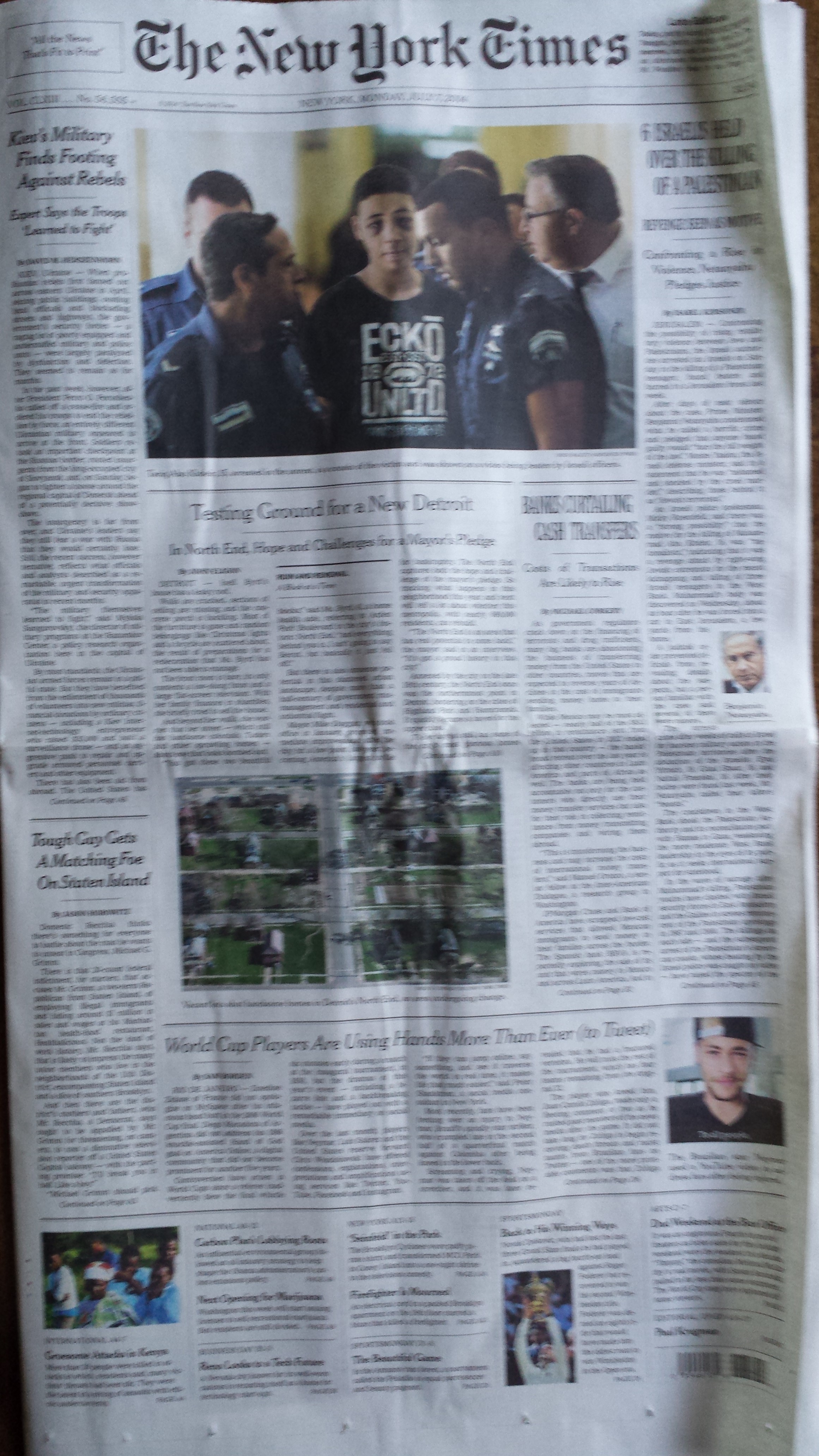
On July 7, 2014 the New York Times posted, on the top of its front page, a large color photograph of a Palestinian youth who was injured during riots against Israeli police. The bruised teenager was deemed to be a bigger story than victims of mass murders in other countries on a particularly violent day in Africa and the Middle East:

20140707_082918

On page A4, the paper posted a large black and white photograph and article about  20 people who had their throats slashed in Kenya;


On page A7, the NYT posted a black and white photograph of soldiers and militiamen in Uganda where 50 people were killed in a battle between security forces and a tribal militia;

On the bottom of that same page, a short article (with no associated picture) described how 35 to 40 people were killed in Yemen in a fight between “Shiite rebels and tribesmen associated with the government.”

20140707_08293720140707_08294820140707_083002
Pictures of mass murders buried in the NYT pages

While over 100 people were slaughtered in the region, the Times thought that a bruised youth was more significant than any and all of those atrocities. Could that have been because the teenager was a Palestinian Arab? That wouldn’t be logical as the Yemenis are Arab too. Could it be because the injured boy was a Muslim? That also would not make sense since al-Shabab is the Islamist terror group in Kenya that has been killing dozens of people every week, and both parties in the slaughter in Yemen are Muslim.

The difference in the dynamic of these stories lies in the counter-party – Israel – as evidenced by the other pictures in the news story. In a small picture on the (extreme right) side of the cover page, and then again in a color photograph on page A5, are close up pictures of Israeli Prime Minister Benjamin “Bibi” Netanyahu. Netanyahu is possibly the only world leader who is more despised by the NYT editorial board than former US President George W. Bush. The Times often uses pictures of Netanyahu alongside stories of Israeli aggression. It does this uniquely and consistently for Bibi.

By means of comparison, imagine an article about US drones killing civilians in Afghanistan, and then a picture alongside of it of US President Barack Obama. It doesn’t happen in the NYT or liberal media outlets. You probably wouldn’t even see a picture of injured people or mourning mothers in US papers. That is because they do not want to sketch a killer in Obama’s image.

As examples, here are two NYT articles that are critical of US policy of drone attacks – but include no pictures (let alone two!) of Obama. These are attacks that Obama ordered, (compared to a general situation in Israel which Netanyahu was not directly involved). Needless to say, the articles that simply report on the use of drones have no pictures of the US Commander-in-Chief.

http://www.nytimes.com/2013/10/22/world/asia/civilian-deaths-in-drone-strikes-cited-in-report.html?pagewanted=all&_r=0

http://www.nytimes.com/2014/06/26/world/use-of-drones-for-killings-risks-a-war-without-end-panel-concludes-in-report.html

In another article that is completely about Obama’s war on terrorism, the picture puts Obama so far in the background you would think he was accidentally caught in the photo.

http://www.nytimes.com/2012/05/29/world/obamas-leadership-in-war-on-al-qaeda.html?pagewanted=all

However, the New York Times and various liberal publications like to paint Bibi and Israel as attackers. They use his image alongside articles which describe attacks and counter-attacks. He has been made into a caricature of war; a cartoon of a blood libel.

Every picture tells a story. It is time to ask what the artist had in mind.

The Subtle Discoloration of History: Shuafat

Reader’s often assume that the more reputable news organization do research and perform fact-checks before posting articles. However, they do not often consider the word choices or juxtapositions of those facts relayed in a story. The truths and half-truths can combine to distort reality. This becomes exacerbated when quotes from biased witnesses are included in the article.

Witness the July 6, 2014 New York Times article on page 8 describing the terrible abduction and murder of an Arab teenager as a case in point. The second paragraph of the story: “…Mohammed was at the recreation center named for his respected, expansive Palestinian family in the ancient section of the East Jerusalem neighborhood of Shuafat.” I will avoid commenting on the “respected” background of the Abu Khdeir family who “started farming [in Israel] 250 years ago” as I do not know them (and why should I doubt Jodi Rudoren?). Consider the proximity in one sentence of the words “Palestinian”, “ancient”, “East Jerusalem” and “Shuafat”. A reader could naturally conclude that Palestinian Arabs have long been living in the ancient Palestinian city of East Jerusalem. A quote from a member of the family in the article adds that “All Shuafat is in danger, all the settlers are around us. It’s like a monster – they want to eat us.” could lead a reader to conclude that Jews are recent “settlers” to the area and harass Arabs.

All of those conclusions would be false.

Shuafat is indeed thought to be an ancient site. Archeological excavations reveal Roman encampments and Jewish homes and mikvahs from 2000 years ago. However, neither Shuafat, nor the rest of Israel, have ancient Arab finds as Arabs did not come to the region en masse until the Muslim invasion in the 7th century.

Shuafat remained a small village until 1967 when Jordan (together with Palestinian Arabs who were granted Jordanian citizenship) attacked Israel in the Six Day War. Israel took control of the “West Bank” and extended the boundaries of Jerusalem to include Shuafat and other villages around the city. In 1980, Israel declared all of Jerusalem to be its united capital.

For parties that do not recognize Israel’s annexation of the eastern part of Jerusalem, it would logically extend that those same people would not recognize Israel’s extension of Jerusalem’s boundaries. Shuafat is either a neighborhood in Jerusalem, Israel (if one accepts Israel’s position) OR it is a village in the West Bank (if one doesn’t).

Regarding the comment of “[Jewish] settlers”- there are many more new Muslims that moved to Jerusalem than there are new Jewish residents. Since 1967, when Israel reunified the city, until 2012, the Jewish population grew by 2.6 times while the Arab population grew by 4.4 times. This huge difference comes despite the higher (4.3) birth rate for Jewish women in Jerusalem than for Arab women (3.6).

Lastly, Shuafat and “East Jerusalem” are integral parts of Jerusalem. Just below 40% of the eastern part of Jerusalem which was annexed in 1967 is Jewish. Arabs and Jews work and live together in the city (compared to some Israeli cities like Umm al-Fahm that are 99% Arab). Shuafat sits just south of the second largest neighborhood in Jerusalem, Pisgat Ze’ev (pop. 37,000). The new Jerusalem light rail line includes two stops in Shuafat, one of the only neighborhoods with two stops.

A fact-checked sentence should have read:

“…in the ancient Jewish section of the predominantly Arab East Jerusalem neighborhood of Shuafat in Jerusalem…”.

Just saying…

Every Picture Tells a Story, Don’t It?

The media – whether print or digital – are experts at what they do. They know what articles make people react. They know what motivates people to buy their newspapers and watch their news programs. They know how to drive tweets and retweets.

I therefore observe and review how they craft their craft; how they shape the stories they sell.

Photographs – even in papers that art the printed word – are the most engaging. They are no longer limited to tiny and grainy black & whites of decades ago; they are now displayed in vivid colors that convey a story and an emotion. The choice of which pictures to present, as well as the how and where, essentially prioritizes the news for the reader. For example, a color photograph on the top of the front page with an associated article in the far right column is the most news-worthy story of the day. If a photograph is small and in black & white in the back of the paper, alongside advertisements and other news stories, it would transmit the passing interest in the event.

With such understanding, I reviewed the New York Times coverage of the kidnapping and killing of three Israeli teenagers, and the killing of Arab children in the subsequent days.


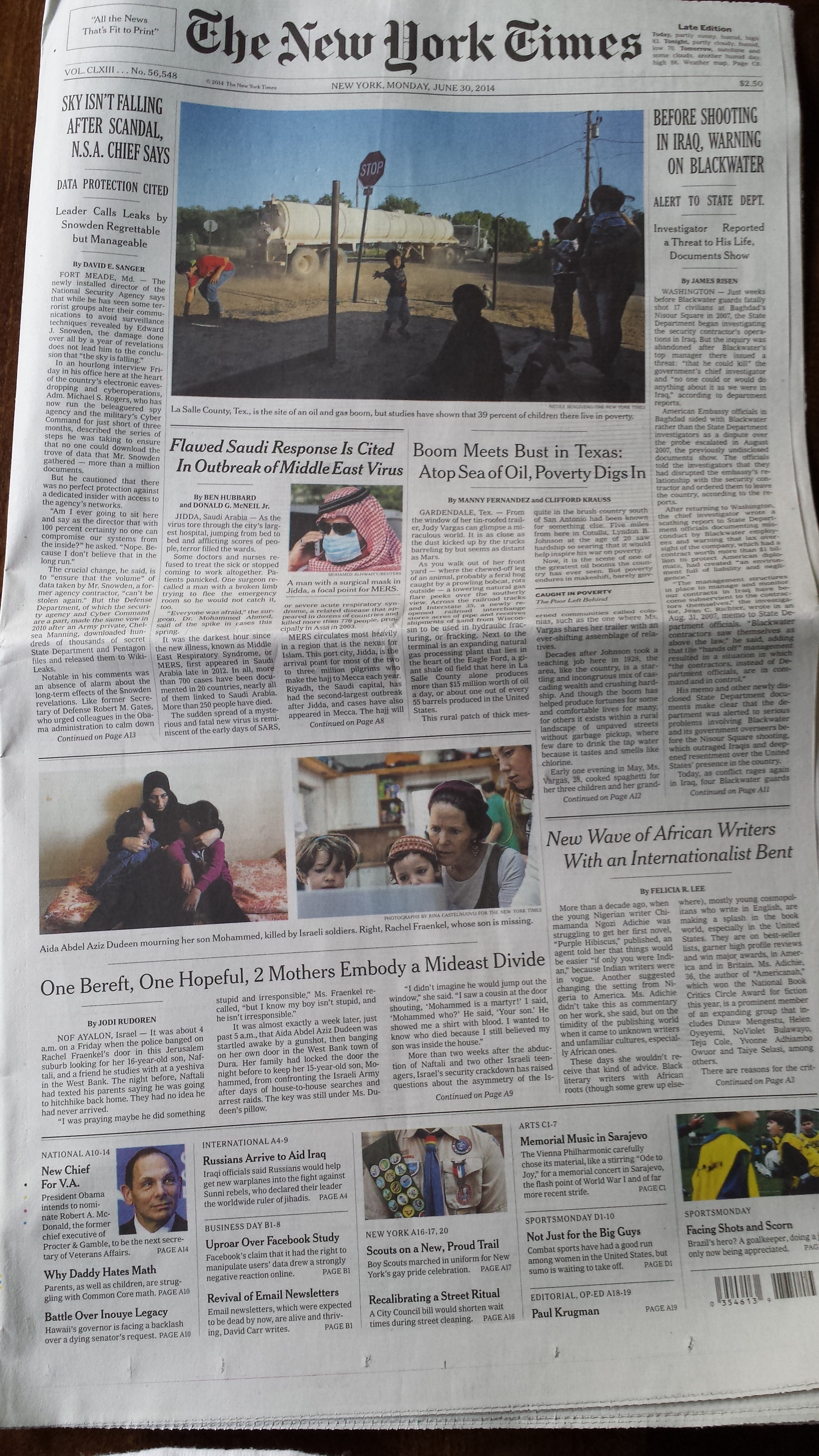
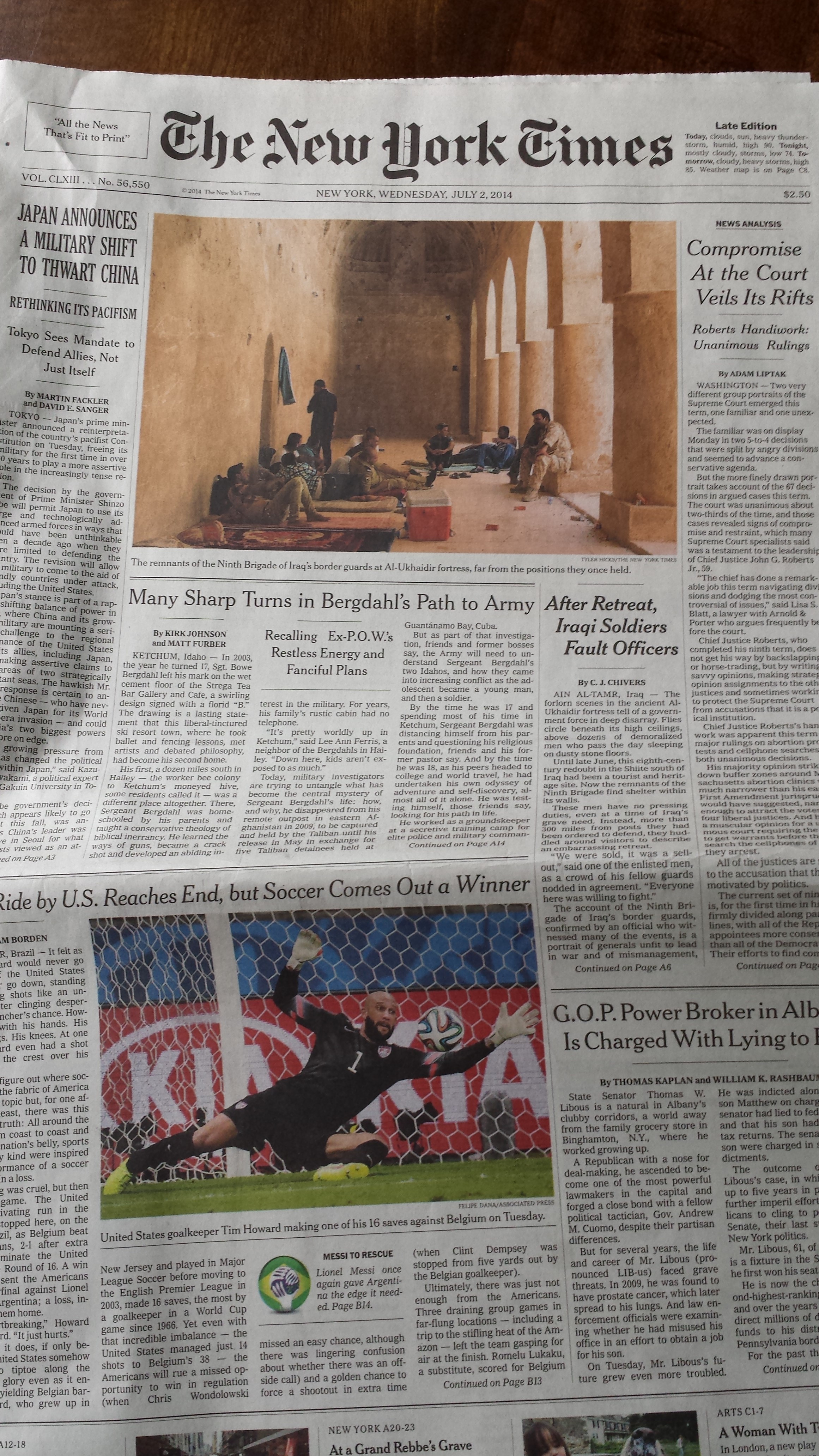
On June 30, the NYT ran a cover story on the bottom of the page, including two color photographs, about two mothers of victims – one Arab woman from the West Bank and another Jewish woman. The caption stated that the Arab woman’s son was “killed by Israeli soldiers” (one would need to read the article to learn that he was pelting the soldiers with rocks and bricks). The caption added that the Jewish woman’s son was “missing”. The article continued on page A9, with black and white pictures of equal size showing each woman together with friends praying. The captions again repeated that the Arab boy “was killed by Israeli soldiers”, and that the Jewish boy “was abducted” with other boys.

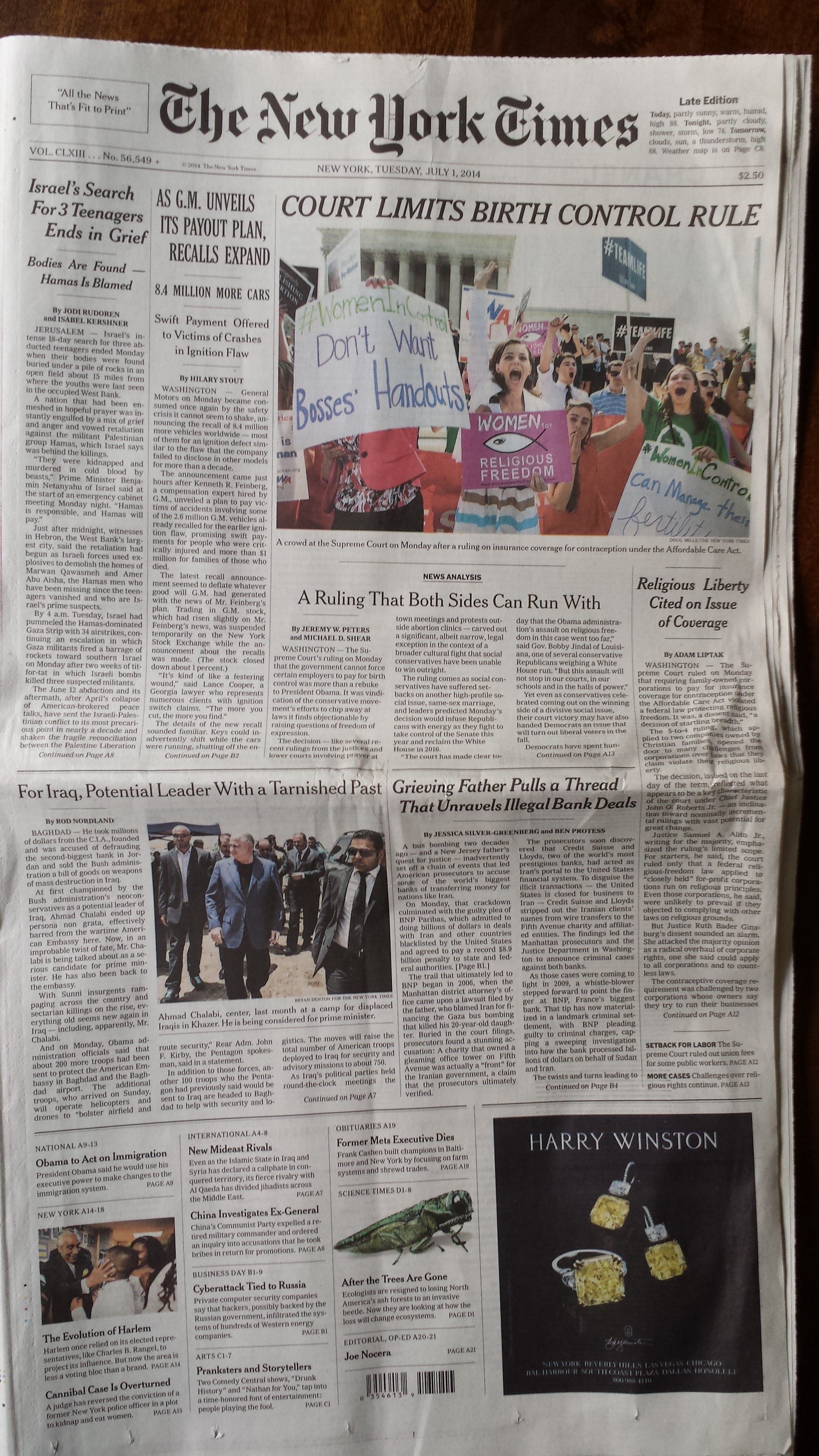
On July 1, the NYT ran a cover story that the Israeli teens were found dead. The story ran on the left hand (secondary) column of the front page and had no picture. The paper did, however, include several color photographs in the middle of the paper, on page A8, of a prayer vigil, pictures of the three boys, and army jeeps near the discovery site of the boys. The caption reads that their bodies “were found”.

On July 2, the NYT did not have any cover stories about the killings of the Israeli boys. On page A4, it posted some black and white photographs of friends mourning at the gravesite of one of the murdered teenagers. The caption read that the boys were “found dead”. The associated article ran from page A4 and continued on page A20.

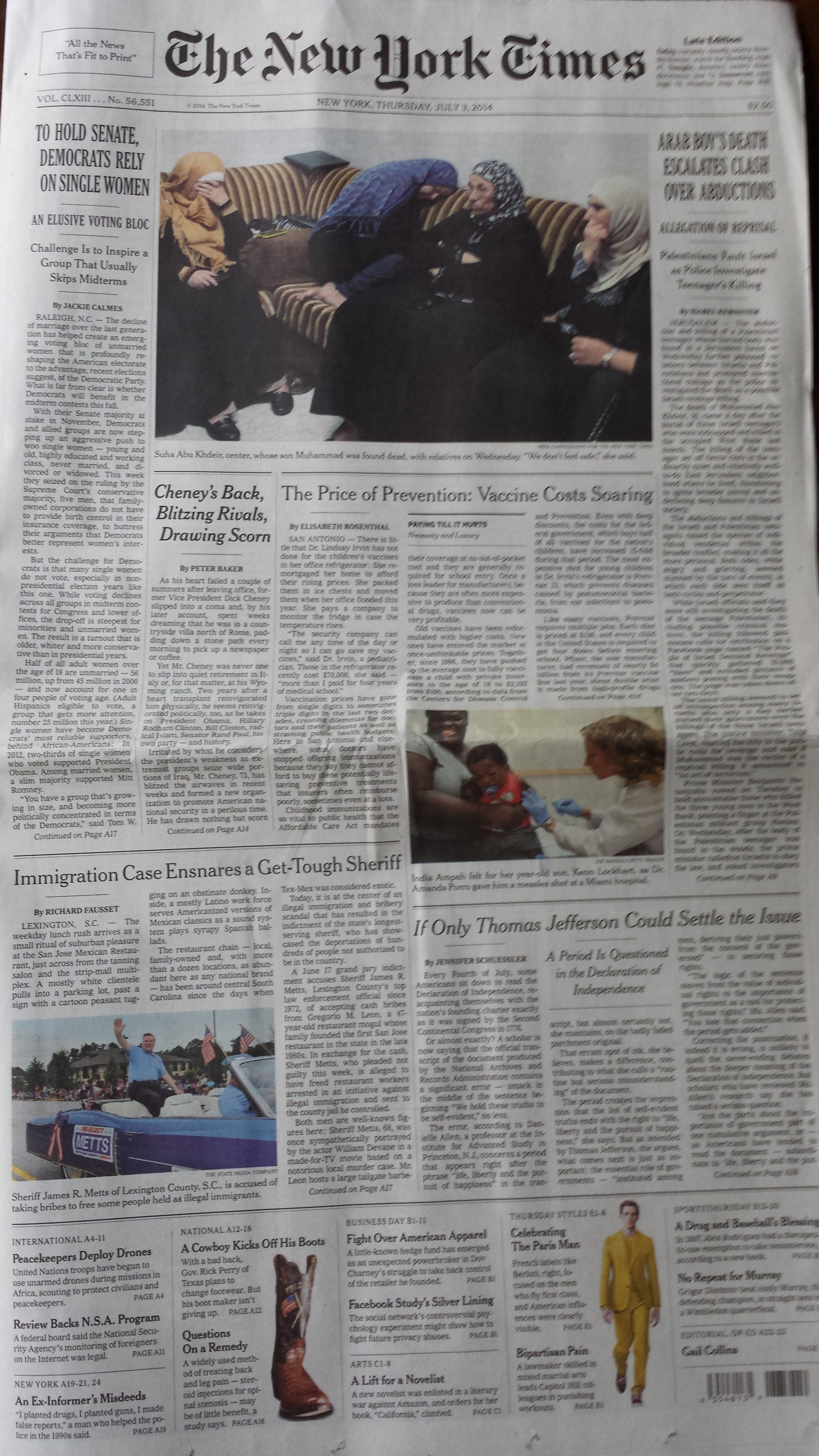
On July 3, the NYT posted a large color photograph on the top of the page of Arab women mourning and an associated right-hand column about the killing of an Arab boy (the trifecta – large color photo on top of page 1 and associated right-hand article). The caption said her “son Mohammed was found dead” included a quote from the mother of the dead boy “We don’t feel safe”. The cover article continued on page A8 with three additional color photographs of: Palestinian men clashing with Israeli police; Israeli police searching the crime scene; and the dead boy. The captions state that there was a “kidnapping and killing of a Palestinian teenager”.

Over these four days, if one were to just get news from pictures and their captions, what would a reader take away?

From the captions, it would appear that everything that happened to the three Jewish teenagers was passive. The boys were “missing” and their bodies “were found”. There was no mention of kidnapping or killing, nor any attribution of who was the aggressor.

Contrast that to the captions of the Arab boys who were “killed by Israeli soldiers” and another that stated there was a “kidnapping and killing of a Palestinian teenager”. The aggression described against the Arab victims was underscored by the cover article quote from an Arab woman that “We don’t feel safe”. Pictures and captions showed Israeli soldiers and police, but shared no sentiment of the Jewish women.

Further, the large color pictures on the top of the page with the Arab women mourning was the only time that the NYT gave the stories in the region prominence. The only time we saw a cover picture (on the bottom of page) related to the Jewish victims was when one of the mothers appeared alongside a grieving Arab woman in a story meant to convey balance in grief. In fact, the underlying message was not balance: the pictures and captions made clear that the Arab woman was a victim of Israeli aggression trying to find missing teens, while the Jewish woman still had hope that her “missing” son (not kidnapped) would reappear.

What does the NYT positioning of greater emphasis on Arab suffering convey to a reader? How do the pictures of Israeli soldiers in armored vehicles and border police with machine guns compare with Palestinians throwing rocks? Were the pictures and captions deliberately shaping a larger story than the immediate events?

Were people more likely to buy the paper or talk about it with friends? Does the Times believe that more readers sympathize with Arabs than Israelis? Does the NYT editorial board believe that Israelis are the aggressors and Palestinians the victims, even when this entire episode began with the abduction and murder of three Jewish teenagers on their way home from school?

June 30. cover June 30. A9 July 1. cover July 1. A8 July 2. cover July 2. A4 July 3. cover July 3. A8What do you think?

Eyal Gilad Naftali Klinghoffer. The new Blood Libel.

A troublesome series of reports in major “liberal” media outfits like the New York Times and BBC have shown a pattern of “blame the victim” uniquely when it comes to Jews and Israel.

Consider the BBC’s Nicky Campbell’s coverage of the kidnapping of three Israeli teenagers, Eyal Yifrach, Gilad Shaer and Naftali Frankel, in Judea & Samaria arguing that “Palestinians would say perhaps these people were in the West Bank illegally.” He then continued to discuss Arabs in Israeli jails to “give [the kidnapping] some perspective” as if the comments provided any justifications for the kidnapping of teenagers trying to get home from school. (I suppose Nicky would support Iraqis kidnapping his daughters because of the UK involvement in the Iraqi war.)

The New York Times followed on June 16 when it posed several questions regarding “the cavalier practice of hitchhiking” in the West Bank. Was the NYT suggesting that these boys were responsible for their own kidnapping?

The hitchhiking abduction coverage was not unique. The New York Times ran an editorial on 6/19/14 bemoaning that the New York Metropolitan Opera, “bowing to the wishes of Leon Klinghoffer’s daughters and other Jewish critics,” decided to not globally telecast an opera about the murder of a 69-year old American Jew by Palestinian terrorists. The Times thought that “the opera gives voice to all sides” as if the rationale of the murder of an elderly American confined to a wheelchair was worthy of serious consideration. The general manager of the Met, Peter Gelb, said that the composer “John Adams said that in composing ‘The Death of Klinghoffer’ he tried to understand the hijackers and their motivations, and to look for humanity in the terrorists.” Gelb and the Times have called the opera “a masterpiece”. I am considering the right term for the Met and the Times.

Somehow, these outlets believe that Jews bare at least partial responsibility for the crimes committed against them: Jews are not victims; they are vehicles to voice displeasure of the state of the Palestinian Arabs.

To illustrate and contrast the vileness of this targeting of Jews and Israel by these media outlets, consider the coverage of other crimes during this same time period.

The New York Times covered the sexual assaults of women in Egypt during the celebrations for new President Abdul Fattah al Sisi with appropriate disgust. It ran articles, editorials and op-eds that condemned the attacks. The Times did not run articles questioning why the women were out late among so many men. The paper did not suggest that the women were dressed inappropriately. It did not post articles by Egyptian clerics who describe the value of modesty for women and the inappropriateness of their being out among men. Because if the paper had done so, it would have served to validate the disgraceful attack and place blame on the victim.

Similarly when a young man, Elliot Rodger, went on a shooting rampage in California because he felt rejected by girls in his school, the papers did not post opinions that girls should be nicer to young men and consider their feelings. As is clearly obvious, doing so would be an insult to all of the innocent victims of the rampage.

The daughters of Leon Klinghoffer, Lisa and Ilsa, put it best in their letter to the editor of the New York Times on June 21: “Our 69 year-old father was singled out and killed by Palestinian terrorists on his wedding anniversary cruise in 1985 solely because he was Jewish. His memory is trivialized in an opera that rationalizes terrorism and tries to find moral equivalence between murderers and the murdered. Imagine if Mr. Adams had written an opera about the terrorists who carried out the 9/11 attacks, and sought to balance their worldview with that of those who perished in the twin towers. The outcry would be immediate and overwhelming. But ‘Klinghoffer’ is justified as ‘a work of art’ and an opportunity to ‘debate’ the Israeli-Palestinian conflict. This is an outrage.”

The media’s blind spot for Jewish victims in its visual field have left Jews in the dark ages of history once again. The “progressives” are developing a new Blood Libel, in which every Jew has a hand soaked in the misfortune of Arabs. They have turned the State of Israel into a new blood matzah, conceived and living in sin.  During the Dark Ages, Jews were accused of taking missing Christian children.  At present, the progressive press blames Jews for their own missing and felled Jews – sacrifices that must be made to uphold the evil Jewish State.

Can anything right the “left”? If the Royal Ballet were to perform “The Untimely Fall of Lee Rigby” with beautiful arias about the sorrowful tale of Michael Adebolajo and Michael Adebowale, the two people who were sentenced to life in prison for Rigby’s murder, would the press react? Would the British press cheer the “work of art” and celebrate the “humanity in the terrorists” who hacked a soldier to death on the streets of England to avenge the killing of Muslims by British forces? The Klinghoffer daughters believe the “outcry would be immediate and overwhelming,” from the press and public. While I agree, I fear that it would not cause progressives to rethink their attitude towards Jews. The new Blood Libel has caught hold.


Related FirstOneThrough articles:

The Death of Civilians; the Three Shades of Sorrow

UN Comments on the Murder of Innocents: Itamar and Duma