The Israeli Peace Process versus the Palestinian Divorce Proceedings

Summary: The gap in resolving the long running Israel-Palestinian Question has to do with the goals of each party: the Israelis believe they have been engaged in a peace process between peoples while the Palestinians are negotiating a divorce settlement between countries.

Politicians and the media – both well-meaning and otherwise – have blamed various parties for the failures to resolve the Israeli-Palestinian conflict. When they are not directly pointing accusing fingers, they still use language which conveys their biases. A person needn’t look past the language used in discussions about Jewish homes beyond the Green Line/ 1949 Armistice Lines – the “settlements”.

“Settlements”

“Viability”: As detailed in “A Viable Palestinian State”, various parties have described the “settlements” as a hindrance to a viable Palestinian state. The statement is meant as a direct attack on Israel, and is absurd. If a Palestinian state cannot exist with a 5% Jewish population, then surely Israel cannot exist with a 20% Muslim population. Are the people that make such a comment looking for Israel to expel a million Israeli Arabs?

Similarly, if a viable Palestine is compromised because such new country would be only 15km across at a single point, surely Israel cannot exist in its current configuration with a 15km narrow corridor for a dozen kilometers. Are these politicians and media pundits suggesting that Israel must annex the entire spine of the land?

“Complication” and “Provocation”: Another sentiment that is expressed is that settlements “complicate the peace process.” As conveyed in June 2015 by the New York Times in an article called “Israel’s work on a West Bank Site Gives Rise to New Suspicion,” even existing homes purchased by private individuals (as opposed to new communities established by the Israeli government) hurt the peace process. The article described a man who purchased an abandoned building and surrounding property: “Leftist Israeli politicians and advocacy groups have reacted with alarm, suspecting a new settlement in the occupied West Bank [a NYT term] that would further complicate the peace process.

This statement is similar to the rebuke of the Obama administration to Jews buying and moving into homes they own in Silwan, in the eastern part of Jerusalem. As detailed in the FirstOneThrough article “Obama supports Anti-Semitic Palestinian Agenda of Jew-Free State,” the Obama administration condemned Jews for legally buying homes and becoming neighbors in an Arab neighborhood east of the Green Line, referring to such basic act of living as a provocation.

And therein lies the basic gap in understanding the actions, intentions and goals of the two sides.

20150610_080707
New York Times article quoting “leftists” that claim that individual Jews owning land east of the Green Line “complicates peace”

Israeli Peace Process

The primary stated goals of the negotiations were to get to a peace based on two states:

  • The peace agreements with Egypt and Jordan are vital. But they’re not enough. We must also find a way to forge a lasting peace with the Palestinians. Two years ago, I publicly committed to a solution of two states for two peoples: A Palestinian state alongside the Jewish state. I am willing to make painful compromises to achieve this historic peace. As the leader of Israel, it is my responsibility to lead my people to peace.” Israeli Prime Minister Benjamin Netanyahu May 2011
  • Our goal is two states, Israel and Palestine, living side by side in peace and security. The process is the one of direct negotiations to end the Israeli-Palestinian conflict and to resolve all the permanent status issues and end the occupation that began in 1967 under which Palestinians have suffered so much.” Prime Minister of the Palestinian National Authority Mahmoud Abbas June 2003

As part of making peace with Palestinian Arabs, Israel has stated it will enable a new state of Palestine to be created.  For their part, the Palestinian Arabs are interested in their new state to be self-governing and to not deal with Israeli Jews. Israel has focused on peace with the people; Palestinians have focused on separation of the people. Two states living side-by-side in peace is not the same as two people living side-by-side in peace.

A peace process is best established with various personal, commercial and governmental relationships and dealings. Such interactions would enable the parties to navigate ongoing thorny issues like water rights and security.  It would enable partnerships to develop tourism and the economy.

Israel understands the importance of establishing relationships with its Arab neighbors.  As soon as the country was founded in 1948, the country granted 160,000 non-Jews citizenship and extended an offer and desire for peace with the neighboring Arab countries.  When Israel annexed Jerusalem, it offered all of the people there citizenship.  As of 2015, non-Jews account for 25% of Israel and have full rights in the most liberal country in the region, and one of the most liberal in the world. In the 2015 Israeli election, the Arab party placed third among the dozen parties seeking seats in the Knesset.

Over the decades, Israel forged peace agreements with neighboring Arab countries Egypt and Jordan.  It has stated that it is ready to so with Palestinian Arabs and the other neighboring countries as well.

Palestinian Divorce Proceedings

When Israel captured the area east of the Green Line in 1967 after it was attacked by the Jordanian and Palestinian Arabs, it rescinded the Jordanian ban on Jews living in the area (from 1949-67).  Israel allowed Jews to live and establish themselves in the region once again where they bought existing houses next to Arabs, built new houses, and created new companies.

All of which, made the Palestinian Arabs angry.

The Palestinians do not want Jewish neighbors in a new state.  Acting President Abbas made very clear his intention when he declared “we will not see the presence of a single Israeli – soldier or civilian – on our lands.”

The Palestinians do not want any Jewish businesses in a new state.  Despite the extraordinary efforts that some companies like Sodastream went through to hire Palestinian Arabs in its plant east of the Green Line (EGL) to work alongside Israeli Arabs and Jews, Palestinians put pressure on the company to abandon the area – which it did. Palestinians promote a BDS (boycott, divestment and sanctions) of all businesses established by Jews in the EGL.

Palestinians think Jews have no rights to buy or live anywhere in the land. They think the entire region – including Israel – is Arab land and that Jews have no history in the region. One can often hear Abbas and other Palestinians refer to the “Judaization” of the land, as if the holy land never had Jews.

The Palestinians reject the legitimacy of Israel itself. While the Palestinians will acknowledge the fact that Israel exists and will negotiate with it, they do not view the existence of the Jewish state as legitimate. They consider Jews colonialists and Israel a foreign colonial enterprise.  As such, they will not recognize Israel as a Jewish State.

The Palestinians are not looking for peace with Israel, nor are they seeking peace with Jews. They view the presence of both in the entire holy land as illegitimate. Their goals are to completely separate themselves from Israel and Jews in their own state, and to reestablish a majority Arab presence inside of Israel. Within their new country, the Palestinians do not want a single Israeli person or business.  Inside of Israel, they want millions of Arabs that are second and third generation removed from Arabs that once lived in the land, to specifically move to Israel because they feel that such land is also Arab land which Jews took illegally.


That is why Jewish “settlements” east of the Green Line are inaccurately called obstacles to a “peace process.” Jewish homes and businesses east of the Green Line do NOT “complicate the peace process”, they complicate the divorce proceedings that the Palestinians desire. A Jewish presence can only be called a “provocation” to a people that want to be rid of Jews.

It is not inaccurate to state that Jewish homes in EGL complicate permanent status negotiations, but it is an inversion of the truth to claim that they hurt the “peace process.”


Related First One Through articles:

Nicholas Kristof’s “Arab Land”

Delivery of the Fictional Palestinian Keys

Names and Narrative: The West Bank / Judea and Samaria


Names and Narrative: Palestinian Territories/ Israeli Territories

Summary: Almost every major media outlet refers to the Gaza Strip and the west bank of the Jordan River as “Palestinian Territories”, when in fact, those areas are actually “Israeli territories” and “Palestinian Authority Territories.”

Most places in the world are part-and-parcel of a country.  However, there are situations when a place is administered by a government which has not incorporated the land and assumed full sovereignty.

The United States of America historically had several large territories as the country expanded, including Alaska and Hawaii.  Today, the USA continues to have several territories including:

  • Puerto Rico
  • US Virgin Islands
  • Guam
  • Northern Mariana Islands
  • American Samoa

These territories have some rights and protections of the US government, but not others such as the right to vote.

Israeli Territories and
Palestinian Authority Territories
1995 to Present

It is easy and obvious to understand that there are no “Palestinian Territories”, because there is no such thing as the State of Palestine (as of this writing, in any event).  Most of the area east of the Green Line (EGL/ west bank of the Jordan River, WBJR), is controlled and administered by Israel.

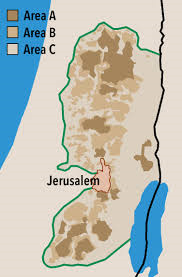
Under the Oslo Accords, EGL was divided into three parts: Areas A, B and C. Area A was handed over to the Palestinian Authority (PA) and it has complete control of that land.  Area C is “Israeli Territory” and is completely controlled by Israel. Area B is a hybrid, which is under the civil administration of the Palestinian Authority, but security control of Israel.

Areas ABC
Breakdown of Areas A, B and C
on the west bank of the Jordan River

Gaza would ostensibly be called “Palestinian Authority Territory”, however, the PA has no control in the area.  The governing party is Hamas, which won elections in 2006 and routed any PA personnel from the region in 2007.  Israel withdrew from Gaza in 2005.

Israeli Territories
1967 to 1995

The Oslo Accords between the State of Israel and the PLO started the process of breaking the Israeli territories into areas with local Palestinian Arab control.  Before the Oslo Accords, all of Gaza and EGL/ west bank of the Jordan River (WBJR) were only Israeli territories.

Israel took control of Gaza from Egypt in June 1967 during the Six Day War.  Egypt had amassed a large army and announced its intention of attacking Israel, so Israel preemptively attacked Egypt and seized Gaza.  In response to Israel’s preemptive attack on Egypt, Jordan attacked Israel from the EGL/WBJR. Jordan lost the region and gave up all claims to the land in 1988.

Jordan and Egyptian Territory
1949 to 1967

In May 1948, the Palestinian Arabs and five Arabs armies attacked Israel as it declared independence from Great Britain. At the end of the war in 1949, Jordan assumed control of much of Judea and Samaria in an area which became known as the “west bank of the Jordan River (WBJR)” in the United Nations, ultimately shortened to the “West Bank”.  Jordan annexed that area in 1950, gave all Arabs living there citizenship and expelled all of the Jews from the area, counter to the Fourth Geneva Convention.

Egypt assumed control of the Gaza Strip, but did not annex the area.

British Territory 1922 to 1948
Ottoman Territory 1517 to 1922

At the end of World War I, the defeated Ottoman Empire was carved up into several areas (including Lebanon, Syria, Iraq, and Jordan) which were administered by the French and British.  The lands currently known as WBJR and Gaza were part-and-parcel of the British Mandate and had no unique laws or characteristics.  Similarly under Ottoman rule for hundreds of years before the British, those areas were neither divided nor distinct.

As detailed above, there are not, nor have there ever been “Palestinian Territories”. Such terminology inherently upgrades the status of the Palestinian Authority and eliminates the legal role and status that Israel has in Areas B and C.


Related First.One.Through articles

Names and Narrative: The West Bank / Judea and Samaria
Nicholas Kristof’s “Arab Land”

The Subtle Discoloration of History: Shuafat

The Legal Israeli Settlements

Obama’s Friendly Pass to Turkey’s Erdogan

US President Barack Obama has made some interesting friends in office. Those friends get some special attention, and often more importantly, benign neglect.

Among the five world leaders that Obama highlighted as his best friends was the Turkish leader Recep Tayyip Erdogan.  Over Obama’s tenure as president, Erdogan served as both the Turkish Prime Minister and President.  This weekend, elections in Turkey could help cement his power as he attempts to remake the country’s constitution.

One would normally congratulate Obama on aligning himself with such a powerful leader, particularly one with a significant presence in the Muslim world. Such an ally could help the United States advance American interests in the volatile Middle East.

erdogan obama
US President Barack Obama talks with Turkey’s Prime Minister Recep Tayyip Erdogan during a family photo at the G20 Summit in Cannes on Nov. 3, 2011. (Photo: AP)

Turkey’s “Help” in The Middle East

Turkey sits geographically as a bridge between the European and Asian continents.  Turkey borders the volatile countries Syria and Iraq, both of which are consumed by war, where Obama has expressed a US interest.

Turkey’s geographic position and large army make it a potential important ally for the US in the fight against the Islamic State.  However, despite the good terms between Obama and Erdogan, Turkey has not been a good partner in this regard.  As relayed by The Guardian October 2014: “The US is especially angry with Turkey because it is a Nato ally and yet it has refused to provide even basic logistical assistance to the US-led coalition.” It took many months for Turkey to agree to even begin training Syrian forces in Turkey to fight ISIS.  Turkey’s efforts continue to be minimal.

Erdogan’s Values

If Turkey hasn’t been so helpful to American interests, perhaps Obama’s friendship is based on shared values.

As reviewed in “The Churlish Turkish Leadership“, Erdogan has moved his country to the far right into the deep religious Islamic sphere. He has curbed the freedoms of press and expression dramatically over his tenure. Are those shared American values? Obama’s values?

A Friend With Benefits: Erdogan

Despite Erdogan’s lack of assistance to America and suppression of human rights, Obama has treated Erdogan rather nicely:

  • There were no ramifications to Turkey from withholding support in the fight against ISIS
  • There were no ramifications from Erdogan’s suppression of human rights
  • Obama has issued no statement about Turkey’s illegal occupation of northern Cyprus since 1974, which is deemed illegal by the United Nations and not recognized by any country other than Turkey.
  • When Erdogan said the “Zionism was a crime against humanity” in February 2013, the White House merely condemned the statement, but did not threaten any action against Turkey.
  • In May 2015, in the week before elections, Erdogan stated that he sought Turkish unity (with the Kurds) in liberating Jerusalem just as our forefathers went together to liberate Jerusalem with Saladin, we will march together on the same path“, in a comment that did not even get a response from the Obama administration.

It would appear that Obama is fine with Erdogan despite the lack of Turkish support for American policies or values.

A Friend without Benefits: Netanyahu

Obama’s relationship with Erdogan is in sharp contrast to the way Obama treats the Israeli Prime Minister Benjamin Netanyahu.


While Obama claims that the US and Israel are strong allies, his policies appear to be based more on personal friendships.  For Obama, friendship is showing he works for them and not what his friends do for the US. “I think that if you ask them — Angela Merkel, or Prime Minister Singh, or President Lee, or Prime Minister Erdoğan, or David Cameron would say, we have a lot of trust and confidence in the president. We believe what he says. We believe that he’ll follow through on his commitments. We think he’s paying attention to our concerns and our interests,”

Obama will likely continue to show benign neglect to the demagogic statesman from Turkey who makes vile attacks against allies and quells the rights of the people in Turkey.  Conversely, Obama has demonstrated that he will berate and lecture the Israeli leader about “values” and take actions that threaten the country’s existence.

Troubling trends based on personal preferences.


Related First.One.Through articles:

Turkish Hypocrisy – Erdogan’s Line of Defense

New York Times Talking Turkey

Educating the New York Times: Hamas is the Muslim Brotherhood

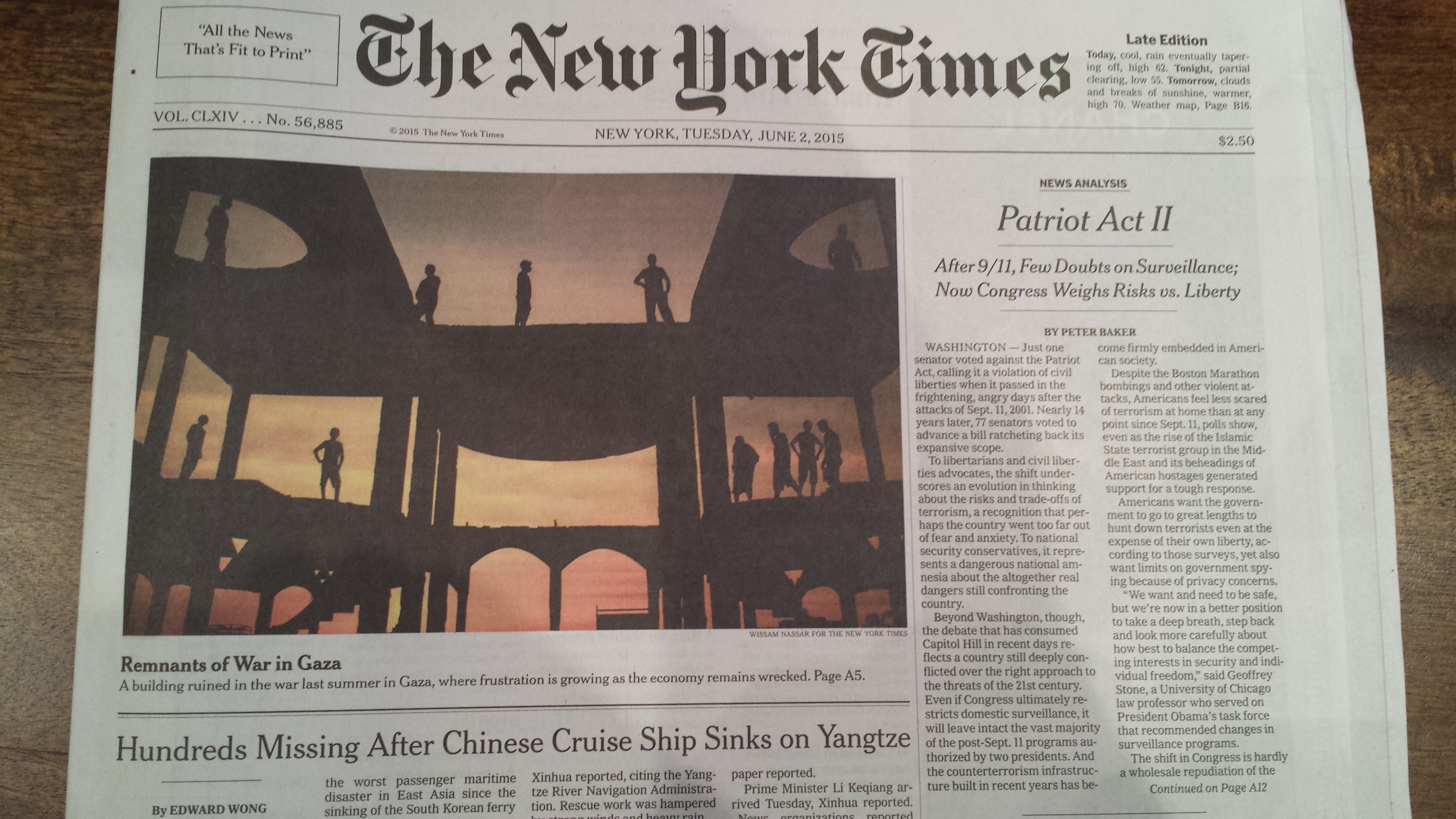
On June 2, 2015 the New York Times once again decided to tell the world that the people of Gaza are suffering.

20150602_201544
New York Times cover picture of Gaza,
June 2, 2015

With a large color picture on the front page, the Times included another picture and article inside regarding how the Gazan community has still suffered from a lack of money, jobs and rebuilding of the infrastructure one year after the war “between Hamas and Israel.”  If a reader ever wanted to learn about the scores of people killed in Nigeria, they would have to hunt inside the paper for an article on page A4 (with no picture).  If they wanted to hear about the dozens of Yemeni civilians killed by Saudi Arabia, they would have had to turn to page A12 the day before.  This has been a continuing pattern for the NYT, as outlined in “Every Picture Tells a Story – Whitewashing the World” where the killing of civilians around the world went under-reported, while the suffering of Gazans remained over-reported.

Another trend of the liberal press has been to not label Hamas a terrorist organization, as reviewed in “CNN’s Embrace of Hamas.”  The group simply is a political group dedicated to “resistance.”

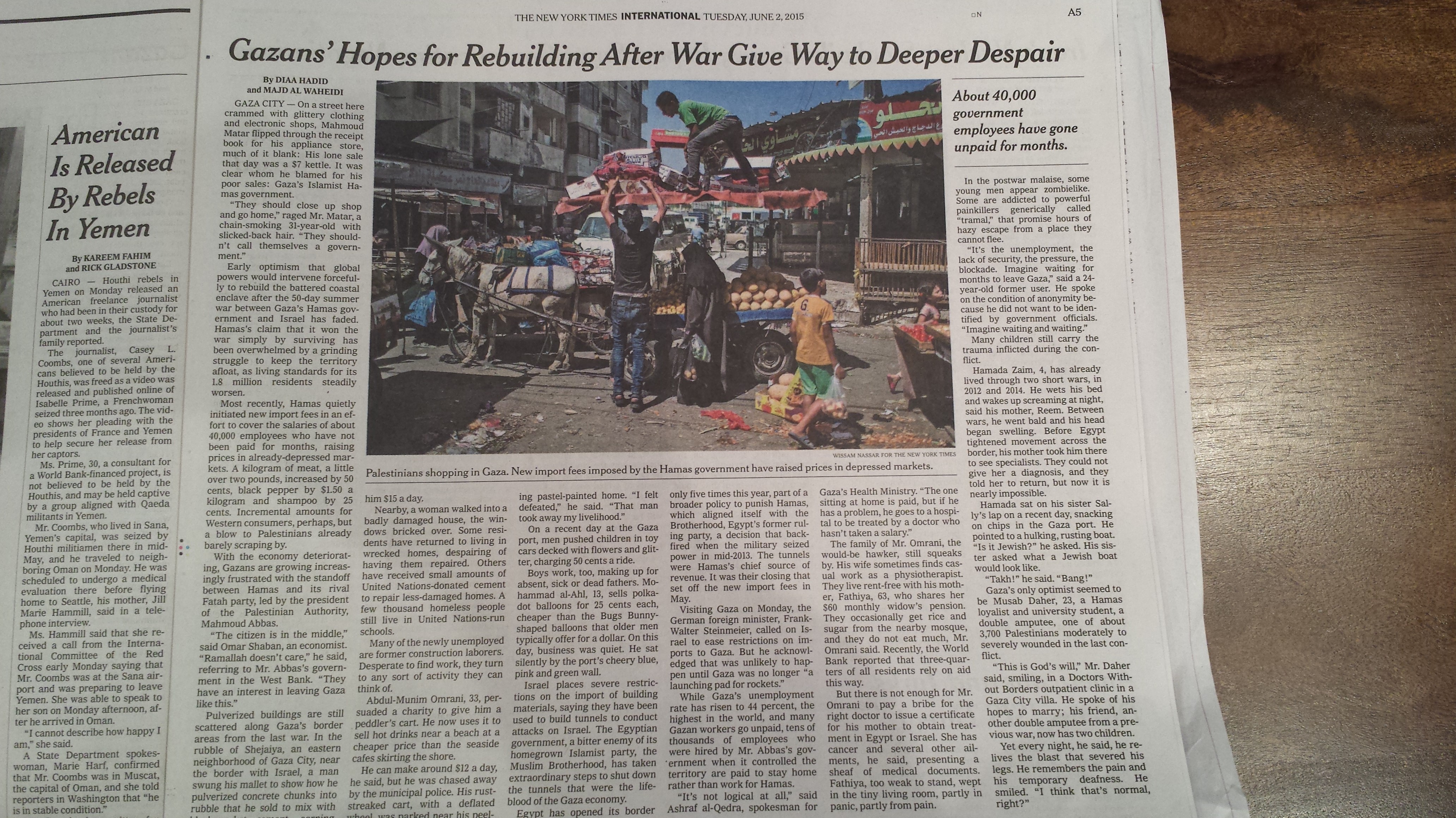
The June 2 NYT article “Gazans’ Hopes for Rebuilding After War Give Way to Deeper Despair” has continued to add to the trend of distancing Palestinian Arabs from Hamas, and Hamas from terrorism, as if everything that happened to Gazans was poor luck and happenstance.

20150602_201625

The article referred to the Palestinian Arabs’ “hope” and “Early optimism that global powers would intervene forcefully to rebuild the battered coastal enclave after the 50-day summer war between Gaza’s Hamas government and Israel “.  The article never discussed their hope that Hamas would destroy Israel.

The article detailed the blight in Gaza, stating “Pulverized buildings are still scattered along Gaza’s border areas from the last war. In the rubble of Shejaiya, an eastern neighborhood of Gaza City, near the border with Israel,” but did not discuss that the Shejaya neighborhood was the locus of dozens of tunnels from people’s homes into Israel to commit acts of terror.

It would appear that the NYT further wanted its readers to believe that the people of Gaza made a momentary strategic blunder in aligning itself with the Muslim Brotherhood in a “decision that backfired“:

The Egyptian government, a bitter enemy of its homegrown Islamist party,
the Muslim Brotherhood, has taken extraordinary steps to shut down the tunnels [connecting Egypt and Gaza]  that were the lifeblood of the Gaza economy.

Egypt has opened its border only five times this year, part of a broader policy to punish Hamas, which aligned itself with the Brotherhood, Egypt’s former ruling party,
a decision that backfired when the military seized power in mid-2013.

This is ridiculous.  Hamas IS an integral part of the Muslim Brotherhood. It didn’t simply “align itself” in “a decision that backfired.”  Here are quotes from the Hamas Charter (1988):

“Article 2: The Islamic Resistance Movement is one of the wings of Moslem Brotherhood in Palestine. Moslem Brotherhood Movement is a universal organization which constitutes the largest Islamic movement in modern times….

Article 7: The Islamic Resistance Movement is one of the links in the chain of the struggle against the Zionist invaders. It goes back to 1939, to the emergence of the martyr Izz al-Din al Kissam and his brethren the fighters, members of Moslem Brotherhood. It goes on to reach out and become one with another chain that includes the struggle of the Palestinians and Moslem Brotherhood in the 1948 war and the Jihad operations of the Moslem Brotherhood in 1968 and after.”

This is not subject to interpretation. Hamas is an integral part of the global Muslim Brotherhood movement, a group which has been actively banned and persecuted in Muslim countries such as Egypt and Syria for promoting terrorism.

However, such facts muddy a narrative of Palestinian Arabs as innocent victims.  Therefore, the media seems to have concluded that the best way to advance the victimhood tale requires a multi-part effort:

  1. Distance the people from the ruling government and negative reports. Minimize the fact that Palestinian Arabs voted for Hamas, which has led Fatah in every poll since 2006. Explain that the Arabs are frustrated by the Fatah corruption so had no practical choice other than voting for Hamas. Explain Palestinian Arabs being the most anti-Semitic people in the world by using terms like “not surprising” without delving into cause-and-effect.
  2. Stop calling Hamas a terrorist organization. Use terms like “militant” sparingly, and ideally, just “Islamist”.
  3. Refer to Hamas as a political entity. Which it is, like the Nazi party was a political entity elected by the Germans in the 1930s. Quote “political leaders” of Hamas often.
  4. Never refer to the Hamas Charter, which calls for the complete destruction of Israel; murder of Jews and never accepting any negotiated settlement. Skip the long, evil Jewish and Zionist conspiracy theories- those statements are just noise that cloud the picture of Palestinian Arab suffering.
  5. Localize Hamas to an Israeli resistant movement.  In a world that fears the dangerous rise of the Islamic State / ISIS, do not let Hamas get painted as part of a broader Muslim terrorist group (as described above).

If you follow these steps, the Palestinian Arabs can appear as passive victims and not as active participants in a radical anti-Semitic, anti-Western regional movement to install a Muslim caliphate.

Read the press today. Which rules are they using?


Related First.One.Through articles:

Cause and Effect: Making Gaza

The Death of Civilians; the Three Shades of Sorrow

Honor Killings in Gaza

The Palestinians aren’t “Resorting to Violence”; They are Murdering and Waging War

What do you Recognize in the Palestinians?

Extreme and Mainstream. Germany 1933; West Bank & Gaza 2014

Obama’s “Values” Red Herring

On May 21, 2015, Jeffrey Goldberg from The Atlantic published an interview with US President Barack Obama on ISIS, Iraq and Israel. Here is a review of Obama’s comments on Israel and his deliberate attempt to minimize his threats to Israel. It would appear that the president needs a reminder that the primary Jewish value is the sanctity of life.

 obama the atlantic
Photo of President Obama from The Atlantic May 2015


OBAMA’S CLAIM OF JEWISH SUPPORT AND
PRO-ISRAEL POSITIONS

  • 1)  Obama stated that he enjoys broad Jewish support.I consistently received overwhelming majority support from the Jewish community, and even after all the publicity around the recent differences that I’ve had with Prime Minister Netanyahu, the majority of the Jewish American community still supports me, and supports me strongly.

Comment: Obama’s Jewish support has declined considerably. Obama received weaker Jewish support than any of the recent Democratic candidates for president (going back to the loser Michael Dukakis in 1988).

  • 2012 Obama 69%
  • 2008 Obama 78%
  • 2004 Kerry 76%
  • 2000 Gore 79%
  • 1996 Clinton 78%
  • 1992 Clinton 80%
  • 1988 Dukakis 64%

Obama’s poll numbers continued to collapse among Jews, especially during the six months prior to the interview. The latest Gallup poll had Obama’s approval rating among Jews at 54%, only 8% above the national average. That was the narrowest gap ever in Obama’s presidency. This precipitous drop-off coincides with Obama’s decision to encourage 58 Democratic loyalists to walk out on Israeli Prime Minister Benjamin Netanyahu’s address to the joint session of Congress

  • 2)  Obama said “political” opportunists are portraying him as anti-Israel and anti-Jewish because he questions Israel’s policy regarding Palestinians. there has been a very concerted effort on the part of some political forces to equate being pro-Israel, and hence being supportive of the Jewish people, with a rubber stamp on a particular set of policies coming out of the Israeli government. So if you are questioning settlement policy, that indicates you’re anti-Israeli, or that indicates you’re anti-Jewish. If you express compassion or empathy towards Palestinian youth, who are dealing with checkpoints or restrictions on their ability to travel, then you are suspect in terms of your support of Israel. If you are willing to get into public disagreements with the Israeli government, then the notion is that you are being anti-Israel, and by extension, anti-Jewish. I completely reject that.

Comment: Obama’s critics and his collapsing poll numbers are about OBAMA’s policies regarding Israel, not Israel’s policies regarding Palestinians. Obama’s poll numbers among Jews were fairly consistent during his first term, but with a downturn which could be attributed both to his criticisms of Israel’s permitting Jews to live anywhere they choose as well as the Democrat’s gutting of their pro-Israel platform in 2012. The more precipitous drop in Jewish support for Obama had to do with his Iranian nuclear negotiations and his treatment of the Israeli PM during that time.

Comment: Obama is being a hypocrite by stating that his “public disagreements with the Israeli government” should not be construed as anti-Israel, while Netanyahu’s public criticism of Obama’s policies were attacked. Obama has criticized Israel repeatedly on the world stage for Israel’s handling of disputed lands. However, when Netanyahu disagreed with Obama, it was over a matter that was an existential threat to Israel. Yet Obama chose to belittle Netanyahu’s argument and berate the Israeli leader.

  • 3)  Obama believes that Israel is simply a safe haven for Jews.There’s a direct line between supporting the right of the Jewish people to have a homeland and to feel safe and free of discrimination and persecution, and the right of African Americans to vote and have equal protection under the law. These things are indivisible in my mind

Comment: Obama has never internalized that Israel is THE homeland of the Jewish people. There has always been an important and significant disconnect that Obama has about Israel: Israel is not simply a safe haven where Jews are “free of discrimination and persecution.” Such a safe space could have been created in Uganda too. Israel is not just “a homeland” as if Jews had been self-governing in many other places on earth for centuries; as if the Jewish religion did not have an exclusive and unique relationship with the holy land. Israel is THE homeland of the Jewish people as it has been for 3700 years. That is why the San Remo Conference in 1920 specified Palestine for the Jews.

  • 4)  Obama has hung all of his pro-Israel credentials on his support of Israel militarily.I have maintained, and I think I can show that no U.S. president has been more forceful in making sure that we help Israel protect itself, and even some of my critics in Israel have acknowledged as much.

Comment: Obama’s goal for Israel is not particularly unique. Obama has stressed that the Iraqi government needs to protect Iraq; the Afghani government needs to protect Afghanistan, and so on. Obama has sought to pull American forces out of conflict zones and put the onus on the local governments to protect themselves. That is a broad Obama policy decision – with which one can agree or not regarding America’s role as the world policeman.

What is not subject to debate, is that the policy is not unique and is hardly the great shining example for Obama to underscore as his complete bona fides in being pro-Israel. His stance for Israel’s security is part-and-parcel of his broad position regarding military support and cooperation around the region.


OBAMA’S DOUBLE STANDARDS
AND THREATS

  • 5)  Obama was highly critical of Netanyahu’s comments as being counter to Israel’s democratic laws. Obama came out forcefully against Netanyahu’s comments to get out the vote when Bibi feared he was losing the election. “what I [Obama] did say is that when, going into an election, Prime Minister Netanyahu said a Palestinian state would not happen under his watch, or there [was] discussion in which it appeared that Arab-Israeli citizens were somehow portrayed as an invading force that might vote, and that this should be guarded against—this is contrary to the very language of the Israeli Declaration of Independence, which explicitly states that all people regardless of race or religion are full participants in the democracy. When something like that happens, that has foreign-policy consequences.

Comment: Obama was curiously selective in focusing on certain comments which portrayed Netanyahu only as an extremist. Obama chose to focus on Netanyahu’s comments on election eve when Netanyahu was worried he was going to lose the elections and was trying to rally groups to get out and vote for him. Obama ignored Netanyahu’s later comments which back-tracked and explained his intentions regarding election night. Obama ignored the many years that Netanyahu negotiated with the Palestinian Arabs (Netanyahu ran three prior Israeli governments). Obama ignored Netanyahu’s handing over cities to the Palestinian Authority in showing his willingness to swap land-for-peace.

Comment: Obama ignored comments from repressive regimes. Obama is putting forward sanction reliefs for Iran while the regime chants “Death to America”. Obama has back-tracked from his no nuclear capability for Iran pledge, while Iran chants “Death to Israel”. Obama pushed Israel to negotiate with acting President of the Palestinian Authority Mahmoud Abbas and to release Arab terrorists convicted of murder, while Abbas celebrated the killers of innocent Israelis.

Comment: Obama ignored undemocratic regimes. Obama’s reference to Israel’s Declaration of Independence suggested that he only treats countries with liberal values as allies. How does Obama send billions of dollars to the Kingdom of Saudi Arabia which is one of the most repressive regimes in the world?

Comment: Obama threatened Israel. While Obama ignored the many statements and long history of Netanyahu negotiating with the Palestinian Authority, and ignored the actions and statements of surrounding Arab governments, he threatened Israel. Threatening a country is a far cry from having a difference of opinion or being upset with momentary excited statements from an individual. When Turkish leader Erdogan called Zionism a “Crime against Humanity”, the White House denounced the statement but never threatened Turkey. When Erdogan called for Muslims to conquer Jerusalem, the White House was silent; no threats were issued. Indeed, Obama considered Erdogan one of his closest friends among world leaders.

As detailed in FirstOneThrough “International-Domestic Abuse: Obama and Netanyahu”, the relationship between Israel and the United States is both unique and not one of peers. Israel relies on the US on many levels. Therefore, Obama’s double standards for Netanyahu, coupled with Obama’s global pronouncement that he will punish the entire country of Israel, is an abuse that has angered Israel supporters around the world.

  • 6)  Obama has no issue criticizing Israel on the global stage, as he stated: “the one argument that I very much have been concerned about, and it has gotten stronger over the last 10 years … it’s less overt than the arguments that a Sheldon Adelson makes, but in some ways can be just as pernicious, is this argument that there should not be disagreements in public

Comment: Obama has double standards about criticism in public. Obama lectured Netanyahu that Bibi’s election eve comments and actions ran counter to Israel’s laws. Would Obama feel it is appropriate for Netanyahu to lecture him about America’s ongoing use of the death penalty which most of the western world abolished? Would Obama care to hear about Netanyahu’s views on how the US should treat gay marriage or gays in the military as running afoul of America’s foundation documents? Or would Obama feel that such comments have nothing to do with Israel and that he doesn’t need to listen to a lecture about his own country’s laws from a foreign leader?

Yet, when Netanyahu criticized Obama’s negotiations with Iran over their nuclear program – which poses a direct existential threat to Israel – Obama did not just get offended, but rallied his Democratic loyalists to boycott Netanyahu’s speech in D.C.


OBAMA’S “VALUES” RED HERRING

  • 7)  Obama received talking points from liberal rabbis. Obama’s interview was peppered with remarks specifically intended for a Jewish audience: “we creating a safe Jewish homeland, but also we are remaking the world. We’re repairing it.” Obama also said “when you show intolerance and when you are persecuting minorities and when you are objectifying them and making them the Other, you are destroying something in yourself,”

Comment: Obama learned only half a lesson from the rabbis. The phrases used by Obama are uniquely Jewish referring in English to Tikkun Olam, repairing the world, and “Acher”, the Other. The choice of language was so out of place that it would be the equivalent of a Jewish person littering a conversation with “Grace”. The Atlantic’s Goldberg even made the comparison stating “Obama, when he talks about Israel, sounds like a rabbi in the progressive Zionist tradition.” The aggressive Obama sales tactic was clearly courtesy of a progressive rabbi to parrot to a Jewish audience.

Regrettably, Obama only learned (or was taught) half of the lesson. The most important Jewish value of all is the preciousness and sacredness of life. Protecting life supersedes almost every other commandment. It is precisely for that reason that Jews have turned against Obama and his poll numbers have dropped. Enabling Iran to get a nuclear weapon threatens millions of people in Israel. Obama’s threats to suddenly withhold support for Israel at the United Nations risks putting Israel’s border security and economic viability at risk.

  • 8)  Obama has higher expectations for Israel. it’s true, I have high expectations for Israel, and they’re not unrealistic expectations, they’re not stupid expectations, they’re not the expectations that Israel would risk its own security blindly in pursuit of some idealistic pie-in-the-sky notions”

Comment: Obama has double standards for Israel. There is no crime in having high expectations for someone; indeed, it is often thought of as a compliment. However, if one uses those higher expectations to punish the party, that is a form of discrimination. For example, Obama cannot make demands on Israel for preconditions for final status talks but make none on Palestinian Arabs. Obama cannot wage wars thousands of miles from his shores against enemies who cannot possibly destroy the US, while berating Israel for fighting against an enemy on its borders that threaten to destroy Israel.

  • 9)  Obama thinks there is nothing unique about Jewish values or a Jewish State.Goldberg question: you want Israel to embody Jewish values. Obama: I want Israel, in the same way that I want the United States, to embody the Judeo-Christian and, ultimately then, what I believe are human or universal values that have led to progress over a millennium”

Comment: There is one Jewish State called Israel and its Jewish Values stress the sanctity of life. Obama managed to roll Judaism into Christianity and ultimately human and universal terms. While I am sure that he intended this as a compliment, it also undermined the uniqueness of Israel.

By way of comparison, does Obama have dreams that Turkey will embody Judeo-Christian values? How about Norway or Greece? Costa Rica? He probably does, but he would never make such a statement as those countries have distinct Islamic or Christian characters. To state that he wished they embody several cultural values does several things:

  • It minimizes the difference between the religions
  • It suggests that the country does not live up to those values

Regarding the first point, Obama minimized the fact that there is only one Jewish state. While Israel has religious freedom for all, it is the Jewish homeland. Israel’s goal is not to embody Obama’s dream of a Star Trek-like future of universalism.

Regarding the second point, Obama needs to be re-educated by the progressive rabbis that coached him, about the paramount Jewish value of the sanctity of life. It is precisely for that reason that Netanyahu came to address the joint session of Congress to talk about the Iranian nuclear threat. That exact value and speech that Obama boycotted.

  • 10)  Obama thinks Jewish Values are about freedom and human rights. Obama continued from his comments above about Judeo-Christian and universal values: “The same values that led to the end of Jim Crow and slavery. The same values that led to Nelson Mandela being freed and a multiracial democracy emerging in South Africa. The same values that led to the Berlin Wall coming down. The same values that animate our discussion on human rights and our concern that people on the other side of the world who may be tortured or jailed for speaking their mind or worshipping—the same values that lead us to speak out against anti-Semitism. I want Israel to embody these values because Israel is aligned with us in that fight for what I believe to be true. And that doesn’t mean there aren’t tough choices and there aren’t compromises. It doesn’t mean that we don’t have to ask ourselves very tough questions about, in the short term, do we have to protect ourselves,

Comment: Obama doesn’t know that Israel is the most liberal country from Greece to Singapore to South Africa.  What was this Obama rant? Was there an insinuation that Israel is an apartheid state (why mention Jim Crow or Nelson Mandela)? Was there a suggestion that Israel’s Security Wall which it built to stop Palestinian terrorism in 2002 is like the Berlin Wall? Does he think that people are being tortured or jailed for speaking their mind or worshipping in Israel? Israel is a thriving liberal country in the heart of a backwards Middle East. What were these bizarre comparisons? Why does Obama say that he “wants Israel to embody these values” rather than acknowledge that it DOES embody those values?

Should Netanyahu wax about his dream for America to not shoot unarmed black people?

  • 11)  Obama claimed to understand the need for protecting Jerusalem.  As he stated above and continued: “I was the first one to acknowledge that you can’t have the risk of terrorists coming up right to the edge of Jerusalem and exposing populations

Comment: Obama lied about understanding security for Jerusalem. If Obama understood the need for security for Israel’s capital, how can he condemn Jews LIVING in Jerusalem? Why did Obama condemn Jews moving into homes they legally purchased?

How can Obama state that Israel’s development of E1 which protects Jerusalem from the east, is a bad idea that hinders a final agreement?  Obama in March 2013 to Palestinian Arabs: “You mentioned E1, in particular.  I think that is an example of at least a public statement by the Israeli government that would be very difficult to square with a two-state solution.”  E1, which connects Jerusalem to Maale Adumim, a city which every Israeli Prime Minister has always insisted on retaining, is the exact solution for keeping “terrorists [from] coming up right to the edge of Jerusalem and exposing populations.

  • 12)  Obama thinks he is a better at Jewish Values than Netanyahu.  Obama concluded the thought above with “So this isn’t an issue of being naive or unrealistic, but ultimately yes, I think there are certain values that the United States, at its best, exemplifies. I think there are certain values that Israel, and the Jewish tradition, at its best exemplifies. And I am willing to fight for those values.”

Comment: Obama continued to move the discussion away from defending Israel’s security to defending its values.  In a fitting conclusion of delusion, Obama placed himself in the center of defending Israel.  How is he doing it? By enabling Iran to get nuclear weapons and withholding support for Israel at the United Nations.  Doesn’t seem logical to you?  Well, let me explain the Obamian logic:

  • Since Obama said he has Israel’s back, you must believe him.  Just ignore that his words about preventing Iran to get nuclear capacity have been meaningless; that the Syrian red line was crossed without consequence; that Obama has ignored US’s treaties to support Ukraine and let Russia take over half of the country.
  • Since Obama said he is willing to fight for Jewish Values, you must believe him. Just ignore that he doesn’t understand that the primary Jewish value is the sanctity of life. Ignore that he thinks Israel isn’t the most democratic and humane country for thousands of miles in every direction.

Obama clearly does not appreciate the values that Israel lives each day.  If he did, he would be doing the opposite of his current actions by nixing a bad Iranian deal and by standing proudly next to Israel in international fora like the United Nations.


OBAMA UPSET AT BEING CRITICIZED BY ISRAEL SUPPORTERS

  • 13)  Obama knows that double standards are wrong.you should be able to align yourself with Israel when it comes to making sure that it is not held to a double standard in international fora”

Comment: Obama hasn’t internalized his own double standards for Israel.  Obama spoke about Israel’s history and the history of anti-Semitism even until today which makes it easy to align himself with Israel.  However, his personal higher expectations of Israel and the unique role that the United States has in defending Israel in international for a has made him use double standards for the country.

  • 14)  Obama feels his moral convictions and role as defender of Jewish values can let him criticize Israel without being hostile.we can have a debate, and we can have an argument. But you can’t equate people of good will who are concerned about those issues with somebody who is hostile towards Israel

Comment: Threats and actions that have dire consequences are not debates.  Of course anyone can debate and disagree (in a democracy!) The two questions are 1) how do you do it and 2) what are the ramifications.

Regarding how one disagrees, the notion of being publicly hostile and rallying party loyalist to blacklist the Israeli prime minister is NOT the way to disagree. When the animosity is so public that fellow world leaders would approach you and share their disgust with Netanyahu (French PM Sarkozy in 2011), you have clearly let it be known to the world that you seriously despise the man. Politics is an art of subtlty and getting things moivig along. Mission Failed.

To the second point, on the ramifications of disagreeing, in a civil society, people just go back to their corners and disagree. However, in this situation, the disagreement leads to Iran – which has sworn to destroy Israel – obtaining nuclear weapons. Here the disagreement has led to the threat of the US not siding with Israel at the United Nations to make Israel become a pariah state and subject to various sanctions.

This is not simply “it’s OK to disagree”. Those disagreements will seriously harm the very viability of the State of Israel. And to somehow suggest that putting Israel in grave risk REPEATEDLY should not lead anyone to question the “good will” of those people is puzzling.  To argue that the actions themselves are not “hostile towards Israel” is absurd.


While Obama may have won over some Israel-supporters with his heavily coached- discussion on values, the red herring he is marketing is foul.

Related First One Through Articles:

International-Domestic Abuse: Obama and Netanyahu

Netanyahu’s View of Obama: Trust and Consequences

For Obama, Israeli security is not so time-sensitive

Bugs Bunny on Obama’s credibility in Negotiating with Iran

Red Herrings on the Red Line

Delivery of the Fictional Palestinian Keys

Summary: Imagine perceiving the future when you cannot see the present nor recognize the past.

One of the most famous paintings in the Sistine Chapel in the Vatican is by Pietro Perugino, entitled “Christ Handing the Keys of the Kingdom to St. Peter.” The painting itself is notable for several important contributions to the world of art such as displaying three dimensions using linear perspective and a vanishing point. The subject matter is also an interesting metaphor for the Israeli-Palestinian conflict today.

keys

The Painting

The subject of the painting reflects the establishment of the role of the pope in Catholicism. Jesus’s handing of the “keys of heaven” to his disciple Peter was considered establishing a connection between earth and the heavenly realm.

The center of the painting focuses on the actual handing of the keys: one key is held by Jesus, while a second key remains dangling in the foreground. The viewer does not really notice two keys, but the single dangling key. From that key, eyes are drawn up towards the open doors of the Temple of Solomon, displayed as an interpretation of the eight-sided Dome of the Rock. This is a metaphor of the connection between the divine to the physical and up again to the divine: the keys connecting Jesus and Peter, and then the dangling key from Peter to the Temple.

In the painting, the Temple of Solomon is sitting on a plaza surrounded by people and triumphal arches of Constantine. It was the emperor Constantine that welcomed Christianity to the Roman Empire in 325CE. While the Temple of Solomon sat in Jerusalem, these arches were in Rome, near the Vatican.  By integrating these themes, Perugino brought Jerusalem to Rome and had Christianity flanking the holy Temple.

 The Metaphor of Keys

Keys are often used as metaphors in art and poetry. Keys are not only tools for gaining access, but connote ownership. The holder of the key is considered both the rightful owner of whatever is locked, and is the sole person who has the means of gaining access to whatever the lock has sealed. In the case of this famous painting, Jesus holds the heavenly key in gold, which is paired with a darker key for Peter. The twining is a partnership bridging heaven and earth, with Peter as the rightful owner of the earthly key. The key itself opens the Temple in Jerusalem, the physical gateway back to heaven.

The brilliance of the painting lies in the suspension of the dark key. Set against a plain background in the center of the painting, a viewer has no choice but to be drawn to it. The key anchors the focus, and the story is built around it.

The Israeli-Palestinian Conflict

The Middle East has a long history of using keys, both physical and metaphorical. In 1917, the Mayor of Jerusalem handed over “keys of Jerusalem” to British General Allenby as a sign of surrender, and in 1841, the Ottomans handed the keys to Rachel’s Tomb in Bethlehem to Jews as a symbol of their control of the holy site. Even today, the Church of the Holy Sepulchre has a key that is held by a Muslim family as was the tradition dating back to 1246, even though the church has no religious significance to Islam.

Many Palestinians carry their own physical keys with symbolic messages today: that they are the rightful owners to homes in Israel and are waiting to move there.

keyboy

The skeleton keys are not the actual keys to homes that grandparents abandoned in 1948 while they waited for Arab armies to destroy the nascent Jewish State.  These Palestinian keys are representational of their quest to a “right of return” to homes in Israel. It has become a physical manifestation of their view of themselves as refugees. However, both the keys and status are manufactured.

As detailed in “Palestinian “Refugees” or “SAPs”?” there are only about 30,000 refugees (or more accurately, Internally Displaced Persons) alive from 1948, as refugee status cannot be handed down like an inheritance. Further, a refugee is someone who left a country, not a house. International law covers refugees return to a country, not an abandoned building (and Palestine was never a country).

Regardless, the acting President of the Palestinian Authority, Mahmoud Abbas, continues to put the “refugees” as a key issue in negotiations with Israelis. He does this with the blessings of the United Nations which is complicit in misleading the Palestinians.

The United Nations not only created a unique agency for Palestinian refugees (UNRWA) separate from the organization that handles all other refugees in the world (UNHCR), but uniquely enables the descendants of Palestinian refugees to get services from the UN.  As elaborated in “Help Refugees: Shut the UNRWA, fund the UNHCR” the staffing of the UNRWA now exceeds the total number of Palestinian refugees.

The larger issue with UNRWA is not their giving extended services to millions of Palestinians who are not refugees, but the UN agency’s active encouragement of Palestinians to seek to move to, and delegitimize Israel.

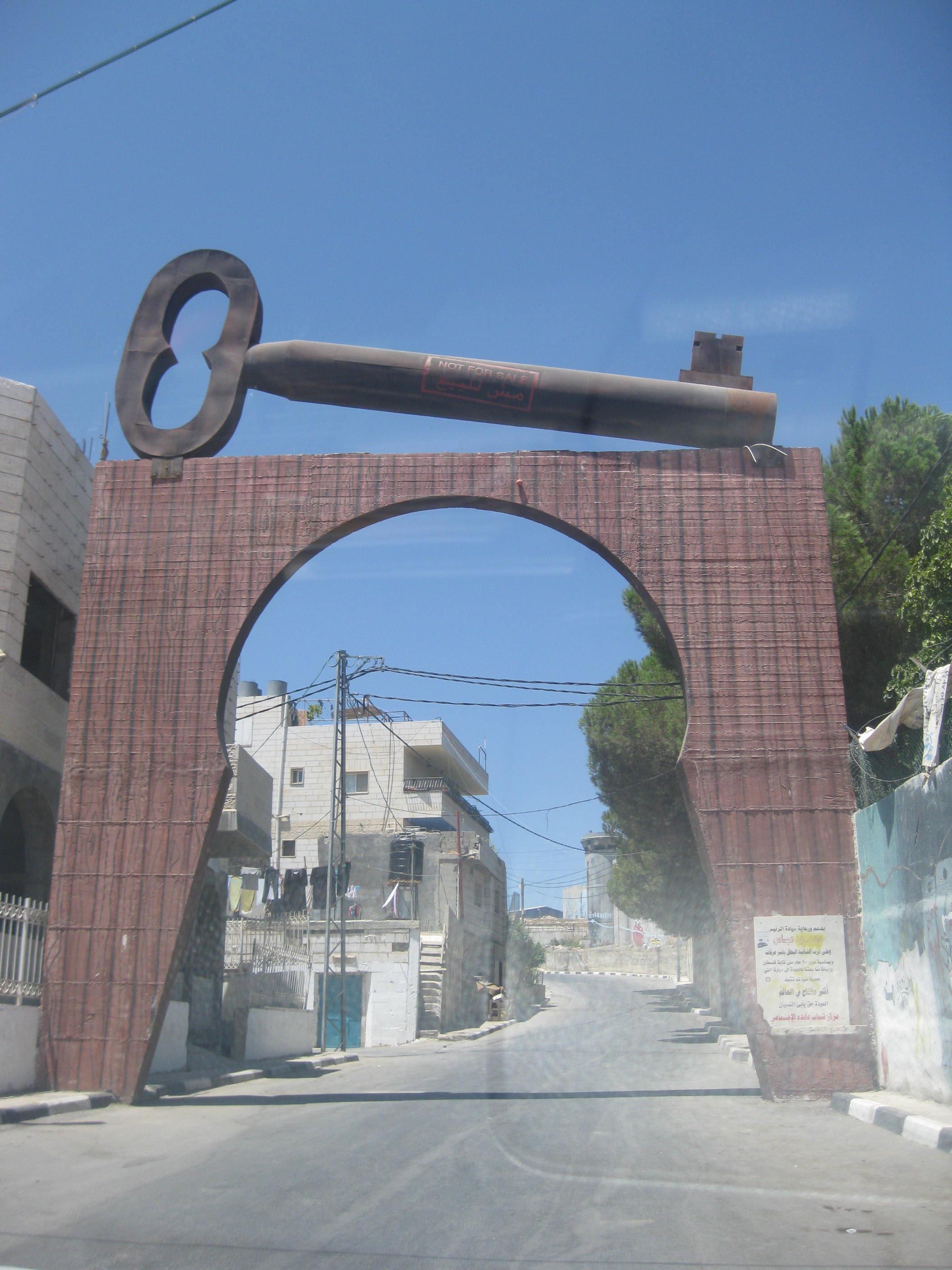
key doorway
Entryway to UNRWA camp in Bethlehem with a large key atop

Both the United Nations and Palestinians have manufactured a particular narrative:

  • Palestine was an Arab country in 1948
  • Palestinian Arabs were the only indigenous people who had lived there for centuries
  • Jews ethnically cleansed Palestine of its Arab inhabitants
  • Per the points above, Israel is not a legitimate state as the Jews are interlopers who stole the native Arab land

Such story stands in stark contrast to basic facts:

  • Palestine was never an independent country
  • The region and Mandate of Palestine had a mixture of Jews and Arabs, with Jews accounting for over 30% of the population in 1948
  • More Arabs than Jews moved to Palestine under the British Mandate 1922-1948
  • Many Palestinian Arabs were not land owners but tenants in the land
  • Most Arabs fled from their homes in 1948, while they hoped and waited for Arab armies from Jordan, Lebanon, Syria, Iraq and Egypt to destroy Israel
  • Israel welcomed non-Jews, giving 160,000 non-Jews citizenship in 1948, in sharp contrast to the Jordanian and Palestinian Arabs who expelled all Jews from Judea and Samaria

As in the painting “Delivery of the Keys,” UNRWA has  handed Palestinians a narrative and claim to Israel: the Arabs are the rightful owners of Israel. The United Nations paints these “refugees” against a bleak background (like the key in the painting) to emphasize their stateless position. The key above the portal at the UNRWA camp is a potent symbol to all Palestinians, that it is through the United Nations that millions of Arabs will migrate to Israel. UNRWA and the Palestinians have established a pairing of keys like Jesus and Peter in the painting above: Palestinian Arabs are the owners of Israel, and the gateway to getting that land is through the United Nations.

The Vanishing Point

The vanishing point is where eyes are drawn to in the horizon.  It is a place where parallel lines converge giving depth to a two dimensional painting.  It is also the point where things become increasingly smaller and faint, disappearing altogether.

In the Perugino painting, the vanishing point is the open door to the Temple of Solomon. It is this worldly portal to the heavens, where man’s prayers ascend to ethereal songs.  The viewer of the painting is pulled to the very spot where the material world melts – indeed, the vanishing point.

Today, a person could look at the artwork with another perspective.

The Temple of Solomon, the most holy place on earth for Jews, is replaced with an Islamic shrine.  The Temple, and Jewish presence has seemingly disappeared.  In this Christian piece of art, the flanking of Constantian arches and Jesus and Peter in the foreground are meant to underscore that the pope and Christianity are the proper pathways to God. Judaism has faded to Islam, and both are replaced by Jesus’s emissary.

Over Jerusalem Day 2015, the vanishing point added an additional dimension.

The current pope, Pope Francis, canonized two nuns who were born in the holy land in the 1840s, while it was part of the Ottoman Empire. One nun was born in Jerusalem and another was born in the Galilee.  Yet the pope decided to refer to these nuns as “Palestinians,” not Ottomans and not Israeli (while the status of Jerusalem is under debate, the only people that consider the Galilee part of Palestine are Hamas-supporters who seek the destruction of Israel).  If one chooses to be generous and argue that the region was called Palestine in the 1840s, does the pope refer to people from regions like the Sahara (Saharans?), the Rockies (Rockies?) or Patagonia (Patagonians?), or does he call them Libyans, Americans and Chileans?

Is the pope seeking a new replacement theology, where not only has the Vatican replaced Jerusalem as the center of divine revelation, but history itself can be updated? Is Israel being supplanted today the way the painting at the Vatican shows Judaism being replaced?

The news media has certainly rallied to such vision.  The New York Times decided to cover the celebrations of Jerusalem Day on May 17, 2015 from a purely Arab point of view.  The day in which Israelis celebrate the reunification of their holiest city from which they were expelled and barred from reentry was characterized as a moment of protest. The atrocities committed by Jordanian and Palestinian Arabs during 1949-1967 vanished and this year’s celebration was mocked.

The Times questioned the very essence of Israeli rights to Jerusalem as it quoted a Palestinian man ““How would you feel if somebody marched through your living room, without your permission?””  Whose house is this anyway?


A Vanishing Point has interesting features: our eyes are drawn there; but the subject matter blurs and disappears.

The world’s attention is focused on the Middle East and the Arab-Israeli conflict. Jews and Palestinian Arabs are focused on Jerusalem and the Temple Mount.  As they do, Palestinians grab hold of the dangling key and Israelis don’t see the golden key in their hand. Everyone wonders what the future will bring and ventures predictions as they gaze into the distance.

And as they do so, all reality disappears.


Related First One Through articles:

In Israel, Everybody’s New

The Holocaust and the Nakba

The Arguments over Jerusalem

“Arab” Land

The Arguments over Jerusalem

Summary: In considering the arguments that Palestinian Arabs and Israeli Jews each make for Jerusalem as their capital, only one party makes a truly compelling case.

Jerusalem has long been considered the thorniest issue in the Israeli-Palestinians Question. In 1947, when the United Nations put forward a plan to partition the land into two states, it proposed placing Greater Jerusalem and Greater Bethlehem into an international zone called the “Holy Basin.” This Holy Basin would be neither part of Israel nor Palestine, to remove the sensitive region from the conflict.

1947plan jerusalem
UN 1947 Partition Plan for the “Holy Basin”
of Greater Jerusalem and Greater Bethlehem

However, as fate would have it, the partition plan was rejected by the Palestinians who then launched a war to destroy Israel in May 1948, together with armies from Transjordan, Lebanon, Syria, Egypt and Iraq. At war’s end, the Holy Basin was divided with the western half of Greater Jerusalem and Hebrew University falling under Israeli control, and Greater Bethlehem and the eastern half of Jerusalem falling under Arab control (Jordan annexed the area and granted the Palestinian Arabs there citizenship).

The Holy Basin remains an outstanding issue.  In a two-state resolution, the Israelis propose to split the Holy Basin whereby they control all of Greater Jerusalem and the Palestinians would have Greater Bethlehem; the Palestinians seek to have all of Greater Bethlehem AND the eastern half of Jerusalem as its capital, while Israel would only have the western half of Jerusalem. Which side has a better claim?


The Arguments over Jerusalem

THE HOLY BASIN

RELIGION: The sensitivity over the Holy Basin is due to the fact that it holds many holy sites for the three monotheistic religions. A short list includes:

  • The Temple Mount/ The Noble Sanctuary (Jerusalem). Jewish and Muslim
  • Al Aqsa Mosque (Jerusalem). Muslim
  • Dome of the Rock (Jerusalem). Jewish and Muslim
  • The Wailing Wall / Kotel (Jerusalem). Jewish
  • Church of the Holy Sepulchre (Jerusalem). Christian
  • Dormition Abbey (Jerusalem). Christian
  • The Old City (Jerusalem). Jewish
  • Church of the Nativity (Bethlehem). Christian
  • The Tomb of Rachel (Bethlehem). Jewish

There are many other churches, synagogues and mosques in the Holy Basin, however, these sites are considered sacred as various events are believed to have occurred at these locations. For Christians, the churches were built on the various spots where Jesus and Mary are thought to have had significant life events. For Muslims, the Al Aqsa Mosque is considered to be the place where Mohammed ascended to heaven. For Jews, the Temple Mount is not only considered to be the place of two Temples, but also the spot where Abraham brought Isaac for a sacrifice.  Of this entire list, only the Jewish Temple has any archeological evidence supporting the beliefs.

Among the three religions, Jerusalem is considered the holiest spot only for Jews. Muslims consider the Al Aqsa Mosque to be its third holiest spot (after Mecca and Medina), and the Roman Catholic Church considers the Vatican in Rome, Italy to be the holiest location.

Judaism is also unique in considering the entire Old City to be holy. While Christianity and Islam consider certain specific spots to be sacred, only Judaism considers the city as a whole.

Jerusalem: Advantage Israel
Bethlehem: Advantage None

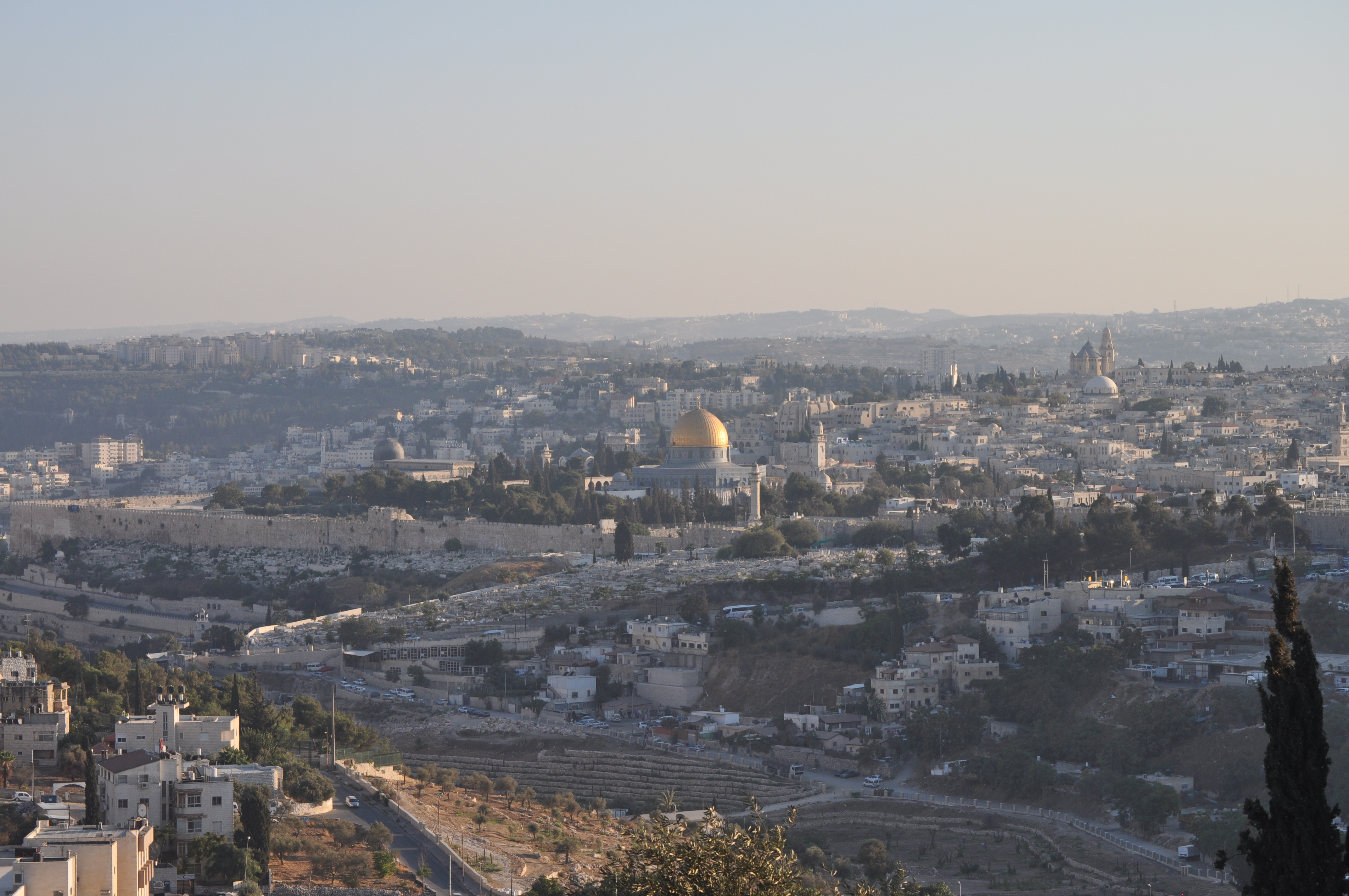
10857261_10153336968548706_7334281522188334026_o
Aerial view of Old City of Jerusalem from the south

ACCESS TO HOLY PLACES: A key concern for the United Nations (UN) is that access is provided to each religion’s holy places. In this regard, the divide between the Palestinian Arabs and Israel is stark.

The Arabs only controlled Bethlehem and the eastern half of Jerusalem from 1949 to 1967, as the cities and entire region were governed by the British and Ottoman Turks (who were NOT Arabs) for hundreds of years before then. During their brief period of control, the Jordanian and Palestinian Arabs evicted all of the Jews from Jerusalem and forbade their reentry, even during religious holidays.

While Israel has controlled all of the Holy Basin since 1967, all religions have had access to all of the holy places. Not only does Israel ensure that people of all religions have access, but the country created laws ensuring their safe keeping and open access, and put their religious organizations in charge of those places – even the Islamic Waqf over the Temple Mount which Jews consider their holiest spot.  This same Islamic Waqf prohibits Jews from praying at their holiest location today.

Further, Israel has allowed other denominations to establish themselves in Jerusalem.  The government of Israel helped the Mormons build their church overlooking the Old City.  This compares to Jordan, which doesn’t even recognize the Baha’i faith today (Israel has a huge Baha’i temple in Haifa).

Advantage Israel

MAINTAINING HOLY PLACES: While access is the primary concern for the UN, maintenance of the holy spaces is important as well. When the Palestinian Arabs controlled areas such as Nablus (Shechem), they almost destroyed the Tomb of Joseph. Archaeological digs occurred on the Temple Mount unsupervised resulting in the destruction of important and sacred sites.

Conversely, Israel has made extensive efforts to maintain all of the religious sites under its control. It performs archeological digs mindful of scientific rigor while balancing religious sensitivities.

Advantage Israel

 DSC03240
The Hurva Synagogue in the Old City was destroyed by the Jordanian Arabs in 1949
(photo: FirstOneThrough)

THE CITIES AND THE PEOPLE

HISTORY: The history of the Jewish people in Jerusalem extends back 3700 years when Abraham offered Isaac as a sacrifice. It became the unified capital of Jews under King David 3000 years ago and site of two temples (954BCE-587BCE and 516BCE-70CE). Jews have always continued to live there and move there over the centuries except when they were banned during the Crusades (early 1200s) and under Arab rule (1949-1967).

Arab history in Jerusalem is more recent than for Jews. Arabs came to the region and city of Jerusalem as part of the Muslim invasion in the seventh century, roughly 2300 years after Jews.

Advantage Israel

CAPITAL: Only one people ever made and considered Jerusalem to be its capital: the Jews. Whether in ancient times or modern, Jerusalem is the capital of the Jewish people.

When Muslims ruled the region and controlled Jerusalem, they never made Jerusalem the capital. Whether under the initial Arab invasion of the seventh century, under the Mamelukes or the Ottoman Turks, or even under Jordanian Arab rule 1949-1967, Jerusalem was never the central seat of government.

Jerusalem: Advantage Israel
Bethlehem: None

CENTRALITY: There is only one country in the UN that has a national anthem that is completely about its capital: Israel.

“As long as in the heart within a Jewish soul still yearns And onward, towards the ends of the east, an eye still gazes towards Zion.

Our hope is not lost, the hope of two thousand years, To be a free people in our land, the land of Zion and Jerusalem.”

Jerusalem: Advantage Israel
Bethlehem: None

 IMG_3691
Beta Israel, Jews from Ethiopia, return to Jerusalem
(photo: FirstOneThrough)

THE PEOPLE

In considering the future of the residents of the Holy Basin, it is important to consider how the people have been treated.

CITIZENSHIP: When Israel declared statehood in 1948, it granted citizenship to 160,000 non-Jews. When it took control of the entire Holy Basin in 1967, it offered citizenship to those who requested it.

This was in stark contrast to the Jordanian and Palestinian Arabs who evicted the Jews in 1949. Today, Palestinian leadership has insisted on a new Palestinian state devoid of Jews, which is why the Palestinian Authority objects so strongly to Jews buying homes in Jerusalem.

Advantage Israel

POPULATION GROWTH: Population growth can be used as a proxy for the freedom for Arabs and Jews in the Holy Basin under the different administrations.

From 1949 to 1967, the Jewish population under Jordanian and Palestinian Arab control went from zero to zero. The Jews were evicted from eastern Jerusalem and were not allowed to return. However, the Jewish population in the western part of Jerusalem nearly doubled (+98%). Over the same time period, the Arab population under both Israeli (the Israelis gave Arabs citizenship in their half of Jerusalem) and Jordanian control grew by 72%. Jewish growth outpaced Arab growth, even though Jews were only able to live in half of the city.

After reunification of the city in 1967 until 2005, the population trends changed. Jewish growth throughout the city grew by 196%, while Arab growth grew by 315%. Overall, the city grew at a compounded growth rate of 3.1% compared to the divided city which only grew at 2.4%.

  • Under Arab control, Jews were expunged from the area; but under Israeli control, Arab growth rate surpassed Jews’. Arabs performed ethnic cleansing while Jews encouraged diversity.
  • Under a constrained Jewish situation from 1946-1967 while there was no access to eastern Jerusalem, Jewish growth outpaced an unconstrained Arab dynamic. Jewish demand to live in Jerusalem outpaced Arab interest.
  • Under Israeli sovereignty, the city grew faster than under Arab control.

Under Israel, the city did better, the Arabs did better and the Jews did better.

Advantage Israel

POPULATION: Jews have been the dominant religious group in Jerusalem since the 1860s. Even at the start of World War I, when Jews accounted for only 8% of Palestine, they accounted for 64% of the population of Jerusalem.

Today, Jews continue to be a majority of Jerusalem, despite the Arab growth accelerating in Jerusalem under Israeli control (up to 3.8% CAGR from 2.6%). Jews account for roughly 69% of the city’s population overall, and 39% in the eastern part of the city.  The eastern part contains some of the largest Jewish neighborhoods (Pisgat Ze’ev) and is home to Hebrew University (established in 1925).

Advantage Israel

DSC_1067
View from Hebrew University
(photo: FirstOneThrough)

LONG TERM VIABILITY

Any final agreement between the Israelis and Palestinian Arabs must not simply focus on being fair, but be sustainable.

SECURITY: No capital city sits on the border of another country. To have the seat of government sit adjacent to a foreign country risks the viability of the state. In the case of Israel, the situation is even more sensitive than for other countries:

  • The countries adjacent to Israel have repeatedly attacked it
  • Those same countries continue to challenge the basic right of Israel to even exist
  • The main political party (Hamas) of the proposed country has a charter repeatedly calling for Israel’s complete destruction
  • Jerusalem sits on hills, making it even more vulnerable if the city would be divided, but significantly safer, if all of the hills and access roads remained within Israel

Jerusalem: Advantage Israel
Bethlehem: None

HISTORY OF DIVIDED CITIES: Fewer than 1/1000th of 1% of cities and towns in the world are divided. Those handful of towns that are split between two countries are typically very small and have a natural geological separator like a river dividing the city.  None of those factors apply to Jerusalem.

Divided capitals are even more rare, and history shows that they are unsustainable.  Recent examples include: Beirut, Lebanon; Berlin, Germany; Jerusalem and Nicosia, Cyprus.

Beirut and Berlin were divided by war for a few decades, and both have been reunified in peace.  Nicosia has continued to be split along with the rest of Cyprus, and ongoing peace talks since 1974 have attempted to reunite the city – not divide it.

Advantage Israel

OFFENSIVE-DEFENSIVE PARTIES: In the San Remo Resolution of 1920, the League of Nations (precursor to the UN) recognized the right of Jews to return to their homeland in the holy land. However, the Palestinian Arabs launched major riots against the Jews, most notably in 1929 and 1936-9 which made the British start to move Jews out of their homes in certain cities (such as Hebron).

When the UN developed various proposals over the years 1937-1947 to divide the land, the Israeli Jews said yes while the Arabs consistently said no. The Arab position was to control all of the land including Jerusalem with no land for Jewish control.

As part of their efforts, the Arabs launched a war to destroy all of Israel in 1948, and then again in 1967. The Arabs lost both wars, and the incremental land Israel acquired in each of those wars were from defensive actions.

In total, Israel’s land was acquired initially from the world’s recognition of the historic rights of Jews to the holy land, together with defensive wars.

Conversely, all of the Arab land was acquired through fighting the UN mandate and launching wars.

In regard to the Holy Basin specifically, both Israel and the Jordanian and Palestinian Arabs took sections of the city during the Arab war against Israel in 1948-9, that the UN had proposed to keep under international control. As such, the UN did not recognize either country’s seizure of parts of the city. When Israel took the eastern half of Jerusalem along with Bethlehem in 1967, the UN continued to withhold recognition.

Countries around the world did not recognize Israel’s western Jerusalem in 1949 nor the capture of eastern Jerusalem in 1967, so they have never moved their embassies to the city. Their refusal to recognize Jerusalem as Israel’s capital (or Jordan’s) is from 1949, NOT because of Israel’s reunification of the city in 1967.

Advantage Neither
Slight preference for Israel due to defensive nature of acquisitions

CONCLUSION

By almost every measure, Israel should maintain control of all of Jerusalem as well as additional territory to the east to control the hills and access roads to the capital.  The Palestinians could have control of half of the Holy Basin – Bethlehem – which was handed to Palestinian Authority control in 1996 by Israeli Prime Minister Benjamin Netanyahu.

There is one last reason which underscores the complete logic of Israel maintaining complete sovereignty of all of Jerusalem: it is the heart of the home of the Jewish people.  While there are 57 Islamic countries and dozens of Arab countries, there is only one Jewish State, and it has always had one capital: Jerusalem.

 IMG_1263
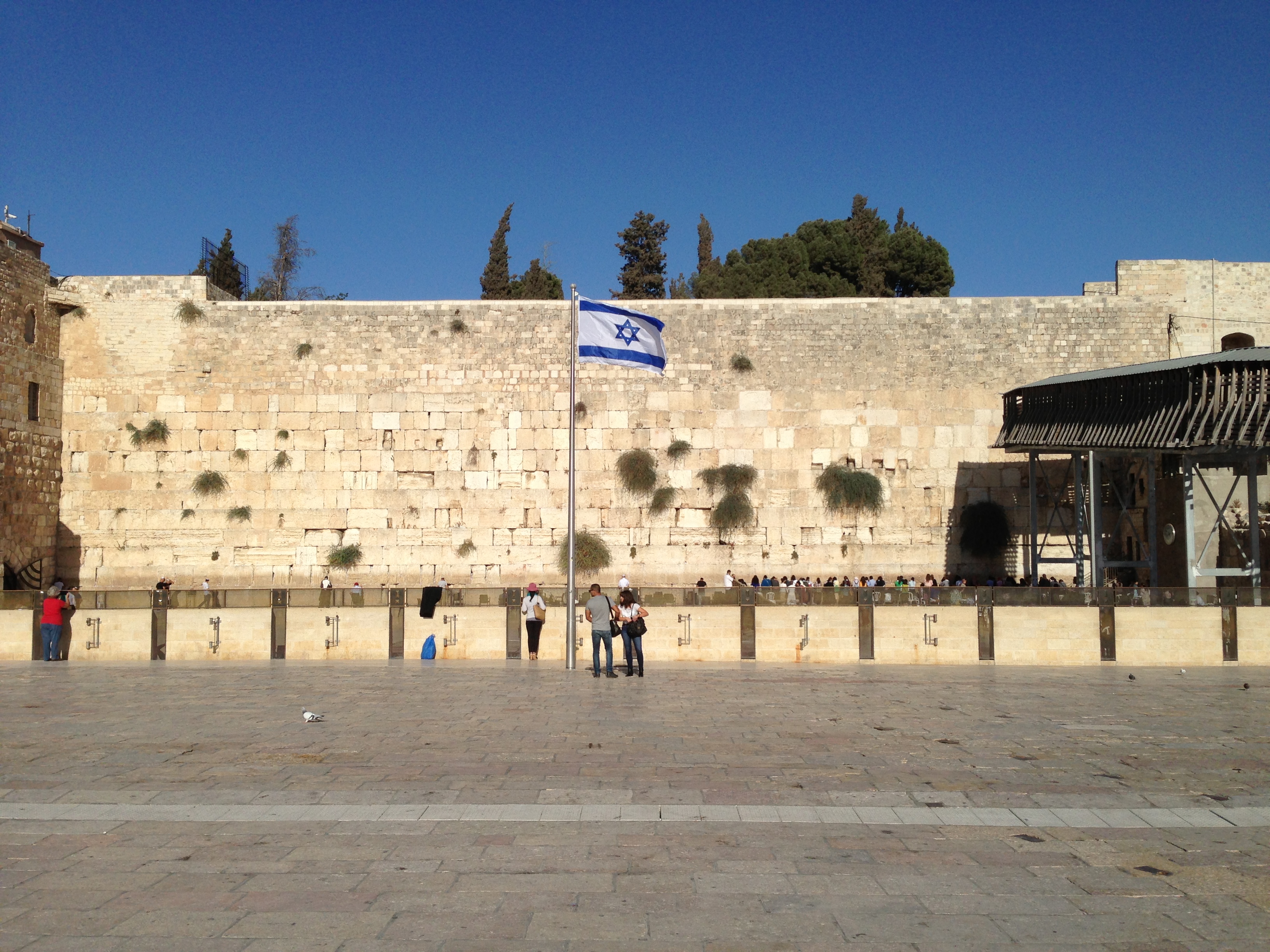
The Israeli flag at the Kotel
(photo: FirstOneThrough)

 Text from first half of Israel’s Basic Law declaring Jerusalem as it’s capital:

1. Jerusalem, complete and united, is the capital of Israel.
2. Jerusalem is the seat of the President of the State, the Knesset, the Government and the Supreme Court.
3. The Holy Places shall be protected from desecration and any other violation and from anything likely to violate the freedom of access of the members of the different religions to the places sacred to them or their feelings towards those places.

Related First One Through articles:

The United Nations and Holy Sites in the Holy Land

The Waqf and the Temple Mount

The anthem of Israel is JERUSALEM

A Review of Divided Capitals

“East Jerusalem” – the 0.5% Molehill

Israel: Security in a Small Country

A “Viable” Palestinian State

Israel, the Liberal Country of the Middle East

Cause and Effect: Making Gaza

Summary: The media frequently touches on the suffering that takes place in Gaza. Yet, the depth of their coverage of Arab misery never approaches any level of analysis on the root cause for the Israeli-Arab conflict.


The Atlantic published an article on May 2, 2015 called “Gaza is Hell” (all in quotes) which described the miserable living conditions of Arabs living in Gaza. The 2000-word article covered the area and quoted the residents, but never scratched the surface of the underlying cause of the residents’ misery.

atlanticmay2
The Atlantic magazine,
May 2015

The problem in the coverage was in five key areas, long ignored by the media and politicians.

  1. Hamas isn’t “resisting” Israel. It wants to destroy Israel.
  2. Palestinian Arabs never ruled Gaza until 2005.
  3. Israel’s wars with Gaza have all been defensive.
  4. There are no “refugees” in Gaza.
  5. Much of the Gazan misery is self-inflicted.

The Atlantic article did not fall victim to a sixth category, which is actually a subset of lie #5: Hamas is the democratically-elected choice of Palestinian Arabs.

 HAMAS’S MISSION

Hamas’ mission is very clear for any literate individual: the complete destruction of Israel. It lays out its goal repeatedly in its 1988 Charter, the most antisemitic charter of any governing body in the world, including the Nazi party when it took power in 1933.

For those who cannot read (former US President Jimmy Carter?) there are dozens of recent videos from Hamas officials which call for the murder of Jews and destruction of Israel.

Yet, The Atlantic echoes soft lies in its piece stating that “Hamas’s rhetoric is all about resistance,” and “Hamas advocates militant resistance to Israel.” Nope. Resistance means opposing a force. Hamas is the force that seeks jihad and the total destruction of Israel. Any statement that says that Hamas is a resistance movement, inherently makes the argument that the basic existence of the State of Israel is an active force against Palestinians.

GAZA’S FIRST INDEPENDENCE and
ISRAEL’S DEFENSIVE WARS

The mutant siblings of lie #1 that Gazans are “resisting” Israel, are lie #2, that Palestinians have always been self-governing in a country of their own, and lie #3, that Gazans just want to live in peace alongside Israel but Israel continues to attack it.

Alice Su, the author of The Atlantic article is based in Jordan, a country that is over 50% Palestinian Arab. That country, like Gaza, was part of the 1922 British Mandate from the League of Nations. Before the British ruled Gaza, the Ottoman Turks were in charge, and after the British came the Egyptians. None of these rulers made it into Su’s description which starts a historical background of Gaza in 1967: “Gaza, which was under Israeli occupation from 1967 until 2005”. With some additional background, it would have been clear to any reader that Gaza was never ruled by local Arabs (the Ottomans were Muslims but not Arabs), and it has only been since Israel left the territory in 2005 that Gazans have ruled over themselves.

Additionally, the various wars that Israel fought against the Arabs including 1948 and 1967 were defensive wars against several Arab countries (including the Arabs in Gaza). The more recent wars from Gaza were also defensive, in response to Hamas’s rocket attacks, terror tunnels and abduction and murder of Israeli teenagers. Yet Su stated that “Israel has also launched three military operations in Gaza since the Hamas takeover,” which suggested that Israel was the aggressor, which it was not.

Arab amnesia repeats itself today, as Su writes about a Gazan: “They keep asking him why the Israelis bombed them. “I tell them, ‘Naseeb. This is our fate,’”  The Gazan assumed a completely passive stance in the conflict and Su did not educate the reader about: the abduction and murder of three Israeli teenagers; the rockets fired from Gaza into Israel; and the terror tunnels Hamas dug into Israel to kidnap Israelis.

It was only eight paragraphs later that Su brought up the tunnels: “Israel has restricted imports of key building materials like cement and steel, out of concern that they’ll be used to build tunnels and facilitate terrorist activity.”  Such concern looks out-of-place without any history regarding the Hamas tunnels which were used for terrorist activities.  The Israeli ground invasion into Gaza in 2014 was specifically to destroy those tunnels.

To underscore the point of misdirecting the reader, consider the title of the Atlantic article.  It comes from a resident of Gaza. ““Gaza is hell,” 20-year-old Ahmad told me in Shejaiya, one of the worst-hit neighborhoods in Gaza City.”

Shejaiya was the neighborhood with the greatest number of terror tunnels, many coming straight from people’s homes. That is why the Israelis concentrated its efforts on the neighborhood in a defensive action.

Why did The Atlantic run an article with a headline quote from a man who was part of the terrorist infrastructure?  Why did it deliberately mislead readers into thinking these people were merely passive homeowners who were bombed indiscriminately by Israel?

REFUGEES IN THEIR HOME

Su’s article describes refugees and refugee camps in Gaza. Now that Gaza is not occupied by Israel, Egypt, the British or anyone else, these people cannot be considered “refugees” since these “Palestinian Arabs” are living in “Palestine” run by themselves.

The refugee myth has continued to compound itself as this misnomer is incorrect on additional levels.  Refugee status cannot be handed down like inheritance through the generations.  Refugees can only be from a country, not a house or region.

At the most generous, these people can be considered descendants of “internally displaced” people from the region of Palestine which was occupied for centuries until 2005. Yet Su used the term refugee several times:

“a refugee camp initially built to shelter 9,000 out of the 750,000 Palestinians who became refugees when Israel was established in 1948. More than half a century later, the camp hosts more than 21,000 refugees,”

The description above elegantly covers many soft lies: the ones mentioned above, and that Arabs became refugees when they actively launched a war to destroy Israel; they were not passive “when Israel was established in 1948.

SELF-INFLICTED MISERY

Su did get several things right, such as “Gaza remains in ruins.” But why?

Su pointed out that “Hamas, the Islamic militant group that governs Gaza… since the organization defeated the PLO-affiliated Fatah party in Palestinian elections in 2006.” Hamas was chosen by the Palestinians in 2006 and polls continue to show Palestinians favoring Hamas should elections ever be held again. The various quotes of Arabs on the street in Su’s article affirm that view: “Another college student said she’d lost faith in politics, but would vote for Hamas if an election were held now.”

Yet Su would have you believe that Gazans are simply passive victims in the situation. That position is encapsulated in her article: “Those who survived last summer’s war are trapped in 360 square kilometers of trauma and contradiction, choking on war and blockade, disillusioned with the Palestinian leadership and disempowered by the aid communityThey sit without jobs, relief, or means of rebuilding, waiting for things to change.” Untrue.

  • The Palestinians voted for Hamas, well aware of its charter and calls to destroy Israel. The fact that Palestinians are “disillusioned” with their leadership is only because Hamas hasn’t been successful in their genocidal mission.
  • The phrase “disempowered by the aid community” is strange but Su’s meaning becomes clear when she later writes that foreign aid is slow in coming “because donors are put off by the political deadlock between Palestinian parties.”  A Lie. The aid is being held up until there are guarantees that Hamas will not have access to the funds as it is a terrorist organization.

The catalyst for war is Hamas.

  • If Gazans would turn away from Hamas, there would be no blockade.
  • If Gazans did not allow Hamas to build terror tunnels in their houses, the neighborhood would not get demolished.
  • If Hamas were disbanded and outlawed, foreign aid would flow into Gaza for rebuilding.
  • If Hamas would not attack Israel, there would be peace.

The simple cause-and-effect of the situation in Gaza is about the people’s support of a genocidal anti-Semitic regime.  But writing about such reality would make it harder to sympathize with the picture laid before readers in The Atlantic.

Scarier still, is the support for the insidious paring: Hamas with a nuclear Iran. That is what keeps the hopes of Gazans alive under the shade of complicit countries and malevolent media.


Related FirstOneThrough article:

The Death of Civilians; the Three Shades of Sorrow

International-Domestic Abuse: Obama and Netanyahu

Summary: The relationship between Israel and the United States is not one between peers. While the United States is a super-power that protects Israel in many ways, Obama’s use of its dominant position has led to an abusive relationship based on control.


In an ideal relationship, parties treat each other with mutual respect and care. Close and special relationships, such as marriage, are especially intimate due to their exclusive nature. When such a relationship turns, and one party chooses to assert control over the other, that physical or psychological trauma is referred to as “domestic abuse.”

DOMESTIC ABUSE

Domestic abuse is a phenomenon that has a long sad history. It typically happens when a husband/boyfriend uses his power (money or physical size) to intimidate and harm his partner. As described in a blog:

Domestic violence and abuse are used for one purpose and one purpose only: to gain and maintain total control over you. An abuser doesn’t “play fair.” Abusers use fear, guilt, shame, and intimidation to wear you down and keep you under his or her thumb. Your abuser may also threaten you, hurt you, or hurt those around you.”

The aspect of control through intimidation is a key component of domestic abuse. One party is effectively threatened to comply with the wishes of the dominant party. The independent will is crushed with the threats of or actual violence (active or passive) or from withholding a needed or cherished item. The abused partner has nowhere to turn, as it is reliant on the abuser.

The dynamic can be seen between countries as well. The historic special relationship between the United States and Israel, has devolved into such an abusive relationship.

Intimacy

The bond between the US and Israel is unique in many respects.

The relationship is not just one of shared values, but Israel relies on the US in several key areas:

  • Trade: The US is Israel’s largest export partner (over 2.5x number two UK)
  • Military edge: The US gives Israel $3 billion of military aid each year
  • Protection at the UN: The US protects Israel at the United Nations Security Council, often as the sole vote to protect the country from condemnation

The three aspects of Israel’s heavy reliance on the United States have come under pressure over the last few years: the BDS movement (boycott, divestment and sanctions) has attempted to hurt trade; a nuclear Iran would create an imbalance for Israel’s security; and the protective US shield at the United Nations is being threatened.

obama scorn bibi

OBAMA-NETANYAHU
INTERNATIONAL-DOMESTIC ABUSE

A natural relationship built on shared values, now more closely resembles an abuser-victim dynamic, as Obama increasingly asserted his powerful influence over Israel:

  • In 2010, Obama gave Netanyahu a series of demands to get the Israel-Palestinian talks moving including freezing settlements. Obama walked out of the meeting and left Netanyahu to stew. Israeli newspapers described the shame and weakness of Netanyahu. Netanyahu complied with Obama’s demand.
  • In 2011, French President Nicolas Sarkozy and Obama had an exchange where they called Netanyahu “a liar” and terrible person with whom to deal.
  • In 2012, the Obama administration removed all of the supporting clauses for Israeli positions from the Democratic platform that had been there for years (Hamas is a terrorist state; Palestinian “refugees” would be relocated to Palestine, not Israel; future borders would not follow the 1949 Armistice Lines; Jerusalem is the united capital of Israel).
  • In 2013, while Iran threatened to destroy Israel, Obama entered into negotiations with the Iranians, preventing Israel from taking any actions against Iran’s nuclear program.
  • In 2013, Obama declined the invitation to address the Israeli Knesset. Instead he addressed a group of students at the same time stating his desire to speak to the Israeli people, as if the democratically elected parliament was not representative of Israelis. Consider the depth of the insult to Israel, as Obama spoke to the Egyptian parliament (in 2009) as representatives of Egypt.
  • In 2013 the Obama administration demanded Israel release Palestinian terrorists convicted of murder. Nothing was asked from the Palestinians. Netanyahu complied.
  • In 2014, when Israeli three teenagers were killed, Obama asked Israel to act with “restraint.” However, when two American journalists were killed by ISIS, Obama went to war.
  • In 2014, members of the Obama administration chose to disparage Netanyahu, calling him a “chickensh*t
  • In 2015, Obama snubbed Netanyahu at his address to a joint session of Congress, and got 58 Democratic members of Congress to walk out as well.
  • In 2015, Obama is enabling Iran to become a nuclear state. Iran has repeatedly threatened to destroy Israel, and Obama has refused to sell Israel the required defensive weaponry such as bunker busters.
  • Most recently, Obama has threatened to withhold his United Nations vote to protect Israel.

The last two actions taken by Obama are particularly frightening to Israel’s Netanyahu.

Nuclear Iran: Enabling Iran to obtain nuclear weapons is a direct existential threat to Israel. Iran has threatened to destroy Israel and has a long history of supporting terrorist groups that attack Israel (Hezbollah and Hamas) with weapons and financing. With the government of Iran obtaining nuclear weapons, the country becomes an existential threat, its proxy armies become an enormous threat, and the ability for Israel to attack Iran is significantly weakened.

Further, Iran becoming a nuclear state would create an arms race in the region, as other enemies of Israel like Saudi Arabia will also seek to obtain nuclear weapons.

Withholding UN vote: The United States has used its vote on the United Nations Security Council to protect Israel from a wide range of actions including premature Palestinian statehood and harsh economic sanctions.  If Obama follows through with this threat to move away from Israel, Israel would come under tremendous financial and security pressure.

CONGRESS TO ISRAEL’S RESCUE

Congress has taken note of the terrible trend in Obama’s actions and has taken steps to protect Israel.

netanyahu-graham
Senator Lindsay Graham with Israeli PM Netanyahu

In April 2015, the Senate passed a bill making it difficult for any company to do business with a company or country that supported BDS of Israel.

Republican Speaker of the House, John Boehner invited Netanyahu to address Congress about the Iran nuclear negotiations. That speech launched the momentum for a role for Congress in the Iranian nuclear program negotiations.

It is difficult for Congress to take direct actions against the president’s policies at the United Nations, as he controls the vote. However, Congress controls funding of the United Nations as well as the Palestinian Authority. Senator Lindsay Graham has stated his intention to use the power of the purse to prevent unilateral UN actions against Israel. “Any effort by the French, the Jordanians or anyone to avoid direct negotiations between the Israelis and the Palestinians over the peace process, anyone who tries to take this [resolution] to the U.N. Security Council, there will be a violent backlash by the Congress that could include suspending funding to the United Nations,” Graham said.

All three issues on which Israel relies on the United States are under threat by Obama, and only the US Congress is attempting to ameliorate the situation.


If Israel’s neighbors did not threaten to destroy the country both directly and indirectly, perhaps Israel would not feel alarmed.

If Israel were not surrounded by an Arab winter inferno, perhaps its fears would not be so immediate.

If Israel had many allies in the world, perhaps the abusive relationship between Obama and Netanyahu would not be as upsetting and painful.

However, the realities are different.  As such, Netanyahu has turned to Congress to become Israel’s domestic violence hotline .  What a sad state of affairs.


Related First One Through articles:

Israel is a Small Country

Israel cannot afford to be smug about its security

Obama not concerned about timeliness of Israel’s security

An Easy Boycott: Al Jazeera (Qatar)

People often complain that they would love to boycott one of the many countries with horrible human rights, but cannot do so as those countries do not make or export anything of value. Well, here’s the good news: Qatar brings Al Jazeera direct to many homes in your country.

Human Rights Abuse in Qatar

Qatar is a very small country in the Arabian Peninsula. The total country population of 2 million only consists of 10% Qatari nationals; roughly 90% of the balance are migrant workers who experience a variety of abuses according to Human Rights Watch. The abuses for these workers include:

qatar death
Preparing funeral rights for Nepalese worker killed in Qatar

The country abuses many citizens in addition to the migrant workers:

Seemingly unsatisfied with brutalized its own population, Qatar also funds terrorists in Gaza (Hamas) and in Libya.

These facts may get lost on the general American public, as the Obama administration commends its own negotiation prowess and Qatar’s joining the coalition fighting ISIS.

Al Jazeera

Qatar is a very wealthy nation thanks to its location atop various oil fields. It has used its considerable wealth to buy and build various properties around the world.  These include Harrod’s, the swanky department store in London as well as The Shard and 1 Hyde Park, expensive buildings in London. It was also able to win the competition to host the World Cup global soccer tournament in 2022. (Here is a funny video by HBO’s John Oliver about FIFA and Qatar).

Qatar also owns a large media company called Al Jazeera. It entered the United States market by buying former Vice President Al Gore’s CurrentTV for about $500 million in 2013. It has since rebranded that channel Al Jazeera America.  It is now available in many US households.

aljazeera

Al Jazeera is not simply owned by a country that supports terrorism. The channel itself is a mouthpiece for terrorism.

In 2014, the channel gave special airtime to various members of the Palestinian terrorist group Hamas. The main media channel, Al Jazeera Arabic, routinely posts anti-US and anti-Semitic pieces. But those posts are beyond the capabilities and reach of most Americans, so they believe that watching Al Jazeera America is simply watching a news channel that represents an Arab point of view.  In truth, they are supporting a media company that broadcasts propaganda for terrorists, which is owned by a government that funds those same terrorists.

For those looking for a BDS (boycott, divestment and sanction) of their own. there is an opportunity right in your home.


Related First.One.Through articles:

Apostasy: https://firstonethrough.wordpress.com/2015/01/13/apostasy/

Murderous governments of the Middle East: https://firstonethrough.wordpress.com/2014/08/01/murderous-governments-of-the-middle-east/

Dancing with the Asteroids: https://firstonethrough.wordpress.com/2014/11/14/dancing-with-the-asteroids/