Brooklyn Chanukah Donut Crawl 2024

​Our crew brought out a minivan for the Brooklyn Chanukah Donut Crawl for 2024, as we added two new people to the crawl. Going on Christmas day meant some of the bakeries had lighter staffs, and going later in the day meant some stores had run out and donuts were not at their peak freshness.

We added several new destinations based on people’s Instagram posts. Let me share that some of the IG posts may be paid advertisements (this blog takes no money or ads- please just get friends to subscribe on topics covering Jews, Judaism and Israel) since some were quite weak and overpriced. We also added a nice new bakery based on conversations with people we met at the stores. The list for 2024 is (in the order we visited them):

  • Oneg Bakery, 188 Lee Ave, Brooklyn, NY 11211 [Williamsburg]
  • Almah Cafe, 87 Utica Ave, Brooklyn, NY 11213 [Crown Heights]
  • Ricotta Coffee, 513 Albany Ave, Brooklyn, NY 11203 [Crown Heights]
  • Schreiber’s Homestyle Bakery, 3008 Avenue M, Brooklyn, NY 11210 [Flatbush]
  • Pita Sababa, 540 Kings Hwy, Brooklyn, NY 11223 [Flatbush]
  • Maison Valero, 501 Avenue M, Brooklyn, NY 11230 [Flatbush]
  • Sesame – Flatbush, 1540 Coney Island Ave, Brooklyn, NY 11230 [Flatbush]
  • Taste of Israel, 1322 Avenue M, Brooklyn, NY 11230 [Flatbush]
  • Ostrovitsky Bakery, 1124 Avenue J, Brooklyn, NY 11230 [Flatbush]

For those familiar with Brooklyn, you will note that these are a bit scattered, but there is a method to the madness that you will see in the descriptions below.

Oneg Bakery

We’ve skipped Oneg over the last couple of years since Williamsburg bakeries do not, in general, stand out. Oneg is the exception. It is famous for its babkas which are among the very best in NYC. You should pick one up (do not get overwhelmed by the size which looks prepared for a synagogue kiddush; they will cut it in sections. Note that they freeze very well.) You can order from Goldbelly if you do not want to visit in person.

Oneg is small “Old World” bakery and has a small staff during Christmas. Here, a worker prepares dough for their apple strudel

There is not a large selection of donuts at the small store, and they didn’t have frittle when we visited as they were short-staffed on Christmas. Some of our tasting crew thought the plain jelly donut was “fantastic!” and others really enjoyed the Boston cream.

Oneg’s jelly, custard, caramel and sprinkle donuts

Almah Cafe

Almah is a new addition to the donut crawl, being flagged on Instagram. We decided to taste some of their other baked goods like the olive and mushroom focaccias, which were great. It’s a small and fantastic place to visit for brunch. However, I would NOT suggest going for the sufganiyot. They are small, very expensive at $7 each, and not that tasty. We tried two, including strawberry cheesecake. There was little filling and the flavor is so subtle to be virtually non-existent.

Ricotta Coffee

Ricotta Coffee is a pretty new establishment that doesn’t even have signage on the doors. The small place was packed with people eating lunch which looked very fresh. Unfortunately, we did not know that you have to order in advance, so please do so at (347) 365-5177, the day before you plan on picking up donuts. We were very fortunate to meet a Chabad rabbi and his wife that we know who very generously gave us their order of three donuts, as they lived nearby and were able to pick up another order the next day. So nice!!

We found the raspberry donut to be okay and the pistachio to be interesting- it is much saltier (like salted pistachios you might normally eat) with bits of pistachios in the filling. It’s a much more crunchy, saltier version than Sesame which is creamier and sweeter.

Schreiber’s Homestyle Bakery

We visit Schreiber’s each year to get their lace cookies, which they do to perfection (I know that it’s a simple cookie but we love places that perfect things).

The sufganiyot were all in the back and they have simple jellies for about $2, and fancy ones for $5. They have a nice selection of packaged donuts for quick takeaway or you can select the ones you want. We bought one pretzel and one graham cracker donut. Both were good, not too sweet.

At this point, we had our first sugar rush. We broke for sushi at Sushi Meshuga, 1637 E 17th Street. The sushi was fine, and helped cleanse our palates for the second half of the donut crawl.

Pita Sababa

As a non-Brooklynite, (and non-Sefaradi) I did not know Pita Sababa, a large Moroccan bakery. I heard about the bakery from a woman on line at Almah who told me she absolutely loved the bakery. It seems so do many others!

The bakery was totally sold out when we visited. Tal, who runs the store, told me he thought he’d sell 10,000 donuts on Christmas! He expects to sell closer to 5-7,000 on the other days of Chanukah. One needs to order in advance on the website. We decided to try a sfenj which is a Moroccan donut. It’s basically just fried dough, somewhat like a churro. It was straight out of the oven, warm and delicious.

You can also pre-order at sabababakery.com or with the QR code below. There are just a few flavors, including chocolate ($48/dozen), custard ($42/dozen) and jelly ($42/dozen). They also sell mini donuts in smaller sizes.

Maison Valero

Some of the smaller bakeries only cook in the morning (as opposed to larger one’s like Sesame and Pita Sababa which bake all day). As such, one needs to come early to get donuts at the smaller shops, and this store was closed by the time we arrived in the afternoon.

Sesame

Sesame has a well-earned reputation for excellent donuts so the few bakery locations are packed. Because they bake all day, people stand around and clamor over the next flavors to emerge from the ovens, shouting “lotus!” and “white chocolate!” Pareve flavors include Oreo, Halvah, Lotus, Pistachio, Peanut Butter, Lemon and classic jelly. Dairy varieties include White Chocolate, Nutella, Caramel and Cheese. All of the fancy sufganiyot were about $5.25.

Crowd standing outside of Sesame bakery in Flatbush waiting to fill in boxes of donuts with the next great flavor to emerge from the kitchen next door to the retail store

Note that these sufganiyot and large and have very rich flavor. We suggest cutting them in quarters so you can try from their wide variety. All are excellent. We ordered a dozen and brought them to friends for dinner.

If you are not planning on eating them for a while and not so particular of the flavors you get, consider picking up packaged Sesame donuts at stores like Sprinkles. We met people at the Oneg bakery who had done just that.

Inside Oneg bakery, people show the Sesame sufganiyot they purchased at Sprinkles. Many people like to sample baked goods from several bakeries

Taste of Israel

Taste of Israel is small general store, but you can order sufganiyot in advance at (347) 554-8133. They have eight varieties ranging in price from $4 to $6, and all are very good. We bought another dozen here to bring to people.

Ostrovitsky’s Bakery

Ostrovitsky’s was cleared out of their fancy sufganiyot (Rosemarie, Chocolate Mousse…) when we arrived around 4pm. We tried a custard donut which was just okay. Dough gets heavy as the day goes on which weakens the experience.

Summary

If one budgets $2-$4 for a donut, look for simple jelly donuts or custard which are usually quite good at most locations (including Pomegranate). The more expensive varieties run $5-$6 each. There is absolutely no reason to spend $7 for a small donut at Almah.

Sufganiyot are much, much better fresh. If one is planning to eat them at the time of purchase, go early to the smaller bakeries which only bake in the morning. The larger locations like Sesame and Pita Sababa can be visited at any time and recommended if one is planning on having them at dinner.

Some places require ordering at least a day in advance, including Pita Sababa, Ricotta Coffee and Taste of Israel. It is very unlikely that you will be able to get any if not ordered early. However, I imagine that it will get easier on the last few nights of the holiday.

Lastly, talk to people! We discovered Sababa from talking to a woman in line and got gifted donuts at Ricotta from speaking to a Chabad rabbi. People are out enjoying the holiday and you should view the bakery hop as an experience to enjoy with everyone, and not just picking up donuts because pictures looked pretty on Instagram.

BONUS: Latkes (Pomegranate and Essen Deli)

We sampled latkes from Pomegranate (across from Sesame-Flatbush) and Essen Deli (not far from there, next to Ostrovitsky’s). Pomegranate had a few flavors like potato, sweet potato and zucchini which were flat and wide. Essen had potato which were very crunch and thick. The Essen latkes were a bit saltier and people preferred them to Pomegranate’s which candidly, did not look as appetizing when placed side by side.

Wishing you and your families a very wonderful Chanukah!

At The Story Of Chanukah, There Was No Temple Mount…

The story of Chanukah happened in 164 BCE. The Seleucid king Antiochus IV Epiphanes had defiled the Second Jewish Temple in Jerusalem and enacted several laws against Judaism, including banning circumcision, celebrating Shabbat and Jewish holidays, forcing Jews to eat pork, and making it a capital offense to have a torah scroll. The Jews of the holy land revolted against the Syrian-Greek king and got rid of all the anti-Judaism decrees and rededicated the Temple.

This was a war of pagans against the Jewish religion, before Herod built the expanded Temple Mount plaza and before Christianity.

Over the following centuries, King Herod (72 BCE – 4 BCE) built the expanded Temple Mount and Jesus was crucified in Jerusalem by the Romans. Jewish revolts against the Romans in 66CE-70CE and 132-135CE led to the destruction of Jerusalem and expulsion of Jews from the area, renaming the city to “Aelia Capitolina” and the region to “Palestina.”

This was a war of pagans against Jews and Christians, before the birth of Mohammed and creation of Islam.

Mohammed’s quest to bring Islam from the Arabian Peninsula to the world brought a Muslim invasion into the Jewish holy land in the 7th and 8th centuries. Muslims built their third holiest site on top of Herod’s Temple Mount, the Al Aqsa Mosque. Christians and Muslims waged several wars over the holy land between 1095 and 1291.

Those battles between Christian crusaders and Muslims, were over the Jewish holy land and Judaism’s holiest location.

In 1948, Muslim Arab armies invaded and tried to destroy the newly declared State of Israel. The Jordanian army ethnically cleansed all of the Jews on the western bank of the Jordan River all the way through the Old City of Jerusalem. In 1954, it granted citizenship to all Arabs, as long as they were not Jewish.

This was a war of Arab Muslims countries against the physical presence of Jews in the Jewish holy land.

From the Chanukah story to the creation of Israel in 1948, many groups laid siege to Jerusalem, often attacking Jews through anti-religious actions, or lumped in with other religious groups. Since 1948, the war has been about the physical presence of Jews in Jerusalem, a place where Jews have been the majority since the 1860s.

At the story of Chanukah, there was no Temple Mount, no Christianity and no Islam. It was a battle of pagans against a small local tribe’s religion, who lived at the intersection of Africa, Asia, and Europe.

Chanukah marks the beginning of Jews in the holy land being attacked for their religion. The successful battles proved to be short-lived, as most Jews were forced into the diaspora over the following centuries, until the recent past. Celebrating the holiday today amidst a multi-front defensive war and global antisemitic chants that Jews are “European settler colonialists” is a chance to reassert Eight Attestations On Jerusalem:

  1. Jews have an Inalienable right to pray on the Jewish Temple Mount
  2. Banning Jews from living and praying in their holiest city is blatant anti-Semitism, as is denying Jewish history
  3. There is no “Judaizing” Jerusalem, as Jews have been the majority in Jerusalem since the 1860s, and have devoted themselves to the city since 1000BCE
  4. The security of Israel demands that its capital sit well within its borders
  5. Divided capitals are a function of war, not peace. The place known as “East Jerusalem” only existed for a few years, 1949-1967
  6. No part of Jerusalem was ever contemplated to be part of Palestine. Not only is “East Jerusalem” not an actual city, but there is no basis to call it “Occupied Palestinian Territory”
  7. Jerusalem Arabs have been and are continued to be offered Israeli citizenship
  8. There is no ethnic cleansing of Arabs. The Arab population in Jerusalem has grown faster than Jews since Israel reunited city

On Chanukah, diaspora Jews should pay particular attention to the direction of their prayer, the Jewish Temple Mount in Jerusalem, Israel, as Jews have done for thousands of years.

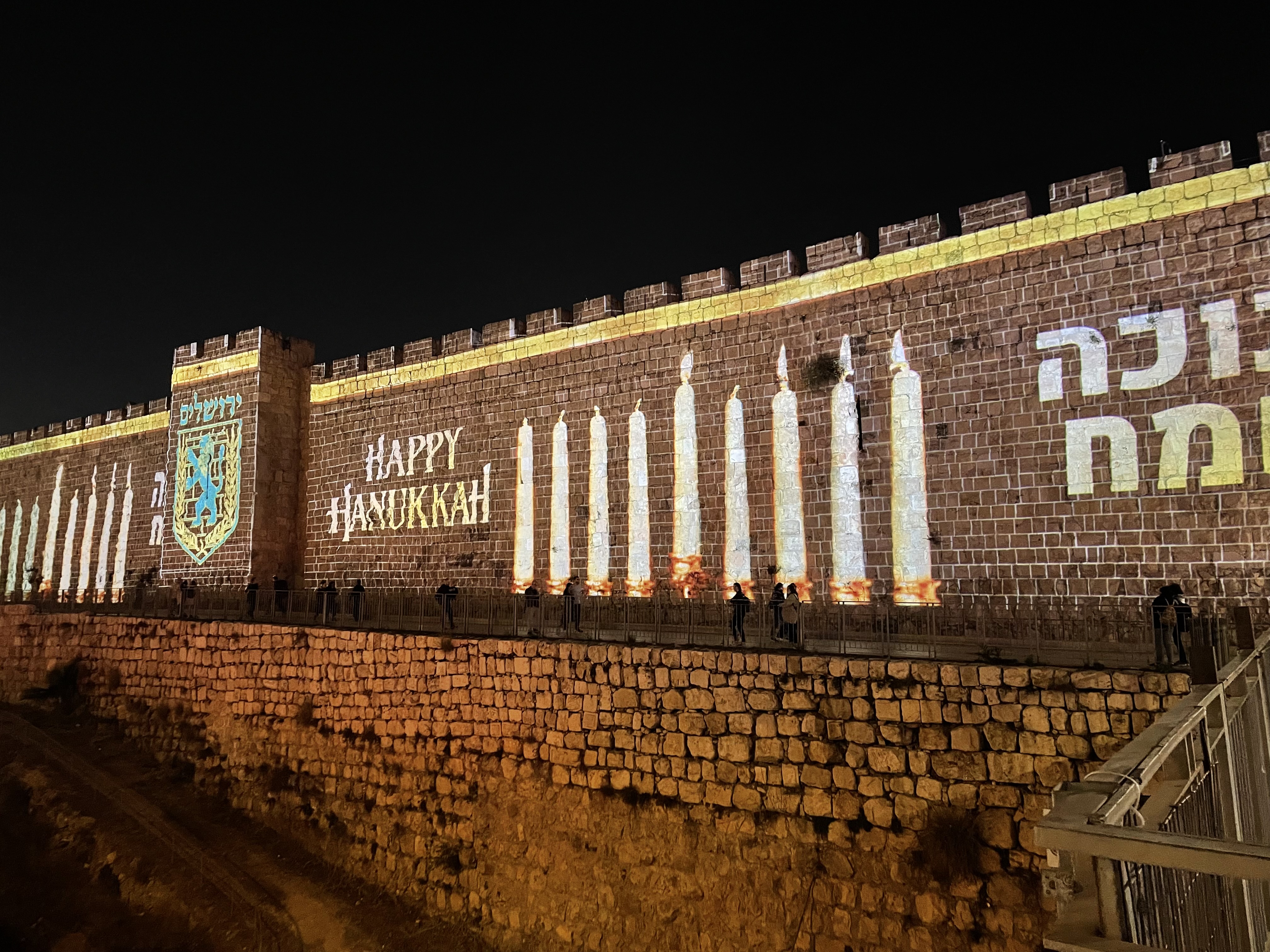
Happy Chanukah signs on the walls of Jerusalem, 2021

Related articles:

It’s Jerusalem Stupid. Duping The Christian World To Join The Jihad Against The Jews (November 2024)

The UN Talks About Jews Building In Jerusalem On Chanukah (December 2022)

For Chanukah, Arab League Shines Light On Why It Should Be Condemned (November 2021)

The Jews of Jerusalem In Situ (April 2019)

Today’s Inverted Chanukah: The Holiday of Rights in Jerusalem and Judea and Samaria (December 2015)

Jacob – And Esau’s – Ladder

One of the most famous stories in the Book of Genesis is about Jacob’s ladder with angels ascending and descending. The famous biblical commentator Rashi (1040-1105) said that the angels going up were tied to the holy land and had to leave Jacob as he journeyed to live with his uncle Laban outside of the land. The angels coming down were new angels who would accompany Jacob while he lived outside of the holy land.

Jacob’s Ladder by Frans Francken II the Younger (1581-1642)

I would like to share an alternative interpretation: the angels on the ladder represent Jacob’s relationship with Esau.

There is no tool that connects hands and feet like a ladder. Both are required to go up as well as to come down. If several people are on a ladder at one time, hands and feet would likely be touching.

That is a reference to Jacob. His name literally came from his act of holding onto the heel of his brother Esau at their births. “Jacob” stems from the Hebrew word for heel, “akeb” (Genesis 25:26):

וְאַֽחֲרֵי־כֵ֞ן יָצָ֣א אָחִ֗יו וְיָד֤וֹ אֹחֶ֙זֶת֙ בַּעֲקֵ֣ב עֵשָׂ֔ו וַיִּקְרָ֥א שְׁמ֖וֹ יַעֲקֹ֑ב וְיִצְחָ֛ק בֶּן־שִׁשִּׁ֥ים שָׁנָ֖ה בְּלֶ֥דֶת אֹתָֽם׃

The clutching of the heel in the world’s first recorded twins set the primogeniture battle for the ages.

Birthright

There are two stories of Jacob angling to take the birthright from Esau. First, Jacob operates on his own and trades food with a hungry Esau for the birthright (Genesis 25:29-34). Years later, as their father Isaac wasn’t likely to abide by the earlier exchange between the brothers, Jacob acts at the urging of his mother Rebekah to trick Isaac into giving the special blessing intended for Esau to himself. Esau was so distraught by this action, that he swore he would kill Jacob, forcing Jacob to flee to live with Laban. (Genesis 27:1-21).

Jacob had the dream of angels on the ladder while he was fleeing from Esau. Jacob was not sure whether he had the advantage of the blessing or was a hunted man. On the ladder, the person higher up is only ahead while ascending; the elevated person actually trails the person below him when they are all descending.

The story of Jacob clutching Esau’s leg finally comes to a close when Jacob returns to the holy land. In Genesis 32:25-33, Jacob wrestles a man/angel who dislocates Jacob’s hip. As the angel breaks free he blesses Jacob by changing his name to Yisrael:

וַיֹּ֗אמֶר לֹ֤א יַעֲקֹב֙ יֵאָמֵ֥ר עוֹד֙ שִׁמְךָ֔ כִּ֖י אִם־יִשְׂרָאֵ֑ל כִּֽי־שָׂרִ֧יתָ עִם־אֱלֹהִ֛ים וְעִם־אֲנָשִׁ֖ים וַתּוּכָֽל׃

“Said he, ‘Your name shall no longer be Jacob, but Israel, for you have striven with beings divine and human, and have prevailed.'”

Jacob/Israel, together with his wives and children, are then able to meet with Esau with his 400-person army, no longer carrying the weight of the contest. After they meet, Jacob gets affirmation from Gd about moving beyond the Jacob-Esau heel connection in Genesis 35:9-13.

וַיֹּֽאמֶר־ל֥וֹ אֱלֹהִ֖ים שִׁמְךָ֣ יַעֲקֹ֑ב לֹֽא־יִקָּרֵא֩ שִׁמְךָ֨ ע֜וֹד יַעֲקֹ֗ב כִּ֤י אִם־יִשְׂרָאֵל֙ יִהְיֶ֣ה שְׁמֶ֔ךָ וַיִּקְרָ֥א אֶת־שְׁמ֖וֹ יִשְׂרָאֵֽל׃

Gd saying to him, “You whose name is Jacob, You shall be called Jacob no more,
But Israel shall be your name.” Thus he was named Israel.

וַיֹּ֩אמֶר֩ ל֨וֹ אֱלֹהִ֜ים אֲנִ֨י אֵ֤ל שַׁדַּי֙ פְּרֵ֣ה וּרְבֵ֔ה גּ֛וֹי וּקְהַ֥ל גּוֹיִ֖ם יִהְיֶ֣ה מִמֶּ֑ךָּ וּמְלָכִ֖ים מֵחֲלָצֶ֥יךָ יֵצֵֽאוּ׃

And God said to him, “I am El Shaddai. Be fertile and increase; A nation, yea an assembly of nations, Shall descend from you. Kings shall issue from your loins.

וְאֶת־הָאָ֗רֶץ אֲשֶׁ֥ר נָתַ֛תִּי לְאַבְרָהָ֥ם וּלְיִצְחָ֖ק לְךָ֣ אֶתְּנֶ֑נָּה וּֽלְזַרְעֲךָ֥ אַחֲרֶ֖יךָ אֶתֵּ֥ן אֶת־הָאָֽרֶץ׃

The land that I assigned to Abraham and Isaac I assign to you;
And to your offspring to come Will I assign the land.”


Jacob’s view of himself was tied to his name which conveyed a pursuit of his brother and his blessing. Once he broke free of that pursuit – together with a limp and a new name – Israel was able to accept that he was the heir to the blessings Gd bestowed upon his forefathers.

The angels on the ladder in Jacob’s dream were not geofenced protectors of Jacob but a reflection of his link with Esau, together with confusion of his actions. Esau would always be older and above him on the ladder, but descending and on the ground in the holy land, Jacob/Israel was entitled to the blessings and inheritance.

Related articles:

Jacob’s Many Angels and Vayetze Jews (December 2023)

The First Dreamer Foreshadowed The Life Of Joseph (December 2022)

For The Sins of 5784…

For the sin of donating to my antisemitic alma mater;

For the sin of laughing hysterically at the Hezbollah pagers explosions;

For the sin of not doing enough to get rid of antisemitic members of Congress;

For the sin of not doing all I could to get rid of an antisemitic “charity” in my backyard;

For the sin of not lobbying my government to label Hamas a terrorist group;

For the sin of not lobbying my government to defund the United Nations;

For the sin of failing to educate children that the oppressor/oppressed narrative does not excuse people to act immorally;

For the sin of allowing myself to get pulled by the empathy swamp regarding Gaza to condemn Israel’s defensive war;

For the sin of not clearly calling out ‘woke’ profound antisemitism;

For the sin of not signing petitions to defund and abolish UNRWA;

For the sin of allowing ‘Intifada’ to be normalized;

For the sin of not calling out the antisemitic genocidal intent of Gazans;

For the sin of rewriting history;

For the sin of not demanding the firing of United Nations Secretary General Antonio Guterres;

For the sin of watching Israel slowly get demonized and isolated without doing anything;

For the sin of not reporting antisemitic incidents;

For the sin of not believing people’s comments about Jews;

For the sin of pretending that Palestinian leadership does not want the destruction of Israel;

For the sin of excusing chants against Jews in ways I would never excuse similar chants against other groups;

For the sin of believing the whataboutery and red herrings of allies and preferred media;

For the sin of believing in the decency of my neighbors too much; for believing in them too little;

For the sin of seeking too few allies; for seeking too many allies;

For the sin of pardoning my government for not fighting enough for the Jewish people;

For the sin of talking about Israel at work too little; for talking about it too much;

For these things related to the Jewish world, please pardon us

For the sin of waiting for someone else to say Psalm 119 in Tehillim chat groups;

For the sin of doubling up my recitation of the same Tehillim chapter on different WhatsApp groups;

For the sin of taking two handfuls of mints at restaurants;

For the sin of not mentoring enough young people;

For the sin of not putting ‘AsAJew’ people who put Jews directly in harms way in herem;

For the sin of not defending AIPAC from ridiculous slander;

For the sin of claiming anti-Zionism is not antisemitism;

For the sin of dressing up extremist and divisive positions as merely “progressive”;

For the sin of believing that the Biden-Harris administration has been effective at controlling the nation’s borders;

For the sin of believing in Kamala Harris the moment she became the presidential nominee when I had believed her utterly incompetent for three and one-half years;

For the sin of not believing that Donald Trump is a megalomaniac;

For the sin of wasting time debating Trump-Harris for hours, when I live in a deeply blue or red state;

For the sin of not speaking to as many Holocaust survivors as possible;

For the sin of thinking about Israel too much; for thinking about it too little;

For the sin of not volunteering for community security service;

For the sin of not fighting to neuter harmful “Jewish” charities;

For the sin of obsessing about peace in a time of war;

For the sin of not thinking about the hostages in Gaza every day;

For these sins related to community, please pardon us

For the sin of giving away the Wordle answer to someone who hasn’t completed it;

For the sin of watching Instagram videos of dogs while in bed instead of paying attention to my spouse;

For the sin of using ChatGPT to make R-rated content;

For the sin of not writing to the media when they print something full of antisemitic lies;

For the sin of believing The New York Times;

For the sin of reading The New York Times and not writing to them about every article related to Israel;

For the sin of not contacting Marvel to ensure that antisemitism and anti-Israel narratives don’t flood the screen;

For these sins related to media and social media, please pardon us

For the sin of playing the lottery weekly without my spouse’s knowledge;

For the sin of letting dishes soak when it’s my turn to clean up;

For the sin of “borrowing” a Netflix account;

For the sin of believing in my children too little; for believing in them too much;

For the sin of not visiting parents enough;

For these sins related to family, please pardon us

For the sin of blogging instead of exercising;

For the sin of reading emails while driving;

For the sin of sneaking desserts at 5AM;

For these sins related to health, please pardon us

For the sin of not subscribing to blogs I enjoy;

For all these things, please pardon us

Related articles:

For The Sins Of 5783…

For The Sins Of 5782…

For the Sins of 5780…

For the Sins of 5777 of…

Beyond Death, Religion

Is there a word
For the day that no one remembers someone? Quotes their poems, enjoys the production of a life lived?
Is that the day the person really dies
And if so, what is the word to mark such moment? 

‘Extinction’ is for a species 
Where only memory and fossils
remain. But what when records are no more? Is that beyond Extinction? 

And a star’s end is its collapse
A singularity in which space and time lose ordinary meaning
and light loses memory of itself at the cusp of the ‘Event Horizon.’

The Old Cemetery in Jerusalem rides the Event Horizon
breaking from centuries of unchanted kaddishes 
echoing against a wall and sealed door.
Will it bury itself forever or loosen the bounds of tenses,
a ‘Memory Horizon’ with and without past, present and future?

I Understand Why the Caged Jew Sighs

The Touch of the Sound of the Shofar

The Red Bendel

Many Jews and fans of Jewish mysticism wear a red bendel, a wool thread tied around their wrists. They do so in the belief that the talisman will protect them from evil spirits. Some parents and grandparents even place the thread on small infants.

While available on Amazon, these bendels typically are originated from Israel, with the holy Jewish sites of the Old City of Jerusalem and the Tomb of Rachel in Bethlehem being the most popular points of origin.

Man near the Kotel in Jerusalem selling red bendels, July 2024 (photo: FirstOneThrough)

The actual significance of the red thread is more complex.

Marker Between Parties

The first mention of a red thread being affixed to a hand is found in the Jewish Bible, Genesis 38:27-30, when Tamar was giving birth to twins:

וַיְהִ֖י בְּעֵ֣ת לִדְתָּ֑הּ וְהִנֵּ֥ה תְאוֹמִ֖ים בְּבִטְנָֽהּ׃

When the time came for her to give birth, there were twins in her womb!

וַיְהִ֥י בְלִדְתָּ֖הּ וַיִּתֶּן־יָ֑ד וַתִּקַּ֣ח הַמְיַלֶּ֗דֶת וַתִּקְשֹׁ֨ר עַל־יָד֤וֹ שָׁנִי֙ לֵאמֹ֔ר זֶ֖ה יָצָ֥א רִאשֹׁנָֽה׃

While she was in labor, one of them put out a hand, and the midwife tied a crimson thread on that hand, to signify: This one came out first.

וַיְהִ֣י ׀ כְּמֵשִׁ֣יב יָד֗וֹ וְהִנֵּה֙ יָצָ֣א אָחִ֔יו וַתֹּ֕אמֶר מַה־פָּרַ֖צְתָּ עָלֶ֣יךָ פָּ֑רֶץ וַיִּקְרָ֥א שְׁמ֖וֹ פָּֽרֶץ׃

But just then it drew back its hand, and out came its brother; and she said, “What a breach you have made for yourself!” So he was named Perez.

וְאַחַר֙ יָצָ֣א אָחִ֔יו אֲשֶׁ֥ר עַל־יָד֖וֹ הַשָּׁנִ֑י וַיִּקְרָ֥א שְׁמ֖וֹ זָֽרַח׃ {ס}        

Afterward his brother came out, on whose hand was the crimson thread; he was named Zerah.

Because of the biblical tradition that the oldest male child was entitled to inherit the father’s fortune, it was important to distinguish between the two boys about to be born. The first to emerge was marked for special privilege.

A red thread was used for a very different occasion in the Book of Joshua 2:8-24. There, spies came to Jericho and stayed with a woman. She saved the spies by lowering them out of her window to exit the city with a promise of being saved once the Jews came to destroy the city. She marked her house with a crimson cord:

וְעַתָּ֗ה הִשָּֽׁבְעוּ־נָ֥א לִי֙ בַּֽה’ כִּֽי־עָשִׂ֥יתִי עִמָּכֶ֖ם חָ֑סֶד וַעֲשִׂיתֶ֨ם גַּם־אַתֶּ֜ם עִם־בֵּ֤ית אָבִי֙ חֶ֔סֶד וּנְתַתֶּ֥ם לִ֖י א֥וֹת אֱמֶֽת׃

Now, since I have shown loyalty to you, swear to me by GOD that you in turn will show loyalty to my family. Provide me with a reliable sign

וְהַחֲיִתֶ֞ם אֶת־אָבִ֣י וְאֶת־אִמִּ֗י וְאֶת־אַחַי֙ וְאֶת־[אַחְיוֹתַ֔י] (אחותי) וְאֵ֖ת כׇּל־אֲשֶׁ֣ר לָהֶ֑ם וְהִצַּלְתֶּ֥ם אֶת־נַפְשֹׁתֵ֖ינוּ מִמָּֽוֶת׃

that you will spare the lives of my father and mother, my brothers and sisters, and all who belong to them, and save us from death.”

וַיֹּ֧אמְרוּ לָ֣הּ הָאֲנָשִׁ֗ים נַפְשֵׁ֤נוּ תַחְתֵּיכֶם֙ לָמ֔וּת אִ֚ם לֹ֣א תַגִּ֔ידוּ אֶת־דְּבָרֵ֖נוּ זֶ֑ה וְהָיָ֗ה בְּתֵת־ה’ לָ֙נוּ֙ אֶת־הָאָ֔רֶץ וְעָשִׂ֥ינוּ עִמָּ֖ךְ חֶ֥סֶד וֶאֱמֶֽת׃

The men answered her, “Our lives are pledged for yours, even to death! If you do not disclose this mission of ours, we will show you true loyalty when GOD gives us the land.”

וַתּוֹרִדֵ֥ם בַּחֶ֖בֶל בְּעַ֣ד הַחַלּ֑וֹן כִּ֤י בֵיתָהּ֙ בְּקִ֣יר הַחוֹמָ֔ה וּבַֽחוֹמָ֖ה הִ֥יא יוֹשָֽׁבֶת׃

She let them down by a rope through the window—for her dwelling was at the outer side of the city wall and she lived in the actual wall.

וַתֹּ֤אמֶר לָהֶם֙ הָהָ֣רָה לֵּ֔כוּ פֶּֽן־יִפְגְּע֥וּ בָכֶ֖ם הָרֹֽדְפִ֑ים וְנַחְבֵּתֶ֨ם שָׁ֜מָּה שְׁלֹ֣שֶׁת יָמִ֗ים עַ֚ד שׁ֣וֹב הָרֹֽדְפִ֔ים וְאַחַ֖ר תֵּלְכ֥וּ לְדַרְכְּכֶֽם׃

She said to them, “Make for the hills, so that the pursuers may not come upon you. Stay there in hiding three days, until the pursuers return; then go your way.”

וַיֹּאמְר֥וּ אֵלֶ֖יהָ הָאֲנָשִׁ֑ים נְקִיִּ֣ם אֲנַ֔חְנוּ מִשְּׁבֻעָתֵ֥ךְ הַזֶּ֖ה אֲשֶׁ֥ר הִשְׁבַּעְתָּֽנוּ׃

But the men warned her, “We will be released from this oath that you have made us take

הִנֵּ֛ה אֲנַ֥חְנוּ בָאִ֖ים בָּאָ֑רֶץ אֶת־תִּקְוַ֡ת חוּט֩ הַשָּׁנִ֨י הַזֶּ֜ה תִּקְשְׁרִ֗י בַּֽחַלּוֹן֙ אֲשֶׁ֣ר הוֹרַדְתֵּ֣נוּ ב֔וֹ וְאֶת־אָבִ֨יךְ וְאֶת־אִמֵּ֜ךְ וְאֶת־אַחַ֗יִךְ וְאֵת֙ כׇּל־בֵּ֣ית אָבִ֔יךְ תַּאַסְפִ֥י אֵלַ֖יִךְ הַבָּֽיְתָה׃

[unless,] when we invade the country, you tie this length of crimson cord to the window through which you let us down. Bring your father, your mother, your brothers, and all your family together in your house;

וְהָיָ֡ה כֹּ֣ל אֲשֶׁר־יֵצֵא֩ מִדַּלְתֵ֨י בֵיתֵ֧ךְ ׀ הַח֛וּצָה דָּמ֥וֹ בְרֹאשׁ֖וֹ וַאֲנַ֣חְנוּ נְקִיִּ֑ם וְ֠כֹ֠ל אֲשֶׁ֨ר יִֽהְיֶ֤ה אִתָּךְ֙ בַּבַּ֔יִת דָּמ֣וֹ בְרֹאשֵׁ֔נוּ אִם־יָ֖ד תִּֽהְיֶה־בּֽוֹ׃

and if anyone ventures outside the doors of your house, their blood will be on their head, and we shall be clear. But if a hand is laid on anyone who remains in the house with you, their blood shall be on our heads.

וְאִם־תַּגִּ֖ידִי אֶת־דְּבָרֵ֣נוּ זֶ֑ה וְהָיִ֣ינוּ נְקִיִּ֔ם מִשְּׁבֻעָתֵ֖ךְ אֲשֶׁ֥ר הִשְׁבַּעְתָּֽנוּ׃

And if you disclose this mission of ours, we shall likewise be released from the oath that you made us take.”

וַתֹּ֙אמֶר֙ כְּדִבְרֵיכֶ֣ם כֶּן־ה֔וּא וַֽתְּשַׁלְּחֵ֖ם וַיֵּלֵ֑כוּ וַתִּקְשֹׁ֛ר אֶת־תִּקְוַ֥ת הַשָּׁנִ֖י בַּחַלּֽוֹן׃

She replied, “Let it be as you say.” She sent them on their way, and they left; and she tied the crimson cord to the window.

The red crimson cord served as both a marker to differentiate between the woman’s household from the rest of Jericho, as well as a sign of the pledge made between the woman and the spies. Tying the red thread consecrated the promise between the woman and the spies for special treatment.

The red thread for the woman of Jericho was an echo of the Jews use of red blood on their doorposts on the evening of the plague of the death of the firstborn in Egypt: save the inhabitants of this household differently than the slaughter that will come for everyone else.

Knot As Symbol Of Unique Bond

The idea of using a knot to symbolize a specialized bond can be found in marriage. The expression “tie the knot” is thought of coming from Celtic or Renaissance tradition of when spouses hands were tied during the wedding ceremony.

In Judaism, tzizit have knots which attest to the bond between God and Jews. As conveyed in Numbers 15:38-14:

דַּבֵּ֞ר אֶל־בְּנֵ֤י יִשְׂרָאֵל֙ וְאָמַרְתָּ֣ אֲלֵהֶ֔ם וְעָשׂ֨וּ לָהֶ֥ם צִיצִ֛ת עַל־כַּנְפֵ֥י בִגְדֵיהֶ֖ם לְדֹרֹתָ֑ם וְנָ֥תְנ֛וּ עַל־צִיצִ֥ת הַכָּנָ֖ף פְּתִ֥יל תְּכֵֽלֶת׃ וְהָיָ֣ה לָכֶם֮ לְצִיצִת֒ וּרְאִיתֶ֣ם אֹת֗וֹ וּזְכַרְתֶּם֙ אֶת־כׇּל־מִצְוֺ֣ת ה’ וַעֲשִׂיתֶ֖ם אֹתָ֑ם וְלֹֽא־תָת֜וּרוּ אַחֲרֵ֤י לְבַבְכֶם֙ וְאַחֲרֵ֣י עֵֽינֵיכֶ֔ם אֲשֶׁר־אַתֶּ֥ם זֹנִ֖ים אַחֲרֵיהֶֽם׃ לְמַ֣עַן תִּזְכְּר֔וּ וַעֲשִׂיתֶ֖ם אֶת־כׇּל־מִצְוֺתָ֑י וִהְיִיתֶ֥ם קְדֹשִׁ֖ים לֵאלֹֽהֵיכֶֽם׃ אֲנִ֞י ה’ אֱלֹֽהֵיכֶ֗ם אֲשֶׁ֨ר הוֹצֵ֤אתִי אֶתְכֶם֙ מֵאֶ֣רֶץ מִצְרַ֔יִם לִהְי֥וֹת לָכֶ֖ם לֵאלֹהִ֑ים אֲנִ֖י ה…

Speak to the Israelite people and instruct them to make for themselves fringes on the corners of their garments throughout the ages; let them attach a cord of blue to the fringe at each corner. That shall be your fringe; look at it and recall all the commandments of יהוה and observe them, so that you do not follow your heart and eyes in your lustful urge. Thus you shall be reminded to observe all My commandments and to be holy to your God. I יהוה am your God, who brought you out of the land of Egypt to be your God: I, your God.

While tzizit have a blue cord rather than red, the idea of a knotted cord symbolizes a bond based on an oath is captured in the text above. In looking at the fringes, people “recall all of the commandments” that God gave to the Jewish people to observe.

Blue Versus Red

Blue is used throughout the Middle East to ward off the evil eye. Buildings are often painted or adorned in blue for good luck.

Like the tzizit, blue is used to connect with God. It is a connection that is meant to ward off evil temptations and spirits which is NOT based on exclusion. It is a color which everyone and every building is encouraged to wear and adorn oneself.

The red bendel is exclusionary and symbol of a particular pledge. It is meant to differentiate between those wearing it and those who do not. It is a device meant to highlight a special promise made for those who wear it, to the exclusion of those who do not.

People may tie a red bendel to their wrists in the hope of warding off the evil eye, but that would only happen if they accept a particular commandment in exchange for God’s blessing. In these troubled times, some commandments about rescuing the hostages and dealing with members of the community fairly should be embraced as described in Leviticus 19:16-19:

לֹא־תַעֲשׂ֥וּ עָ֙וֶל֙ בַּמִּשְׁפָּ֔ט לֹא־תִשָּׂ֣א פְנֵי־דָ֔ל וְלֹ֥א תֶהְדַּ֖ר פְּנֵ֣י גָד֑וֹל בְּצֶ֖דֶק תִּשְׁפֹּ֥ט עֲמִיתֶֽךָ׃

You shall not render an unfair decision: do not favor the poor or show deference to the rich; judge your kin fairly.

לֹא־תֵלֵ֤ךְ רָכִיל֙ בְּעַמֶּ֔יךָ לֹ֥א תַעֲמֹ֖ד עַל־דַּ֣ם רֵעֶ֑ךָ אֲנִ֖י ה׃

Do not deal basely with members of your people. Do not profit by the blood of your fellow [Israelite]: I am ‘ה.

לֹֽא־תִשְׂנָ֥א אֶת־אָחִ֖יךָ בִּלְבָבֶ֑ךָ הוֹכֵ֤חַ תּוֹכִ֙יחַ֙ אֶת־עֲמִיתֶ֔ךָ וְלֹא־תִשָּׂ֥א עָלָ֖יו חֵֽטְא׃

You shall not hate your kinsfolk in your heart. Reprove your kin but incur no guilt on their account.

לֹֽא־תִקֹּ֤ם וְלֹֽא־תִטֹּר֙ אֶת־בְּנֵ֣י עַמֶּ֔ךָ וְאָֽהַבְתָּ֥ לְרֵעֲךָ֖ כָּמ֑וֹךָ אֲנִ֖י ה׃

You shall not take vengeance or bear a grudge against members of your people. Love your fellow [Israelite] as yourself: I am ‘ה.

Related articles:

Judaism Is Uniquely Tied To The Land Of Israel (December 2023)

The Haggadah as Touchstone for Harmony (April 2022)

Humble Faith (October 2021)

Parshat Zachor: Defeating the Scar (February 2021)

Kohelet, An Ode to Abel (October 2019)

Taking the Active Steps Towards Salvation (April 2018)

Gimme that Old-Time Religion (July 2015)

The Disproportionality of Hate Speech

The size and “power” of Jews is grossly inflated.

While Judaism is described as one of the three great monotheistic religions in the western world, it is a fraction of the size of Christianity and Islam. While Christianity and Islam are universalistic religions which forced or coerced conversions over centuries, Judaism is a particular religion with no such tenet. Consequently, Christians and Muslims number roughly 2.4 billion and 1.9 billion, respectively, spread around the world, while Jews number only about 15 million, found principally in Israel and the United States.

The scale differential is enormous. Consider that if only 10% of Muslims are radical antisemites willing to kill Jews, the 190 million Islamists would be 12 times the entire Jewish population.

There are about 50 Muslim-majority countries in the world, and only a single Jewish-majority country. Even in countries without a Muslim majority, the number of Muslims are growing quickly and dwarf Jews.

The result is that Muslims can voice antisemitic things without fear of reprisals. In Muslim-majority countries, the Quran and Islamic teachings are beyond reproach under blasphemy laws but not non-Islamic faiths. Jews and Judaism can be mocked without any repercussions.

Deborah Samuel was killed and burned by mob after she was accused of blasphemy at Shehu Shagari school in Sokoto, Nigeria

That is becoming more true in Western non-Muslim majority countries as well. People are terrified about drawing a picture of the Islamic prophet Muhammed out of fear of being killed, but will comfortably mock the small minority Jewish population and Judaism aloud publicly.

The sheer size of the Christian and Muslim population and number of Muslim-majority countries, coupled with fear of crossing radical extremists produces a disproportionate volume of hate speech. Whether at the U.N., social media or on college campuses, Islamic privilege insulates the large religions in a way that does not exist for Jews and Judaism.

Some resolutions have been put forward at global bodies which try to afford religious protections.

In 1992, the United Nations adopted the “Declaration on the Rights of Persons Belonging to National or Ethnic, Religious and Linguistic Minorities.” It was followed in 2011 with UN Human Rights Council 16/18 “Combating intolerance, negative stereotyping and stigmatization of, and discrimination, incitement to violence and violence against, persons based on religion or belief.” More recently in July 2023, the UNHRC passed a resolution introduced by Pakistan to prohibit “desecration of sacred books and religious symbols” after a Quran burning in Sweden. It’s a smattering of protections for people (in 1992), curtailing speech (in 2011) and protection of articles (in 2023).

Many of the sponsors of the resolutions have been Islamic countries. Their desire to protect the sanctity of Islamic holy texts and prophets globally is part of the reason there have been almost no incidents of radical Islamists burning Jewish holy books. Islamists also don’t insult Jewish prophets such as Moses, as Islamists also view them as prophets.

Instead, Islamists come for Jews and the Jewish State. They mock the Holocaust as a fair target of Jewish history, not of Judaism. They state that Jews have no history in the land of Israel, which, while undermining the basic text of the Bible, is viewed as only insulting Jews as people and not the religion itself.

This divide is another element in the disproportionality of hate speech: an intrinsic part of modern antisemitism is to divorce Jews from Judaism. It allows Judaism to be placed among the three great monotheistic religions, even while there are a paltry number of Jews compared to Christians and Muslims. The gap between the understanding of religion and people inflates the fictitious “power” of the handful of Jews, a source of significant hate speech.

On April 11, 2016, the UN Secretary General Ban Ki Moon saidOne of the key warning signs of genocide is the spread of hate speech in public discourse and the media…. And every day, the seeds of future massacres and genocides are being planted… It is essential that Governments, the judiciary and civil society stand firm against hate speech and those who incite division and violence.”

The U.N., social media platforms and antisemitic politicians are themselves enabling and spreading antisemitic hate speech. Everyone can feel the temperature rising for Jews but few are willing to condemn the vile slander.

Jews are a small minority-minority facing a disproportionate number of hate crimes in the United States every year. They also face a disproportionate amount of hate speech, protected by free speech laws in the West, and indifference in the East and global South.

Related articles:

We Normalized Jew-Hatred For Years (December 2023)

Jews Are A Minority-Minority (November 2023)

The United Nations Ignores Radical Muslim Violent Extremism and Terrorism (February 2023)

Islamic Privilege (March 2022)

The Re-Introduction of the ‘Powerful’ Jew Smear (March 2021)

NY Times Considers Notion That Terrorism Against Israel is a Matter of Free Speech (January 2021)

Organized and Disorganized Antisemitism (January 2020)

Uncomfortable vs. Dangerous Free Speech (October 2017)

The Only Religious Extremists for the United Nations are “Jewish Extremists” (March 2016)

Bewildered

Four university presidents of America’s leading academic institutions came to the United States capital to address a congressional hearing on antisemitism on college campuses. Most failed to satisfactorily answer a very simple question: “Does calling for the genocide of Jews violate the school’s code of conduct?” As private institutions, the question had nothing to do with free speech, and in framing the question about “the genocide of Jews”, there was no debate about what “intifada” or “Free Palestine” meant.

The answers should have been clear and unambiguous, just as if the question were about students shouting to drown gay people or lynch Blacks.

Not long after America’s theoretically best-and-brightest failed Morality 101, campuses around the country actually began calling for the genocide of Jews and the destruction of America. Right in New York City, the capital of Diaspora Jewry, people called for a repeat of the October 7 massacres, to kill Zionists and Israeli businesses and to run Jewish organizations out of the public square.

Pamphlet from New York University anti-Israel encampment

Somehow, this has caught New Yorkers and Americans off guard, as if October 8th happened from thin air. As if there had not been antisemitism and anti-Zionism in the United States. As though the situation for American Jews was at perfection on October 6.

This dynamic recalls the story of the Jews in Persia 2,500 years ago, as told in the Book of Esther. Hints about the current tragedy are laid out in how the story is chanted in synagogues.

That story, retold on the holiday of Purim, began to unfold around the year 483BCE. The Jewish exile had come to a close with most Jews having returned to the land of Israel after the First Temple was destroyed one hundred years earlier. Still, many Jews decided to remain in the Persian kingdom in the Jewish diaspora, as their lives had become quite good.

As laid out in chapter three, there was an opportunist named Haman who saw that the laws of the land were capricious. In that backdrop, he saw a wealthy, non-conformist community that was easy prey and offered the king 10,000 talents of silver in exchange for the fate of the Jews. Every single Jew – from infants to the elderly – were to be exterminated, leaving no heir for Haman to consider as he stole the lives and property from every unsuspecting Jew, yielding himself multiples of the 10,000 talents of silver.

The edict against the Jews was not made in secret. It was put in public in every province and every language. At the end of the chapter, the text states that the king and Haman sat down together “but the city of Shushan (the capital) was bewildered.”

The Book of Esther is sung in a unique set of happy cantillations, but there are a few parts that are read in an unhappy melody used for the Book of Lamentations. One would imagine that the entirety of chapter three describing the condemnation of the country’s Jews for annihilation would be read in the sad tune, but it is not. Only those last few words “the city of Shushan was bewildered” are sung in the sad melody.

Why? Why would the rabbis leave the call to annihilate Jews in a happy tune but the dumbfoundedness of Jews and non-Jews of Shushan emphasized in tragic song?

There are a few explanations.

Some suggest that the Persian Jews should have moved back to the land of Israel. That foreign laws turning on Jews should not be shocking. The Persian Jews had deluded themselves that they were living in the heart of civilization in a protected lifestyle. It was that delusion and failure to return to the holy land that was the tragedy; the new antisemitic edicts were to be expected.

Another approach builds on that theme. Jews had become trained to only think of antisemitism in a certain way: the blocking of particular rituals like kosher, observing the Sabbath and circumcision. If those were practices were not infringed upon, the general breakdown of a legal framework in the country was ignored.

These ideas are familiar to Jews in America today.

American Jews were trained to think of society as not inherently antisemitic because their synagogues got built and they attained corporate success. While they saw the reports that Jews suffered the greatest number of hate crimes, it was generally dismissed as being a problem for the outwardly devout, while those focused on just living and working with their heads down would do just fine.

Jews ignored politicians saying that wealth is in the hands of the “wrong people.” They didn’t complain when edicts for DEI (Diversity, Equity and Inclusion) specifically excluded Jews and promoted other minorities. Jews observed themselves being systematically removed from positions of power and joined the celebration; diversity replaced meritocracy, seemingly in line with “social justice” and “tikkun olam“, even if not universally fair.

Somehow, it never dawned on American Jews that they were facing a threat as they watched a legal and financial system which was based on fairness and hard work in which they participated and excelled, being trashed as inherently racist. Jews nodded approval that a proper response to the War on Terror on a couple of Muslim-majority countries was to facilitate billions of dollars and tens of thousands of students and professors from other Muslim-majority countries into leading American universities. They did not consider that the curricula was being gutted to vilify America, capitalism, Jews and the Jewish State.

America and American Jews – like Persia and Persian Jews 2,500 years ago – were duped into believing that antisemitism was only about Jewish customs and ignored the reality that the seeds of antisemitism are planted when a legal framework that protects EVERYONE is dismantled in favor of a select few. More specifically, laws that excluded Jews in favor of people of preference.

To be bewildered is to be caught off guard, a horribly sad situation for a people who have thousands of years of history from which to learn.

Related articles:

Politicians In Their Own Words: Why We Don’t Support Defending Jews (January 2022)

The Wide Scope of Foreign Interference (November 2020)

Pelosi’s Vastly Different Responses to Antisemitism and Racism (June 2020)

The Building’s Auschwitz Tattoo (April 2020)

The March of Silent Feet (January 2020)

Anti-Semitism Is Harder to Recognize Than Racism (September 2019)

From “You Didn’t Build That” to “You Don’t Own That” (August 2019)

I See Dead People (July 2019)

The Holocaust Will Not Be Colorized. The Holocaust Will Be Live. (May 2019)

Watching Jewish Ghosts (March 2018)

Your Father’s Anti-Semitism (January 2017)

It’s Jewish: Kosher, Bris, Menorah, Mikvah, Land of Israel

Kosher food is eaten by Jews and non-Jews. Some Jews don’t eat kosher food and prefer non-kosher items. But “kosher” is definitely Jewish, as defined in the Bible outlining which foods are permissible and not permissible for Jews.

Many Jewish men get circumcised at eight days old in a “bris.” A small percentage of Jewish boys are not circumcised because the parents do not like the custom. But a “bris” is definitely Jewish, a commandment laid out in the Bible.

Many Jewish homes have a menorah as do many synagogues. They are lit on the holiday of Chanukah per rabbinic tradition. Some Jews do not own or light a menorah, but it is definitely a Jewish religious article.

Religious married Jewish women go to a ritual bath, a “mikvah,” once a month. Most Jewish women are not Orthodox or do not have regular menstrual cycles and do not visit the mikvah. But a mikvah is definitely a Jewish bath and has been for thousands of years.

Roughly 45% of world Jewry lives in the land of Israel, while the majority do not live there. But the land of Israel is central to Judaism, the “promised land” to the Jewish forefathers of Abraham, Isaac, Jacob and their descendants. It is central to the Jewish Bible and for Jews for 3,700 years.

Jews visiting the Jewish Temple Mount in the Old City of Jerusalem

Whether a person keeps kosher, had a bris, visits a mikvah, lights a menorah, or lives in the land of Israel, has nothing to do with those items being integral parts of Judaism. Similarly, a person may never read the Talmud, but such action is irrelevant to the tractates inherently being a fabric of Jewish tradition.

So when a Jewish person says Jews shouldn’t live in Israel, it doesn’t negate that the land of Israel is central to Judaism; it just means that that particular person doesn’t believe it.

The next time you see members of Neturei Karta yelling that Zionism is terrible and the Jewish State should be destroyed, whisper in their ears that you are working to ban kosher meat and circumcision in America, as a gentle reminder that just because they may not appreciate how some people express their Judaism, they shouldn’t fight to ban it for others.

Members of ultra-Orthodox Neturei Karta protesting a march combating antisemitism, January 2020 (photo: First One Through)

The land of Israel, the city of Jerusalem and the Temple Mount are deeply Jewish locations and have been for thousands of years. It makes absolutely no difference what any Jew or non-Jew says, and whether they are one side or the other of the Israeli-Hamas war. Parading “AsAJews” who fight against Zionism before cameras does nothing to negate the reality that Israel is an essential component of Judaism, much like keeping kosher and a bris.

The magnification of fringe anti-Jewish views held by Jews is a noxious tool used by Jew-haters to splinter the beleaguered minority-minority to become easier fodder for extinction. Shame on the media for making a deliberate point of doing so in these days of toxic antisemitism.

Related articles:

The Zone Of Jew Hatred Interest (March 2024)

Judaism Is Uniquely Tied To The Land Of Israel (December 2023)

We Normalized Jew-Hatred For Years (December 2023)

Re-education: Israel is The Jewish Homeland, Not Just A Safe Haven (February 2023)

NY Times Ignores Centrality of the Jewish Temple Mount (August 2020)

Jews, Judaism and Israel (December 2019)

The Subtle Discoloration of History: Shuafat (July 2014)

Will People Advocating For Equal Rights In A One State Solution Promote Jewish Prayer And A Jewish Temple On The Temple Mount?

People debate the meaning of the phrase “From the River to the Sea, Palestine Will Be Free.” Many believe it to be a genocidal chant to destroy the Jewish State of Israel and kill the Jews living there, echoing the stated intentions of the political-terrorist group Hamas. Others have said that it is simply a call for all people to live in the area to be free, in a democratic binational state (although neither Israelis nor Palestinian Arabs want such outcome according to polls).

Perhaps an easy way to decipher whether people yelling “Free Palestine” are pro-Hamas or pro-Palestinian is to ask their opinion about whether all people should have dignity and rights in the land. Specifically, do they support Jews being able to pray openly in mass at their holiest site of the Jewish Temple Mount in the Old City of Jerusalem? Would they further support rebuilding a Jewish Temple on the site?

Currently, Jews are denied the basic human right to pray at their holiest site because radical Islamists like Hamas demand that the site be a purely Islamic site. If the chanters want to disassociate themselves from the genocidal charter, and advocate for mutual dignity and rights, they should add another chant “All over the Temple Mount, Jewish prayer will abound!”

Failure to actively support full Jewish rights throughout the Old City of Jerusalem and especially on the Temple Mount, marks the chanters of “Free Palestine” as backers of a U.S.-designated foreign terrorist organization and supporting the destruction of an ally. Those people should face the full ramifications of supporting such genocidal killers.

Related articles:

The United States Is “Morally, Historically, and Politically Wrong” About Jewish Prayer on Temple Mount (October 2023)

Dividing The Temple Mount Into Jewish And Muslim Sections (June 2023)

Time for Jordan To Live Up To Its Peace Treaty With Israel And Support Jewish Prayer On The Temple Mount (April 2022)

The Inalienable Right of Jews to Pray on The Temple Mount (November 2021)

Replacing the Jordanian Waqf on The Temple Mount (July 2020)

The Dark Side of Jerusalem Day: Magnifying the Kotel and Minimizing the Temple Mount (June 2019)

Dignity for Israel: Jewish Prayer on the Temple Mount (May 2017)

It’s the Temple Mount, Not the Western Wall (October 2016)

The Parameters of Palestinian Dignity (August 2016)

Active and Reactive Provocations: Charlie Hebdo and the Temple Mount (October 2015)

Visitor Rights on the Temple Mount (October 2015)

Joint Prayer: The Cave of the Patriarchs and the Temple Mount (November 2014)

Tolerance at the Temple Mount (November 2014)