A Native American, An African American and a Hispanic American walk into Israel…

Restoring the indigenous population to their land

Native Americans: Native Americans lived in the United States for millennia before Europeans discovered the land. Within a few hundred years, the Europeans overwhelmed the native population and effectively banished them from their lands and homes. To add insult to the injury, the invaders forced new religions onto the remaining tribes.

In the 20th century, Americans began to slowly reverse course and offered more rights to the Native Americans, including American citizenship in 1924. At present, the United States recognizes several hundred Native American tribes and gives them some degree of autonomy in lands of their own.

Jews: Jews have lived in the land of Israel for roughly 3700 years. They had two independent kingdoms in the land and built their holiest Temples there. Roughly 1900 years ago, Romans destroyed the Second Jewish Temple, forced conversion on thousands of Jews, banned Jews from Jerusalem, and renamed their holy land “Palestine”. While some Jews continued to live in the Holy Land, most were dispersed throughout the world.

In the 1800s Jews began to move back to their holy land in greater numbers. While much of the land had been taken over by Arabs who invaded Palestine in the 7th century, the world sought to reconstitute the Jewish homeland as so declared in the the 1922 League of Nations Mandate of Palestine.  The British assumed their Mandate of Palestine to encourage Jewish immigration, land ownership and citizenship in Palestine in 1924, the same year that America offered all Native Americans citizenship.

From Slavery

African Americans: While the Europeans came to conquer the New Worlds of North and South America, they brought Africans with them to be their slaves.  It took hundreds of years for the United States to abolish the inhuman treatment of African Americans.

Jews: The Jewish people became a nation when they emerged from hundreds of years of slavery in Egypt 3500 years ago.  It was only at that time that they received the Bible and entered the promised land.

On January 1, 1863, US President Abraham Lincoln freed the black slaves in America, and just three days later, he abolished the most anti-Semitic decree in US history when he overrode General U.S. Grant’s order to expel the Jews.  In one week, Lincoln actively asserted the self-evident rights and dreams in the US Constitution, “that all men are created equal,” including blacks and Jews.

MLK

Advancing Minorities’ Interests

Hispanic Americans: Hispanics were always a decent segment of the United States population from the earliest colonies.  However, in 1964 and 1965, new laws were passed in the United States which dramatically increased their number and visibility.  The Civil Rights Act of 1964 made discrimination unlawful, and the Immigration and Naturalization Act of 1965 ended a quota system from certain countries.  With those actions, the number of immigrants coming to the USA from Latin America jumped from 9% to 44% from the 1950s to the 1980s.

Jews: Jews were an unwelcome minority in many countries in the world, and in many parts of the United States.  Golf Clubs, universities and private clubs would not admit any Jews – some publicly, and others, privately. The same laws that addressed inequalities for black and Hispanic minorities, also helped Jews in America.

Beyond America’s shores, just a few years after the acts of 1964 and 1965, the Kingdom of Jordan which had evicted and banned every Jew from the area of Palestine it conquered in 1949, attacked Israel again.  In so doing, it lost that region of Palestine it had illegally annexed, the “West Bank.”  Israel quickly repealed the anti-Semitic bans and welcomed Jews once more.

American Minorities Come to Israel

Minority groups in America “get” the Jewish State of Israel.  African-Americans understand a history of slavery and persecution.  Native Americans understand being torn from land, culture and religion.  Hispanic Americans understand being excluded.

When these groups look at Israel, they instinctively get why the world made some attempt to rectify the long history of expelling and murdering Jews throughout Europe, Russia and northern Africa.  They have sought the same kind of consideration themselves.

But even more, when they come to Israel – to the reconstituted Jewish State – they see a success story.  They see that the vanquished can be victorious.  Where the excluded are now the leaders.  Where the defenseless are now a military powerhouse. Where a forgotten language has been reestablished.  Where a barren land has become an environmental leader.  Where a bankrupt society has become a financial success story.

Minorities that come to Israel see a country where minorities count.  Where women account for 24% of the Israeli Knesset, compared to only 16% in the US Congress.  Where Arabs represent 14% of the Knesset, versus only 8% black representatives in the US Congress.

Martin Luther King saidPeace for Israel means security, and we must stand with all our might to protect her right to exist, its territorial integrity and the right to use whatever sea lanes it needs. Israel is one of the great outposts of democracy in the world, and a marvelous example of what can be done, how desert land can be transformed into an oasis of brotherhood and democracy. Peace for Israel means security, and that security must be a reality.

Israel is not just a success story for Jews; it is a beacon of hope for minorities around the world.


Related First.One.Through articles:

Israel, the Liberal Country of the Middle East

In Israel, the Winner is… Democracy

Subscribe YouTube channel: FirstOneThrough

Join Facebook group: FirstOne Through  Israel Analysis
Wearing Our Beliefs

There are a number of English expressions in which people describe their inner feelings by describing their external appearances.

For example, “Being comfortable in one’s skin” means exuding confidence and being content with one’s appearance.  The expression “wearing one’s heart on one’s sleeve” dates back hundreds of years. It is meant to convey the openness of one’s emotions for the world to see. The inner feelings are plain and visible for review, scrutiny, appreciation and/ or scorn.

What an individual decides to show to the outside world oftentimes says a lot about their personal beliefs and emotions.

The way a society dresses people, also says much about such society’s beliefs.

Nazi Germany Enforced Dress Code

During the Holocaust, the Germans made certain undesirable people wear badges on their outer-garments so the people could be easily identified. Jews were forced to wear yellow stars. Gays wore pink triangles. Jehovah’s Witnesses had purple ones. These symbols were not chosen by the individual as an outward expression of their faith, but by an evil society that chose to mark people for abuse, imprisonment, torture and death.

In the Auschwitz concentration camp complex, prisoners were tattooed by the Nazis beginning in autumn 1941. The numbering system etched into the arms of men, women and children, was used almost exclusively on Jews. The system allowed the Nazis to track and process hundreds of thousands of people who were not killed immediately. The ink relayed the cold reality that these prisoners were not in charge of their bodies anymore. Society no longer recognized their names nor humanity.

The evil of Nazi Germany was not simply that they viewed the “Aryan race” as superior – they viewed others as less than human.  The Nazis marked the clothing and bodies of those Untermensch to relay the Aryan perception of these sub-humans.

auschwitz tattoo

Jews Wearing Tefillin

Jewish tradition is an important component of the Jewish religion. While there are specific laws in Judaism, such as wearing phylacteries/ tefillin, the manner in which some Judaic laws are carried out changes according to custom.  Some people wrap the tefillin around the arm in an outward motion, while others wrap them going towards the body.  Some traditions have the entire name of God appearing on the hand while others only write a portion of the three letter name of God.

When a person wraps the tefillin straps around the fingers, he recites a quote from Hosea 2:19-20: “V’erastich li l’olam; v’erastich li b’tzedek u-v’mishpat u-v’chesed u-v’rachamim; v’erastich li b’emunah; v’yadat et adonai.
And I will betroth you to myself forever; and I will betroth you to myself in righteousness and in justice, in kindness and in mercy; and I will betroth you to myself in faithfulness, and you will know God.”

teffilin
Grandfather, father and two sons wearing tefillin
(photo: First.One.Through)

Just one generation ago, the dominant force in Europe labeled Jews and stole their humanity.  Today, when Jews put on tefillin, they assert themselves and declare their connection to both God and family tradition.


Related First.One.Through

The Touch of the Sound of the Shofar

The Termination Shock of Survivors

The EU’s Choice of Labels: “Made in West Bank” and “Anti-Semite”

Subscribe YouTube channel: FirstOneThrough

Join Facebook group: FirstOne Through  Israel Analysis

Today’s Inverted Chanukah: The Holiday of Rights in Jerusalem and Judea and Samaria

In the year 164BCE, the Jews in the land of Israel successfully evicted the Selucid Greeks from Jerusalem and rededicated the Jewish Temple which had been defiled. Roughly 2200 years later, history has been inverted.

The Selucid Greeks Come to the Holy Land

The Selucid Greeks (from Syria) and the Egyptians were the major powers in the Middle East 2200 years ago. Israel acted as a buffer region between the two powers, and often fell under the authority of one or the other.

The Selucid King Antiochus III (241BCE-187BCE) expanded his kingdom into Asia and took control of Israel from the Egyptians. Generally, he treated the Jews well and they continued their autonomy and Temple worship in Jerusalem.  When he died, his son Antiochus IV became king, who sought to unify the various parts of the expanded Selucid kingdom via a common religion and culture. He removed the Jewish High Priest Yochanan from the Temple in Jerusalem and installed Yochanan’s brother Jason who was willing to permit more Hellenistic and pagan worship. Jason was later replaced by Menalus who promised even more pagan rituals.

Before long, Antiochus IV came to the holy land and began to ban important parts of Judaism such as circumcision and observing the Sabbath. He enforced his vision via the sword.

As the Selucid Greeks rampaged through Israel, they descended on an important city in the heart of Judea, 19km northwest of Jerusalem.

The Priestly City of Modi’in

Modi’in had grown into a large city full of priests to help manage Temple worship in Jerusalem. As thousands of Jews from northern Israel went to Jerusalem for sacrifices, the city was often overwhelmed both in terms of places for pilgrims to stay and in processing animals and offerings. Modi’in became the main city for Jews of northern Israel to stop into before continuing to the Temple in Jerusalem.  The priests in Modi’in acted as partners to Jerusalem’s priests in managing an orderly Temple service.

The priests of Modi’in were already alarmed by the defilement of the Temple when Antiochus came to their city to install pagan altars. The priests, led by Mattityahu, rebelled against Antiochus and over the next years, turned back the Selucid’s evil decrees and rededicated the Jewish Temple in Jerusalem. The holiday of Chanukah is a celebration of the re-establishment of Jewish autonomy throughout the holy land and purification of the holy Jewish Temple.

The Inverted Chanukah Today

The modern city of Modi’in was established in 1993 as a central hub halfway between the major Israeli urban centers of Tel Aviv and Jerusalem. As the city grew to nearly 100,000 people, it incorporated the neighboring villages of Maccabim (named after the Maccabees who fought the Selucid Greeks) and Re’ut. Nearby towns also carry the names of the Jewish heroes of 2200 years ago, such as Chashmona’im, named after the Hasmonean Dynasty.

In August 2012, the European Union declared that Modi’in was not part of the Jewish State.  The EU followed that ruling in November 2015, when it began to label any products from the city and the rest of Judea and Samaria as distinct from Israel.

While the EU was declaring that the heart of Judea and Samaria were not part of Israel, the Palestinian Arabs were complaining that Jews were defiling their holy places on the Temple Mount.

In September 2015, acting-President of the Palestinian Authority Mahmoud Abbas called for Arabs to rebel against Jews who were defiling Jerusalem: “We bless you, we bless the Murabitin (those carrying out Ribat, religious conflict/war to protect land claimed to be Islamic), we bless every drop of blood that has been spilled for Jerusalem, which is clean and pure blood, blood spilled for Allah, Allah willing. Every Martyr (Shahid) will reach Paradise, and everyone wounded will be rewarded by Allah. The Al-Aqsa [Mosque] is ours, the Church of the Holy Sepulchre is ours, and they have no right to defile them with their filthy feet. We will not allow them to, and we will do everything in our power to protect Jerusalem.”

Arabs took the streets with knives stabbing Jews throughout the holy land.  The United Nations, the United States and the EU did not condemn Abbas’s calls of incitement.  Instead, they spoke about the “legitimate grievances” of Muslims and Arabs.  In response, Israeli Prime Minister Benjamin Netanyahu decided to limit access for Jews to the Temple Mount.


This Chanukah, the world bears witness to evil in the Middle East once again, as Palestinian Arabs stab Israeli civilians and the Islamic State beheads infidels.  The desire to establish a homogeneous religion and culture still simmers in the Arab world.

But some history is now inverted:

  • Modi’in, the large ancient city where the Jewish revolt was launched, which now houses nearly 100,000 Jews, is now not considered part of the Jewish State by the global community.
  • The Jews complained and fought to remove pagan practices from their Temple long ago, and now Muslims seek to remove Jews from the Temple Mount (even though the Jews have done nothing to block Muslim worship).

On the first Chanukah 2200 years ago, Jews purged the pagan presence from Judea and Jerusalem.  Today, the world works to purge those cities of Jews.

This year, Jews should not just celebrate the holiday of lights, but commemorate the holiday of rights.  The meaning of the holiday is about Jewish autonomy and rights of worship from Judea to Jerusalem.  Put your menorah in the window and your voice on the web.

Moddin menora
Chanukah in Modi’in 2015
(photo: Elliot Bache)


Related First.One.Through articles

The UN’s Disinterest in Jewish Rights at Jewish Holy Places

Visitor Rights on the Temple Mount

The Journeys of Abraham and Ownership of the Holy Land

The United Nations and Holy Sites in the Holy Land

Losing the Temples, Knowledge and Caring

Subscribe YouTube channel: FirstOneThrough

Join Facebook group: FirstOne Through  Israel Analysis


The Nation of Israel Prevails

The weekly Torah portion of Vayishlach, describes a famous story in the life of Jacob.  It is a message that Israeli Jews continue to hold dear.

Jacob had left his parent’s home fearing for his life, as his brother Esau had threatened to kill him.  After many years away, Jacob prepared to return with his new large family, only to discover that Esau had a welcoming party for him of 400 men, an army.

Assuming a battle, Jacob prepared to meet his brother Esau by separating his family into two groups, hoping that one group could escape while the other fought Esau’s army.  Jacob did not anticipate that there would be another fight before he even encountered Esau.

Genesis 32:24-30 relays the story of Jacob being left alone after readying his family. Then Jacob was left alone, and a man wrestled with him until daybreak. When he saw that he had not prevailed against him, he touched the socket of his thigh; so the socket of Jacob’s thigh was dislocated while he wrestled with him. he said, “Let me go, for the dawn is breaking.” But he said, “I will not let you go unless you bless me.” So he said to him, “What is your name?” And he said, “Jacob.” He  said, “Your name shall no longer be Jacob, but Israel; for you have striven with God and with men and have prevailed.” Then Jacob asked him and said, “Please tell me your name.” But he said, “Why is it that you ask my name?” And he blessed him there. So Jacob named the place Peniel, for he said, “I have seen God face to face, yet my life has been preserved.”

Jacob-Struggle-With-Angel
Jacob Struggles with an Angel
Gustav Dore (1832-1883)

Sages relayed that the man with whom Jacob wrestled was an angel, both a physical man and divinely creature.  This angel was both a symbol and a messenger: Jacob had fought with men such as Esau and his father-in-law Lavan, but also in his relationship with God.  The angel let Jacob know that as he had prevailed in the past, he would again prevail when he encounters his brother.  As such, the angel renamed Jacob “Yisrael” which is a combination of Hebrew words conveying both the struggle and the success.

Yisrael Today

The Jews of today were originally called “the Sons of Israel” in the bible, not the sons of Jacob.  They carried Jacob’s new name and the knowledge that while they continued to struggle with both man and God, they would ultimately prevail.

Jewish history is full of difficult encounters with men, whether in the holy land or around the world.  Jews lost many more battles than they won which often led them to question their belief in God.  Sages debated whether that cause-and-effect was actually reversed, and considered whether Jews lost so many fights because they failed in their relationship with God.

The Holocaust is an example of the terrible struggle Jews had with man and God. The very government to which Jews remained loyal, turned on them and butchered them.  Holocaust Survivors were left to question both the morality of men as well as the role of God. Was “surviving” really prevailing? On a broader basis, was the establishment of the Jewish State of Israel after the slaughter of one-third of the global Jewish population, really “prevailing?”  Is the definition of “prevailing” staying alive, a tangible victory of a self-governing homeland, or simply maintaining faith?

Today, Jews continue to grapple with those relationships and questions.  In November 2015, an Israeli woman preparing for her wedding was informed that a Palestinian Arab terrorist killed her father and brother.  She delayed the wedding so she could bury her family members and sit shiva, seven days of mourning.  As she ended her mourning, she invited the entire country to join in the wedding celebration.  Her invitation carried a message from the prophet Micah:

אַֽל־תִּשְׂמְחִ֤י אֹיַ֙בְתִּי֙ לִ֔י כִּ֥י נָפַ֖לְתִּי קָ֑מְתִּי כִּֽי־אֵשֵׁ֣ב בַּחֹ֔שֶׁךְ יְהֹוָ֖ה א֥וֹר לִֽי

Do not rejoice over me, O my enemy. Though I fall, I will rise”

The heavenly promise of overcoming battles was matched by human determination.  The bride said precisely from the pain in the month of courage before Hanukkah we will, together with all the nation of Israel, spread a great light of joy, giving and love that the nation of Israel has inundated upon us.

Her voice was echoed by thousands of Jews who came to the wedding in Jerusalem waving Israeli flags singing “The Nation of Israel Lives!”

The children of Israel continue to wrestle with God and man, but prevail. They prevail in being alive, in the Jewish State with complete faith in God.

Am Yisrael Chai.


Related First.One.Through article and video:

From Promised Land to Promised Home

The 2011 Massacre of the Fogels in Itamar (Gorecki)

Subscribe YouTube channel: FirstOneThrough

Join Facebook group: FirstOne Through  Israel Analysis

Rick Jacobs’ Particular Reform Judaism

The Union for Reform Judaism (URJ) held its biennial in Orlando, FL in November 2015. The head of the URJ, Rabbi Rick Jacobs, gave opening remarks that laid out his personal politics and worldview as the belief system of Reform Judaism.

rickjacobs
Union for Reform Judaism President Rabbi Rick Jacobs
November 2015

Politics

Rabbi Jacobs is not a stranger to politics. In November 2014, Jacobs urged the state of Israel to not go forward with legislation to reaffirm its Jewish character. His position was that Israel needs more pluralism than Judaism; more universalism than particularism. In his opening speech to the Reform Movement one year later, he made clear that Judaism itself needed more of that approach too.

Jacobs spoke about Jewish values that are rooted in the Torah such as loving the stranger in your midst. He said that “thirty-six times the bible reminds us ‘v’ahavtem et ha’ger’ – to love the resident alien and treat the stranger as ourselves.” Indeed, such quotes are throughout the bible such as:

  • “The stranger who resides with you shall be to you as the native among you, and you shall love him as yourself, for you were aliens in the land of Egypt; I am the LORD your God.” (Leviticus 19:34)
  • You shall not wrong a stranger or oppress him, for you were strangers in the land of Egypt” (Exodus 22:21)
  • He executes justice for the orphan and the widow, and shows His love for the alien by giving him food and clothing. So show your love for the alien, for you were aliens in the land of Egypt.” (Deuteronomy 10:18-19)

However, Jacobs opted to then announce his own personal political views as being the official mantra of the Reform Movement: specifically that Jews living east of the Green Line (EGL) in Judea and Samaria is wrong and should be opposed. He stated the “Reform Movement has long opposed Israeli settlement policy in the West Bank. The occupation threatens the very Zionism that we hold dear: the living expression of a Jewish democratic state.

Ignore for a moment that the global community endorsed Jews living throughout Palestine in the British Mandate of 1922.  How does a movement that prides itself on universalism advocate that anyone should be banned from living somewhere? How does a Jewish movement call for Jews being barred from living anywhere? How can a rabbi advocate for an anti-Semitic policy that is also directly against the bible?

Jacobs wants to see peace in holy land; he has no monopoly on that desire.

But why does a policy of welcoming strangers, mean adopting their hateful agenda? While Palestinian Arabs may demand Jews be prevented from buying and living in homes east of the Green Line (EGL), why should Jews endorse the same policy? There are many paths to a two state solution – and actual peace – that would not bar Jews from living in parts of the holy land.

The vast majority of Jews living EGL/ Judea and Samaria, want to live at peace with their Arab neighbors. These are lands that Jews have lived in for thousands of years and without any prohibitions from the League of Nations nor under the Ottomans before them.

While many Reform Jews may agree with Jacobs and his J Street view, does Reform Judaism leave no room for Jews with different views? Is Reform Judaism only open to radical liberals?

A Failure to Educate and Celebrate Israel

Jacobs did passionately defend Israel and spoke clearly of his opposition to the boycott, divestment and sanctions movement (BDS).  He continued that many young people “feel that Israel has become too intolerant, not only of Arab citizens, but also of non-Orthodox Jews, Ethiopian Jews, LGBT Jews, asylum seekers and others.” He tacitly agreed to this viewpoint.

Exactly how does Jacobs believe that he defends Israel?  Just by saying that he is against BDS?

Why doesn’t he educate people and celebrate the accomplishments of Israel? Why isn’t he and the Reform Movement at the forefront of telling fellow liberal friends that Israel is the most liberal country in the entire Middle East and North Africa (MENA) region, and in much of the world?


Jacobs called for a Reform Judaism that welcomes everyone in something he called “audacious hospitality.” He advocated a universalistic approach to the world over one of particularism.

Yet the leader of the Reform movement put forth a narrow political agenda regarding Israel that only spoke to a slice of its members, and by doing so created a wedge within the community about Israel. He failed to educate the community about Israel’s values that it shares, and thereby left a gap between Reform Judaism and the Jewish State.

There is a lot to love about Israel and much to learn about the different approaches to peace in the Middle East.  It would be better – and more consistent – for Rabbi Jacobs to understand that Reform Jews have a range of opinions about Israel that are consistent with Judaism and “loving one’s neighbor as thyself”, not in priority over oneself.

It would also go a long way to healing rifts between the broader Jewish community, and between the diaspora community and Israel.


Related First.One.Through articles:

The Fault in Our Tent: The Limit of Acceptable Speech

A Disservice to Jewish Community

Nicholas Kristof’s “Arab Land”

Subscribe YouTube channel: FirstOneThrough

Join Facebook group: FirstOne Through  Israel Analysis


Abraham’s Hospitality: Lessons for Jews and Arabs

The biblical portion of Vayera showcases stories of the patriarch Abraham welcoming strangers. The stories of Abraham’s hospitality became incorporated into the ways that the children of Abraham think of themselves today. However, the nature of the hospitality of Arabs (descendants of Abraham’s son Ishmael) and Jews (descendants of Abraham’s son Isaac) diverge in many ways.

Giovanni_Andrea_de_Ferrari_-_Abraham_and_the_Three_Angels
Abraham and the Three Angels
by Giovanni Andrea de Ferrari (1598-1669)

Man and God

Jewish perspective: Judaism prides itself in being a religion of actions, not faith. God gave the Jewish people 613 commandments to follow, some of which are active (make the Sabbath holy) and others that are passive (don’t kill). A division could also be made of laws between people (like murder) and those between man and God (like the Sabbath).

A casual observer of religions would imagine that laws about God would take precedence to laws about people.  The Jewish organization Limmud, posted an article about Vayera, which argued the opposite.

During the story of Vayera there was an encounter between Abraham and God. In the middle of the conversation, Abraham asked God to wait so he could welcome three strangers that were passing his tent. The author of the Limmud article, Jeremy Rosen argued that Abraham’s action taught Jews a lesson for today, “that however primary God is, there are certain types of human crises or obligations that are so important that one can actually tell God to wait. In the end religion must enhance our relationship with other humans.

Islamic perspective: The website “OnIslam” is dedicated to educating Muslims on a variety of subjects. An article on hospitality and the “joy of honoring others” made a clear effort to differentiate between the kind of hospitality that Muslims extend, and those of non-Muslims. The true concept of hospitality is not something that is widely practiced in most non-Muslim countries. For many non-Muslims, the entertainment of guests is of primary importance in many cases for worldly reasons only, not rooted in real hospitality for the sake of God. In Islam, however, hospitality is a great virtue that holds a significant purpose. Being hospitable to neighbors and guests can increase societal ties as well as unite an entire community. Most importantly, God commands Muslims to be hospitable to neighbors and guests. There is a great reward in doing so. Hospitality in Islam is multi-faceted and covers many different areas in addition to the hospitality that we show guests who visit our homes.”

In Islam, hospitality is performed because it is commanded by God. The act of hospitality may have benefits of creating communal harmony, but it is a derivative of the second degree. The primary obligation is to follow God’s command, and He commands all Muslims to be hospitable. God’s command leads man to action, and such action may, in turn, lead to friendship and social cohesion.

The difference in the approach of the religions is both subtle and significant. Judaism has a value system of helping others. Welcoming a stranger takes precedence to a direct conversation with God. In contrast, Islam focuses on obedience to God’s commands. Hospitality happens to be one of those commands and is therefore performed – within the bounds of religion.

Hospitality Today on a National Level

It is interesting to look at the nature of hospitality on a national level and how the one Jewish State handles hospitality compared to various Muslim countries (note that there are many Muslim countries, like Turkey, Malaysia and Indonesia, that are NOT Arab and descendants of Abraham).

Welcoming Refugees
Israel: Israel has an incredible record when it comes to welcoming Jews from around the world. Whether in bringing Jews that were persecuted in the Arab world in the 1950s, or Russian and Ethiopian Jews in the 1990s, Israel took in so many Jews from around the world, that they dwarf the number of European Jews who came to the country due to persecution in Europe during the 1930s and 1940s.

Those Moroccan, Yemenite, Ethiopian and Russian refugees received Israeli citizenship immediately. They got housing and job training. They had teachers to teach them a new language (Hebrew) and lessons about incorporating into a society that was completely foreign to their old way of living.

Arab/ Muslim Countries: The Middle East has witnessed a large number of wars and corresponding waves of refugees fleeing the battles. Many Arab countries did not welcome their fellow Arabs.

  • When Arabs left the British Mandate of Palestine to Lebanon and Syria in 1948-9, they were forced to live in refugee camps. They were not offered citizenship nor given an opportunity to have white color jobs. Those conditions continue for their children and grandchildren almost 70 years later.
  • When the PLO sided with Iraq when Iraq invaded Kuwait in 1991, Kuwait expelled roughly 360,000 Palestinians that were living there.  Fellow Arabs that were neighbors for 75 years were evicted en masse because of the actions of people hundreds of miles away.
  • Most recently, the millions of Arabs fleeing the civil war in Syria, and ISIS in Iraq have been shut out of the wealthy countries of Saudi Arabia; Qatar; Bahrain; United Arab Emirates and Kuwait.  Westerners may wonder how these oil rich countries are not embarrassed to refuse to welcome fellow Arabs, especially as Europe and America open its doors.  Only Lebanon, Jordan and Turkey (Muslim, but not Arab) have shown these refugees Islamic hospitality.

Welcoming “Others”
Israel: The phrase in the bible “love thy neighbor as thyself” (Leviticus 19:18) has been interpreted by various scholars as both a model for treating fellow Jews and for interactions with all of mankind.

  • When Israel declared independence in 1948, it granted 160,000 non-Jews citizenship.  When Israel reunited Jerusalem after Jordanian and Palestinian Arabs attacked it in 1967, it offered citizenship to all non-Jews.
  • When Menahem Begin became prime minister of Israel in 1977, he brought in and gave citizenship to roughly 300 Vietnamese people fleeing their country.
  • Today the country is grappling with how to deal with Eritrean and Sudanese asylum seekers as many Israeli Jews believe in the principal of hospitality, even while the government considers issues of safety.

Arab/ Muslim Countries: The Arab countries do very poorly in regards to their hospitality with non-Muslims.

  • When Jordan seized Judea and Samaria in 1949, it expelled all of the Jews in the area and forbade them from even visiting their holy sites in Jerusalem.
  • Today, Mahmoud Abbas has laws preventing the sale of any land by Arabs to Jews and has demanded a new country to be established devoid of Jews.
  • After Israel was founded, the Arab countries forced over 850,000 Jews to flee their homes where they had lived for generations.

Helping Others
Israel: Israel has a reputation of rushing to assist countries around the world suffering from natural disasters.  Whether from earthquakes in Turkey or Haiti or tsunamis in the Pacific Ocean, Israel is on the scene with disproportionate numbers with life-saving assistance.

Arab/ Muslim Countries: The Arab world typically does not send much assistance to countries in need.  That fact is surprising since it is a core tenant of Islam.  OnIslam states: “In Islam, hospitality extends well beyond the walls of the home. Being hospitable also means having good manners and treating others with dignity and respect. Hospitality can be applied to the greater community and Muslims must strive to help out whenever there is a time of need. Natural disasters, for example, often result in community turmoil as residents grapple with the aftermath. This provides Muslims with an excellent opportunity to pitch in, whether delivering hot meals to those affected or donating gently used items to someone who has lost everything.”

However, the Charities Aid Foundation did rank some Islamic nations among the most generous in the world, including: Malaysia; Indonesia; and Iran in the top 20.  However, none of those three countries is Arab.  Israel, the Jewish State, ranked number 32.


Abraham taught Jews and Arabs about the importance of hospitality.  Each group interpreted his acts of kindness through their respective prophets and teachers over the centuries, with Jews extracting a primary value of the kinship of men, while Muslims placed hospitality as just one of God’s commands to be observed.  Jews learned a life-lesson from Abraham; Arabs stifled that more human example and took the message of hospitality from the Quran.

The children of Abraham – the Jewish State and the Arab states – should all be mindful of the importance of hospitality in their dealings today.


Related First.One.Through artices:

The End of Together

Joint Prayer: The Cave of the Patriarchs and the Temple Mount

Subscribe YouTube channel: FirstOneThrough

Join Facebook group: FirstOne Through  Israel Analysis

The Journeys of Abraham and Ownership of the Holy Land

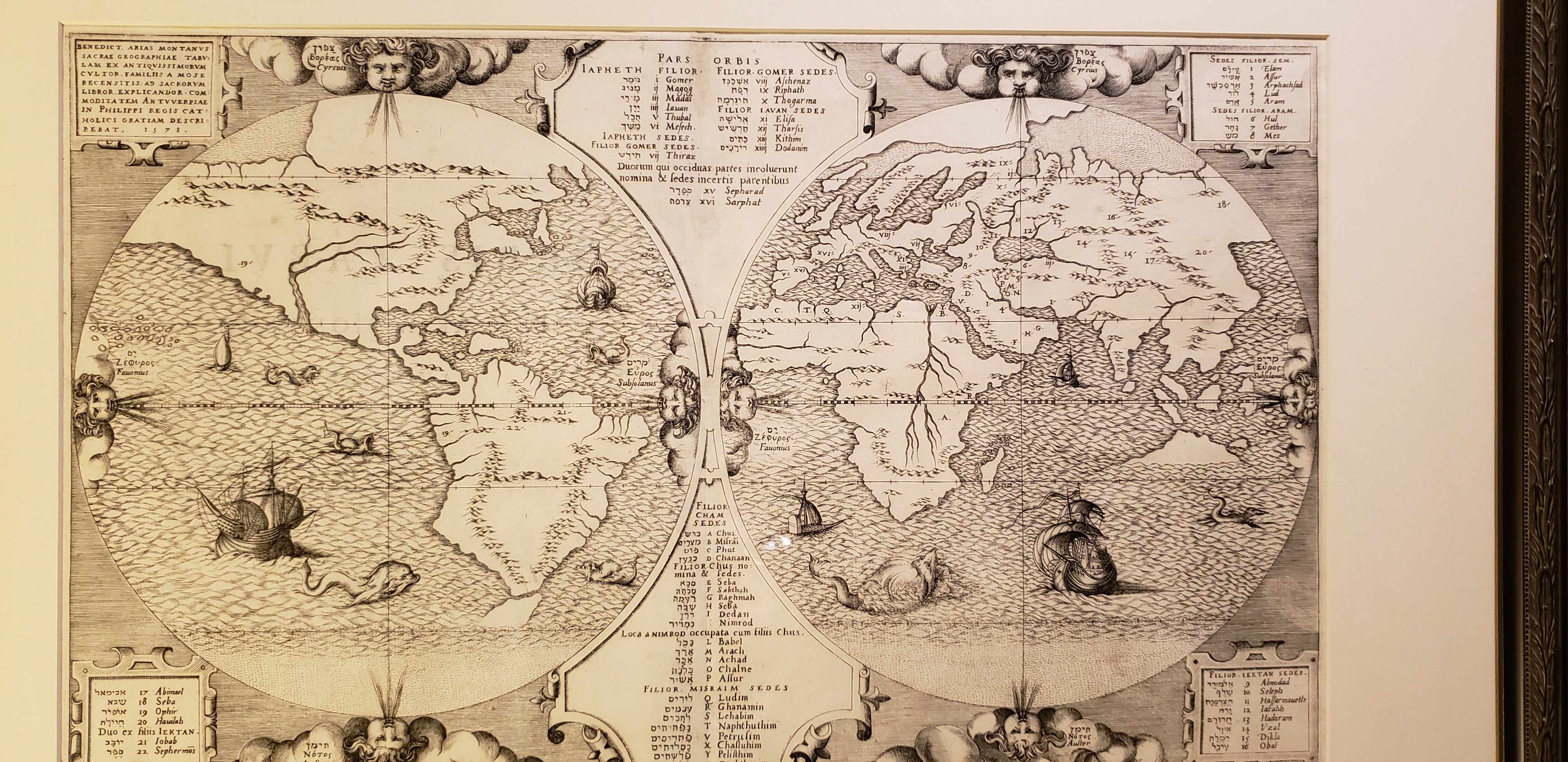
One of the most famous cartographers in the world was Abraham Ortelius (1527-1598). Appointed as cartographer to King Phillip II of Spain, the religious Christian Flemish cartographer is credited with creating the first world atlas called “Theatrum Orbis Terrarum” or “Theatre of the World.” The atlas was originally printed in 1570 and became one of the most popular books of its time and resulted in a few printings. In total, there were 178 plates amounting to approximately 730,000 printed copies of the various maps.

In addition to the maps printed in the atlas, Ortelius also produced “Parergon” maps of interesting places. These “classical” maps were produced by Ortelius himself, as opposed to some maps in “Theatrum” which were adopted from other cartographers. The 56 such plates produced roughly 143,000 printed maps.

One of the maps of the Parergon was called “Abrahami Patriarchae” which chronicled the life of the biblical patriarch Abraham. The first map was printed between 1590 and 1595 (975 copies made) with a second plate produced 1592-1624 (2925 copies made). The map shows the journey and life of Abraham with an inset map of his journey from Ur to Canaan, as well as 22 medallions of significant life events. The map highlights Ortelius’s gift as cartographer, artist and historian.

Ortelius
Abrahami Patriarchae Peregrinatio et vitae, 1592

Some notable medallions in the map are detailed below which underscore the belief that God gave Jews the holy land:

  • Medallion 6. Genesis 13: 14-15 “The Lord said to Abram after Lot had parted from him, “Look around from where you are, to the north and south, to the east and west. 15 All the land that you see I will give to you and your offspring forever.”
  • Medallion 10. Genesis 15: 17-21 “17 When the sun had set and darkness had fallen, a smoking firepot with a blazing torch appeared and passed between the pieces. 18 On that day the Lord made a covenant with Abram and said, “To your descendants I give this land, from the Wadi of Egypt to the great river, the Euphrates— 19 the land of the Kenites, Kenizzites, Kadmonites, 20 Hittites, Perizzites, Rephaites, 21 Amorites, Canaanites, Girgashites and Jebusites.”
  • Medallion 12. Genesis 17:3-8 “Abram fell facedown, and God said to him, “As for me, this is my covenant with you: You will be the father of many nations. No longer will you be called Abram; your name will be Abraham, for I have made you a father of many nations. I will make you very fruitful; I will make nations of you, and kings will come from you. I will establish my covenant as an everlasting covenant between me and you and your descendants after you for the generations to come, to be your God and the God of your descendants after you. The whole land of Canaan, where you now reside as a foreigner, I will give as an everlasting possession to you and your descendants after you; and I will be their God.
  • Medallion 18. Genesis 21: 27-31 (ownership of Beersheba) “27 So Abraham brought sheep and cattle and gave them to Abimelek, and the two men made a treaty. 28 Abraham set apart seven ewe lambs from the flock, 29 and Abimelek asked Abraham, “What is the meaning of these seven ewe lambs you have set apart by themselves?” 30 He replied, “Accept these seven lambs from my hand as a witness that I dug this well.” 31 So that place was called Beersheba, because the two men swore an oath there.
  • Medallion 20. Genesis 23: 19-20 (ownership of Hebron) 19 Afterward Abraham buried his wife Sarah in the cave in the field of Machpelah near Mamre (which is at Hebron) in the land of Canaan. 20 So the field and the cave in it were deeded to Abraham by the Hittites as a burial site.”

This map was made by a religious Christian, not a Jew. Many evangelical Christians and others that believe in the Old Testament firmly hold that while the holy land may be holy to all of the monotheistic faiths, the land itself is God’s gift to Jews. Indeed, God is the original Zionist.

The Touch of the Sound of the Shofar

This year I am fortunate to return to my childhood home for Rosh Hashanah, the Jewish New Year. In addition to the good food and the company of my family, parents, siblings and even a nephew with a new baby, I will get to hear my father blow shofar at shul, as he has done for many decades.

My memories of Rosh Hashanah extend beyond the dining room table and synagogue. As a child, my father and I would walk around the neighborhood after prayers visiting people who were too ill to attend services. I carried the shofar and my father took a machzor, as we visited people before running home to have lunch with the rest of the family. I recall elderly and sick individuals who were so happy to see my father, to recite the prayer of listening to the sound of the shofar, and to be able to appreciate the beautiful deep blasts from my father’s impeccable blows. For many of those elderly people, it would be the last shofar blasts that they would ever hear.

Decades later, with my own household and community, I have continued that tradition of blowing shofar for people who could not make it to synagogue. Of those many visits, two episodes stand out.

Quiet

A few months after moving with my family to our new community, I volunteered to blow shofar for home-bound people. The rabbi gave me the name and address of a woman that I had met some years earlier but did not know that well. I heard that she suffered from multiple sclerosis which became extremely complicated after she gave birth to her only daughter. She found it difficult to leave her house as she suffered from intense migraines.

I walked to her house after shul services concluded. I knocked on the front door and heard a voice yell from upstairs that I should come in. She was home alone as her husband and daughter prayed at a different synagogue that ended later than my shul. Upon entering the home I saw that the house was going through major renovations. She called for me to go upstairs, so I moved past the various building materials and climbed the steps to the bedroom.

The woman was fully dressed in everyday clothes, sitting upright in her bed under her covers. I had the sense that she had been in that same position for a very long time. On the covers was essentially everything one could imagine: books; newspapers; food; tissues; a dog…. The scene was not of a woman with a cold, but of someone who was home-bound. When I wished her a happy new year and asked how she was doing, she replied that her migraines were incessant and not improving. She and her husband decided it was time to renovate the garage and convert it into a bedroom to make it easier for her. This young woman, who was not even 40, was creating a first floor suite not for parents or in-laws, but for herself.

I handed her the machzor and took the shofar in my hands. As I put the shofar to my lips it occurred to me that I was in an impossible situation: how was I going to blow the shofar standing right next to a woman whose migraines were so intense that she could not even stand or leave her bed? I attempted to blow as softly as possible that the sound was barely audible. She adjusted herself in bed and whispered “it’s OK – I want to hear the shofar,” and smiled.

I had never met a person who had such a debilitating illness that noise prevented them from taking a step. Yet despite the constant pain, here was this woman requesting that I blow a horn at the edge of her bed! I tried to blow slightly louder to modest success. She again assured me that it was okay.

So I blew.

First with eyes staring into the distance, and then looking at her, I blew the shofar clearly and loudly. My lips and lungs automatically ran through the pace of tikya-shevarim-truah-tikya, while my mind thought about rabbis who commented that the sound of the shofar was meant to resemble crying. But the call of the shofar that day did not cause this woman to cry, but brought her comfort.

I had come to help someone fulfill a mitzvah of hearing the shofar, and left with a sense of marvel at a woman who chose to bring a life into this world at a tremendous personal cost, and further marveled at her desire to seek out and engage so fully into Judaism, even when the pain was so dear.

Tears

A few years later my family was back in our community for Rosh Hashanah (one has to visit the in-laws and parents after all). I once again offered my services of blowing shofar for anyone who could not attend services in shul. To my surprise, the rabbi asked if I would blow for some Jews who were in a nearby hospital that treats mental disorders. I did not mind the long walk to the facility even though it meant I would be home quite late for lunch; my concern was much more basic and childish: fear. I was fortunate to have never been in a psychiatric ward and have a deep childish fear of even visiting ordinary hospitals. But how could I refuse? I told my wife that she should have lunch without me and went on my way.
While the rabbi warned me about the security at the hospital, I nevertheless tensed every time I was buzzed through another set of locked doors as I worked my way through the large building complex. I was ultimately led to a medium-sized waiting room where a woman of perhaps 20 or so sat with her parents in fine clothing. I attempted to make small conversation and only the parents engaged. I handed the father the machzor for them to recite the prayer on the shofar blowing. The three of them stood up, each parent holding a hand of their daughter as they waited for me to begin.

Blowing before an entire synagogue brings its own considerations and nervousness. However, my feelings at that moment passed nervousness towards discomfort. I was nervous about my surroundings; edgy about what affect blowing a shofar in a mental hospital might have on people on the floor. My lips were tight and the sound barely came out. The family didn’t seem to notice. They waited. Patiently. After some time, I found some calm and began to blow.

As the first tkiyah came out from the shofar, my fears became realized. The girl began to cry uncontrollably and tears flowed from both eyes like a waterfall. Her mother holding her right hand did not move and continued to stare at the floor. Her father on her left, continued to stare directly at me. Neither one moved or sought to calm their crying daughter. I stopped blowing and pulled the shofar from my lips.

The father told me it was okay and that I should keep going. I do not know what kind of expression I wore, and covered my mouth with my left hand and returned the shofar to the right corner of my mouth and continued to blow 40 blasts.

The woman’s tears did not stop and the parents’ positions and expressions did not change. However, my mind raced to my participation in an intimate moment. Was the sound of the shofar making the woman cry? Did it cause her to reflect on why she was in this facility? Did it make her think and pray to God for a better year? And what about the parents? Why was the father fixed on staring at me and the shofar – were we tools in her cure? Were the mother’s thoughts on her daughter, on Rosh Hashanah, on her own life? I tried to stop examining these strangers at a vulnerable moment, and focus on the sound of shofar. My only role was to be an agent for the sound which may help each of them in some way.

80 Years

In just a few months, my father will turn 80 years old. In the Jewish book Pirkei Avot, it says that “eighty [years old] is for power.” In Hebrew, the number 80 is represented as a pei, which means “mouth”. Thank God, my father at 80 still has the power to bring the shofar to his lips each day of Elul and Rosh Hashanah to blow magnificently. He has passed the talent down, having taught my son how to blow shofar for his bar mitzvah just a few years ago.

This year, I am off duty from blowing shofar. I will be lucky to watch my father on the bimah surrounded by a community that he loves along with children, grandchildren and great-grandchildren. The sound of his shofar will touch me beyond a note or the symbolism of the holy day. The sound will trigger memories of people who have long since passed away for whom my father and I visited; people who extended themselves in amazing ways for their families; and people who were deeply touched by the shofar blasts in ways I cannot fathom. For me, the sound has become an amalgam of life and death; physical sickness and determination; mental illness and hope; family and friends; and our responsibilities and roles in our community.

May we all be touched by the sound of the shofar in meaningful ways. All the best for a happy and healthy year.

Related First One Through article:
Shabbat Hagadol at the Third Hurva Synagogue, 2010
Subscribe YouTube channel: FirstOneThrough
Join Facebook group: FirstOne Through Israel Analysis

Chag Kasher v. Sa’meach

Summary: For many people, the “v.” is for “versus”, not for “and”. In the ongoing battle between a Chag Kasher versus Sa’meach, Kasher seems to be winning again.

I am neither a cook nor a chef.

While I love to eat, my wife prohibits me from doing any food preparation for fear -not without reason or history- that should I venture into the kitchen, her holy sanctuary, the entire room – no, the house itself! – would become un-kosher.

Over time, my place has become confined to the kitchen table. It is there that I must sit and wait for my meals, not unlike our dog (which she prefers on most days) who waits before his bowl. Remarkably, I am afforded more table scraps than him. Score one for me.

This is not to say that I cannot approach the sink. My share of the household bargain falls on cleaning up after meals. My wife considers the dishwasher and garbage pail safe terrain, as I can usually deduce whether I just consumed a dairy or meat meal.

That all ends on Passover.

When I think of my wife on Passover, I am reminded of the final scene from the movie Gallipoli where manic soldiers charge an Ottoman trench, knowing of their certain death. A fury fills her eyes as the holiday approaches and I know that no cleaning I do could ever satisfy her Kashrut Compulsive Disorder (commonly referred to by Jewish psychiatrists as KCD). This non-silent killer has taken more husbands than latkes on Hanukah.

My wife, (let’s call her “Pharaoh” to protect her identity from the teachers in school who think of her as a sweet, mild-mannered parent) despises Passover. Her venom is matched by her vigilance as she tries to square the invisible shmura matzah of Passover kashrut stringencies with her own KCD.

The Pharaohs of ancient Egypt had it easier than my modern Pharaoh. The ancient kings had teams of advisers and thousands of slaves to execute their commands. Today’s Pharaoh is left with a spouse who only gets to clean in the kitchen during most of the year because we have two dishwashers.

More warriors are clearly needed for the task.

New York has an outsourced cleaning industry which features companies with jolly names like “Molly Maids” and “PIG” which stands for “Partners in Grime”. When these companies drop the non-kosher acronyms and become armed with blowtorches, perhaps Pharaoh will “let these people come.”

Well, in truth, they do come.  They come a few times in succession to make sure that one team picked up where the first team may have been sloppy. At $400 a pop, the twelve cleaning tours of duty make a not so subtle reminder that we could have gone to a Passover program in the sunshine somewhere.

The cleaning troupes do not absolve me of cleaning (nor the sin of making Passover at home). My tasks are to lift and move large objects around the house in case a morsel of bread was carried there by a microscopic antisemitic mouse.  Dishwashers are pulled from their moorings. Refrigerators are yanked from the walls.  I am ordered to lift the island in the kitchen, until my rabbi steps in on my behalf (only because he thought I was too weak). My dog snickers at my misery.  Score one for him.

After eighteen gallons of bleach have been pored over every inch of the kitchen, and the fleas on my dog would no longer consider smelling (let alone eating) anything in the house, my next task is assigned. Foiling.

Foiling on Pesach has nothing to do with fencing.  It involves rolling out aluminum foil over counter tops as a punishment for not giving one’s wife a new kitchen. For the hardcore, the foiling of tables, chairs, cushions is also warranted.  Our family is so famous for our foiling, that we get Happy Passover cards from Alcoa.

IMG_3295
Foiling at a bar

As the first seder arrives, Pharaoh starts to resemble my former wife again. The house is indeed clean enough that even Eliyahu would be impressed.  Family and friends gather around the table to recount the timeless story… of how no one in the shtetls had more than one pot and somehow made Passover.

As has become our tradition, before I recite the Kiddush to start the seder, my wife inverts the very order of the seder. She sings out in a loud, yet exhausted, teary voice “Hashana ha’ba’a b’Yerushayim” – Next year in Jerusalem. Everyone joins in.