Civil Death and Terrorism

Many governments are trying to develop legal structures to prevent and punish acts of terrorism. Their proposals and actions would extend to those who have not (yet) committed terrorism in their countries, to those who join terrorist groups such as the Islamic State/ ISIS.

France has considered stripping a person of their French citizenship if they engage in terrorist acts, if they were not born in France and held a second passport. The United Kingdom is considering a law of stripping British citizenship for naturalized Britons (those not born in the country).

While western European governments consider different ways of inhibiting terrorism and would-be terrorists, rights groups have argued that these steps infringe on an individual’s freedoms.  The groups contend that a government should not take punitive actions against a person before they actually commit a wrongful deed.

The governments are seeking a middle ground: not incarcerating a person if they are not found liable of committing a crime, yet still punishing them from embarking on a path towards terrorism.  Indeed, prison takes away a person’s freedoms, while withdrawing citizenship removes a person’s rights. Placing a person in jail removes a potential threat; the softer stance of removing citizenship inhibits dangerous associations.

The governments’ course of actions are not without precedent.

Civil Death

The United States has a legal concept called “Civil Death.” A “civil death” essentially strips a person of their rights that are connected to the government. For example, a violent felon would lose:

  • The right to vote
  • The ability to hold public office
  • The ability to be licensed for a business (many businesses require licenses to operate)
  • Ability to enter contracts or sue in court
  • The right to obtain insurance or pension
  • Any and all property

These are no small matters. Such person would not be in prison, but remain very limited in the ability to live, work and function freely in society. The courts effectively rule that if a person has shown a willful intolerance and disdain for society’s rules and laws, they will no longer be protected by those same laws.

Israel has used a similar approach in its ongoing war against terror.

Israel

Israel has long struggled with how to deter terrorists.  The military reduces acts of terrorism through roadblocks, checkpoints, and barriers, but they do not inhibit a person from considering such action.  The difference is significant, particularly for people who are willing to kill themselves in the act of terrorism.  There is no jail sentence for a suicide bomber.

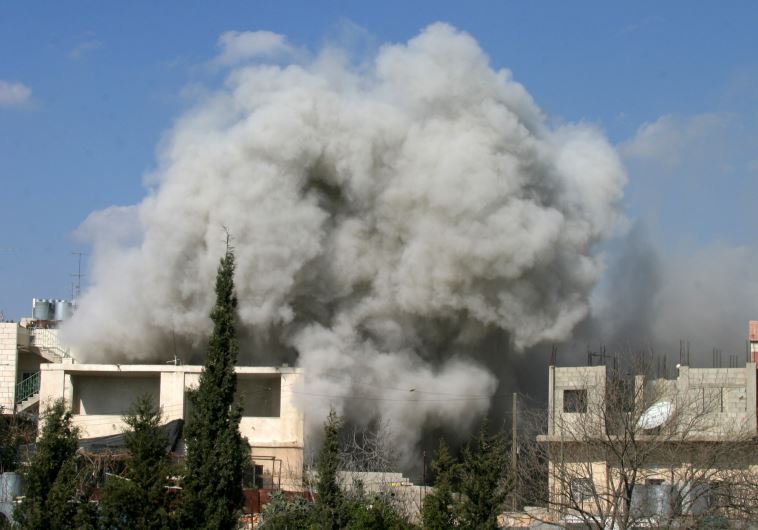
Israel has ruled that people who aid and abet violent acts can be found liable, or at least partially liable, for the criminal behavior.  Israel has used home demolitions of suicide bombers as a means of punishing the murderer’s family who knowingly enabled the act of terrorism.

demolition
IDF demolishing home of Palestinian Arab terrorist
(photo: Reuters)

Rights groups have condemned the Israeli policy.  They claim that such actions amount to collective punishment against ordinary civilians who did not participate in any crime.  That position, while used by B’Tselem broadly, is actually unclear.  Not only may the family members be aware of the planned attack, but if the terrorist was the owner of the house, then the government could claim that all such rights to property ownership were null and void the moment the owner committed the terrorist act.  As such, the home became government property, which it can handle as it sees fit.

The Israeli government is exploring other punitive acts that are similar to the actions taken by European governments, such as revoking work papers or residency rights for terrorists and those that assist them. Other penalties could be handed down for the “civil dead” should they be found guilty of crimes in the future:

  • Forfeit any chance for parole
  • Never be exchanged in a prisoner swap


Governments around the world are investigating ways to slow the tide of would be terrorists.  As they do, the various punishments of a civil death will likely be explored in the future.


Related First.One.Through articles:

Collective Guilt / Collective Punishment

UN’s Confusion on the Legality of Israel’s Blockade of Gaza

Alternatives for Punishing Dead Terrorists

Subscribe YouTube channel: FirstOneThrough

Join Facebook group: FirstOne Through  Israel Analysis

Israel’s Peers and Neighbors

Observers of Israel often consider the appropriate benchmark for the country. To whom should Israel be compared? Against the Western world or its neighbors in the Middle East?

Western World Peers

The arguments to compare Israel to western countries such as in Western Europe and North America are plentiful.

Democracy: Israel is a democracy in which all citizens of the country elect its leadership, similar to the western world. That is in stark contrast to its neighbors that have monarchies and dictatorships.

Freedoms: Israel believes in various freedoms, including of religion, assembly and press. Such freedoms are cornerstones of western values, but difficult to find elsewhere in the Middle East.

Economy: Israel’s economy is based on capitalism. It has been termed the “start-up nation” due to the tremendous number of companies that are launched by ordinary Israelis. This compares to the economies dominated by oil money controlled by governments among Israel’s neighbors.

The long list of commonalities is detailed in “Israel, the Liberal Country of the Middle East.”  The peer group for Israel according to its principles and values is indeed the western world, not the MENA region.

Neighbors in MENA
(Middle East and North Africa)
israel_surrounded_sm
Arab World

Israel resides in a predominantly Arab neighborhood.  The people of the Arabian Peninsula spread en masse from the region shortly after the founding of Islam, during the 6th and 7th centuries.  In some locations, like Turkey, the Arab invasion was repelled, even while the Islamic religion still took hold in the area.  There are now 22 Arab countries and 57 Muslim countries, most of which surround Israel.

muslim_distribution
Muslim World

While Israel is unique in being the only Jewish State in the world, it’s uniqueness is magnified within its neighborhood that is almost uniformly Arab and Muslim.  Many of these Muslim countries are governed by Sharia, Islamic law, while others have laws that are Sharia-inspired.  These laws have little in common with laws found in western countries.  This is even true where the British held Mandates after World War I, such as in Jordan and Iraq.

Judging Peers

English Common Law has a concept that a person should be judged by a group of one’s peers.  The rationale for this provision was to afford context and humanity to the cold rule of law.  As peers should know a defendant better than a judge, those individuals in the jury could fine-tune the rule of law for the specific case and party.

In the United States, the concept of “peers” has been adjusted to “neighbors.”  The jury pool in the US courts system pulls in people from an entire region.  The individuals in such neighborhood likely have a wide range of backgrounds, including: race; religion; occupation; wealth; political views, to name a few.  US law requires that any party that knows the defendant – presumably who are more likely to be “peers” – to be excluded from the jury so as to avoid favoritism.  As such, the US system has moved from a court of peers to one of neighbors.

What happens when one’s peer group and one’s neighbors have nothing in common?  An extreme example happens every day in the court of world opinion regarding Israel.

Judging Israel

Neighbors: Israel’s neighbors have opposed the very existence of the Jewish homeland since such concept became international law in the 1920 San Remo Conference and the 1922 British Mandate for Palestine.  Sporadic riots in the 1920s became a multi-year war 1936-9, when the Arabs convinced the British to roll back the essence of the laws to curtail Jewish immigration and cap the number of Jews in Palestine, as well as to limit where Jews could live.  When Israel declared independence in 1948, Arab armies from that surrounded Israel fought to destroy the country.

The parties have been at war ever since, with the exceptions of Egypt and Jordan which made peace with Israel in 1979 and 1994, respectively.

Today, the 57 Muslim nations that comprise the Organization of Islamic Cooperation (OIC), vote as a bloc at the United Nations, and consistently condemn Israel for anything and everything, as they view the “Zionist entity” as illegal and unjust.

Clearly, this is not a group of neighbors that can be used as a “jury of one’s peers” to assess whether Israel is acting appropriately in any given matter.

oic_11
Representatives of the OIC

Peers: Israel cares about the opinions of its peer group in western Europe, North America and Australia.  These countries share Israel’s values and have ongoing trading and commercial relationships with Israel.

Much of the criticism against Israel from its peer group relates to Israel’s activities in the disputed territories east of the Green Line (EGL/West Bank). Some governments claim that Israel “occupies” the Palestinian people and takes over “Arab land.” Those critics call out Israel for its use of its military and point to lopsided casualty figures in Israeli-Arab wars. They protest Israel’s use of roadblocks, the security barrier, and of house demolitions of terrorists.

The flaw of such commentary is that it inherently assumes that Israel’s peer group exists – or could exist – in the same environment as Israel.

A Mile in Their Shoes

As detailed in “Israel: Security in a Small Country,” Israel is almost 1/500th of the size of the United States, but has three times as many neighbors. It is half of the size of the Netherlands, but no Dutch neighbor refuses to recognize its right to exist. Israel may have a similar number of countries bordering it as Argentina, but none of Argentina’s neighbors have launched numerous wars against it over the past decades.  The United Kingdom may have knowledge of the region from managing the Palestine Mandate from 1924 to 1948, but when was the last time England had foreign tanks and fighters on its home soil?  France may have experienced terrorism, but is there a country working to obtain nuclear weapons that threatens to wipe it off the map?

In short, Israel’s values’ peers do not have comparable security issues.

conflict map
Israel’s values’ peer group of western Europe, North America and Australia
are peaceful relative to the raging conflicts in MENA

When countries in the western world do have moments of inflamed security concern, such as when France suffered from terrorist attacks in November 2015, that country quickly went on the offensive. It instituted curfews. It performed raids on apartments. It curtailed a range of freedoms…. much as Israel does when it confronts security concerns on a continual basis.

Members of French special police forces of the Research and Intervention Brigade (BRI) and forensic experts are seen near a raid zone in Saint-Denis, near Paris, France, November 18, 2015 during an operation to catch fugitives from Friday night's deadly attacks in the French capital. REUTERS/Christian Hartmann - RTS7R5L

Members of French special police forces of the Research and Intervention Brigade (BRI) and forensic experts are seen near a raid zone in Saint-Denis, near Paris, France, November 18, 2015 during an operation to catch fugitives from Friday night’s deadly attacks in the French capital. REUTERS/Christian Hartmann – RTS7R5L

After the United States was attacked on September 11, 2001, it went on a multi-year, multi-country war, which is still ongoing in Afghanistan.  Many more people have been killed in the US wars on terror, than were killed on 9/11.

Israel has faced more than a terrible day of violence; it has daily assaults.  Israel has faced more than just terrorism; it has existential threats.  And it has continued to confront these security concerns, ever since the country was reconstituted in the 20th century.

Israel’s peers have not walked a mile in Israel’s shoes.  They have simply put them on and taken an uncomfortable first step.  And as they have done so, they have shown their determination to protect their civilian population and way of life.


Israel shares the democratic values of much of the western world. The critics from Israel’s peer group should recognize and celebrate the society that Israel has been able to create inside the illiberal Middle East. Those peers must also come to recognize and differentiate between the peaceful environment in which they live and the hostile environment in which Israel resides.


Related First.One.Through articles:

A Flower in Terra Barbarus

Murderous Governments of the Middle East

Seeing Security through a Screen

Obama’s “Values” Red Herring

The Disproportionate Defenses of Israel and the Palestinian Authority

Subscribe YouTube channel: FirstOneThrough

Join Facebook group: FirstOne Through  Israel Analysis

New York Times Grants Nobel Prize-in Waiting to Palestinian Arab Terrorist

There once was a journalist who won a Pulitzer Prize for reporting on terrorism. Thirteen years later, it would appear that he cannot find terrorism at all.  Or worse. His paper endorses the terrorism itself.


Steven Erlanger has been a reporter for The New York Times for several decades. In 2002, he shared a Pulitzer Prize for his work reporting on the terrorist group al Qaeda. On February 28, 2016, he wrote an article that made a reader question whether he continued to have the faculties to recognize the nature of terror anymore.

In his article called “Talk Grows About Who Will Succeed Palestinians’ Fading Mahmoud Abbas,” Erlanger listed several potential candidates to succeed the inept current acting-President of the Palestinian Authority, Mahmoud Abbas. In addition to some leading candidates, Erlanger wrote:

“The other inescapable figure is Marwan Barghouti, 56, sometimes called the Palestinian Mandela for his long period in Israeli prison and his efforts to bring Hamas and Fatah together.”

No reasonable person calls Barghouti a Palestinian Mandela other than anti-Israel outfits like The Guardian in the United Kingdom. Will the Times also begin to refer to Israeli Prime Minister Benjamin Netanyahu as a “modern day Winston Churchill” like the National Review? I doubt it.

Using a referral to a secondary source (“sometimes called”) made Erlanger appear as an unbiased reporter rather than inserting his own editorial into the story. But sourcing such a narrow and biased paper for a quote, rather than broadly used terminology, is an editorial itself, not news.

Barghouti versus Mandela

Part of the reason the reference to Mandela is so absurd is the nature of the two individuals’ imprisonments. Nelson Mandela was imprisoned because he tried to fight the racist apartheid system in South Africa. Marwan Barghouti was not imprisoned for fighting for rights for Palestinians, nor for “his efforts to bring Hamas and Fatah together.” Barghouti was jailed for his direct involvement in murdering several civilians.

Between January and June 2002, Barghouti was directly involved with killing of: Yula Hen at a gas station (January 2002); Yosef Havi, Eliyahu Dahan and Selim Barachat in a restaurant (March 2002); and Gur Pzipokatsatakis, a Greek Orthodox monk (June 2002). For those crimes, he received five life sentences.

In addition to those direct murders, Barghouti was also held responsible for a failed suicide bombing at a major shopping mall in Jerusalem. For that crime, he received another 40 year sentence.

His involvement in the murder of scores of other civilians was beyond dispute, however, the Israeli courts deemed it was beyond its authority to convict him.

Barghouti is credited with launching the Second Intifada at the end of 2000. Tanzim, the terror arm of Fatah, targeted Israeli civilians around the country, such as on buses and at bat mitzvah celebrations. The Tanzim attacks went on continuously in 2001 and early 2002 until his arrest, and sporadically afterwards.

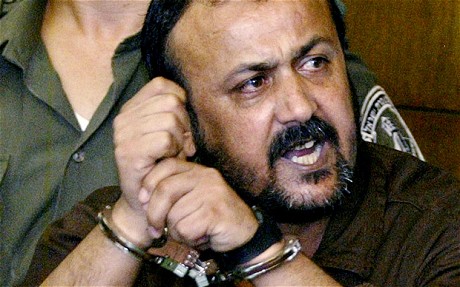
marwan barghouti
Marwan Barghouti, head of Tanzim

This background is in sharp contrast to Nelson Mandela, who also headed a terrorist group. UmKhonto we Sizwe, the terrorist arm of the ANC and South African Communist Party, carried out several attacks against South Africans in the 1980s.

But the similarity ends there.  Mandela fought against the racism of apartheid, while Barghouti fought against the existence of Israel.

Mandela started the group after the South African government killed 69 people. Barghouti launched the Second Intifada after Yasser Arafat rejected the terms of the peace agreement with Israel.

Mandela was never directly involved in any murders. Barghouti was involved in several.

Today, Erlanger refers to Barghouti’s call for a unity government between Hamas and Fatah.  He ignores Barghouti’s incitement for a Third Intifada.

The Evolving Palestinian Narrative of the New York Times

For several years, the New York Times has written about the Israeli – Palestinian Arab conflict from a Palestinian point of view. The biases included portraying Israelis as aggressors and Palestinians as victims. It softened the image of Palestinian fighters by not calling on Hamas as a terrorist organization, even while it is so designated by many countries including the United States.

Most recently, the Times has extended that Palestinian narrative to a new level: Palestinian terrorists are freedom fighters. Their fight against Israel is noble and just and should be welcomed by progressives:

  • On February 27, the Times called the terrorist group Popular Front for the Liberation of Palestine as a “leftist group,” embracing the murderers of Israeli civilians as part of the progressive global movement.
  • On February 28, the Times awarded a convicted murderer a Nobel Prize-in waiting, by calling Marwan Barghouti a “Palestinian Mandela.”

These are new and problematic lows.

Feeling sympathy for people who suffer is natural (ignoring for a moment the debate about the cause for such suffering).  But labeling terrorist groups and murderers in glowing terms is a hairs-breadth from endorsing murder and terrorism.

Will that be next? Is the Times preparing to endorse a Third Intifada?


Related First.One.Through articles:

The New York Times wants the military to defeat terrorists (but not Hamas)

Why the Media Ignores Jihadists in Israel

The Palestinians aren’t “Resorting to Violence”; They are Murdering and Waging War

What do you Recognize in the Palestinians?

Subscribe YouTube channel: FirstOneThrough

Join Facebook group: FirstOne Through  Israel Analysis

What’s “Left” for The New York Times?

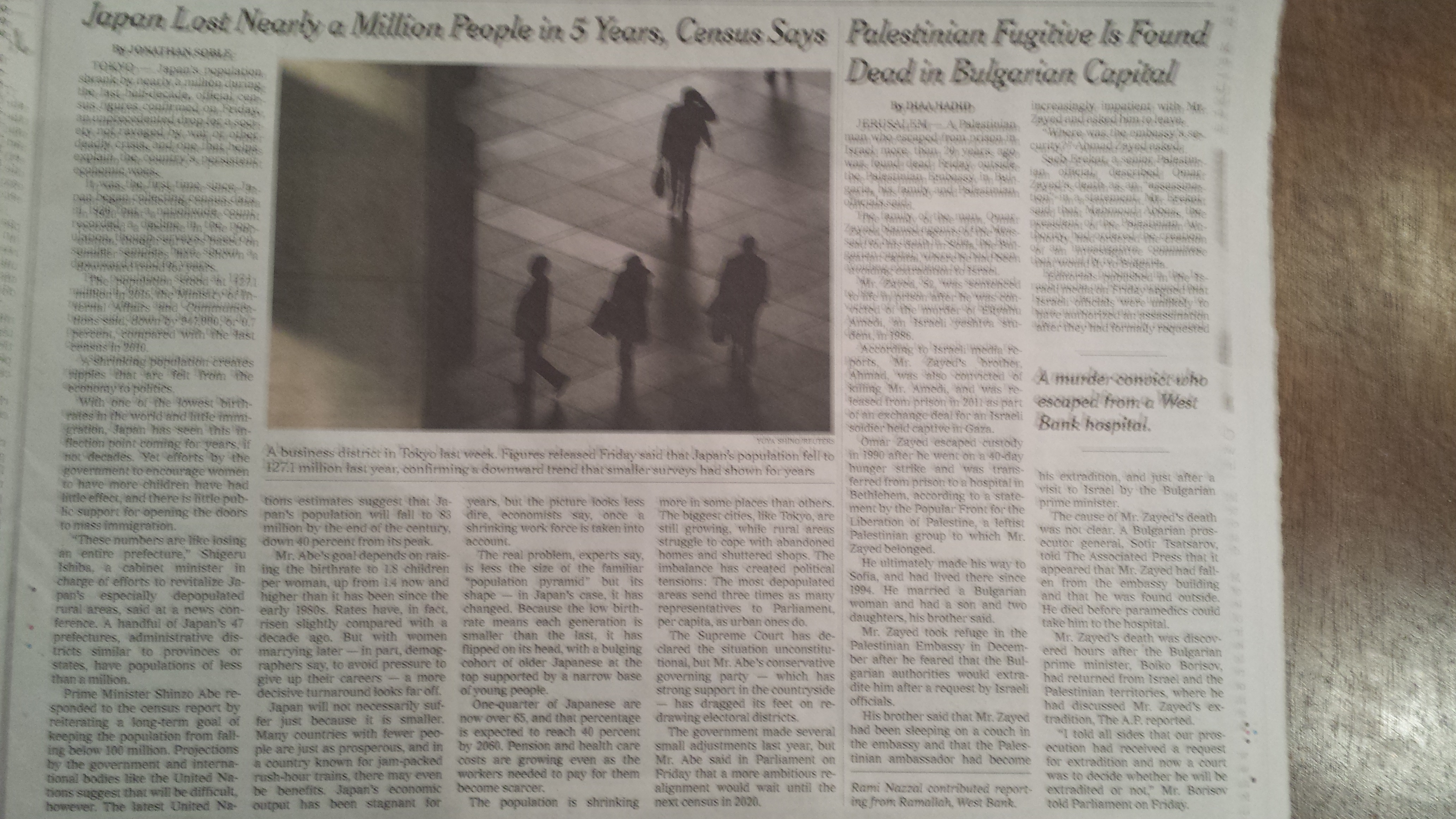
On February 27, 2016, the New York Times ran an article on page A7 by Diaa Hadid titled “Palestinian Fugitive Is Found Dead in Bulgarian Capital.” The article described how “a Palestinian man who escaped from prison in Israel more than 20 years ago was found dead outside the Palestinian Embassy in Bulgaria.” The piece described how “Mr. Zayed, 52, was sentenced to life in prison after he was convicted of the murder of Eliyahu Amedia, an Israeli yeshiva student, in 1986…. Omar Zayed escaped custody in 1990 after he went on a 40-day hunger strike and was transferred from prison to a hospital in Bethlehem, according to a statement by the Popular Front for the Liberation of Palestine, a leftist Palestinian group to which Mr. Zayed belonged.”

Wow. The New York Times described the PFLP as a “leftist group.” Is it?

Popular Front for the Liberation of Palestine (PFLP)

The PFLP was founded in December 1967, and makes no secret about its enemies: Israel; the “World Zionist Movement”; and the United States of America. The inclusion of the USA is clear, as the PFLP states on its website: “In the battle for the liberation of Palestine, we are facing a third force, that of world imperialism led by the United States of America.”

The goal of the PFLP is the complete destruction of Israel through armed conquest from all sides. As it states in its manifesto written in 1969: “The armed struggle against Israel and all imperialist interests in our homeland, the expansion of the armed struggle front which stands in the face of Arab reaction and all imperialist interests and bases in the Arab homeland, and the encirclement of Israel with the strategy of the people’s liberation war from every side – from Syria, Egypt, Lebanon, Jordan and inside the territory occupied before and after 5 June 1967 – is the only path that leads to victory.

pflp
PFLP logo, showing map representing the Arab world
entering and consuming all of Israel

Some of the group’s activities have included:

  • Hijacking El Al plane (July 1968)
  • Hijacking three planes (September 1970)
  • The assassination Israeli Member of Knesset Rehavam Ze’evi (October 2001)
  • Suicide bombing in a pizza store in Karnei Shomron killing three civilians (February 2002)
  • Suicide bombing in a bus station in Tel Aviv killing three (December 2003)
  • Suicide bombing in a food market in Tel Aviv killing three (November 2004)
  • Killing four rabbis praying in a synagogue with axes and knives in Jerusalem (November 2014)

The PFLP continues to incite terrorism, as it praises attacks and calls on all strugglers in Palestine to escalate the flame of the intifada.

Due to its mission and actions, the US State Department labeled the PFLP a foreign terrorist organization (FTO) when it formulated such list at inception on October 8, 1997, together with the PFLP-General Command.

pflpsweetsgaza
PFLP hands out sweets after the group claimed credit for hacking four Jewish worshipers to death in a Har Nof synagogue
November, 2014

And the New York Times decided to label this terrorist group a “leftist group’ rather than a terrorist group.

The New York Times Welcomes Arab Terrorism to the “Left”

The NYT is proud of its left-leaning ways.

Just recently, as the paper endorsed Hillary Clinton for the Democratic nomination for president, it considered that her challenger, Senator Bernie Sanders had fortunately brought the former Secretary of State further to the left: “[Sanders] has brought income inequality and the lingering pain of the middle class to center stage and pushed Mrs. Clinton a bit more to the left than she might have gone on economic issues. Mr. Sanders has also surfaced important foreign policy questions, including the need for greater restraint in the use of military force.

Note that the Times considers the “greater restraint in the use of military force” to be a leftist ideal. Yet, somehow, the Times called a militant Palestinian Arab group, an organization which has led dozens of suicide bombings, murders and plane hijackings, a group which is a Foreign Terrorist Organization (FTO) according to the US State Department – a “leftist group.”

Perhaps the greater restraint of military forces is a leftist ideal, only when such force is used by America and its allies.

If the right-leaning Wall Street Journal decided to label a terrorist group a “left-wing group,” presumably, many people on the left would be greatly offended. Aligning mass murderers and people who are sworn enemies of the United States, with the liberal cause would be called out as a libelous charge. Letters to the editor would pour forth from “progressive” pens denouncing the comparison.

But here, the left-leaning NYT opted to embrace the terrorist group as one of its own. It actively chose to align their political points of view.

The liberal paper has long declined to label Hamas, another Palestinian Arab group, as a terrorist group.  The paper often uses soft language like “a militant group” or “an Islamist group” to portray that FTO.

In February 2016, the Times moved passed softening the image of Palestinian terror.  It baptized and embraced Arab terror.

If this is the modern day version of being “progressive,” the entire world should loudly condemn it in every way possible.

20160227_201234
New York Times article by Diaa Hadid on February 27, 2016


Related First.One.Through articles:

The New York Times wants the military to defeat terrorists (but not Hamas)

Why the Media Ignores Jihadists in Israel

The Palestinians aren’t “Resorting to Violence”; They are Murdering and Waging War

What do you Recognize in the Palestinians?

Subscribe YouTube channel: FirstOneThrough

Join Facebook group: FirstOne Through  Israel Analysis

Israel is Found and Lost in Barcelona

Mobile World Congress (MWC) is the largest conference dedicated to the enormous mobile ecosystem, and is, by far, the largest conference hosted in the beautiful city of Barcelona, Spain each year. The conference in February 2016 drew about 100,000 people from around the world. Israel was both well very well and very poorly represented.

Israel’s Ministry of Economy and Industry had a section of Hall 5 with 65 companies presenting, including Audiocodes and Alvarion. In Hall 2, the Israel Marketing Association had meeting spaces for over 20 companies including Kaltura and Radware. Other Israeli companies had large stand-alone booths in various halls including Allot Communication and Amdocs. And there was yet additional Israeli representation that was only observable to the observant, where Israeli technologies (as opposed to the companies) were featured within large non-Israeli companies that had acquired Israeli firms, such as Red Bend Software within Harman.

20160222_122258
Israeli companies at MWC in Barcelona, Spain, February 2016
(photo: First.One.Through)

The various Israeli companies attested to the enormous technology leadership that the small country had at the show. Thousands of people came to the Israeli booths to meet with their existing business partners and to learn about emerging technologies such as those from StoreDot and Insert.

Despite the significant Israeli presence, the MWC decided not to highlight Israel among the flags of the world at the show.

At the inside courtyard at the show’s southern entrance, and outside at the northern entrance, the MWC hoisted the flags of dozens of countries. They included countries that were prominent at the show including the United States, the United Kingdom, South Korea, Japan, China, India, Germany and Spain. Yet there were also flags of countries with little presence at the show, including: Mexico; Ukraine; and Argentina. Remarkably, the flags of Saudi Arabia and Iran were also flying high in the air.

But Israel’s flag was absent.

20160223_191710
30 flags from around the world inside the entrance at MWC in Barcelona, Spain
(photo: First.One.Through)

A little over 500 years ago, Spain expelled its 200,000 Jews, but recently, the country made efforts to mend ties with Jews. It finally recognized Israel as the homeland of the Jewish people in 2011, and in 2012, the country stated that it would grant Spanish citizenship to those Jews who could demonstrate that they were descended from Jews expelled in 1492. The same day that the Barcelona conference began, another city in Spain announced that it would not participate in any BDS (boycott, divestment and sanctions) against Israel.

For its part, the Mobile World Congress clearly did not participate in any BDS activity in allowing over 140 Israeli companies to present at the show. They did not block over 1000 Israelis from attending the event. Yet why did the blue and white Israeli flag with the Star of David get snubbed?

MWC published an article that was broadly distributed on the first day of the show about a study completed by the large Spanish Telecom phone company, Telefonica, about the state of the digital ecosystem among 34 countries. Among the findings highlighted in the MWC article, was that Saudi Arabia was, by far, the country with the worst digital ecosystem relative to the country’s wealth.  Yet MWC chose to fly the flag of the Kingdom of Saudi Arabia (KSA) outside the convention center, alongside the Spanish flag.

20160224_121018
Country flags outside northern entrance of Barcelona convention center.
KSA flag on right between South Korea and Spain.

(photo: First.One.Through)

What do you think could have been the thinking of flying the flag of Saudi Arabia, but not flying the Israeli flag?


Related First.One.Through articles:

The EU’s Choice of Labels: “Made in West Bank” and “Anti-Semite”

European Narrative over Facts

Subscribe YouTube channel: FirstOneThrough

Join Facebook group: FirstOne Through  Israel Analysis


The Illogic of Land Swaps

The argument that using the “1967 lines” as the basis for the borders of Israel and Palestine in a two-state solution is flawed at the outset.  “Land swaps” simply underscore that absurdity of the argument.

Obama on Israel-Palestine Borders

In May 2011, US President Barack Obama shared his thoughts on the contours of the ultimate borders of Israel and Palestine in a two-state solution: “We believe the borders of Israel and Palestine should be based on the 1967 lines with mutually agreed swaps, so that secure and recognized borders are established for both states.

The comment infuriated Israeli Prime Minister Benjamin Netanyahu and pro-Israel advocates. Obama clarified his comments before a pro-Israel group a few days later: “By definition, it means that the parties themselves, Israelis and Palestinians will negotiate a border that is different than the one that existed on June 4, 1967… it allows the parties themselves to account for the changes that have taken place over the last 44 years…. Including the new demographic realities on the ground, and the needs of both sides.”

Obama’s second statement moved away from his comments about “1967 lines.” By stating that the border would be arrived at through mutual negotiations and look “different than the one that existed on June 4, 1967,” Obama made the comment about the 1967 lines moot.  If the parties agree to an entirely new construct for borders, than that would be acceptable too.  There is no reason to even mention the “1967 lines” or land swaps.
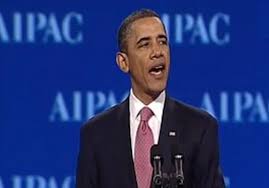
obama aipac
President Barack Obama at AIPAC May 2011

But the left-wing group J Street was much more aggressive than Obama on the contours of Israel, and lobbied the US government about the 1967 lines and land swaps.

J Street on Israel-Palestine Borders

J Street clearly calls for a two-state solution to be based on the 1967 lines with land swaps as detailed on its site: “This border will be based on the pre-1967 Green Line, with equivalent swaps of land…  land of equivalent quantity and quality will be swapped from within the pre-1967 Green Line.

The group also urged the US government and Jewish groups to strongly condemn any Jews living east of the Green Line (EGL/West Bank).  More specificaly, J Street stated:

J Street is deeply concerned that the pre-1967 Green Line separating Israel and the occupied territory is being effectively erased both on the ground and in the consciousness of Israelis, Jews and others around the world.

The resolution of the Israeli-Palestinian conflict will require establishing a border through negotiations between Israel and the new state of Palestine – based, as noted previously, on the pre-1967 Green Line with adjustments. Until that border is negotiated, the Green Line remains the internationally-recognized separation between the state of Israel and the territory won in the Six Day War in 1967.

A disturbing and growing lack of awareness of the Green Line is partially responsible for the 47-year occupation fading from the consciousness of the Israeli and international Jewish publics. Efforts to erase the Green Line from maps and from public awareness serve the interests only of those who seek to establish control over all the territory to the Jordan River.

One step American community groups, businesses, schools and governments could take to foster memory of the distinction between pre-1967 Israel and the subsequently occupied territory would be to use only maps that include the pre-1967 Green Line – a visual reminder of the Green Line and its significance.”

j street bookmark

All of J Street’s arguments: negotiations based on 1967 lines; equivalent swaps of land; and using equivalent “quality” are all illogical.  The desire to push the US government to punish Israel was demonic.

The Illogic of “Land Swaps”

There are a number of issues regarding using the 1967 lines and subsequent land swaps as envisioned by J Street.

The 1967 Lines Rewards Aggression.  Using the 1967 lines as a starting point for negotiations rewards aggression.  When Israel declared itself as an independent state in 1948, it was immediately attacked by five Arab armies from Egypt; Jordan; Syria; Lebanon; and Iraq.  The 1967 lines were the Armistice Lines where the warring parties stopped fighting in 1949.

Imagine that in 1948-9, Egypt conquered the entire southern part of Israel, all of the way up until Bethlehem, and Jordan conquered the entire eastern part of the country, leaving Israel as a narrow sliver of coastline from Tel Aviv to Rosh Hanikra. Consequently, imagine that it is this small state that becomes recognized by the United Nations in 1949, within Armistice Lines with Egypt and Jordan.

Further consider that history played out precisely as it did: in 1967 the Arab armies once again threatened to destroy Israel, so Israel pre-emptively attacked Egypt and Syria and then Jordan attacked Israel. Egypt and Jordan lost all of the territory that it took from the 1922 Palestine Mandate for a Jewish homeland in the war.

How would the world react?  Would the world demand that Israel needs to return to a stub of a state and give Egypt and Jordan all of the land past the 1949 Armistice Lines? Even if Egypt and Jordan ultimately relinquished their claims to the lands they seized in favor of Palestinian Arabs, would those borders somehow be considered the appropriate borders for Israel and Palestine?

Of course not.

Pushing Israel to accept the borders that the UN endorsed in 1949 would be rewarding the five Arab armies assault on Israel. The areas within the Jewish homeland mandate that are some refer to as “Arab land,” are simply lands that were seized by Arab aggression.  Using such 1967 lines/ the 1949 Armistice Lines, is a direct reward to an aggressive war to destroy the Jewish State.

Land Swaps Acknowledges that 1967 Lines are not Borders.  Those parties that suggest that land swaps between Israel and a future Palestinian state, inherently admit that the 1967 lines have no merit.  How could anyone suggest that a sovereign nation (Israel) give up some of its own land?  How could a country annex land of another country (Palestine)?  It can do so, if the two parties both acknowledge that the lines are not borders.

This was clearly spelled out in the Armistice Agreement with Egypt that stated “[t]he Armistice Demarcation Line is not to be construed in any sense as a political or territorial boundary.” Similarly, the Armistice Agreement between Israel and Jordan which stated “The Armistice Demarcation Lines defined in articles V and VI of this Agreement are agreed upon by the Parties without prejudice to future territorial settlements or boundary lines or to claims of either Party relating thereto.

While J Street urges Israel and Jewish groups to “know its boundaries,” the actual suggestion to engage in land swaps undermines the J Street argument that the 1967 lines have any real significance.  If there is any doubt, the Armistice Agreements that created those specific Armistice Lines stated those lines were not borders.

Land Swaps Undermine a call to limit Jewish “Settlements.” J Street and other groups that suggest that no Jewish Israelis should be allowed to live east of the Green Line (EGL/ West Bank), undermine their own argument when they suggest that there should be land swaps.  If Israel should give over some of its land west of the Green Line to a future Palestinian State, that would mean that Jews should also be prohibited from living in those border areas in Israel too.  Swapping land means that those Jewish communities in Israel would be considered a similar threat towards peace as the “settlements” in EGL/West Bank.

If people really believe that Jewish communities threaten the viability of a Palestinian State, the same parties that argue for banning Israelis in EGL/West Bank should argue similarly argue against Jewish communities in Israel that threaten the ability to effectively conclude land swaps.

That suggestion is clearly absurd.

Therefore if it is not a problem for Jews to move into communities that are west of the Green Line, than it is not an issue for Jews to move east of the Green Line.

Phantom Size.  The suggestion that the exact number of square kilometers of the “West Bank” and Gaza that were created by the 1949 Armistice Lines is somehow a sacred amount is ridiculuous.  As described above, the “West Bank” was an artifice created by a war of Arab aggression against Israel in 1948.  There is/was nothing inherently special about where the warring parties stopped fighting.

It is therefore non-sensical to suggest that the “equivalent quantity”of land be exchanged between the parties.  The Armistice Lines were arbitrary, non-permanent lines, and therefore the amount of land on either side of those lines are also arbitrary.

Further Absurdity of “Equivalent Quality.” J Street outdid itself in promoting a concept that went beyond the illogical suggestions of the 1967 lines land swaps.  It proposed that the land swaps between Israel and the Palestinian Authority should be based on land of “equivalent quality.”  In other words, J Street did not only propose that there be a swap of 50 square km on one side of the Green Line for 50km on the other side.  J Street introduced the concept of “quality.”  The far left-wing group argued that desert land would not be equivalent to an aquifer.  Holy land would not be equivalent to non-Holy land.

What is the conversion factor between the different types of land? Who knows!  Just add some subjective requirements to simplify negotiations that are already going nowhere for decades and are illogical at the start.  That should speed things up!

 benami-J Street
J Street leader Jeremy Ben Ami

When people pick on Obama for being anti-Israel, they should consider his rather moderate stance compared to the advice he receives from J Street.


Related First.One.Through articles:

J Street: Going Bigger and Bolder than BDS

The Legal Israeli Settlements

The Left-Wing’s Two State Solution: 1.5 States for Arabs, 0.5 for Jews

The Long History of Dictating Where Jews Can Live Continues

Subscribe YouTube channel: FirstOneThrough

Join Facebook group: FirstOne Through  Israel Analysis



UN Breakthrough? “Hamas continues to directly threaten the security of Israel”

But fear not, the UN still wants Hamas to be part of the government.

On January 26, 2015, United Nation’s Secretary General Ban Ki-Moon stated that it was “human nature” for the Palestinians to attack and kill Israelis on the streets, in a statement that was roundly criticized by pro-Israel advocates. Just a few weeks later, on February 18, 2016, Nickolay Mladenov, Secretary-General’s Special Coordinator for the Middle East Peace Process, made a more balanced report to the UN Security Council. His comments included:

The issue of incitement runs to the heart of the current climate of tension and fear. It is essential that authorities on both sides do more to address this scourge. I am particularly concerned that some Palestinian factions continue to glorify violence and terror. Such acts only contribute to tensions and violence.   Governance reforms must also remain a central commitment for the Palestinian Authority.  

Volatility persists in Gaza amidst a tenuous security situation. The collapse of another four tunnels — bringing the total to date this year to five — and the continued test firing and launching of rockets at Israel indicate that Hamas continues to directly threaten the security of Israel. Such actions risk not only people’s lives but the fragile reconstruction process in the devastated Strip.”

What might Mladenov have been describing?

Consider the February 14th Palestinian cartoon calling on all men to stab and kill Israelis.  Just days later, two 14-year old Palestinian Arabs stabbed two Israelis in a supermarket, killing one.

Mladenov
Special Coordinator for the Middle East Peace Process, Nickolay Mladenov.
(photo: UN/Devra Berkowitz)

The Mladenov comments were much more specific than Ban Ki-Moon has been about Palestinian incitement to violence and Hamas’s threats against Israel.  Ban would only generally refer to incitement by both Israelis and Palestinians and never refer to Hamas at all.

Perhaps a giant breakthrough at the United Nations, that it is active incitement by the Palestinians to commit murder, and not “human nature” that is causing the deaths of hundreds?

Don’t be too sure.

Endorsement of Hamas

Even while Mladenov more specifically placed blame on Hamas, he still urged for a Palestinian government that included the group, just as Ban has.

Mladenov stated that “[a]dvancing genuine reconciliation on the basis of non-violence, democracy and PLO principles is a key priority. I welcome the recent unity talks in Qatar and urge all sides to continue their discussions and implement previous agreements, particularly those brokered by Egypt. The formation of a National Unity Government and long-overdue elections are vital to laying the foundations of a future Palestinian state.”  Those comments suggested that either Hamas’s threats and acts of violence are a passing phase, or not objectionable to be part of a ruling Palestinian government.  In this regard, he echoed the sentiments of the Secretary-General who said:

“I strongly urge the Palestinian factions to advance genuine Palestinian unity on the basis of democracy and the PLO principles.  
Reconciliation is critical in order to reunite the West Bank and Gaza under a single legitimate Palestinian authority.   
Healing Palestinian divisions is also critical so that Palestinians can instead focus their energies on establishing a stable state as part of a negotiated two-state solution. 
Genuine unity will also improve the Palestinian Government’s ability to meet pressing economic problems, which are adding to the frustration and anger driving Palestinian violence.”

The urgency to place Hamas into the Palestinian Authority, even while it promotes the murder of Jews, is a critical part of the UN strategy.  Perhaps it is because those violent actions threaten “the fragile reconstruction process in the devastated [Gaza] Strip,” which is a key UN concern.

Mladenov’s comments are a baby step forward for the United Nations on Israel: words that finally call out the Palestinian incitement and threats.  Unfortunately, the UN still urges for flawed policies to elevate the terrorist group.


Related First.One.Through articles:

The United Nation’s Ban Ki Moon is Unqualified to Discuss the Question of Palestine

The Undemocratic Nature of Fire and Water in the Middle East

The Palestinians aren’t “Resorting to Violence”; They are Murdering and Waging War

What do you Recognize in the Palestinians?

Differentiating Hamas

Subscribe YouTube channel: FirstOneThrough

Join Facebook group: FirstOne Through  Israel Analysis
J Street’s Select Appreciation of Transparency

J Street, a far-left lobbying group which calls itself “pro-Israel” has a select appreciation for the value of transparency.  Consider its statements in the recent past:

On October 23, 2015, the group stated: “J Street congratulates delegates to the World Zionist Congress for overwhelmingly approving a resolution requiring the institutions it oversees to provide Jewish communities around the world with comprehensive and accurate information on their budget, finances and activities.

This was an important vote for democracy and accountability. Jews in Israel and around the world should know where the money they raise to support the State of Israel is invested. They should know that these funds are spent in ways consistent with Jewish values and in a manner that advances Israel’s future as a secure democratic homeland of the Jewish people.  
 
For too long, the actions of vital institutions like the Jewish Agency for Israel, the Keren Kayemeth LeIsrael and the Settlement Division of the World Zionist Organization have operated in secrecy, cloaked in deliberate confusion. Investigations have raised serious concerns about corruption. Meanwhile, some of these organizations, under the direction of the Government of Israel, have funneled funds to strengthen settlements in the West Bank at the expense of needy communities within Israel’s 1967 boundaries…. This massive support shows that financial transparency is something Jews around the world can unite around.”

J Street seemed particularly happy with the notion of clearly showing the flow of funds at organizations as it promoted “democracy,” “accountability” and “transparency.”

However, if the transparency of the flow of funds came against parties J Street supported, like those that opposed settlements, J Street reversed its opinion.

benami-J Street
Executive Director of J Street, Jeremy Ben Ami
(photo: JTA/J Street)

On December 28, 2015, J Street condemned the Israeli government for a bill that would provide financial transparency of NGOs (non-governmental governmental organizations):

J Street is deeply concerned and disappointed by the Israeli cabinet’s decision Sunday to send to the Knesset for approval a one-sided bill aimed at restricting the work of progressive non-governmental organizations which monitor human rights and oppose the occupation…. The bill, which was introduced by Justice Minister Ayelet Shaked of the right-wing Jewish Home party, would create a series of onerous new requirements that aim to demonize and discredit progressive organizations. Under the guise of “transparency,” these groups would have to identify themselves as foreign agents on the grounds that they receive the majority of their funding from foreign governments. Meanwhile, right-wing organizations, which receive significant funding from private foreign entities, would be free to continue to funnel money to West Bank settlements and to other anti-democratic causes without being subject to the same requirements.”

Somehow, J Street likes transparency in some situations, while not in others.

The group claims that the bill only targets progressive groups, but that is not the case at all.  All NGOs, whether left-wing or right-wing, would be forced to declare if they received the majority of their funding from foreign governments.  All NGOs funded by private foreign entities – left-wing ones like George Soros’s Open Society, or right-wing groups – would not need to declare if that they were foreign entities.

Former Israeli Ambassador to the United States and current MK (Kulanu) Michael Oren believes that the bill to provide transparency would hurt Israel’s ties to the United States.  He suggested including labels for private donations as well as governmental donations. “You either have transparency, or you don’t.

Perhaps a solution to meet everyone’s goals on transparency would be to label groups funded by foreign governments “Foreign Entities,” and those sponsored by private foreign money “Internationally Sponsored.”


J Street is always keen to expose, highlight and label Jews living in Judea and Samaria and those that support them.  As it states on its website: “Communal institutions should provide full transparency to supporters regarding the source, amount and purpose of funds transferred through their accounts to institutions and programs on the West Bank.

That is why J Street also supports removing the “Made in Israel” label of products made in the “West Bank,” and using a distinct label of products as being “Made in the West Bank.”

Just don’t make J Street or its supporters provide transparency itself on its foreign funding.


Note:  To learn more about which organizations and countries support the various lobbying and activist groups, go to NGO-Monitor.  For example, the anti-Zionism group Adalah received money from: Switzerland; Belgium; Netherlands; Germany; Sweden; Denmark; the EU as detailed here.

NGO Monitor


Related First.One.Through articles:

J Street: Going Bigger and Bolder than BDS

The Fault in Our Tent: The Limit of Acceptable Speech

The Left-Wing’s Two State Solution: 1.5 States for Arabs, 0.5 for Jews

Adalah, Dismantling Zionism

Squeezing Zionism

Liberals’ Biggest Enemies of 2015

Subscribe YouTube channel: FirstOneThrough

Join Facebook group: FirstOne Through  Israel Analysis

New York Times Lies about the Gentleness of Zionism

“Do not go gentle into that good night.
Rage, rage against the dying of the light.”
– Dylan Thomas (1914-1953)

The famous Welsh poet Dylan Thomas penned a poem called “Do Not Go Gentle into that Good Night.”  In it, he urged people to not accept their deaths meekly, without a fight.

Written for his dying father, the poem struck a chord among the broad public.  While the sentiments were intimate, they could be read on a grander scale, as it was published after the end of World War II and the Genocide of the Jews.  The British withstood a pounding by the German Nazi forces, but they fought on and prevailed.  The Jews of Europe were unarmed, and managed only a few resistance movements.  Two-thirds of the Jewish population perished.

Gentleness is normally pursued and praised.  But Thomas – and his fans – declared that one should not acquiesce to death.  At such times, gentleness is to be shunned.

NY Times Rage Against “Displacement”

On February 7, 2016, New York Times reporter Steven Erlander wrote an article called “Who Are the True Heirs of Zionism?” It’s an interesting question for someone who fails to understand Zionism.

20160207_143907

The article launched with Erlander’s negative bias:

Zionism was never the gentlest of ideologies. The return of the Jewish people to their biblical homeland and the resumption of Jewish sovereignty there have always carried within them the displacement of those already living in the land.”

Quite an opening paragraph to direct readers that Zionism – whatever its future – is evil at its core. Erlander claimed that Zionism lacks a gentleness since it seeks to displace indigenous people.  It did so at its founding when the secular founders of Zionism created the State of Israel, and the religious settlers do so now, as they seek to annex the “West Bank,” east of the Green Line (EGL). Such claim is completely false and repeats an anti-Israel narrative of Jews as “colonial occupiers” (as acting-President of the Palestinian Authority Mahmoud Abbas claimed).

In reality, Zionism is about fighting against and fleeing from anti-Semitism.  It was the case when Theodore Herzl wrote “The Jewish State” in 1896, and it is the case today.  The essence was not about “displacing” people, but creating a safe place for Jews by reestablishing them in their homeland.

Some facts:

  1. Jews always lived in the Holy Land. While the mass expulsion of Jews happened in 135 CE by the Romans, Jews always maintained a presence in Israel. As evidence, Jews have been a majority in Jerusalem since the 1860s, thirty years before the first Zionist Congress.  In other words, Jews were not newcomers – they were part of “those already living in the land.”
  2. Jews were the only people that moved to the Holy Land during the last century of Ottoman Rule. From 1800 until the end of the Ottoman Empire, the annual growth rate of Muslims in the Holy Land was just 1.0% – the rate of growth of births minus deaths. That means that no Muslims migrated there. However, the Jewish rate of growth was 2.1% over that time period.
  3. Muslims only began to come to the Holy Land after the British Mandate. After a century of zero Muslim migration, Arab Muslims started to move to the Holy Land after the British Mandate of Palestine took effect. More Muslims moved to Palestine under the British Mandate than Jews.
  4. Jews did not intend to “displace” non-Jews. The Jews did not intend to remove the non-Jews – neither those that lived in Palestine for generations, nor the incredible number of Arab newcomers. The intent of Zionism was to bring in Jews from around the world, not to displace others as Erlander claimed. As evidence, Israel gave citizenship to every non-Jew when it declared statehood in 1948.

When Zionism was first broadly advanced in the 1890s after the Dreyfus Affair in France, there were roughly 540,000 people living in Palestine, and millions of Jews living in Europe and Russia. The dream of Zionism’s founders was to move millions of Jews from Europe and Russia to the sparsely populated, unpopular land of Palestine. As history would have it, two-thirds of the Jews in Europe would be massacred, and the Arabs would expel the Jews from their countries, many of whom were to then move to Israel and become the largest segment of the Israeli population.

Today, there are 8.1 million people in Israel, in just a fraction of the original Mandate of Palestine. Roughly 25% of the people – about 2 million – are non-Jews.  That is over four times the number of non-Jews in the entirety of Palestine in 1890. Clearly, Zionism created a place for non-Jews, counter to Erlander’s slander.

Zionism’s Next Phase According to the NY Times:
Secular Israelis versus Religious Jews

Erlander continued to paint a story of the “new Zionists – religious Zionists” who also seek to displace Arabs:

“In that gap between idealism and pragmatism is the fierce battle now going on in Israel, some 65 years after the founding of the state, about the true inheritors of Zionism. Are they those who hold to a secular and internationalist vision of the nation’s founders, or are they the nationalist religious settlers who create communities beyond the 1967 boundaries and seek to annex more of the biblical land of Israel?”

The article painted a picture of secular Israelis today seeking a pragmatic vision of Zionism within 1949 boundaries (as the Times and left-wing group J Street demand) on one side, and irrational religious Israelis, “settlers [that] are the epitome of a particularism, of localism, and they give a bad name to Zionism,” on the other.

Yet the article continued to ignore basic facts:

  1. Zionism continues to be principally about a haven from Anti-Semitism. The vast majority of people moving to Israel, making Aliyah, are people escaping persecution. The countries that dominate moving to Israel every year are Russia and Ukraine. When things get bad in France, French Aliyah spikes. Almost all of these Jews are not religious and are not moving for religious reasons, similar to Zionism of a century ago.
  2. Jews are moving to Judea and Samaria according to International Law, not the Bible.  The “religious settlers” are not seeking to resettle all of the biblical kingdoms of Israel. They are not moving into southern Lebanon, southern Syria or western Jordan which were all part of the Jewish kingdoms. They are moving into those areas that were established in international law in the San Remo Conference of 1920 that outlined that Jews could live throughout the land of Palestine. That land included Judea and Samaria. Just because the Jordanians attacked Israel in 1948, illegally annexed the land in 1950, and evicted all of the Jews counter to the Fourth Geneva Convention, does not mean that these lands are somehow not an integral part of the lands set for a Jewish homeland by international law.
  3. Non-Jews have not been expelled from the West Bank/EGL or Gaza.  The contention that the “religious settlers” are continuing this rage of Zionism by displacing yet more non-Jews is absurd.  The only people that the Israeli government expelled from their homes were Jews, as happened in Sinai (1982) and Gaza (2005).
  4. “Religious Settlers” are not primitive.  Erlander seemed to draw a contrast against the cosmopolitan, pluralistic, secular Israelis involved in art and technology living in Tel Aviv to “religious nationalists.”  Erlander would do well to visit Maale Adumim, Efrat and many other “settlements” to see that these “settlers” are more cosmopolitan than many of the people living in Bat Yam, just south of Tel Aviv.

The founders of Zionism in the 19th century knew the sentiment of Dylan Thomas’s poem before he was even born: “do not go gentle into the good night.”  They fought against hatred and persecution and set up a liberal democracy in the heart of the illiberal Middle East.  Had Zionism flourished earlier, and the Arabs and British not delayed the creation of the State of Israel, perhaps a million Jews would have been saved from the Holocaust.

Today, Jews continue to come to Israel, fleeing persecution. They live throughout Israel and Area C in the West Bank/EGL. They believe in the international law that gave them the right to settle and reconstitute their homeland.  Just as they would not tolerate the anti-Semitism from where they left, they do no support the anti-Semitic wishes of a Palestinian Authority that demands land free of any Jews.

Erlander is right that “Zionism was never the gentlest of ideologies,” but he misses the crucial point.  Zionism’s rage is against anti-Semitism and persecution; it has never been about displacement.

The gentleness of Zionism, in which “every high tech start-up, every new Thai restaurant and every successful film” flourishes, is found when and where anti-Semitism and persecution are absent.  As the world embraces the anti-Semitic credo of Palestinians demanding Jews be barred from living or working in the West Bank/EGL, Israelis will continue to “rage, rage against the dying of the light.”


Related First.One.Through articles:

New York Times’ Tales of Israeli Messianic War-Mongering

A Native American, An African American and a Hispanic American walk into Israel…

Rick Jacobs’ Particular Reform Judaism

Liberals’ Biggest Enemies of 2015

Squeezing Zionism

Israel was never a British Colony; Judea and Samaria are not Israeli Colonies

Obama’s “Values” Red Herring

A Flower in Terra Barbarus

Subscribe YouTube channel: FirstOneThrough

Join Facebook group: FirstOne Through  Israel Analysis

J Street: Going Bigger and Bolder than BDS

The BDS Movement (Boycott, Divestment and Sanctions) against Israel and Israeli companies has been going on for several years.  According to Professor Eugene Kontorovich, the movement focuses on three main areas: campuses; companies and countries.  He notes that the college campus activities get a lot of attention, but have little practical impact.  The BDS of specific Israeli companies have more direct financial ramifications on the targeted companies (like Sodastream), while actions by countries can have the most severe impact on the Jewish State.

In that light, it is interesting to note the actions of J Street, which describes itself as a “Pro-Israel” group.

benami-J Street
J Street Executive Director Jeremy Ben Ami
(photo: JTA/ J Street)

There is no question that the country with the largest economic and security relationship with Israel is the United States.  As detailed in “International-Domestic Abuse: Obama and Netanyahu,” the US is by far Israel’s largest trading partner.  Further, Israel relies on the US not only for $3 billion in military aid each year, but protection at the United Nations Security Council.

Therefore, the threat of the United States government putting pressure on Israel is many magnitudes more significant than a group of angry anthropologists on college campuses.  Such US pressure could cripple Israel both on a financial front and the security of its people.

And that is exactly what J Street proposes.

January 2011: “[I]f the [UN] Resolution [condemning Israeli settlements] does come to a vote, we urge the Obama administration to work to craft language, particularly around Jerusalem, that it can support condemning settlement activity and promoting a two-state solution.

While we hope never to see the state of Israel publicly taken to task by the United Nations, we cannot support a U.S. veto of a Resolution that closely tracks long-standing American policy and that appropriately condemns Israeli settlement policy.”

J Street advocated that the United States abandon Israel at the UN Security Council, a place where the US is often the only voice of support.  The statement above was so reprehensible to many, that even devout liberal politician Gary Ackerman (D-NY) condemned the group and stated that he would have nothing to do with it.

J Street continued:

In September 2014: “J Street urges the United States government to undertake a thorough review of its policy toward Israeli settlements and to announce the steps it will take if Israel goes forward with this decision. As a first step, it should declare now that it is the view of the United States that settlements are not merely “unhelpful” or “illegitimate” but illegal under international law as laid out in the Fourth Geneva Convention.”

There are many leading international authorities (as well as the government of Israel itself) that clearly lay out why the settlements are neither illegal, nor counter to the Fourth Geneva Convention. However, it was the Jordanian annexation of the “West Bank” in 1950 and the expulsion of all of the Jews from the area that was clearly counter to the Fourth Geneva Convention.

Not only does J Street not side with the Israeli government in this regard, it “urges the United States government” to penalize Israel at the United Nations security council and elsewhere.

These official policy statements of J Street have implications well beyond angry annoying voices at universities.  They put Israel directly at risk.

J Street may make proclamations that they do not support BDS, but their voices and lobbying efforts are actually much more dangerous to the security of Israel.


Related First One Through articles:

The Fault in Our Tent: The Limit of Acceptable Speech

Liberals’ Biggest Enemies of 2015

The Left-Wing’s Two State Solution: 1.5 States for Arabs, 0.5 for Jews

Adalah, Dismantling Zionism

Subscribe YouTube channel: FirstOneThrough

Join Facebook group: FirstOne Through  Israel Analysis