The Arab-Israeli conflict gets so much ink and analysis because the region is always in flux.
Yet some things remain constant.
The Israelis and Palestinian Arabs poll themselves frequently about sentiments on a variety of topics. Occasionally, they conduct joint polls as occurred on January 24, 2023. The Palestinian Center of Policy and Survey Research (PCPSR) and Tel Aviv University’s International MA Program in Conflict Resolution and Mediation (Israeli Pulse) issued their report as Palestinians and Israelis engaged in a series of attacks. The joint poll is another tool to assess how Israeli Jews, Israeli Arabs and Palestinian Arabs (there are no Palestinian Jews anymore, as Palestinians exclude Jews from the definition) consider different aspects of living together, and how trends in such attitudes change.
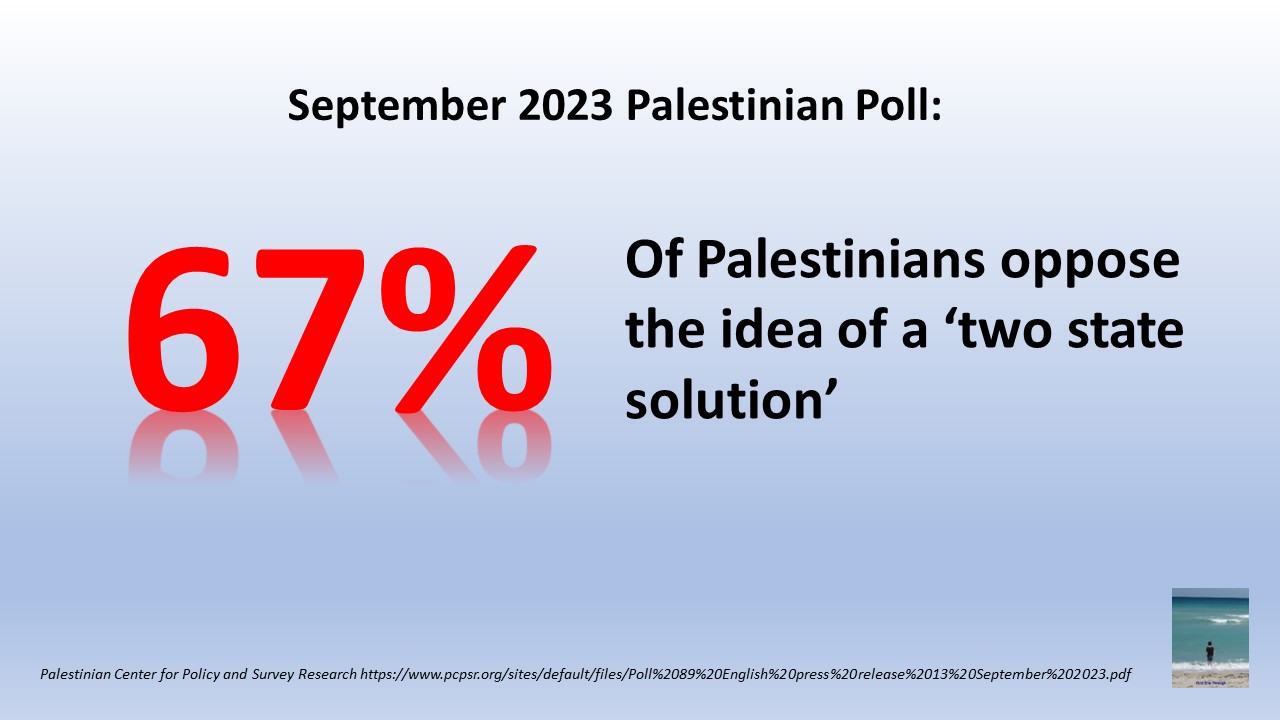
In many ways, the groups agree on much: only about one-third of Israelis and Palestinians supports a two-state solution, a percentage that has continued to decline since 2016. About 85% of both Israelis and Arabs do not trust each other, and 84% of each considers themselves the victim in the conflict. About 60% of each group fears for their safety, roughly 93% of each group believes that they are the rightful owners to all of the land, and about 70% of each thinks the conflict is a zero-sum relationship, in that what’s good for one side is bad for the other.
The areas with some gap in sentiments includes engaging in an all-out war, with an estimated 40% of Palestinians and 26% of Israelis in favor, and roughly one-third of Israeli Jews willing to share the land with Palestinians but only 7% of Palestinians willing to share any land with Jews.
That last figure – only about one in fourteen Palestinians Arabs are in favor of sharing any of the land between the Jordan River and the Mediterranean Sea – is frightening and should be read in the context of another question in the joint poll.
“When did the conflict begin?”
To read the news and consider the ideas floated to bring peace to the region, one would imagine that the respondents would answer “the 1967 Six Day War,” to the question when the conflict originated, as that is when “occupation” began and those are the contours proposed in the Saudi Peace Plan. Yet only 8% of Palestinian Arabs and 5% of Israeli Jews believe that is the beginning of the conflict.
A majority of both Palestinians and Israeli Jews (60% and 52%, respectively) believe that the conflict began with the Balfour Declaration in 1917 and the Zionist immigration wave. It is the increased presence of Jews in the region – with international support – that is the core of the conflict, and why only 7% of Palestinians would consider sharing any of the land with the Jewish “colonialists.”
Only Israeli Arabs don’t hold this position, as they believe the conflict began with Israel’s declaration of independence, which makes sense as that is when their reality began. Similarly, they are the group most likely to promote good relations between Jews and Arabs (70%), followed by Israeli Jews (56%). Almost no Palestinians want to promote good relations (22%), as it has been blacklisted under the banner of “normalization.”
Palestinians do not believe that the Arab-Israeli conflict is about land or religion. They believe it is about the physical presence of Jews in the land they view as singularly theirs. Until the world focuses on changing this jaundiced Palestinian viewpoint, there is no hope for a peaceful resolution.
U.S. Secretary of State Anthony Blinken is flying to the Middle East on a scheduled trip, that is coming days after a series of deadly attacks in the holy land. His responses thus far have been clear, unambiguous and morally correct.
After a Palestinian Arab gunned down seven Jews walking out of synagogue on Sabbath, Blinken issued a statement strongly condemning the attack:
“The United States condemns in the strongest terms the horrific terrorist attack that occurred today outside of a synagogue in Jerusalem. We mourn those killed in the attack, and our thoughts are with the injured, including children. The notion of people being targeted as they leave a house of worship is abhorrent. It is particularly tragic that this attack occurred on International Holocaust Remembrance Day.
“On behalf of the United States, I express our deepest condolences to the families of the deceased and wish those injured a full recovery. We are in close contact with our Israeli partners and reaffirm our unwavering commitment to Israel’s security.“
Earlier in the day, Ned Price, spokesman for Blinken offered the following in response to the Israeli raid into Jenin to root out Palestinian terrorists planning attacks, which left nine Palestinians dead:
“Today in Jenin, at least nine Palestinians, including militants and at least one civilian, were killed and over twenty injured during an Israeli Defense Forces counterterrorism operation against a Palestinian Islamic Jihad cell. We recognize the very real security challenges facing Israel and the Palestinian Authority, and condemn terrorist groups planning and carrying out attacks against civilians. We mourn the loss of innocent lives as well as injuries to civilians, and are deeply concerned by the cycle of violence in the West Bank. We underscore the urgent need for all parties to de-escalate, prevent further loss of civilian life, and work together to improve the security situation in the West Bank. Palestinians and Israelis equally deserve to live safely and securely.“
This is in sharp contrast to the liberal media which attempted to portray Israel as gratuitously killing Palestinians, while Jews just happen to die in land that Arabists believe should be Jew-free. It’s a welcome show of moral clarity which should be welcomed and appreciated.
Secretary of State Antony Blinken arrives to meet with Israeli President Isaac Herzog, not pictured, in Washington, D.C., on Oct. 25, 2022. Photo by Stefani Reynolds/Pool via REUTERS
The “cycle of violence” is continuing in the holy land, in a phrase that inappropriately conveys similarity.
Last week, the Israel Defense Forces went after a terrorist cell in Jenin which was planning attacks against Israelis. The gun battle resulted in nine dead Palestinians, seven of them terrorists.
Hours later, a Palestinian Arab shot and killed seven innocent Jews coming out of synagogue on the Jewish Sabbath. The terrorist was killed. The following day a 13-year old Palestinian shot and injured a father and son walking on the streets of Jerusalem on the Sabbath. The perpetrator was taken into custody.
There is no moral equivalence between the actions of Palestinians attacking innocent Jews and Israel defending its citizens. There is no equivalence of intent which is lost in the phrase “cycle of violence.”
While Israel has created a multi-ethnic democracy which has tried to live in peace with its neighbors, Palestinians continue to demand a purely Arab and Islamic region, ethnically cleansed of Jews.
Both the United States and Israel conducted raids on wanted terrorists in January 2023. Both countries killed about ten terrorists and escaped the raids without losing any soldiers. The Israeli raid also was reported by local Arab sources to have two civilian casualties, while no civilians deaths were reported by the U.S. military.
The New York Times covered the stories very differently.
The story of the U.S. raid was found at the bottom of the page. It had no pictures. The title read “U.S. Copter Raid Kills an ISIS Leader in Somalia,” which made the U.S. raid sound mechanical – as if done by a drone. The attack clearly took out a bad person, the leader of ISIS.
The article itself would only quote from the U.S. military. The reporters did not run around Somalia to talk to local people about whether the American claims were true and that no civilians were injured.
That is all in sharp contrast to the Israeli raid on the same day.
The Israeli story was featured at the top of the page with two large pictures, one of a funeral and another of “an elderly Palestinian mourner as the funeral procession began.” The article ran under the header “Israeli Troops Kill Several Palestinians in West Bank Raid.” In this case, there was no distancing of soldiers in the field as there was in the U.S. story. More significantly, the headline made the Palestinians appear as innocent civilians, rather than active terrorists.
The Times article was written by two Arab women, and featured many quotes from local Arabs who used inflammatory language about the raid to stop terrorist activity.
The New York Times is creating a fictional narrative that Israelis are wantonly killing Palestinian civilians to turn American support from the Jewish State. It is an example of the insidious anti-Zionism which has permeated liberal media and is instigating anti-Semitism on American streets.
Six Arab men stomp and pepper spray Orthodox Jew in Manhattan on way to pro-Israel rally in May 2021, calling him a “dirty Jew,” “F–k Israel,” and “Hamas is going to kill all of you.” Attacker sentenced to only six months in January 2023
If this sounds exaggerated, consider the Times headline the following day when a Palestinian Arab murdered seven Jews coming out of a synagogue on Sabbath.
For the anti-Zionist media, Israelis kill Palestinians but some “people” are dead from anonymous shots. Of course, this is a complete inversion of facts, as the Arab intentionally shot and killed innocent Jews, while Israel went to Jenin to capture terrorists.
The Times is maliciously lying to its readers and falsifying the Israeli-Arab Conflict.
Jodi Rudoren became known to many people during her years as the Jerusalem bureau chief for the New York Times. From that perch, she attempted to educate the paper’s liberal and international readers of the evil ways of the Jewish State which infect Palestinian society. She left the Times in July 2019 and became the editor-in-chief of the far-left Jewish paper, ‘The Forward’.
Who could have imagined that her invective could become worse?
On January 20, Rudoren published an interview she had with an affable Jewish actor named Joshua Malina, about his career on ‘The West Wing’ and other shows. One would imagine something light-hearted.
Ha.
She opened her Malina piece with some personal comments about The West Wing‘s fictional White House pondering Middle East Peace compared to reality today:
“Of course Netanyahu’s far-right and racist partners would not even consider the proposals for refugee resettlement and international control of parts of Jerusalem…. It is difficult to fathom these extremists even sitting for Shabbat dinner while their Palestinian counterparts pray outside.“
There was no such observation about the anti-Semitic, Holocaust-denying, Palestinian Arab terrorist neighbors.
After feeding (choking) the witness, Malina responded that while he was a “lefty” in politics, he had to contend with co-stars who were “super lefty.” These alt-left Jews (very much like Rudoren) were extremely aggressive, “particularly the Jews, the liberal Jews behind the scenes and in the cast, had a hard time finding space for the Israeli perspective. I remember trying to be a proponent of nuance.“
Perhaps sensing the rebuke, Rudoren responded “I, too, am a committed proponent of nuance.“
What a joke.
And sickness.
Jodi Rudoren, editor-in-chief of the Forward. Photo: David Packard
Two things struck me in reading the article.
First, however bad The New York Times was (and is) about portraying Israelis as racist, sinister invaders and murderers, and simultaneously absolving the Palestinians of even the most-heinous crimes and blatant anti-Semitism, the paper is actually BETTER than how liberal non-Orthodox Jews discuss Israel among themselves.
The second observation was that the woke believe they are nuanced. To imagine otherwise would presumably not be open-minded, a feature ascribed to the opposition. They believe that they have honestly assessed the situation and correctly concluded that religious people (only Jews and Christians mind you) are racists and close-minded at their core, embedded in right-wing extremism and nationalism. Progressives are not the counterpoint to people on the right reaching the opposite conclusion, but the only thinking party on the issues.
The righteous smugness and blindness of it all.
Progressive anti-Zionism has become common in politics, college campuses and mainstream media. Each is being fed the lines of the alt-right “Jews will not replace us,” by super-lefty non-Orthodox Jews like Jodi Rudoren and her counterpart at Haaretz, prepackaged and sanitized with the false banner of “nuance”.
Pitchforks and tiki torches are passé, and don’t burn into minds of the masses the way that the woke intelligentsia’s propaganda drip permeates society.
The Jewish anti-Zionist vanguard has given people a fast track to popularity and highbrow society, with easy anti-Semitic slurs which can be openly uttered in public. ‘The Forward’ is the Jewish fortune cookie which is unfortunately not read quietly, scoffed at and tossed, but read allowed, enjoyed by friends, and taped to a wall for posterity.
In the narrative war in the Israeli-Arab conflict, pro-Israel advocates often use the term “Judea and Samaria” instead of the commonly used “West Bank” in an effort to show that Jews lived in the land far longer than Arabs, and that Arabs are actually occupying Jewish land. While the rationale has merit, the approach does not.
Judea and Samaria
The Children of Israel came back to Canaan in the 12th century BCE. The land was allotted to the twelve tribes, in a division that was mostly stable for about 300 years.
Jan Jansson’s holy land map, 1630, which shows the migration of the Israelites from Egypt to the holy land, and the location of the twelve tribes.
After the death of King Solomon in 931BCE, the Jewish people split their kingdom under two rulers, creating the southern kingdom of Judah and northern kingdom of Israel. Sometimes fighting together against external foes and sometimes fighting internally, the kingdom of Israel fell to the Assyrians between 734 and 712 BCE from the Assyrian campaigns of Tiglath-Pileser III, Shalmaneser V and Sargon II. Sargon II swapped the population of the Jews and his kingdom in Babylon as told in 2 Kings 17:
בִּשְׁנַ֨ת הַתְּשִׁעִ֜ית לְהוֹשֵׁ֗עַ לָכַ֤ד מֶֽלֶךְ־אַשּׁוּר֙ אֶת־שֹׁ֣מְר֔וֹן וַיֶּ֥גֶל אֶת־יִשְׂרָאֵ֖ל אַשּׁ֑וּרָה וַיֹּ֨שֶׁב אוֹתָ֜ם בַּחְלַ֧ח וּבְחָב֛וֹר נְהַ֥ר גּוֹזָ֖ן וְעָרֵ֥י מָדָֽי׃ {פ} In the ninth year of Hoshea, the king of Assyria captured Samaria. He deported the Israelites to Assyria and settled them in Halah, at the [River] Habor, at the River Gozan, and in the towns of Media. (2 Kings 17:6)
וַיִּתְאַנַּ֨ף יְהֹוָ֤ה מְאֹד֙ בְּיִשְׂרָאֵ֔ל וַיְסִרֵ֖ם מֵעַ֣ל פָּנָ֑יו לֹ֣א נִשְׁאַ֔ר רַ֛ק שֵׁ֥בֶט יְהוּדָ֖ה לְבַדּֽוֹ׃ The LORD was incensed at Israel and He banished them from His presence; none was left but the tribe of Judah alone. (2 Kings 17:18)
וַיָּבֵ֣א מֶֽלֶךְ־אַשּׁ֡וּר מִבָּבֶ֡ל וּ֠מִכּ֠וּתָה וּמֵעַוָּ֤א וּמֵֽחֲמָת֙ וּסְפַרְוַ֔יִם וַיֹּ֙שֶׁב֙ בְּעָרֵ֣י שֹֽׁמְר֔וֹן תַּ֖חַת בְּנֵ֣י יִשְׂרָאֵ֑ל וַיִּֽרְשׁוּ֙ אֶת־שֹׁ֣מְר֔וֹן וַיֵּֽשְׁב֖וּ בְּעָרֶֽיהָ׃ The king of Assyria brought [people] from Babylon, Cuthah, Avva, Hamath, and Sepharvaim, and he settled them in the towns of Samaria in place of the Israelites; they took possession of Samaria and dwelt in its towns. (2 Kings 17:24)
Those new Assyrians who were settled in Samaria were told to follow Jewish religious customs, but they did not:
עַ֣ד הַיּ֤וֹם הַזֶּה֙ הֵ֣ם עֹשִׂ֔ים כַּמִּשְׁפָּטִ֖ים הָרִֽאשֹׁנִ֑ים אֵינָ֤ם יְרֵאִים֙ אֶת־יְהֹוָ֔ה וְאֵינָ֣ם עֹשִׂ֗ים כְּחֻקֹּתָם֙ וּכְמִשְׁפָּטָ֔ם וְכַתּוֹרָ֣ה וְכַמִּצְוָ֗ה אֲשֶׁ֨ר צִוָּ֤ה יְהֹוָה֙ אֶת־בְּנֵ֣י יַעֲקֹ֔ב אֲשֶׁר־שָׂ֥ם שְׁמ֖וֹ יִשְׂרָאֵֽל׃ To this day, they follow their former practices. They do not worship the LORD [properly]. They do not follow the laws and practices, the Teaching and Instruction that the LORD enjoined upon the descendants of Jacob—who was given the name Israel— (2 Kings 17:34)
There are many papers written by historians and archaeologists about Samaria during this time period, as there are written documents such as the Annals of Sargon II and prisms which reflect these battles, as well as a shift in types of pottery found with the population migration.
Judea refers to the province of the tribe of Judah which held Jerusalem and the area to the south. King Cyrus of Persia allowed the Jews to return to Jerusalem to rebuild the Temple in 538BCE, after Nebuchadnezzer destroyed the Temple in 586BCE.
The term “Jews” arose because they were the people of Judea. As noted above, Samaria was part of the region but inhabited by non-Jews who did not follow Jewish rituals.
The United Nations General Assembly voted to partition the holy land into a Jewish State and an Arab State in November 1947, but the Arab countries uniformly rejected the effort. Five Arab armies invaded Israel when it declared itself a new state in May 1948, and by the end of the war in 1949, Israel secured more land than conceived under the partition plan.
While the borders were not considered official under the 1949 Israel-Jordan Armistice Agreement, (“The Armistice Demarcation Lines… are agreed upon by the Parties without prejudice to future territorial settlement or boundary lines”), the Kingdom of Transjordan opted to unilaterally – and illegally – annex the region it had seized in an offensive war.
United Nations map showing the contours of the various Armistice Lines Israel signed with its neighbors to halt the fighting.
When Transjordan annexed the area on April 24, 1950, only the United Kingdom, Iraq and Pakistan recognized its actions while the rest of the world rejected it. After that time, during the years 1950 through 1958, the United Nations used various terms for that area which were tied to either Jordan or the Jordan River:
Then, in 1959, the United Nations seemed to embrace the de facto Jordanian annexation, referring to the area simply as “Jordan,” no different than the eastern part of the kingdom. To the extent that the U.N. wanted to specifically call out that area it used wordy terms:
“Jordan side of the armistice demarcation line”
“frontier villagers in Jordan”
That changed after Jordan illegally attacked Israel in June 1967 and lost the region. By the end of that month, the United Nations quickly moved to shorthand (A/6713) by the third mention:
“the West Bank of the Jordan”
“West Bank area of the Jordan”
“West Bank”
This shortened version for that area east of the 1949 Armistice Line has stuck at the U.N. and media parlance since that time.
Judea and Samaria Versus the “West Bank”
As reviewed above, Judea and Samaria and the West Bank are not the same. Judea and Samaria are historical names to much of the land, while the “West Bank” is a smaller, modern day creation due to an illegal act of war waged by Arab states upon Israel.
When people refer to the West Bank, they are only reviewing that part of the land that has been subject to negotiation between Israel and the Palestinian Authority, as laid out in the Oslo Accords, signed by both parties. They are not considering the broader reach of all of Judea and Samaria, which includes land west of the 1949 Armistice Lines inside of Israel.
If one does not like to give the term “West Bank” – an area that existed for only 18 years from 1949 to 1967 and named only upon its extinguishment – any legitimacy, then perhaps a better term would be “east of the Armistice Lines (EAL)”, to highlight that the contour of such region was created as a temporary measure to halt hostilities, was never intended to be a border, and has no historic significance.
Before Israel declared itself an independent state in May 1948, “Palestinians” were a mix of Jews, Christians and Muslims. At the end of the 1948-9 Arab-Israeli War, the region was divided and renamed. There were Israeli Jews, Christians and Muslims, but no longer any “Palestinians,” as the non-Israeli territory fell under Egypt (Gaza) and The Hashemite Kingdom of Transjordan (the west bank of the Jordan River). The term “Palestinians” for the United Nations came to only mean Arab refugees from Israel, who were then living either in Lebanon, Syria, Jordan, Gaza and Israel (the term Palestinian refugees inside of Israel was phased out by the global body in 1952).
Jordanians and subsequently, Former Jordanians
After Transjordan illegally seized control of the west bank of the Jordan River in 1949, it renamed itself as “Jordan”, now controlling both banks of the river. Jordan annexed that west bank land in 1950 and subsequently gave all the people who lived there – as long as they weren’t Jewish – Jordanian citizenship in 1954. These new Jordanians moved freely between both sides of the Jordan River and many opted to NOT take on the label of “refugee.” To wit, in June 1950, there were 506,200 refugees in Jordan, and that number shrank to 465,741 in June 1951, an 8% drop.
The new Jordanians were part of the force that attacked Israel in June 1967 and lost the eastern part of Jerusalem and all of the land Jordan illegally annexed in 1950. Jordan ultimately withdrew Jordanian citizenship from these West Bank Arabs in July 1988, when the Palestinians declared their independence, in a move not recognized by much of the world.
The former Jordanians are ruled by the Palestinian Authority, under the unpopular leadership of Mahmoud Abbas of Fatah. He has championed for more countries to recognize the Palestinian State and has secured the Muslim countries as well as several in Latin America. As the United States and western Europe have refused to recognize the country until it negotiates borders and other matters with Israel, they are viewed as stateless.
Meanwhile, Israel lifted the Jordanian ban on Jews living in the region. Israeli Jews now live throughout the area known as Area C, while they are still banned in Areas A and B under Palestinian Authority-control.
Hamas and Fatah have not been able to reconcile their differences over the past many years. Gaza remains an Islamic terrorist territory, and Areas A and B of the West Bank (handed by Israel to the Palestinian Authority) remain under control of the PA, for now. Should elections ever be held, it is likely that Hamas will win control of the PA and thereby take control of the former Jordanians in those areas.
One hundred years ago, “Palestinians” included a mix of Jews, Muslims and Christians living together. Today it means nothing. As Hamas controlled-Gaza and Fatah-controlled Areas A and B are completely distinct and there is no country of Palestine, the people should similarly be referred to differently, as Gazans and former Jordanians.
Isabel Kershner deposited an article in the international section of The New York Times on January 4, 2023 about an Israeli member of Knesset visiting the Jewish Temple Mount. It should have been posted in the opinion pages.
The article led off with a comment lifted from the Muslim Arab world that Itamar Ben-Gvir’s visit to the holy site was “provocative.” Kershner used the term three times (highlighted in red boxes above). The visit was nothing of the sort. The Temple Mount has standard visiting hours as it did when Ben-Gvir visited on Tuesday.
That was unmentioned in the article. Instead the article was replete with characterizations of Israel as full of “right-wing” and “hard-line” extremists unfairly punishing Palestinian Arabs, rather than Israelis trying to live a normal life with genocidal anti-Semitic neighbors.
After Kershner said that Ben Gvir was provocative, she added this:
“The visit under heavy guard to the site – a frequent flash point in the Old City of Jerusalem where past Israeli actions have set off broader conflagration – was the first by such high level official in years and passed without incident. But coming two days after Mr. Ben-Gvir took office, it was an early indicator of the difficulties Israel’s new government , its most right-wing and religiously conservative yet, will face in the domestic and global arenas.“
This is a complete inversion of victim and aggressor. A visit by a prominent Israeli Jew to the holiest site in Judaism during regular visiting hours was not the trigger for violence, any more than a woman who rejected an unwanted incel’s advance deserves to be attacked. Adding the clause that Israel’s government is politically and religiously right-wing while saying nothing about the Islamic terrorist groups further paints Israelis as instigators of violence.
The picture accompanying the article showed many “Israeli security personnel” surrounding the visitors, but the article failed to report that Jewish visitors are frequently assaulted during their visits by radical Islamists. The security personnel were not just “near visitors” but there to guard Jews from marauding jihadists.
Kershner’s article continued in the same noxious vein. She wrote that Israelis had “a nationalist and religious agenda,” and held “hard line policies,” and Ben-Gvir “support[ed] a terrorist group.” She failed to mention that Hamas is a recognized terrorist group by the United States which seeks the destruction of Israel. She did not write about the Palestinian Authority’s “pay-to-slay” terror-incentive program. She ignored Palestinian polls which show half of all Palestinians supporting the murder of Israeli Jews in their homes, and ADL polls which shows that almost every Palestinian is an anti-Semite.
Quite the opposite. Her opinion piece masked as reporting said that Israelis are “hard liners” and Arabs are peaceful victims.
Kershner claimed that former Prime Minister Ariel Sharon ignited the “second Palestinian intifada”, when it was actually deliberately launched by Yasser Arafat in the collapse of the Oslo Accords in which he led the slaughter of over 1,000 Israeli civilians in hundreds of terrorist attacks (also unmentioned). She said that Israel’s new government had an “uncompromising approach to the Palestinians,” as if terrorism and threats to murder deserve a compromise.
Perhaps only kill Jewish males and leave the females alive, like the Egyptians in the bible?
To underscore Kershner’s fake narrative on the peaceful ways of Muslim Arabs regarding the Jewish Temple Mount, she added this bit of malarkey:
“the [Temple Mount] compound was conquered by Israel during the Arab-Israeli War of 1967. Under an uneasy arrangement that has prevailed for decades under Jordanian custodianship, Jews are permitted to visit, as are non-Muslim tourists, but they are not supposed to pray there.”
This fantasy narrative for the ignorant has Israel forcefully seizing the Temple Mount and the Jordanians giving Jews and other non-Muslims the right to visit.
The Times is lying to its readership and inverting history.
The reality is the Jordan attacked Israel in 1948, ethnically cleansed all Jews from the Old City of Jerusalem, destroyed the synagogues and illegally annexed the Temple Mount compound, the Old City of Jerusalem and Judea and Samaria. During the eighteen years 1949-1967 while Jordan illegally held the Temple Mount, it barred Jews from even visiting the western wall/ Kotel, let alone the Temple Mount. Jordan attacked Israel again in 1967 and Israel took the Old City in a defensive battle. The Jewish State granted Jordan administrative rights on the Temple Mount while it provided security.
In short, it is Israel – not Arabs – which has tried to create a system of coexistence in the holy city and holy places, exactly the opposite of NYT reporting.
It is seemingly insufficient that Jews must fight to survive among genocidal jihadists in the Middle East and anti-Semites in the diaspora. Mainstream media is working to ensure that Jews will be hamstrung in public opinion, as the anti-Zionists attempt to sever the ties of the Jewish State’s critical backer, the United States, and leave Israel isolated among those hell-bent on its destruction.
Each society makes rules to govern its citizenry. It considers the tastes and preferences of its inhabitants and tries to balance enabling human rights and the maintaining of public order. Some countries opt to ban certain activities if they might lead to violence, while others believe that human expression cannot be stifled because of the reactions that might ensue.
The world has seen this play out in the recent past, with an interesting wave of defenses and condemnations.
Charlie Hebdo Drawings of Mohammed
France is a deeply secular society that prizes its freedoms, including freedom of the press. It was perfectly legal for a French satirical magazine, Charlie Hebdo, to draw pictures of the Islamic prophet even though it was highly provocative and upsetting to devout Muslims. Indeed, several Islamic radicals shot up the magazine’s headquarters, killing many of its writers. As part of the jihadists’ derangement, they followed up on that violent vengeance with a visit to a local kosher store to slaughter Jews who had nothing to do with the cartoons.
The western world rallied to the defense of France, with global leaders marching arm-in-arm in defense of freedom of expression and against reactive violence. The provocative nature of the drawings was dismissed as irrelevant.
World leaders march in support of France and freedom of expression in January 2015 (Photograph: AFP)
Gay Pride Parade and Israeli Pride Marches in Jerusalem
The city of Jerusalem is both holy and contentious. It is the holiest city for Jews, the third holiest city for Muslims, and holy for Christians who don’t rank cities as commonly as Jews and Muslims.
It is also a politically sensitive city. Recommended to be an international city (along with Bethlehem) by the United Nations General Assembly in 1947, it became divided between Israel and Jordan in the 1948-9 Arab-Israeli War. After Jordan attacked Israel again in 1967, the reunited city became completely Israeli, even while much of the world still considers it to be international or under negotiations for a final settlement.
The holiness of the city makes the annual gay pride parade offensive to many religious Jews, Muslims and Christians. While legal, the provocative nature of holding the event in Jerusalem has sparked violence, such as occurred in July 2015 when a Jewish man just released from a mental hospital, stabbed six people, killing one. The public condemned the violence and defended the right to parade.
For their part, proud Jewish nationalists flew Israeli flags through Jerusalem, including in predominantly Arab sections of eastern Jerusalem, to mark the reunification of the city. When Palestinian groups claimed the parade was “provocative” and threatened violence, the United States asked Israel to reroute the march away from Arab areas, an action it did not take for the gay parade.
Both legal marches went on as planned, with left-wing groups labeling the nationalist march as provocative, and right-wing groups stating the same about the gay parade.
Israeli Jews on the Temple Mount
In sharp contrast to the legal actions above which are defended, the fundamental human right to pray at a holy site is deemed illegal and condemned. At least, only for Jews in Jerusalem.
The central point of prayer and holiest place on earth for Jews is the Jewish Temple Mount in the Old City of Jerusalem. Jews around the world pray facing it, and many around the world make a pilgrimage to Jerusalem three times a year, as commanded in the Jewish Bible.
It has historic significance as the place where two Jewish Temples stood, and deep relevance today, especially to Orthodox Jews.
Jews have a basic human right to pray at their holiest location, as detailed in the Universal Declaration of Human Rights. Even more, they have an accepted right to visit the Jewish Temple Mount according to rules laid out by the Islamic Waqf which has administrative rights on the compound.
But Arab extremists want to have none of it.
Wafa, the official Palestinian news site said “Israeli Jewish supremacist Minister of National Security, Itamar Ben-Gvir, Tuesday stormed the compounds of al-Aqsa mosque in the occupied city of Jerusalem under heavy protection from the Israeli forces.“
The political-terrorist group Hamas’s news site said “Ben Gvir’s incursion into the Al-Aqsa Mosque courtyards on Tuesday morning constitutes a grave violation against the Palestinian people and their holy sites.” It condemned and mocked other Jews praying outside of the Temple Mount as “settlers [who] organized provocative dances and performed Talmudic rituals in the Old City and near Al-Aqsa Mosque.“
Jordanian Foreign Ministry spokesman Sinan Al Majali said “The storming of the blessed Al Aqsa Mosque by one of the Israeli ministers and violating its sanctity is a provocative, condemned move.“
National Security Minister Itamar Ben Gvir quietly visited the Temple Mount on the Jewish fast day of the 10th of Tevet, January 3, 2023. (Courtesy Minhelet Har Habayit)
While not directly condemning Ben-Gvir’s visit or mocking Jews who pray in Jerusalem, the US Embassy in Jerusalem said that Ambassador Thomas Nides “has been very clear in conversations with the Israeli government on the issue of preserving the status quo in Jerusalem’s holy sites. Actions that prevent that are unacceptable.”
It is deeply disturbing that Israeli Jews visiting their sacred site is greeted by condemnation by not only radical Islamists, but by the western media and governments. Did those same people argue for the “status quo” of banning gay marriage? Segregation? Why do liberal values melt before jihadi zealots when it comes to the Jews?
Jews visiting and praying on the Temple Mount do so because the site is dear to them, not to antagonize Muslims. The people who condemn Jewish visitation and call it and act of “provocation” are not simply echoing radical Islamist propaganda, but denying Jewish history and Judaism itself, while simultaneously trampling on a basic human right.
Palestinian Arabs and their supporters claim that they have a “right of return” to towns in Israel based on two principles. One is the Universal Declaration of Human Rights (established December 10, 1948) and the other United Nations General Assembly Resolution 194 (issued the following day, December 11, 1948). These are grossly misapplied, and if anyone wants to see a peace agreement between Israel and the Palestinian Authority, this issue is a complete roadblock.
UDHR, Article 13
Article 13 of the UDHR makes two statements that Palestinian propagandists assert give Palestinians the right to move into Israel:
Everyone has the right to freedom of movement and residence within the borders of each state.
Everyone has the right to leave any country, including his own, and to return to his country.
Regarding the first point, the freedom of movement is “within the borders”, meaning that any Israeli Jew or Arab should be free to live anywhere inside of their home country of Israel. This clause has nothing to do with Palestinian Arabs or wards of UNRWA who live outside of Israel. It simply means that Israeli Arabs should be free to move into Israeli towns – where grandparents may have lived or entirely new locations – as long as there are no security matters which render such movement impossible.
As it relates to the second point of leaving and returning to a country, there are two issues with Palestinians using this clause to move to Israel: the people and the land.
Israel is a new country, founded on May 14, 1948. There are only an estimated 20-30,000 elderly Arabs who lived in Israel on that date who now reside outside of the country’s recognized borders. The other 14 million Palestinian Arabs were born elsewhere and have no such claim to “return” to Israel, including the 6.4 million registered persons with UNRWA.
The second related matter has to do with the borders of Israel. If one were to take the non-factual view that the land of pre-1948 Palestine is a single country (it was a region / territory), then the millions of Arabs living in Gaza and the West Bank today still live in that same country, so there is no argument under the second clause. Only the Stateless Arabs of Palestine (SAPs) in Lebanon, Syria and Jordan could argue to move into Israel, Gaza or the West Bank. The right of return in UDHR relates to returning to a country, not a particular town or region.
UNGA Resolution 194, Article 11
As opposed to the general UDHR meant for all people, UNGA Resolution 194 was specifically adopted for Palestinians. Article 11 calls out the matter of returning to “homes,” not a country as specified in UDHR:
“Resolves that refugees wishing to return to their homes and live at peace with their neighbours should be permitted to do so at the earliest practicable date, and that compensation should be paid for the property of those choosing not to return and for loss of or damage to property which, under principles of international law or equity, should be made good by the Governments or authorities responsible.“
At the most fundamental level, General Assembly resolutions are simply suggestions and not binding in law. Israel is not beholden to GA resolutions.
Critically, Palestinians have shown in deeds and words since the founding of Israel that they are not willing to “live at peace with their neighbors.” Add to the fact that only 20-30,000 people at this time are actually “refugees” makes this resolution relatively meaningless in application.
Two State Solution
Those people who back the notion of a “two-state solution” for the Israeli-Arab Conflict, with one state for Jews and one state for Arabs, should be appalled at the idea of a Palestinian “right of return” to the Jewish State. The Jewish State currently has 25% of its citizenry being non-Jews. It would destroy the basic principle of the “two state solution” for millions of Arabs to enter Israel. It is even more outrageous, when the United Nations demands that NO JEWS be allowed to live in a future Palestinian State. There’s no two-state solution if 50% of the Jewish State is comprised of non-Jews and 0% of the Arab State has Jews.
One State Solution
For advocates who argue for a single Jewish-Arab country and that Palestine was always a singular country, there are a couple of considerations.
One, Arabs in the West Bank and Gaza already live in such country, so are not and have never been “refugees” but just internally displaced people, taking billions of dollars from the world’s largess over the past decades. Resolution 194 Article 11 is specifically for refugees which excludes Arabs in Gaza and the West Bank. Only UDHR 13.1 would argue for freedom of movement within the single country, if security matters permit.
Secondly, there is only return to a country under UDHR 13.2, not to villages where grandparents once lived. Allowing refugees from Lebanon, Syria and Jordan to move to the West Bank or Gaza satisfies this clause as much as moving inside the borders of Israel.
Palestinian Sentiment
Importantly, Palestinians have no interest in either of these solutions. According to the PCPSR December 2022 poll, only 32% of Palestinians support a two-state solution and 26% support a one-state solution with equal rights for Jews and Arabs. That compares to 55% who favor terrorism against Israelis, to destroy the Jewish State and replace it with a single Arab state. It’s outrageous for Palestinians to demand the right to move to homes under UNGA Resolution 194, and skip the basic premise of coexistence that the resolution demands.
The poll also showed that the right of return issue was the second most important issue for Palestinian Arabs, behind establishing a state. The fact that UNGA Resolution 194 requires coexistence while Palestinians support new armed gangs can only be viewed as an attempt to better infiltrate and take over the Jewish State, as part of establishing a new Palestinian State.
Sentiment of Israeli Arabs
When polled in June 2018, Israeli Arabs were the most likely to cap Palestinian refugees coming to Israel (the proposed question used a figure of 100,000 people) with the balance going to a new state of Palestine and getting compensation for lost property. A whopping 84.1% of Israeli Arabs supported such limited “right of return”, compared to 21.3% of Israeli Jews and 47.5% of Palestinian Arabs. When offered a different formulation in which a capped number of Palestinians would get permanent resident status but not citizenship in Israel, and Jews in the West Bank would similarly get such status in a new Palestinian State, Israeli Arab support (63.8%) dwarfed that of Israeli Jews and Palestinian Arabs with 36.1% and 31.7%, respectively.
Beyond the differences in granting a Palestinian “right of return” among Israeli Arabs, Jews and Palestinian, the same poll showed a big difference in support for a two state solution. Not surprisingly, no Israeli Arabs favored the idea of “apartheid” or expulsions of the other, while 14.9% of Israeli Jews voted in favor of minimal rights for Israeli Arabs, and 17.2% of Palestinians favored expelling all the Jews from the region.
SAPs in Lebanon, Syria and Jordan
The Stateless Arabs from Palestine (SAPs) only poll people in Gaza and the West Bank where the Palestinian Authority and Hamas have control and self-determination, having been given land to administer by Israel. The SAPs who might have some actual claims under UDHR and UNGA Resolution 194 are those in Lebanon, Syria and Jordan as described above but were not polled.
Almost all of the SAPs in Jordan have Jordanian citizenship so cannot be considered “refugees.” Jordan illegally annexed the West Bank after the 1948-9 War against Israel, and granted all Arabs living there citizenship– as long as they were not Jewish – in 1954. Palestinian-Chileans have the same non-claim to move to Israel as these Palestinian-Jordanians.
The Palestinians who might be considered “refugees” with rights to move to the holy land are those elderly Palestinians who left Israel in May 1948 and now reside in Lebanon and Syria, countries which have denied them citizenship for almost their entire lives. Of the 1.2 million SAPs in those two countries (18.8% of the total people getting services from UNRWA), around 2% are over 75 years old and would qualify to move to Israel under UDHR Article 13.2, and under UNGA Resolution 194, Article 11, if they are willing to live with Israelis in peace. While it is well understood that Palestinian Arabs in the West Bank and Gaza have no desire to live peacefully with Israelis, it is possible that those in UNRWA camps in Lebanon and Syria might.
If one advocates for a two-state solution, one must simultaneously be against a Palestinian “right of return” for any Arab other than the elderly living in UNRWA camps in Lebanon and Syria. All other Palestinians wishing to return to the region would need to move to Gaza or the West Bank under the approval of the Palestinian Authority. This has long been the logical bipartisan approach of both Democrats and Republicans.
In summary, there are very few people who qualify for a Palestinian “right of return” and there is very little support for, or belief that it can be implemented peacefully amongst the people in the region.