My Big Fat Passover Program – US Edition

A satire.

This year’s Passover excursion kept us in the United States. American programs tend to be much larger and more expensive since the law of large numbers doesn’t seem to apply to matzah. This one was the same: 1,300 people spending $25 million, while complaining about the yeshiva tuition and shidduch crises.

Despite the price tag for a single room which could have purchased a small car (pre-tariffs), my family couldn’t pass up the opportunity to spend ten days with 33 extended family members, including 14 children under 10 years old. The challenge of migraines versus memories was too enticing to pass over.

Our small tribe descended on the destination “resort” nestled 47 minutes from civilization in desert foothills with panoramic views of ugly sand and rocks. The 99 degree heat baked every living thing except for snakes which blended into the brown landscape. We ran inside to escape the sun and scenery.

The hotel “lobby” had a couch and two chairs, insufficient for my immediate family let alone 1,300 other guests. It appeared that we were going to be left with few choices for hanging out together: either in the dining room, tea room, shul or our own rooms.

We grabbed keys and programs and headed to our rooms to unpack 75 outfits.

All of the rooms were essentially “suites” with a small living room which looked great for late night reading. However, the bathroom was so small that the door bumped into the toilet seat, so one needed to shimmy around the door and place a foot in the bathtub to enter. As I extended my hand to grab the shower door for balance, I actually grabbed a fistful of curtain. I let out a small shriek and heard someone next door do the same. A chorus of “a shower curtain?!” could be heard echoing through the halls.

Our horde unpacked and changed for the first of forty meals. On American programs, people seemed extra intent on getting their money’s worth by gorging non-stop. It was especially true at this location, as rooms normally go for $109 per night.

The first dinner was set up as a barbeque outside. The pieces of steak were larger than our plates to make us forget that the program lacked vegetables. It was delicious and set the stage for a carnivorous vacation theoretically focused on small tasteless pieces of flatbread.

We awoke early the next day and rapidly learned who was going to attend prayer services and who was tasked with looking over small tykes while their wives slept. We created a mini-WhatsApp group apart from the broader family chat to notify each other about minyan times and where to grab a nosh. There was a short back-and-forth about whether to label our chat “The Minyan 7” or “Tallis Toters” and settled on The “XYs” as none of the women attended other than for yizkor.

The conference room turned shul could seat 500 people, so the 70 men and 3 young women who came home from seminary in Israel had plenty of room, if not heat or decent lighting. The first ba’al tefillah launched prayers with “she asani aved” thanking God for making him a slave, dropping the important “not” in the blessing, making people wonder whether he had sold a kidney to pay for the program or was trying to set the mood for the Passover story of liberation.

The hashkama minyan flew by quickly, allowing people to enjoy another four hours of breakfast. It was our chance to see our family’s designated table for the holiday which occupied one-third of the dining room, a behemoth square of 28 feet a side. We had the staff reconfigure the table for the other meals so we could hear each other, but the reality of eating in a room with 1,000 other people including screaming children made a conversation beyond five feet impossible anyway.

The buffet in the center of the large hall was arranged as follows: wine table, omelet or carving station depending on the meal, various hot dishes, omelet/carving, hot dishes, omelet/carving, hot dishes, omelet/carving, hot dishes, and at the very back of the room, a small salad table with hearts of palm and shredded carrots. Perhaps the caterer didn’t want to check vegetables or wanted all-brown meals like the desert outside.

On rare occasion, there was plated food when we arrived, once consisting of gefilte fish with horseradish together with seared tuna and wasabi. If it was intended to placate both the Ashkenazi and Sephardi crowds it didn’t work as my Syrian niece threw up at the sight.

For some reason, despite the enormous quantity of cooked animal flesh at lunch and dinner, the dessert table only had 20 cookies. Everyone assumed we were being encouraged to head to the tea room for sweets so the staff could set up for the next meal.

We obliged and ran over to see what was in store.

Regrettably, it seemed that some guests had paid off staff to seize all the Bisli for their entourage. The rest of the attendees made due with “tropical” ices that tasted like antifreeze and various chocolate snacks that varied more in shape than flavor.

When snack time was over we were at a loss for what to do. We went to one of the pools to watch the water evaporate before our eyes. We then hunted for shade and were informed that the indoor cabanas were already reserved by guests for $12,000 for the week, a pretty penny to watch White Jews combust but many seemed content to do so.

My wife went looking for one of the shadchanim “matchmakers” to discuss our boys and various single friends. The boys refused to engage in the “meat market” and opted to sit at the poolside barbeque and talk to girls there.

People were kvetching that the program last year in the Caribbean was much nicer in terms of hotel and food quality. As one person voiced her disagreement, she was cut off by a loud thump of an older couple tripping on the broken cobblestone pathway, crashing to the ground. It would be the first of seven hospital calls during the holiday. By the last day of chag, thirteen orange cones dotted the heavily-trafficked walkway.

For shabbat, we were handed a few velcro strips to disable the electronic door locks. Later in the week, I saw some men using them to extend their belts to accommodate their bulging waists.

During shabbat and yomtov prayers, the program auctioned off aliyahs for different charities. It got more people to attend the earlier hashkama minyan in hope for a better deal. Az Yashir went for $5,000 at hashkama, but the winner didn’t realize he had to hand the aliyah over to the program’s rabbi. It crushed the fundraise for the next much larger minyan and people wouldn’t go above $100. I suggested bridging the tzedakah gap by bidding out the right to be the sole person to yell “ka’eleh” during the second torah reading, as the masses cannot keep themselves from drowning out the ba’al koreh.

The night activities alternated during shabbat and yomtov on talks about Israel at war, antisemitism and rabbis put into herem for heresy. Very uplifting and spiritual. During chol hamoed, the nights alternated between unfunny young comedians ripping off older comics’ material, to a couple of Sephardic singers singing the same popular four songs that they didn’t write. The band behind them pretended to play various instruments while their prepared music mix blared for the stablehands six miles away. It was the Israeli version of Milli Vanilli.

And the kids loved it. They cheered their Instagram star despite his lack of stage presence and joined the 45 year old bearded male singer when he asked for girls under 14 years old to join him on stage.

For some reason, I think I was the only one to find the spectacle creepy.

As the three-day shabbat-yomtov continued, people bemoaned their Wordle streaks ending. The various right-wing speakers suggested to all that it was a perfect time to terminate their New York Times subscriptions.

People slowly became aware that the entire hotel was not reserved for the Passover guests. Loaves of bread were in the hallways and a Christian wedding party which booked the second weekend created a stir. A ruckus broke out when the hotel insisted that all Jews leave the pool area for the wedding. Fewer men complained the following day when tall blonde women came out in their bikinis.

The Latin staff seemed nonplussed by everything and kept smiling. The Jewish staff looked perpetually perturbed by the incessant demands of one thousand over-entitled kvetches from friends and neighbors.

Overall, the holiday was a win. Getting so many family members together for a week is an accomplishment in itself, and there were no major blowouts. We had a chance to meet some nice new people and collectively discover why Jews left the desert over 3,300 years ago.

Related article:

My Big Fat Passover Program (April 2023)

The Provenance Of Jews

In the world of archaeology, there is nothing as prized as finding something in situ, meaning in its original place. The location helps provide archeologists with clues as to the surroundings’ age and usage, who lived in that location and the nature of society. Once an item moves, critical details of the environment are lost forever.

From that moment, the provenance is often a curiosity. Who owned the item and for how long? How did it come to find its way into this collection or that museum and what happened to the artifact over this time? These matters are often used to prove the subject’s authenticity, by tracing it back without interruption to the point of discovery.

When it comes to works of art (rather than archeological finds), provenance is less of a curiosity. Experts and viewers mostly focus on the art itself as well as the artist. The visual and message are the primary matters, not the journey of the art onto a museum’s wall.

Yet there are stories too remarkable to ignore. Sometimes the provenance is as much of the subject as the art itself, even reorienting the very perception of the artwork to modern viewers.

A Dutch Masterwork, As Seen By A Jew, A Nazi And Complicit Government

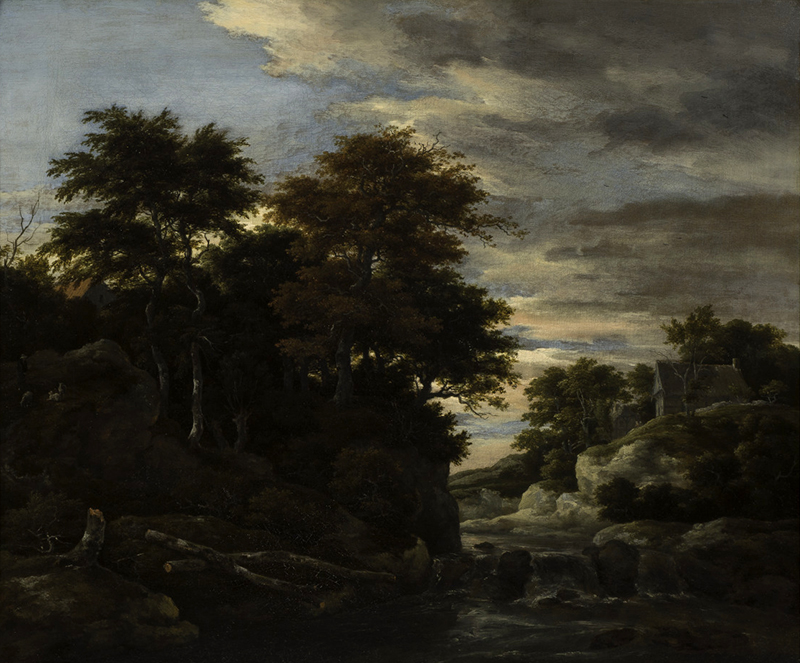
Consider the painting A River Landscape with a Waterfall (1660) by Jacob van Ruisdael (1628-1682).

A River Landscape with a Waterfall (1660) by Jacob van Ruisdael (1628-1682).

Van Ruisdael was considered among the greatest landscape painters of the Dutch Golden Age. While his peers Johannes Vermeer (1632-1675) and Rembrandt (1606-1669) mostly painted people, Van Ruisdael painted scenes of nature.

In A River Landscape with a Waterfall, we see the artist’s work with contrasts. The right side of the painting is illuminated by the setting sun, with a solid house on a hill set under clouds. To the left is dark scene in the shadow of the sun. Broken branches lay on the rocks and a hint of a house protrudes from the standing leafy trees. A barely perceptible person makes his way towards that house before sunset. A stream separates the two sides of the painting with a small waterfall.

This is one of many waterfall paintings by Van Ruisdael during the middle of his life. Of them all, this one is the most serene, with the title’s inclusion of “river” and “waterfall” seemingly an exaggeration of a modest calm landscape.

The story of the painting’s journey to the Phoenix Art Museum where it is exhibited today was anything but calm.

In the mid-1930s, the painting came into the collection of Jacques Goudstikker (1897-1940), a Jewish Dutch art dealer who was among the foremost collectors of Old Master works. When the Germans invaded the Netherlands in May 1940, Nazi military leader Hermann Göring confiscated Goudstikker’s collection. Over the course of the war, Göring is estimated to have amassed over 4,000 works of art. Most of the art was taken from France, including from the Rothschild family. Goudstikker’s collection made up a sizable part of the non-French collection, as he was partial to landscapes and the Old Masters.

Jacques Goudstikker (1897-1940), a Jewish Dutch art dealer

As the war started, Goudstikker fled Holland with his wife and one year old son. They first went to England and then caught a boat to the United States. On the ship to America, Jacques accidentally walked into an open hatch and plummeted to the ground below, dying instantly. His wife and son made it to America without him.

At the end of the war, the Dutch government confiscated the looted Nazi art. Most of the paintings did not find their way back to the rightful owners as there were few notes about the provenance of each work. However, because Goudstikker was a leading arts dealer, he had ledgers with each work, including this Van Ruisdael painting. Despite the clear markings on the back of the painting with Goustikker’s seal, and Goustikker’s wife and family showing records of being the proper owners, the Dutch government would not release the painting to the family until 2002, 57 years later. The family sold the painting in 2007 to a doctor in Phoenix, Arizona who donated it to the Phoenix Art Museum in 2022, where it hangs today.

During World War II, private art collections like Goustikker’s were often seized by the Nazis, while those from public museums were better able to protect the most prized works.

To mark the 80th anniversary of the liberation of the Netherlands, the Mauritshuis public art museum in The Hague is having an exhibition until June 29, 2025 called “Facing the Storm – A Museum in Wartime.” It relays the efforts taken by the museum to hide its most valuable art from the Nazis. As described by the museum, “The exhibition will devote attention to the travels of Vermeer’s Girl with a Pearl Earring during the war. The Mauritshuis had a bombproof ‘art bunker ’ in which it would store all its masterpieces overnight, bringing out a few – including the Girl – during the day…. During the course of the war, the most important works of art were taken to the various ‘National Storage Facilities’, where they remained until the war ended. During this time, the gallery walls at the Mauritshuis were a sorry sight, lined as they were with empty frames.” During some of the public showings during the war, Hitler featured his personal paintings and his book Mein Kampf alongside the museum’s Dutch masters.

Moving paintings from Dutch museum to hide from Nazi theft and bombings

There was a split dynamic between public and private museums as well as viewing art during the day and night during the war in Holland. Private collections were seized and public collections were hidden at night. When collections made it to the light of day, they were used as propaganda for Dutch residents and the enjoyment of Nazi officers who were able to walk the streets freely. Empty frames were like the disappeared Jews of Holland, perhaps hidden away like Anne Frank and her family, or shipped to Nazi concentration camps for liquidation.

Empty frames at the Mauritshuis museum in The Hague, July 1944

The background story and provenance of the Van Ruisdael painting is very much part of viewing the painting today. The pastoral scene of light and darkness owned by a Dutch Jewish family on the eve of World War II was seized – and enjoyed – by Nazi criminals. After the defeat of the Nazis, the Dutch government held onto the artwork and would not return it to the Jewish family which had to flea across the ocean to survive the Holocaust, even as the man who owned the painting did not survive.

To view the painting with such knowledge, the stream becomes an ocean which the Goudstikker family crossed to save themselves. They left their open, illuminated and public house on a hill for an unknown future. Indeed, Jacques’ untimely death during the journey is like the broken branches in the foreground of the painting.

The home and art the Goudstikkers left behind became a showcase for Nazi propaganda, like the house on the right side of the painting enjoying the full setting sun and completely exposed to the world. The dark left side of the painting are the works of art and the Jews of Holland who were hidden and transported to death camps, or perhaps they were lucky to leave the war early like the Goudstikkers, attempting to find a new uncertain home across the ocean. And even when they made it safely to the other side, did they get to enjoy their freedom, or were they fighting for their basic rights and property, such as against the Dutch government who would not surrender their art?

A painting made in the 17th century can be understood anew hundreds of years later because of its provenance. Journeys can shape the subject.

That is most certainly true of Jews, especially on Passover.

Passover Seder As Seen By A Guest

It is a tradition for hundreds, if not thousands of years to invite someone to a Passover seder. Inviting a guest unfamiliar with the story of the Jewish Exodus from Egypt over 3,000 years ago – especially for meals that do not have any children present – provides an opportunity to tell the story of the Jewish journey from slavery to freedom, and from Egypt to the Jewish Promised Land.

The seder uses a Haggadah, a standard text used by Jews around the world, which not only discusses the Exodus, but prior generations telling the story of the Exodus on Passover. The seder is both a story FROM 3,000 years ago at the point of origination, as well as the journey of that story over the intervening years until today.

The guest at the seder is not only learning about ancient Jewish history but seeing and hearing the provenance of that history.

A person can read the bible at any time of year to get a clinical understanding of the Exodus from Egypt. However, to sit at a seder is to see the redemption of Jews in a new light, incorporating the journeys they have taken over the centuries.

The story of the Exodus and the journey of Jews for millenia are too remarkable to ignore. Viewing both simultaneously is the magic of Passover, a gift for everyone attending a seder.

Related articles:

When Our History Begins (December 2022)

The Haggadah as Touchstone for Harmony (April 2022)

Prayer of The Common Man, From Ancient Egypt to Modern Israel (January 2021)

The Jews of Jerusalem In Situ (April 2019)

The Beautiful and Bad Images in Barcelona (March 2019)

Delivery of the Fictional Palestinian Keys (May 2015)

The World Zionist Congress Is Ideological, Not Regional

The World Zionist Congress is holding elections now through May 4, 2025.

To read the news, one would think that this is a matter of Jews around the world getting to vote for Jewish and Israel-related matters, with each country getting a vote based approximately on the percentage of the Jewish population in that country. For example, the United States which has roughly 40% of global Jewry gets 152 of the 525 delegates at the WZC (29%) and Israel get 38%. There are only 13 other countries which are participating in the elections which will get 33% of the delegates: Romania, Canada, Argentina, South Africa, Venezuela, Sweden, Spain, France, Peru, England, Hungary, Brazil, and Uganda. Israel gets the majority of delegates.

The allocation based on country would suggest that countries represent a unit but that is far from the case. The 22 US slates are competing aggressively AGAINST each other with religious right and left attacking the other, as well as political left and right. The handful of centrist parties tout unity to appeal to the middle swath of Jews.

The reality is that religious and political affiliations and philosophies are driving the delegates, not their countries of origin.

Consider Jamie Geller, an American influencer who moved to Israel several years ago. Despite not living in the US, she is using her platform from Israel to try to get the vote out for Aish Ha’am in America, in which she says she chairs the advisory committee.

The surprising big winner of the 2020 WZC US election was Eretz Hakodesh which had over 20,000 votes and secured 16.2% of the American delegates. The enormous slate of delegates in 2025 – multiples larger than any of the 22 slates – is packed with ultra-Orthodox rabbis and influencers who are directing their communities to vote for that slate. Much of the community is opposed to the secular nature of the State of Israel and look at local rabbinic positions that support (like Rav Avrohom Gurwicz, Rosh Yeshivas Gateshead) and oppose (like Rav Malkiel Kotler from BMG in Lakewood) participating in the election, but also look at international opinion (like Rabbi Dov Landau of Bnai Brak who opposes voting).

The center and right in Israel are not the only influencers on the American votes. The left-wing flank, consisting of A New Union, Hatikvah, Arza-Reform and Jewish Future, have gotten Israelis like Yair Golan of the Democrats Party, to lobby votes for left-wing slates.

The global nature of lobbying makes sense. After the elections, all 525 delegates will be together for votes regarding priorities and allocation of resources. The country of origin makes much less difference over the next five years.

Which leads one to conclude that the enormous effort placed on the US elections is misplaced tactically.

While Israel and US Jewry account for over 80% of world Jewry, they get only two-thirds of the delegates. Most of the rest of world Jewry doesn’t even hold elections. That leaves one-third (174) of the delegates getting an outsized impact relative to the Jewish population in the 13 countries holding elections or some sort of convention: Romania (9,000), Canada (393,000), Argentina (175,000), South Africa (75,000), Venezuela (6,000), Sweden (15,000), Spain (13,000), France (490,000), Peru (2,000), England (292,000), Hungary (47,000), Brazil (92,000), and Uganda (2,000). That’s a total Jewish population in these 13 countries of roughly 1.611 million. That equates to roughly 108 delegates per million Jews compared to only 27 per million for the United States, FOUR TIMES THE IMPACT.

Influencers should target international markets, not the United States to get real influence at the WZC. The aggressive marketing in the US may get more followers on Instagram but yield much less than focusing on Jews in Brazil and Hungary.

Many people discussing the election are not that concerned about the outcome and are using this time to engage millions of Jews with Israel. Some slates, like Israel365, are using the election to further engage Christian Zionists who cannot vote in the WZC elections but are very influential in US politics. The left-wing Israeli Policy Forum is showcasing new voices whom they hope will become emerging leaders.

The election is a tool to enlist people in preferred ideologies, even more than having influence on policy.

Related articles:

Unpacking The Ignored “Jerusalem Program” (March 2025)

Facts and Stats about the World Zionist Congress Elections (February 2020)

25,000 Jews Remaining (March 2019)

Eden Without Snakes

The Bible’s Garden of Eden is the prototypical paradise. God’s first hand creation of nature in balance with man is the dream of many, a place of bliss and innocence. Philosophers and biblical commentators ponder what would the world have been like had the snake never teased people into disobeying God’s command of eating from the fruit of the Tree of Knowledge. Would mankind be simple and peaceful, enjoying God’s grace?

Alas, the world we live in today is a product of that fateful day. Mankind was expelled from the garden and soon knew of murder, and the snake became one of the most feared and hated animals to man. A steep price to pay for the knowledge between good and evil.

There are almost no countries on Earth without snakes today, as the reptile thrives in a wide variety of climates. New Zealand, an island far removed from most inhabited locations is one of those snake-free homes. Its natural beauty is beyond comparison, with a habitat with few predators; quite a world apart from its closest neighbor Australia with crocodiles, Great White sharks and killer spiders, jellyfish, snakes and taipans.

New Zealand’s beauty and lack of lethal animals offers an initial peer into the inhabitants’ innocence. Its government makes visitors declare every food item and more upon entering the country, less its fragile environment become threatened by the introduction of new harmful elements.

This Eden Without Snakes fosters a socially conscious and environmentally-friendly culture, at least according to the European colonialists who took control of the islands from the indigenous Maori. White Europeans now constitute just shy of 70 per cent of the nation, Maori 16.5% and Asians 15.3%. The colonialists cemented their rule on February 6, 1840 with the signing of the Waitangi Treaty in which the Maori essentially handed over their land to the Europeans. The country celebrates Waitangi Day every February 6, without pausing how the European colonists importation of various animals and trees to make it resemble Scotland, destroyed the Eden that existed before their arrival, almost bringing the native flightless birds like the kiwi to extinction.

Residing thousands of miles from the nearest country – with whom it has warm bilateral relations – has insulated the country from wars. Its national assessment of the risk of terrorism is low, quite different than Australia (probable) and the United Kingdom (substantial).

The clueless New Zealanders (no admitted relationship to Ben Stiller’s Zoolander) broadcast their ignorance when they attack Israel in its defense against antisemitic genocidal jihadists who live next door. The country passed laws sniffing out Israelis visiting the country, while the actual local Kiwi colonists seek out Israelis for harassment on the streets.

Posters all over Christchurch seeking Israelis on vacation (photo: First One Through)

No Western democracy deals with threats to existence like Israel. Israel exists on one extreme, a small sliver of a country surrounded by jihadists who seek to destroy the country as a matter of open public policy, while the remote Eden of New Zealand is on the other extreme.

Wanted poster of Israeli Prime Minister Benjamin Netanyahu on street of Christchurch, NZ (photo: First One Through)

To watch the Kiwis stand in judgment of the Jewish State is a pathetic display of virtue signaling by naive and entitled actual colonists, about a situation thousands of miles away which has no direct bearing on their peaceful existence. One is left with concluding New Zealanders are either idiots or antisemites.

We can also let them declare their every bias before they proffer their views to avoid contaminating other democracies.

Related:

Israel’s Peers and Neighbors (March 2016)