Inclusive, Except For Infidels

Antonio Guterres, the United Nations’ Secretary-General, flew to Saudi Arabia last week to praise tourism as a “force for peace” and “inclusive development.”  He told the UN Tourism Assembly that travel “brings humanity closer together.”  The speech glowed with globalist virtue.

Except for one problem: it was delivered in a country that bans people of certain religions from entering its holiest city. Non-Muslims can tour the malls of Riyadh, but not take a single step inside Mecca. “Inclusive,” Saudi style, comes with a checkpoint.

The hypocrisy is so thick you could pave a runway with it. The leader of the United Nations extolling openness from a podium in a state that literally posts “Muslims Only” signs on highways. Tourism for peace—so long as you’re the right faith.

Saudi Arabia’s Vision 2030 invites the world’s money while keeping its spiritual gates locked. And the UN, a tool of Islamic Supremacy, pretends not to notice. It’s hard to bring humanity closer together when half of humanity is forbidden to enter.

UN Secretary General Antonio Guterres extols Saudi Arabia as a force of inclusion and equality

The Wrong Pressure

Israeli Prime Minister Benjamin Netanyahu has vowed that Israel will retake Gaza, dismantle Hamas, and free the hostages still held there. In response, the UK and France have rushed to apply diplomatic pressure — not on Hamas, but on Israel — pledging to recognize a Palestinian state in September. This move will only embolden Hamas to fight on, convinced it is winning a historic victory.

The flaw in this strategy is glaring: it’s not Israel that needs pressure — it’s Hamas, and that pressure must come from the Arab world, not just Europe. On July 30, 2025, Arab states took an overdue but welcome step, publicly calling on Hamas to disarm and hand authority over to the Palestinian Authority. This was a first in regional unity against Hamas.

Now Europe must pivot and press Arab states to go further: formally designate Hamas as a terrorist organization. This is not a radical suggestion. Egypt, Saudi Arabia, Bahrain, Jordan, Syria and the UAE already classify the Muslim Brotherhood as a terrorist group (the United States is on the cusp of doing so). Hamas is the Brotherhood’s Palestinian branch — extending the label is logical and overdue.

Such a declaration would signal to Hamas and to Stateless Arabs from Palestine (SAPs) that terrorism against Israel has no future and no backing in the Arab world, and that the region is moving towards normalization. It would also make it easier for the United States to advance pushing the United Nations Security Council to list Hamas alongside al-Qaeda and ISIS as a global pariah. To date, UN officials have described Hamas as a legitimate representative of the Palestinian people, keeping the terrorist group’s hopes alive.

Only then could Netanyahu ease military pressure, creating space for serious negotiations to dismantle Hamas and secure the return of the hostages.

Palestinian Terrorist Groups (July 2021)

What Will France’s “Concrete” Steps Be To Advance A “Two State Solution”?

On May 23, 2025, France said it is “determined to advance the implementation of the two state solution.” The June conference in New York that it will chair with Saudi Arabia titled “the International Conference for the Peaceful Settlement of the Palestinian Question and the Implementation of the Two-State Solution” is designed to focus on IMPLEMENTATION. France made clear that it expects “Irreversible steps and concrete measures for its implementation” to make the future a reality.

The combined effort of a western country and the dominant force in the Arab world to spearhead the effort, might lead to a balanced consensus that can help the parties forward. To be successful, the team must be realistic about the goals and constraints of both Israel and Palestinian society, and move on a realistic timeframe. Most importantly, it must work on an ENDURING peace that will last, not simply getting to an agreement.

Here are seven constructive steps that could lead to a stable two-state solution:


1. Disarm All Palestinian Militias

Peace starts with law and order. The Palestinian Authority has no monopoly on violence in the territories it claims to govern. Hamas and Islamic Jihad still run Gaza. In the West Bank, terrorist groups like Lion’s Den and the Jenin Brigades run wild with guns and explosives.

France needs to lead an international push to fully disarm all terrorist militias, not just generic phrases of “condemning violence.” All arms must be placed under the control of the Palestinian Authority (PA), or there’s no point in talking about sovereignty. No state — and certainly not Israel — can accept a terror enclave as its neighbor, as has existed in Gaza since 2007.


2. Elections With Rules

The last Palestinian elections were held when Justin Beiber became legally allowed to drink alcohol. Mahmoud Abbas was elected in 2005… for a 4-year term. He’s now on year 20.

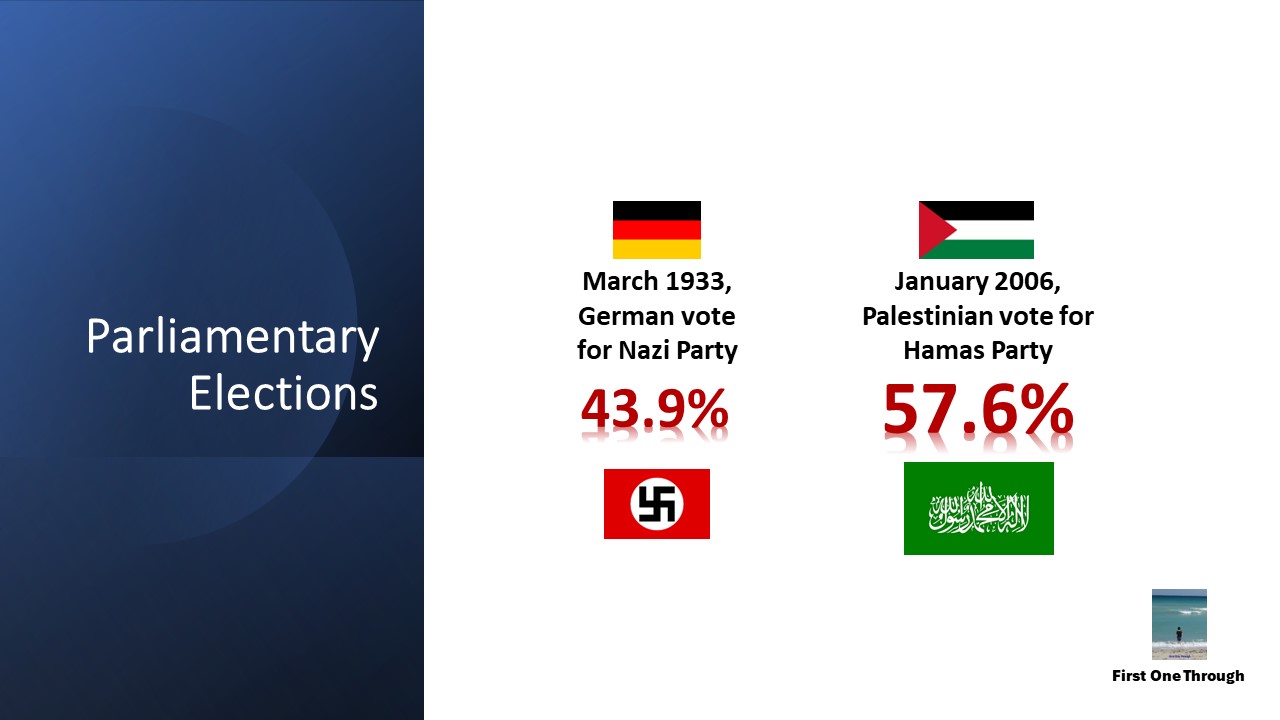
New elections must be held, but not every group gets to play. Hamas — a terrorist organization by U.S., EU, and Israeli designations — should not be allowed to run, just like Nazis weren’t allowed to run in post-war Germany. The party should be outlawed.

France and Saudi Arabia should insist on clear criteria: no party that promotes violence, antisemitism, or the destruction of Israel gets a seat at the table. There is no pathway to an enduring peace if there is an underlying state of war.


3. Reform Education — Stop Teaching Hate

An Enduring Peace isn’t signed on paper; it’s taught in classrooms and instilled in society.

As part of de-Hamasification of Palestinian society, schools — especially and including those run by UNRWA — a complete overhaul of Palestinian education, with international oversight to remove antisemitic and violent content. IMPACT-SE has written about this problem for years, and concrete steps must be taken to allow a future of coexistence.


4. Stop Treating Jews Like Foreigners in Their Homeland

Palestinian schools aren’t the only problem. The United Nations is rank with Jew-hatred and one cannot expect Palestinians to be less anti-Israeli Jews than the global body.

UN Security Council Resolution 2334 outrageously declared that Jews living in eastern Jerusalem and east of the 1949 Armistice Lines with Jordan (E49AL) are somehow illegal — a modern form of antisemitism dressed up in legalese. UNSC 2334 should be renounced and rescinded as part of the steps towards an enduring peace.

France must reject the idea that Jews should be banned from parts of their ancestral homeland. At the same time, to facilitate compromise, a cap on Jewish residents east of the 1949 lines — say 15% of the overall population — could be introduced to avoid major demographic shifts in a future Palestinian state.


5. End the So-Called “Right of Return”

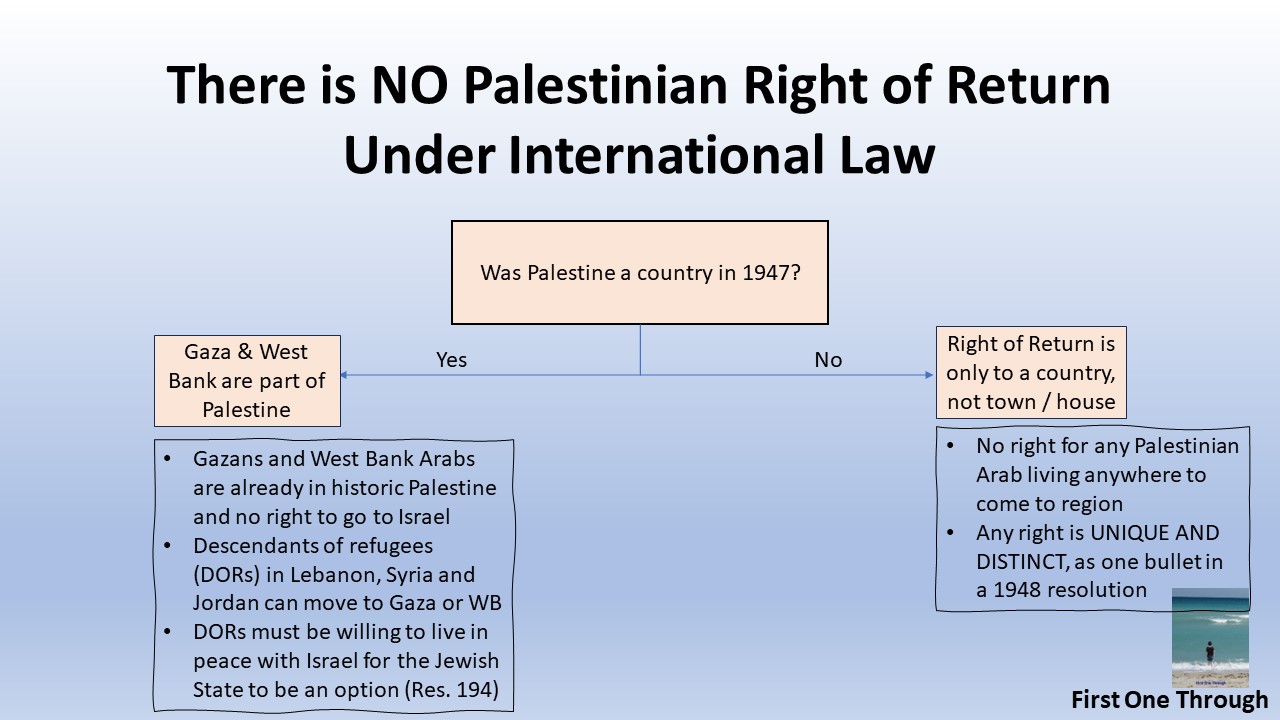
The Palestinian demand that millions of descendants of refugees be allowed into Israel is not about peace — it’s about destroying Israel demographically. It’s a fantasy rooted in grievance, not reality.

France must take the lead in declaring the Palestinian “right of return” over. In its place, a compensation fund should be set up — funded by Israel, Arab countries that started the 1948 war, and international donors. A similar fund should be set up for the descendants of Jews from Arab countries which were expelled in the decades after 1948. Work should begin now to compile a list of the properties which were lost and the related descendants who will collect associated reparations.


6. tighten the border framework, including jerusalem

The Saudi Peace Plan of 2002 suggested that Israel retreat to the 1949 Armistice Lines — a temporary ceasefire line, not a border. That’s not a starting point. That’s a non-starter.

France and its partners should endorse a realistic territorial framework: borders will fall somewhere between the current Israeli security barrier and the 1949 lines, through mutual negotiations. Land swaps are fine — as long as they reflect demographic realities and security needs.

In regards to Jerusalem, no country divides its capital city and no country places its capital on a border. Jerusalem should remain the capital of Israel, as it has uniquely afforded freedoms for all religions. Saudi Arabia should take over the administration of the Temple Mount from the Jordanian Waqf as part of advancing peace in the Middle East.


7. Shut Down UNRWA — Gradually, Responsibly

UNRWA, the UN agency that was supposed to help refugees, has become a sprawling, corrupt bureaucracy that perpetuates dependency and fuels incitement. Its existence undermines the Palestinian Authority and entrenches the myth of perpetual refugee status.

France and Saudi Arabia should lead the call for a phased shutdown of UNRWA, starting in Gaza and the West Bank. Services should be handed over to the PA — and resettlement should begin for Palestinians in Lebanon, Syria, and Jordan, with annual caps to avoid regional overload.

UNRWA offices in Jerusalem (photo: First One Through)

Bottom Line

France says it wants permanent changes on the ground. Good. The Middle East has had enough of circular negotiations, terrorism-as-usual, and international hypocrisy.

If France is ready to be honest, clear-eyed, and courageous, it can help move the region toward peace. But if it sticks to the same old script — blaming Israel, indulging Palestinian rejectionism, and hiding behind the UN — then we’ll just keep getting the same instability, bloodshed, and failure.

Peace will not be achieved overnight and “concrete” steps must be phased with reality. France and Germany gradually became allies after World War II with the benefit of the deNazification of Germany. Germany even made peace with the Jewish State over time once it was committed to avoid the hatred of its past. An overhaul of the Palestinian mindset and rejection of radical jihadism and goal of eliminating the Jewish State, under the sheepherding of Saudi Arabia can help map a better course for the region.

France must internalize the needed overhaul of the “deformity in Palestinian culture,” to quote James Zogby, President of the Arab American Institute who spoke to the UN in June 2023. Saudi Arabia must overlay the Abraham Accords on top of its 2002 Peace Plan to refine it to account for the reality of the last several years.

The emphasis of the France-Saudi chaired conference must be on the direction, not on the permanence of “concrete” and “irreversible” steps, to find a less violent and just future for the region.

Related articles:

There Is No Basis For A Palestinian “Right of Return” (July 2024)

The Three “Two-State Solution”s (December 2023)

Jerusalem Population Facts (May 2021)

When You Understand Israel’s May 1948 Borders, You Understand There is No “Occupation” (July 2019)

Ending Apartheid in Jerusalem (June 2018)

Arabs in Jerusalem (January 2016)

The Israeli Peace Process versus the Palestinian Divorce Proceedings (June 2015)

The Arguments over Jerusalem (May 2015)

Saudi Students In United States

Over the 1990s decade, Saudi Arabia sent roughly 5,000 students per year to learn in the United States. After the terror attacks of 9/11/01 in which Saudis killed almost 3,000 people in the U.S., the number of Saudi students declined.

For a while.

In 2003, as the American War on Terror raged in mostly Muslim countries, the Kennedy-Lugar Youth Exchange and Study Program was launched. The goal was to bring “High school students from countries with significant Muslim populations [to] live and study in the United States for an academic year through the U.S.”

In the 2005/6 academic year, the program hit stride and really began to focus on Saudi Arabia, and reversed the trends of declining Saudi students in the U.S. The number of students grew from just over 3,000 in the 2004/5 academic year to over 61,000 in 2015/6. That high figure represents 0.2% of the entire population of Saudi Arabia to a single country. By way of comparison, the ENTIRE American students abroad cohort all over the world is around 162,000, or 0.05% of the U.S. population.

The whopping Saudi figures of 2014/5 and 2015/6 began to decline with the terrorist attacks in Europe including the Charlie Hebdo and kosher supermarket attacks of January 2015. Around that time, Saudi Arabian spies were also caught stealing private user information from Twitter to enable the government to crack down on users posting negative things about the monarchy.

Under the Trump administration, for all of the comments that President Trump cozied to the Saudis, the declining trend continued, which did not get any pushback from liberals who were incensed by the killing and dismemberment of dissident journalist Jamaal Khashoggi.

For the 2021/22 academic year, China and India were the countries with the largest cohort of students learning in the U.S., as Saudi Arabia dropped to number 7, “primarily due to changes in its government’s scholarship program.” COVID disrupted the program significantly in the following years. In 2021/22, China accounted for 31% and India 21% of all international students.

The human rights abuses in China, Saudi Arabia and Nigeria continue, and the U.S. continues to bring in their students, perhaps in an effort to build bridges to a more tolerant future.

In 2022, Saudi Arabia executed 196 people, the highest record in a single year recorded by Amnesty International. The trend has continued in 2023, including the July 2023 death sentence handed to Mohammad al-Ghamdi, who tweeted negative things about the government.

The United States is once again trying to build bridges to the powerful, rich and morally-defective Saudi kingdom. Fruits of that effort may be found throughout America’s college campuses.

Related articles:

On Accepting and Rejecting Donations

Biden Enables Anti-Semitism On College Campuses

Courageous Jews On Hostile Campuses

The Campus Inquisition

On 9/11, Commit To Blocking Iran and Saudi Arabia From Ever Possessing Weapons Of Mass Destruction

The horrific terrorist attacks conducted against Americans on September 11, 2001 was not only the worst loss of life in a coordinated attack by foreign enemies, it changed the vector of American and world history.

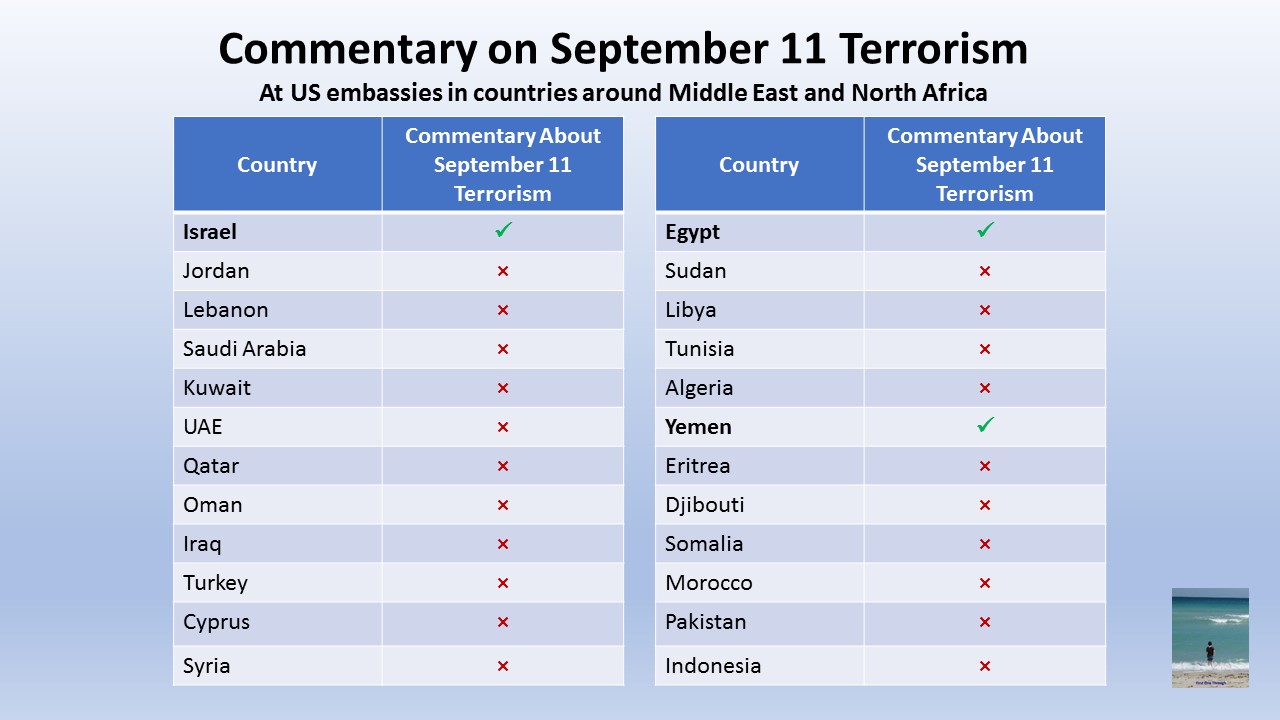
On the 21st anniversary of the attacks, the United States posted comments by President Biden about “Patriot Day” at various embassies around the world. In the Middle East and North Africa, the American embassies took very different approaches.

The US embassies in Israel, Egypt and Yemen were unique in posting Biden’s remarks about the 9/11 terrorism. The embassies in other countries which are considered US allies, such as Jordan which receives $1.45 billion in annual aid from the U.S., Qatar, which houses the largest US military presence in the region, and Saudi Arabia, where President Biden just visited to increase its oil exports, all opted to remain silent on the solemn day.

What do these three countries have in common?

Israel has been fighting the scourge of Palestinian Islamic radical terrorism for decades. Egypt and Yemen are fighting terrorist forces backed by the Islamic Republic of Iran. Many of the other regional Muslim-majority countries back those terrorist groups like Hamas, or have other US-designated terrorist groups operating openly in their borders, including Turkey, Lebanon and Qatar.

As we remember the victims of the 9/11 attacks, we must also remember the state sponsors of terrorism – Iran and Saudi Arabia in particular – and make sure that they never have access to weapons of mass destruction.

Related articles:

Paying to Murder Jews: From Iraq, Saudi Arabia and Iran to the Palestinian Authority

Will Biden Enable Hamas’s Sponsors of Iran, Qatar and Turkey

Some Global Supporters of the P5+1 Iran Deal

The Blinding Witch Hunt of Minor Offenses

There are many signs that society has lost its moorings.

‘Woke’ America makes the argument daily with inanity such as the charge that math is racist and the demand to ‘defund the police’ as if anarchy is a model society. Left-wing activists are similarly trying to change the very meaning of words with new spins that only White people can be racist by definition, and smears that Israel, the most liberal country in the Middle East, is an ‘apartheid‘ state.

Stupidity is not confined to alt-left sensitivities. Society as a whole is outraged by offenses much less grave than serious crimes which are ignored.

Consider The New York Times and its treatment of the Kingdom of Saudi Arabia. For years the left-wing paper gave a pass to one of the most repressive regimes in the world which doesn’t allow a woman to drive or leave the home without a male escort. It said nothing about the country’s policy of executing minors or its public beheadings.

In its see/hear/say no evil orientation, The Times sold expensive tourist packages to the country. At least, until the crown price was accused of killing the journalist Jamal Khashoggi. Then the media conglomerate found its spine to cancel its lavish junket. Beheading juveniles was deemed a lesser offense than killing a fellow journalist.

It goes on today with American politics as well, like New York Democratic Governor Andrew Cuomo.

Cuomo was directly responsible for killing thousands of older New Yorkers during the early months of the COVID pandemic when he ordered coronavirus patients to be sent to nursing homes. Cuomo then directed his staff to lie about the nursing home deaths to make it appear that he was doing a great job handling the crisis. Not a surprise, as he was being paid millions of dollars to write a book about his leadership during the pandemic. The depravity of conceit!

And society cheered this man, until he did something truly unforgivable – he sexually harassed women in his office. Only at that point did society turn on him.

Gov. Andrew Cuomo allegedly placed his hands on Anna Ruch’s cheeks at a wedding party in 2019 and asked if he could kiss her. Cuomo was undone by sexual harassment charges but not for killing thousands of seniors and ordering the cover-up, as he sought millions of dollars for writing a ‘leadership’ book.

A healthy society can easily identify and call out depravity; but we are far from healthy. Even before the pandemic, we let our minds become infected with the adrenaline of righteous rage as we embarked on witch hunts of minor offenses, ignoring the glaring evil before our eyes. Now, trapped in the cycles of closures, our anger buys distrust, so we vilify counter opinions and embrace the tyrants who feed our faiths.

Vaccines and time we will eventually vanquish the coronavirus pandemic, but we must seek a cure for the mental illness which confuses the all-out assault to flatten society’s hierarchy, with blinding rage preventing people from seeing the spectrum between good and evil.

The Veil of Hatred

The expression “the best defense is a good offense” is most often applied in the military and sporting competitions. It is now being used regarding anti-Semitism with greater frequency.

The World Conference Against Racism met from August 31 to September 7, 2001 in Durban, South Africa with a stated noble goal: to rid the world of racism and intolerance while promoting human rights. However, the forum was hijacked by several Muslim and Arab countries who pushed for particular attention on one country, Israel, even as the conference was conceived to address a global phenomenon without delving into any specific country.

Several western countries did their utmost to strip the Israel agenda item from the conference to no avail and were left with the choice of not attending an important event. The United States’ compromise was to send a mid-level representative rather than Secretary of State Colin Powell. Ultimately, the conference became so toxic with anti-Israel sentiment that many withdrew. Powell ultimately described the situation as  “a throwback to the days of ‘Zionism equals racism’” at the United Nations.

The Durban Conference became the playbook for many Muslim and Arab countries as well as far-left progressives to attack Israel under the veil of fighting racism. Each held conferences and promoted peace centers to establish co-existence bona fides while simultaneously trampling human rights in their own countries and promoting a fictitious anti-Israel narrative.

Recent conferences and center openings include:

  • Opening the King Abdullah Bin Abdulaziz (Saudi Arabia) International Centre for Interreligious and Intercultural Dialogue (KAICIID) in Vienna on November 26, 2012
  • Forum on the Role of Religious Leaders in Preventing Incitement that could Lead to Atrocity Crimes, held in Fez, Morocco, on April 23 and 24, 2015
  • the International Institute for Tolerance and the Muslim Council of Elders in the United Arab Emirates, in 2017
  • Doha Conference on Interfaith Dialogue, held in Qatar February 20-21, 2018
  • the World Tolerance Summit, in Abu Dhabi on November 13-14, 2019

The notion of interreligious dialogue and peaceful coexistence sounds wonderful, but the hypocrisy of the situation doesn’t seem to enter the minds of the willing participants.

The KAICIID website states that “Our vision is a world where there is respect, understanding, and cooperation among people, justice, peace and reconciliation, and an end to the abuse of religion to justify oppression, violence, and conflict.” Yet this statement comes from an organization founded and named for the leader of Saudi Arabia which denies women basic rights and kills people for converting from Islam.

Apostasy is subject to capital punishment in many of the countries which hosted recent interfaith conferences, and include: Afghanistan; Brunei; Mauritania; Qatar; Saudi Arabia; Sudan; the United Arab Emirates and Yemen. In 2013, the Supreme Council of Religious Scholars in Morocco issued a fatwa that Muslims who leave Islam should be sentenced to death.

Additionally, Qatar funds mosques around the world which host imams calling for people to kill Jews.

Yet these countries host conferences and centers promoting coexistence among faiths.

People would never attend a conference on the freedom of the press in Turkey as they comprehend the irrationality of discussing such topic in the country that jails the most journalists every year. They would similarly not attend a forum on Holocaust studies in Iran when its leaders actively deny the Holocaust.

But they show up for interfaith dialogue in countries that deny basic human rights.

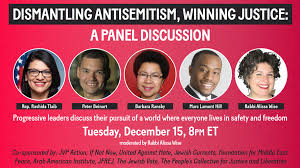
When the Jewish Voice for Peace hosted a discussion in December 2020 to discuss anti-Semitism with panelists who want to destroy Israel, it employed that familiar twist of attempting to excuse the accused.

anti-Israel group hosted event about anti-Semitism to absolve people accused of anti-Semitism

Genuine reform to combat bigotry and anti-Semitism is most welcome and should be encouraged but many of today’s conferences are only granting absolution to haters and sanctifying them as champions of a just cause. Beware of the Durban Conference coming to a forum near you.


Related First One Through article:

Peter Beinart is an Apologist for Anti-Semites

Bitter Burnt Ends: Talking to a Farrakhan Fan

Rep. Ilhan Omar and The 2001 Durban Racism Conference

The Insidious Jihad in America

Omar and Tlaib’s Antisemitic B.D.S.

Jewish Voice for Peace Ignores Dead Jews

Students for Justice in Palestine’s Dick Pics

An Easy Boycott: Al Jazeera (Qatar)

Related First One Through video:

Drive, Saudi Arabia (music by The Cars)

Freedom of Speech and BDS (music by Coldplay)

Subscribe YouTube channel: FirstOneThrough

Join Facebook group: Israel Analysis and FirstOneThrough

Replacing the Jordanian Waqf on The Temple Mount

After Israel defeated the attacking Jordanian army in June 1967, it allowed the Jordanian Islamic Waqf to have administrative control of the Jewish Temple Mount in the Old City of Jerusalem while Israel controlled the security of the area. In 1980, Israel officially applied sovereignty and reunited the city of Jerusalem as its eternal capital but still allowed the Jordanian Waqf to administer Judaism’s holiest site. And in Israel’s 1994 peace treaty with Jordan, the country continued to be sensitive to Jordan, statingIsrael respects the present special role of the Hashemite Kingdom of Jordan in Muslim Holy shrines in Jerusalem. When negotiations on the permanent status will take place, Israel will give high priority to the Jordanian historic role in these shrines.

However, in recent months, Jordan has come out very aggressively against Israel’s contemplated application of sovereignty over more of the west bank of the Jordan River.

In May 2020, Jordanian Prime Minister Omar al-Razzaz saidWe will not accept unilateral Israeli moves to annex Palestinian lands and we would be forced to review all aspects of our relations with Israel.” King Abdullah also said that if Israel “really annexes the West Bank in July, it would lead to a massive conflict with the Hashemite Kingdom of Jordan.

In light of the statements and contemplated reaction by Jordan, it makes sense for Israel to approach both Egypt and the Kingdom of Saudi Arabia to see if they would be interested in taking over the role of the Jordanian Waqf in Jerusalem.

Egypt has maintained a peace treaty with Israel since 1979 and there is a good working relationship with Egyptian President Abdel Fattah al-Sisi. Israel’s relationship with KSA has improved in recent years, especially because of the countries mutual distrust of Iran. As the guardian of Mecca and Medina, KSA would logically welcome the role to extend its guardianship of Islamic holy sites, and the move could be part of an important peace treaty with Saudi Arabia.

The Old City of Jerusalem including the Jewish Temple Mount/ Al Aqsa Compound during the Jewish holiday of Passover

Jordan’s threat to abandon its peace agreement with Israel is an opening for Israel to offer Saudi Arabia a place in Jerusalem and to forge a new peace agreement with the powerful kingdom. In light of the Trump Administration’s deep ties with KSA, it makes sense to advance those initiatives now.


Related First.One.Through articles:

Jordan’s King Abdullah II Fights to Retain His Throne

Oh Abdullah, Jordan is Not So Special

Time for King Abdullah of Jordan to Denounce the Mourabitoun

The Waqf and the Temple Mount

Hamas Charter, Articles 11 and 12

Subscribe YouTube channel: FirstOneThrough

Join Facebook group: Israel Analysis and FirstOneThrough

On Accepting and Rejecting Donations

The head of the MIT Media Lab, Joichi Ito, was forced to resign when people learned that he accepted donations from Jeffrey Epstein after he had pleaded guilty to soliciting prostitution from a minor. Ito also resigned from several other boards in short order.
While institutions need donors’ money to exist and operate, they are becoming reluctant to be associated with certain types of individuals – in this case, taking money from someone who committed crimes against minors.
This is part of a growing trend of considering the source of donations, particularly among not-for-profit institutions.
Consider The Metropolitan Museum of Art in New York which stated it will no longer accept donations from the Sackler family. While the Sacklers were not convicted of a crime, the Met felt that the owners of Purdue Pharma, the maker of OxyCotin, were responsible for “the ensuing public health crisis surrounding the abuse of these medications.” While the proper use of the drug helped many, the abuse of the drug became an epidemic causing the Met to conclude that the association with the Sacklers was toxic to the image and values that it wanted to portray. The simplified math was the Sacklers equaled Purdue equaled OxyCotin equaled opioid overdoses and death which should never equal the Met. Goodbye Sackler dough.
In June 2019, the University of Alabama decided to return the largest donation in its history after the donor called for a boycott of the State of Alabama and the university for passing a very restrictive abortion law. The university said that it did so because of the donor’s “ongoing attempts to interfere in the operations of the Law School.
The cases above highlight institutions returning donations because the donor either tarnished the institution’s brand image or actually sought to harm operations.
Some politicians have similarly returned donations from people who are associated with “sinful” activities like e-cigarettes. Sometimes the action is spurred by activists demanding that an institution return donations from companies who profit from actions deemed harmful, like immigrant detention facilities or, on the opposite side of the coin, demand a donor recall a personal donation or risk a massive boycott of their businesses.
In short, cash donations are no longer considered neutral currency of exchange but a binding seal between giver and recipient.
So what is one to make of noted Israel-basher Linda Sarsour raising money for Jewish causes, like repairing vandalized Jewish cemeteries? Are her vile comments about Israel and activists like Ayaa Hirsi Ali as well as association with anti-Semite Louis Farrakhan reasons to reject her funds? Many Jewish groups want her to be banned from speaking at forums or even entering Canada, while others are content to take her funds and ignore her more evil inclinations.
Universities are typically the most likely to turn the cheek while they open their pockets.
The New York University and many other colleges take in millions of dollars from the Kingdom of Saudi Arabia, a country that openly executes minors as well as people who convert from Islam (apostasy), a fundamental human right. Yet no one batted an eyelash, until the Saudi government was accused of murdering a journalist. Suddenly, it became common knowledge that several U.S. universities had taken over $600 million from the Saudi government and Saudi companies. Those universities, not coincidentally, had become hotbeds for anti-Israel activity, including Columbia University, Tufts University, and the University of Southern California with each school receiving at least $1 million and George Washington University receiving $12 million in 2017. MIT received $78 million from the Saudis between 2011 and 2017.
Saudi Arabia’s funding of American universities paled compared to Qatar, which gave over $1 billion between 2011 and 2017. Qatar openly funds Hamas, a U.S. State Department designated foreign terrorist organization, and an openly anti-Semitic organization. No matter. Georgetown, Carnegie Mellon, and Northwestern established satellite campuses in the small country.
Curiously, there is virtually no public outcry about universities taking hundreds of millions of dollars from Saudi Arabia and Qatar. Without a protest, it is highly unlikely that these institutions of “higher learning” will do anything.
Consider the situation when Islamic antisemitism went into global overdrive in mid- 2000 just before the start of the Second Intifada, pushing money and narratives of Jews and Israel as enemies of the entire world, most notably manifest in the 2001 Durban Conference about Racism. In July 2000, the president of the United Arab Emirates, Sheik Zayed bin Sultan al-Nahyan, donated $2.5 million to the Harvard Divinity School to endow the Sheik Zayed Al Nahyan Professorship in Islamic Religious Studies. Within a short period of time, the Zayed Center became a noxious fountain of anti-Semitic screed complete with Holocaust denials and blood libels. It took the non-profit group The David Project and a student at the Harvard Divinity School, Rachel Fish, to loudly protest the donation and Center itself. Harvard did nothing for years, but ultimately returned the gift in July 2004, but not before hosting speakers like former president Jimmy Carter and former Vice President Al Gore.

Jeffrey Epstein and Sheik Zayed bin Sultan al-Nahyan: too hot to handle
For the most part, Qatar and Saudi Arabia’s funding of terrorism and anti-Semitism has not irked the American public. Organizations only started to return funds to Saudi Arabia – like the Endeavor talent agency – after the murder of the journalist in October 2018. It would appear that the well-being of journalists ranks much higher than of children or Jews.
The dirty money does not only go towards research or new Islamic study departments at American universities. Oftentimes the money is for paying for scholarships to send tens of thousands of Muslim students into American campuses.
In the 2017/18 school year, Saudi Arabia had over 44,000 students studying in American universities – the fourth largest total in the world and as much as every country in South America COMBINED (a population 13 times as large). That total was actually down from the 2016/17 school year when there were over 52,000 Saudi students, and lower then the incredible 61,287 in 2015/16 – an astounding one Saudi student in the United States for every 537 people from that country. To give that figure context, that’s the equivalent of 610,000 American students studying in a single country, while the actual number of US students studying abroad, all over the world, was 330,000.
The enormous number of students coming from Saudi Arabia was the part of the Obama Administration’s outreach to the Muslim Middle East. The United States permitted greater numbers of students from Muslim countries than anywhere else in the world. That policy reversed course under the Trump Administration, as seen in the table below showing the annual change in the number of foreign students in the U.S.

NYU, Harvard, Columbia, MIT and many other universities have been taking hundreds of millions of dollars and tens of thousands of students from corrupt Islamic regimes who finance terror and spur antisemitism. As many American institutions have begun to return tainted money from the likes of the Sacklers and Jeffrey Epstein, it is similarly time to send the money and students back to their point of origin.

Related First.One.Through articles:
An Easy Boycott: Al Jazeera (Qatar)
Buckets of Deplorable Presidential Endorsements
Rep. Ilhan Omar and The 2001 Durban Racism Conference
The Many Lies of Jimmy Carter
Paying to Murder Jews: From Iraq, Saudi Arabia and Iran to the Palestinian Authority
Related First.One.Through video:
Drive Saudi Arabia (music by The Cars)
Subscribe YouTube channel: FirstOneThrough
Join Facebook group: Israel Analysis and FirstOneThrough

NY Times Disgraceful Journeys

As media companies have come under financial strain due to the availability of plentiful free and immediate news sources online and the collapse of the print advertising industry, the companies have sought new methods of generating revenue.

As part of such endeavor, The New York Times got into the travel business.

The Times markets its “Journeys” as a way to not only see the world, but to gain an understanding of the “history & context” of the countries with “featured experts.” Not surprisingly, the paper’s infamous pro-Arab and anti-Israel orientation fills the Times’ brochures.

Consider the Times description of its trip to Iran (below). The main headline of “How Much Do You Understand?” seems to beg the reader into an opportunity to learn. The text for Iran is as follow:

“Iran: Tales from Persia

Persia. Iran. For 2,500 years, this powerful country has entranced, mystified and beguiled the world. Discover the ancient secrets and modern complexities of this influential land on a 13-day itinerary, visiting some of the world’s oldest archaeological sites and the family home of the religious leader who engineered Iran’s transition to an Islamic republic. Welcome to the once-forbidden land of Iran.”

The featured expert is “Gary Wintz, a writer and lecturer, has traveled to Iran regularly since the 1980s and is an expert on the cultural and political landscape there. He joins all our departures.

The trip sounds very exciting. So much intrigue and history.

There is no mention that this country is one of the most repressive in the world. This is a government that hangs gays by cranes in the street – literally. It has fomented civil wars in Yemen, Iraq and Syria. It has publicly called for the destruction of Israel. It leads the entire Middle East in executions  (more than every country in the region COMBINED). It executes minors.

No worries. The NYTimes will tell you that its mysterious and beguiling.

At least this year’s “featured expert” has been to Iran. In 2016, the featured expert was the notorious Op-Ed Israel-basher, Roger Cohen. He probably told the tour participants how terrible it was that Israel opposed Iran getting nuclear weapons.

There is only one other country in the world that executes minors: Saudi Arabia. The Times will gladly take you there too.

Saudi Arabia and the Emirates: The Past and Future of Oil

Oil transformed the Arabian Peninsula, bringing wealth into a region steeped in tradition and heightening tensions with oil-dependent Western nations. On this 10-day journey accompanied by New York Times journalists, learn more about Saudi Arabia, on the cusp of change. Explore the conservatism that still grips Saudi Arabia (women, you may need to bring a head scarf), then see the modern architectural gem that is Abu Dhabi.

Saudi Arabia, where Islam was born, remains a deeply conservative country where women are only now being allowed to drive and alcohol is not served. It’s also one of the most important allies of the United States, even though they don’t always see eye-to-eye. Journey to Jidda, Al-Ula, Riyadh and Dammam to better understand the relationship between these two nations. Hear perspectives from oil industry and government officials and learn how Saudi Arabia keeps its grip on its past even as it tries to embrace its future. Then travel to Abu Dhabi in the United Arab Emirates, and see how it has used its oil wealth to create a city of culture.”

The Times pointed out that the country is “deeply conservative” but ignored that it is rated one of the “worst of the worst” repressive countries by Freedom House. It is the only country in the world that has public beheadings. Seriously, even today.

No worries. You’ll get to see a “modern architectural gem” with the Times.

In regards to Egypt, the Times could not be bothered to mention anything “conservative” about the country.
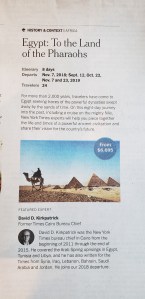
Egypt is the land of “powerful dynasties” and “New York Times experts will help you piece together the life and times of a powerful ancient civilization and share their vision for the country’s future.”

How wonderful! Not an iota of anything controversial. Did the Times mention that Egypt is one of the worst countries to be a Christian according to Open Doors? That the Arab Spring swept out one long-time strongman, and a military coup took out his replacement? Terrorism targeting tourists? Why would it? This is the Times.

Morocco? It’s gorgeous! “A land of of legend and intrigue… delve deep into this colorful nation.” Illegal annexation of Western Sahara? Never heard of it.

For some of the worst murderous regimes in the world, involved with human rights abuses in their own countries as well as active participation in killing many tens and hundreds of thousands of people, the most the NY Times could muster about the Islamic countries was that Saudi Arabia is “deeply conservative” and “don’t always see eye-to-eye” with the United States. Remarkable.

But it gets worse.

You can perhaps try to forgive the Times that is trying to sell a vacation package to make a few more dollars. Why highlight the bad (actually evil) when marketing a trip for several thousands of dollars?

The NY Times also offers a trip of Israel. Surely the Times would highlight the miracle that is the rising star of the Middle East.

The paper which claims to be “a leader in its evenhanded coverage of Israel,” seems to think that the only democracy in the Middle East, the technological and environmental leader, the most liberal country for thousands of miles in any direction, needs some “balance” in its “Journeys” packages. Not Iran nor Saudi Arabia nor Egypt nor other Middle eastern lands. Only Israel.

This is from the Times Journey’s website on the Israel trip:

In 2018, Israel will observe its 70th anniversary as a nation. But its history goes back more than 5,000 years, and even now, its future promises many difficulties. On this nine-day itinerary, travel with experts from The New York Times, a leader in its evenhanded coverage of Israel, Palestinians and the Middle East. Enjoy extraordinary opportunities to hear from opinion makers, scholars, grassroots activists and media experts.

Travel behind the media lens to explore the broad spectrum of the Israeli-Palestinian experience on a journey through millennia of history, politics and religion. Explore one of the most fascinating destinations in the world, and seize this once-in-a-lifetime opportunity to participate in the next chapter of history. Learn about the evolution of Israeli and Palestinian identities by understanding the region’s past struggles while considering its current political reality and contemplating its future. With unparalleled access and New York Times guidance, this unforgettable trip will present this volatile region in a new light.”

How is it that a trip of Israel, a country with so many incredible things to cover in both ancient history, religion, economy, arts and technology, could get wrapped into a discussion about Palestinians (three times!)? Why is Israel uniquely described as having “difficulties” and “struggles” in a “volatile region”? More people have died in the wars that Iran and Saudi Arabia have been fighting over the past three years than the entire 70-year history of Israel.

Saudi Arabia is noted as the place “where Islam was born.” Is it too much for the Times to point out that Israel is the Jewish homeland?

In Iran, people are invited to visit “some of the world’s oldest archaeological sites.” Are there not enough ruins in Israel to highlight?

The Times puts on a unique lens for Israel. Consider the itinerary on the first full day of the trip, called “Jerusalem: Understanding the Borders and Territories.” The schedule includes: “This morning, attend a talk by Avi Issacharoff, an Israeli journalist who specializes in Palestinian affairs. Learn about his work, including the geopolitical TV thriller “Fauda” (Arabic for “Chaos.”) Then, drive north to the Qalandiya checkpoint to enter the West Bank for a guided tour led by Rami Nazzal, a Palestinian and New York Times contributor. Visit a Palestinian refugee camp, the city of Al-Bireh and homes near the Psagot Israeli settlement. After lunch at a local Palestinian restaurant, meet with a senior Palestinian official to discuss the history and current state of Israeli-Palestinian affairs. End the day with a driving tour through Ramallah, which serves as the de facto administrative capital of the Palestinian National Authority.” On the New York Times’ trip to Israel, visitors adopt the Palestinian narrative from the outset.

A visit to Israel’s parliament, the Knesset in Jerusalem? To it’s Supreme Court? No way! The trip to Israel and a tour starting in Jerusalem visits “the de facto administrative capital of the Palestinian Authority.” Heaven-forbid actually spending a trip to Israel in Israel’s capital city.

The New York Times is not remotely fair to Israel even while it tries to make a few bucks on its travel packages. Do you think there’s an iota of even-handedness in its news stories?


Related First.One.Through articles:

Murderous Governments of the Middle East

Paying to Murder Jews: From Iraq, Saudi Arabia and Iran to the Palestinian Authority

Is Israel Reforming the Muslim Middle East? Impossible According to The NY Times

The New York Times will Keep on Telling You: Jews are not Native to Israel

First.One.Through video:

Saudi Arabia’s Repressive Regime (music by The Cars)

Subscribe YouTube channel: FirstOneThrough

Join Facebook group: FirstOne Through  Israel Analysis