Venezuela in NYC, Twice

Venezuela has arrived in New York City in two forms.

One arrives carrying the wreckage of a socialist system that hollowed out a country by redefining private property as moral corruption and state control as virtue. That experiment ended in scarcity, corruption, and mass flight. Its leaders now face judgment far from home, a coda to a long collapse.

The other arrival is quieter, bureaucratic, and far more consequential. It moves through City Hall.


Words That Become Policy

Private property — especially homeownership — is a weapon of white supremacy masquerading as wealth-building public policy.

Those words were written by Cea Weaver, who now holds authority inside New York City government over housing regulation, landlord enforcement, and real estate policy.

This is a moral judgment about ownership itself. Homeownership is framed as harm. Property is recast as a moral hazard. The implication is straightforward: what has long been treated as legitimate must be dismantled.

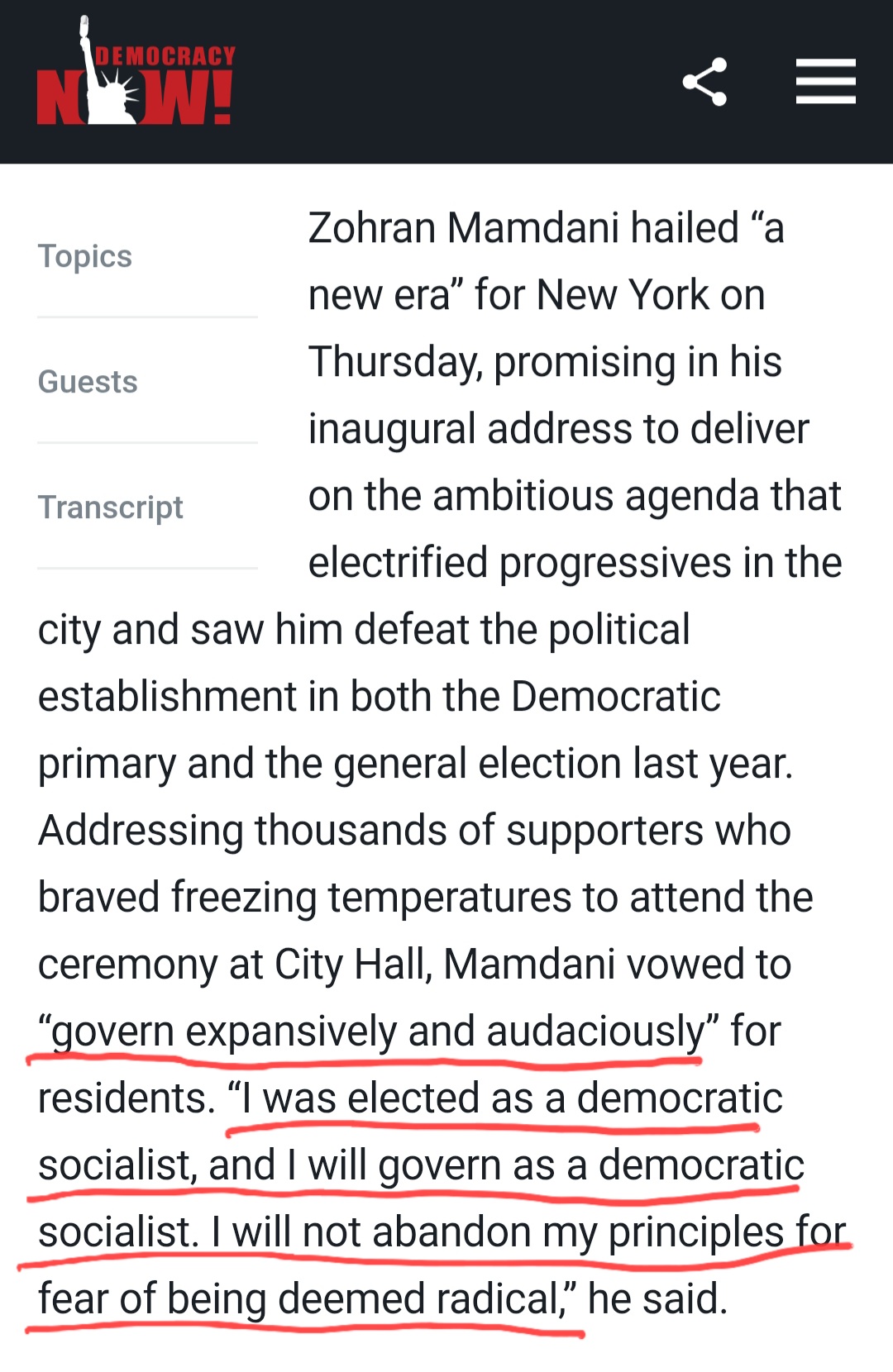
Knowing full well her position about private real estate and home ownership, Weaver was elevated into a role designed to shape housing outcomes by Democratic Socialist Mayor Zohran Mamdani.


Real Estate as the Lever

Because housing is where ideology becomes operational.

Weaver’s portfolio centers on real estate because real estate concentrates independence, savings, and permanence. It is immobile, heavily regulated, and politically sensitive. Those traits make housing the easiest sector in which to normalize forced redistribution through regulation rather than spectacle.

Within Democratic Socialist thought, housing functions as the primary front for structural change. The stated objective is “decommodification” — removing housing from private markets through eminent domain and insulating it permanently from profit. Achieving that objective requires stripping ownership of legitimacy and transferring control to the state or state-backed collectives.


Jacobin Makes the Case Explicit

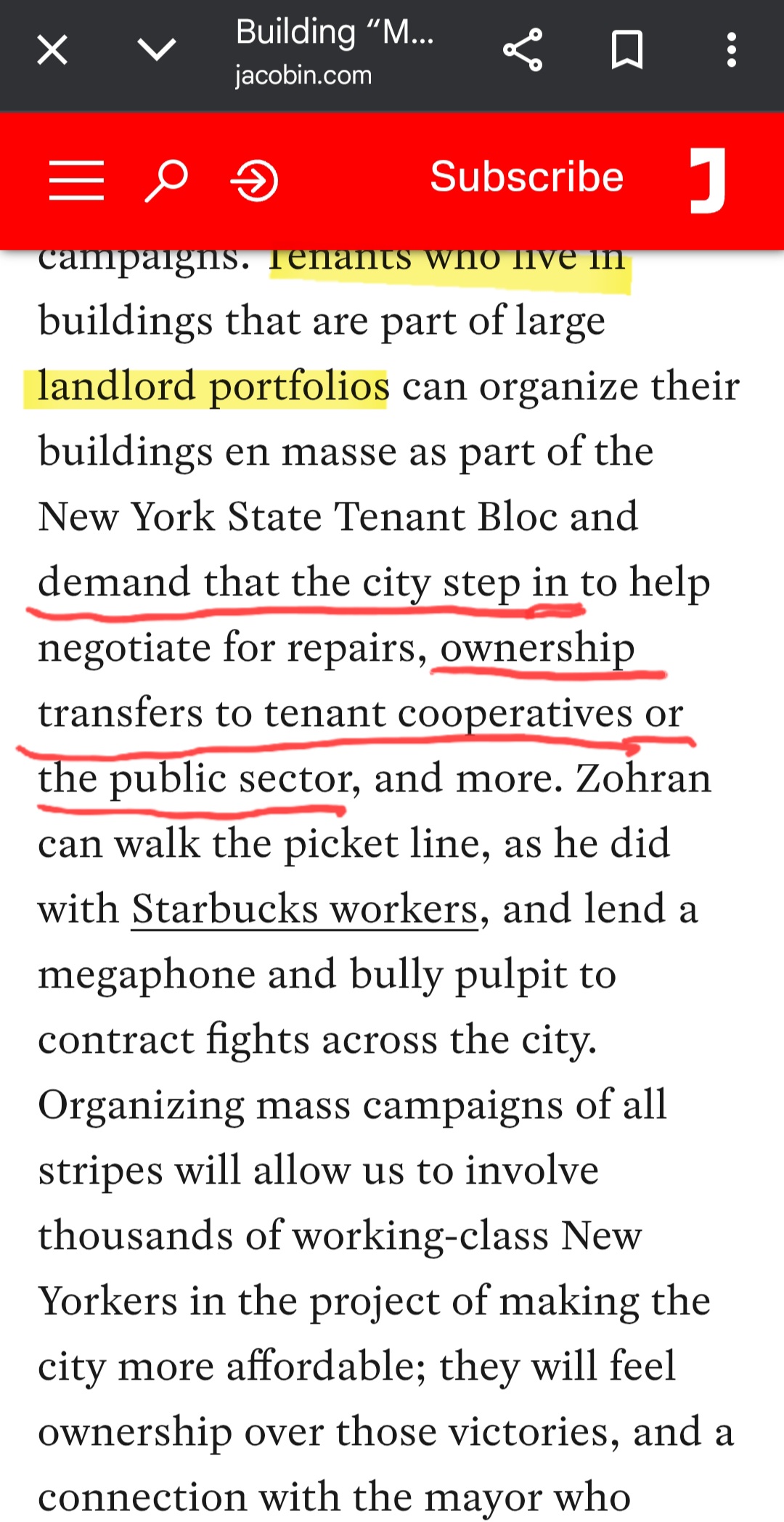
That program is reinforced repeatedly in Jacobin, the flagship publication of democratic socialism. Its housing coverage goes well beyond expanding public housing or strengthening tenant protections. It openly endorses removing homes from private ownership.

Jacobin has praised campaigns such as Berlin’s Deutsche Wohnen & Co Enteignen, which was approved by voters in 2021, calling for the expropriation of privately owned residential housing and its transfer to public control. It regularly argues that landlord property rights must yield to collective ownership if housing justice is to be achieved.

The logic is consistent: justice requires taking housing out of private hands.


Venezuela’s Sequence Is Familiar

Venezuela followed this same sequence.

Ownership was recast as exploitation.
Returns were constrained.
Controls expanded.
Maintenance collapsed.
Scarcity spread.

By the time property was openly seized, the groundwork had already been laid. Confiscation felt justified because ownership had already been condemned. Language prepared the public long before policy completed the transfer.

History records this pattern with grim consistency.


Ideological Alignment at City Hall

Zohran Mamdani placed Weaver precisely where her beliefs carry consequence.

“Impoverish the “white” middle class. Homeownership is racist/failed public policy.” – Cea Weaver

Democratic Socialists today debate pace and scope more than premise. Housing is the testing ground because it touches wealth, stability, and autonomy simultaneously. Alter the rules of ownership there, and broader economic control becomes easier to assert.


Donald Trump Begins to Align with Democratic Socialists on housing

And it seems that President Donald Trump is getting on board.

Trump just announced that he will ban institutional investors from buying single family homes. The goal is to keep the housing market acting rationally based on normal individual demand, rather than bowing to the force of massive realtors controlling rent prices.

It is not stripping individuals of their homes the way Weaver desires, but a first step in meeting the mission part way.


Naming the Mechanism

When government redefines private assets as illegitimate and reallocates them through enforcement, penalties, and regulatory attrition, the economic effect remains consistent regardless of branding.

Control shifts away from owners.
Value erodes.
Decision-making migrates to the state.

“As landlords exit the market, using state action to acquire properties and leverage divestment to convert thousands of homes into publicly and democratically controlled land/housing.” – Cea Weaver

“The president and his team are discussing a range of options to pursue this important foreign policy goal [of seizing Greenland], and of course, utilizing the U.S. military is always an option at the commander-in-chief’s disposal.” – Trump’s White House

Language about equity or justice does not change outcomes for families whose homes become conditional assets rather than protected property. Redistribution through regulation or seizure is theft.

People think of Donald Trump as a true Conservative; he is not. He spent years as a Democratic real estate developer in New York City. Owning, controlling and licensing property is in his bloodstream.

We are entering a dangerous moment when government leaders of the right and left are converging on the thesis that the state is the arbiter of private property, including your house.


The Question That Matters

A society either treats private property as legitimate or places it at the discretion of the state.

Once ownership depends on ideological approval, it no longer functions as a right. Capital withdraws. Investment slows. Stability erodes. Liberty disappears.

Venezuela already supplied the answer.

History rarely announces itself as collapse. It usually arrives disguised as compassion, long before the consequences become unavoidable.

Abraham Accords Versus UK and France

Europe is declaring peace while America is building it.

As Britain and France rush to recognize a Palestinian state to pressure Israel, the United States is doing something more durable: expanding the Abraham Accords. With Kazakhstan now actively promoting its joining Muslim-majority nations normalizing ties with Israel, the U.S. is advancing a vision that builds relationships rather than rhetoric.

US President Donald Trump meets with Kazakh President Qasym-Zhomart Toqaev

European leaders say recognition will balance the scales and restart diplomacy. But what exactly are they recognizing? The Palestinians remain divided between an unpopular and corrupt authority in the West Bank and Hamas in Gaza—an antisemitic terrorist group that thrives on conflict and rejects coexistence. There are no elections, no functioning institutions, no borders, and no credible security force. Declaring this fractured reality a “state” doesn’t bring peace any closer. It just flatters the fantasy that paperwork can substitute for progress.

For Palestinians, European gestures feel validating, but validation without change is illusion. No declaration from Paris or London can rebuild Gaza, reform leadership, or disarm Hamas. It’s diplomacy as performance—morally satisfying to distant audiences but meaningless in practice.

The Abraham Accords take a different approach. They focus on cooperation. Each new country that signs—Bahrain, Morocco, the UAE, and now Kazakhstan—proves that Israel can be accepted across the Muslim world without waiting for Hamas’s permission. This shift is reshaping the region. It turns rejection into partnership, slogans into investment, and isolation into integration. Every handshake chips away at the myth that the Middle East must remain hostage to its oldest conflict.

But peace will never advance while Hamas holds power. Hamas doesn’t just oppose Israel; it opposes peace itself. It rejects every agreement, glorifies violence, and sacrifices its own civilians to preserve control. Allowing Hamas to participate in elections or continue ruling Gaza ensures that destruction will repeat everywhere. Disarming Hamas and excluding it from Palestinian politics isn’t an Israeli condition—it’s a Palestinian necessity. Without that step, there can be no state, no sovereignty, and no future.

Alas, Palestinians disagree. In the latest PCPSR October 2025 poll, Hamas remains the most popular political party (60% approval) and Khaled Mashal, the leader of Hamas would trounce Fatah’s Mahmoud Abbas by 63% to 27%. Palestinian Arabs (69%) remain adamant that Hamas not give up its arms. Even after the decimation of Gaza, a majority (53%) still approves the October 7 massacre. And imagine that now, as the ceasefire appears to be bringing the end of the war, a remarkable 39% of Palestinians still think Hamas will win.

The choice is clear. Europe can keep recognizing an idea of Palestine that doesn’t exist and that the Palestinian Arabs are more moderate than they really are, or the U.S. can keep building the conditions for a reformed Palestinian society. The road to peace will not run through European parliaments; it runs through a changed Palestinian worldview, normalization between Israel and Muslim countries, economic growth, and a regional consensus that leaves Hamas behind.

The pathway to peace in the Middle East is the Abraham Accords, not European theater.

The Weight of Nations

“Why do the nations rage, and the peoples plot in vain?” — Psalm 2:1

Saudi Arabia – the kingdom which Israel hoped would next join the Abraham Accords – sought to pressure Israel into ending its defensive war in Gaza by rallying nations of the Global North to recognize a State of Palestine. It found a partner in France, which successfully pulled the United Kingdom, Canada, and Australia into the orbit of recognition. In September 2025 at the United Nations, the group jointly declared their acknowledgment of a Palestinian state—with caveats—but the symbolism was unmistakable.

Israel did not budge. It viewed the coordinated announcement as an alarming reward for the genocidal Hamas regime that had unleashed war on October 7 two years earlier.

Enter the United States. President Donald Trump had tasked developer and confidant Steve Witkoff to lead a back-channel negotiation with Hamas for the release of Israeli hostages and an end to hostilities. Jared Kushner joined the effort more forcefully in September, unveiling a “20-point plan” aimed at ending the two-year war and reshaping the region’s political future.

To counter the Saudi-French gambit, Trump built his own coalition. The U.S. secured the backing of several Arab and Muslim nations from the Global South—including Qatar, Jordan, the United Arab Emirates, Indonesia, Pakistan, Türkiye, Saudi Arabia, and Egypt —for its peace framework. By October, the administration succeeded in gathering the leaders of 27 countries from across the North and South, including some that had just recognized Palestine, to fly to Egypt to sign what was billed as a ceasefire agreement.

A summit to support ending the more than two-year Israel-Hamas war in Gaza after a breakthrough ceasefire deal, Monday, Oct. 13, 2025, in Sharm El Sheikh, Egypt labeled “Peace 2025”

It was a mirage. Neither of the warring parties—Israel or Hamas—attended. The event was instead diplomatic theater, meant to transform a ceasefire proposal into a movement for regional peace. Trump designed the event to flip the script.

Where Saudi Arabia and France tried to impose the weight of the Global North on Israel, the United States sought to use the combined weight of both hemispheres on Hamas. The former demanded an immediate path to a two-state solution; the latter demanded the end of Hamas rule.

The Moral Gravity

The story of this moment is not only about geopolitics, but about moral gravity. The nations of the world have grown accustomed to weighing Israel’s every move while ignoring the crimes of its enemies. They call for “balance” in a war that began with mass murder, rape, and hostage-taking. They lecture the victim to compromise while the aggressor reloads. The UN Security Council could have easily passed resolutions to push for an end to the war if they had just condemned Hamas, but repeatedly refused to do so.

The weight of nations once meant the defense of justice and the pursuit of peace. Today, it is too often the ballast of perfidy—dragging down the innocent under the pretense of even-handedness.

Israel, standing increasingly alone, may yet prove that the true measure of a nation is not in the number of its allies, but in the steadiness of its conscience. It is fortunate to have President Trump in the White House as it shoulders this weight once again.

The tight bond between Israel and the United States has continued, despite Americans starting to sour on Israel since 2015.

The Embarrassment and Lies of the Palestinian Authority in Trump’s Peace Plan

The Palestinian Authority (PA) has perfected the art of self-deception — and the spectacle has become an embarrassment to watch. Its leaders trade in fantasies while their people – and the entire region – suffer the consequences of their delusions.

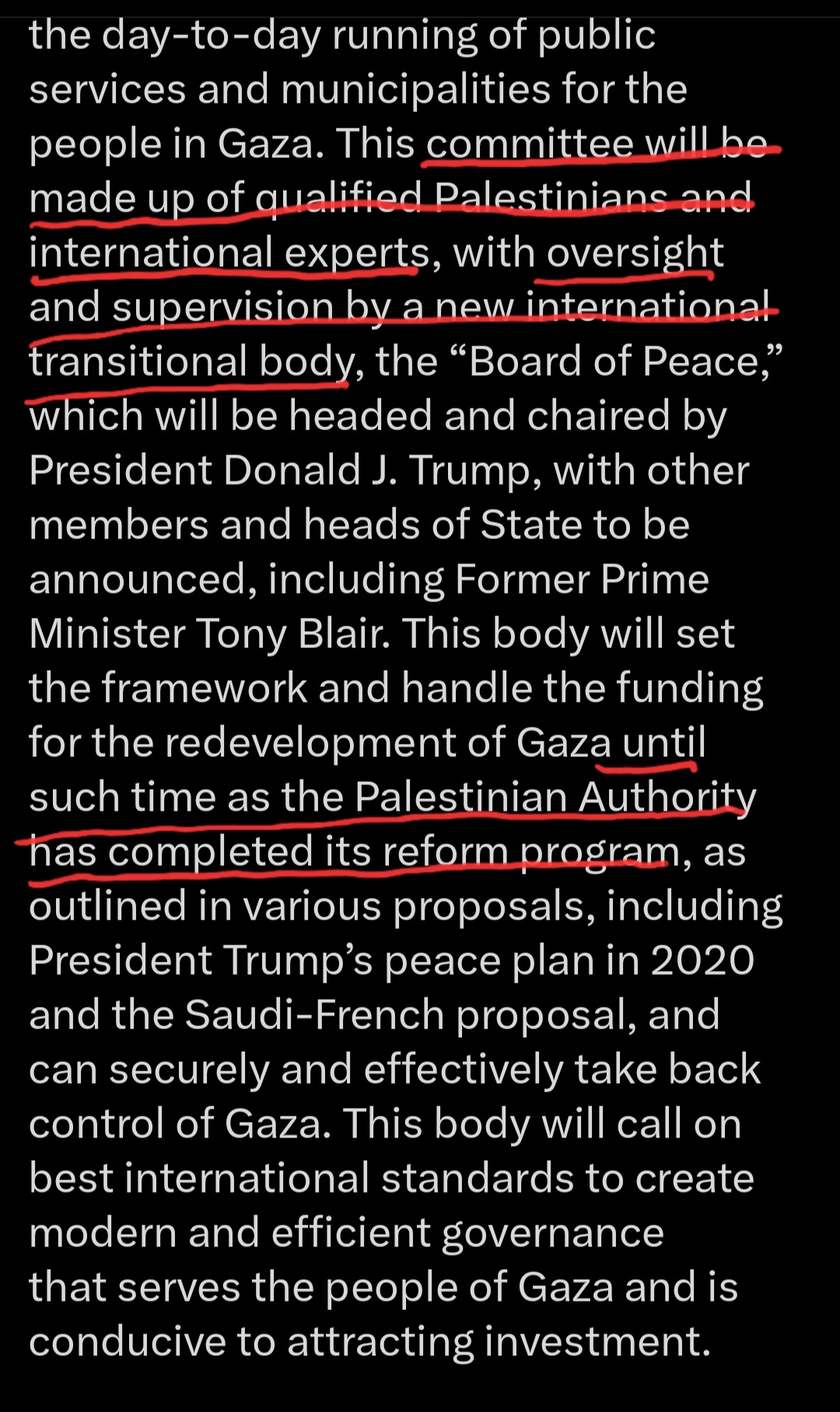
When President Donald Trump released his 20-point Comprehensive Plan to End the Gaza Conflict, it was explicit: the focus was on fixing Gaza and the PA would have no role. The document said in plain language that the PA would need to be overhauled and reformed before it could ever be trusted as a partner for peace. It deliberately withheld any credit or recognition for the current leadership, recognizing its corruption, incitement, and support for terror. “A technocratic, apolitical Palestinian committee” headed by Trump himself would be the day-after plan for Gaza. Only “qualified Palestinians” would get to sit on such committee, not the UN-lauded PA.

President Trump’s peace plan specifically did not hand control of Gaza to the PA and said the group had to “complete its reform program.”

The plan’s very structure was layered with conditionality — each potential step toward a Palestinian state contingent on verifiable reforms, renunciation of violence and demilitarization. Even then, the most it offered was that maybe one day, post-reform, there could be a pathway to a two-state solution.

The Trump plan layered conditions of “when,” “may” and “pathway” to Palestinian “statehood”

And yet, in a surreal twist, the official PA news agency WAFA ran an article in which Mahmoud Abbas claimed that Trump stood ready to endorse a Palestinian state with “East Jerusalem” as its capital. It was an astonishing fabrication — a complete lie, meant to mask Abbas’s very public humiliation and preserve his illusion of relevance.

Official PA media lied that Trump’s peace plan would establish a new Palestinian State which would follow the “June 4, 1967 borders, with East Jerusalem as its capital”

This distortion was not a misunderstanding; it was intentional misrepresentation, propaganda designed to convince Palestinian Arabs that Abbas still holds the key to their future. But everyone can see through the act. All Abbas and Hamas have delivered is destruction, division, and hatred.

The PA’s falsehoods no longer even convince its own people. Each new lie only underscores its impotence — a government in name only, ruling by inertia and deceit. The tragedy – like the lies – has layers of corruption, hatred, murder and deceit.

The Palestinian people, too, bear responsibility for their choices. They voted for Hamas, a genocidal terrorist movement to 58% of the parliamentary seats which brought death and destruction not only to Israelis but to Palestinians themselves – which the vast majority supported. They elected Mahmoud Abbas, a Holocaust denier and an ineffective president, and now watch him recycle lies and propaganda instead of leadership and reform. The Palestinians voted for failure — and the region has paid the price.

WAFA called the Israeli government an “occupation government”, clearly showing the PA was upset by being sidelined because it sorely needs reform

The Trump plan recognized that hard truth. It was not a welcome mat for Fatah or Hamas, nor a reward for decades of violence and corruption. The plan envisioned a different future entirely. The “day after” will not be another PA regime or HAMAS ruling Gaza, but the first step in a new chapter of deradicalization, where education replaces indoctrination, coexistence replaces hate, and peace is no longer a slogan but a shared reality.

Trump’s plan – as endorsed by Qatar, Jordan, the United Arab Emirates, Indonesia, Pakistan, Türkiye, Saudi Arabia, and Egypt – states clearly that a possible Palestinian State will come as a BYPRODUCT of deradicalization and peace, not in order to CREATE the forum for coexistence as offered by France and the United Kingdom. All of which may or may not happen, and most likely after Abbas is long gone.

Advancing Religion In America

On October 28, 2011, Lord Jonathan Sacks, the Chief Rabbi of England, came to New York City and sat with Rabbi Meir Soloviechik at Yeshiva University. Their hour long talk touched on Lord Sacks’ book The Home We Build Together, and the role of religion in society, focusing on the United States and the United Kingdom, in particular.

Chief Rabbi Lord Jonathan Sacks Speaks at Yeshiva University with Rabbi Meir Soloveichik, October 2011

In the opening remarks (3:10), Rabbi Soloveichik shared a story about Senator Joseph Lieberman, who once observed that on Simchat Torah, Jews dance with the Torah in the streets with joy, yet often fail to carry that Torah into the world during the rest of the year. It was a reminder that religion cannot remain confined to ritual but must be brought into society.

Lord Sacks followed with a story of his own. Prime Minister Tony Blair once teased him that he had reached the “boring part” of the Hebrew Bible—the lengthy passages about the building of the Mishkan (Tabernacle). Why, Blair asked, does the Torah devote hundreds of verses to it, compared to just 34 for the creation of the universe?

Lord Sacks replied:

Prime Minister, it is not difficult for an omniscient, omnipotent, infinite God to create a home for human beings. But for finite, fallible human beings to create a home for the infinite God, that is difficult.

The Mishkan, Sacks explained, was not just architecture—it was a project that united the people. More than what God does for us, it is what we do for God that transforms and binds us together. “If you want to take this diverse, fractured culture of Britain and turn it into a united nation,” Sacks said, “you have to get them to build something together.”

Rabbi Soloveichik and Lord Sacks went on to describe that the decline of religious life and secularization of Europe was tied to fewer children being born. A self-centered focus weakens families, weakens faith, and weakens society. In contrast, raising children—caring for someone more than oneself—provides both the foundation of belief and the roots of charity: “having somebody whose life you care about more than yourself, that could actually be the foundation of faith for many of us.”

Washington (D.C.) and Rembrandt

Nearly fourteen years later, on September 8, 2025, U.S. President Donald Trump held an event at the Museum of the Bible in Washington, D.C. He invited members of the newly established (May 1, 2025) Religious Liberty Commission to hear how he was advancing the centrality of religion in American public life. He said “When faith gets weaker, our country seems to get weaker. When faith gets stronger… good things happen for our country…. To have a great nation, you have to have religion.”

President Trump remarks at the Museum of the Bible, September 8, 2025

One of the members of the Presidential Committee on Religious Liberty is Rabbi Meir Soloveichik. He was unable to attend the speech by the president in Washington because he was giving a day long-lecture in New York City at the home of Mem and Zalman Bernstein and the Metropolitan Museum of Art for the Tikvah Fund about art, religion and western society.

Rabbi Meir Soloveichik discussing Rembrandt’s 1635 painting “The Sacrifice of Isaac” for Tikvah

Rabbi Solveichik focused on Rembrandt’s two versions of the Sacrifice of Isaac. He contrasted Abraham’s devotion to God’s command to offer his son Isaac, to the investment of love and devotion he had made in his son. The angel broke the conflict, and with it, the end of human sacrifice which was prevalent in the world at that time. From this point onward, belief in a higher power could be accompanied by protecting and investing in our children.

Religion, Children and Western Democracy

It made for an interesting sermon triptych connecting religion, children and western values: Lord Sachs, Rabbi Soloveichik and President Trump all emphasized that religion has the power to strengthen ourselves, our families, our communities and our nation.

In Lord Sacks book, The Great Partnership, published in June 2011, right before his talk at YU, he wrote:

My argument has been that contrary to the received narrative, freedom has been better served in the modern world by a religious vision rather than a secular one. The Abrahamic vision, with its insistence on the non-negotiable dignity of the human person and the importance of protected space – the families and communities that make up civil society – where relationships are not based on power, saved England and America from the worst excesses of the revolutionary politics that cost tens of thousands of lives in France and tens of millions in Russia….

Abrahamic politics, by contrast, is politics with a human face, the politics that knows the limits of power, as well as the transformative effect of free persons freely joining together to make social institutions worthy of being a home for the divine presence. Abraham politics never forgets that there are things more important than politics, and that is what makes it the best defense of liberty.”

That is the motion before Western democracies: can humble faith as embodied in “Abraham politics” lead our different faiths to help build a cohesive society of respect and growth.

Concluding Circle

The discussion of religion and democracy is being advanced passionately today because it feels abandoned.

According to Lord Sacks, democracy under secularism preached intersectionality which yielded segregation and isolationism. Rabbi Solveichik responded that “a Mayflower of persecuted religions might leave England and Europe to come to safer shores [like America].” For his part, President Trump established the Religious Liberty Commission to deal with such matters, with the first group’s term ending on July 4, 2026, on the nation’s 250th anniversary.

So it was fitting that Rabbi Soloveichik should end his talk to the Tikvah Fund, a group whose motto is “Advancing Jewish Excellence and Western Civilization through Education & Ideas,” before Emanuel Leutze’s Washington Crossing the Delaware, while President Trump was concluding his remarks in Washington, D.C.

Rabbi Soloveichik at the Metropolitan Museum of Art, September 2025

In the 1851 painting, the future president of the United States stood aboard a boat filled with a diverse crew, readying to end the rule of England and break with the British monarchy and Church of England, to establish a new democratic state in 1776. Nearly 250 years later, the Chief Rabbi of England, the president of the United States, and the rabbi leading the oldest synagogue in the United States were championing the importance of religion in strengthening democracies everywhere. A quiet revolution to return to the foundations of faith to help build a more perfect union.

Abbas Pivots from Insults to Flattery in a Bid for Trump’s Favor

For years, Palestinian Authority President Mahmoud Abbas spared no insult for U.S. President Donald Trump and his administration. He called Trump’s peace plan the “slap of the century.” He labeled U.S. Ambassador to Israel David Friedman a “son of a dog.” Abbas publicly refused to meet with any Trump envoy after the U.S. recognized Jerusalem as Israel’s capital in 2017, cutting off nearly all formal ties with Washington. He refused to stop paying salaries to the families of terrorists despite Trump’s demand that he do so.

PA President Abbas issues prayer that President Trump’s “house be destroyed” in 2018

But now, in a stunning reversal, Abbas is praising Trump following America’s attacks on Iran’s nuclear facilities, hoping to reengage with the man he once vilified. The about-face reveals not only Abbas’s desperation but also a familiar tactic in Middle Eastern politics: appealing to the ego of strongmen to gain leverage in diplomacy.

June 25, 2025 article in official Palestinian Authority media, Wafa, relaying Abbas’s appreciation for Trump reaching a ceasefire between Israel and Iran

Attempted Falsification of Division From Enemies

Just two weeks ago, Abbas condemned Hamas’s October 7 attack on Israel, in a letter to French President Emmanuel Macron and Saudi Crown Prince Mohammed bin Salman. Abbas had never done so before. He is seemingly attempting to distance himself from the dominant Palestinian political party which is struggling to stay alive.

Somehow, Abbas wants to bury reality and history. Just one year before the October 7, 2023 massacre, Palestinian factions agreed to a reconciliation in Algiers, Tunisia. Hamas, Fatah (Abbas’s political party), the Popular Front for the Liberation of Palestine and eleven other movements signed an agreement to “get rid of this [political] split and cancer that has entered the Palestinian body.” This move was an attempt to unify the Palestinian people under new elections with a single unified government representing all groups. The United Nations celebrated the integration of Hamas and PFLP – which the U.S. designates as terrorist groups – into a unity government.

A total of 14 Palestinian factions signed reconciliation agreement in Algiers to end their 15-year-long division. (photo: Xinhua)

But Abbas now recognizes the endgame of the current battle: Iran, Hezbollah, Houthis and Hamas have failed in their attempt to destroy the Jewish State. Abbas would have welcomed such outcome, so stayed quiet for over 600 days. Now, while his decimated fellow Muslims sort through the rubble, Abbas is attempting to distance himself from the losing side, of which he was a silently cheering member.

Appealing to Trump’s Vanity

As he throws Hamas under the bus, the nearly-90 year old unpopular Abbas is looking for a lifeboat. Imagine his dismay to realize that even after Hamas led Gaza to a war of destruction, Palestinian polls still show Hamas to be more popular than his Fatah party, and over 80% of Palestinians want Abbas to resign.

In Abbas’s worldview, perhaps aligning himself with a winner will salvage some dignity and allow a few more years of relevancy. Despite spitting on Trump’s Abraham Accords and vilifying Trump & Co., Abbas is replacing his vitriol with flattery.

This is not just a change in tone; it’s a strategic pivot. Abbas’s flattery is designed to appeal directly to Trump’s vanity. Trump craves recognition and praise, particularly when it comes from those who previously doubted him. Abbas is betting that Trump, flattered by the turnabout, might seek to craft a renewed deal between Israel and the Palestinians, this one closer to the Arab Initiative crafted by Saudi Arabia in 2002, rather than Trump’s “deal of the century.”

The logic is simple: Trump, the dealmaker, might relish the chance to win the Nobel Peace Prize by securing an Israeli-Palestinian Peace Agreement, alongside a broad opening of the Abraham Accords with Saudi Arabia and other nations whom would likely follow.

There is little indication that Abbas has changed his position on any of the core issues — recognition of Israel as a Jewish state and the so-called “right of return” principal among them. His newfound praise for Trump is not based on ideological alignment or shared values but on the simple belief that stroking Trump’s ego might yield results.

Israel’s View

From Israel’s perspective, Abbas’s pivot will likely be met with skepticism. Israeli officials have long regarded the Palestinian Authority as duplicitous — speaking the language of peace in English while praising and funding terrorists in Arabic. Abbas’s credibility is further diminished by years of internal repression, a stagnant economy, and a populace which despises him.

Still, Israeli leaders will watch closely. If Trump signals willingness to broker another deal — one perhaps based on regional normalization and security guarantees rather than the moribund Oslo framework — Abbas’s outreach could become a diplomatic variable worth tracking.

Conclusion: Desperation Dressed as Diplomacy

Mahmoud Abbas’s pivot from name-calling to praise is more than political theater. It’s a sign of deep weakness — a recognition that time, allies, and leverage are all slipping away. By appealing to Trump’s vanity, Abbas is hoping for a personal reprieve and a political lifeline.

But Trump will likely recall the years of insults and rejection. Whether he’s willing to forgive and forget — and whether Abbas is willing to concede more than just compliments — remains to be seen.

What is clear is that Abbas, who once derided Trump as a destroyer of peace, now sees him as his best hope to remain relevant.

Related:

Abbas Pays Tribute To Murderers Of Jews Before The United Nations General Assembly, To Applause (September 2023)

Abbas Declares All of Israel is a “Painful Settlement” (June 2021)

Abbas Failed To Capitalize on Trump’s Gift (December 2020)

Abbas’s Speech and the Window into Antisemitism and Anti-Zionism (May 2018)

The Iran Exception

When President Donald Trump tore up the 2015 Iran nuclear deal (JCPOA) during his first term and launched a maximum pressure campaign against Tehran, critics on the far-left, alt-right and in the media howled that this was a break from his self-proclaimed “America First” isolationist stance. They called it the “Israel Exception” — the idea that Trump’s supposed non-interventionist worldview had one glaring carve-out: protecting Israel. They repeat that claim today after Trump bombed Iran’s nuclear installations.

Jill Stein ran for president with a radical anti-western VP running mate who called to “Globalize the Intifada”

But this narrative ignores the obvious. The real story is not an “Israel Exception” but the “Iran Exception.” The Islamic Republic is the single most destabilizing force in the Middle East and the world’s leading state sponsor of terrorism. Trump’s decision to confront Iran wasn’t about changing ideology; it was about confronting the reality of a regime that posed a unique and escalating threat.

A Nuclear Red Line

In his first year in office, Trump pursued diplomacy with one of America’s long-standing nuclear antagonists: North Korea. He met Kim Jong-un in a historic summit, issued warm statements, and flirted with détente. Critics scoffed, but Trump’s logic was simple — North Korea already had nuclear weapons. Any confrontation risked an immediate global catastrophe.

Iran, by contrast, was racing toward the bomb but wasn’t there yet. Trump saw a closing window and chose to act, not only to prevent Tehran from crossing the nuclear threshold but to counter years of American accommodation that had only emboldened the regime. It wasn’t about pleasing Israel — it was about containing an implacable enemy of the West.

Iran’s Unique Threat

Unlike any other adversary, Iran is a transnational menace. It does not merely govern a repressive theocracy at home. It exports its revolution abroad through a network of terror proxies, militias, and insurgents:

  • Hezbollah in Lebanon
  • Hamas and Palestinian Islamic Jihad in Gaza
  • Shiite militias in Iraq
  • The Houthis in Yemen
  • Assad’s brutal regime in Syria

These groups have not only targeted Israel but have attacked American forces, embassies, and interests in the region. The drone and missile attacks by Iranian-backed groups on U.S. bases in Iraq and Syria are only the latest proof that Tehran’s tentacles reach far beyond its borders.

Iran is not France. If Israel went to war with an American ally — the United States would not enter the conflict. It is Iran that makes this different.

Iran has plotted terror attacks on U.S. soil, such as the 2011 plot to assassinate the Saudi ambassador in Washington, D.C. Its Quds Force and IRGC have been sanctioned for targeting American soldiers and orchestrating killings throughout the region. Trump’s authorized strike on Qassem Soleimani in 2020 was not done at Israel’s urging — it was in response to direct threats to American personnel and the storming of the U.S. embassy in Baghdad.

“If the United States and Iran are engaged in international armed conflict, then there is no requirement for the threat of an imminent attack, and the use of force is not limited to self-defense.”

Ongoing armed conflict. Self-defense. Self-interest.

The Obama Era Legacy

What Trump inherited from the Obama administration was a nuclear deal that put Iran on a glide path to the bomb, enriched the regime with sanctions relief, and gave international legitimacy to a regime that chants “Death to America” and funds global terror. Obama had essentially outsourced regional stabilization to Iran and hoped the Islamic Republic would become a responsible stakeholder.

Instead, Iran took the cash and accelerated its malign activities against the region and American interests.

Trump reversed course. Far from being an anomaly in an “America First” framework, his stance on Iran was the clearest extension of that doctrine: protect American lives, punish America’s enemies, and stop subsidizing the world’s worst actors under the false banner of diplomacy.

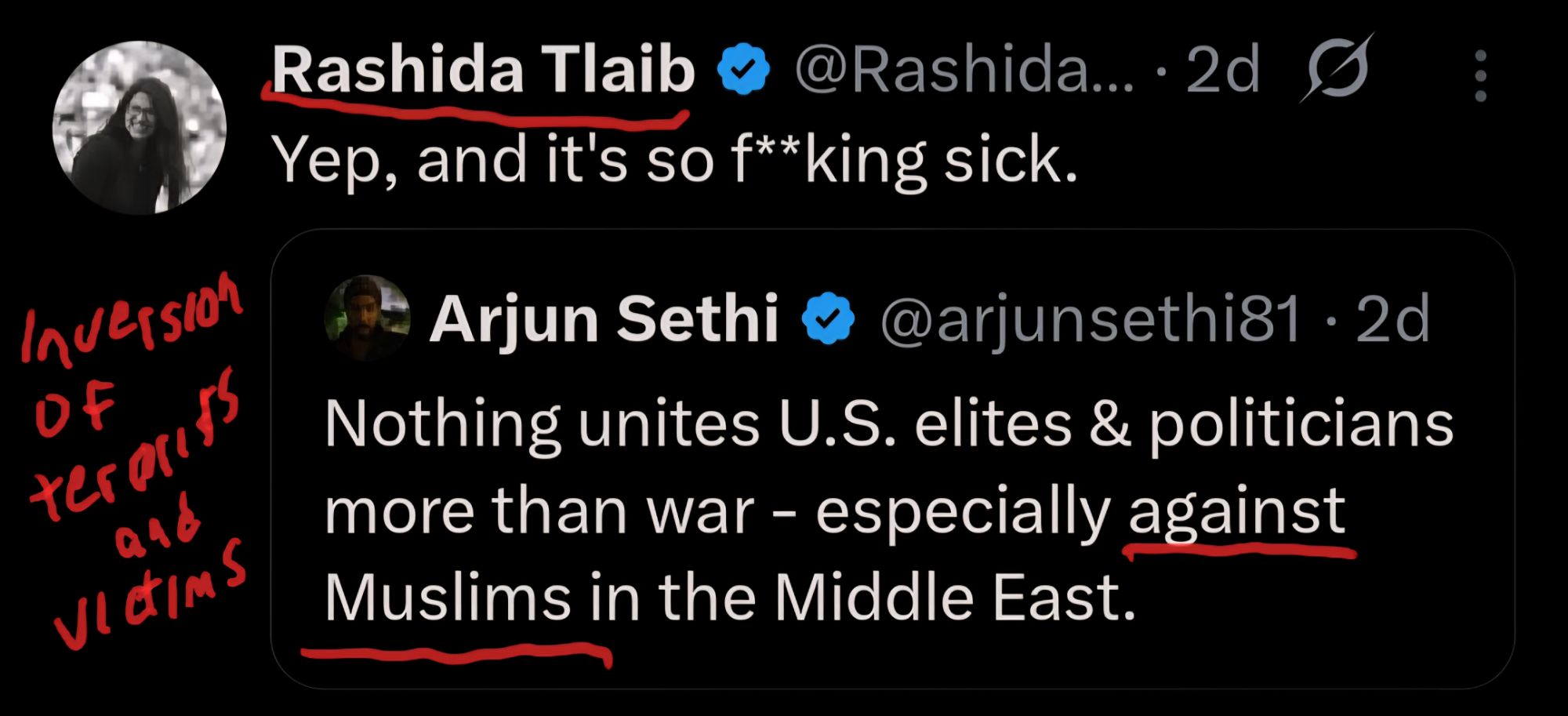
Rep. Rashida Tlaib (D-MI) tried to cast America and Israel as racist, and invert the reality of the fight against genocidal jihadists

The Double Standard

The claim that Trump’s Iran policy was driven by Israel’s interests alone is a cynical deflection — a smear that erases Iran’s long record of bloodshed and global subversion. Even the European Union, which tried to salvage the JCPOA, has acknowledged Iran’s role in terror plots on European soil.

Far left anti-Israel group Justice Democrats attempts to use noxious blood libels that Jews are puppetmasters controlling the U.S. government

Iran’s ideology is expansionist, messianic, and apocalyptic. It seeks not just regional dominance but the destruction of its enemies — America, the “Great Satan,” chief among them.

Conclusion

The Iran Exception is not a flaw in U.S. foreign policy logic — it’s a recognition of Iran’s unique place at the epicenter of global jihadist terrorism and nuclear blackmail. Trump didn’t go after Iran because of Israel. He went after Iran because of Iran. Those calling an “Israel Exception” are hawking dangerous antisemitic smears meant to strip Israel of earned appreciation for taking on the global menace and stoke a modern blood libel.

ACTION ITEM

Donate to JewBelong to place billboards like these around the United States.

Related:

NY Times Lies About Iran Wanting “Less Confrontation” (November 2024)

US Bans Iranian Media But Israel Shouldn’t In The Middle Of A War? (May 2024)

Jamaal Bowman Parrots Iran That American Exceptionalism Is A Lie Based In Racism (January 2024)

On 9/11, Commit To Blocking Iran and Saudi Arabia From Ever Possessing Weapons Of Mass Destruction (September 2022)

Reuters Can’t Spare Ink on Iranian Anti-Semitism (February 2019)

Paying to Murder Jews: From Iraq, Saudi Arabia and Iran to the Palestinian Authority (December 2017)

Qatar Buys Influence Everywhere In America

Qatar has been buying its way into the heart of American power. Not metaphorically—literally. The small Gulf state has dumped billions of dollars into American universities, co-opted think tanks, and inserted itself into political circles on both sides of the aisle. It’s not just about soft power anymore. This is strategic infiltration.

According to Middle East Forum, Qatar pumped “$33.4 billion into businesses and real estate; $6.25 billion to universities; $72 million to lobbyists. Qatar purchases access to our corridors of power while simultaneously funding Hamas terrorists who seek our destruction. The pattern is clear: Qatar targets critical infrastructure, including our energy grid. It bankrolls academic departments that foment campus unrest, buys Manhattan skyscrapers, and infiltrates Silicon Valley. Its capital flows to Washington insiders who shape Middle East policy.”

And now, in the latest display of quiet power, Qatar gifted the President of the United States a brand-new plane.

This isn’t a gift. It’s a transaction. And we don’t know what was sold.

Experts Sound The Alarm

Jonathan Conricus, a former Israel Defense Forces spokesperson and now senior fellow at the Foundation for Defense of Democracies (FDD), has made it clear that Qatar is not neutral. He describes the Gulf emirate as an “active nefarious actor,” using its wealth to export ideological influence and to shield organizations like Hamas. He’s seen what this money funds—from underground terror tunnels in Gaza to misinformation and antisemitic narratives in the West.

Others, like Michael Doran of the Hudson Institute, argue Qatar is just playing defense—just a tiny monarchy with a population of 300,000 surrounded by giants like Saudi Arabia and Iran. But here’s the flaw: Qatar already hosts the largest U.S. military base in the Middle East, the Al Udeid Air Base, just outside Doha. With thousands of American troops stationed there, Qatar doesn’t need more protection. What it IS doing is leveraging that partnership as cover for its far-reaching agenda.

Buying The American Narrative And Minds Of The Youth

Qatar’s influence isn’t just in think tanks and campuses—it’s also in your living room.

In 2013, Qatar’s state media arm Al Jazeera bought Al Gore’s cable network, Current TV, for a staggering $500 million. The rebranded Al Jazeera America failed commercially, but its goal wasn’t ratings. It was presence in 40 million American households.

The acquisition gave Qatar the ability to market propaganda under the guise of serious journalism. It continues to do so under the AJ+ brand on social media, pushing anti-Israel, anti-Western, and often antisemitic narratives to audiences across the globe. It doesn’t aim to inform—it aims to manipulate.

The monarchy’s influence extends into elementary public schools.The Qatar Foundation provides materials for New York City’s “Arab Culture Arts” program which has a map of the Middle East with Israel removed. Tova Plaut, a New York City public school instructional coordinator for pre-K through fifth grade classrooms, said “It’s not just that we’re experiencing Jewish hate in NYC public schools, we’re actually experiencing Jewish erasure.”

A report by the Institute for the Study of Global Antisemitism and Policy (ISGAP) uncovered extensive foreign influence and anti-Israel bias infiltrating as many as 8,000 K-12 classrooms, reaching one million students. Qatar is mentioned 48 times in the report.

Congressional Sleepwalking

Disgracefully, few members of Congress have called out Qatar for their support of Hamas and fueling antisemitism in American schools.

Rep. Carol Miller (R-WV) did so in November 2023 noting “the influence of foreign governments on tax-exempt college campuses, [specifically] Qatari funding for Northwestern University. It is no coincidence that it now has a campus in the Gulf country and has become a pipeline for reporters for the Qatari state-owned media Al Jazeera and their youth-focused subsidiary, AJ+.”

Rep. Ann Wagner (R-MO), Vice Chair of the House Foreign Affairs Committee said in May 2024, “It’s simple: if Qatar can’t pressure Hamas to make a deal with Israel, they must expel these terrorists so they can be brought to justice and punished for their horrific crimes against humanity.  If they won’t do either, then the United States should seriously examine whether Qatar still deserves the privileges of its status as a major non-NATO ally.”

Yet it’s taken the public gift of an airplane to President Trump to finally make everyone in Congress wake up to the evils of Qatari influence.

Conclusion: Start The Audit And Pressure Campaign

President Trump has no qualms bankrupting Iran’s oil business if it continues to pursue a nuclear weapons program. It is time to threaten the Qatari regime to reverse its nefarious connections to state sponsors of terrorism and vicious antisemitism, or face actions similar to those inflicted on the Islamic Republic of Iran.

Congress should use the airplane gift as an opportunity to open a wide ranging probe into Qatari influence everywhere in the USA.

Related articles:

Banning Qatar’s Al Jazeera Is Only News Sometimes (December 2024)

Nexus of Terrorism Hypocrisy: UN, Qatar and Hamas (January 2021)

Al Jazeera (Qatar) Evicts Jews and Judaism from Jerusalem. Time to Return the Favor (October 2016)

An Easy Boycott: Al Jazeera (Qatar) (April 2015)

Orthodox Jewish Student At Trump’s White House Writes A Kvitel

Satire?

The public schools of the United States have become increasingly broken, failing to teach math and science, with the US placing 25th among 37 OECD countries for 15 year olds. Teacher unions have long prioritized teachers’ well being over students, and woke causes over basic skills, leading America to fall far behind other developed countries. Fewer and fewer Americans are opting to bother going to college or graduate schools, leading to a giant visa program for people of the Global South to enter the US, with a record 1.1 million international students in the US in 2023/4.

President Donald Trump applied the woke-standard of absolutism like “defund the police” and “abolish ICE” to begin the process of eliminating the federal Department of Education and move control of schools to the states. He orchestrated a photo op with signing an executive order in front of school children which bemoaned the DOE’s spending over $3 trillion since its creation in 1979, without improving student knowledge.

US President Donald Trump holds an executive order in the East Room of the White house in Washington, DC, March 20, 2025 to start dismantling the Department of Education, in front of young students. (Photo by Mandel NGAN / AFP)

The photo session included a young Orthodox Jewish student in the background. It was perhaps not surprising, as Trump was the only president to invite an Orthodox rabbi to speak at his inaugurations – both times.

When Trump held the signed EO aloft and the other students similarly did so, the Orthodox boy in large blue kippah continued to write. People speculated whether he had OCD and was compulsively checking his spelling. Perhaps he was correcting grammar in the EO or adding footnotes like the biblical commentator Rashi (1040-1105).

Others wondered whether the boy was asking Trump to protect yeshivas in Brooklyn which are being closed right-and-left for failing to teach secular studies, or perhaps leave the DOE open a little longer to root out rampant antisemitism on campuses.

It is rumored that both Sotheby’s and Kestenbaum & Company are fighting to obtain the Jewish boy’s mock EO for auction.

Thank All Those Who Donated And Volunteered For Jewish Causes

As the Children of Israel walked the desert, they built a home, a mishkan, for God. Exodus 36: 2-7 introduces us to the work:

Then Moses summoned Bezalel and Oholiab and every skilled person to whom the Lord had given ability and who was willing to come and do the work. They received from Moses all the offerings the Israelites had brought to carry out the work of constructing the sanctuary. And the people continued to bring freewill offerings morning after morningSo all the skilled workers who were doing all the work on the sanctuary left what they were doing and said to Moses, “The people are bringing more than enough for doing the work the Lord commanded to be done.” Then Moses gave an order and they sent this word throughout the camp: “No man or woman is to make anything else as an offering for the sanctuary.” And so the people were restrained from bringing more, because what they already had was more than enough to do all the work.

The Torah relates that there was such an outpouring of donations to help build the mishkan, that it overwhelmed those skilled craftsmen performing the actual construction work.

Alas, we do not have that kind of over-enthusiasm for causes today, but we definitely have many foot soldiers in trying to stem the tide of antisemitism in the Jewish diaspora.

Consider those fighting the rampant antisemitism at Columbia University. The university finally took action on March 21, 2025, announcing a plan that basically aligned with the demands of the Trump administration to protect Jewish students and faculty on campus. It did not happen in a vacuum.

Columbia’s Hillel had been trying to get the Columbia administration to make changes since the October 7, 2023 massacre of Jews in Israel and riots against Israel and Jews and at the university since then. Alums For Campus Fairness issued a 33-page report about antisemitism at Columbia in 2019. Countless alumni wrote letters to the school administration and withheld donations.

Announcement from Columbia Hillel on March 21, 2025

Congresswoman Virginia Foxx (R-NC) held many committees about antisemitism on campus where Rep. Elise Stefanik (R-NY) lambasted the failure of university leadership to protect Jews.

Leaders of the Jewish philanthropic world like Dan Loeb, Bill Ackman and David Magerman very publicly shifted their donations from their alma maters to Jewish schools like Yeshiva University and some in Israel. Some not so wealthy but public voices like Alan Dershowitz announced that they were shifting all of their philanthropic activities and pro bono work to Jewish causes.

All of these activities helped pivot public thought. It made former Republicans switch to the Democratic Party to help oust politicians perceived as antisemitic like Jamaal Bowman. It was part of what led a decades-long record percentage of Jews to vote for Donald Trump for president in 2024 with his promise to clean up the widespread failures in American schools.

Do not think that the work is done but take a moment to thank the many people who fought to stem the horrific tide of Jew hatred. We need them to keep putting money into Jewish institutions instead of naming buildings at disgraced universities. We need groups like StandWithUs and Brandeis Center to continue to advocate for Jews on campus. We need politicians like Rep. Ritchie Torres and Rep. Mike Lawler in the House, and Sen. Josh Hawley and Sen. John Fetterman to continue their principled work on behalf of Americans. We need the Trump administration to continue to pressure universities to stop enabling a toxic environment for Jewish and other students on campus.

Many people have been working for years to end Jew hatred and it should not be taken for granted. Now is a moment to thank them for their noble efforts.

Related articles:

The Trump Letter To Columbia DEFENDS Research (March 2025)

Columbia University Sets New Standards For Free Speech (December 2024)

Ignoring Columbia’s – And The Education Industry’s – Systemic Antisemitism (July 2024)