“Please Sir, May I have Some More?”

As the 2014 Operation Protective Edge (hopefully) draws to a close, one can expect the same histrionics that have become well-known and well-worn to emanate from the Arab world. The video below of Queen Rania of Jordan, is of her appeal to the United Nations five years ago, which can serve as the outline for the Arab textbook on UNRWA. In summation, we are pathetic and we want to ask the world for money again.

(As further background/amusement, Queen Rania of JORDAN was born in KUWAIT and considers herself Palestinian, when convenient).

“Life half-lived” – Palestinian Quality of Life. The Arabs will bemoan their treatment by Israel and ignore their treatment by their Arab brethren.

Palestinians in Lebanon and Syria are denied citizenship by their host countries. They are denied the ability to own property and obtain white color jobs. The Jordanians gave Palestinians citizenship in 1954, only to revoke it in 1988. Egypt has totally shut down Hamas which runs Gaza, as it is a part of the banned Muslim Brotherhood.

The reason why Palestinians have a bad quality of life (beyond the discrimination from their Arab “brothers”) is because of UNRWA. UNRWA has given millions of second and third generation Arabs a life “half-lived” because of a promise that they will get to go to a house that no longer exists, in a country that their grandparents sought to destroy at its infancy. The Arabs in Israel have twice the life of Palestinians in Arab countries.

Regardless, all protests about quality of life will be directed at Israel, and not at UNRWA, Lebanon, Syria or Egypt.

“Hours wasted at checkpoints” – Border control. The Palestinians will complain about the restrictions of movement out of Gaza and the West Bank. The fact that those territories have amassed over 10,000 rockets, have a charter calling for the death of Jews and destruction of Israel, have fired over 10,000 rockets at Israeli towns over the past 13 years, and killed hundreds of Israeli civilians does not seem to factor into their concern about Israel’s need for border controls.

Regardless, Arab nations will press Israel to alleviate travel restrictions.

“UNRWA has delivered sanctuary.” – Charge of War Crimes. The vast majority of UNRWA employees are Palestinians. These employees were caught not only storing missiles in their schools, but handing them over to Hamas to launch against Israel. Those same members of Hamas launched missiles in and around the UNRWA schools.  UNRWA teachers have been caught building rockets for Hamas.

Regardless, the histrionics of Israel firing at the missile launching sites will continue.

“Reconstruction”. – Appeal for Money to Gaza. The historic blame for the limited re-building homes and schools in Gaza was laid squarely on Israel’s restriction on allowing building materials into Gaza. As Operation Protective Edge made clear, the fault was not the lack of cement in Gaza, but which projects the Palestinians sought to develop. Hamas used the materials to build terror tunnels instead of schools and roads above ground.

Regardless, the Arabs will argue for the ease of more materials into Gaza without oversight.

“School provides a comforting routine.” The schools in Gaza may fly an UNRWA flag, but the curricula are determined by the ruling authority – Hamas. The Hamas education is complete with demonization of Jews and Holocaust denial.

Regardless, Palestinians will demand a rebuilding of schools under the Hamas watch.

“Hell on Earth”. Queen Rania described Gaza as “Hell on Earth” for many years. She used this statement even though people in Gaza had: longer life expectancy; better immunization rates and higher literacy rates than Jordanians.

“If we let UNRWA collapse… we risk destabilizing the entire region.” Queen Rania should hand back her prophesy credentials. The Arab and Muslim world is in total chaos in Syria, Iraq, Libya, Nigeria and other places, with no connection to Israel or UNRWA. UNRWA itself is a destabilizing force to the Israeli-Palestinian peace process, in its current configuration.

Regardless, the Arabs will shout that the organization should not be overhauled.

“All of us depend on UNRWA.” The appeal that the world needs UNRWA will continue even though it is blatantly false. It is a cheap attempt to get the world to continue to fund salaries for 30,000 Palestinians.

The amazing hypocrisy, is that the Arab world funds only 10% of the UNRWA budget, while they are the ones who claim it is necessary.

Regardless, Palestinians will once again have their hands out asking the world for more money.


Source:

“First of its kind” missile discovery: http://www.theguardian.com/world/2014/jul/17/unrwa-investigating-20-rockets-empty-gaza-school-palestinian

“Second time” http://www.unrwa.org/newsroom/press-releases/unrwa-condemns-placement-rockets-second-time-one-its-schools

Third time a trend? http://www.timesofisrael.com/rockets-found-in-unrwa-school-for-third-time/

“Vast Majority” of UNRWA employees are Palestinians: http://www.unrwa.org/userfiles/20100118153142.pdf

UNRWA teacher and terrorist: http://www.globaljihad.net/view_news.asp?id=409

Frontpage article on UNRWA: http://www.frontpagemag.com/2014/dgreenfield/defund-the-unrwa/

Protesting the Victor, not the Victims

Brett Stephens of the Wall Street Journal wrote an editorial on August 5, 2014 about the seeming hypocrisy of parts of the world protesting against Israel in the current Israel-Hamas war but barely making a peep about wars in Pakistan, Iraq, Nigeria, Libya, etc. He doubted the sincerity of people’s stated concern about Arab victims, and considered the protestors motivation of racism, since they only show up when the counter-party is Israel.

As posted in FirstOneThrough on July 21, wars involving Israel account for a very small portion of all Muslim deaths in wars. Muslim-Muslim wars account for 90% of fatalities.

That should not come as a surprise. Most wars are between neighboring countries or are civil wars. (The United States is the exception which seems to only go to war with countries that are not neighbors). As most Muslim countries neighbor other Muslim countries, it would stand to reason that most Muslim wars and fatalities would be at the hands of other Muslim countries.

However, the expected number of fatalities in wars involving Israel is out-of-proportion. Israel’s neighbors account for 7% of the world’s Muslim population (117 million people), but the fatalities account for only 1% of the deaths in wars.

The reason that so few deaths happen in wars with Israel has a lot to do with the length of the wars.

Israel’s wars tend to be much shorter than wars between Muslim countries. The Iran-Iraq war went on for 8 years. The civil war in Angola- 27 years; Somalia- 15 years; and the wars of Sudan (which included Christians) went on for 17 and 22 years. Those Muslim wars killed millions of people. Compare that to the 6-Day War of 1967, and the Israeli wars in 2006, 2008 and 2012 which were 34, 22 and 7 days long, respectively. Those four wars plus the current 2014 war killed 20,000 people combined.

The Israeli wars were short – when they were winning/won. The longest Israeli wars had heavy casualties. The 1948 Israeli War of Independence against five invading armies lasted 300 days, when Israel fought for its very existence. The First Lebanon War lasted three years and did not have a clear victor. Each of those wars had as many fatalities as the five short wars combined. Those battles where Israel was the decisive victor were typically under one month and consequently, the death tolls much smaller.

These facts lead to some interesting questions about the protests:

  • Were the wars short because Israel achieved its near-term security objectives and did not factor in global protests?
  • Did the protests help shorten the war?

More specifically to the question raised by Brett Stephens about the motivation of the protestors during these short battles with Israel:

  • Were the protestors actually concerned that Israel would wipe the opponents off the map, as their Muslim adversaries would certainly have done if they were the winner?
  • Would they protest a quick end to the wars if Israel were losing?

The answers to those questions would demonstrate that the motivation has little to do with victims, and everything to do with the victor. As the Arabs lost the wars, the protests masked their hatred for Israel as a call for the victims. If the Arabs had been winning, the protests would have been chants of support for the Muslim armies, and the “victims” would have been hailed as “martyrs” for the cause.

These anti-Israel protests occur in places with significant Muslim immigrants. If they protest a Muslim-Muslim war in their new host countries, it could lead to local street battles between Sunnis and Shiites, essentially importing their religious war to Europe. However, protesting against a common adversary in Israel is not only easier, but serves as a way of uniting Muslims that are in the middle of a large global war with themselves.


Sources:

Brett Stephens, Palestine and Double Standards: http://online.wsj.com/articles/bret-stephens-palestine-and-double-standards-1407194971?mod=trending_now_8

FirstOneThrough, Israel and Wars: https://firstonethrough.wordpress.com/2014/07/21/israel-and-wars/


The History of Jewish Expulsions

The streets of Europe are once again filled with mobs yelling to expel the Jews. Mankind has not advanced far over the last 1000 years.

For 1000 years Jews were persecuted and evicted from their homes as a vulnerable minority in countries throughout Europe, Asia and Africa. The justifications for the expulsions ranged from: Jews serving as scapegoats for mysterious deaths; a convenient method of cancelling debts and stealing property; and a distorted view of Christianity and Islam requiring that Jews suffer for believing in an unpopular religion.

Ironically, now that Jews have a country of their own, they are the ones evicting Jews in the hopes of appeasing their neighbors.

[xxxx..]an Zionists Stand with Israel

[Fill in your country], and stand with Israel


People around the world have been upset about the fighting in Israel and have reacted in a variety of ways.

  • Many communities around the world focused on sending packages to soldiers in Gaza. Items ranged from letters, pizzas, underwear and socks.
  •  Some communities held fund-raisers, such as selling challah in support of Leket, the Israeli food bank, and the Friends of the IDF.
  •  Many people flew to Israel and volunteered to help disabled people who have difficulty getting to bomb shelters amid the constant attacks from Hamas. Others went to staging areas near Gaza to help set up food stations. Many went to funerals for people they never met.

While the global media has often repeated that the Operation Protective Edge has been fought during the Muslim holiday of Ramadan, they have neglected to discuss that the timing is also the Jewish period of mourning – the Three Weeks – that culminates on August 5th with the 9th of Av.

The Three Weeks is a period when many tragedies happened to the Jewish people throughout history. The common belief is that the various tragedies – especially the destruction of the Temples in Jerusalem – happened because Jews did not treat each other with respect nor did they care for each other.

In 2014, the tremendous support within Israel for the Israeli government, and the global Jewish communities’ constructive responses to the attacks from Gaza may lead one to believe that these three weeks may lead to the building of the Third Temple.


Source:

http://jpupdates.com/2014/07/30/survey-israelis-overwhelmingly-support-idf-gaza-attack/


The Iron Lady of Syria

In January 2009, Asma al-Assad, the first lady of Syria, gave an interview on CNN criticizing Israel’s first war against Hamas in Gaza. The FirstOneThrough review with an overlay of news stories went viral and is below.

The irony of the interview can be viewed on different levels in August 2014:

Death toll:  In August 2014, the death toll in the Syrian Civil War approached 175,000, of which 57,000 were civilians. The 175,000 total dead would surpass the 174,000 civilians killed in the United States War on Terror in Iraq and Afghanistan.

The 57,000 civilians would amount to 46 Syrian civilians killed on average per day for over three years since March 2011, compared to 37 civilians killed on average in Iraq and Afghanistan for 13 years. In the four weeks of the current Gaza fighting, an estimated 50-70% of the deaths were civilians or 29 to 41 civilians killed on average over four weeks.

Muslim Brotherhood: The Hamas party that rules Gaza is a part of the Muslim Brotherhood. As specified in Article 2 of the Hamas charter: “The Islamic Resistance Movement is one of the wings of the Muslim Brothers in Palestine. The Muslim Brotherhood Movement is a world organization, the largest Islamic Movement in the modern era.”

The Muslim Brotherhood was a banned political party in Syria. Asma al-Assad’s father-in-law, Hafez al-Assad banned the party and imposed the death penalty on its members in 1980. In 1982, Hafez al-Assad sought to crush the Brotherhood in Hama, where he slaughtered over 20,000 people – over 740 Syrians per day on average for 27 days – and then leveled the city.

Palestinians: The Palestinians who reside in Syria are treated as illegals – even though they have been there since 1948. They are denied citizenship. The are not given the rights to own property or hold white-color jobs.

Since the Syrian Civil War began, Palestinian Arabs have been pushed from their homes to Jordan and have been shelled repeatedly by al-Assad’s Syrian army.

Youth: Asma al-Assad talks about the significant youth population in the Middle East and Syria who have hopes for a brighter future. Over 10,000 children have been killed in her husband’s civil war, or over 8 children per day for over three and one-half years.


Sources:

http://www.aljazeera.com/indepth/features/2012/02/20122232155715210.html

http://carnegie-mec.org/publications/?fa=48370

http://www.dailystar.com.lb/News/Middle-East/2014/Jul-10/263416-syria-war-toll-tops-170000-one-third-civilians.ashx#axzz39IXDSkpF

http://www.nbcnews.com/storyline/middle-east-unrest/gaza-death-toll-nears-1-500-72-hour-truce-israel-n170236

http://syrianfreepress.wordpress.com/2014/05/06/martyrs-day-asma-al-assad-syrian-womens-sacrifices-unlimited-media-martyrs-honored-on-martyrs-day-and-arab-press-day/

http://www.abc.net.au/news/2014-02-06/102c000-children-killed-in-syrian-civil-war3a-un-report/5241448

http://www.un.org/apps/news/story.asp?NewsID=47662#.U92-VaNeLi8


Two Ways to a 3-Day pass from the IDF

Israel and Hamas agreed to a 72-hour ceasefire in their current battle.  Henny Youngman reviews another funny way out below:


Source:

http://www.foxnews.com/world/2014/08/01/gaza-crisis-humanitarian-cease-fire-underway/


Murderous Governments of the Middle East

Many countries in the Middle East have legal systems that enforce the death penalty in non-violent crimes and matters that have no victim at all such as apostasy (conversion from Islam) and homosexuality.  Many of those countries have public executions, condemn minors and encourage the public to view and participate in the murder (in the case of stonings).

Israel is the only country in the region to not carry out the death penalty for any person in the past 50 years.

Number of people executed (2012):

  • Iran: 314+
  • Saudi Arabia: 82+
  • Iraq: 68+
  • Yemen 28+
  • Somalia 10
  • Sudan 7+
  • Palestinian Authority: 6
  • South Sudan 5
  • Syria 1 (thousands in Civil War not included)
  • UAE 1

iran executions
80% of Iranian executions are for drug offenses

Executed Minors (under 18 years old):

  • Iran
  • Saudi Arabia

Iran Minors
Most of the minors in Iran are killed for drug offenses

Judicial Method of Execution

  • Bahrain: Shooting
  • Egypt: Hanging
  • Ethiopia: Shooting
  • Iran: Hanging, often in public (floggings often before the hanging); stoning (women buried to the neck, men to the waist)
  • Iraq: Hanging; shooting
  • Jordan: Hanging.
  • Kuwait: Hanging; shooting
  • Lebanon: Hanging (civilian court); shooting (military court)
  • Libya: Shooting
  • Palestinian Authority: Hanging
  • Qatar: Stoning
  • Saudi Arabia: Beheading (often in public); hanging; stoning
  • Somalia: Shooting; stoning
  • Sudan: Hanging; stoning; crucifixion afterwards for armed robbery
  • Syria: Hanging (civilian court); shooting (military court)
  • UAE: Shooting; stoning
  • Yemen: Shooting (vast majority); stoning. Post execution public crucifixion allowed for three days

Stoning is used for cases of adultery

somalia adultery
Man stoned in Somalia for adultery

Public Executions

  • Iran
  • Saudi Arabia
  • Somalia
  • Yemen

KSA behead nanny
Saudi Arabia publicly beheads a nanny,
January 2013

Reason for Capital Punishment [last execution]

  • Bahrain: premeditated murder; treason [2010]
  • Egypt: rape; murder; treason; drug trafficking [2014]
  • Ethiopia: murder; treason; genocide [2007]
  • Iran: adultery; homosexuality; murder; armed robbery; drug trafficking; kidnapping;rape; paedophilia; apostasy [2014]
  • Iraq: drug dealing; rape; terrorism [2014]
  • Israel: Crimes against humanity [1962]
  • Jordan: Murder [2006]
  • Kuwait: drug trafficking; rape; murder [2013]
  • Lebanon: murder [2004]
  • Libya: treason; premeditated murder [2010]
  • Oman: murder; drug trafficking [2007]
  • Palestinian Authority: murder; collaboration [2014]
  • Qatar: treason; apostasy [2003]
  • Saudi Arabia: drug trafficking; homosexuality; atheism; apostasy; adultery; rape; armed robbery; witchcraft; murder [2014]
  • Somalia: homosexuality; murder; adultery [2014]
  • South Sudan: murder; treason; drug dealing [2013]
  • Sudan: Homosexuality; apostasy; prostitution; treason; murder; armed robbery; smuggling [2013]
  • Syria: speaking against the government; rape; membership in Muslim Brotherhood; drug trafficking [2014]
  • UAE: drug trafficking; rape; treason; armed robbery [2014]
  • Yemen: homosexuality; adultery; apostasy; murder [2013]


Sources:

http://en.wikipedia.org/wiki/Use_of_capital_punishment_by_country

http://www.deathpenaltyworldwide.org/search.cfm

http://www.btselem.org/inter_palestinian_violations/death_penalty_statistics

http://www.atlantaprogressivenews.com/interspire/news/2011/08/31/%28ips%29-five-nations-execute-homosexuals-two-more-considering-it.html

http://en.wikipedia.org/wiki/Public_execution

http://www.theguardian.com/world/2013/aug/09/hamas-public-executions-gaza-amnesty

http://gulfnews.com/news/region/palestinian-territories/gaza-man-hanged-in-30th-palestinian-execution-1.1238693

The End of Together

Over July 24-6, 2014, a chapter of religious pluralism ended in the city of Mosul, Iraq and its sister city across the Tigris, the ancient city of Ninveh. The Islamic militants of ISIS forced out all of the Christians, and blew up the Tombs of Seth (son of Adam and Eve) and of the Prophet Jonah.

Jonah

Jonah was the last prophet considered holy to each of the monotheistic religions. His story was unusual in several respects which enabled him to capture the imagination and dreams of Christians, Muslims and Jews.

Thousands of years ago, Judaism was the only monotheistic religion. The people in the Middle East practiced a variety of religions and worshiped many gods. The non-Jews were not particularly interested in the Hebrew Bible, and the Bible – seemingly – did not address them. The prophets in the Old Testament almost universally addressed the Jews: the children of Abraham, Isaac and Jacob.

That held true until Jonah. Jonah was given an unusual task by God: leave the land of Israel and go to a far away land because the people there did not behave properly:

“Arise, go to Nineveh, that great city, and proclaim against it;
for their wickedness is come up before Me.”

The story of what comes next is famous. Jonah fled from God and boarded a ship that was tossed in a storm. The sailors reluctantly threw Jonah overboard to appease his angry God whereupon Jonah was swallowed by a big fish. After three days, the fish vomited him onto land to fulfill his task of admonishing the people of Ninveh. The people of Ninveh – including the king- took Jonah’s words to heart, repented, and all was forgiven.

The story of Jonah has many messages. The Jewish rabbis consider them so important that the only time the story is read in synagogue is on the holiest day of the year, Yom Kippur. The lessons of Jonah include that:

  • Repentance through prayer and action can save a great city (Ninveh) and a lone individual (Jonah in the fish);
  • It is not sufficient for Jews to only be concerned with the welfare of their people, but must work to help others as well;
  • A person should not run from a divine mission;
  • God is everywhere, and you cannot hide from Him

For Christians, the story of Jonah is not just about prayer and repentance, but about rebirth. They consider the story of Jonah’s reemergence from the great fish after three days as a precursor to the resurrection of Jesus.

For Muslims, Jonah was the only one of the twelve minor prophets mentioned in the Koran. Mohammed was said to recognize the holiness of Jonah and referred to Ninveh as “the city of Jonah”.

Three monotheistic religions embraced the mission of a man who (perhaps reluctantly) tried to help other people change their ways, while not trying to make them change their religion.


Religions in Modern Iraq

When Iraq became an independent state in 1932, roughly 120,000 Jews lived in the country comfortably. However, when the UN voted to partition Palestine in 1947, the Iraqi government and people turned on the Jews. Pogroms and public hangings became celebrated events. Operation Ezra & Nechemia from 1949 to 1951 got most of the Jews out of the country, with the balance leaving over the 1960s and 1970s. Almost no Jews remain today.

The Christian community in Iraq extends back roughly 1600 years, before the founding of Islam. As recently as 2003, the number of Christians in the country numbered about 1.5 million. However, the numbers declined rapidly during the US-Iraq war. In 2014, ISIS took over much of the country and actively pushed to remove Christians. In Mosul, the Christian community was given a choice that had historically been put before Jews in various countries over the past 1000 years: convert; pay a huge tax; or be killed. There may only be 100,000 Christians left in the country by the end of 2014.

ISIS belongs to the Salafi movement of Islam which is against the worship of the dead, and therefore opposes the use of tombs as shrines. They have destroyed many tombs of Muslim leaders, in addition to those that are important to Jews and Christians. They razed the tomb of Seth, the fifth person created in the Bible (not as famous as his siblings Cain and Abel) for the same reason. They are also slaying fellow Muslims who practice differently by the thousands.


Religions- God and Practice

During the time of Jonah, most people believed in many Gods. When Jonah addressed the sailors on the ship and the king of Ninveh, they readily accepted the words of the Jewish God – not exclusively- but alongside the other Gods they worshiped. Their openness to various Gods let them listen and pray openly together. Such receptiveness to a new God was not universal as demonstrated by the Greeks and Romans who defiled the Jewish Temple in Jerusalem centuries later.

As new monotheistic religions emerged – first Christianity and then Islam – that openness was further challenged. As each religion accepted a single God, the uniqueness of each religion became based on either: 1) unique Gods; or 2) the same God, but with a different set of practices. If the Gods were different, then only one religion could be correct. If the religions had the same God, then distinction between them was based on the method of worship and priorities.

Religious scholars debate whether the monotheistic religions all believe in the same God, just with different names and observances. In practice, the religions have battled each with the fervor of unique Gods for centuries: Muslim invasions; Christian Crusades; enforced Inquisitions. Religious wars scar most of mankind’s history.

For Muslims, it has been intra-religious battles that have been the bloodiest. Since 1948, 90% of all deaths in wars involving Muslim countries have been at the hands of other Muslim countries. In 2014, ISIS killed many more Muslims than other religious groups, and Syrian President Assad killed many more Muslims than people of other faiths. The peculiarities of practice position the battle lines.


The Demise of the Shared

July 2014 yielded a sad watershed moment. The Tomb of Jonah, whom Jews, Christians and Muslims all revered as a religious leader, was demolished. The Tomb of Seth, for whom Bible believers consider a common forbear, was destroyed. In a single week, religious fanatics dismantled physical and metaphysical symbols that united the three monotheistic faiths. If the religions shared a common God, they had a common prophet. If they had different Gods, they still had the same forbears. The tombs were not just shrines to the ancients; they were opportunities for Jews, Christians and Muslims to meet and re-establish their common bonds today. No longer.

Thousands of years ago, a Jew left his homeland to help non-Jews. He did not seek to convert or change their methods of worship, just to pass along a message from God to end evil behavior. He became a celebrated hero to billions of people of different faiths and different practices. As recently as 70 years ago, Jews, Christians and a variety of Muslims (including Sunni and Shiites) prayed together at the tomb of this common hero. But the advance of bigotry consumed them: first they got rid of the Jews, then the Christians. Now they are ridding fellow Muslims.  God’s message through Jonah of reaching out to “others” has been replaced by man’s effort to destroy the “others”.  Perhaps that was the original wickedness of Ninveh 2600 years ago.


Part of the magic of the story of Jonah was that there were no casualties: Jonah; the city of Ninveh and all of its inhabitants; the sailors; and even the fish, all escaped harm.

In today’s dark reality, we may marvel more at that part of the legend and forget what we all have lost.


Sources:

http://www.washingtonpost.com/news/morning-mix/wp/2014/07/25/after-leveling-iraqs-tomb-of-jonah-the-islamic-state-could-destroy-anything-in-the-bible/

http://www.mechon-mamre.org/p/pt/pt1701.htm

http://www.newsweek.com/isis-destroys-shiite-mosques-and-shrines-iraq-257683

http://www.jewsnews.co.il/2014/07/25/muslims-just-made-history-in-mosul-killing-and-exiling-every-last-christian/

http://english.alarabiya.net/en/News/middle-east/2014/07/26/ISIS-destroy-Prophet-Sheth-shrine-in-Mosul-.html

https://www.jewishvirtuallibrary.org/jsource/anti-semitism/iraqijews.html

http://nypost.com/2014/07/27/iraqs-abandoned-christians/

http://www.ibtimes.co.uk/isis-militants-destroy-tomb-jonah-mosul-1458469

The NYT refuses to Listen

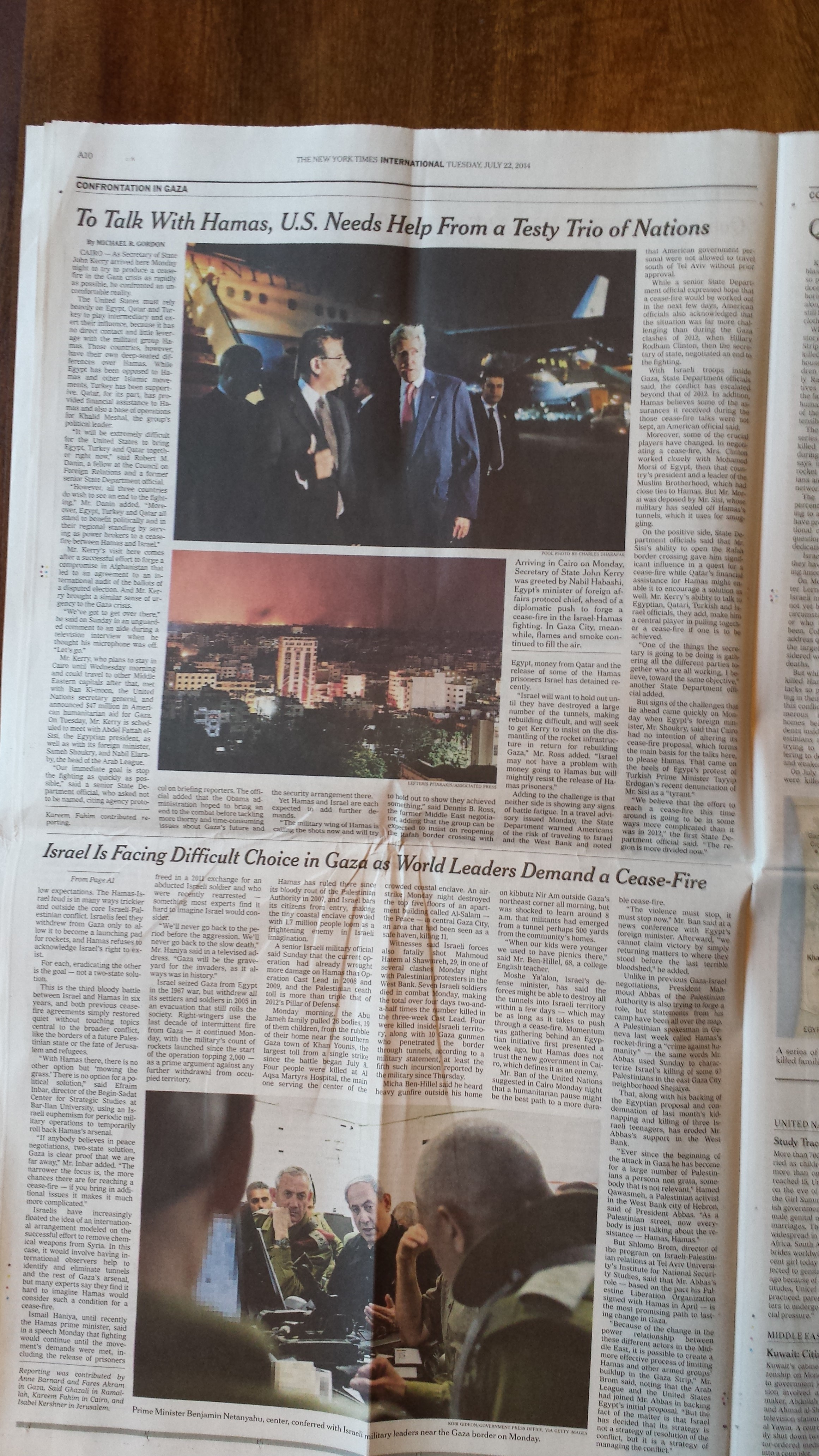
On July 29, an explosion hit the electricity plant in Gaza, setting it afire.  The cause of the explosion is unclear – perhaps from Hamas mortar fire or from Israel – but according to the Times, the uncertainty and Israeli disclaimers were not a reason not to blame Israel from the outset.

IDF Spokesman, Lt. Col. Peter Lerner said repeatedly that Israel had “no confirmation” of striking the Gaza power plant and that it clearly “was not a target”.

Mark Regev, spokesman for Israeli Prime Minister Benjamin Netanyahu, said on CNN that it had definitively cleared the Israel Defense Forces as the cause of the fire as it had reviewed the activities of all of the IDF personnel in the area.

Regardless, the New York Times specifically blamed Israel for the attack in a caption on the front page “In Gaza, Israel bombed 150 sites, including the territory’s only power plant”.  In the story on page A6, the paper continued “Israel’s military on Tuesday broadened its offensive, bombing 150 sites, and one strike set ablaze the territory’s only power plant,”  The large color photograph alongside the article showed a huge ball of fire and smoke.  The same article quotes Lt. Col. Lerner as “I don’t have a clear picture of what happened there.”  Interesting that an article right below makes very different statements and there was no quote from Mark Regev.

The article in the Times below it was entitled “Israel Steps Up Airstrikes in Gaza as International Cease-Fire Efforts Stumble.”  But reading the article and watching the news makes clear that Hamas rejected the cease fire while all other parties accepted.  The cease-fire did not passively “stumble”, but was specifically rejected by Hamas.  The article entitled “Loss of Shelter and Electricity Worsens a Crisis for Fleeing Gazans” also stated that “International efforts to secure even short-term cease-fires have so far failed,” fails to mention that it was Hamas that rejected the cease-fire.

In both of the articles, there is not a single mention of Hamas terrorism on the day.  Nothing about the missiles that were fired into Israeli cities.  Nothing about Palestinian terrorists using tunnels to go into Israel, killing five soldiers and retreating back through the tunnels.

In the world of the Times, there is only one party who suffers, one party at fault.

July 30 cover July 30. A6


Sources:

http://news.nationalpost.com/2014/07/29/israel-hits-symbols-of-hamas-power-gazas-only-power-plant-in-heaviest-bombardment-of-war/

http://www.timesofisrael.com/hamas-tunnel-raid-kills-five-idf-soldiers-in-southern-israel/


The New York Times’ Buried Pictures

Operation Protective Edge was launched on July 8 after Palestinian terrorists infiltrated Israel through tunnels and launched missiles across Israel.

Israeli Prime Minister Benjamin Netanyahu stated repeatedly that the goal of the operation was to destroy the extensive tunnel network that the terrorists had constructed. “We will not finish the mission, we will not finish the operation without neutralizing the tunnels, which have the sole purpose of destroying our citizens, killing our children,” Netanyahu said.

Remarkably, pictures of the terrorists who use the tunnels have yet to make an appearance to the New York Times. Although numerous pictures and images of terrorists penetrating Israel were made available to journalists, the NYT decided to not print any of them.

Even though dozens of tunnels were uncovered, it took until July 29 for the Times to publish it’s first picture of one – inside the paper on the bottom of page A6 (under a picture of Palestinians mourning).  Jodi Rudoren referred to the Israeli military “propaganda push” which “invited a few journalists underground for a tour” as “Israelis exchange nightmare scenarios that are the stuff of action movies” – as if the tunnels were a backstage viewing at a Disneyland movieset.

In three weeks of covering the conflict, the Times featured pictures of Palestinians mourning on the front page seven times (July 11, 14, 17, 21, 22, 24 and 29th). But the root cause of the conflict – Hamas terrorists attacking Israel through the tunnel network – never made it to the front page pictures. The Times actually had a story of the tunnels on the front page on July 29- but decided that a large color photograph of a Palestinian morgue was a more appropriate picture for that article.

It would appear that the underground war is being fought by Hamas and by the Times.


Sources:

Articles and pictures of Gaza tunnels in other papers:
http://online.wsj.com/articles/israel-strikes-30-houses-in-gaza-killing-islamic-jihad-official-1406286950

http://af.reuters.com/article/egyptNews/idAFL6N0Q34PG20140728

http://www.businessweek.com/news/2014-07-27/secret-tunnels-under-israel-reveal-intricate-threat-from-gaza

http://america.aljazeera.com/articles/2014/7/23/gaza-undergroundhamastunnels.html

http://www.haaretz.com/news/diplomacy-defense/.premium-1.606903

Videos:

https://www.youtube.com/watch?v=TlvnkECJkYc&list=UUawNWlihdgaycQpO3zi-jYg

https://www.youtube.com/watch?v=_NBEixuQbYQ&list=UUawNWlihdgaycQpO3zi-jYg

https://www.youtube.com/watch?v=5-hH2026OnU&list=UUawNWlihdgaycQpO3zi-jYg

https://www.youtube.com/watch?v=Mv8xR1FPakY&list=UUawNWlihdgaycQpO3zi-jYg

July 29 cover July 29. A6 Jul 21 cover July 17.cover Jul 22 cover July 14. cover July 24 cover (2) July 11. cover