There is a temptation in moments of fear and anger to reach for the bluntest possible instrument: collective blame.
We are seeing it again now, in calls from some politicians and commentators to treat Muslim Americans not as individuals, but “as a class.” It is offensive. It is wrong. And it is profoundly un-American.
We have been here before.
American history offers a warning that should never be forgotten: General Ulysses S. Grant’s order expelling Jews “as a class” from parts of the South during the Civil War. It was born of frustration, prejudice, and expedience. It is remembered today as a stain.
That is what collective guilt produces. Not security. Not clarity. Just injustice.
And it obscures the truth.
Because the truth is more important: not all Muslims are jihadists. The overwhelming majority are not. But there exists, within every society, a subset animated by radical, supremacist ideology. In this case, that subset is jihadists and they are a very real problem.
We have seen synagogues attacked, Jewish schools targeted, and civilians murdered around the world – from New York to Paris, from Sydney to Jerusalem. These acts are not isolated. They are the violent edge of a broader ideological ecosystem that glorifies terror, sanctifies hatred, and seeks legitimacy in the West.
That ecosystem is not confined to foreign battlefields. It has nodes here.
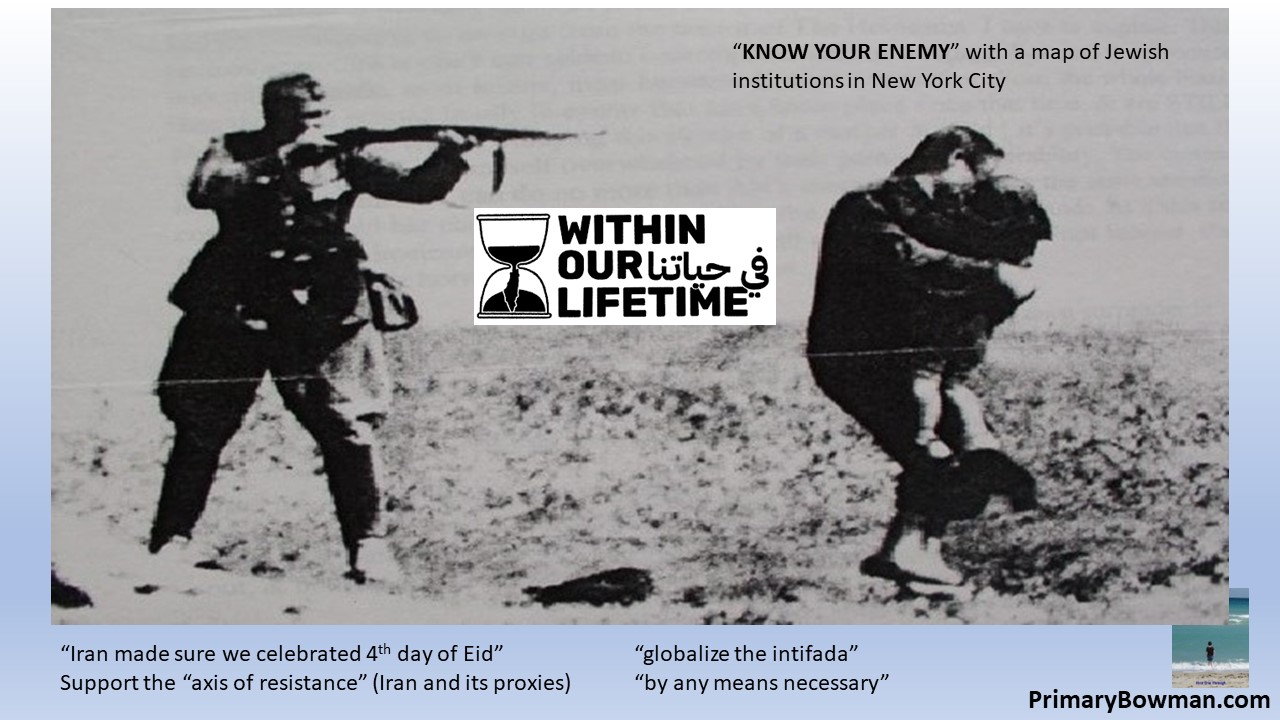
Organizations like Students for Justice in Palestine (SJP) and Within Our Lifetime do not operate as neutral advocacy groups. Their rhetoric, tactics, and alliances echo the narratives of jihadist movements – erasing terrorism, justifying atrocities, and turning mass violence against Jews into something to be rationalized and celebrated.
This is where scrutiny belongs.
Not on millions of Muslim Americans living ordinary lives who are part of the American fabric. But on the networks, organizations, and ideologies that radicalize, that excuse violence, and that deliberately blur the moral line between protest and terror.
Failing to make that distinction is not only unjust but dangerous.
When everything is labeled the problem, nothing is. When all Muslims are treated as suspects, actual jihadists disappear into the noise. They benefit from that confusion. They rely on it.
And worse, it hands them a propaganda victory: proof, in their telling, that the West is inherently hostile, that coexistence is impossible, that radicalism is justified.
That is why calls to expel Muslims from the United States are not just racist; they are strategically self-defeating. They punish the innocent, betray American principles, and distract from the real threat.
A serious society does not fight ideologies with hysteria. It fights them with precision.
It identifies the threat clearly: jihadist ideology, its enablers, and the institutions that normalize or legitimize it. It protects the innocent. And it refuses, no matter how charged the moment, to abandon the principles that distinguish a free society from the movements that seek to destroy it.
What disappears in all three cases is the simplest word: invasion.
We prefer a softer story that cultures blended, languages spread, religions were adopted. But that story falls apart on contact with reality. Spain did not grow into the Americas. France did not organically merge with Africa. Arab armies did not quietly diffuse ideas across continents. They came from the outside, took control by force, and reshaped the societies they conquered—imposing language, religion, and identity.
That is not exchange. It is replacement.
Over time, something happens to memory. The longer the outcome lasts, the more natural it feels. A forced language becomes simply the language. An imposed religion becomes tradition. Conquest becomes history and eventually, heritage.
But modern outrage does not follow history evenly. It clusters around the United States as if European expansion began and ended there. The rest of the Americas, reshaped just as profoundly – perhaps more – by Spanish and Portuguese conquest, rarely draw the same sustained scrutiny.
Part of this is power. The United States is the dominant global actor today, and criticism follows visibility. Part of it is recency. But another part—rarely stated outright—lies in how colonialism is now framed.
In today’s discourse, colonialism is implicitly coded as a “white” phenomenon. The category is no longer just historical but visual.
Where power is perceived as Western and white, the language of colonialism sharpens. Where societies are seen as non-Western or part of the Global South, even when shaped by earlier conquests, the language softens into history or identity. Entire regions transformed by Spanish and Portuguese expansion or Islamic invasions are broadly framed as “indigenous,” while the United States becomes the central exhibit.
That same lens is applied even more aggressively to Israel.
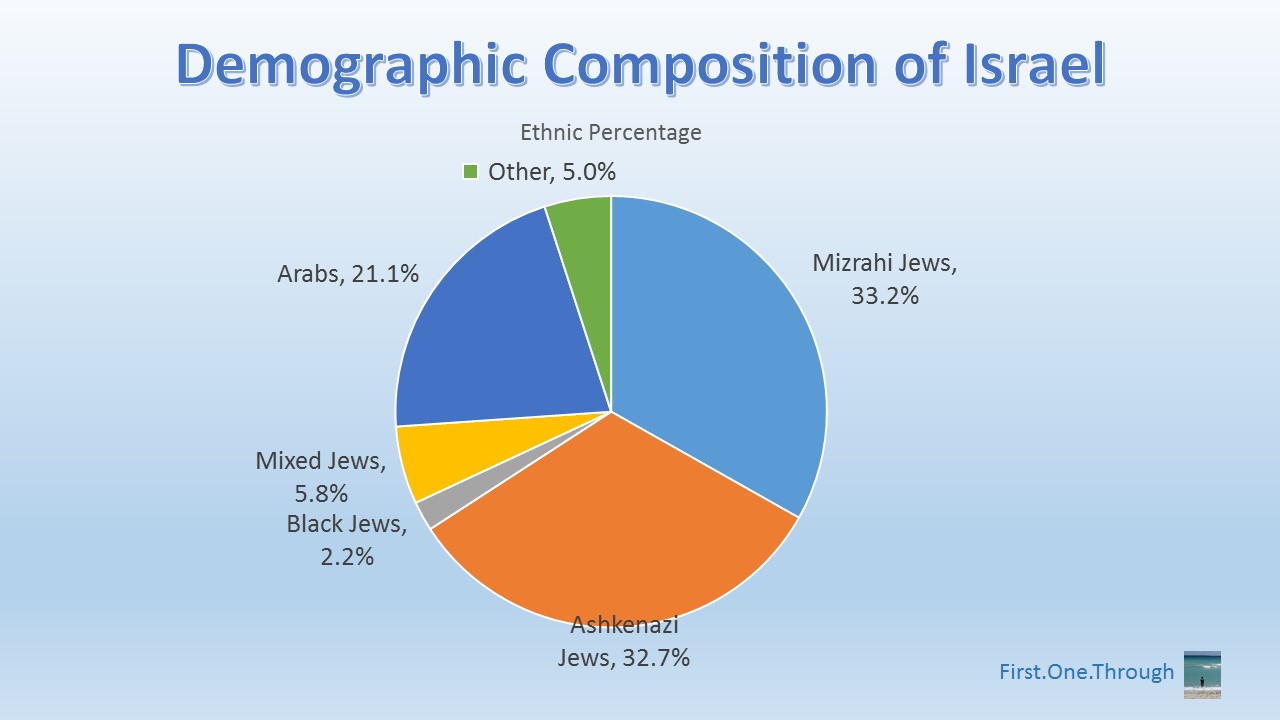
Israel is often cast as a project of Western, even “white,” power. But that framing collapses under even modest scrutiny. The largest share of Israel’s population descends from Jewish communities across the Middle East and North Africa, whose skin is as dark as their neighbors.
More fundamentally, the Jewish return to the land of Israel is a decolonization movement. It is not an external power projecting control into a foreign land. It is dispersed communities reconnecting to a shared origin and reviving their language and restoring their cultural framework in the place it began.
And yet it is falsely framed as colonial.
While the clearer cases fade into history, the exception is forced to fit the rule.
That contrast reveals something deeper. Colonialism is no longer a historical description. It has become a moral label which is applied unevenly, shaped by contemporary perceptions of identity, power, and alignment.
Histories that fit a “white West imposing on others” framework are foregrounded and moralized. Histories that do not fit as neatly are softened, reframed, or absorbed into the past.
European and Islamic invasions took over the Americas and Africa, but universities and progressive media only showcase the interlopers with whiter skin. The blind rage infects reason to such a degree, that even anti-colonial movements such as the Jewish State, cannot be addressed by fact and reason.
The colonial-imperial lens at work today is shaped by an anti-White racist Global South. Its mission is portable colonialism – to extract wealth and power from White societies and redistribute them to non-White communities.
Broadway has always returned, in one form or another, to Jewish life. For decades, those stories were carried by memory, infused with struggle, displacement, and loss, yet grounded in continuity, humor, and the stubborn persistence of a people that refused to disappear. What has changed is not the subject matter, but the center of gravity. The stage has shifted from portraying how Jews lived to confronting how Jews are targeted.
The Past: Life in the Foreground
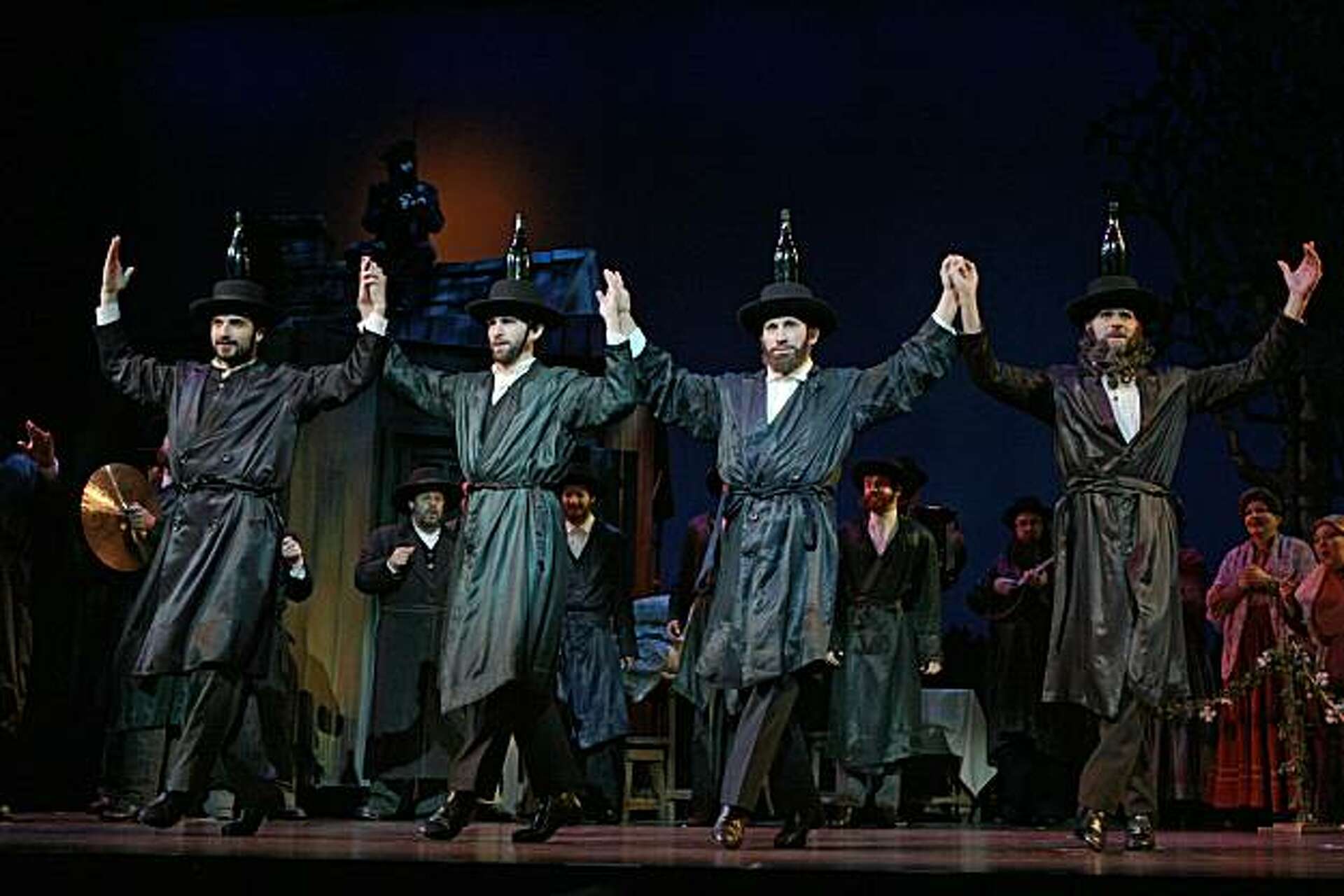
Fiddler on the Roof (2018 in Yiddish) remains the defining example of how Jewish life was once presented. The audience is drawn into a village that feels intimate and alive, filled with arguments between generations, negotiations between tradition and change, and the quiet dignity of ordinary people trying to hold their world together as it begins to shift beneath them.
The violence arrives but it does not dominate the story. It lingers at the edges, a reminder of fragility rather than the force that defines the narrative. What stays with the audience is the humanity that precedes it: the sense that Jewish life contains richness and meaning even as it is repeatedly uprooted, and that something essential survives the disruption.
The Present: History Without Distance
Vienna, and the Illusion of Safety
Leopoldstadt (2022-3) opens in a world that feels secure, even enviable in contrast to the humbler scenes from the Pale of Settlement in Fiddler – assimilated Jews in Vienna who have embraced culture, intellect, and national identity with the confidence of people who believe they belong. The early scenes are filled with warmth and the easy assumptions of permanence.
As the story unfolds, those assumptions dissolve with unsettling speed. Families thin, names disappear, and what began as a portrait of belonging becomes a study in erasure. The audience is left confronting how completely a thriving world can vanish and how little warning the people inside it seemed to have.
America’s Own Reflection
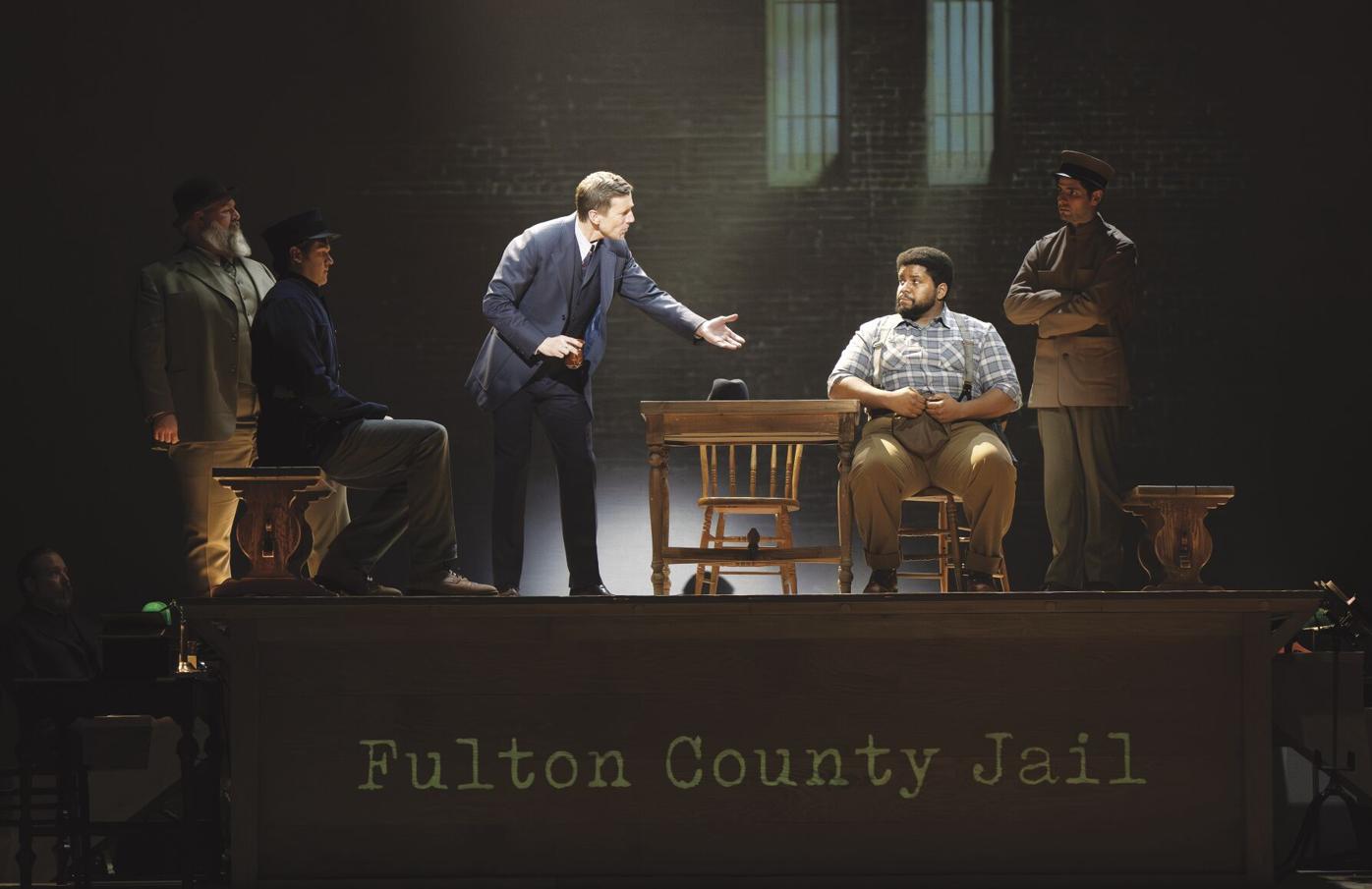
Parade (2022-3) brings that realization into the American setting through the story of Leo Frank. His life in early twentieth-century Atlanta ends in a spectacle shaped by rumor, media amplification, and a public willing to accept accusation as truth.
The discomfort of the story lies in its familiarity. The mechanisms feel recognizable, the escalation disturbingly plausible. The setting removes any remaining sense that antisemitism belongs elsewhere or to another time, placing it squarely within the American experience.
A Present That Refuses to Stay Quiet
Prayer for the French Republic (2024) unfolds in unmistakably contemporary terms, following a French Jewish family as they debate whether their future still lies in the country they call home. The conversation revolves around schools, neighborhoods, and the quiet calculations that shape daily life.
What emerges is not a single defining incident, but an accumulation, a steady normalization of hostility that makes departure feel less like a rupture and more like an eventual step. The question is no longer abstract. It is logistical, immediate, and deeply personal.
Hatred with a Familiar Face
Giant (2026) centered on Roald Dahl, shifts the focus from overt violence to something quieter and, in many ways, more unsettling. Here, antisemitism resides within a figure celebrated for imagination and storytelling, revealing how prejudice can coexist with cultural admiration.
The discomfort lies in how easily such views can be absorbed into environments that otherwise pride themselves on sophistication. Hatred does not require a uniform or a slogan when it is permitted to live comfortably within admired voices. It persists not despite acceptance, but often because of it.
A Pattern Taking Shape
Seen together, these productions trace a continuum across time and place – Vienna, Atlanta, Paris, and the cultural circles of modern Britain – linked by a recurring dynamic. Each begins with a sense of stability, moves through unease, and arrives at rupture. The details differ, but the trajectory remains strikingly consistent.
This repetition carries its own message. It suggests that the issue is not confined to a specific moment or geography, but reflects a pattern capable of reappearing in new forms, shaped by local conditions yet driven by familiar forces.
The Audience and the Mirror
The audiences filling these theaters are often educated, affluent, and deeply engaged with cultural life. They watch these stories unfold, absorb their lessons, and respond with admiration for the craft and the performances.
Yet there is a tension that lingers beyond the applause. The same cultural spaces that elevate these narratives often struggle to confront their contemporary parallels with equal clarity. The distance between stage and reality narrows, but the response to each is not always aligned.
The result is a kind of dissonance: an ability to recognize antisemitism when framed as art, while hesitating to address it with the same urgency when it appears in present-day discourse.
Why This Moment Feels Different
This shift on Broadway reflects a broader change in perception. The conditions once associated with distant history no longer feel entirely removed. The sense of safety that allowed earlier generations to treat persecution as context has given way to a more immediate awareness, one that resists easy separation between past and present.
Recent events have reinforced that awareness. The resurgence of openly hostile rhetoric, the normalization of extreme positions in public discourse, and the willingness in some circles to rationalize or reframe acts of violence have all contributed to a climate in which these stories resonate with a new intensity.
Art does not create that reality, but it reveals how widely it is being felt.
The contrast with earlier eras becomes difficult to ignore. Where once the stage offered a portrait of Jewish life shaped by external pressures, it now presents environments in which those pressures define the experience itself. The richness of daily life is increasingly overshadowed by a sense of vulnerability that cannot be pushed to the margins.
This evolution reads less like a natural progression and more like a recalibration, one that places the question of security at the center. The stories no longer unfold at a comfortable distance. They press closer, asking the audience to consider what they mean beyond the confines of the theater.
Broadway continues to tell Jewish stories, but the tone has shifted in a way that carries unmistakable weight. The warmth that once framed these stories has given way to something sharper, more immediate, and more raw.
The audience is no longer only staring ahead at actors; the Jews attending Broadway turn to the right and left to consider their own lives as living theater.
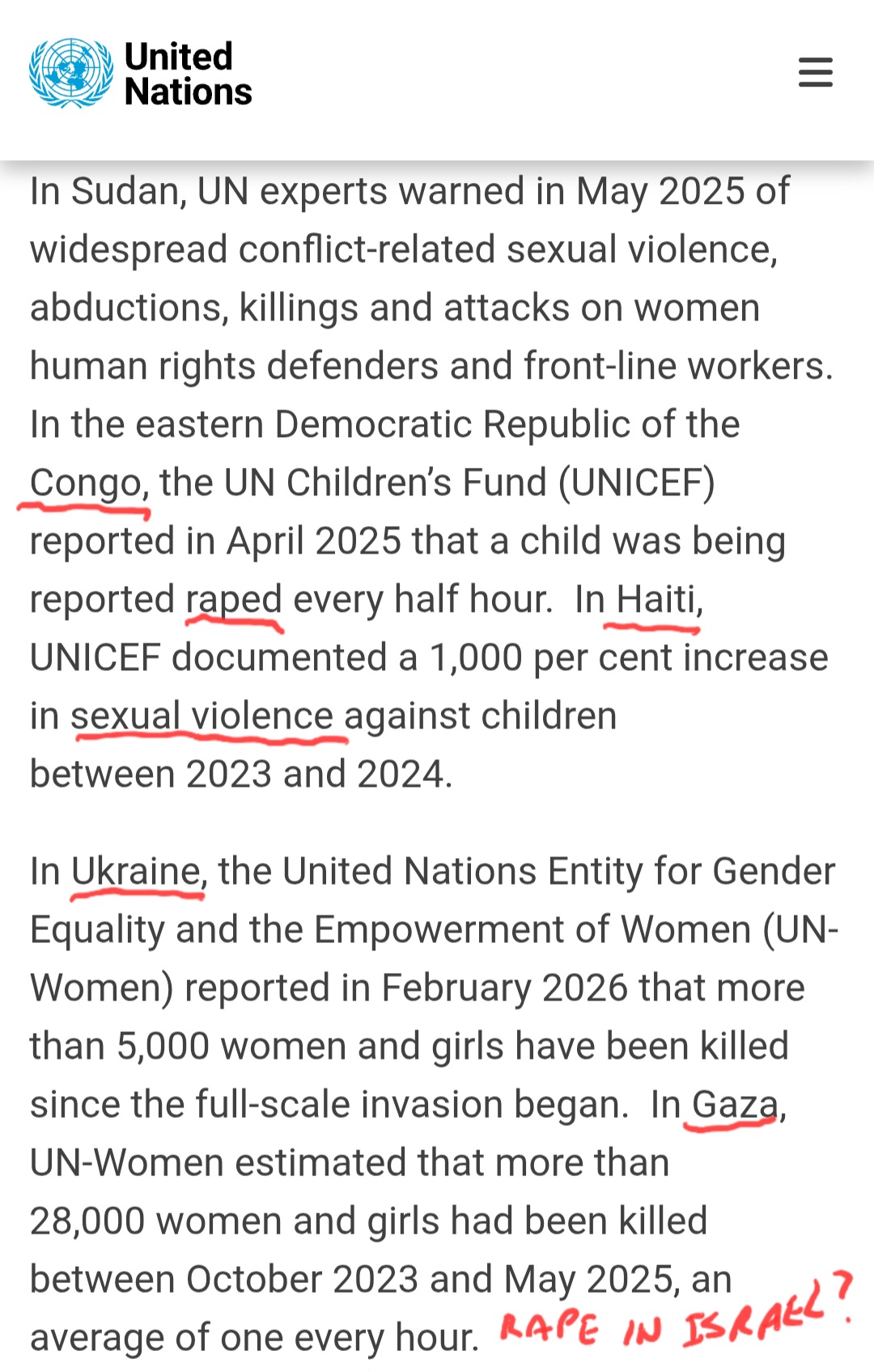
The United Nations has released yet another report on violence against women. It reads like a catalogue of human depravity – Sudan, Congo, Haiti, Ukraine, Gaza – each documented, each calibrated to shock the conscience.
And it does but not for the reason the authors intend.
Because one of the most documented episodes of mass sexual violence in recent history is missing. Not debated. Not contextualized.
Absent.
On October 7, an estimated 6,000 Gazans invaded Israel and carried out atrocities that included the systematic rape and mutilation of women. This is not a matter of competing narratives. It has been documented by eyewitnesses, first responders, forensic teams, and subsequent investigations.
And yet, in a sweeping global report about violence against women, these victims disappear.
The report finds space for a child raped every half hour in the Democratic Republic of the Congo, for the explosion of abuse in Haiti, for war deaths in Ukraine, and for casualty figures in Gaza. Horrific and worthy of attention.
But the omission is not accidental. It is instructive.
Because what the United Nations is quietly establishing is a hierarchy of victims. Some suffering is elevated. Some is ignored. And some – when it disrupts a preferred political narrative – is erased altogether.
Jewish women fall into that last category.
That is not human rights reporting. It is narrative management.
And that distortion does not stay confined to UN documents. It bleeds outward. When the international system refuses to clearly name and center atrocities committed against Jews, it creates a form of moral cover. The record itself becomes a kind of absolution.
So when figures in the West – like the wife of New York City Mayor Zohran Mamdani, Rama Duwaji – publicly express approval for the October 7 massacre, the reaction is muted, rationalized, or ignored. The most grotesque elements of that day, including the sexual violence, have already been softened, blurred, or omitted by institutions that claim to stand for universal rights.
If the crime is not fully acknowledged, then the celebration of it can be more easily excused.
That is the downstream consequence of selective memory and outrage.
The United Nations is not failing to see. It is choosing not to look and remind the world about violent antisemitism. And in doing so, it transforms a report about protecting women into something far more revealing: a document that tells us which victims matter and which ones are inconvenient.
In that calculus, the rape and murder of Jewish women is not denied. It is deemed unworthy of inclusion. Perhaps even harmful, lest it paint its forever wards, the Stateless Arabs from Palestine (SAPs) in an unfavorable light.
CAIR (Council on American-Islamic Relations) recently accused Israel of “waging war on Islam” after security restrictions limited Muslim access to the Al-Aqsa compound during Ramadan.
According to CAIR, preventing Muslim worship at one of Islam’s holy sites is proof of hostility toward Islam itself.
If that is the standard, then a simple question follows:
Will CAIR support Jewish prayer on the Temple Mount during Passover?
Because if restricting prayer equals religious persecution, then Muslims have been denying Jews the right to pray at their holiest site for generations.
The Holiest Site in Judaism
The compound Muslims call Haram al-Sharif is the Jewish Temple Mount, the holiest site in Judaism.
It is where the First Temple of King Solomon stood. It is where the Second Temple stood until the Romans destroyed it in 70 CE.
For nearly two thousand years Jews have prayed toward this location.
Yet today Jews are largely forbidden from praying there.
Under the “status quo” arrangement Israel maintained after capturing Jerusalem in the Six-Day War, Jews may visit the Temple Mount during narrow windows of time via a single entry portal, but are generally prohibited from praying, even silently.
The reason is simple: Muslim authorities insist Jewish prayer there is unacceptable.
A Short History of the Ban
The prohibition on Jewish worship at the site did not begin recently.
Under Ottoman rule, Jewish prayer on the Temple Mount was restricted.
From 1948 to 1967, when Jordan controlled eastern Jerusalem, Jews were banned entirely from visiting the Old City, even the Western Wall, Judaism’s most sacred accessible prayer site.
After 1967, Israel regained control of the Old City but maintained Muslim administrative authority over the mount to prevent unrest.
The result is an unusual reality: The holiest site in Judaism is effectively the only major religious site in the world where adherents of that religion are largely barred from praying.
A One-Way Principle
CAIR’s accusation therefore reveals a remarkable double standard.
When Muslim access is restricted temporarily during wartime security conditions, it is framed as an attack on Islam. But when Jews are prevented from praying at their holiest site at all times, it is treated as normal.
Religious freedom, apparently, runs in only one direction.
The Passover Test
If CAIR genuinely believes preventing prayer at a holy site is an attack on religion, the principle should apply equally. Which leads to a straightforward test:
Will CAIR support Jewish prayer on the Temple Mount during Passover?
Not silent whispers quickly stopped by police. Actual prayer at Judaism’s holiest location.
If religious liberty is universal, that should be an easy position to endorse.
The Irony
Israel remains one of the few countries in the Middle East where Muslims freely maintain and worship at major holy sites. Yet Israel is accused of “waging war on Islam” for imposing security restrictions during a war.
The claim collapses the moment the broader reality is considered.
So instead of outrage, perhaps the most useful response to CAIR’s statement is curiosity: Will CAIR support Jewish prayer on the Temple Mount this Passover?
Or is religious freedom a principle that applies only when the worshippers are Muslim?
When Iran attacks neighboring countries, many observers react with confusion.
How could the Islamic Republic of Iran strike Muslim countries, they ask?
The question reflects a misunderstanding. Throughout modern Middle Eastern history, many of the region’s bloodiest conflicts have been Muslims fighting other Muslims. The idea of a unified “Muslim world” standing together against outsiders is largely a Western illusion.
Reality has always been far messier.
Muslims Fighting Muslims
One of the deadliest wars in the modern Middle East was the Iran–Iraq War. From 1980 to 1988, two Muslim-majority states fought a brutal conflict that killed hundreds of thousands and wounded millions. Both sides invoked Islam. It did nothing to prevent the slaughter.
More recently, the Syrian civil war has killed roughly 500,000 people, most of them Muslims, as factions divided along sectarian and political lines tore the country apart.
But these are far from isolated examples. Modern history is filled with wars in which Muslims killed other Muslims on a massive scale.
Major Muslim-vs-Muslim Conflicts
Iran–Iraq War (1980–1988) ~500,000–1,000,000 killed Shia Iran vs Sunni-led Iraq in one of the deadliest wars in modern Middle Eastern history.
Syrian Civil War (2011–present) ~500,000+ killed Assad regime, Sunni rebel groups, ISIS, and other militias fighting largely Muslim populations.
Yemen Civil War (2014–present) ~350,000+ killed (including famine and disease tied to the war) Iranian-backed Houthis vs Saudi-backed Yemeni government.
Sudan / Darfur conflicts (2003–present phases) ~300,000+ killed Fighting largely between Muslim militias and factions within Sudan.
ISIS war in Iraq and Syria (2013–2019) ~200,000+ killed ISIS fighting governments and populations that were overwhelmingly Muslim.
Algerian Civil War (1991–2002) ~150,000–200,000 killed Islamist insurgents vs Algerian government.
Iraq sectarian civil war (2006–2008 peak) ~100,000–200,000 killed Sunni and Shia militias fighting for control after the fall of Saddam Hussein.
Black September in Jordan (1970–1971) ~3,000–10,000 killed Jordanian army crushing Palestinian militant groups operating inside Jordan.
Hamas–Fatah conflict (2006–2007) ~600–1,000 killed Palestinian factions fighting for control of Gaza.
Together, these conflicts account for millions of deaths, overwhelmingly among Muslims themselves.
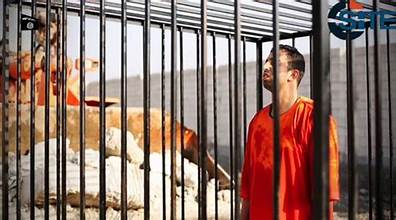
Members of ISIS about to burn Jordanian to death in a cage
Palestinians Killing Palestinians; Israel Arabs Killing Israeli Arabs
Even movements that claim to represent a single people often turn their guns inward.
In 2007, Hamas violently seized Gaza from Fatah, executing rivals and throwing some from rooftops in a bloody Palestinian power struggle.
The same pattern appears inside Israel.
Most Israeli Arabs who die from violence are killed by other Israeli Arabs, usually in criminal or clan disputes rather than in conflict with Jews.
Internal violence, not confrontation with Israel, accounts for the majority of these deaths.
Power Over Solidarity
Western observers often assume shared religion should produce political unity.
But the Middle East repeatedly shows otherwise.
Persians compete with Arabs. Arabs compete with Turks. Sunni compete with Shia.
Power, rivalry, and survival drive politics far more than religious solidarity.
A Familiar Pattern
Seen in this context, Iran attacking Muslim countries is not surprising.
It follows a long-standing regional pattern: Muslim states and factions frequently fight one another.
The Middle East’s wars are not unique. They follow the same rule that has governed politics everywhere:
Nations and movements fight for power and dominance—even when they share the same faith.
In 2022, the United Nations created the International Day to Combat Islamophobia, observed each year on March 15.
The date commemorates the victims of the Christchurch mosque shootings in New Zealand, where worshippers were murdered during a terrorist attack in 2019.
Hatred directed at any religious community deserves condemnation. But the decision raises an uncomfortable question: why is Islam the only religion granted a dedicated global day to combat hatred?
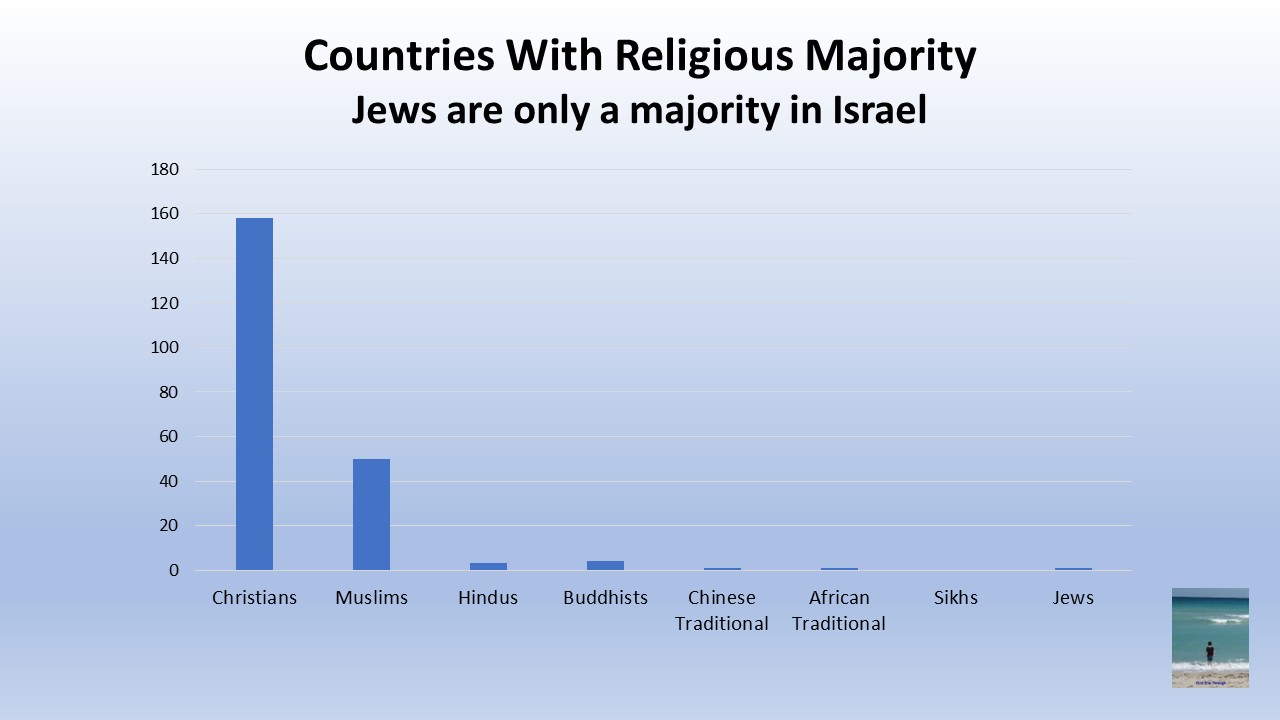
Islam is hardly a marginal faith. With roughly two billion followers, it is one of the largest and fastest-growing religions in the world and the majority religion across dozens of countries stretching from North Africa through the Middle East and into Asia. Within the UN itself it is represented by a powerful diplomatic coalition, the Organization of Islamic Cooperation, a bloc of 57 states that frequently coordinates its positions inside the General Assembly.
Yet Islam is the only religion singled out for a specific UN observance addressing prejudice against its followers.
Other religious communities facing persistent hatred receive no comparable recognition.
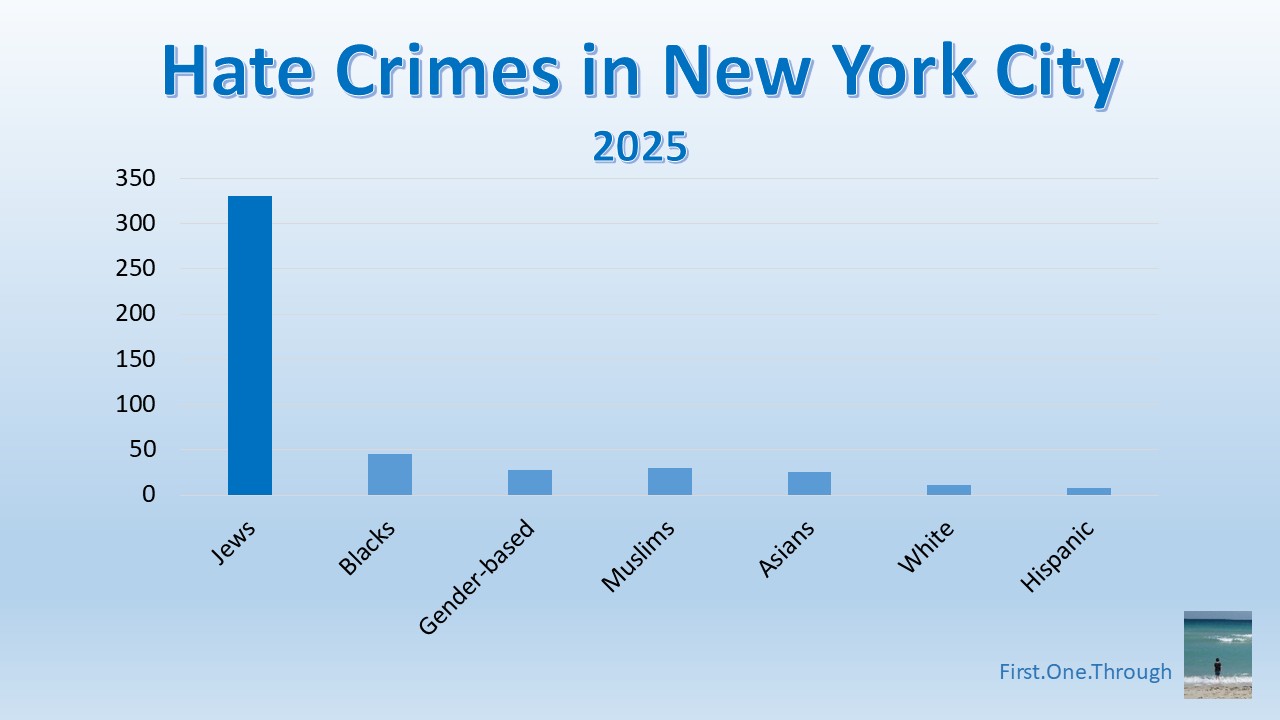
There is no UN day dedicated specifically to combating antisemitism today, despite the fact that Jews are the most frequently targeted religious minorities per capita in many countries. While the UN does observe International Holocaust Remembrance Day each January to commemorate the genocide of Jews during The Holocaust, that observance focuses on crimes committed eighty years ago. There is no equivalent UN day focused on antisemitism in the present.
Nor is there an observance addressing anti-Christian persecution, even though research by organizations such as Open Doors and studies by Pew Research Center consistently show that Christians face some of the largest levels of religious persecution globally in absolute numbers.
The UN does maintain a broader commemoration—the International Day Commemorating Victims of Acts of Violence Based on Religion or Belief—but that observance focuses on victims after violence occurs, not on confronting the ideologies that fuel it.
Except in one case: Islam.
The religion which dominates the countries where Christians are most persecuted, including: Somalia, Libya, Eritrea, Yemen, Nigeria, Pakistan, Sudan and Iran.
Violence the UN Does Not Mark
The choice of March 15 highlights another inconsistency.
Deadly attacks on synagogues have occurred repeatedly in recent years.
In 2018, eleven Jews were murdered in the Pittsburgh synagogue shooting at the Tree of Life synagogue, the deadliest antisemitic attack in American history. In Germany, a terrorist attempted to massacre Jews during Yom Kippur in the Halle synagogue shooting.
And in October 2025, a Jewish man was fatally stabbed outside a synagogue in Manchester, England, in an attack carried out on Yom Kippur, the holiest day in Judaism, when Jews gather in synagogues around the world for prayer and reflection.
Synagogues across Europe and North America have repeatedly been targets of shootings, stabbings, and attempted massacres.
Yet no comparable United Nations observance exists dedicated specifically to combating antisemitism tied to those attacks.
If the UN can create a global day tied to violence against mosques, why has it never created one tied to attacks on synagogues?
Politics Behind the Principle
The explanation lies less in theology than in politics.
For decades the powerful Organization of Islamic Cooperation has used its diplomatic weight to advance religious protection initiatives inside the UN system. Beginning in the late 1990s, the bloc pushed resolutions condemning what it called the “defamation of religions,” efforts widely understood as attempts to restrict criticism of Islam.
Western democracies resisted those proposals on free-speech grounds, and by around 2010 the campaign stalled.
So the strategy evolved.
Instead of defending religion from criticism, the focus shifted toward defending believers from discrimination under the banner of Islamophobia.
Opposing the initiative could now be portrayed as defending prejudice against Muslims, even if the broader debate still involved questions of speech, ideology, and religious critique.
In 2022 the effort succeeded with the creation of the UN’s International Day to Combat Islamophobia.
When Institutions Reflect Power
The episode reveals something fundamental about how the modern UN operates.
The organization does not function as a neutral body weighing global injustices. It functions as a political arena shaped by large voting blocs.
In the General Assembly—where every state has one vote regardless of size or political system—coordinated coalitions wield enormous influence. The 57 countries of the Organization of Islamic Cooperation represent a significant force in that system, often aligned with broader coalitions such as the Non-Aligned Movement.
Together these alliances can shape the symbolic agenda of the institution. They determine what the United Nations chooses to highlight and what it chooses not to see.
A Test of Moral Consistency
The United Nations was founded after World War II to defend universal human rights. But institutions derive legitimacy not only from their ideals, but from their consistency.
When some hatreds receive global recognition, others historical remembrance, and still others little acknowledgement at all, the institution begins to reflect political influence more than universal principle.
Combating religious hatred is a noble goal. But when that effort becomes selective, it reveals the farce and the forces controlling the United Nations.
A man attempted to massacre Jews at a synagogue and preschool in Michigan.
He drove a truck into the building, fired a rifle, and carried explosives and gasoline. Inside were more than a hundred children and staff. Only the quick response of security guards prevented what could have been a mass slaughter of Jewish children.
That should have been the story.
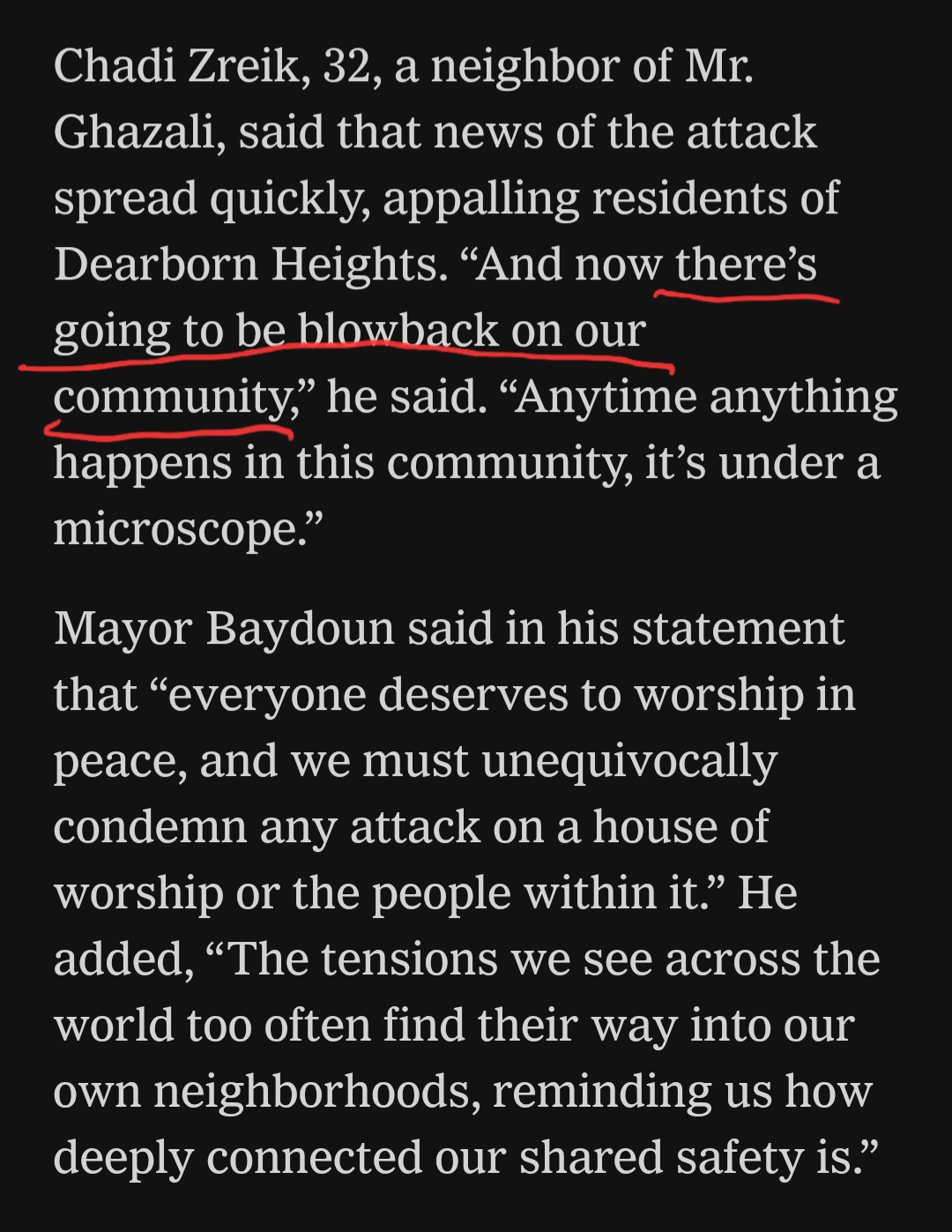
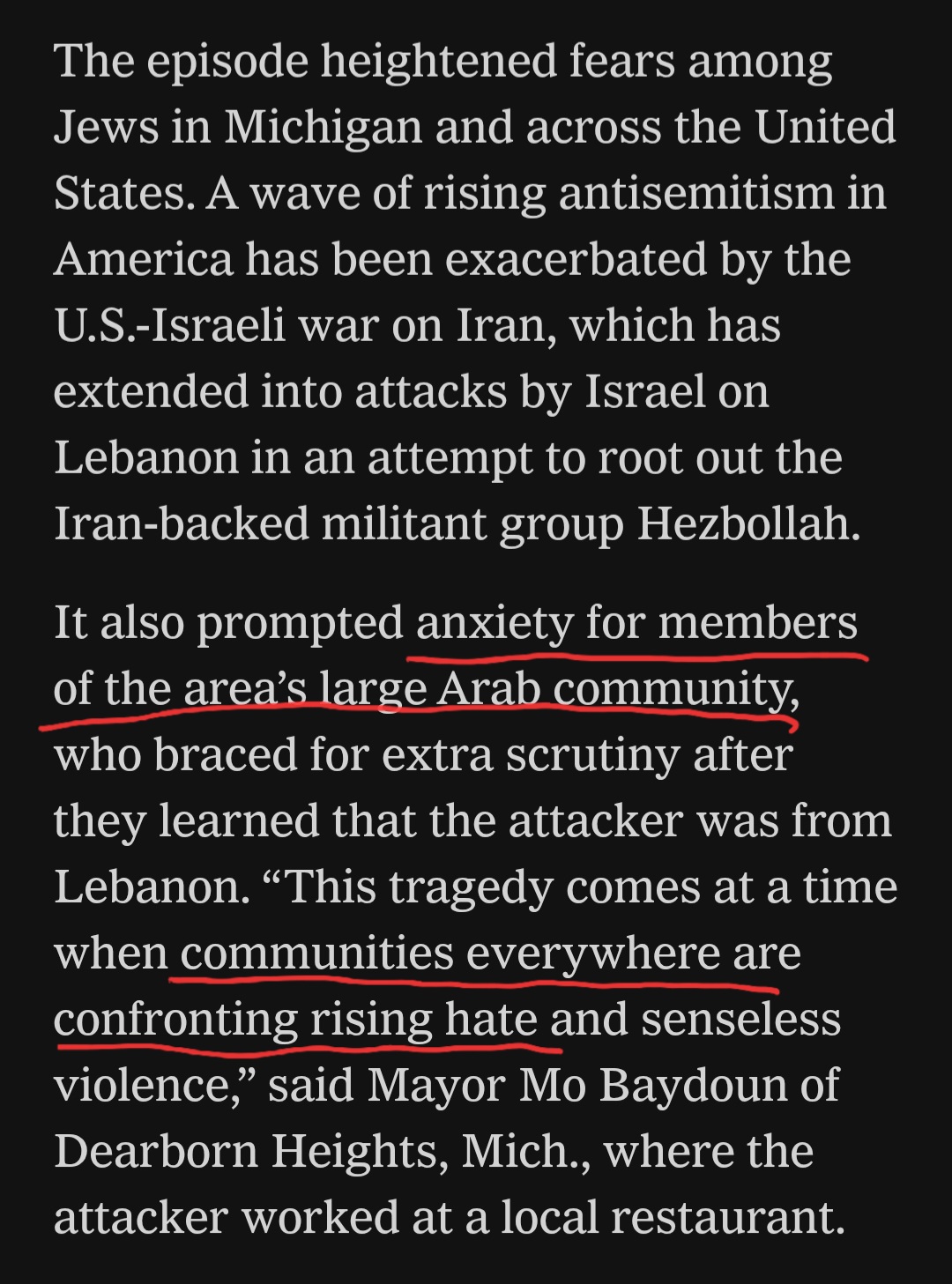
Instead, in its coverage of the attack, The New York Times quickly shifted the emotional center somewhere else. The paper highlighted concern that Muslims or members of the local Arab community had “anxiety,” worried they might face might face “blowback” after the attack.
Pause for a moment and consider the moral inversion.
A man tries to murder Jewish children in a synagogue, and the newspaper of record worries about the social consequences for people who share the attacker’s background, and “communities everywhere.. confronting rising hate.”
Would this framing appear in any other circumstance?
If a white nationalist attempted to burn down a Black church, would the central concern in the article be whether white Americans might face uncomfortable scrutiny?
If a neo-Nazi attacked a mosque, would journalists pivot immediately to the anxiety of Christians worried about backlash?
Of course not.
The victims would be the story. The ideology behind the violence would be examined directly and without hesitation.
But when Jews are attacked – especially by jihadists – the narrative too often drifts away from them.
The Reality the Coverage Avoids
There is another uncomfortable fact that often disappears in these discussions.
In the United States, Jewish institutions have repeatedly been targets of ideological violence.
Synagogues, kosher markets, Jewish schools, and community centers have been attacked by extremists motivated by antisemitism and/or jihadist ideology.
The list is tragically familiar:
the Tree of Life synagogue massacre in Pittsburgh
the Poway synagogue shooting
the Jersey City kosher market attack
the Colleyville synagogue hostage crisis
Across Europe the pattern is even clearer: the Toulouse Jewish school massacre, the Hyper Cacher supermarket attack in Paris, and numerous synagogue shootings and plots across the continent have been by jihadists.
Yet the reverse pattern is almost nonexistent.
There is no recurring history in the United States of Jews entering mosques to massacre Muslims, no wave of Jewish attackers targeting Muslim schools or grocery stores.
The asymmetry matters.
Jewish institutions build security fences, hire armed guards, and train for active shooters not because of paranoia, but because experience has taught them they are frequent targets.
The Michigan synagogue had security for exactly this reason.
Without it, the story might have been hundreds of funerals.
A Pattern of Moral Softening
The New York Times’ framing of the Michigan attack fits a broader pattern that has become increasingly visible in recent years.
When jihadist-inspired violence occurs, the language often softens. Motives become vague. Ideology dissolves into references to “grievances,” “tensions,” or the emotional distress of communities associated with the attacker.
Select context is provided for the perpetrator that make him appear a victim, such as mourning the loss of family members in the Middle East, without sharing that those family members were members of jihadi terrorist groups.
This is no longer news but distortion.
Journalism is supposed to clarify reality, not obscure it. When coverage instinctively protects the social sensitivities of the attacker’s community while barely dwelling on the intended victims, it creates a moral fog.
No serious observer believes entire communities are responsible for the crimes of individuals. That principle should remain unquestioned.
But shifting sympathy away from the Jewish victims of an attack to the jihadi attacker is a failure to report the truth clearly for the purpose of a twisted narrative. One that continues to put the most attacked minority-minority in the crosshairs while falsely painting their most frequent attackers as the ones needing sympathy.
This week’s parsha, Vayakhel, introduces one of the Torah’s most overlooked symbols: mirrors. The bronze basin used by the priests in the Mishkan was fashioned from the mirrors donated by Israelite women. Before performing sacred service, the priests had to wash there as a ritual reminder that moral authority begins with reflection.
Rashi (1040-1105) says these mirrors carried a deeper story. They were not instruments of vanity. In Egypt, when slavery crushed hope and dignity, the women used those mirrors to encourage their husbands and restore their spirit, and thereby build families that would become the nation of Israel. What appeared to be self-reflection was in fact an act of national responsibility.
Now Moses was about to reject them [mirrors] since they were made to pander to their vanity, but the Holy One, blessed be He, said to him, “Accept them; these are dearer to Me than all the other contributions, because through them the women reared those huge hosts in Egypt!” For when their husbands were tired through the crushing labor they used to bring them food and drink and induced them to eat. Then they would take the mirrors, and each gazed at herself in her mirror together with her husband, saying endearingly to him, “See, I am handsomer than you!” Thus they awakened their husbands’ affection and subsequently became the mothers of many children, – Rashi on Exodus 38:8
Egyptian copper mirror
The Torah’s insight is timeless: using a mirror as a tool for the greater good. Individuals often avoid doing so. Nations, virtually never.
Spain today offers a vivid example of what happens when a country replaces the mirror with a flattering portrait of itself.
Spain presents itself as a moral voice on the international stage, particularly when it comes to Israel. Spanish officials speak the language of humanitarian principle and international law, portraying their stance as the product of ethical clarity.
But when viewed through the mirror the Torah describes, Spain’s posture looks far less like moral leadership and far more like moral performance.
The issue is not disagreement with Israeli policy. Democracies criticize one another all the time. The issue is the enormous gap between Spain’s self-image and its conduct. Spain condemns Israel in sweeping moral terms while maintaining quiet relationships with regimes like the Islamic Republic of Iran whose human rights records make Israel’s conflicts look restrained by comparison. It speaks loudly about justice in the Middle East while applying far less scrutiny elsewhere.
The mirror reveals something uncomfortable: a country congratulating itself for moral courage while directing its harshest condemnation toward the world’s only Jewish state.
This pattern does not arise in a vacuum. Spain’s relationship with Jews carries a long and painful history, culminating in the Alhambra Decree. The ease with which moral outrage is directed toward Jews while harsher regimes escape similar condemnation raises an uncomfortable question about whether some old instincts still linger beneath the surface.
The mirrors of Vayakhel represent the opposite instinct. The women of Israel used mirrors not to flatter themselves but to build a future. Their reflection demanded responsibility, not self-congratulation. That is why those mirrors became the basin in which priests purified themselves before entering sacred service.
The Torah’s message is simple: before claiming moral authority, look honestly into the mirror.
Spain seems to have replaced the mirror with a portrait of itself as a defender of justice. But to many observers the reflection looks different: moral preening, selective outrage, and criticism of the Jewish state so disproportionate that it begins to resemble something older and much uglier.
The basin in the Mishkan stood at the entrance to sacred service. Every priest had to wash there before speaking in the name of holiness.
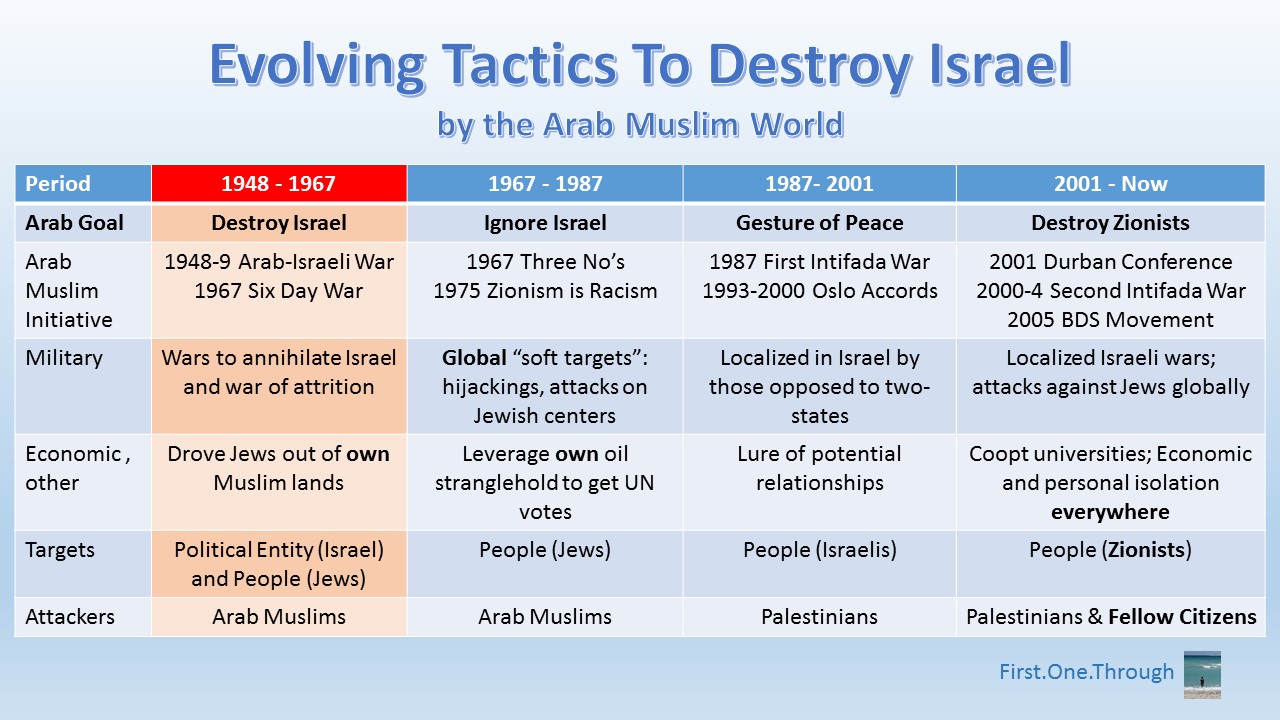
When armies lose wars, the battlefield does not always disappear. It often moves to softer targets.
That is what happened after the Six-Day War, when Israel delivered a devastating defeat to the combined armies of Egypt, Jordan, and Syria. In six days, territories changed hands, military reputations collapsed, and the promise that Israel would soon be destroyed evaporated.
The defeat reverberated far beyond the battlefield. It humiliated governments across the Arab world and shattered the image of inevitable victory that had surrounded the campaign against Israel.
But the war did not end. It simply changed form.
In the years that followed, militant organizations such as the Popular Front for the Liberation of Palestine and the Black September Organization exported the conflict around the world.
The targets were no longer Israeli armies; they were civilians.
Airplanes became battlegrounds. Diplomats became targets. Jewish institutions across the diaspora suddenly found themselves on the front lines of a war being fought thousands of miles away.
The Munich massacre shocked the world when Israeli athletes were murdered at the Olympic Games by Palestinian Arab terrorists. It demonstrated that the battlefield could be moved to the most international stage imaginable.
Another defining moment came with the Entebbe hijacking, when Palestinian terrorists seized an Air France flight and diverted it to Uganda. There, Jewish and Israeli passengers were separated from the others and held hostage in an old airport terminal. The episode ended with a daring Israeli rescue, but the hijacking revealed something chilling: Jews anywhere could be turned into targets for a war militants could not win against Israel itself.
Synagogues and Jewish community centers were attacked in cities far removed from the Middle East battlefield. Rome. Athens. Istanbul. Hezbollah and Iran were often behind the atrocities.
These were not military targets. They were chosen precisely because they were vulnerable.
The message was unmistakable: if Israel could not be defeated in the Middle East, Jews everywhere would become targets.
Today there are worrying signs that the same pattern may be returning.
Iran and its regional network of militias face mounting military pressure from Israel and the United States. When regimes and movements cannot confront stronger armies directly, history shows they often search for targets they can reach more easily.
Recent intelligence chatter has suggested that Iran may have issued signals intended to activate sleeper operatives abroad. Western security services have increased monitoring of potential networks across North America, Europe, and Australia. Whether these warnings prove accurate or not, the concern reflects a familiar strategic logic: when the battlefield is lost in one region, pressure is applied elsewhere.
As the United States becomes the central military opponent of Iran, American Jews may face the threat most acutely.
Extremist movements have repeatedly treated Jewish communities abroad as symbolic stand ins for Israel and its allies. When Israel gains the upper hand militarily, Jews in distant cities have often become the targets that terrorists believe they can reach.
This time the danger may be compounded by a new environment.
Terror no longer requires direct command structures. Groups such as Islamic State pioneered a model of “inspiration terrorism,” where individuals absorb propaganda online and act independently without formal membership or training, such as happened this week in New York City.
At the same time, a troubling ideological convergence has taken shape in parts of Western society. Radical Islamist movements and segments of the revolutionary left increasingly share a political vocabulary built around anti-imperialism, anti-colonialism, and the demonization of Israel. In that narrative, Israel becomes the embodiment of oppression. Jews are portrayed as agents of imperial power rather than a people with a three thousand year connection to their homeland.
When those ideas spread through social media, activist networks, and even parts of the educational system, hostility toward Israel can easily spill over into hostility toward Jews themselves.
The result is combustible.
A generation is growing up hearing that violence against Israel is “resistance,” that Jews represent colonial domination, and that the conflict is part of a global struggle against oppression.
History shows where that logic can lead.
If history is echoing once again, the streets of Western cities may soon remind us of a grim truth: the losers of wars do not always accept defeat.
We are witnessing the next phase of the War on Zionists.



















 First One Through