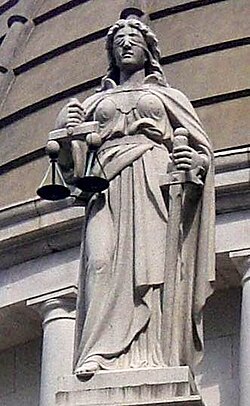
Protesters demand it. Politicians promise it. Journalists expose its absence. Nations wage wars in its name. Even terrorists describe their violence as justice.
Perhaps that is why this week’s Torah portion, Shoftim, does not simply command “Justice, justice shall you pursue.” First comes a warning:
“You shall not pervert judgment; you shall not recognize faces.” – Deuteronomy 16:19
Lo takir panim. Do not recognize faces. The biblical commentator Rashi explains that “this is an admonition addressed to the judge that he should not be lenient to one and harsh to the other, e.g. letting one stand and the other sit; because as soon as he (the party treated harshly) observes that the judge shows more respect to his fellow his ability to plead is hampered (i.e. he loses self-confidence and cannot present his case with assurance) (cf. Shevuot 30a).”
Justice becomes corrupted when we look first at who stands before us and only afterward decide how to judge what happened.
Was the attacker powerful or weak? Majority or minority? Progressive or conservative? Do we admire the cause or despise it?
Sometimes the distortion comes from empathy. Suffering naturally draws us toward the person in pain. But compassion can obscure how the suffering began, what that person did, or what they intend to do next. Empathy is a human instinct. It is not a verdict.
Once we recognize the face, an attack can become “resistance.” A defeat becomes an injustice. The suffering of an aggressor eclipses the aggression that produced it. Terrorism becomes “liberation,” and “peace” only has relevance for one party.
Shoftim understands that the greatest threat to judgment can come from the judge himself. Human beings have an extraordinary ability to bend principles around the people before them.
Erase the faces. Reverse the identities.
If the nationalities were switched, would you reach the same judgment? If the religion were different, would you excuse the same violence? If people you admire committed the act you condemn, would you still condemn it?
If the verdict changes when the faces change, the principle was never really the principle.
The first justice is judging the act. The second is judging ourselves—whether we would render the same verdict after changing the faces.
We normally think about free will as a choice between good and evil. Do the right thing or the wrong thing.
But that is not how Moses presents the choice at the beginning of this week’s Torah portion, Re’eh.
“See, I set before you today a blessing and a curse.” – Deuteronomy 11:26
Good and evil describe the choice we make. Blessing and curse describe what comes from that choice.
The language takes us back to the Garden of Eden and the Tree of the Knowledge of Good and Evil. Adam and Eve ate from it, acquiring the moral awareness that would define humanity: the ability to recognize alternatives and choose between them.
It was an extraordinary power. Alone, it was insufficient.
The Bible soon becomes a history of choices and their consequences. Cain murders Abel. Humanity descends into the violence preceding the Flood. Babel rebels and is scattered. Sodom becomes corrupt and is destroyed.
People possess knowledge of good and evil, but God still delivers the judgments. Humanity acts; God determines the consequences.
Sinai changes the dynamic. Israel receives commandments revealing a divine framework for how to live. The knowledge acquired in Eden is now joined to God’s instruction about how that knowledge should be applied.
And in Re’eh, something more happens.
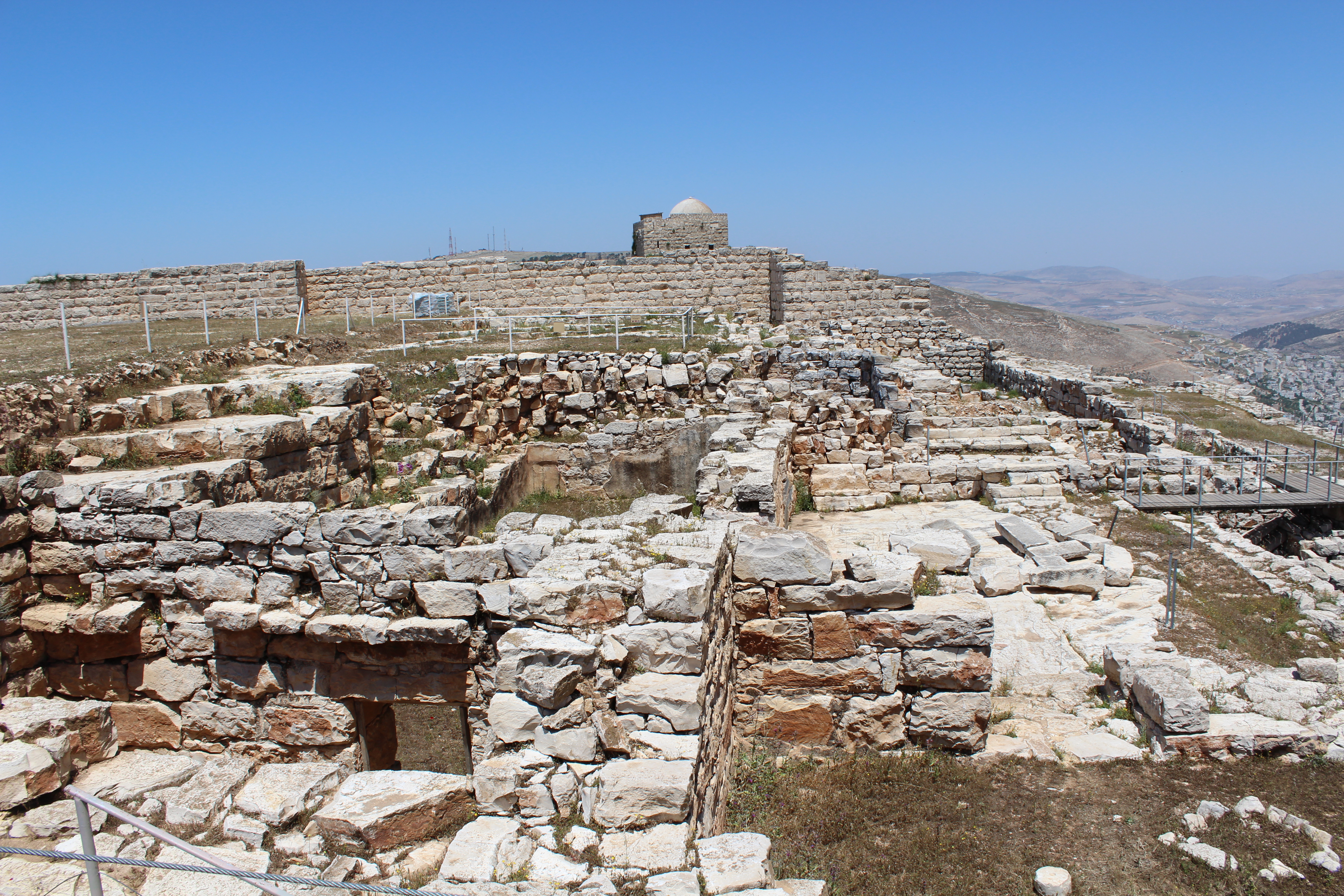
Moses is speaking to the Israelites as they prepare to enter the Promised Land. They know the commandments. They know what God expects. And now blessing and curse are given a physical location. When they cross the Jordan, the blessing is to be pronounced on Mount Gerizim and the curse on Mount Ebal.
Archaeological site on Mount Gerizim
The consequences of human choice that had unfolded across the world in Genesis are now brought home. They will be proclaimed on two mountains in the land where the Israelites themselves will live.
That gives Re’eh — “See” — added force.
See the choices before you. See the commandments that guide them. And now, quite literally, see where their consequences will reside.
In Eden, humanity acquired the knowledge of good and evil. At Sinai, Israel received a framework for choosing. And upon entering the Promised Land, blessing and curse would be placed before them on the very mountains of their new home.
The lesson was no longer abstract.
They knew good and evil. They had been given the commandments. And now, in their own land, they would live with the consequences of their choices.
One of the most quoted verses in this week’s parashah, Eikev, is also one of its most misunderstood.
“He humbled you, made you hungry, and fed you with the manna… to teach you that man does not live by bread alone, but by everything that proceeds from the mouth of God.” (Deuteronomy 8:3)
Of course we live by bread. Without food, we die. So what was Moses teaching?
Perhaps the answer begins with a forgotten detail. When the Israelites left Egypt, they did not leave destitute. The Torah says they departed with gold, silver—and large flocks and herds.
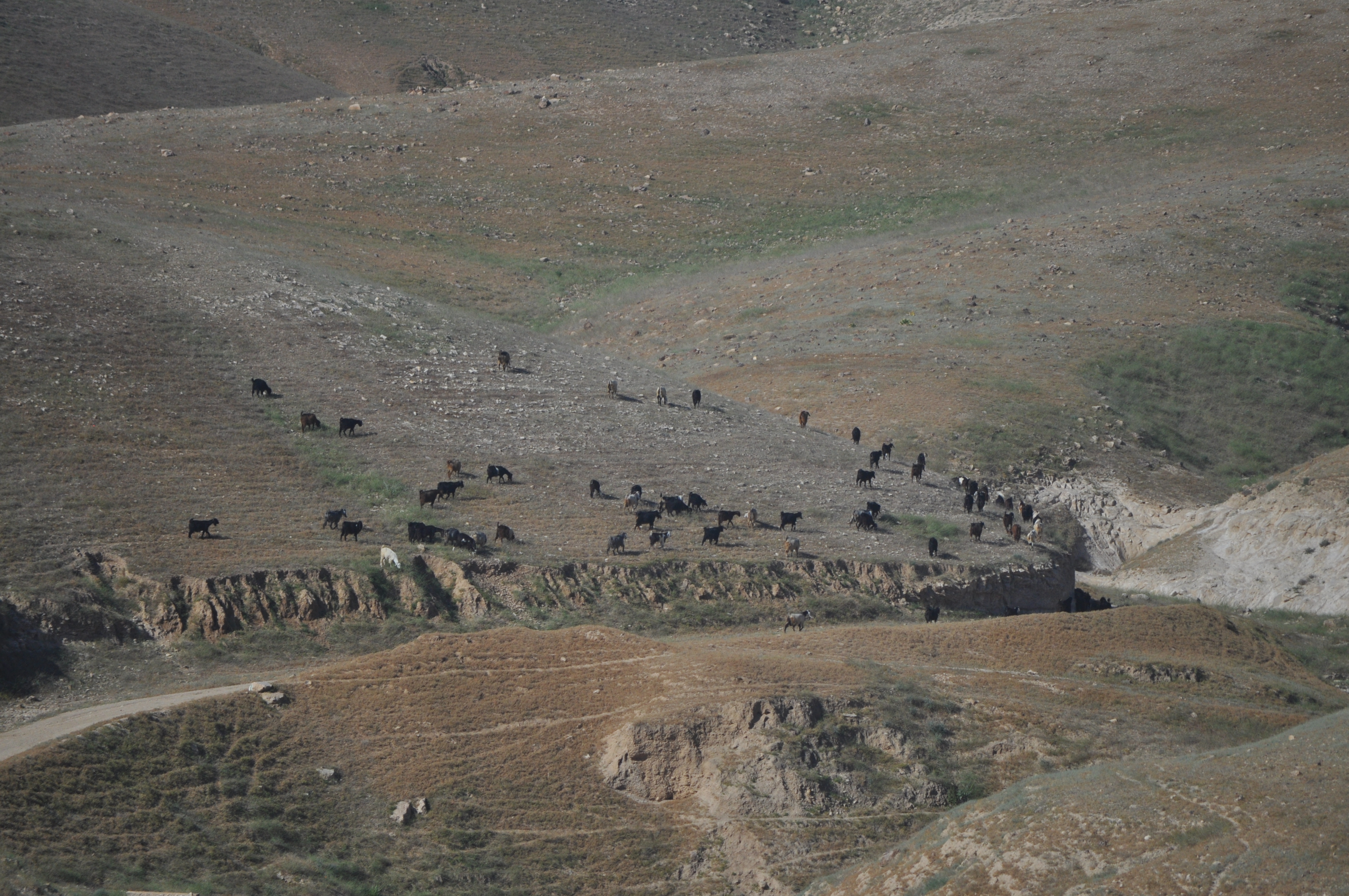
Flock in the area known as “E1” just east of Jerusalem (photo: First One Through
If they already possessed wealth, why were they hungry? They had plenty of cattle to satisfy their needs.
Perhaps God was interrupting a dangerous transition.
In Egypt, Israel depended on Pharaoh. After the Exodus, they could have concluded, Now we provide for ourselves. We have the means, we are self-sufficient. But alas, God “made you hungry.”
For what purpose?
Had Israel been sated with eating meat for their entire sojourn in the desert, they might have entered the Promised Land having consumed much of its productive wealth. Instead, God preserved those assets by first making them less appealing, and then supplying a substitute for their daily needs.
Read this way, the manna was both sustenance and strategy.
That sheds new light on Moses’ warning just a few verses later:
“Beware lest you say, ‘My power and the might of my hand have made me this wealth.'” (Deuteronomy 8:7)
That wealth would had been long decimated without the daily manna.
The point of the manna was both the immediate sustenance and the vehicle with which to preserve future sustenance (the cattle). And it was God who gave the manna to not just keep people alive, but to position the nation to succeed in the future in the Promised Land.
The same is true today.
We need jobs, businesses, investments, and income. Eikev asks us to appreciate the means of our immediate livelihood, future savings and the source for both.
God was not preparing Israel for perpetual dependence. He was preparing them for covenantal partnership. Today and tomorrow.
Consider the lesser known phrase of “He made you hungry” rather than “man does not live by bread alone,” to appreciate the gifts of today and what it enables tomorrow.
Listen to many of today’s most prominent progressive Jewish organizations—T’ruah, Bend the Arc, Jewish Voice for Peace, and many rabbis who speak in similar terms—and a pattern quickly emerges. Their Judaism is explained through a familiar vocabulary.
Justice.
Human dignity.
Welcoming the stranger.
Repairing the world (Tikkun Olam).
Compassion.
These are presented not simply as Jewish values, but as the defining Jewish values.
It is an appealing message. It is also one the modern Western world already overwhelmingly believes.
Nearly every university, corporation, NGO, church, and democratic government affirms human dignity, equality, compassion, caring for refugees, and social justice. Whether one agrees with every application of those ideals is beside the point. They are no longer uniquely Jewish insights. They have become the common moral language of much of the modern world.
The progressive Jewish rabbis and organizations often remind audiences that many of those ideals trace their roots to the Hebrew Bible. That observation is true. Judaism profoundly shaped Western moral thought. Therefore the comment of them being Jewish values is seemingly to educate the western world that they only have their own universal values because of Jews. Also perhaps true, but to what end is the observation? Is it to inform those listening that Jews alone carry the essence of justice, with a transmission extending back thousands of years? That they alone are the actual guardians of values?
Or that they are all on the same page – that the values the West holds dear and the progressive rabbis are one and the same? That one or the other may take the lead on a subject – say condemning genocide, for example – and the other will echo the sentiment?
That approach deliberately strips anything uniquely Jewish from values. It makes the adjective superfluous. Redundant.
Many non-progressive rabbis and the mainstream Jewish organizations have a different view, one that affirms the Jewish component of values. Those are values that are woven into the covenant between God and the Jewish people, as laid out in the Bible and holy books, and debated for thousands of years.
In such telling, justice is not equity as progressive rabbis champion, but based on fairness and balance.
Charity is not generosity. It is tzedakah – an obligation, and one in which helping someone get a paying job and being able to care for themselves is viewed as much greater than making them addicted to welfare.
Rest is not work-life balance. It is Shabbat, a holy day that interrupts commerce, technology, and ordinary life every seventh day because God commanded it. The notion of people adding holiness to something inanimate – like an idol – is actually prohibited in Judaism, while it is encouraged for something specified and incorporeal like the seventh day.
Environmental stewardship is not merely “sustainability.” It includes shmita, allowing the Land of Israel itself to rest every seventh year, because it is a special gift to the Jewish people, much like Shabbat.
Family is not simply important. Marriage, children, circumcision, honoring parents, and transmitting Torah from one generation to the next are sacred obligations.
The list goes on. Some Jewish values are absent from the umbrella of tikkun olam, while others stand in direct contrast to the T’ruah placards.
Recovering the definition matters. Otherwise, “Jewish values” risks becoming little more than progressive ethics wrapped in Hebrew vocabulary—a faith whose unique contribution is remembered mainly as history, while its living covenant is quietly left behind.
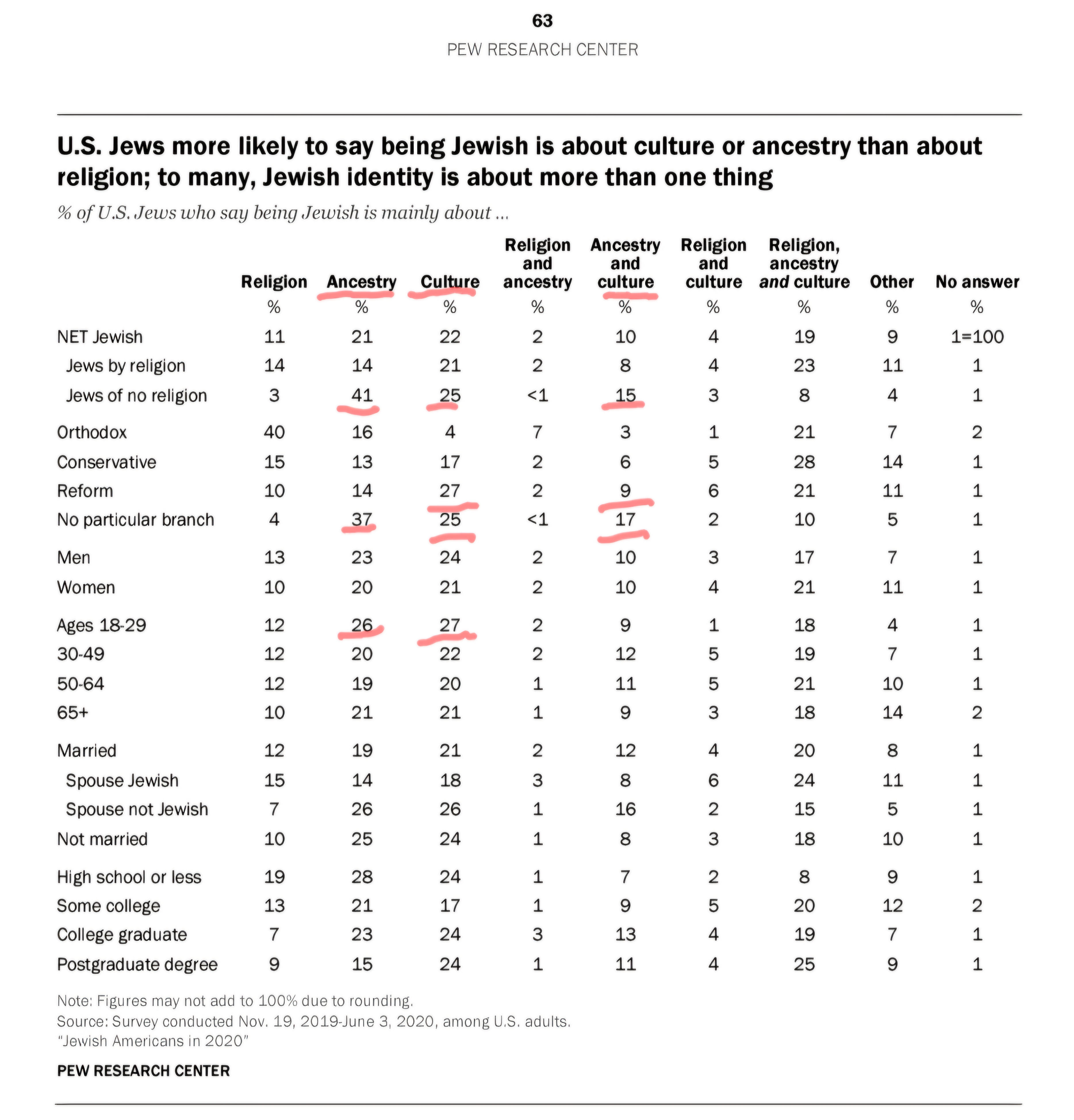
“U.S. Jews do not have a single, uniform answer to what being Jewish means…. Many American Jews prioritize cultural components of Judaism over religious ones…. Orthodox Jews are a striking exception…. A plurality of Orthodox Jews say that being Jewish is mainly about religion alone (40%), and they are the only subgroup in the survey who overwhelmingly feel that observing halakha is essential to their Jewishness (83%)… The vast majority of Jews of no religion say that for them, being Jewish is mainly a matter of ancestry (41%), culture (25%) or both (15%).” – Pew Research May 2021
At this moment in time, the distinction is not theoretical or esoteric. Many progressive left Jewish organizations have adopted stridently anti-Israel positions, some arguing that the Jewish State should be destroyed. They knowingly lock arms with antisemites to advance such future vision.
And should it be a surprise? If the essence of Jewish values for the non-Orthodox far-left is that there is nothing particular about Jews, and that both the noun and adjective “Jew” and “Jewish” are simply historic words without meaning, why should Jews have self-determination any more than left-handed people?
“Supporting Israel is not a battle of political orientation between liberal and conservative Jews. It is a philosophical break in the Jewish community with a fault line regarding the uniqueness of Jews and the Jewish State. The non-Orthodox denominations’ religious philosophy will only let it embrace an Israel that is: about people, not God; about rights not rituals; more secular than religious; more democratic than Jewish; and more universal than particular.” – The Non-Orthodox Jewish Denominations Fight Israel, January 2018
The broader Jewish community should be clear and confident to say that this simply untrue. Judaism and Jewish values are not ancient rock carvings on a cave from which sprang forth the Judeo-Christian values of today. Jews are a living people with a belief in an ongoing covenant which have particular Jewish values that extend beyond universal morality. We should not accept self-erasure in the current environment of cancelling Jews.
More, everyone should fight this approach. Not only Jews but every people who care about their own unique culture and perspective. The lure of the “melting pot” is great but needn’t be absolute. Appreciate the universal AND the particular for Jews and every neighbor.
Judaism helped shape the modern vocabulary of universal values. But Judaism’s enduring contribution is not simply to teach those ideals but show how they are woven into a sacred way of living. One that sanctifies time through Shabbat, family through covenant, body through mitzvot, land through shmita and pilgimmage, and elevates communal responsibilities to a daily obligation.
Jewish values are not simply universal values. And we should not be ashamed to state it clearly.
The United Nations speaks constantly of justice, equality and freedom of worship in Jerusalem. Yet when confronted with the denial of the most basic religious freedom at Judaism’s holiest site, it demands that the discrimination continue.
This is not the position of one committee or one conference. It is the official position of the United Nations.
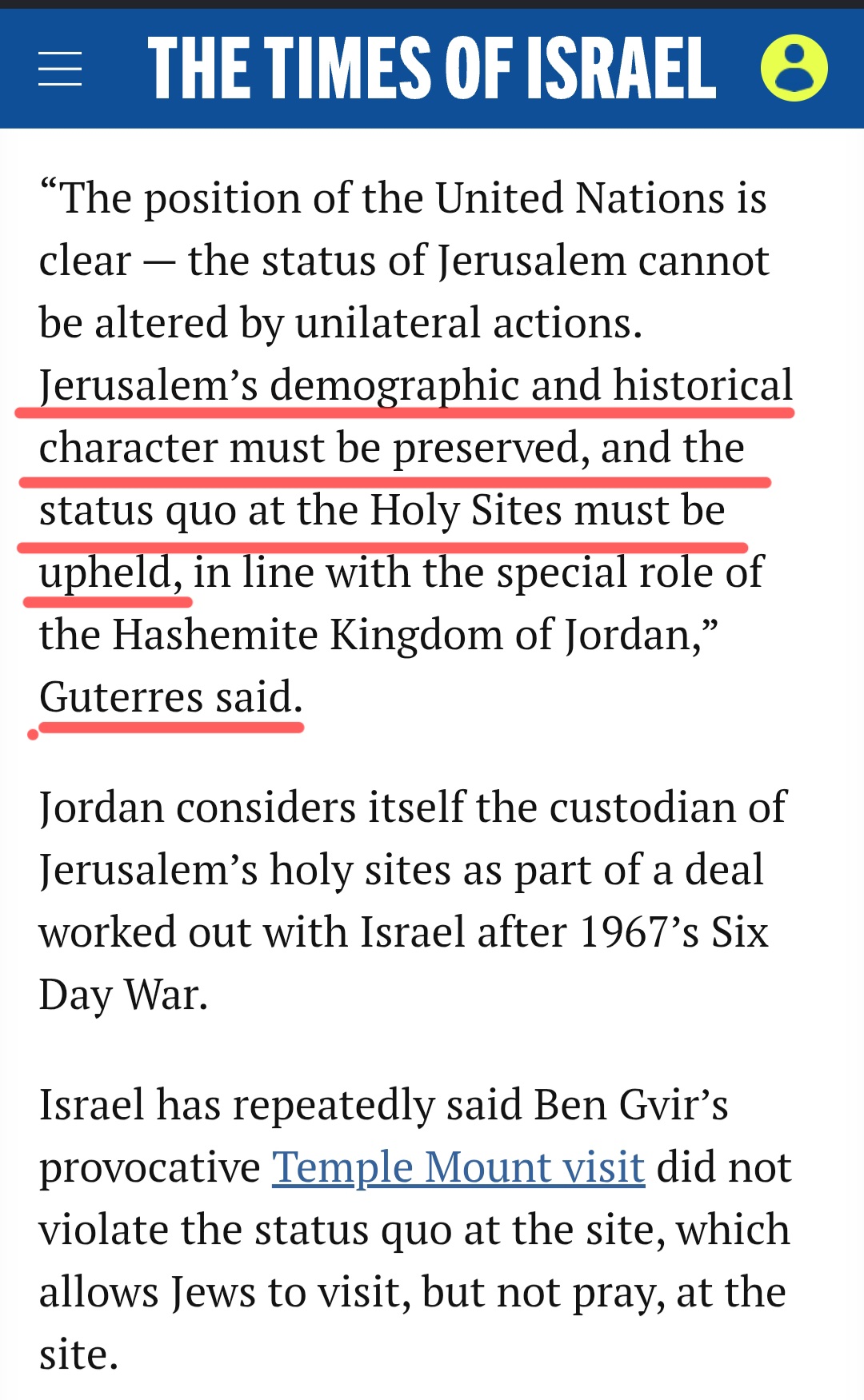
Following a recent visit by Israel’s National Security Minister to the Temple Mount, Secretary-General António Guterres declared that “the status quo at the Holy Sites must be upheld.” His spokesman, Stéphane Dujarric, went further on July 23, insisting that “there is a status quo regarding the holy sites of Judaism, Christianity and, of course, Islam in Jerusalem” and that “the faithful of all religions are able to interact with those sites… in a free manner.”
Those statements cannot both be true.
On the Temple Mount—the holiest site in Judaism—the “status quo” bars Jews from praying openly. Jews may visit during limited hours, but they are prohibited from conducting public prayer under the religious administration of the Islamic Waqf.
The United Nations therefore advocates preserving a system that denies Jews the freedom to pray at their holiest site while simultaneously claiming that people of all faiths are able to worship freely.
That is not religious equality. It is institutionalized religious discrimination.
Imagine the United Nations calling for the preservation of a system that prohibited Christians from praying at the Church of the Holy Sepulchre or Muslims from praying at the Al-Aqsa Mosque. Such a position would rightly be condemned around the world. Yet when the restriction applies to Jews, it is described as preserving the “status quo.”
The phrase has become a euphemism for unequal rights. For sanctioned antisemitism.
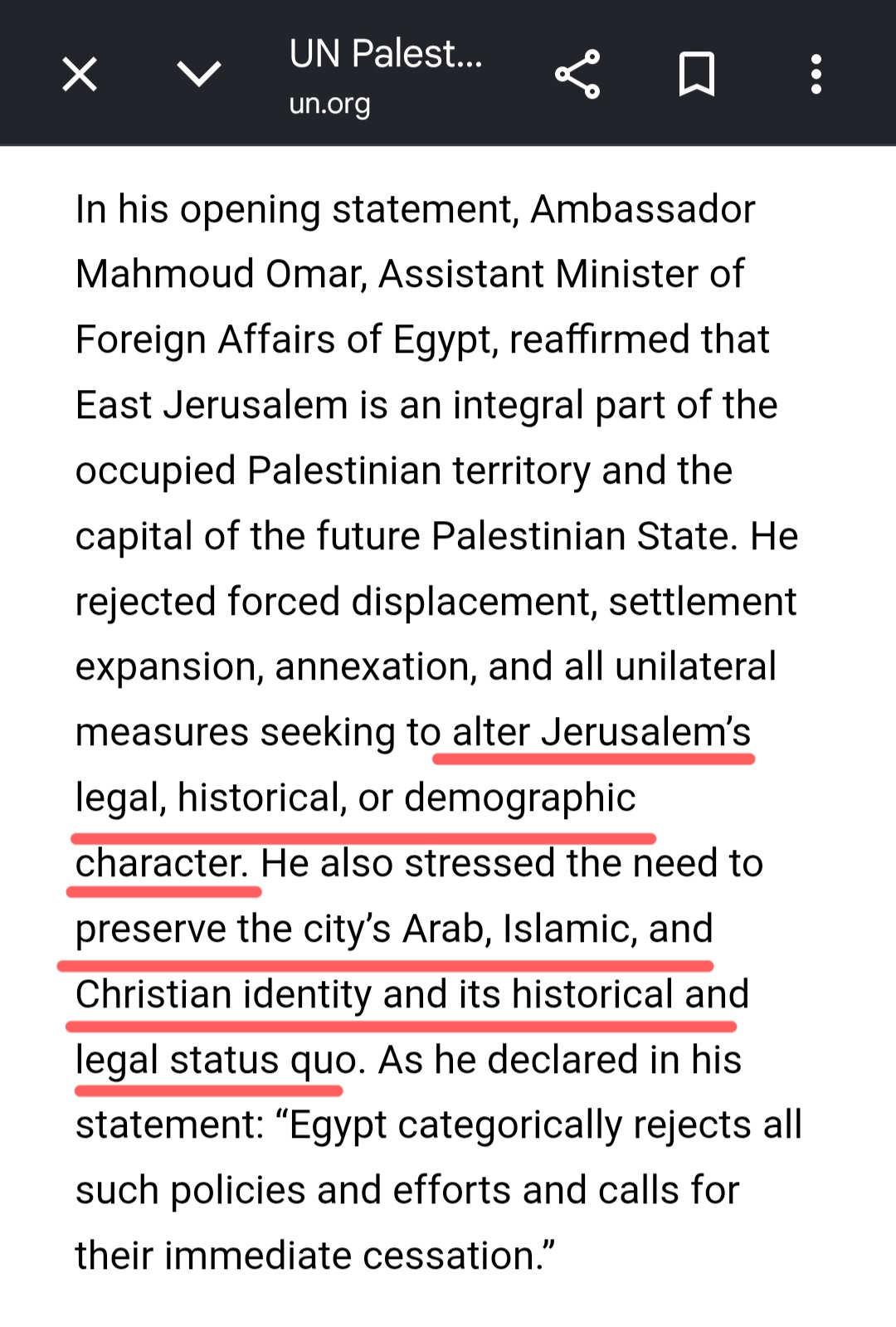
The UN states that the “Palestinian people” have “inalienable rights” in Jerusalem, while insisting that Jews have none
Peace is not built by requiring one religion alone to surrender the right to pray at its holiest place.
The United Nations should stop demanding preservation of the Temple Mount status quo and instead demand its reform.
The UN Human Rights Council should establish a permanent agenda item asking a single question: Why are Jews still barred from praying openly at Judaism’s holiest site?
Every report by the Secretary-General on Jerusalem should state whether that prohibition remains in force.
Every General Assembly debate on Jerusalem should require Jordan and the Islamic Waqf to explain why the ban continues and what concrete steps are being taken to end it.
Every UNESCO discussion of the Temple Mount should address not only Jewish history at the site, but whether Jewish freedom of worship is being respected there today.
Every UN conference on Jerusalem should repeat the same demand until the answer changes:
End the prohibition on peaceful Jewish prayer on the Temple Mount.
The United Nations cannot credibly champion freedom of worship while defending a religious order that denies Jews that very freedom at Judaism’s holiest site.
Every year, just days after Tisha B’Av, when Jews mourn the destruction of the First and Second Temples, comes Shabbat Nachamu—the Sabbath of Consolation. The haftarah opens with God’s promise: “Comfort, comfort My people.” And the Torah portion is always Va’etchanan, containing perhaps the most important words in Judaism:
The parasha begins with one of the Torah’s most poignant moments. Moses pleads to enter the Promised Land, but God refuses. He will see the Land from afar, yet die alone on the eastern bank of the Jordan, separated from both the land he longed to enter and the people who would continue without him. Rather than dwell on what he has lost, Moses spends his final days giving Israel what can never be taken away.
Just after today’s Jews remember what was destroyed on Tisha B’Av, the Torah turns to the covenant between God and the Jewish people.
The Shema is recited every morning upon waking and every evening before sleep, fulfilling the Torah’s command to speak these words “when you lie down and when you rise.” Many Jews have long sought to make it their final words before death. The Shema frames a Jewish life—from its first waking moments to its final conscious breath.
Before reciting its opening verse, Jews traditionally cover their eyes.
One explanation is that removing visual distractions allows the words to be heard more completely. But perhaps the custom also captures something about the moment itself.
With eyes covered, we become vulnerable. For an instant we stand alone, unable to rely on what we can see. It is precisely then that we declare: Hashem Echad—the Lord is One.
Not better than another. Not merely the only God. Simply One: singular, indivisible.
At that moment, the person saying the Shema also stands as one—alone before the One. The moment becomes a deeply personal connection; in Genesis, created in the image of God, and today, retiring together with God.
That may be the deepest consolation after Tisha B’Av.
Enormous empires destroyed the Temple and powerful armies scattered the Jewish people. Yet they could not destroy the simple words Moses taught. They are still whispered every morning, every night, before sleep and, if blessed, with a final breath.
Judaism is designed to be a humble faith, one in which individuals know that their God is not only there to empower them when they need to fight, but console them when they are bereft and alone.
Shabbat Nachamu reminds us that consolation does not begin with rebuilt stones or a visit to Moses’ gravesite. It begins with a people who still know they can close their eyes and connect with God as they say Shema Yisrael, Hashem Elokeinu, Hashem Echad.
For nearly 2,000 years, Jews have fasted on Tisha B’Av to mourn the destruction of the First and Second Temples, the loss of Jewish sovereignty, exile from Jerusalem, and a long chain of national tragedies.
Jewish tradition also teaches that the fast will not last forever. The prophet Zechariah envisioned a day when the fasts commemorating Jerusalem’s destruction would become days of “joy and gladness and cheerful festivals.” Many rabbis have understood that era to arrive with the rebuilding of the Temple.
No one knows when that day will come.
Yet the last century has witnessed changes that generations of Jews scarcely dared imagine.
The Jewish people returned to their ancestral homeland. The State of Israel was reborn (1948). Jerusalem was reunited under Jewish sovereignty (1967). For the first time in nearly two thousand years, Israel is home to the world’s largest Jewish population (2012).
Israel has also become increasingly accepted by its Arab and Muslim neighbors, establishing diplomatic relations with Egypt (1979), Jordan (1994), the United Arab Emirates (2020), Bahrain (2020), Morocco (2020), Sudan (2020, pending implementation), and Kosovo (2021). Meanwhile, the United States (2018), Guatemala (2018), Honduras (2021), Kosovo (2021), Papua New Guinea (2023), Paraguay (2024), and Fiji (2024) have moved their embassies to Jerusalem, while other countries (Slovenia and Nauru) are considering doing the same.
Last year (2025), more than 75,000 Jews ascended the Temple Mount – a modern record that would have been unimaginable only a generation ago.
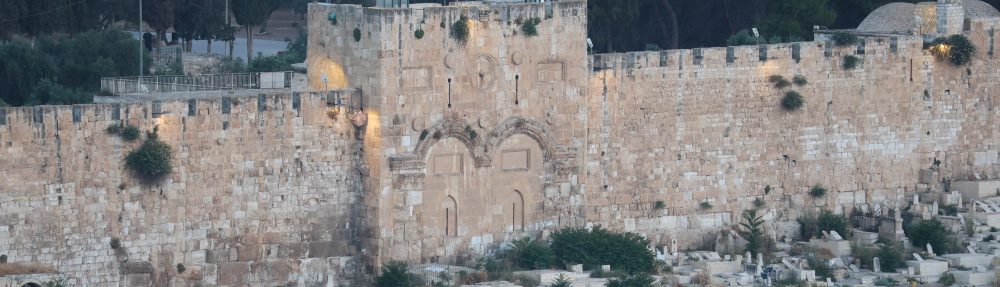
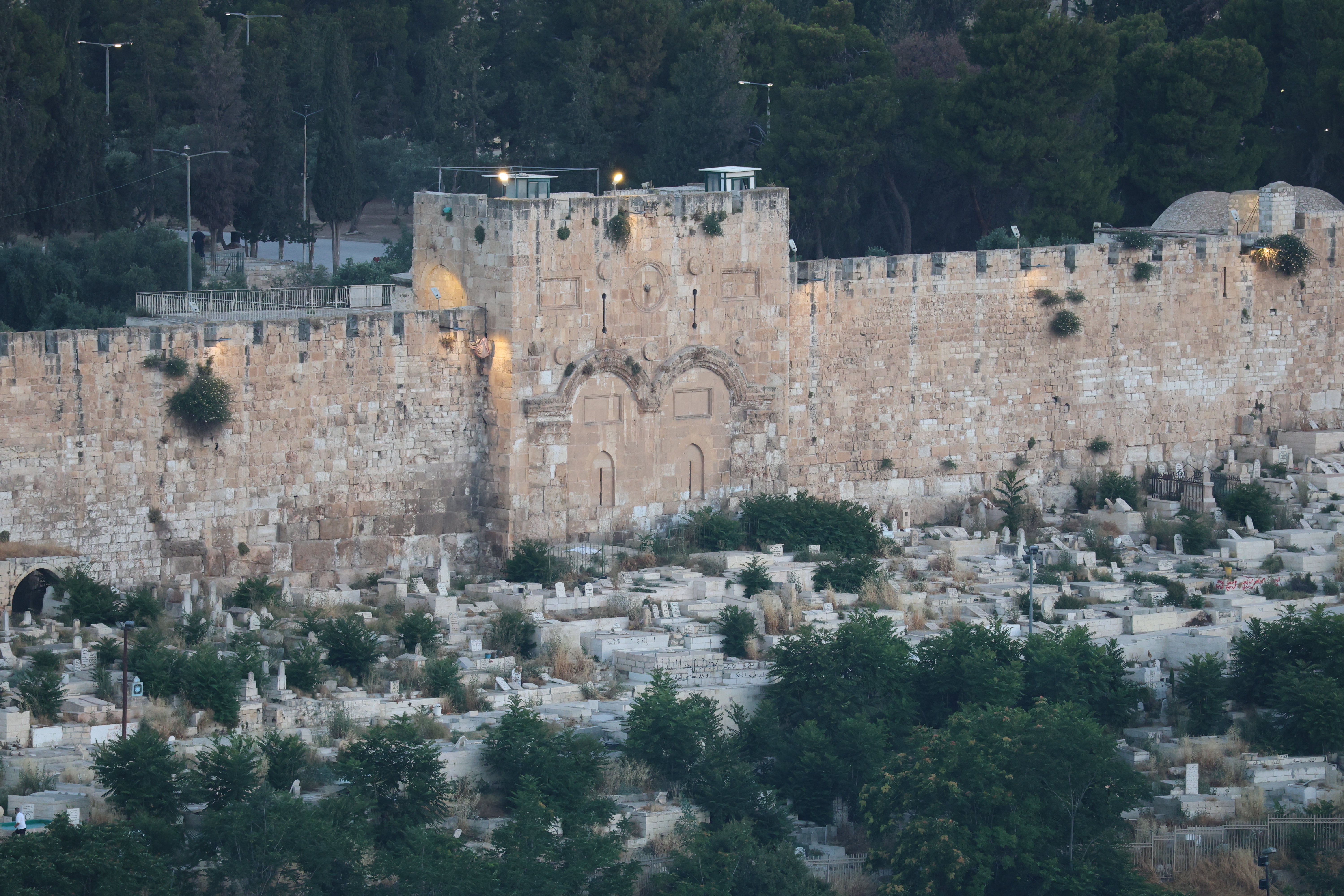
The Golden Gate in Jerusalem’s Old City exterior wall (photo: First One through)
The Temple remains unbuilt and Tisha B’Av remains a day of mourning.
But it does raise a question that previous generations could scarcely have imagined asking: Will this be the last Tisha B’Av fast?
Perhaps Jews a century from now will still be asking the same question. Or perhaps they will look back and realize that ours was among the last generations to mourn the destruction rather than celebrate the restoration.
For almost two thousand years, that possibility seemed unimaginable. Today, it no longer does.
There is something profoundly human about gathering related things into a single vessel.
We do it with photo albums, where a lifetime of moments is gathered into one book. We do it with museums, where centuries of artifacts are brought together under one roof.
The Jewish calendar does the same with time.
Tisha B’Av is not merely the anniversary of the destruction of the First and Second Temples. Over centuries it became the vessel into which Jewish history poured its sorrows – from the destruction of the Temples to the expulsions from England and Spain, to catastrophes that culminated in the Holocaust. Generations found in Tisha B’Av a place large enough to hold them all.
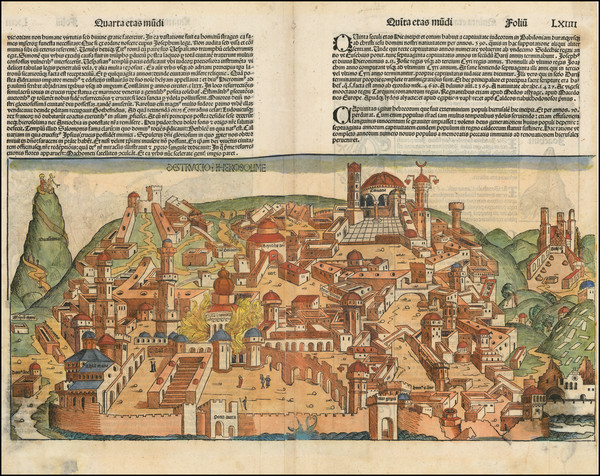
The Nuremberg Chronicle showing the destruction of Jerusalem
The Temple Mount in Jerusalem became another vessel. Of place.
For much of history, Jerusalem was known as the city of the Jewish Temple. But over time it gathered far more meaning. It became the location of the near sacrifice of Isaac, the destination of pilgrimage, the focus of exile, and the direction toward which Jews have prayed for thousands of years.
Other faiths also poured meaning into Jerusalem. Christians revere it as the place of Jesus’ crucifixion and resurrection. Muslims honor it as the destination of Muhammad’s Night Journey. Layer upon layer, century upon century, Jerusalem became more than a city. It became a vessel carrying humanity’s deepest convictions, hopes, and conflicts.
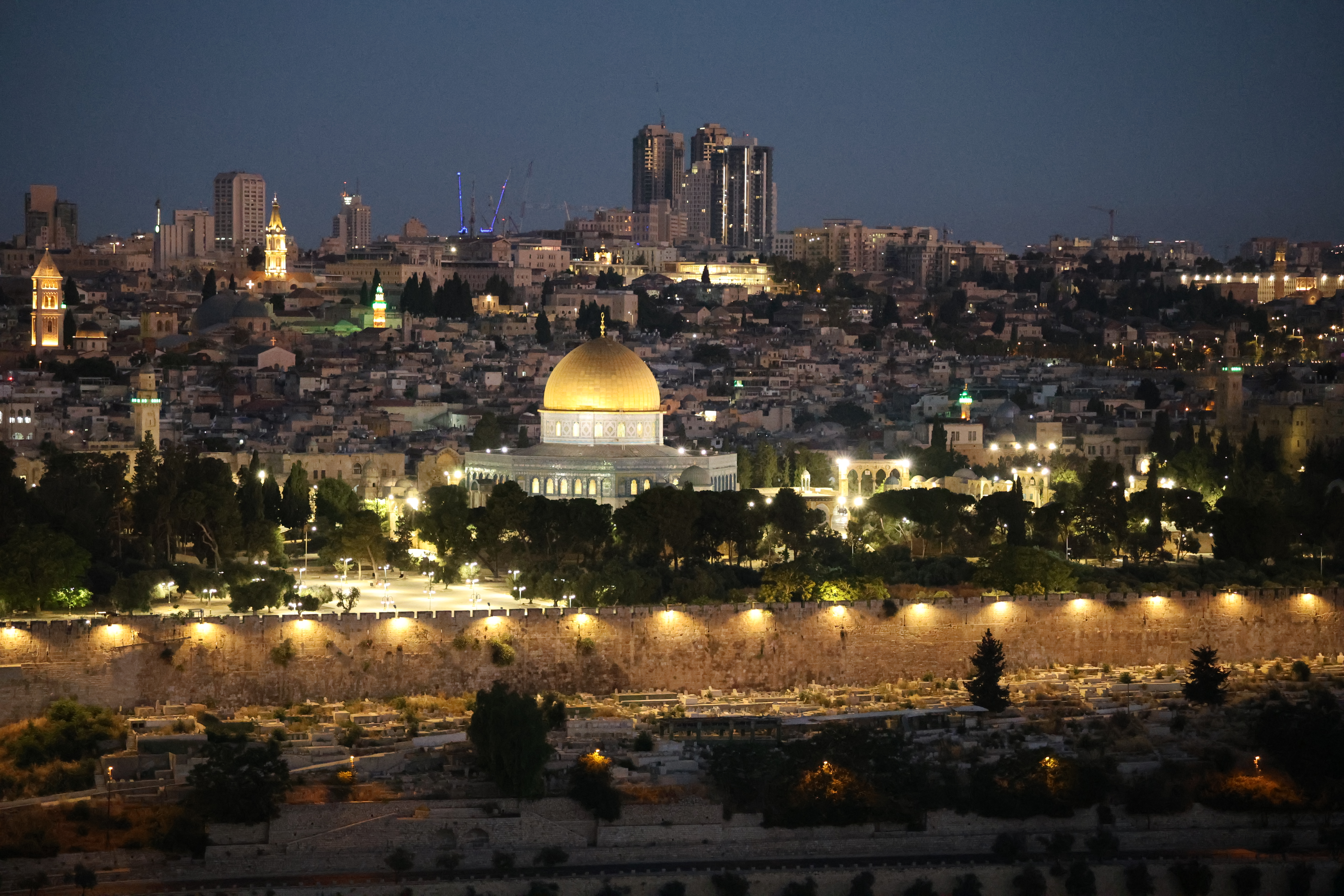
Temple Mount at dawn (photo: First One Through)
And then there is a unique people.
The Jewish people became a vessel unlike any other. Across thousands of years they carried covenant, exile, learning, persecution, survival, and hope. They preserved ancient language, sacred texts, melodies, customs, and memory across continents and generations. They became the vessel through which memory survived when kingdoms fell, empires vanished, and even the Temple itself lay in ruins.
Every vessel carries something. Some carry water. Some carry treasure. Some carry ashes. The greatest vessels carry what cannot be touched: memory, identity, covenant, and hope.
And that is what the Jewish people, Jerusalem, and Tisha B’Av have become. Three vessels in one elaborate story.
Every generation poured something more into those vessels: not only grief, but hope.
Within them rests the hope captured in the Israeli national anthem, Hatikvah: that the Jewish people will live as a free people in their own land, with Jerusalem at its heart.
And on Tisha B’Av in particular, the vessel holds one additional hope above all others: the rebuilding of the Beit HaMikdash. Not because Jews long merely for stones and walls, but because it represents the restoration of wholeness – between God and humanity, a people and their land, memory and redemption.
Every Tisha B’Av, Jews gather into one day the grief of centuries, turn toward one city, and renew one hope. As they do, they recognize that this is more than a story of three fused vessels. It is that together they carry one enduring promise.
For many people, Jewish holidays are family traditions: apples and honey on Rosh Hashanah, a Passover Seder, Hanukkah candles, or a sukkah in the backyard. Yet beneath these customs lies the deeper reality that every major Jewish holiday is connected in some way to the Temple in Jerusalem.
The Temple was not simply a house of worship. It was the spiritual, national, and legal center of Jewish life. Pilgrimages, sacrifices, priestly service, national assemblies, and the calendar itself revolved around Jerusalem. Even after the Temple’s destruction in 70CE, the holidays preserved its memory and continue to point toward it.
Rosh Hashanah marks the Jewish New Year and the sounding of the shofar. In Temple times, witnesses testified before the Sanhedrin in Jerusalem to establish the new month, and the shofar echoed through the Temple courts. Today, Jews still pray that God’s kingship will once again be recognized from Zion.
Yom Kippur is inseparable from the Temple. The High Priest entered the Holy of Holies only once a year to seek atonement for the nation. Modern synagogue services painstakingly recount the Temple ritual, preserving the memory of the day’s most sacred service.
Sukkot was one of the three pilgrimage festivals when Jews ascended to Jerusalem. The Temple hosted the joyous water-drawing ceremony (Simchat Beit HaShoeva), accompanied by music, dancing, and water libations on the altar. Rabbinic tradition describes it as one of the greatest celebrations ever witnessed.
Shemini Atzeret and Simchat Torah conclude the festival cycle begun at the Temple with Sukkot. While Simchat Torah developed later, it celebrates the Torah that was publicly taught and read in Jerusalem.
“Ki mitzion tetze torah” (כִּי מִצִּיּוֹן תֵּצֵא תוֹרָה). “For instruction shall come forth from Zion, The word of God from Jerusalem.” – Isaiah (Chapter 2, Verse 3)
Hanukkah commemorates the rededication of the Second Temple after it was reclaimed from the Seleucid Greeks. Every candle recalls the restoration of Jewish worship in Jerusalem.
Tu BiShvat, the New Year for Trees, determined agricultural laws whose tithes and first fruits were ultimately brought to the Temple.
Purim is the only holiday without a direct Temple ritual, yet its story ensured the survival of the Jewish people who would rebuild and worship in the Second Temple. Jerusalem itself celebrates Purim a day later, preserving its ancient status as a walled city.
Passover was the greatest pilgrimage festival. Hundreds of thousands ascended to Jerusalem to offer the Passover sacrifice before gathering in homes throughout the city for the Seder. Even today Jews conclude the Seder with the words, “Next year in Jerusalem.”
Tens of thousands of Jews at the Kotel Plaza in the Old City of Jerusalem during Passover, as they cannot ascend to the Temple Mount today
Shavuot celebrated the first fruits brought to the Temple in elaborate processions from across the Land of Israel. Farmers entered Jerusalem carrying decorated baskets while choirs sang Psalms of thanksgiving.
Tisha B’Av mourns above all the destruction of both the First and Second Temples. It is the day on which Jews sit on the floor, recite Lamentations, and remember the loss of Jerusalem’s spiritual heart.
Even holidays with no formal Temple ceremony ultimately orbit Jerusalem. They celebrate the survival of the Jewish people, the covenant, the Land of Israel, and the hope of restoration.
Jerusalem is not merely Judaism’s holiest city; it is the organizing principle of the Jewish calendar itself. The cycle of holidays begins and ends with memories of Temple worship, pilgrimages, offerings, repentance, thanksgiving, and national gathering in one place.
For centuries Jews prayed facing Jerusalem, broke a glass at weddings to remember its destruction, left part of a home unfinished in mourning, and ended the Passover Seder and Yom Kippur with the same aspiration: “Next year in Jerusalem.”
The Jewish calendar is more than a record of sacred time. It is a map whose destination is Jerusalem, carrying the memory of the Temple from one generation to the next.
Every graduation marks the end of one chapter and the beginning of another.
Parshat Devarim, read each year during the Nine Days before Tisha B’Av, opens at precisely such a moment. The Jewish people stand on the banks of the Jordan River. After forty years in the wilderness, they are finally ready to enter the Land of Israel. Moses is delivering his final address. One might expect him to unveil a military strategy, an economic vision, or a blueprint for nation-building.
Instead, he teaches history.
For three chapters, Moses reviews the defining moments of the previous forty years: the appointment of judges, the sin of the spies, the years of wandering, and the victories over Sihon and Og. This is not nostalgia but preparation. Before Israel can build its future, it must first understand its past.
Moses sees the promised land from afar, 1902 by James Tissot (1836-1902)
That lesson feels especially relevant for this year’s Jewish college graduates.
Like the Israelites, they are crossing into a new world. They are leaving the structured environment of school and entering workplaces, neighborhoods, and communities where they will make their own decisions and assume new responsibilities.
The past few years have given many Jewish students an education that extended far beyond the classroom. They witnessed campuses wrestle with antisemitism. They watched administrators make revealing choices. They saw professors, classmates, elected officials, employers, and civic leaders respond in different ways when Jewish students felt threatened or isolated.
Whether those responses inspired confidence or disappointment, they were lessons.
Moses understood that the moments just before entering a new chapter are precisely when history matters most. The question is not simply, What happened? It is, What have you learned that should shape the future you are about to build?
For today’s graduates, those lessons should inform more than career decisions. They should influence how they participate in civic and Jewish life.
Who has earned your trust through actions rather than slogans?
Which institutions proved resilient under pressure?
How will you respond if antisemitism appears in your workplace?
What kind of community do you want to help build?
Graduation should also mark the beginning of Jewish adulthood. That means becoming more than an occasional participant. Join a synagogue by becoming a dues-paying member. Vote in local, state, and national elections. Volunteer and mentor younger students. Strengthen the institutions that strengthened you, and build the ones you wished had existed.
The Jewish calendar reinforces this idea. Before we reach the season of renewal – before Elul, Rosh Hashanah, and Yom Kippur – we pause for the Nine Days and Tisha B’Av. Before looking ahead, we look back. Before rebuilding, we reflect.
That is exactly what Moses was doing on the edge of the Jordan.
Every generation has its own Jordan River.
Before crossing into tomorrow, Moses offers one final piece of advice: study yesterday. Not to dwell on it, but to be equipped by it. History is not simply something to remember. It is something to carry forward as you begin writing the next chapter of your own story – and of the Jewish people.