Gimme that Old-Time Religion

Two of the three main monotheistic faiths had amazing historical revelations in July 2015. If you read the New York Times, you only learned about one of them.

Quran

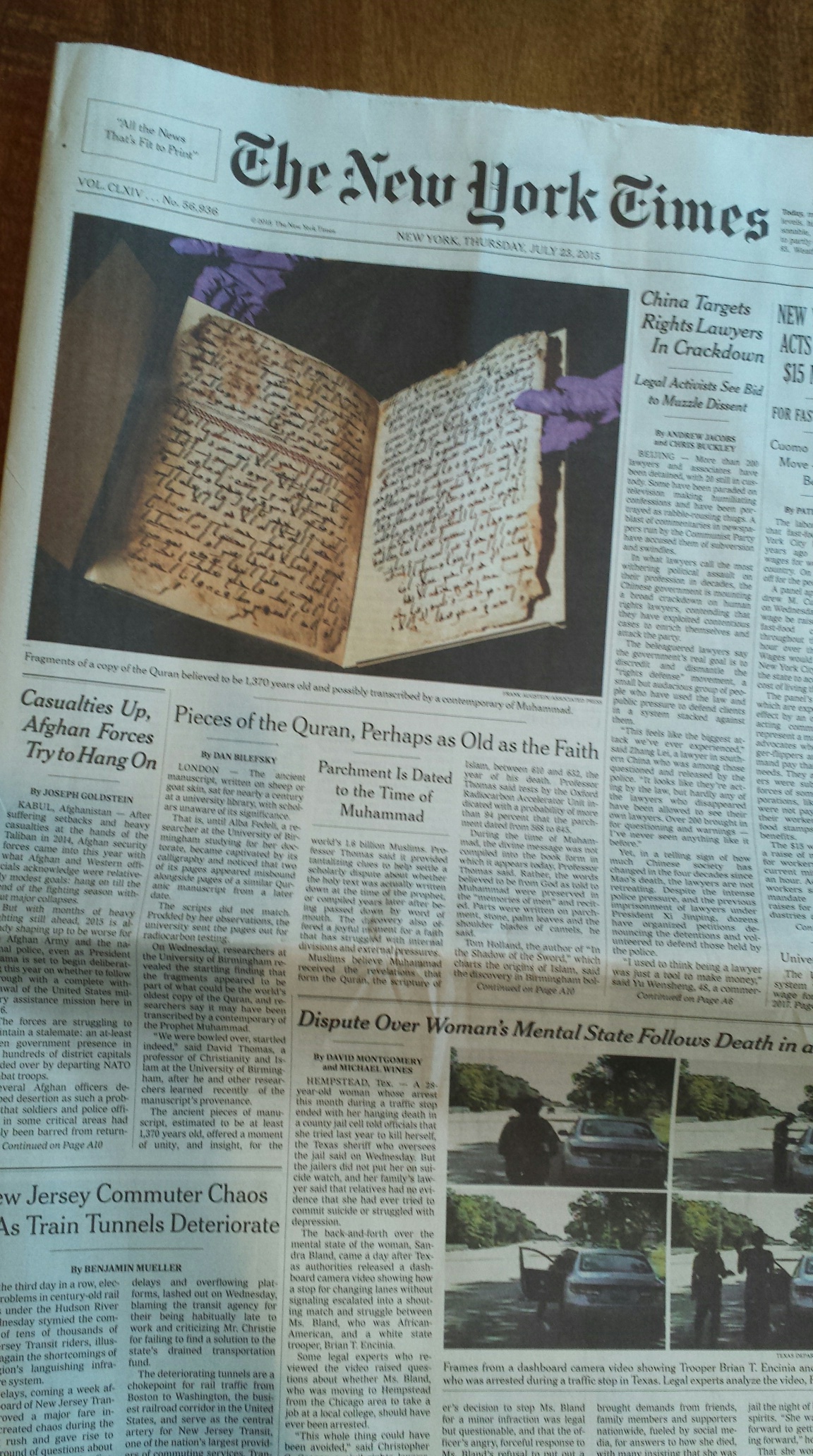
On a front page story with a large accompanying color picture, the New York Times relayed an incredible discovery: an old Quran that had been sitting on the shelves of the University of Birmingham, England for a century, was dated to around the year 600CE plus or minus 50 years.  That would make this version of the Quran the oldest manuscript in Islam.

20150724_072357
New York Times Front Page Story on Quran,
July 23, 2015

According to Islamic tradition, their prophet Mohammed received divine revelations and compiled the Quran sometime between 610 to 632CE. Religious scholars had debated whether the Quran was passed down in oral form for many generations after Mohammed’s death before ultimately being written down. If the text indeed was written down on the parchment when it was prepared (sometimes parchments were washed and reused, and carbon-dating only relates to the parchment but not the actual ink and text), it would answer that outstanding question.

The Hebrew Bible

Three days before the world heard about the dating of the oldest Quran, researchers uncovered one of the oldest texts of the Hebrew Bible, dating from around 500CE.

EinGediscroll1
Charred scroll from synagogue in Ein Gedi
(photo: Shay Halevi/Israel Antiquities Authority)

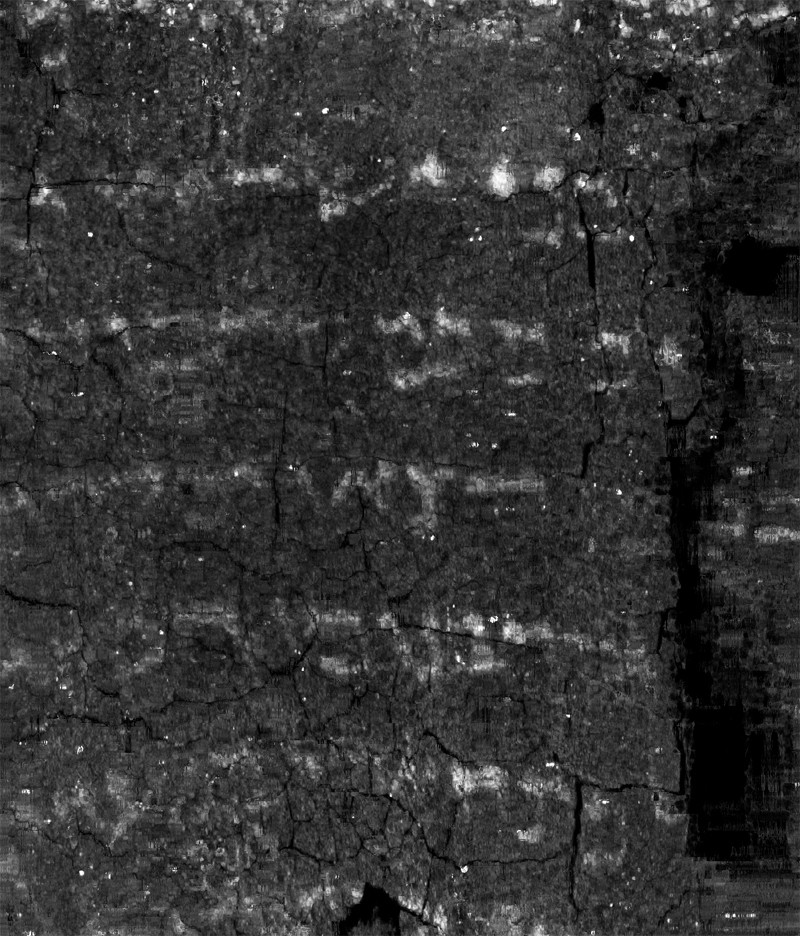
In the 1970s, the piece of a charred scroll was discovered in Ein Gedi in the Judean Desert. Only in July 2015 were researchers able to use the latest technology to decipher the damaged text to reveal sentences from the book of Leviticus. While older documents (by 500+ years) of the Hebrew Bible had been discovered not far from Ein Gedi, those documents were found hidden in jars within caves.  This scroll was found in the ancient synagogue of Ein Gedi, revealing the earliest discovery of a Torah scroll housed in a synagogue.

scroll-800x936
Text from the Ein Gedi scrolls
(photo: University of Kentucky)

Both of these stories are amazing in terms of history, religion and science.  It brings to mind an old gospel song: “Give Me that Old Time Religion!”

Yet the part “that’s NOT good enough for me” (to paraphrase the song) is the nagging question why the New York Times never misses an opportunity to slight Israel.  The discovery of one old religious treasure received front page attention (for Islam) but a text from 100 years earlier didn’t even get a passing mention (for Judaism).  Was it because the scrolls were found in the Judean Desert which further underscores the long history of Jews in the contentious Jordan Valley?

Why do you think the NYT mentioned only one of these stories?


Related FirstOneThrough articles:

When were Jews barred from living in Judea & Samaria?

Names and Narrative: The West Bank / Judea and Samaria

The Subtle Discoloration of History: Shuafat

Subscribe YouTube channel: FirstOneThrough

Join Facebook group: FirstOne Through  Israel Analysis

Parallel and Perpendicular Views of Iranian Nuclear Deal

In a world of 7 billion people, there can be no surprise that people have different views. Even in smaller segments of society, whether in a small town or school, different people could look at a situation and arrive at very different conclusions. One story, two views.

Conclusions may in turn generate additional comparisons. Once an opinion becomes anchored, another similar thought may come to mind. Over time, the two distinct ideas become linked together, in closely related parallel views. Two stories, one view.

THE IRANIAN NUCLEAR DEAL

Perpendicular Conclusions

Much of the world followed the negotiations between six global powers and Iran over the latter’s nuclear ambitions. Not only did many people seek different outcomes, even people that sought the SAME outcomes, viewed the deal in completely different ways.

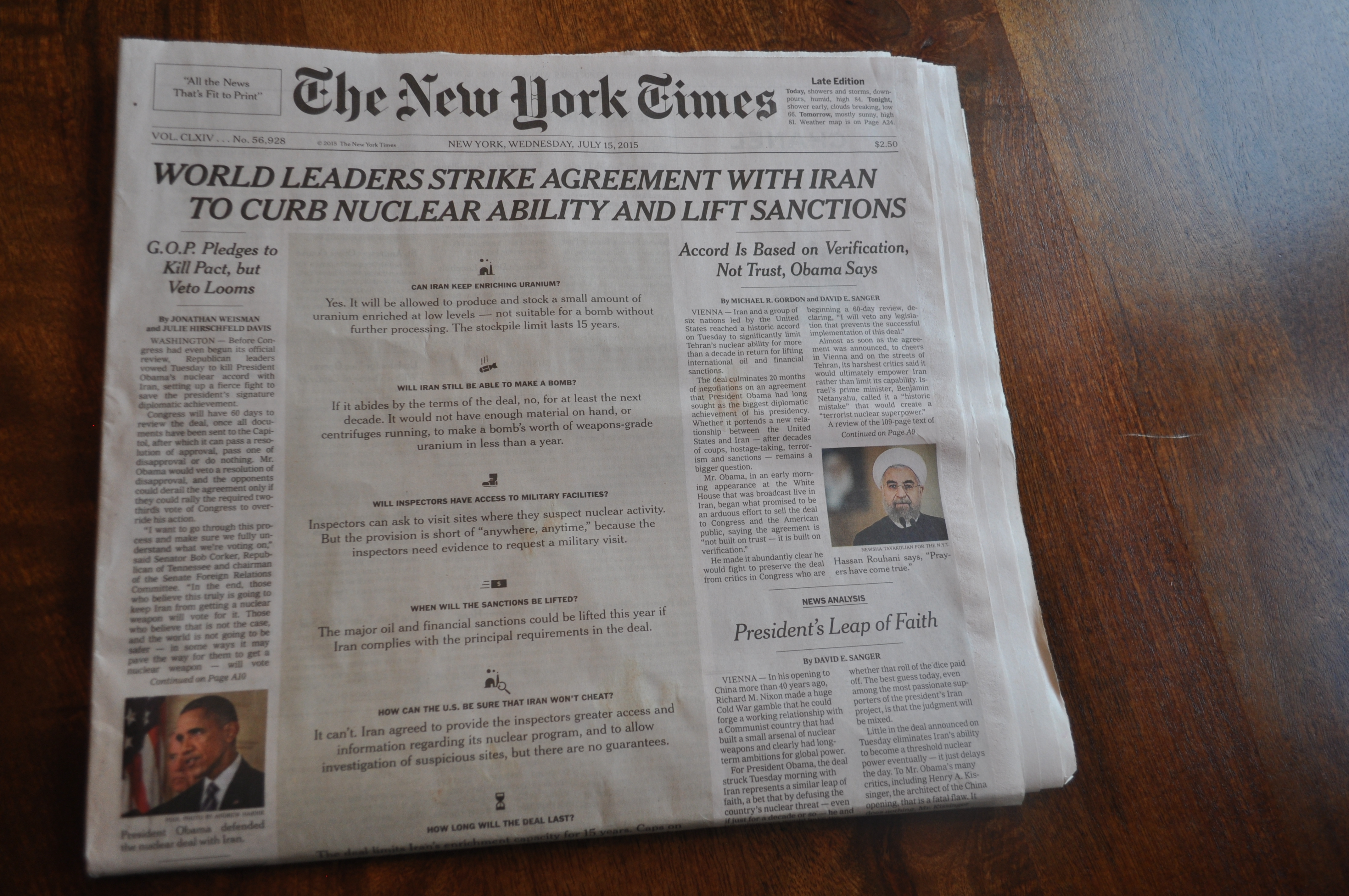
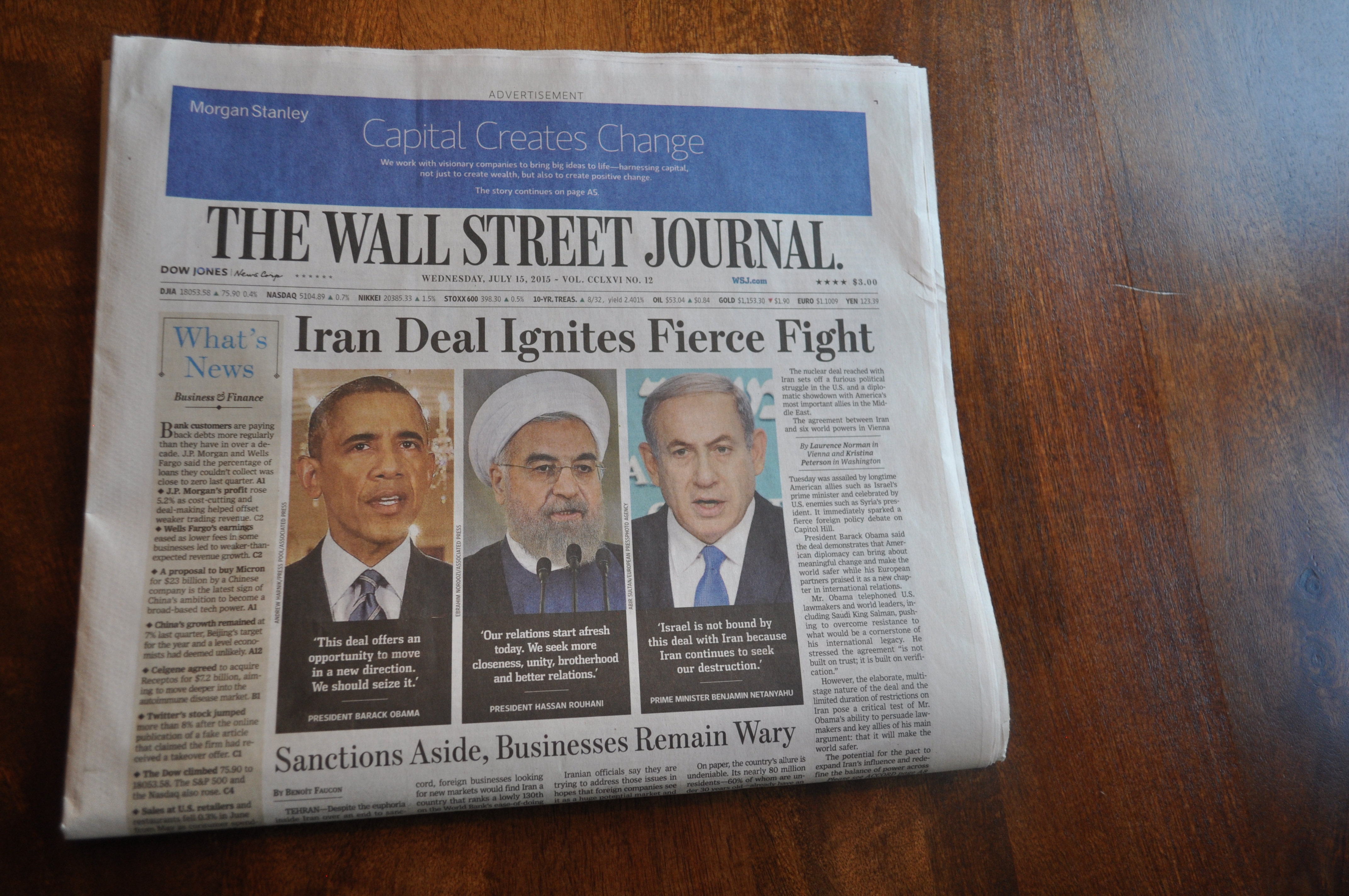
Consider the Wall Street Journal and The New York Times. Presumably each American newspaper sought a deal which left Iran without nuclear weapons capability.  On July 15, each paper ran factual headlines about the outcome of the negotiations.  Yet the emphasis for each was extremely different.

DSC_0119
Front page of New York Times,
July 15, 2015

The headline for the NYT read: “World Leaders Strike Agreement with Iran to Curb Nuclear Ability and Lift Sanctions.”  Sub-headers read “Accord is Based on Verification, Not Trust, Obama Says” and “G.O.P. Pledges to Kill Pact, But Veto Looms.”  An article further down the page was entitled “President’s Leap of Faith“.

In the middle of the front page the Times sought to summarize the deal terms in a Q&A format.  For anyone reading the answers, it was clear that the deal offered few assurances that Iran was not going to have nuclear weapons within the decade, and certainty that they would have it after a decade.

The portrayal was in sharp contrast to the front page of the WSJ.

DSC_0118
Front page of Wall Street Journal,
July 15, 2015

The WSJ also led with a factual headline about the reactions to the Iranian deal. “Iran Deal Ignites Fierce Fight” The paper included three large pictures with quotes from the leaders of the United States, Iran and Israel with their views on the deal terms.

Both papers considered that Obama and Iranian leader Rouhani were happy with the deal.  That was where the similarities ended.

The Times called out the Republicans as being unhappy, while the Journal highlighted Israel’s unhappiness with the deal. One paper took a more domestic review of the international matter, while the other focused on the international fallout. The NYT used small font to review the dissent of the deal in language that could have been used to describe a capital gains tax hike, while the WSJ used large color photographs in the center of the paper to draw attention to the significant global ramifications of the agreement.

The NYT seemed to tell its readership that if they had faith in Obama, they should have faith in this deal. The WSJ told its readership that a huge fight was brewing overseas, and the US aligned itself with an enemy state and against an ally.

Two papers presumably started at the same spot seeking the same result, but moved in opposite directions when the negotiations concluded.

False Parallels

The head of the Shalom Hartman Institute of North America, Yehuda Kurtzer, also decided to weigh in on the Iranian deal from the ancient Jewish city of Hebron. In a blog called “On Iran, from Hebron” he described his trip with a group of rabbis who came to hear a wide range of narratives from all sorts of people in the city.  Kurtzer’s conclusion was that there exists an obvious parallel between the Iranian threat against Israel, and Jews living east of the Green Line. He said: “I am sad and nervous – both about what Israel is doing to itself in places like Hebron with its commitment to structures which risk its unmaking, and about the threats to Israel’s existence from state actors” and continued the parallel in more clear language about “a settlement [Hebron] that constitutes a self-imposed existential threat to Israel, while listening on Twitter to debates about external existential threats.

Here was a leader of an organization that described itself as a “pluralistic center of research and education deepening and elevating the quality of Jewish life in Israel and around the world,” equating a Jew living with his family in Hebron, with an Iranian regime shouting “Death to Israel” while it obtained the green light from the world to have nuclear weapons in ten years.

A champion of pluralism drew an equivalence between starkly different stories: Jews living freely in places they lived for thousands of years; and a country that has threatened -and will soon be armed for- a genocide.


I understand different people having different opinions. I respect the concept that two parties can start at the same spot and move in opposite directions. Yet I struggle when a single person can conflate two completely different matters into a single narrative.

The NYT loves Obama and feels that their trust and faith in him has prevailed over his presidency, so why not trust him again now? (Of course, that has nothing to do with trusting Iran, but the Times at least starts consistently). The WSJ has always pointed out the flaws of Obama’s foreign policies and used this bad Iranian deal to point it out again.

But what of the leader of a “pluralistic” organization? Does being pluralistic mean that everything and everyone carry the same weight? Does the notion that “pluralism can mean that no full knowledge of truth is possible” mean that it can be so amazingly wrong to suggest that the “external existential threat” of an Iranian nuclear bomb is the same as a “self-imposed existential threat” of Jews living in Hebron?

There is a logic to a liberal paper supporting a liberal president. One can agree to disagree. But how does one react to someone who distorts reality as if the world was a hall of mirrors perched atop a black hole? On Earth, we know opinions can diverge.  In the ethereal world of “pluralism”, it would appear that accepting information from everywhere can lead to a singularity of stupidity.

Absolute and Relative Ideological Terrorism in the United States

Summary: The New York Times has sought to educate people to fear Republican terrorists more than Muslim extremists.

“Right-Wing” versus “Muslim Extremism”

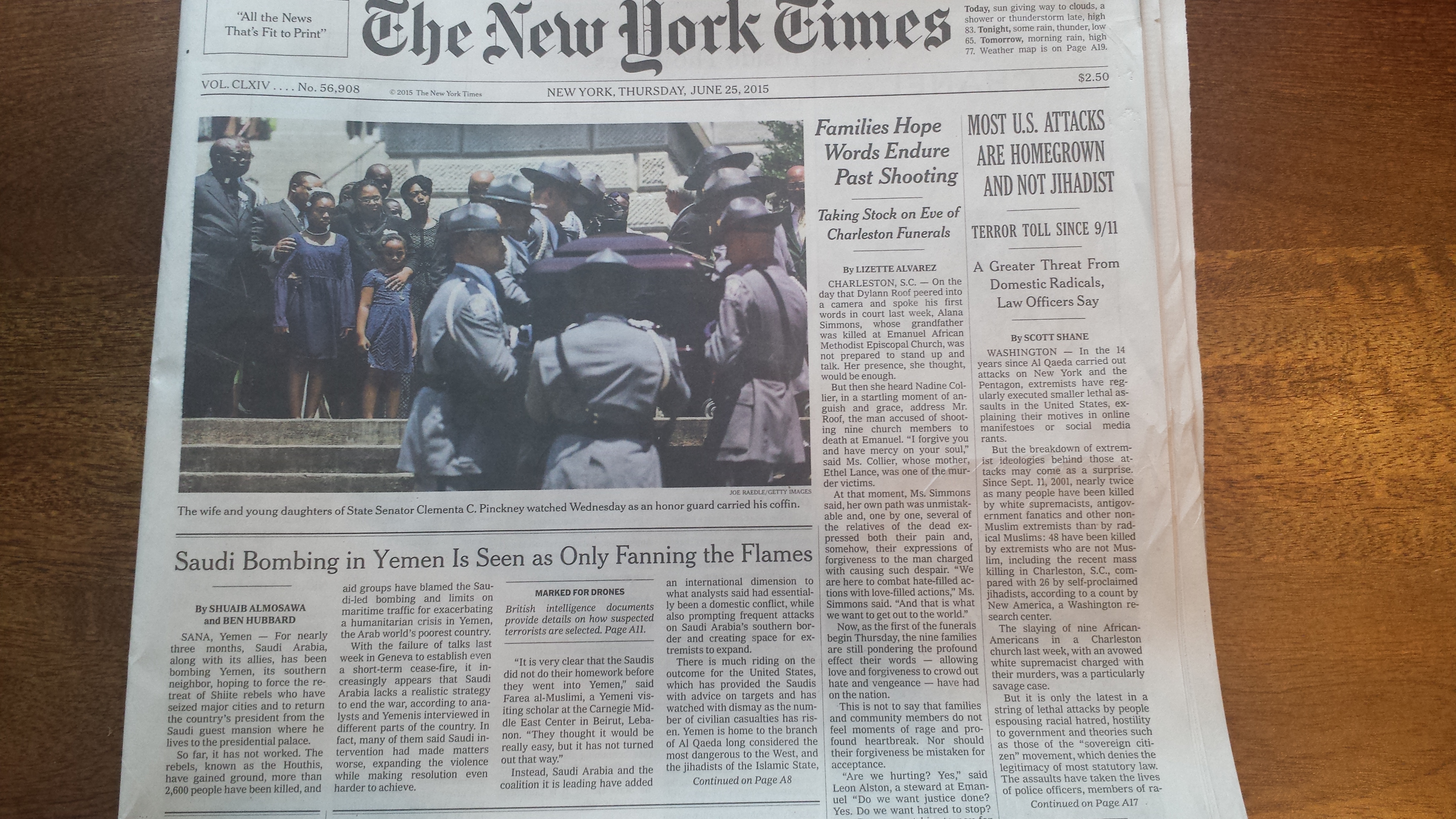
In June 2015 the New York Times ran some articles and editorials claiming that domestic terrorism was more of a problem than radical Islamic terrorism.

  • A June 16 op-ed “The Growing Right-Wing Terror Threat” quoted a police officer that “said that “militias, neo-Nazis and sovereign citizens” are the biggest threat we face in regard to extremism’”. The paper quoted statistics from The Global Terrorism Database which counted 65 attacks at the hands of “right-wing ideologies and 24 by Muslim extremists since 9/11”. It added another source, “the International Security Program at the New America Foundation identifies 39 fatalities from “non-jihadist” homegrown extremists and 26 fatalities from “jihadist” extremists.
  • On June 24, the NYTimes had an article entitled “Homegrown Extremists Tied to Deadlier Toll Than Jihadists in U.S. Since 9/11”. The paper stated that “Since Sept. 11, 2001, nearly twice as many people have been killed by white supremacists, antigovernment fanatics and other non-Muslim extremists than by radical Muslims: 48 have been killed by extremists who are not Muslim, including the recent mass killing in Charleston, S.C., compared with 26 by self-proclaimed jihadists, according to a count by New America, a Washington research center.” That data looks to be the same as the International Security Program, but included the nine black church-goers who had just been gunned down. Another statistic in the article stated that “Non-Muslim extremists have carried out 19 such [ideological] attacks since Sept. 11, according to the latest count, compiled by David Sterman, a New America program associate, and overseen by Peter Bergen, a terrorism expert. By comparison, seven lethal attacks by Islamic militants.”

The Washington Examiner questioned the definition of “right-wing terrorists” to include a very broad group of people. How did neo-Nazis and racists get lumped in with the “right-wing”?  Before exploring the Times deliberate grouping of all non-Muslim extremism under a single banner, consider a brief education about relative numbers versus absolute numbers.

20150626_073343
Main cover story in the New York Times

 Absolute versus Relative

A cursory review of numbers could lead to a quick conclusion: 48 people killed is a greater total than 26 people killed. A total of 19 attacks is more than seven attacks. As such, the quotes in the article such as “Law enforcement agencies around the country have told us the threat from Muslim extremists is not as great as the threat from right-wing extremists” would appear accurate on its face as there were more than two times the number of attacks and almost twice the number of fatalities from non-Muslim attacks.

However, a review of the statistics on a relative basis would yield a very different result.

According to the Pew Research Center, Muslims accounted for 0.9% of Americans in 2014. That means that there are 99 times more non-Muslims than Muslims in the US. If one were to assume that the percentage of Muslims who are radical that would commit an act of terror is the same as the broad group of right-wing and anti-government terrorists within the non-Muslim population, one would expect the right-wing terrorists to have 99 times the number of attacks and fatalities, not two times.  This implies that an average Muslim is 49 times more likely to commit an act of ideological terror than a non-Muslim in the United States.

(By the way, the statistics deliberately exclude the jihadist terrorism of 9/11 which killed nearly 3000 people.)

 The New York Times Warning of Terrorism by Conservatives

After the Times led its readers to focus on “homegrown extremism” as the actual threat of terrorism (compared to jihadists), it lumped all of those non-Muslim fanatics into the Republican party:

 On several occasions since President Obama took office, efforts by government agencies to conduct research on right-wing extremism have run into resistance from Republicans, who suspected an attempt to smear conservatives. A 2009 report by the Department of Homeland Security, which warned that an ailing economy and the election of the first black president might prompt a violent reaction from white supremacists, was withdrawn in the face of conservative criticism.”

Even if one were to use the liberal paper’s biased assumptions that all anti-government and racist fanatics must exclusively come from the Conservative and Republican parties (which account for roughly 45% of the population according to a June 2015 Gallup poll), it would still suggest that an average Muslim is over 20 times more likely to commit an ideological attack as a “homegrown [Conservative] extremist.”

That would suggest one of the following conclusions:

  1. Non-Muslim terrorists have nothing to do with the Conservative/ Republican parties; OR
  2. An average Muslim is much more likely to commit acts of terror than an average non-Muslim

Either way -or both – these are the exact opposite conclusions that the New York Times sought to convey in its articles.


Related FirstOneThrough article:

Ramifications of Ignoring American Antisemitism


Selective Speech

Summary: Just because we are free to do or say something, doesn’t mean we should. And the selection of what speech to admire or admonish is not hypocrisy, but a choice on philosophy.


Many people have taken very hard positions regarding the recent killings at a “Muhammad Art Exhibit and Contest,” in Texas. In an effort to portray everything in black-and-white, they miss important distinctions.

  1. Murdering someone for being insulted is ALWAYS wrong. As discussed on these pages, “I’m Insulted; You’re Dead,” everyone should whole-heartedly condemn the killing of people because sensibilities were offended. Whether the attacks were at the Parisian offices of the magazine Charlie Hebdo, or at an event in Texas where people drew the Islamic prophet, no one should condone murder.
  2. Freedom of Speech is a CAUSE worthy of Defense. Freedom of speech and press are cornerstones of western democracies. They are basic and important causes to uphold.
  3. Specific language does NOT need to be defended. Just because someone has the right to say something, doesn’t require everyone to come to the defense of the content of any particular speech. An individual or organization that opts to distance itself from an event does not mean they are against free speech.

Civil Sensitivities

Western societies are a mix of people and ideas. Such combinations create both civil and uncivil conversations. One can choose to be part of a completely civil society where nothing unpleasant is ever said, uncivil society in which people attack people all of the time, or more likely, a blend of the two, where different ideas are shared which may upset certain individuals at certain times.

Civil society’s “safe spaces” are one’s home and organizations where people share common values.  It is hard to imagine that one can walk in public and never hear or see something disagreeable.

An inherent component of being part of the mixed society is to strike a balance of the use of free speech and society’s sensitivities.  Just because someone has the right to say something, doesn’t mean that they should, and that everyone has to support the comment. The other half of that balance is that there is no requirement in society to be polite to everyone.

Not Hypocrisy, But a Preference

When a party or organization chooses to defend some speech and not others, they show their own preferences or priorities. Consider the New York Times approach to several events that upset segments of the American population:

  • Mosque at Ground Zero (2010): The United States offers freedom of religion (as well as speech and press) and as such, Muslims are free to build a mosque at any location where they legally have rights to the land. However, many people viewed the proposed building of a mosque overlooking the site where terrorists killed thousands of people in the name of Islam, as wrong and insulting. The New York Times editorial felt differently stating that it saw “the wisdom of going ahead with the project,” in an opinion that sided with Muslims but offended many people.
  • Convent at Auschwitz (1989): Similar to the mosque at the base of the destroyed World Trade Center, the location of a Roman Catholic convent on the grounds of a notorious concentration camp where over a million Jews were killed simply because of their religion, was viewed as completely insensitive by many Jews. While the Times covered the news story in several articles, it conspicuously never offered its own opinion as to whether the convent should be moved.
  • Giuliani on the Brooklyn Museum art show (1999): The Brooklyn Museum ran a controversial series of “art works” that treated Christianity harshly, including a painting of Mary covered in dung. After New York City NYOR Rudolph Giuliani threatened to withhold funding for the museum, the NYT opted to attack the Mayor stating that “Art is the name of a perpetual human struggle with the limits of perception. The Mayor… is failing dramatically in that role in a fashion that makes him and the city look ridiculous
  • Metropolitan Opera on Klinghoffer (2014): When the streets of New York held civil protests about the Metropolitan Opera’s airing of a play that showed a sympathetic side of terrorists murdering an infirm elderly Jew, the New York Times rushed to the opera’s defense. The editorial page ran a headline that stated “The Death of Klinghoffer Must Go On”. It argued that it stood for art and free speech. Others claimed that it simply stood on the side of Palestinian terrorists.
  • Charlie Hebdo (2015): The New York Times printed a series of editorials trying to find its position on the murder of journalists by Muslim terrorists. While it clearly stood by the rights of journalists to free press, it seemed to support such right because it lampooned all religions, and not just Islam.
  • Draw Mohammed Exhibit (2015). The New York Times chose to attack the organizer of the event, Pamela Geller and stated that the event was simply “hate speech”. It condemned the contest “cannot justify blatantly Islamophobic provocations like the Garland event.

What is the summary of the observations of the New York Times?

  • It sided with Muslims at Ground Zero and the Draw Mohammed Contest; against them at Charlie Hebdo;
  • It sided against Christians at the Brooklyn Museum and offered no opinion at the Auschwitz convent;
  • It sided against Jews for the Klinghoffer opera and no opinion at the Auschwitz convent

When it came to religion, the Times record was mixed, while showing a preference for Muslim sensitivities over Christians and Jews.

Overall, the Times will claim its record is for upholding freedoms.  It obviously failed in that principle when it came to the Mohammed Exhibit, which it claimed failed the threshold for art and was merely “hate speech”.  Perhaps the Times forgot the never-ending nature of its definition of art from 1999: “Art is the name of a perpetual human struggle with the limits of perception.”


Related First.One.Through articles:

Blasphemy OR Terrorism

My Terrorism

New York Times Confusion on Free Speech

The Waqf and the Temple Mount

Summary: According to Muslims, the Temple Mount is held in “trusteeship” by the Islamic Waqf, which assures its use and access as a mosque. The role of the Waqf has nothing to do with sovereignty of the land on which it resides.

The most sensitive issue of the Israel-Arab conflict is considered to be the Temple Mount in Jerusalem.

TEMPLE MOUNT

The Temple Mount is a 35 acre platform that held the second Jewish Temple from around 515CE to 70CE. Herod extended the platform on which the Temple sat southward to enable the greater flow of the thousands of Jews that came to the Temple to perform their rituals. The platform extension project ran from 19BCE to 63CE and Jews enjoyed the benefit of his work until the Romans destroyed the Temple in 70CE.

10857261_10153336968548706_7334281522188334026_o
The Old City of Jerusalem, including Jewish Quarter and Temple Mount

The area is considered sacred to Muslims as they believe Mohammed had a night journey from Saudi Arabia on a flying horse to that location before ascending to heaven. When Arabs invaded Jerusalem in 627CE, they built the al Aqsa Mosque on the southern edge of Temple Mount (completed in 705CE and rebuilt in 1033) to commemorate the importance of the location. The other structures on the Temple Mount include the Dome of the Rock, the Dome of the Chain, the Dome of the Prophet and various other structures which are NOT mosques, but shrines.

Jews had access and were able to pray on the Temple Mount until around the year 1550, when Suleiman I began a series of “improvements” to Jerusalem. He ordered the rebuilding of the city walls and moved the Jews off of the mount to an area now referred to as the “Kotel” or “Wailing Wall” or “Western Wall”, a sliver of the western retaining wall built by Herod. Since that time, prayer on the Mount has been restricted only for Muslim use.

MODERN HISTORY

Five Arab armies attacked Israel at its founding in 1948. At the end of the war in 1949, Jerusalem became divided with the western half (almost all completely established since the 1850s) under Israeli sovereignty, and the eastern half (including the Old City dating back 4000 years) under Jordanian sovereignty (which was not recognized by the United Nations). The Jordanians evicted all of the Jews and barred their reentry, even to visit their holy sites, counter to the Fourth Geneva Convention.

In 1967, the Jordanians again attacked Israel. They lost the eastern half of Jerusalem and all of Judea and Samaria, which they had annexed in 1950. Israel reunified the city and made clear that people of all religions – not just Jews – would have access and rights to their holy places.  Non-Muslims were once again allowed onto the platform, and Israel gave administrative oversight of the Temple Mount compound to the Jordanian Waqf. Israel annexed the area and the rest of eastern Jerusalem in a move not recognized globally.

In 1988, Jordan gave up all claims to lands it lost to Israel in the 1967 war, and signed a peace treaty with Israel in 1994. In that peace agreement, several key clauses were added to address Jerusalem, Article 9:

  • Each Party will provide freedom of access to places of religious and historical significance.
  • In this regard, in accordance with the Washington Declaration, Israel respects the present special role of the Hashemite Kingdom of Jordan in Muslim Holy shrines in Jerusalem. When negotiations on the permanent status will take place, Israel will give high priority to the Jordanian historic role in these shrines.
  • The Parties will act together to promote interfaith relations among the three monotheistic religions, with the aim of working towards religious understanding, moral commitment, freedom of religious worship, and tolerance and peace.

10383720_10153336970463706_7100356438545362102_o
Jews Praying at the Kotel, 2015

WAQF

Islam allows Muslims to place property (land or any object) into a “Waqf”. By doing so, the item comes under the trusteeship of the party specified in the declaration. In the case of the al Aqsa Mosque, the building is considered to be for the public use of all Muslims under the administration of the Jordanian Waqf.

When the al Aqsa mosque was taken over by Crusaders in the 12th century, the place did not lose its special status for Muslims. As stated in Issue 2697: ““If the Waqfed property is ruined, its position as Waqf is not affected, except when the Waqf is of a special nature, and that special feature ceases to exist. For example, if a person endows a garden and the garden is ruined, the Waqf becomes void and the garden reverts to the heirs of the person.”

Properties or entities like the Old City of Jerusalem or the Temple Mount itself can be subdivided according to Islam. As written in Issue 2698: “If one part of a property has been waqfed and the other part is not, and the property is undivided, the Mujtahid, or the trustee of the Waqf, or the beneficiaries can divide the property and separate the Waqf part in consultation with the experts.”

As described above, the Jordanian Waqf took control of the Temple Mount in 1949 and Israel has continued to let the Waqf administer the site. The Jordanian Waqf now employs 500 people to run the mosque. It does this, while Israel maintains all security controls and runs it as part and parcel of Israel.

It would appear that the actions of 1967, 1988 and 1994 laid the groundwork for a sharing of the Temple Mount between Jews and Muslims again. However, it has continued to be a struggle.

 POLITICS and PROPAGANDA

Over the last few years, the Waqf has become more politicized, anti-Jewish and anti-Israel, as it was decades ago. Public statements from the Waqf:

  • Deny Jewish history at the Temple Mount
  • Attempt to deny Jewish rights of access
  • Deny Jewish rights to prayer (agreed to by the Israeli government)
  • Deny sovereignty of the Jewish State and Jerusalem municipality (agreed by many countries in the United Nations)

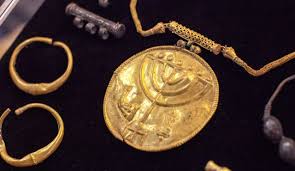
Consider a recent discovery of ancient Judaica near the Temple Mount. The Waqf issued a statement that the findings were “an attempt to support Israeli claims about Jewish rights in the holy city and to impose Israeli sovereignty on the occupied holy compound through the use of fake evidence….An immediate Arab and Muslim campaign is needed to stop the Israeli attempts to Judaise the holy city of Jerusalem,”
temple mt find
Discovery of Jewish artifacts at base of Temple Mount
dating to period before creation of Islam

It is interesting that the Waqf would make a claim of “Judaising” the city of Jerusalem which has had a Jewish majority for 150 years. It was also this same Jordanian Waqf that participated in expelling Jews from the Old City of Jerusalem and barring their entry from 1949-1967.

PEACE ON THE TEMPLE MOUNT

Israel’s perspective: Israel has sought a peaceful situation on the Temple Mount from the very beginning of reunifying Jerusalem. In 1967, Moshe Dayan announced: “To our Arab neighbors we extend, especially at this hour, the hand of peace. To members of the other religions, Christians and Muslims, I hereby promise faithfully that their full freedom and all their religious rights will be preserved. We did not come to Jerusalem to conquer the Holy Places of others.”

The declaration was followed by the establishment of the Protection of Holy Places Law which ensured the rights of all religions to pray at their holy sites.

Today, in an effort to appease the extremist views of the Waqf, radical Palestinians and the Jordanian government itself which threated to break its peace treaty with Israel, the Israeli government has continued to enforce a ban on Jewish prayer on the Mount.

Muslims’ Perspective: Suleiman pushed the Jews off of the Temple Mount in 1550 and Jordanian Arabs expelled the Jews from the entire Old City in 1949. Muslims and Arabs would clearly prefer that there be no Jews in Jerusalem.

However, according to Islam, there is no conflict with the Temple Mount being completely under Israeli sovereignty as detailed above.

According to the Peace Treaty between Israel and Jordan, the Temple Mount (outside of al Aqsa Mosque) should permit non-Mulsim prayer, despite Jordan’s recent protests.

Israel has continued to extend its full hand to share the Temple Mount.  Meanwhile, the Arab world took initial steps some decades ago to recognize Jewish history and rights which do not conflict with Islamic law.  Regrettably, recent history has witnessed a more hostile Arab approach.

Perhaps the future will witness peace on the Temple Mount with full access and rights for Jews at their holiest location.


Sources:

Waqf rules: http://www.al-islam.org/islamic-laws-ayatullah-ali-al-husayni-al-sistani/rules-regarding-waqf

Noble Sanctuary: http://www.noblesanctuary.com/AQSAMosque.html

Palestinian women fight Jews on Temple Mount: http://www.nytimes.com/2015/04/17/world/middleeast/palestinian-women-join-effort-to-keep-jews-from-contested-holy-site.html

Related First One Through articles:

Tolerance at the Temple Mount

Sharing the Temple Mount like the Cave of Patriarchs

Five holy sites in the holy land

Palestinians are “desperate”… but for what?

Palestinian Arabs control of Jerusalem for 0.5% of its history 

Divided Cities and Capitals
Israel, the Liberal Country of the Middle East

Summary: Israel is by far the most liberal country of the entire Middle East and North Africa region (MENA). It is also probably the most liberal country from Western Europe to Australia and down to South Africa.

Diversity of population. Israel has a diverse population. The majority, 75%, are Jewish, about 20% Arab Muslims, and the balance of 5% a mix of Christians, Baha’i, Druze and others. Almost all of the MENA region is 90%+ Muslim, with a large number being almost completely Arab Muslim (Morocco; Tunisia; Iran; Yemen; Iraq; Jordan; Turkey; Algeria; Gaza and EGL; Saudi Arabia; Libya; Egypt; Syria). Lebanon is the only other country in the region with some diversity.

Equal Justice. Israel administers its legal system to all levels of society.  Consider that both a former Prime Minister and President were sentenced to jail for general crimes such as bribery and sexual assault (as opposed to a method to remove a dictator). They were afforded no special privileges compared to ordinary citizens.

Salim_Joubran
Salim Joubran, Israeli Arab Supreme Court Judge

Women’s Rights. Women in Israel have full rights of equality including the ability to vote, inheritance, walk in public alone, drive, etc. These are rights that are not found in much of the MENA region. Saudi Arabia has virtually no rights for women.  The new 20th Knesset will have 29 women– 24% of the parliament, significantly higher than the 16% of women in the US congress.

shaked
Ayelet Shaked, Member of Knesset

Free Speech, Assembly and Press. Israel permits freedom of expression. Freedom House ranked Israel as the only country in MENA with a free press for several years, and just added Tunisia. The MENA region continues to be the most repressive in terms of freedoms in the entire world, such as Turkey which leads the world in jailing the most journalists.

african protest
Thousands of illegal African immigrants protest in front of parliament

Freedom of Religion. Israel allows people of all faiths the freedom to practice their religion. This compares to much of the MENA region which has criminal laws against apostasy– changing one’s religion from Islam to something else- even though such right is guaranteed by the Universal Declaration of Human Rights. A growing number of countries in Europe have begun to restrict freedom of religion including bans on minarets at mosques, head coverings in public and permitting kosher and halal foods.

mormon
Mormon church in Jerusalem built with assistance of Israeli government

Gay Rights. According to a gay rights group, ILGA, Israel was the only country to get a perfect score on gay rights in the region between Western Europe, South Africa and Australia. For example, Israel permits gay couples to adopt children and serve openly in the army , something which many western countries do not permit. In some MENA countries such as Iran, Yemen, Saudi Arabia and Mauritania, gays are actually publicly executed by the government.

gays in israel
Gays in Israel

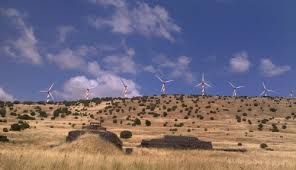
Environmental Matters. Israel is a “green” country. It leads the world in recycling plastic, having surpassed Europe in 2012. It created the first commercial wind farm in MENA and the first permanent bike sharing program. It leads the word in drip irrigation technology. It was one of only two countries in the world to have more trees entering the 21st century than it had in the 20th due to forestation efforts.

windfarm
Wind Farm in the Golan

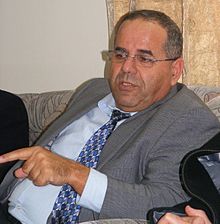
Open Public Office. People of all backgrounds and faiths are allowed to serve in the Israeli government, to become Prime Minister, serve in every branch of the military and Supreme Court. The new 20th Knesset will have 17 Arabs – 14% of the parliament. This compares to 8% black representation in the US Congress. Many countries, like Syria, restrict the participation of people who are not Muslims from participating in public office.

Ayoub_Kara
Ayoub Kara, Druze MK from Likud Party

Death Penalty. Israel only has a single reason for sentencing someone to death – crimes against humanity – which it has carried out only once: fifty years ago for Adolf Eichmann for his role in the Holocaust. Much of the MENA region uses capital punishment for a range of offenses including: apostasy; adultery; drug trafficking; being gay; murder; witchcraft; and prostitution.

Abortion. Abortion is legal in Israel for a variety of circumstances. It is illegal in almost the entire rest of the MENA region, with the exception of Tunisia.

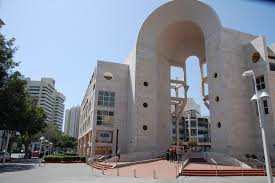
The Arts. Israel is the only country in the MENA region to have both an opera house and a ballet company.  Opera exists in Israel, Oman and Syria and ballet companies are in Israel, Tunisia, Egypt, UAE and Iran.

opera
Tel Aviv Performing Arts Center

Animal Rights. Israel became only the third country/ entity (after the European Union and Norway) to ban the sale of cosmetics that were tested on animals.

Human Body Rights. Israel permits full control of a person’s body including tattoos, body piercings and prostitution. More neighboring countries are enforcing bans on tattoos and piercings such as Turkey. Lebanon and Israel are the only countries in MENA that permit and regulate prostitution.

tattoo

Protecting Women. Israel passed a law that bans the use of underweight models to prevent women from becoming anorexic.

barrefaeli
Israeli model Bar Refaeli

Universal Healthcare.  Many countries in the Middle East provide universal healthcare including: Israel; Kuwait; Bahrain; and UAE.


Israel. An open society in the middle of the Middle East.


Related First One Through article

Israel: Security in a small country

In Israel, the winner is…Democracy

I’m Offended, You’re Dead

The US President and the media have portrayed “radical extremists” as angry about cartoons of the Muslim prophet by western media. Such a view focuses very narrowly on the recent attacks in Paris and Copenhagen. This is because democracies consider freedom of speech a fundamental right in their societies and object strongly to such rights coming under fire. Should the media and democracies look more broadly, they would note the broader attacks on basic human rights that Islam imposes where it is in control.

The “hateful ideology” (as US President Obama calls it) is not simply an “ideology” by a few “extremists”. The basic laws of several Islamic countries trample on many fundamental human rights. Islamic laws do not only challenge what you can say, but often attack the essence of who you are, and enforce double standards regarding what you can do. To aggravate the Islamic illiberal attitudes further, the laws impose severe punishments to the offenses, often the death sentence.

 muslim protest
Muslim Protest in England

What you said

Blasphemy is clearly part of the objection of the Muslim killers. Whether Charlie Hebdo (2015), Copenhagen (2005; 2015) or Theo Van Gogh in the Netherlands (2004), the drawings of the Islamic prophet Mohammed were considered offenses deserving of murder. Those attacks made news and drew world attention because they happened in Western Europe. In the Islamic world, blasphemy is considered a crime in over a dozen countries. Pakistan recently sentenced a blasphemer to death, but the laws and actions do not often attract the world’s attention.

Asa Bibi
Asa Bibi sentenced to death in Pakistan for blasphemy,
November 2014

Who you are

Islamic countries impose the death sentence on people for simply being who they are.  Innocent civilians are viewed as criminals even though they harm no one.

  • Apostasy is the act of changing religion. In several Islamic countries, the act of converting from Islam to another religion is punishable by death. Those countries include: Afghanistan; Brunei; Mauritania; Qatar; Saudi Arabia; Sudan; United Arab Emirates; and Yemen. Many other countries also consider it a crime, punishable by a year or more in prison.
  • Being Gay is considered a crime in 76 countries in 2015. There are several Islamic countries that sentence gays to death including: Iran; Iraq; Mauritania; Nigeria; Qatar; Saudi Arabia and Yemen.
  • Islamic terrorists targeted Jews in recent attacks in Jerusalem; Paris and Copenhagen. Many Muslims feel that non-believers are doomed and should be killed according to Islamic teachings. While many Islamic countries do not sentence non-Muslims to death, they subject the non-Muslims to secondary “dhimmi” status and make them pay special taxes. There are “radical” Islamic groups like Boko Haram and ISIS that are actively killing non-Muslims throughout NigeriaIraq, and Libya.

gay hang iran
An estimated 4,000 gays have been killed in Iran since 1979

What you do

Some Islamic countries have laws that prevent persecuted segments of society from doing what other members of society (Muslims, men) can do freely.  The double standards and misogyny are simply part of the culture that the world ignores.

  • In Saudi Arabia, there are laws that prevent women from driving cars; only men can drive.
  • In Pakistan, girls are prevented from going to school to get an education; only boys can go to school.
  • In many Southeast Asian countries like Pakistan, Bangladesh and India, a girl who reject a boy’s marriage proposal may be disfigured either by having her nose and ears cut off, or acid poured on her face. Boys do not deal with such issues.
  • In Israel, the Jordanian Muslim Waqf prevents Jews from praying on the Jewish Temple Mount; only Muslims are allowed to pray on the entire 35 acre site.
  • In Gaza and Islamic countries like Pakistan and Afghanistan, people kill female family members in “honor killings” if they dress inappropriately or date unapproved men. Men do not face honor killings.

KSA women drive
Woman arrested for driving in Saudi Arabia,
December 2014

How they Respond

The punishment for many of these basic activities that people in the western world take for granted, is death.  The death sentence is often brutal and public.

“Minor” infractions also can yield a death sentence:

  • Adulterers are stoned to death in Iran; Qatar; Saudi Arabia; Somalia; Sudan; UAE; Yemen
  • Drug traffickers are killed in: Egypt; Indonesia; Iran; Iraq; Kuwait; Oman; Saudi Arabia; South Sudan; Syria and UAE
  • Prostitutes are killed in Sudan

The Danger

The view that a few “extremists” have hijacked Islam and are attacking the freedom of press is both myopic in terms of history and geography, and hazy in terms of numbers and scope. In reviewing the laws and actions of several Islamic countries, one can better understand the gross intolerance and extremism in their societies. Many Muslims are offended by a great many things, and will kill the offender.

If the West limits its review to freedom of speech in the world of social media, the conversation becomes limited as well.  Hate speech versus freedom of speech, and attitudes towards censorship of social media (such as in Turkey) are worthwhile discussions, but far too narrow.  The value of jobs and economic development for a handful of radicals is brought up by the Obama administration because he misses the larger point. Obama argues for “reasonableness and restraint” from countries because he views the attacks on them as limited to a handful of radicals.

That flawed worldview led Obama to abandon Iraq without helping secure the vacuum.  It will lead an Obama administration to enable Iran to get a nuclear weapon.

Perhaps it is time for Obama to visit Cairo again as he did on his first international trip in 2009.  This time he will meet a new leader in al-Sisi who has called for a “revamping” in Islam. Maybe al-Sisi should be on Obama’s Iran negotiating team.


Related First.One.Through articles:

Murderous governments

Blasphemy

My Terrorism

US Hypocrisy – “Reasonableness and Restraint”

Subscribe YouTube channel: FirstOneThrough

Join Facebook group: FirstOne Through  Israel Analysis

Jews in the Midst

Summary: Jews are vulnerable members of society. They are not on the fringe on the one hand, nor are they just a regular part of the broader community, on the other. As such, they must be actively protected by governments and citizens alike.

copenhagen jews
Jews in Copenhagen laying flowers where a Jewish man was gunned down,
February 2015 

No Canary in the Mine

Well-meaning people have referred to Jews as the “canary in the mine” when it comes to terrorism. They argue that various attacks on Jews in Europe, Israel and Asia by Islamic radicals over the past years should be seen in the context of an oncoming onslaught on the broader civilized world.

Canaries are treated as disposal life forms that coal miners bring into mines to detect poisonous gases. They assume that if the canary is alive, the air is breathable; however, should the canary die, they should evacuate immediately. The sole role of the canary is to detect danger and benefit the people in the mine.

Jews were not brought to Europe or Asia to serve as warning signs for non-Jews. They are not inferior life forms meant to live solely for the benefit of the broader society. They are proud citizens of their home countries.

 hyperkosher
Paris kosher supermarket where four Jews were killed,
January 2015

Not a Fringe Group

Jews are integrated into society in each country where the live. They have homes in the hearts of the country; they have jobs at corporations, in the government and military. They speak the language and have employment rates that are comparable to their fellow countrymen.

Jews are not a fringe group that fails to assimilate, that doesn’t speak the language or has high unemployment. They are not financial drains on society and do not have incarceration rates above the community averages.

Jews are a fabric of society. They are “everymen,” with particular beliefs and customs.

mumbai chabad
Chabad House in Mumbai where six people were murdered,
November 2008 

No “Random” Attack

While Jews are a basic part of the fabric of society, they are uniquely targeted by Islamic radicals. Terrorist attackers who assaulted major cities including Mumbai (2008), Paris (2015) and Copenhagen (2015), took time to specifically attack this small minority.

While US President Obama and his administration initially called the attack on a kosher supermarket in Paris a “random” attack, he back-tracked to corroborate the statement of the French government which clearly stated that the attack stemmed from antisemitism.

Even while embedded in society, Jews are picked out for attack for the simple reason that they are Jewish.

 bruseels museum
Attack on Jewish Museum in Brussels killed four,
May 2014

Jews in the Midst

There was a movie made in 1988 about a woman, Dian Fossey, who fought to protect gorillas in Uganda. These special creatures were a unique part of the Ugandan landscape that were singled out for slaughter. Dian fought both the government and locals to protect those “Gorillas in the Mist”.  It was a brave action on the part of an individual to take on so many to save the group from butchery.

It is the obligation of governments to protect their citizens.  The leaders in Germany and France have correctly stated that they will take action to ensure that their Jewish communities are safe.

It is time for all governments and citizens to speak loudly and act defiantly in protecting their vulnerable neighbors and countrymen, the Jews in their midst.

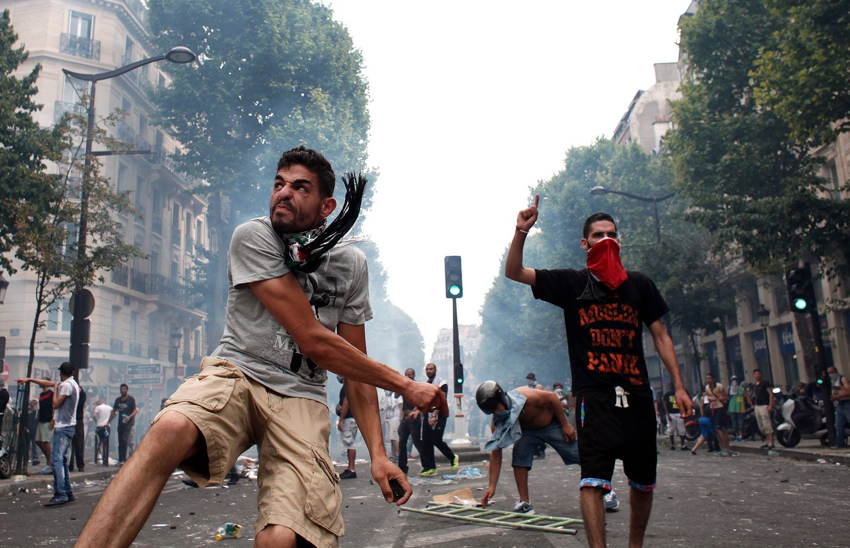
 scariest-riots-anti-semitism-men
Riots against Israel and Jews in France,
July 2014

Israel in Europe

The governments of Europe must do more than just assign police officers to synagogues and Jewish centers. They must also declare that Jews everywhere – including in Israel – cannot be targets of jihad.  As part of that effort, they should confront the biases in their governments that are uniquely against the Jewish State, such as:

  • delisting Hamas as a terrorist organization despite its calls to kill Jews and eradicate Israel
  • European Union blaming Israel for the failure of the peace talks without acknowledging the various actions the Palestinians took to sabotage the talks

The list of European actions against the Jewish State over the past year was long, and to an absurd level when compared to EU actions and comments towards murderous regimes such as Iran and Syria. The people in the streets noted, and held anti-Israel rallies which became anti-Semitic riots.

It was against that backdrop of both murders by homegrown terrorists and the anti-Israel actions of the governments that made Israeli Prime Minister Benjamin Netanyahu invite the Jews of Europe to come to Israel.

The governments of Europe must declare their strong commitment to a safe and secure Israel.  Such actions should include declaring Hamas a terrorist organization and not recognizing a Palestinian state until it prohibits the promotion of antisemitism and Holocaust denial.  The governments should not pass any BDS (boycott, divestment, sanction) actions against Israel any more than they do for other disputed territories such as Kashmir and Cyprus.

The leaders of several European countries acknowledge that there is a problem of anti-Semitism spreading in the continent.  They must be aggressive in confronting it in every manner possible.

Jews in the Midst

Summary: Jews are vulnerable members of society. They are not on the fringe on the one hand, nor are they just a regular part of the broader community, on the other. As such, they must be actively protected by governments and citizens alike.


No Canary in the Mine

Well-meaning people have referred to Jews as the “canary in the mine” when it comes to terrorism. They argue that various attacks on Jews in Europe, Israel and Asia by Islamic radicals over the past years should be seen in the context of an oncoming onslaught on the broader civilized world.

Canaries are treated as disposal life forms that coal miners bring into mines to detect poisonous gases. They assume that if the canary is alive, the air is breathable; however, should the canary die, they should evacuate immediately. The sole role of the canary is to detect danger and benefit the people in the mine.

Jews were not brought to Europe or Asia to serve as warning signs for non-Jews. They are not inferior life forms meant to live solely for the benefit of the broader society. They are proud citizens of their home countries.


Not a Fringe Group

Jews are integrated into society in each country where the live. They have homes in the hearts of the country; they have jobs at corporations, in the government and military. They speak the language and have employment rates that are comparable to their fellow countrymen.

Jews are not a fringe group that fails to assimilate, that doesn’t speak the language or has high unemployment. They are not financial drains on society and do not have incarceration rates above the community averages.

Jews are a fabric of society. They are “everymen,” with particular beliefs and customs.


No “Random” Attack

While Jews are a basic part of the fabric of society, they are uniquely targeted by Islamic radicals. Terrorist attackers who assaulted major cities including Mumbai (2008), Paris (2015) and Copenhagen (2015), took time to specifically attack this small minority.

While US President Obama and his administration initially called the attack on a kosher supermarket in Paris a “random” attack, he back-tracked to corroborate the statement of the French government which clearly stated that the attack stemmed from antisemitism.

Even while embedded in society, Jews are picked out for attack for the simple reason that they are Jewish.


Jews in the Midst

There was a movie made in 1988 about a woman, Dian Fossey, who fought to protect gorillas in Uganda. These special creatures were a unique part of the Ugandan landscape that were singled out for slaughter. Dian fought both the government and locals to protect those “Gorillas in the Mist”.  It was a brave action on the part of an individual to take on so many to save the group from butchery.

It is the obligation of governments to protect their citizens.  The leaders in Germany and France have correctly stated that they will take action to ensure that their Jewish communities are safe.

It is time for all governments and citizens to speak loudly and act defiantly in protecting their vulnerable neighbors and countrymen, the Jews in their midst.


Israel in Europe

The governments of Europe must do more than just assign police officers to synagogues and Jewish centers. They must also declare that Jews everywhere – including in Israel – cannot be targets of jihad.  As part of that effort, they should confront the biases in their governments that are uniquely against the Jewish State, such as:

  • delisting Hamas as a terrorist organization despite its calls to kill Jews and eradicate Israel
  • European Union blaming Israel for the failure of the peace talks without acknowledging the various actions the Palestinians took to sabotage the talks

The list of European actions against the Jewish State over the past year was long, and to an absurd level when compared to EU actions and comments towards murderous regimes such as Iran and Syria. The people in the streets noted, and held anti-Israel rallies which became anti-Semitic riots.

It was against that backdrop of both murders by homegrown terrorists and the anti-Israel actions of the governments that made Israeli Prime Minister Benjamin Netanyahu invite the Jews of Europe to come to Israel.

The governments of Europe must declare their strong commitment to a safe and secure Israel.  Such actions should include declaring Hamas a terrorist organization and not recognizing a Palestinian state until it prohibits the promotion of antisemitism and Holocaust denial.  The governments should not pass any BDS (boycott, divestment, sanction) actions against Israel any more than they do for other disputed territories such as Kashmir and Cyprus.

The leaders of several European countries acknowledge that there is a problem of anti-Semitism spreading in the continent.  They must be aggressive in confronting it in every manner possible.

Why the Media Ignores Jihadists in Israel

Summary: According to the Times, terrorists in Europe and Israel are very different and have different motivations.  If they weren’t, the hope that two states (Israel and Palestine) could live side-by-side in peace would obviously disappear.

The New York Times has taken to breaking the universe of Islamic terrorists attacking civilians into two camps: those that are hardened and trained to commit attacks, and those that do so as a result of their personal situation as opposed to their beliefs.  Curiously, that line is defined by geography.

Consider the January 17, 2015 reporting about the raids that prevented a terrorist attack in Belgium. The Times discussed “the expanding threat from radical jihadists, many of them battle-hardened in Syria and Iraq.” Another article on the same day questioned why Lunel, a small town in France “has come to earn the dubious distinction as a breeding ground for jihadists.” A third article that day clearly stated that attacks in Paris against the magazine Charlie Hebdo were by “jihadist gunmen”. In Europe, the Times is clear that attacks against civilians are done by radical jihadists. While the articles discussed Muslim anger at the insult to their prophet Mohammed by the Charlie Hebdo cartoons that ultimately instigated the attacks, that anger was only the final motivating factor to unleash actions embedded in the radical jihadist philosophy.

The Times does not view attacks against Israelis the same way.

On January 23, 2015 the NY Times explored the motivation of a Palestinian who stabbed a dozen Israeli civilians on a bus in Tel Aviv. Over and again the Times referred to the man as “angered by the war in Gaza… and tensions over the revered Aqsa Mosque.” The article stated that “the family was in debt and struggling” and described this assailant as well as another who attempted to assassinate a Jewish activist as stories of “dislocation”. The New York Times deliberately kept the motivations away from any categorization of “radical jihad” by saying that the assailant “was not considered an extremist.”

This description fits consistently with the Times narrative as written in its editorial page on January 1, when it described the Palestinians as “desperate.” The opinion piece suggested that the Palestinians are “deeply frustrated” by their lack of a state. The Times does not feel that Palestinians are engaged in a radical jihad against Israel in the same way European cities are facing Islamic extremism. It is curious that they arrive at such a conclusion when there are Palestinian polls and elections that consistently show an overwhelming support for Hamas, which mentions “jihad” against Israel 36 times in its charter (see the FirstOneThrough article below).

Several articles in the Times mentioned the anti-Semitism harbored by Amedy Coulibaly, the French Muslim who shot a policeman and four Jews in a kosher supermarket in Paris. They discussed his allegiance to the Islamic State which seeks to build a new state in the Middle East ruled by Islamic sharia law. However, the New York Times never mentioned that the Palestinians are the most anti-Semitic people in the world, with 93% of the population holding anti-Jewish views. It neglected to inform its readers that the popular Hamas party seeks to completely destroy Israel and set up an Islamic state ruled by sharia law.

Why does the Times continue to relay different motivations and narratives for jihadists in Europe and Israel?

The liberal newspaper would like to see a new State of Palestine established in the Middle East, whereas it is comfortable with the borders of countries elsewhere. The conundrum is that the Times’ hope for a new moderate secular Palestinian state alongside Israel is in conflict with the reality that the Palestinians are much more radical than the paper pretends.

To conceal the radical nature of the Palestinians today, the Times editorials and articles follow specific guidelines in reporting that:

  • The Palestinians and its leadership are moderates
  • The Palestinians only take to violence because they are desperate and alienated
  • The Israelis are at fault for lack of a two-state solution

In Israel, people see the jihad in Iraq, France, Nigeria and in their own country as a single violent movement of Islamic extremism. That is why Israeli Prime Minister Benjamin Netanyahu referred to Hamas and Islamic State as “branches of the same poisonous tree”. Should the Times ever decide to detail the full nature of Hamas beyond simply being a “militant group” and also discuss the huge support it receives by Palestinians, it would undermine the vision of two states living side-by-side in peace. Therefore, the pages of the Times state that Europe faces “radical jihadists” while Israel faces desperate, isolated and alienated Palestinians (who are in that situation only because of Israel).

However, hope is hardly honest reporting.
20150125_162037


Sources:

Netanyahu comment on Hamas: http://www.pressherald.com/2014/09/30/netanyahu-islamic-state-hamas-branches-of-the-same-poisonous-tree/

Palestinians proudly elcebrating murderer of Israeli civilians: https://www.youtube.com/watch?v=RRTXmeRVPlY

Related First One Through articles:

Palestinians “Desperation Move”: https://firstonethrough.wordpress.com/2015/01/06/palestinians-are-desperate-for/

Palestinians are not “resorting” to violence: https://firstonethrough.wordpress.com/2014/11/19/the-palestinians-arent-resorting-to-violence-they-are-murdering-and-waging-war/

Hamas is mainstream: https://firstonethrough.wordpress.com/2014/09/04/its-the-democracy-stupid/

Abbas pivot to Hamas positions: https://firstonethrough.wordpress.com/2014/11/12/mainstream-and-abbas-jihad/

The extremism of the Palestinian positions: https://firstonethrough.wordpress.com/2014/10/25/extreme-and-mainstream-germany-1933-west-bank-gaza-2014/