Congress should Vote on the Deal, not on the Disappointment nor on the President

The long saga of global bodies negotiating over Iran’s nuclear program ended a significant phase on July 14, 2015, when the parties concluded a Joint Comprehensive Plan of Action (JCPOA) in Vienna, Austria. The negotiation has now entered the “approval” phase by various bodies including the US Congress. The initial reviews and comments of the JCPOA have been heated and ugly.

The Disappointment

On August 7, 2015, David Brooks of the New York Times wrote an op-ed piece entitled “3 U.S. Defeats: Vietnam, Iraq and Now Iran”. Brooks enumerated the various points that make many Americans angry about the terms of the JCPOA, specifically, the failure to realize the stated goals set out by the Obama administration:

  • Prevent Iran from becoming a nuclear power
  • Dismantle the nuclear infrastructure
  • Remove their ability to enrich uranium
  • Close the Fordow Heavy water reactor enrichment facility
  • Force Iran to disclose all past nuclear activities
  • Anywhere, anytime inspections
  • No sanctions relief until all of the above have been accomplished

Brooks concluded that none of Obama’s stated objectives were realized. He referred to the agreement as a “partial surrender” to Iran that came about because of the poor tactics of team Obama.

However, that is not the question before Congress. If Congress were to vote on whether the JCPOA produced a disappointing result, the vote would be nearly unanimous (with the exception of a few Obama puppets).  But Congress is not being asked to opine if this was the best deal that could have been achieved, but whether the deal is good enough.

The President

On August 10, 2015, former New York City Mayor Michael Bloomberg spoke out against the president’s tactics in aggressively trying to sell the JCPOA. In “White House Should Leave Politics Out of Iran Deal,” Bloomberg admonished Obama for name-calling opponents of the deal war-mongers and for threatening payback against any politician who dared to vote against the deal. For his part, Bloomberg concluded that the JCPOA was extremely marginal at best, and that Obama’s forceful defense of the deal was “grossly overstating” his case.

The “especially disappointing” behavior by the White House was politics at its worst, particularly when so much is on the line, according to Bloomberg. Politicians should not vote on this significant agreement based on politics or party loyalty; they must vote based on the deal’s merits.

The Deal

On August 7, 2015, New York Senator Charles Schumer detailed his rationale for not supporting the JCPOA. He analyzed the deal based on three criteria:

  • Preventing Iran from obtaining nuclear weapons over the next ten years
  • The position of Iran’s nuclear capabilities at the sunset of the deal
  • The cost of the agreement in terms of giving Iran sanctions relief

In terms of the negotiating team’s primary mission of preventing Iran from getting nuclear weapons, Schumer stated that there “are serious weaknesses in the agreement,” including the lack of anytime-anywhere inspections and that the US would need approval of a majority of China, Russia and the Europeans to enforce inspections. Overall, he thought the deal’s terms were not compelling.

On the second point, Schumer was even more negative and stated “we will be worse off with this agreement than without it.

Regarding the non-nuclear components of the deal, Schumer was extremely clear in opposing the enablement of a state-sponsor of terrorism to obtain billions in funds and access to ballistic missiles: “When it comes to the non-nuclear aspects of the deal, I think there is a strong case that we are better off without an agreement than with one.”

Senator Schumer analyzed and articulated his assessment of the deal. He avoided voting based on the deal’s disappointment, and based on his president’s rhetoric.

Schumer
NY Senator Charles Schumer
(photo: Getty images)

Vote Ramifications

President Obama has stated that the only alternative to this deal is war. Secretary of State John Kerry stated that there is no “better deal” out there nor is there an opportunity to renegotiate this one.

Yet, those claims are far from clear. Based on behavior of both Obama and Kerry, it would be easy to conclude that these are just their opinions dressed as facts as they attempt to forcefully push through the JCPOA.

There is no clear answer as to the impact of the US voting down the JCPOA.  While procedurally, it is understood that Obama outmaneuvered Congress in only needing one-third instead of a two-thirds vote to secure his deal, what happens if Congress does manage to have the votes?  Obama claims that Iran gets the best of all worlds and gets sanctions relief from the rest of the world while it moves forward with a nuclear program.  That is hard to imagine. That inherently implies that the rest of the world doesn’t care if Iran has nuclear weapons and it is only the USA that is applying the pressure.  If Obama really believes that, then a negative US vote is an opportunity to renegotiate.

Conclusions

Disappointment: The JCPOA is clearly a disappointing result, especially considering the many years that tough sanctions were imposed on Iran as well as the severely depressed recent price of oil applied intense pressure on the regime that will be hard to ever replicate. Together with significant American troops next door in Afghanistan, the P5+1 had tremendous leverage to force complete capitulation by Iran.

The President: Obama is overselling his weak deal as a “strong deal” (in his words) and is bullying his fellow Democrats into submission. If the deal is as strong as he claims, it should be able to stand on its own merits.

The Deal: The deal by itself seems borderline at best. Perhaps it is better than nothing- but only if it costs nothing. The significant sanctions relief and various deal terms make the marginal deal appear unacceptable.

Ramifications: Congress must vote on the deal based on its merits and not based on the disappointing terms nor Obama’s threats. But it must also better understand the ramifications of rejecting the deal.  Kerry’s losing face is not a reason to alter one’s vote on something so important.

Congress and the American people must understand the actual ramifications of turning down the JCPOA without the aggressive salesmanship of the White House.


Related FirstOneThrough articles:

The Obama Administration Lays Foundation of Blame at Israel for a Potential War with Iran

Obama’s White Lie on his Red Line

The Gap between Fairness and Safety: WMDs in Iraq and Iran

The New Nuclear Normal

Some Global Supporters of the P5+1 Iran Deal

Obama’s bright white lie on his red line.

US President Obama gave a speech about the broad support the Iranian deal enjoys: “because this is such a strong deal, every nation in the world that has commented publicly, with the exception of the Israeli government, has expressed support. The United Nations Security Council has unanimously supported it. The majority of arms control and nonproliferation experts support it. Over 100 former ambassadors who served under Republican and Democratic presidents support it.

There are others that strongly support the deal too that Obama failed to highlight:

  • Syria’s president Basher al-Assad, the man who has waged a war with this own people that has killed over 220,000 people thus far told the Iranian leader: “In the name of the Syrian people, I congratulate you and the people of Iran on this historic achievement.
  • Hezbollah, the terrorist group in Lebanon was impressed that Iran now had “global recognition as a member of the nuclear club.
  • David Duke, the former member of Congress and head of the KKK was happy that the Iranian deal would likely keep Israel from attacking Iran

assad_iran_083013_1385159834190

Iran’s supreme leader Ayatollah Ali Khamenei meets Syrian President Bashar al-Assad in Tehran 25 January 2001.(photo: Atta Kenare/AFP/Getty Images)


As part of this agreement, Iran will get funds in the range between Obama’s estimate of $56 billion to as much as $150 billion.  Not surprisingly. this makes the various terrorist entities that are financed by Iran quite happy including (parenthetical is the year when placed on the US State Department list of foreign terrorist organizations):

These Iranian-backed terrorist groups are responsible for the deaths of thousands of civilians and continue to destabilize the Middle East and beyond..

In Obama’s attempt to sell the Iranian deal, he cited many allies that endorsed the deal while specifically avoiding mention of America’s enemies that also support it.  How does one account for the fact that both US allies and foes celebrate the deal? Is the deal actually beneficial to all of the parties, or do some countries simply not understand the deal’s details?

  • The Western world gets to curtail Iran’s nuclear program and avoids a war in the near-term
  • Iran gets to avoid a war, keep its nuclear infrastructure intact, global legitimacy, does not have to change its behavior regarding backing terrorism, and gets tens of billions of dollars in cash
  • Iran’s allies get access to funds and arms from Iran in the near and medium-term, and potentially a nuclear-armed Iranian-sponsor in the not-too-distant future

Obama deliberately does not discuss the many enemies of the United States that support the P5+1 deal and their long list of reasons for doing so. Instead, he makes comments that it is only the Iranian hardliners (and Republicans and Israel) who oppose the agreement. By doing so, he attempts to conceal the enormous benefits granted to Iran (and its proxies) in the agreement. It is pure marketing and a bright white lie over his old red lines.

do not enter
A bright White Lie over a Red Line
(Do Not Enter)


The party Obama highlighted as not being happy with the deal is Israel. A few reasons:

  • Iran will be allowed to continue to call for Israel’s annihilation
  • Iran will have billions of dollars that will not be constrained in any manner from funding terrorist groups that target Israel
  • Iran will get access to a range of ballistic missiles in as little of five years
  • Within 10-15 years, Iran will be a threshold nuclear state
  • The structure of the deal provides Iran opportunity to break the terms and develop nuclear weapons within ten years

In other words, there is a little something (or a lot) for everyone in the deal, with the exception of Israel.


Related FirstOneThrough articles:

The Obama Administration Lays Foundation of Blame at Israel for a Potential War with Iran

The Gap between Fairness and Safety: WMDs in Iraq and Iran

O’bama, Where Art Thou?

Netanyahu’s View of Obama: Trust and Consequences

For Obama, Israeli security is not so time-sensitive

Missing Netanyahu’s Speech: Those not Listening and Those Not Speaking

The Obama Administration Lays Foundation of Blame at Israel for a Potential War with Iran

President Obama has not only begun to lobby aggressively to win support for the P5+1 deal on the Iranian nuclear program, he has begun to lay the foundation of blame for a potential war squarely on Israel.

epa04873202 US President Barack Obama delivers a speech on the nuclear deal with Iran, at American University's School of International Service, in Washington DC, USA, 05 August 2015. Obama urged Americans to accept a controversial nuclear deal with Iran in spite of criticism from Republican lawmakers. The speech evoked late US President John F. Kennedy's 1963 USSR speech at American University during the height of the Cold War.  EPA/PETE MAROVICH / POOL ORG XMIT: MHR02

US President Barack Obama delivers a speech on the nuclear deal with Iran, at American University’s School of International Service, in Washington DC, USA, 05 August 2015. (photo: EPA/PETE MAROVICH / POOL ORG XMIT: MHR02)

Diplomacy or War?

  • US President Barack Obama: “Let’s not mince words: The choice we face is ultimately between diplomacy and some sort of war — maybe not tomorrow, maybe not three months from now, but soon… How can we in good conscience justify war before we’ve tested a diplomatic agreement that achieves our objectives?August 5, 2015

What does the world want?

  • US President Barack Obama: this deal is not just the best choice among alternatives, this is the strongest nonproliferation agreement ever negotiated, and because this is such a strong deal, every nation in the world that has commented publicly, with the exception of the Israeli government, has expressed support.” August 5, 2015

If war happened, who is to blame?

  • US Secretary of State John Kerry: “I fear that what could happen is if Congress were to overturn it, our friends in Israel could actually wind up being more isolated and more blamed, and we would lose Europe and China and Russia with respect to whatever military action we might have to take because we will have turned our backs on a very legitimate program that allows us to put their program to the test over these next years.” July 24, 2015

Is there anyone in the United States – including the Obama administration – that believes this is a great deal? Does anyone deny that Iran’s nuclear infrastructure will remain largely intact with this signing? Honest people can arrive at different conclusions about whether to endorse or reject this agreement. So why state that a negative outcome of the vote would be the fault of Israel, “money” and “lobbyists“?

Obama has framed his opponents in a familiar anti-Semitic canard that Jews are responsible for wars around the world.  Here is a section of Article 22 from the anti-Semitic terrorist group Hamas in its foundation Hamas Charter:

“The enemies have been scheming for a long time, and they have consolidated their schemes, in order to achieve what they have achieved. They took advantage of key elements in unfolding events, and accumulated a huge and influential material wealth which they put to the service of implementing their dream. This wealth [permitted them to] take over control of the world media such as news agencies, the press, publication houses, broadcasting and the like. [They also used this] wealth to stir revolutions in various parts of the globe in order to fulfill their interests and pick the fruits. They stood behind the French and the Communist Revolutions and behind most of the revolutions we hear about here and there. They also used the money to establish clandestine organizations which are spreading around the world, in order to destroy societies and carry out Zionist interests. Such organizations are: the Freemasons, Rotary Clubs, Lions Clubs, B’nai B’rith and the like. All of them are destructive spying organizations. They also used the money to take over control of the Imperialist states and made them colonize many countries in order to exploit the wealth of those countries and spread their corruption therein. As regards local and world wars, it has come to pass and no one objects, that they stood behind World War I, so as to wipe out the Islamic Caliphate. They collected material gains and took control of many sources of wealth. They obtained the Balfour Declaration and established the League of Nations in order to rule the world by means of that organization. They also stood behind World War II, where they collected immense benefits from trading with war materials and prepared for the establishment of their state. They inspired the establishment of the United Nations and the Security Council to replace the League of Nations, in order to rule the world by their intermediary. There was no war that broke out anywhere without their fingerprints on it

Obama and Kerry have dismissed anyone who disagrees with the agreement they helped craft.  They have announced that members of Congress must fall into one of two camps: agree with Obama OR be a pawn in the Israeli scheme of lobbyists.

Now, if the US goes to war, any casualties and ramifications would be the fault of Israel and its lobbyists. Not Iran. Not the poorly negotiated deal. But Israel.

There is a long history of anti-Semites blaming Israel for wars in the world. It is shocking to see the administration of the Unites States – which purports to be a strong ally of Israel – use a blood libel to lay blame for another Middle East war on Israel.


Related FirstOneThrough article:

Israel and Wars

Has the “Left-Wing” Joined the UN in Protecting Iran and the Palestinians from a “Right-Wing” Israel?

The New Blood Libel

John Kerry’s Hypocrisy: “Can You Deliver?”

Listening to US Secretary of State John Kerry try to explain and defend the P5+1 Iranian nuclear deal to various audiences is a spectacle to behold, regardless of one’s position on the best course of action.  One of the people who might want to watch the sessions and learn something from John Kerry is John Kerry.

Kerry CFR
John Kerry speaking at the Council of Foreign Relations
July 2015

Secretary Kerry argued at the Council for Foreign Relations (CFR) that Congress must support the deal or it would undermine his ability to negotiate any treaty with any government in the future. At 29:55 of the CFR talk, Kerry said: “Other people in the world are going to sit there and say ‘hey, let’s negotiate with the United States, they have 535 Secretaries of State. I mean, please! I would be embarrassed to try to go out… I mean, what am I going to say to people after this as Secretary of State? ‘Come negotiate with us?’ ‘Can you deliver?’ Please!

Kerry made the point that when two parties sit down to negotiate, it is critical for the sides to know that the negotiating parties are both authorized to negotiate and have the ability to fulfill their sides of the deal. If no such authority or ability exists, the discussions are an irrelevant waste of time.

Despite Kerry being quite clear about his logic, he has nevertheless insisted that Israeli Prime Minister Benjamin Netanyahu sit down and negotiate with Acting-President of the Palestinian Authority Mahmoud Abbas, even though it is clearly understood that Abbas can deliver nothing.

  • No Mandate: Abbas’s four-year term as president ran out in 2009. No presidential elections have been held since then.
  • No Authority: Abbas’s Fatah party lost legislative elections in 2006, winning only 33% of the parliament. No legislative elections have been held since then.
  • No Support: Abbas lags in every Palestinian poll held since 2006.
  • No Control: Abbas has no control of Gaza since his Fatah party was kicked out in 2007.
  • No Track Record: Abbas has shown zero credibility in being able to strike compromises to govern his own people, let alone deliver compromises with Israel.

Despite the glaringly obvious impotence of Abbas, the Obama administration continued to pressure Israel to negotiate with this straw man.

The Obama administration publicly acknowledged that the Palestinian Authority has absolutely no ability to deliver peace a few years ago. During the Gaza war on Israel in 2012, then US Secretary of State Hillary Clinton tried to broker a cease-fire. She made a dozen calls to various world leaders to halt the war- but not ONCE called the Abbas and the Palestinian Authority.

Compounding the inherent flaws in Abbas and the Palestinian Authority is Abbas’s insistence on bringing terms of any deal with Israel to a referendum. Abbas stated that he cannot decide on the “Right of Return” for all Palestinians, but that each of the 5 million Palestinian Arab “refugees” must make a decision for themselves. Hey Kerry- 535 “second-guessers” looks pretty good compared to 5 million! In terms of the rest of the components of a final agreement, Abbas stated that he “would go to a referendum everywhere because the agreement represents Palestinians everywhere.”  That’s impressive – he seeks the approval of 11 million “Palestinian” Arabs from all around the world!


Kerry’s comments regarding Iran are both on- and off-the-mark.  Iran and all of the parties in the negotiations know that the United States is a democracy and the political process must run its course.  Once the American people’s representatives in Congress make a decision, the government will deliver on its commitments.

However, Abbas – a complete straw man if ever there was one – with no authority or control whatsoever, openly states that millions of individuals will ultimately not only decide the fate of an Israeli-PA deal overall, but even on certain components on an individual basis.


Kerry fully appreciates that before negotiators start a process that they want to know the answer to the fundamental question: “Can you deliver“? However, he doesn’t care when he forces Israel to do exactly that with Abbas and the Palestinian Authority.


Related FirstOneThrough video and articles:

Abbas demands R-E-S-P-E-C-T

The Disappointing 4+6 Abbas Anniversary

Palestinian “Refugees” or “SAPs”?

Subscribe YouTube channel: FirstOneThrough

Join Facebook group: FirstOne Through  Israel Analysis
The Fault in Our Tent: The Limit of Acceptable Speech

 Some passionate and eloquent liberals have bemoaned the state of inclusiveness among Jews today. Leon Wieseltier, editor of the New Republic, penned an angry piece “J Street’s Rejection Is a Scandal” about the exclusion in 2014 of J Street from the Conference of Presidents of Major American Jewish Organizations. Angry voices are again being heard about J Street due to their position in favor of the Iranian nuclear deal promoted by the Obama administration. Is Wieseltier correct in that we only seek to hear our own voices and that “the orthodoxies and the bubbles and the closed loops and the echo chambers are everywhere?” Is there a “red line” that J Street and others have crossed and therefore deserve to be excluded from the broad tent of acceptable conversation?

Individual Hate Speech

Many countries have laws that ban hate speech. Sometimes the exact language is clearly spelled out about what cannot be said publicly and sometimes it is more general in nature.

For example, several European countries, including Germany, have laws that prohibit Holocaust denial. Those countries took such steps not simply because such expressions offend Jews, but because of the continent’s failure to step in and protect Jews which led to their slaughter. Silence became complicity which must never be allowed to happen again.

For its part, the United Nations Human Rights Council adopted Resolution 16/18 whose goal is “Combating Intolerance, Negative Stereotyping and Stigmatization of, and Discrimination, Incitement to Violence and Violence Against, Persons Based on Religion or Belief.” The resolution was drafted principally at the behest of Islamic countries who were worried about the spread of “Islamophobia.”

The various laws against hate speech all seek to curtail an incitement to violence and harm. The banned speech relates to a specific group of people (ie. Muslims) and not a concept (for example, a religion like Islam).  While a person can legally say disparaging remarks about a concept (“Communism is evil”), one risks breaking the law by attacking a group of people (“All Communists should be beaten up”).

Banned Groups

Hate Speech laws are typically drafted against individuals. However, laws are also drafted against groups that incite violence.  Israel banned two political parties, Kach and Kahane Chai in 1994 as they were defined as terrorist organizations.  The groups’ ideology was based on the teachings of Rabbi Meir Kahane who called for expelling Arabs from Israel, thereby running afoul of the premise of calling for negative actions against people.  Israel has also banned some Arab parties from running in elections which supported terrorism.

BDS, Hamas and Iran

Liberals and J Street supporters feel that BDS (Boycott, Divestment and Sanctions), Hamas and the Iranian nuclear deal should be rightly within civil discourse.  However, do these topics and groups support violence against people, or are they just broad discussions about policies and ideas?

BDS: Reasonable people can arrive at different conclusions about Jewish settlements in Judea and Samaria. Some feel that all the settlements are completely legal as called for in international law in 1922, while others feel that Jews living east of the Green Line is against international law as recently stated by the UN Secretary General. Those competing viewpoints would fall within legal and acceptable conversation, both in public society and in an open-minded pro-Israel community.

However, inciting hatred against settlers is inciting violence.  Calling on the economic strangulation of Jews who legally purchased homes and businesses is akin to hate speech.  As such, new laws are being passed which specifically outlaw supporting BDS.

Hamas: Hamas is a rabidly anti-Semitic organization that calls for the complete destruction of Israel. It has fired well over 10,000 rockets into Israel, killed thousands of people in hundreds of attacks. Since completely taking over Gaza in 2007, Hamas has engaged in three wars against Israel.

Supporting Hamas in any way is supporting terror.  It should be banned completely in public society and in the pro-Israel tent.

Iranian nuclear deal: The Iranian nuclear agreement took various turns over the past several years. As Iran openly calls for the destruction of Israel, any group supporting Iran or helping Iran obtain weaponry would be supporting violence against Israel.

While the Iranian deal may arguably slow down Iran’s pathway to nuclear weapons, it certainly gives Iran tremendous financing and weaponry.  As such, 78% of Israelis oppose the Iran deal in its current format.

J Street Views

J Street has taken provocative stances on these three issues.

  • On BDS, the group technically states that it opposes the BDS movement, while it supports efforts that do call for BDS, particularly of communities east of the Green Line.
  • On Hamas, the group’s own website states that “Hamas is a political movement with an important and significant base of support within Palestinian society… and we support efforts by third parties to achieve reconciliation [between Fatah and Hamas which Israel opposes] and a unity government.”  One could similarly say that the Nazi party was a political party.
  • On Iran, the group launched a major campaign to support the deal, in direct opposition to pro-Israel groups such as AIPAC and the government of Israel itself. J Street was even against Iranian sanctions in 2009.

20150724_072448
 Full page J Street Advertisement supporting Iran Deal
New York Times July 25, 2015

On these issues which directly harm Israelis and the state of Israel, J Street has sided against the stated desires of the government of Israel.  Each time, they have taken stances which closely align with Israel’s enemies which seek to harm the country and its citizens.

Further, and most alarmingly, J Street has urged the Obama administration to vote against Israel at the United Nations Security Council, which is the sole voice of support in many instances. That action was so reprehensible, that even devout liberal politician Gary Ackerman (D-NY) said I’ve come to the conclusion that J-Street is not an organization with which I wish to be associated….America really does need a smart, credible, politically active organization that is as aggressively pro-peace as it is pro-Israel. Unfortunately, J-Street ain’t it.

Erekat
PLO negotiator Saeb Erekat at J Street Conference
March 2015 (photo: J Street)

A Related View from Tisha b’Av

The Talmud relates a story about the reason the Second Temple in Jerusalem was destroyed:

In Gittin 56ab the Talmud tells the story of zealots who wanted to fight the Romans as they got ready to attack Jerusalem. These zealots burned decades worth of food that had been stored in Jerusalem in order to force the residents of the city to confront the Romans.

These zealots undoubtedly considered themselves pro-Jewish. They thought that by destroying all safeguards and alternative options, they could force the rest of the Jewish people to adopt their position in the battle against Rome.

J Street, like the zealots 2000 years ago, view themselves as pro-Israel. While some parts of the Arab and Muslim world (f/k/a Romans) may seek to attack and destroy Israel, J Street views their approach to the conflict as the only logical course of action.  As such, they have engaged in co-opting the US government to take positions against those sought by the government of Israel.  Like the zealots who burned all of Jerusalem’s food supplies (now known as US support), they feel that Israel stripped of all of the territories won in 1967, without a Gaza blockade, and with a nuclear pact in place with Iran will secure Israel’s future. J Street is pursuing global and US pressure to make that happen, rather than seeking to convince the Israeli government.

JStreet-Map
Bookmark designed for J Street Conference
(Photo: Lisa Goldman)

 In the minds of many, the J Street positions have made them the a modern-looking version of Neturei Karta, the anti-Zionist Chasidic sect, similar to the clean-shaven Jewish outreach people who market a more modern version of Chabad outreach.


Debating the merits of different approaches for how Israel deals with hostile neighbors is within constructive debate.  Consistently arguing in favor of Israel’s enemies that seek to destroy the country and kill its people is akin to inciting violence.

Review the statements and positions of J Street here and consider whether such voices deserve to be heard in your community.


Related First One Through articles:

New York Times Confusion on Free Speech

Selective Speech

A Disservice to Jewish Community

Subscribe YouTube channel: FirstOneThrough

Join Facebook group: FirstOne Through  Israel Analysis

The Joys of Iranian Pistachios and Caviar

This is not a Satire (?)

The full text of the Iranian nuclear deal completed in Vienna on July 14, 2015 was a weighty 159 pages. The many members of the negotiating teams clearly used their time very productively as they worked through months of discussions and debates, even working past several deadlines on complicated scientific matters of nuclear fission.

The great citizens of the United States can thank the members of Secretary of State John Kerry’s team who negotiated endlessly on behalf of every American. His negotiating skills were clearly evident as he secured important points to benefit the country in these tense talks. In particular, Americans may not have caught a key clause buried inside the deal points. I offer one here (see page 67 of the agreement):

“Section 5.1.3 License the importation into the United States of Iranian-origin carpets and foodstuffs, including pistachios and caviar.”

kerry green tieThis was an important concession that Kerry’s team was able to secure.  Americans have grown tired of California pistachios and miss their Beluga Caviar from the Caspian Sea.  While the Iranian team was busy focused on centrifuges, missiles and fissile material, Kerry scored a big hit for US bellies.

Over the coming weeks, Obama will surely point out this key item in emphasizing that this is a “good deal” for the United States. The American people have suffered long enough from the sanction regime that has denied them these delectable treats from Iran.

pistachios

To paraphrase Robin Leach in Lifestyles of the Rich and Famous to the Obama Administration trying to sell this “good deal” to Congress:  “Wishing you pistachio wishes and caviar dreams.”

O’bama, Where Art Thou?

In 2000, the Coen brothers released a movie called “O Brother, Where Art Thou?” loosely based on Homer’s Odyssey (it won the Oscar for Best Screenplay from Adapted Material).  The original tale of 2700 years ago, described Odysseus’ 10-year ordeal to return home from his decade-long Trojan War. A convoluted parallel is taking place in the Middle East today.

Iran and Iraq Wars

In 1979, Iran went through an Islamic revolution at which time it threw out its western-backed leader. In a year’s time, Iran was at war with its Muslim neighbor next door in Iraq. That eight year war claimed 1 million lives.  Within two years of that war’s end, in 1990 Iraq went to war with its neighbor Kuwait, which brought America back to the region in Operation Desert Storm.

America would return to the region to defend itself rather than an ally. After the terrorist attacks on the United States in 2001, the US launched a major offensive against Iraq in 2003, under the belief that Iraq was behind the 9-11 attacks and that it was developing weapons of mass destruction again (Israel destroyed Iraq’s initial plant in 1981).  While running for president of the USA, then-Senator Barack Obama stated that the Iraq war was a mistake and promised to pull US forces out if elected, which he did in 2011.

The vacuum created from the withdrawal of American troops was filled by Islamic radicals seeking to create a new Islamic State.  The group brutally slaughtered many thousands of people as it sought to impose a new country based on radical Islam throughout the Middle East, beginning with Iraq.

Obama Cast as Hero

Obama defined himself in his presidential campaign as being anti-war. The world cast the young politician as a hero (like Odysseus?) and awarded him the Nobel Peace Prize in 2009 before he even did anything. His moniker “Hope” stuck to him like bumper stickers on a Subaru: here was a man who was going to leave the wars behind and bring Americans home. The decades of war in the Middle East were ending, and Odysseus – ‘er Obama – was the hero to make it happen.

obama car

Obama in the Middle East

Obama has fought (and sought to portray his fights) in the Middle East with a very light hand, compared to his aggressive war in Afghanistan:

  • In Yemen, he preferred discrete drone strikes against terrorists, over deploying thousands of US troops on the ground
  • In Syria, where a civil war has claimed over 200,000 lives (and counting), he has been reluctant to get involved. Indeed, even after Syria used chemical weapons which crossed Obama’s “red line”, he still opted to use diplomacy over a military strike
  • In Libya, Obama overthrew the government, but he claimed it was a “limited operation” and didn’t even seek Congressional approval
  • In Iraq, he removed all US troops, even though he was advised strongly against doing so by members of Congress.

And then there is Iran.

The US did not initially get involved in stemming Iran’s nuclear ambitions. In 2006 the UN Security Council passed its first resolution calling for Iran to stop its nuclear program, and US President George Bush convinced Russian President Vladimir Putin to agree to a sanctions program against Iran. However, when Iran elected Hassan Rouhani president in 2013, the Obama administration opted to shift courses from crippling sanctions and a military threat, to engagement. Obama called Rouhani. US Secretary of State Kerry met with Iranian Foreign Minister Zarif. The dream was that Iran had changed attitude to become more moderate, and therefore changed course on the direction of its nuclear program.

The 2013 Iranian election provided a pathway for Obama to dial back on sanctions and threats on the Iranian nuclear program.  While the Iran still shouted “Death to America, Death to Israel”, hanged gays from the center of the capital, and promoted terrorism around the world, Obama “Hoped” that Iran had moderated its ways with a single election, which would enable Obama to avoid returning American troops to the region.

The People on Iranian Nuclear Weapons

Times sq3
July 22, 2015 Protest in Times Square, NY
(photo: FirstOneThrough)

It is almost universal in the western world that people do not want Iran to have nuclear weapons. Whether in protests in New York or London, or reading blogs in Berlin or Tel Aviv, ordinary people understand that a state-sponsor of terrorism with a violent ideological bent should never be permitted to have weapons of mass destruction.

In the summer of 2015, the question before the US Congress is whether the proposed Iranian deal will ensure that Iran will not have the ability to obtain nuclear weapons.  For some reason, the view that the deal will be effective is held uniquely by Democrats, while Republicans view the deal as a guarantee for a nuclear-armed Iran.

At a rally in New York City on July 22, 2015 against the Iran deal, almost every speaker was a Republican, including George Pataki and Allen West. The Democrats that came out were not politicians, but ordinary citizens like Harvard Professor Alan Dershowitz who said that Iran should not be a partisan issue (he needs to talk to more fellow Democrats). Speakers like Caroline Glick and others called out Senator Chuck Schumer, Democrat of New York, for not being there. The crowd essentially called out “O Democrats, Where Art Thou?”

Timessq2timesq4timessq1
10,000 people protest against Iran deal in Times Square
(photos: FirstOneThrough)

Obama’s Homeward Journey; The World’s Souvenir

Like Odysseus, Obama is coming to the end of his journey. He has charted his way home from long wars, and he is doing everything he can to avoid returning back to the scene of the battles.

However, avoiding war is not always a good choice.  A commitment to end a war should only be kept if conditions warrant. A fear of returning to a region should not govern important matters of foreign policy.

Obama claims that the Iranian deal will prevent the country from obtaining nuclear weapons and is pitching the merits of the deal on that basis. His party loyalists are willing to believe him; liberals will always believe in this hero. But is this deal more about Obama finally arriving home to complete his epic poem?

The world is not a poem which ends with Obama’s last speech. The world will live with the ramifications of this deal for many years to come. There are many who feel strongly that Obama and the United Nations are pursuing a dangerous course that will guarantee a much more costly war in the future, rather than deal effectively with the issue today.

A nuclear-armed rogue state is not a souvenir the world can afford to end Obama’s journey.


Related FirstOneThrough articles:

Has the “Left-Wing” Joined the UN in Protecting Iran and the Palestinians from a “Right-Wing” Israel?

The New Endorsed Parameters of Peaceful Nuclear Power

The Gap between Fairness and Safety: WMDs in Iraq and Iran

Obama’s Iranian Red Line

Has the “Left-Wing” Joined the UN in Protecting Iran and the Palestinians from a “Right-Wing” Israel?

The left-wing Israeli newspaper Haaretz published an article in May 2015 questioning Israel’s nervousness over a possible deal regarding Iranian nuclear weapons. It pointed out that another Muslim country, Pakistan, already possessed nuclear weapons and Israel did not object.  However, the paper noted that “though Pakistan is the first Muslim state with a nuclear weapons program, it does not call for Israel’s destruction or sponsor terror attacks against Israel. A nuclear Iran, by contrast, would receive cover to step up its hegemonic ambitions in the region and intensify its support for terrorism against the Jewish state.”  A significant difference.

The parameters of the final Iran deal made many people question whether Iran would be able to advance a nuclear weapons program immediately, as the verification program ultimately was very far from the “anywhere, anytime” stated goal that would have better ensured Iranian compliance.  The plan left wide open the possibility that Iran could “break-out” with nuclear weapons in a decade.

Putting aside the question of if-and-when Iran obtains nuclear weapons for a moment, the following deal points are clear:

Unlike the core issue of Iran potentially having nuclear weapons, these dangerous deal points are not in question.

Ramifications – More Money and Weapons

The US State Department considers Iran a state-sponsor of terrorism.  Specifically, it stated: “Iran has historically provided weapons, training, and funding to Hamas and other Palestinian terrorist groups, including the Palestine Islamic Jihad (PIJ) and the Popular Front for the Liberation of Palestine-General Command (PFLP-GC), although Hamas’s ties to Tehran have been strained due to the Syrian civil war.  Since the end of the 2006 Israeli-Hizballah conflict, Iran has also assisted in rearming Hizballah, in direct violation of UNSCR 1701.  Iran has provided hundreds of millions of dollars in support of Hizballah in Lebanon and has trained thousands of its fighters at camps in Iran.  These trained fighters often use these skills in support of the Assad regime in Syria.”

With the execution of this Iranian deal, $150 billion will flow to Iran, some of which, the Obama administration noted, will most likely go towards terrorism.  The deal will also provide a fresh flow of missiles to Iran and likely to Iranian friends on the borders of Israel.

Iran Hamas
Hamas leader Haniyeh and Iranian spiritual head Khamenei

Ramifications – Tighter Border Controls

While Israel’s main fear is a nuclear-armed Iran, the flow of money and missiles to Hamas and other terrorists on Israeli borders are also significant concerns.  The likely Israeli actions to counter these threats will be:

  • Tighter Gaza blockade
  • Permanent security positions along the Jordan Valley
  • Fewer permits with longer delays in allowing Palestinian Arabs to travel to Israel and between territories

The significantly enhanced threats on Israel’s borders – even before factoring in a nuclear Iran – will force Israel to take additional security measures which will harm daily life for ordinary Israelis and Palestinian Arabs.

World Preemptive Action – Stop Israeli Defenses

The global powers voted to approve the Iranian deal and lift the sanctions against Iran, knowing of Israel’s security concerns.  The world has now begun to take additional steps to prevent Israel from protecting itself:

As Israel prepares to protect its citizens from the immediate threats from the Iranian nuclear deal that the United Nations approved, the world prepares to challenge those very defenses that Israel needs to implement, such as the land and sea border controls..

 What is the Goal of all the Negotiations?

These actions beg questions that contradicts the narrative used in the west:

      • was the real goal of the Iranian nuclear deal to protect Iran from a nuclear Israel? The deal includes language that the P5+1 group will “protect against, and respond to nuclear security threats, including sabotage [against the Iranian nuclear program].” Seriously?
      • Has Obama deliberately handed over authority and control of the region to Iran, as he has no desire to put US troops back into the Middle East?

Is the world now taking steps to protect Palestinian Arabs from their perception of a Mr. Right Wing Benjamin Netanyahu of Israel?

The Obama narrative is that the world is safer with the Iranian deal.  In actuality, is the world safer, or is Iran safer? 

President Obama faces an American public that is more wary of Iran and sympathetic to Israel than much of the world, so he is spinning the deal in verbiage that is more accepting to Americans.  Thus far, Americans are buying the pitch, even while they strongly question whether it will work.

Who’s goals are these anyway?

  • The Arab and Muslim world celebrated the advancement of its goals to destroy the west and Israel.  They did not attempt to hide their mission.
  • The left-wing American parties, papers and groups like J-Street have endorsed the Iranian deal, and are pushing Israel to further dismantle its defenses. They are either lying to themselves or the American people about their goals. Perhaps both.

As Jeffrey Goldberg wrote in the Atlantic, “The Iran deal represents one of those rare issues that has unified Israelis of most political parties[including] the left, center, and right.”  In the United States, it has only unified the left-wing with the Iranian dream.


Related First One Through articles:

The New Endorsed Parameters of Peaceful Nuclear Power

The Gap between Fairness and Safety: WMDs in Iraq and Iran

Hidden Reactor, Silent Reaction

Netanyahu’s View of Obama: Trust and Consequences

UN’s Confusion on the Legality of Israel’s Blockade of Gaza

A “Viable” Palestinian State

The New Endorsed Parameters of Peaceful Nuclear Power

In July 2015, six world powers concluded their negotiations with Iran on its nuclear power program. Parties like US President Barack Obama congratulated himself and the negotiating team for “prevent[ing] Iran from acquiring a nuclear weapon and ensur[ing] that Iran’s nuclear program will be exclusively peaceful going forward.”

That claim is questionable in the short-term and clearly false in the long-term. What is certain, was the deal established the new parameters for peaceful nuclear power for the world to (potentially) replicate.

 iran-historic-nuclear-deal
European Union foreign policy chief Catherine Ashton (3rd L) delivers a statement during a ceremony next to British Foreign Secretary William Hague, Germany’s Foreign Minister Guido Westerwelle, Iranian Foreign Minister Mohammad Javad Zarif, Chinese Foreign Minister Wang Yi, U.S. Secretary of State John Kerry, Russia’s Foreign Minister Sergei Lavrov and French Foreign Minister Laurent Fabius (L-R) at the United Nations in Geneva November 24, 2013 (Reuters / Denis Balibouse) / Reuters

Nuclear Energy versus Nuclear Weapons

There are thirty-one countries in the world that have nuclear power plants for generating electricity and nine countries which have nuclear weapons. Those countries are (countries in bold posses both nuclear energy and weapons):

  • Nuclear power plants (31): United States; France; Russia; South Korea; China; Canada; Germany; Ukraine; UK; Sweden; Spain; Belgium; India; Czech Republic; Switzerland; Finland; Slovakia; Hungary; Japan; Brazil; South Africa; Bulgaria; Mexico; Romania; Argentina; Slovenia; Pakistan; Iran; Netherlands; Armenia
  • Nuclear weapons (9): Russia; United States; France; China; United Kingdom; Pakistan; India; Israel; North Korea

There are more than 31 countries that use electricity from nuclear plants – such as Italy and Denmark that each get over 10% of their power from nuclear plants – but do not host nuclear power plants in their country.  Nuclear power plants generate 14% of the electricity in the world.

Safety Concerns of Nuclear Energy

Despite the sizable role that nuclear electricity-generation plays, there are many safety concerns.

Peaceful power plants: Notable “meltdowns” of peaceful nuclear power plants include Ukraine (1986); United States (1979); and Japan (2011).  Countries with nuclear power plants institute many safety procedures to protect the surrounding areas from potential nuclear radiation fallout.

Fuel: Beyond the plants themselves, countries carefully manage the materials that are the basis for nuclear power: raw uranium and plutonium (that are mined); enriched uranium and plutonium (suitable for use in nuclear power or weapons); and spent fuel rods (post-use, no longer able to generate electricity, but have radiation).

  • Mining: Uranium is mined in 20 countries, with 90% mined in just a handful of countries: Australia; Kazakhstan; Russia; Canada; Niger; Namibia; South Africa; Brazil; USA; and China. Plutonium, while found in trace amounts in nature, is created in nuclear plants by modifying uranium.
  • Spent fuel: Edwin Lyman and Harold Feiveson have written about safety concerns of spent fuel.  Spent nuclear reactor fuel is highly radioactive and contains significant concentration of weapons-usable plutonium isotopes. Some countries like the USA, Canada and Sweden plan to store the spent fuel in geologic repositories. Others like UK and France reprocess the spent fuel and separate the plutonium from the uranium. Such uranium, which can be handled, becomes a potential source for theft to be used in nuclear weapons.

Nuclear weapon facilities: Some nuclear facilities do not focus on generating electricity but are built specifically to produce weapons of mass destruction. These facilities pose risks not only from the radioactive materials or potential fallout from a meltdown of the plant, but from the massive destruction that such weapons can produce.

End-to-End Nuclear Facilities

Most countries with peaceful nuclear power plants do not have end-to-end facilities which can produce nuclear-generated power completely on their own.  Countries do not typically mine uranium, enrich it, produce the electricity and store or reprocess the spent fuel.  For example, Japan, which gets over 30% of its power from 50 nuclear plants, imports uranium from Australia, Kazakhstan and Canada. Historically, Japan relied on other countries for various steps of its nuclear program, but it has recently taken steps to enrich the raw uranium and reprocess some of the spent fuel inside Japan. For the most part, spent fuel has still been stored in the UK and France.

With the new 2015 P5+1 deal with Iran, Iran will have complete end-to-end nuclear capabilities with global approval.

iran_nuclear_624
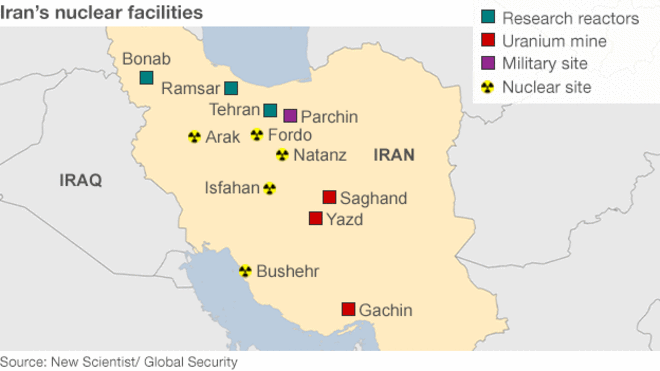
Source: New Scientist/Global Security

Iranian Uranium Mines:  Iran opened two uranium mines in 2013, the Saghand mine and Gchine mine, that provide some uranium for its enrichment program (but these have low concentrations of uranium). The two mines in the city of Saghand in central Iran operate 1,150 feet underground.

Iranian Milling Facility: Approximately 75km from Saghand is the Ardakan mill which processes the uranium into yellowcake.

Iranian Enrichment Facility: The Uranium Enrichment Facility at Isfahan purifies the yellowcake to UF6, a gas, which enables it to be enriched. Enrichment increases the proportion of the U-235 isotope from its natural level of 0.7% to 3-5%.

After enrichment, the UF6 gas is converted to uranium dioxide (UO2) which is formed into fuel pellets. These fuel pellets are placed inside thin metal tubes which are assembled in bundles to become the fuel elements for the core of the reactor.

Natanz is Iran’s primary enrichment facility and consists of three underground buildings, two of which are designed to hold fifty thousand centrifuges, and six buildings built above ground. It’s stated purpose is to produce enriched uranium for use in both the Tehran Research Reactor (requiring 19.75% U-235 content) and fuel for the Bushehr nuclear power plant (requiring 3.5% U-235 content).

The Fordow Enrichment Plant is a large underground industrial facility located near the city of Qom. The site includes two underground halls each able to hold 1,500 centrifuges.  Iran failed to disclose the existence of the Fordow facility until it was revealed publicly by western governments in 2009.

A heavy water nuclear reactor near Arak was first identified by US satellite images in 2002. Heavy water reactors produce a lot of plutonium waste product as part of enriching uranium, which can be used in nuclear weapons.

The nuclear reactor at Bushehr on the Arabian Gulf, was started by Germany in the early 1970s, but suspended after the 1979 Iranian Revolution.  Russia took over constructing the plant and started delivering the nuclear fuel in May 2011.

Iran will soon have a complete end-to-end nuclear program which would include several underground and fortified nuclear sites.

From Nuclear Energy to Nuclear Weapons

There is a narrow gap between the assets and capability needed to build a power plant and what is needed to build weapons of mass destruction.  A brief primer from the Centre for International Governance Innovation (CIGI):

Both nuclear reactors and nuclear bombs use either uranium or plutonium to create a nuclear chain reaction that releases energy. The speed with which they release energy is the crucial difference between the two: in a reactor the energy release is controlled and sustained over an extended period, whereas in a nuclear bomb the release occurs in fractions of a second. The science of fission is fairly straightforward; however, controlling fission reactions to get the desired effect is challenging.

While on the surface it may appear that the infrastructure required for both electricity and weaponry is the same (just some technical understanding stands in the gap), the reality is more complicated.

“To develop a nuclear device, the difference in the speed of the chain reaction creates additional requirements for the firing mechanism, grade of the uranium or plutonium used, and the density, physical surrounding and shape of the fissile material. These differences are substantial barriers to a state looking to shift from power production to assembling a nuclear device.”

In short, the raw materials and infrastructure are very similar, while the technical capabilities are a bit more complicated.

 Iran’s Nuclear Program: from Energy to Weapons?

According to CIGI: “a peaceful program provides the scientific foundation
upon which a state can go on to build and operate its own dedicated plutonium production reactor to produce the material for a nuclear weapon… The main benefit derived from a once-through nuclear energy program for the construction of a nuclear device is the buildup of nuclear infrastructure that would otherwise be difficult, if not impossible, to camouflage….  a peaceful nuclear energy program is best characterized as a stepping stone to acquiring the wherewithal for a nuclear device.”

The White House produced a summary of how the contemplated 2015 deal would block Iran from converting a peaceful program into a weapons program:

  • Reduce level of raw uranium: cut stockpile (mostly acquired in the past from South Africa) by 98%
  • Block enriching uranium: by reducing centrifuge count at Natanz and Fordow
  • Cap the enrichment level: to 3.67%, below the required level to produce weapons
  • Block plutonium production: reconfigure Arak plant so it cannot produce plutonium; ship out all spent fuel. Additionally, no new construction of heavy-water reactors for 15 years

In July 2015, the P5+1 countries effectively endorsed the acceptable parameters of a valid and peaceful nuclear energy program.

Creating the New Paradigm for All Countries

Which begs the question, if there are 31 countries that have nuclear power plants, why are there only 9 with nuclear weapons? Do they not have the technical capabilities for producing a weapon? Lack the desire? How much effort and infrastructure would it take for a country like Hungary to go from a peaceful nuclear program to a weapons program?

If a known state-sponsor of terrorism which calls for the annihilation of other countries (Iran) is permitted to keep such a vast nuclear infrastructure, every other country would be permitted to build comparable nuclear infrastructure.  This is true for countries with existing nuclear plants like Armenia, or non-nuclear countries like Venezuela.  In other words, this deal marks the world’s endorsement of a baseline peaceful nuclear program.

This is obviously very dangerous for the safety and security of the entire world.

A Better Alternative

US President Obama and others have questioned whether there is a better alternative.  Here are some possible points that should be considered before blessing an explosion of “peaceful” nuclear infrastructure construction in the world:

  • No end-to-end capabilities.  As a checks-and-balance for nuclear proliferation, no country should be able to maintain a complete mines-to-reactor program. Countries which are state-sponsors of terrorism should be barred from two components of a complete program. For Iran, they would likely opt to abandon their mines which are not very productive anyway. They would then be left with a choice of modifying their global behavior or giving up another component of their program (maybe opting to ship all spent fuel out of the country permanently).
  • No underground fortified facilities.   As a global precaution against a peaceful program becoming weaponized, no nuclear enrichment facilities should be fortified to such a level that destroying them with conventional weapons becomes nearly impossible. This would require Iran dismantling some of their underground facilities or making them less fortified.
  • Anytime, anywhere inspections. All peaceful nuclear facilities should be available for inspections by the IAEA at anytime.  For this Iranian deal, it would require a more stringent approach than the lengthy 24-day process currently contemplated.
  • Cap on centrifuges. Not only should the number of centrifuges of a country be capped, but no facility should be able to have over a certain number of centrifuges (for example, a cap of 6000 in a country, and no single facility with over 1,500).

These are some examples which should become a requirement of every country for every peaceful nuclear power program. These steps would help protect the entire world from a step-up from peaceful nuclear energy to threshold nuclear weapons.


The current P5+1 Iranian nuclear deal cannot be viewed in a simple comparison of whether the deal is better than no deal. It must be viewed in the context of establishing a new baseline for the use of nuclear power around the world. On such basis, it is easy to see the existing shortfalls.


Related First One Through articles:

Parallel and Perpendicular Views of Iranian Nuclear Deal

Has the “Left-Wing” Joined the UN in Protecting Iran and the Palestinians from a “Right-Wing” Israel?


Parallel and Perpendicular Views of Iranian Nuclear Deal

In a world of 7 billion people, there can be no surprise that people have different views. Even in smaller segments of society, whether in a small town or school, different people could look at a situation and arrive at very different conclusions. One story, two views.

Conclusions may in turn generate additional comparisons. Once an opinion becomes anchored, another similar thought may come to mind. Over time, the two distinct ideas become linked together, in closely related parallel views. Two stories, one view.

THE IRANIAN NUCLEAR DEAL

Perpendicular Conclusions

Much of the world followed the negotiations between six global powers and Iran over the latter’s nuclear ambitions. Not only did many people seek different outcomes, even people that sought the SAME outcomes, viewed the deal in completely different ways.

Consider the Wall Street Journal and The New York Times. Presumably each American newspaper sought a deal which left Iran without nuclear weapons capability.  On July 15, each paper ran factual headlines about the outcome of the negotiations.  Yet the emphasis for each was extremely different.

DSC_0119
Front page of New York Times,
July 15, 2015

The headline for the NYT read: “World Leaders Strike Agreement with Iran to Curb Nuclear Ability and Lift Sanctions.”  Sub-headers read “Accord is Based on Verification, Not Trust, Obama Says” and “G.O.P. Pledges to Kill Pact, But Veto Looms.”  An article further down the page was entitled “President’s Leap of Faith“.

In the middle of the front page the Times sought to summarize the deal terms in a Q&A format.  For anyone reading the answers, it was clear that the deal offered few assurances that Iran was not going to have nuclear weapons within the decade, and certainty that they would have it after a decade.

The portrayal was in sharp contrast to the front page of the WSJ.

DSC_0118
Front page of Wall Street Journal,
July 15, 2015

The WSJ also led with a factual headline about the reactions to the Iranian deal. “Iran Deal Ignites Fierce Fight” The paper included three large pictures with quotes from the leaders of the United States, Iran and Israel with their views on the deal terms.

Both papers considered that Obama and Iranian leader Rouhani were happy with the deal.  That was where the similarities ended.

The Times called out the Republicans as being unhappy, while the Journal highlighted Israel’s unhappiness with the deal. One paper took a more domestic review of the international matter, while the other focused on the international fallout. The NYT used small font to review the dissent of the deal in language that could have been used to describe a capital gains tax hike, while the WSJ used large color photographs in the center of the paper to draw attention to the significant global ramifications of the agreement.

The NYT seemed to tell its readership that if they had faith in Obama, they should have faith in this deal. The WSJ told its readership that a huge fight was brewing overseas, and the US aligned itself with an enemy state and against an ally.

Two papers presumably started at the same spot seeking the same result, but moved in opposite directions when the negotiations concluded.

False Parallels

The head of the Shalom Hartman Institute of North America, Yehuda Kurtzer, also decided to weigh in on the Iranian deal from the ancient Jewish city of Hebron. In a blog called “On Iran, from Hebron” he described his trip with a group of rabbis who came to hear a wide range of narratives from all sorts of people in the city.  Kurtzer’s conclusion was that there exists an obvious parallel between the Iranian threat against Israel, and Jews living east of the Green Line. He said: “I am sad and nervous – both about what Israel is doing to itself in places like Hebron with its commitment to structures which risk its unmaking, and about the threats to Israel’s existence from state actors” and continued the parallel in more clear language about “a settlement [Hebron] that constitutes a self-imposed existential threat to Israel, while listening on Twitter to debates about external existential threats.

Here was a leader of an organization that described itself as a “pluralistic center of research and education deepening and elevating the quality of Jewish life in Israel and around the world,” equating a Jew living with his family in Hebron, with an Iranian regime shouting “Death to Israel” while it obtained the green light from the world to have nuclear weapons in ten years.

A champion of pluralism drew an equivalence between starkly different stories: Jews living freely in places they lived for thousands of years; and a country that has threatened -and will soon be armed for- a genocide.


I understand different people having different opinions. I respect the concept that two parties can start at the same spot and move in opposite directions. Yet I struggle when a single person can conflate two completely different matters into a single narrative.

The NYT loves Obama and feels that their trust and faith in him has prevailed over his presidency, so why not trust him again now? (Of course, that has nothing to do with trusting Iran, but the Times at least starts consistently). The WSJ has always pointed out the flaws of Obama’s foreign policies and used this bad Iranian deal to point it out again.

But what of the leader of a “pluralistic” organization? Does being pluralistic mean that everything and everyone carry the same weight? Does the notion that “pluralism can mean that no full knowledge of truth is possible” mean that it can be so amazingly wrong to suggest that the “external existential threat” of an Iranian nuclear bomb is the same as a “self-imposed existential threat” of Jews living in Hebron?

There is a logic to a liberal paper supporting a liberal president. One can agree to disagree. But how does one react to someone who distorts reality as if the world was a hall of mirrors perched atop a black hole? On Earth, we know opinions can diverge.  In the ethereal world of “pluralism”, it would appear that accepting information from everywhere can lead to a singularity of stupidity.