The Disproportionate Defenses of Israel and the Palestinian Authority

The United Nations Human Rights Council (UNHRC) produced a report in the spring of 2015 about the war between Israel and the Palestinians in the summer of 2014. The UNHRC continued with a debate in June 2015 in which several “delegations strongly condemned Israel’s excessive and disproportionate military aggression against the Palestinians” including from: Egypt; Tunisia; Maldives; Iraq; South Africa; Indonesia; Ireland and Cuba.

This analysis does not directly review “disproportionate force” but disproportionate defense employed by the two sides.

Obligation to Defend

The foremost responsibility of any governmental leadership is to protect its population. Such defense can be implemented in a variety of ways: a police force or army to maintain order; infrastructure to ensure safety; and intelligence which can guide the appropriate use of manpower and equipment. The United Nations has been developing a framework for “The Responsibility to Protect” over the past several years.

In the conflict between Israel and the Palestinian Authority, only one side proactively protects its citizens, while the other side uses reactive defenses. One side assumes responsibility via using its own resources and capabilities, while the other side relies completely on outside agents.

ISRAEL – ACTIVE DEFENSE

Protecting Against Incoming Missiles and Armaments

Bunkers and Bomb Shelters: Israel is unique in the Middle East in establishing a policy of bomb shelters throughout the country. In response to being surrounded to hostile neighbors that have attacked and shelled its people and lands since its inception, houses, schools, hotels, hospitals and even playgrounds are built with bomb shelters.

The Palestinians have not built shelters. Instead, they used their cement to build tunnels with which to attack Israel.

Israel_-_shelter_by_kate_simmons

Playground shelter in Israel
(photo: Kate Simmons)
Iron Dome. Israel developed a new missile defense system called the Iron Dome, and continues to build new air defense systems to protect the country from incoming missiles.

The Palestinians have neither developed nor imported defensive systems. They have only imported offensive weaponry.

irondome

Israeli developed “Iron Dome” Defense System
Blockade of Gaza. Israel imposed a naval blockade around Gaza after the terrorist group Hamas, which is sworn to the destruction of Israel, seized the land. The blockade has successfully kept out many missiles and other arms from reaching Hamas and ultimately causing death and destruction in Israel.

Protection Against Killers

Security Barrier. In September 2000, the Palestinians began multi-year riots which killed over a thousand Israelis through hundreds of attacks. In response, the Israeli government began to construct a security barrier in 2002 to keep out terrorists who mostly emanated from cities in Judea and Samaria/ east of the Green Line (EGL).

The Palestinians have not built any security barriers from the Israelis. There have been no suicide bombers going from Israel into Gaza or EGL blowing up civilians.

IMG_1805

Stretch of Security Barrier along highway
(photo: FirstOneThrough)

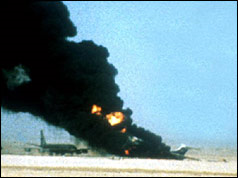
Airport Security. Well before the world became attuned to airport security after the attacks on the United States on 9/11/01, Israel established an extensive airport security system. The screening of passengers, x-rays of baggage and other methods were in response to a series of airplane hijackings in the 1970s (a method of terrorism created by the Palestinian Arabs).

The Palestinians do not have an airport and therefore no such security concerns.
plane blowup 1970

Palestinians blow up plane, 1970

Protection Against Lethal Plans

Intelligence. Israelis utilize a wide variety of information sources to uncover plans to attack its country. Whether through a network of Israeli spies, Palestinian informants, money tracking, wiretapping and other means, the Israelis gather information and make assessments on potential Palestinian Arab attacks. It is then able to take preventative action before such attacks occur.

PALESTINIAN AUTHORITY AND HAMAS – REACTIVE DEFENSE

Relying on Israeli Sensitivities and Sensibilities

Civilians. As detailed above, the Palestinian Authority and Hamas have not instituted proactive tangible means of defending its people. One of the ways it attempts to defend the population is by making it nearly impossible to distinguish between fighters and civilians.

  • The fighters do not typically wear uniforms and can therefore not be distinguished from civilians
  • Men, women and children are all enlisted in the war against Israel
  • Militants fire at Israel from mosques, schools and civilian neighborhoods

Palestinian Arabs hope that Israel will not indiscriminately fire upon everyone. By forcing Israel to take time and extra precautions to target the right attackers, it slows down Israeli defenses during battles.

humanshieldsgaza

Destroying its Own Infrastructure. Hamas built an extensive offensive network of tunnels into Israel which originated in many private homes. By relying on Israelis sensitivities to minimize destruction in civilian neighborhoods, Hamas was able to protect many tunnel openings.

Further, Hamas and other Palestinian Arab groups often booby-trapped homes from which they attacked Israel. While the Palestinian Arabs destroyed their own infrastructure, they slowed down and killed many Israelis who looked to root out the attackers.

Relying on Global Bodies like the United Nations

United Nations. One of the principal methods that the Palestinian Authority uses to defend its population is through global bodies AFTER a war. The United Nations includes 57 Islamic countries (in the OIC) and 22 Arab countries (in the Arab League) which align themselves with the Palestinian Arab cause. Many of those countries do not even recognize the State of Israel. They were instrumental in passing the “Zionism is Racism” resolution in 1975 and creating several committees devoted only to Palestinian causes.

The Palestinians turn to the UN to highlight the damage that Israel inflicts on its intentionally defenseless population. It uses deliberate attacks on Israel to provoke premeditated casualties to show the world.

This same UN has not condemned the Palestinian Authority for not properly defending its population. Instead, it recommended the incredulous idea that Israel must give the Arabs the defensive systems like Iron Dome that it developed.

The latest forum that the Palestinian Authority has pursued is the International Criminal Court, the ICC. While it is evident that the Palestinians Arabs definitely committed war crimes in the 2014 War against Israel, it would still sue Israel in the hopes that such action will hurt Israel, further its cause and protect the Palestinian Arabs.


As detailed above the two sides in the Israel-Palestinian Authority conflict have disproportionate defenses.

  • The Israelis use several proactive approaches; the Palestinians use reactive methods
  • The Israelis rely upon ingenuity and preparedness; the Palestinians rely on Israeli sensitivities and global sympathy
  • The Israelis principally depend on themselves; the Palestinians depend on the world

A discussion of “disproportionate force” cannot be made in a vacuum without discussing “disproportionate defenses”. The global community cannot continue to reward the acts of a leadership that deliberately deals in its own premeditated casualties.


Related FirstOneThrough articles:

Israel: Security in a Small Country

The United Nations and Holy Sites in the Holy Land

The International Criminal Court for Palestinians and Israelis

The United Nations Audit of Israel

Names and Narrative: Palestinian Territories/ Israeli Territories

Summary: Almost every major media outlet refers to the Gaza Strip and the west bank of the Jordan River as “Palestinian Territories”, when in fact, those areas are actually “Israeli territories” and “Palestinian Authority Territories.”

Most places in the world are part-and-parcel of a country.  However, there are situations when a place is administered by a government which has not incorporated the land and assumed full sovereignty.

The United States of America historically had several large territories as the country expanded, including Alaska and Hawaii.  Today, the USA continues to have several territories including:

  • Puerto Rico
  • US Virgin Islands
  • Guam
  • Northern Mariana Islands
  • American Samoa

These territories have some rights and protections of the US government, but not others such as the right to vote.

Israeli Territories and
Palestinian Authority Territories
1995 to Present

It is easy and obvious to understand that there are no “Palestinian Territories”, because there is no such thing as the State of Palestine (as of this writing, in any event).  Most of the area east of the Green Line (EGL/ west bank of the Jordan River, WBJR), is controlled and administered by Israel.

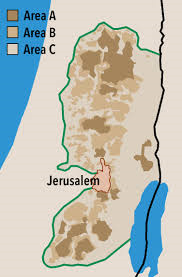
Under the Oslo Accords, EGL was divided into three parts: Areas A, B and C. Area A was handed over to the Palestinian Authority (PA) and it has complete control of that land.  Area C is “Israeli Territory” and is completely controlled by Israel. Area B is a hybrid, which is under the civil administration of the Palestinian Authority, but security control of Israel.

Areas ABC
Breakdown of Areas A, B and C
on the west bank of the Jordan River

Gaza would ostensibly be called “Palestinian Authority Territory”, however, the PA has no control in the area.  The governing party is Hamas, which won elections in 2006 and routed any PA personnel from the region in 2007.  Israel withdrew from Gaza in 2005.

Israeli Territories
1967 to 1995

The Oslo Accords between the State of Israel and the PLO started the process of breaking the Israeli territories into areas with local Palestinian Arab control.  Before the Oslo Accords, all of Gaza and EGL/ west bank of the Jordan River (WBJR) were only Israeli territories.

Israel took control of Gaza from Egypt in June 1967 during the Six Day War.  Egypt had amassed a large army and announced its intention of attacking Israel, so Israel preemptively attacked Egypt and seized Gaza.  In response to Israel’s preemptive attack on Egypt, Jordan attacked Israel from the EGL/WBJR. Jordan lost the region and gave up all claims to the land in 1988.

Jordan and Egyptian Territory
1949 to 1967

In May 1948, the Palestinian Arabs and five Arabs armies attacked Israel as it declared independence from Great Britain. At the end of the war in 1949, Jordan assumed control of much of Judea and Samaria in an area which became known as the “west bank of the Jordan River (WBJR)” in the United Nations, ultimately shortened to the “West Bank”.  Jordan annexed that area in 1950, gave all Arabs living there citizenship and expelled all of the Jews from the area, counter to the Fourth Geneva Convention.

Egypt assumed control of the Gaza Strip, but did not annex the area.

British Territory 1922 to 1948
Ottoman Territory 1517 to 1922

At the end of World War I, the defeated Ottoman Empire was carved up into several areas (including Lebanon, Syria, Iraq, and Jordan) which were administered by the French and British.  The lands currently known as WBJR and Gaza were part-and-parcel of the British Mandate and had no unique laws or characteristics.  Similarly under Ottoman rule for hundreds of years before the British, those areas were neither divided nor distinct.

As detailed above, there are not, nor have there ever been “Palestinian Territories”. Such terminology inherently upgrades the status of the Palestinian Authority and eliminates the legal role and status that Israel has in Areas B and C.


Related First.One.Through articles

Names and Narrative: The West Bank / Judea and Samaria

Nicholas Kristof’s “Arab Land”

The Subtle Discoloration of History: Shuafat

The Legal Israeli Settlements

Educating the New York Times: Hamas is the Muslim Brotherhood

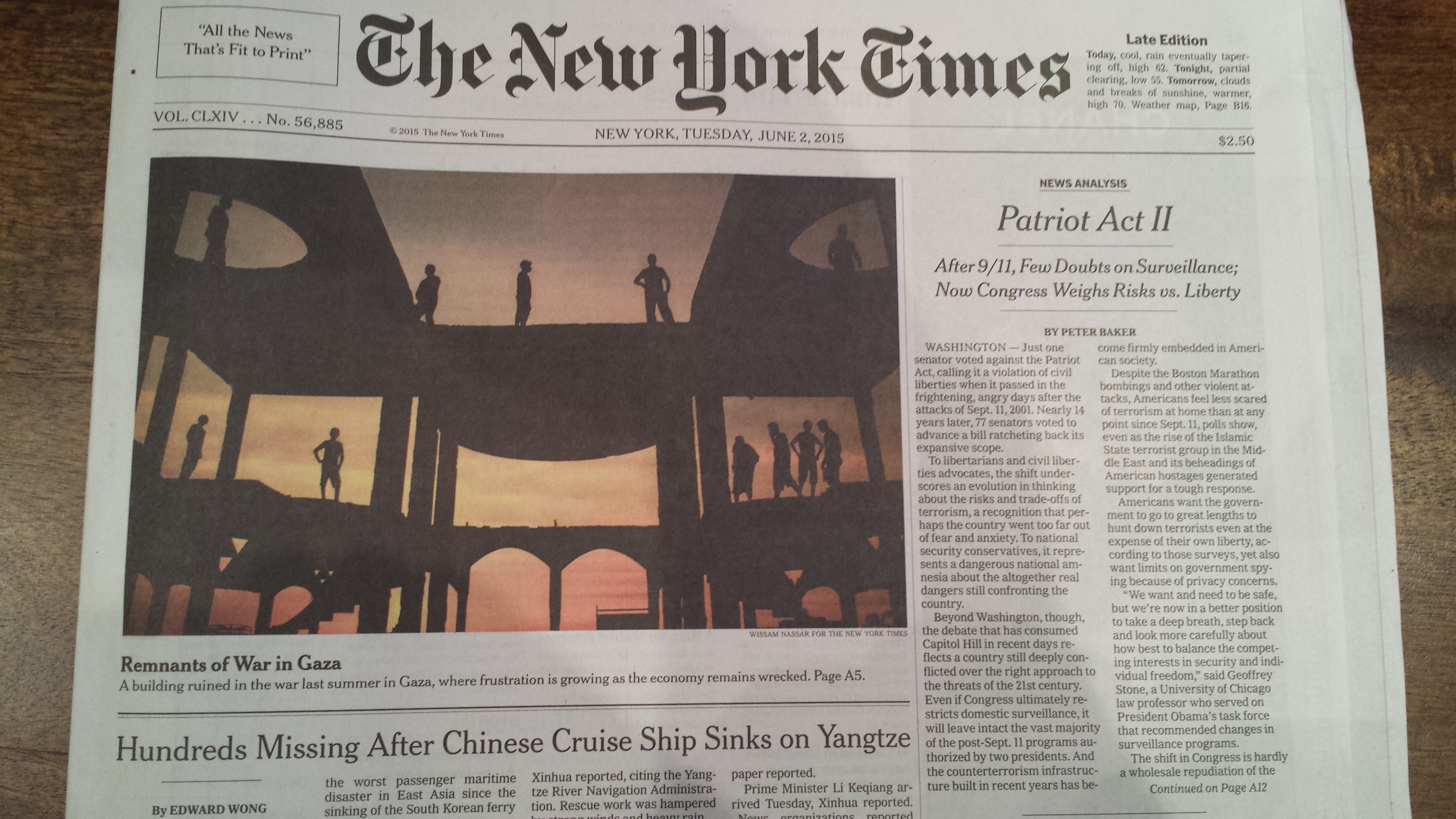
On June 2, 2015 the New York Times once again decided to tell the world that the people of Gaza are suffering.

20150602_201544
New York Times cover picture of Gaza,
June 2, 2015

With a large color picture on the front page, the Times included another picture and article inside regarding how the Gazan community has still suffered from a lack of money, jobs and rebuilding of the infrastructure one year after the war “between Hamas and Israel.”  If a reader ever wanted to learn about the scores of people killed in Nigeria, they would have to hunt inside the paper for an article on page A4 (with no picture).  If they wanted to hear about the dozens of Yemeni civilians killed by Saudi Arabia, they would have had to turn to page A12 the day before.  This has been a continuing pattern for the NYT, as outlined in “Every Picture Tells a Story – Whitewashing the World” where the killing of civilians around the world went under-reported, while the suffering of Gazans remained over-reported.

Another trend of the liberal press has been to not label Hamas a terrorist organization, as reviewed in “CNN’s Embrace of Hamas.”  The group simply is a political group dedicated to “resistance.”

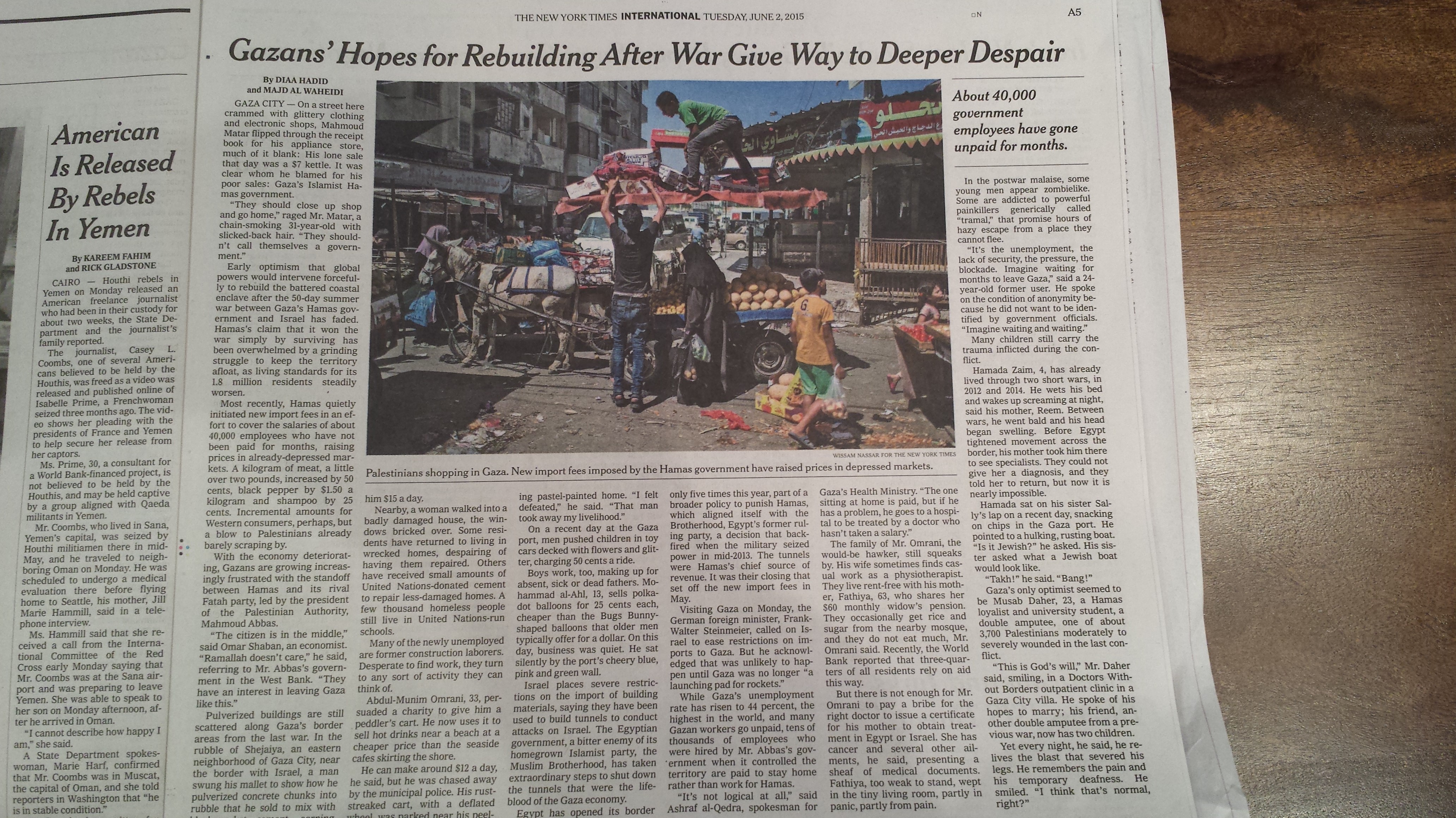
The June 2 NYT article “Gazans’ Hopes for Rebuilding After War Give Way to Deeper Despair” has continued to add to the trend of distancing Palestinian Arabs from Hamas, and Hamas from terrorism, as if everything that happened to Gazans was poor luck and happenstance.

20150602_201625

The article referred to the Palestinian Arabs’ “hope” and “Early optimism that global powers would intervene forcefully to rebuild the battered coastal enclave after the 50-day summer war between Gaza’s Hamas government and Israel “.  The article never discussed their hope that Hamas would destroy Israel.

The article detailed the blight in Gaza, stating “Pulverized buildings are still scattered along Gaza’s border areas from the last war. In the rubble of Shejaiya, an eastern neighborhood of Gaza City, near the border with Israel,” but did not discuss that the Shejaya neighborhood was the locus of dozens of tunnels from people’s homes into Israel to commit acts of terror.

It would appear that the NYT further wanted its readers to believe that the people of Gaza made a momentary strategic blunder in aligning itself with the Muslim Brotherhood in a “decision that backfired“:

The Egyptian government, a bitter enemy of its homegrown Islamist party,
the Muslim Brotherhood, has taken extraordinary steps to shut down the tunnels [connecting Egypt and Gaza]  that were the lifeblood of the Gaza economy.

Egypt has opened its border only five times this year, part of a broader policy to punish Hamas, which aligned itself with the Brotherhood, Egypt’s former ruling party,
a decision that backfired when the military seized power in mid-2013.

This is ridiculous.  Hamas IS an integral part of the Muslim Brotherhood. It didn’t simply “align itself” in “a decision that backfired.”  Here are quotes from the Hamas Charter (1988):

“Article 2: The Islamic Resistance Movement is one of the wings of Moslem Brotherhood in Palestine. Moslem Brotherhood Movement is a universal organization which constitutes the largest Islamic movement in modern times….

Article 7: The Islamic Resistance Movement is one of the links in the chain of the struggle against the Zionist invaders. It goes back to 1939, to the emergence of the martyr Izz al-Din al Kissam and his brethren the fighters, members of Moslem Brotherhood. It goes on to reach out and become one with another chain that includes the struggle of the Palestinians and Moslem Brotherhood in the 1948 war and the Jihad operations of the Moslem Brotherhood in 1968 and after.”

This is not subject to interpretation. Hamas is an integral part of the global Muslim Brotherhood movement, a group which has been actively banned and persecuted in Muslim countries such as Egypt and Syria for promoting terrorism.

However, such facts muddy a narrative of Palestinian Arabs as innocent victims.  Therefore, the media seems to have concluded that the best way to advance the victimhood tale requires a multi-part effort:

  1. Distance the people from the ruling government and negative reports. Minimize the fact that Palestinian Arabs voted for Hamas, which has led Fatah in every poll since 2006. Explain that the Arabs are frustrated by the Fatah corruption so had no practical choice other than voting for Hamas. Explain Palestinian Arabs being the most anti-Semitic people in the world by using terms like “not surprising” without delving into cause-and-effect.
  2. Stop calling Hamas a terrorist organization. Use terms like “militant” sparingly, and ideally, just “Islamist”.
  3. Refer to Hamas as a political entity. Which it is, like the Nazi party was a political entity elected by the Germans in the 1930s. Quote “political leaders” of Hamas often.
  4. Never refer to the Hamas Charter, which calls for the complete destruction of Israel; murder of Jews and never accepting any negotiated settlement. Skip the long, evil Jewish and Zionist conspiracy theories- those statements are just noise that cloud the picture of Palestinian Arab suffering.
  5. Localize Hamas to an Israeli resistant movement.  In a world that fears the dangerous rise of the Islamic State / ISIS, do not let Hamas get painted as part of a broader Muslim terrorist group (as described above).

If you follow these steps, the Palestinian Arabs can appear as passive victims and not as active participants in a radical anti-Semitic, anti-Western regional movement to install a Muslim caliphate.

Read the press today. Which rules are they using?


Related First.One.Through articles:

Cause and Effect: Making Gaza

The Death of Civilians; the Three Shades of Sorrow

Honor Killings in Gaza

The Palestinians aren’t “Resorting to Violence”; They are Murdering and Waging War

What do you Recognize in the Palestinians?

Extreme and Mainstream. Germany 1933; West Bank & Gaza 2014

CNN’s Embrace of Hamas

Many people in the pro-Israel community continue to be frustrated by the refusal of many media outlets and some political organizations to designate Hamas a terrorist organization. While the phrase “one person’s terrorist is another person’s freedom fighter” is often bandied about, organizations have no difficulty clearly labeling some organizations as terrorist groups.

Consider CNN which highlighted five jihadist groups in February 2015 as terrorist organizations: Al-Shabaab; Al Qaeda; Boko Haram; ISIS; and the Taliban. The groups are consistently labeled as jihadist terror organizations that seek to destroy reigning governments.

AL-SHABAAB

CNN has clearly labeled Al-Shabaab as a terrorist group:

Al-Shabaab was specifically designated as a  terrorist organization by CNN, which did not couch the language as a suggestion that it could be considered a terrorist group by some third party.

AL QAEDA

As of early 2015, CNN considered Al Qaeda’s central command structure under threat while it spread around the world. It was clear in all circumstances that they were terrorists:

BOKO HARAM

CNN often localized Boko Haram to Nigeria and neighboring countries (compared to the growing global threat of Al Qaeda), but consistently referred to the group as terrorists.

ISIS

ISIS/ ISIL/ Islamic State has been extremely active in 2015 and gathering many news reports on CNN and all media outlets, particularly as the United States has been engaging them in Iraq and Syria:

TALIBAN

The Taliban has not been as prominent in the news lately.  However, when it was, CNN was clear that the group’s actions and the group itself was involved in terrorism.

These five organizations are identified by CNN as terrorist groups. They are Islamic jihadists. They terrorize and attack. They seek to overthrow existing governments through murder and mayhem.

Now compare them to CNN’s description of Hamas.

HAMAS

On February 28, 2015 CNN had an article entitled Egyptian court designates Hamas as a terror organization, state media says.  Note that CNN clearly did not make the designation, but repeated an assertion from Egypt.  The article read: “Hamas, the Islamist group which dominates the Gaza strip, has been at odds with the Egyptian government…” made it seem that there was simply a political disagreement between Hamas and Egypt, between two ruling parties. CNN referred to Hamas only as “Islamist” and not “jihadist”, “militant” or “terrorist”.

CNN continued: “Hamas quickly denounced the decision at a news conference…. “It is a shocking and dangerous decision that targets the Palestinian people,” Fawzi Barhoum, a Hamas spokesman, said at a news conference”.  The article highlighted that Hamas was designated a terrorist organization by one country (as opposed to actually being a terrorist group) and CNN made the effort of showing that the group challenged such opinion.  The quote chosen by CNN further tried to show that such designation was itself an attack on “the Palestinian people” making the group the victim.

How is that for a turn?

On January 6, 2015 CNN wrote another piece that seemed all about politics. “Senior Hamas official Izzat Risheq denied reports Monday that the group’s political leader Khaled Meshaal has been expelled from Qatar” making the group appear as purely s political party. There was no mention that the group is in favor of jihad, destruction of Israel or is terrorist group.

On November 27, 2014 a CNN article entitled “Israel says it broke up Hamas terror plot” specifically gave attribution of the plot to Israel, and not as a clear fact. The article stated that “Authorities arrested at least 30 members of Palestinian militant group Hamas” which at least referred to the group as “militantwhich is much more than it typically writes to describe Hamas.

These were the recent articles while Hamas licked its wounds from its 2014 war against Israel.  How did CNN describe Hamas during the 2014 campaign itself?

CNN’s Assertion of No Hamas War Against Israel 

In its August 22, 2014 article “Hamas leader admits militants abducted slain Israeli teens,” CNN quickly distanced the group leadership from the abduction and murder of three Israeli boys.  The three leading paragraph’s took pains to absolve the group’s leadership:

“Three Israeli teens kidnapped in the West Bank in June and later found dead were abducted by Hamas militants who did not inform the group leadership about
the kidnapping, a Hamas official said Friday.
“At that time, the Hamas leadership had no knowledge about this group or the operation it had just carried,” Saleh Aruri, a Hamas Political Bureau member, said in a statement from Doha, Qatar. “It turned out later, however,
that they were members of Hamas.”
Aruri said the operation to abduct the teens was not approved by the Hamas leadership or its military wing, the Qassam Brigades.”

The article (in its entirety) quoted no Israelis. CNN repeatedly referred to Hamas as a political entity (does CNN ever quote Boko Haram’s main political spokesman?), as the article sought to distance Hamas from the murders.

These actions were done repeatedly by CNN, most egregiously on August 4, 2014 when it aired an interview “CNN exclusive: Inside the mind of Hamas’ political leader

Meshaal CNN Meshaal “Political Leader” on CNN

The introduction to the interview with Khaled Meshaal made it appear that CNN was going to have a serious exchange: “CNN’s Nic Robertson had tough questions for Hamas’s political leader.”   Well, maybe not- CNN was again directing the public that Hamas is simply a political organization. Did the article ever mention:

  • that the Hamas Charter calls for the complete destruction of Israel?
  • the Hamas Charter calls for jihad and murder of Jews by every man, woman and Palestinian child?
  • the Hamas Charter which declares that there is no possibility of peace with Israel through any negotiation, and that all of Israel must be destroyed through military means?
  • the Hamas Charter’s repeated use of anti-Semitic slurs, stereotypes and conspiracy theories?
  • the repeated calls by Hamas and Palestinian leadership to attack Israel?

During the interview, did Robertson get answers to questions:

  • if Hamas is fighting for the Palestinians, why was Meshaal sitting comfortably in Qatar?
  • if Hamas was intentionally firing rockets from civilian neighborhoods in Gaza?
  • if Hamas targeted Israeli civilians with such attacks?
  • if Hamas built tunnels to abduct and kill Israelis?
  • if Hamas would abolish its charter?
  • if Hamas would recognize Israel?
  • what lands Hamas considers as “occupied” since Israel left Gaza in 2005

It is noteworthy that Robertson asked Meshaal how he was helping his “resistance” to Israel (Robertson used Hamas’ terminology instead of terrorism). Meshaal responded that Palestinians understood that military resistance was needed to get rid of Israeli occupation, the same way that the Americans got rid of the British and the French got rid of the Nazis.  Robertson let the statement stand and did not follow up about the absurdity of the comparisons. The French repelled the Nazi invading force that took over France. The US sought separation from a colony to an independent country. But here, the Palestinians were attacking an independent country, once again seeking its complete destruction and murder of its people.

Neither in the interview nor accompanying article did CNN’s Robertson ever call out Hamas as a jihadist terrorist group.  It did however, allow Meshaal to air his propaganda and assume a victim status both at the hands of Israel and the global community:

“”We the Palestinian people have, since 1948, have listened to the international community and U.N. and international regulations, in the hope they end the aggression against us. But the international community failed in ending the Israeli occupation and failed in helping our people to have self-determination and have its own state.”

Imagine CNN airing such an interview and article about any other terrorist group.


Related FirstOneThrough articles:

Differentiating Hamas into Political and Military Movements

The New York Times wants to defeat Terrorists (just not Hamas)

Cause and Effect: Making Gaza  

Recognizing the Palestinians

Palestinians are “Desperate” for…

The Palestinians aren’t “Resorting to Violence”; They are Murdering and Waging War

Why the Media Ignores Jihadists in Israel


Cause and Effect: Making Gaza

Summary: The media frequently touches on the suffering that takes place in Gaza. Yet, the depth of their coverage of Arab misery never approaches any level of analysis on the root cause for the Israeli-Arab conflict.


The Atlantic published an article on May 2, 2015 called “Gaza is Hell” (all in quotes) which described the miserable living conditions of Arabs living in Gaza. The 2000-word article covered the area and quoted the residents, but never scratched the surface of the underlying cause of the residents’ misery.

atlanticmay2
The Atlantic magazine,
May 2015

The problem in the coverage was in five key areas, long ignored by the media and politicians.

  1. Hamas isn’t “resisting” Israel. It wants to destroy Israel.
  2. Palestinian Arabs never ruled Gaza until 2005.
  3. Israel’s wars with Gaza have all been defensive.
  4. There are no “refugees” in Gaza.
  5. Much of the Gazan misery is self-inflicted.

The Atlantic article did not fall victim to a sixth category, which is actually a subset of lie #5: Hamas is the democratically-elected choice of Palestinian Arabs.

 HAMAS’S MISSION

Hamas’ mission is very clear for any literate individual: the complete destruction of Israel. It lays out its goal repeatedly in its 1988 Charter, the most antisemitic charter of any governing body in the world, including the Nazi party when it took power in 1933.

For those who cannot read (former US President Jimmy Carter?) there are dozens of recent videos from Hamas officials which call for the murder of Jews and destruction of Israel.

Yet, The Atlantic echoes soft lies in its piece stating that “Hamas’s rhetoric is all about resistance,” and “Hamas advocates militant resistance to Israel.” Nope. Resistance means opposing a force. Hamas is the force that seeks jihad and the total destruction of Israel. Any statement that says that Hamas is a resistance movement, inherently makes the argument that the basic existence of the State of Israel is an active force against Palestinians.

GAZA’S FIRST INDEPENDENCE and
ISRAEL’S DEFENSIVE WARS

The mutant siblings of lie #1 that Gazans are “resisting” Israel, are lie #2, that Palestinians have always been self-governing in a country of their own, and lie #3, that Gazans just want to live in peace alongside Israel but Israel continues to attack it.

Alice Su, the author of The Atlantic article is based in Jordan, a country that is over 50% Palestinian Arab. That country, like Gaza, was part of the 1922 British Mandate from the League of Nations. Before the British ruled Gaza, the Ottoman Turks were in charge, and after the British came the Egyptians. None of these rulers made it into Su’s description which starts a historical background of Gaza in 1967: “Gaza, which was under Israeli occupation from 1967 until 2005”. With some additional background, it would have been clear to any reader that Gaza was never ruled by local Arabs (the Ottomans were Muslims but not Arabs), and it has only been since Israel left the territory in 2005 that Gazans have ruled over themselves.

Additionally, the various wars that Israel fought against the Arabs including 1948 and 1967 were defensive wars against several Arab countries (including the Arabs in Gaza). The more recent wars from Gaza were also defensive, in response to Hamas’s rocket attacks, terror tunnels and abduction and murder of Israeli teenagers. Yet Su stated that “Israel has also launched three military operations in Gaza since the Hamas takeover,” which suggested that Israel was the aggressor, which it was not.

Arab amnesia repeats itself today, as Su writes about a Gazan: “They keep asking him why the Israelis bombed them. “I tell them, ‘Naseeb. This is our fate,’”  The Gazan assumed a completely passive stance in the conflict and Su did not educate the reader about: the abduction and murder of three Israeli teenagers; the rockets fired from Gaza into Israel; and the terror tunnels Hamas dug into Israel to kidnap Israelis.

It was only eight paragraphs later that Su brought up the tunnels: “Israel has restricted imports of key building materials like cement and steel, out of concern that they’ll be used to build tunnels and facilitate terrorist activity.”  Such concern looks out-of-place without any history regarding the Hamas tunnels which were used for terrorist activities.  The Israeli ground invasion into Gaza in 2014 was specifically to destroy those tunnels.

To underscore the point of misdirecting the reader, consider the title of the Atlantic article.  It comes from a resident of Gaza. ““Gaza is hell,” 20-year-old Ahmad told me in Shejaiya, one of the worst-hit neighborhoods in Gaza City.”

Shejaiya was the neighborhood with the greatest number of terror tunnels, many coming straight from people’s homes. That is why the Israelis concentrated its efforts on the neighborhood in a defensive action.

Why did The Atlantic run an article with a headline quote from a man who was part of the terrorist infrastructure?  Why did it deliberately mislead readers into thinking these people were merely passive homeowners who were bombed indiscriminately by Israel?

REFUGEES IN THEIR HOME

Su’s article describes refugees and refugee camps in Gaza. Now that Gaza is not occupied by Israel, Egypt, the British or anyone else, these people cannot be considered “refugees” since these “Palestinian Arabs” are living in “Palestine” run by themselves.

The refugee myth has continued to compound itself as this misnomer is incorrect on additional levels.  Refugee status cannot be handed down like inheritance through the generations.  Refugees can only be from a country, not a house or region.

At the most generous, these people can be considered descendants of “internally displaced” people from the region of Palestine which was occupied for centuries until 2005. Yet Su used the term refugee several times:

“a refugee camp initially built to shelter 9,000 out of the 750,000 Palestinians who became refugees when Israel was established in 1948. More than half a century later, the camp hosts more than 21,000 refugees,”

The description above elegantly covers many soft lies: the ones mentioned above, and that Arabs became refugees when they actively launched a war to destroy Israel; they were not passive “when Israel was established in 1948.

SELF-INFLICTED MISERY

Su did get several things right, such as “Gaza remains in ruins.” But why?

Su pointed out that “Hamas, the Islamic militant group that governs Gaza… since the organization defeated the PLO-affiliated Fatah party in Palestinian elections in 2006.” Hamas was chosen by the Palestinians in 2006 and polls continue to show Palestinians favoring Hamas should elections ever be held again. The various quotes of Arabs on the street in Su’s article affirm that view: “Another college student said she’d lost faith in politics, but would vote for Hamas if an election were held now.”

Yet Su would have you believe that Gazans are simply passive victims in the situation. That position is encapsulated in her article: “Those who survived last summer’s war are trapped in 360 square kilometers of trauma and contradiction, choking on war and blockade, disillusioned with the Palestinian leadership and disempowered by the aid communityThey sit without jobs, relief, or means of rebuilding, waiting for things to change.” Untrue.

  • The Palestinians voted for Hamas, well aware of its charter and calls to destroy Israel. The fact that Palestinians are “disillusioned” with their leadership is only because Hamas hasn’t been successful in their genocidal mission.
  • The phrase “disempowered by the aid community” is strange but Su’s meaning becomes clear when she later writes that foreign aid is slow in coming “because donors are put off by the political deadlock between Palestinian parties.”  A Lie. The aid is being held up until there are guarantees that Hamas will not have access to the funds as it is a terrorist organization.

The catalyst for war is Hamas.

  • If Gazans would turn away from Hamas, there would be no blockade.
  • If Gazans did not allow Hamas to build terror tunnels in their houses, the neighborhood would not get demolished.
  • If Hamas were disbanded and outlawed, foreign aid would flow into Gaza for rebuilding.
  • If Hamas would not attack Israel, there would be peace.

The simple cause-and-effect of the situation in Gaza is about the people’s support of a genocidal anti-Semitic regime.  But writing about such reality would make it harder to sympathize with the picture laid before readers in The Atlantic.

Scarier still, is the support for the insidious paring: Hamas with a nuclear Iran. That is what keeps the hopes of Gazans alive under the shade of complicit countries and malevolent media.


Related FirstOneThrough article:

The Death of Civilians; the Three Shades of Sorrow

Every Picture Tells a Story- Whitewashing the World (except Israel)

Summary: The New York Times continued to minimize pictures of attacks on civilians and assassinations around the world by burying small pictures deep inside its paper. The precious front page ink was only reserved for portrayals of Israel as the aggressor.


The Every Picture Tells a Story series reviewed media’s deliberate use of pictures to tell a story to its readers. It is a story that conveyed Israel committing gross atrocities, uniquely in the world:

  • Every Picture Tells a Story, Don’t it?” reviewed the New York Times’ use (and lack) of pictures of the three murdered Israeli teenagers in the summer of 2014 on the front page of its newspaper, while showing the Arab family whose son was killed.
  • Every Picture Tells a Story, the Bibi Monster reviewed how the NYT showed a large color picture of a Palestinian Arab teenager injured by Israeli police on its front page, while small pictures of mass murders in Kenya, Uganda and Yemen were found inside the paper. Further, pictures of Israeli PM Netanyahu repeatedly showed up next to pictures of injured Arabs, while no member of the Palestinian Authority or Hamas ever made it to the front pages during the entire Operation Protective Edge.
  • The New York Times Buried Pictures analyzed the puzzling lack of exposure of the Hamas terror tunnels from Gaza into Israel, which were the primary reasons for the Israeli ground offensive into Gaza.
  • The New York Times 2014 Picture of the Year wrapped up these observations, noting that the New York Times used large color photographs on its cover page of injured Palestinian Arabs repeatedly – on July 11, 14, 17, 21, 22, 24 and 29 – while continuing to hide pictures of Palestinian Arab aggression, and attacks in conflicts around the world.

THE WORLD

The Times continued preference for ignoring mass killings and assassinations in the world continued into 2015.

During a week of April 2015, world governments and terrorists killed hundreds of people. Not one incident merited a front page picture in the Times:

These articles were found buried in the paper. The associated pictures were relatively small and several were in black and white. No picture showed the victims injured or hurt.

This is not a new phenomenon. The Times often minimizes attacks that occur in the MENA (Middle East/ North Africa) region.  The exception to the rule, is if Israel is the attacker.

ISRAEL

Natan Sharansky, a famous Jewish refusenik who was jailed in Russia for trying to move to Israel, developed a three part “3D test” to determine anti-Semitism: Double standards; Demonization; and Delegitimization. Many liberals disagree with this approach and feel that double standards do not convey anti-Semitism. The liberal argument is that Israel should not be held to the same standards as Yemen, Iran, Iraq, Kenya, Saudi Arabia and the many countries in the Middle East, let alone terrorist groups like ISIS and al-Shabab. As Israel is a modern progressive country, the standards should be more akin to the USA or Western Europe. But that argument falls flat in general, and in particular, regarding the New York Times coverage of Israel.

DOUBLE STANDARDS

First, the situations are not remotely comparable. The US and Western Europe do not sit in the middle of the Middle East, surrounded by a combination of: war; terrorist groups operating freely; countries and entities that threaten to destroy their countries; and constant attacks on its citizens. It is easy to be judgmental while lunching in Luxembourg. However, Israel is forced to fight and defend itself repeatedly because of the volatile neighborhood and hostile attitude of its neighbors.

Second, the New York Times uses a double standard for the US and its allies. The paper does not treat the war effort of the US and Europe which have opted to fight battles thousands of miles from their borders, in the same manner as Israel fighting to defend itself. The NYT never posted a picture of President Obama next to the victims of a drone strike (which the president actually authorized) as it does with PM Netanyahu (for general military actions). It does not show pictures of civilians killed by US troops. It minimizes the pictures of terrorists killed by the US and its allies, using small black and white photos in the middle of the newspaper, rather than large color photographs on the front page as it does for Israel.

DEMONIZATION

Third, the NYT and many liberals do not only use double standards, but demonize and delegitimize Israel as well. The unique focus on how Israel defends itself is one thing (double standards). Uniquely showing pictures of injured Palestinian Arab victims alongside pictures of Israeli leaders and weaponry is demonization.

Simply compare the natural human reaction of looking at a small headshot picture of an al Qaeda leader (accompanied by an article that the United States killed the person), to a collage of pictures of injured and killed Palestinian civilians alongside pictures of Israeli military personnel and another of the Israeli Prime Minister. A person would likely skip the article buried in the paper that only has a head shot. But the large color collage of pictures on the front page delivers a biased story that is impossible to ignore: that the Israeli government is responsible for sending its army to kill civilians.

Further, consider opening the pages of paper and seeing a smoke trail coming from Gaza (the closest the Times came to showing Hamas militants firing weapons). The accompanying article refers to the people in Gaza providing a “counterpunch,” making the group appear as the victims instead of the party that initiated the fight.

20140718_103800

Imagine if the Times had shown pictures of the missiles Israel used to “tap” the roof of targeted homes to let the occupants know that a real explosive was coming so they could flee. Imagine the Times showed pictures of the thousands of leaflets that Israel dropped on certain neighborhoods urging residents to leave an upcoming battle zone.  Imagine pictures of Arabs holding cellphones far from the military action, because they received calls from Israel to move to safety.

You would need to imagine such images, because the Times does not print them.

DELIGITIMIZATION

The defensive nature of Israel’s war against Hamas was delegitimzed by the Times because the paper did show pictures of Hamas leaders, nor its tunnels and weaponry. Without the clear imagery of the three slain Israeli teenagers and Hamas terror tunnels which were the causes for the war, the reader was left with an impression that it was a war of choice for Israel.  Cover page pictures of injured Palestinians were coupled with articles under the headline “Confrontation in Gaza” as opposed to “War FROM Gaza,” left the reader with the incorrect conclusion that Israel as the big belligerent party.

The Times 2014 war coverage failed on all parts of the “3D Test” for anti-Semitism.


Now, in 2015, the Times photo editor has taken time off since Israel is not at war.

Attacks around the world continue to be buried inside the paper. Without images of Israel as the aggressor, more neutral and natural images cover the paper, such as shipwrecks in the Mediterranean, earthquakes and volcanoes.


The New York Times tried to defend its coverage of Israel as balanced. By going through the effort of explaining itself, it has at least realized that the accusation of double standards for Israel is indeed anti-Semitism, which is a better than many liberal pundits. It stil

It is time that everyone join the effort of pointing out to the Times its 3D failures, rather than just a handful of outlets like CAMERA, Honest Reporting, StandWithUs and FirstOneThrough.

A “Viable” Palestinian State

Summary: Pundits parrot Palestinian propaganda and state that Jews living in homes on the west bank of the Jordan River (WBJR) threaten the viability of a Palestinian state, Jodi Roduren of the Times being the latest. As Shakespeare wrote “The lady doth protest too much, methinks.”

 20150313_130018
New York Times cover story on “Settlements”

The New York Times’ Jodi Rudoren once again took to the front pages of the paper to decry the building of Jewish homes in lands the Palestinians want for a future state. In the March 12 cover story she wrote: “Steady growth of settlements across the occupied West Bank and East Jerusalem, which most world leaders consider violations of international law, complicates both the creation of a viable Palestine and the challenge of someday uprooting Israelis, who are now raising a second and third generation in contested areas.” The thousand-plus word article detailed the size of various towns and the number of Jews living there, but never once discussed how the presence of Jews “complicates the creation of a viable Palestine.” Thomas Friedman echoed the sentiment on March 18, 2015 op-ed piece where he wrote “some 350,000 settlers are now living in the West Bank, makes it hard to see how a viable two-state solution is possible anymore.“ Let me spell out what they suggested.

PEOPLE

Palestinians are not simply seeking the establishment of a new country where they can be self-governing; they seek a country devoid of Jews. It is as though the presence of Jews triggers some sort of terrible anaphylactic shock to the Palestinian people.

In 2013, acting Palestinian President Mahmoud Abbas declared that “we would not see the presence of a single Israeli – civilian or soldier – on our lands.” For some reason, Abbas abhors the presence of Jews. This would appear to be the rationale for the media thinking that Jews risk the viability of a Palestinian state.

Ignoring for the moment the glaring anti-Semitic nature of the Abbas’s desire, consider the number of Jews that could potentially live in a new state of Palestine.

Small Percentage: Jews account for roughly 40% of the population in the eastern part of Jerusalem; about 13% of the remainder of the west bank of the Jordan River (WBJR), and 0% of Gaza. Ignoring the eastern part of Jerusalem which Israel annexed, Jews account for 8% of the population in the territories. If a portion of the Palestinian population living around the world (estimated at 7 million people) moved to a new state of Palestine – say 2 million of them – the total percentage of Jews would drop to 5%. If land swaps with Israel would move blocks of towns with Jews to Israel, the percentage would drop into the very low single digits.

Is this truly a sticking point for Abbas? Does he need a country to be completely Judenfrei like Nazi Germany? Would a Jewish population of 2-3% make a state non-viable?

Maybe he should look at Israel, which seems to do fine with non-Jewish citizens, which account for 25% of the country’s population. Umm al-Fahm in Israel is a city of nearly 50,000, almost all of whom are Israeli Arabs. Nazareth, with a population of about 66,000 is also completely Arab. Haifa, one of Israel’s largest cities, has a 24% Arab population. The Arab presence doesn’t offend Israelis and doesn’t impact the “viability” of Israel, and they account for 10 times as large a group as Jews would in a new country of Palestine.

“Uprooting Israelis”: Roduren wrote that it will be difficult to move hundreds of thousands of Jewish Israelis from their homes. She is right: such a massive expulsion would dwarf the evictions of Israelis from the Sinai in 1982 and Gaza in 2005. The situation here is also completely different.

When Israel took Sinai from Egypt in the 1967 war, it was new territory. It was never part of the holy land to Jews and was not part of the 1922 Palestine Mandate which established a Jewish homeland in Palestine. The 4500 Israelis that lived in the Sinai who were evicted by the Israeli government as part of a peace treaty were new transplants to the region.

When Israel evacuated the 21 settlements in Gaza in 2005, it was much harder. Gaza was part of Palestine and is featured in the bible. However, it was never home to many Jews at any point in its history.

The WBJR (plus additional area) is known as Judea and Samaria. It has ALWAYS been part of the Jewish history and Jews have always lived throughout the area, except for brief periods of time when they were evicted and banned (such as when Jordanian and Palestinian Arabs controlled the area from 1949-67). The area was an integral part of the 1922 British Mandate of Palestine which established a Jewish homeland. When Israel legally counter-attacked the Jordanians in 1967, it removed the racist ban of Jews in the land that the Jordanians put in place, after they evicted all of the Jews counter to the Fourth Geneva Convention. In 1967, Israel allowed Jews to return to live in lands they had always lived in.

The “complication” of “someday uprooting” hundreds of thousands of Israelis living in WBJR is not about the sheer size of the numbers. These residents belong there and should never be evicted or forced to leave at all.

Counter to Palestinian Law: In 2002, Palestinians drafted a framework of laws called the Basic Law. It, theoretically, guarantees the freedom of religion:

  • Article 18: Freedom of belief and the performance of religious rituals are guaranteed, provided that they do not violate public order or public morals.It is interesting (telling?), that the Palestinians would guarantee the freedom of religion, as long as there are no Jews living in the land.

LAND

Other media sources claim that the threat to a viable Palestinian state is not because of the presence of Jews, but because of the remaining configuration of the land.

For example, the Guardian wrote about the potential development of a parcel of land known as “E1”, standing for “East of Jerusalem”, which Israel plans to develop to bridge the eastern part of the Jerusalem municipality with the large city of Maale Adumim. The Guardian wrote Despite its prosaic name, E1 has the potential to kill off hopes for a viable Palestinian state with East Jerusalem as its capital, according to opponents of Israeli development on the 12 sq km site east of Jerusalem…. It would also almost bisect the West Bank, making a contiguous Palestinian state almost impossible.”

While the annexation of E1 would likely cut off “East Jerusalem” as a capital of a future Palestinian State, it does nothing to harm the viability of a new country. Making such comments is simply echoing the Palestinian government’s alarmist position “we cannot build a viable state with a country that is disintegrating into small pieces.

The “bisection of the West Bank” that the article claims refers to the distance from Maale Adumim to the Jordan River which would be only 15 kilometers. This would be the narrowest spot of WBJR. It would happen at only a single spot in the middle of the Judean Desert before widening by many miles.

Israel’s narrowest spot is that same 15 kilometers across, except it stays narrow for several miles. Further, that narrow stretch runs along Israel’s main population and commercial center near Tel Aviv. This compares to the WBJR which is mostly unpopulated desert land.

15miles wide
Narrowest point map,
from Honest Reporting

Is a single narrow stretch of land so catastrophic that Palestine would not be viable? Should that be true, Abbas must believe that much of the spine of the country which sits in the hills of eastern “West Bank” should be annexed by Israel to make sure it becomes viable, just as Bayit Yehudi’s Naftali Bennett suggests.


In short, if Abbas feels that the issue of a “viable” state is because a handful of Jews cannot live in Palestine, then by definition, the “Right of Return” of millions of Arabs to Israel cannot be permitted or it would destroy Israel. Similarly, if the threat of viability stems from “bisecting” the land, then Israel would need to annex the entire middle of the country.

There are many paths to a viable country which include building an economy and ensuring security. Neither of those are accomplished by banning Jews from living in the land.  It is well past time for Abbas to continue to make such racist claims; it is disgraceful that western media continues to blindly repeat it.


Related First One Through articles:

Abbas’s racism: https://firstonethrough.wordpress.com/2014/10/27/abbas-knows-racism/

The Legal Settlements: https://firstonethrough.wordpress.com/2014/12/11/the-legal-israeli-settlements/

West Bank/ Judea and Samaria: https://firstonethrough.wordpress.com/2014/12/08/names-and-narrative-the-green-line-west-bank-judea-and-samaria/

Palestinian xenophobia:https://www.youtube.com/watch?v=eQS1XVQR-Xc

The Churlish Turkish Leadership

Under the leadership of Recep Tayyip Erdoğan, Turkey has continued to slide further and further into the extreme right towards militant Islam. It has (coincidentally?) also pushed the country closer to US President Obama and further from Israeli Prime Minister Netanyahu.

erdogan hitler

Turkish leader Erdogan on magazine cover

In terms, of the continued suppression of freedom and liberty in Turkey:

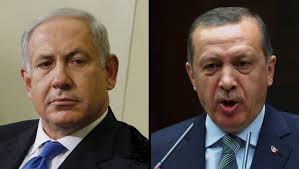
The Turkish leader has also led his country into repeated confrontations with Israel due to his adamant support for the terrorist group Hamas, a group sworn to the destruction of Israel:

erodgan netanyahu

The strong rightward shift has not changed the relationship between Erdogan and Obama.

obama erdogan

  • Obama considered Erdogan in his top five friends among international heads of state (January 2012)
  • Obama used his relationship to coerce an apology from Netanyahu to Erdogan for the assailants killed on the flotilla (March 2013)
  • US continued to contort itself to make Turkey happy as the US tried to help Kurdish fighters against ISIS, while Turkey did almost nothing in the fight, as it despised the Kurds (October 2014)

As described above, the Netanyahu apology to Erdogan did nothing to repair relations between Israel and Turkey and nothing slowed Erdogan’s crackdown on freedom in Turkey.  The Obama administration twisted itself every-which-way to excuse terrible Turkish policies (whether its treatment of the Kurds, failure to support war on ISIS, suppression of freedoms at home…) while it picks on Israel for matters of protocol.

To listen to liberal media and democrats these days, you would think that it was Israel that was acting “churlish” for matters of protocol as opposed to specific attacks on Israel.

Here is the satirical music video by First.One.Through about the sad state of the world, where victims must apologize to the aggressors (music by Joe Cocker):


Related First.One.Through articles:

NY Times support of Erdogan over Netanyahu: https://firstonethrough.wordpress.com/2014/08/11/new-york-times-talking-turkey/


Mad World of Palestinian Quality of Life Statistics

The United Nations had another productive year in 2014, condemning Israel 20 times compared to the rest of the world 4 times in total. This was on the heels of 2013 when it condemned Israel 21 times and the rest of the world only four times in total.

One would imagine that the quality of life of Arabs in Gaza and the West Bank was the worst on the planet by a far margin. Not only does the UN censure Israel multiples of the rest of the world, but it has put into place permanent structures to protect the Palestinians:

  • The only people to get a designated committee in the General Assembly, Committee on the Exercise of the Inalienable Rights of the Palestinian People
  • The only people with a special Ad Hoc committee, Ad Hoc Committee of the General Assembly for the Announcement of Voluntary Contributions to the United Nations Relief and Works Agency for Palestine Refugees in the Near East.
  • The only people with a designated Special Committee, Special Committee to Investigate Israeli Practices Affecting the Human Rights of the Palestinian People and Other Arabs of the Occupied Territories.

These unique committees and agencies further managed to create new definitions to advance the Palestinian cause such as a redefinition of “refugee” only for Arabs pre-1948, to mean people who left a land instead of a country.  They compound the absurdity by enabling these “refugees” and their children, grandchildren and additional generations to obtain benefits courtesy of the world.

With all of the unique concerns of the world for the Arabs from the West Bank and Gaza, it is amazing how well these Arabs are doing compared to the other countries in the world by various measures. Here are some rankings and statistics from the CIA World Fact book comparing 229 countries and territories:

  • Population Growth rate: Gaza (#13) and the West Bank (52) have among the highest population growth rates in the world. Compare them to Jordan (#4), Yemen (20), Turkey (108) and Tunisia (126)
  • Birth rate: Gaza (#35) and West Bank (67) are much higher than many Arab and Muslim countries: Yemen (#39), Jordan (53), Tunisia (112) and Turkey (114)
  • Death rate: Palestinians have the lowest death rates in the world Gaza (#220) and West Bank (#215). Jordan ranks 212, Tunisia 167, Turkey 162 and Yemen 153.
  • Net Migration: Compared to the world and the volatile Middle East, West Bank (#84) and Gaza (#108) are fairly stable, compared to Jordan (5), Yemen (37), Turkey (71) and Tunisia (161).
  • Life expectancy at birth: West Bank (#91) and Gaza (#109) have higher life expectancies than Jordan (#117), Turkey (124) and Yemen (175) and about the same as Tunisia (92).
  • Infant Mortality: Palestinian Arabs have much lower infant mortality rates with Gaza (#105) and West Bank (#117) much lower than Yemen (38), Tunisia (78), Turkey (84) and Jordan (104).
  • Unemployment: the Arabs in West Bank (#169) and Gaza (170) have high unemployment for people aged 15-24, as it has one of the highest percentages of its population under 20 years old, like Yemen. Turkey ranks #101, Jordan 133, Tunisia 151 and Yemen ranks 188.
  • Literacy rate: Gaza (96.4%) and the West Bank (95.6%) compare very favorably to other countries including Jordan (93.4%), Tunisia (88.3%) and Yemen (63.9%), while lower than Turkey (98.8%).

How do the 100+ countries who fair much worse than Gaza and West Bank feel about the unique attention that the Palestinians get? Countries like Tunisia and Yemen probably don’t mind, if the attention comes at the expense of Israel.


The First One Through political music video with music by Tears for Fears:

https://www.youtube.com/watch?v=I943cOvrvm4


Sources:

CIA Fact Book: https://www.cia.gov/library/publications/the-world-factbook/rankorder/2002rank.html

Literacy rates: http://en.wikipedia.org/wiki/List_of_countries_by_literacy_rate

UN condemns Israel 20 times in 2014: http://blog.unwatch.org/index.php/2014/12/17/2014-at-the-un-20-resolutions-against-israel-3-on-rest-of-the-world/

United Nations committees: http://www.un.org/en/ga/about/subsidiary/committees.shtml

The New York Times Picture of the Year, 2014

15yearold

The year 2014 was notable for the global escalation in terror and death compared to prior years.

  • Islamic State/ ISIS created killing fields in Iraq, executing and beheading hundreds of people which it recorded and aired on the Internet. The group massacred and destroyed entire villages that existed for centuries.
  • Boko Haram in Nigeria killed hundreds of Christians and abducted hundreds of girls.
  • The ongoing war in Syria had a death toll approaching 200,000 people including over 10,000 children.
  • Israel responded to attacks from Gaza for the third time in eight years as Hamas continued rocket fire into Israeli towns. An advanced Hamas terror tunnel network extending into Israel forced a ground invasion into Gaza which claimed over 2000 lives.
  • Russia invaded and annexed Crimea, as Ukraine turned to the world for support but received virtually nothing.
  • Wars in Sudan, Yemen, Afghanistan and other countries continued to claim thousands of lives.

The year also included near break-out race riots in the United States as several unarmed black men were killed by white police officers. In Africa, the deadly disease Ebola killed thousands.

Various news agencies highlighted the most significant news events which ranged from Ebola to Russia’s invasion of Ukraine. They selected new events that impacted thousands of people in 2014 which had potentially long-term consequences.

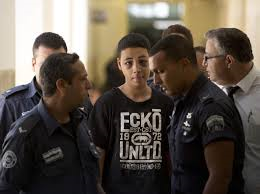
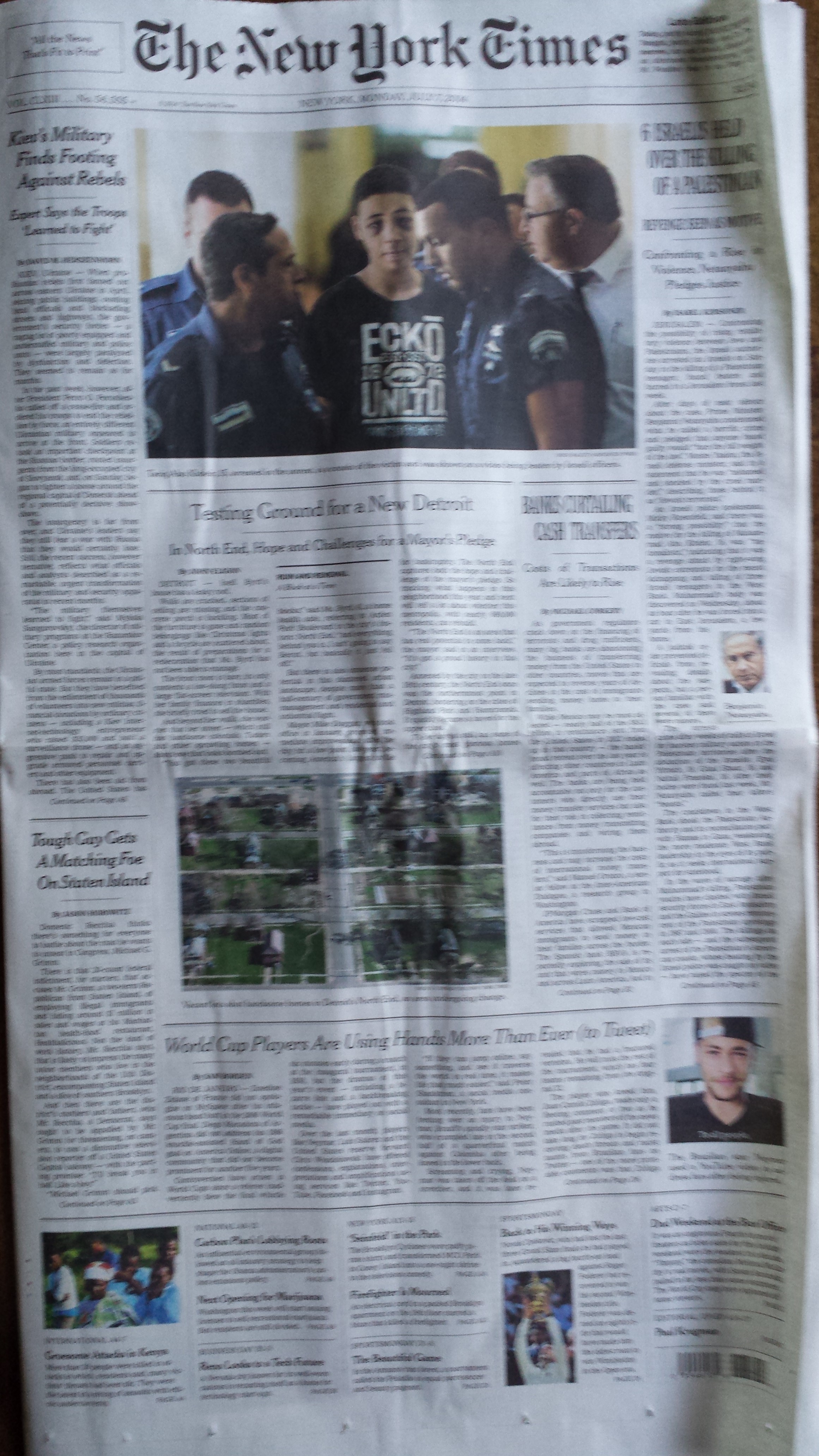
The New York Times year-end review posted dozens of pictures of conflicts around the world to encapsulate 2014.  In my opinion, the NYT picture that  summed up a dominant theme in its reporting for 2014 was the picture above, of a 15-year old Arab surrounded by Israeli policemen. For the New York Times, the stories on its cover pages in 2014 repeatedly told the story: that Israel attacks Arab youths.

The large color picture was displayed on its cover page on July 7, 2014. The bruised 15-year old Arab boy was being escorted out of a police station where he had been detained after throwing stones in a riot. There are several things that make the front-page treatment of the teenager note-worthy:

  • On that same day, over 100 people were killed in attacks in Kenya, Uganda and Yemen. Small stories appeared on the inside pages of the Times to discuss the scores murdered.
  • When Boko Haram killed hundreds, it also did not make the front page.
  • ISIS beheadings of journalists did not make the front page.

The beating of an Arab youth by Israeli forces was given more prominence and therefore deemed more important than those other world events.

This New York Times news story came shortly after three Israeli teenagers were abducted and murdered by Palestinians. The New York Times never placed even a small black-and-white photo of any of the three Jewish teenagers on the front page. Their plight was also not viewed as important by the Times.

Over the course of the next several weeks as Operation Protective Edge unfolded, the New York Times continued to put pictures of Palestinian children on the front page of the paper. Throughout July (July 11, 14, 17, 21, 22, 24 and 29th) the paper had pictures of Palestinians suffering on the front page. It took until July 29 – buried on page A6 – for the Times to write about and post a single picture of the Hamas terror tunnel network that was a main factor in launching the Israeli ground invasion of Gaza.

Further, Palestinian leadership, whether Hamas leaders such as Khaled Mashal or acting Palestinian Authority president Mahmoud Abbas, never were pictured on the pages of the Times during Operation Protective Edge (the only leader to be pictured was Ismail Haniya on September 4 page A10, well after the fighting had stopped). The paper only showed pictures of Arab civilians. However, Israeli Prime Minister Benjamin Netanyahu’s picture was shown often (July 7 twice; July 22; July 27; July 29; August 7), as were Israeli police and soldiers. The overall message of the New York Times was clear: the Israeli government was attacking Palestinian youths and civilians; it was not a war between opposing government authorities.

The Times news stories and editorials built additional narratives onto this theme, regardless of inaccuracies. In attempts to make the Israeli government seem callous to the conditions of Arab youth, an article and editorial on July 7 and July 8 stated that “days of near silence” passed before Israel Prime Minister spoke about the killing of an Arab teenager by Israeli radicals. This was completely untrue and it took days for the NYTimes to print a correction (below).

The NYT editorial board led with a piece on July 19 entitled “Israel’s War in Gaza”.  It was not called “Hamas’ War against Israel”, nor was it called the “War Between Hamas and Israel”.  The Times continued to paint the battle as an aggressive Israeli action against a populace.

In case there was any confusion in the New York Times message to its readership, it included another small picture of Netanyahu near its large picture of the year. (By way of comparison, did you ever see the NYT post a picture of US President Obama near an article about drone strikes or deaths in Afghanistan that he specifically ordered and oversaw?)


The New York Times tried to defend its coverage of the Gaza conflict by printing an editorial on November 23, 2014 entitled “The Conflict and the Coverage”.  Not surprisingly, it attempted to defend its poor media coverage and that it tried too hard to offer “symmetry” in the conflict. It claimed that the paper has “baseline beliefs that Israel has a right to exist and that the Palestinians deserve a state of their own.” The charitable Times board believing that “Israel has a right to exist,” clearly doesn’t extend to: believing that Israel has a right to defend itself; that it was reluctantly pulled into a battle in Gaza; that it sought to minimize Arab casualties; that Hamas is rabidly anti-Semitic; that Hamas leaders are intent on destroying Israel and killing Jews; and that Arab leadership was responsible for the war and deaths of both Israelis and Palestinians.


Sources:

http://www.huffingtonpost.com/2014/07/07/jodi-rudoren-new-york-times-_n_5564067.html

Times moved picture down in online of story: http://www.nytimes.com/2014/07/07/world/middleeast/israel-palestinians-muhammad-abu-khdeir.html

Every Picture Tells a story: https://firstonethrough.wordpress.com/2014/07/04/every-picture-tells-a-story-dont-it/

Bibi as a killing monster: https://firstonethrough.wordpress.com/2014/07/08/every-picture-tells-a-story-part-ii/

The NYT buried pictures: https://firstonethrough.wordpress.com/2014/07/29/the-new-york-times-buried-pictures/


NY Times Correction: July 9, 2014

An article on Monday about the arrest of six Israelis in the killing of a Palestinian teenager referred incorrectly to Prime Minister Benjamin Netanyahu’s response to the killing of Muhammad Abu Khdeir. On the day of the killing, Mr. Netanyahu’s office issued a statement saying he had told his minister for internal security to quickly investigate the crime; it is not the case that “days of near silence” passed before he spoke about it. The error was repeated in an editorial on Tuesday.”