Republicans Do Not Believe There is Any “Occupation”

The terminology used by the United Nations that Israel is “illegally occupying Palestinian Land” has angered Israelis for a long time. The Israelis do not believe that the land is “Palestinian,” that they are “occupying it” or that living in and controlling such land is “illegal.”

The Trump Administration agrees with this approach.

The 2016 Republican platform discussed Israel in several sections, including the B.D.S. (boycott, divestment and sanctions) movement which it labeled antisemitic, in prioritizing the security needs of allies like Israel over foes, and in moving the U.S. embassy to Israel’s capital city, Jerusalem. It also clearly mentioned Israel’s control over disputed land:

“We reject the false notion that Israel is an occupier”

The logic behind such attitude has been voiced by Israel and Israeli advocates for a long time, although it gets no air in the left-wing media. In short:

  • International law in 1920 and 1922 specifically called for Jews to reestablish their homeland throughout Palestine, covering all of the land between the Mediterranean Sea and the Jordan River;
  • The “Green Line” or “1967 border,” is no border at all, but simply the armistice lines of 1949 which were deliberately and specifically not called borders but temporary lines too be negotiated for final settlement;
  • Jordan illegally evicted all the Jews from the area between the Green Line and the Jordan River (an area which later became known as the “West Bank”) and annexed the land in a move which was not recognized by almost the entire world;
  • Jordan broke the Jordanian-Israeli Armistice Agreement by attacking Israel in June 1967;
  • Israel took the “West Bank” in a defensive war, which makes the situation completely distinct from laws regarding taking land in an offensive war, especially when such land was not part of a sovereign nation, and was designated to be part of the acquiring country in any event

In summary, Israel took the “West Bank” back from a country which had illegally evicted all Jews, illegally annexed the land and illegally attacked it (the “Three Illegal Actions”).

Meanwhile, the Obama Administration sided with the United Nations, a group dominated by over 50 Arab and Muslim countries, the majority of which do not recognize Israel in any form. The United States, as part of the “Middle East Quartet,” co-signed a joint statement in September 2016, the final declaration before the Trump Administration took over which included the following:

“The Quartet reiterated its call on the parties to implement the recommendations of the Quartet Report of 1 July 2016, and create the conditions for the resumption of meaningful negotiations that will end the occupation that began in 1967 and resolve all final status issues.”

“The Quartet stressed the growing urgency of taking affirmative steps to reverse these trends in order to prevent entrenching a one-state reality of perpetual occupation and conflict that is incompatible with realizing the national aspirations of both peoples.”

The Obama Administration followed this up in December 2016 when it allowed UN Security Council Resolution 2334 to pass which stated:

“the establishment by Israel of settlements in the Palestinian territory occupied since 1967, including East Jerusalem, has no legal validity and constitutes a flagrant violation under international law and a major obstacle to the achievement of the two-State solution and a just, lasting and comprehensive peace;”

The Republican and the Democratic Party/UN could not be further apart on this issue.

Since the Trump Administration has taken office, it has followed through on its position on this matter:

  • It has curtailed the announcements made by the Quartet, and none of them refer to an “occupation” of “Palestinian territory” being “illegal”;
  • In June 2019, the U.S. Ambassador to Israel David Friedman said that “Under certain circumstances, I think Israel has the right to retain some, but unlikely all, of the West Bank,“; and
  • U.S. Middle East envoy Jason Greenblatt also stated in June that “We might get there [to peace] if people stop pretending settlements, or what I prefer to call ‘neighborhoods and cities,’ are the reason for the lack of peace.

US Envoy Jason Greenblatt speaks at the Israel Hayom forum in Jerusalem on June 27, 2019. (photo: Gideon Markovitz)


While the two positions seem incompatible, they need not be.

The Republican position is completely logical. Further, how can there really be an enduring peace assuming the Democratic position of blessing an Arab Jew-free state? How can “progressives” support the antisemitic notion that Jews should be banned from living somewhere, let alone, in parts of their homeland?

The Democratic position also has logic. The Palestinian Arabs and the broader Arab world are insistent on Palestinian sovereignty. While sovereignty is NOT an “inalienable right” which the biased United Nations bestowed upon the Palestinians uniquely (only self-determination is an inalienable right of all people), it might not be a bad solution to the current impasse. Should the Palestinian Arabs obtain sovereignty, they will require defined borders. However, such new state of Palestine need not – and should not – be based on the antisemitic notion that Jews cannot live there.

The blend of the positions might be that Palestinians obtain sovereignty over a portion of the land, say in Gaza and land east of the security barrier which Israel built to stem the waves of Palestinian terrorists. It is consistent with both the Democrats and Republicans stated positions of caring about Israel’s security, while acknowledging the substance of the Republican position that the “1967 borders” are arbitrary and not borders, and the Democratic position that a two-state solution is the best path towards a peaceful settlement.

The Trump administration has not yet revealed the political portion of its Middle East plan and may not do so until after the Israeli elections scheduled for September 17. It might call for a new independent Palestinian State on the lines above, or it might suggest some sort of confederation with Jordan, which poses its own issues for Jordan’s King Abdullah.

Either way, the Republicans have clearly broken with the notion endorsed by the Unsavory UN and the Democratic Party that Israel illegally occupies Palestinian Land, and will advance a peace proposal on such basis.


Related First.One.Through articles:

Obama’s “Palestinian Land”

Nicholas Kristof’s “Arab Land”

Marking November 29 as The International Day of Solidarity with Jews Living East of the Green Line

The Israeli Peace Process versus the Palestinian Divorce Proceedings

“Settlements” Crossing the Line

Anti-“Settlements” is Anti-Semitism

Names and Narrative: It is Called ‘Area C’

The New York Times Major anti-Netanyahu Propaganda Piece

Subscribe YouTube channel: FirstOneThrough

Join Facebook group: FirstOne Through Israel Analysis and FirstOneThrough


Go back

Your message has been sent

Warning
Warning
Warning

Warning.

The United States Should NOT be a Neutral Mediator in the Arab-Israel Conflict

A “Quartet” of official bodies was set up in 2002 to help facilitate peace between Israel and the Arab world. The four entities include the United States, the United Nations, the European Union and Russia. The principal parties of the Quartet (the U.N. Secretary General, the U.S. Secretary of State, the Russian Foreign Minister and the High Representative of E.U. Foreign Affairs) meet regularly to assess the latest developments in the region.

Roughly 17 years later, there has been little advancement towards a broader peace agreement.

Lately, the acting-President of the Palestinian Authority Mahmoud Abbas (whose term expired a decade ago) said that the United States was too biased in Israel’s favor to be considered a mediator in the conflict sayingby recognising Jerusalem as the capital of Israel the US government has proved that it is not neutral, which led us to reject its peace plan.” Other complaints include America cutting aid to the Palestinian Authority and U.N. agencies which provide assistance to Palestinians (Abbas did not mention that the aid was cut because he helps fund terrorism).

However, the United States is just one member of the Quartet. Why shouldn’t it have its own bilateral relationship with Israel and approach toward the peace process?

Consider that the United Nations is extremely biased in favor of the Palestinians, essentially adopting them as a child decades ago. It has set up separate agencies just for the Palestinians, condemned Israel more than any country in the world, created new forms of “inalienable rights” uniquely for Palestinian Arabs, and generally has taken actions that make clear it regrets its role in helping establish Israel. The global body has over 50 Arab and Muslim countries, of which the majority do not even recognize the existence of the Jewish State. It is unlikely to ever side with the Jewish State in negotiations with a Muslim state.

The European Union has also been a biased actor in favor of the Palestinians. Several of its members have recognized the State of Palestine, and have promoted boycotts of Israeli goods and services. The proposed incoming High Representative of E.U. Foreign Affairs, Josep Borrell Fontelles is a major critic of Israel.

Russia is an ally of several countries at war with Israel including Syria and Iran, which has threatened to destroy Israel. Russia has stated that it will propose an alternative peace plan than the one due to be proposed by the U.S.A.


Russian President Vladimir Putin (left) greets Palestinian Authority President Mahmoud Abbas at the Bocharov Ruchei residence in the Black Sea resort of Sochi, Russia,
May 11, 2017. (Alexei Druzhinin/Sputnik, Kremlin Pool Photo via AP)

With three of the four members of the Quartet biased in favor of the Arabs, it would be a travesty of justice for there to be no party biased in favor of Israel. It is as though the court only has a prosecution with no defense, and the judge is the brother of the prosecutor.

In truth, not only should the United States be highly biased in favor of its strong ally, Israel, there should be at least one other member of the Quartet to be pro-Israel to have a balanced approach. As the United Nations is hopelessly biased against Israel, it should be removed from the Quartet and replaced with another country of Israel’s choice – perhaps Australia, Canada or even India.

Should the United States become the sole mediator of the Arab-Israeli conflict, then it would be worth a discussion of America playing a more neutral role. However, as long as there are four parties playing that role, the U.S. should forcefully advance the cause of Israel, and the U.N. should be replaced in the Quartet by another pro-Israel party to properly balance the discussions.


Related First.One.Through articles:

The Legal Israeli Settlements

Both Israel and Jerusalem are Beyond Recognition for Muslim Nations

Time to Define Banning Jews From Living Somewhere as Antisemitic

Jerusalem’s Old City Is a Religious War for Muslim Arabs

Ending Apartheid in Jerusalem

The Custodianship of a Child and Jerusalem

Arabs in Jerusalem

The Arguments over Jerusalem

Subscribe YouTube channel: FirstOneThrough

Join Facebook group: FirstOne Through Israel Analysis and FirstOneThrough

Should the ZOA Sponsor a “Birthright” Trip

Birthright Israel has been a phenomenal success in achieving its goal of ensuring “the vibrant future of the Jewish people by strengthening Jewish identity, Jewish communities, and connection with Israel.” The group, founded in 1999 with the financial support of Charles Bronfman and Michael Steinhardt, has brought over 650,000 Jews from 67 countries to better understand their common tie to the Jewish holy land.

However, the left-wing group J Street felt that the free trips gave the 18 to 26 year olds too many highlights and not enough lowlights.

At first, J Street demanded that the trips include discussions regarding Israel’s relationship with Palestinian Arabs. After being rebuffed that it was not the mission of Birthright, J Street launched its own trip called “The Let Our People Know Trip.” The itinerary includes a focus on “Israel’s minority communities,” “pluralism,” an afternoon in “East Jerusalem,” a full day called “The Israeli-Palestinian Conflict and the Occupation 101,” and another day called “Israel and Palestinian Perspectives Over the Green Line.” The trip is designed to split the Jewish holy land into areas that are Israeli and those that are occupied.

J Street map of Israel excluding Israeli territories in Judea and Samaria

I imagine that the right-wing Zionist Organization of America might pull together its own Birthright trip to further educate people about the nature of the conflict, which might have a different orientation than J Street. Here’s a possible itinerary:

Day 1: Terrorism in the 1970’s

  • Land in Ben Gurion Airport.
  • Get a briefing on the various security measures that Israel must deploy because of the threats of hijackings and bombings. Include a speaker who freed over 200 Jews who were hijacked by members of the Popular Front for the Liberation of Palestine in 1976, and review the various hijackings perpetrated by Palestinian terrorists over the years.
  • Drive up road towards Netanya and stop at the location of the Coastal Road Massacre of 1978, in which 38 Israeli civilians, including 13 children, were killed under direction of the dominant Palestinian party, Fatah. Learn about Dalal Mughrabi, a woman who planned and fought in the terrorist attack who is celebrated by Palestinians to this day with schools and public squares named after her.
  • Night in Netanya

Day 2: The British Mandate and the Separation Barrier as Peace-Builder

  • Visit the Park Hotel in Netanya where a Palestinian suicide bomber killed over 30 people having a Passover seder in 2002. Hear from soldiers who fought to eliminate the terrorists in Jenin after the massacre, who went door-to-door on foot to minimize civilian casualties. Read reports from CNN who falsely charged the Israeli Defense Force (IDF) with killing hundreds of civilians.
  • Visit a section of the separation barrier which was built as a result of the Second Intifada to curtail the infiltration of Palestinian Arab terrorists. Review the statistics of the bombings and killings in Israel from Arabs coming from the east of the barrier before and after the barrier was erected and discuss Israel’s security needs.
  • Visit the Arab city of Umm al-Fahm, which some Israeli politicians want to swap to a future state of Palestine due to their glorification of terrorists.
  • Tour Atlit, a displaced persons camp used by the British to lock up Jewish immigrants to the holy land in the 1930’s and 1940’s who were trying to escape or had just escaped the Holocaust in Europe. Sit near the barbed wire fence and hear from a historian how the British ignored international law established in 1920 (San Remo Conference) and 1922 (British Mandate) to facilitate the immigration of Jews to reestablish their homeland, and instead instituted the White Paper of 1939 at the urging of Palestinian Arabs which limited Jewish immigration over five years to just 75,000 people, resulting in the deaths of over 100,000 Jews in the Holocaust.
  • Drive to the combined Jewish-Arab towns of Ma’alot-Tarshiha where Israel has tried to promote coexistence. Visit the Netiv Meir Elementary School where members of the Democratic Front for the Liberation of Palestine took over a school in 1974, taking over 100 hostages, almost all children. A total of 25 hostages were killed, including 22 children.
  • Sleep in Ma’alot-Tarshiha

Day 3: The Golan Heights and Syria

  • Drive to the Golan Heights and visit Mount Hermon. Look out on Damascus, Syria and hear from army experts how the Syrians had used the Golan to shell Israeli farmers in the Galilee before being evicted from the heights in 1967.
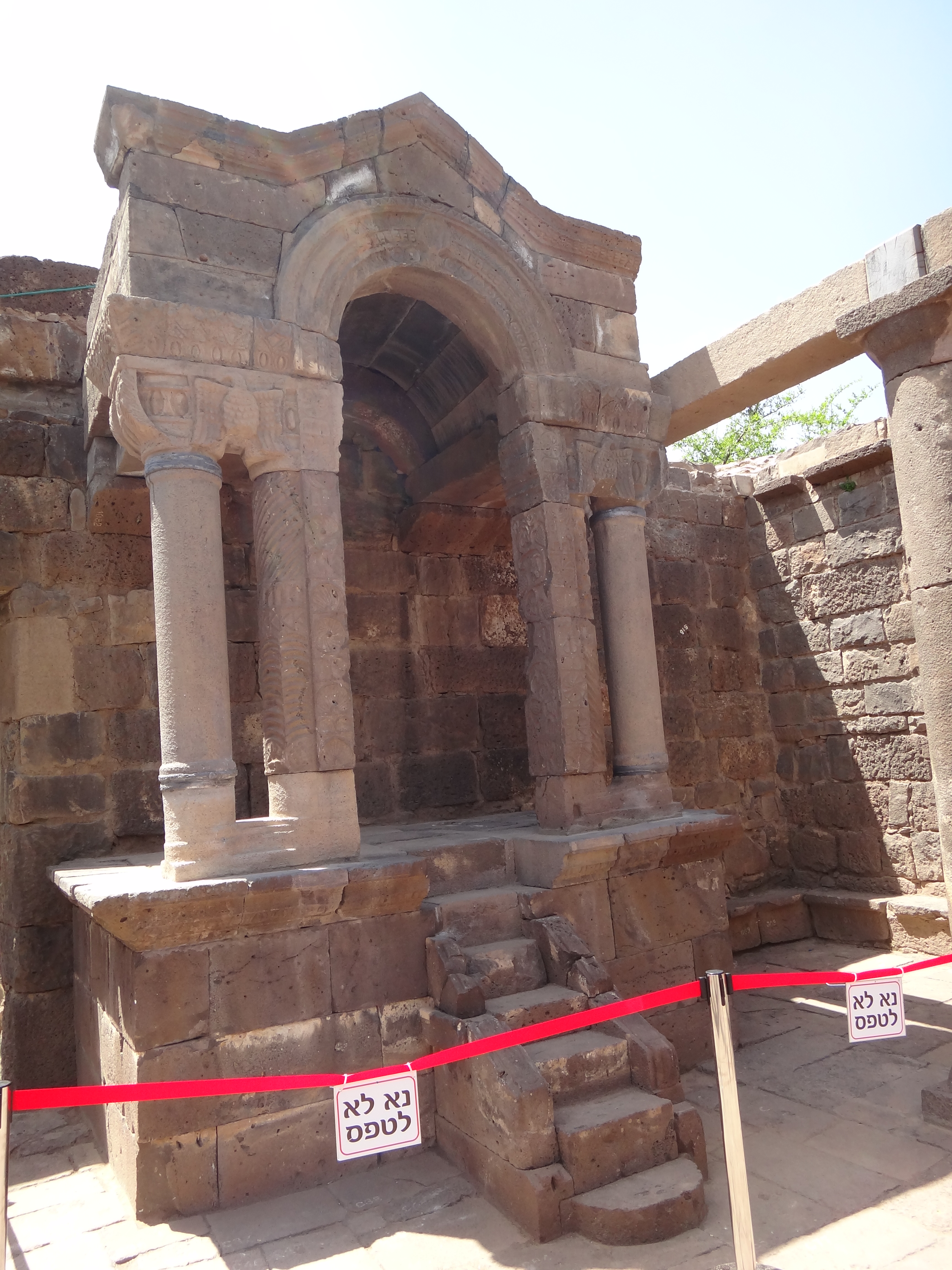
  • Visit various ancient synagogues which dot the Golan Heights, attesting to the historic Jewish presence in the region, and stop by Ramat Trump, a new town named after U.S. President Donald Trump.
  • Afternoon in Safed where doctors detail caring for Syrians fleeing the civil war which has killed over 500,000 people.
  • Visit the town of Capernaum, where Jesus is said to have lived, and tour a lovely intact fourth century synagogue.
  • Night in Tiberias

Ancient synagogue in the Golan
(photo: FirstOneThrough)
Day 4: Jews and Christians in the Galilee

  • Tour the various tombs of famous Jewish rabbis including Maimonides (1135-1204) and Yohanan Ben Zakkai (c. 10CE – 90CE) and learn about their persecutions and journeys to the Galilee.
  • Visit Tzippori, a Jewish city established in the first century BCE which became the center for the Sanhedrin (Jewish courts) after the destruction of the Second Jewish Temple. It was from this location that the Christian Crusaders rode out to defeat in 1187 to the Muslim sultan Saladin.
  • Visit Nazareth, the place where Jesus lived which was mostly a Christian town for many years, and now has a Muslim Arab majority.
  • Night in Tel Aviv

Day 5: Terrorism from the Oslo Accords to the Second Intifada

  • Visit the bus station where the Palestinian group Islamic Jihad detonated a bomb in 2006 which killed eleven people, and launched twin bombings in 2003 killing 23 civilians and injuring over 100.
  • Visit the popular Allenby Street where a suicide bomber from Hamas blew up a bus in 2002, killing six and injuring 70.
  • Visit the popular Dizengoff Center, where a suicide bomber blew himself up on the eve of the festive Purim holiday in 1996, killing 13 and injuring 130. Hear from experts about the wave of killings after Israel and the Palestinian Authority signed the Oslo Peace Accords in 1995.
  • Dinner near the beach, and then a visit to the shell of the Dolphinarium discotheque, where Palestinian terrorist killed 21 Israelis, 16 of them teenage girls out dancing in 2001.
  • Night in Tel Aviv

Day 6: Addressing Terrorists: Palestinians and Americans

  • Visit the site of the “Seafood Market attack” of 2002 in which two civilians and a police officer were killed in an attack by the terrorist group Tanzim. Hear from a leading expert on terrorism about the head of Tanzim, Marwan Barghouti, who led that attack as well as several others which killed a number of civilians, who is currently serving five life sentences in an Israeli prison. Learn how Barghouti is one of the most famous Palestinians today who calls for a third “intifada” and how Palestinians want him to become the next president of the Palestinian Authority (PA). Discuss how, despite his murderous past and calls for additional terrorism against civilians, the New York Times thinks Barghouti could be a Noble Peace Prize winner.
  • Visit the Tel Aviv promenade where an expert in the funding of terrorism will relay the story of Taylor Force, an American visiting Israel who was stabbed to death by a Palestinian terrorist. The U.S. Congress passed a law in his name (H.R. 1164) which de-funds the PA unless it can show that it no longer finances terror.
  • Stop by a Christian monastery near Beit Shemesh and hear the story of Neta Sorek, an Israeli feminist who worked to bring peace with Palestinian Arabs, who was murdered for being Jewish by Palestinian terrorists while she walked in the gardens.
  • Afternoon tour of Yad Vashem in Jerusalem
  • Night in Jerusalem

Day 7: Terrorism throughout Jerusalem

  • Morning tour of Shaare Zedek Hospital where Jewish and Arab doctors and patients work and are treated side-by-side. Hear the story of Dr. David Appelbaum who ran the emergency room which treats dozens of terrorist victims, and how he and his daughter were killed in a Palestinian terrorist bombing while eating at a restaurant the night before her wedding. Dr. Appelbaum had just arrived from New York the day before where he was training first responders in how to deal with mass emergencies.
  • Go to downtown Jerusalem to the former location of a Sbarro restaurant where Hamas and Islamic Jihad Movement in Palestine executed a bombing in a pizza store, killing 15 people including 7 children and a pregnant woman.
  • Drive over to Hebrew University in the eastern part of the city and learn about the school which was founded in 1925 and included Albert Einstein among its founders. Hear from a school historian about how buses with professors were often shot at in the 1940’s and how Hamas blew up the cafeteria in 2002, killing 9 people including five Americans.
  • Head back to the western side of the city to a small synagogue in the Har Nof neighborhood where two Palestinian men walked into prayer services with axes and slaughtered worshipers in 2014.
  • Night in Jerusalem

Day 8: Jerusalem, America and Democracy

  • Tour the Israel Museum and the Shrine of the Book to see the Dead Sea Scrolls and learn how Judaism was practiced 2,000 years ago and about early Christianity.
  • Visit the Israeli Knesset, the parliament, to see how a democracy functions in the turbulent Middle East. Uniquely in the region, it has Jews, Muslims, Christians and Druze all serving in the parliament.
  • Tour the modern Supreme Court building and get a briefing about the most liberal country for thousands of miles in any direction.
  • Stop by Yad Kennedy, a large monument in the Jerusalem forest dedicated to the memory of U.S. President John F. Kennedy.
  • Visit the only 9/11 memorial in the Middle East which includes the names of every person killed in the terrorist attacks in America of 2001.
  • Dinner at the new American embassy in Jerusalem, which President Donald Trump moved to Israel’s capital in 2018.
  • Night in Jerusalem

Day 9: 3,000 Years of Jewish Jerusalem

  • Visit the Old City of Jerusalem, including the Western Wall (the Kotel) and the Jewish Temple Mount. Witness that only Jewish visitors need armed guards to visit their holiest site, and experience the Mourabitat women who harass Jewish pilgrims.
  • Visit the Davidson Center and the City of David which detail the 3,000-year history of Jews in their holiest site. Tour the recently uncovered “Pilgrimage Road.” Read quotes from the leaders of the Palestinian Authority which claim that Jews have no history in Jerusalem and from the United Nations which declares that Israel has no rights to the site.
  • Pray at the Hurva Synagogue, rebuilt in 2010 after the Jordanians destroyed it in 1949 right before they evicted all of the Jews from the Old City and the eastern portion of Jerusalem. Read Jordan’s 1954 Nationality Law which specifically excludes Jews from obtaining citizenship.
  • Visit the Tiferet Yisrael development site, another synagogue destroyed by the Arabs which is now being rebuilt despite loud Palestinian protest.
  • Exit the Old City and climb the tower of the YMCA to get a 360-degree view of Jerusalem. Review the expansion of the city westward towards Jaffa in the 1860’s and the demographics which have seen Jews as the majority in Jerusalem since 1869.
  • Take a bus to Bethlehem and visit The Tomb of Rachel, now under heavy guard.
  • Dinner with a political expert to review the various debates about Jerusalem.
  • Night in Jerusalem

YMCA tower in Jerusalem
(photo: FirstOneThrough)
Day 10: The Ongoing War Today

  • Get early start and head to Hevron. Read the biblical chapters of Abraham buying the cave to bury his wife, Sarah, the Jewish matriarch. Climb the steps of the Cave of the Jewish Patriarchs up to the seventh step and learn the history of the site, from the time King Herod built the current structure (minus the minarets) over the cave, to how the Arabs took over the site when they invaded in the seventh and eighth century when they brought Islam throughout the Middle East and North Africa region turning sites holy to one religion into mosques and forbidding Jews from climbing above the seventh stair of their second holiest location. Review current history of Arabs slaughtering the Jewish community in 1929 and Britain’s forced expulsion of the remaining Jewish residents of the city, and how Israel reclaimed the area in a defensive war in 1967, allowing Jews to return to the city and pray at the Cave of the Jewish Patriarchs once again. Hear how most recently, Israel handed over almost the entirety of the city to the PA except for a small sliver, as part of the Oslo Accords, and how the remaining Jews in the city must live in an armed protective zone to prevent a recurrence of the 1929 massacre.
  • Drive to Sderot on the border of Gaza. Learn about the Hamas Charter, the most antisemitic document of any ruling governmental party ever written, and how the Palestinians elected Hamas to the majority of the Palestinian parliament in 2006 with full knowledge and support of its mission statement; and how Hamas took over Gaza in 2007 precipitating the Israeli blockade in 2008, which the United Nations Palmer Report of 2011 deemed as legal and necessary. Tour the bomb shelters where Israelis only have ten seconds to hide from missiles launched by Hamas and the Palestinian Islamic Jihad and hear about the wars launched from Gaza in 2008, 2012 and 2014.
  • Visit the burnt fields set afire from incendiary balloons launched by Palestinian youths over the past year.
  • Visit a Patriot Missile battery, a United States defense system, as well as Israel’s Iron Dome system whose R&D was partially funded by the U.S. Hear about how each technology works and how the United States is now purchasing the Iron Dome system for its own defenses.
  • Drive up to the Israeli city of Ashdod and visit the site where an Israeli-American was killed in 2019 by a Gazan missile.
  • Dinner in Tel Aviv before flight home.

The ZOA should probably call their trip “Let Our People UNDERSTAND.”


Related First.One.Through articles:

The Shrapnel of Intent

Israel: Security in a Small Country

The Free Speech Nickel

What do you Recognize in the Palestinians?

The Cave of the Jewish Matriarch and Arab Cultural Appropriation

Subscribe YouTube channel: FirstOneThrough

Join Facebook group: FirstOne Through Israel Analysis and FirstOneThrough

The Remarkable Tel Jerusalem

Archaeologists spend their time excavating and examining sites where humans lived in an effort to better understand the nature of societies from long ago. They let the physical evidence provide clues as to how people lived, what they ate and how they existed as a community.

Some of the best places to explore ancient history are found in tels, hills where one society was built upon the ruins of an earlier society. Such ruins are common in the Middle East, where there has been continuous human presence in many of the same locations for 4-5,000 years.

The issue confronting archaeologists excavating any tel is that one layer of history must be removed to be able to explore the next layer of the human past. Removing the ruins of a floor of a 13th century mosque may reveal a 5th century church, while clearing the 5th century level may reveal a municipal building from the first century BCE. History must be destroyed to find yet more ancient history. Peeling back time yields discovery via destruction.

In the holy city of Jerusalem, the challenges for archaeologists and historians becomes further ensnared in religious and political battles. Why should the ruins of a 16th century mosque be cleared to reveal an ancient Byzantine church? Why should the church be dismantled to uncover an ancient Jewish ritual bath house? Is one truth more significant than another? Does the exposure of ancient Jewish edifices impact today’s realities and political considerations? Is the destruction of an ancient house of worship in favor of another religion’s house of worship an act of historical exploration or a crusade?

The city of Jerusalem became central to the Jewish people 3,000 years ago, when King David sacked the then-Jebusite city and made it the official capital of the Jewish people in roughly 1000 BCE. His son, King Solomon, built the First Jewish Temple in the city in 950 BCE, making the city both the religious center and the political center of the people. Jews made pilgrimages to sacrifice at the temples during both the First Temple period (950 BCE – 587 BCE) and during the Second Temple period (515 BCE – 70 CE). Since the destruction of the Second Temple, Jews continued to live in and make pilgrimages to the city to pray, but without the ritual sacrifices, as Arab Muslims and Christian Crusaders took turns dominating the landscape.


City of Jerusalem during First Temple Period covered a portion of the current
Temple Mount and an area south of today’s Old City walls

Over the last several years, a team of archaeologists has been excavating an old road used by the Jewish pilgrims of two thousand-plus years ago. The “Pilgrimage Road” was one of a series of pathways that facilitated the flow of hundreds of thousands of Jews into the Jewish Temples. It’s route must have changed during the centuries as the walls of Jerusalem changed, and as archaeologists continue their excavations, undoubtedly, more facts will emerge.


The Pilgrimage Road from the Shiloach Pool to the Temple Mount, used by Jewish worshipers in the late Second Temple period, was excavated over the course of six years and unveiled by the City of David organization on June 30, 2019.
(Source: City of David.)

The road now exists as a tunnel lying beneath a predominantly Arab section of Jerusalem, called Silwan. The area was originally settled in modern times by Yemenite Jews in the 1880’s, who were then expelled when Jordan attacked Israel in 1948 and annexed the area in a measure not recognized by almost every country in the world. Just as in ancient history, the sacking and rebuilding of the city continues to play out.

But today’s Israeli archaeologists managed a new feat: they did not destroy the layers of recent history above the Pilgrim Road; they burrowed a tunnel which left the current residents of Silwan still living in their homes. As opposed to the living history of tels which builds one reality on top of another, and excavations which destroy one history to unveil another, both the ancient Jewish history and modern Arab homes coexist.

Historians celebrated the event as did the State of Israel which plans to develop the road as a tourist attraction as an important part of understanding the history of Judaism’s holiest location. Even foreign dignitaries came to the June 30 opening dedication including U.S. Ambassador to Israel David Friedman, White House Middle East envoy Jason Greenblatt and United States Senator Lindsey Graham (R-SC).

But Palestinian Arabs cried foul. Palestinians like PLO veteran Hanan Ashrawi said that the United States “will go to any length to show collusion, identification with and support for all these illegal acts, for the transformation of the character of Jerusalem.” A ridiculous charge which prompted Greenblatt to reply on Twitter that “we can’t ‘Judaize’ what history/archaeology show. We can acknowledge it; you can stop pretending it isn’t true! Peace can only be built on truth.

Traditionally, archaeologists need to destroy one layer of history to reveal the more ancient, but in Jerusalem today, the Israelis managed to uncover a 2,000-year old road used by pilgrims to ascend to the Jewish Temple Mount, while leaving the homes of modern day Arabs and Jews intact. It is a feat which sustains all truths, and underscores both the deep historic and religious ties of the Jewish people to their holiest city, while also respecting the modern sensitivities and political realities of the diverse modern capital city.


Related First.One.Through articles:

The Jews of Jerusalem In Situ

Gimme that Old-Time Religion

The Cave of the Jewish Matriarch and Arab Cultural Appropriation

Squeezing Zionism

Tolerance at the Temple Mount

The New York Times will Keep on Telling You: Jews are not Native to Israel

Subscribe YouTube channel: FirstOneThrough

Join Facebook group: FirstOne Through Israel Analysis and FirstOneThrough