Failures of the Obama Doctrine and the Obama Rationale

Historians have begun to debate the “Obama Doctrine” and its impact on global stability. The Doctrine itself is not so novel or controversial.  It is the “Obama Rationale,” his underlying worldview, and how he applies the doctrine’s principles, that are causing the destabilization of global security.

Obama Doctrine
President Obama defining his “Obama Doctrine” with Thomas Freidman
April 2015 (photo: New York Times)

The Obama Doctrine
We will engage, but we preserve all our capabilities”

In April 2015, New York Times Op-Ed columnist Thomas Freidman penned a piece called “Iran and the Obama Doctrine.” In a long interview with US President Barack Obama, Freidman came to conclusions about Obama’s approach to foreign affairs. In short:

  • Engagement over Sanctions, Isolation and War. Obama stated a problem ignored is not a problem solved.  However, dialogue opened a possibility to change people’s hearts and minds. Diplomacy should always be the first option, both with allies and foes.
  • A Single Foreign Policy. The Executive Branch of the United States government must be the sole representative of US foreign policy. Senators and congresspeople should not engage with world leaders with messages that contradict those decided by the president.

Liberals and Conservatives may agree or disagree with this formula for engaging the world. Presumably, many would agree with these approaches in general.

Then why the terrible polls for Obama’s foreign policy?

Failed Implementation

There is a significant percentage of Americans who strongly disagree with Obama’s handling of foreign policy. Those reasons may have less to do with the Obama Doctrine itself, but how it is applied.

  • Negotiations with Foes. Engaging with friend or foe should yield results to one’s liking. Many Americans criticized the Obama team in that it did not extract enough concessions from negotiations.
    • Cuba was opened up with nothing to show for it.
    • Syria was given a pass for using chemical weapons even though Obama threatened the country with military force.
    • Iran was left with an enormous nuclear infrastructure, even though sanctions had pushed the country to the brink.
    • Russia actively established itself on the world stage including annexing part of Ukraine, as it knew that Obama would not take military action.
    • Engagement is okay, if it achieved the desired outcome, but Obama showed a pattern of coming away with only modest achievements at great costs. He resorted to touting the engagement itself as the victory, rather than tangible goals.
  • Engagement with Allies. Foreign policy is equally about managing relationships with allies. Yet Obama has shown an inability to keep allies close, work for American interests and make reforms, as necessary.
    • Egyptian President Hosni Mubarak was a longtime ally of the United States, and Obama made a point of visiting Cairo in his first international trip. Yet Obama quickly turned on this one-time ally and blessed his overthrow.
    • Israel has rarely had such a cold treatment form any US administration. The lack of trust has not produced an environment conducive to peace negotiations.
    • Saudi Arabia is an oppressive regime that is nevertheless a US ally. The kingdom has never been so unsure of America’s leadership, nor has it beheaded as many of its own citizens.
    • Turkey’s leader Erdogan has been described by Obama as being one of his closest allies.  Yet Turkey has dragged its feet in allowing the US to use its territory to fight ISIS and prefers using its Turkish troops to bomb Kurds than ISIS.
    • Despite an established agreement with Ukraine, Obama let the country fall to Russia.
  • Terrorism. More than almost any issue since 9/11/2001, has the world been focused on terrorism. Obama has been unsure how to utilize his “Doctrine” when the counter-party is not an official government, but a terrorist organization.
    • Islamic State/ ISIS has been targeted for destruction by Obama in words, but he has engaged in militarily confronting the group only sporadically. Meanwhile, the group continues to expand its attacks in Lebanon, Egypt (against a Russian airliner) and France.
    • Boko Haram; Al-Shabaab, Hamas and other Islamic terrorist groups do not get any engagement from Obama at all. Obama considers them local problems for local governments to handle and does not consider the global aspirations of the affiliates groups.  Never mind that these group like Ansar al-Sharia in Libya have attacked and killed Americans, including Ambassador Stevens.

The Obama Doctrine by itself is not that controversial to many Americans, however, it’s implementation is roundly criticized.  Further, the underlying Obama worldview which governs his approach to engagement is considered a disaster.

The Obama Rationale

President Obama has spent seven years outlining his thoughts as to why people use terrorism. The rationale leads directly to his proposed solutions, so appreciating those views is key to understanding his tactics.

In February 2015, not long after the terrorist attacks in Paris in January 2015, several world leaders met to discuss ways of combatting terror. President Obama addressed the American people and outlined his thoughts about the root causes of terrorism and his associated game plan:

  • Frustration with Injustice and Corruption. Obama stated that “anger that festers when people feel that injustice and corruption leave them with no chance of improving their lives.
  • No Outlet other than Through Violence. He added that the frustration was exacerbated by “[g]overnments that deny human rights play into the hands of extremists who claim that violence is the only way to achieve change
  • Misguided Belief that West is at War with Islam. Obama stated that some clerics and groups have a “twisted interpretation of religion” and that “al Qaeda and ISIL peddling the lie that the United States is at war with Islam

The Obama rationale for terrorism is that there is a very small number of people who have twisted religion and then prey upon people’s “legitimate grievances” (his words).  His approach to addressing this terrorist threat is an extension of his Obama Doctrine.

The Obama Solution to Terrorism

  • Broadcast the Voices of Muslim Moderates. “The world must continue to lift up the voices of Muslim clerics and scholars who teach the true peaceful nature of Islam”  Americans should show “support of their family, friends, teachers and faith leaders.”
  • Export Democracy.  While Obama has shown a reluctance to nation-build, he nevertheless thinks that advancing democracy would help stop terrorism: “Efforts to counter violent extremism will only succeed if citizens can address legitimate grievances through the democratic process and express themselves through strong civil societies.
  • Community Development.  Showing his roots as a community organizer, Obama advocates for local job creation, whereby “economic, educational and entrepreneurial development so people have hope for a life of dignity.” That’s why spokespeople like Marie Hart from the State Department continue to push the notion that a jobs program is the key to stop terrorism.
  • Repeat that the US is NOT at war with Islam. Obama consistently repeats over and again that America is not at war with Islam and that Islam is a religion of peace.  Such efforts, he believes, keep the terrorism from spreading to America’s shores and allies.

These approaches to terrorism are very much like the Obama Doctrine: engage and assist people in reaching democratic aspirations.  The small number of terrorists with hateful ideology would be eliminated (using “all capabilities”), while the masses should be “engaged”.  As Obama said:

Our campaign to prevent people around the world from being radicalized to violence
is ultimately a battle for hearts and minds.”

However, this approach has not slowed the advance of terrorism which continues to kill in France; Egypt; Israel; Lebanon; Nigeria; Kenya and elsewhere.

Critics of Obama say the battle is not “FOR the hearts and minds” but “OF the hearts and minds” of a broad number of Muslims.  They point out the murderous governments throughout the Muslim world, and the gross intolerance of their societies, that are not just offended by what people say or do, but who they are.

Many of these critics believe that the terrible state of global security is solely because of Obama’s worldview.  They argue that there is no administration failure to execute; the team is executing the Obama Doctrine according to the Obama Rationale: Give the various regimes money, jobs, trading, asylum and the like.  Remove American troops from the MENA region, engage economically, and peace will prevail (or if it doesn’t, it will be a local problem).

Obama’s critics dismiss this approach and believe the “clash of civilizations” goes beyond a handful of terrorists.  The world is too flat and integrated to believe such a naïve approach will keep America and its allies safe.


As Americans consider their next president, it will be important to not just consider whether they agree with the Obama Doctrine, but with the Obama worldview. If terrorism continues to occur over the election season, the Obama Rationale will take center stage in the debates.

Subscribe YouTube channel: FirstOneThrough

Join Facebook group: FirstOne Through  Israel Analysis

Actions and Adjectives: Cluster Bombs

Summary: When it comes to reporting on the death of civilians, it is interesting to review how and when some media outlets choose to simply report facts, rather than delve into critical reporting. Here is a comparison of the New York Times discussion of cluster bombs being used by Syria and the Kingdom of Saudi Arabia (KSA). Remarkably, the party that is lambasted the most in the articles is Israel.

 Actions and Adjectives

The “Actions and Adjectives” series discusses the media’s use of language. Oftentimes, the press chooses to be fairly clinical in describing a situation, while at other times, it chooses to direct (or redirect) the conversation in a particular fashion.

For an example, an article can have different ways of describing a car crash:

  1. “Three people died in a car crash,” is purely factual.
  2. “Three people were killed in a car crash when a teenager crashed his car into oncoming traffic,” provides more color about the incident, giving an account of how the crash happened.
  3. “Three innocent people were killed when an irate teenager plowed his car into oncoming traffic after the teen had a big fight with his girlfriend,” takes the article to an entirely different place.

While all of the sentences are factual, the third description does two significant things:

  • It gets the reader to be more engaged- “innocent people were killed” by an “irate teenager,” phraseology gets the reader more excited and angry.
  • Further, the conversation moves the reader away from the victims, towards the driver. The reader is intentionally led towards possible motivation and background which caused the incident. Most likely, a more detailed description of the driver and his relationship would follow in the article. Should the balance of the article focus on teenage relationships, the headline would unlikely be about the car crash; the accident was there solely as a tool to delve into the main focus, which in this example, is the potential danger and ramifications of teenage love.

With that general overview about word choice and focus, consider the New York Times description of the use cluster bombs by Syria and Saudi Arabia.

Cluster Bombs Used by Saudi Arabia

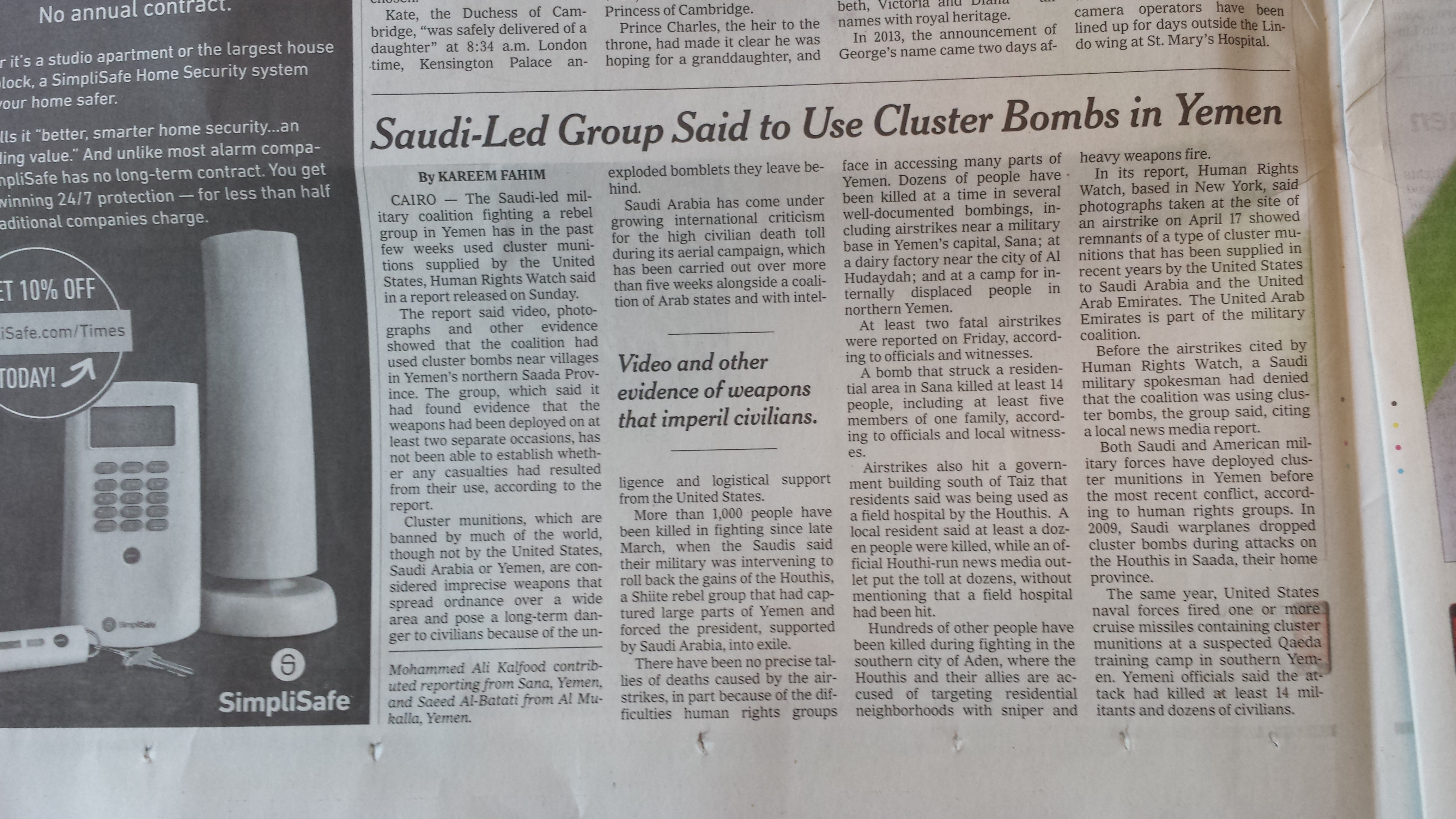
On May 3, 2015, the New York Times published a piece entitled “Saudi-led Group Said to Use Cluster Bombs in Yemen“. The 14 -paragraph article showed up at the bottom of page 10 and discussed a report by the Human Rights Watch (HRW) which concluded that Saudi Arabia used cluster bombs on at least two occasions. No casualty figures were supplied.

Saudi Arabia cluster bombs

The article made clear that “cluster munitions, which are banned by much of the world, though not by the United States, Saudi Arabia or Yemen,… pose a long-term danger to civilians because of the unexploded bomblets they leave behind.” The article included a single condemnation of KSA for its use of the weapons: “Saudi Arabia has come under growing international criticism for the high civilian death toll during its aerial campaign, which has been carried out over more than five weeks alongside a coalition of Arab states and with intelligence and logistical support from the United States. More than 1,000 people have been killed in fighting since late March, when Saudis said their military was intervening to roll back gains by the Houthis, a Shiite rebel group that had captured large parts of Yemen and forced the president, supported by Saudi Arabia, into exile.

These sentences may look unremarkable on their own, but consider what was actually written and the direction of the article as a whole:

  • It was clear that the parties that engaged in the use of the cluster bombs had not signed onto the treaty barring their usage
  • The “unexploded bomblets” were left behind by the cluster bombs, not by the Saudis which were a step removed
  • KSA was portrayed in a negative manner only a single time in the article: “growing international criticism
  • The aerial campaign was described as having wide support from a “coalition” which included “support from the United States”
  • A rationale was given for the KSA military attack- to “roll back” a “rebel group

The article stayed roughly true to the HRW report. This was in very stark comparison to an article in the New York Times published on August 28, 2014 called “Heavy Use of Banned Cluster Bombs Reported in Syria”

Cluster Bombs Used by Syria

In September, FirstOneThrough wrote a detailed analysis of the August 2014 article which outlined how the story about Syria’s use of cluster bombs ended up becoming harsh a critique of Israel. Below is some added comparisons to this week’s NYT article.

The 2014 article had a single negative comment for Syria’s use of cluster bombs, attributed to a HRW lawyer: “This year’s use of cluster munitions shows that while these weapons have been banned by most countries of the world, some actors still flout international opinion and standards,” Mary Wareham, the advocacy director of Human Rights Watch’s arms division,” in a statement that did not specifically mention Syria.

However, the Times did heap condemnation many times upon Israel, even though it was presumably not the focus of the article.  The author, Rick Gladstone, redirected the timely article about Syria towards Israel’s use of the cluster bombs eight years earlier.

 “Israel-Lebanon conflict that triggered global outrage and contributed to the establishment of the ban convention. Israel’s military was widely criticized at home and abroad for its heavy cluster-bomb use in Lebanon,”

Gladstone’s 16-paragraph article mentioned Israel in six of the paragraphs. In almost each case, Israel was lambasted.

  • In the 2015 article, KSA had “growing international criticism” while in 2014, Israel had “global outrage” and was “widely criticized” and many other uses of such critical language for Israel, including “insane and monstrous”  and “completely immoral.” Syria was not condemned by name.
  • In 2015, KSA fought against “the Houthis, a Shiite rebel group,”  However, in the 2014 article, Hezbollah, a Shiite army that is considered a terrorist group by the United States, was mentioned only once while “Israel-Lebanon” was used repeatedly.
  • The 2015 article articulated the reason KSA waged its aerial campaign; the 2014 article did not describe Hezbollah’s firing rockets into Israel and blowing up military vehicles which initiated the war.


As evidenced in this week’s KSA article on cluster bombs, the Times can write an article about the current news when it desires. It has also shown that it is deft at inflaming passion and redirecting an article towards Israel, as it did in August 27, 2014.  Why did the New York Times report on cluster bombs in such a different manner?

In August 2014, Israel and Hamas had just ended a bloody war in which the New York Times covered Israel as an evil, murderous aggressor against civilians.  The story of cluster bombs in Syria served as an excuse to continue to portray Israel as indifferent to the lives of civilians in a war.  The choice of critical adjectives and adverbs such as “insane,”  “monstrous” and “immoral” for Israel were meant as permanent monikers.

Other questions arise when reviewing the two cluster bomb -articles:

  • Why does the New York Times goes out of its way to portray Saudi Arabia as an ally of the United States that receives “support” but does not do the same for Israel?
  • Why was the United States’ usage of cluster bombs in 2009 buried at the bottom of the 2015 article, and the thousands that the US dropped in Vietnam mentioned in passing in the 2014 article?

Articles do not just convey facts. They tell a story that the editors want you to follow and believe. What do you believe?


Related First One Through articles:

Every Picture Tells a Story- Whitewashing the World (except Israel) 

New York Times Talking Turkey


Hidden Reactor, Silent Reaction

Summary: As the world negotiates with Iran about their nuclear program, it is worth remembering lessons from Syria’s nuclear plant in 2007.

In September 2007, something significant happened in the Middle East. While the details were very murky as the news reports were cryptic, it was clear that a major event came-and-went. Over the following months and years, more information emerged about Syria’s nascent nuclear program and Israel’s attack that destroyed it.

syria reactor
Syrian nuclear reactor, 2007

Failure to Detect

Syria began to investigate the feasibility of a nuclear program in the 1990s and by the mid-2000s it was building a nuclear facility with the help of North Korea. The facility was being constructed roughly 100 miles from the Iraqi border. During its construction, hundreds of thousands of American troops were busy a few miles from the construction site during the Iraq War.  Many reconnaissance missions repeatedly flew over the Syrian site, but US intelligence failed to detect that Syria had embarked on plans to build a weapon of mass destruction. For years.

The New York Times stated that “the Americans were somewhat blindsided…. By their own account, they…only identified the plant at Al Kibar, named for the nearest town, after they received photos of the interior of the plant last spring from Israel… But even this victory [of destroying the plant], some experts note, raises questions about the [CIA]’s focus. The reactor was built within 100 miles of the Iraqi border yet never identified even though the administration was searching for any form of such arms programs in Iraq…. Graham Allison, a Harvard professor and author of “Nuclear Terrorism,” who was in Washington on Thursday to testify about Iran’s nuclear program [said] ‘if you can build a reactor in Syria without being detected for eight years, how hard can it be to sell a little plutonium to Osama bin Laden?’”

al kabir map
Location of Syria’s nuclear plant

The Power of Pride

The incident of the secret nuclear facility remained quiet considering the enormity of both its construction and destruction. Not surprisingly, the Syrians wanted to keep the plant hidden as they saw what Israel did to Iraq’s nuclear reactor in 1981. Israel’s silence on its actions against Syria was a calculated move on the part of Israeli Prime Minister Ehud Olmert.

Israel refused to broadcast its strike out of fear that doing so would provoke Syrian President Assad to respond with an attack on Israel. By maintaining silence, Olmert hoped he could allow Assad an escape from reacting to his bruised pride from the crushing setback of Israel’s destroying his plan to become the first Arab nuclear power.

Indeed, the news reports that emerged from Syria about the event were inconsistent. Some reports stated that Israeli planes entered Syrian airspace and were forced to flee due to Syrian fire. Later, the Syrian government said that Israeli planes did enter its airspace, but the warplanes only hit an empty military building.  As such, there was no need for an immediate large-scale confrontation with Israel.  War averted.

Lessons for the Iranian Nuclear Program

DETECTION: The United States administration is actively negotiating with Iran about the extent to which Iran could build nuclear power. Early reports on the negotiations indicate that the terms would necessitate an examination of the Iranian facilities to make sure that they would not migrate an energy program towards nuclear weapons. However, as the Syrian reactor incident makes clear, inspections are flawed. The US’s track record about bad intelligence of Iraq developing a nuclear weapon must also be considered.

Further, consider that the Iranian facilities (that are known) are spread all over the country.  This agreement may enable Iran to operate those current facilities freely.  If the US failed to identify the building of large facilities over many years, can the world really be sure it can make a thorough accounting of the thousands of centrifuges and the fissile materials warehoused inside many buildings spread around the country? The Obama Administration essentially has conceded that it cannot, so it will rely on Iran to show them what they have: “Without an agreement we don’t have any of this insight into Iran’s nuclear program.

In other words, the current working agreement is to let the fox guard the chicken coop.

iran nukes
Iranian nuclear research facility

PRIDE: The second lesson from Operation Orchid, as the Israeli bombing mission was known, was the significance of Arab pride. Israel understood that Syrian pride would have demanded a large response to the Israeli attack. By its keeping its role and the target silent, Israel avoided a large scale war.

The secrecy surrounding Israel’s own nuclear program is for the same purpose.  If Israel’s Arab neighbors would publicly acknowledge the existence of their enemy having nuclear weapons, they would demand WMDs as well. By maintaining an undeclared nuclear program, the arms race in the Middle East never occurred.

That will now change.

Iran’s development of nuclear power, and the world’s tacit approval of it will force other players in the region such as Saudi Arabia to seek nuclear weapons.  The very public nature of these discussions do not permit the Saudi Kingdom to swallow their pride.  People will assume that a quiet side deal was made to allow Iran to get nuclear weapons, or Iran will obtain them against the terms of the agreement.  Regardless, approving a nuclear program for Iran will commence an arms race in the most volatile region in the world.


  • Iraq’s sole nuclear plant was known and Israel’s attack was public.
  • Syria’s nuclear facility was hidden and Israel’s attack was kept silent.
  • Iran’s program is large and public and will demand a large and public response to halt the program from the global community.

Related First.One.Through articles:

The gap between fairness and safety: https://firstonethrough.wordpress.com/2015/03/01/the-gap-between-fairness-and-ramifications-wmds-in-iraq-and-iran/

Obama’s Iranian red line: https://firstonethrough.wordpress.com/2014/11/24/obamas-iranian-red-line/

Murderous governments of the Middle East: https://firstonethrough.wordpress.com/2014/08/01/murderous-governments-of-the-middle-east/

Obama dancing with the Asteroids: https://firstonethrough.wordpress.com/2014/11/14/dancing-with-the-asteroids/

New York Times Creates, then Inflates Israeli Crimes

On August 28, the New York Times published an article called: “Heavy Use of Banned Cluster Bombs Reported in Syria”, which – one would imagine – was about Syria’s use of cluster bombs. A careful reader could come away with some information about Syria’s use of bombs; but any reader would be led to conclude that Israel is the worst offender on the planet.

The tone of the article (about Syria) moves quickly against Israel from the opening paragraph:

  •  Cluster bombs, outlawed munitions that kill and maim indiscriminately, have caused more casualties in the Syrian civil war than in the 2006 Lebanon conflict, when Israel’s heavy use of the weapons hastened the treaty banning them two years later, a monitoring group said Wednesday.

It is true that some countries adopted a treaty on the weapons about two years after the Israel-Lebanon war. In case Israel’s usage of bombs wasn’t clear, the article elaborated on this same point a few paragraphs later:

  • The [Human Rights] group’s statement said, “Already, casualties in Syria are higher than those attributed to the 2006 Israel-Lebanon conflict that triggered global outrage and contributed to the establishment of the ban convention.

I guess the Times wasn’t sure if people read the point at the start of the article, so it added a line about “global outrage” to underscore the world’s opinion about Israel. The Times continued:

  • Israel’s military was widely criticized at home and abroad for its heavy cluster-bomb use in Lebanon, dropping HUNDREDS OF THOUSANDS [CAPS ADDED]of them, containing more than 1.2 million bomblets, particularly in the final days of the 34-day conflict with Hezbollah. The Israeli newspaper Haaretz quoted a commander of the Israel Defense Forces as saying, “What we did was insane and monstrous, we covered entire towns in cluster bombs.”

By this point, the Times was really rolling. It repeated the anger at Israel two more times with “widely criticized” and “we [were] monstrous”. The attribution was given not only to the general global community, but also to Israelis criticizing themselves. The negative portrayal of Israel went on:

  • Jan Egeland, a Norwegian statesman and diplomat who at the time of the Lebanon conflict was the top humanitarian aid official at the United Nations, described Israel’s use of the weapons as “completely immoral.” Mr. Egeland’s criticism was widely credited with helping to galvanize the efforts to achieve a treaty two years later known as the Convention on Cluster Munitions.

To cap off the review of Israel, a fourth phrase “completely immoral” was given to “the top humanitarian aid official at the UN”. That totaled four attacks on Israel in an article about Syria’s use of cluster bombs. And how many negative comments were there against Syria – which was the subject of the story, and had more injuries than Israel? ZERO.

Further, the article was written in a manner that made it nearly impossible for a reader to clearly see that Israel used the weapons LEGALLY BEFORE THERE WAS ANY TREATY IN EXISTENCE. It inverted this point by repeatedly saying that Israel’s actions caused the treaty to come into existence.

The singular focus on Israel and phraseology were just the beginning of the Times’ crime creation.  Crime inflation was to come.

Gross omissions from the report gave the incorrect impression that Israel was the only country that used such weapons. In fact, according to the Cluster Munitions Monitor, 22 governments used the weapons in 38 countries since World War II. Today, over 90 countries hold stockpiles of the munitions. None of those points made it into the Times’ article.

On top of the obsession, wording and lies of omission, were complete falsehoods. The “hundreds of thousands” of bombs figure attributed to Israel was over-stated by about 250 times. It took three days for the Times to post a correction noting that the correct figure “was about 1,800 bombs”.

But wait, there’s more.

  • Megan Burke, another editor of the “Cluster Munition Monitor” report, said the widely accepted data for the Israel-Lebanon conflict showed 249 cluster munition casualties between July 12, 2006, and April 12, 2007. The time period goes beyond the conflict’s end to reflect the effects of the unexploded Israeli bomblets. The United Nations has said that many of the Israeli cluster bomblets in Lebanon did not explode, essentially turning them into booby traps that required an extensive cleanup operation.

A nice usage of “Israeli bomblets” twice in a single paragraph. By this point, “bomblet” is almost synonymous with Israel in the article as no other country in the article is married to the munitions in this way.

More egregious, the casualty figure is only compared to the 264 deaths in Syria until the very end of the article. If one were to read and report on the study, one would learn that the number of casualties from “Israeli bomblets totaled 0.5% of the total casualties inflicted by cluster bombs – or roughly 1 in 200.

The article finally mentions some other countries at the end of the article – in a passive way. It notes that the number of casualties in Laos, Vietnam and Iraq was higher than in Syria today, but it does not state who the perpetrators dropping the bombs were. Maybe bombs just happen when other countries are involved; only Israel actively drops “Israeli bomblets”.

If the Times had cared to educate a reader, or if it cared to comment on a country other than Israel, it might have noted that the only country which continues to produce, export and use cluster munitions is the United States. But the goal of the Times is clearly not to educate or report facts that disrupt its Israel-bashing narrative.


It is a sad but reliable continuation of Israeli coverage by the New York Times: it creates and inflates crimes attributed to Israel. Now, it is even featured in articles about other countries, in case you missed their point elsewhere in their “news” coverage.


Source:

An article about Syria using cluster bombs in the New York Times – August 27

http://www.nytimes.com/2014/08/28/world/middleeast/monitor-reports-heavy-cluster-bomb-use-in-syria.html?_r=0

“Cluster Munition Monitor 2014,” : http://the-monitor.org/index.php/LM/Press-Room/Cluster-Munition-Monitor-Media-Kit/CMM14/CMM-Major-Findings-2014-English


The Iron Lady of Syria

In January 2009, Asma al-Assad, the first lady of Syria, gave an interview on CNN criticizing Israel’s first war against Hamas in Gaza. The FirstOneThrough review with an overlay of news stories went viral and is below.

The irony of the interview can be viewed on different levels in August 2014:

Death toll:  In August 2014, the death toll in the Syrian Civil War approached 175,000, of which 57,000 were civilians. The 175,000 total dead would surpass the 174,000 civilians killed in the United States War on Terror in Iraq and Afghanistan.

The 57,000 civilians would amount to 46 Syrian civilians killed on average per day for over three years since March 2011, compared to 37 civilians killed on average in Iraq and Afghanistan for 13 years. In the four weeks of the current Gaza fighting, an estimated 50-70% of the deaths were civilians or 29 to 41 civilians killed on average over four weeks.

Muslim Brotherhood: The Hamas party that rules Gaza is a part of the Muslim Brotherhood. As specified in Article 2 of the Hamas charter: “The Islamic Resistance Movement is one of the wings of the Muslim Brothers in Palestine. The Muslim Brotherhood Movement is a world organization, the largest Islamic Movement in the modern era.”

The Muslim Brotherhood was a banned political party in Syria. Asma al-Assad’s father-in-law, Hafez al-Assad banned the party and imposed the death penalty on its members in 1980. In 1982, Hafez al-Assad sought to crush the Brotherhood in Hama, where he slaughtered over 20,000 people – over 740 Syrians per day on average for 27 days – and then leveled the city.

Palestinians: The Palestinians who reside in Syria are treated as illegals – even though they have been there since 1948. They are denied citizenship. The are not given the rights to own property or hold white-color jobs.

Since the Syrian Civil War began, Palestinian Arabs have been pushed from their homes to Jordan and have been shelled repeatedly by al-Assad’s Syrian army.

Youth: Asma al-Assad talks about the significant youth population in the Middle East and Syria who have hopes for a brighter future. Over 10,000 children have been killed in her husband’s civil war, or over 8 children per day for over three and one-half years.


Sources:

http://www.aljazeera.com/indepth/features/2012/02/20122232155715210.html

http://carnegie-mec.org/publications/?fa=48370

http://www.dailystar.com.lb/News/Middle-East/2014/Jul-10/263416-syria-war-toll-tops-170000-one-third-civilians.ashx#axzz39IXDSkpF

http://www.nbcnews.com/storyline/middle-east-unrest/gaza-death-toll-nears-1-500-72-hour-truce-israel-n170236

http://syrianfreepress.wordpress.com/2014/05/06/martyrs-day-asma-al-assad-syrian-womens-sacrifices-unlimited-media-martyrs-honored-on-martyrs-day-and-arab-press-day/

http://www.abc.net.au/news/2014-02-06/102c000-children-killed-in-syrian-civil-war3a-un-report/5241448

http://www.un.org/apps/news/story.asp?NewsID=47662#.U92-VaNeLi8