
Westchester County has three neighboring towns which act very differently when it comes to their public schools. White Plains stands out relative to neighboring Scarsdale and similarly sized New Rochelle: it spends more and gets worse student performance.
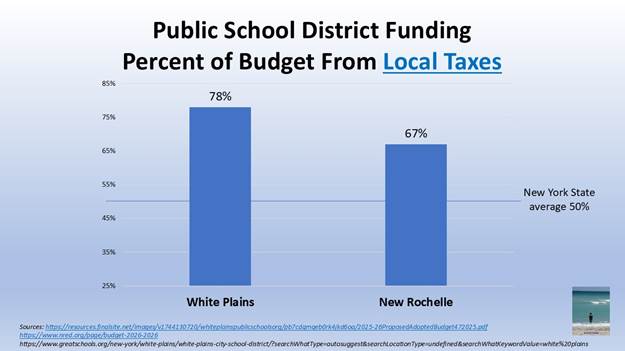
White Plains has a staggering 2025-2026 budget of $277,965,500 for 6,836 students. That amounts to $40,662 per student. That is 13% more than Scarsdale spends, which is one of the best school districts in the entire country. It is also significantly more than New Rochelle which is a similarly sized city with comparable demographics.
And White Plains performs much worse than both despite its massive budget.

Almost all of the Hispanic and Black students in Scarsdale perform well in math, with both groups having over 80% proficiency. In New Rochelle, proficiency in mathematics is 57% each for the groups. Yet in White Plains, only 38% of Hispanics and 42% of Black students have proficiency in math.
Where does the money go in White Plains if not into educating students?
Ten years ago, the White Plains school budget was $208,750,0000 in 2016-2017 when it had 7,091 students, spending $29,439 per student. White Plains is now spending 38% more per student. Much of the cost is NOT GOING FOR THE STUDENTS but to facilities and teacher benefits.
Facilities
The school district has 1.4 million square feet of buildings, not including the new $33 million high school building going up now. New York State generally guides schools to have 85 to 125 square feet per child, depending on the grade. White Plains has 199 square feet per student, 60% more than the high-end recommendation.
And the White Plains school district is planning on spending much more on facilities despite a declining enrollment.
According to the school district’s long-term plan, school enrollment is projected to decline to 6,540 in 2028-9. Despite the shrinking student body, the 20-year plan has $395 million of expenditures to upgrade its facilities.
The city already has $88 million of debt and an $11 million capital lease (page 26). The capital lease and $38 million in notes are coming due in 2026. Presumably this is going to be refinanced in a higher interest rate environment which will add expenses into the school budget.
Fewer kids, worse performance and state-of-the-art buildings.
Teacher Salaries and Benefits
The budget lays out teacher salaries (page 39), with school principals making just under $200,000 per year and the school superintendent making over $300,000.
Employee benefits account for $68.6 million (page 10), or 25% of the budget. This is a 10% jump from the previous year, and accounts for OVER HALF OF THE INCREASE from last year’s budget. So while curriculum development went down this year, teacher benefits rose by $6.25 million.
And this is going to continue according to the long-term plan (page 25). Contributions to the teachers retirement and employee retirement systems are going to keep going up while the number of students declines.
Student Performance
There is a lot of data on student performance (pages 43 onward). There are a few take-aways:
- The school is 70% Latino and Black and those groups are not reaching proficiency in English or math
- Roughly 19% of the students are English language learners, 17% have disabilities and 56% are economically disadvantaged. The English learners and those with disabilities are doing terribly. It is unclear how the school can continue to keep these children in the school system when they are clearly unable to service them. The government should do a full review of the situation.
School Board
The school board will tell you that your taxes are not going up and that the school district is an incredibly open and caring environment with state-of-the-art facilities. What they are not telling you is that they have been over-taxing you for years to fund capital projects, have $50 million of looming debt coming due in 2026, are spending incredible sums on teacher benefits while allowing a significant percentage of the student body to flounder.
That is the sad reality.
ACTION PLAN
Vote on May 20. Polls are open from 12:00PM to 9:00PM. Find your voting location here.
Vote ‘No” on the school budget to reduce it by $3.4 million.
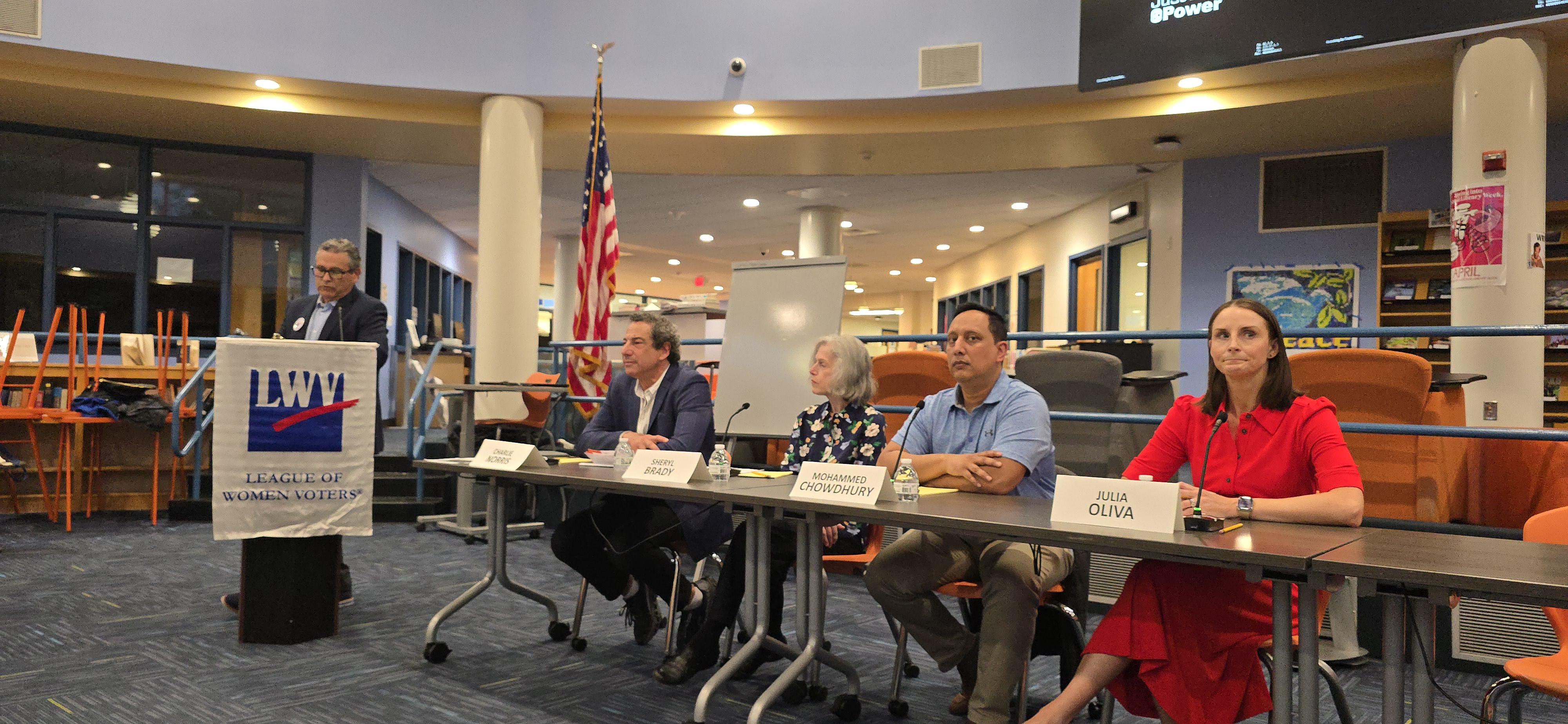
Vote for Julia Oliva, a parent of a second grader who wants to put money into services instead of football fields. It is time to phase out the old school board which has spent your money on shiny buildings instead of our youth.
Related articles:
School Boards Are the New Battleground: Why the New York Jewish Community Must Vote on May 20


















 First One Through


