Abraham once defended the wicked on the merit of the righteous few. Today, the world defends the wicked for the sake of evil masses.
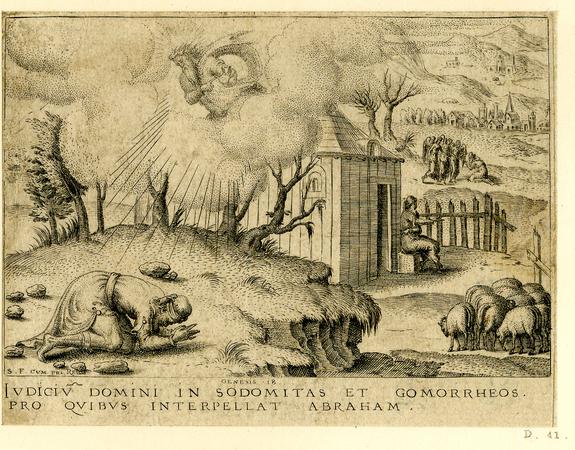
The Moral Math of Vayera In Parashat Vayera, God tells Abraham that Sodom will be destroyed for its depravity. The city is beyond saving — cruelty is civic policy, justice a mockery. But Abraham does the unthinkable: he defends the wicked, not because he excuses them, but because he believes that within their city a few righteous might remain.
“Will You indeed sweep away the righteous with the wicked?” (Genesis 18:23)
Abraham bargains God down — fifty, forty-five, thirty, twenty, ten. If even one percent (population of Sodom estimated 1,000) righteous can be found, the city deserves another chance. Abraham’s plea becomes the Torah’s first moral equation: mercy for the many on the merit of the few. He argues for the wicked because of the righteous – or perhaps for only the righteous to be spared.
Abraham praying to God on behalf of the residents of Sodom and Gomorrah, by Étienne Delaune (1518-1583)
A Sordid Defense of Evil Four thousand years later, the moral logic has flipped. After the October 7 massacre — the torture, murder, and kidnapping of civilians — millions marched not to defend the righteous within Gaza, but to defend the wicked who carried out the atrocities. From London to New York, the cry was “Globalize the Intifada.” The United Nations would not even utter Hamas’s name.
They did not plead for ten good souls but glorified evil itself. Abraham argued for the guilty because he believed in goodness; today’s socialist-jihadists argue for the guilty because they despise Jews. That is not compassion — it is moral rot spreading far from the center of evil, infecting universities, newsrooms, and now city halls.
In Sodom’s time, no one defended depravity. Today, Genocide becomes “context.” Rape becomes “resistance.” Decapitation becomes “desperation.” Abraham fought for the 99 percent on the merit of the 1 percent righteous. Now we see millions fighting for the 75 percent wicked, based on the very actions of the depraved.
Nowhere is this clearer than in New York City — home to the world’s largest Jewish community — where activists chanting “Globalize the Intifada” and rape deniers will shape city politics. The descendants of Abraham are mocked as colonizers in their own synagogues and schools.
The Torah is silent on the punishment for those who aid and abet wickedness, but American law is not. The U.S. forbids “material support to terrorism.” Groups like CAIR face renewed scrutiny for Hamas ties; Students for Justice in Palestine has been banned from campuses for celebrating terror. Perhaps the law will finally catch up to those who glorify murder under the banner of justice.
Or New York City’s new mayor will bend and enforce the law to his own tune.
Abraham taught that one may plead for the wicked only on the merit of the righteous — never for the wicked in a moral void. The first is faith and mercy; the second, blasphemy and depravity. Today, we have lost the lesson, a moral stain on this generation.
For the last several parshas, Moses has been addressing the children of Israel with a constant refrain: follow the commandments in the land, and you will be blessed; stray from them, and you will lose your inheritance. To us today, these verses are about mitzvot — the commandments that define Jewish life. But to the Israelites standing on the banks of the Jordan, the charge must have sounded different.
They had just watched an entire generation die in the desert. The memory of the spies still lingered — those men who declared that the land was too difficult to conquer, that the people within were too mighty to destroy. Could such whispers have been forgotten? Surely the children had heard rumors of what their parents had repeated around campfires for forty years. And now, standing on the edge of the land, they might have expected Moses to lay out the strategy, the order of battle, the plan of conquest.
Instead, Moses did something else entirely. He skipped the war. He jumped straight to what life would look like after. The rules of worship, the rhythms of daily life, the blessings and curses of obedience. It was as if the battles ahead — Jericho’s walls, Ai’s ambush, the wars against mighty kings — would be non-events.
Imagine a coach gathering his team before kickoff and skipping the playbook. Instead, he passes out dinner menus for the victory banquet to follow. No Xs and Os. No defensive schemes. Only a vision of celebration after the game.
Why? Perhaps it was Joshua’s role to direct the war, the next chapter of the Tanach already waiting to be written. Perhaps Moses, who knew he would not enter the land, wanted to leave the people with principles for the future. Or perhaps Moses was teaching something deeper: that the wars were only one part of securing a peaceful future. That the real challenge was not in winning the land, but in living faithfully within it.
The truth is, the dream of the land was already realized — even if the Israelites didn’t know it. Hundreds of years of diaspora were ending. The promise was being fulfilled before their eyes, not through a war plan but through divine decree. The land would be theirs. The victory was guaranteed. What remained in doubt was whether they would keep it.
Moses understood: the conquest would be won by God’s hand, but the inheritance would be maintained only through God’s law. The spies had feared giants and fortified cities, but the true danger was disobedience and forgetfulness once the land was secured. That is why Moses spoke not of how to conquer, but of how to live.
The people knew that Joshua would lead them to battle, just as he had over Amalek. And they had seen that Moses was their intermediary with God, who prayed for their success (Exodus 17:10-13). Now Moses was telling the people: you no longer need me as your agent; you are they keys to victory. Prayers during battle to secure victory; obedience thereafter to keep the peace.
Aaron and Hur hold up the hands of Moses in prayer as he grew tired, asking God’s help for Joshua to lead the people to victory in battle
And so it is today. The battles of our time are real, but they are only part of the threat. We must not be complacent. We must not assume that everything is on the battlefield. Beyond the battle plans lies our own responsibilities in living a meaningful life and knowing the source of our strength.
ACTION PLAN
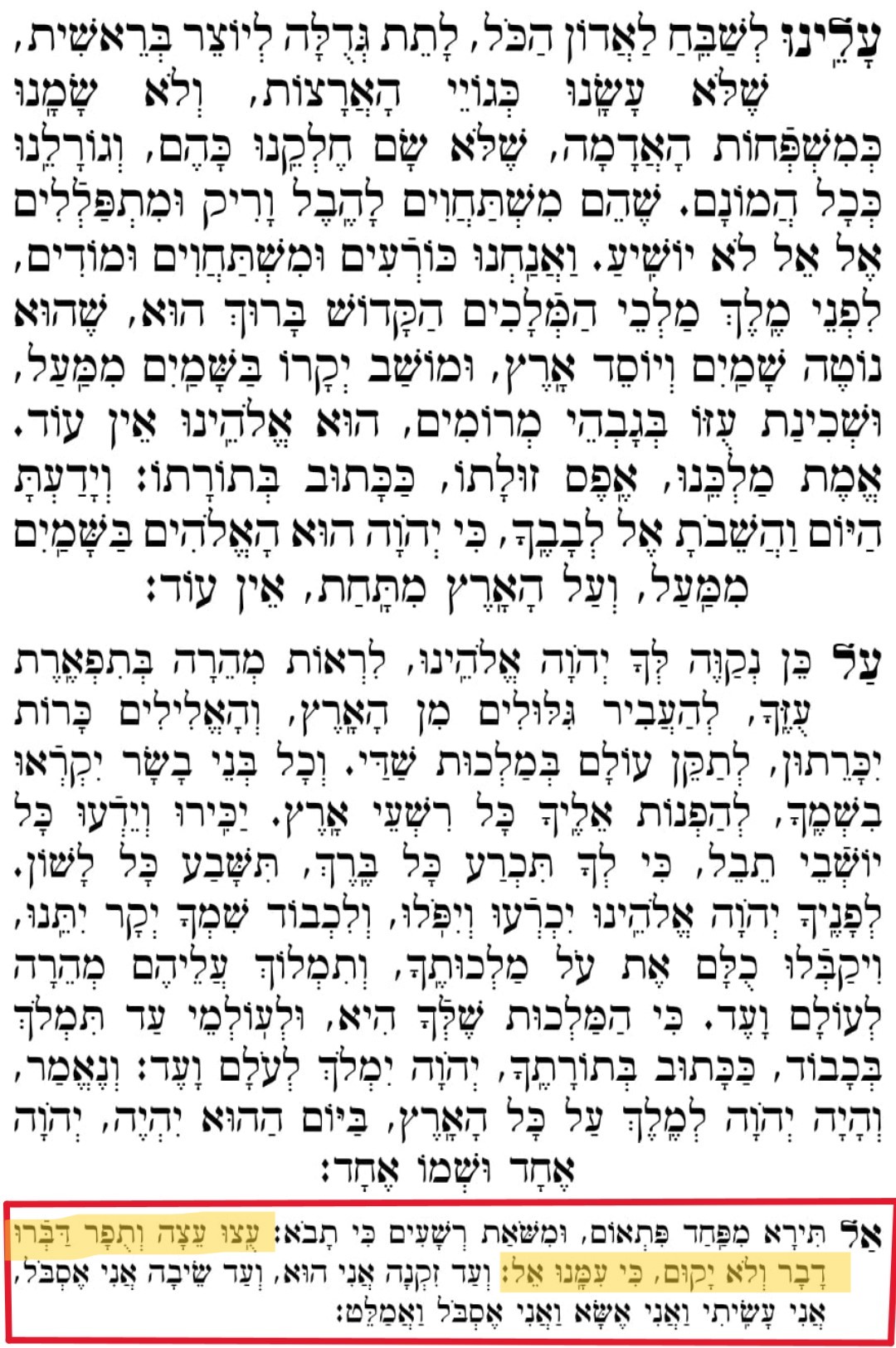
Go to the United Nations and sing outside the line from Al Tira, “Utzu Etza”: “Take counsel together, and it shall come to nought; speak the word, and it shall not stand: for God is with us.”
People debate the meaning of the phrase “From the River to the Sea, Palestine Will Be Free.” Many believe it to be a genocidal chant to destroy the Jewish State of Israel and kill the Jews living there, echoing the stated intentions of the political-terrorist group Hamas. Others have said that it is simply a call for all people to live in the area to be free, in a democratic binational state (although neither Israelis nor Palestinian Arabs want such outcome according to polls).
Perhaps an easy way to decipher whether people yelling “Free Palestine” are pro-Hamas or pro-Palestinian is to ask their opinion about whether all people should have dignity and rights in the land. Specifically, do they support Jews being able to pray openly in mass at their holiest site of the Jewish Temple Mount in the Old City of Jerusalem? Would they further support rebuilding a Jewish Temple on the site?
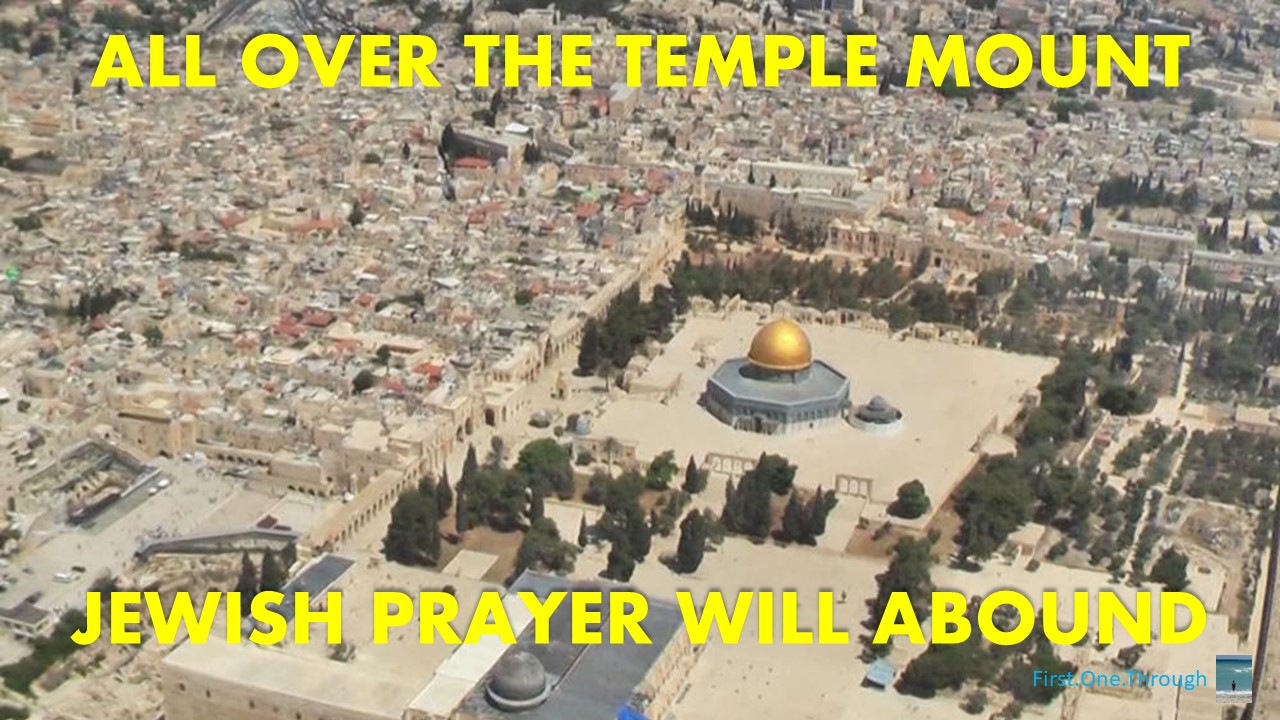
Currently, Jews are denied the basic human right to pray at their holiest site because radical Islamists like Hamas demand that the site be a purely Islamic site. If the chanters want to disassociate themselves from the genocidal charter, and advocate for mutual dignity and rights, they should add another chant “All over the Temple Mount, Jewish prayer will abound!”
Failure to actively support full Jewish rights throughout the Old City of Jerusalem and especially on the Temple Mount, marks the chanters of “Free Palestine” as backers of a U.S.-designated foreign terrorist organization and supporting the destruction of an ally. Those people should face the full ramifications of supporting such genocidal killers.
For the last few hundred years, Jews inserted three lines after their penultimate prayer in their daily services. Right after Aleinu and before the final mourner’s Kaddish, a sentence from Proverbs and two from Isaiah are found:
Be not afraid of sudden fear, neither of the desolation of the wicked, when it cometh. Take counsel together, and it shall come to nought; speak the word, and it shall not stand: for God is with us. And even to your old age I am he; and even to hoar hairs will I carry you: I have made, and I will bear; even I will carry, and will deliver you.
Al-Tirah
Roots Of Al Tira Prayer
Leaving synagogue was often a traumatic affair when Jews were scattered around the world. Inside of the synagogue, Jews were both together and felt connected to God; outside was a starkly different reality. Sometimes the local non-Jews would attack the Jews with pogroms and edicts, and at other times, Jews would be fortunate to find salvation.
Today, very few congregations actually recite the prayer despite its inclusion in prayer books.
I suggest that perhaps it is now time for all congregations to begin saying it.
Israel has responded to the Palestinian barbarity. It has killed and injured roughly one-third of the political-terrorist group Hamas in Gaza and has leveled much of the terrorist enclave. Hamas has claimed that nearly 30,000 Gazans have been killed at this point, with children accounting for over one-third.
On top of the frozen state of terror of Jews from the ongoing antisemitic attacks since October 7 is the sadness of watching the destruction of Gaza. Why did Hamas do this and why does the evil group insist that Israeli forces continue to pound Gaza rather than release the hostages and surrender the terrorists?
Hamas has an evil and twisted ideology rooted in a radical interpretation of Islam that demands the destruction of the Jewish state, believing its presence is an embarrassment for Muslims. As it states in its foundational charter “Israel will exist and will continue to exist until Islam will obliterate it…. Our struggle against the Jews is very great and very serious… There is no solution for the Palestinian question except through Jihad. Initiatives, proposals and international conferences are all a waste of time… In face of the Jews’ usurpation of Palestine, it is compulsory that the banner of Jihad be raised…. the Palestinian problem is a religious problem, and should be dealt with on this basis.”
For its part, Judaism has a different set of beliefs that stretches back thousands of years before the Islamic prophet Mohammed was born. It urges calm in the face of fear.
Be not afraid of sudden fear, neither of the desolation of the wicked, when it cometh. (Proverbs 3:25)
Jews are carrying both the shock of October 7 in Israel and the sickening reaction of Hamas’s fans around the world. They are simultaneously witnessing the destruction of that enemy. It’s a lot to process – the “sudden fear” and the “desolation of the wicked” – and has led many Jews and Zionists to huddle together in synagogue, and hide symbols of being Jewish when they go outside.
Jewish Calendar And Numbers
The Jewish year 5784 is a Jewish leap year which adds another month, and the year 2024 in the secular calendar is also a leap year which adds a single day. Both the Jewish calendar and the secular calendars add the time in the winter to “correct” the calendar for the upcoming spring.
We are now in the first of two months of Adar. Jewish tradition holds that Adar is a month of happiness and when Jews defeated their mortal enemies who attacked the weakest Jews. The double month of Adar is meant as a moment of double celebration.
This year of 5784 is the eighth year of the 19-year Metonic cycle which marks leap years on the third, sixth, eighth, eleventh, fourteenth, seventeenth and nineteenth year. Just as 2024 is the eighth year in the cycle, so was 1967, when Israel reunified Jerusalem, as was 1948, the year that the Jewish State was reborn. From 1948 to 1967 was one Metonic cycle and from 1967 to 2024 were three full cycles.
Numbers have significance in Judaism. One is connected to the singularity of God in the Jewish monotheistic faith. Three symbolizes Judaism’s founding fathers, the sections of the Shema prayer, three holidays of pilgrimage to Jerusalem and the three groups of Jews.
Eight is also meaningful. Beyond the day that Jewish males are circumcised to join the Jewish nation, tradition is that eight connects man in the natural to the supernatural world. While God made the world in seven days and had seven branches on the menorah in the holy Temple, eight is the step beyond. The seven branch menorah was for the Temple, while Jews light an eight branch menorah in their homes and synagogues today to connect to the miracle.
Take counsel together, and it shall come to nought; speak the word, and it shall not stand: for God is with us. (Isaiah 8:10)
These months of Adar seem like important months to recite the oft-skipped prayer. A time to mark the third complete leap year cycle of Jewish control Jerusalem and the Temple Mount. It is a time to remember that God is with us and he is the sole source of fear.
Amalek And Arms Aloft Together
When the Jewish people left slavery in Egypt they were attacked by the nation of Amalek. During the battle, Jews looked up to Moses who held his arms pointing to the sky with the assistance of Aaron and Hur who held the elderly prophet’s arms. The Jews were empowered when they saw Moses praying to God to vanquish the enemy, and prevailed as God enabled their success.
And even to your old age I am he; and even to hoar hairs will I carry you: I have made, and I will bear; even I will carry, and will deliver you. (Isaiah 46:4)
Today, there is no Jewish leader like Moses to pray on behalf of the jews, and every Jew takes their own prayer book to talk to God. They gather in minyanim around the world to pray for Jewish soldiers fighting with weapons, and Jewish lay leaders who fight against Hamas’s supporters in governments, college campuses and everywhere.
Let us all recite Al Tirah together, holding the hands of the people to our right and left, and pray for God to deliver success in defeating all of our foes.
Chanukah is a celebration of Jews purging the pagan practices of their holy Second Temple in Jerusalem, and expunging the Hellenists from the holy land. It is a worthwhile time to consider how Jews today think about the Jewish Temple Mount and the future of Jewish prayers on the site.
Reform Judaism
Reform Jews are the largest denomination of American Jews, accounting for roughly 33% of American Jews (right ahead of 29% of Jews of no religion) according to a 2021 Pew poll. Their authoritative rabbinic body, the Central Conference of American Rabbis (CCAR) issued a resolution in 2015 about the Reform movement’s view of the Temple Mount. While it said that Jews considered it “holy”, it noted that it only was so because of historic significance. It added some important points:
There is “not to any hope for rebuilding the Temple, reestablishing sacrificial rites, or restoring any future Jewish worship where the Al-Aqsa Mosque and Dome of the Rock now stand”
“Supports the status quo on the Temple Mount which restricts prayer to Islamic, not Jewish, prayer.”
“Stands in opposition to those Jews who attempt to alter the status quo by praying on the Temple Mount, which is contrary both to traditional Jewish law and practice as well as peaceful co-existence.”
“Affirms the freedom of religion and the right of persons to pray where they choose, while at the same time, asserts that the interests of peace and safety are, in this unique and extraordinary circumstance, best served when some rights are suspended and legitimate religious passions restrained in deference to the rights and sensibilities of others.”
“Encourages efforts of the [Reform Movement’s] Israel Religious Action Center, in cooperation with the Religious Action Center, to maintain the status quo on the Temple Mount while combating terror and incitement to violence.”
The Reform Movement repeatedly makes clear that it opposes Jewish prayer on the Temple Mount now and forever. It believes that Temple Mount is simply a relic of the past, and any Jew who seeks to pray at Judaism’s holy site is essentially inciting violence.
The Reform movement’s leaders echo this theme. Rabbi Rick Jacobs lied to his base during Chanukah 2016 that the Maccabees of 2,200-years ago fought for religious tolerance when they did did the opposite. The Maccabees fought for a Jewish Temple, period. Further, it is perplexing (revolting) that the movement advocates for religious tolerance seemingly for all religions except for Jews at their holiest location.
Conservative Movement
The Conservative Movement is the fastest shrinking denomination of American Jewry. For every Jew who joins, three leave according to Pew, with the vast majority migrating to Reform or Jews with no denomination.
The movement has said remarkably little about the Temple Mount.
Way back in 2001, the Rabbinical Assembly issued a resolution which said almost nothing about its position about the sacred site, other than confirming its holiness to Jews, and respectfully asking Islamists to stop proclaiming otherwise. It has issued no other official comments about the holy compound.
Its silence can be found in other places as well.
In 2016, the Conservative movement published a new prayer book, a siddur, meant to be more egalitarian which included a wide variety of contemporary commentators. The siddur sits somewhere between Reform and Orthodox denominations’ liturgy, but much closer to Reform as it relates to the Temple Mount.
While Orthodox Jews recite a short prayer after the central Amidah service three times a day (four times on Sabbath and holidays), as well as earlier in the morning service, asking for the Temple to be rebuilt, the Conservative Movement omitted it:
May it be Your will, Adonoy, our God, and the God of our Fathers that the Holy Temple be rebuilt speedily in our days, and grant us our share in Your Torah. And there we will serve You reverently as in the days of old, and in earlier years. And let Adonoy be pleased with the offerings of Judah and Jerusalem as in the days of old and in earlier years.
Perhaps the Conservative movement agrees with Reform Jews that there is no need for a Third Jewish Temple and that Jews should be banned from the site. Or maybe it is just staying out of the fray.
View of the Jewish Temple Mount from the top of the rebuilt Hurva Synagogue in the Old City’s Jewish Quarter (Photo: First One Through)
Orthodox Jews
While most non-Orthodox American Jews do not focus on the Temple Mount even as they might pray facing it, the small Orthodox community actively prays about rebuilding the Third Temple, as seen above. Many have gone to the site in recent years, during the few hours in which visitation for non-Muslims is currently permissible.
In December 2013, the Chief Rabbis of Israel reimposed a ban on Jews ascending the Temple Mount, as Orthodox Jews began to do so with greater frequency. The rationale had nothing to do with angering Islamists, as it did with potentially walking on the most holy of spots, which is not permitted for Jews other than a High Priest, according to Jewish law.
Despite the ban, the number of Jews visiting the Temple Mount has jumped in recent years as Orthodox Jews have rationalized that the location of the holy of holies is understood. In 2012, the total number of Jewish visitors was about 7,700. In October 2022 during the Jewish month of Tishrei, the figure was almost 8,000 according to Beyadeynu, an activist group encouraging Jewish visitation. The group estimates that the total this year doubled to about 50,000 from last year and it hopes to double again – to 100,000 Jews – in the coming year.
That figure remains a small fraction of the millions of Muslims who frequent the site at all hours.
In Israel, the Ultra-Orthodox Haredi community makes up 13% of the population and it is growing twice as fast as the rest of the country. There is roughly another 10% of Jews who are dati, or Modern Orthodox religious. Taken together, the 20%-plus Orthodox Israeli Jews is quite a bit larger than the 8% of Orthodox American Jews. Israel – and Jerusalem in particular – is much more Orthodox than world Jewry, as the devout Jews are drawn to the holy city much more than other Jews.
The increasingly secular nature of the majority of America’s Jews has fed a narrative that the Temple Mount is not central to Jewish prayer or aspirations. As Israel’s new government includes several Orthodox parties in the ruling coalition, the likely promotion of a greater Jewish presence at Judaism’s holiest spot will be cast as foreign and extreme around the world, when it is, and has always been, a basic component of Orthodox Judaism.
King Abdullah II of Jordan came to Washington D.C. in February 2017 to attend the National Prayer Breakfast. We once again spoke eloquently about “tolerance, mercy, compassion for others, mutual respect.” He stated clearly his belief that people should be “equal in dignity” and that there should be “respect for the houses of God.” Welcome words, particularly from the leader of a country with a terrible history of treating Jews and Jewish holy places.
Jordanian King Abdullah II speaking at National Prayer Breakfast February 2, 2017
But Jordan made peace with Israel in 1994 and perhaps King Abdullah may finally be ready to take the next step in recognizing Jewish rights in Jerusalem.
The Mourabitoun
After the Gaza War in 2014, the Palestinian Arabs in the West Bank were looking for a way to express their anger at Israel. On the Jewish Temple Mount in Jerusalem, dozens of Muslim women began to actively protest Jews coming onto the plaza. They would follow the visitors around the site and yell “Allahu Akbar” in efforts to intimidate them to leave the area.
Men joined these protestors as well, sometimes throwing rocks at the Jewish visitors. These “Mourabitoun” were actively promoted by the terrorist group Hamas, and tacitly approved by the Waqf that administers the holy site. The Waqf is funded by the Jordanian government.
Because of the Mourabitoun, the number of Jews that get to visit the Jewish Temple Mount is a fraction of the tourists that ascend to the complex each day. Armed Israeli guards vet each Jews that goes up to ensure that they have no prayer books and do not pray during the visit. The soldiers surround these small groups of 10-15 people as they methodically go to discrete areas of the site.
Meanwhile, thousands of non-Jewish tourists get to visit Judaism’s holiest site unimpeded.
If Abdullah wants to be a man true to his word, it is time to denounce the Mourabitoun and give Jews the tolerance and mutual respect he says is necessary for a peaceful world. It is time for the Waqf to not stand in the way of Jewish visitors who used to pray freely on the Temple Mount 450 years ago, before Suleiman kicked them from the site and relegated a small section of the western retaining wall of the mount – the Kotel – for Jewish prayer.
Will Abdullah be a man of his word in advancing peace and respect as he advocated at a prayer breakfast? Or will he be a hypocrite and anti-Semite who cannot show mutual respect to Jews? It is time for action, not just words.
This weekend, thousands of Jews from around Israel and other parts of the world came to the Cave of the Patriarchs in the city of Hebron. The annual tradition of visiting the city on this weekend goes back many years, as it coincides with the reading in the Torah of Abraham buying land to bury his wife Sarah, the “first mother” of the Jewish people.
The Cave of the Patriarchs is considered the burial place of almost all of the “founding fathers and mothers” of Judaism 3700 years ago: Abraham; Isaac; Jacob; Sarah; Rebecca and Leah. As such, it is considered the second most holy site in Judaism (on par with Medina for Muslims).
Roughly 2,000 years ago, a monumental structure was built on top of the cave, attributed to the Jewish King Herod. Over the following centuries, many people conquered the city of Hebron. About 800 years ago, the Muslim Mamlukes took over the city and declared the Tomb of the Patriarchs to be a mosque and forbade Jews from coming beyond the seventh step of the structure.
The Cave of Jewish Patriarchs in Hebron
When the Ottomans ruled Hebron from 1517 to 1917, there was relative peace between the Arabs and Jews in the city (even though the Jews were forbidden from entering their holy site). However, in 1929, Arabs rioted against their Jewish neighbors after incitement from the Grand Mufti in Jerusalem. During those few days in August, 67 Jews were killed, hundreds were injured, and the British (who then controlled the mandate of Palestine) forced all of the Jews to leave their city.
In 1967, in response to the Jordanian (and Palestinian) attack on Israel, Israel captured Judea and Samaria, including the city of Hebron. When Israel took control of their holy site, it opened the shrine for prayer for both Jews and Muslims. Today, there are discreet times set aside for each religion to use the site for prayer.
In 2014, the discussion about opening the Temple Mount in Jerusalem – Judaism’s holiest site – to non-Muslim prayer has again been raised due to the shooting of Jewish activist Yehuda Glick who fought for that basic right. The acting-President of the Palestinian Authority Mahmoud Abbas was outraged at the suggestion and described such approach as amounting to a “religious war“, as the al-Aqsa Mosque, which sits on the Temple Mount, is Islam’s third holiest site. While Glick and many other activists never suggested praying at or near the mosque, but on other parts of the 35 acre platform, the Israeli Prime Minister Benjamin Netanyahu nevertheless agreed to keep the status quo ban on Jewish prayer on the mount.
On the tenth anniversary of Yaser Arafat’s (fungus be upon him) death, Abbas stated: “The leaders of Israel are making a grave mistake by thinking that history can move backward and that they could impose facts on the ground by dividing the Aksa Mosque in time and space, as they did with the Ibrahimi Mosque [Cave of the Patriarchs] in Hebron.”
In Hebron, Israeli action at the Cave of the Patriarchs opened the way for both Muslims and Jews to share holy sites in the holy land. The Temple Mount could similarly become a place of tolerance and prayer.






 First One Through