“East Jerusalem” – the 0.5% Molehill

The Middle East is not short on drama. Things in the region are magnified by perfect faith and distorted by perceived foresight. The people in the land are The People of The Land. Their collective perspective has long ago been blurred by reading texts about ethereal matters too closely.

To wit, Arabs have stated a quest for a new country with a capital city they call “East Jerusalem”. The small matter that seems to escape them is that it doesn’t exist.

Jerusalem was founded 4000 years ago. In the city’s turbulent history, it reached religious heights and was vanquished many times. Still, in all but 19 of those 4000 years, it remained a single united city.

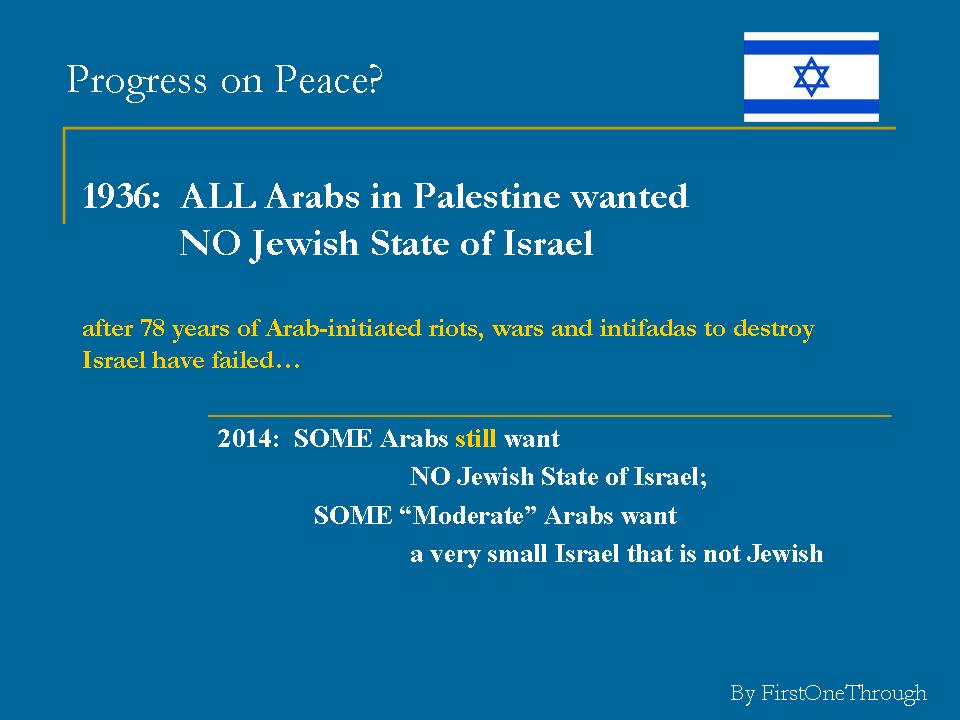
In 1947, the United Nations considered expanding the borders of the city and put forth a plan to create a “Holy Basin” which was to include Greater Jerusalem and Greater Bethlehem. The proposed entity would have housed the significant religious sites of the three monotheistic religions and been under international control. The Arabs rejected the proposal and five Arab armies attacked the new State of Israel in 1948 with the stated objective of destroying the country completely.

At the end of that war, the Jordanians seized and unilaterally annexed the eastern part of the Jerusalem and renamed it “East Jerusalem”. The joyful Jordanians gave the Palestinian Arabs Jordanian citizenship, but evicted all Jews from their “East Jerusalem”.

So the spiritual center of Judaism was stolen by the Jordanians. From 1949 to 1967, (0.5% of the city’s existence), the Jordanians banned Jews from the eastern part of Jerusalem.

In 1967, the Jordanians (which included Arabs from Palestine who were granted Jordanian citizenship) attacked Israel again, and lost the eastern half of the city. Israel dismantled the barbed wire that split the city and reunited Jerusalem. “East Jerusalem” existed no more.

In 1995, in an effort to establish peace in the region, Israel handed control of Bethlehem to the Palestinian Authority, thereby giving half of the “Holy Basin” to the Arabs.  The “Holy Basin” sat divided, but not Jerusalem.

Remarkably, despite the short dark blip in history 46 years ago, and current control of Bethlehem, the Arabs contend that East Jerusalem still exists and always existed. Should it surprise anyone that when it comes to Jerusalem, people would try to turn a 0.5% molehill into owning the Temple Mount?

The history of united + divided Jerusalem

The history of united + divided Jerusalem

In Israel, Who’s New? Everybody.

Many items in the Middle East are subject to positioning and posturing.   People point to paragraphs in the papers and argue whether the piece has an Israeli or Palestinian perspective. Rarely does the news provide analysis or education for its readers. Instead, it rehashes the political leanings of its editorial board and applies it to the story of the day. How often does a reader put down a paper and say: “Who knew?”

Here is a review of “Who’s New” and the misrepresentation of the facts in the media. Note that statistics, while often easily distorted, can still say a lot. In an area like the Middle East, it is amazing that they are rarely discussed.

A common narrative (which has merit) is that Jews came to Israel en masse after the English took control of the entire region of Palestine (which includes today’s Jordan). That statement, however, is incomplete.

  1. Jews have always lived in Palestine
  2. Jews moved to Palestine in great numbers under the Ottomans
  3. Muslims did not move to Palestine under the Ottomans

In 1800, there were approximately 7,000 Jews in the region of Palestine. It is not a big number, and they accounted for about 3% of the population at that time.

Between 1800 and 1890, the population of Jews jumped to 57,000, then accounting for 8% of the population. Their numbers continued to grow under the Ottomans, with an estimated 94,000 Jews in 1914, or 14% of the population.

The population of Muslims and Christians during these time intervals barely moved. The Muslim population grew 113% over those 114 years, or a compounded annual growth rate (CAGR) of 0.7%. That is roughly the rate of natural growth (births minus deaths) which suggests that NO Muslims moved to Palestine for 114 years of Ottoman rule.

The Christian population grew at twice the rate of Muslims – 218% (vs. 113% for Muslims). To say that all of those Christians were Arabs would be surprising as one would expect the growth rate of both groups of Arabs to be roughly the same.

The Jewish growth in the region over the last 114 years of Ottoman rule was 1,243% – many multiples of Muslims and Christians. It clearly did not take the Balfour declaration in 1917 to get Jews to move to Palestine. They were historically (pre-1914) the only group who did move there.

4.  Arabs moved to Palestine in greater numbers than Jews during the British Mandate

Say that again?

While the common Arab narrative is that Jews came to Palestine under the British to do a “land grab”, and all of the Arabs were living in Palestine for centuries, the statistics do not support the claim.

For Jews, the Third Aliyah (1919-1923) brought about 40,000 Jews and the Fourth Aliyah (1924-1928) another 80,000 Jews to Palestine. About 15,000 Jews left Palestine due to the economic hardship at that time, meaning a total of about 105,000 Jews immigrated over the decade. The Fifth Aliyah was the most dramatic (1929-1939), bringing about 250,000 Jews. The Arab riots of 1936-9 basically shut down Jewish immigration to 75,000 people, so in total there were about 420,000 Jews who moved to Israel under the British.

The Arab narrative completely ignores the mass immigration of Arabs that happened under the British. From 1914 to 1949 (after the Israel War of Independence), the Muslim population grew to 1.18 million. That means that after over a century of 0.7% growth (and even lower 0.6% annual growth in 1890-1914), the Muslim population jumped to 2.3% annual growth. Put another way, the Muslim population was 540,000 people larger in 1949 than one would have assumed using all historical norms. So while the Arabs may point to the roughly 420,000 Jews who migrated from Europe, Russia and Yemen, they deliberately ignore the half of a million Muslims who moved from Egypt, Iraq and around the Middle East to Palestine under the British.

So who was new to Israel/Palestine? Who moved there under the British Mandate? Everybody. About 540,000 Muslims, 60,000 Christians and 420,000 Jews.

Which is all fine and good. But it is a lie to state that all Palestinian Arabs lived in their homes for centuries and Jews were “colonialists” brought by the British. There were more Muslims that moved to Palestine between 1914 and 1949 than Jews.

Consider further that the figures above net out over 300,000 Arabs that left Israel during the 1948 War to Lebanon, Syria and Jordan, which would suggest that Muslim immigration was twice that of Jewish immigration under the British.


Who knew?

Hope versus Hate. The Anthems of Different Peoples.

In the two and one-half weeks since three Israeli teenagers were kidnapped, the government of Israel dispatched hundreds in search parties to find the boys, called “Operation Brothers’ Keeper.” The citizens of the country, and Jews and civilized people around the world, hoped and prayed for the boys’ safe return. The reactions were emblematic of Israel’s culture: to actively pursue – by physical and metaphysical means – a better future. A future that includes life and peace for its entire people.

The reaction from Israel’s Arab neighbors was also emblematic of their culture. Hamas spokesman Khaled Mashaal said “If it turns out the kidnapping really happened, I welcome it.” The mother of one of the men accused of the kidnapping, Amer Abu Aysha, said that “If he truly did it – I’ll be proud of him till my final day.”

Those sentiments of hatred can be found throughout the Arab and Muslim Middle East in their national anthems. Country after country have songs calling for death, vendetta and martyrdom, as seen in the video below. These are not army marching songs, but the values that are instilled in the people every day before soccer matches and graduations. Here is a small sample:

We all sacrifice for you, we supply you with our blood” – UAE

Our martyrs’ souls are formidable guardians” – Syria

We will drink from death” – Iraq

Palestine is my vendetta and the land of withstanding” – Palestinian Authority

A life of dignity and a death of glory” – Tunisia

We never betray the call for sacrifice, death” – Sudan

On our dead we build glory” – Algeria

May God take my life” – Turkey

We are your sacrifices” – Libya

Remember through my joy, each martyr” – Yemen

The Kurdish youth are ever-ready And always prepared to sacrifice their lives To sacrifice their lives, to sacrifice their lives” – Kurdistan

These aspirations stand in sharp contrast to the national anthem of the Jewish State of Israel, a democracy in the middle of the Middle East.  Israel’s anthem is called “Hatikva”, which means “The Hope”.

Our hope of 2000 years is not lost. To be a free people in our land- the land of Zion and Jerusalem.”

NY Times skewed view on Pope prayer invitation and MidEast Peace

NYT May 27, 2014 “For Middle East, Region of Religious Conflict, Pope Suggests a Respite in Prayer”


Jodi Rudoren penned a piece in a “Memo from Jerusalem”, freeing her from the invisible constraints of reporting news “truthfully”, and shared her personal observations about the pope and the Middle East conflict. Her bias towards the Palestinian narrative remains clear.


  1. Her opening sentence states that Pope Francis came back from the “Holy Land with the typical bag of ceremonial gifts, including, from the children of Bethlehem’s refugee camps, a mock-up of an identification card in the name of Jesus that lists family members as Mohandas K. Gandhi, Nelson Mandela, Yasir Arafat and Martin Luther King Jr.” Wow.
    1. I’ve been to Israel 30+ times. I’ve been to Jerusalem, Jericho and Bethlehem. I never once came back with a propaganda ID card. Does she really think that it’s “typical”?
    2. Jodi has often written about the Vatican and the UN now referring to the “State of Palestine”. You cannot have a refugee camp of Palestinians in a “State of Palestine”. You cannot claim to have a state and be a refugee of that state while living in such state.
  2. It is quite impressive to list a terrorist like Yasir Arafat with Gandhi and MLK. I would have hoped Jodi would have continued to detail the outrageousness of the comparison, but alas, I believe she thinks it fine to equate a civil rights leader with the man who brought the world airplane hijackings. Here are two quotes: one from Arafat and one from Gandhi. See if you can guess who said which:
    i.      “I suppose leadership at one time meant muscles; but today it means getting along with people.
    ii.      “We will not bend or fail until the blood of every last Jew from the youngest child to the oldest elder is spilled to redeem our land!
  3. The article compliments the pope navigating his trip “without seeming to offend” any of the parties.  A strange comment considering over the prior three days Jodi pointed out the anger of the Palestinians for the pope’s laying a wreath at Herzl’s grave and of the Israelis anger for the pope stopping at the security barrier near a sign that labeled it an “Apartheid Wall”.
  4. Jodi goes on to compare the pope’s stopping at the security barrier, with a wall commemorating Israeli victims of terror. In a “normal” world, these two visits would be THE SAME prayer to stop violence, as the security barrier was built during the Second Intifada specifically to stop terrorism. However, Jodi’s remarks make clear that the stop at the barrier was not just the pope connecting with Palestinians and Israelis, but was meant to “shame” the Israelis. How can a parallel be drawn between a security mechanism and a memorial to innocent victims?
  5. She dismissed the prospects of the “peace prayer” at the Vatican “particularly” because Israeli President Peres role is “ceremonial” and he is set to leave the post in July.
    1. NYT again blames Israel for any path forward.
    2. Ignores the fact that Palestinian President Abbas’s term in office expired in 2009 – over four years ago.
  6. Jodi chose to liken the parties stating that “extremists on both sides have exploited religion to block resolution”. That statement is not an over-simplification, it is dishonest:
    1. Hamas won the last elections the Palestinians held, winning 58% of the vote back in 2006. Kahane’s party has been banned in Israel for decades.
    2. Hamas controls Gaza and 1.7 million people. Jewish “extremists” are individuals who do not control land or a population.
    3. The “right-wing” (NYT terminology) Likud and The Jewish Home parties have no disparaging comments about Christians or Muslims. However, the Hamas governing charter is a rant of anti-Semitism. A few quotes here:
      i.      Article 20: [the Jews are] “a vicious, Nazi-like enemy, who does not differentiate between man and woman, elder and young…The Nazism of the Jews does not skip women and children, it scares everyone.”
      ii.      Article 22: “[Jews] have been scheming for a long time,… they took over control of the world media such as news agencies, the press, publication houses, broadcasting and the like. … They stood behind the French and the Communist Revolutions and behind most of the revolutions”
      iii.      Article 7: “The prophet, prayer and peace be upon him, said: The time will not come until Muslims will fight the Jews (and kill them); until the Jews hide behind rocks and trees, which will cry: O Muslim! there is a Jew hiding behind me, come on and kill him!”
  7. Notable for its absence over a week of reporting on the pope visiting the Holy Land, and again in this article dedicated to religion and prayer, was the current status of Christianity in the region.
    1. Israel has freedom of religion for all; all churches are open and people are free to pray in the manner of their choosing. That is not true in most of the Middle East
    2. Israel is the only country in the Middle East where the Christian population is growing
    3. Israel is the only country in the Middle East where the number of Christian tourists surpasses any other religion, including Jews.
    4. Israel is the only country in the region which is the target of BDS by some Christian groups
  8. Also absent from the articles was Abbas’s comment to the pope that “Israel is systematically acting to change [Jerusalem’s] identity and character, and strangling the Palestinians, both Christians and Muslims, with the aim of pushing them out”. No comment from the NYT about the religiously charged lie:
    1. The Christian population in Jerusalem has increased since Israel re-unified the city in 1967. The only time that the Christian population declined over the past 100 years was during Jordanian rule 1949-67
    2. The Muslim population in Jerusalem never increased more over the past 150 years than it has under Israeli rule
    3. From 1967-2011, Muslim population in Jerusalem increased 4.4x, compared to 2.5x for Jews
    4. Jerusalem has had a Jewish majority since 1870. How has the “identity and character” changed in Abbas’s mind? Oh, Jews are once again living in the Old City, now that the 1949 Jordanian expulsion of the Jews and 19-year ban is over.


NYTimes shows its preference in “dueling narratives” in the Middle East

New York Times May 26, 2014: “Pope Lays Wreath at Tomb of Zionism’s Founder”

The NYT headline would lead a reader to believe that the article is about Theodore Herzl, the founder of modern Zionism. Guess again.

1.      The article is not about Herzl at all- he is mentioned in passing in the seventh paragraph.

2.      The article is about dueling narratives of Israelis and Palestinians. It is clear which one the NY Times favors, as the day beforehand it posted a huge front page photograph of the Pope at the security barrier, compared to this article on page A10 which includes three photographs of the pope at religious sites for Jews, Muslims and Christians.

3.      The article does not point to the NYT posting the photograph on its front page, but says that the picture simply “rocketed around the Internet”, making the paper seem uninvolved in its promotion.

4.      The author writes of the “graffiti-scarred concrete barrier separating Bethlehem from Jerusalem”. There is no mention that Israel handed control of Bethlehem to Palestinians and that Israel controls Jerusalem, so a checkpoint is appropriate.

5.      The fact that the fence was built specifically due to Arabs from the West Bank murdering Israelis is stated only as a quote from Netanyahu, making the statement appear biased rather than factual.

6.      The choice of words “the pope acceded to Israel’s request that he add to his packed Monday morning another unscheduled stop” makes Israel appear demanding and unreasonable in bullying the pope.

7.      The NY Times decided that a stamp of the pope pressing his head against a security barrier next to a sign that says “Apartheid Wall” is somehow analogous to Israel making a stamp of the pope placing a note in the Western Wall. One is a wall constructed to prevent terror, but has a sign blaming the victim, while the other wall is a religious place of prayer. The Palestinian stamp is a propaganda tool which wipes its crimes clean, while the Israelis post a stamp of hope. (There are four paragraphs in the article to stress this point).

8.      The NYT mentions that Peres post of President of Israel is ceremonial and that he leaves his post soon, but does not continue that Abbas’s term of President of the Palestinian Authority ended in 2009.

9.      The NYT, as always, included language that make the Israelis appear angry: “incensed some Israelis” and “some Israeli griping”. This language is not used for Palestinians.

http://www.nytimes.com/2014/05/27/world/middleeast/pope-francis-jerusalem.html

Jerusalem, and a review of the sad state of divided capitals in the world

Divided capital cities are a sad result of wars.  No capitals get divided as a result of peace; they are unstable models.

-divided cities make up less than 1/1000th of 1% of all cities in the world
-divided cities are almost all less than 50,000 people
-most divided cities are split by a natural boundary like a river
>> none of that is true for Jerusalem

The only rationale of dividing Jerusalem is that Palestinian Arabs have asked for it as a capital, which is the same as Israel asking for it.

Three of the divided capitals in recent years – Beirut, Berlin and Jerusalem – have been reunited.  The last city – Nicosia, Cyprus – is still under negotiation to be reunited.


Strange difference of opinion on Boko Haram and Hamas in New York Times

What do Boko Haram and Hamas have in common? Not the concern of the New York Times.

Compare the NYT editorials of May 6, 2014 on Boko Haram, and of December 28, 2009 on Hamas:
1. Boko Haram is described as a “ruthless Islamist group“, while Hamas is described as “militant Palestinian group“- not ruthless; not driven by religious zeal

2. NYT describes the “horrifying abduction” of Nigerian girls; it simply states that Hamas is responsible for the “barrage of rocket attacks into Israeli territory” without any negative imagery

3. NYT is disgusted by Nigeria’s “shockingly slow and inept” response to Boko Haram, but NYT says “we fear that Israel’s response“- blaming the victim

4. NYT claims that Boko Haram’s goal “is to destabilize and ultimately overthrow the government.” (which BH does not claim even though the NYT assumes so). Meanwhile, Hamas clearly and publicly declares that its goal is the destruction of lsrael, but NYT fails to mention it

5. NYT correctly describes the violent history of BH with “It is not the first time Boko Haram has attacked“, but fails to mention the history of attacks by Hamas against Israel.

6. NYT wants Nigeria to “contain a virulent insurgency” but prefers to blame BOTH Israel and Hamas for Israel’s situation, ignoring that the terrorist group actively and constantly calls for the complete destruction of the country


Sources: