The New York Times Refuses to Label Hamas a Terrorist Group

Readers rightfully assume that newspapers go through the effort of educating its readers. As such, the papers should include descriptions and backgrounds of the main actors in any news story.

“Good” actors and “bad” actors are often labelled as such.  For example, readers would imagine that the media would specifically call out a terrorist organization, and almost all of the time, they do. The exception is the terrorist group Hamas.

Consider this comparison:

P.K.K.

A group that is often-mentioned in the New York Times lately that is labelled a terrorist group is the P.K.K. The Kurdish group has been fighting for years against Turkey to gain independence and has used violence to achieve its goal. Some people consider the Kurdish aspirations for independence similar to the Palestinians, but there are many differences, such as the fact that the Kurds are actually a distinct people compared to Arabs and Muslims in Syria, Iraq and Turkey where they live, as opposed to Palestinians who are an indistinguishable part of the broader Arab world. The P.K.K. fights alone for the Kurdish people, while the whole Arab world fights for the Palestinian Arabs. Put those facts aside and look at recent reports from the New York Times.

The NY Times is consistent in labelling the P.K.K. a terrorist group.  It may state that the label is attributed to Turkey and other groups such as NATO, the United States or just “widely considered.”  But it usually avoids just stating that Turkey alone considers the group to be a terrorist organization:

  • October 12, 2015: “Turkey and its NATO allies consider the P.K.K a terrorist organization.”
  • September 9, 2015: “The Kurdish group, which is considered a terrorist organization by Turkey, the United States and the European Union, has been attacking Turkish security officials almost daily since the breakdown of the fragile peace process.”
  • August 12, 2015: “a Kurdish separatist group known as the P.K.K., which is widely listed as a terrorist group
  • August 6, 2015: “Mr. Erdogan has said he is acting in Turkey’s national security interests in targeting terrorists of all stripes, both the Islamic State and the P.K.K”
  • July 29, 2015: “Under alliance rules, they are bound to protect Turkey from threats, and they have long listed the Kurdish militant group that fought a long insurgency in Turkey, the P.K.K., as a terrorist organization
  • July 26, 2015 (an exception to prove the rule): “targeting camps of the militant Kurdistan Workers’ Party for the first time in four years… ended an unstable two-year cease-fire between the Turkish government and the Kurdish militants, also known by the initials of their Kurdish name, P.K.K.”

Readers of the New York Times are educated by the paper over-and-again that many countries outside of Turkey consider the P.K.K. a terrorist group.  Understanding that designation gives readers specific context with which to consider the story.  A government fighting a terrorist group is logical and appropriate; a defensive action of “the good guys” against the “bad guys”.

Now consider the labeling of Hamas in the New York Times.

Hamas

Hamas has been labeled a “Foreign Terrorist Organization” by the United States government since 1997. This is not subject to interpretation but is established fact.  It was awarded this designation on the same day as other notable terrorist groups including: Abu Nidal; Hizbullah; Palestine Liberation Front; Palestinian Islamic Jihad; Popular Front for the Liberation of Palestine; PFLP-General Command; and the P.K.K.  It is also consider a terrorist group by the European Union, Canada and other countries.

However, the New York Times does not call Hamas a terrorist group.  Instead it prefers to call it a “militant group.”  The Times does not call attacks by Hamas “deliberate attacks” but uses terms like “resorting to violence.”  The Times does not say that Hamas is the favorite established political party of the Palestinians, winning 58% of the Parliament, but uses terms like “dominates Gaza” to make it appear as an outside force against its own people.

All of these observations are plain facts for any reader of the Times to see (some examples are listed below, but do your own search of Hamas and the Times and see it for yourself).  These descriptions by the Times are used to transform readers’ mindsets:

  • from thinking of Hamas as a terrorist organization, to a freedom fighting group.
  • from a group that seeks to destroy all of Israel, to one that simply wants freedom of movement.
  • from a group that actively seeks to kill innocents, to one that is left with no choice.
  • from a popular Palestinian political party, to a small outside force.

From a terrorist group that violently seeks to overthrow a democratic government which must therefore be combatted aggressively with force, to a group that justly uses an armed struggle to achieve modest ends which should be placated.

  • July 17, 2015: “Saudi support for reconciliation between Hamas and Fatah, the two dominant but feuding Palestinian factions
  • June 30, 2015: “the ruling Islamist group, Hamas
  • June 8, 2015 “Hamas, the militant group that dominates Gaza”
  • June 3, 2015: “Hamas, the Islamic militant group that controls Gaza, has worked to enforce the cease-fire with Israel,” makes Hamas part of the peaceful solution (enforcing a cease-fire), not the core of the problem.
  • May 26, 2015: “The militant group Hamas used last summer’s war” separates Hamas from launching the war to a group that just used the war.
  • September 4, 2014: “…orchestrated by Hamas, which Israel regards as a terrorist group committed to its destruction” makes the characterization specific ONLY TO ISRAEL and not the US and many other countries.

IMG_3608
New York Times October 30, 2015 referred to Hebron as the
“‘Fortress of Hamas,’ because of its role as the Islamist group’s
unofficial West Bank headquarters.”

In short, the liberal paper goes through efforts to transform the broadly popular terrorist group that seeks the destruction of Israel and murder of Jews, to a fringe militant religious group that controls a part of the Palestinian population and occasionally resorts to violence against Israel. In such a narrative, who does the Times label as the “good guy” and who is the “bad guy”?  In such a scenario, is the current wave of violence just an “intifada” or “uprising” or part of a broader war to destroy the Jewish State?


Related First.One.Through articles

CNN’s Embrace of Hamas

Differentiating Hamas

The New York Times wants the military to defeat terrorists (but not Hamas)

Cause and Effect: Making Gaza

Why the Media Ignores Jihadists in Israel

The Palestinians aren’t “Resorting to Violence”; They are Murdering and Waging War

What do you Recognize in the Palestinians?

Subscribe YouTube channel: FirstOneThrough

Join Facebook group: FirstOne Through  Israel Analysis

Palestinians of Today and the Holocaust

The New York Times berated Israeli Prime Minister Benjamin Netanyahu for tying Palestinians to the Holocaust in its editorial pages on October 23, 2015 “Mr. Netanyahu’s Holocaust Blunder.”  It is interesting for the Times to be so angry about this remark while failing to note certain current truths about the Palestinians and the Holocaust:

  • Acting-President of the Palestinian Authority Mahmoud Abbas wrote his doctoral paper on Holocaust denial
  • Abbas’s April 2014 disturbing comments trivializing the Holocaust when he said that Palestinians understand genocide because they suffer “ethnic discrimination and racism” from Israelis was celebrated by the NY Times
  • Regular NY Times contributor Roger Cohen suggested a pathway to peace between Israelis and Palestinians was that “Jews should study the Nakba. Arabs should study the Holocaust” trivializing the torture and killing of millions of innocent people with a conflict about land.
  • Abbas repeatedly said that Israel is engaged in “a war of genocide” against Palestinians, in a deeply insulting distortion of both the conflict and the Holocaust.
  • Palestinian leaders forbid Holocaust education in UNRWA schools in Gaza, counter to the United Nations wishes and curricula.
  • The list goes on

The Palestinians are the most anti-Semitic people in the world, with almost every person (93%) holding negative feelings about Jews according to a May 2014 poll.  By almost every measure, the Palestinians today are more extreme than Germans were in 1933, whether in passing laws that forbid Jews entry onto Palestinian college campuses; laws that prevent land sales to Jews; or the stated desire to have a country free of any Jews.  Shouldn’t that be the main focus of the Times?  Why does it perpetually give a pass to the vile anti-Semitism and trivialization of the Holocaust by the Palestinians, but immediately attack of Netanyahu?

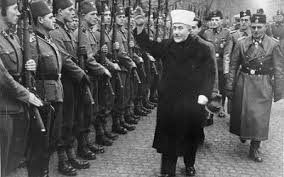
The Times stated that Netanyahu attempted “to distort history in order to draw a straight line between Mr. Husseini’s Nazi views and the current Palestinian leadership.”  Netanyahu didn’t need to do that. Palestinians do that themselves.

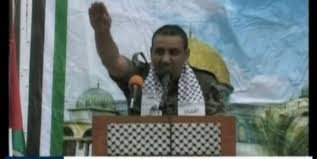
Pal nazi2Pal naziFatah nazimufi Jlem Nazi
Palestinians with Nazis yesterday. Palestinians acting like Nazis today.


Related First One Through articles:

Abbas Knows Racism

What do you Recognize in the Palestinians?

Extreme and Mainstream. Germany 1933; West Bank & Gaza Today

Subscribe YouTube channel: FirstOneThrough

Join Facebook group: FirstOne Through  Israel Analysis

Framing the Israeli-Palestinian Arab Conflict: WSJ and NY Times

The portrayals of the Israeli-Palestinian Arab conflict in the two main New York newspapers could not be more different.  Snapshots of the two papers on October 17, 2015 and the editorials from the prior days frame the conflicting attitudes.

In Pictures

On October 17, 2015, each paper posted a picture of an attack that occurred in Hebron. The Wall Street Journal captured the Palestinian who posed as a journalist stabbing an Israeli soldier.  The New York Times showed a picture of two Israeli soldiers standing over the dead Palestinian.

IMG_3554
Wall Street Journal front page picture of Israeli soldier attacked by Palestinian
October 17, 2015

IMG_3549
New York Times front page picture of armed Israeli soldiers standing over dead Palestinian October 17, 2015

The Wall Street Journal covered this story – and many of the stories over October 2015 when Palestinians attacked Israelis – as Palestinians as the aggressors and Israelis as defending themselves.  However, The New York Times almost uniformly showed all Palestinians as victims and Israelis as the armed aggressors.

In Editorials

New York Times: On October 15, the Times ran an editorial entitled “The Cycle of Violence in Israel.” The title and the opinion piece described a country that is in a never-ending cycle of “attacks and reprisals“, blaming neither party as being aggressor or instigating the violence.  The attacks were referred to as Palestinian “uprisings,” and the Times pointed the finger at a few parties:

  • “Yasir Arafat, could speak for all Palestinians” back in 1993 so there was a better prospect for peace according to the Times behind a unifying leader.  It neglected to state that the same Arafat walked away from a serious peace offer and then launched the Second Intifada in 2000, killing thousands.
  • The Times correctly stated that “Mahmoud Abbas is bitter and unpopular” which makes it difficult for him to lead and deliver peace negotiations. The paper failed to point out that Abbas has constantly incited violence against Israelis and never put forth any public comments on his willingness to compromise on his demands to create peace.
  • “Netanyahu has demonstrated little interest in a two-state solution” according to the Times, even though he is the only person that specifically has demonstrated a desire for peace: handing over half of the “Holy Basin”, Bethlehem, in 1996; a ten month settlement freeze in 2010; releasing dozens of terrorists; and repeatedly stating his willingness to engage in direct peace talks anytime, anywhere.

The New York Times described the only solution to ending the cycle of violence as “creating an independent Palestinian state alongside an Israel whose right to exist is fully acknowledged by all Palestinians.”  Note that the Times language specifically does not mention any Israeli demands of “security” and recognition as a “Jewish State.”  According to the Times, the only thing creating violence is the lack of a Palestinian state.

Wall Street Journal: On October 16, 2015, the WSJ had an editorial calledThe Knives of Jerusalem.The Journal’s attitude about the violence and approach could not be more different than the New York Times:

  • The WSJ called the Palestinian Arab attacks “terrorism” five times, a term never used by the Times (nor by the Obama Administration for that matter)
  • “[A] deep-seated culture of hate” among Palestinian Arab society was at the core of the attacks
  • Blame is specifically placed on Palestinian leaders including Abbas spreading “rumors” and “lies” about Israel to incite the Arabs.

The WSJ noted that Israel will need “to ride out another storm of terror.”  Peace will ultimately come when Palestinians realize that the Jews are not going to leave: “The sooner they [Israelis] impress on Palestinians that they will never bow to knives or bend to terror, the sooner the stabbings will end.”


The Times placed the principal blame for the attacks on Israeli “occupation” and therefore the solution is a peace agreement / a separation accord. Their pictures and articles repeatedly use images of Palestinians as victims and Israelis as militant occupiers.

The WSJ placed the blame on Palestinian Arabs who have denied the right of Jews to live in the holy land as self-governing people since the League of Nations gave Jews that legal right in 1922.  Peace will only come when Palestinian Arabs give up the fight and accept that the Jews are never going to leave. Their articles are more likely to show Israel as at the frontlines in the battle against Islamic radicals, similar to much of the western world.

The pictures and articles of the two papers have been consistent in their coverage of the conflict, and the weekend of October 17, 2015 brought the contrast into clear focus.


Related First One Through articles

Every Picture Tells A Story: Only Palestinians are Victims

Why the Media Ignores Jihadists in Israel

The Israeli Peace Process versus the Palestinian Divorce Proceedings

Every Picture Tells a Story: Versions of Reality

Subscribe YouTube channel: FirstOneThrough

Join Facebook group: FirstOne Through  Israel Analysis

Every Picture Tells a Story: Versions of Reality

The New York Times published an article on October 16, 2015 entitled “Conflicting Accounts of Jerusalem Strife Surround Wounded Boy“.  The article described a 13-year old Palestinian boy who stabbed a 13-year old Israeli boy who was riding a bicycle.  The acting-President of the Palestinian Authority Mahmoud Abbas claimed that the innocent Palestinian was executed by Israelis, while in fact he was recuperating at an Israeli hospital.

Normal logic would suggest that the pictures that accompany the article have something to do with the story.  Indeed, the Times did post a small black-and-white photograph of the 13-year old Palestinian recuperating in a hospital bed.  However, the Times decided to post a much larger photograph on top of that picture – of Israelis with machine guns standing over Palestinian Arab women.

IMG_3546
Times leading with a picture of armed Israelis standing over Arab women in a story about a 13-year old Palestinian terrorist being described as “executed” by Mahmoud Abbas

Why didn’t the Times also post a picture of the wounded Israeli boy? Why didn’t it have a picture of Abbas declaring the boy “executed”?  Or Israeli Prime Minister Benjamin Netanyahu pointing out the lies and incitement of Abbas? Because for this “progressive” newspaper, the real story about Arabs attacking innocent Israelis is about Israelis fighting Palestinians, not the other way around.

The Times wrote a piece about “conflicting versions of reality” between Israelis and Palestinians. The reality of the Times constant portrayal of Israelis “occupying” Palestinian victims is another disturbing story in the “conflicting” (read “false”) narratives that fan the flames in the region.


Related First One Through articles:

Every Picture Tells A Story: Only Palestinians are Victims

Every Picture Tells a Story: The Invisible Murdered Israelis

Subscribe YouTube channel: FirstOneThrough

Join Facebook group: FirstOne Through  Israel Analysis

Every Picture Tells A Story: Only Palestinians are Victims

The “Every Pictures tells a Story” series reviews newspapers through a lens focused only on their pictures and captions. The brutal attacks that occurred in Israel during the week October 7-14 provide a good snapshot for how the New York Times viewed the conflict – the only victims in the Middle East are Palestinians.

To set the background for the two weeks of violence: on October 1, 2015, Palestinians shot an Israeli couple who were driving on a road with four of their children. After shooting up the car, the Palestinians approached it once it came to a stop and executed the parents. The Times did not post any pictures of the Henkins, the murdered Israelis along the story. If one were to only focus on the pictures and captions, their murders would never have occurred.

In the following days, the number of Palestinian Arab attacks against Jews continued to grow in frequency. Yet remarkably, the Times pictures showed one story: Palestinians as victims.

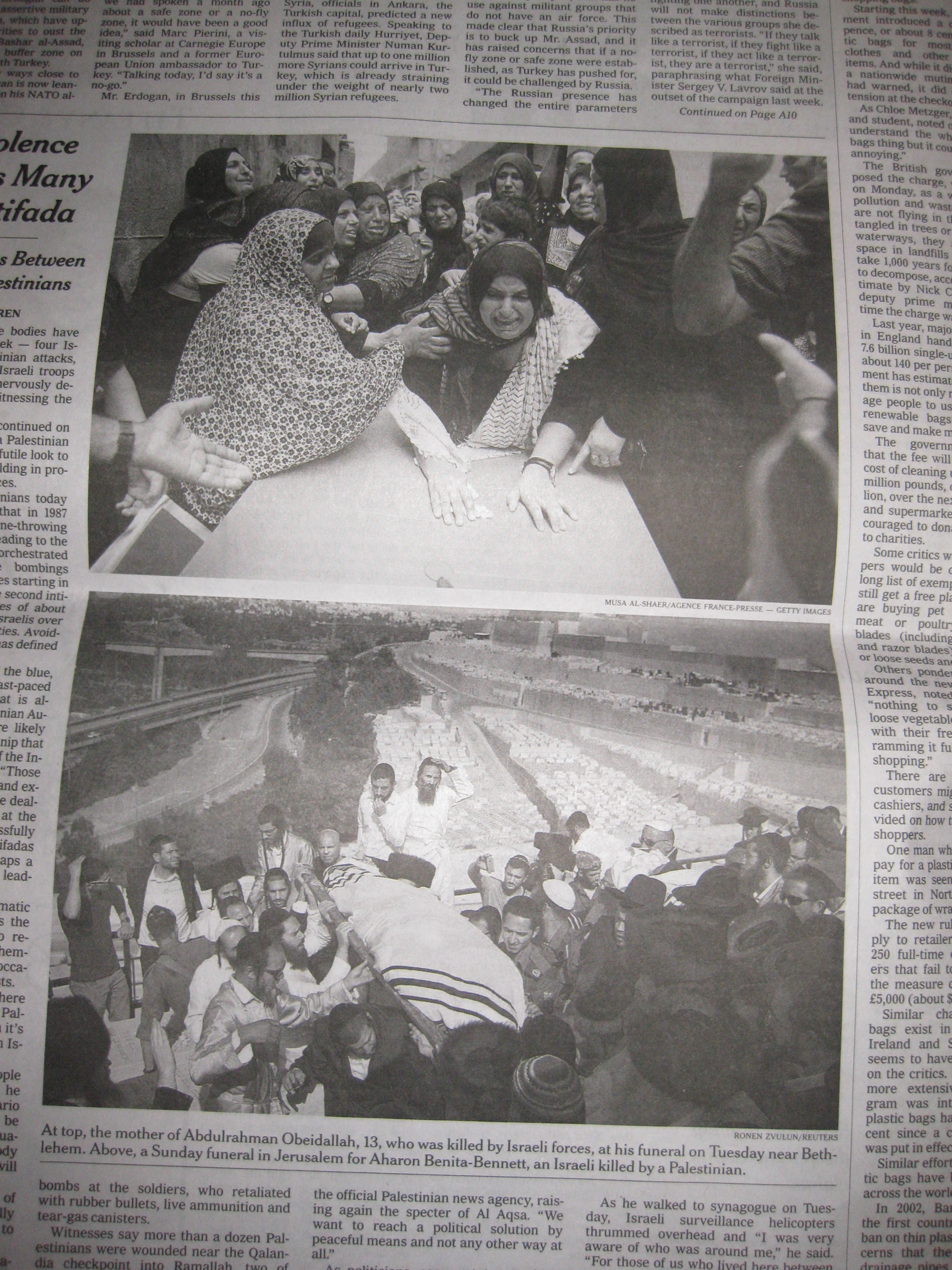
October 7 Page A4. “At top, the mother of Abdulrahaman Obeidallah, 13, who was killed by Israeli forces, at his funeral on Tuesday near Bethlehem. Above, a Sunday funeral in Jerusalem for Aharon Benita-Bennett, an Israeli killed by a Palestinian.” This was the Times only attempt at providing a “balanced” picture of deaths on both sides. However, there was no attempt to convey that the Palestinian was not shot intentionally, while the Palestinians deliberately were murdering Israelis.

IMG_3538
Only NY Times photo showing Israelis attacked during week October 7-14, 2015
included picture above of Palestinian killed

October 8 Page A6. “A Palestinian man in a flooded tunnel that was used to smuggle goods between Egypt and the Gaza Strip. Egypt has been flooding the tunnels to deter smuggling.” The large color picture and caption leads one to feel sorry for the Palestinian. Of course, what was not mentioned was that the “goods” that were being smuggled into the tunnels included weapons to target Israelis and Egyptians.  The article continued on page A14 with two black and white pictures.  The large picture’s caption “Juma Abu Shaer and his wife Masouma Abu Shaer, at home in Rafah. They fear they may have to leave because of flooding.” Names are given of people living in fear. You will not see that for Israelis over the week of terror attacks. The last small photo has a caption “The border between Rafah, in the Gaza Strip, and Egypt on the right. Egypt has flooded part of the nine-mile border area twice.” Such picture and caption confirms that the Times knows that many readers only glance over the articles and rely on the pictures and captions only.

The article about “Unrest Spreads in Israel Despite Tighter Security” which reviewed more Palestinian’s attacking Israelis had no pictures.  No Israelis were injured in unprovoked attacks for the news-in-pictures.

IMG_3536IMG_3537
Three sad Palestinian Arabs

October 9 Page A14. “An Israeli man looked over the body of a Palestinian assailant who was shot dead after carrying out a stabbing attack on an Israeli soldier and three civilians in Tel Aviv on Thursday.” Another article with larger picture “Palestinian protestors took cover during clashes with Israeli security forces on Thursday in Beit El, West Bank. Disputes over Jerusalem have added to tensions.” The pictures again show dead Palestinians and those under fire. There were no pictures of Israeli civilians who the Palestinian stabbed in unprovoked attacks. The “protestors” are not shown throwing Molotov cocktails and rocks.

IMG_3534IMG_3535
Dead Palestinian and one under attack

October 10 Page A4. Small color picture of soldiers over small boys “With security increased, Israeli border police told Palestinians on Friday they could not enter the Noble Sanctuary in Jerusalem’s Old City.” The caption fed a Palestinian narrative that the unrest is from Israeli soldiers keeping innocent Palestinians from praying at their holy site. The image of soldiers with weapons directing small boys add to the drama of the story. There were no pictures of Arabs harassing Jewish visitors on the Temple Mount nor firing firecrackers at the soldiers.

IMG_3527
Sad Palestinians Turned away by Israeli soldiers

Page A8: 2 color pictures. Very large crowd of Palestinians carrying wounded “Palestinians carried a wounded man on Friday in Gaza. It was the first time in the latest outbreak that significant unrest spread to the territory” smaller picture of man throwing stones “A Palestinian protestor hurled some stones at Israeli soldiers on Friday amid clashes on the Israeli border.” Again, Palestinians are shown injured, not Israelis.

Page A8 another article with medium color picture of Israelis taking wounded away “Israeli emergency personnel loaded a Palestinian into an ambulance on Friday after violent confrontations in the West Bank.” In the third article of the day, the Times once again chose to only show injured Palestinians in attacks that they provoked. None of the injured Israelis is pictured.

IMG_3524
Dead Palestinian

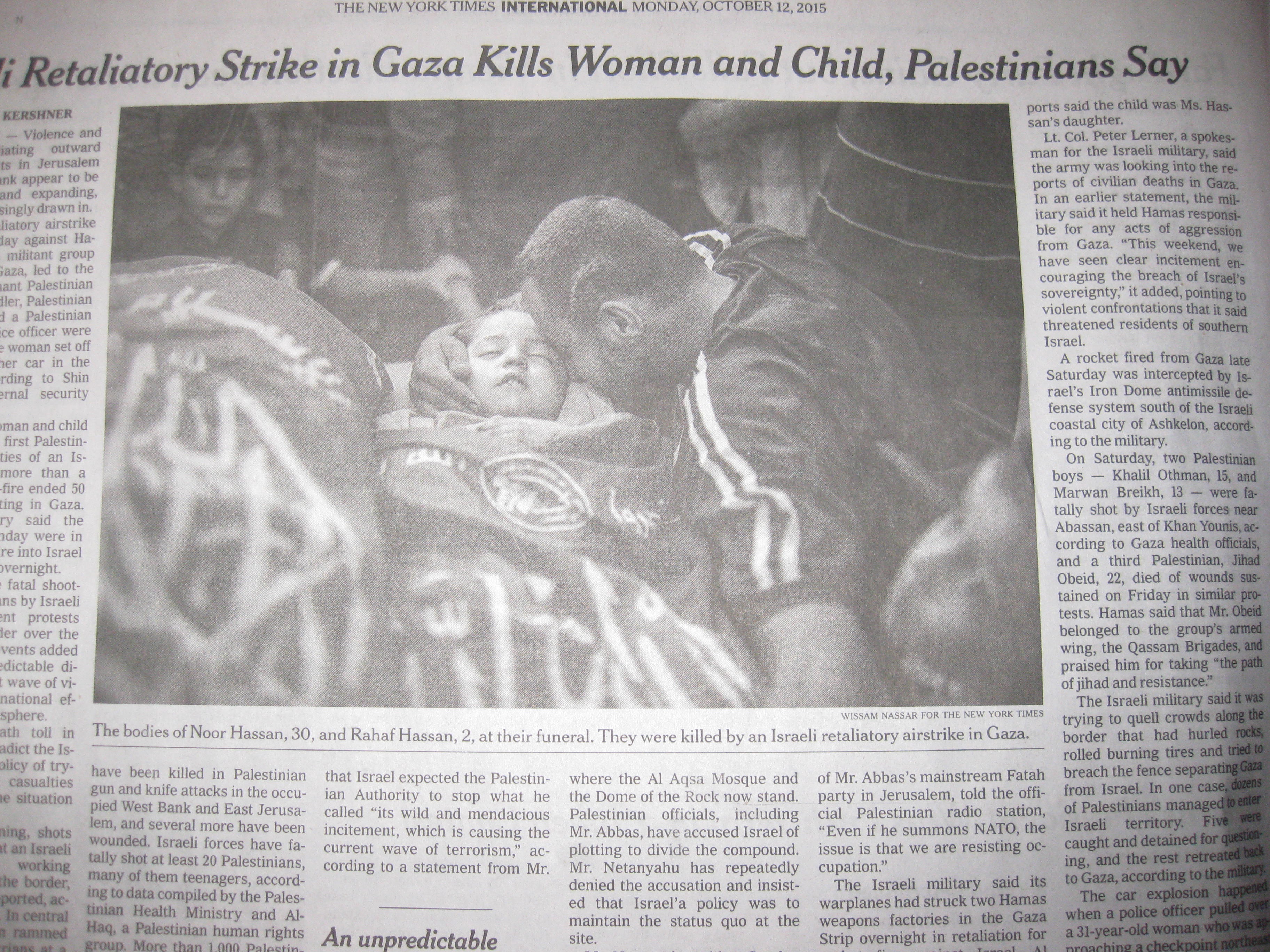
October 12 Page A6. Black and white of father over dead child “The bodies of Noor Hassan, 30m and Rahaf Hassan, 2, at their funeral. They were killed by an Israeli retaliatory strike in Gaza.” While the caption at least mentioned that the Israeli did a “retaliatory strike” conveying that Palestinians initiated the fight (compared to earlier language of a generic “confrontation”) the pictures are again only of Palestinians hurt in the conflict.

IMG_3520
Two dead Palestinian Arabs

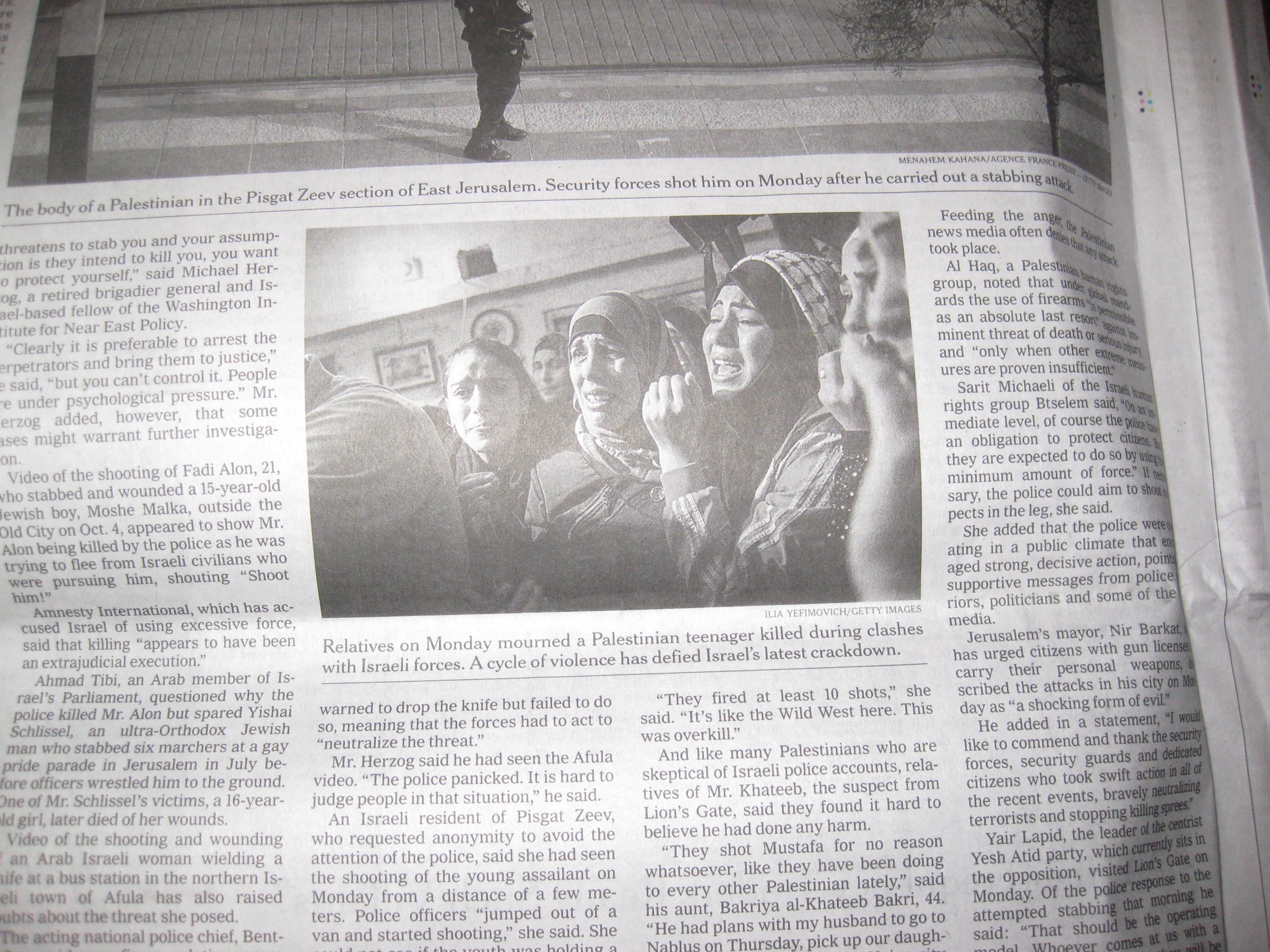
October 13 page A4. Two black and white photographs. The large photo caption reads “The body of a Palestinian in the Pisgat Zeev section of Eat Jerusalem. Security forces shot him on Monday after he carried out a stabbing attack.” The body of a partially dressed man lay on the ground surrounded by police.  The smaller photo showed women crying with a caption “Relatives on Monday mourned a Palestinian teenager killed during clashes with Israeli forces. A cycle of violence has defied Israel’s latest crackdown.

IMG_3529IMG_3530
Dead Palestinian and Grieving Palestinians

October 14 COVER PAGE: On a particularly violent day with Palestinian Arabs hacking people with meat cleavers and killing three, the Times covered an alternative news in its pictures. The front page large color photo of Palestinians running from Israeli tear gas with a caption “Palestinian demonstrators scattered Tuesday after Israeli forces fired tear gas during clashes in the West Bank city of Bethlehem.

IMG_3540
Cover page picture of Palestinians fleeing from Israeli forces

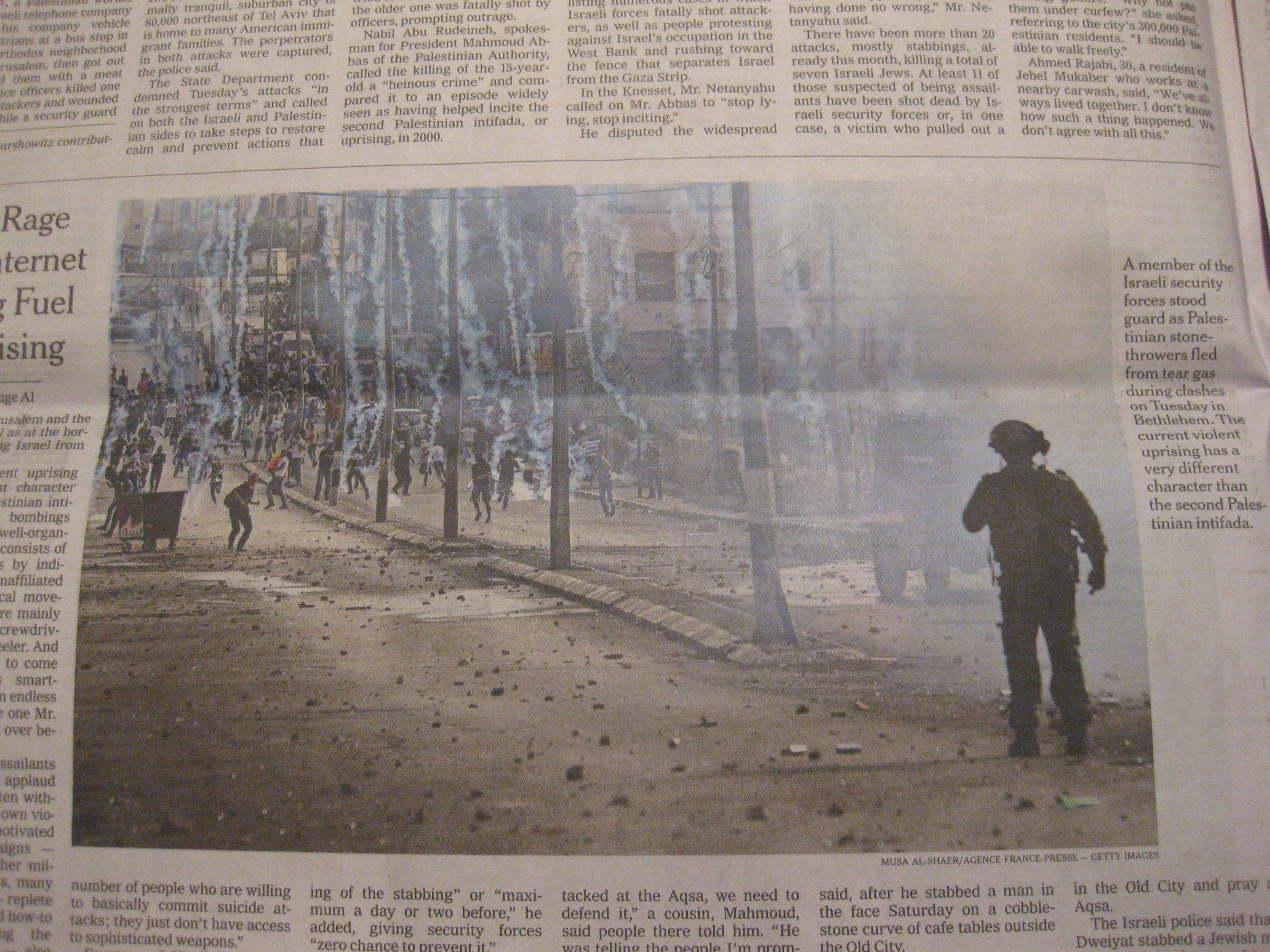
Page A8: The cover page story continued on page A8 with another large color picture of Israeli forces before Palestinians running from tear gas. The caption: “A member of the Israeli security forces stood guard as Palestinian stone throwers fled from tear gas during clashes on Tuesday in Bethlehem. The current violent uprising has a very different character than the second Palestinian intifada.”

IMG_3543
Palestinians fleeing tear gas

Page A8: Another story about the attacks medics pulling someone out of a bus. The caption: “Israeli emergency responders removing the body of a Palestinian from  bus where an attack took place in Jerusalem in Tuesday.” No Israeli victims covered from an unprovoked attack by a crazy Arab- note that no blame assigned for the “attack” in the caption.

IMG_3541
Dead Palestinian removed from a generic “attack”

In a week that saw dozens of unprovoked attacks on Israelis, it cannot be an oversight that the New York Times repeatedly chose to show only injured Palestinians. The Times deliberately decided to feed the narrative of Palestinian victimhood. The Israelis were seemingly untouched.

There are some researchers that argue that the media and social media are fanning the flames of the unrest in the Middle East by fanning “misinformation.” If so, the Times’ irresponsible journalism might be viewed as a war crime.


Related First One Through articles:

Every Picture Tells a Story: The Invisible Murdered Israelis

Every Picture Tells a Story- Whitewashing the World (except Israel)

Every Picture Tells a Story, the Bibi Monster

Every Picture Tells a Story, Don’t It?

The New York Times’ Buried Pictures

Subscribe YouTube channel: FirstOneThrough

Join Facebook group: FirstOne Through  Israel Analysis

Every Picture Tells a Story: The Invisible Murdered Israelis

In an Instagram and Twitter world, people expect their news in small tidbits. The major media sources have understood this and not only have taken to social media, but have their news stories include more pictures than they had previously. A review of their selection of pictures and captions provides an interesting snapshot of their views of the news.


Over a two week period in June/July 2015, seven major unprovoked attacks on Israeli Jews were committed by Palestinian Arabs. The Washington Post captured the anguish of the attacks with a picture of a grieving family which included a caption “Relatives of Malachi Moshe Rosenfeld, an Israeli settler who died in a car shooting attack on Tuesday near a Jewish settlement in the Israeli-occupied West Bank, cry during his funeral.”

The New York Times had no such pictures or description of Israelis suffering. Even while reporting on the region from many different journalists on June 24, 25, 26, 27, 28, 29, 30 and July 1 and 4

On June 27, the NYTimes made a small post without a picture in the World Briefing section in a blurb called “Man is Shot in West Bank After Opening Fire on Soldiers”. (journalist: Diaa Hadid)

On July 1, the NYTimes posted in the World Briefing section a blurb called “Man Died After West Bank Attack”. (Isabel Kershner)

These two attacks on Israeli Jews were completely invisible to a casual reader.

Another World Briefing report on June 24 without picture had a headline “Gazans Denied Access to Mosque.” (Diaa Hadid)

On June 30 Diaa Hadid had another World Briefing “Ship Halted in Blockade Protest

DSC_0101DSC_0105

On June 30, the NYTimes ran a larger article, also without a picture entitled “Worried that a Fasting Palestinian Prisoner Could Die, Israel Releases Him.” While there was no picture, the bold headline might have caught someone’s attention. The details in the article that the Palestinian prisoner was the spokesman for the terrorist group Islamic Jihad certainly would not have been recorded. (by Diaa Hadid)

Here are stories that the Times emphasized with pictures with their own terse storyline captions.

On June 29 the paper had an article which included a small map. The heading was “Israel plans Fence for part of Jordan Border.” (Diaa Hadid and Rick Gladstone)

On June 26, the Times included a small color photograph under an article called “Palestinians Deliver Accusations of Israeli War Crimes to International Criminal Court.” The picture of a group of people had a caption “Riad al-Malki, the Palestinian foreign minister, center, and delegation members on Thursday after submitting what they called evidence of Israeli war crimes to the court in The Hague.” (by Marlise Simmons)

On June 25, the Times posted two large black and white photographs as part of an article “Years after Massacre, a West Bank ‘Ghost Town’ Stirs.” The large picture was of Israeli soldiers walking past a store, while the smaller picture was of a man opening his store before four children. The single caption read “Israeli soldiers patrolling al-Sahla Street passed a reopened granary. Below, children watched as Mohammed Abu Halaweh briefly unlocked his butcher shop.” (by Jodi Roduren)

DSC_0099

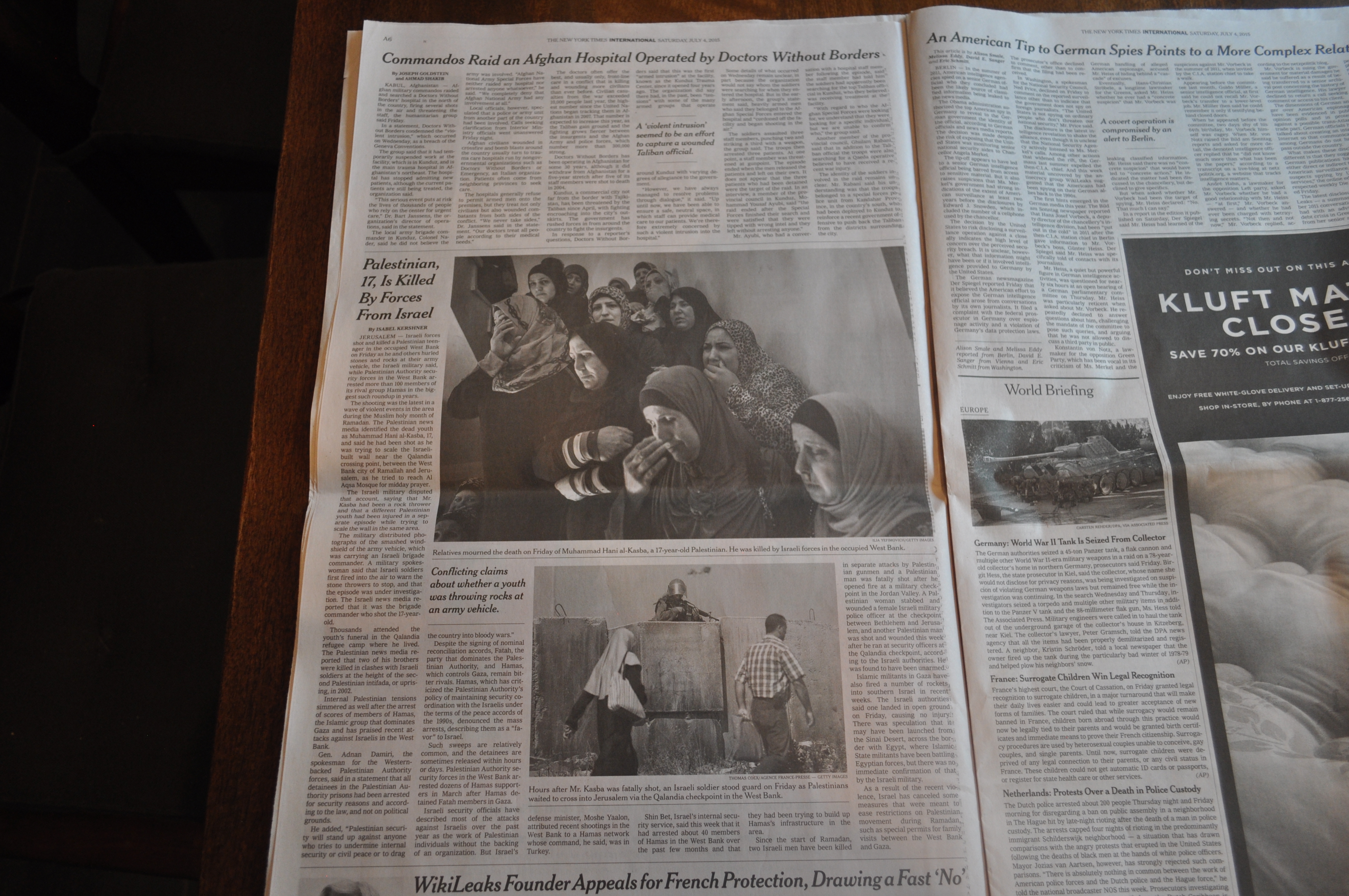
On July 4, The Times again posted two large black and white pictures alongside an article called “Palestinian, 17, is Killed by Forces from Israel.” The large photograph was of Palestinian women mourning with a caption “Relatives mourned the death on Friday of Muhammad Hani al-Kasba, a 17-year-old Palestinian. He was killed by Israeli forces in the occupied West Bank.” The smaller picture was of an Israeli soldier behind a barricade with two people walking before him. The caption read “Hours after Mr. Kasba was fatally shot, an Israeli soldier stood guard on Friday as Palestinians waited to cross to Jerusalem via the Qalandia checkpoint in the West Bank.” (Isabel Kershner)

DSC_0110

There was one news story which had two color pictures, albeit smaller than the two stories above. On June 28, the paper ran an article “Youth Chorus Unites Israelis and Palestinians, at Least for a Few Hours.” The two pictures were of a group of young men and women clapping and laughing. The caption read “Members of the Jerusalem Youth Chorus, above, took a break from rehearsing this month for their first United States tour. Micah Hendler, right, a Maryland native, founded the group.” (by Isabel Kershner)

DSC_0102

Contrast in Israeli Jews and Palestinian Arabs

The balance in the stories overall and in individual news reports was completely lacking in the New York Times.

First, consider the pictures and the stories they told: the Palestinians were dignitaries and everyday people going about life or mourning a death. They had names and professions. However, every Israeli that was pictured was a soldier and nameless. Even more, they were accused of war crimes.

Second, think of the seven attacks on Israelis Jews. They were treated as non-events and received no pictures or mention in the captions. The casual reader would not even know that such attacks occurred.

Third, review a specific story: The July 4 headline, pictures and caption would lead a reader to think that Israeli soldiers simply opened fire on a youth and that soldiers continue to patrol the intimidate the Arab population. The complete news report was that the Arab that was killed initiated an attack by hurling stones at Israeli vehicles, smashed the windows. It was in response to the Arab attack that soldiers got out of their vehicles and shot him. There were many pictures of the smashed car available that the Times could have posted as the second picture to show the complete story of the incident. Instead, it opted to convey a one-sided narrative of Palestinian Arabs as passive victims and Israelis as military oppressors.


The pictures and captions in the New York Times tell a specific narrative time after time after time: the Palestinian Arabs are passive victims under the oppression of the Israeli military. It is only these poor Arabs that suffer – unprovoked. Ordinary Israelis are not stoned, stabbed and murdered and are not subject to attacks by Palestinian Arabs. More, if there is any chance for peace in the region, it will come from Americans who will bring peace to the region.


Related First.One.Through articles

Every Picture Tells a Story, Don’t It?

Every Picture Tells a Story, the Bibi Monster

Every Picture Tells a Story- Whitewashing the World (except Israel)

The New York Times’ Buried Pictures

Educating the New York Times: Hamas is the Muslim Brotherhood

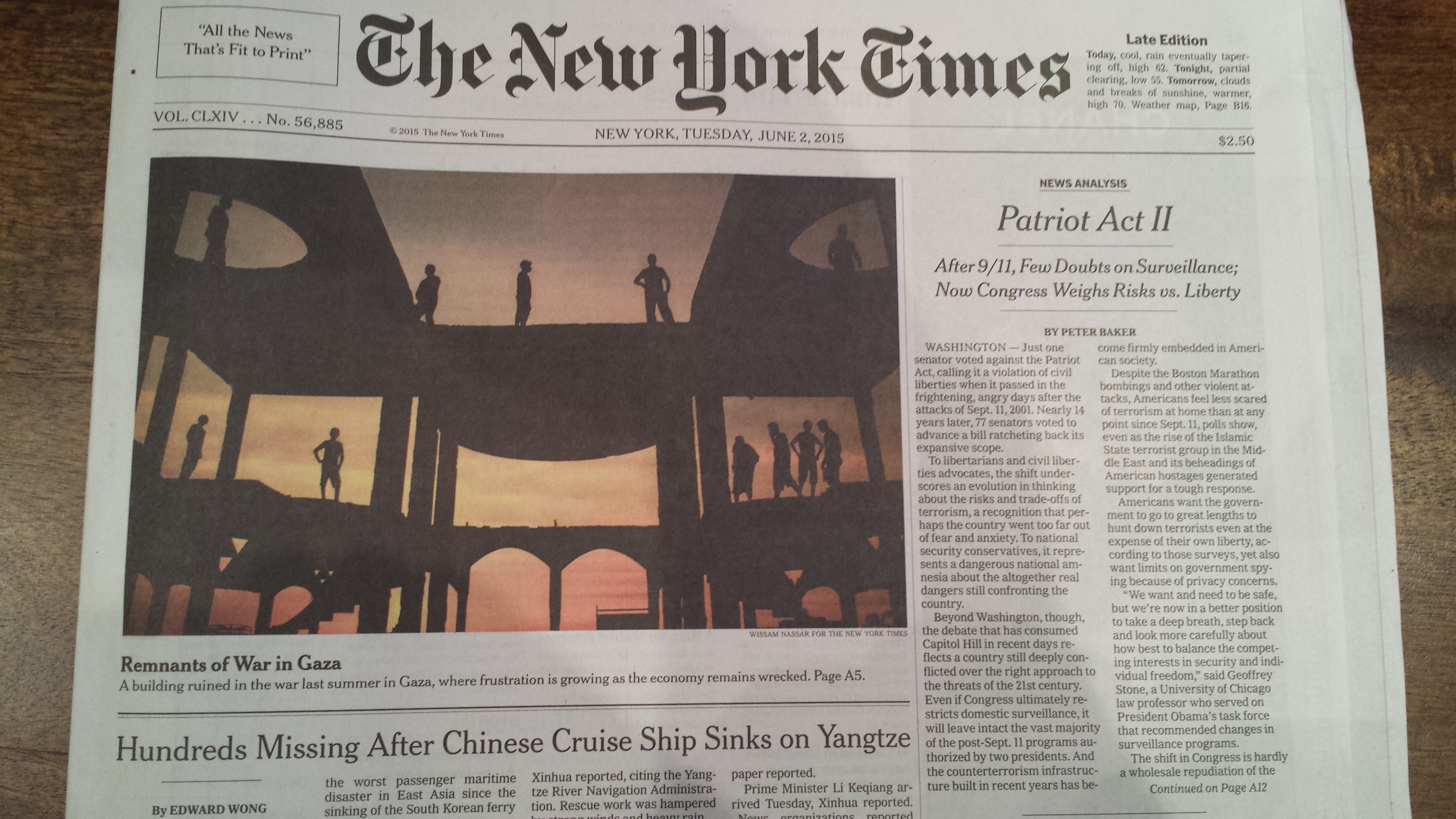
On June 2, 2015 the New York Times once again decided to tell the world that the people of Gaza are suffering.

20150602_201544
New York Times cover picture of Gaza,
June 2, 2015

With a large color picture on the front page, the Times included another picture and article inside regarding how the Gazan community has still suffered from a lack of money, jobs and rebuilding of the infrastructure one year after the war “between Hamas and Israel.”  If a reader ever wanted to learn about the scores of people killed in Nigeria, they would have to hunt inside the paper for an article on page A4 (with no picture).  If they wanted to hear about the dozens of Yemeni civilians killed by Saudi Arabia, they would have had to turn to page A12 the day before.  This has been a continuing pattern for the NYT, as outlined in “Every Picture Tells a Story – Whitewashing the World” where the killing of civilians around the world went under-reported, while the suffering of Gazans remained over-reported.

Another trend of the liberal press has been to not label Hamas a terrorist organization, as reviewed in “CNN’s Embrace of Hamas.”  The group simply is a political group dedicated to “resistance.”

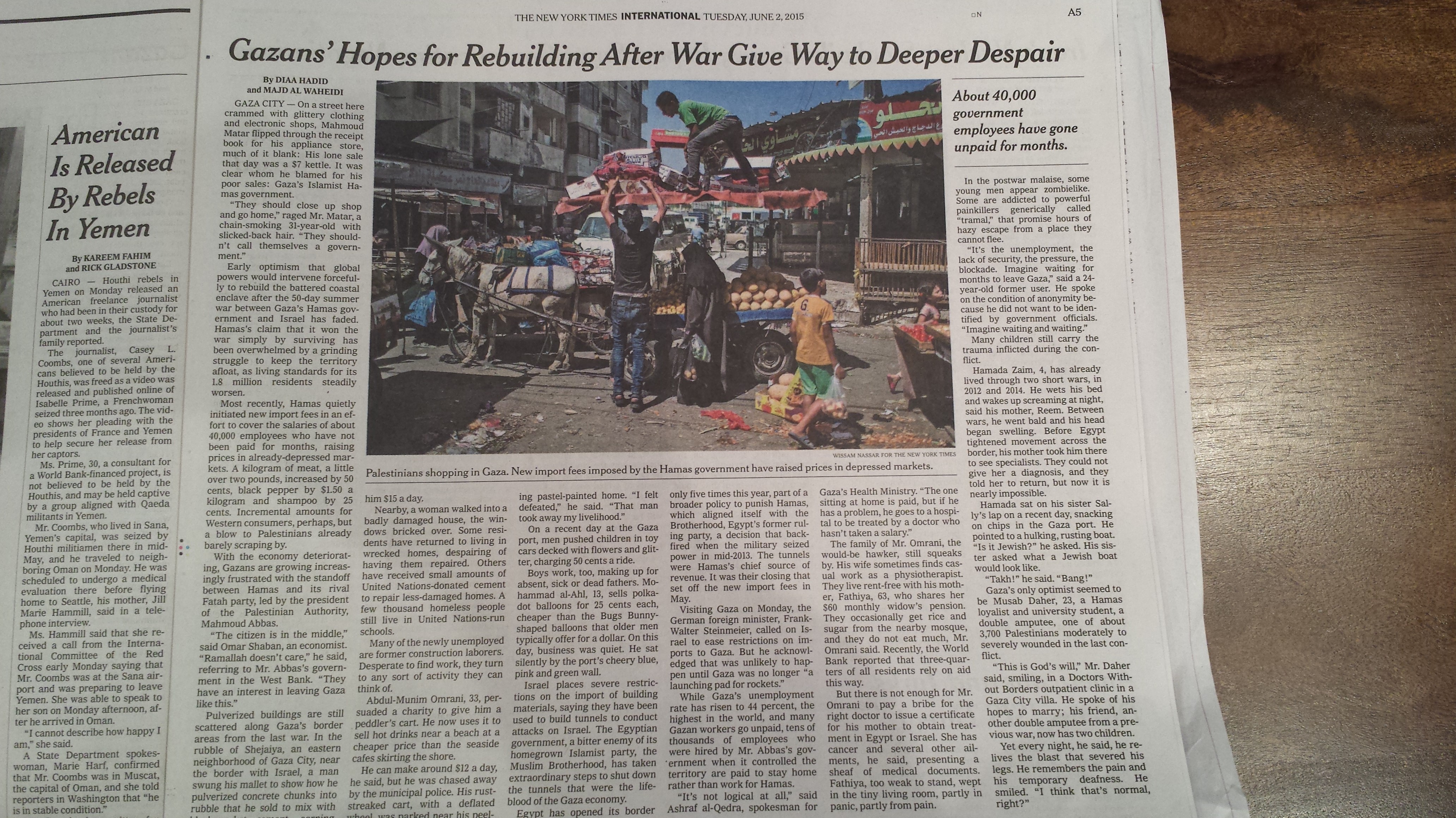
The June 2 NYT article “Gazans’ Hopes for Rebuilding After War Give Way to Deeper Despair” has continued to add to the trend of distancing Palestinian Arabs from Hamas, and Hamas from terrorism, as if everything that happened to Gazans was poor luck and happenstance.

20150602_201625

The article referred to the Palestinian Arabs’ “hope” and “Early optimism that global powers would intervene forcefully to rebuild the battered coastal enclave after the 50-day summer war between Gaza’s Hamas government and Israel “.  The article never discussed their hope that Hamas would destroy Israel.

The article detailed the blight in Gaza, stating “Pulverized buildings are still scattered along Gaza’s border areas from the last war. In the rubble of Shejaiya, an eastern neighborhood of Gaza City, near the border with Israel,” but did not discuss that the Shejaya neighborhood was the locus of dozens of tunnels from people’s homes into Israel to commit acts of terror.

It would appear that the NYT further wanted its readers to believe that the people of Gaza made a momentary strategic blunder in aligning itself with the Muslim Brotherhood in a “decision that backfired“:

The Egyptian government, a bitter enemy of its homegrown Islamist party,
the Muslim Brotherhood, has taken extraordinary steps to shut down the tunnels [connecting Egypt and Gaza]  that were the lifeblood of the Gaza economy.

Egypt has opened its border only five times this year, part of a broader policy to punish Hamas, which aligned itself with the Brotherhood, Egypt’s former ruling party,
a decision that backfired when the military seized power in mid-2013.

This is ridiculous.  Hamas IS an integral part of the Muslim Brotherhood. It didn’t simply “align itself” in “a decision that backfired.”  Here are quotes from the Hamas Charter (1988):

“Article 2: The Islamic Resistance Movement is one of the wings of Moslem Brotherhood in Palestine. Moslem Brotherhood Movement is a universal organization which constitutes the largest Islamic movement in modern times….

Article 7: The Islamic Resistance Movement is one of the links in the chain of the struggle against the Zionist invaders. It goes back to 1939, to the emergence of the martyr Izz al-Din al Kissam and his brethren the fighters, members of Moslem Brotherhood. It goes on to reach out and become one with another chain that includes the struggle of the Palestinians and Moslem Brotherhood in the 1948 war and the Jihad operations of the Moslem Brotherhood in 1968 and after.”

This is not subject to interpretation. Hamas is an integral part of the global Muslim Brotherhood movement, a group which has been actively banned and persecuted in Muslim countries such as Egypt and Syria for promoting terrorism.

However, such facts muddy a narrative of Palestinian Arabs as innocent victims.  Therefore, the media seems to have concluded that the best way to advance the victimhood tale requires a multi-part effort:

  1. Distance the people from the ruling government and negative reports. Minimize the fact that Palestinian Arabs voted for Hamas, which has led Fatah in every poll since 2006. Explain that the Arabs are frustrated by the Fatah corruption so had no practical choice other than voting for Hamas. Explain Palestinian Arabs being the most anti-Semitic people in the world by using terms like “not surprising” without delving into cause-and-effect.
  2. Stop calling Hamas a terrorist organization. Use terms like “militant” sparingly, and ideally, just “Islamist”.
  3. Refer to Hamas as a political entity. Which it is, like the Nazi party was a political entity elected by the Germans in the 1930s. Quote “political leaders” of Hamas often.
  4. Never refer to the Hamas Charter, which calls for the complete destruction of Israel; murder of Jews and never accepting any negotiated settlement. Skip the long, evil Jewish and Zionist conspiracy theories- those statements are just noise that cloud the picture of Palestinian Arab suffering.
  5. Localize Hamas to an Israeli resistant movement.  In a world that fears the dangerous rise of the Islamic State / ISIS, do not let Hamas get painted as part of a broader Muslim terrorist group (as described above).

If you follow these steps, the Palestinian Arabs can appear as passive victims and not as active participants in a radical anti-Semitic, anti-Western regional movement to install a Muslim caliphate.

Read the press today. Which rules are they using?


Related First.One.Through articles:

Cause and Effect: Making Gaza

The Death of Civilians; the Three Shades of Sorrow

Honor Killings in Gaza

The Palestinians aren’t “Resorting to Violence”; They are Murdering and Waging War

What do you Recognize in the Palestinians?

Extreme and Mainstream. Germany 1933; West Bank & Gaza 2014

The New York Times Major anti-Netanyahu Propaganda Piece

Summary: The New York Times once again showed its bias against Jews living on the west bank of the Jordan River by painting opinion as international law. It posted a large non news-article during the week of Israeli elections in an attempt to discredit Israeli Prime Minister Netanyahu.

On March 12, 2015, the New York Times ran a cover page story called “As Israeli Settlements take Root, So do Complications” and on its online version it was titled “Netanyahu and the Settlements”. The article repeatedly referred to something called the “Geneva Initiative” as if the initiative carried any backing or legal authority. In actuality, the 2003 initiative is most akin to a present day Facebook Group.

20150313_130018
New York Times large cover story on the “Settlements”

The Times wrote “Two-thirds of new construction over the last two years, the Peace Now report shows, was on the Palestinian side of a line drawn by the Geneva Initiative, an international working group that produced a model agreement in 2003…
Efrat, with nearly 10,000 residents, is to Israelis the capital of the Etzion block. Palestinians, though, do not accept it as part of the block at all,
because it is on the eastern side of Route 60 — their side of the Geneva Initiative map. Annexing it would be far more complicated.”

By reading such statements, one would think that Israel is deliberately building homes on the “Palestinian side” of a road, contrary to existing laws and/or agreements. Palestinians are comfortable with Jews living on one side of Route 60, but not on the other.  That is specifically what the NYT intends the reader to conclude by writing such an article. It is completely untrue.

The Geneva Initiative was launched by a handful of people- both Israelis and Palestinians. The civilians met during 2003 and drafted a guideline of how a two state-solution could emerge. None of the people participating were elected or appointed by any governmental body. Their initiative was not endorsed by any government. Neither Israelis nor Palestinians consider this old private working paper at all.

“the 2003 Geneva Initiative is most akin
to a present day Facebook Group”

Meanwhile ACTUAL laws and agreements were deliberately omitted from the NYT article. They include the 1922 British Mandate of Palestine which was signed by the League of Nations, the precursor to the United Nations. The Mandate stated:

  • Article 6: The Administration of Palestine, while ensuring that the rights and position of other sections of the population are not prejudiced, shall facilitate Jewish immigration under suitable conditions and shall encourage, in co-operation with the Jewish agency referred to in Article 4, close settlement by Jews on the land, including State lands and waste lands not required for public purposes.
  • Article 15: The Mandatory shall see that complete freedom of conscience and the free exercise of all forms of worship, subject only to the maintenance of public order and morals, are ensured to all. No discrimination of any kind shall be made between the inhabitants of Palestine on the ground of race, religion or language. No person shall be excluded from Palestine on the sole ground of his religious belief.

As described above, international law enabled Jews to live everywhere in Palestine. Such freedom of movement and the ability to buy land was also the case under the Ottoman Turks. This is history and law – not the opinion of a handful of private citizens.

The west bank of the Jordan River was an integral part of the 1922 British Mandate of Palestine.  It was annexed by the Jordanians in 1950, after Jordan attacked Israel in the 1948-9 war (such Jordan annexation was with approval of the Palestinians but never considered by the United Nations). The Jordanians illegally evicted all of the Jews from the area, including the eastern part of Jerusalem, counter to the Fourth Geneva Convention.

After Jordan (and the Palestinians who were Jordanian citizens) attacked Israel again in 1967, Israel was obligated to launch a counter-attack per The Hague Regulations which state:

  • Article 40: Any serious violation of the armistice by one of the parties gives the other party the right of denouncing it, and even, in cases of urgency, of recommencing hostilities immediately.

Jordan was therefore legally attacked by Israel.  The Jordanians officially gave up all claim to the land in 1988.

None of these international laws, agreements or actions on the part of governments are mentioned in this large cover story by the New York Times. Instead, the Times chose to paint a picture that Israel is not abiding to laws to make it appear as the belligerent party. It does this with the aid of a private working paper from 12 years ago.

20150313_130046
Double page story by the NYT, continued from March 12 2015 cover 

There was nothing new in the story which begs the questions:

  • Why give the article such prominence by placing it on the cover with a large color picture, and continue with a full two-page spread in the inside pages complete with pictures, maps and drawings?
  • Why use an old private Initiative to make an argument about the location of settlements instead of history and law?
  • Why post the article now?

The New York Times posted the piece as they want to see Israeli Prime Minister Netanyahu defeated in upcoming Israeli elections.  The Israeli elections will take place later in the week, on March 17, 2015.  The New York Times, which has a long history of attacking the Israeli Prime Minister, put this non-news story on the front page the week before Israeli elections to make it appear that Israeli Prime Minister Benjamin Netanyahu was acting outside of the law.

The Times has once again shown it is not a credible source of news and chooses to air its biased opinions throughout the newspaper.  It has also shown that it seeks to influence the outcome of foreign elections with large distortions.  An interesting piece of hypocrisy, as the day before, on March 11, the NYT posted an op-ed from Thomas Freidman arguing about Sheldon Adelson’s attempts to influence elections in the United States with major contributions to Republican candidates, as well as claiming Adelson’s Israel Hayom newspaper is a biased mouthpiece for Netanyahu in Israel.

Is the Times posting the opinion of Barack Obama or George Soros?


First One Through articles:

Legal settlements: https://firstonethrough.wordpress.com/2014/12/11/the-legal-israeli-settlements/

NYT’s Nicholas Kristof’s “Arab Land”  https://firstonethrough.wordpress.com/2015/02/27/nicholas-kristofs-arab-land/

NYT ignores Jihadists in Israel: https://firstonethrough.wordpress.com/2015/01/26/radical-jihadists-in-europe-and-dislocated-and-alienated-palestinians-in-Israel/

NYT minimizing Netanyahu’s election success: https://firstonethrough.wordpress.com/2014/08/11/new-york-times-talking-turkey/

NYT only using “West Bank” instead of “Judea and Samaria” https://firstonethrough.wordpress.com/2014/12/08/names-and-narrative-the-green-line-west-bank-judea-and-samaria/

Nicholas Kristof’s “Arab Land”

On February 26, 2015, Nicholas Kristof wrote an op-ed in the New York Times called “The Human Stain” that was more than flawed- it was wrong; it was more than anti-Israel, it was anti-Semitic.

Among the many incorrect and racist statements were his claims that the “West Bank” and “East Jerusalem” were Arab. Here are some quick thoughts about his statement that “nibbling of Arab land is just plain wrong.

IMG_2118
Judean Desert down to the Jordan Valley

Geography

The west bank of the Jordan and eastern Jerusalem are not part of the Arabian Peninsula. That landmass is located east of Israel. The borders of the region are surrounded by water on three sides (the peninsula) and the northwestern edge of Saudi Arabia is the land border.

The countries that constitute the Arab land in addition to Saudi Arabia are: Oman; Kuwait; UAE; Bahrain; Qatar; and Yemen. The Arabian Plate on which the peninsula rests includes parts of southern Jordan and southern Iraq.

Neither the Arabian Peninsula nor the Arabian plate cross the Jordan River, hence there is no geographical basis for referring to any land west of the Jordan as “Arab Land.”
Population

The “Arab Nation” spread beyond the Arabian Peninsula in the 7th and 8th centuries when Muslim invasion of neighboring lands brought Islam and Arabs to those areas. Those Muslim conquests brought Arabs to southern Spain called Andalusia. No one refers to Spain as Arab land today.

Politics

The Arab countries formed a “League of Arab States” which includes 22 countries. That group is political in nature and does not speak to the actual people and culture of the countries. For example, Syria was suspended from the League in 2011 due to its civil war. Palestine was admitted as a member in 1945 (the entire British Mandate of Palestine which includes Israel today) even though it was not an independent country.
To refer to the west bank of the Jordan as “Arab” because Palestine is a member state would also mean that Israel is an Arab state. Is that part of Kristof’s real message? Does he feel that Israel is not a valid entity and is occupying “Arab land”?

Ruby all Israel  29 (1)
Binyamin Region

Government Sovereignty

A “Land” is distinguishable from lowercase “land” in that one conveys sovereignty and ownership. The land on the west bank of the Jordan River is disputed land without independent sovereignty. Israel administers the land after Jordan attacked Israel in 1967 and subsequently lost the territory. Jordan gave up all claims to the land in 1988, including “East Jerusalem”. “Arab East Jerusalem” in capital letters makes no sense in any interpretation as sovereignty and administration belongs to Israel (albeit not recognized in much of the world) but the eastern part of the city is also not recognized, nor under sovereignty of Arabs, nor part of the Arab peninsula, and is 40% Jewish.

While many Palestinian Arabs claim the west bank of the Jordan as part of a future state and “East Jerusalem” as such state’s capital, the rule of the land is still in negotiations. As of this date, the land is much more Israeli than it is Palestinian.

Exclusivity

Liberals and progressives typically argue that no land should be the exclusive right of a single racial or religious group. No one refers to “White Selma” where only whites can live or “Black Harlem” where only blacks should be permitted to live.

While people refer to the Islamic State of Iran, Iran claims that it welcomes people of all faiths. Israel, the Jewish State, is 25% non-Jewish. Turkey, which is a secular Islamic state, is mostly non-Arab but has many Arabs living in the country.

Not only is the west bank of the Jordan not “Arab”, but the suggestion that it should be limited only to Arabs is racist and anti-Semitic. That policy was put into place under the Jordanian Arabs that attacked Israel in 1948 and expelled all of the Jews from the area including the eastern part of Jerusalem, counter the Fourth Geneva Convention.

IMG_4963
South of Bethlehem

Private Property

Land ultimately falls into two categories: private land and public land. Private land changes hands with the owner and is not considered to belong forever to a particular religion or people. One day it may be owned by an Arab, the next day by a Jew and the next by a WASP.

Public lands are administered by the government. As discussed above, the west bank of the Jordan is administered by Israel. The eastern part of Jerusalem was annexed by Israel decades ago.

Therefore neither the west bank of the Jordan River nor “East Jerusalem” can be considered “Arab land.”

History

For 400 years the Ottomans ruled Palestine and allowed Jews to live everywhere without restriction. They lived in Jericho and Jerusalem and throughout the region. The Ottomans welcomed the Yemenite Jews who founded Silwan in the eastern part of Jerusalem just outside the city walls in 1881 – in what Kristof terms “Arab East Jerusalem.

The international community gave the British the Mandate to govern Palestine in 1922, in which it specifically stated that the entire mandate – including Kristof’s “Arab West Bank” – “shall facilitate Jewish immigration under suitable conditions and shall encourage, in co-operation with the Jewish agency referred to in Article 4, close settlement by Jews on the land, including State lands and waste lands not required for public purposes” (Article 6). The mandate further stated in Article 15 “No discrimination of any kind shall be made between the inhabitants of Palestine on the ground of race, religion or language. No person shall be excluded from Palestine on the sole ground of his religious belief”.

 DSC_1020
Silwan, in the eastern part of Jerusalem, founded by Yemenite Jews in 1881

Countering the Bible

As detailed above, there is no basis for naming places “Arab West Bank” or “Arab East Jerusalem”.   To claim that any land inherently belongs to a single group is a direct lift from the Old Testament in which God gives the land of Canaan to the Jews. Jews have always considered the entire land holy for that reason. Modern claims that part of that land is inherently Arab (and not Jewish) is done to specifically counter the Bible and any Jewish claim to the land.

Of course, the Jewish faith that asserts that the land is holy has nothing to do with sovereignty or private ownership. Jews have always considered the land holy, even in 1400 when they had no sovereignty, and Jews today who do not own land in Israel. The land is holy to Jews, which motivates many Jews to move there.

Kristof’s claim that this specific land (the “West Bank” which didn’t even exist as an entity or term until recently) is Arab is meant to directly confront the Jewish belief that the land was given to Jews by God. Just as the Times never uses the Jewish terminology of “Judea and Samaria” to remove Jewish connection to this land, Kristof attempts to sever the Jewish connection by stating it is inherently “Arab”. It is wrong in fact and intention.

Jews have always and will always consider Judea and Samaria/ the west Bank of the Jordan as holy regardless of its sovereignty, or the religion and ethnicity of a person living in a house on the land. Such sentiments do not preclude any type of peace deal.

Kristof wrote that The 350,000 Israeli settlers in the West Bank — not even counting those in Arab East Jerusalem — impede any Middle East peace and stain Israel’s image,” can only be viewed as an obstacle to peace for racists that want a Jew-free state.

Attacking the Jewish faith is not a path to peace. Antisemitic calls for banning Jews from anywhere – let alone places they consider holy and lived in for thousands of years – is disgraceful.  The “Human Stain” is Kristof’s and those that share such sentiments.

New York Times Confusion on Free Speech

The attacks on the offices of the satirical magazine Charlie Hebdo in Paris in January 2015 sparked a plethora of articles describing the freedoms of speech and press. The New York Times, like many other media sources, fiercely defended the right of people to offer their opinions, even if such views are unpopular. Despite the clarity of its overall stance, the paper appeared confused about “double standards” in its articles which failed to clarify and distinguish between free speech and hate speech.

In the NY Times lead front page story of January 14 referring to such “double standards”, the paper contrasted the right of Charlie Hebdo to make cartoons of the Islamic prophet Mohammed, to the arrested French “comedian” M’bala M’bala who stated that a Jewish journalist should have been killed in the Nazi gas chambers and that he considers himself like the terrorist who shot and killed four Jews in the Parisian supermarket. Neither clarification nor education was given about the differences and limits of free speech.

20150115_144909

The NY Times continued to confuse the public (or itself) in a story the next day by David Carr, which included the following:

  • “Not all the French were reveling in unbridled expression of speech. Dieudonné M’bala M’bala, a comedian who has made highly provocative statements since the shooting at Charlie Hebdo’s offices, was detained as an “apologist for terrorism” for statements he made on his Facebook page that were seemingly in support of one of the attackers.
  • His arrest highlights the fact that one man’s free expression is another man’s hate speech or sedition. In Israel, the conservative Jewish newspaper HaMevaser scrubbed out the German chancellor Angela Merkel from a photograph, along with other female leaders who had participated in a solidarity march in Paris, because photos containing women are considered inappropriate in ultra-Orthodox publications.”

In an effort to educate the Times and its readership, here are three important points to distinguish between various types of speech:

  • Concept versus People
  • Active versus Reactive Incitement
  • Editing versus Censorship

 Concept versus People

A central dividing line between freedom of speech and hate speech has to do with the right to discuss concepts as opposed to the right (and limit) to discuss people. Everyone is free to say anything they want about concepts such as: capitalism, communism, Islam and Buddhism. Whether it is religion or economic theory, each topic is considered a concept worthy (perhaps?!) of discussion and debate in a positive or negative fashion. However, speech can descend into “hate speech” (or libel) which is banned by many countries, if people attack either groups or specific human beings.

For example, Louis Farrakhan, a bombastic anti-Semitic Muslim preacher referred to Judaism as a “gutter religion”. He was not brought up on any charges, despite the hateful speech. Egyptian leader Mohammed Morsi was not prosecuted for calling Jews the descendants of monkeys and pigs, which could have perhaps been classified as hate speech in some countries because he addressed people rather than a religion.

 Active versus Reactive Incitement

A key factor in the distinction of permissible versus prohibited speech revolves around “incitement”. Many countries prohibit speech that incites violence, as does the recent United Nations Resolution 16/18. The UN language:

  • “condemns any advocacy of religious hatred that constitutes incitement to discrimination, hostility or violence, whether it involves the use of print, audio-visual or electronic media or any other means”

The phrase incitement to violence is clear. For example, when an imam in Germany called for killing Jews, that fell under hate speech to incite violence, and the country is now investigating that imam.

However, it is considered completely legal to say things that may involve “reactive incitement”, that is, saying something that may annoy people to the extent that they would use violence. To ban reactive incitement would stifle free speech completely which is what the press sees as the essence of the Charlie Hebdo assassinations. Just because Muslims were insulted by the publishing of cartoons of their prophet, their reaction cannot be the basis to ban that freedom of expression.

Based on the United Nations language, the incitement to discrimination would have to be explored further. Did Charlie Hebdo promote discrimination against Muslims? Was the paper simply making pictures of Mohammed or was it attempting to foster intolerance of all Muslims? The new United Nations law makes a distinction.

The M’bala M’bala calls for a Jewish journalist to be killed in gas chambers and supporting terrorists who killed four innocent Jews are calls for direct and indirect incitement to hostility and violence.  Acting Palestinian Authority President Mamoud Abbas praise for martyrs who slaughtered innocents could also be called incitement to hostility and violence.

dalal_popular_inauguration

Fatah officials at naming of Dalal Mughrabi square,
murderer of 38 civilians including 13 children

 Editing versus Censorship

Every media outlet edits their news stories. Papers constantly select only those parts of interviews that confirm a thesis it promotes to its readers. That is (theoretically) its right. Michael Moore edited interviews about global warming and the auto industry to convey a particular narrative that he wanted to portray in his movies. The public may ultimately view the half-stories they receive as accurate, half-accurate or completely inaccurate because of the known bias of the producers of the content.

However, no one considers editing to be a form of censorship or an infringement on the freedom of speech or press. If a paper opted to not publish a sports section, that is its right. If it crops a picture to focus on a particular image to reinforce its narrative, that is also its right. It may be bad journalism, but it is not censorship (and certainly not by a governmental authority).

In its ramble on free speech above, the New York Times highlighted the Israeli “conservative” newspaper Hamevaser’s choice to edit the picture of the Paris unity march to remove the female leaders. Hamevaser is run by and serves an ultra-Orthodox Jewish community (not politically conservative) that is against showing pictures of women due to their interpretation of modesty. Such action is a form of editing that newspapers engage in to meet the tastes of its readership. To somehow suggest that it is a form of Israeli censorship is absurd. Why would the Times possibly lump this example in with examples of freedom of speech and hate speech? It is completely off topic.


People in the western world rallied behind Charlie Hebdo because they see this situation as falling completely within the framework of free speech: it poked fun at a religion (a concept), not people (Muslims); and it did not call for any violence, rather the attacks came from a reaction from incensed Muslims. The case of M’bala M’bala has to do with inciting violence against people, and the Hamevaser picture has nothing at all to do with government censorship.

So how did the Times develop this list of irrelevant examples and not try to educate its readers (and actually confuse them with calling out “double standards”)?


Sources:

NYtimes articles and picture Jan 14: http://www.nytimes.com/2015/01/14/world/europe/new-charlie-hebdo-has-muhammad-cartoon.html

NY Times article January 15: http://www.nytimes.com/2015/01/15/business/media/flocking-to-buy-charlie-hebdo-citizens-signal-their-support-of-free-speech.html?_r=0

Louis Farakhan on Judaism: https://www.youtube.com/watch?v=NbrH3eUuA3U

Egyptian leader Mohammed Morsi calling Jews names: https://www.youtube.com/watch?v=JukaOi8pKzM

UN Resolution 16/18: http://www2.ohchr.org/english/bodies/hrcouncil/docs/16session/A.HRC.RES.16.18_en.pdf

German imam calling for killing Jews: http://forward.com/articles/202751/germany-warns-against-hate-speech-after-imam-calls/

PA Abbas praise for terrorists: http://www.algemeiner.com/2013/01/10/video-of-abbas-praising-hitler-supporting-mufti-terrorists-released-video/

Naming square and centers after terrorist who killed 37 civilians: http://www.palwatch.org/pages/news_archive.aspx?doc_id=1442

Related First One Through articles:

Blasphemy or terrorism: https://firstonethrough.wordpress.com/2015/01/12/blasphemy-or-terrorism/

Klinghoffer opera: https://firstonethrough.wordpress.com/2014/06/23/eyal-gilad-naftali-klinghoffer-the-new-blood-libel/