Words matter. Especially when a newspaper chooses them carefully.
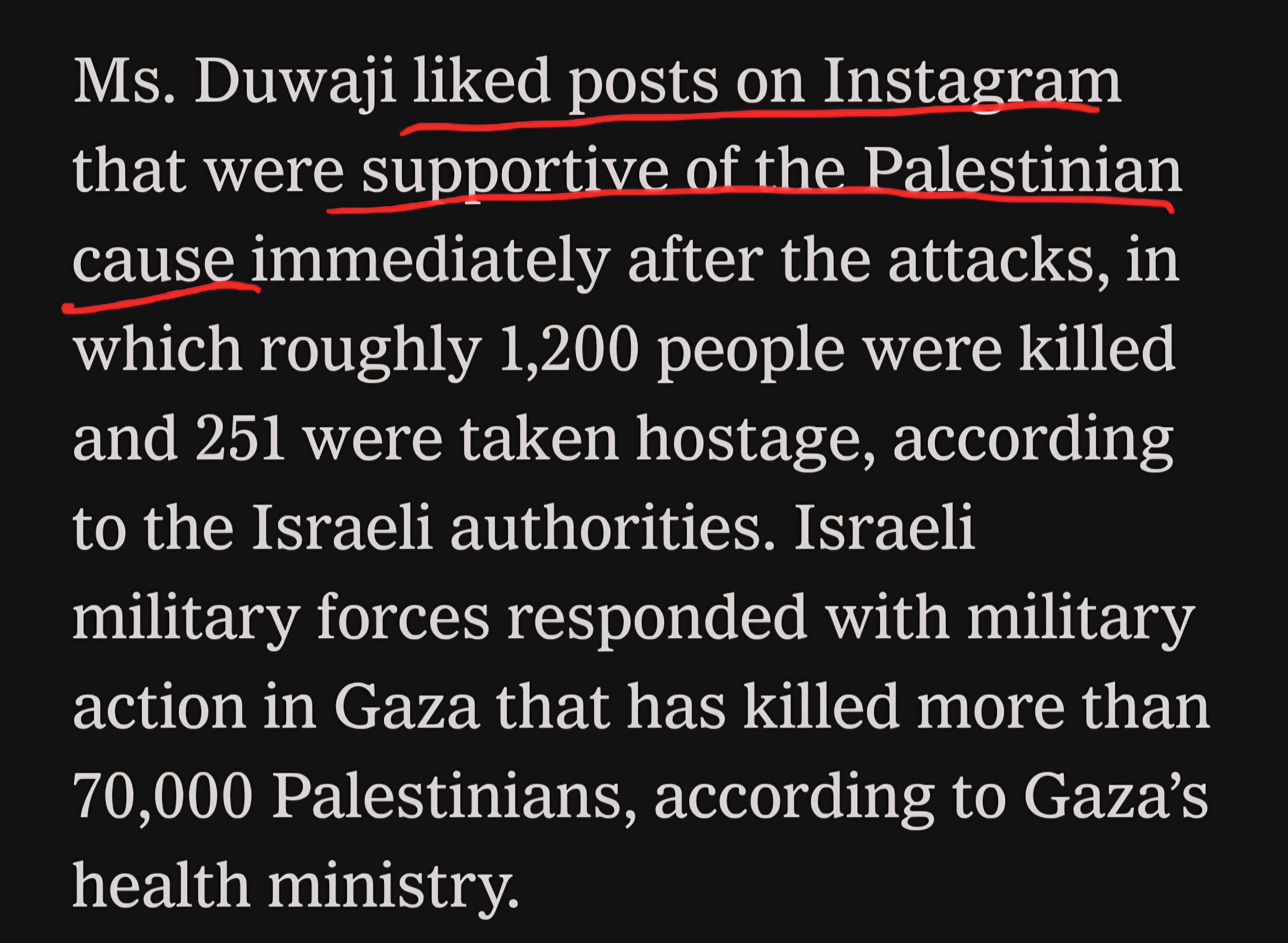
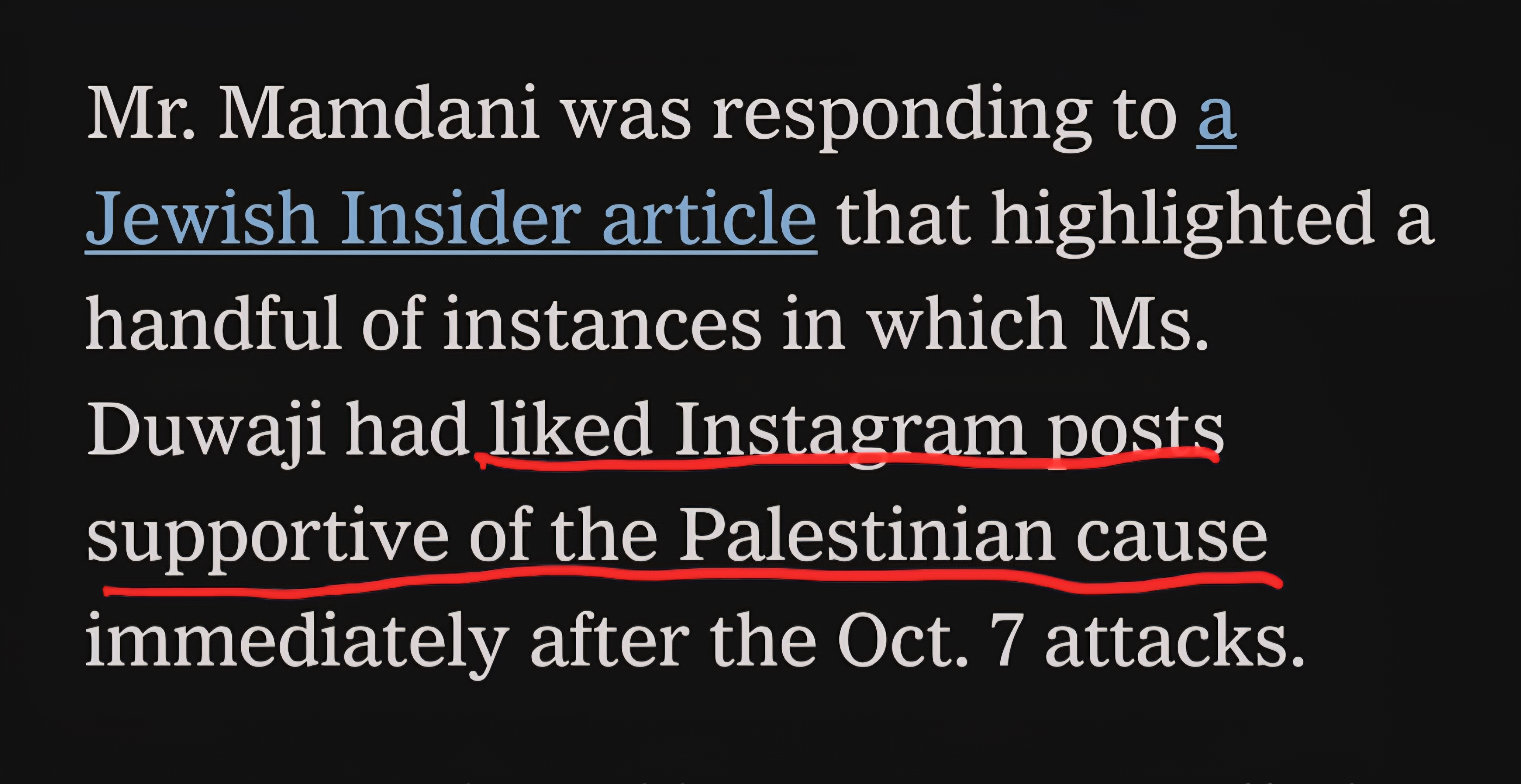
In a recent article, The New York Times wrote that New York City Mayor Zohran Mamdani’s wife, Ms. Duwaji had “liked Instagram posts supportive of the Palestinian cause immediately after the attacks,” referring to October 7.
Read that sentence again.
October 7 was the largest massacre of Jews since the Holocaust. Hamas terrorists murdered about 1,200 people, raped women, burned families alive, and kidnapped 251 civilians.
Yet approval of posts celebrating that moment is described by the Times as support for a cause.
A cause sounds political. Principled. Even noble.
But immediately after October 7 the images circulating online were not debates about borders or statehood. They were videos of murdered Israelis, kidnapped civilians, and triumphant Hamas fighters.
Calling appreciation of those posts “support for the Palestinian cause” launders the meaning of the act. The language turns approval of atrocities into activism. And it did the spin repeatedly.
Then the article pivots.
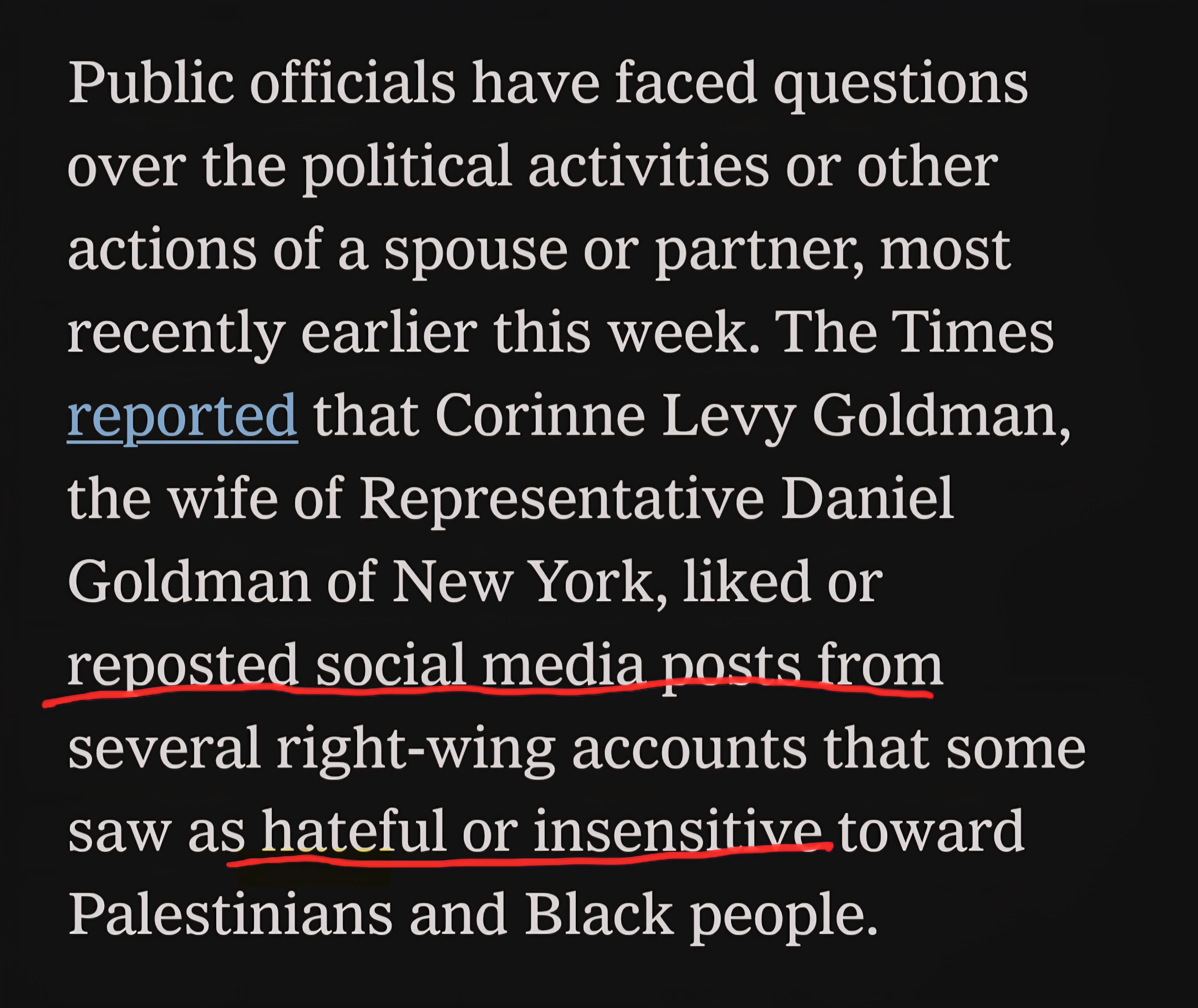
The Times raises concerns about a Jewish congressman from New York because his wife had “liked or reposted” posts from right wing accounts that some people considered hateful or insensitive.
So approval of posts DIRECTLY ABOUT a terrorist massacre is softened, while a Jewish public official becomes controversial through a chain of ASSOCIATIONS.
One situation involves praise for the moment Jews were slaughtered. The other involves subjective offense. Yet the newspaper treats them as comparable.
And this pattern did not begin here.
For years the Times has regularly described Israel’s elected government as “the most right wing in its history,” a political judgment embedded in news reporting. At the same time, the paper often avoids stating a simple fact: Hamas is a U.S.-designated terrorist organization.
So the judgmental language is applied freely to Israel and the factual label is avoided for Hamas.
Frighteningly, the framing has sunk even lower. The New York Times has moved from absolving terrorists to sanctifying the antisemitic genocidal terror itself as a “cause.”
It is a moral inversion that reflects a deeper rot in how the story is being told.
And it arrives at a moment when hostility toward Jews is rising once again across the world, seemingly with the endorsement of The New York Times.
In the legends of Prague, the Golem came into being when civic order failed Jews in predictable ways. Blood libels circulated, crowds gathered, and authorities hesitated at the decisive moment. Rabbi Judah Loew, the Maharal (c.1512-1609), recognized the pattern. He shaped a human form from the mud of the Vltava River—from the city itself—and animated it with sacred words. The choice of material mattered. The defender of Jews was made from the ground beneath their feet. Even if the city’s leaders would not protect Jews, the city itself would.
The Golem patrolled the Jewish quarter, broke the rhythm of violence, and restored deterrence. When the danger passed, it was deactivated and laid to rest in the attic of the Old New Synagogue, the Altneuschul. The legend recorded a hard truth: when the state falters, protection is improvised; when the state recovers, emergency power sleeps.
Altneuschul in Prague (photo: First One Through)
That memory traveled.
The melody of Hatikvah, the national anthem of the Jewish State of Israel, traces back through the musical world of that same Prague river Vltava, famously shaped by Bedřich Smetana (1824-1884). Exile and return share a river. The Golem embodies survival within exile; Zionism embodies the resolve to end exile. One guards a community where it stands, the other builds sovereignty so guarding becomes policy.
Yet the Golem never disappears. It waits for the moment when trust in authority thins again.
New York, Upper East Side
New York City holds one of the world’s largest and most visible Jewish populations. Jewish life here is open and proud. Synagogues, schools, and community institutions operate in public view, anchored by the assumption that their protection is a foundational duty of government.
That assumption has been tested.
On the Upper East Side in November 2025, an anti-Israel crowd swarmed a synagogue hosting a pro–Land of Israel event. The scene echoed an old shape: shouting at the doors of a Jewish house of worship, intimidation in a public park, the expectation that Jews would need to justify gathering openly as Jews. Instead of drawing a clear perimeter around the synagogue and condemning the mob, Zohran Mamdani, the incoming mayor of New York City, scolded the shul for holding a Zionist event, shifting the burden of restraint onto the Jewish institution.
For Jews who carry history close, the signal was unmistakable. Cities fail their minorities first through language, then through hesitation, and only later through force. When the synagogue itself surrounded by an angry crowd is framed as the problem, safety has become conditional.
Conditional safety never endures.
How the Modern Golem Forms
The Golem of New York does not rise from clay. It forms from memory.
Private guards appear where confidence once lived. Volunteer patrols lengthen into the evening. Parents coordinate entrances and exits. Institutions harden quietly, without ceremony.
These are the incremental steps of adaptation. Communities organize when clarity blurs. Parallel systems take shape when weak reassurance yields to experience.
Other minority groups get municipal funding and public declarations of support while Jews are only lumped into a general “other” category, as in White Plains, the capital of Westchester County just north of New York City. Jews learn that they must fend for themselves, because their basic protection offends many. Frighteningly, even for local politicians.
On the Upper East Side, a growing and proudly Zionist congregation bears a name heavy with inheritance: Altneu Synagogue. Old–New. It is a spin-off of the Park East Synagogue where the anti-Israel mob harassed and intimidated Jews. The echo of Prague’s Altneuschul may also prove prescient. Old dangers return wearing contemporary language. Rivers change. Cities change. But the logic persists.
Natan Sharansky, a famous Russian “refusenik” who was jailed for years before being allowed to leave to Israel, knows the dangers of antisemitic regimes. He came to Washington, D.C. in November 2023 to address 300,000 people about the need to fight back: “We, together, will fight against those who try to give legitimacy to Hamas. We will fight for Israel. We will fight for every Jew. We will fight against antisemitism. We will fight for the values and against corruption of those values which are at the center of our Jewish identity and American identity.”
For the moment, things may be OK. Mamdani appointed Jessica Tisch as police commissioner, a role she has had for several years. She is Jewish and no-nonsense leader, widely supported by the city’s Jewish community. If she can do her job without anti-Zionist and antisemitic politicians limiting her mandate, Jews will be fine. Otherwise, a new golem will rise in the New World, hundreds of years after the Golem of Prague went to sleep in the attic of the Altneuschul.
Abraham once defended the wicked on the merit of the righteous few. Today, the world defends the wicked for the sake of evil masses.
The Moral Math of Vayera In Parashat Vayera, God tells Abraham that Sodom will be destroyed for its depravity. The city is beyond saving — cruelty is civic policy, justice a mockery. But Abraham does the unthinkable: he defends the wicked, not because he excuses them, but because he believes that within their city a few righteous might remain.
“Will You indeed sweep away the righteous with the wicked?” (Genesis 18:23)
Abraham bargains God down — fifty, forty-five, thirty, twenty, ten. If even one percent (population of Sodom estimated 1,000) righteous can be found, the city deserves another chance. Abraham’s plea becomes the Torah’s first moral equation: mercy for the many on the merit of the few. He argues for the wicked because of the righteous – or perhaps for only the righteous to be spared.
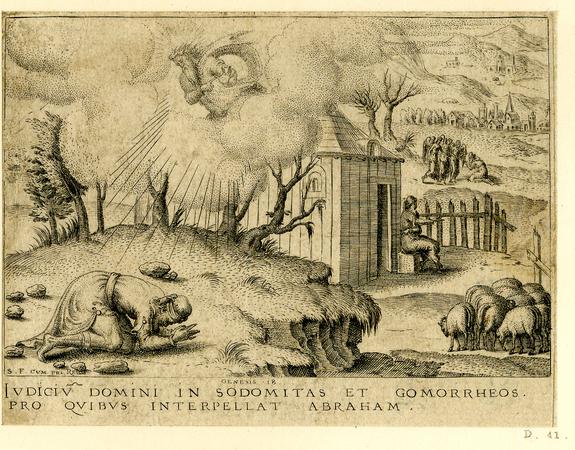
Abraham praying to God on behalf of the residents of Sodom and Gomorrah, by Étienne Delaune (1518-1583)
A Sordid Defense of Evil Four thousand years later, the moral logic has flipped. After the October 7 massacre — the torture, murder, and kidnapping of civilians — millions marched not to defend the righteous within Gaza, but to defend the wicked who carried out the atrocities. From London to New York, the cry was “Globalize the Intifada.” The United Nations would not even utter Hamas’s name.
They did not plead for ten good souls but glorified evil itself. Abraham argued for the guilty because he believed in goodness; today’s socialist-jihadists argue for the guilty because they despise Jews. That is not compassion — it is moral rot spreading far from the center of evil, infecting universities, newsrooms, and now city halls.
In Sodom’s time, no one defended depravity. Today, Genocide becomes “context.” Rape becomes “resistance.” Decapitation becomes “desperation.” Abraham fought for the 99 percent on the merit of the 1 percent righteous. Now we see millions fighting for the 75 percent wicked, based on the very actions of the depraved.
Nowhere is this clearer than in New York City — home to the world’s largest Jewish community — where activists chanting “Globalize the Intifada” and rape deniers will shape city politics. The descendants of Abraham are mocked as colonizers in their own synagogues and schools.
The Torah is silent on the punishment for those who aid and abet wickedness, but American law is not. The U.S. forbids “material support to terrorism.” Groups like CAIR face renewed scrutiny for Hamas ties; Students for Justice in Palestine has been banned from campuses for celebrating terror. Perhaps the law will finally catch up to those who glorify murder under the banner of justice.
Or New York City’s new mayor will bend and enforce the law to his own tune.
Abraham taught that one may plead for the wicked only on the merit of the righteous — never for the wicked in a moral void. The first is faith and mercy; the second, blasphemy and depravity. Today, we have lost the lesson, a moral stain on this generation.




 First One Through