The Book of the Maccabees lays out that the war against the Jews did not start with violence but with policy. The Syrian-Greeks initiated the battle by denying Jews their right to religious practice. Jewish life was made illegal through decrees and prohibitions, through the quiet insistence that Jews no longer have standing in their own holiest spaces.
The Temple Mount was seized. Jewish worship was banned. Foreign rites were imposed in its place. The text is precise and unsparing:
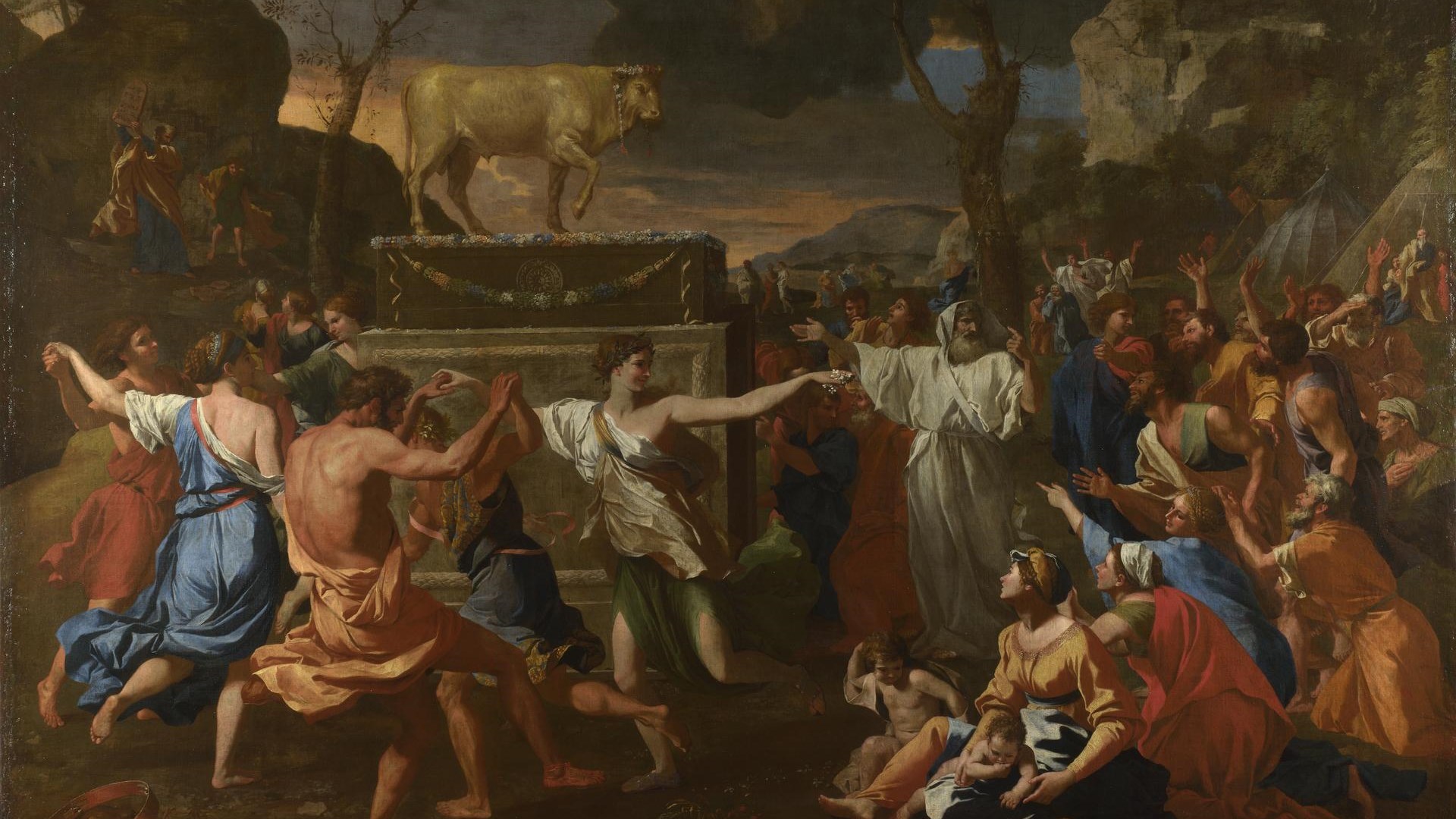
“And forbid burnt offerings, and sacrifice, and drink offerings, in the temple; and that they should profane the sabbaths and festival days…. They set up the abomination of desolation upon the altar, and built idol altars throughout the cities of Juda on every side.” —1 Maccabees 1:45,1 Maccabees 1:54
When the Maccabees returned to Jerusalem, the devastation they witnessed was total. The enemies of the Jews intended humiliation. A holy place was turned into a ruin so complete that nature itself began to reclaim it.
“They saw the sanctuary desolate, the altar profaned, and the gates burned. In the courts shrubs had grown up as in a forest.” — 1 Maccabees 4:38
Judas and his brothers refuse to accept erasure as permanent and took action:
“Then Judas and his brothers said: ‘Behold, our enemies are crushed. Let us go up to cleanse the sanctuary and dedicate it…. They tore down the altar and stored the stones in a suitable place on the temple hill until a prophet should come to tell what to do with them.” — 1 Maccabees 4:36, 44–46 “They purified the sanctuary and made another altar of sacrifice… and offered burnt offerings according to the law….They celebrated the dedication of the altar for eight days, and offered burnt offerings with gladness.“ — 1 Maccabees 4:48–56
And then memory was mandated.
“Judas and his brethren with the whole congregation of Israel ordained, that the days of the dedication of the altar should be kept in their season from year to year by the space of eight days, from the five and twentieth day of the month Casleu, with mirth and gladness.” — 1 Maccabees 4:59
Why legislate remembrance? Why must it be done with joy?
Because danger does not end with victory nor complacency. The danger is forgetting how erasure begins—how denial of access precedes denial of life. Enemies rarely announce extermination at the start. They begin by declaring Jews illegitimate, unworthy of presence, unfit to practice their own traditions.
Guard blocks entry of a Jewish man onto the Jewish Temple Mount at the Cotton Merchant’s Gate, because he is a Jew, in November 2025. (Photo: First One Through)
The Maccabees understood something timeless: when Jews accept exclusion as normal, the battle has already been lost. When they are told to make do with less than basic human rights demand, they can never really have a full heart.
Hanukkah is the refusal to let others define Jewish legitimacy. It is the insistence that Jewish rights—to worship, to gather, to exist openly—are not privileges granted by empires or overseers, but as the opening lines of America’s Declaration of Independence state, “endowed by their Creator.”
There are moments when a headline tells you everything by what it refuses to say.
A mass shooting took place at a Hanukkah party in Sydney, Australia. A Jewish holiday. A Jewish gathering.
Yet when major global outlets reported the story, something curious happened.
The New York Times headline did not mention Jews. Only the sub-header caught the significance of the attack, but did not say Jews were targeted.
More disturbing, follow-up articles did not focus on the horrific spike in antisemitism in Australia these past two years. Instead, the Times posted an article about… Bondi Beach, and how beautiful and popular it is.
The BBC followed a similar path. So did The Guardian. So did others like CNN. The event was flattened into abstraction: a “shooting,” a “disturbance,” a “tragedy,” untethered from identity.
By contrast, The Telegraph named Jews. The Jerusalem Post did as well. The New York Post and CNBC, too. Al Jazeera did not. Actually, Qatari-owned Al Jazeera attempted to whitewash the entire incident that there was “no information.”
This divide is not accidental. It reflects something deeper and more uncomfortable.
Because at the same moment that major Western media hesitated to name Jewish victimhood, the global Jewish community had no such confusion. WhatsApp groups lit up within minutes. Videos circulated—not to sensationalize, but to bear witness. The injured were named, not as statistics but as people. Hebrew names were shared so strangers across continents could pray for them.
No one asked whether Jews had been targeted. They knew.
The only uncertainty discussed privately was not if the attack was antisemitic, but which strain of antisemitism it represented. Neo-Nazis? Radical Islamists? A lone actor steeped in online hate? Jews have learned, painfully, to recognize the pattern even before the authorities finish their press conference.
So why the hesitation in public framing?
Why is Jewish identity often erased precisely when Jews are attacked?
Part of the answer lies in a narrative trap the modern media has built for itself. Jews, especially Israeli Jews, are increasingly cast in a single role: power holders, enforcers, aggressors. In that framework, Jews are permitted to be actors—but not victims. Agents—but not targets. Perpetrators—but not innocents.
Victimhood, in today’s moral economy, is rationed. And Jews often find themselves disqualified from it in favor of victims of preference.
Naming Jews as victims complicates the preferred storyline. It disrupts the binary of oppressor and oppressed. It forces an uncomfortable reckoning: that a people portrayed relentlessly as powerful are still being hunted in synagogues, homes, and holiday celebrations—from Pittsburgh to Poway, from Paris to Copenhagen, from Jerusalem to Sydney.
And so the language softens. The identity disappears. The motive is delayed, blurred, or left unexplored. The story becomes about the setting, not the target. About the neighborhood, not the people. About ambience, not intent.
The question is not whether Jews are under attack. That is beyond dispute.
The question is whether the world’s most influential media institutions are willing to say so plainly—or whether Jews may only appear in headlines when they are accused, never when they are wounded.
Part of the answer to the disgraceful shrug to the barbaric October 7 massacre in Israel is the systemic brainwashing that has been going on, that Jews cannot be viewed as innocent victims. Even when they plainly are, half a world away.
Jerusalem is a city of gates. Stone thresholds worn smooth by centuries of feet. Arches that promise passage, and others that deny it.
Nowhere is this more literal—and more symbolic—than at the gates to the Temple Mount.
There are many gates along its walls. Some are sealed, some are ceremonial, and some are active. But in practice, Muslims ascend and descend freely through multiple entrances, while non-Muslims are funneled through a single ramp, tightly controlled, time-limited, and revocable at will.
Group of Muslim women come down from the Jewish Temple Mount at the Cotton Merchants’ Gate (photo: First One Through)
This is not accidental. It is policy.
Muslims enter through gates embedded naturally in the Old City’s fabric—the Cotton Merchants’ Gate among them. There, the walls are alive. Candy shops spill color onto the stones. Children’s clothing hangs in soft defiance of gravity. The scent of sweets mixes with dust and history. Life flows in and out, up and down, as it has for generations.
Jews, by contrast, are stopped.
They are turned away from nearly every gate. Not questioned. Not debated. Simply blocked.
Despite the Temple Mount being the holiest site in Judaism, Jews are told—by police, by signs, by precedent—that they may not enter as worshippers.
A solitary Jew is blocked from ascending the steps to the Jewish Temple Mount, the holiest location in Judaism, because he is a Jew. (photo: First One Through)
They are redirected instead to a single entrance ramp, detached from the Old City’s living arteries. The ramp rises from the edge of the Western Wall plaza, a vast open expanse that functions less like a neighborhood and more like a giant stone parking lot. From there, Jews may ascend only during narrow windows, under escort, forbidden to pray, forbidden to whisper, forbidden even to move their lips in devotion.
Jews are limited to prayer at the Western Wall, a supporting wall to the Temple Mount. The ramp to the Mughrabi Gate (top right) is the only gate of the ten operating gates where Jews can pass onto the Temple Mount, in limited numbers, at limited times. (photo: First One Through)
Jews are told to make do.
Make do with praying to a retaining wall of the Temple Mount. Make do with history filtered through permission. Make do with holiness at a distance.
This arrangement is often called the “status quo,” as if it were ancient, neutral, or inevitable. It is none of those things. It is modern. It is enforced. And it rests on a single premise: Islamic supremacy over the site requires Jewish silence at Judaism’s holiest place.
The irony is almost unbearable. Judaism sanctified this mountain long before Islam existed. The Temples stood here before the Qur’an was written, before the Dome of the Rock was imagined, before the word “status quo” could be used to freeze injustice in place.
And yet today, Jewish presence itself is treated as a provocation.
Not violence. Not disruption. Presence.
The gates tell the story more honestly than any diplomatic statement ever could. Gates that welcome. Gates that redirect. Gates that close.
It’s a caste system familiar to Black Americans. “For Whites Only” is now “For Muslims Only” for 90% of the gates to the Temple Mount. “Negro Entrance” read “Non-Muslim Entrance” is plastered atop a ramp in the far corner of the Temple Mount. While racial Jim Crow laws ended in the U.S. decades ago, Jews remain subject to open religious discrimination at their holiest location. At the insistence of the United Nations.
In Jerusalem, everyone speaks of coexistence. But coexistence cannot survive when one faith ascends freely and another is barred from its own summit.
On December 8, 1965, a crowd of 100,000 spectators assembled in St. Peter’s Square to mark the closing ceremony of Vatican II. The three years of work was orchestrated to bring about Christian unity, hoping to bring non-Catholics and Catholics together in a joint mission. The sixteen documents that the council enacted were designed on the theme of aggiornamento (Italian for bringing up to date) the Catholic church, which had started to be viewed by many as fading in relevance.
Pope Paul VI greets the faithful during the closure of the Second Vatican Council in St. Peter’s Square at the Vatican Dec. 8, 1965. (CNS/Catholic Press Photo)
The Second Vatican Council did not emerge in a Christian vacuum. It unfolded in the long shadow of Auschwitz, under the moral weight of a truth that could no longer be hidden: Christian Europe had stood by, silent or complicit, as the Jewish people were hunted, deported, and incinerated. The murderers were not pagan invaders; many were baptized Christians. The trains did not run through lands hostile to Christianity; they passed churches, crossed Catholic villages, glided along tracks laid in the heart of Christendom.
In 1961, the world could no longer avert its eyes. The Eichmann trial in Jerusalem forced every nation, every church, every conscience to watch. Survivors spoke in court with the clarity of witnesses resurrected from the grave: the collaborators, the bystanders, the bureaucrats, the bishops who said nothing, the priests who closed doors, the institutions that rationalized their silence. The trial tore away the last veil protecting Christian moral innocence. It was a moment when the Church had to confront not only the sins of individual Christians but the theological soil in which hatred had grown.
Trial of Adolph Eichmann in Jerusalem, Israel in 1961 (Photo: Bettmann / Getty)
Against this storm of reckoning, another seismic event had already taken place: the re-establishment of the Jewish state in 1948. For nearly two thousand years, Christianity had preserved an image of the Jew as the wandering witness, condemned by God to homelessness so Christians could inherit the promise. But suddenly, the wandering stopped. The Jewish people returned to their ancient homeland. Hebrew was resurrected from liturgy into daily speech. Jewish sovereignty reappeared as if history itself had refused to obey the theological script.
Israel’s rebirth shattered the Christian narrative of Jewish exile more forcefully than any sermon ever could. It reopened questions buried since the early Church Fathers: What does it mean if God’s covenant with the Jews never ended? What does it mean if the Jewish people still live, still dream, still return? What does it mean when prophecy looks suspiciously like news?
Israel declares itself a new country on May 14, 1948, to take place officially the following day May 15, which was Shabbat, coinciding with Britain ending its mandate.
By the time the Vatican convened, the Church was wrestling with two cataclysms: the moral collapse of Christian Europe during the Holocaust and the miraculous revival of the Jewish nation that Christian theology had relegated to the margins of history. These two realities — failure and fulfillment — created an impossible tension.
One of the sixteen Vatican II documents, Nostra Aetate (October 26, 1965) was not merely a doctrinal correction. It was a confession, an apology, a theological revolution. It declared the Jews not rejected but beloved, not guilty but enduring, not a fossil but a living partner in covenant. It rejected antisemitism “at any time and by anyone.” For Christians, it was liberation from a poisoned inheritance. For Jews, it was an unexpected invitation to be seen — perhaps for the first time — not as shadows in another people’s story, but as a people with a story of their own.
And something else began in the wake of Vatican II, something few would have predicted: the rise of Christian Zionism in its modern form. Many Christians, freed from the contempt of supersessionism, looked upon the Jewish state not as an accident of geopolitics but as a fulfillment of ancient promise. Some of Israel’s strongest supporters today come from Christian communities shaped by the theological revolution Vatican II inaugurated. They see Jewish sovereignty as evidence not of colonialism but of covenant, not of power but of destiny. They stand with Israel not out of political calculation but out of spiritual gratitude — an act of repentance and solidarity woven together.
Christian leaders assemble at the Western Wall in Jerusalem, observing Jewish prayer in November 2025 (photo: First One Through)
For Jews, this support has been both a blessing and a riddle. After centuries of persecution in Christian lands, how does one accept the embrace of former adversaries? How does a people long defined by suspicion learn to trust a hand that once struck but now extends in friendship? The Jewish story, once shaped by surviving Christian hostility, must now grapple with receiving Christian loyalty. The sting of history meets the strange balm of reconciliation.
These questions unfold in a nation — the United States — whose own identity has been shaped by Judeo-Christian roots from its earliest days. As the country approaches its 250th birthday, Americans are rediscovering that its foundational ideas — human dignity, moral law, liberty of conscience — flowed from a biblical inheritance shared by Jews and Christians alike. The Founders read the Hebrew Bible not as relic but as roadmap. The Exodus shaped the imagination of revolutionaries and abolitionists. The prophets shaped the conscience of Lincoln and King. The Jewish story is woven into the American one, even when America failed to honor it.
Rabbi Meir Soloviechik leads a tour of Christians and Jews at the Metropolitan Museum of Art in New York City, discussing the Judeo-Christian roots of America through art, in September 2025 (photo: First One Through)
Now, as antisemitism again rises and institutions fray, the old alliance becomes newly urgent. Jews and Christians are bound not by accident but by destiny: two peoples who share scripture, share moral vocabulary, and share responsibility for sustaining a civilization built on covenant rather than empire. Vatican II made it possible for this bond to be spoken aloud again, freed from the hostility that had once obscured it.
December 8, 1965 created a new Christian. But it also created a new Jew: a Jew who could stand in relationship not only to Jewish history but to Christian history, not only in resistance but in dialogue, not only as survivor but as partner. A Jew whose identity could be affirmed by the very institutions that once erased it.
And perhaps, as America steps toward its 250th year, this renewed bond is not merely theological or historical. It is a reminder that the future of Western freedom may depend on the same truth Vatican II finally proclaimed: that the Jewish people are not a footnote in someone else’s story, but the root from which so much of our shared moral world has grown.
People assume the moon is a universal constant. A simple shared celestial orb rising and falling across planet Earth.
At first glance, that seems right. The phases of the moon follow the same cycle for everyone. The waxing crescent in New York is the waxing crescent in Nairobi. The full moon bathing Buenos Aires is the same one brightening Beijing.
But the details betray the simplicity.
Because of Earth’s curvature and tilt, the angle of the moon changes depending on where you stand. In the northern hemisphere, the crescent opens to one side; in the southern hemisphere, it opens to the other. Near the equator, the crescent often lies on its back like a cup collecting light. The horizon line shifts the moon’s ascent and descent, making the same moon feel subtly unfamiliar across latitudes.
Phases of the moon in northern and southern hemispheres
So while the moon itself is constant, the human experience of it is not. Geography shapes perception.
Which brings us to a particular location: Jerusalem.
Why did ancient Jewish sages insist that the new month—the very heartbeat of the Jewish calendar—could only be declared there? Why could only witnesses standing in that one city testify that they had seen the first thin sliver of the new moon? It wasn’t because Jerusalem had the sharpest skies or the best astronomical vantage point. Other regions had clearer air, lower humidity, more favorable horizons.
The choice was not scientific. It was cultural.
The sages understood that if the Jewish calendar were anchored anywhere else—in Babylonia, in Alexandria, in Rome—it would become a local calendar. A diaspora calendar, and reflection of exile. Time would belong to the places where Jews merely lived, not the place where they belonged.
And so they declared: the Jewish month begins only where Jewish destiny begins. In Jerusalem.
The moon in Jerusalem is not visually unique. It does not shine brighter, hang lower, or reveal a different pattern of craters. What is different is what it carries.
Elsewhere, the moon is a mechanism of light in the night. In Jerusalem, it is a messenger and message.
In the city, it rises over stones worn by millennia, over a city that has been destroyed and rebuilt and prayed toward more times than any other on earth. Outside of Jerusalem, generations of Jews looked to that moon to mark the days of their wandering. Prisoners in Soviet cells whispered its phases in the dark. Families in medieval Europe and North Africa opened their windows each month hoping for a sliver that someone in Jerusalem might already have seen.
For them, the new moon was a signal: Somewhere, in the city we lost, time is still ours.
The moon is the same everywhere, but meaning is not. For Jews, the appearance of the moon in Jerusalem was the moment when wanderers and exiles, merchants and mystics, shepherds and scholars all re-entered the same story, no matter how far they lived from its setting, regardless of their own particular vision of the moon.
The world sees a reflection of the sun’s light in the moon. Jews see a reflection of their unique common heritage, and permanent tie to Jerusalem.
There are endless scams in New York City. People forge deeds, steal equity, and prey on desperation every week. Almost none of those crimes get elevated to a national morality tale.
So why did The New York Times choose a particular case and present it as it did?
A headline about home theft. A photograph of a visibly Orthodox Jew in a courtroom to lead the story. A description of victims “from minority communities.”
The message was unmistakable: A Jew stole from vulnerable minorities.
The Times could have reported the crime without turning it into a racial and religious showdown, yet it chose not to.
If his religion played no role in the scheme, then it had no business in the article. Yet the Times made sure every reader saw the kippah and beard, and read of his Orthodox clan coming to rally for the criminal: a greedy Jew stealing from the vulnerable.
The New York Times made a point of discussing the perpetrator being from the “Orthodox Jewish community“, even though the case had nothing to do with religion.
This did not land in a vacuum. Jews are being attacked in New York at rates that should horrify any decent newsroom. Anti-Jewish tropes about Jews stealing land, homes, and resources are exploding across campuses and city streets. It is standard stump propaganda by Democratic Socialist politicians.
Rep. Rashida Tlaib (D-MI) at a Democratic Socialist conference said of Jews: “they do it from Gaza to Detroit, and it’s a way to control people, to oppress people. And it’s those structures that we continue to fight against. I know you all understand the structure we’ve been living under right now is designed by those who exploit the rest of us, for their own profit.“
If the victims were Orthodox Jews and the offender was a member of another minority group – a majority-minority group like Blacks or Latinos – does anyone believe the Times would blast the offender’s ethnicity and splash a religiously identifiable photo across the top of the page?
Absolutely not. They would call that incitement.
This is a pattern. Mainstream media outlets have spent the last decade profiling Jews as:
They would never speak this way about any other minority group. But when the subject is Jews, especially Orthodox Jews, suddenly it’s acceptable to present them as predators and everyone else as their prey.
That is not journalism. It is character assassination dressed up as social justice.
And it does this in the backdrop of the election of a Ugandan immigrant, Zohran Mamdani who has trafficked in antisemitism, to be the new mayor of New York City. A man supported by the Black and Latino communities and opposed by the Orthodox Jewish one. A man who focused on the affordability crisis of living in New York City, with scaffolding provided by the Times about how corrupt Jews make it impossible for poor immigrants to live in the city.
The New York Times made a point of discussing the perpetrator being from the Orthodox Jewish community, even though the case had nothing to do with religion.
Propaganda does best when there are elements of truth. It does best when the fire has already been lit and the mob is seeking red meat to fuel the passion. The Times is feeding the beast and clearing an auto de fe for Jews to be marched through the streets.
There was a time when respect was earned by learning. People who studied hard, accumulated degrees, mastered facts and logic were admired. They didn’t need followers; they had knowledge. They didn’t need virality; they had depth.
That world is gone.
Fame today is not built in libraries or laboratories but in the palm of a hand. A ring light replaces a classroom. A viral clip replaces a thesis. And the more lurid, outrageous, emotional, and dishonest the content is, the faster the fame spreads. The algorithms demand provocation, not proof. They reward outrage, not understanding.
And people are responding exactly as the system intends: they’re dropping degrees, skipping college, deciding that years of expensive education aren’t worth it in a world where clout is free and clicks are currency. AI will write the papers anyway. Tuition is a fortune. Morality is optional. Why struggle through years of learning when you can fabricate a persona, press “upload,” and watch the world react?
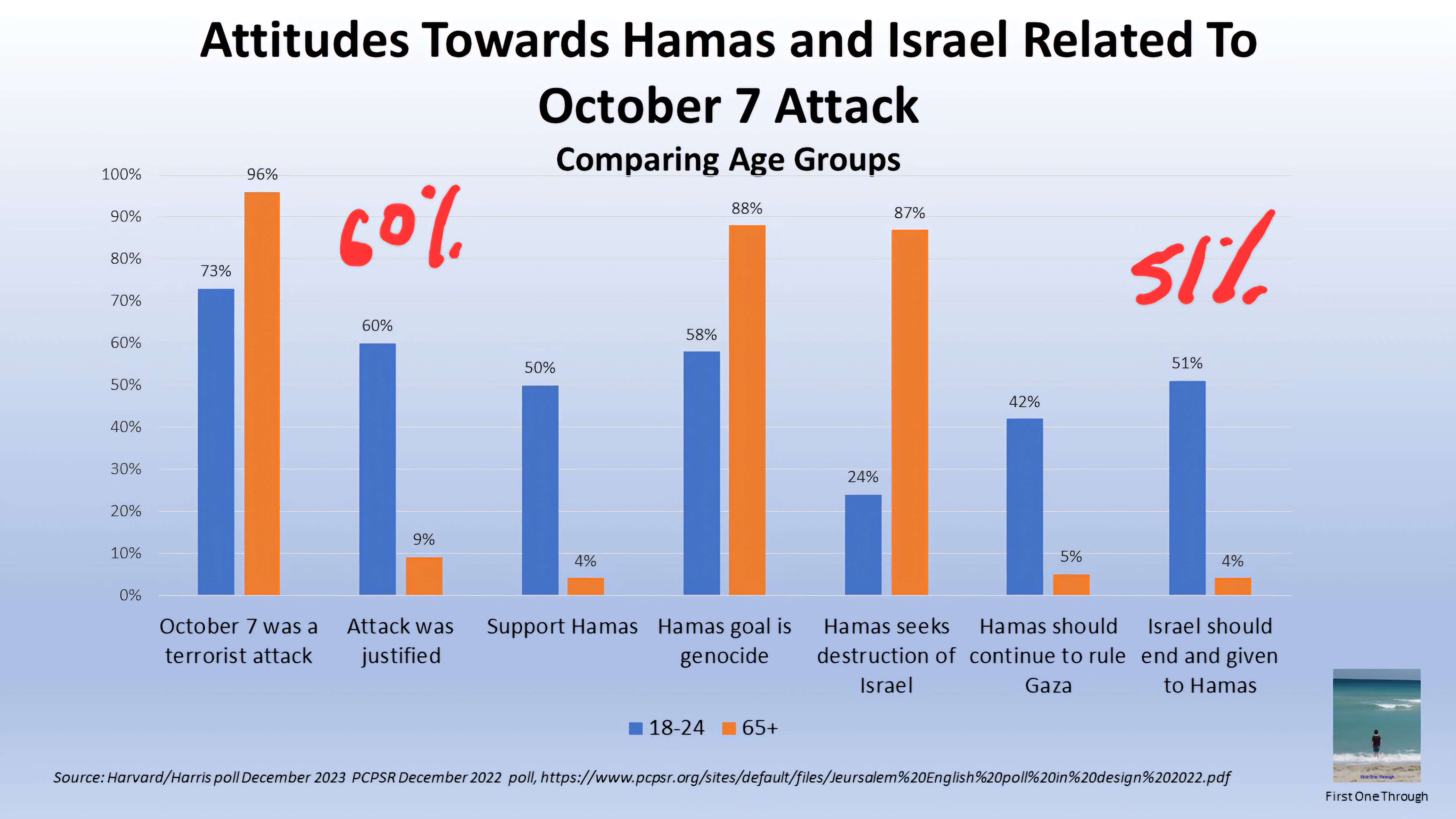
For the first time in history, the older generation will have far more education than the young. Degrees are becoming relics. Expertise is becoming an antique. And winning hearts and minds through argument — the old democratic ideal — is becoming a luxury.
Politics is drifting toward the young, the uninformed, the inflamed, the furious, the ones who know how to play the game of attention better than the game of truth.
Hasan Piker doesn’t win debates; he wins followers. Comedian David Smith isn’t famous for jokes; he’s famous for attacking fellow Jews, because tearing down your own people brings clicks in a sick digital economy.
And here is the crisis for the Jewish people: We are the People of the Book trying to survive in a world where books don’t matter. We are a civilization built on reason, argument, text, questioning — and we cannot comprehend why we’re losing the PR battle against influencers who deal only in emotion, rage, and spectacle.
We fight with facts. They fight with feelings.
The socialist-jihadi crowd celebrates Hasan Piker showing up at Zohran Mamdani’s victory party
We build logic. They build engagement.
We look for truth. They look for traction.
And so a terrifying question hangs in the air: Must Jews abandon their values to survive? Must we trade nuance for noise? Must we jump into the sewer of social-media fabrication because that is the only battlefield the world seems to care about? Must we out-viral our enemies just to protect ourselves from the lies, the hatred, and the persecution that spread faster than any truth we offer?
Or is there a third way — a way to fight fiercely without becoming the thing we oppose? A way to compete in the digital arena without destroying the intellectual soul that has kept us alive for 3,000 years?
This is the defining challenge of the modern Jewish experience. Not whether we can win a debate — we always could. But whether debate still matters.
And if it doesn’t, then the Jewish people must decide how to defend themselves in a world where vanities, not virtues, are the currency of influence.
The People of the Book didn’t choose this kind of world. But we must learn how to survive it — without losing who we are.
Every political movement faces the same question: what do you do with the bad people in your camp?
Ezra Klein, writing in The New York Times, argues that Democrats should welcome everyone under their banner — no matter how extreme — because inclusion wins elections. He calls it the big tent: forget purity, just make sure they call themselves Democrats. It’s politics over principle, and power over conscience.
Republicans, by contrast, still try to draw a line. When groups like the Heritage Foundation flirt with extremists such as Tucker Carlson or Nick Fuentes — men who traffic in grievance and racism — many conservatives recoil. To them, the party label still carries moral weight. You can lose elections, but you shouldn’t lose your soul.
And then there’s Hamas — the third model. When Hamas decides someone in its own ranks isn’t loyal enough, it doesn’t debate inclusion or expulsion. It breaks their legs in the street. It executes them in public. For Hamas, politics is not persuasion or debate; it is terror enforced by fear. That’s how it keeps power — absolute, unchallenged, and bloodstained.
The Temptation of the Big Tent
Ezra Klein’s “big tent” philosophy played out in real time with Zohran Mamdani’s win in New York City. The Democratic Party opened its doors to a wholly different ideology and welcomed it inside to secure a victory. But at what cost?
The party platform now stretches so far that it’s unrecognizable — and to many, repulsive. In its desperation to confront unified Republican power in Washington, the Democrats chose to absorb the fringe rather than confront it. The price of inclusion was coherence.
For illustration, imagine a Jewish newspaper facing a business dilemma:
A group like Jews for Jesus wants to buy an ad. The editor must decide: Do we take the money? Do we run it in the name of inclusion and open debate? Or do we reject it as off-brand, offensive, and disloyal to our readership?
Most would choose the last. They’d rather forgo the check than cheapen their identity.
But the Democrats have made a different calculation. The party tasted the fringe, saw no backlash, and convinced itself there’s no downside. It’s as though that Jewish paper ran the Jews for Jesus ad — and the subscribers applauded. So what’s next? An ad from the KKK? Pork recipes for Passover? How far can inclusion stretch before it becomes desecration?
Power, Principle, and the Price of Brand
Republicans have power so can afford to maintain their brand by shedding radicals. Hamas maintains power by shedding blood. Democrats, desperate to gain power, are willing to shed consistency.
Three models emerge to rule:
The Democrat: inclusion for victory
The Republican: exclusion for integrity
The Islamist: execution for control
Each reveals a truth about how institutions face the corrupting pull of power.
Politics, like publishing, isn’t just about what you include — it’s defined by what you refuse to print. A brand without boundaries isn’t brave. It’s broken.
Of course the masses would like consistency and inclusion and integrity and peace on the streets. But they have come to realize that politics is power, and they want power. When Congress was a bell curve with little difference between Democrat and Republican, there was general ambivalence about elections and the impact on people’s daily lives regarding who was in power. Not so in today’s barbell society with extremists dominating politics.
The Jewish Community
What does the Jewish community do with groups like Neturei Karta that join the worst of the anti-Israel protests and fly to Iran for Holocaust denial conferences? With Jews who voted for a mayor who supports “globalize the Intifada”?
Neturei Karta protesting a march against antisemitism in New York City, January 2020 (photo: First One Through)
Neturei Karta is a small fringe group that mostly keeps themselves isolated, so in practice, there needn’t be an active response. But there were an estimated one-third of Jews in New York City that voted for Zohran Mamdani, including public officials and celebrities. There was a big turnout in younger Jews voting for Mamdani, estimated at two-thirds of those under 44 years old.
How does the Jewish community react when a majority of young Jews are viewed as putting the broader community at risk? Which model does it follow, or is the question more complicated as one’s Jewishness cannot be shed like political affiliation, and being a Jew is not about attaining power.
And is the conclusion in the observation? Politics is about power and people take actions depending on the environment to obtain or maintain power. However, Judaism shuns power, and seeks to live a religious life of one’s choosing without external influence.
Mandy Patinkin endorsing Zohran Mamdani for mayor, president and emperor
Jews, while always small in number, have always had a very large and wide tent because they don’t get to decide who to include and exclude for their numbers. They only decide who should be included in their associations – in their shuls, schools, umbrella groups.
In May 2021, young anti-Israel Jews were calling Israeli engagement with Palestinian Arabs “apartheid” and “genocide’ (well before Hamas’s 2023 War on Israel), and some were thereby fired from teaching positions at Jewish schools. At Upper East Side Yeshivat Ramaz, alumni pressured the Principal Emeritus Haskel Lookstein to not speak at Donald Trump’s 2017 inauguration. Jews shut down other Jews for their comments and associations.
I do not believe that there is a single answer for what Jews should do with kinsmen who are regarded as beyond the pale. Historically, in a bell curve political dynamic with moderate antisemitism, the radical could be ignored as noise. However, in today’s barbell political reality, with heightened antisemitism, active measures need to be considered regarding the bad apples.
Much of the attention on the Balfour Declaration—issued on November 2, 1917—focuses on the United Kingdom’s pledge to “facilitate” “the establishment in Palestine of a national home for the Jewish people.” Israel-haters rage at this clause, claiming that Jews had no historical connection to their ancestral homeland and that Britain had no right to “hand over” immigration rights from local Arabs to Jews.
Balfour Declaration
On the anniversary of the Declaration in 1943, Heinrich Himmler of Nazi Germany sent a telegram to the “Grand Mufti” of Jerusalem that Nazis and Arabs had the same enemies – Jewish invaders. In 2016, the President of the Palestinian Authority, Mahmoud Abbas demanded an apology and reparations from Britain for issuing the Balfour Declaration, having repeatedly failed to destroy the Jewish State.
Telegram from Heinrich Himmler to Amin al-Husseini on November 2, 1943
But there’s another part of that same document that antisemites also detest. The closing line reads:
“…nothing shall be done which may prejudice the civil and religious rights of existing non-Jewish communities in Palestine, or the rights and political status enjoyed by Jews in any other country.”
That final clause—protecting Jews’ rights around the world—is precisely what modern antisemitic movements are trying to undermine. Groups like Within Our Lifetime, CAIR, and the Democratic Socialists of America openly campaign to dismantle what they deride as “Jewish power” in America.
They smear Jews as self-serving “capitalists,” accuse them of exploiting “Black and Brown bodies” for profit (as Rep. Rashida Tlaib has said), and seek to push Jews to the margins of public life—all because Jews affirm that the land of Israel is their homeland.
A century after the Balfour Declaration, its promise remains under attack—not only in the Jewish homeland but wherever Jews dare to live proud and free.
There are signs on the streets of London that read “LOOK RIGHT.” They are painted boldly on the pavement to protect visitors—especially Americans—who are used to glancing left before stepping into the street. In the U.K., traffic comes from the opposite direction, and those who rely on old instincts can find themselves in sudden danger.
So it is now with American Jews.
For generations, they have turned instinctively to the Democratic Party—to the left—out of habit, heritage, and a deep belief that liberal ideals best protected minorities. But the political landscape has shifted beneath their feet. The party that once championed freedom, tolerance, and support for Israel has been co-opted by radicals: anti-Israel voices, socialists, and anarchists who now wield growing influence in its ranks.
These are not the Democrats of old. They are activists who view capitalism as oppression, who denounce Israel as colonial, and who see Jews not as a vulnerable minority but as part of a power structure to be dismantled. They are coming for capitalism—and for the Jews who helped build and sustain it.
This election, American Jews must recognize that the public square is not what it used to be. The political traffic now comes from the right direction—but the danger comes from the left.