The spectacle of Congress voting to replenish the Iron Dome funding was heart-breaking. Voting to replenish the interceptor missiles that saved hundreds – if not thousands – of civilians in Israel was a no-brainer, but nine members of Congress thought that any support of Israel was too much.
Democratic leadership noted that their eight anti-Israel colleagues (there was one Republican that also voted to block the funding) were a small minority and the vast majority of Democratic members of congress voted in favor of defensive support. The leadership insisted that those who pointed out the fracturing of the party were trying to inflate the radicals.
But polls of American civilians show that the left-wing has already pulled away from Israel.
In June 2021, a AP-NORC poll showed the left was pushing the administration for greater support of Palestinians over Israelis. Three times as many (47% to 15%) liberal Democrats as Conservative Republicans thought that the United States is too supportive of Israel. Three times as many (61% Conservative to 17% Liberals) thought that the US wasn’t supportive enough of Israel.
The same poll showed the opposite in relation to support of Palestinian Arabs. Eight times as many (58% Conservatives to 7% Liberals) think the US is too supportive of Palestinians, while seven times as many (62% Liberals to 9% Conservatives) thought the US should devote more support to Palestinian Arabs. To lay that out more directly, 62% and 47% of Liberals think the US should be more supportive of Palestinians and less supportive of Israel, respectively. That’s in sharp contrast to 61% and 58% of Conservatives who think the US should be more supportive of Israel and less supportive of Palestinians.
A University of Maryland poll held around the same time yielded similar results with different questions. Regarding the May fighting between Israel and Gazans, ten times as many Democrats as Republicans blamed Israel for the violence (34.8% Democrats to 3.7% Republicans). Conversely, seven times as many Republicans as Democrats blamed the Palestinians (59.1% Republicans to 8.1% Democrats). Not surprisingly, seven times as many Democrats than Republicans (43.7% to 6.3%) want the US to apply more pressure on Israel, including withholding aid. Many more Republicans (49.0%) prefer applying pressure including withholding aid on the Palestinians than Democrats (8.5%). Independents were much more neutral on the issue.
These poll results show a very different dynamic than argued by Democratic politicians. The far-left (and growing) fringe of their party is becoming more anti-Israel. This makes it easier for the leaders of deep blue districts to vote against Israel in concert with their base.
The redistricting that is occurring around the country based on the 2020 census will certainly change Congress at the next election. It will also likely produce a large increase in the anti-Israel voices in congress.
Rep. Rashida Tlaib (MI) and Rep. Ilhan Omar (MN), leading anti-Israel voices in Congress
As Chairman of the U.S. Senate Foreign Relations Subcommittee on Near East, South Asia, Central Asia and Counterterrorism, I appreciate your involvement in foreign policy and engagement on matters in the Middle East. However, your approach to the region is seemingly a departure from official U.S. foreign policy, at odds with the idea of bipartisanship, belittles the danger of Palestinian terrorist groups and undermines the relationship with Israel.
I note the opening paragraph of the letter your office distributed to people who have written to you about the Arab-Israeli Conflict, about your recent trip to the region, copied here:
email from the office of Senator Chris Murphy (D-CT)
“Because you have written to us concerning Israel and Palestine, I wanted to share this important update. Senator Murphy, Chairman of the U.S. Senate Foreign Relations Subcommittee on Near East, South Asia, Central Asia and Counterterrorism, returned from foreign travel this month which included visits to Israel and the West Bank. He led a congressional delegation of his Senate colleagues to discuss regional security and democracy in the region. He was joined by Senator Richard Blumenthal (D-Conn.), Senator Chris Van Hollen (D-Md.), and Senator Jon Ossoff (D-Ga.).”
To start, the United States does not recognize any country called “Palestine.” As Chairman of the Senate Foreign Relations committee, it is imperative that you not unilaterally begin to upgrade the status of the Palestinian Authority.
Please share the reason that you only traveled to the region with fellow Democrats, especially as President Biden repeatedly stated his desire to keep support of Israel a bipartisan matter between Democrats and Republicans. Was Sen. Todd Young (R-Ind.) or any of the Republicans on the Foreign Affairs committee unwilling to join the delegation?
I have additional questions as it relates to the second paragraph of your letter:
“The delegation’s visit to Israel came after the formation of a new government under Prime Minister Naftali Bennett in June, and was the first to travel to the country after President Biden met with Prime Minister Bennett at the White House. The senators also met with President Isaac Herzog, Foreign Minister Yair Lapid, and Ra’am Party leader Mansour Abbas to discuss the priorities of the new government and the path forward to ensure that both Israelis and Palestinians can live safely and securely and equally enjoy freedom, prosperity and democracy.The senators also met with Palestinian Prime Minister Mohammad Shtayyeh and young Palestinian leaders in the West Bank. In addition, the senators also engaged with USAID partners who are implementing programs on the ground.“
I understand why members of the US Foreign Relations committee would meet with Israel’s prime minister, president and foreign affairs minister. But why would the U.S. delegation meet the head of a small Arab party in the coalition government who is not a member of Israel’s own foreign affairs committee? Do you believe that Israeli Arabs are actually ‘Palestinians’ and wanted to be sure that Israel’s Arab citizens “enjoy freedom”? Or do you think that only an Israeli Arab perspective can shed light on what Palestinian Arabs feel, even though the delegation also met with leaders of the Palestinian Authority in the West Bank? If you wanted a perspective of minority groups, did you also visit Israeli Jews living in the West Bank?
I note that you referred to Palestine as a country again when you called Mohammad Shtayyeh the Prime Minister of “Palestine” instead of the Palestinian Authority (PA). Does the subcommittee you head have its own foreign policy apart from the United States?
In your letter’s final paragraph, you decided to gratuitously and falsely accuse the former Israeli Prime Minister Benjamin Netayahu:
“Upon his return from travel, Senator Murphy joined CNN International’s Amanpour with Christiane Amanpour to discuss the United States’ role in the world following the withdrawal from Afghanistan. In recounting his visit to Israel and the West Bank, Senator Murphy said: “[I]t is important to note that this government has taken some really important steps: one, to do outreach with the Palestinians, the first government-to-government meetings at the highest levels in over a decade. And they have begun to open up humanitarian pathways into Gaza. They’re trying to relieve the suffering there in a way that the Netanyahu government would have never contemplated. This is obviously a very unique coalition government… but I left pretty impressed with the seriousness of the government, and some of the early steps that they have taken to lower the temperature, both inside Israel and in the relationship with Palestinians.”
I am baffled how your recollection of a visit to America’s strongest ally in the Middle East begins with the “outreach with the Palestinians.” You falsely stated that the meetings were the first held in “over a decade” between the US and the PA, seemingly forgetting the debacle of a flawed 2014 peace process shepherded by the Obama Administration’s Secretary of State John Kerry.
You stated that the goal of the mission was regarding “regional security and democracy,” yet offered nothing on the remarkable Abraham Accords that the Netanyahu government cemented with several Arab nations over the prior year. Instead, you implied that Netanyahu helped create the suffering in Gaza, rather than note that a US-designated foreign terrorist organization launched several wars against Israel, and the Netanyahu government responded in a restrained manner. Further, Netanyahu enabled Gaza exports to hit record levels in the beginning of 2021 and allowed monies from Qatar to flow into the terrorist-run enclave, much more than the current Israeli Prime Minister Bennett.
Senator, as Chairman of the Senate Foreign Relations Subcommittee on Near East, South Asia, Central Asia and Counterterrorism, Americans expect you to call out the evil of the US-designated terrorist group Hamas, to not upgrade the PA to a state, to acknowledge the expanding circle of diplomatic relations Israel recently forged in the region, and to follow protocol in regards to visiting Israel, America’s strongest ally in the region, without gratuitously bad-mouthing the prior government. Your approach simply leads Americans to believe that the Democratic Party is pulling away from Israel.
On August 24, 1929, Palestinian Arabs incited a riot throughout the Jewish holy land with rumors that Jews were attempting to seize and destroy the Al Aqsa Mosque in Jerusalem. In Hebron, sixty-nine Jews were brutally slaughtered and hundreds were maimed and injured. The catastrophe was so horrific, that the British who were ruling the land under international mandate, felt compelled to evacuate all of the Jews from the city as they did not feel it would be safe for any Jew to remain among the majority Arab population, ethnically-cleansing the Jewish victims from their holy city.
On the 92nd anniversary of the Arab massacre of Jews, The New York Times wrote an article about Jews praying on the Temple Mount. It characterized the Jews as having a history of aggressively pushing onto a Muslim holy site inciting riots.
New York Times article on page A4 of August 24, 2021 edition, about how quiet Jewish prayer provokes angry Muslim reaction and death.
The article began with stating that Israel forbids Jews from praying on the Temple Mount, which is true, but it did not state that Israel was maintaining the anti-Semitic policy instituted by Jordan of banning Jewish prayer when it illegally ruled the city. The omission was minor in comparison to the paper’s recap of history.
The paper noted that Israel is in charge of security and the Jordanian waqf is responsible for administrative matters on the Temple Mount, but “when the balance of power has teetered,” bad events happen. The Times listed the visit of Prime Minister Ariel Sharon in 2000 setting off the “Second Intifada“; Israel installing metal detectors in 2017 that led to riots; and Israeli police “raid[ing] the compound several times last spring” provoking an 11-day war with Hamas. In each situation, Israeli actions were attributed as the provocation which led to deaths and destruction.
Misleading its readership, the Times did not write that the “Second Intifada” which began in 2000 was the result of Yasser Arafat, the head of the Palestinian Authority, rejecting the Israeli peace offer capping the Oslo Accords, which would have given Palestinians roughly 98% of their demands, and instead opting for a multi-year war. The Times did not describe Arabs shooting police officers on the Temple Mount in 2017 which led to the decision to install metal detectors. The paper omitted the Arab riots over the evictions of squatters in homes in Sheikh Jarrah neighborhood next to the Old City and the Palestinian Authority cancelling elections which made HAMAS launch hundreds of missiles at Israeli towns.
The Times inverted every story, and recast the Arab attackers as victims.
Obviously, the paper left out the massacre of 69 Jews in Hebron as it revealed that Arabs murder Jews for perceived threats, not actual force.
The New York Times is attempting to rewrite history that Jews are responsible for war, a smear promoted in the infamous forgery ‘Protocols of the Elders of Zion’ and in the HAMAS Charter. It is a vile tactic which anti-Semites have used for a long time. That the Times would specifically do it on the anniversary of the 1929 Hebron Massacre marks its editors as cruel sadists as well.
When Donald Trump pushed an executive order (EO) to limit the entry into the United States of people from a few countries who were deemed to have poor border controls and many terrorists, the Democratic Party called it a “Muslim ban,” even though the order still allowed people from over forty Muslim-majority countries to enter the US. The Democratic cheerleaders in the mainstream media picked up the phrase and each used it to advance the narrative of Trump as a racist and “Islamophobe.” It wasn’t hard to do, as Trump frequently attacked various minority groups and Islam in other situations.
But the phrase “Muslim ban” made no sense in regards to the actual EO which continued to allow in people from Afghanistan and Saudi Arabia and many other Muslim war-torn countries beset by terrorism.
In sharp contrast, the media refuses to call the global effort for a boycott, sanctions and divestment from Israel (BDS) campaign, a “Jewish ban,” even though it is explicitly that on many levels.
The BDS movement is economic warfare against the only Jewish state and does not target any other country involved in a dispute over land, of which there are many. The effort is to refuse selling products or services to Israel and also to refuse buying such from the country. It attempts to block any speakers, professors, exchange students, sporting teams and athletes, as well as to push investment funds to not invest in any Israeli companies. A variant of the BDS movement only seeks to impose those restrictions against the Israeli territory of Area C in the area east of the Green Line (EGL)/ the West Bank.
The rationale behind this effort is not to protect citizens like Trump’s EO, but to punish Israel for not annexing the West Bank, which Israel has held off doing in the hopes of trading some of the land for an enduring peace with Palestinian Arabs. Israel already gave the Palestinians the entirety of the Gaza Strip and land in the West Bank which is home to 86% of the Palestinian population. The Jewish State has offered more land in various initiatives but each proposal was rejected as insufficient by the Palestinian Authority.
BDS supporters are not interested in a negotiation between the parties but full Israeli capitulation to Palestinian demands.
In the interim, BDS supporters want to enforce a number of additional Jewish bans beyond those listed above. They want to ban Jews from living, working or visiting the West Bank and the eastern part of Jerusalem. They want to bar Jews from praying at their holiest site of the Jewish Temple Mount. They want Jews to abandon their second holiest location in Hebron and the Tomb of the Jewish Patriarchs and Matriarchs to sole Muslim control.
Members of the Israeli security forces stand guard to protect Jews from Palestinian Arabs as they visit the Jewish Temple Mount on Tisha B’Av (Ninth of Av), commemorating the destruction of the Jewish temples some 2000 and 2600 years ago. (Photo by AHMAD GHARABLI / AFP)
As part of the effort, they will deny Jewish history in the holy land and engage in Holocaust denial. They will attempt to alter Arab history by declaring that Jesus was a Palestinian rather than a Jew and instead of acknowledging that Arabs invaded the holy land in the 7th century, claim that Palestinians are descendants of Canaanites and Jebusites in a comic attempt to pre-date Jews. They will further attempt to smear Jews as “colonialists” engaging in “apartheid” and “ethnic cleansing” as a core message of their campaign, in sharp contrast to reality.
The so called-“Muslim ban” was solely placed on people coming from a few countries and did not persecute citizens from those lands nor Muslims generally in the US. Not so for the BDS movement, which attacks the Jewish State and Jews globally.
When the United States placed sanctions on the Islamic Republic of Iran, it did so because the leading state sponsor of terrorism was attempting to build nuclear weapons, a matter of global security concern. When the US put limits on the ability of China to own and operate communications infrastructure, it did so because of national security concerns.
But the BDS movement is not about protecting local or global interests. It is not even about being pro-Arabs-thousands-of-miles-away who have a better situation in Israel and Area C than Arabs in all of the surrounding countries. Those Arabs in Syria, Lebanon, Egypt, Libya, Iraq and elsewhere get no support from the BDS’ers, because BDS’ers aren’t pro-Arab but anti-Jew. They believe that a Jew controlling Arab land or people offends Muslim sensibilities and denies their dignity.
BDS is a movement against the Jewish State, Jews living in the holy land and Jews around the world. It is a “multipronged Jewish ban and jihad,” and should be clearly labeled as such.
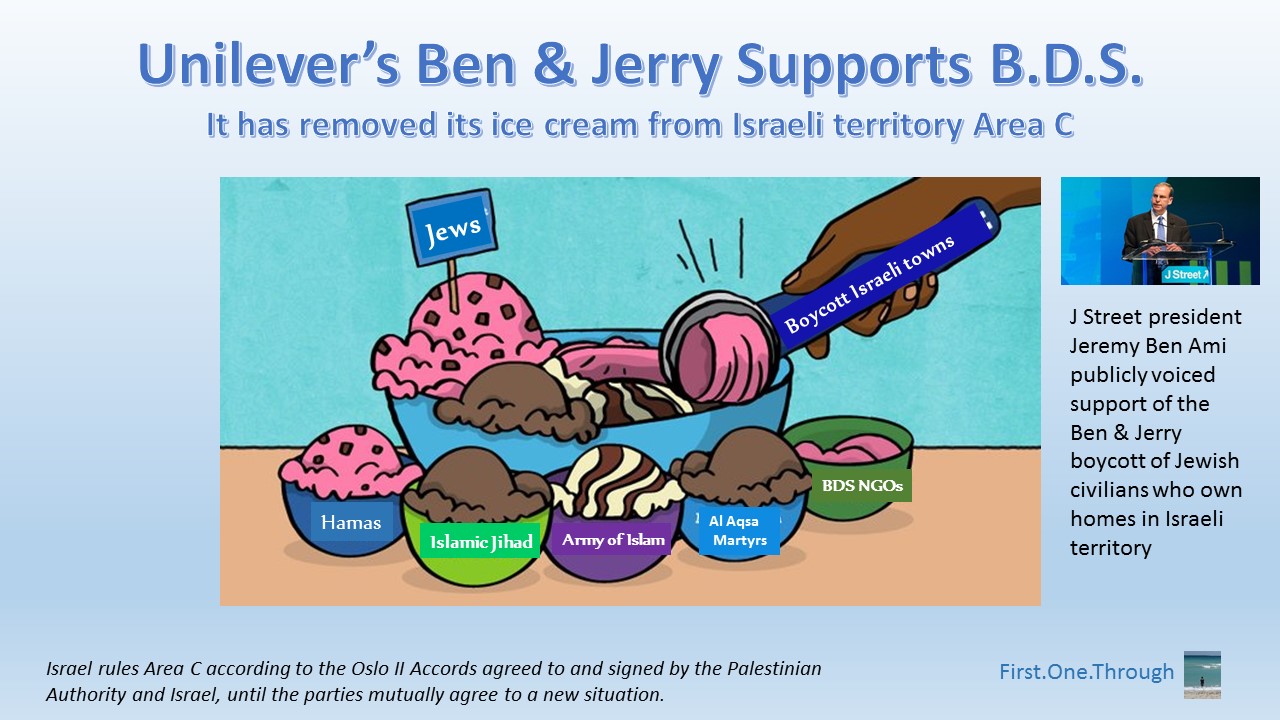
There is an emerging fight going on about Ben & Jerry’s sudden decision to stop selling ice cream in what it calls the “occupied Palestinian territories.” One side has called it anti-Semitic while the other defends the company and its parent, Unilever, from the charge stating that not deciding to sell a product in the OPT but continuing to do so in Israel cannot be called anti-Semitic as it differentiates between Israel and the West Bank/ Judea and Samaria.
While this sounds like a niche and irrelevant subject – about selling ice cream! – the discussion and decisions made on this topic are important for the broader review of the boycott, divestment and sanctions (BDS) movement. As dissected and reviewed below, the Ben & Jerry’s board engaged in a boycott of the West Bank (and likely Israel) in concert with its far-left progressive followers but likely outside of its agreement with Unilever. Other companies will be taking note of the fallout.
The Ben & Jerry’s Boardand Mission
B&J was acquired by Unilever in 2000 with a clause in the purchase agreement that allows the ice cream maker to retain its own independent board to preserve “Ben & Jerry’s social mission, brand integrity and product quality, by providing social mission-mindful insight and guidance to ensure we’re making the best ice cream possible in the best way possible.” The term “social mission” is a progressive catch-all that covers a wide range of activities. The three primary categories of values detailed on the company’s website are “human rights and dignity,” “social and economic justice” and “environmental protection.” The company pursues each of these items through a progressive lens which directs the company to use capitalism to the benefit of all, to protect the environment as best it can, and “support nonviolent ways to achieve peace and justice.”
These are clear and worthwhile missions for the company and within its rights to run a company as it sees fit. But any company working with a mission statement as its guide – and Ben & Jerry’s in particular, as this independent board takes actions BASED on the clause in its acquisition agreement that it can pursue its “social mission” – cannot do anything that it wants and just claim it as a “social mission.” Some important criteria to review:
is there really a social mission behind the action
is the action being taken an internal or external concern to the company
is the action itself legal and moral
While B&J was acquired with the proviso that it’s social mission is at the discretion of its independent board, these questions are critical for Unilever to review as to whether the board acted within its rights to boycott the OPT.
The Board Boycott and Intent
Before delving into each of these points, it is important to review what was and wasn’t said by B&J.
On July 19, 2021, B&J issued a statement which read:
“We believe it is inconsistent with our values for Ben & Jerry’s ice cream to be sold in the Occupied Palestinian Territory (OPT). We also hear and recognize the concerns shared with us by our fans and trusted partners.
We have a longstanding partnership with our licensee, who manufactures Ben & Jerry’s ice cream in Israel and distributes it in the region. We have been working to change this, and so we have informed our licensee that we will not renew the license agreement when it expires at the end of next year.
Although Ben & Jerry’s will no longer be sold in the OPT, we will stay in Israel through a different arrangement. We will share an update on this as soon as we’re ready.”
The statement makes clear that its “values” make it difficult to see its product in the “OPT.” It differentiates the OPT from Israel and states in the last line that it will continue to sell ice cream in Israel.
But the B&J board never authorized the last sentencethat it will remain in Israel. The board subsequently released a statement that “The statement released by Ben & Jerry’s regarding its operation in Israel and the Occupied Palestinian Territory (the OPT) does not reflect the position of the independent board, nor was it approved by the independent board.” The sentence was added solely by Unilever without B&J knowledge. The chair of the B&J board, Anuradha Mittal, was incensed by the statement that the ice cream will continue to be sold in Israel and said “I am saddened by the deceit of it. This is not about Israel; it is about the violation of the acquisition agreement that maintained the soul of the company. I can’t stop thinking that this is what happens when you have a board with all women and people of color who have been pushing to do the right thing.“
Mittal specifically wanted no mention of Israel in its statement, just that it is boycotting the “Occupied Palestinian Territory,” presumably meaning the area east of the Green Line (EGL). She seemed poised to rally minorities to her defense describing her situation as pitting “women and people of color” against a conglomerate, deflecting the conversation from her values and actions.
B&J’s website showcases its board members and notes that Mittal’s primary social cause is “Land and Indigenous Rights.” Her resume led with a note that she is “founder and executive director of the Oakland Institute, is an internationally renowned expert on development, human rights, and agriculture issues.“
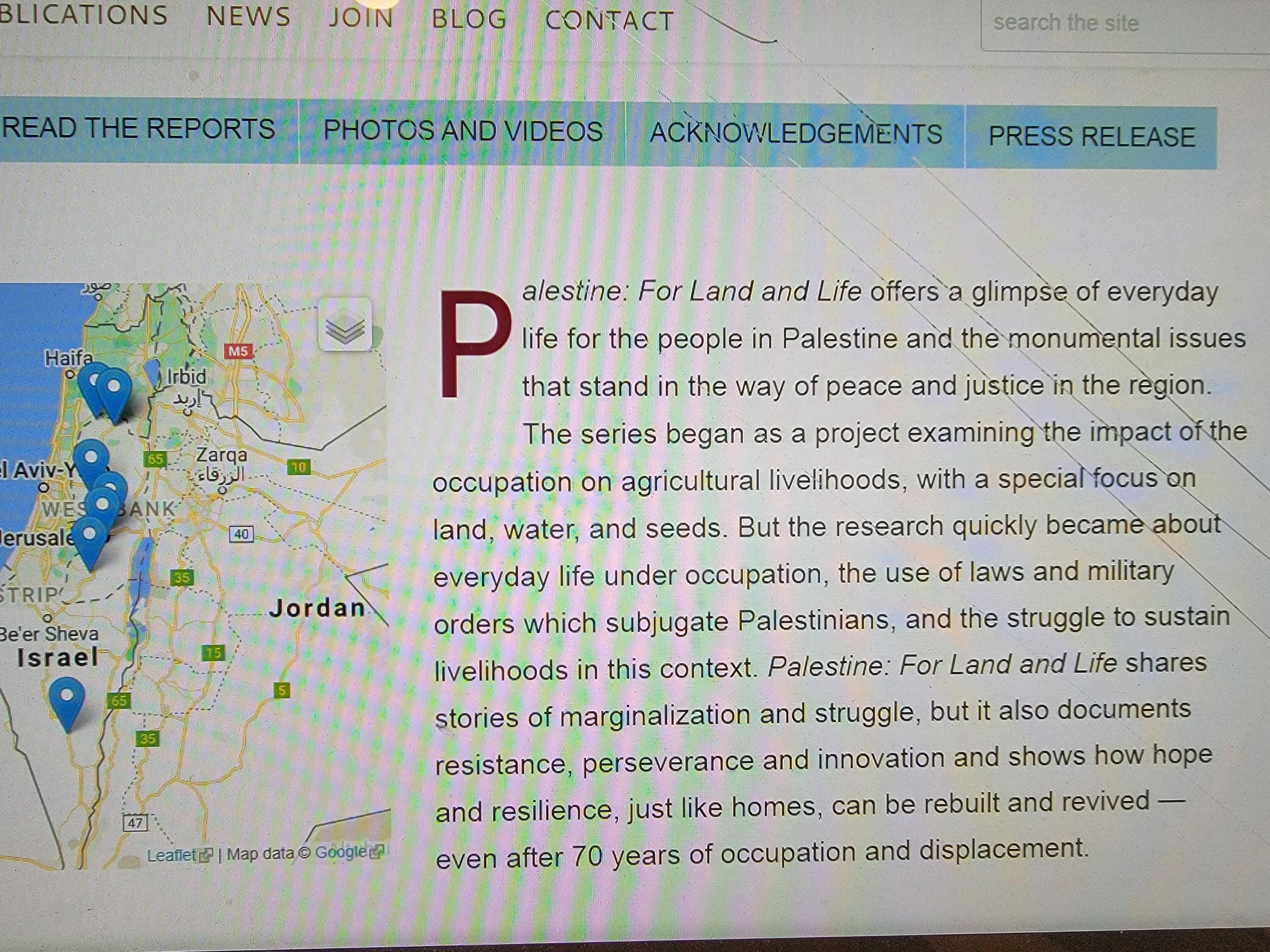
The Oakland Institute website covers a number of topics including “Palestine.” It refers to “research” published by Mittal on “Palestinian resistance & resilience 70 years after the Nakba & 100 years after the Balfour Declaration.” It includes a map regarding places of such “resistance” which includes areas in Israel.
The Oakland Institute website founded by the board chair of Ben and Jerry’s, refers to Palestine and occupation with locations inside of Israel.
Mittal’s references to the “Nakba” in 1948 and Balfour Declaration in 1917 (each well before there was a land called the “West Bank” in 1967) are part-and-parcel of her objection to the inclusion by Unilever of a statement regarding operating in Israel. Her position is seemingly that all of Israel and Israeli territory is “Occupied Palestinian Territory.” That is why she was alarmed by Israel’s “downgrading Arabic as an official language,” (nothing to do with the West Bank) and efforts by Congress “that would criminalize the nonviolent Boycott, Divestment, and Sanctions (BDS) campaign against Israel and Israeli settlements,” (note the inclusion of Israel.)
The B&J board’s statement was vague in verbiage as to whether OPT meant just the West Bank or the entire area known as Palestine in 1917, allowing mainstream progressive groups to jump to the defense of B&J on the premise that this action was just a non-violent “social mission” fighting against Israel’s “military occupation” of the West Bank, and cheered by the radical left and jihadi extremists who consider ALL of Israel to be under occupation.
What Constitutes a Social Mission
Is opposing the existence of a Jewish homeland a valid social mission?
That is the current mindset connecting jihadists, progressives and the alt-right today.
The anti-Zionists were birthed in the Arab and Muslim worlds in 1917 at the Balfour Declaration. The alt-right joined the cause in earnest during the reign of Nazi Germany which collaborated against “the shared… enemy [of world Jewry] and joint fight against it and creating the strong base uniting Germany and freedom-seeking Arabs around the world,” as Heinrich Himmler wrote to the Palestinian Grand Mufti of Jerusalem in 1943. The toxicity spread at the United Nations as more Arab and Muslim countries were admitted and effectively passed the “Zionism is Racism” resolution in 1975. While that resolution was rescinded in 1991 due to the efforts of the United States, it was reintroduced to the world at the Durban Conference in 2001, just before the jihadi attacks on America on 9/11. With the Zionism-is-Racism smear once again in vogue and the progressive wing of intersectionality pushing active anti-Racism initiatives, Anti-Zionism got incorporated under the same banner by necessity.
Is anti-Racism a social mission? Most likely. If one believes that “Zionism is Racism” it follows naturally that anti-Zionism is a social mission too.
Lost in the logic is recognizing the false premise of the “Zionism is Racism” mantra. The notion that Jews should be able to live throughout their holiest land where they have thousands of years of history is a matter of simple human rights. The dream of having independence and sovereignty in the land is no longer a “debatable political philosophy” (to quote Keith Ellison, a progressive politician) but a reality. Arguing against Zionism today is a call to dismantle the sole Jewish State, an anti-Semitic urge.
Anti-Semitism is not a social mission. At least, not for any decent human being or organization.
Internal / External Social Mission
The social mission of a company often helps it build its brand, empower employees and the community in which it operates and serves. The choices are therefore important.
Some experts suggest avoiding politics, niche causes and charisma-fueled social missions, while stressing issues like the environment, local community involvement and charity.
Ben & Jerry’s did not follow this advice and always made its political leanings known. It’s current focus areas include a host of progressive issues including: criminal justice reform; voting rights; racial justice; LGBT rights; climate justice; campaign finance reform; and refugee rights.
The company actively engages in some of these things as a matter of how it runs the company, for example making products in an environmentally-friendly way. In other situations, it tries to inform people about a topic – like criminal justice reform – with articles on its website and directing people how to register to vote.
The company is not shy about getting involved in controversial topics like “Defund the Police,” where it argues that Minneapolis disbanding its police department “is a great start.”
Some topics, like abortion, do not make it onto its website, perhaps to avoid alienating about 40% of America. Still, it signs onto letters in advertisements that criticize abortion restrictions.
So with such history of activism outside the walls of the company’s business, it should not be a surprise that the company would wade into the Arab/Muslim-Israeli conflict.
The question is, what is its position? Does it seek coexistence and peace? Does it advocate for a one state, two state or three state solution? Does it want to see the end of Israel as a Jewish State?
Ben & Jerry’s has operated in Israel since 1987, even before the First Intifada. It has distributed ice cream throughout Israel and EGL/West Bank over this time, even during the waves of Palestinian terrorism and wars over the past 20 years. This suggests that the company has (or at least had) no issue doing business in the Jewish State or its territories.
Anuradha Mittal joined the B&J board in 2008, the same year she founded the Oakland Institute. Her publications there covered many countries including Ethiopia, Sri Lanka, Cambodia and Sierra Leone. Some publications were highly critical of the U.S. Bush Administration for using the War on Terror to cut aid to some poor countries. She wrote that “the U.S. threatened to sever humanitarian aid to the people of Palestine for exercising their right to vote.” Well, maybe not for the act of voting but for voting overwhelmingly for Hamas, a US designated terrorist organization which killed over a thousand people. She skipped that part but added “Alarmed by its [Hamas’s] victory, President Bush announced to his Cabinet that he will not support a Palestinian government made up of Hamas. The U.S. has put pressure on other international donors to follow similar action with the intention of bankrupting the future Hamas-led Palestinian Authority,” and added her concern that “nearly one-half of all Palestinians already live below the poverty line…. and cutting off aid would push the Palestinian territories into chaos.” She tacitly advocated for the US to support a government run by a Palestinian political-terrorist group.
That article which covered the broad War on Terror was an outlier and Mittal did not devote much time to the Arab/Muslim-Israeli conflict at the Oakland Institute until 2017 when she became alarmed at the election of Donald Trump and his pro-Israel positions. It seems that despite B&J operating in Israel for 30 years, the idea of taking action against Israel really came to the front of her mind as U.S. policy began to favor Israel more explicitly.
Is the Action Legal or Moral
As discussed above, the promotion of peace and coexistence is a noble social mission. Actions to advance that mission could include donating to schools and organizations that facilitate dialogue and working together. Ben and Jerry’s donates to numerous causes and there is no shortage of groups (mostly in Israel) which seek to develop a harmonious future which would be happy beneficiaries of the company’s funds but the company specifically excludes donating to international organizations.
In contrast, there are actions that do not advance peace and coexistence such as supporting a ban on Jews living alongside Arabs in the West Bank and in eastern Jerusalem. The denial of Jewish history and connection to the land is not only anti-Semitic but harms the ability for the people to live together as it falsely portrays Jews as foreigners. Promoting a status quo which prevents Jews from praying at their holiest location is a simple denial of basic human rights.
The question comes back to what is the underlying “value” that the board is seeking to promote and is the subsequent course of action, legal and moral.
The board clearly feels that the United States needs to improve a lot in areas like police reform, refugee and LGBT rights, not to mention those of indigenous Americans. Yet B&J continues to manufacture and serve ice cream in these non-perfect lands. It runs its business as a profit-oriented company, selling its products in all 50 states, while articulating methods in which it believes the country can improve. It comments on its values and continues to sell ice cream.
The company has done the opposite in regards to Israel. There is no stated message anywhere on the B&J site about its objection to the state and how it is “inconsistent” with its values. It just published the July 19 statement above that it was going to stop conducting business in the “occupied Palestinian territories.” It did this, with the full knowledge – and perhaps hoping – that various states and countries which have laws banning the boycott of Israel and its territories would take action against the company to elevate the discussion globally.
If the company is against serving its products in disputed territories then it should say so and take similar actions in Cyprus/Turkey, Kashmir/India/Pakistan, Tibet/China, Western Sahara/Morocco and other locations as a new corporate policy and live with the ramifications of doing so. I cannot imagine that Unilever would allow B&J to take such actions of severely hurting the company’s business, which must fall outside the spirit of their agreement.
Israel did not annex the territory it took in a defensive war against Jordan (which itself, had illegally annexed the land in 1950), with the exception of the eastern half of Jerusalem which had been ethnically-cleansed of its Jews under Muslim Arab rule. Israel has withheld annexation in the hopes of arriving at a land-for-peace arrangement which has been consistently rejected by the Palestinians. To penalize Israel and/or the people living in the territory for holding out the hope of reaching an enduring peace goes beyond being illegal in many jurisdictions to being simply asinine.
Ben & Jerry’s board is headed by someone who seemingly thinks all of Israel is occupied Palestinian territory and believes the US should support the popular political-terrorist group Hamas. She is now taking aim at Israel and its territories in full knowledge that such action is considered illegal in many jurisdictions despite the company not taking similar actions in other disputed lands (which also do not incur financial repercussions). Further, while decrying a long list of problems in the United States, B&J continues to operate and sell its products here, but in contrast, it never says anything about the Arab/Muslim-Israeli conflict and then suddenly announces its intention to boycott the region.
The shroud of a social mission does not provide a shield from the accusations of inconsistency, double-standards and poor business judgment, and a global progressive company joining the BDS movement does not miraculously christen anti-Zionism as a “value” for a either a person or a company.
The fallout from the B&J boycott is in the early days and may yet claim the chair of its board.
The pro-Israel community is livid about Ben & Jerry’s decisions to ban the sale of its ice cream in the Israeli territories of Area C and to not renew its affiliation with the distributor who sells the ice cream in Israel. Kosher stores around the world are removing the ice cream from its shelves and pro-Zionists and human rights activists are considering boycotting Unilever (the conglomerate which owns Ben & Jerry’s) products.
But not J Street. Jeremy Ben Ami congratulated Ben & Jerry’s on the move:
J Street President @JeremyBenAmi said that @benandjerrys was drawing “a principled and rational distinction between commercial transactions in the State of Israel & those in the territory it occupies.”
Far left extremist rabbis and synagogue presidents proudly affiliate with the organization while members sit in silence and assume that if their religious leaders support the group which bills itself as “pro-Israel”, then actions advocated by J Street like boycotting Israel and giving Iran a legal pathway to nuclear weapons, must be the pro-Israel thing to do.
It is time for Israel supporters to show J Street and its backers the door before they advance truly dangerous initiatives to a feckless administration and susceptible organizations which might believe they actually speak for the Jewish community.
Palestinian Arabs are like the kid who kills his parents and then asks the court for mercy because he is an orphan.
Here are a few examples:
The Security Barrier which Palestinian Arabs call an “Apartheid Wall.” Once upon a time there was no separation barrier between Israel and the West Bank. But the Arabs launched a ferocious wave of terrorism beginning in September 2000 killing and maiming hundreds of people. By 2002, Israel decided it was imperative to erect a mix of fencing and concrete walls to stop the flow of Arab jihadi terrorists from entering Israel. By 2005, the number of terrorist attacks dropped significantly due to the barrier. The Palestinians hate the wall and blame Israel for it, even though it was constructed because of their genocidal actions.
Section of security barrier erected to keep Palestinian terrorists from killing Israeli civilians
The Gaza Blockade which Palestinian Arabs and supporters refer to as “the World’s Largest Open Air Prison.“ In 2006, Palestinians elected the terrorist group Hamas to 58% of their parliament. Hamas routed the rival Fatah party from Gaza the following year and took over ruling the strip. As Hamas’s charter calls for the destruction of Israel and its history of terrorist attacks, the Jewish State imposed a blockade of Gaza to keep Hamas from importing weapons. The terrorist-political group has still done its utmost to wage war against Israel with missiles, underground tunnels, arson balloons and more. Despite the genocidal intent and actions, Israel still allows goods to flow in and out of Gaza through managed ports, as well as electricity to flow into the area. The Palestinians complain that the blockade is illegal even though investigations concluded that it is warranted due to Hamas’s genocidal actions and stated intentions.
Israeli Soldiers Protecting Jews on the Temple Mount. Palestinians and their supporters complain that Israeli troops harass Muslim worshipers and “storm” the al Aqsa Compound. The reality is that Muslim worshipers have specifically targeted Jewish visitors to the site for years with taunts and pelting them with rocks, necessitating the Israeli security detail.
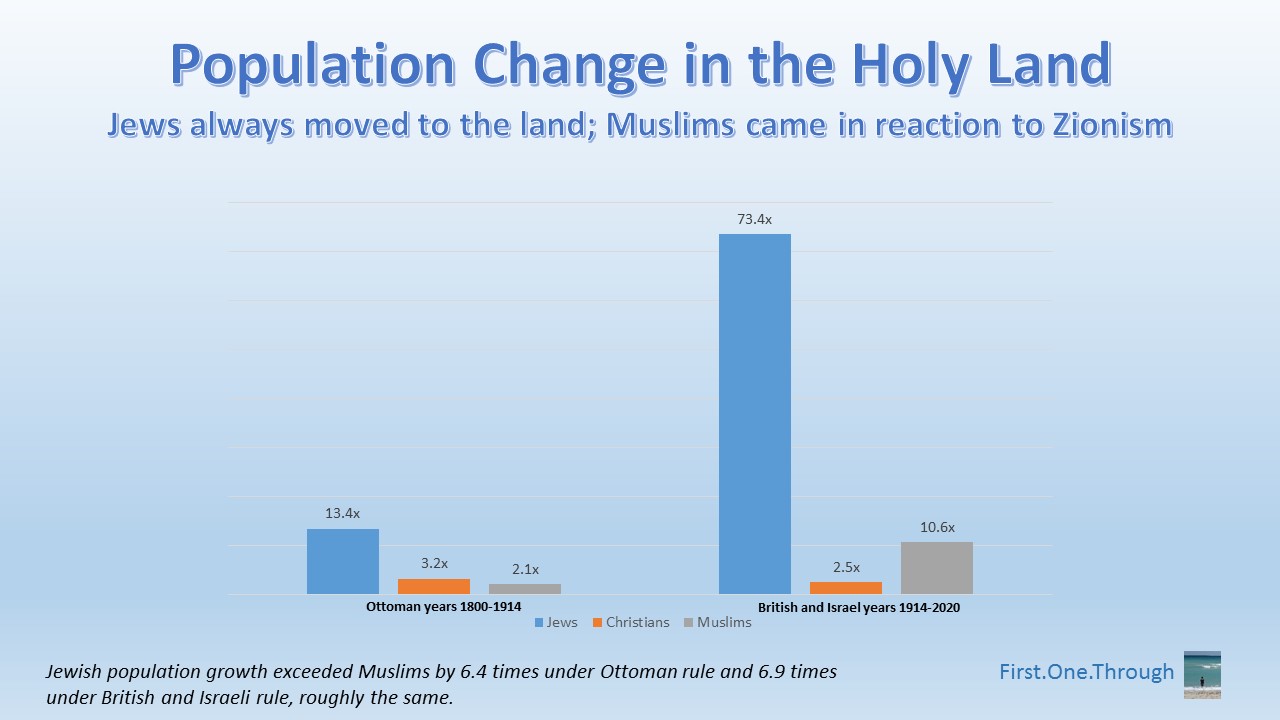
Palestinians blame Israel for the “Nakba” in 1948. Jews moved to the holy land at six to seven times the rate of Muslims during the Ottoman period as well as since the Balfour Declaration. But since the Ottomans left Palestine, Arabs have rioted and done everything in their power to stop Jews from entering the Jewish holy land, including riots, terrorism and trying to destroy the Jewish State at its rebirth in 1948. Palestinians mourn losing the civil war they initiated and then pretend that the number of Arabs in Israel and in Israeli and Palestinian territories hasn’t skyrocketed since then, with outrageous claims of “ethnic cleansing.”
The “Occupation.” While Zionists approved the proposed United Nations Partition Plan in 1947, the Arabs unanimously rejected it and went to war. The Arabs continued warring many more times in attempts to destroy Israel but the result was losing land, lives and dignity. Palestinian leadership continued to refuse Israeli peace offers, even in 2000 and 2008, opting instead for war. The fact that Israel has not annexed all of the lands in the hopes of one day making peace in an action that no nation in the world would ever make is remarkable. Yet anti-Zionists invert the situation and blame Israel for holding out the prospect of land-for-enduring peace, rather than blame Palestinian Arabs for constantly going to war and refusing coexistence.
Jews buying land via third parties. Palestinian Arabs and their anti-Zionist supporters describe Jews buying land in eastern Jerusalem and the West Bank in “shadowy transactions” in a libelous attempt to make them appear as sneaky and crooked Jews “nibbling Arab land.” The reality is that the Palestinian Authority has anti-Semitic laws which call for the death penalty for any Arab who sells land to a Jew, so they have to conduct real estate transactions via third parties or the Arabs would get killed. Read the stories of Issam Akel, Ahmed Salama or Ezra Nawi and then ponder how Jews attempting to do a normal activity like buying homes for their families are portrayed in vile fashion because of anti-Semitic Palestinian laws.
All around the world, going on a plane requires arriving at the airport hours in advance, going through long security lines, removing shoes and belts, and being scanned in a prophylactic system to prevent death and mayhem because of the actions of jihadi extremists twenty years ago. Israel has similarly instituted security measures to protect lives after years of jihadi wars and terrorism.
The TSA, airport screening, the security barrier and Gaza blockade are not forms of collective punishment but systems put in place to protect society from the all too real Islamic extremism and terrorism.
Judaism is the only religion which is tied to a specific land, the land of Israel.
Judaism created the very notion of “promised land,” not as an aspirational dream as commonly used today, but as an actual piece of land passed as an inheritance for generations.
Only Jews consider the Jewish Temple Mount in Jerusalem as their holiest location.
Jews are the only people who pray facing Jerusalem, regardless of where they are.
Only Jews are commanded to visit Jerusalem three times per year.
The Old City of Jerusalem including the Jewish Temple Mount during Passover
Jerusalem is the most mentioned city in the Hebrew bible.
Jerusalem has been the focal point of Judaism for over 3,000 years.
Israel is the only country whose national anthem is all about its capital city.
Jews have been the largest group of residents in Jerusalem continuously since the 1860’s. There is no other capital where Jews are the majority.
Israel is the only Jewish State.
Israel is also the only country:
which is not recognized by dozens of countries at the United Nations
whose capital city is not recognized by the majority of the members of the UN
which is singled out as a routine part of the UN’s Human Rights Council
where Jewish and non-Jewish residents in the eastern part of the capital are attributed different names of “settler” and “resident” in the non-Jewish world
Jerusalem and Israel are unique and special to Jews. The passion of its lovers and haters regarding the exceptional Jewish connection to both says more about their overall attitudes towards Jews than the locations themselves.
Progressive and conservative people around the world have different interpretations of justice.
For progressives, justice is achieved by enabling people who have been marginalized to succeed. It seeks to even the playing field by affording those at the edges some advantages to address systemic roadblocks which kept them down for so long. Justice demands reform in various areas beyond economy and law, to include healthcare and the environment.
Conservatives view justice through a narrower lens of tradition and law. They appreciate order and security, and upholding historic truths. Justice demands a system which rewards or punishes risk and investment. It requires uneven outcomes in order to spur overall growth.
Zionism speaks justice to both.
Liberals rallied to Zionism after the Holocaust of the Jews in Europe. They saw systemic anti-Semitism commit a genocide of millions of European Jews in the 1940’s and then watched the Muslim world expunge its Jewry from 1948 through the 1970’s. A home where Jews could be safe and self-governing was clearly needed in the creation and building up of the Jewish State.
Conservatives were some of the earliest Zionists – even pre-dating the first Zionist Congress in 1897 – and continue to be strong supporters. They appreciate Jews’ 3,300 year-history in the land of Israel, and understand that “the promised land” is a religious term uniquely meant for Jews about that Jewish holy land.
Progressives are amazed that a small new country was able to absorb immigrants fleeing persecution from dozens of diverse countries including: Morocco, Russia, Argentina, Uruguay, France, Tunisia, Egypt, Iraq, Syria, Ethiopia, Ukraine and Yemen. There is no country in the world that has such a high percentage of immigrants coming into the country – virtually penniless – from so many lands. None.
Conservatives are amazed at the stability and application of the law in Israel. While other countries in the region have killed hundreds of thousands in wars, the strong Israeli army has kept its wars very short, minimizing death tolls. While the authoritarian leaders of neighboring countries stay in power for decades, Israel holds genuine elections and prosecutes its leaders, sometimes sending former prime ministers to prison.
People from across the political spectrum may not know some statistics about Israel but aren’t surprised to hear them. For example, Israel is the only religious country which has more tourists each year from a different religion (the Jewish State has more Christian tourists than any other religious group; other religious countries like Denmark have mostly Christian visitors; Iran, mostly Muslim visitors). Some facts may surprise them, such as the fact that the Arab population in Jerusalem has gone up by 3.4 times since 1980 when Israel declared the city as its eternal capital, compared to a rise of only 1.9 times for the Jewish population.
Both progressives and conservatives marvel at the religious freedoms in the only Jewish State. Muslims may wear hijabs (banned in France), build minarets near mosques (banned in Switzerland) and have halal meat (banned in the Scandinavian countries). Anyone of any faith can become prime minister in Israel (only Christians can lead Greece, only Muslims in Syria). Israel even helped the Mormons build a church in Jerusalem! and the Baha’i have a major temple in Haifa (the faith is banned in Qatar).
Liberals love that Israel is a green country, leading the world in recycling plastic. It was the first country in the Middle East to have wind farms and a bike sharing program. It also has a universal healthcare system for every citizen and permanent resident. Meanwhile, conservatives love that the Jewish State has a thriving free market built on capitalism. It has more companies listed on Nasdaq than any other country except for China (a country with a population 155 times as large).
Israel has strived to build a country that incorporates freedom, justice and fairness in an open, secure and vibrant multi-cultural society, in the heart of a turbulent and extremist neighborhood.
When Israel declared itself an independent state in 1948, it called for justice instinctively understood by both progressives and conservatives:
“THE STATE OF ISRAEL will be open for Jewish immigration and for the Ingathering of the Exiles; it will foster the development of the country for the benefit of all its inhabitants; it will be based on freedom, justice and peace as envisaged by the prophets of Israel; it will ensure complete equality of social and political rights to all its inhabitants irrespective of religion, race or sex; it will guarantee freedom of religion, conscience, language, education and culture; it will safeguard the Holy Places of all religions; and it will be faithful to the principles of the Charter of the United Nations.”
David Ben Gurion signing the Declaration of Independence with Rabbi Yehuda Leib Hacohen in Tel Aviv, May 14, 1948 (photo: Hans Pinn/GPO)
Israel was designed as a particular Jewish State, focused on Jewish immigration and a vision of peace based on the Jewish bible, but also with “complete equality of social and political rights to all inhabitants irrespective of religion.” The country’s foundational principles stressed both the particular and universal in a unique and bold ambition for justice for all: a space for the most persecuted minority in the world, and a philosophy of justice based on history, tradition, truth and fairness.
Progressive and conservative people around the world have different interpretations of justice, yet both see their visions realized in Israel.
The spike in anti-Semitism right after the latest skirmish between the Palestinian political-terrorist group Hamas and Israel seemingly caught many people off guard even though the same thing happened in 2014. The surprise is rooted in the delusion that the conflict is between two ethnic groups (Arabs and Jews), when in fact it is a religious war between Muslims and Jews, much like the crusader wars between Christians and Muslims centuries ago. The religious battles in the holy land quickly ignite anti-Semitism globally, especially when holy sites are involved.
Sovereignty: Islamic Ottomans versus Zionist Jews
Various peoples have ventured through the holy land over thousands of years, as the small strip of land is the only corridor connecting Africa on one hand, and Europe and Asia on the other. Different races, religions and ethnicities came and went with sovereignty falling under different regimes.
From 1517 to 1917, the Ottoman Turks ruled the region as part of its vast empire. The Ottomans were Islamic and gave preference to members of its faith. Early in its rule, Ottomans kicked Jews off of the Temple Mount, Judaism’s holiest location, and relegated them to a small part of the western supporting wall of the Temple Mount. That area, the Kotel, has since become the stand-in for Jews for their sacred spot. Similarly, the Islamists forbade Jews from entering the Cave of the Jewish Patriarchs and Matriarchs in Hebron.
When the British and French defeated the Ottomans in World War I, they divided the empire into distinct mandates which would ultimately become various countries including Lebanon, Syria, Iraq, Jordan and Israel. Upon announcing that the Jews would get to reestablish their homeland in the Balfour Declaration which became codified in international law in the 1920 San Remo Agreement and 1922 Mandate of Palestine, the Muslim Arab world went berserk. It was one thing for the far-away, non-Arab Ottoman regime to rule Palestine, but at least they were Muslims. It was an insult to Islamic pride to have the land ruled by Jews.
GoodbyeJewish Neighbors
Once the notion of Jewish sovereignty was introduced, the basic presence of Jews became a problem.
Muslim Arabs slaughtered Hebron’s Jews in 1929, making the British feel that the removal of Jews from the city was the right course of action rather than punishing the murderers. The British would fold to Muslim Arab anti-Semitism again after their multi-year riots from 1936 to 1939, and instituted the White Paper which forbade the Jews fleeing Nazi Europe to enter Palestine, resulting in the deaths of hundreds of thousands of Jews.
During World War II, the Mufti of Jerusalem met frequently with Hitler and other Nazi leaders to conspire against the Jews, making sure they were killed and could not flee to Palestine.
Telegram from Nazi Heinrich Himmler to Islamic Mufti of Jerusalem on the anniversary of the Balfour Declaration talking about “the battle against world Jewry.”
After the war, in the shadow of the Holocaust, Muslim nations routed Jews from their lands, with roughly one million Jews fleeing Morocco, Tunisia, Egypt, Algeria, Libya, Yemen and elsewhere. These were not Zionists but Jewish neighbors who had lived for hundreds of years in Muslim lands. They were attacked simply for sharing the faith with Jews in Israel.
Whether in Europe, the Middle East or North Africa, Christians and Muslims trounced the local Jewish communities.
Toxic Islamic Anti-Semitism
While the Christian world rethought systemic anti-Semitism in the Second Vatican Council of 1965, the anti-Semitic toxicity level continued to spread among Muslims, especially after their defeat in 1967 when they went from smug warriors about to finish off the Jews a mere generation after the Holocaust, to embarrassed losers in just a week.
The 1988 Hamas Charter remains the most anti-Semitic foundational document of any political party ever written. It combines the vileness of Hitler’s Mein Kampf with the Russian forgery Protocols of the Elders of Zion. It blames Jews for starting all wars for profit, controlling the media and global resources as well as “uncleanliness, vileness and evils.” The document calls upon Muslims around the world to fight the Jews and kill them in a messianic jihad. “Israel will exist and will continue to exist until Islam will obliterate it…. Our struggle against the Jews is very great and very serious…. the Palestinian problem is a religious problem, and should be dealt with on this basis…. Israel, Judaism and Jews challenge Islam and the Moslem people.” The conflict is anchored through the lens of a religious war against Jews and Judaism.
The charter makes clear that the issue is not 1967 borders or even 1948 borders, but that “struggle against the Zionist invaders… goes back to 1939,” the beginning of the Holocaust. For Hamas, the core of the issue is that Jews survived the Holocaust and came to Palestine. The root of the current hastags #Hitlerwasright has nothing to do with a property dispute in Sheikh Jarrah in eastern Jerusalem, but that the Jews continue to exist.
Regular Islamic Anti-Semitism
Not all Muslims believe that all Jews are sinister and must be punished for re-assuming sovereignty of the holy land as they had thousands of years ago. Many are garden-variety anti-Semites.
In 2005, the Palestinians voted a man who wrote his doctoral thesis on Holocaust denial, Mahmoud Abbas, as their new president. The following year they voted the political-terrorist group Hamas to 58% of the parliament. In 2014, the ADL conducted a poll which found that 93% of Palestinian Arabs – almost every single person polled – held anti-Semitic views.
Beyond the holy land, a 2015 ADL poll found that Muslims around the world were two to five times more likely to be anti-Semites than Christians in the same country.
When Palestinians poll themselves they continue to favor Hamas. A June 2021 poll found that 59% would vote for Ismail Haniyeh of Hamas for president. They are overwhelmingly in favor of attacking Jewish Israeli civilians inside Israel.
As further proof that the dispute is between religions and not ethnic groups, Hamas’s biggest sponsors are not Arab countries but non-Arab Islamic countries of Turkey and Iran (which has threatened to wipe Israel off the map). Religion, not ethnicity, drives the conflict.
The Sensitivity of Religious Sites
While Muslim Arabs object to Jews living anywhere in what they perceive as an Islamic waqf, the sensitivity is heightened around religious sites. The Muslim world calls for “days of rage” when anything happens around Jerusalem and especially the al Aqsa Mosque. Even during peaceful times, Muslim Mourabitoun harass Jewish visitors to the Jewish Temple Mount, while they simultaneously leave Christian visitors alone.
The Indignity of the “Jewish State”
Underscoring the religious dimension of the conflict is the refusal of Palestinian Authority President to accept Israel as the “Jewish State,” even though doing so costs nothing in terms of the main desires of Palestinian Arabs which seek sovereignty and to move into neighborhoods where ancestors once lived. Abbas would be willing to forgo an independent Muslim Arab state if he has to simultaneously acknowledge Jewish sovereignty in Israel.
The Broader World’s Embrace of Muslim Anti-Semitism
The non-Muslim world has accepted many of the Muslim charges, seemingly re-connecting with its own historic toxic anti-Semitism.
Only Jewish Israelis moving east of the 1949 Armistice Lines are labeled with the unique term “settlers,” while Muslim Israeli Arabs moving to eastern Jerusalem or other parts of the West Bank are simply called “Palestinians.” Airbnb has one policy for Jews renting homes in the West Bank and another for non-Jewish neighbors renting out their homes. Europe seeks to have distinct labels for products coming from Jewish businesses in the West Bank and a different one for Muslim businesses. The dividing line is not whether the owner is Israeli or Palestinian but whether the Israeli is Jewish or Muslim.
The examples go on.
The two-state solution has been long been marketed as creating sovereign entities for two ethnic groups – Jews and Arabs – but that has always been a myth. The Arabs already have dozens of countries and Palestinian Arabs were content being part of Muslim Arab Jordan from 1949 to 1967 and the Muslim non-Arab Ottoman Empire from 1517 to 1917. The conflict stems from the massive Muslim world’s distaste for the single small Jewish state. The Islamists proposed solution is ideally to wipe the Jewish State off the map. Failing that, making the country exceptionally small, without control of any religious sites, and converted into a bi-national (non-Jewish) state is the most they could accept.
The “Palestinian-Israeli” or “Arab-Israeli” Conflict is actually the “Muslim-Jewish Conflict over the Holy Land.” It is therefore no surprise that flare-ups in Israel rooted in noxious Palestinian Muslim anti-Semitism should ignite the same vile reactions against local Jews around the world, led by regional Muslim fanatics and abetted by other willing anti-Semites.











 First One Through