In Chayei Sarah, Abraham does something brave. When it’s time to find a wife for his son Isaac, he refuses to choose from the neighbors around him. These were the people he did business with, lived among, interacted with every day — but they did not share his values. So he sends his servant far away to find someone who does.
Abraham teaches us something simple and powerful: proximity is not loyalty. Geography is not identity. Values matter more than convenience.
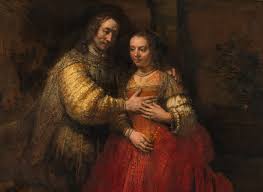
Rembrandt’s “The Jewish Bride,” (c. 1665) originally called “Isaac and Rebecca”
We are living this lesson now. In the last year, too many of us have watched people we assumed were “ours” turn their backs — classmates, coworkers, fellow Jews, even friends who share our politics. Being nearby doesn’t make someone trustworthy. Sharing a label doesn’t make them aligned. We’ve learned, painfully, that not everyone who sits next to us stands with us.
Abraham reminds us that it’s okay — even necessary — to choose our people carefully. To build relationships around courage and truth, not comfort or habit. To seek out the ones who show up for Jewish dignity when it’s hard, not only when it’s fashionable.
Isaac didn’t need a local partner; he needed the right partner. So do we.
The first words God ever spoke to the first Jew were not of comfort, but command:
“Go forth from your country, from your birthplace, and from your father’s house, to the land that I will show you.” (Genesis 12:1)
Abraham was told to leave everything that gave him safety — his home, his family, his people — and to walk alone to a foreign and unknown land.
That is the Jewish story. And it remains Israel’s story today.
Abraham Ortelius map “Journey of Abraham”, 1595
The Call to Walk Alone
Lech Lecha is more than a journey of geography; it is a test of courage. Abraham separated from a world that had lost its moral compass. He stood against the idols of his age.
Israel does the same now. The world pities the violent. It demands “restraint” from the victim and “understanding” for the murderer. Israel stands almost alone — mocked, pressured, condemned — for defending its people from those who glory in death.
Lech Lecha reminds us that holiness begins with separation. To follow conscience sometimes means turning your back on the crowd.
The Lonely Battle
When Abraham heard that his nephew Lot was taken captive, he didn’t wait for permission. He gathered a few hundred men and faced an army of kings. Outnumbered, he fought — and won.
That is Israel today. A small nation surrounded by hostile powers, fighting not for conquest but survival. Like Abraham, it refuses to wait for global approval before rescuing its own.
The Modern Lech Lecha
To stand alone is never easy. It is lonely, painful, and exhausting. But moral isolation is not failure — it is faith.
Abraham began our story by walking away from a world gone mad. Israel continues it by standing firm in one.
Lech Lecha — Go forth. Fight on. Even if you walk alone.
There is a reason the Bible lingers on grapes. They are rich, sweet, bursting with promise — a fruit that invites you in.
When the spies returned from scouting the Promised Land, they brought back a single cluster so heavy it had to be carried on a pole. That image has endured for millennia: the land was good, overflowing, generous. The fruit drew the Israelites forward, a taste of the future God promised.
Yet that same cluster became a stumbling block. The spies’ report turned the promise into fear. Instead of trusting that the God who brought them out of Egypt would also give them this land, they shrank back. The grapes that should have stirred hope instead fed doubt about the size and power of the land. The draw of abundance proved to be no guarantee of holiness.
Grapes in the Song of Moses
Forty years later, as Moses prepared the people to finally enter the land, he again reached for the image of the grape and the vine, which must have still captured the imaginations of the generation that wandered the desert. In the Song of Ha’azinu he sang of the bounty to come:
“Honey from the rock,… milk of the flock,… and the blood of the grape you drank as wine.” (Deuteronomy 32:13-14)
The land’s fruit would not be a passing token or aspiration as it was in the wilderness — it would be a daily reality. The vine was not only a sign of blessing but also of permanence.
And Moses warned that the very blessing could corrupt:
“Yeshurun grew fat and kicked… then he forsook the God who made him.” (Deuteronomy 32:15)
When abundance becomes self-indulgence, the sweetness sours. The gift is no longer an offering; it becomes an idol.
The Poisoned Vintage
The Song of Moses added a different reference to wine – not of over abundance but used for immoral purposes:
“Their vine is from the vine of Sodom, their grapes are grapes of poison, their wine is the venom of serpents.” (Deuteronomy 32:32-33)
The same fruit, when cultivated for injustice and oppression, becomes toxic. The vine can yield joy or venom depending on the heart of the grower.
The Test of Blessing
The Bible’s teaching is that grapes themselves are neither holy nor unholy. They are a draw — a gift meant to be enjoyed in gratitude and moderation.
When abundance is hoarded, flaunted, or wielded for harm, it ceases to be a blessing. The line between the vineyard of the Lord and the vineyard of Sodom lies not in the soil but in the soul.
The cluster carried by the spies, the wine of the Song of Moses, and the poisonous vintage of the nations all point to the same truth: the fruits of the earth reveal the heart of the one who gathers them.
It is our message as we leave the Fast of Yom Kippur and ready for the joyous and communal holiday of Sukkot: wine in moderation and with purpose, gladdens and sanctifies. In excess or in service of corruption, intoxicates and destroys.
“Three times a year all your males shall appear before Hashem your God in the place He will choose—on the Festival of Matzot [Pesach], on the Festival of Weeks [Shavuot], and on the Festival of Booths. [Sukkot]” (Deuteronomy 16:16).
At a time when the tribes of Israel were destined to live across a wide and varied land—from the Galilee to the Negev, from the Mediterranean to the Jordan Valley and beyond—this commandment ensured that all Jews, regardless of tribe or geography, would remain bound to a single center: the place “He will choose:” Jerusalem.
Then: One City for One People
The pilgrimage festivals were not simply religious obligations; they were national glue.
Unity in Diversity: Each tribe had its own territory, customs, and leadership. But Jerusalem reminded them that they were not twelve separate entities—they were one nation.
Physical Connection: The journey itself—families traveling for days from north, south, east, and west, THREE TIMES A YEAR—kept every Jew intimately connected to the city at the nation’s core.
Spiritual Focus: No matter how far they lived, Jews oriented their lives toward Jerusalem.
Without this ritual of convergence, the tribes might have drifted apart, their shared purpose diluted by distance and difference.
Now: Re-Centering Around Jerusalem
Fast forward over three millennia. Jerusalem is once again the capital of a sovereign Jewish state. But the modern challenge is becoming increasingly less about tribal dispersion, with Jews in the holy land making up a plurality of Jews – it is geopolitical pressure and strategic vulnerability.
Recent government plans to develop the area known as E1, just east of Jerusalem, have sparked international controversy. Critics claim the project is “obstructive to peace.” It’s an absurd claim. Supporters see it differently: as an essential step to connect Jewish communities around the capital, ensuring that Jerusalem remains safe and accessible and central to Jews from north, south, east, and west.
The parallels to Re’eh are striking:
Geographic Cohesion: Just as ancient pilgrimage routes tied the tribes together, modern infrastructure links surrounding communities to Jerusalem.
National Identity: Building around Jerusalem reinforces its role not just as a city, but as the beating heart of Jewish life.
Defying Fragmentation: Where outside forces seek to carve up and isolate Jerusalem, development ensures continuity and connection.
Jerusalem: The Eternal Center
Parshat Re’eh’s vision was never merely about geography—it was about survival through unity. When Jews journeyed to Jerusalem three times a year, they reaffirmed their covenant and their peoplehood. One God, one people.
Today, as Israel strengthens the areas around Jerusalem, it is engaged in the same mission: to keep the Jewish people close to their capital, secure in their homeland, and united across generations.
Then as now, Jerusalem is not just a place—it is the center of a people.
The Old City of Jerusalem including the Jewish Temple Mount on the holiday of Sukkot
As the Israelites were about to enter their Promised Land, the Bible relays stories of a series of conflicts.
After the spies delivered a bad report on the land in Parshat Shlach, we read the story of Korach who tried to launch a mutiny against Moses and Aaron. Then Chukat describes a war with Amorites, and Balak shares the story of a prophet trying to curse the Jewish people. At the end of Balak (Numbers 25:1-9), we read about Moabite women engaged in profanities with Jewish men. Pinchas, son of Elazar son of Aaron, took a spear and impaled the couple having sex in front of the Ohel Mo’ed, the tent Moses used to communicate with God.
Illuminated manuscript miniature from the 15th-century Alba Bible
And that is where Parshat Balak and the story seemingly end. With the murder of the couple and 24,000 others engaged in similar acts.
But it doesn’t really.
Parshat Pinchas continues the story with a pivot. Rather than highlighting the sins and the deaths, Numbers 25:10 begins with God appreciating the defense of holiness and His blessing Pinchas and his descendants. While the story may appear as a single episode, the Torah divides the parshas – and the narrative – between the violent and the holy, even when the violence was in the name of the holy.
The theme of separation can similarly be seen immediately after this in chapter 26, where God calls for another census of the tribes. Here, God counts the tribes and their families to allocate land for their inheritance. This is in contrast to the census of Numbers chapter 1 in which God wanted to account for how people would assemble in their journey and combat enemy forces. In the case of the journey and battle-readiness, there was a single head of each tribe; when they entered the land, each tribe’s family was specified.
It is a metaphor for how Jews assemble and coordinate today: there are wars that are fought in Israel and the diaspora against those who want to harm Jews and the Jewish State. Global Jewry understands the us-versus-them dynamic and the role for every Jew in the battle. It is related yet distinct from the interaction amongst Jews regarding our common heritage. We each have a part to play living together as a community.
Individuals fight with a common purpose. Families live under a societal umbrella.
We have tribes and borders and homes. We coexist with each other while understanding our peaceful lines. The separations today may be between synagogues or religious denominations. Between schools and political affiliations. Each aspiring for peace and holiness.
Those lines are very different than the battle lines between us and “them,” those who mean to harm us physically, morally and spiritually.
Upon entry into the Jewish holy land, Jews migrated from an army with legions to a people with property. While there were still wars to be fought inside the Jewish Promised Land, the muscle memory of understanding who is within the holy communal tent and those outside forces, was taught over the trials in the desert.
It is a lesson for our time as well: to clearly identify our allies and foes, and wage war and peace accordingly.
In the book of Numbers, the Moabite king Balak summons the non-Jewish prophet Bilaam to curse the Israelite nation which was traveling near Moab. What unfolds, is one of the most mysterious blessings in the Bible.
As Bilaam gazes upon the people of Israel, he declares:
“How can I damn whom God has not damned, How doom when God has not doomed? As I see them from the mountain tops, Gaze on them from the heights, There is a people that dwells apart, Not reckoned among the nations,” “הֶן־עָם֙ לְבָדָ֣ד יִשְׁכֹּ֔ן וּבַגּוֹיִ֖ם לֹ֥א יִתְחַשָּֽׁב“(Numbers 23:8–9)
The statement is peculiar – a nation which dwells alone – has befuddled rabbis for centuries. Is it a curse? A blessing? A prophecy?
At first glance, the idea of being alone evokes discomfort. In Genesis, God explicitly declares, “It is not good for man to be alone” “לֹא־ט֛וֹב הֱי֥וֹת הָֽאָדָ֖ם לְבַדּ֑וֹ” (Genesis 2:18). From this verse, Jewish tradition emphasizes the centrality of community, companionship, and connection. So why would Bilaam say something seemingly negative—and continue with a positive blessing in Numbers 23:10 “Who can count the dust of Jacob, Number the dust-cloud of Israel? May I die the death of the upright, May my fate be like theirs!”
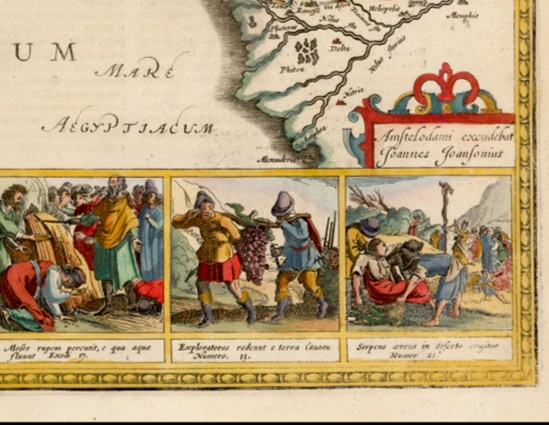
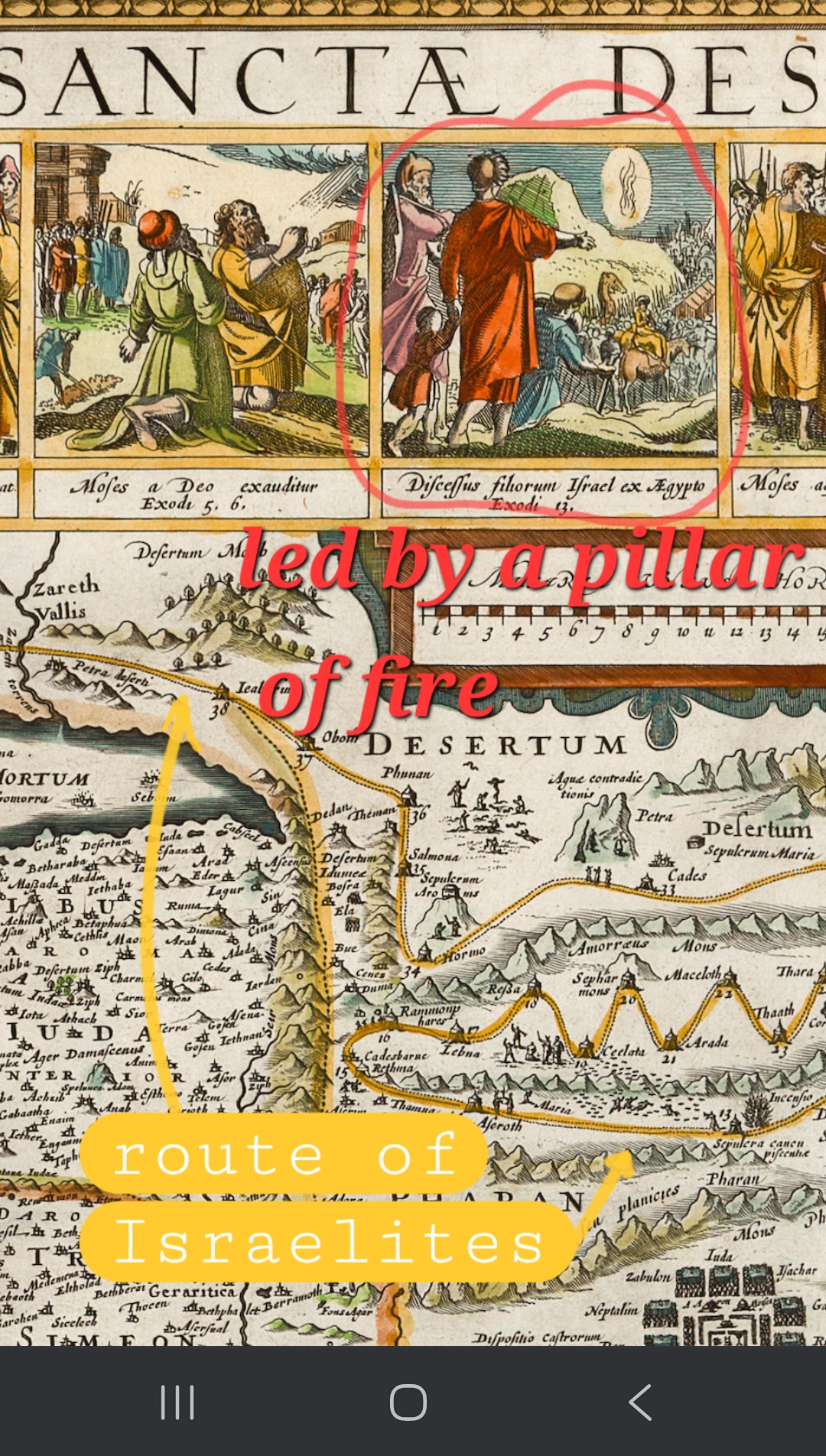
Jan Jansson (1588-1664) map of the Holy Land (c. 1630) showing the life of Moses in vignettes and the organization and route of the Israelites through the desert and then Moab above the Dead Sea on the map on their way to the Promised Land
The answer may lie in context of the event and the deeper meaning of distinctiveness. Bilaam was not commenting on mere social isolation. He was marveling at the singularity of an entire people traveling together through the desert, in unison, yet set apart in character and destiny. He was struck by the sight of an entire nation—young and old, rich and poor—not scattered as refugees or as imperial conquerors, but moving as one, under a divine mission. This was a nation on a journey, and yet already a people. They were not defined by geography, wealth, or military might—but by a relationship with God.
close up of Jansson map
In Jewish tradition, blessings are tied to recognition and distinction. Consider the rules of berachot (blessings): when a person eats an apple, it receives the blessing “borei pri ha’etz”—a specific blessing for fruit of the tree. If the apple is altered, like mashed into applesauce or mixed with other foods, the blessing remains the same ONLY if the fruit can still be identified. But if the fruit is so blended or processed that its original form can no longer be distinguished, it receives the general blessing of “shehakol“. The highest form of blessing is given to that which is most clearly recognizable.
In this light, Bilaam’s words take on added meaning. The Jewish people, by dwelling alone, are not to be pitied but admired. They are not a mashed mixture indistinguishable from general society but a clearly defined people, worthy of the highest blessing. Their uniqueness—religiously, culturally, and morally—is their spiritual signature.
Moreover, Bilaam wasn’t simply remarking on ethnic isolation. He noted the nation’s relationship with the Divine. Even when they seemed to be isolated, they were never truly alone—they were accompanied by God. The camp of Israel may have appeared vulnerable in the wilderness, but it was surrounded by divine presence, protected by a covenant older and stronger than any human alliance. As a prophet, he could not help but shout “How can I damn whom God has not damned” and “May my fate be like theirs!”
close up of Jansson map
This point is emphasized by commentators like Rashi (1040-1105), who notes that Bilaam’s phrase can be read as prophetic: “They do not come under the same reckoning (לא יתחשב) with other nations. — Another explanation is: When they rejoice, no other nation rejoices with them.”
This is certainly the case today, as Israel defeats one enemy after another. Each – Hamas, Hezbollah, Iran – armed with both weaponry and genocidal intent, have been neutralized. The Jewish world is relieved and gives thanks, while the United Nations runs to condemn the Jewish State for its defensive war.
The aloneness feels like isolation but is it? Is the success – and “aloneness” – to be read as a glory to God? Bilaam’s blessing isn’t merely poetic—it is theological. He sees a people whose separation from other nations isn’t a curse but a connection to God – for those, like him, who can appreciate the holy tie.
For those who recognize this divine connection, the Jewish people become a source of blessing. As Bilaam says later, “Blessed are those who bless you, and cursed are those who curse you” (Numbers 24:9). But for those who fail to see the holiness of that distinction and connection to God—who seek to blend, suppress, or erase it—the reading is a curse. The uniqueness is condemned as outside societal standards.
In the end, Bilaam’s words are not a curse in disguise. They are a prophetic blessing that reveals a truth that many overlook: there is holiness in standing apart when one stands with God. The Jewish people, though often alone among the nations, are never alone in essence. They are accompanied by the Divine, distinguished by faith, memory, and mission.
In a time when smooth talking politicians win elections despite questionable morals and policies, it is an appropriate time to consider the greatest Jewish prophet, Moses, whose life was a constant struggle of public speaking.
At The Burning Bush: Fear of the Task
In Moses’ first encounter with God, Moses pushes back on taking the mission that God has commanded to lead the Israelites out of Egypt. His protest is not about the scale or danger of the mission but his own inadequacy – as a speaker:
“Please, my Lord, I have never been a man of words… I am slow of speech and slow of tongue.” (Exodus 4:10)
God responds with reassurance, promising divine assistance:
“Who gives man speech?… Now go, and I will be with your mouth and teach you what you shall say.” (Exodus 4:11-12)
Still, Moses persists in his reluctance, and God tells Moses that he should partner with his brother Aaron to be joint spokespeople before Pharaoh. From that moment on, Aaron is often the mouthpiece, and Moses leads more through presence. This foundational moment sets the reader considering the role of Moses for the rest of the Torah: if Aaron is doing the talking and God is providing the words, what exactly is Moses doing?
With The Spies: Adding Words, Shaping Minds
Years later, after the Jews receive the Ten Commandments on Mount Sinai, Moses gives instructions to twelve tribal leaders to inspect the land of Israel. God’s original command was simple:
“Send men to scout the land of Canaan, which I am giving to the Israelites.” (Numbers 13:2)
But when Moses relays the mission, he adds additional language which was not stated by God:
“See what the land is like. Are the people who dwell in it strong or weak? Few or many? Is the land good or bad?” (Numbers 13:18-19)
These added questions introduce the possibility of negative reports. Moses frames the land not as a divine gift to be received with confidence, but as an object of evaluation and skepticism. This subtle addition tilts the mission toward doubt. The spies return not with faith but fear, and the people’s panic results in a devastating punishment of forty years of wandering.
The Rock: Silence When Only Words are Needed
Fast forward to Parshat Chukat. The Israelites are again without water and God instructs Moses and Aaron:
“take the rod and assemble the community, and before their very eyes order the rock to yield its water.” (Numbers 20:8)
But Moses, perhaps frustrated and weary with his flock, or not understanding why he was tasked with talking to an inanimate object, or confused with the purpose of taking his staff, strikes the rock instead—twice. Crucially, he does not speak. He bypasses the command and replaces it with physical action:
“And Moses raised his hand and struck the rock twice with his rod.” (Numbers 20:11)
The water comes forth, but God is displeased and informs Moses that he will not get to go to the Promised Land:
“Because you did not trust Me enough to affirm My sanctity in the sight of the Israelite people, therefore you shall not lead this congregation into the land that I have given them.” (Numbers 20:12)
After years of faithful service, it is this moment of silence—a refusal to speak as commanded—that costs Moses entry into the Promised Land.
Symbols and Sanctity
At the rock, Moses used the staff as a TOOL in which he was the active agent in bringing forth the water. The Jews were thereby given the impression that Moses delivered the outcome they sought. Moses did not appreciate that the staff was a SYMBOL and that Moses was only a vehicle for God’s actions.
From the very beginning, God used Moses as his emissary, “I will be your mouth.” Ignoring the speech that God gave to Moses to bring forth water, denigrated words in favor of action. God created the world and separated water and land on the third day with words; He could certainly make water come from a rock with a few words.
The episode of Moses hitting the rock recalls when the Jews were trapped at the sea when Pharaoh’s chariots were descending upon them. Without prompting from God, Moses offered that God will battle the Egyptians:
“But Moses said to the people, “Have no fear! Stand by, and witness the deliverance which יהוה will work for you today; for the Egyptians whom you see today you will never see again. God will battle for you; you hold your peace!” (Exodus 14:12-13)
But God never told Moses to say any of those things. He is upset and tells Moses:
““Why do you cry out to Me? Tell the Israelites to go forward. And you lift up your rod and hold out your arm over the sea and split it, so that the Israelites may march into the sea on dry ground. And I will stiffen the hearts of the Egyptians so that they go in after them; and I will gain glory through Pharaoh and all his warriors, his chariots, and his riders. Let the Egyptians know that I am God, when I gain glory through Pharaoh, his chariots, and his riders.” (Exodus 14: 15-18)
The stories are a mirrored echo of each other:
In Exodus, God doesn’t instruct Moses to say anything, just to act; in Numbers, God asks Moses to speak and not act
In Exodus, God has Moses lift his staff and splits the sea to reveal dry land; in Numbers, God tasks Moses with lifting his rod to split the rock to deliver water
In Exodus, God gains glory through the obstinance of the defeated Egyptians; in Numbers, God seeks to attain sanctification in the sight of Jews
In Exodus, Moses listens, the Jewish people are saved, and the story of the splitting of the sea is recited daily by Jews to this very day; in Numbers, Moses doesn’t listen, he is condemned to never make it to the Promised Land and have a burial spot which remains unknown
The staff is a symbol, not a tool. It conveys that Moses is God’s conduit for words and action. Through them, God becomes sanctified and holy to Jews, while glorified by the world.
Understanding this, it is worth considering why Moses was chosen to lead the Jewish people: his lack of confidence in speaking would make him more likely to stay close to his brother and not speak extemporaneously. An overly confident person might not follow direction or the script God has for saving the Jewish people.
Moses’ speech journey is a case study of people’s personal struggles. At first, he doesn’t trust his voice. Then he misuses it. Then he avoids it entirely. People who are unsure of certain skills might go through a similar lifecycle. And that’s without God talking in your ear.
Conclusion: A Prophet’s Voice and a People’s Path
Moses’ fear of speech is central to his leadership story. It colors his interaction with God, with the people, and with destiny. His silence at the rock seals his fate just as his earlier distortions redirected Israel’s path.
God’s desire wasn’t just for obedience, but for faith expressed in words. The gift of speech—of prophecy, persuasion, prayer—was not to be avoided or altered. Moses’ story reminds us that voice is sacred. To lead is not just to act, but to speak with clarity, fidelity, and trust in the One who gives speech.
The Jewish people have succeeded when speech was measured and divinely inspired. It is a lesson in the power of words – that the right words – can have a longer and more sustainable impact than even repetitive actions.
The Book of Esther has several primary and secondary characters. One of the seemingly minor players is Hatach, the eunuch who appears in four sentences in chapter 4:4-11:
When Esther’s maidens and eunuchs came and informed her, the queen was greatly agitated. She sent clothing for Mordecai to wear, so that he might take off his sackcloth; but he refused.
Thereupon Esther summoned Hathach, one of the eunuchs whom the king had appointed to serve her, and sent him to Mordecai to learn the why and wherefore of it all.
and Mordecai told him all that had happened to him, and all about the money that Haman had offered to pay into the royal treasury for the destruction of the Jews.
He also gave him the written text of the law that had been proclaimed in Shushan for their destruction. [He bade him] show it to Esther and inform her, and charge her to go to the king and to appeal to him and to plead with him for her people.
“All the king’s courtiers and the people of the king’s provinces know that if any person, man or woman, enters the king’s presence in the inner court without having been summoned, there is but one law for him—that he be put to death. Only if the king extends the golden scepter to him may he live. Now I have not been summoned to visit the king for the last thirty days.”
The Ishtar Gate from Babylon, now in the Pergamon Museum in Berlin
In the plain reading of the text, we see that Hatach is one of several eunuchs and attendants that the king had assigned to Queen Esther. Esther uses Hatach as a messenger to find out what so distressed Mordecai that he sits in mourning at the city gate. Mordecai must have recognized Hatach as one of Esther’s attendants, as he not only shares everything that he knows about Haman’s plan, but hands Hatach the written order to show Esther. He further tells Hatach to direct Esther to intervene for the Jewish people. Esther sends Hatach back with a reply to Mordecai that she cannot intervene, lest she be put to death.
The text then stops using Hatach’s name. Perhaps he continues to be the trusted messenger between Esther and Mordecai or perhaps another messenger takes his place. See Esther 4:12-17:
On the contrary, if you keep silent in this crisis, relief and deliverance will come to the Jews from another quarter, while you and your father’s house will perish. And who knows, perhaps you have attained to royal position for just such a crisis.”
“Go, assemble all the Jews who live in Shushan, and fast in my behalf; do not eat or drink for three days, night or day. I and my maidens will observe the same fast. Then I shall go to the king, though it is contrary to the law; and if I am to perish, I shall perish!”
So Mordecai went about [the city] and did just as Esther had commanded him.
The back-and-forth language switches to a passive verb. Hatach no longer delivers the messages but messages were somehow delivered. What is the text trying to teach the reader?
Hatach was fine following Esther’s order to find out what was troubling Mordecai and return with such information. He also accepted the queen’s order to respond back to Mordecai with a message that she couldn’t go against the king’s rules to simply show up at the palace.
And that is when Hatach disappears.
Perhaps Hatach felt that his role had ended. He was not Mordecai’s servant and only brought back his initial message because Esther specifically asked to find out what was happening with Mordecai. Without the expressed order to hear what Mordecai had to say, he was done at delivering Esther’s message.
Or maybe he never delivered the message.
Sentence 12 reads that Mordecai “was told” the message from Esther. It is possible that when Hatach heard about the possible penalty of death for showing up at the palace unannounced, he became frightened. Perhaps he felt that a plot was unfolding of which he wanted no part.
There may be more. The assumption that eunuchs are safe to have around the queen typically relates to the inability to have sex. But the point is deeper.
Voluntary castration is a sign of profound loyalty to the king. To give up so much to be in the king’s graces must mean that the eunuchs have completely aligned with everything the king desires. Eunuchs are safe to have around the queen not only because they cannot have sex but because they have proven that they will do anything for the king and never harm the king.
When Hatach heard the back-and-forth between Mordecai and Esther, his loyalty to the king came into play. While he was a trusted messenger between Esther and Mordecai, his true allegiance was with King Acheshverus.
While sentences 11 and 12 are in sequence, it is possible that there is a significant gap in the story. Did Hatach just not deliver the message and Esther found a new messenger? Did Hatach find another way to get the message to Mordecai without delivering it personally?
Sentences 12 to 17 are the start of the plan which put either Esther or all Jews in the kingdom at risk of death. It is possible that Esther and Mordecai used multiple messengers and did everything in writing to make the scheme difficult to comprehend if a messenger only had one part of the story and thereby not risk the plan with people loyal first and foremost to the king.
Queen Esther likely viewed Hatach as HER trusted messenger when this communication began but came to realize that “the king had appointed” him and his loyalty was actually with king. It likely made her feel even more isolated and vulnerable in the palace, questioning even those attendants whom surrounded her.
A deeper review of the text and minor characters adds more color to the terrifying story of 2,500 years ago that we continue to celebrate today.
The story of Chanukah happened in 164 BCE. The Seleucid king Antiochus IV Epiphanes had defiled the Second Jewish Temple in Jerusalem and enacted several laws against Judaism, including banning circumcision, celebrating Shabbat and Jewish holidays, forcing Jews to eat pork, and making it a capital offense to have a torah scroll. The Jews of the holy land revolted against the Syrian-Greek king and got rid of all the anti-Judaism decrees and rededicated the Temple.
This was a war of pagans against the Jewish religion, before Herod built the expanded Temple Mount plaza and before Christianity.
Over the following centuries, King Herod (72 BCE – 4 BCE) built the expanded Temple Mount and Jesus was crucified in Jerusalem by the Romans. Jewish revolts against the Romans in 66CE-70CE and 132-135CE led to the destruction of Jerusalem and expulsion of Jews from the area, renaming the city to “Aelia Capitolina” and the region to “Palestina.”
This was a war of pagans against Jews and Christians, before the birth of Mohammed and creation of Islam.
Mohammed’s quest to bring Islam from the Arabian Peninsula to the world brought a Muslim invasion into the Jewish holy land in the 7th and 8th centuries. Muslims built their third holiest site on top of Herod’s Temple Mount, the Al Aqsa Mosque. Christians and Muslims waged several wars over the holy land between 1095 and 1291.
Those battles between Christian crusaders and Muslims, were over the Jewish holy land and Judaism’s holiest location.
In 1948, Muslim Arab armies invaded and tried to destroy the newly declared State of Israel. The Jordanian army ethnically cleansed all of the Jews on the western bank of the Jordan River all the way through the Old City of Jerusalem. In 1954, it granted citizenship to all Arabs, as long as they were not Jewish.
This was a war of Arab Muslims countries against the physical presence of Jews in the Jewish holy land.
From the Chanukah story to the creation of Israel in 1948, many groups laid siege to Jerusalem, often attacking Jews through anti-religious actions, or lumped in with other religious groups. Since 1948, the war has been about the physical presence of Jews in Jerusalem, a place where Jews have been the majority since the 1860s.
At the story of Chanukah, there was no Temple Mount, no Christianity and no Islam. It was a battle of pagans against a small local tribe’s religion, who lived at the intersection of Africa, Asia, and Europe.
Chanukah marks the beginning of Jews in the holy land being attacked for their religion. The successful battles proved to be short-lived, as most Jews were forced into the diaspora over the following centuries, until the recent past. Celebrating the holiday today amidst a multi-front defensive war and global antisemitic chants that Jews are “European settler colonialists” is a chance to reassert Eight Attestations On Jerusalem:
Jews have an Inalienable right to pray on the Jewish Temple Mount
Banning Jews from living and praying in their holiest city is blatant anti-Semitism, as is denying Jewish history
There is no “Judaizing” Jerusalem, as Jews have been the majority in Jerusalem since the 1860s, and have devoted themselves to the city since 1000BCE
The security of Israel demands that its capital sit well within its borders
Divided capitals are a function of war, not peace. The place known as “East Jerusalem” only existed for a few years, 1949-1967
No part of Jerusalem was ever contemplated to be part of Palestine. Not only is “East Jerusalem” not an actual city, but there is no basis to call it “Occupied Palestinian Territory”
Jerusalem Arabs have been and are continued to be offered Israeli citizenship
There is no ethnic cleansing of Arabs. The Arab population in Jerusalem has grown faster than Jews since Israel reunited city
On Chanukah, diaspora Jews should pay particular attention to the direction of their prayer, the Jewish Temple Mount in Jerusalem, Israel, as Jews have done for thousands of years.
Happy Chanukah signs on the walls of Jerusalem, 2021
One of the most famous stories in the Book of Genesis is about Jacob’s ladder with angels ascending and descending. The famous biblical commentator Rashi (1040-1105) said that the angels going up were tied to the holy land and had to leave Jacob as he journeyed to live with his uncle Laban outside of the land. The angels coming down were new angels who would accompany Jacob while he lived outside of the holy land.
Jacob’s Ladder by Frans Francken II the Younger (1581-1642)
I would like to share an alternative interpretation: the angels on the ladder represent Jacob’s relationship with Esau.
There is no tool that connects hands and feet like a ladder. Both are required to go up as well as to come down. If several people are on a ladder at one time, hands and feet would likely be touching.
That is a reference to Jacob. His name literally came from his act of holding onto the heel of his brother Esau at their births. “Jacob” stems from the Hebrew word for heel, “akeb” (Genesis 25:26):
The clutching of the heel in the world’s first recorded twins set the primogeniture battle for the ages.
Birthright
There are two stories of Jacob angling to take the birthright from Esau. First, Jacob operates on his own and trades food with a hungry Esau for the birthright (Genesis 25:29-34). Years later, as their father Isaac wasn’t likely to abide by the earlier exchange between the brothers, Jacob acts at the urging of his mother Rebekah to trick Isaac into giving the special blessing intended for Esau to himself. Esau was so distraught by this action, that he swore he would kill Jacob, forcing Jacob to flee to live with Laban. (Genesis 27:1-21).
Jacob had the dream of angels on the ladder while he was fleeing from Esau. Jacob was not sure whether he had the advantage of the blessing or was a hunted man. On the ladder, the person higher up is only ahead while ascending; the elevated person actually trails the person below him when they are all descending.
The story of Jacob clutching Esau’s leg finally comes to a close when Jacob returns to the holy land. In Genesis 32:25-33, Jacob wrestles a man/angel who dislocates Jacob’s hip. As the angel breaks free he blesses Jacob by changing his name to Yisrael:
“Said he, ‘Your name shall no longer be Jacob, but Israel, for you have striven with beings divine and human, and have prevailed.'”
Jacob/Israel, together with his wives and children, are then able to meet with Esau with his 400-person army, no longer carrying the weight of the contest. After they meet, Jacob gets affirmation from Gd about moving beyond the Jacob-Esau heel connection in Genesis 35:9-13.
And God said to him, “I am El Shaddai. Be fertile and increase; A nation, yea an assembly of nations, Shall descend from you. Kings shall issue from your loins.
The land that I assigned to Abraham and Isaac I assign to you; And to your offspring to come Will I assign the land.”
Jacob’s view of himself was tied to his name which conveyed a pursuit of his brother and his blessing. Once he broke free of that pursuit – together with a limp and a new name – Israel was able to accept that he was the heir to the blessings Gd bestowed upon his forefathers.
The angels on the ladder in Jacob’s dream were not geofenced protectors of Jacob but a reflection of his link with Esau, together with confusion of his actions. Esau would always be older and above him on the ladder, but descending and on the ground in the holy land, Jacob/Israel was entitled to the blessings and inheritance.