Time to Say Goodbye, With Love and Sorrow

I was sitting in the audience at an Andrea Bocelli concert at Madison Square Garden in New York City, the lights dimmed, the hall hushed in anticipation for the encore “Con Te Partiro,” (Time to Say Goodbye), his most iconic song. He teased the audience with “New York, New York” and headed for the exit once more. The crowd cheered and he came back to sing the song they craved.

Andrea Bocelli at Madison Square Garden (photo: First One Through)

Beside me sat a close Jewish friend who grew up in Australia. We had come for the music, for the beauty of a voice that carries memory as much as sound. Yet, as the first familiar notes rose, I saw her mind was in another world.

She was thinking of her parents and brother’s family back in Melbourne.

Only days earlier, they had been at a Chabad Chanukah party—children, candles, singing, the ordinary holiness of Jewish joy. Then the news broke of the shooting in Sydney. Phones buzzed. Conversations stopped. Parents gathered children closer. And out. What had begun as celebration turned into a flight of urgency. They left with the unmistakable instinct that something precious had become fragile. Perhaps lost.

As Bocelli sang of leaving—of standing alone and dreaming of the horizon—the words landed differently. “It’s time to say goodbye,” he sings, not with bitterness, but with ache. He sings of departing lands once fully lived in, of moving forward while carrying love along. The song understands that some goodbyes are spoken precisely because the bonds mattered.

Time to say goodbye
Countries I have never
Seen and experienced with you

Australia has been such a land for Jews. Around 115,000 strong, the community was built in large part by Holocaust survivors and their children, who arrived determined to create lives of dignity and contribution. They succeeded. Jewish schools flourished. Synagogues filled. Jewish families felt Australian in the fullest sense—rooted, confident, woven into the national fabric. It was a beloved home.

That is why this moment feels so melancholy.

When antisemitism intrudes into Jewish life—when Chanukah gatherings require calculation, when news of violence travels faster than reassurance—something internal shifts. Families begin to think not only about safety today, but about continuity tomorrow. They listen closely for the voice of government, for the firmness of protection, for the sense that Jewish life is fully defended. When that reassurance feels thin – no, absent – dark history whispers.

Yes, I know there is no light in a room when there is no sun
If you’re not there with me, with me

For two years my friend had been speaking to her parents and brother about leaving Australia as antisemitic incidents surged and the government seemed unwilling to do anything. Now, the threats had crossed to violence. Murder. On a mass scale.

At the concert, Bocelli sang on. “With you I will leave,” he promises. The line felt written for this generation of Jews. Leaving does not mean erasing. It means carrying Australia forward: the beaches, the friendships, the generosity, the years of building a good life. Love will not dissolve at the airport gate.

For children, aliyah after moments like these is not politics. It is the air they breathe. It is the desire to grow where Jewishness fills the public calendar, where holidays are shared rather than guarded, where identity settles into the background instead of standing on alert. Israel becomes the horizon the song gestures toward—not as fantasy, but as alignment.

But they know some parents – many Holocaust survivors – will not be able to make the journey. They will stay behind in a land they thought of as home while their children and grandchildren head to their homeland.

When you’re far away I dream of the horizon and words fail
And I, yes, I know that you are with me, with me

As the music swelled, my friend wiped away tears. They were for her brother’s children, who should have stayed longer at a Chanukah party. They were for her parents’ generation, who believed Australia was the final chapter. They were also for something enduring: the knowledge that the Jewish story includes movement, discernment, and the courage to know when it is time.

I will leave with you
On ships at sea
Which, I know
No, no, they don’t exist anymore

The concert ended. The applause lingered. We walked out quietly, in a world darkly distinct from the thousands of other concert-goers heading to their homes.

Somewhere between Melbourne and Jerusalem, between a beloved home and a homeland, the song kept playing, softly affirming the discussions of long goodbyes that were taking place in Jewish homes throughout Australia.


Where the Eagles Still Land

At Sinai, God tells the Israelites: “I carried you on eagles’ wings and brought you to Me” (Exodus 19:4). It is the Torah’s softest reassurance — that when the world turns crushingly heavy, something stronger will lift the Jewish people before they disappear beneath its weight.

Every generation reads the verse and wonders how such a thing could ever happen again.

The Yemenite Wings

In 1949–50, it did.

Yemenite Jews — who had kept Hebrew alive for centuries through chants in dim courtyards — found themselves suddenly gathered into airplanes they had never seen before. Operation Kanfei Nesharim lifted nearly 50,000 people from danger to home, a moment so surreal that many believed prophecy had slipped back into the world.

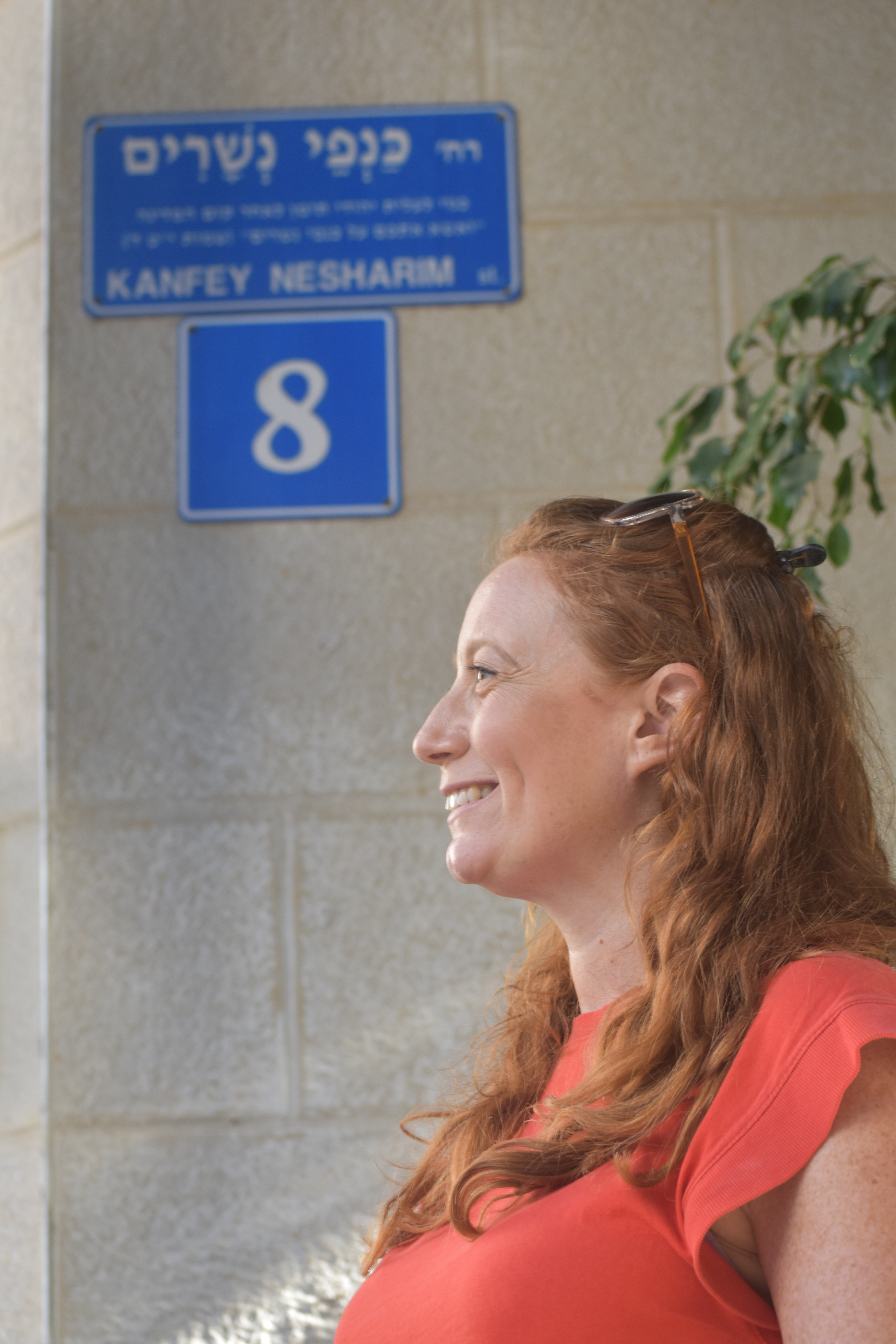
They came to Tel Aviv’s Kerem HaTeimanim, where the streets still hold their memory: Rechov Kanfei Nesharim, Rechov HaAliyah HaTeimanit, and alleys named after the poets and dreamers who carried Yemen’s Jewish soul through generations of exile. The neighborhood became a landing place for people who had lived so close to the dust of history that being lifted into the sky felt like God reaching down again.

A New Kind of Arrival

Today those same streets are welcoming new immigrants — Jewish artists from Paris, Berlin, Amsterdam, and London. They are not fleeing famine or forced conversion. They leave behind apartments, galleries, and studios, places where they once felt at home but now feel the room shifting beneath their feet.

They speak quietly of exhibitions canceled with careful wording, of colleagues who grow uncomfortable when they identify openly as Jews, of a cultural world that prides itself on openness yet signals, in subtle ways, that Jewish presence complicates the picture.

Or they just concluded it was time to move on.

Their departure is not dramatic. No riots, no decrees. Just a slow tightening — a sense that Europe’s warm lights are dimming for them. And so they come here, carrying sketchbooks, guitars, half-finished manuscripts, their beautiful voices, and the hope that Israel will give them what their former homes no longer can: the ability to be fully themselves.

They settle into Kerem HaTeimanim because it feels familiar: small homes, open doors, neighbors who still greet each other, a neighborhood built by people who also crossed deserts — literal or emotional — to find peace.

Actress and singer from London makes a new home in the “Yemenite Vineyard” section of Tel Aviv (photo: First One Through)

The Meeting of Journeys

In these narrow lanes, two different exoduses breathe the same air. Children run past synagogues founded by Yemenite families and new galleries opened by European artists. Hebrew floats from balconies in melodies that sound ancient and brand new at once.

The Yemenite grandparents who arrived barefoot on metal wings once prayed simply to reach Zion. The young European immigrants arriving today pray to belong — to a people, to a place, to their own identity without contortion.

Here, on Kanfei Nesharim Street, the verse from Sinai feels alive again. Not as a metaphor of miraculous rescue, but as a quiet truth: every Jew who finds their way home is carried by something — hope, fear, memory, longing — that lifts them just high enough to begin again.

In this little corner of Tel Aviv, you can almost feel the wings settling gently on the houses, as if history itself decided to rest for a moment before taking flight again.

Over three thousand years ago, God took the Jews of Egypt out from slavery and established the Jewish people. Nearly eighty years ago, just after the reestablishment of the Jewish State, the government of Israel rescued the Jews of Yemen from persecution and brought them to the holy land. Today, Jews from the West come on their own to the Jewish Promised Land.

We marvel at the notion of being taken to safety on “eagles’ wings.” Perhaps we should also marvel at the place to which we arrived.

Before You Make Aliyah…

Many Americans are disillusioned by the state of antisemitism today. Not only is it rampant on college campuses but alive and well in U.S. Congress from people like Rashida Tlaib, Ilhan Omar and Marjorie Taylor Greene. Jewish Americans are considering buying a home in Israel, and perhaps relocate for all or part of the year.

Rep. Rashida Tlaib (D-MN), Rep. Ilhan Omar (D-MN) and Rep. Jamaal Bowman (D-NY) on November 30, 2021 in Washington, DC. (Photo by Drew Angerer/Getty Images)

Before they do, they should relocate within the United States.

Most American Jews live in deep blue or red states like New York, New Jersey, Florida, California and Illinois. Before moving to Israel, they should change their place of residence to one of the swing states like Pennsylvania, Georgia, Arizona or Nevada. That will enable the person to submit an absentee ballot in a state where the vote could actually impact the outcome of a presidential election, tipping the electoral college towards candidates which favor western values.

Even as the world watches the tragedy in the Middle East, many Jewish Americans have greater fear for their futures in the United States and are moving to a war zone. While abroad, they can continue to help America by making sure their votes will matter by first relocating to Philadelphia, Atlanta, Phoenix or Las Vegas.

Related articles:

The Muslim American Community Gameplan For 2024 Presidential Election Is Beyond 2024 (September 2024)

The Most Important Congressional Races For Your Engagement (September 2024)

Peacefully Calling For The Annihilation Of Jews (May 2024)

Hamas, CAIR, DSA, Within Our Lifetime, SJP Are All Gunning For Jews (May 2024)

“Jews, Will Not Replace Us” By Radical Jihadists, The Alt-Left and Alt-Right (May 2024)

‘Tis The Season To Vote And Donate Jewish (April 2024)

Considering Campus Antisemitism (November 2023)

The Insidious Jihad in America (July 2019)

Please Don’t Vote for a Democratic Socialist (November 2018)

Aliyah to Israel

Even during these turbulent times, Jews from around the world move to Israel.

Jews have always lived in and moved to Israel. They started coming to Israel in greater numbers throughout the 1800s as the number of Jews in the land moved up from 3% to 14% of the population.

The reasons why people come to Israel have changed over time:

  • A spiritual connection to the land;
  • Escape from poor treatment in their prior home country;
  • Economic opportunities;
  • Family

The main regions that are coming to Israel over the past few years are: Russia/Ukraine; France; US/Canada.  In August 2014, over 300 Jews from the US and Canada moved to Israel, with over 100 joining the Israel Defense Forces.

Since 2008, Israel has been the home to more Jews than any other country- for the first time in almost 2000 years.


Source:

http://www.israelnationalnews.com/News/News.aspx/183977#.U-oXhZt8OUk

The loss of Jews in Europe continues

The recent fatal shooting at the Jewish Museum in Brussels may increase the probability of more Jews leaving Belgium.  Belgium is already one of the countries with the highest rates of aliyah to Israel.

In 1948, there were 34 countries with over 25,000 Jews.  Today, there are HALF -17 countries.  Belgium (30,400) and Italy (28,000) are the next countries that are likely to see their Jewish populations drop below 25,000.

Over 82% of the Jews in the world are concentrated in only two countries – Israel and the US – the greatest concentration of Jews in 2000 years.