The New Endorsed Parameters of Peaceful Nuclear Power

In July 2015, six world powers concluded their negotiations with Iran on its nuclear power program. Parties like US President Barack Obama congratulated himself and the negotiating team for “prevent[ing] Iran from acquiring a nuclear weapon and ensur[ing] that Iran’s nuclear program will be exclusively peaceful going forward.”

That claim is questionable in the short-term and clearly false in the long-term. What is certain, was the deal established the new parameters for peaceful nuclear power for the world to (potentially) replicate.

 iran-historic-nuclear-deal
European Union foreign policy chief Catherine Ashton (3rd L) delivers a statement during a ceremony next to British Foreign Secretary William Hague, Germany’s Foreign Minister Guido Westerwelle, Iranian Foreign Minister Mohammad Javad Zarif, Chinese Foreign Minister Wang Yi, U.S. Secretary of State John Kerry, Russia’s Foreign Minister Sergei Lavrov and French Foreign Minister Laurent Fabius (L-R) at the United Nations in Geneva November 24, 2013 (Reuters / Denis Balibouse) / Reuters

Nuclear Energy versus Nuclear Weapons

There are thirty-one countries in the world that have nuclear power plants for generating electricity and nine countries which have nuclear weapons. Those countries are (countries in bold posses both nuclear energy and weapons):

  • Nuclear power plants (31): United States; France; Russia; South Korea; China; Canada; Germany; Ukraine; UK; Sweden; Spain; Belgium; India; Czech Republic; Switzerland; Finland; Slovakia; Hungary; Japan; Brazil; South Africa; Bulgaria; Mexico; Romania; Argentina; Slovenia; Pakistan; Iran; Netherlands; Armenia
  • Nuclear weapons (9): Russia; United States; France; China; United Kingdom; Pakistan; India; Israel; North Korea

There are more than 31 countries that use electricity from nuclear plants – such as Italy and Denmark that each get over 10% of their power from nuclear plants – but do not host nuclear power plants in their country.  Nuclear power plants generate 14% of the electricity in the world.

Safety Concerns of Nuclear Energy

Despite the sizable role that nuclear electricity-generation plays, there are many safety concerns.

Peaceful power plants: Notable “meltdowns” of peaceful nuclear power plants include Ukraine (1986); United States (1979); and Japan (2011).  Countries with nuclear power plants institute many safety procedures to protect the surrounding areas from potential nuclear radiation fallout.

Fuel: Beyond the plants themselves, countries carefully manage the materials that are the basis for nuclear power: raw uranium and plutonium (that are mined); enriched uranium and plutonium (suitable for use in nuclear power or weapons); and spent fuel rods (post-use, no longer able to generate electricity, but have radiation).

  • Mining: Uranium is mined in 20 countries, with 90% mined in just a handful of countries: Australia; Kazakhstan; Russia; Canada; Niger; Namibia; South Africa; Brazil; USA; and China. Plutonium, while found in trace amounts in nature, is created in nuclear plants by modifying uranium.
  • Spent fuel: Edwin Lyman and Harold Feiveson have written about safety concerns of spent fuel.  Spent nuclear reactor fuel is highly radioactive and contains significant concentration of weapons-usable plutonium isotopes. Some countries like the USA, Canada and Sweden plan to store the spent fuel in geologic repositories. Others like UK and France reprocess the spent fuel and separate the plutonium from the uranium. Such uranium, which can be handled, becomes a potential source for theft to be used in nuclear weapons.

Nuclear weapon facilities: Some nuclear facilities do not focus on generating electricity but are built specifically to produce weapons of mass destruction. These facilities pose risks not only from the radioactive materials or potential fallout from a meltdown of the plant, but from the massive destruction that such weapons can produce.

End-to-End Nuclear Facilities

Most countries with peaceful nuclear power plants do not have end-to-end facilities which can produce nuclear-generated power completely on their own.  Countries do not typically mine uranium, enrich it, produce the electricity and store or reprocess the spent fuel.  For example, Japan, which gets over 30% of its power from 50 nuclear plants, imports uranium from Australia, Kazakhstan and Canada. Historically, Japan relied on other countries for various steps of its nuclear program, but it has recently taken steps to enrich the raw uranium and reprocess some of the spent fuel inside Japan. For the most part, spent fuel has still been stored in the UK and France.

With the new 2015 P5+1 deal with Iran, Iran will have complete end-to-end nuclear capabilities with global approval.
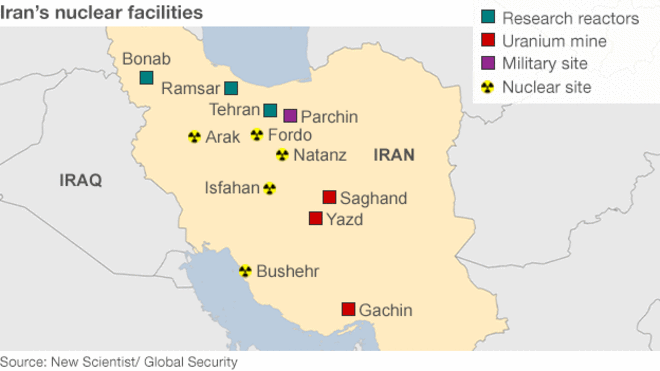
iran_nuclear_624
Source: New Scientist/Global Security

Iranian Uranium Mines:  Iran opened two uranium mines in 2013, the Saghand mine and Gchine mine, that provide some uranium for its enrichment program (but these have low concentrations of uranium). The two mines in the city of Saghand in central Iran operate 1,150 feet underground.

Iranian Milling Facility: Approximately 75km from Saghand is the Ardakan mill which processes the uranium into yellowcake.

Iranian Enrichment Facility: The Uranium Enrichment Facility at Isfahan purifies the yellowcake to UF6, a gas, which enables it to be enriched. Enrichment increases the proportion of the U-235 isotope from its natural level of 0.7% to 3-5%.

After enrichment, the UF6 gas is converted to uranium dioxide (UO2) which is formed into fuel pellets. These fuel pellets are placed inside thin metal tubes which are assembled in bundles to become the fuel elements for the core of the reactor.

Natanz is Iran’s primary enrichment facility and consists of three underground buildings, two of which are designed to hold fifty thousand centrifuges, and six buildings built above ground. It’s stated purpose is to produce enriched uranium for use in both the Tehran Research Reactor (requiring 19.75% U-235 content) and fuel for the Bushehr nuclear power plant (requiring 3.5% U-235 content).

The Fordow Enrichment Plant is a large underground industrial facility located near the city of Qom. The site includes two underground halls each able to hold 1,500 centrifuges.  Iran failed to disclose the existence of the Fordow facility until it was revealed publicly by western governments in 2009.

A heavy water nuclear reactor near Arak was first identified by US satellite images in 2002. Heavy water reactors produce a lot of plutonium waste product as part of enriching uranium, which can be used in nuclear weapons.

The nuclear reactor at Bushehr on the Arabian Gulf, was started by Germany in the early 1970s, but suspended after the 1979 Iranian Revolution.  Russia took over constructing the plant and started delivering the nuclear fuel in May 2011.

Iran will soon have a complete end-to-end nuclear program which would include several underground and fortified nuclear sites.

From Nuclear Energy to Nuclear Weapons

There is a narrow gap between the assets and capability needed to build a power plant and what is needed to build weapons of mass destruction.  A brief primer from the Centre for International Governance Innovation (CIGI):

Both nuclear reactors and nuclear bombs use either uranium or plutonium to create a nuclear chain reaction that releases energy. The speed with which they release energy is the crucial difference between the two: in a reactor the energy release is controlled and sustained over an extended period, whereas in a nuclear bomb the release occurs in fractions of a second. The science of fission is fairly straightforward; however, controlling fission reactions to get the desired effect is challenging.

While on the surface it may appear that the infrastructure required for both electricity and weaponry is the same (just some technical understanding stands in the gap), the reality is more complicated.

“To develop a nuclear device, the difference in the speed of the chain reaction creates additional requirements for the firing mechanism, grade of the uranium or plutonium used, and the density, physical surrounding and shape of the fissile material. These differences are substantial barriers to a state looking to shift from power production to assembling a nuclear device.”

In short, the raw materials and infrastructure are very similar, while the technical capabilities are a bit more complicated.

 Iran’s Nuclear Program: from Energy to Weapons?

According to CIGI: “a peaceful program provides the scientific foundation
upon which a state can go on to build and operate its own dedicated plutonium production reactor to produce the material for a nuclear weapon… The main benefit derived from a once-through nuclear energy program for the construction of a nuclear device is the buildup of nuclear infrastructure that would otherwise be difficult, if not impossible, to camouflage….  a peaceful nuclear energy program is best characterized as a stepping stone to acquiring the wherewithal for a nuclear device.”

The White House produced a summary of how the contemplated 2015 deal would block Iran from converting a peaceful program into a weapons program:

  • Reduce level of raw uranium: cut stockpile (mostly acquired in the past from South Africa) by 98%
  • Block enriching uranium: by reducing centrifuge count at Natanz and Fordow
  • Cap the enrichment level: to 3.67%, below the required level to produce weapons
  • Block plutonium production: reconfigure Arak plant so it cannot produce plutonium; ship out all spent fuel. Additionally, no new construction of heavy-water reactors for 15 years

In July 2015, the P5+1 countries effectively endorsed the acceptable parameters of a valid and peaceful nuclear energy program.

Creating the New Paradigm for All Countries

Which begs the question, if there are 31 countries that have nuclear power plants, why are there only 9 with nuclear weapons? Do they not have the technical capabilities for producing a weapon? Lack the desire? How much effort and infrastructure would it take for a country like Hungary to go from a peaceful nuclear program to a weapons program?

If a known state-sponsor of terrorism which calls for the annihilation of other countries (Iran) is permitted to keep such a vast nuclear infrastructure, every other country would be permitted to build comparable nuclear infrastructure.  This is true for countries with existing nuclear plants like Armenia, or non-nuclear countries like Venezuela.  In other words, this deal marks the world’s endorsement of a baseline peaceful nuclear program.

This is obviously very dangerous for the safety and security of the entire world.

A Better Alternative

US President Obama and others have questioned whether there is a better alternative.  Here are some possible points that should be considered before blessing an explosion of “peaceful” nuclear infrastructure construction in the world:

  • No end-to-end capabilities.  As a checks-and-balance for nuclear proliferation, no country should be able to maintain a complete mines-to-reactor program. Countries which are state-sponsors of terrorism should be barred from two components of a complete program. For Iran, they would likely opt to abandon their mines which are not very productive anyway. They would then be left with a choice of modifying their global behavior or giving up another component of their program (maybe opting to ship all spent fuel out of the country permanently).
  • No underground fortified facilities.   As a global precaution against a peaceful program becoming weaponized, no nuclear enrichment facilities should be fortified to such a level that destroying them with conventional weapons becomes nearly impossible. This would require Iran dismantling some of their underground facilities or making them less fortified.
  • Anytime, anywhere inspections. All peaceful nuclear facilities should be available for inspections by the IAEA at anytime.  For this Iranian deal, it would require a more stringent approach than the lengthy 24-day process currently contemplated.
  • Cap on centrifuges. Not only should the number of centrifuges of a country be capped, but no facility should be able to have over a certain number of centrifuges (for example, a cap of 6000 in a country, and no single facility with over 1,500).

These are some examples which should become a requirement of every country for every peaceful nuclear power program. These steps would help protect the entire world from a step-up from peaceful nuclear energy to threshold nuclear weapons.


The current P5+1 Iranian nuclear deal cannot be viewed in a simple comparison of whether the deal is better than no deal. It must be viewed in the context of establishing a new baseline for the use of nuclear power around the world. On such basis, it is easy to see the existing shortfalls.


Related First One Through articles:

Parallel and Perpendicular Views of Iranian Nuclear Deal

Has the “Left-Wing” Joined the UN in Protecting Iran and the Palestinians from a “Right-Wing” Israel?


Parallel and Perpendicular Views of Iranian Nuclear Deal
In a world of 7 billion people, there can be no surprise that people have different views. Even in smaller segments of society, whether in a small town or school, different people could look at a situation and arrive at very different conclusions. One story, two views.

Conclusions may in turn generate additional comparisons. Once an opinion becomes anchored, another similar thought may come to mind. Over time, the two distinct ideas become linked together, in closely related parallel views. Two stories, one view.

THE IRANIAN NUCLEAR DEAL

Perpendicular Conclusions

Much of the world followed the negotiations between six global powers and Iran over the latter’s nuclear ambitions. Not only did many people seek different outcomes, even people that sought the SAME outcomes, viewed the deal in completely different ways.

Consider the Wall Street Journal and The New York Times. Presumably each American newspaper sought a deal which left Iran without nuclear weapons capability.  On July 15, each paper ran factual headlines about the outcome of the negotiations.  Yet the emphasis for each was extremely different.

DSC_0119
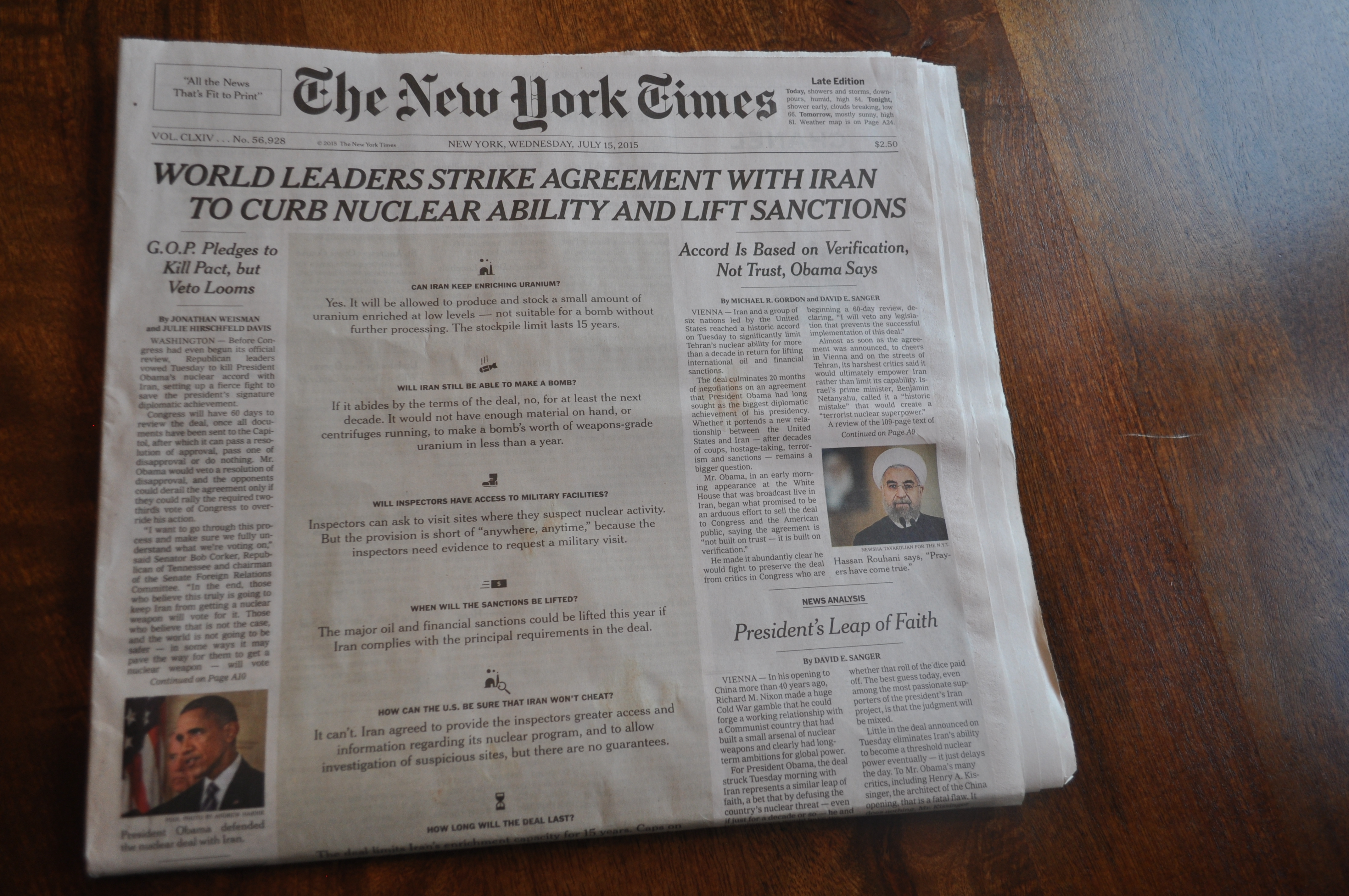
Front page of New York Times,
July 15, 2015

The headline for the NYT read: “World Leaders Strike Agreement with Iran to Curb Nuclear Ability and Lift Sanctions.”  Sub-headers read “Accord is Based on Verification, Not Trust, Obama Says” and “G.O.P. Pledges to Kill Pact, But Veto Looms.”  An article further down the page was entitled “President’s Leap of Faith“.

In the middle of the front page the Times sought to summarize the deal terms in a Q&A format.  For anyone reading the answers, it was clear that the deal offered few assurances that Iran was not going to have nuclear weapons within the decade, and certainty that they would have it after a decade.

The portrayal was in sharp contrast to the front page of the WSJ.

DSC_0118
Front page of Wall Street Journal,
July 15, 2015

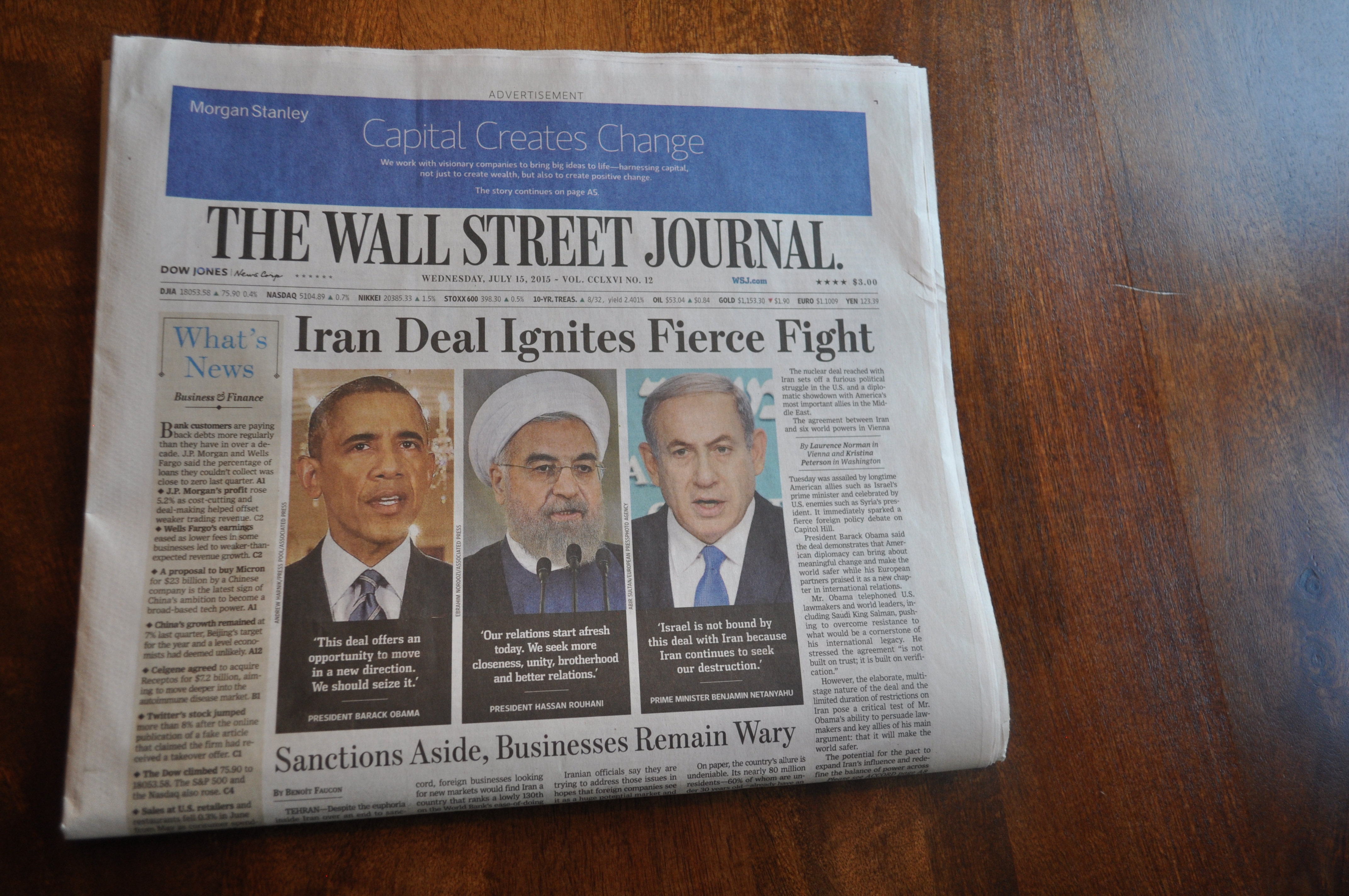
The WSJ also led with a factual headline about the reactions to the Iranian deal. “Iran Deal Ignites Fierce Fight” The paper included three large pictures with quotes from the leaders of the United States, Iran and Israel with their views on the deal terms.

Both papers considered that Obama and Iranian leader Rouhani were happy with the deal.  That was where the similarities ended.

The Times called out the Republicans as being unhappy, while the Journal highlighted Israel’s unhappiness with the deal. One paper took a more domestic review of the international matter, while the other focused on the international fallout. The NYT used small font to review the dissent of the deal in language that could have been used to describe a capital gains tax hike, while the WSJ used large color photographs in the center of the paper to draw attention to the significant global ramifications of the agreement.

The NYT seemed to tell its readership that if they had faith in Obama, they should have faith in this deal. The WSJ told its readership that a huge fight was brewing overseas, and the US aligned itself with an enemy state and against an ally.

Two papers presumably started at the same spot seeking the same result, but moved in opposite directions when the negotiations concluded.

False Parallels

The head of the Shalom Hartman Institute of North America, Yehuda Kurtzer, also decided to weigh in on the Iranian deal from the ancient Jewish city of Hebron. In a blog called “On Iran, from Hebron” he described his trip with a group of rabbis who came to hear a wide range of narratives from all sorts of people in the city.  Kurtzer’s conclusion was that there exists an obvious parallel between the Iranian threat against Israel, and Jews living east of the Green Line. He said: “I am sad and nervous – both about what Israel is doing to itself in places like Hebron with its commitment to structures which risk its unmaking, and about the threats to Israel’s existence from state actors” and continued the parallel in more clear language about “a settlement [Hebron] that constitutes a self-imposed existential threat to Israel, while listening on Twitter to debates about external existential threats.

Here was a leader of an organization that described itself as a “pluralistic center of research and education deepening and elevating the quality of Jewish life in Israel and around the world,” equating a Jew living with his family in Hebron, with an Iranian regime shouting “Death to Israel” while it obtained the green light from the world to have nuclear weapons in ten years.

A champion of pluralism drew an equivalence between starkly different stories: Jews living freely in places they lived for thousands of years; and a country that has threatened -and will soon be armed for- a genocide.


I understand different people having different opinions. I respect the concept that two parties can start at the same spot and move in opposite directions. Yet I struggle when a single person can conflate two completely different matters into a single narrative.

The NYT loves Obama and feels that their trust and faith in him has prevailed over his presidency, so why not trust him again now? (Of course, that has nothing to do with trusting Iran, but the Times at least starts consistently). The WSJ has always pointed out the flaws of Obama’s foreign policies and used this bad Iranian deal to point it out again.

But what of the leader of a “pluralistic” organization? Does being pluralistic mean that everything and everyone carry the same weight? Does the notion that “pluralism can mean that no full knowledge of truth is possible” mean that it can be so amazingly wrong to suggest that the “external existential threat” of an Iranian nuclear bomb is the same as a “self-imposed existential threat” of Jews living in Hebron?

There is a logic to a liberal paper supporting a liberal president. One can agree to disagree. But how does one react to someone who distorts reality as if the world was a hall of mirrors perched atop a black hole? On Earth, we know opinions can diverge.  In the ethereal world of “pluralism”, it would appear that accepting information from everywhere can lead to a singularity of stupidity.

Absolute and Relative Ideological Terrorism in the United States

Summary: The New York Times has sought to educate people to fear Republican terrorists more than Muslim extremists.

“Right-Wing” versus “Muslim Extremism”

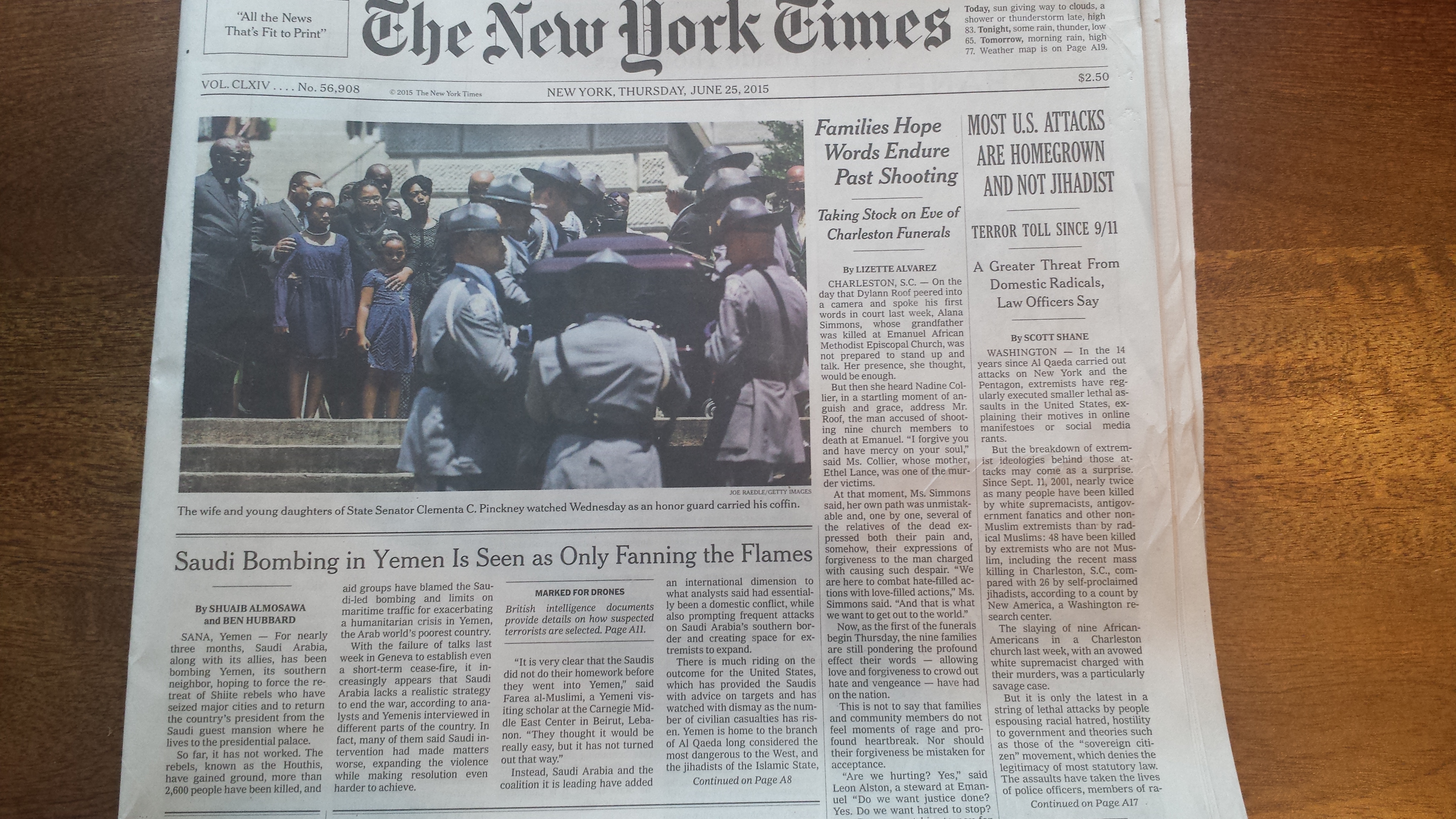
In June 2015 the New York Times ran some articles and editorials claiming that domestic terrorism was more of a problem than radical Islamic terrorism.

  • A June 16 op-ed “The Growing Right-Wing Terror Threat” quoted a police officer that “said that “militias, neo-Nazis and sovereign citizens” are the biggest threat we face in regard to extremism’”. The paper quoted statistics from The Global Terrorism Database which counted 65 attacks at the hands of “right-wing ideologies and 24 by Muslim extremists since 9/11”. It added another source, “the International Security Program at the New America Foundation identifies 39 fatalities from “non-jihadist” homegrown extremists and 26 fatalities from “jihadist” extremists.
  • On June 24, the NYTimes had an article entitled “Homegrown Extremists Tied to Deadlier Toll Than Jihadists in U.S. Since 9/11”. The paper stated that “Since Sept. 11, 2001, nearly twice as many people have been killed by white supremacists, antigovernment fanatics and other non-Muslim extremists than by radical Muslims: 48 have been killed by extremists who are not Muslim, including the recent mass killing in Charleston, S.C., compared with 26 by self-proclaimed jihadists, according to a count by New America, a Washington research center.” That data looks to be the same as the International Security Program, but included the nine black church-goers who had just been gunned down. Another statistic in the article stated that “Non-Muslim extremists have carried out 19 such [ideological] attacks since Sept. 11, according to the latest count, compiled by David Sterman, a New America program associate, and overseen by Peter Bergen, a terrorism expert. By comparison, seven lethal attacks by Islamic militants.”

The Washington Examiner questioned the definition of “right-wing terrorists” to include a very broad group of people. How did neo-Nazis and racists get lumped in with the “right-wing”?  Before exploring the Times deliberate grouping of all non-Muslim extremism under a single banner, consider a brief education about relative numbers versus absolute numbers.

20150626_073343
Main cover story in the New York Times

 Absolute versus Relative

A cursory review of numbers could lead to a quick conclusion: 48 people killed is a greater total than 26 people killed. A total of 19 attacks is more than seven attacks. As such, the quotes in the article such as “Law enforcement agencies around the country have told us the threat from Muslim extremists is not as great as the threat from right-wing extremists” would appear accurate on its face as there were more than two times the number of attacks and almost twice the number of fatalities from non-Muslim attacks.

However, a review of the statistics on a relative basis would yield a very different result.

According to the Pew Research Center, Muslims accounted for 0.9% of Americans in 2014. That means that there are 99 times more non-Muslims than Muslims in the US. If one were to assume that the percentage of Muslims who are radical that would commit an act of terror is the same as the broad group of right-wing and anti-government terrorists within the non-Muslim population, one would expect the right-wing terrorists to have 99 times the number of attacks and fatalities, not two times.  This implies that an average Muslim is 49 times more likely to commit an act of ideological terror than a non-Muslim in the United States.

(By the way, the statistics deliberately exclude the jihadist terrorism of 9/11 which killed nearly 3000 people.)

 The New York Times Warning of Terrorism by Conservatives

After the Times led its readers to focus on “homegrown extremism” as the actual threat of terrorism (compared to jihadists), it lumped all of those non-Muslim fanatics into the Republican party:

 On several occasions since President Obama took office, efforts by government agencies to conduct research on right-wing extremism have run into resistance from Republicans, who suspected an attempt to smear conservatives. A 2009 report by the Department of Homeland Security, which warned that an ailing economy and the election of the first black president might prompt a violent reaction from white supremacists, was withdrawn in the face of conservative criticism.”

Even if one were to use the liberal paper’s biased assumptions that all anti-government and racist fanatics must exclusively come from the Conservative and Republican parties (which account for roughly 45% of the population according to a June 2015 Gallup poll), it would still suggest that an average Muslim is over 20 times more likely to commit an ideological attack as a “homegrown [Conservative] extremist.”

That would suggest one of the following conclusions:

  1. Non-Muslim terrorists have nothing to do with the Conservative/ Republican parties; OR
  2. An average Muslim is much more likely to commit acts of terror than an average non-Muslim

Either way -or both – these are the exact opposite conclusions that the New York Times sought to convey in its articles.


Related FirstOneThrough article:

Ramifications of Ignoring American Antisemitism


Palestinians agree that Israel rules all of Jerusalem, but the World Treats the City as Divided

The Palestinian Arabs and Israelis last managed to negotiate an agreement in September 1995. That agreement, Oslo II, was intended to be an interim agreement after which a permanent resolution was to be reached in five years. However, five years later in September 2000, Palestinian leader Yasser Arafat walked away from the Israeli peace proposal and launched multi-year riots which claimed thousands of lives.

The terms of Oslo II still live on, decades later.

Oslo II signing
Rabin and Arafat sign maps prior to the Oslo II signing ceremony at the White House, as US president Bill Clinton, Egypt’s Hosni Mubarak and Jordan’s King Hussein look on, September 28, 1995 (photo credit: GPO)

Goals of Oslo II

Oslo II was meant to set in place an interim Palestinian Authority which would become the basis of a Palestinian political structure. Oslo II had NO calls for an independent Palestinian state, but stated the goal of the negotiations was to lead to a permanent settlement based on Security Council Resolutions 242 and 338.

  • Security Council Resolution 338 was declared after Egypt attacked Israel in the Yom Kippur War. The goal was to stop hostilities and commence peace negotiations.  The thrust of SC 338 was to implement SC 242 to establish “a just and durable peace
  • Security Council 242 was drafted after the Six Day War in 1967. In that war, Israel preemptively attacked Egypt and Syria that were readying an attack on Israel, and Israel defended itself from an attack from Jordan.

Without delving into the nuances of SC 242 here, the thrust of the resolution was to have Israeli armed forces pull back from some territories which it won in the 1967 War and that all states respect “the sovereignty, territorial integrity and political independence of every State in the area… free from threats or acts of force.” It also proposed “a just settlement of the refugee problem.

Oslo II built on these UN Security Council goals with an interim roadmap. It began with Israel’s handing over certain territories to the Palestinian Authority (Gaza and Jericho) as well as other major Palestinian cities.

Status of Jerusalem in Oslo II

Jerusalem is mentioned eight times in the Oslo II Accords. In every instance, the entire city is referenced, not just the eastern half that Israel acquired from the Jordanians and Palestinian Arabs in 1967.

The first six times “Jerusalem” appeared in the Oslo II agreement relate to future Palestinian elections in which Palestinian Arabs located in Jerusalem would be able to participate. The remaining two times specifically state that Jerusalem is a point for final status negotiations:

  • ARTICLE XVII Jurisdiction
    1. In accordance with the DOP, the jurisdiction of the Council will cover West Bank and Gaza Strip territory as a single territorial unit, except for:
    2. issues that will be negotiated in the permanent status negotiations: Jerusalem, settlements, specified military locations, Palestinian refugees, borders, foreign relations and Israelis;
  • ARTICLE XXXI Final Clauses
    5. Permanent status negotiations will commence as soon as possible, but not later than May 4, 1996, between the Parties. It is understood that these negotiations shall cover remaining issues, including: Jerusalem, refugees, settlements, security arrangements, borders, relations and cooperation with other neighbors, and other issues of common interest.

According to the agreements executed by the Palestinians and Israelis:

  • Jerusalem is not part of the West Bank, as it is broken out separately
  • Jerusalem is not a “settlement”, as the agreement stated later that “settlements” are entities in the West Bank and Gaza – “For the purpose of this Agreement, “the Settlements” means, in the West Bank the settlements in Area C; and in the Gaza Strip – the Gush Katif and Erez settlement areas, as well as the other settlements in the Gaza Strip, as shown on attached map No. 2
  • Israel controls Jerusalem“Israel shall continue to exercise powers and responsibilities not so transferred”

There is therefore no basis for any of the United Nations, the EU or the Unites States to claim that Jerusalem is a settlement and that Jews should have any restrictions from living anywhere in the city.  Should there be any modifications to the Israeli rule of the city, it will be made by mutual consent in permanent status negotiations.

Yet, the world ignores the Oslo II foundation document of a peace agreement.

United Nations Ignores Oslo II on Jerusalem

UN Secretary-General Ban Ki-Moon made an address on the “International Day of Solidarity with the Palestinian People” in 2013:

On Jerusalem’s Jewish “settlements”:All settlement activity in the West Bank and East Jerusalem must cease.  Measures that prejudge final status issues are not to be recognized.
Announcements of thousands of new housing units cannot be reconciled with the goal of a two-state solution and risk the collapse of negotiations”

These statements ignore Oslo II in many respects: it broke apart “East Jerusalem” as a distinct entity; it claimed that Jews living in “East Jerusalem” were in “settlements”; it called for a two-state solution (while not in Oslo II, both the Israelis and Palestinians later agreed to such plan); it suggested that Jews living in “East Jerusalem” hurt a two-state solution.

On Palestinian homes in “East Jerusalem”: “Of particular concern are developments in East Jerusalem, where this year alone, some 100 [Arab] structures have been demolished, displacing 300 people.  Hundreds more Palestinians are at risk because their homes were built without Israeli-issued building permits”

The UN leader voiced concern with more Jews moving into eastern Jerusalem and not enough Arabs being accommodated there.

On the Permanent Status Negotiations of Jerusalem: “Jerusalem is to emerge from negotiations as the capital of two States, with arrangements for the holy sites acceptable to all”

Ban Ki-Moon voiced a conclusion not made in Oslo II and “prejudged” an outcome that Jerusalem must be divided, even though Israel already divided the UN’s “Holy Basin” when it gave Bethlehem to the Palestinian Authority 20 years earlier.  Amazing commentary from someone who is concerned with “prejudging final status issues.”

European Union Ignores Oslo II on Jerusalem

The EU has taken positions adopted by the Palestinian Authority which are outside of the agreements reached by Israel and the PA in Oslo II:

On Jerusalem’s Jewish “settlements”: “EU considers that settlement building anywhere in the occupied Palestinian Territory, including East Jerusalem, is illegal under international law, constitutes an obstacle to peace and threatens to make a two-state solution impossible.”

On Palestinians in “East Jerusalem”: “The EU supports [Arab] institution building work in East Jerusalem, notably in the areas of health, education and the judiciary.” 

On the Permanent Status Negotiations of Jerusalem: “the EU has repeatedly confirmed its deep concern about accelerated settlement expansion in the West Bank including East Jerusalem. This expansion prejudges the outcome of final status negotiations and threatens the viability of an agreed two-state solution”
“The EU considers that the peace negotiations should include the resolution of all issues surrounding the status of Jerusalem as the future capital of two states. The EU will not recognise any changes to the pre-1967 borders including with regard to Jerusalem, other than those agreed by the parties.”

Like the United Nations, the EU ignored the mutual recognition of both Palestinians Arabs and Israel that only Israel administers all of Jerusalem, and any modification to such arrangement must be made by mutual agreement. Oslo II made no suggestion that the holy city be divided.

The United States Ignores Oslo II on Jerusalem

On Jerusalem’s Jewish “settlements”: Jen Psaki, Spokesperson for the US Department of State said on October 27, 2014: “we continue to make our position absolutely clear that we view settlement activity as illegitimate and unequivocally oppose unilateral steps that prejudge the future of Jerusalem. Israel’s leaders have said they would support a pathway to a two-state solution, but moving forward with this type of action would be incompatible with the pursuit of peace”

On the Palestinian Authority in Jerusalem: While the US does not recognize Jerusalem as the capital of Israel or any country (and therefor does not maintain on embassy in Jerusalem), it has nevertheless decided to establish an office for Palestinians in Jerusalem.  The United States Security Coordinator for Israel and the Palestinian Authority (USSC) sounds like it services both Israel and the PA, but its mission is to serve and assist the PA in meeting its security needs. “The USSC directs all facets of U.S. security sector assistance to the Palestinian Authority and synchronizes international supporting efforts…The USSC assists the Palestinian Authority to transform and professionalize its security sector.

The US decided to place such office to assist the PA in Jerusalem, rather than Bethlehem or Jericho. The address is home of the Consul General of the US in Jerusalem which serves US citizens from Jerusalem, the West Bank and Gaza.

On the Permanent Status Negotiations of Jerusalem:  Back in 2009, White House Press Secretary Robert Gibbs made a point that recognized that Jerusalem is a matter for final status negotiations, but said he was opposed to construction in “East Jerusalem”. “The United States opposes new Israeli construction in East Jerusalem. The status of Jerusalem is a permanent status issue that must be resolved by the parties through negotiations and supported by the international community. Neither party should engage in efforts or take actions that could unilaterally pre-empt, or appear to pre-empt, negotiations. Rather, both parties should return to negotiations without preconditions as soon as possible. The United States recognizes that Jerusalem is a deeply important issue for Israelis and Palestinians, and for Jews, Muslims, and Christians. We believe that through good faith negotiations the parties can mutually agree on an outcome that realizes the aspirations of both parties for Jerusalem, and safeguards its status for people around the world.”


There have been very few agreements between the Palestinian Arabs and Israelis throughout history.  When the parties last mutually agreed to move forward with a peace process, they agreed that all of Jerusalem was controlled by Israel.  The agreement had no caveats about what Israel could or could not do anywhere in the city. It made no suggestion that the city was or would be divided.

Despite that reality, a new perception has taken hold in world bodies that Israel should prohibit Jews from living in parts of their capital and holiest city.  It is being repeated more frequently and with greater force: at one point, world bodies opposed Israel building new neighborhoods in the eastern part of Jerusalem; now they decry Jews moving into existing homes that  they legally purchased privately.

How can Israel expect to negotiate a final status agreement if the world rejects the agreements Israel makes with Palestinian Arabs as it did with Oslo II? How can Israel enter negotiations when the world advances a prejudged outcome to such negotiations to which Israel never agreed?


Related First One Through articles:

The Arguments over Jerusalem

Real and Imagined Laws of Living in Silwan

Nicholas Kristof’s “Arab Land”

Obama supports Anti-Semitic Palestinian Agenda of Jew-Free State

The Israeli Peace Process versus the Palestinian Divorce Proceedings

A “Viable” Palestinian State

A Simple Question for Hillary Clinton on Israel

In June 2015, Hillary Clinton claimed to have been a strong ally for Israel. Without getting into the history of her tenure as Secretary of State, (when she could claim she was following the orders of US President Barack Obama), here is a simple question for Hillary on her presedential run: will she reintroduce the pro-Israel Democratic platform that was present in 2008, but abolished under Obama in 2012?

Hillary rally
Hillary Clinton speaks at her first campaign rally in New York City
June 13th, 2015. Photograph: Andrew Harrer/Bloomberg

Specifically, will she reintroduce the pre-Obama Democratic platform that called for:

  • The isolation of Hamas until it renounced terrorism. As declared in the 2008 Democratic platform: “The United States and its Quartet partners should continue to isolate Hamas until it renounces terrorism, recognizes Israel’s right to exist, and abides by past agreements.”
  • The settlement of the descendants of Palestinian refugees in a new Palestinian State, not Israel.The creation of a Palestinian state through final status negotiations, together with an international compensation mechanism, should resolve the issue of Palestinian refugees by allowing them to settle there, rather than in Israel.”
  • Dismissing the concept that borders should be based on the 1949 Armistice Lines.All understand that it is unrealistic to expect the outcome of final status negotiations to be a full and complete return to the armistice lines of 1949.”
  • Recognized Jerusalem as the capital of Israel.Jerusalem is and will remain the capital of Israel.” The party removed the statement, and then reinstated it after a bitter fight on the convention floor.

Obama made his pivot away from Israel very clear in his 2012 presidential run.  What are Hillary Clinton’s intentions?


Related First.One.Through articles:

International-Domestic Abuse: Obama and Netanyahu

America’s Closed Doors

The spring of 2015 has been a tumultuous time for Americans.

Politics and debate are not new and neither are riots and war. However, it is typically the former that resides on America’s shores while the latter remains a foreign phenomenon.

Closed Doors at Home

Historically, when riots broke out in the United States, they were over isolated incidents such as after a sports game, a concert or visit of foreign diplomats. When protests had “a theme,” such as “Occupy Wall Street,” they carried on for a long time, but remained mostly non-violent. Today’s multi-city violent protests over a common cause is unusual.

The black community has had a mixed relationship with police for a long period of time. People on all sides of the political spectrum debate the reasons for the tension between law enforcement and the citizens they are there to protect. No one denies that there is a problem that is capturing more American cities, whether Ferguson, MO, Berkeley, CA or Baltimore, MD.

Liberal arguments have followed two general themes – racism and economic opportunity – which are actually one: Black unrest stems from the fact that a predominantly white populace holds positions of power. The power may be law enforcement (including the police force and lawyers), municipal government, banks or business. They argue that white people’s biases (whether overt or veiled) discriminate against black people.

The racism argument stems from the large number of arrested and incarcerated black people which is disproportionate to their population figures. The Department of Justice report on Ferguson, MO stated that Ferguson’s police and municipal court practices both reflect and exacerbate existing racial bias, including racial stereotypes…. Evidence shows discriminatory intent.

Counter-arguments point to the situation in Baltimore, MD where the mayor, the majority of the city council, the head of police and the majority of the police force are black. Yet, an unarmed black youth still died while in police custody and black violence took to the streets.

Regardless of the reason, doors appear closed.

Liberals argue that metaphorical doors to economic opportunity are closed to blacks which create economic hardship and frustration. Conservatives argue that doors are naturally closed to everyone; people need to open the doors on their own.  The conservatives do not agree that metaphorical doors of progress are locked because of white bigotry.

Conservatives are focused on physical doors that are closed. Stores which were looted and burned to the ground may never reopen. Both the businessmen and community suffer from the destruction.  For their part, liberals use such conservative arguments to claim that conservatives care more about business than about the lives of black people.

But more physical doors continue to close.

The city of Baltimore imposed a curfew. It barred people from attending a professional baseball game, the first time in history that a game had no fans in the stands.  What will be next?

Closed Doors Abroad

America’s doors are closing due to violence and political snafus in other parts of the world as well.

In Yemen, the United States closed its embassy doors due to unrest in the country. The Obama administration had been using drones to attack rebel forces for many years, yet the rebels overtook the capital.  It would appear that despite America’s outreach to Iran, the Iranians continue to back rebels in Yemen who fight against American allies.

America’s allies in the Middle East are not happy with Obama.  While Obama invited the leaders of several Gulf countries to visit the White House to sell them on his Iranian nuclear deal, Saudi Arabia and other countries declined the invitation.

Just months before, it was Obama who snubbed the Israeli Prime Minister on his visit to the US, who similarly disagreed with Obama’s Iranian policy.


Regarding physical doors, both in the US and abroad, people are locked out of public places and embassies because the government cannot protect them. Metaphorically, America seems to be failing its citizens and allies as well.

At least Obama is focused on opening the door with Iran…. to get nuclear weapons while it chants “Death to America.”

KerryIran
US. Secretary of State Kerry and Iranian FM Zarif shake hands as Omani FM Alawi and EU envoy Ashton watch in Muscat.. (photo credit:REUTERS)

Look for Mom on Mother’s Day

Summary: Society’s ongoing demands for special recognition is making seeing one’s mother on Mother’s Day the equivalent of “Where’s Waldo”.

Just 101 years ago, on the brink of World War I, US President Woodrow Wilson declared Mother’s Day.

In its original format, it seemed like a nice, sweet, uncontroversial idea. Each person would make time to thank and honor their own mother for the love and effort they expended in bringing them into and up in this world.

Within a few months, many of those American mothers would be mothers-no-more, as over 100,000 American men died in combat. Americans reached out to those bereaved parents, and implicitly changed the singular “Mother’s Day” to “Mothers’ Day” in plural (as preferred by President Wilson over the wishes of the holiday’s creator, Anna Jarvis).

It did not take long for other societal changes to creep into this Sunday in May.

The first foxes in the henhouses were commercial opportunists. Merchants of flowers, candy and greeting cards convinced us that buying-was-caring, and that their wares were welcome with women, while warm wishes were watered down gifts.

They exploited the public “MotherS’ Day” and advocated that every mother you ever knew was important to recognize. Gone was the one-to-one heartfelt communication from child to mother. On came mass media and mega merchandizing.

This was much better for businesses, as now husbands were expected to buy more significant gifts for their spouses. Before long, jewelry and fashion accessories became the normal gift from a spouse, while the flowers remained a welcome gift from children. Meanwhile, terms of endearment became shorter than Twitter, as the space for sentiments was just the accompanying notecard.

As society expanded the definition of MotherS’ Day, many people came forward to demand their own recognition.  The LGBT community called for more coverage of people who would not have historically been considered mothers.  Others called on society to account for recognizing women with every conceivable iteration of motherhood or non-motherhood.  It is now commonplace for a person grabbing a quick bite to be told by the cashier to call their mother.

How did all of this societal noise get introduced when the day was intended to be a direct communication between child and parent?  Can American society soon expect extreme feminists will assault Mothers’ Day and try to replace it with a single gender-neutral Parents’ Day, the way they are destroying urinals and gender distinct bathrooms?

Hillary Clinton wrote a New York Times bestseller book in 1996 called It Takes a Village” in which she argued that all of society is needed to raise a child.  It would appear that our society is now demanding its acknowledgment in return. Perhaps you can simply use a megaphone and thank your mother in the crowd.


It is perhaps not surprising that the by-product of declaring a public day to have a private communication would eventually destroy that private moment and insist on the public’s inclusion.

However, I do hope that people can move past the cacophony of societal demands and advertising blitz to carve out time for personal expressions of thanks directly with their moms.


Source:

Wilson declares Mother’s Day

International-Domestic Abuse: Obama and Netanyahu

Summary: The relationship between Israel and the United States is not one between peers. While the United States is a super-power that protects Israel in many ways, Obama’s use of its dominant position has led to an abusive relationship based on control.


In an ideal relationship, parties treat each other with mutual respect and care. Close and special relationships, such as marriage, are especially intimate due to their exclusive nature. When such a relationship turns, and one party chooses to assert control over the other, that physical or psychological trauma is referred to as “domestic abuse.”

DOMESTIC ABUSE

Domestic abuse is a phenomenon that has a long sad history. It typically happens when a husband/boyfriend uses his power (money or physical size) to intimidate and harm his partner. As described in a blog:

Domestic violence and abuse are used for one purpose and one purpose only: to gain and maintain total control over you. An abuser doesn’t “play fair.” Abusers use fear, guilt, shame, and intimidation to wear you down and keep you under his or her thumb. Your abuser may also threaten you, hurt you, or hurt those around you.”

The aspect of control through intimidation is a key component of domestic abuse. One party is effectively threatened to comply with the wishes of the dominant party. The independent will is crushed with the threats of or actual violence (active or passive) or from withholding a needed or cherished item. The abused partner has nowhere to turn, as it is reliant on the abuser.

The dynamic can be seen between countries as well. The historic special relationship between the United States and Israel, has devolved into such an abusive relationship.

Intimacy

The bond between the US and Israel is unique in many respects.

The relationship is not just one of shared values, but Israel relies on the US in several key areas:

  • Trade: The US is Israel’s largest export partner (over 2.5x number two UK)
  • Military edge: The US gives Israel $3 billion of military aid each year
  • Protection at the UN: The US protects Israel at the United Nations Security Council, often as the sole vote to protect the country from condemnation

The three aspects of Israel’s heavy reliance on the United States have come under pressure over the last few years: the BDS movement (boycott, divestment and sanctions) has attempted to hurt trade; a nuclear Iran would create an imbalance for Israel’s security; and the protective US shield at the United Nations is being threatened.

obama scorn bibi

OBAMA-NETANYAHU
INTERNATIONAL-DOMESTIC ABUSE

A natural relationship built on shared values, now more closely resembles an abuser-victim dynamic, as Obama increasingly asserted his powerful influence over Israel:

  • In 2010, Obama gave Netanyahu a series of demands to get the Israel-Palestinian talks moving including freezing settlements. Obama walked out of the meeting and left Netanyahu to stew. Israeli newspapers described the shame and weakness of Netanyahu. Netanyahu complied with Obama’s demand.
  • In 2011, French President Nicolas Sarkozy and Obama had an exchange where they called Netanyahu “a liar” and terrible person with whom to deal.
  • In 2012, the Obama administration removed all of the supporting clauses for Israeli positions from the Democratic platform that had been there for years (Hamas is a terrorist state; Palestinian “refugees” would be relocated to Palestine, not Israel; future borders would not follow the 1949 Armistice Lines; Jerusalem is the united capital of Israel).
  • In 2013, while Iran threatened to destroy Israel, Obama entered into negotiations with the Iranians, preventing Israel from taking any actions against Iran’s nuclear program.
  • In 2013, Obama declined the invitation to address the Israeli Knesset. Instead he addressed a group of students at the same time stating his desire to speak to the Israeli people, as if the democratically elected parliament was not representative of Israelis. Consider the depth of the insult to Israel, as Obama spoke to the Egyptian parliament (in 2009) as representatives of Egypt.
  • In 2013 the Obama administration demanded Israel release Palestinian terrorists convicted of murder. Nothing was asked from the Palestinians. Netanyahu complied.
  • In 2014, when Israeli three teenagers were killed, Obama asked Israel to act with “restraint.” However, when two American journalists were killed by ISIS, Obama went to war.
  • In 2014, members of the Obama administration chose to disparage Netanyahu, calling him a “chickensh*t
  • In 2015, Obama snubbed Netanyahu at his address to a joint session of Congress, and got 58 Democratic members of Congress to walk out as well.
  • In 2015, Obama is enabling Iran to become a nuclear state. Iran has repeatedly threatened to destroy Israel, and Obama has refused to sell Israel the required defensive weaponry such as bunker busters.
  • Most recently, Obama has threatened to withhold his United Nations vote to protect Israel.

The last two actions taken by Obama are particularly frightening to Israel’s Netanyahu.

Nuclear Iran: Enabling Iran to obtain nuclear weapons is a direct existential threat to Israel. Iran has threatened to destroy Israel and has a long history of supporting terrorist groups that attack Israel (Hezbollah and Hamas) with weapons and financing. With the government of Iran obtaining nuclear weapons, the country becomes an existential threat, its proxy armies become an enormous threat, and the ability for Israel to attack Iran is significantly weakened.

Further, Iran becoming a nuclear state would create an arms race in the region, as other enemies of Israel like Saudi Arabia will also seek to obtain nuclear weapons.

Withholding UN vote: The United States has used its vote on the United Nations Security Council to protect Israel from a wide range of actions including premature Palestinian statehood and harsh economic sanctions.  If Obama follows through with this threat to move away from Israel, Israel would come under tremendous financial and security pressure.

CONGRESS TO ISRAEL’S RESCUE

Congress has taken note of the terrible trend in Obama’s actions and has taken steps to protect Israel.

netanyahu-graham
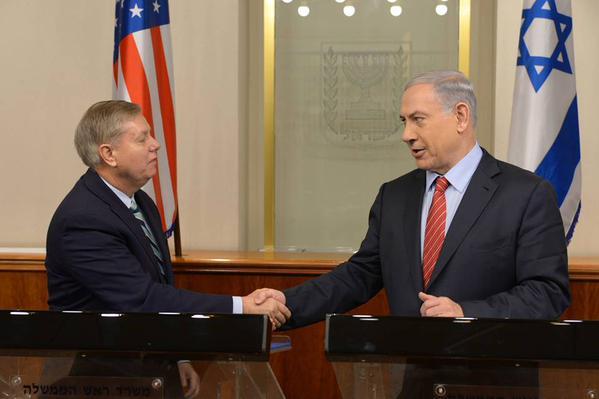
Senator Lindsay Graham with Israeli PM Netanyahu

In April 2015, the Senate passed a bill making it difficult for any company to do business with a company or country that supported BDS of Israel.

Republican Speaker of the House, John Boehner invited Netanyahu to address Congress about the Iran nuclear negotiations. That speech launched the momentum for a role for Congress in the Iranian nuclear program negotiations.

It is difficult for Congress to take direct actions against the president’s policies at the United Nations, as he controls the vote. However, Congress controls funding of the United Nations as well as the Palestinian Authority. Senator Lindsay Graham has stated his intention to use the power of the purse to prevent unilateral UN actions against Israel. “Any effort by the French, the Jordanians or anyone to avoid direct negotiations between the Israelis and the Palestinians over the peace process, anyone who tries to take this [resolution] to the U.N. Security Council, there will be a violent backlash by the Congress that could include suspending funding to the United Nations,” Graham said.

All three issues on which Israel relies on the United States are under threat by Obama, and only the US Congress is attempting to ameliorate the situation.


If Israel’s neighbors did not threaten to destroy the country both directly and indirectly, perhaps Israel would not feel alarmed.

If Israel were not surrounded by an Arab winter inferno, perhaps its fears would not be so immediate.

If Israel had many allies in the world, perhaps the abusive relationship between Obama and Netanyahu would not be as upsetting and painful.

However, the realities are different.  As such, Netanyahu has turned to Congress to become Israel’s domestic violence hotline .  What a sad state of affairs.


Related First One Through articles:

Israel is a Small Country

Israel cannot afford to be smug about its security

Obama not concerned about timeliness of Israel’s security

Netanyahu’s View of Obama: Trust and Consequences

Summary: Obama has asked Netanyahu to trust him on an issue (Iranian nuclear power) that is an existential threat to his country, even though Obama hasn’t earned that trust on more basic issues. Obama then compounds Netanyahu’s fear by stating Obama will act completely alone in controlling the outcome. Netanyahu’s nightmare is not just becoming “1938 Czechoslovakia”, but “2014 Ukraine”.

 obama netanyahu2
Netanyahu and Obama

TRUST

Trust is the bedrock of a functional relationship. It enables one party to rely on the other. A trust that includes both intention and capability permits a sharing of responsibility and workload.

The relationship between US President Obama and Israeli Prime Minister Netanyahu started off badly and further deteriorated over the years. Personalities aside, the lack of a shared vision about the path to peace and security in the violent Middle East damaged relations.  However, it was a series of bad decisions which destroyed the trust between the two leaders.

Negotiation with Palestinians. Obama’s actions early in his presidency, hurt his credibility with Netanyahu. Obama insisted on an Israeli settlement freeze as a pre-condition to negotiations with the Palestinians- a pre-condition that was never introduced before, even by the Palestinians. Despite Netanyahu’s serious reservations, he instituted a ten-month freeze on building new homes in the west bank of the Jordan River. In exchange, Obama could not get acting-Palestinian President Abbas to even show up to talk for the first nine months, and when he did, all Abbas offered was extending the freeze even longer.

When US Secretary of State John Kerry tried another round of negotiations with Abbas in the fall of 2013, the US again asked Israel to give up something to start talks while it made no demand of the Palestinians. Israel released dozens of terrorists that were convicted of murder from its prisons. In exchange, Kerry could not even get Abbas to recognize Israel as a Jewish State, let alone any compromises for a Palestinian state. The negotiations failed again.

In both situations the US pressured Israel to give up something just to initiate negotiations and asked nothing of the Palestinians. In the end, the Palestinians continued to give exactly the same: nothing.

Giving it away upfront. The Obama administration has used the tactic of giving away bargaining points upfront in the hope of gaining something in the negotiations down the road. In Cuba, Obama has pulled back sanctions, in the hope that the country reforms. In Iran, the US eased sanctions to get Iran to consider allowing monitors to watch it build nuclear power.

Netanyahu does not believe in such negotiating tactics and it has not worked out well for Israel.

Giving up on Allies. The disagreement on negotiating style is only part of Netanyahu’s issue.  Israel and the Middle East watched the Obama administration turn its back on its allies. Egyptian President Mubarak was once a close ally of the United States. One day, the Obama administration decided it would no longer stand by its ally and called for Mubarak’s ouster. He was rushed off to jail.

The US’s Middle Eastern allies were dumb-founded by Obama’s action. A senior Arab government official stated “[The Saudis] are at odds with the U.S. position, publicly pushing Mubarak out. And frankly so are we—this isn’t how you handle issues in region.”

Failure to Understand Regional Dynamics. Obama’s turn on Egypt’s Mubarak was followed by an embrace of the democratically-elected Muslim Brotherhood. Obama’s infatuation with the “Turkish model” of democratic Islam made him welcome the new Egyptian ruler Mohammed Morsi. Morsi reopened Egypt’s ties with Hamas (the Muslim Brotherhood in Gaza) , much to the chagrin of Israel’s Netanyahu. Those actions also undermined the more moderate (on a relative basis) acting PA President Abbas.

Obama back-tracked from his support of democracy in Egypt by not objecting to the replacement of Morsi via a takeover by Abdul Fattah el-Sisi. El-Sisi clamped down on Hamas and the Muslim Brotherhood which won praise in Israel. From Israel’s perspective, a mistake was rectified to some degree, but the damage done by Obama of not standing by an ally and not appreciating the regional dynamics was etched in memory.

Obama not standing by Treaties or Comments. In addition to not standing by allied leaders, Obama has not stood by his own word or by US treaties with governments. For example, Obama’s declared “red line” on Syria’s use of chemical weapons came and went without ramifications for Syrian President Assad. While Obama claimed credit for negotiating a solution to get rid of Syria’s known chemical weapons, there was no personal penalty for Assad. Assad continues to remain in power and murder his countrymen.

Saudi Arabia was incredulous and stated“We’ve seen several red lines put forward by the president, which went along and became pinkish as time grew, and eventually ended up completely white…When that kind of assurance comes from a leader of a country like the United States, we expect him to stand by it.”

obama syrian red line
Obama asserting a “red line” on Syrian chemical weapons

The Ukrainian situation is even more telling. In 1994, Ukraine signed onto the Budapest Memorandum which was to guarantee its territorial integrity in exchange for giving up its nuclear weapons. While it adhered to its upfront part of the bargain by giving up its weapons, the Obama administration refused to enforce its end of the agreement by coming to the aid of Ukraine when Russia invaded and annexed Crimea in 2014. Russian leader Putin correctly assessed the temperament of Obama that he would fail to honor his obligation, just as he failed to take action in Syria. Putin has continued to move past Crimea to other parts of Ukraine while the US not only fails to come to the defense of Ukraine, but drags its feet in sending weapons to defend itself.

The situation is not lost on Netanyahu (while it is on the knee-jerk liberal New York Times which stated in its lead editorial on March 12, 2015 that “Republicans are perfectly willing to diminish America’s standing as a global power capable of crafting international commitments and adhering to them.”  As detailed above, Obama has made very clear that HE has diminished America’s commitments, not the Republicans).

Obfuscation. The last loose thread in the unraveling fabric of trust is the lack of transparency.

While Obama touted his goal of transparency when he ran for office, his administration has been one of the least transparent. Witness Obamacare, where House Speaker Nancy Pelosi famously said “We have to pass the bill to that you can find out what is in it.” Secretary of State Hillary Clinton ran her own email server outside of the State Department and deleted emails at her own whim. Now, Obama refuses to provide details of the Iranian negotiations with Israel.

The trust between Obama and Netanyahu is broken.

ACTING ALONE

Compounding the Israeli frustration with the lack of trust in the Obama administration’s dealing with Iran, is the unilateral course that Obama has taken. Obama has effectively barred Israel from attacking Iran and is attempting to seal negotiations without legislative approval.

Blocking an Israeli attack. As soon as Obama began to negotiate with Iran, it became impossible for Israel to attack Iran. How could Israel attack the facilities while the US was pursuing a diplomatic initiative? The start of Obama’s talks signaled the end of Israel’s ability to destroy their nuclear program.

Skipping Congress. Obama repeatedly stated that he does not believe that he needs congressional approval to sign a deal with Iran. As such, he has asserted that he has complete authority to negotiate and finalize a deal.  The Republicans, which now have majority control of both the House and Senate, strongly disagree and have taken steps to make their position known to both the Obama administration and Iran itself.

COMPETENCIES and CONSEQUENCES

Israel’s Netanyahu is left in a precarious situation.  As his country is under threat of annihilation by Iran, its close ally has put itself in the lead seat in negotiations.  However, Netanyahu is looking at the current US president as:

  • Lacking an understanding of regional dynamics;
  • Incapable of negotiating;
  • Refusing to be transparent about the negotiations;
  • Unwilling to stand by statements and treaties in support of allies;
  • Determined to act alone without the legislative branch of government

The Trust in Competencies and Fear of Consequences leaves Israel in a vulnerable and lonely spot.  While Israel fears it will be sacrificed at the alter of larger players like Czechoslovakia in 1938, it sees how the lead negotiator will not enforce any security agreements that may be struck, as in the embattled Ukraine today.


Related First.One.Through articles:

Arab states agree with Netanyahu in speech to Congress: https://firstonethrough.wordpress.com/2015/03/08/missing-netanyahus-speech-those-not-listening-and-those-not-speaking/

Conservative focus on safety: https://firstonethrough.wordpress.com/2015/03/01/the-gap-between-fairness-and-ramifications-wmds-in-iraq-and-iran/

Obama’s Iranian red line: https://firstonethrough.wordpress.com/2014/11/24/obamas-iranian-red-line/

The need for a global public reaction to Iran’s nuclear aspiration: https://firstonethrough.wordpress.com/2015/03/03/hidden-reactor-silent-reaction/

Liar, Liar! Hillary’s Pant Suit’s on Fire!

A satire of Hillary Clinton’s deleted personal emails

To: [tailor]

Can you make me something a little less boxy? Bill says I look like a Lego-character. Nothing too hip; I don’t want to lose my New England fan base.

hillary pantsuit
A Hillaryous pant suit


To: Bill

Your JDate account just automatically renewed. Can you please cancel it? We’ve been over this before…


From: Bill

Good news. I spoke to your doctor about your concussion. She said you hit the part of the brain that handles the function distinguishing between good and evil, so there’s really nowhere to go but up.


To: Bill

Can you believe that arrogant pr*ck? He named his new dog after himself, “BO.” What kind of idiot calls his dog “Junior”?


To: Bill

Just heard Michelle has a staff of over 40! I knew someone would come along and have a larger first spouse-staff than I did.  I just assumed it would be you!


From: Bill

When you see the Sultan [of Brunei] next week, please tell him he’s behind on his contributions to both my library and CGI [Clinton Global Initiative].  Give him a month [to pay up] before you attack his human rights abuses.


To: Bill

That b*tch Oprah took my spotlight on The View. I barely got to push my book. I need to find a new generation of journalists to field me softball questions and raise millions of dollars and Big O was sopping up all of the sun.


From: Bill

While I know the blue dress and black wig is your Halloween costume, would you mind wearing it on Valentine’s Day?


From: Chelsea

Mom, why don’t you ask Nancy [Pelosi] who does her face?  It’s not like you’d be wearing the same dress.


From: Bill

Hill, you tell your mother-f**in boss to stop walking around like he’s the messiah; that’s our f**in office he’s in.


To: Bill

I feel like I live in a 48 hour per day-world since I work 24/7 and still spend half of my day on personal emails.


To: Bill

I’ve been doing a lot of spying on world leaders lately. How can we make sure that no one spies on us? Do we control all of our emails?


From: Egyptian President Mubarak

My dear Hillary, please bring over a few cartons of those amazing US cigarettes on your next visit. They are the only things that “boost” my libido.


To Bill

Can you believe it? I almost lost “Most Admired Woman” in the last Gallup poll to Palin. I hate this country. Why don’t they love me?


To: Chelsea

Don’t worry about marrying a Jew. You’ll see, one day the Gore girls will marry Jews too.


To: Huma [Abedin, married to Anthony Weiner, aid to Hillary]

I saw your husband’s picture – not bad, not bad at all. That’s what I call a shmuck!


To: Bill

I have to tell you- Beyoncé was right.  Libya is really nice.


From: Chelsea

Mom, I hope you don’t mind that I have termed you “TechnoMom” as you’ve been so cutting edge on social media.  I hope it doesn’t bite you in the ass one day.