The Wall Street Journal Shows Unity with Israel

The conservative newspaper The Wall Street Journal has a long history of supporting Israel. The articles and editorials typically take an Israeli narrative, as reviewed in the related stories section below.

The contrast in the daily coverage to the New York Times is striking, even in the pictures each paper opts to print.

This week, a Palestinian Arab terrorist used a truck to ram down several Israeli soldiers who were standing along a beautiful promenade in Jerusalem. The Wall Street Journal showed empathy with Israel in giving the story a full page large picture at the very top of the front page. The picture showed a circle of Israeli soldiers mourning.

img_3945
Front page of the Wall Street Journal, January 9, 2017

This compared to a small black-and-white picture at the bottom of page A4 that the New York Times opted to use to cover the story.

img_3947
New York Times page A4 on 1/9/17,
with a small picture of the terrorist attack in Jerusalem

The caption of the WSJ read: “SHOW OF UNITY: Israeli soldiers gathered near the site of a truck-ramming attack Sunday. Four soldiers died and some 17 were injured.” The conservative paper has repeatedly shown its unity with America’s ally, in sharp contrast to the liberal NY Times.


Related First.One.Through articles:

Every Picture Tells a Story: Versions of Reality

Framing the Israeli-Palestinian Arab Conflict: WSJ and NY Times

Every Picture Tells a Story: Goodbye Peres

Every Picture Tells A Story: Only Palestinians are Victims

Every Picture Tells a Story: No Christians Targeted

Why the Media Ignores Jihadists in Israel

Subscribe YouTube channel: FirstOneThrough

Join Facebook group: FirstOne Through  Israel Analysis

Every Picture Tells a Story: No Christians Targeted

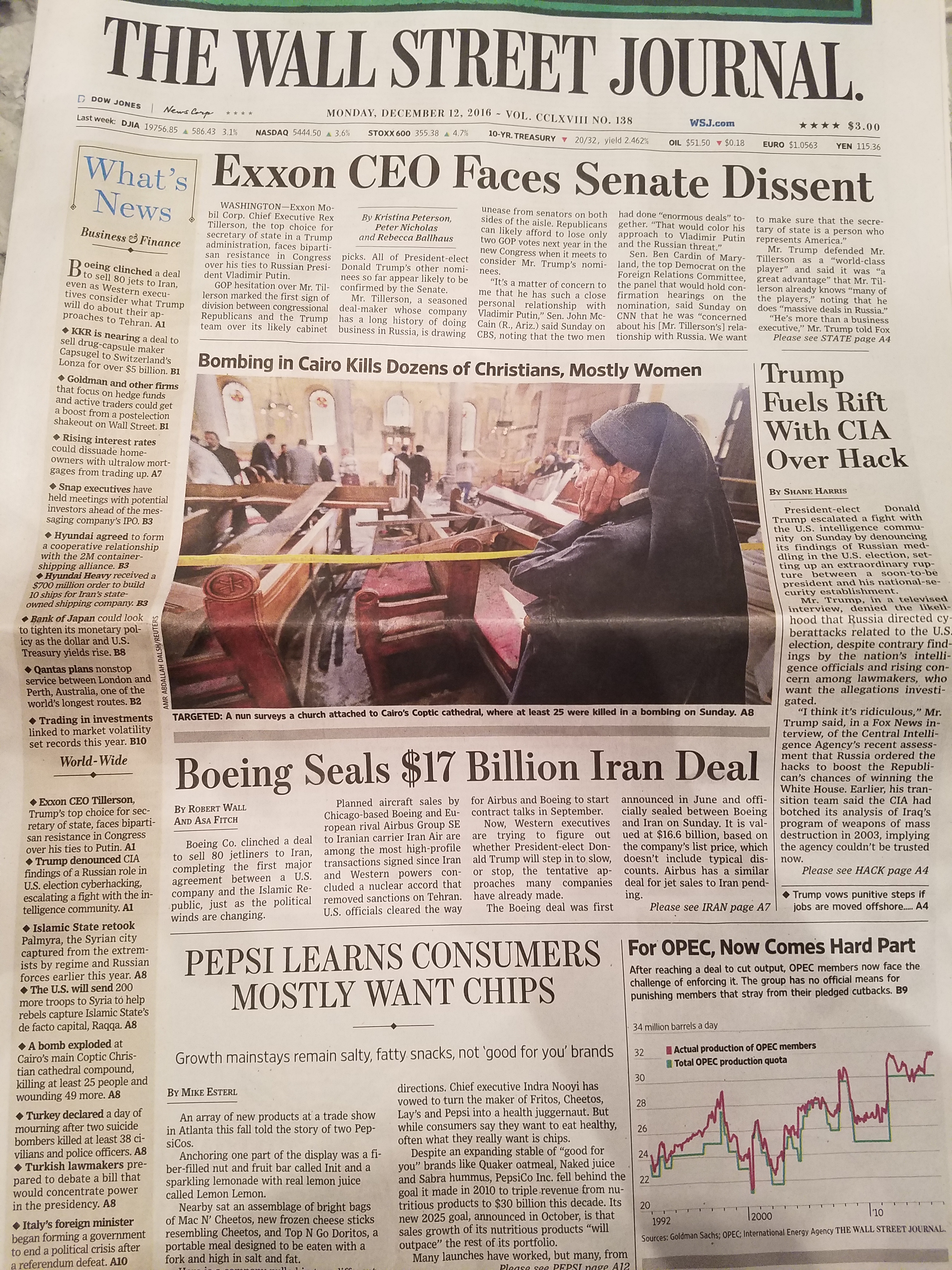
A horrific terrorist attack on a Coptic Church in Cairo Egypt killed dozens on December 11, 2016. The coverage in the New York Times and the Wall Street Journal could not have been more different, and underline an ongoing difference between the two papers: the WSJ does not shy away from telling its viewers about radical Muslims targeting Christians and Jews in the Middle East, while the NYT would rather minimize that story, and highlight the Muslims are also victims in the wave of jihadists.

20161212_191610

Cover of The Wall Street Journal
December 12, 2016

The cover page of the WSJ had a single large color photograph of the carnage in Cairo. The boldface title of the picture read” “Bombing in Cairo Kills Dozens of Christians, Mostly Women.”  The caption continued: “Targeted: A nun surveys a church attached to Cairo’s Coptic cathedral, where at least 25 were killed in a bombing on Sunday. A8” The paper did not seek to place the blame on radical Muslims on the cover, but it did make clear that Christians were specifically targeted in the attack.

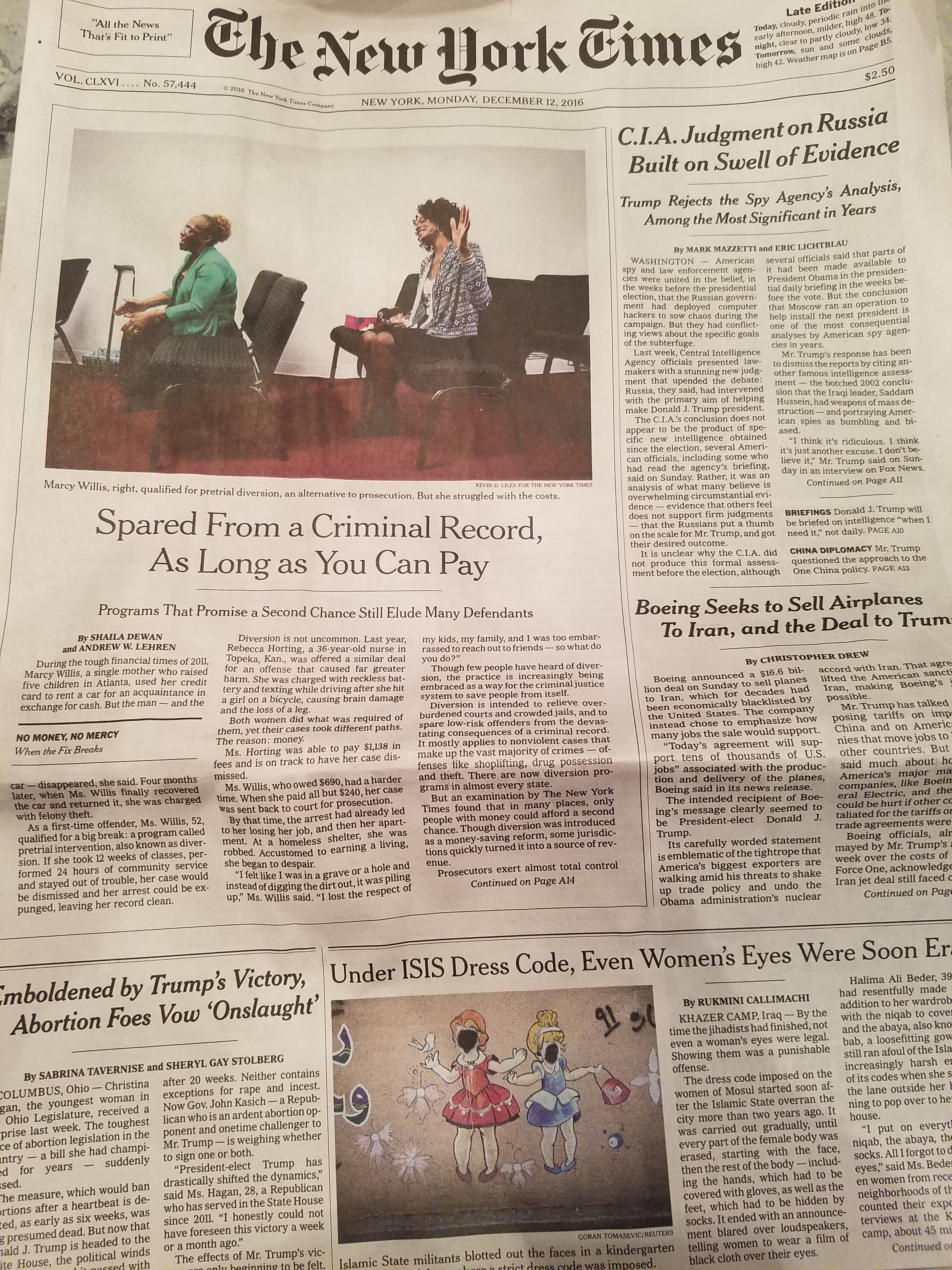
Now consider the coverage in the Times.

20161212_191628

Cover of The New York Times
December 12, 2016

The main picture on the NYT cover page was about discrimination against poor people. It was part of a multi-day story of the Times about injustices faced by people of color and the indigent.  The smaller picture on the bottom of the page discussed how ISIS marked up the pages of children’s books, presumably of Muslim children. There was no coverage of the attack on the Christian community in Egypt.

20161212_191712

Page A4 in the Times, December 12, 2016

The Times did cover the story in the middle of the paper. On page A4 there was a copy of the same picture that the Wall Street Journal posted in color on the front page. However, the Times posted it in black-and-white.  The Times shrunk the picture to such a level, that it was almost hard to notice it compared to the giant picture of Nigerian refugees (people of color) in the middle of the page. The headline of the bombing attack did state that the “Bombing Targets Egypt’s Christian Minority,” however, it is a question of whether anyone would pause to read the article compared to the prominent article on the page “Niger Feels Ripple Effect of Boko Haram.

The Times coverage of world affairs follows a familiar pattern: Christians and Jews do suffer, but hardly as much as Muslims and people of color. Racism and Islamophobia are the themes of the Times. Do not get distracted by tinges of hatred of Christians and Jews. To do so, would be to invert victim and perpetrator.


Related First.One.Through articles:

Every Picture Tells a Story- Whitewashing the World (except Israel)

Every Picture Tells a Story: The Invisible Murdered Israelis

Every Picture Tells A Story: Only Palestinians are Victims

Every Picture Tells a Story: Versions of Reality

Every Picture Tells a Story: Arab Injuries over Jewish Deaths

NY Times Discolors Hate Crimes

The New York Times Thinks that the Jews from Arab Countries Simply “Immigrated”

Every Picture Tells a Story: Goodbye Peres

Subscribe YouTube channel: FirstOneThrough

Join Facebook group: FirstOne Through  Israel Analysis

Social Media’s “Fake News” and Mainstream Media’s Half-Truths

Liberals have taken to the streets to protest the loss of the Democratic presidential nominee Hillary Clinton. Some (like Clinton) blamed the loss on a late breaking notice by the FBI about more emails surfacing from Clinton’s email server, while others blamed the Russians for interfering in the US elections. The latest scapegoat from US President Barack Obama was that “fake news” that spread on Facebook, Twitter and Google, undermined Clinton.

Obama claimed that the “active misinformation” that spread on social media continues to threaten the “democratic freedoms and market-based economies and prosperity that we’ve come to take for granted.

If only the president were as concerned about the active use of half-truths that are told routinely in the left-wing media and the United Nations. Those “credible” sources deliberately tell a fraction of the story and lead people to focus on the wrong targets through vicious alt-left editing. Those half-truths are just as lethal and the authors are just as guilty of spreading lies.

Consider the liberal media source, NPR. On November 15, 2016 it wrote about President-elect Donald Trump consideration of moving the US embassy in Israel from Tel Aviv to Jerusalem. In giving background to the story, NPR wrote: The western part of Jerusalem is almost entirely Jewish. The eastern part of the city was entirely Arab when Israel captured it in the 1967 Arab-Israeli war. Many Israeli Jews have moved into the eastern part of the city, and Israel claims all of Jerusalem as its capital, though no other country recognizes this.”

The NPR background made it sound like Israel took over the eastern half of Jerusalem in a war, and then asserted its control over the area, even though no country recognizes Israel’s positions. NPR deliberately omitted that:

  • Jews had always lived in Jerusalem, and have constituted a majority of the city since 1870
  • The Arabs initiated a war against Israel in 1948-9 and took control of the eastern half of the city and then EVICTED ALL OF THE JEWS from that part of the city, that’s why there were no Jews there in 1967.
  • When Jordan annexed the “West Bank” and eastern part of Jerusalem in 1950, no country recognized Jordan’s claim on the land.
  • Israel took the eastern half of Jerusalem in a DEFENSIVE WAR, after Jordan attacked Israel in 1967.

These facts are never shared in the liberal media, and by doing so, the liberal press provides the public with a biased half-truth narrative that Israel was an aggressor in seizing land that belonged to Arabs by history and right. It is simply not true.

Consider the beacon of the left-wing media, The New York Times.  It covered anti-Semitic riots in Europe in 2014 with a passing comment that there may have been a “tinge” of antisemitism when mobs called out that “Hitler was Right.” It did this repeatedly.

The Times also actively shielded its liberal champion, President Obama from criticism. Consider that when the Times wrote about Israel during Operation Protective Edge in 2014, it chose to include pictures of Israeli soldiers, Palestinian Arab victims and Israeli Prime Minister Benjamin Netanyahu throughout the conflict. The paper never showed the leadership of the Palestinian Authority, of Hamas or of Israeli victims. These pictures were also in sharp contrast to articles about US drone attacks that kill civilians, that NEVER show pictures of Obama alongside the story. Ever wonder why?

Regarding racism in the United States, the Times continued to suggest that racism was rising from the right-wing against blacks and Muslims in various articles.  They did this, even though the number of hate crimes committed by whites dropped significantly, from 63% in 2007, to 29% in 2015.

The liberal papers have company at the United Nations.

The UN media center is a frequent peddler of half-truths. It is seemingly not sufficient for the global body to be extremely prejudiced against Israel; its media center deliberately omits comments made on the world stage that could be construed as sympathetic towards Israel. Consider:

  • When world leaders spoke about the alarming attacks against Israelis in October 2015, the press corps only mentioned attacks against Arabs, and completely deleted “Israel” from the summary comments, as detailed in “UN Press Corps Expunges Israel.” The media center refused to publish the comments made by the UN Assistant Secretary General complimenting Israeli Prime Minister Benjamin Netanyahu for trying to calm the situation.
  • On December 15, 2015, the High Commissioner for Human Rights gave a press briefing where she spoke about violence in Israel which killed dozens, including 21 Israelis. The UN media centre deliberately deleted any mention of Israelis, and only spoke of Palestinians and foreigners that were killed.

The list of disturbing “half-truths” which relay a false narrative is long.


Fake news is indeed a problem, but arguably a smaller one than the half-truths peddled by the mainstream media.  The fake news sites will ultimately earn a reputation for doing so, such as magazines that tout that Elvis is alive and that Hollywood stars are having babies with aliens. The flash of news is rapidly revealed as entertainment.

However, the persistent and dangerous problem of lies, stems from the “accepted” mainstream media that distort reality to fit their liberal agenda.

Christiane Amanpour, a journalist for CNN received a Press Freedom Award in November 2016. In her remarks she attacked Donald Trump as a demagogue who would stifle free speech. She stated that “journalists… need to recommit to robust fact-based reporting without fear.” As she made such comments, her smugness masked her complicity in feeding the world half-truths. Her fellow journalists have spent years feeding a feast of delicious liberal fabrications, at the expense of unvarnished accuracy.

amanpour-freedom-press-burton-benjamin-award-full-speech-00080106-large-169
Christiane Amanpour Receiving Press Freedom Award November 2016

Amanpour added that “I learned a long, long time ago – when I was covering the genocide and ethnic cleansing in Rwanda and Bosnia – never to equate victim and aggressor.  Never to create a false moral or factual equivalence, because then, if you do,… you are party and accomplice to the most unspeakable crimes and consequences.” Perhaps she was criticizing the New York Times which gave a glowing review of the opera “Death of Klinghoffer,” about Palestinian Arab terrorists that threw an elderly Jew in a wheelchair off of a ship to his death, which it called a “masterpiece” as “the opera gives voice to all sides.

Amanpour called for advertisers to stop advertising on the “fake news sites,” a call for action that seemed a bit cheeky, considering she makes her living from those same advertisers.

In short, Amanpour has still not internalized that she is a part of a biased-and-bought media industry that is the core of the problem.

It has therefore become an unfortunate necessity for blogs such as FirstOneThrough to do a critical and factual analysis of the world affairs, because of the failures of mainstream media, not the fake news sites. It does the original analysis without any advertising, and is not beholden to any purchaser’s point of view.  The digital revolution that cares about truth will ultimately abandon today’s popular press in favor of such sites, and use fake news sites as entertainment, much as they view The Onion.


Related First.One.Through articles:

Israel’s Freedom of the Press; New York Times “Nonsense”

New York Times Confusion on Free Speech

Thomas Friedman Thinks Palestinians are Crazy in the Margins, While Israel is Crazy in the Mainstream

The New York Times Wrote About Computer Hackers Charged by the US and Israel. Differently.

The New York Times Refuses to Label Hamas a Terrorist Group

What’s “Left” for The New York Times?

Subscribe YouTube channel: FirstOneThrough

Join Facebook group: FirstOne Through  Israel Analysis


NY Times Discolors Hate Crimes

On November 14, 2016, the NY Times published an article about hate crimes in which it deliberately misled its readers in several areas.

The article entitled “U.S. Hate Crimes Surge 6%, Fueled by Attacks on Muslims,” sought to continue a NY Times narrative that Trump supporters are white racists and xenophobes.  In this article, it chose to do this by emphasizing certain facts, redirecting the reader, and omitting some statistics completely.

All crimes are terrible, and hate crimes are particularly noxious.  If America wants to confront them with solutions, it needs to review them honestly.

The Focus on Muslims

The title of the article focused on the rise in hate crimes against Muslims, as did the article itself.  While there was a significant jump in the anti-Muslim attacks, an average Muslim in 2015 was still 50% LESS likely to be attacked than an average Jew (257 attacks against an American Muslim population of 3.3 million, versus 664 attacks against 5.8 million American Jews).

The Times did say that Jews were the most frequently attacked religious group, while blacks were the most targeted race – in the article’s seventh paragraph.  However, it then sought to redirect the reader to the significance of the anti-Muslim attacks:

“Blacks were the most frequent victims of hate crimes based on race, while Jews were the most frequent victims based on religion, according to the F.B.I. data. But the increases in attacks on these groups were smaller than the rise in attacks against Muslims and transgender people.”

Hey reader! Over here!  Focus on Muslims and transgender attacks! That’s the real story, not the groups that are subject to the most hate crimes!  Never mind that the total number of attacks against Muslims and transgender people COMBINED was LESS THAN HALF of the number of attacks against Jews.

Blame Trump

For over a year, the Times has called out Donald Trump and his supporters as being racists, homophobes and xenophobes. The Times told all of its readers to fear the local radical right much more than radical Islamic terrorism in articles throughout the year.  This article began:

“WASHINGTON — The F.B.I. reported Monday that attacks against American Muslims surged last year, driving an overall increase in hate crime against all groups.

The data, which is the most comprehensive look at hate crime nationwide, expanded on previous findings by researchers and outside monitors, who have noted an alarming rise in some types of crimes tied to the vitriol of this year’s presidential campaign and the aftermath of terrorist attacks at home and abroad since 2015.

That trend appears to have spiked in just the last week, with civil rights groups and news organizations reporting dozens of verbal or physical assaults on minorities and others that appear to have been fueled by divisions over the election.”

This is complete editorializing by the Times.  The FBI report gave a statistical analysis and breakdown of attacks that occurred in 2015. The report did not get into speculation about what drove people to commit the crimes. It certainly did not cover November 2016 when the report was solely about 2015.

The Times seemed to further add support for its rationale of blaming Trump, by stating “Attacks against Muslim Americans saw the biggest surge. There were 257 reports of assaults, attacks on mosques and other hate crimes against Muslims last year, a jump of about 67 percent over 2014. It was the highest total since 2001, when more than 480 attacks occurred in the aftermath of the Sept. 11 attacks.”

For the Times, Donald Trump equals September 11 for Muslim Americans.

Yet, if one were to scratch the surface, it would be clear that the number of attacks against Muslims has up-and-down years.  For example, hate crimes against Muslim Americans spiked in the early Obama years compared to the George W Bush years.  Under President Bush in 2008, there were 105 anti-Muslim attacks, which jumped by 52% to 160 attacks in 2010 under President Obama. Such attacks also jumped 15% between 2013 and 2014, well before the rise of Trump.

No Mention about the Offenders

The Times did not discuss other statistics from the FBI report, such as the ethnicity of the offenders.

In 2015, whites were twice as likely to commit a hate crime as a black American. Consider that there are over five times more whites than blacks in the US. That means that black people disproportionately are committing hate crimes (if all people are as likely to commit a hate crime, it would suggest that there would be roughly five times as many white offenders as black offenders, not two times).

The trendline about the offenders of hate crimes is also important to highlight, but dismissed in the Times.

In 2001, white people committed 4.5 times more hate crimes than black people (5,149 versus 1,157). That difference is more in line with what would be expected by the larger white population.

However, the New York Times did not report on the alarming trend of black people committing a growing and more disproportionate share of hate crimes, because it undermined the paper’s narrative that white Trump supporters are the bigots and “deplorables.”  Shining a light on the SHRINKING number of white attackers (2,657 in 2015 versus 5,149 in 2001), went against the liberals view of the world.


The reason that independents and libertarians are abandoning the Democratic Party is liberal’s blind adherance to a narrative that has no basis in facts. How can such a party hope to arrive at solutions to society’s ills if it will not honestly look at the world as it is?

hate-crimes-2015


Related First.One.Through articles:

Obama’s Select Religious Compassion

The Invisible Anti-Semitism in Obama’s 2016 State of the Union

Ramifications of Ignoring American Antisemitism

Leading Gay Activists Hate Religious Children

The Dangerous Red Herring Linking Poverty and Terrorism

A Deplorable Definition

Liberals’ Biggest Enemies of 2015

Older White Men are the Most Politically Balanced Demographic By Far

Subscribe YouTube channel: FirstOneThrough

Join Facebook group: FirstOne Through  Israel Analysis

The New York Times Thinks that the Jews from Arab Countries Simply “Immigrated”

On October 20, 2016, the New York Times profiled a rising Israeli member of Knesset, Miri Regev.  The article, “Miri Regev’s Culture War,” highlighted her background in Israel’s “periphery,” as part of the Mizrachi or “Eastern” communities.

The Times stated that “Mizrachi” is “a catchall term that includes Jewish communities from Muslim countries in the Middle East and North Africa, as well as the Sephardic Jews, whose origins can be traced to Spain and Portugal, who settled there. These communities immigrated to Israel in mass waves after its founding in 1948 and into the early 1950s, upending its demographic makeup. The Jewish population, almost exclusively Ashkenazi, became more than 40 percent Mizrahi. But it wasn’t just the country’s ethnic composition that changed. The Jewish population that predated the founding of the state was primarily young, secular and idealistic; it was also heavily male. By contrast, the new Mizrahi arrivals tended to be large families from traditional societies. In their ethnic garb, often with no knowledge of Hebrew, they struck the native-born Israeli sabras and the European Ashkenazim as provincial and uneducated.”

Read the passage again.  It sounds like these Jews simply left the MENA region because they wanted to go to the newly reestablished Jewish State after Israel was founded in 1948.  Nowhere in the article is there any sense that these Mizrachi Jews suffered any persecution by the Muslim nations. Such poor treatment was only under the elitist Ashkenazi Jews from Israel.

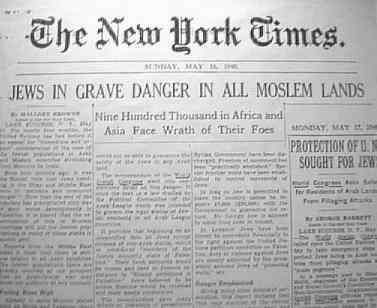
This was a continued insult and mischaracterization of history by the media of the over 850,000 Jews that were forcibly expelled or fled for their lives from communities that they had lived in for centuries, due to Muslims anger over the founding of the Jewish State in a place that they deemed “Arab land.

nyt-jews-in-arab-lands
New York Times announcing the danger to Jews in Moslem countries, 1956

The Muslim Expulsion of the Jews

Roughly two-thirds of the Jewish refugees from the MENA region (Middle East and North Africa) went to Israel, while one-third fled to France.  France was a natural place for Jews to flee French-speaking Arab countries such as Algeria, Morocco and Tunisia.

Algeria. Pogroms in Algeria began shortly after the Palestine Mandate to reestablish a Jewish homeland took effect, killing dozens in the 1920s and 1930s. During World War II, Jews were stripped of their citizenship when Nazis took over France, as Algeria was technically part of France. The French Vichy regime was particularly harsh to Jews, stripping them of most rights and ability to work.

Even as the war ended, Muslims put in place their own anti-Jewish laws. In 1962, when Algeria declared independence from France, virtually the entire Jewish community fled, seeing the Nuremberg-type laws in Muslim countries, and the fate of Jews in the rest of the MENA region. The majority of Jews went to France, while many moved to Israel.

Egypt. Nationality Laws in 1927 and 1929 gave preference to Egyptians who were Arab-Muslim. The laws made it difficult for Jews to gain citizenship, and in 1947, it is estimated that only 10,000 of the 75,000 Jews in Egypt had citizenship, while the rest were either stateless or were foreign nationals.

Jews came under direct attack at the founding of Israel, including bombings of Jewish neighborhoods in 1948 which killed 70, and a bombing in the Cairo Jewish Quarter in 1949 that killed 34.

When the Suez War with Israel broke out in 1956, there was no more room for Jews.  On November 23, 1956, the Egyptian Minister for Religious Affairs declared that “all Jews and Zionists are enemies of the state,” as Egypt moved to expel the Jews and confiscate their property.

Iraq. In the 1920s, Jews were prohibited from teaching Hebrew or Jewish history. In July 1948, Iraq made Zionism a crime, punishable with up to seven years in jail. In October 1948, all Jews who held positions in government were fired. In May 1950, Jews in Iraq were stripped of their citizenship and the government began to seize all Jewish property.

In response to the edicts, in 1951 and 1952, Israel launched Operation Ezra and Nechemia to airlift the Jews out of the country to safety. The Jewish community in Iraq that had stood had close to 130,000 people was quickly down to a mere 3000.

After the Arab armies were defeated in another war in 1967, the remnant of Jews in Iraq would find the situation unbearable. On January 27, 1969, the government hanged nine Jews in the public square to the cheers of Iraqis. The Jewish community in Iraq was soon no more.

Libya.  Jews were attacked by Libyans in the immediate aftermath of World War II, with 140 murdered in a pogrom. The Libyan government’s Nationality Law of 1951 prohibited Jews from having Libyan passports, and Jews were no longer allowed to vote or hold public office. By 1953, Jews in the country were subject to broad economic boycotts. The community of roughly 40,000 Jews dwindled to just 6 people.

Morocco. The Jewish community in Morocco was one of the largest in the MENA region, estimated at over 250,000 people.

After Israel’s declaration of independence in May 1948, two pogroms broke out in Morocco, in the towns of Oujda and Djerrada. The attacks killed 47 people, wounded hundreds and lefts hundreds homeless. Not surprisingly, 10% of the country’s Jews quickly fled the country.

After Morocco declared independence in 1956, an Arabization of the country commenced, cutting Jews off from parts of society. At the same time, the government prohibited emigration to Israel, which lasted until 1963. In 1961, roughly 90,000 Moroccan Jews had to be ransomed in Operation Yakhnin, bringing Jews to Israel. In the aftermath of the 1967 Six Day War, another 40,000 Jews fled to Israel.

Syria. In 1947, the sale of any real estate to Jews was prohibited, Jews were discharged from public office, and in 1949, the governments seized Jews’ financial assets.  In 1950, Jews were forced to leave the farming industry.  Syrians took the message, an initiated pogroms from November 1947 through August 1949, killing many as they looted Jewish homes and stores.

As Jews fled, the country had their assets seized by the state.

More edicts would follow for the Jews that remained.  In 1967, Muslims were placed as principals of all Jewish schools. In 1973, with the onset of the Yom Kippur War, new edicts were enforced that Jews could no longer communicate with anyone outside of Syria.

Tunisia. Tunisia’s independence in 1956 led to an Islamification of society and placed Jews in a secondary dhimmi status. From that point on, all Jewish businesses were forced to take on a Muslim partner.

The old Tunis Jewish cemetery was expropriated in 1957, and the great Tunis synagogue was destroyed in 1960. As Jews began to flee the country in 1961 as they had in the rest of the MENA region, Tunisia only allowed Jews to take one dinar with them, as the country confiscated the rest of their possessions.

Yemen. Sharia law was instituted in 1913, and all Jewish orphans were forcibly converted to Islam. In the 1920s, Jews became excluded from the army and public service.

In 1947, riots in Aden killed 82 Jews, and in 1948, Yemeni Jews began to lose control of their possessions, with laws forcing Jews to transfer all crafts to Arabs before leaving the country.

As a result of the crisis, Operation Magic Carpet airlifted 49,000 Jews out of the country between June 1949 and September 1950.

TOTALS. The number of Jews that fled persecution from homes they lived in for centuries was between 850,000 and 1 million people.

  • Algeria 140,000
  • Egypt 75,000
  • Iraq 135,000
  • Lebanon 5,000
  • Libya 38,000
  • Morocco 265,000
  • Syria 30,000
  • Tunisia 105,000
  • Yemen 55,000

This total of 850,000 Jews does not include the Jews who fled Iran and Afghanistan.


Yet the New York Times chose to write that Jews “immigrated” to Israel, implying no malice on the part of Arabs, nor fear in the hearts of Jews.  The paper implies that the Mizrachi Jews sought to take advantage of the new Jewish State. Maybe for economic opportunities.

This characterization comes from the same media source that makes every effort to describe Palestinian Arabs as “refugees,” and despondent, even when they are living just a few miles from the homes where their grandparents sought to destroy the nascent Jewish state.

The New York Times has a long history of only parroting the Palestinian Arab narrative in their collective fight against Israel. It has now further chosen to whitewash the crimes of the entire Muslim Arab world that forcibly rid their nations of Jews as they robbed them of their dignity, lives and property.


Related First.One.Through articles:

The Long History of Dictating Where Jews Can Live Continues

UN Summit for Refugees and Migrants September 2016

Help Refugees: Shut the UNRWA, Fund the UNHCR

Palestinian “Refugees” or “SAPs”?

Subscribe YouTube channel: FirstOneThrough

Join Facebook group: FirstOne Through  Israel Analysis

The New York Times Op-Ed on Jews and the Oslo Accords, 1993

Almost 23 years after the Oslo Peace Accord was signed in September 1993, one of its architects and champions, Israeli statesman Shimon Peres, died at 93 years old in Jerusalem, Israel. As detailed in “Every Picture Tells a Story: Goodbye Peres,” the New York Times chose not to honor the Israeli leader, even as the paper repeatedly calls for a two-state solution for the Israeli-Arab Conflict.

So consider the NYT Op-Ed back on September 17, 1993, just after the Accords were signed and the major opinion makers weighed in on the agreement.

20160922_211852
New York Times Op-Ed
September 17, 1993

A.M. Rosenthal (1922-2006)
Winner of the Pulitzer Prize

A.M. Rosenthal wrote about the ‘Holocaust Syndrome“, where he lamented the pessimism coming from “Jews, Israeli and American” about the ultimate outcome of the Oslo agreement. Rosenthal was sad that it was becoming fashionable for Jews to echo sentiments that were most typically heard from Israel’s enemies.

The “Holocaust Theory” advanced a notion from “deep pessimism, fear and defensiveness arising out of the Holocaust. No matter how strong the country [Israel]became, they trusted no one, relied only on arms, saw themselves perpetually as victims who had to act defensively instead of a free people determining their own destiny.”

To believe the Holocaust syndrome theory is to believe what Israel’s worst enemies say – that it was Israelis who brought a half-century of war between Jew and Arab.”

Rosenthal dismissed that idea completely. He reviewed the history that those “shtetl Jews were ready to share Palestine with Arabs from the beginning. The Arabs refused,” and launched pogroms and wars both from within Israel and without to destroy the Jewish State. Rosenthal had no patience for Jews that were cynical about the chance for peace:

There is a mental malady that afflicts Israelis and other Jews but it is not the Holocaust syndrome. It is the tendency to confuse hope for the future with present reality….Israelis are not catatonically traumatized, curled up in a defensive ball seeing enemies everywhere. They can get up in the morning, work, raise families, make love, make peace or war, distinguish friend from foe and how to deal with each.”

“Pray for peace but add another prayer for truth upon which it depends.

Amazing words that resonate today as much as they did when they were written.

Anthony Lewis (1927-2013)
Two-time winner of the Pulitzer Prize

Anthony Lewis’s post was called “The Crux of the Deal,” and was optimistic about Oslo.  He believed that each party’s self-interest would compel the parties forward.

For Palestinian Arabs, Lewis wrote that Arabs preventing terrorism would lead eventually to “establishing a Palestinian state.”  Lewis was too optimistic.

The years after the 1993 Oslo Accords were followed by hundreds of terrorist attacks by Palestinian Arabs, and by the end of the interim Oslo II Accords in 2000, Yasir Arafat (fungus be upon him) rejected the contours of the Palestinian state and launched another war against Israel.

Lewis missed another point: that the Arab-Israel Conflict was key to stability in the Middle East.

Lewis wrote: “Success would be a key to reducing tensions in the entire Middle East, and reducing the threat of the two radical states that have denounced the agreement: Iran and Iraq.” Lewis could not foresee America’s toppling of Iraq – and then abandoning it – and the turmoil that would pour out of Syria, Yemen, Sudan and Libya.

The cause-and-effect theories of Lewis 23 years ago proved completely wrong:

  • Israel has been able to prosper despite regional turmoil. It has done so by focusing on building businesses and technology surrounded by its strong defenses
  • It was Palestinian leaders self-interest that has dictated events and marred the prospects of peace, as they enriched themselves, maintained their “lofty” titles and avoided confrontations with fellow Arabs in the cause of peace

Self-interest may indeed be a motivator for all players in the region.  However, it would appear that Lewis was too optimistic about Palestinian Arab leadership caring more about their constituents than themselves.

Alexander Schindler (1925-2000)
Leader of the Reform Judaism Movement

Alexander Schindler described himself as “an unreconstructed dove,” in his editorial “Memo to a Hawk.” He relayed how he was worried about Likud leader Menahem Begin coming to power in 1977 and what he would do to the chances of peace.  But Schindler gave Begin a chance “and he did not disappoint.”  Schindler urged politically conservative Jews to give Yitzhak Rabin and the Oslo Accord that same chance.

Schindler argued that that moment in history – 1993 – was the best time to advance peace in the region:

“It is now that the American Government’s role as guarantor of the peace is unaffected by cold war concerns. It is now that the Arab powers understand that the real threat they face is not the steady achievements of Zionism but the rampaging golem of Islamic fundamentalism. It is now that the influx of Jews to Israel from the former Soviet Union has upset the demographic contest the Palestinians had expected to win.”

Schindler gets an interesting score on predicting the future.

  • Total Miss: In 2016, the cold war is very much alive and affecting the region, as Russia takes an active role in Syria, with missiles and migrants flowing out of the region unabated.
  • Spot on: Many people did not appreciate the threat of the “rampaging golem of Islamic fundamentalism” until 9/11/2001, but Schindler did.
  • Mixed: the demographic time bomb that Yasir Arafat hoped to use to conquer Israel is still believed in some corners, and dismissed in others.

The dreamer of peace believed in the peace process, and understood the threat of Islamic fundamentalism.  However he never considered his logic that Islamic fundamentalism existed everywhere else in the Middle East except among Palestinian Arabs.


In 2016, on the eve of the Jewish New Year, world leaders came to pay their respects to a leader of the Israeli people, and a man devoted to the Oslo peace process.  As people consider Peres’s legacy over the past 70 years in public service and his persistent optimism that peace would come to the region, review the caution and optimism at the dawn of the peace process launched in Oslo, and where we are today.

For the New York Times, the lack of peace between Israel and Palestinian Arabs has nothing to do with Islamic fundamentalism, the cold war, the influx of Russian Jews, the corrupt Palestinian Arab leadership or the civil wars raging in the region. For the Times and many liberal Jews, it continues to be a hawkish Israeli government that continues to repeat the “Holocaust Syndrome.”

Perhaps it is time for everyone to re-read the prescient words and warning of A.M. Rosenthal: beware the “mental malady that afflicts Israelis and other Jews but it is not the Holocaust syndrome. It is the tendency to confuse hope for the future with present reality….Pray for peace but add another prayer for truth upon which it depends.


Related First.One.Through articles:

An Inconvenient Truth: Palestinian Polls

The Israeli Peace Process versus the Palestinian Divorce Proceedings

The Only Precondition for MidEast Peace Talks

“Peace” According to Palestinian “Moderates”

Subscribe YouTube channel: FirstOneThrough

Join Facebook group: FirstOne Through  Israel Analysis


Every Picture Tells a Story: Goodbye Peres

The “Every Picture Tells a Story” series has exposed the long history of the New York Times in using its pictures and captions to portray Israelis as militant occupiers and Palestinian Arabs as victims.  However, one would imagine that the paper would rally behind one of its heroes: the liberal Israeli statesman and winner of the Nobel Peace Prize, Shimon Peres. But at the funeral of Peres, the Times once again dismissed the Israeli leader and promoted the Palestinian Arabs.

Consider first the coverage by the conservative newspaper the Wall Street Journal:

20161001_194726
Cover of the Wall Street Journal, Saturday October 1, 2016

The top half of the front page contained three pictures from the funeral of Shimon Peres, two of which portrayed the Israeli flag-draped coffin of the esteemed leader. The pictures were of: the honor guard carrying the coffin of Peres; Israeli Prime Minister shaking hands and welcoming acting-President of the Palestinian Authority Mahmoud Abbas; and US President Barack Obama with a somber expression placing his hand on the coffin.

The caption of the picture read:

HONORED: Members of a Knesset guard carry the flag-draped coffin of the late Israeli statesman Shimon Peres; Israel Prime Minister Benjamin Netanyahu greets Palestinian Authority President Mahmoud Abbas; and President Barack Obama takes a moment.”

The Wall Street Journal led with the word “honored” of the “late Israeli statesman.” It showed world leaders like Obama and Netanyahu considering the Israeli leader. It led the entire collage with a bold header “World Leaders Say Farewell to Israel’s ‘Biggest Dreamer.‘”

A respectful farewell by the paper indeed.

Contrast that with the New York Times picture and caption.

20161001_194737
Cover page of New York Times October 1, 2016

On the bottom half of the front page was a single picture. It featured no Israeli flags. It did have Israeli Prime Minister Netanyahu or US President Obama.

It featured Mahmoud Abbas, front-and-center.

The caption read:

“Mahmoud Abbas, the Palestinian president, center, at the funeral of Shimon Peres on Friday.”

Not only did the caption pay no homage to Peres, it focused squarely on “the Palestinian president.”  But there is no country of Palestine recognized by the United States or Israel. Abbas is simply the acting-President of the Palestinian Authority, whose term expired close to eight years ago.

The title of the article stated: “World Leaders Gather to Mourn Peres, and Possibly His Dream.” Is a reader to infer that Abbas is a world leader? That he’s the president of a country? That Peres ended life as a failure?

It is both remarkable and frightening that a paper that theoretically loved the liberal Israeli leader, would opt to belittle him as their eulogy.

Or perhaps this was yet another declaration of the NYT, that the Jewish State never deserves a tribute.


Related First.One.Through articles:

Every Picture Tells a Story, the Bibi Monster

Every Picture Tells a Story: Versions of Reality

Every Picture Tells A Story: Only Palestinians are Victims

Every Picture Tells a Story: The Invisible Murdered Israelis

Every Picture Tells a Story: Arab Injuries over Jewish Deaths

Every Picture Tells a Story- Whitewashing the World (except Israel)

New York Times’ Lost Pictures and Morality for the Year 2015

Every Picture Tells a Story, Don’t It?

Subscribe YouTube channel: FirstOneThrough

Join Facebook group: FirstOne Through  Israel Analysis

Thomas Friedman Thinks Palestinians are Crazy in the Margins, While Israel is Crazy in the Mainstream

He should learn some math.


Thomas Friedman is an acclaimed columnist for the New York Times. He won three Pulitzer Prizes for his writing on the Hama, Syria massacre in 1982, the First Palestinian Intifada against Israel, and for his writings about terrorism after 9/11.

One would think he had a pretty good command of the facts about the players in the Middle East. However, a review of Friedman’s op-ed pieces since the Gaza War against Israel in 2014 would reveal disturbing lies.

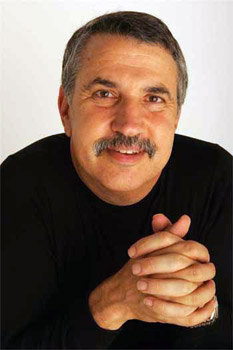
Thomas Friedman
Author and journalist Thomas Friedman

On May 25, 2016, Friedman wrote an article called “Netanyahu, the Prime Minister of Israel-Palestine.” The article denounced the addition of Yisrael Beytenu into the ruling coalition government headed by Likud’s Benjamin Netanyahu. Friedman wrote that Israel had become “controlled by Jewish extremists.”

Lie 1, “controlled by Jewish extremists. Israel is a thriving democracy with liberal values in the heart of the volatile, illiberal Middle East ruled by monarchs, military strongmen and dictators.  In the 2015 Israeli election, the Likud Party won the most seats in the Israeli parliament (30) and formed a coalition government. That coalition had a slim majority with only 61 of the 120 total seats, making it vulnerable to any single party’s whims to take down the government. To relieve such pressure and instability, Netanyahu sought to add to the coalition, first negotiating with the opposition party, Zionist Union (24 seats), before settling on the nationalist party, Yisrael Beytenu (6 seats).

Yisrael Beytenu, the most right-wing of the parties in the coalition, does not “control” the government. It was added to an existing ruling coalition to provide a broader base of stability.

Lie 2, “controlled by Jewish extremists. The term “Jewish extremists” is used often by Friedman (as it is at the United Nations). The latter uses the term freely, even as it denounces using the term “extremism” for any other religion.

As detailed in “Palestinian Authority Perfects Hypocrisy,” the political party Yisrael Beytenu, is indeed a nationalistic party, but it is a far cry from Hamas (which Friedman labeled as a group with “an apocalyptic jihadist agenda” in his August 6, 2014 op-ed). It is also much less radical that the Palestinian Authority which Freidman called “moderate” in the same piece. That “moderate” Palestinian Authority calls for all Jews to be banned from the West Bank. It prohibits Jews from stepping foot on college campuses. It calls for the death penalty for any Arab that sells land to Jews.

That’s moderate according to Friedman?

Maybe the PA is moderate relative to Hamas, but Yisrael Beytenu is certainly more moderate than the PA.

Lie 3, “Netanyahu’s steady elimination of any possibility that Israel will separate itself from the Palestinians in the West Bank.” Friedman never mentions that it was Netanyahu that pulled Israel out of half of the Holy Basin of Jerusalem-Bethlehem in 1996 during his first premiership. Friedman also never mentions the various peace talks Netanyahu has engaged in and his freeze on settlements.

Friedman prefers to state that Israel wants to forever “occupy” Palestinian Arabs, as he wrote in February 10, 2016 “Israel [is] determined to permanently occupy all of the territory between the Jordan River and the Mediterranean Sea, including where 2.5 million West Bank Palestinians live.” Why deliberately not mention Israel’s unilateral move out of Gaza in 2005? Because in exchange for that action, Israel was rewarded with over 10,000 rockets from Gaza in to Israel?

Why not mention the Separation Barrier, built by Israel during the Second “Intifada.” If Israel was intent on keeping all of Judea and Samaria, why did it build a separation wall?

Lie 4, Israel as a country is nationalistic and racist, while the Palestinians are moderate and seeking peace.  Friedman does not state this outright, but his various articles repeatedly describe a rightward shift in Israel and refers to any Palestinian Arab that is not Hamas, as a moderate.

At the end of Hamas’s 2014 War from Gaza, Friedman wroteEither Arab and Israeli moderates collaborate and fight together, or the zealots really are going to take over this neighborhood.”  Where are these moderates on each side?

Israelis voted in 2015, and gave its most right-wing party 5% of the seats in parliament.  It gave the extreme anti-nationalist Arab Joint List 13 seats, or over 11% of the parliament. That’s twice as many people that wanted to see the country lose its Jewish character, rather than strengthen it.  It also meant that 84% of the country did NOT vote on extreme nationalistic lines.  Compare that to the millions in the United States voting in 2016 for Donald Trump and Bernie Sanders. Americans have voted on the polar extremes much more than Israel, even while Israel faces existential threats from Iran, and has ISIS, Hezbollah and Hamas at its borders.

On the Palestinians side, the Arabs last voted in 2006, and gave the virulent anti-Semitic jihadist terrorist group Hamas 58% of the seats in parliament. The Palestinians have not been able to hold any elections since that time.

Yet Thomas Friedman continues to write that it is Israel that is controlled by extremists, while the Palestinians are governed by a moderate government.

The leader of that moderate government, acting-President Mahmoud Abbas of the Palestinian Authority, is simply inept, not extreme, as Friedman wrote The Palestinian president, Mahmoud Abbas, sacked the only effective Palestinian prime minister ever, Salam Fayyad, who was dedicated to fighting corruption and proving that Palestinians deserved a state by focusing on building institutions, not U.N. resolutions.”

For Friedman, Abbas doesn’t do anything extreme. He is a moderate, but simply a poor administrator.

As to the Palestinian people, a poll published by the Anti Defamation League in April 2014 found that almost every single Palestinian Arab- 93% – harbor anti-Semitic views.  Friedman never wrote about that poll’s findings.


When people are led to believe that the Palestinians are moderate and are led by a moderate leader, and the only Arab extremists are a few lunatics on the fringe (Hamas), it becomes easy to blame Israel for the stalemate in peace negotiations.

So Friedman leaves his readers with the following summations in his editorials:

“Israel is a really powerful country. It’s not a disarmed Costa Rica. No one expects it to give up everything. But fewer and fewer can understand why it puts so much energy into explaining why it can’t do anything, why the Palestinians are irredeemably awful and why nothing Israel could do would affect their behavior. I truly worry that Israel is slowly committing suicide, with all the best arguments.”

October 28, 2015

This is not your grandfather’s Israel anymore”

February 10, 2016

“For those of us who care about Israel’s future, this is a dark hour.”

May 25, 2016

The winner of the Pulitzer Prize continues to paint Israel as the extremists “slowly committing suicide.” Perhaps those that care about the country should react strongly and force it to take corrective actions (sound like a J Street call out to US President Obama to side against Israel at the United Nations Security Council?)  This is the clarion call for liberals: we condemn Israel because we care, not because we hate it.

There is certainly no call to moderate the “moderate” Palestinians, as pretending they are moderate is core to the belief system of pinning the responsibilities on Israel.  It also allows the progressives to align themselves with these moderate, peace-seeking people.

Such is the liberal war against Israel.


Related First.One.Through articles:

What do you Recognize in the Palestinians?

Palestinians are “Desperate” for…

Abbas Knows Racism

Extreme and Mainstream. Germany 1933; West Bank & Gaza Today

The Left-Wing’s Two State Solution: 1.5 States for Arabs, 0.5 for Jews

The Palestinians aren’t “Resorting to Violence”; They are Murdering and Waging War

Subscribe YouTube channel: FirstOneThrough

Join Facebook group: FirstOne Through  Israel Analysis

If Palestinians are Scared, it Must be Real

On May 21, 2016, the New York Times ran a front page story “New Tunnels Instill Fear on Gazan Side Too.”  The front page story continued onto page A6 with two black-and-white pictures of attack tunnels dug from Gaza into Israel.

20160522_12124720160522_121312
New York Times front page and page A6, May 21, 2016.
The pictures include a tunnel and a destroyed Gazan home. No photos of the kibbutz in Israel where Hamas gunmen appeared,
or of Gilad Shalit who was abducted via a tunnel.

The story spoke of the fear of Palestinian Arabs living in Gaza because Israel might seek to destroy the Hamas tunnels. The article described the “parallel anxiety” of Palestinian Arabs and Israelis stemming from the tunnels.

The Times article failed to mention that Hamas was democratically elected to a majority of parliament by these same Palestinian Arabs, based on a public platform that called for destroying Israel. For their part, the Israelis had no role in bringing Hamas to power.

The article correctly pointed out that “the tunnels were the prime rationale Israel gave for its ground invasion of Gaza during the 2014 battle with Hamas.”  However, back in 2014, the New York Times did not think much about those attack tunnels.

As detailed in “The New York Times’ Buried Pictures,” it took three weeks into the 2014 war for the Times to produce any pictures of the Hamas tunnels, even though multiple news sources had already been publishing pictures of them.  When the Times finally decided to write about it in an article called “Tunnels Lead Right to Heart of Israeli Fear,” it published the story underneath a picture of Palestinian Arabs mourning.

July 29 coverJuly 29. A6
July 29, 2014 New York Times cover with large color picture with caption:
“Overcome with Grief: At a morgue in Gaza City, Palestinians mourned the arrival of children killed in the Gaza conflict.”  The follow-up to the article contains a large black-and-white of Palestinians mourning, and only beneath that, was there a smaller black-and-white picture of a soldier in an attack tunnel.
(photos: First.One.Through)

The Times author, Jodi Roduren, made light of Israelis fear of the tunnels.  She repeatedly used language to make Israelis fear seem completely overblown.  Consider her remarks:

  • Tunnels have lurked in the dark places of Israeli imagination at least since 2006,”
  • In cafes and playgrounds, on social media sites and in the privacy of pillow talk, Israelis exchange nightmare scenarios that are the stuff of action movies.”
  • “As part of the propaganda push, the military has also invited a few journalists underground for a tour.”

One would think that the Israelis were completely paranoid for no reason and dreamed of scenarios that could not take place in the real world.  Roduren seemed to suggest that the Israelis then used the tunnels to advance a “propaganda push” to validate their invasion.


For the New York Times, the war is felt in Gaza and the Palestinian Arabs’ fears are real.  However, for Israelis, fears are overblown in imagined nightmarish scenarios, which the army then uses as a propaganda to conceal their over-reactions.

Even when the left-wing paper can admit that both sides have real fears, it cannot lay blame for the situation on the Palestinians that elected -and continue to support – this terrorist party.


Related First.One.Through articles:

The New York Times Wrote About Computer Hackers Charged by the US and Israel. Differently.

New York Times Lies about the Gentleness of Zionism

New York Times’ Tales of Israeli Messianic War-Mongering

The New York Times Refuses to Label Hamas a Terrorist Group

Educating the New York Times: Hamas is the Muslim Brotherhood 

Subscribe YouTube channel: FirstOneThrough

Join Facebook group: FirstOne Through  Israel Analysis

The New York Times Wrote About Computer Hackers Charged by the US and Israel. Differently.

On March 24, 2016 the New York Times wrote an article about Israel’s arrest of a computer hacker breaking into sensitive military computers. The next day, the paper wrote about the United States charging several Iranian computer hackers attacking the United States. Similar stories should get similar coverage, right?  Not when one party is Israel.

A comparison of the two stories can provide a primer for how the NY Times continues to portray Israel in a negative light:

  1. Use of Headlines.
  2. Using soft or harsh language.
  3. Quoting insiders and outsiders.
  4. Statement of fact versus charges.
  5. Providing background on fear of attacks.
  6. Pictures of targets (or none).
  7. Use of multiple reporters covering different sides of the story

Use of Headlines

The Times article on Iranian hackers attacking the US was titled U.S. Indicts 7 Iranians in Cyberattacks on Banks and a Dam.”  The article clearly laid out that Iranians committed cyberattacks. No question.

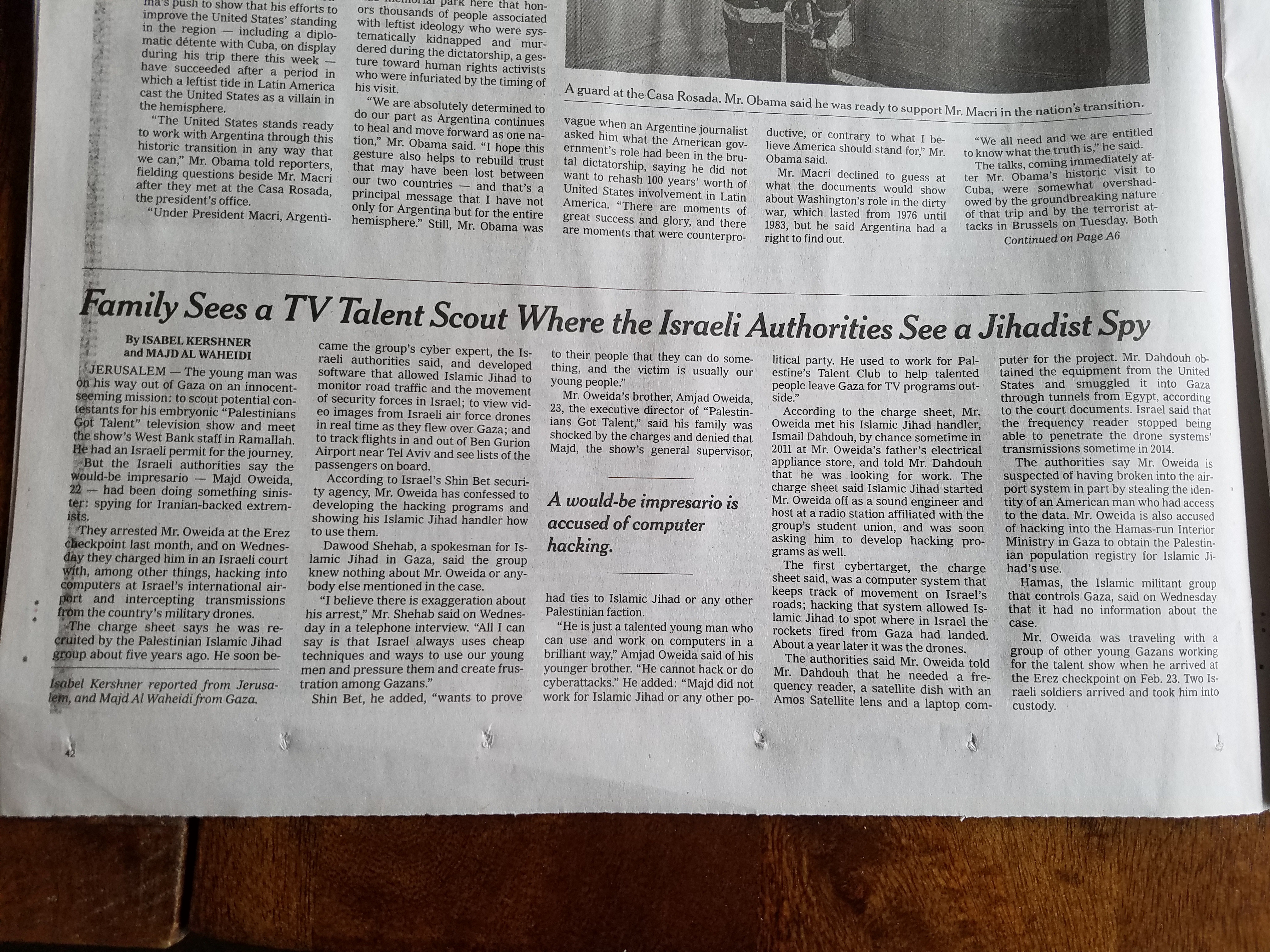
The article about the Israeli arrest had a different approach to the headline: “Family Sees TV Talent Scout Where Israeli Authorities See Jihadist Spy.” In this case, there is a difference of opinion about the facts. Israelis perceive evil, while others see a normal working person.

The Israeli situation is not cut-and-dry. The US is cracking down on attacks, while the Israelis are arresting people who may simply work for a fun media company.
20160325_140615
New York Times article with headline questioning Israeli arrest

Soft versus Harsh Language

The article about the hacker against Israel describe a “young man” on an “innocent” mission. The age and supposed profession of the hacker was given.

The US story mentioned only the attackers’ names with no ages. The only color given for the individuals were their “online handles” including “Nitr0jen26,” “PLuS,”and “Turk Server,” making them all appear guilty.

Selection of Quotes

An often used strategy of twisting the narrative of a story is carefully selecting the parties who provide personal color to the events.

For Israel, the only quotes about the arrest came from Palestinians: a spokesman for the terrorist group Islamic Jihad, and the accused’s brother (I’m not making it up- his brother). The quotes include many denials, and accusations against Israel.

In the article about the US arrest, no Iranians were interviewed (nor any of the accused family members- imagine that). Quotes came from the indictment itself, Senator Chuck Schumer, and the head of the national security department of the Justice Department.

Guess which way the quotes tilted in each case?

Statement of Facts versus Charges

This subtle and directed approach is often used by the New York Times.

The article’s description of the Israeli arrest is couched in cautionary, inconclusive language: “according to Israeli authorities” or “”according to the charge sheet” and “the Shin Bet says,” are followed by statements.  The NY Times aim is to clarify that the charges against the hackers are not necessarily true.  Maybe cyberattacks happened, maybe they didn’t.  Maybe this is the person responsible, maybe he isn’t.  The paper is just reporting what they culled from Israeli authorities.

Compare that use of cautionary language to the article about the attacks against US targets.  Those attacks were all described as factual; there is no language that suggests that hacking attacks did not happen, the question is why the attacks happened.

For example, in the attack on the dam the Times wrote “It appeared to be an effort to take over the dam itself,” meaning, the attack is a fact, but it is unclear if the attackers wanted to fully control the entirety of the dam.  There was no caveat of “according to US investigators.”

Background

The US story included information about the recent US-Iranian negotiations around the Iranian nuclear power program. It stated that “the indictment appeared to be part of an American effort to keep Iran from shifting activity from its nuclear program to its growing corps of cyberwarriors.”

However, the article on Israel mentioned nothing about the current attacks by Palestinian Arabs against Israelis, nor the missile attacks and wars launched from Gaza over the past eight years.

In other words, America was rational in trying to protect itself against Iran. Meanwhile, Israel’s arrest was seemingly made in a vacuum to “create frustration among Gazans,” as a quote said.

Use of Pictures

The story about Iranians attacking American targets included a picture of US Attorney General Loretta Lynch, and one of the targets of the cyberattacks- a dam in suburb of New York City. The picture added to the significance of the story and fear of the attack.

The Israeli story featured no pictures. Hacking into the country’s airports and drones was not prominently featured with accompanying photos. There were no captions that highlighted Israeli’s fears.

cyber-web-master
New York Times Photo accompanying article:
Caption: “Cyberattackers attempted to gain control of the Bowman Dam in Rye, a suburb of New York, in 2013. The effort failed, but worried American investigators because it was aimed at seizing a piece of infrastructure.
Credit Christopher Capozziello for The New York Times”

Use of Reporters

The long article by David Sanger about the US arrests did not rely on any other reporters. However, the Israeli article which was half the length of the US story, used two reporters: “Isabel Kershner reported from Jerusalem, and Majd Al Waheidi from Gaza.

Such wonderful balance!


Newspapers can write up a story in any manner they see fit. It is not surprising that an American paper would side strongly in its reporting with the United States and against its foes. One would imagine that papers treat American allies in much the same manner.

Not the New York Times for Israel.

As seen above and analyzed often in FirstOneThrough, the New York Times skews its reporting against Israel and in favor of Palestinians.

20160325_140548
New York Times on US indictment of Iranian hackers


The articles from the New York Times:

Article on Israeli arrest of cyberhackers:

“JERUSALEM — The young man was on his way out of Gaza on an innocent-seeming mission: to scout potential contestants for his embryonicPalestinians Got Talent” television show and meet the show’s West Bank staff in Ramallah. He had an Israeli permit for the journey.

But the Israeli authorities say the would-be impresario — Majd Oweida, 22 — had been doing something sinister: spying for Iranian-backed extremists.

They arrested Mr. Oweida at the Erez checkpoint last month, and on Wednesday they charged him in an Israeli court with, among other things, hacking into computers at Israel’s international airport and intercepting transmissions from the country’s military drones.

The charge sheet says he was recruited by the Palestinian Islamic Jihad group about five years ago. He soon became the group’s cyber expert, the Israeli authorities said, and developed software that allowed Islamic Jihad to monitor road traffic and the movement of security forces in Israel; to view video images from Israeli air force drones in real time as they flew over Gaza; and to track flights in and out of Ben Gurion Airport near Tel Aviv and see lists of the passengers on board.

According to Israel’s Shin Bet security agency, Mr. Oweida has confessed to developing the hacking programs and showing his Islamic Jihad handler how to use them.

Dawood Shehab, a spokesman for Islamic Jihad in Gaza, said the group knew nothing about Mr. Oweida or anybody else mentioned in the case.

“I believe there is exaggeration about his arrest,” Mr. Shehab said on Wednesday in a telephone interview. “All I can say is that Israel always uses cheap techniques and ways to use our young men and pressure them and create frustration among Gazans.”

Shin Bet, he added, “wants to prove to their people that they can do something, and the victim is usually our young people.”

Mr. Oweida’s brother, Amjad Oweida, 23, the executive director of “Palestinians Got Talent,” said his family was shocked by the charges and denied that Majd, the show’s general supervisor, had ties to Islamic Jihad or any other Palestinian faction.

“He is just a talented young man who can use and work on computers in a brilliant way,” Amjad Oweida said of his younger brother. “He cannot hack or do cyberattacks.” He added: “Majd did not work for Islamic Jihad or any other political party. He used to work for Palestine’s Talent Club to help talented people leave Gaza for TV programs outside.”

According to the charge sheet, Mr. Oweida met his Islamic Jihad handler, Ismail Dahdouh, by chance sometime in 2011 at Mr. Oweida’s father’s electrical appliance store, and told Mr. Dahdouh that he was looking for work. The charge sheet said Islamic Jihad started Mr. Oweida off as a sound engineer and host at a radio station affiliated with the group’s student union, and was soon asking him to develop hacking programs as well.

The first cybertarget, the charge sheet said, was a computer system that keeps track of movement on Israel’s roads; hacking that system allowed Islamic Jihad to spot where in Israel the rockets fired from Gaza had landed. About a year later it was the drones.

The authorities said Mr. Oweida told Mr. Dahdouh that he needed a frequency reader, a satellite dish with an Amos Satellite lens and a laptop computer for the project. Mr. Dahdouh obtained the equipment from the United States and smuggled it into Gaza through tunnels from Egypt, according to the court documents. Israel said that the frequency reader stopped being able to penetrate the drone systems’ transmissions sometime in 2014.

The authorities say Mr. Oweida is suspected of having broken into the airport system in part by stealing the identity of an American man who had access to the data. Mr. Oweida is also accused of hacking into the Hamas-run Interior Ministry in Gaza to obtain the Palestinian population registry for Islamic Jihad’s use.

Hamas, the Islamic militant group that controls Gaza, said on Wednesday that it had no information about the case.

Mr. Oweida was traveling with a group of other young Gazans working for the talent show when he arrived at the Erez checkpoint on Feb. 23. Two Israeli soldiers arrived and took him into custody.”


Article on US arrest of cyberhackers:

WASHINGTON — The Justice Department on Thursday unsealed an indictment against seven computer specialists who regularly worked for Iran’s Islamic Revolutionary Guards Corps, charging that they carried out cyberattacks on dozens of American banks and tried to take over the controls of a small dam in a suburb of New York.

The indictment, while long expected, represents the first time the Obama administration had sought action against Iranians for a wave of computer attacks on the United States that began in 2011 and proceeded for more than a year, paralyzing some banks and freezing customers out of online banking.

The indictment stops short of charging that the attacks were directed by the Revolutionary Guards, a branch of the Iranian military. But it referred to the seven Iranians as “experienced computer hackers” who “performed work on behalf of the Iranian government, including the Islamic Revolutionary Guards Corps.”

Nothing in the indictment addresses the motives for the attacks. But intelligence experts have long speculated that the cyberactions directed at roughly four dozen financial institutions — including JPMorgan Chase, Bank of America, Capital One and PNC Bank — were intended to be retaliation for an American-led cyberattack on Iran’s main nuclear enrichment plant. That attack, which employed the so-called Stuxnet virus, was revealed in 2010.

All of the Iranian attacks — which, the indictment said, included actions against the New York Stock Exchange and AT&T — were “distributed denial of service” attacks, often called DDoS attacks. In those assaults, the target’s computers are overwhelmed by coordinated computer requests from thousands of machines around the world. The targeted networks often crash, putting them out of service for some period.


Attorney General Loretta E. Lynch announced an indictment against seven Iranians who are believed to have attempted to hack into several American banks and a dam in New York.

But the case of the Bowman Dam in Rye, N.Y., was entirely different: It appeared to be an effort to take over the dam itself. The attempt failed because the dam was under repair and offline, but in some ways it worried American investigators more because it was aimed at seizing control of a piece of infrastructure.

“The most likely conclusion is that it was a warning shot” from the Iranians, who were saying, “‘Don’t pick on us, because we can pick on you,’” said Senator Chuck Schumer, Democrat of New York.

But Mr. Schumer said that the lesson from this case was “not that we should not employ cyberweapons, but that we should be able to protect ourselves.”

It is doubtful that any of the named Iranians will ever appear in an American courtroom. In that respect, the indictment is similar to one the Justice Department issued two years ago against members of Unit 61398 of the People’s Liberation Army of China, which it accused of stealing data from American corporations. The Chinese have never been arrested.

But the administration argues that such indictments send a strong signal and make it difficult for those who are indicted to travel, for fear of extradition.

On Tuesday, the Justice Department indicted two other hackers who it said were members of the Syrian Electronic Army, which has supported the government of Bashar al-Assad, and it believes that it has a chance to gain custody of one of them. On Wednesday, the department obtained a guilty plea from a Chinese national living in Canada, Su Bin, whom it accused of mounting a cybercampaign to steal the designs of military aircraft from Boeing, on behalf of Chinese intelligence agents.

The Iran indictment comes eight months after the nuclear deal reached between Tehran and six other nations, including the United States, which appeared to be putting Tehran and Washington on a track toward a more productive relationship after 35 years of enmity. But Iranian missile launches in recent months — also organized by the Guards — have led to calls in Congress for new sanctions.

The indictment appeared to be part of an American effort to keep Iran from shifting activity from its nuclear program to its growing corps of cyberwarriors, some of whom work directly for the government, while others, like those named in the indictment, seem to be contractors.

As a measure of the importance the administration placed on the indictment, it was announced by Attorney General Loretta E. Lynch, in a news conference in Washington with Preet Bharara, the United States attorney for the Southern District of New York, where the indictment was handed up. It was unclear how long it had been under seal.

The Iranians named in the indictment included Ahmad Fathi, Hamid Firoozi, Amin Shokohi and Sadegh Ahmadzadegan, who went by the online handle of “Nitr0jen26.” Also named were Omid Ghaffarinia, known as “PLuS,” Sina Keissar and Nader Saedi, also known as “Turk Server.” Their whereabouts was not described, but some worked for a firm the indictment called the ITSec Team, and some for the Mersad Company, both described as security companies in Iran.

John P. Carlin, who heads the national security division of the Justice Department, said in an interview that the indictments arose from a new approach within the Obama administration. “Prior to 2012, we dealt with these cases as intelligence matters,” which were hard to bring to court, Mr. Carlin said, because the evidence was classified. “Now we are following traditional investigative rules,” he said, assembling data that can be entered into court records.

Iran’s computer networks have been a primary target of the National Security Agency for years, and it is likely that in penetrating those networks — for intelligence purposes or potential sabotage — the N.S.A. could have traced the attacks to specific computers, IP addresses or individuals.

But naming individuals, some experts suggested, could lead to retaliation. Jason Healey, a cyberconflict expert at Columbia University and the Atlantic Council, asked in a Twitter post on Thursday whether naming individuals, rather than governments, put cyberoperators for the National Security Agency and the Central Intelligence Agency “at risk for similar indictments.”


Related First.One.Through articles:

New York Times Lies about the Gentleness of Zionism

Every Picture Tells a Story: Arab Injuries over Jewish Deaths

The New York Times Refuses to Label Hamas a Terrorist Group

Framing the Israeli-Palestinian Arab Conflict: WSJ and NY Times

Every Picture Tells a Story: Versions of Reality

Subscribe YouTube channel: FirstOneThrough

Join Facebook group: FirstOne Through  Israel Analysis